EN EN
international
qualifications
An increasing number of qualifications – certificates and diplomas – are awarded at international level, outside the jurisdiction of national authorities. These ‘non-State’ qualifications have been developed and are awarded by a wide range of bodies, organisations and companies addressing various purposes. What unites this extreme variety of qualifications is that they are not restricted to a particular national system or territory. They are all qualifications whose exchange value is defined outside traditional national qualifications systems. This raises some key questions and challenges for policy-makers as well as users – be they individual citizens or employers. This report is a first effort to increase transparency in this field, notably by pointing to existing sources and clarifying the concepts to be used for mapping and analysis.
4116 EN
–
TI-31-12-754-EN-C
Europe 123, 570 01 Thessaloniki (Pylea), GREECE PO Box 22427, 551 02 Thessaloniki, GREECE
Tel. +30 2310490111, Fax +30 2310490020, E-mail: [email protected] European Centre for the Development of Vocational Training
ISBN 978-92-896-1117-6
international
Luxembourg:
Publications Office of the European Union, 2012
A great deal of additional information on the European Union is available on the Internet.
It can be accessed through the Europa server (http://europa.eu). Cataloguing data can be found at the end of this publication. Luxembourg:
Publications Office of the European Union, 2012 ISBN 978-92-896-1117-6
doi:10.2801/8721
Copyright @ European Centre for the Development of Vocational Training (Cedefop), 2012. All rights reserved.
Designed by [email protected] Printed in the European Union
The European Centre for the Development of Vocational Training(Cedefop) is the European Union's reference centre for vocational education and training. We provide information on and analyses of vocational education and training systems, policies, research and practice.
Cedefop was established in 1975 by Council Regulation (EEC) No 337/75. Europe 123, 570 01 Thessaloniki (Pylea), GREECE
PO Box 22427, 551 02 Thessaloniki, GREECE
Tel. +30 2310490111, Fax +30 2310490020 E-mail: [email protected]
www.cedefop.europa.eu
Christian F. Lettmayr, Acting Director
Foreword
Many and very diverse qualifications, diplomas, certificates and licences are awarded outside the jurisdiction of public authorities, including by multinational companies, so there is a need to analyse further the character and typology of these qualifications, their credibility and value on the labour market, both for individuals and employers.
While international qualifications can be of relevance for the labour market they are also important in national and European perspectives as they promote common trust and cooperation at operational level. International qualifications feed in the context of the development and implementation of two European initiatives; the European qualifications framework (EQF) and the European classification of skills/competences, qualifications and occupations (ESCO). The EQF 2008 recommendation also specifies the need to increase transparency of qualifications awarded at international level, a challenge still not addressed systematically by the EQF. On the other hand, international qualifications are part of ESCO work in the qualifications pillar illustrating how awards influence the right to access and practise an occupation or task.
From experience gained from EQF/NQF (national qualifications framework) developments and ESCO work we observe there is high complexity in purpose, type, coverage, currency and competent bodies involved. This booklet is a first attempt to work on a typology of international qualifications, to present examples from various sectors and occupations, and finally to contribute to their better understanding to provide a basis for future EQF and ESCO developments.
Christian F. Lettmayr
Acknowledgements
This paper presents results of research carried out by Cedefop on qualifications and learning out comes. It reflects the work of Loukas Zahilas who wrote the report with the valuable support and contribution of Jens Bjornavold, both senior experts at Cedefop. Thanks are due to Philippe Tissot, senior expert, Cedefop who provided help on terminological issues and Marco Serafini, expert, Cedefop who provided statistical data. Special thanks go to Luisa Coutinho, chief executive EWF and Tim Jessop, Associate Director, TWI who reviewed and commented on the welding sector case study. Finally, thanks to Cedefop colleague Yvonne Noutsia for her technical support.
Table of contents
Foreword 1
Acknowledgements 2
Executive summary 6
1. Setting the scene 8
1.1. What we mean by qualification 8
1.2. International qualifications 9
1.3. International qualifications and quality 10
1.4. Qualifications and licences 11
1.5. Context 13
2. Capturing international qualifications – Elements of a typology 14
2.1. Purpose – What the qualification is for 14
2.2. Type – How complete and how durable the qualification is 16
2.3. Coverage – Where the qualification can be used 17
2.4. Competent body – Who awards the qualification 18
2.5. Currency value – What the qualification can be exchanged into 19
3. International qualifications in practice 20
3.1. Administration and management 20
3.1.1. Project Management Institute (PMI) certifications 20
3.2. Education and training sector 22
3.2.1. Common European framework of reference for
languages: learning, teaching, assessment 22
3.2.1.1. University of Cambridge ESOL 23
3.2.2. Association Montessori International 24
3.3. Financial services 25
3.3.1. European foundation certificate in banking (EFCB) 26
3.3.2. Accountant 27
3.4. ICT sector 28
3.4.1. European computer driving licence 29
3.4.2. Microsoft certifications 30
3.4.3. Cisco certifications 31
3.5. Personal services 33
3.5.1. Hairdressing 34
3.6. Sports sector 35
3.6.1. Volleyball international referee 37
3.7. Transport sector 39
3.7.1. Sea transport 40
3.7.2. Maritime training 40
3.7.3. Certificates for seafarers – IMO (STCW) 42
3.7.4. Master and chief mate on ships of
3 000 gross tonnes or more 42
3.8. Air transport 44
3.8.1. International Civil Aviation Organisation 45
3.8.2. European Aviation Safety Agency 45
3.8.3. Pilot licences 46
3.8.4. Air traffic controllers 48
3.8.5. Airbus training 51
3.8.6. Airbus Catia V5 composites 51
3.9. Road transport 52
3.9.1. International driving licence 54
4. The welding case 56
4.1. Welding 56
4.2. The EWF/IIW system 58
4.3. European Welding Federation 58
4.3.1. Guidelines and standards 59
4.4. International Institute of Welding 60
4.4.1. IIW manufacturer certification system 60
4.4.2. Certification to EN ISO 3834 60
4.5. Qualification 61
4.5.1. Training and qualifications for welding personnel 62
4.6. Certification 64
4.6.1. Relation between the welding qualification
and certification titles 65
5. The way ahead 68
Bibliography 70
International qualifications
Annexes
I. List of abbreviations 73
II. Observing another world: the US Department of Labor –
Career one-stop 77
III. International qualifications, certifications and licences 81
IV. Welding guidelines 86
List of tables
1. Project management professional 21
2. Cambridge English proficiency (CPE) 24
3. Montessori assistant to infancy training 25
4. European foundation certificate in banking (EFCB) 27
5. Chartered certified accountant 28
6. European computer driving licence (ECDL) 30
7. Microsoft certified technology specialist 31
8. Cisco certified architect 32
9. Hairdressing 35
10. Volleyball international referee 38
11. Master and chief mate on ships of 3 000 gross tonnes
or more 44
12. ATPL – Airline transport pilot licence 48
13. Air traffic controllers 51
14. Airbus Catia V5 composites 52
15. International driving licence 55
16. European/international welding engineer (qualification) 65
17. Certified European/international welding
engineer (certification) 67
Executive summary
An increasing number of widely recognised certificates and diplomas of high quality are being awarded at international level, outside public authorities’ jurisdiction. These non-State qualifications are awarded by a range of bodies, organisations and companies representing a wide variety of stakeholders and interests. This trend goes against the ‘traditional’ concept of qualifications, as something awarded and guaranteed by national authorities, most frequently in the education and training sector. The international dimension of sectors like transport, ICT, construction, marketing and welding has raised issues on transparency, quality assurance and trust needed for the qualifications offered.
This booklet aims to:
• develop a conceptual framework to help identify and classify non-State and international qualifications;
• establish a basis for better understanding the function and value of these qualifications;
• provide concrete examples (cases) of international and non-State qualifications.
It has been written to support two European initiatives: European qualifications framework (EQF) and European classification of skills/competences, qualifications and occupations (ESCO).
We can distinguish five broad differentiating elements according to: (a) purpose – what is the qualification for;
(b) type – how complete and which is the duration of the qualification; (c) coverage – where is the qualification used (geographical dimension); (d) competent body – which body awards the qualification;
(e) currency – what can the qualification be exchanged into.
Qualifications play different roles in fulfilling public interest, such as health and safety and quality assurance requirements, meeting the needs and controlling access to practising tasks, technologies, professions and occupations, and in some cases, in defending interests of professional groups and bodies.
We can distinguish international qualifications in all types of formally-recognised modules and certificates. Duration of qualifications is a crucial dimension.
Geographical coverage and institutional validity is an interesting aspect defining where international qualifications are recognised and are valid.
There is big diversity in companies, organisations and other bodies developing, providing and awarding international qualifications including international organisations, international sector and branch bodies, multinational enterprises and EU bodies.
Finally, the value of international qualifications depends on several factors, like what kind of information is provided by the qualification in question, what we know about the learning process, what we know about use of learning outcomes, what kind of quality assurance is carried out, what we know about assessment and standards, and if they are updated.
From the examples presented it is evident there is a strong relation between type of international qualification and the sector, occupation or profession it relates to.
Qualifications in the transport sector gives an example of the international dimension as the sector represents a ‘globalised’ case that has led to marked uniformity in standards related to safety. It also had an impact on traditional qualifications as new professional profiles had to be developed for transparency of certification procedures.
In welding qualifications we analyse a sector with a high degree of international organisation and in which sectoral organisations play a larger and more autonomous role than organisations in other sectors. Although welding qualifications exist in national qualification structures, the international welding sector has for decades created harmonised standards and different types of qualifications.
1.
Setting the scene
More and more qualifications – certificates and diplomas - are awarded at international level, outside national authorities’ jurisdiction. These ‘non-State’ qualifications have been developed and awarded by a wide range of bodies, organisations and companies addressing various purposes. This trend goes against our traditional understanding of qualifications, as ‘papers of value’ guaranteed by national authorities and can be seen as a direct reflection of globalisation of economies and labour markets.
Individuals need to be able to use their qualifications in more than one country and employers need to be able to judge the level of skills and competences held by potential employees. This trend is particularly visible in sectors like ICT and transport where international organisations, sectoral bodies as well as multinational companies already play a key role in defining and awarding qualifications and thus, in setting the requirements for skills and competences.
1.1.
What we mean by qualification
To understand increasing importance of international qualifications, it is necessary to start with the basic term qualification and how this is understood and described. According to the EQF recommendation (European Parliament; Council of the European Union, 2008), a qualification is ‘a formal outcome of an assessment and validation process which is obtained when a competent body determines that an individual has achieved learning outcomes to a given standard’. Defined in this broad way, the term qualification helps to clarify what can be considered as the separate building blocks of a qualification:
• learning outcomes; a qualification must clarify what the holder is expected to know, be able to do and understand. A qualification’s relevance to future recipients depends on its ability to signal learning outcomes clearly; • assessment and validation process; a qualification must be based on reliable
and valid assessment procedures able to capture the essence of the knowledge, skills and competences held by an individual learner;
• need for standards; standards are critical to qualifications as they define what a learner is expected to know, be able to do or understand. Standards
can be seen as the reference point around which the entire qualification process turns. Standards are also critical for relevance of the qualification to future users (for example, in the labour market) as they define the level and profile to be achieved;
• recognition process; a qualification is a ‘paper of value’ and its currency depends on a formal stamp of approval or recognition. Recognition can be seen as the final step in the qualification process, confirming that the process has been appropriately carried out and that the qualification can be trusted; • role of competent bodies.
1.2.
International qualifications
A qualification’s value and relevance is largely defined through combination of these elements. For international qualifications operating outside national borders and awarded outside the remit of national authorities, particular challenges exist:
• they must be able to signal their profile and level precisely to be understood across national and sectoral borders;
• they must be able to demonstrate that assessment procedures applied are reliable and valid. Quality standards in this area (see ISO 17024) reflect this need for transparent and trustworthy procedures and processes:
• they must be based on standards reflecting relevant stakeholders’ needs, in effect requiring initial development and continuous review based on active contributions of these stakeholders;
• their formal recognition will potentially draw various sources of legitimacy. In some cases international law is applied, as for automatic recognition in the EU internal market. In other cases, legitimacy of a qualification will reflect market position and power (such as in the ICT sector);
• even at national level a wide variety of bodies may award a qualification on behalf of State authorities. This variety increases further for international qualifications, including a wide range of public and private bodies, international organisations, sectoral bodies and associations as well as private companies.
While definition of qualification helps us to understand some of the similarities and differences between national and international qualifications, a systematic review of qualifications developing outside national bodies’ control is currently lacking. While this partly reflects the recent character of these developments, it even more reflects the big variety of stakeholders
involved. As no single source exists, various sources must be systematically exploited and used as a basis for further analysis. The purpose of this booklet is therefore to:
• develop a conceptual framework which can help identify and classify international qualifications;
• establish a basis for better understanding the function and value of these qualifications;
• provide concrete examples (cases) of international and non-State qualifications.
1.3.
International qualifications and quality
As mentioned in Section 1.2 the extent to which an international qualification is considered to be credible, depends partly on whether transparent quality assurance arrangements are in place. While this is a problem encountered also by national qualifications, the extreme diversity of international qualifications makes them even more dependent on visible and trusted mechanisms of quality assurance. The standard ISO/IEC 17024 Conformity assessment – General requirements for bodies operating certification of persons introduces clear quality criteria to underpin award of certificates. Released in 2003, it is designed to harmonise the personnel certification process worldwide and in the European Union ISO/IEC 17024 replaced EN 45013 (1989). The standard provides a uniform set of guidelines for organisations managing qualifications and certification of persons, including procedures for development and maintenance of a certification scheme. It is designed to help bodies certifying persons to conduct well-planned and structured evaluations using criteria for competence and grading to ensure impartiality and reduce any conflict of interest.
These standards focus on division of roles making sure that training providers and learning assessors are not identical. The purpose is to ensure that assessment of learning outcomes according to a relevant standard is carried out transparently and reliably and can be fully trusted by the receiver – be that an individual or employer.
In Europe, the European Committee for Standardisation (CEN) (1) is a major
provider of European standards and technical specifications. It is the only
International qualifications
10
recognised European organisation according to Directive 98/34/EC for planning, drafting and adopting European standards in all areas of economic activity except for electrotechnology (Cenelec – European Committee for Electrotechnical Standardization) and telecommunication (ETSI – European Telecommunications Standards Institute).
Outside Europe, the two most important organisations are the International Organisation for Standardisation (ISO) (2) which deals with standards
worldwide, and the American Society for Testing and Materials (ASTM) (3) that
publishes standards that have wide global recognition.
There is a close working relationship between CEN and ISO and, in many areas, standards are developed jointly under what is known as the Vienna agreement (4) which was signed in 1991 ensuring technical cooperation and
coordination.
1.4.
Qualifications and licences
The term ‘licence’ is frequently used as a synonym for ‘qualification’ and ‘certificate’. This may in some cases cause confusion and it is therefore important to clarify how a licence (to practise) relates to and differs from a qualification and certificate.
In general the term to license (or to grant license) means to give permission. A licence may be granted by a party (‘licensor’) to another party (‘licencee’) as an element of an agreement. In particular a licence may be issued by public authorities to allow an activity that would otherwise be forbidden. It may require paying a fee, meeting certain technical, financial or institutional requirements and/or proving a capability. The requirement may also serve to keep the authorities informed about a type of activity, and give them an opportunity to set conditions and limitations, for example for health and safety and environmental reasons. Historically, universities have also used the term licence to indicate that somebody is allowed to teach at this level (the Finnish and Swedish ‘licentiate’ grades reflect this tradition).
For the purpose of this booklet it is important to note that licence is used in a broader sense than certificate. Including in this analysis all internationally-based ‘licences’ to practise occupations and tasks would be misleading as it
Setting the scene 11
(2) http://www.iso.org/iso/home.htm[accessed 3.4.2012].
(3) http://www2.astm.org/index.shtml [accessed 3.4.2012].
would go far beyond qualifications. While a certificate or qualification formally acknowledges that learning outcomes have been assessed in accordance to a standard, granting a licence may rest on criteria having little to do with knowledge, skills and competences. To some extent we can say that licensing has a more explicit regulatory role and intervenes further in market processes than qualifications and certificates.
A challenge for this analysis is therefore to decide when the terms certificate and licence de facto overlap and are used as synonyms. For welding the ‘personnel certification scheme’ provides a simple means by which job capability can be assessed and recognised. It defines the education, knowledge, experience and responsibility profile required for a range of conventional welding tasks, and provides a professional assessment procedure. A person having acquired a certificate in this scheme is automatically licensed to perform specific tasks or jobs.
International qualifications
1.5.
Context
This booklet is written for development and implementation of two European initiatives: the European qualifications framework and the European classification of skills/competences, qualifications and occupations.
EQF establishes a European, learning outcomes-based reference framework for qualifications aiming at improving transparency and comparability of qualifications. While the EQF mainly is about comparing national qualifications, the 2008 recommendation also points to a need to increase transparency of qualifications awarded at international level. This challenge has still to be addressed systematically by the EQF.
ESCO intends to develop multilingual terminology on occupations, skills, competences and qualifications. The qualifications part of this work will have to include qualifications awarded at European and international levels. An important objective of ESCO is to indicate the relationship between occupations, skills and competences and qualifications; exemplified by the fact that qualifications and certificates in many cases directly influence the right to access and practise an occupation or task.
Cedefop’s work in this area may support both initiatives mentioned above. Lack of an overview of international qualifications makes it difficult for both the EQF and ESCO to achieve their objectives. This report is a first effort to increase transparency, notably by pointing to existing sources and clarifying the concepts to be used for mapping and analysis. Increased transparency is important as international qualifications do not respond to a single set of standards and quality assurance mechanisms; their quality and relevance can therefore be difficult to judge for individuals and employers.
2.
Capturing international
qualifications – Elements
of a typology
International qualifications are awarded by a wide range of stakeholders for many different purposes and functions. To understand this diversity we suggest looking at the following five aspects:
(a) purpose – what is the qualification for;
(b) type – how complete and how durable is the qualification;
(c) coverage – where is the qualification used (geographical and institutional coverage);
(d) competent body – which body awards the qualification; (e) currency – what can the qualification be exchanged into.
While such a typology must be broad enough to cover extreme variation, it must also be precise enough to capture specificity of qualification developments in different sectors, occupations and professions. It can be seen as a first step in a long-term process where questions related to quality assurance and trust must play a key role. While the origin and basis of national qualifications is in most cases transparent, diversity of international qualifications makes it difficult for potential users to decide whether they are faced with a ‘low quality’ qualification or not. Qualifications are increasingly offered for sale on the Internet and through commercial channels, which raises a serious question on our ability to sort good from bad.
2.1.
Purpose – What the qualification is for
In preparing for the ESCO qualifications pillar (5), an analysis of close to 500
qualifications listed by the Swedish employment services was carried out. This analysis showed that apart from traditional national qualifications, a high number of other qualifications existed with the following main purposes:
(5) ESCO (2012). Developing the qualifications pillar: sources, principles and examples.
• qualifications awarded at national level but regulated at European and international levels, for example medical doctors and ship’s navigators; • qualifications linked to specific tasks and technologies, for example
specifying expected learning outcomes for welders and users of ICT software;
• qualifications linked to occupations and professions, for example specifying required levels of knowledge, skills and competence for pilots and truck drivers.
In some cases these three categories overlap. As demonstrated by the sample analysed for ESCO, however, the three categories point to important common purposes. Qualifications play an important role in controlling access to and practise of tasks, technologies, professions and occupations. This control function is frequently motivated by health and safety and quality assurance requirements. It is, for example, widely accepted that welding of bridges and treatment of patients both involve risks and require clear and high quality standards. In other cases use of qualifications to control access and practise may be linked to particular interests of professional groups and bodies. Controlling numbers of practitioners in a profession can be important to safeguard salaries and working conditions.
The ICT sector provides a particular example of task and technology-related certificates and licences. They are in most cases awarded by multinational companies (Apple, Cisco, Microsoft, Oracle, Sun) and exemplify the role of private companies in certifying skills and competences. We also find ICT certification developed outside multinational companies. The European computer driving licence (ECDL) is currently the best known and widely used of these (6).
In several industry and service sectors we find elaborate systems of certification based on European or international agreements and recognised across borders. Examples include aviation, railroad transport, merchant shipping, financing and banking and logistics. The qualifications required for aviation and merchant shipping refer to particularly rigid international standards and requirements strictly supervised by respective international
Capturing international qualifications – Elements of a typology 15
(6) The particular situation in the ICT sector, and the challenges involved in reviewing diverse
qualifications awarded by different stakeholders in different settings, explains why major players have initiated development of the ICT competence framework. This framework, taken forward by the European Standardisation Organisation (CEN), is intended to provide a cross-border reference point for public institutions, enterprises, educational institutions and others.
organisations such as the International Maritime Organisation (IMO) and International Air Traffic Association (IATA). While aviation and merchant shipping provide the strongest examples of this kind of internationally-based qualification, some other sectors are joining this trend, such as banking and financial services. It should be noted that use of qualifications to regulate access to and practise of occupations and tasks can take many forms. While some sectors, like transport, may operate based on formal agreements between national authorities, other and less formal arrangements may be used, for example linking certificates to membership of professional associations.
2.2.
Type – How complete and how durable
the qualification is
At national level, qualifications are frequently distinguished as full or partial. Full qualifications – for example a master degree or a vocational qualification – signal successful completion of an initial education and training sequence, giving access to a particular occupation or providing a general basis for entrance to the labour market. Partial or component qualifications can either be seen as building blocks (modules or units) to be combined into a full qualification or can be used for renewal or specialisation purposes. The distinction between initial and continuing education and training complements the above distinction between full and partial qualifications and indicates the location of a particular qualification in relation to an education, training and learning career.
International qualifications can to some extent be distinguished according to these categories. While full international qualifications reflecting initial education and training are typically encountered in the transport sector (pilots, seafarers), partial or component international qualifications linked to continuing education and training seem to be more common. The following main distinctions can be made:
• partial qualifications which can be combined as building blocks towards a full, initial qualification;
• partial qualifications building on a full, initial qualification and signalling that successful specialisation and/or renewal has taken place;
• stand-alone qualifications linked to a particular task, technology or occupation with no particular relation to any initial education or training sequence or full qualification.
International qualifications
Generally, partial international qualifications seem to be closely oriented towards needs of the labour market. The need for rapid and targeted updating of knowledge, skills and competences – reflecting the global character of technologies and markets – largely explains why international qualifications flourish.
We can also distinguish types of qualifications according to duration and lifespan. In the case of Microsoft, for example, lifespan of a certification varies. Some certificates provide recertification paths to allow regular updating of the latest technological developments. In this way many certificates lose their value when Microsoft discontinues mainstream support for a related technology. These ‘outdated’ certificates still appear on individual transcripts but in most cases, upgrade paths, which allow candidates to earn certification with fewer exams, are offered to holders of previous version certificates. 2.3.
Coverage – Where the qualification can
be used
For traditional qualifications awarded by national authorised bodies, geographical and institutional coverage can largely be taken for granted. The situation is very different for qualifications awarded outside national jurisdiction and control. In such cases qualifications must explicitly communicate where they can be used – geographically and institutionally. As shown in Chapters 3 to 5, this is not straightforward. While all qualifications have been awarded at international level, their actual coverage and validity differs substantially. While qualifications awarded by the IMO have global coverage, supported by the UN, coverage of welding certificates is limited to member countries of the International Welding Organisation. These limitations are even more important in the sports sector where international cooperation is limited and validity of particular certificates is thus reduced.
Coverage of qualifications linked to specific tasks and technologies is frequently not a result of formal agreements and decisions, but reflects their size, status and position within the economy and labour market. In some cases, such as Microsoft and Cisco certifications, their coverage can be – de facto – global. Mapping international qualifications needs to specify where a qualification can be used, geographically and institutionally.
2.4.
Competent body – Who awards the
qualification
There is big diversity in the companies, organisations and other bodies involved in developing, providing and awarding international qualifications. We can distinguish the following main categories of awarding bodies: • international level, such as international transport organisations or
authorities;
• EU bodies, agencies and foundations promoting mainly common European standards of safety and environmental protection such as the European Aviation Safety Agency (EASA);
• European and international sectoral organisations, associations, social partners organisations, federations and institutes promoting common sectoral reference standards at European level;
• multinational companies, networks and associations focusing mainly on particular professional needs linked to international technologies and specialised markets.
Chapters 3 to 5 illustrate that new actors are getting involved in awarding qualifications. Corporate universities, for example, have developed rapidly in the USA over the past 20 years, with some, like McDonald’s Hamburger University established in 1962, having a longer history. Many such initiatives exist in large companies (such as Ernst and Young or Lufthansa) and large organisations.
International qualifications
2.5.
Currency value – What the qualification
can be exchanged into
Qualifications are carriers of information and value (‘currencies’) extensively influencing the way individuals and education/training as well as labour market institutions interact with one another.
An international qualification’s value depends on two factors, the learning outcomes themselves and market position of the awarding institution. It is important for a proposal of a typology for qualifications to consider how this ‘relative’ value can be transmitted. The trust required for a strong currency depends on the factors introduced in Chapter 1, notably:
• what kind of information is provided by the qualification in question; what we know about the learning process; what we know about use of learning outcomes, etc.;
• what kind of quality assurance is carried out; how explicit and transparent the processes are; whether international norms are involved (for example ISO 17024 or similar);
• what we know about the assessment process; who assesses and how transparent this process is;
• what we know of use of standards; whether these standards are explicit and visible and correspond to real needs;
• whether qualifications (standards) are updated.
The qualification enables its holder to prove competences, skills and experience and it gives the recipient, the employer, a trusted basis on which to judge the qualified person’s labour market value. This means that a qualification is not seen as a characteristic of a person in the sense of competence, but is seen as the tangible outcome of a qualification process, for example, a diploma. In this sense, qualifications represent a kind of currency accepted within what has been called a ‘zone of mutual trust’.
The value of certifications linked to technologies is their adaptability to specific sectoral needs and responsiveness to the changing working environment. However, there is a danger that overprovision of certificates and licences may end up creating confusion over acquired skills and competences when examined by employers, thereby diminishing their real value. Flexibility and tailor-made solutions offered to the labour market in many cases is counterbalanced with the complication created due to the high number of international certifications on offer.
3.
International qualifications
in practice
The following chapter deals with selected examples of international qualifications. Selection of cases is not considered comprehensive as it is mainly based on anecdotal evidence and experiences from work on sectors and European pilot projects. Further work is needed in this area with contributions from national actors and authorities. The main need is based on the proposed elements of a typology to develop further an analytical framework for analysing existing data collected mainly at sectoral/occupational level and to help identify and analyse all types of international qualifications.
The cases were selected from different sectors, occupations and professions. It is extremely difficult to stick to the definitions used for sectors at European policy level as many qualifications correspond to occupations and professions found in different sectors especially when examined at country level. The case of welding is a clear example as we can find welders in the chemicals, rubber and plastic sectors as well as in electricity, water, waste and gas.
3.1.
Administration and management
In administration and management many qualifications address specific needs and tasks. These types of certifications provide enterprises with employees who have acquired their skills through globally-recognised standards and certifications.
3.1.1. Project Management Institute (PMI) certifications
The PMI is the world’s leading non-profit membership association for the project management profession, with more than 600 000 members and certificate holders in more than 185 countries.
The certifications offered recognise knowledge and competence, including project management, offering credentials held today by more than 400 000 practitioners worldwide. PMI’s standards for project, programme and portfolio management are the most widely recognised standards in the profession. The standards are developed and updated by PMI volunteers with experience in
every type of project, to provide a common language for project management around the world.
The PMI offers a comprehensive certification programme for project practitioners of all education and skill levels. Credential holders are all over the world in industries, ranging from healthcare, telecommunications and finance to IT and construction. Currently PMI certifications are:
• project management professional,
• certified associate in project management, • programme management professional, • PMI scheduling professional,
• PMI risk management professional.
The project management professional credential is accredited by the American National Standards Institute (ANSI) against the International Organisation for Standardisation 17024. The 17024 standard includes requirements for examination development and maintenance, and for quality management systems for continuing quality assurance. In addition, PMI is also registered against the ISO 9001:2000 standard for quality management systems. This accreditation provides third-party affirmation of quality in development, management and governance of the project management professional credential.
The PMI administers a globally-recognised, professional programme certified to the ISO 9001 quality standard. To be eligible for these credentials, candidates must first meet specific educational and project or programme management experience requirements and also agree to a code of professional conduct. The final step is passing a computer-based multiple-choice examination designed to assess and measure ability to apply project or programme management knowledge. Examinations are administered globally with translation aids in 10 languages.
Table 1. Project management professional
Purpose Specific task
Type Certification
Coverage International
Competent body Project Management Institute accredited by the American National Standards Institute (ANSI)
Currency High value on the labour market
3.2.
Education and training sector
3.2.1. Common European framework of reference for languages:
learning, teaching, assessment
The Council of Europe has actively promoted learning modern languages since establishment of the Council for Cultural Cooperation in the late 1950s. At that time modern languages were still in many countries shadowed by classical languages for educating an intellectual, cultural or social elite. They were needed primarily in diplomacy and commerce. Otherwise, professional translators and interpreters mostly mediated international communication. By 1960, Europe had recovered from the Second World War and internationalisation of European society was beginning to be felt, affecting all classes and ages of the population. Over the past 40 years, the process has continued and accelerated, necessitating profound reorientation and reorganisation of the social organisation of language learning, teaching and assessment, which is still far from complete.
Developed by scientific research and wide consultation, the common European framework of reference (CEFR) provides a practical tool for setting clear standards to be attained at successive stages of learning and for evaluating outcomes in an internationally comparable manner (7). It provides
a basis for common recognition of language qualifications, thus promoting educational and occupational mobility. It is increasingly used in reform of national curricula and by international consortia for comparing language certificates.
A European Union Council resolution (November 2001) (8) recommended
use of this Council of Europe instrument for setting up systems of validation of language competences. The Committee of Ministers of the Council of Europe addressed a recommendation to Member States on use of the common European framework of reference for languages and promotion of plurilingualism: CM/Rec(2008)7E.
The CEFR is a document which describes comprehensively (a) the competences necessary for communication, (b) the related knowledge and skills and (c) the situations and domains of communication. It defines levels of attainment in different aspects of its descriptive scheme with an illustrative
International qualifications
22
(7) http://www.coe.int/t/dg4/linguistic/cadre_en.asp[accessed 21.3.2012].
(8) http://www.coe.int/t/DG4/Portfolio/?L=E&M=/documents_intro/common_framework.html
descriptors scale. It helps clearly define teaching and learning objectives and methods and provides the necessary tools for assessing proficiency.
The CEFR has become a key reference document and valuable tool for educational and professional mobility and is currently available in over 35 language versions. It describes language ability on a scale from A1 for beginners to C2 for those who have mastered a language. This makes it easy for anyone involved in language teaching and testing (learners, teachers, teacher trainers, etc.) to see the level of different qualifications. It also means that employers and educational institutions can easily compare qualifications and see how they relate to exams they already know in their own country.
3.2.2.1. University of Cambridge ESOL
University of Cambridge ESOL (ESOL stands for ‘English for speakers of other languages’) was involved in early development of this standard and all examinations are aligned with the levels described by the common European framework of reference. This is consistent with the original aspirations behind the framework described by Professor John Trim, one of the CEFR authors:
‘What we were aiming at was something which will be a common reference point that people working in different fields and people using it for entirely different things and in very different ways could refer to in order to feel that they were part of a common universe’.
There is growing evidence to support the view that Cambridge ESOL exams reflect the CEFR in various ways. This is a natural outcome of several factors, such as historical legacy, conceptual synergy, and empirical underpinning. Benefits of the relationship between CEFR and Cambridge ESOL exams are perhaps best judged by the extent to which together they enable language learning/teaching to flourish and encourage achievements to be recognised. Exams take place in over 130 countries and depend on the work of thousands of professionals. These include Cambridge ESOL’s permanent staff of around 400, staff in over 2 700 centres and more than 50 000 preparation centres, as well as tens of thousands of examiners, teachers and publishers. There are around 2 700 authorised exam centres providing Cambridge English exams worldwide.
Cambridge English exams are officially accepted by thousands of universities, employers and governments globally. They can open doors to higher education, improve job prospects and, as they are so well-known globally, increase mobility.
Table 2. Cambridge English proficiency (CPE)
Purpose Specific task
Type Certification
Coverage International
Competent body University of Cambridge/Council of Europe
Currency High value on the labour market
3.2.2. Association Montessori International
Training centres accredited by the ‘Association Montessori International’ (AMI) operate throughout the world offering courses that prepare adults to work with children at three levels: assistants to infancy (0-3), casa dei bambini (3-6) and elementary (6-12). The AMI training group is responsible for course content and academic guidance as well as selection of trainers and continuous assessment of their ongoing training. It has been providing this type of training since 1974.
The training of trainers programme provides participants with an opportunity to deepen their understanding of the ideas and principles of Maria Montessori and develop the skills to pass knowledge gained to future generations of Montessori teachers. The assistants to infancy training course prepares adults for helping young children to develop their individual human potential to the full. The course provides an opportunity to study, in depth, Montessori pedagogy and practices along with current medical and psychological approaches to child development in the first three years of life.
The casa dei bambini teacher training course prepares adults for helping young children to develop their individual human potential to the full. The course provides studies of Montessori pedagogy and practices including characteristics of the child from three to six years of age, the needs expressed during this stage of development, and the means available to assist the child’s work of self-construction.
Training formats have three options: full-time training in three academic-year courses, full-time training in a combination of academic-academic-year and summer courses for a total of three courses and full-time training in two courses, combined with a series of seminars held over two to three years. The seminars are equivalent, for the purpose of the training of trainers programme, to attendance at one full training course.
International qualifications
Table 3. Montessori assistant to infancy training
Purpose Sectoral need
Type Full qualification
Coverage Number of countries
Competent body Association Montessori International
Currency High value on the labour market
3.3.
Financial services
The financial service sector is important in Europe. Financial and insurance activities include financial service activities, insurance, reinsurance and pension funding, except compulsory social security and activities auxiliary to financial services and insurance services which are offered by banks, financial planners and insurance companies.
An interesting consideration referring to the need for transparency arising from the survey by the European sectoral social dialogue (9) is emergence of
employment profiles:
• recruitment is increasingly standardised in terms of the level of training required;
• short vocational higher education, predominantly legal or commercial for sales management;
• long higher university education or higher technical college or business school, for other core job activities.
Social partners underlined one of the first routes to follow is definition of criteria allowing for clear and precise equivalences to be established for competences and qualifications; to achieve European certification for equivalent national qualifications without seeking systematic harmonisation of diplomas designed in complex national systems, which correspond to specific economic and social cultures. An early example of a unique certification leading to uniform qualifications in Europe in the broad financial services sector is the European foundation certificate in banking (EFCB).
International qualifications in practice 25
(9) http://ec.europa.eu/social/main.jsp?langId=en&catId=782&newsId=535&furtherNews=yes
3.3.1. European foundation certificate in banking (EFCB)
The EFCB is a business-oriented qualification designed in a Leonardo da Vinci-funded initiative by the European bank training network (EBTN), the professional association of leading banking institutes in Europe. EBTN has a central role in accrediting training programmes and certifying knowledge and/or competences in the financial services sector. The EFCB system was officially announced in 2003 and is composed of two main elements: the standard examination model (SEM) and the accreditation model (AM). The SEM is the quality model of the EFCB, as it sets the examination profile and requirements for validity, reliability, acceptability and transparency of the examination. Specifically, in the SEM the exam form defines the method in which the examination is to be organised, while the exam profile describes the knowledge to be tested (thus, the EFCB is a knowledge-based qualification).
The accreditation model guarantees that the standard examination model is observed by organisms accredited to provide the EFCB examination at national level; in particular, a set of accreditation requirements is established, encompassing the syllabus content of the training programme underlying the EFCB, the examination approach and procedures, envisaged strategies for handling recognition of prior learning (including non-formal and informal achievements), etc. The European foundation certificate in banking, based on national study programmes and qualified national examinations, is recognised by all accredited institutes. At present there are 17 accredited institutes that have issued more than 7 500 certificates.
The EFCB is a European standard examination developed by the European bank training network. The EBTN is a network of professional bodies and banking associations from across Europe and 18 of its members from 16 European countries originally developed the EFCB.
Candidates are awarded both a diploma in financial services and the EFCB on successful completion of the course. Candidates taking the EFCB develop knowledge and understanding of the:
• monetary and economic environment in which European banks operate; • bank customers, products and service requirements; and
• fundamentals of marketing, management and ethics.
The European foundation certificate in banking is based on a standard examination model which is the quality model for Europe.
International qualifications
Table 4. European foundation certificate in banking (EFCB)
Purpose Sectoral need, quality assurance
Type Certificate
Coverage European
Competent body European bank training network
Currency High value in the sector
3.3.2. Accountant
An accountant is a practitioner of accountancy (UK) or accounting (US), which is measurement, disclosure or provision of assurance of financial information that helps managers, investors, tax authorities and other decision-makers allocate resources.
Chartered certified accountant – designatory letters ACCA (Association of Chartered Certified Accountants) or FCCA (Fellow Member of the Association of Chartered Certified Accountants) – is a British qualified accountant designation awarded by the ACCA. The term chartered certified accountant was introduced in 1996. Prior to that date, ACCA members were known as certified accountants and it is still permissible for an ACCA member to use this term. Members of ACCA with sufficient post-qualification experience are designated fellows, and use the designatory letters FCCA in place of ACCA.
The term chartered refers to the royal charter granted by Her Majesty the Queen in the United Kingdom. Chartered certified accountants work in all fields of business and finance. Some are engaged in public practice, some work in the private sector and others are employed by government bodies.
Since chartered certified accountant is a legally protected term, individuals who describe themselves as such must be members of ACCA. If they carry out public practice engagements, they must comply with additional regulations such as holding a practising certificate, being insured against any possible liability claims and submitting to inspections. Subjects examined include financial accounting, management accounting, auditing, taxation, financial management, performance management, strategic management and company law.
The chartered certified accountant qualification is legally recognised by all member countries of the European Union under the mutual recognition directive. This recognition extends to European economic area nations and
Switzerland. For example, holders of the ACCA or chartered certified accountant qualification could practise as an accountant in all member countries of the European Union, European economic area and Switzerland, but could only describe themselves as ACCA or chartered certified accountants rather than local professional accountants. Access to local professional qualifications is based on an aptitude test. However, it is necessary to be a citizen of one of the EEA States or Switzerland to benefit from this directive.
Table 5. Chartered certified accountant(10)
Purpose Sectoral need, quality assurance
Type Cerificate/licence
Coverage EU and EEA countries
Competent body Association of Chartered Certified Accountants
Currency High value in the sector
3.4.
ICT sector
ICT is among the leading sectors in Europe (11) and affects economic growth
across the economy in three ways:
• for the EU as a whole, the ICT sector share of total business value added is 8.5% and the ICT sector employment constitutes 3% of total business sector employment in the EU;
• the most important benefits of ICT arise from its effective use and ICT investments help to raise labour productivity;
• use of ICT throughout the value chain enables firms to increase their overall efficiency and makes them more competitive.
The legal basis for European standardisation, including the ICT domain, is the technical standardisation directive. Annual ICT standardisation programmes aim at promoting standardisation work in support of EU policies and legislation. Competitiveness of European industry and social inclusion are
International qualifications
28
(10) From Wikipedia.
dependent on effective use of ICT and knowledge, skills and competences of the European workforce and population. E-skills are the doorway to many opportunities.
The European Commission (EC) adopted a policy communication on e-skills (12) for the 21st century: fostering competitiveness, growth and jobs.
3.4.1. European computer driving licence
ECDL (European computer driving licence) and ICDL (international computer driving licence) are two global standards in end-user computer skills certification in the ICT sector. The roots of this quality standard in ICT date back to 1995, when the Council of European Professional Informatics Societies (CEPIS) created a task force to examine how to raise ICT skills levels in industry throughout Europe. The task force was funded by the European Commission through the Esprit research programme. The task force identified the Finnish computer driving licence as a suitable model and after some modifications the European computer driving licence, gained European-wide acceptance. In January 1997, the ECDL foundation was launched as a central coordinating body to ensure that ECDL is implemented at an equal standard throughout Europe, and subsequently throughout the world.
The ECDL foundation is the certifying authority of the international computer skills certification programme – ECDL/ICDL. Certification programmes are built with over a decade of experience in delivering ICT certification programmes to over 11 million people, in 41 languages across 148 countries, through a network of over 24 000 test centres. The ECDL foundation is a non-profit organisation that benefits from support of experts from national computer societies and international organisations across the globe. It works with communities, local and regional authorities, national governments, international bodies such as the United Nations and other development and international non-governmental organisations (NGOs), in delivering its certification programmes.
The ECDL foundation has offices in Dublin, Brussels, and Singapore, and appoints national partners (also known as ‘operators’) around the world to implement its certification programmes at national level. This global delivery network operates under strictly defined quality assurance standards achieving consistency of programme implementation around the world.
International qualifications in practice 29
Table 6. European computer driving licence (ECDL) (13)
Purpose Sectoral need – technological developments
Type Certificate/licence
Coverage European/international
Competent body European professional informatics societies
Currency High value in the sector
3.4.2. Microsoft certifications
Microsoft certifications are designed to provide recognition needed for personal career development in the ICT sector and provide employers with validated skills from one of the top trend-setting companies in the world. Microsoft certifications are available for most Microsoft technologies and all skill levels and are for IT professionals and developers of all skill levels from entry-level positions to solution architects.
Microsoft certified professional (MCP) is a programme of professional certifications for both IT professionals and developers awarded by Microsoft. Individual certifications are awarded by passing one or more exams. Beneath the MCP programme are various more targeted and focused certifications (Microsoft certified IT professional, etc.).
Like Apple, Cisco, Oracle, Red Hat, Sun and Ubuntu programmes, certifications mainly focus on a respective product, as opposed to employment aptitude tests designed for programmer trainee jobs. These branches of technical series with the MC (Microsoft certified) prefix include Microsoft certified IT professional (MCITP), Microsoft certified master (MCM), Microsoft certified architect (MCA), Microsoft certified professional developer (MCPD), Microsoft certified technology specialist (MCTS).
Exams usually last between two and three hours and consist of 40 to 90 multiple choice, drag and drop, solution building questions and simulated content where students are required to perform certain appropriate common administrative tasks.
International qualifications
30
Table 7. Microsoft certified technology specialist
Purpose Sectoral need – technological developments
Type Certificate
Coverage International
Competent body Microsoft
Currency High value in the sector
3.4.3. Cisco certifications
Widely-known IT certification programmes available through Cisco (another leading company in the sector) focus on the network professional’s needs. Five levels of general IT certification are offered: entry, associate, professional, expert and architect, the highest level of accreditation in the Cisco career certification programme. Various tracks such as routing and switching, network security and service provider are available, adapted to individual needs.
Traditional educational institutions that teach Cisco skills are called ‘Cisco networking academy’ (Wikipedia). Cisco networking academy students can request exam vouchers that allow them to take the exam over an extended period of time. Cisco courses are offered at various institutions and training is available from Cisco learning partners such as the Cisco 360 learning programme for CCIE (Cisco certified internetwork expert) and the Cisco learning network.
The lowest level of Cisco’s certification is CCENT (Cisco certified entry networking technician). CCENT covers basic networking knowledge and is appropriate for entry-level network support positions and is the first step towards a CCNA (Cisco certified network associate) certification. CCENT certified people can install, manage, maintain and troubleshoot a small enterprise network, including basic network security.
3.4.4. Cisco certified architect prerequisites
Cisco certified architect is the highest level of accreditation in the Cisco certification programme. This award recognises the architectural expertise of network designers who can support increasingly complex networks of global organisations and effectively translate business strategies into evolutionary technical strategies.
There are no formal training programmes available for the Cisco certified architect. However, candidates wishing to attain this certification must face a board of Cisco-appointed committee members and defend their proposed network solution. Candidates wishing to apply to become a Cisco certified architect must also hold a valid Cisco design (CCDE – Cisco certified design expert) certification, validating their expert design and business level skill set. A Cisco certified architect gathers the business requirements and objectives necessary to produce a blueprint for an integrated, large-scale, complex, global network. They can translate business parameters and objectives into functional requirements for network design and in addition, can clearly communicate and advocate Cisco network architectures.
The Cisco architect certification is administered as a board exam. Candidates propose and defend an architecture solution to a set of business requirements, and are asked to modify their proposals ‘on the fly’, based on additional requirements presented by the board. Prerequisites include a CCDE certification, approximately 10 years of industry experience, and acceptance into the programme via an application process.
Table 8. Cisco certified architect
Purpose Sectoral need, technological developments
Type Certificate/licence
Coverage International
Competent body Cisco
Currency High value in the sector
We conclude the ICT sector section by observing that the primary value in technology certifications for IT professionals is its ability to open new doors on the job front. However, in a critical article ‘Is Microsoft certification becoming worthless?’ published on www.trainsignal.com, Brian Nelson states that for businesses and IT managers, the primary value has been the assurance that employees or potential employees were skilled in a complex technology. Today’s array of Microsoft titles and certifications makes it difficult to determine what level of skill a person has, and worse, which if any certification requirements should be used in a job posting. To the question if Microsoft certifications still have value, he answers no as according to him confusion seems to dominate among those trying to make use of the new certification titles. Many job postings
International qualifications
resort to vague guesses about certification requirements. One such listing says ‘Microsoft certified systems administrator (MCSA), Microsoft certified technical specialist, Microsoft certified master, or equivalent.’
Considering almost the whole range of administrator certifications is covered, one wonders if those hiring even know what the certifications mean, and if professionals holding higher level certifications would get any extra value from them. Strategically, computer professionals would want to aim for broader certifications.
3.5.
Personal services
This sector (14) has specific characteristics such as a large majority of women
workers (over 80%). Many work part-time and only stay in the sector for short periods of time. The sector has also a significant number of self-employed workers and undeclared work is common. Over the last years there have been few innovations in technology, products and techniques. New developments have largely revolved around improving user-friendliness, quality and safety of mass-marketed products for home use, particularly colouring products. Reduction in business resulting from this trend towards ‘do it yourself’ is leading the personal services industry to seek to compete on quality, and diversify and develop new niche markets such as health and beauty treatments. In some EU countries, significant efforts have also been made to raise training standards and quality of entrants into the profession, while at the same time restructuring hairdressing into a holistic fashion and beauty service provider.
The social partners signed a code of good conduct in June 2001, and through guidelines, stress the need for undertakings to have motivated, well-trained staff, enjoying the confidence of their customers and working in a spirit of cooperation. The standards cover various themes of interest to employees in the sector: salaries, redundancy, health and safety problems, undeclared work, etc. While these are only recommendations, the partners are following them up in the framework of the European sectoral social dialogue by setting up specific projects. The initiatives developed in recent years have been directed mainly towards training (including via the Internet) and improving the work environment.
International qualifications in practice 33
3.5.1. Hairdressing
Analysis of the personal services sector (Cedefop, 2009) could be addressed from many perspectives, based, for instance, on different points of view offered by alternative classification systems and sector categorisation approaches. Thus, NACE (15), ISIC (16) and ISCO (17) categorisations could be considered
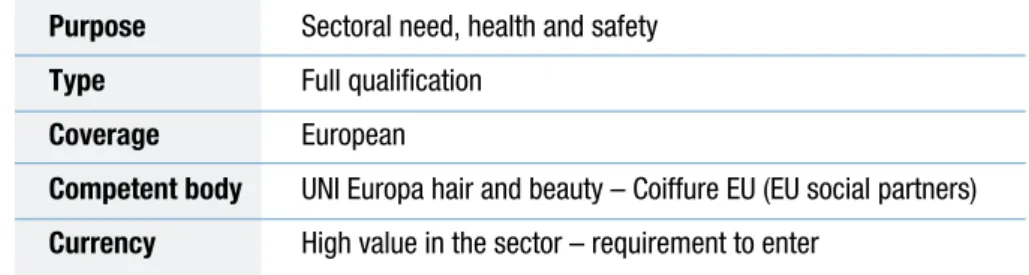
(in their various versions). Further, established frameworks in the European sectoral social dialogue, could be taken into account. Thus, in NACE and ISIC the personal services sector encompasses multiple activities and related professions, while ISCO defines a specific hair and beauty group of occupations. Further, European sectoral social dialogue involves two main parties, the hair and beauty section of UNI Europa (18) and Coiffure EU (19),
representing employees and employers in the hairdressing trade (not including cosmetics industries).
The hairdressing sector has an established qualification structure recognised by European stakeholders based on a European agreement on implementation of European hairdressing certificates. In this European perspective, future training of the hairdressing trade can be divided into three levels; level A corresponds to national training standards, while levels B and C correspond to European standards. Regulation, which dominates other sectors, is not present in hairdressing as transnational regulation does not exist, in spite of a de facto certification, which suggests there is a real sectoral reference standard at European level.
Looking at practical examples of projects developed over the years in EUC hair, the European social partners agreed that, by relating both the European hairdressing certificate ‘level B’ and the management training programme ‘level C’ to the EQF, they placed the training programme in a European standard system expected to be equivalent to recognition and quality of training programmes at European level. In fact, the fundamental principle behind sectoral standards in the hairdressing sector is that, in the European hairdressing certificate, each country is expected to decide how to get from level ‘A’ to level ‘B’ and level ‘C’.
The approach used in the Leonardo da Vinci programme EQF hair project (20) for referencing the European hairdressing certificate with the EQF
International qualifications
34
(15) NACE: classification of economic activities in the European Community.
(16) ISIC: international standard industrial classification of all economic activities.
(17) ISCO: international standard classification of occupations.
(18) http://www.uniglobalunion.org[accessed 21.3.2012].
(19) http://www.coiffure.eu/ [accessed 21.3.2012].
consisted of testing the three types of learning outcomes in the EQF (knowledge, skills, and competences) against the same three types of learning outcomes in the European hairdressing certificate level ‘B’. Based on this, EQF level 4 was selected as the best fit for the European hairdressing certificate (EHC). Through a comparable methodology, referencing the European hairdressing certificate level ‘C’ to the EQF was evaluated. According to the analysis, level ‘C’ would be considered equivalent to EQF level 5.
In the Leonardo da Vinci programme EUC hair - European certification in hairdressi