Moving towards 24-hour support.
Dr Matilda Kolandaisamy Supervisor, IT Customer Support
Macquarie University Library, Sydney, Australia [email protected]
Dr Malcolm Keech
Information Technology Services London School of Economics, London, UK
Abstract:
The academic institution of today is becoming increasingly involved in the electronic delivery of programmes to learners who are geographically dispersed. At the same time, Internet use from home by internal and external students is rapidly expanding. The surge in demand for 24-hour access to IT-based facilities by students and staff off-campus has made the expansion of current services a strategic imperative.
This paper suggests a particular solution to the problem of meeting the growing needs of remote users through extending information services by innovative, collaborative efforts with universities worldwide.
INTRODUCTION
As Internet use from home increases, a greater need arises to service the remote user. Access to electronic mail has become essential for many students and staff in higher education 24 hours a day, 7 days a week, and there is an increasing reliance on remote Web-based access to information services more generally.
The expectations of students have undergone profound change over the past few years and service immediacy has become a factor in problem solving – "I have a problem now, I need a solution now". There is a demand for instant advice from customers who are not prepared to wait until the institutional help desk opens next morning. Library users no longer phone in with a purely library style of information question. The nature of many queries now relates to information technology: "I have saved a search, how do I ftp the file to my computer?" or "How do I download Adobe Acrobat Reader?"
The surge in demand for off-campus access by students and staff has made the expansion of current services a strategic imperative. This expansion need not necessarily mean, however, that each library or information technology service should be staffed 24 hours a day, 7 days a week.
Currently Macquarie University Library (Sydney), along with many other academic libraries around the world, provide a range of IT-based services accessible from home. These include access to the library database and catalogue, access to course materials, book reservations and loan renewals. At the London School of Economics, the Information Technology Services supports Web-based access to email and other remote user services, both for the travelling academic visiting other sites on the Internet and for the dial-up user at home.
In a joint initiative between Macquarie University and the London School of Economics, a Remote Email Help Desk Service (REHDS) has been developed to address the problem of out-of-hours support. By exploiting the time difference between Sydney and London, it became possible to extend a computing advisory service to students during times when local help desk services are closed. It was anticipated that this would be particularly valuable to customers working outside normal hours or working remotely in different time zones, offering the prospect of a 24-hour global service in the near future.
The Macquarie Context – Background
The IT Customer Support Desk answers approximately 13,000 inquiries during the academic year. It handles questions relating to virus detection and corrupt disks as well as any troubleshooting of software packages and/or hardware.
The Support Desk was setup in 1997, initially staffed by reference librarians. It was soon apparent that a support desk staffed by people with some technical expertise was required. The service demand grew in 1998 when the University offered Internet access to all of its students from home. The technical nature of the inquiries increased
in complexity and the expertise of the reference librarian was no longer sufficient. A decision was made therefore, to reorient the support desk focus and to staff it with 2nd and 3rd year Computing students.
The desk was staffed during the opening hours of the Library, i.e. from 9am till 10pm on weeknights (Mon-Thu), 9am till 6pm (Fri) and from 9am till 5pm on weekends (Sat-Sun). This meant that the majority of the students working at home who encountered problems after 10pm had to wait till the next morning for assistance. There would frequently be 20 to 30 voicemail messages and, on many occasions, the mailbox would be full. Turnaround time was too slow. As Anne Lipow (1999) has said, librarians have to be pivotally involved in providing point-of-need service to information seekers ‘at the place where they are when they have a question’. The user's goal is not to get answers to questions, but to get on with their work!
The LSE Context
IT Services at the LSE operates a main Information and Help Desk from Monday to Friday each week of the year, with satellite Help Desks in both the Library and a large 100-seater public computer area. Questions to the Help Desks often involve email, Web browsing and remote access to School IT facilities, as well as the use of office applications and (less frequently) the applications used in teaching and research.
During term-time, the Help Desks are open from 10:00am to 7:00pm, with Information Desk staff handling general queries (e.g. registration, passwords, filestore allocations) from 9:00am. For 5 years now the help desk staff have been drawn from LSE’s postgraduate students and the more mature/proficient undergraduates who are interested in this part-time duty. As time has passed, the demand for the limited number of places each year has grown such that, now, there is a high degree of skill among the staff and solid experience of the 3-desk rota operation.
A small number of permanent staff supervise the help desk operation, and assist with the answer or referral of the more complex queries. Weekend opening has been piloted in the past, which was most in demand near end-of-term assignment deadlines. This also provided a useful facility maintenance role during core hours on a Saturday or Sunday, but was not designed to service the long hours from 7:00pm each day through to the following morning.
The Current Context
Earlier this year Macquarie University and the London School of Economics entered into a joint venture of providing a reciprocal help desk service to students at both institutions. This provided an immediate solution to answering students' inquiries during times when local help desk services were closed.
METHODOLOGY
The pilot Remote Email Help Desk Service, (REHDS) project began in early May 1999 and it operated on a Monday to Friday basis, initially for a three month period. It has since been extended through August and September.
Service Level Agreement
A Service Level Agreement (SLA) was drawn up between the two institutions to cover areas such as:
• How were queries submitted?
Queries from LSE students were submitted by email to: [email protected]
Queries from Macquarie students were submitted by email to: [email protected]
All queries were then directed to the appropriate time zone for response. • What sort of queries were accepted?
During the pilot, REHDS has only dealt with problems relating to the following systems and programs:
Windows 95; Microsoft Word; Microsoft Excel; Microsoft PowerPoint; Netscape Navigator; Microsoft Exchange.
General queries relating to the World Wide Web and the Internet were also accepted. Any IT queries not relating to the above topics were submitted anyway and they were re-directed to other staff where appropriate.
• When was REHDS running?
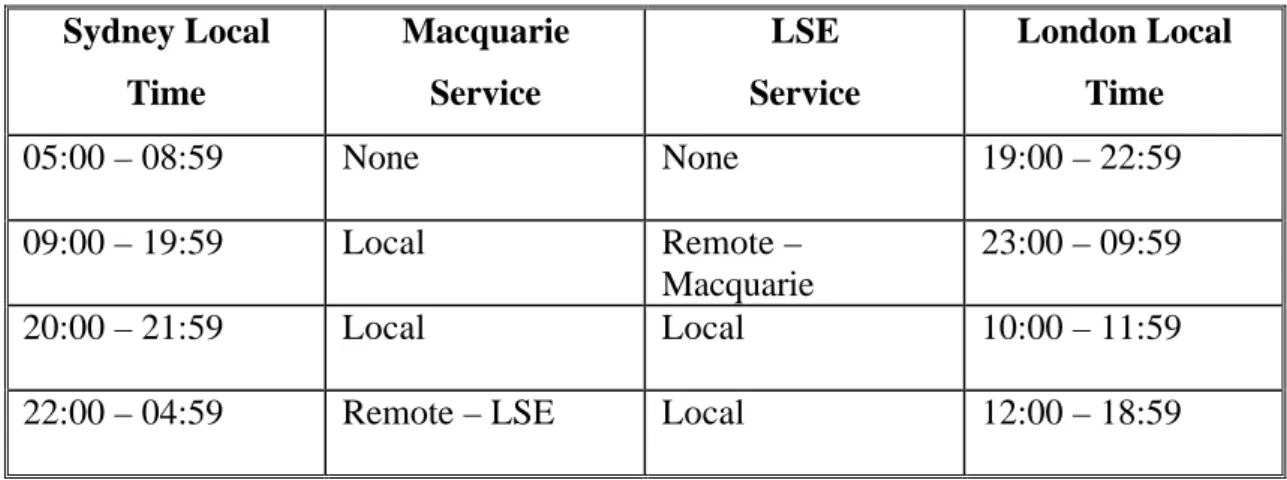
Australia is east of the UK timezone (12 noon in London is 10:00pm in Sydney). REHDS was operated as shown in the table below, the twenty-four hour clock being used. LSE’s conventional service ran from 10:00am to 7:00pm local time (8:00pm – 5:00am, Sydney time) and Macquarie’s service ran from 9:00am to 10:00pm local time (11:00pm – 12 noon, London time). See Table 1.
All queries received a response, although queries received just before and during the “dead zone” suffered inevitable delays. This was the time after which LSE’s Help Desk closed in the evening (London) ahead of Macquarie’s Support Desk opening the next morning (Sydney).
Sydney Local Time Macquarie Service LSE Service London Local Time 05:00 – 08:59 None None 19:00 – 22:59 09:00 – 19:59 Local Remote – Macquarie 23:00 – 09:59 20:00 – 21:59 Local Local 10:00 – 11:59
22:00 – 04:59 Remote – LSE Local 12:00 – 18:59
Table 1 Hours of Service
It can be seen that currently the “dead zone” in Sydney is 5:00am to 9:00am local time and in London 7:00pm to 11:00pm local time.
• Staffing – LSE and Macquarie
LSE staff provided for the service were those IT Help Desk operators normally on duty in IT Services, from 10am – 7pm (Mon-Fri).
Staff at Macquarie were those normally on duty at the IT Support Desk during the Library hours: 9am – 10pm (Mon – Thu), 9am – 6pm (Fri), 9am – 5pm (Sat-Sun). No special training was given except that all staff were required to have read the SLA document.
• Macquarie documentation available to LSE
Documentation relevant to Macquarie is accessible at http://www.lib.mq.edu.au/itsup and other documents relevant to REHDS were made available to staff only.
• LSE documentation available to Macquarie
Documentation relevant to LSE is accessible at http://www.lse.ac.uk/Depts/ITS, and other documents relevant to REHDS were made available privately to help desk
operators and authorised Macquarie staff at http://itsweb.lse.ac.uk . Problems raised by LSE users could be adequately solved with reference to the internal Support
section in the documentation (the only section accessible by Macquarie). • Message handling
To assist in the administration of the project both LSE and Macquarie set up respective REHDS accounts/mailboxes which were used internally by help desk staff at both sites – i.e. [email protected] and [email protected]. The REHDS account at LSE being accessible by Macquarie staff via the Web.
LSE
All email from LSE based clients was directed to [email protected] which was auto-forwarded to Macquarie’s email address [email protected] when Macquarie’s IT Support Desk was in operation.
Help Desk operators at LSE carbon-copied Macquarie-originated messages which were answered to [email protected], keeping a local copy also in the mail folder “DoneMacquarie”. All unanswered Macquarie-originated messages were forwarded to [email protected] for processing by Macquarie staff the next day.
Macquarie
All email from Macquarie based clients was directed to [email protected] which was auto-forwarded to LSE’s email address [email protected] when LSE’s help-desk was in operation.
Support Desk operators at Macquarie carbon-copied LSE-originated messages which were answered to [email protected], keeping a local copy as necessary. All unanswered LSE–originated messages were forwarded to [email protected] for processing by LSE staff later that same day.
• Supervision
Macquarie staff working on the REHDS pilot were responsible to Dr Matilda Kolandaisamy ([email protected]), while LSE staff working on the REHDS pilot were responsible to Robin Judd ([email protected]).
FINDINGS
The REHDS pilot commenced at a convenient time for both institutions, when semesters were drawing to a close. This enabled both Macquarie and LSE to establish procedures locally and implement compatible ways of working across the Internet. Initial teething problems were resolved by the end of the first month.
Teething problems
Message forwarding – before automatic message forwarding was introduced on both sides, the message forwarding was turned on manually. This of course caused problems initially as it relied on the person on duty at the desks to remember to "turn it on or off".
Mailboxes – initially only one mailbox was set up. Any mail that was returned was sent to the supervisors' accounts. However this proved unsatisfactory as it required another step to be taken by the supervisor, forwarding the message onto the help desk
Access to "staff only" information – to answer any of the inquiries, it required the remote desk to be privy to restricted information at each desk. LSE offered password access to their departmental Web site and Macquarie also provided equivalent access.
Advertising
The service was advertised to all students at Macquarie approximately 6 weeks prior to the launch of REHDS. Advertisements were placed in student magazines and on posters, and flyers were available at the help desks.Talks were given around campus. Links to the service were placed on our Web pages. The advertising was found to be still inadequate. On the Web, the extended remote help desk service was (and is) featured on the IT Services home pages at LSE and Macquarie, where users out-of-hours (or time zone) first look for IT information.
Aside from Web-based information, LSE promoted REHDS through the network login box (message of the day), which all users receive at the start of campus-based sessions. An item in both the printed and online newsletter gave further links to the mailbox and REHDS details. Macquarie appended a message to the signature file of each email message sent from the help desk.
Macquarie now also advertises the service on voice-mail and will promote REHDS during the new student enrolment in February 2000.
Email setup
Initially both Macquarie and LSE used just one email address each to receive and process mail from users. Any incoming mail was automatically forwarded to the remote help desk when the local service was closed. Subsequent processing of mail by the remote help desk incurred the problem of mail “bounce” when carbon-copying or forwarding back to the local help desk outside its service hours, because the original auto-forward would still be in place typically. Both sides then set up individual REHDS accounts to cope with the processing of help desk mail, both the cc: of answered messages and returned/unanswered messages.
Another form of the mail bounce phenomenon still exists, during the “dead zone” hours when both services are closed.
Message handling
The desks were staffed in three shifts. The staff on duty for a given shift were responsible for any incoming mail from remote users. Mail messages were answered immediately and replies sent back directly to the user. The responses were carbon copied to the remote REHDS mailbox. Any mail messages which could not be answered were forwarded onto the remote REHDS mailbox for attention when the desk was next open.
At the LSE, supervisory staff would check the REHDS mailbox first thing each morning, and either forward unanswered queries (returned from Macquarie) to the
IT_Help_Desk or deal with them directly. [NB – the auto-forward was deselected first.]
Query types
The desks dealt with problems relating to the Microsoft Office 97 suite, Netscape Navigator, Microsoft Exchange and Windows 95. During the pilot from May – November?, 790 mail messages were received, 72% of which were related to email access and remote Internet setup. 12% of the inquiries related to database access and 16% related to other matters such as access to Mac’s, ftp, virus protection, to name a few.
30% of the inquiries during the pilot were unique to the remote site and hence could not be resolved by the local help desk. The messages were then forwarded back to the remote desk for attention. These queries often comprised students with password problems or requests for other such privileged/restricted actions. The question of remote help desk permissions will be investigated in the new year.
ISSUES and STRATEGIES
Weekend cover
A key gap in the 2-way partnership between Macquarie and the LSE is REHDS support at weekends. Macquarie already has weekend service and LSE is planning to review its weekend help desk coverage in terms of campus-based IT services for the coming academic session, which starts 30 September 1999.
This will be an essential component of the service for out-of-hours users in moving toward a 7-day operation of REHDS each week of the year.
Overnight “dead zone”
Establishing a 3-site configuration will be important in the context of provision of overnight (London) and early morning (Sydney) support for users, eliminating the current “dead zone” while offering the prospect of 24-hour coverage. This will also enable a useful real time handover of problems if any user queries prove to be protracted.
Contacts are being established with potential partners in the US in order to create a truly global sustainable service network.
Other “help desks”
There is also the possibility that REHDS could be linked to other help desks at Macquarie and the LSE respectively. At Macquarie the development of a more seamless referral system embracing call centre principles will be a matter for investigation and analysis in the coming months.
LSE has considered doing the same for its Library Information Desk although, with a major move of premises just completed, this will remain in abeyance for the time being.
Technology challenge
During the coming year there will inevitably be issues for REHDS to face with advancing technology. In the short-medium term LSE plans a strategic move to Windows 2000, starting next summer with a major transition of the student IT desktop. This is timed to coincide with the wholesale adoption of Office 2000 as the School-wide standard for staff as well as students. There could be other changes in core applications too, although the imminent 1999-2000 session is planned to be a year of consolidation at least.
Macquarie is also undergoing a review of its institutional IT provision with moves currently afoot to centralise file server and technical support for common email, wordprocessing and directory services. Any implementation of such strategies may have considerable short term implications for the help desk during the transition period. However, the move to more common software platforms should make it easier to provide assistance in the medium term.
CONCLUSION
This collaborative project has been regarded by both institutions as very much a learning process during this pilot phase of operation. It is already evident however that economies of scale in terms of help desk support may be achieved in the medium term, particularly if a third partner can be found in the US.
It is too early to speculate on how many partners could participate in the one global networked service without losing relevant timely responses. There is also the continuing challenge of incorporating the more information oriented queries relating to traditional library services into the help desk which, as observed by Neil McLean (1999), is open to new solutions in its own right.
In addressing this issue, much closer attention will be paid to the way in which call centres in other service industries deal with the diversity of information requirements through one point of entry. Macquarie will be looking at customising and tailoring its services to the call centre model to suit the information technology needs of the university library environment, over the next 3 years.
REFERENCES
Lipow, A (1999) Serving the remote user. Information Online & On Disc '99 Conference, Sydney, Australia.
McLean, N (1999) Collaborating to Compete: the Search for New Alliances. RAISS Conference 1999, Sydney, Australia.