A Theory-Driven Distribution Algorithm for
Peer-to-Peer Real Time Streaming
Lorenzo Bracciale
∗, Dario Luzzi
∗, Francesca Lo Piccolo
∗Nicola Blefari Melazzi
∗, Giuseppe Bianchi
∗, Stefano Salsano
∗∗Universit´a di Roma “Tor Vergata” Rome, Italy
{lorenzo.bracciale,francesca.lopiccolo,dario.luzzi,blefari,giuseppe.bianchi,stefano.salsano}@uniroma2.it
Abstract—Many distribution algorithms have been proposed up to now for P2P real time streaming. However, due to the lack of basic theoretical results and bounds, common sense and intuitions and heuristics have driven their design so far. The consequence is that we canfind in the literature a large variety of different choices about the main aspects of a P2P system, such as overlay topology, scheduling process and upload strategy. In this situation, it is difficult to establish unambiguously the absolute goodness of a particular algorithm or even the rationale behind a particular choice or solution.
In this paper we propose and evaluate a theory-driven distri-bution algorithm for P2P real time streaming. We take advantage from a previous theoretical study, where: i) we derived a theoretical performance bound for forest-based overlay topologies regarding the number of nodes reachable in a given time interval or equivalently the time required to reach a given number of nodes; ii) we proved the optimality of Streamline, a distribution algorithm based on the serial transmission over forest-based topologies, in terms of its capability to reach such a bound.
TheStreamlinealgorithm is based on some ideal assumptions that prevent its practical implementation. In this paper we remove these assumptions and present a practical and working al-gorithm, named Operational Streamline or simplyO-Streamline. We also evaluate the performance of O-Streamline, comparing them with the optimal bounds of Streamline.1
I. INTRODUCTION
Peer-to-peer (P2P) overlay systems are being proposed to stream multimedia audio and video content from a source to a large number of end-users. The basic idea is to divide stream data in so-called “chunks”, and to organize peer nodes in an overlay distribution network to relay chunks.
To achieve this goal, a plethora of very different distribution algorithms have been proposed up to now. These algorithms make specific and different assumptions and choices about the main aspects of a P2P real time streaming system, such as overlay topology, scheduling process and upload strategy. However, the actual literature is somehow confusing, as the reader can not always understand the rationale behind the choices driving the algorithm design. As a matter of fact, there are algorithms that make different choices about, for instance, the scheduling process, even if the application scenario is the
1This work was supported by the Italian Ministry of University
and Research (MiUR), with the Grant PRIN-2006099023 ”Profiles” (disi.unitn.it/profiles).
same. Or there is an algorithm that combines the overlay topology X with the upload strategy Y, while another one combines the same overlay topology X with another upload strategy Z. In many such cases it is not easy to understand the reason of these choices and, most important, it is very difficult to compare different algorithms as it would be necessary to implement/simulate them. In addition, the measured/simulated results of literature proposals are strongly affected by the used test-bed or custom-made simulator and by the considered eval-uation scenarios, in absence of theoretical properties guiding the system design.
In our opinion, the main reason why so different approaches have been proposed up to now is the lack of baseline theo-retical results and bounds on P2P real time streaming. In ab-sence of theoretical results, common sense and intuitions and heuristics have driven the design of the proposed distribution algorithms.
Another consequence of the lack of basic theoretical results and bounds is the impossibility to establish unambiguously the absolute goodness of a P2P streaming distribution algorithm. In other words, while the performance of different distribution algorithms may be (difficulty) compared, it is not possible to evaluate how far/close the performance of a distribution algorithm are from/to optimal performance. By optimal per-formance we mean the ability to reach the greatest possible number of nodes in a given time interval or equivalently it makes possible to reach a given number of nodes in the smallest possible time interval.
To provide evidence of what we argue above, in the follow-ing we list the main alternatives proposed in the literature for overlay topologies, scheduling processes and upload strategies. As regards the overlay topology, it is possible to distinguish among:
• tree-based solutions, such as NICE [1] and ZIGZAG
[2], where nodes are organized in a tree and content is recursively spread from the parent node (the streaming source) to its child nodes until all peers are reached;
• mesh-based solutions, such as CoolStreaming [3],
Grid-media [4] or PRIME [5], where each node randomly establishes overlay connections with other nodes and sends a received chunk only to neighbors still missing
that chunk, in such a way that each chunk is streamed on a different tree;
• forest-based solutions, such as CoopNet [6] or
Split-Stream [7], where chunks and nodes are logically orga-nized in afinite set of groups and distribution trees, in such a way that each distribution tree includes all nodes and is used to distribute a single group of chunks. Nodes are interior nodes only in one tree and leaf nodes in all the remaining trees. The idea is to exploit the upload capacity that leaf nodes do not use in separate distribution trees, thus increasing the overall transmission capacity of the overlay network.
As regards the scheduling process, it is possible to distin-guish among:
• push-based algorithms, such as [1] and [2], where
sup-plier nodes decide which chunks will be served to which neighbors;
• pull-based algorithms, such as [3] or [5], where
schedul-ing decisions are taken at receivers and a chunk is transmitted only if a receiver requests that chunk;
• hybrid push-pull algorithms, like [4], where chunks are
requested in pull mode at start up and relayed in push mode in the immediate following phase.
Moreover, different local scheduling policies have been pro-posed: for instance, giving priority to the chunks with more stringent playback deadline [3], to the rarest chunks [8], to the neighbors with the highest upload/download capacity [3][9].
As regards the upload strategy, when the same chunk has to be uploaded to more than one child node, it can be transmitted “in series”, e.g. starting the transmission towards a second child node after completion of the chunk upload to the first child, or “in parallel”, i.e. sending the same chunk to more than one child node at the same time.
In this paper, we try to overcome the limitations discussed so far by proposing a theory-driven distribution algorithm for P2P real time streaming. Specifically, we take advantage from the theoretical study in [10], where i) we derived a theoret-ical performance bound for forest-based overlay topologies regarding the number of nodes reachable in a given time interval or equivalently the time required to reach a given number of nodes; ii) we proved the optimality ofStreamline, a distribution algorithm based on the serial transmission over forest-based topologies, in terms of its capability to reach such a bound. However, even ifStreamlineis able to achieve optimal performance, it is not a functioning algorithm in the sense that it is based on assumptions usually not verified in real scenarios. In other words the aim of Streamline is to set the framework of what is doable and achievable. Then, to realize it in practice, it is necessary to remove some ideal assumptions. This is what we are going to do in this paper.
In more detail, the assumptions made in the Streamline
proposal are:
• the distribution topology is derived thanks to a sort of
Maxwell’s demon that holds a global and centralized vision of the whole network. This conceptual entity is
able to instruct peer nodes on how to optimally organize the overlay topology and schedule chunk transmissions;
• there is no churn.
• we do not take into account propagation delays induced
by the underlying physical network topology (practically speaking, we assume that the propagation delays are negligible when compared with the chunk transmission time, or in other words, that chunks are not very small; indeed an assumption valid for most of the practical P2P streaming systems).
• we evaluate the performance by assuming that the ratio
between the uplink capacity of peer nodes and the stream bit rate is equal to one.
In this paper, we propose a practical and working algorithm, named Operational Streamline or more simplyO-Streamline.
O-Streamline: i) does not rely on a centralized vision of the whole network ii) takes the churn into account, iii) does not assume that all peers have an uplink capacity equal to the stream bit rate. As inStreamlinewe do not take into account the signalling burden. This is left for future work also to make possible to evaluate the effect of removing ideal assumptions step by step. Otherwise, it would be difficult to assess the implication of each of this assumption on the overall system performance.
Finally, we evaluate, by means of simulations, the perfor-mance ofO-Streamline, and we show that such performance are close to the optimal bounds derived for Streamline. To the best of our knowledge, this is thefirst work presenting a theory-driven distribution algorithm for P2P real time stream-ing.
The paper is organized as follows. Section II briefly recalls the basic concepts of Streamline and the main theoretical results presented in [10]. Section III describes our proposal. In Section IV we evaluate the performance of our algorithm. Finally, Section V concludes the paper.
II. BASIC CONCEPTS OFSTREAMLINE AND THEORETICAL RESULTS
In this section, we recall some basic concepts ofStreamline
and the main theoretical results presented in [10], to better understandO-Streamline.
Streamline organizes peers and chunks in a finite number
of overlay trees and groups respectively, in such a way that: i) each tree includes all peers and ii) chunks in a group are always transmitted by using the same overlay tree, iii) for each tree, and thus for each chunk, the source node sends the chunk to its children in series, and the same holds for each peer node of the tree, excluding the leaves.
Streamline shares with CoopNet [6] or SplitStream [7]
the advantage of exploiting in separate distribution trees the upload capacity that leaf nodes do not use, thus increasing the overall transmission capacity of the overlay network. However, while CoopNet and SplitStream use a parallel transmission of chunks,Streamlineresorts to a serial transmission of chunks. The idea behind this kind of distribution is that giving all the uplink capacity to a single child, instead of sharing it among
different children, allows that child to start serving other nodes before than in the case of parallel transmission. This means that all nodes, except the last served ones, can start serving their children before than in the case of parallel transmission; in turn, served children can become fathers of other children before than in the case of parallel transmission, and so on. We note that, from the point of view of a given node, serial and parallel transmissions are the same, i.e. there is not a particular advantage, for a given node; however, if we look at the system on the whole, we will show that serializing the chunk distribution brings about significance performance advantages in terms of number of nodes reached in a given time interval or equivalently in terms of time required to reach a given number of nodes.
Streamline assumes the following reference framework. A
stream is generated by a single node (source) at constant rate R (Kbps) and segmented into chunks with fixed sizeL
(Kb). The source starts transmitting at time instant t = 0. We define T = L/R (s) the chunk duration, which is also the time elapsing between two consecutive chunks. Besides to the source, the network is composed of an unlimited number of nodes, which join the system simultaneously, are always on and are assumed to be homogeneous in terms of uplink capacity (equal to B Kbps) and downlink capacity. The downlink capacity is assumed to be great enough so that downlinks are not a bottleneck of the system. Each node has
k overlay parents andk overlay children, being the parent set potentially different from the children set.
Streamline considers the following performance indexes:
• N(c, k, t) : the number of peer nodes that can complete
the download of the c-th chunk aftert time units, being
k the number of parents/children;
• T(c, k, n): the amount of time needed by npeer nodes
to complete the download of thec-th chunk, beingk the number of parents/children.
The previous performance indexes have been derived in [10] under the assumption that the ratio between the uplink capacity of peer nodes and the stream bit rate is equal to one, i.e.,B = R. This is the most demanding assumption, in a streaming scenario. Furthermore, the previous performance indexes have been normalized with respect to the time needed to download a complete chunk at rate B (in bit/s). Thus, the latter time interval will be the unit of time. In addition, for the sake of simplicity, t is always assumed to be an integer value: the generalization to continuous time is rather straightforward.
In [10] we show that the following results hold:
N(c, k, t) =
t−!c+1
i=1
Fk(i) (1)
where Fk(·) is the k-step Fibonacci sequence, defined as follows Fk(i) = 0 ifi≤0 1 ifi= 1 %k j=1Fk(i−j) ifi >1 (2)
As regardsT(c, k, n), it can be obtained thanks to the follow-ing implicit relation:
T(c, k, n) = min{t≥c:
t−!c+1
i=1
Fk(i)≥n} (3)
In addition, and most importantly, in [10] we show that
Streamline is optimal among all distribution algorithms for
forest-based topologies, in the sense explained in the Intro-duction.
Finally, thanks to some results on k-step Fibonacci sums, the following asymptotic expression, with respect to t, for
N(c, k, t)has been derived:
N(c, k, t)≈u(t−c) & φ k φk−1 · φtk−c+1 Qk(φk)− 1 k−1 ' (4) where i) u(·)denotes the unit step function, ii)φk represents the so saidk-step Fibonacci constant and it is the only real root with modulo greater than 1 of the characteristic polynomial
Pk(x) = xk −xk−1 −xk−2 − · · · −x−1 of the k-step Fibonacci sequence, and iii) Qk(x) is a suitable polynomial about which more details can be found in [10]. The asymptotic expression with respect to t in (4) makes possible to state that the performance ofStreamlinedepends on the number of deployed trees through the Fibonacci constant valuesφk; as a matter of fact, Fibonacci constantsφk very rapidly tend to the limit value2 (e.g.φ4 is already1.96595).
III. FROM THEORY TO PRACTICE:OUR PROPOSAL
In this section, we describe our proposal to turnStreamline
into O-Streamline, a practical and working distribution algo-rithm for P2P real time streaming.
O-Streamline tries to maintain the two basic principles of
Streamline, that are i) the organization of peers and chunks in a finite number of overlay trees and groups and ii) the serialization of chunk transmissions.
The second principle is easy to be put in practice. Thefirst principle involves two distinct assumptions: i) the availability of a global and centralized vision of the whole network; ii) the absence of peer churn.
As regards thefirst assumption,O-Streamlinedoes not count anymore on a global and centralized vision of the whole network, but it builds the overlay topology in a distributed manner and schedules chunk transmissions with a limited, local view of the overall topology.
O-Streamline constructs the overlay topology as follows.
Peer nodes are uniformly divided intoG different groups, in such a way that i) each node belongs only to one group, ii) each node establishes random overlay bidirectional con-nections with P peer nodes in the same group to which it belongs and O peer nodes in each of the remaining groups. This can be easily achieved in a real distributed environment. Provided that groups are progressively identified starting from
0, each node may establish its membership group if it extracts an (integer) random number with uniform distribution in the interval [0, G − 1]. In addition, it may also establish
connections with other peer nodes if a bootstrap node provides it with the addresses of the already active nodes in each group. The G groups are also used to organize the stream chunks. In more detail, if chunks are progressively indexed starting from 1, chunk i is associated with the group g such that
g=imod G.
To describe howO-Streamlineschedules chunk transmission we let:
• Lthe chunk size (in bits)
• U the ratio between the stream bit rateRand the uplink
capacityB of all nodes;
• T=L/Rthe chunk duration (in s).
The scheduling algorithm operates as follows:
• the source node, which does not belong to any of the
groups and it is connected toU neighbors per each group, sends the generic chunk in series to the U neighbors of the corresponding group. The source node serves the chunks to the neighbors of each group following the order implicitly established in the association between chunk identifiers and groups. The source node repeat this distribution pattern, moduloG, unless churn changes the overlay neighbors. Therefore each node which is child of the source receives a new chunk from the source every
G×U×BL seconds;
• the generic peer relays only the chunks of the group it
belongs to. A FIFO queue is used to manage the chunks of the group to which the generic peer belongs;
• the generic peer is interested only in chunks that arrive
at the source, starting from the time instant at which the peer joins the system. This implies that peer nodes must be somehow synchronized with the timing reference of the stream. However, this problem can be solved if the bootstrap node is the source, and sends to the new peer nodes joining the system the identifier of the next chunk that is going to be transmitted by the source; the case in which the bootstrap node is not the source is left for future work;
• the generic peer serves each chunk in the FIFO queue in
series toG×U neighbors (if there areG×U neighbors missing that chunk), by giving priority to the neighbors of its own group. This implies that the number of neighbors
P has to be at least equal toG×U. Moreover, whenever possible, the generic peer serves the chunks belonging to the same group to which the peer belongs in the same order;
• if a peer ends serving a chunk toG×U neighbors and
there are no new chunks to be served in the FIFO queue, it tries to serve that chunk to other neighbors, until a new chunk to be served is enqueued in the FIFO queue. As regards the second assumption,O-Streamlinetakes churn into account as follows. In fact, the numbers P and O of neighbors per group are set to be greater thanG×U so that churn can be handled smoothly. In more detail, if peer nodes loosing a neighbor due to a disconnection have less neighbors than G×U in the group to which the disconnecting node
belongs, they may look for another neighbor and maintain
G×U as minimum number of connection in that group. In such a way, O-Streamline does not need to re-configure the whole overlay topology in case of peer churn. In the next section we describe how we setP to achieve this result in our simulations.
IV. SIMULATION RESULTS
In this section we evaluate the performance ofO-Streamline
by considering the following performance indexes:
• Nserved(c, d): is the average number of nodes that com-plete the download of a chunkc with a chunk delivery delay less than or equal to d; the chunk delivery delay is the difference between the time instant at which the chunk arrives at the source and the time instant at which the chunk is completely received from a node. Note that this performance index is very similar to the performance index N(c, k, t) used to evaluate the performance of
Streamline. In fact, if inN(c, k, t)we consider the chunk delivery delayt−c−1 instead of the absolute timet of chunk delivery and we average on all chunks, we obtain
Nserved(c, d);
• chunk delivery ratioR(n, Sn): with reference to a noden, the chunk delivery ratio is the ratio between the number of (completely) received chunks and the total number of chunks generated during the duration of the session of that node,Sn.
We evaluated these performance indexes via simulations by using the OPSS simulator [13]. The duration of the simulations is 1800 s. For each simulation result we assessed the 95% confidence intervals. These intervals are plotted in thefigures only when they are significant; when they are small (e.g. less than5%) they are not shown to improve the readability of the figures themselves.
We simulated a homogeneous scenario in terms of downlink and uplink capacity: all nodes, including the source, have the same uplink and downlink capacity. As regards the downlink capacity, like inStreamline, we set a value great enough so that downlinks are not a bottleneck of the system. As regards the uplink capacity, we remove another assumption ofStreamline.
Streamlineassumes that the ratio between the uplink capacity of all nodes and the the stream bit rate is equal to 1. In O-Streamline we consider also values of this ratio greater than or equal to 1. As a consequence, when this ratio is greater than one, we had to use the OPSS simulator also to evaluate the performance of Streamline. As regards the churn model we make some assumptions, which must not be seen as too oversimplified, since the main goal of this paper is to present a practical and working theory-driven algorithm and to test its robustness against churn rather than to give a real model of churn. These assumptions are:
• the session times are exponentially distributed;
• when a peer node leaves the system, a new peer node
joins the system. This makes possible to keep the number of simulated peer nodes constant throughout the whole
simulation and to simplify the evaluation of simulation results;
• each node may accept up to X connections per group
besides the numberP or O of connections per group2. This guarantees a topology perturbation after node dis-connections. In fact, accepting more connections than the minimum numberP or O, implies that new peer nodes may be placed in topological positions different from the ones of the corresponding peer nodes which are going to disconnect and to be replaced. In addition, also peer nodes loosing a neighbor due to a disconnection may look for another neighbor and maintainP orO(depending on the group to which the disconnecting node belongs) as minimum number of connection per group.
The presentation of simulation results is organized as fol-lows. First, we refer to a churn-free simulation scenario where peer nodes are always on (subsection IV-A). This allows us to compareO-StreamlinewithStreamline, thus understanding
O-Streamline’s position with respect to ideal performance
bounds. Then, we introduce the churn and evaluate its impli-cations on the performance ofO-Streamline(subsection IV-B).
A. Comparison with Streamline, no churn
We assume that the number P of neighbors in the same group to which the generic peer belongs is equal to the number
O of neighbors in the remaining groups.
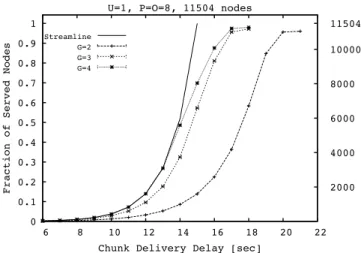
Wefirst consider a scenario with11504nodes,8neighbors per group (P =O = 8) and a ratio between uplink capacity and stream bit rate equal to 1.
In figure 1 we plot the cumulative distribution function of
Nserved(c, d) for three different values of the number G of groups. The curve relative toStreamlinehas been analytically derived by setting k = 4. In fact, even if the performance
of Streamline improve monotonically as a function of the
numberkof children, we chosek= 4since the improvement becomes negligible for greater values ofk(see [10] for more details). We observe that as the number of groups increases, the performance of O-Streamline get closer to the ones of
Streamline. For instance, with4groups, the difference between
O-Streamline andStreamlineis negligible for chunk delivery
delay up to 12−13 seconds; the maximum chunk delivery delay necessary to serve the whole network of O-Streamline
is 3 seconds higher than that of Streamline. With 3 groups the maximum chunk delivery delay of O-Streamlinedoes not worsen, while with 2 groups the maximum chunk deliver is 6 seconds higher than the maximum chunk delivery of
Streamline.
As a consequence, we can state that there exists a threshold for the number of groupsGover which improvements become negligible. In addition the number of groups G should be chosen so as to limit the signaling burden required to maintain the relationships with neighbors belonging to all theGgroups.
2In all the simulations X is a random variable with uniform distribution in
the interval (0,2). 1 0.9 0.8 0.7 0.6 0.5 0.4 0.3 0.2 0.1 0 6 8 10 12 14 16 18 20 22 11504 10000 8000 6000 4000 2000
Fraction of Served Nodes
Chunk Delivery Delay [sec] U=1, P=O=8, 11504 nodes
Streamline G=2 G=3 G=4
Fig. 1. Cumulative distribution function ofNserved(c, d)inStreamlineand
O-Streamlinein case of a network with11504nodes, ratio between uplink
capacity and stream bit rate equal to1and8neighbors per group, for three different values of the number of groups.
In figure 2 we plot the inverse cumulative distribution function3 of R(n, S
n) (the chunk delivery ratio), for three different values of the numberGof groups. As in the previous figure, the curve relative to Streamline has been analytically derived by settingk= 4. We also note that the chunk delivery ratio in Streamline is equal to 1 for every chunk and every node. As expected, we observe that Streamline succeeds in completely diffusing all chunks. Instead, O-Streamlinehas a chunk delivery ratio that increases with the number of groups. For instance95%of nodes download at least 80%,85%and
90%of all chunks with2,3and4 groups, respectively.
0.1 0.2 0.3 0.4 0.5 0.6 0.7 0.8 0.9 1 0.1 0.2 0.3 0.4 0.5 0.6 0.7 0.8 0.9 1
Fraction of Served Nodes
Chunk Delivery Ratio U=1, P=O=8, 11504 nodes
Streamline G=2 G=3 G=4
Fig. 2. Inverse cumulative distribution of chunk delivery ratio inStreamline
andO-Streamlinein case of a network with11504nodes, ratio between uplink
capacity and stream bit rate equal to1and8neighbors per group, for three different values of the number of groups.
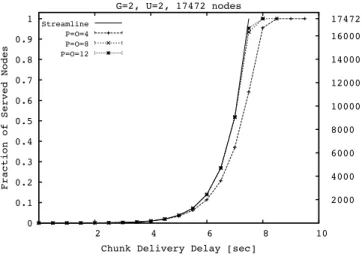
Now we consider a second scenario with 17472 nodes, 2
groups and a ratio between uplink capacity and stream bit rate equal to 2.
In figure 3 we plot the cumulative distribution function of Nserved(c, d) for three different values of the number of neighbors per group (we recall that we assumedP =O). The curve relative to Streamline has been derived via simulations under the assumption of4 parents/children per node.
1 0.9 0.8 0.7 0.6 0.5 0.4 0.3 0.2 0.1 0 10 8 6 4 2 17472 16000 14000 12000 10000 8000 6000 4000 2000
Fraction of Served Nodes
Chunk Delivery Delay [sec] G=2, U=2, 17472 nodes Streamline
P=O=4 P=O=8 P=O=12
Fig. 3. Cumulative distribution function ofNserved(c, d)inStreamlineand
O-Streamline in case of a network with17472nodes, ratio between uplink
capacity and stream bit rate equal to2and2groups, for three different values of the number of neighbors per group.
We observe that as the number of neighbors per group in-creases, the performance ofO-Streamlineget closer to the ones of Streamline. For instance, with 12neighbors per group, the difference betweenO-StreamlineandStreamlineis negligible for chunk delivery delay up to6seconds; the maximum chunk delivery delay necessary to serve the whole network of O-Streamline is1 second higher than that ofStreamline.
Another observation is that the performance ofO-Streamline
get closer to the ones ofStreamlineas the ratio between uplink capacity and stream bit rate increases. As a matter of fact if we comparefigure 1 and figure 3 for the cases ofG= 2 and
P =O = 8 the maximum chunk delivery delay is 21 s for
U = 1 and8.5 s forU = 2.
Finally, we note that we do not present results on the chunk delivery ratio in this scenario, since the choice of U = 2
guarantees the complete diffusion of all chunks, regardless of the number of neighbors per group.
B. Impact of churn
We consider a scenario with 17472 nodes and a ratio between uplink capacity and stream bit rate equal to 2. The average session time of each node is equal to 10minutes.
In figure 4 we plot the cumulative distribution function of
Nserved(c, d) for three different values of the number G of groups. The number of neighbors per group is8(P =O= 8). We observe that: i) the performance worsen with respect to what happens in absence of churn, ii) the lower the number of groups, the more significant the worsening, iii) a single
group implies a maximum chunk delivery delay of about25 seconds; using 2 or 3 groups makes possible to reduce this delay to about16−17 seconds.
1 0.9 0.8 0.7 0.6 0.5 0.4 0.3 0.2 0.1 0 25 20 15 10 5 0 17472 15000 12000 9000 6000 3000
Fraction of Served Nodes
Chunk Delivery Delay [sec]
U=2, P=O=8, 17472 nodes
G=1, no churn G=2, no churn G=3, no churn G=1 G=2 G=3
Fig. 4. Cumulative distribution function ofNserved(c, d)inO-Streamline in case of a network with17472nodes, ratio between uplink capacity and stream bit rate equal to2and8neighbors per group, for three different values of the number of groups.
1 0.9 0.8 0.7 0.6 0.5 0.4 0.3 0.2 0.1 0 1 0.9 0.8 0.7 0.6 0.5 0.4 0.3 0.2 0.1 0
Fraction of Served Nodes
Chunk Delivery Ratio
U=2, P=O=8, 17472 nodes
no churn G=1 G=2 G=3
Fig. 5. Inverse cumulative distribution of chunk delivery ratio inO-Streamline
in case of a network with17472nodes, ratio between uplink capacity and stream bit rate equal to2and8neighbors per group, for three different values of the number of groups.
In figure 5 we plot the inverse cumulative distribution function4 of R(n, S
n) (the chunk delivery ratio), for three different values of the number of groups. The number of neighbors per group is8(P =O = 8). Also this performance index improves as a function of the number of groups.
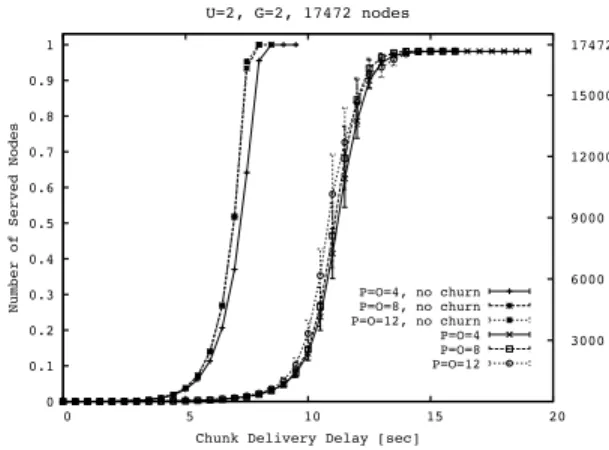
In figure 6 we plot the cumulative distribution function of Nserved(c, d), for three different values of the number of neighbors per group (we recall that P = O). We observe that: i) performance worsen with respect to performance in
absence of churn, ii) increasing the number of neighbors per group improves mostly the maximum chunk delivery delay and only marginally the lower values of chunk delivery delay. We remark that increasing the number of neighbors per group leads to an increment of the signalling burden required to mantain the relationships.
In figure 7 we plot the inverse cumulative distribution function5 of R(n, Sn) (the chunk delivery ratio), for three different values of the number of neighbors per group (we recall that P =O). The variation of the number of neighbors per group does not affect significantly the performance.
1 0.9 0.8 0.7 0.6 0.5 0.4 0.3 0.2 0.1 0 20 15 10 5 0 17472 15000 12000 9000 6000 3000
Number of Served Nodes
Chunk Delivery Delay [sec]
U=2, G=2, 17472 nodes P=O=4, no churn P=O=8, no churn P=O=12, no churn P=O=4 P=O=8 P=O=12
Fig. 6. Cumulative distribution function ofNserved(c, d)inO-Streamline in case of a network with17472nodes, ratio between uplink capacity and stream bit rate equal to 2 and 2 groups, for three different values of the number of neighbors per group.
1 0.9 0.8 0.7 0.6 0.5 0.4 0.3 0.2 0.1 0 1 0.9 0.8 0.7 0.6 0.5 0.4 0.3 0.2 0.1 0
Fraction of Served Nodes
Chunk Delivery Ratio
U=2, G=2, 17472 nodes no churn
P=O=4 P=O=8 P=O=12
Fig. 7. Inverse cumulative distribution of chunk delivery ratio inO-Streamline
in case of a network with17472nodes, ratio between uplink capacity and stream bit rate equal to 2 and 2 groups, for three different values of the number of neighbors per group.
V. CONCLUSIONS
O-Streamline is a distribution algorithm designed starting from a theoretical framework. For this reason, the reader can understand the rationale behind its design and ascertain its pros and cons. More important,O-Streamline is both amenable to a real implementation and has performance close to absolute bounds for this class of algorithms.
5i.e. the complement to one of the cumulative distribution function
REFERENCES
[1] S. Banerjee, B. Bhattacharjee and C. Kommareddy,Scalable application
layer multicast, in Proceedings of ACM SIGCOMM, Pittsburgh, PA,
USA, 2002.
[2] D. A. Tran, K. A. Hua and T. Do, ZIGZAG: an efficient peer-to-peer
scheme for media streaming, in Proceedings of IEEE INFOCOM, San
Francisco, CA, USA, 2003.
[3] X. Zhang, J.C. Liu, B. Li and P. Yum,CoolStreaming/DONet: A
data-driven overlay network for efficient live media streaming, In Proceedings
of IEEE INFOCOM, Miami, FL, USA, 2005.
[4] M. Zhang, L. Zhao, Y. Tang, J. Luo and S. Yang, Large-Scale Live
Media Streaming over Peer-to-Peer Networks through Global Internet,
in Proceedings of ACM Multimedia, Singapore, Singapore, 2005. [5] N. Magharei and R. Rejaie,PRIME: Peer-to-Peer Receiver-drIven
MEsh-based Streaming, in Proceedings of IEEE INFOCOM, 2007.
[6] V. N. Padmanabhan, H. J. Wang and P. A. Chou,Distributing streaming
media content using cooperative networking, in Proceedings of
NOSS-DAV, Miami Beach, FL, USA, 2002.
[7] M. Castro, P. Druschel, A. Kermarrec, A. Nandi, A. Rowstron, and A. Singh, Splitstream: High-bandwidth multicast in cooperative
envi-ronments, in Proceedings of the 19th ACM Symposium on Operating
Systems Principles, The Sagamore, NY, USA, 2003.
[8] M. Zhang, Y. Xiong, Q. Zhang and S. Yang,On the Optimal Scheduling
for Media Streaming in Data-driven Overlay Networks, in Proceedings
of IEEE GLOBECOM, 2006.
[9] L. Bracciale, F. Lo Piccolo, D. Luzzi, S. Salsano, G. Bianchi and N. Blefari-Melazzi,A push-based scheduling algorithm for large scale P2P
live streaming, in Proceedings of QoS-IP 2008, on line available at
netgroup.uniroma2.it/p2p/QoSIP08.pdf.
[10] G. Bianchi, N. Blefari Melazzi, L. Bracciale, F. Lo Piccolo, S. Salsano and D. Luzzi,Streamline: an Optimal Distribution Algorithm for
Peer-to-Peer Real-time Streaming over Forest-Based Topologies, submitted to
ACM SIGCOMM 2008 and on line available at netgroup.uniroma2.it/ p2p/streamline.pdf.
[11] T. Silverston, O. FourmauxSource vs Data-driven Approach for Live
P2P Streaming, ICNICONSMCL ’06 Washington, DC, USA
[12] E. W. Biersack, P. Rodriguez, and P. Felber,Performance Analysis of
Peer-to-Peer Networks for File Distribution, in Proceedings of the 5th
International Workshop on Quality of Future Internet Services (QofIS’04), Barcelona, Spain, 2004.
[13] L. Bracciale, F. Lo Piccolo, D. Luzzi and S. SalsanoOPSS: an Overlay
Peer-to-peer Streaming Simulator for large-scale networks. The simulator