SDN and Virtualization-Based LTE Mobile Network
Architectures: A Comprehensive Survey
Van-Giang Nguyen1•Truong-Xuan Do1• YoungHan Kim1
Published online: 6 August 2015
The Author(s) 2015. This article is published with open access at Springerlink.com
Abstract Software-defined networking (SDN) features the decoupling of the control plane and data plane, a programmable network and virtualization, which enables network infrastructure sharing and the ‘‘softwarization’’ of the network functions. Recently, many research works have tried to redesign the traditional mobile network using two of these concepts in order to deal with the challenges faced by mobile operators, such as the rapid growth of mobile traffic and new services. In this paper, we first provide an overview of SDN, network virtualization, and network function virtualization, and then describe the current LTE mobile network architecture as well as its challenges and issues. By analyzing and categorizing a wide range of the latest research works on SDN and virtualization in LTE mobile networks, we present a general architecture for SDN and virtualization in mobile networks (called SDVMN) and then propose a hierarchical taxonomy based on the different levels of the carrier network. We also present an in-depth analysis about changes related to protocol operation and architecture when adopting SDN and virtualization in mobile networks. In addition, we list specific use cases and applications that benefit from SDVMN. Last but not least, we discuss the open issues and future research directions of SDVMN.
Keywords Software defined networkingNetwork virtualizationNetwork function
virtualizationFuture mobile networkLTEEvolved packet core 5G mobile network
& YoungHan Kim
[email protected]; [email protected] Van-Giang Nguyen [email protected] Truong-Xuan Do [email protected] 1
School of Electronic Engineering, Soongsil University, Seoul, South Korea DOI 10.1007/s11277-015-2997-7
1 Introduction
Recently, the explosion of handheld devices has caused an exponential increase in mobile data traffic usage. Cisco forecasts [1] have shown that mobile data traffic will grow by 61 % from 2013 to 2018. This growth is based on current mobile data services and applications, such as mobile games, mobile videos, and location-based check-in services. This trend is expected to keep growing due to the appearance of new mobile services and applications. The significant growth in mobile traffic, new network services, and appli-cations are pushing carrier network operators to upgrade their systems in order to meet new requirements and increasing customer demands. This imposes challenges for the current cellular network architecture, such as high upgrade costs, complex operation, and slow deployment of new innovations and services [2]. In addition, the simultaneous appearance of multiple wireless technologies has also brought challenges, including the interworking between these diverse technologies, inter-cell interference, and radio resource management in the dense network environment.
However, the current mobile network has several issues regarding its inherent design; thus, the afore-mentioned challenges cannot easily be addressed without radically changing the architecture. First, the current implementations of mobile networks are very expensive and difficult to modify. For example, the current mobile core networks rely on proprietary hardware appliances [3], which make it difficult to upgrade them as they become obsolete. Second, the tightly coupling between the control plane and data plane makes the current mobile network very slow and complicated when new network services or innovations need to be implemented. The manual configuration for each device also brings burdens for network operation and maintenance. Last, the current mobile network manages network resources inefficiently. Traditionally, radio resource management is performed in a dis-tributed fashion [2], where each base station has its own decision on radio resources. This makes radio resource and inter-cell interference management highly complex and suboptimal.
The software-defined network (SDN) [4], a new network paradigm, came from the
campus and enterprise network environments with the invention of the Openflow concept
[5]. The main concepts of SDN include the separation of the control data plane, and a
programmable network. SDN facilitates network configuration and management by pushing all control tasks to a centralized controller. Moreover, SDN speeds the deployment of new innovations or services and reduces operational costs through programmable interfaces (e.g., Openflow [6], ForCES [7], and PCEP [8]) in the controller. Due to the benefits of SDN, mobile network operators have recently realized that SDN is a promising solution for their current mobile networks.
Virtualization refers to two types of technologies: network virtualization [9] (NV) and
network function virtualization (NFV) [10]. NV allows multiple virtual networks to
operate on the same network infrastructure. This enables the coexistence of multiple service providers or carrier network operators in the shared infrastructure. NFV refers to the implementation of network functions in software running on general purpose com-puting/storage platforms. In the mobile network, with the migration from hardware to software appliances, NFV is expected to lower not only equipment costs (CAPEX) but also the operational costs (OPEX).
SDN and virtualization are two major trends in the evolution of the mobile network. Not long ago, the fifth generation (5G) cellular network was defined and discussed globally.
[12], iJOIN [13], Mobile Cloud Networking [14], and CROWD [15], has released its plan and perspectives for future mobile networks until 2020. It considers SDN and NFV to be some of the key technologies for the 5G cellular network architecture. For SDN and NFV, some of the top benefits being focused on include satisfying the need for network operators to speed up their service innovations and simplifying network management.
In this paper, we present a comprehensive survey about the impact of SDN and vir-tualization on mobile network architecture. To the best of our knowledge, this is the first comprehensive and profound survey on SDN and virtualization in the mobile network architecture. We found few papers surveying this topic. In [16], the authors briefly pre-sented a survey on SDN concepts and its benefits while considering a limited number of
surveyed works. In [17], the authors considered two main streams: SDN-based mobile
network and wireless network virtualization, as well as the simple integration of these two approaches. The section focusing on virtualization only covered network virtualization in a general wireless network architecture, and did not cover both NV and NFV in wireless mobile environments. The number of surveyed papers was also limited. In our paper, we aim at providing a more comprehensive and general survey about SDN and virtualization in the mobile network by covering and categorizing a wide range of the latest research works. The main contributions of this paper are as follows:
• Cover a wide range of up-to-date research works on SDN and virtualization in mobile
network.
• Present a general architecture for SDN and virtualization in the mobile network called
SDVMN.
• Describe the benefits that these two concepts bring to each level of the mobile cellular network.
• Propose a hierarchical taxonomy which identifies main issues in the different levels of
carrier network and figure out main groups of SDN and virtualization-based solutions to address these issues.
• Analyze in-depth how SDN and virtualization can change the protocol operation and
architecture of the current carrier network.
• Provide a list of specific use cases and applications that can benefit from SDVMN.
The remainder of the paper is organized as follows. In Sect. 2, we review the current
mobile network architecture and its challenges and issues, and then briefly present the
concepts of SDN, NV, and NFV. In Sect.3, we describe a general architecture for SDN and
virtualization in the mobile network, as well as its benefits. The taxonomy tree of our
survey is described in Sect.4. Section5surveys current approaches to SDVMN organized
according to the proposed taxonomy. We discuss open issues and future research directions in Sect.6. Finally, we conclude our survey in Sect.7.
2 Background
This section describes the mobile network architecture and its problems and issues. Then, we review the key technologies, including software-defined networking, network virtual-ization, and network function virtualization.
2.1 Long Term Evolution (LTE) System
Up to now, the mobile network has gone through many generations during its evolution, such as GPRS and UMTS. In this paper, we only focus on LTE, the latest mobile network generation.
The LTE network is divided into two parts: the LTE part deals with radio access technologies, while the evolved packet core (EPC) deals with the technology related to a core network. User equipment (UE) connects to an eNodeB via radio interface. The eNodeB performs radio resource management functions such as allocating radio resources and managing inter-cell interference. The eNodeB connects to a serving gateway (SGW) through a mobile backhaul network. The SGW serves a large number of eNodeBs and acts as the local mobility anchor point for the inter-eNodeB handover. The SGW is connected to a packet data network (PDN) gateway (PGW), which performs UE IP address allocation, policy enforcement, packet filtering and charging. It is a termination point for the packet data interface towards the external network. The mobility management entity (MME) is the main control entity and is responsible for maintaining mobility management states for UEs and setting up bearers to carry user traffic. The home subscriber server (HSS) is a central database where user profiles are stored. It is in charge of UE authentication and autho-rization. The policy and charging rules function (PCRF) provides QoS and charging rules to the PGW. User data packets are forwarded through GTP (GPRS tunneling protocol)
tunnels between the eNodeB and PGW. Figure1depicts the overall architecture of mobile
network.
Although the LTE came out to cope with the increasing growth of mobile devices, it still has many issues and challenges. In radio access and the mobile backhaul network, the deployment of many base stations and the distribution of the control plane, the LTE is hard to manage, which results in inefficient radio resource management. It is also hard for the network mobile operator to deal with the interference problem between cells or base stations. In the mobile core network, having no clear separation between the control and data planes makes the network difficult to manage and control. The use of proprietary hardware appliances for network entities results in high deployment and operational costs and inefficient resource utilization, which slows down the time-to-market for new inno-vations and impacts the operators’ revenue.
MME SGW PGW SGSN HSS PCRF NodeB 3G SGi-LAN UE INTERNET Operator IP Services (IMS) RNC BTS 2G BSC eNodeB LTE
Control and signaling plane User or data plane Mobile Backhaul
2.2 Software-Defined Networking
SDN is a centralized paradigm in which the network intelligence or control plane is lifted up to a logically centralized entity, or SDN controller. The data plane consists of simple forwarding devices that are controlled by the SDN controller through programmable
interfaces. Nowadays, Openflow [6] is a widely used SDN interface that is maintained by
the Open Networking Foundation (ONF) [19]. There have been several approaches for
SDN, as surveyed in [20–22]. Figure2depicts a typical architecture of SDN. The SDN
architecture consists of three main layers: the infrastructure layer, control layer, and application layer. The infrastructure layer or data plane is composed of forwarding devices, such as virtual switches and physical switches. The control layer or control plane comprises a set of SDN controllers (e.g., a Floodlight controller [23] or OpenDaylight controller [24]) that provide control tasks through southbound interfaces (e.g., Openflow, ForCES and PCEP). These controllers communicate with others using east/westbound interfaces (e.g. SDNi interfaces [25]). The application layer or application plane consists of one or more applications, such as routing, security application and monitoring applications. The SDN applications communicate their network requirements towards the controllers via north-bound interfaces such as REST API or Java API. The main benefits of SDN include ease of configuration and management, high rate of innovation, and network programmability
2.3 Network Virtualization (NV)
As surveyed in [9], network virtualization allows multiple service providers to compose
their own virtual networks that coexist together on the shared physical infrastructure. Service providers can deploy and manage customized end-to-end services on those virtual networks effectively for the end users. Historically, virtual local network (VLAN) and virtual private network (VPN) have been two popular technologies for creating logical
Westbound (SDNi, etc.) Eastbound (SDNi, etc.) Ap p li cation L ay e r Control Layer Infra st ruct re L ay e r
Southbound API (e.g., Openflow, ForCES, PCEP, I2RS, etc.) Northbound API (e.g., REST API, Procera, Frenetic, Pyretic, etc.)
SDN
Controller
Other SDN Controllers Network Virtualization Unified Network Monitoring Security Applications QoS Access Control Mobility Management Traffic Engineering Routing Energy-Efficient Networking Other Applications Physical Switches Virtual Switches Routers Wireless Access Points Network Devices Other SDN Controllers Other Devicesnetworks on physical substrate. Before the advent of SDN and Openflow, among projects
working in the area of NV, we may cite some important projects such as Planet Lab [27],
4WARD [28], GENI [29], and VINI [30]. In the Openflow network, virtual networks are
created by some special controllers, such as FlowVisor [31] and OpenVirteX [32].
FlowVisor and OpenVirteX allow the underlying Openflow-based physical network to be sliced into multiple isolated virtual networks or slices and control of each slice to be delegated to a specific controller, as shown in Fig.3a. The main benefits of NV include the maximization of resource usage, the reduction of equipment and management costs, and QoS improvement, thus encouraging network innovation and the deployment of distinct network services.
2.4 Network Function Virtualization (NFV)
NFV refers to the virtualization of network functions and their migration from stand-alone boxes based on dedicated hardware to software appliances running on a cloud computing
system or an IT standard infrastructure [10]. NFV is promoted and maintained by the
European Telecommunications Standards Institute (ETSI) [33]. NFV provides many
benefits to network operators, including equipment cost reduction, fast time to market, a wide variety of eco-systems and the encouragement of openness, multi-tenancy support,
energy consumption reduction, and scalability [34]. ETSI NFV introduced some use cases
of NFV in the mobile network environment [3]. The reference NFV architecture is depicted in Fig.3b.
In summary, the SDN, NV and NFV technologies aim at accelerating a software-based approach to make networking more scalable, flexible, efficient and innovative. These technologies are all complementary approaches to each other.
3 SDN and Virtualization-Based Mobile Network (SDVMN)
In this section, we describe a generic model of SDVMN architecture. By generalizing the architecture for a mobile network based on SDN and virtualization, we aim at providing the big picture of SDVMN, how the SDN and virtualization can change the current mobile network, and which parts of the mobile network are currently being tackled by researchers
Virtualization Layer (Hypervisor, etc) Virtual Computing Virtual Storage Virtual Network
Computing
Hardware Storage Hardware
Network Hardware
VNF VNF VNF
NFV Hardware Resources Virtual Network Function
NFV Infrastructure (NFVI)
Open Standard API
Openflow
Openflow
Openflow
Openflow Openflow
Virtualization Layer (FlowVisor, OpenVirteX) Controller 1 (POX) Controller 2 (Floodlight) Controller 3 (OpenDaylight) APP APP APP APP APP APP
(a) (b)
Openflow
Openflow Protocol
in academia and industry. In addition, we also analyze and discuss the benefits we can get from SDVMN.
3.1 SDVMN Architecture
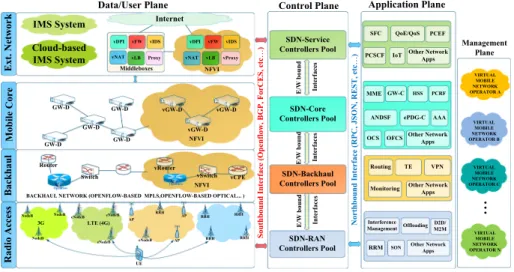
Figure4depicts the overall architecture of a future mobile network that has realized SDN and virtualization technology. The key features of the SDVMN architecture are the sep-aration of the control and the data plane and the virtualization of network infrastructures, as well as the virtualization of network functions. To make the architecture more easily understandable, we will present the detailed architecture of SDVMN in two directions: as a vertical description from bottom to top and then in a horizontal description from left to right.
Vertically, we follow the reference model of the current 3GPP evolution packet system, which consists of three main parts: a radio access network (RAN), mobile backhaul, and the mobile packet core network. The UE uses the services from external networks (IMS system, the Internet, etc.) through a SGi–LAN interface, as defined in [18], where a set of middleboxes are deployed. Horizontally, we show four planes of SDN architectures: the data plane, control plane, application plane and management plane. One of our main objectives is to figure out a generic architectural model for SDVMN and map it into the SDN reference architecture. By using this generic model, we can easily understand how SDN technology and virtualization are being used in mobile networks and how our hier-archical taxonomy is made according to this model.
As depicted in Fig.4, the RAN part is the heterogeneous access network environment
which includes different access technologies such as GSM, UMTS, LTE and Wi-Fi. These radio access networks can be programmable and under the supervision of a pool of SDN-RAN controllers. The second part of the SDVMN is the backhaul network which connects a radio access network and a mobile core network. MPLS or optical technologies are two technologies currently used in mobile backhaul networks. Within the SDN concept, the network equipment used in MPLS or optical networks is enhanced with programmability. These network equipment can be dedicated hardware-based and programmable switches,
BACKHAUL NETWORK (OPENFLOW-BASED MPLS,OPENFLOW-BASED OPTICAL... )
Internet Data/User Plane UE SDN-RAN Controllers Pool SDN-Backhaul Controllers Pool Control Plane SDN-Core Controllers Pool Management Plane
...
Routing Monitoring MME GW-C HSS PCRF Application Plane RRM Interference Management SON Sou th bound In te rf a c e( O penflo w, B GP, F o rC ES, e tc … ) Nort h boun d Interface (RP C, J SON ,R E ST ,e tc … ) ANDSF ePDG-C eNodeB RRH AP AP AP RRH RRH RRH Backhaul Radio A ccess Mobile Core Ext. Network Router Switch Openflow NFVI vRouter vCPE vSwitch Openflow GW-D Middleboxes SDN-Service Controllers Pool IMS System Cloud-based IMS System VIRTUAL MOBILE NETWORK OPERATOR N VIRTUAL MOBILE NETWORK OPERATOR C VIRTUAL MOBILE NETWORK OPERATOR B VIRTUAL MOBILE NETWORK OPERATOR A E /Wb o u nd Inter faces E /W b o un d Interfaces E /W b oun d Inter faces SFCOCS OFCS Other NetworkApps
TE VPN Other Network Apps PCEF Other Network Apps Offloading Other Network Apps QoE/QoS PCSCF AAA NodeB NodeB NodeB D2D/ M2M IoT eNodeB eNodeB eNodeB RRH GW-D GW-D GW-D GW-D vGW-D vGW-D 3G LTE (4G) vGW-D NFVI vDPI vFW vIDS vNAT vLB vProxy vDPI vFW vIDS vNAT vLB Proxy NFVI
routers or virtualized switches that are realized as virtual machines (VMs) running on a cloud computing system or NFVI. The underlying infrastructure of the mobile backhaul network is controlled by a pool of SDN-backhaul controllers.
The third part of the SDVMN is the mobile core network. In contrast to the traditional mobile core networks, the SDVMN core network is composed of simple network gateways called GW-Ds, which can either be dedicated hardware servers or software appliances running on the NFVI environment. The SDVMN core network can also be programmed with SDN-core controllers through open APIs. GW-Ds act as an anchor point for intra-/ inter-handover in the mobile network, and are a point of connection to external networks (e.g., IMS, the Internet, etc.). By using distributed GW-Ds, the SDVMN can eliminate the single point of failure issue, provide scalability and guarantee service availability for users. Last part is the external network placed on the top of the SDVMN architecture. The external network is an IMS system or Internet, which provides the services for UEs. Before flowing to the Internet, the user data traffic needs to pass through a set of middleboxes placed behind the SGi–LAN interface. These middleboxes help ensure security, optimize performance, and facilitate remote access. Some examples of middleboxes include fire-walls, load balancers, and WAN optimization. By realizing the concept of NFV, these middleboxes can be deployed as software appliances running on an NFVI environment. For IMS systems, with the emergence of NFV, traditional IMS is being cloudified, with the migration of proprietary hardware-based systems within a dedicated network infrastructure into software-based deployments in a cloud infrastructure.
Now, let’s look into the horizontal side of SDVMN architecture. Four layers of the general SDN architecture are separated explicitly in Fig.4. The first layer (data or user plane) enables user data traffic to be delivered through the RAN to the external network. The second layer is the control layer, where a pool of SDN controllers can be deployed for every part of the SDVMN. In fact, we can assume that the entire SDVMN architecture can be controlled and managed by a super-SDN controller. However, this makes the archi-tecture too difficult and complex to grasp fully. Therefore, we divide this super-SDN controller into four controller levels, according to the 4-tier model of mobile networks, in order to ease comprehension: the SDN–RAN controller, the SDN–Backhaul controller, the SDN–Core controller, and the SDN–Service controller. From a global view of the network state information, these SDN controllers can perform many actions to control and manage the RAN, the mobile backhaul, the mobile packet core, and the external network, respectively. For example, the SDN–RAN controller is responsible for controlling and managing the radio resources. Our use of the term ‘‘pool’’ implies that we can deploy the SDN controller in a distributed manner with a set of collaborated controllers to deal with the single point of failure issue in the control layer. These controllers cooperate with each other through east/westbound interfaces. Similar to the network devices in the data plane, the SDN controllers can also be deployed as either hardware-based or software-based controllers running in an NFVI environment.
The next layer is the application layer or application plane. Throughout RAN to the external network, the application layer consists of a series of network control functions placed on the top of the SDN controllers. Corresponding to the RAN part, the network control functions can include interference management, radio resource management and offloading. Corresponding to backhaul network part, functions which can be pushed into the controller include backhaul resource management, traffic engineering, and monitoring. Corresponding to the core network part, all network control functions including MME, GW-C, PCRF, HSS and authentication systems (AAA) can be packaged as applications
Corresponding to the external part, network functions can be deployed as a chain. Service
function chaining (SFC) and network service chaining (NSC) [36] are two typical
exam-ples of applications for this part, which refers to a carrier-grade process for the continuous delivery of services based on network function associations.
Last layer at the horizontal side of the SDVMN architectural model is the management
layer or management plane. As defined in [37], the management plane is considered to be
another plane in SDN architecture, which covers static tasks that are better handled outside the application, control and data planes and refers to human-centric interaction. In the SDVMN architecture, the term ‘‘management plane’’ refers to the operator’s management. The network virtualization technology allows multiple network operators to share the same underlying SDVMN infrastructure. In other words, the underlying SDVMN infrastructure can be divided into several virtual networks, from the RAN to the core part, according to the customized requirements of various mobile virtual network operators (MVNO).
In order to operate the SDVMN architecture smoothly, the standard interfaces are needed to define between layers. The southbound interface is used by the SDN controllers to program the mobile network data plane according to various policies and requests from the virtual operators. The southbound interface candidates include Openflow, ForCES,
PCEP and BGP. The northbound interface [38] is a programmatic interface that lives on
the northern side of the controller. Typically, a northbound interface abstracts the low-level instruction sets used by the southbound interfaces to program forwarding devices. Some typical northbound interfaces considered in the SDVMN include the REST API, RPC-JSON, and Java APIs. East/westbound interfaces are used to interconnect among con-trollers in order to achieve scalability in a multi-domain network. A typical east/westbound interface is SDNi, which is being implemented in the OpenDaylight controller [25]. In the SDVMN, the role of east/westbound interfaces is not only to deal with scalability problems but also to synchronize between parts in an SDVMN, so that it can provide a smooth end-to-end connection for users.
3.2 Benefits of SDVMN Architecture
SDVMN architecture offers several useful features for the mobile network evolution: (a) network functions that are decoupled from specific hardware devices to software on the general computing platform; (b) a centralized control plane and the enabling of a pro-grammable network; and (c) a physical network infrastructure that is sliced into virtual networks to enable network sharing. These features can be applied into every level of a mobile network architecture and result in many general key benefits, such as CAPEX and OPEX reduction, easy management and operation, speedy innovation deployment without interfering in-service networks, and efficient resource utilization. These benefits are specific to each level of mobile network architecture and are described below:
3.2.1 Benefits in Radio Access Network
By adopting the SDN and virtualization in the RAN part, we gain some following benefits. First, with network virtualization, the physical RAN resources (i.e. eNobeB) can be abstracted and sliced into virtual RAN resources and shared by multiple operators, so that the operators can save significantly on their deployment and operational costs. Through a SDN–RAN controller, the service providers can customize their own virtual network sli-ces. Second, via the virtualization and centralization of RAN functions, these RAN functions can be shared by other radio functions. This improves resource utilization and
throughput. Last, the radio resource management task is simplified by using a centralized controller for the RAN. The SDN–RAN controller is in charge of scheduling and allocating radio resources for radio access elements. The latest radio resource management and interference coordination algorithms can easily be upgraded and deployed on the SDN– RAN controller. As a result, the SDN–RAN controller can fairly allocate radio resources for radio access elements and calculate an interference map to cancel or exploit interfer-ence between adjacent cells, thus improving RAN performance.
3.2.2 Benefits in Mobile Backhaul Network
The deployment of a mobile backhaul network is often costly. With the support of NFV and SDN, mobile backhaul network equipment can be enhanced with programmability or comprise virtualized appliances running on a commodity hardware platform, which is often cheaper than a dedicated hardware-based deployment. Slicing the mobile backhaul infrastructure provides the ability to share the network resource between different mobile operators. This enables traffic to be redirected from one operator to another in cases of congestion or heavy traffic conditions.
3.2.3 Benefits in the Mobile Core Network
In this core part, the main benefits come from the virtualization of core network functions, the programmability of the core network, the centralization of the control plane, and the virtual network operator concept. First, the virtualization of core network functions helps to reduce CAPEX and OPEX, supports multi-tenancy, and scales core network resources up and down rapidly, according to the demands of mobile operators. Second, the pro-grammability of the core network simplifies its management, makes network configuration easier, and enables new innovations, with faster time to market. By using a centralized controller, the mobile network can control QoS in a fine-grained manner, according to various subscriber attributes and services’ requirements. Last, slicing enables multiple virtual network operators to run on the same physical core network infrastructure, which optimizes the device cost and resource utilization.
3.2.4 Benefits in the External Network
Here, the main benefits come from the virtualization of IMS functions and the introduction of SFC. First, the virtualization of IMS functions on a cloud system allows the mobile operators to scale network resources up and down to meet QoS requirements. Meanwhile, this also improves device resource utilization. Second, the adoption of the SDN concept to control traffic through a series of middle boxes (i.e., SFC) offers higher flexibility in service delivery from the mobile network to the Internet, and vice versa. The traffic from each subscriber only traverses through a series of middle boxes, as defined by for that particular subscriber.
4 SDVMN Taxonomy
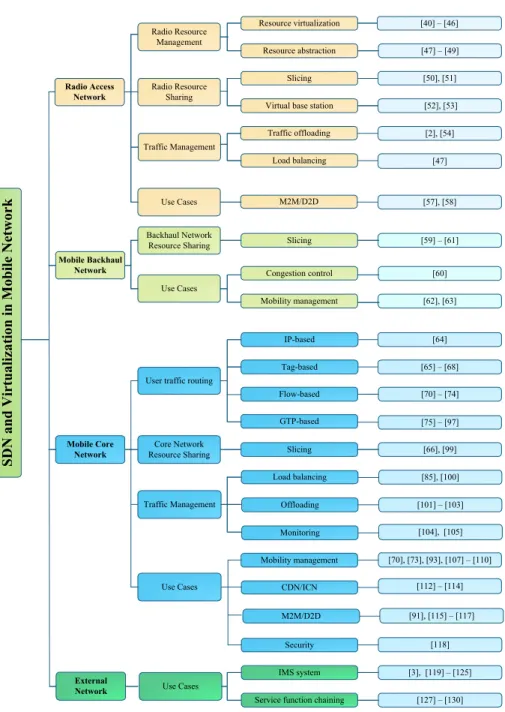
The first step in understanding the concept of SDN and virtualization in a mobile network is to elaborate a classification using a taxonomy that simplifies and eases the understanding of the related domains. In the following section, we define the taxonomy of SDN and virtualization in mobile networks according to the current solutions. Our proposed
taxonomy provides a hierarchical view and classifies the current approaches, corre-sponding to each part of mobile network architecture: mobile radio access network, mobile backhaul network, mobile core network, IMS system and service function chaining in the mobile network. In the following, we elaborate our proposed taxonomy.
4.1 Radio Access Network
At this level, the main issues identified in the literature are radio resource management, radio resource sharing, traffic management, and some use cases that will illustrate the benefits of SDN and virtualization in the mobile network.
4.1.1 Radio Resource Management (RRM)
Radio resource management (RRM) involves strategies and algorithms for controlling transmit power, channel allocation, and data rate. The object is to utilize limited radio-frequency spectrum resources and base station hardware resources as efficiently as pos-sible. Works tackling problems regarding RRM focus on two classes of solutions: resource virtualization and resource abstraction.
• Resource virtualizationThe RAN functions are separated and partially centralized into the cloud system. For example, the main functions of the base station can be divided into baseband and radio processing. The baseband functions of several base stations are combined and virtualized on the general purpose processors to perform baseband processing. In this way, this solution brings several benefits, such as low power consumption, efficient hardware resources, and throughput maximization. The research works in this direction have attempted to determine which functions should be centralized and virtualized on the cloud and deployment model, such as fully centralized or partially centralized.
• Resource abstractionThe base stations in a geographical area are abstracted as a big base station or a big cell that consists of a RAN controller and radio elements. The SDN–RAN controller will dynamically schedule and allocate radio resources to each radio element. The works in this direction focus on methods of allocating radio resources from a radio resource pool in the controller.
4.1.2 Radio Resource Sharing
As surveyed in [39], many sharing solutions are being applied into mobile network. They
can be active or passive sharing approaches. By sharing resources in a radio access net-work, mobile network operators (MNOs) can reduce their CAPEX and OPEX. All of these advantages can help an operator to better position its business within the overall com-petitive environment. When the mobile network is intended to be redesigned with SDN and virtualization, two new technologies can bring more solutions for radio resource sharing in radio access networks. As a consequence, MNOs can further increase their revenue. In order to support resource sharing among the MNOs at the radio access level, works have proposed two solutions:
• SlicingThis class focuses on FlowVisor-based solutions to slice a radio access network infrastructure into virtual radio access networks for different mobile operators. For
example, this solution deals with slicing 3D grid resources, including time, frequency, and radio elements.
• Virtual base stationThis class relies on Hypervisor-based solutions to create the virtual eNodeB, which uses the physical infrastructure and resources of another eNodeB, depending on requests from the MNO.
4.1.3 Traffic Management
Traffic management is an important issue for mobile networks. Managing traffic efficiently can improve throughput, alleviate network congestion, optimize resource use, and enhance quality of service. At the radio access layer, works tackling traffic management focus on two main mechanisms: data offloading and load balancing.
• Traffic offloadingThe works in this direction propose new data offloading mechanisms based on the SDN concept, such as programmable policy-based offloading and wireless network condition-aware offloading.
• Load balancingWe found only one work that mentions using a centralized controller with knowledge of the entire network to balance a workload among base stations.
4.1.4 Use Cases
The works in this section focus on specific problems, new aspects, and mechanisms of the radio access network that can be solved and improved with the support of SDN and virtualization. These use cases cover machine-to-machine (M2M) and device-to-device (D2D).
4.2 Mobile Backhaul Network
At this level, the works mainly concentrate on solving resource sharing issues and intro-duce some use cases of SDN and virtualization in the backhaul network.
4.2.1 Backhaul Network Resource Sharing
In addition to cutting down CAPEX and OPEX, resource sharing at the backhaul level can help network operators to recover from network failure or link congestion. Works in this category are targeted at solutions based on SDN and slicing mechanisms to create multiple virtual backhaul networks and allow one operator to share an amount of its own resources with another operator. In other words, these solutions helps re-direct mobile traffic from the communication links of one network operator to another for the purpose of load sharing in heavy traffic or link failure conditions.
4.2.2 Use Cases
The works in this category show some use cases in which the backhaul network can take advantage of SDN and virtualization, such as mobility management, congestion control, and traffic-aware reconfiguration.
4.3 Mobile Core Network
In this part of the taxonomy, we target issues that belong to the core network part.
4.3.1 Use Traffic Routing
Routing protocol is one of the important issues when we evolve our mobile network using SDN and virtualization. There are two directions for evolving a mobile core network: revolutionary and evolutionary. The revolutionary approach radically changes the current architecture of a mobile core network by using SDN-based switches, and mobile network functions are redesigned and implemented in the SDN controller. The work dealing with this approach focuses on two main routing solutions: tag-based routing and flow-based routing. The evolutionary approach applies the SDN concept into a part of the traditional core network architecture. This evolutionary approach analyzes the traditional mobile network functions, such as PGW, SGW, MME, etc., and decides which functions should be implemented to the controller, and which should be implemented in the traditional dedi-cated hardware. The research works in this approach keep using traditional routing pro-tocols in the mobile core network, i.e., GTP-based routing.
• IP-based routingpacket routing relies on the destination IP address.
• Tag-based routingpacket routing can be done using a multi-dimensional tag, including policy, base station ID, and user equipment ID.
• Flow-based routingpacket routing relies on selected fields of the IP packet header.
• GTP-based routing packet routing is based on GPRS Tunneling Protocol. However, these GTP tunnels are set up by the SDN controller in a central manner instead of systematic establishment as in the traditional mobile network.
4.3.2 Core Network Resource Sharing
Similarly to resource sharing problems in radio and backhaul networks, resource sharing at the core network is considered as a benefit of SDN and virtualization in the mobile network. Work in this direction focuses on slicing techniques to create multiple virtual core networks shared among multiple network operators. The work proposes architectures that extend from FlowVisor to slice cellular core network resources.
4.3.3 Traffic Management
Similarly to the radio access level, works dealing with traffic management at the core network cover load balancing, traffic offloading, and monitoring.
• Load balancing works in this category propose SDN-based solutions to move traffic load among SGWs or redirect data traffic from mobile networks to the Internet directly.
• Traffic offloading works in this category propose solutions that deploy SDN infrastructure in the mobile core network to offload selected traffic to cloud data centers.
• Monitoring works in this category propose solutions that integrate SDN-enabled monitoring platforms into the current mobile networks. These solutions allow configuring measurement devices dynamically and easily according to the requirements of operators.
4.3.4 Use Cases
The research in this category covers several use cases of the mobile core network with the support of SDN and virtualization. These use cases are mobility management, content delivery network (CDN) or information centric network (ICN), MTC traffic (D2D, M2M), and security.
4.4 External Networks
At this level, the major issues focus on the interfaces between the mobile network and external packet data networks. The works in this category cover several use cases of SDN and virtualization in delivering applications and services between mobile network and the external networks.
5 SDVMN: Current Approaches
As defined in the taxonomy tree in Fig.5, in this section, we present a survey on the most relevant research initiatives and current approaches adopting SDN and virtualization into today’s mobile network.
5.1 Radio Access Network
5.1.1 Radio Resource Management
One of the most prominent objectives of efficient radio resource management is to elim-inate inter-cell interference. Inter-cell interference management helps to avoid the over-lapping between cells so that the user throughput is improved. The drawback of inter-cell interference management in existing mobile networks is that it is performed in a distributed fashion. Thus, the techniques such as inter-cell interference coordination (ICIC), enhanced ICIC (eICIC) or coordinated multi-point transmission/reception (COMP) are highly complex and suboptimal. However, with the SDN concept, this task is done easily by an SDN controller in a central manner. Indeed, with the global view of the whole network, RRM function on top of the SDN controller can construct an interference map between base stations and thus can mitigate the inter-cell interference easily. In addition, through the SDN controller, any RRM upgrades can be achieved independently from the base station hardware. In the following we show how the radio resource is managed and allo-cated in the RAN part of SDVMN.
5.1.1.1 Resource Virtualization Proposed by China Mobile [40] in 2011, the C-RAN concept spread widely in recent years as the hottest topic in the radio access part of mobile networks. Unlike the classical distributed base station system, in which a radio remote head (RRH) entity and baseband unit (BBU) entity are tightly coupled, C-RAN represents a system of distant RRH entities connected using high bandwidth front-haul links to a single centralized BBUs pool on a cloud computing system. The radio signal from/to a particular RRH can be processed by a virtual base station, which is part of the processing capacity allocated from the physical BBU pool by the virtualization technology. On the other hand, the resource for an individual RRH is dynamically and flexibly allocated. For efficient
radio resource management in a multi-cells environment, C-RAN adopts the multi-cell joint radio resource management and cooperative multi-point transmission schemes. After
the C-RAN concept was proposed, Hadzialic et al. [41] focused on known techniques to
realize this concept. Checko et al. [42] made a survey that covers the state-of-the-art
literature on C-RAN in the mobile network. This technology overview makes it easy for Radio Resource Management Radio Resource Sharing Resource virtualization Resource abstraction [47] – [49] Slicing [40] – [46] [50], [51]
Virtual base station [52], [53]
Backhaul Network Resource Sharing Use Cases [59] – [61] [62], [63] Slicing Mobility management Congestion control [60]
User traffic routing
Core Network Resource Sharing Use Cases [66], [99] Slicing Radio Access Network Mobile Backhaul Network Mobile Core Network External Network SDN a nd Virtualization in Mobile Network Use Cases Use Cases IMS system
Service function chaining [127] – [130] [3], [119] – [125] Traffic Management M2M/D2D [57], [58] Traffic offloading [2], [54] Load balancing [47] Mobility management [70], [73], [93], [107] – [110] Load balancing [85], [100] Offloading [101] – [103] CDN/ICN [112] – [114] Monitoring [104], [105] Security [118] Traffic Management Flow-based [70] – [74] GTP-based [75] – [97] [64] IP-based [65] – [68] Tag-based M2M/D2D [91], [115] – [117]
anyone who wants to understand the fundamentals of C-RAN and engage in research
activities on C-RAN. The CONCERT [43] proposed a more flexible solution than the
C-RAN in which the baseband resources can be virtualized in a hierarchical manner with three levels: local, regional and central resource pools. In addition, the front-haul network of CONCERT architecture is SDN network.
Unlike C-RAN and CONCERT, the authors in [44,45] proposed RANaaS, a general
radio resource virtualization solution, when considering the trade-off between the full centralization and decentralization. It means RANaaS partially centralizes RAN’s func-tionalities depending on the actual needs as well as network states.
Yang et al. [46] proposed OpenRAN, which is the integration of the C-RAN and SDN
concepts. By doing so, the RAN becomes open, controllable, and flexible. OpenRAN contains three main parts: a wireless spectrum resource pool (WSRP), cloud computing resource pool (CCRP) and an SDN controller. The WSRP is composed of multiple physical remote radio units (pRRUs) to enable several virtual RRU (vRRU) to coexist in one shared pRRU via virtualization technology. The SDN controller plays a role of creating and dynamically optimizing vRRUs according to the requirements. It enables fair allocation and virtualization of radio spectrum, computing and storage resources to virtual access elements in heterogeneous RANs.
In summary, radio resource management with the concept of resource virtualization is mostly related to the migration of several RAN functions into a cloud computing system.
5.1.1.2 Resource Abstraction Unlike the resource virtualization, SoftRAN [47], PRAN [48] and V-Cell [49] introduce another new concept to tackle radio resource management,
called resource abstraction. SoftRAN [47] proposed to rethink the radio access layer of
current LTE infrastructure and focused on the control plane design by abstracting all the physical base stations (not only RRU) in a local geographical area into a virtual big base station. As a result, these physical base stations become simpler radio elements with minimal control logic and are controlled by a logically centralized controller. In SoftRAN, the radio resources are abstracted out as three-dimensional grids (3D grid) of time, fre-quency, and base station index or radio element index. Inside the controller of SoftRAN, there is a RAN information base (RIB) which is the core element of SoftRAN. The RIB consists of essential information to be updated by the controller including an interference map, flow records and network operator preferences. It is maintained by the controller and
is accessed by the various control modules for radio resource management. PRAN [48] is
an extension of SoftRAN which provides mechanism to dynamically reconfigure L1/L2 data plane.
While SoftRAN and PRAN focus on the abstraction of base stations and do not
support multi access technology (Multi-RAT), V-Cell [49] targets cell abstraction with
the ability to support multi-RAT and heterogeneous cells (macro, Pico, and femto). These cells are abstracted as a single big macro cell, and the radio resources for them are considered as a single pool of resources that is managed by a logically centralized software defined network controller (SD-RAN controller). The radio resources in V-Cell are abstracted out in a resource pool through a 3-dimensional matrix including time, frequency and space. The main role of the SD-RAN controller is to allocate radio resources, management limited spectrum, interference and power allocation and balance load across the entire pool of physical cells inside the V-Cell. In summary, the object of two approaches is to abstract the radio resources and manage them by using an SDN controller in a central manner.
5.1.2 Radio Resource Sharing
5.1.2.1 Slicing In order to share radio resources among different mobile operators, one slicing technique was introduced in [50]. RadioVisor [50] extends the FlowVisor concept to allow each controller to access a slice of the radio access infrastructure, in particular SoftRAN architecture [47]. RadioVisor enables traffic to be steered to and from the con-trollers of virtual operators. It isolates radio resources, control channel messages, and CPU resources among various virtual operators. RadioVisor architecture is composed of a device and application to slice mapping, the radio resource allocation and isolation function, and slice manager. The first component is the traffic to slice mapping at RadioVisor and radio elements. The second component performs a heuristic algorithm to allocate the resource to slices in a fairness manner according to resource requests and the service agreements. The last component is in charge of slice configuration, creation, modification, deletion and multi-slice operations. It interacts with each slice through an API provided by RadioVisor. Each slice is defined based on operator, device, subscriber, and application attributes.
While RadioVisor presented a general concept for creating radio access network slices for different mobile operators, Spapis et al. [51] introduced a complete functional archi-tecture to only share the spectrum resources among mobile network operators. Depending on the needs as identified by their operations, administration, maintenance (OAM) mod-ules, the spectrum resources will be allocated from a central spectrum pool to eNBs in the RAN through RRM commands. In addition, the authors also presented a potential
implementation model based on the combination of SoftRAN architecture [47] and
MobileFlow architecture [75].
5.1.2.2 Virtual Base Station Another approach for resource sharing was proposed in [52, 53], which create virtual base stations from the shared physical base stations of multiple network operators. Zaki et al. [53] proposed a sharing solution based on the virtualization of eNodeB in the LTE access network. A key component is called Hypervisor, which is located on top of the physical eNodeB resources and is in charge of allocating these resources to each virtual eNodeB (VeNB) according to the request of different MVNOs. Costanzo et al. [52] presented OpeNB, which is also based on the virtualization of eNodeB in the LTE access network. However, the OpeNB architecture is more flexible by lever-aging SDN and Openflow technologies. In OpeNB, the virtualization of eNodeB can be handled dynamically based on network state and some predefined agreements among various operators. It enables an operator to hire on-demand the physical infrastructure and resources owned by other operators. The OpeNB architecture consists of two types of physical elements: NAeNBs, OpeNBs, and two types of software entities: a main controller (MC) and OpeNB controller (OC). NAeNBs are NV aware eNodeBs, which can forward the NV signaling from the MC toward an OpeNB. OpeNBs are eNodeBs that are controlled by the MC and have the ability to create VeNBs. OpeNB sharing between multiple operators is done by NV procedure triggered from the MC. The OC located inside an OpeNB is responsible for triggering VeNBs upon the request from the MC. These works
5.1.3 Traffic Management
5.1.3.1 Traffic Offloading Mobile traffic offloading refers to the movement of data traffic from a mobile network to a Wi-Fi network. In a mobile network, the traffic offloading is done by an access network discovery and selection function (ANDSF). This entity is used for discovering wireless networks close to the mobile user and then performing the Wi-Fi offload. In [2], the author said that the mobile traffic offloading can be done by SDN since the SDN controller can dynamically control the traffic in a mobile network based on various trigger criteria including individual flow rate, aggregate flow
rate, application type, available bandwidth, etc. In [54], the authors introduced a new
architecture for offloading data traffic from a mobile cellular network to a Wi-Fi network by converting network resource management (NRM) and RRM functions to software modules running on an SDN controller. The RRM application is responsible for col-lecting radio access network conditions such as traffic load or cell capacity while NRM (integrated PCRF) stores the subscriber and application information. In this architecture, the SDN controller is in charge of composing information of these two modules and creates a single set of policies and rules which are then installed to the local control agents in the network gateway and the RAN. This architecture enables the SDN con-troller to gather the real-time network condition and then decide suitable offloading policies.
5.1.3.2 Load Balancing Consider the case where one base station is overloaded with many clients while a nearby base station is free of serving any client. Due to the nature of Table 1 Survey on resource sharing solution in SDVMN
Reference Network part Solution type Solution description Radiovisor [50]
RAN Slicing Create slices of radio access infrastructure. Each slice is
defined using predicates on operator, device, subscriber, and application attributes Spapis et al.
[51]
RAN Slicing a complete functional architecture to only share the
spectrum resources among mobile network operators. Depending on the needs as identified by their OAM modules, the spectrum resources will be allocated from a central spectrum pool to eNBs in the RAN through RRM commands
Costanzo et al. [52]
RAN Virtual base
station
Virtual eNodeBs (VeNBs) are created dynamically from shared physical eNodeBs’ resources with the assist of SDN controller
Zaki et al. [53] RAN Virtual base
station
VeNBs are created from shared physical eNodeBs’ resources according to the request of different mobile virtual network operators
Philip et al. [59–61]
RAN and Backhaul
Slicing Backhaul infrastructure in which access and
aggregation backhaul nodes are incorporated with openflow protocol is shared by using a slicing mechanism
CellVisor [66] Mobile core Slicing Using slicing technique to share mobile core network
infrastructure in the revolutionary mobile architecture MobileVisor
[98]
Mobile core Slicing Using slicing technique to share mobile core network
the distributed control plane in the traditional RAN network, there is no mechanism to balance the traffic load between two such base stations. In [47], the authors proved that the load balancing can be facilitated by using the SDN controller, which has the global view of the entire network and workload. Indeed, the SDN controller will trigger the handover of edge users to balance the load between one base station and its neighbors.
5.1.4 Use Cases
Since SDN and virtualization brings a number of benefits in a radio access network, many works have proposed to adopt them into different application domains including dealing with the machine to machine (M2M) and device to device (D2D) traffic. In the following, we will review these use cases.
5.1.4.1 Dealing with M2M and D2D Traffic M2M [55] and D2D [56] are two new communication types in mobile networks. The M2M and D2D over mobile cellular net-work refer to the communication between two mobile nodes without traversing to the base station or mobile core network. Instead, these devices often communicate with each other
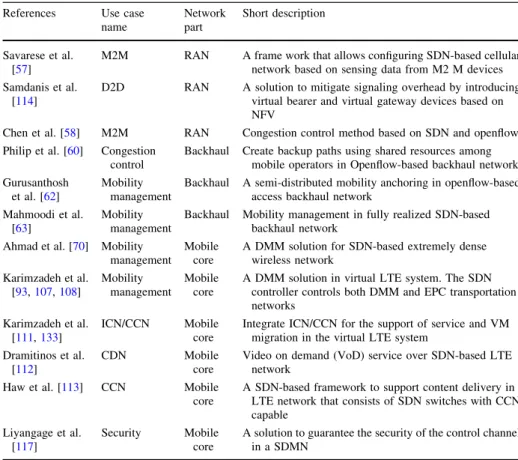
through a M2M or D2D gateway. The authors in [57] proposed a framework that combines
the SDN-based cellular mobile network with M2 M. The main purpose of this paper is to flexibly reconfigure the cellular network based on the monitoring information received from M2M devices. The M2M sensing devices monitor the surrounding area of eNodeBs and send the sensing data to the M2M server via the IP backbone network. The M2M server will alert the SDN control software to reconfigure the network assessments and resource allocation to avoid a disaster in the network. In order to control the congestion
exposed by the M2M communication in the LTE network, the authors in [58] proposed
congestion control methods based on SDN and Openflow. To verify this method, the authors deployed a test-bed framework using NetFPGA and Openflow platform.
5.2 Mobile Backhaul Network
5.2.1 Backhaul Network Resource Sharing
As discussed above, the reduction of CAPEX/OPEX and the improvement of network efficiency and utilization are two objectives of resource sharing in mobile networks. At this part, the authors in [59–61] proposed a solution for backhaul infrastructure sharing by using a slicing mechanism and incorporating Openflow protocol within the access and aggregation nodes. The slicing mechanism is done by extending the FlowVisor concept. As a result, an operator can lease the backhaul network of another operator in cases of link congestion and heavy traffic condition.
5.2.2 Use Cases
In the following, we describe briefly some use cases in mobile backhaul with SDN and virtualization.
5.2.2.1 Congestion Control Philip [60] proposed Openflow-based backhaul network architecture which allows one operator to share its backhaul resources with others. This solution provides mobile operators with backup links in cases of link congestion or heavy
traffic condition. Thus, mobile operators can achieve better resource utilization within their own backhaul network.
5.2.2.2 Mobility Management In order to improve the mobility management efficiency
in cases of inter-eNodeB handovers, the authors in [62] proposed SDMA, a
semi-dis-tributed mobility anchoring in LTE backhaul access network based on Openflow and SDN technologies. In this architecture, all backhaul access nodes are realized as Openflow switches and controlled by Openflow Controllers via Openflow protocol. Furthermore, the concept of service VLAN (S-VLAN) id and customer VLAN (C-VLAN) id is used to separate the traffic of the users under different Openflow controllers. Then a detail of handover procedure including initial attach, handover under the same controller or dif-ferent controllers was defined. Unlike [62], the authors in [63] tried to fully realize the concept of SDN into the entire mobile backhaul network. They introduced a distributed SDN control plane. The management plane, including MME, HSS, PCRF, and billing system, is implemented within VMs that can communicate with SDN controllers. As a case study of mobility management, the authors indicated that the new architecture reduces not only the power consumption of the UE but also the signaling message overhead between entities at the backhaul side.
5.3 Mobile Core Network
5.3.1 User Traffic Routing
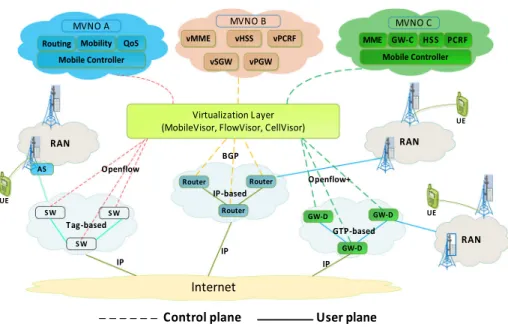
As defined in the taxonomy tree above, there are three kinds of mechanisms for routing the user traffic in SDVMN: tag-based, flow-based or IP-based, and GTP-based. For each method, we show how the current mobile architecture is redesigned with them as depicted in Fig.6.
5.3.1.1 IP-Based Routing The authors in [64] considered IP-based routing in virtual-ization-based LTE EPC architecture (vEPC). In this architecture, the control plane and user plane of EPC entities also are decoupled from each other. Two new entities, namely the EPC edge router (EPC-E) and core router (RTR), were introduced. EPC-E is a router which locates at the same place as the SGW and terminates GTP tunnel between RAN and the core part. It maintains routing information of every UE that is notified by the control plane. RTRs are regular IP routers that are configured from the vEPC’s control plane by a routing protocol like BGP. In other words, BGP is used as protocol for updating the routing in formation in EPC-E and RTR from vEPC’s control plane as well as for routing between EPC-E and RTR in the data or user plane.
5.3.1.2 Tag-Based Routing Li et al. [65] proposed SoftCell, which aims at designing a revolutionary architecture for mobile networks to support numerous fine-grained policies in a scalable manner. The SoftCell architecture is composed of commodity switches, which are simpler and cheaper than specialized network elements (SGW, PGW) and just perform packet forwarding, and relegate complicated packet processing to middleboxes; a set of middleboxes, which act as transcoders, web caches or firewall; access switches, which classify fine-grained packets on traffic from UEs; and a central controller, which is responsible for computing and installing switch-level rules based on subscriber attributes and application types. In order to deal with the challenges of data explosion in the data
plane or the scalability problem in the flow table, the authors proposed the use of multi-dimensional aggregation and tag-based routing. In particular, the forwarding rules in SoftCell are aggregated on three dimensions: policy, location ID, and UE ID. For example, the policy tag allows for aggregating flows that share a common policy. CellSDN [66], the prior work of SoftCell, leverages SDN into both access and core networks. In this work, the author mainly focused on describing use cases that can benefit from CellSDN, such as network control and billing monitoring, seamless subscriber mobility, and remote control of the base station. The routing mechanism is the same as SoftCell by using tag-based routing. Moradi et al. [67,68] proposed SoftMoW to address the challenges in a very large cellular network or mobile WAN. The challenges derive from suboptimal routing, lack of support for seamless inter-region mobility, scalability, reliability, and the rise of new applications (e.g., M2M, IoT). SoftMoW is composed of distributed programmable switches and middleboxes instead of expensive and inflexible gateways (SGW, PGW). SoftMoW is constructed in a hierarchical control plane for the core and radio access networks with L levels. The physical data plane is divided into several logical regions, each of which is controlled by a leaf controller. Leaf controllers abstract their topologies and expose logical components to the next level, including a gigantic switch (G-switch), an abstraction of all physical switches; a gigantic base station (G-BS), an abstraction of a group of physical base stations; and a gigantic middlebox (G-Middlebox). As a conse-quence, the entire network is controlled by a highest-level parent controller at the root region. The routing mechanism in SoftMoW is also performed by an alternative method of tag-based routing called label-based routing. The parent controller pushes a global label into each traffic group while the child controllers perform label swapping at ingress and egress switches. Openflow protocol is assumed as the southbound interfaces in CellSDN and SoftCell as well as SoftMoW architecture.
Virtualization Layer (MobileVisor, FlowVisor, CellVisor)
UE RAN Internet GW-D Mobile Controller UE RAN UE RAN Mobile Controller User plane Control plane
MVNO A MVNO B MVNO C
S W Router GW-D GW-D AS Openflow BGP Openflow+ IP-based Tag-based IP IP IP MME GW-C HS S Router Router GTP-based S W S W
Routing Mobility QoS vMME PCRF
vPGW vSGW
vHSS vPCRF
5.3.1.3 Flow-Based Routing In [70,71], the authors proposed CROWD, an SDN-based solution for dense heterogeneous wireless networks. The main target of this solution is to deal with various challenges in dense heterogeneous wireless network in terms of mobility management, interference management, and energy consumption. The CROWD archi-tecture consists of two-tier SDN controller hierarchy with two types of controllers: a local controller (CLC) and regional controller (CRC). The CLC requires data from the network at a more granular time scale while the CRC requires aggregate data from the network and takes responsibility for management of the CLCs. The data plane of CROWD architecture is composed of DMM gateways (DMM-GWs), which are interconnected using an Open-flow-based transport network. Therefore, the data traffic will be routed using a Open-flow-based routing mechanism.
Trivisonno et al. [72,73] proposed an SDN-based plastic architecture for 5G networks consisting of unified control plane and a clean-slate forwarding plane. The control plane is represented through three logical controllers: edge controller I for processing signaling messages for access nodes and installing forwarding rules into non-access nodes, edge controller II for processing signaling messages between UEs and access nodes, and an orchestration controller which is responsible for resource management and allocation of both 5G control and data plane entities. The data traffic between access and non-access nodes are routed using a flow-based routing mechanism. In addition, the authors also showed the backward compatibility with the legacy systems.
The authors in [74] also proposed an approach for LTE mobile core network relying on
the concept of SDN. In this architecture, the MME entity still exists and is responsible for mobility management. The MME communicates with an Openflow controller to trigger forwarding path setup in Openflow switches, routers according to the UE’s state. The routing in the data plane is relied on flow-based routing mechanism.
5.3.1.4 GTP-based Routing Compared to the above approaches, the GTP-based routing approach is the most popular solution for routing user data packets in SDN and virtual-ization-based mobile core networks. This approach refers to the evolution of mobile core networks where the tunnel between core network entities is still kept and the tunnel setup is facilitated by the use of an SDN controller. MobileFlow [75] proposed a software-defined mobile network (SDMN) architecture. In MobileFlow, the control and data plane are also decoupled from each other. Two main components of MobileFlow are the MobileFlow forwarding engine (MFFE) and MobileFlow controller (MFC). MFFEs are interconnected by an underlying Openflow-based transportation network. MFFEs must support carrier-grade functionality, such as tunnel processing and charging. The MFC has some necessary functions for managing the entire network, such as topology discovery, network resource monitoring or network resource virtualization. In addition, the MFC consists of function blocks for tunnel processing, mobility anchoring, routing and charging. The mobile net-work applications, including the control functions of all current EPC entities (e.g., eNB-C, SGW-C, PGW-C, MME, etc.) are implemented on top of the MFC. The MFC computes and sets up GTP tunnels into MFFEs by using a lightweight protocol called Smf.
Several proposals [76–80] leverage the SDN concept into mobile core gateways. In
[76], the authors made an analysis of all mobile core gateways’ functions and then mapped them into four alternative deployment frameworks based on SDN and Openflow including full cloud migration, control-plane cloud migration, signaling control cloud migration and scenario-based cloud migration. The authors clearly presented the pros and cons of each deployment decision. In addition, several SDN frameworks for GTP tunnel processing and
charging control function are also proposed. Next, in [77] these authors continue their work
in [76] by addressing the function placement problem. In this work, the authors grouped
four deployment models in [76] into two main categories: a virtualized gateway (NFV) and decomposed gateway (SDN). The first category refers to fully virtualizing SGW and PGW into a data center, and an off-the-shelf network element (NE) is used to direct the data traffic from the transport network to the data center. The second category refers to decomposing gateway functions, meaning that only the control plane function is shifted to the data center and integrated with SDN controllers while the data plane is processed by enhanced SDN network elements (NE?). To find the most optimal deployment solution, the authors formed a model by taking the control-plane load and data-plane latency into account, and then tried to minimize these parameters. By doing so, the operators will have a tool to make their own deployment decision: virtualizing all gateways or decomposing all gateways or a combination of two. As an extension of the work in [77,78] proposed power saving models to maximize power savings by adapting the datacenter operation according
to the time-varying traffic patterns and datacenter resources. The authors in [79, 80]
similarly adopted SDN and NFV into EPC S/PGWs. In these works, the control function of an S/P integrated gateway (S/PGW) is decoupled from the user plane. While virtualized S/PGW control is realized as VMs in a cloud computing system, S/PGW user plane can be realized either by VM or dedicated hardware. The dedicated hardware is located possibly close to the access network and is responsible to fast path processing. Another network function implemented in VM in cloud is router functionality. It is used to run routing protocol and advertise UE IP prefixes via the SGi interface. The last element is the SDN controller, which is responsible for allocating UE IP addresses and GTP TEIDs and installing UE specific flow entries to the switch during an attachment procedure and modifies them during a handover. The main objective of this work is to dynamically switch the GTP termination point of an active session between the cloud and fast path in dedicated devices.
Regarding the implementation aspect, several efforts have been made to design appropriate protocols for software defined mobile networks [81–84]. Considered the first approach that adopted the SDN and Openflow concept into the LTE EPC environment, the authors in [81–83] introduced an evolution of mobile core network architecture based SDN and Openflow, which allows the entire control plane to be moved into a data center. In these works, the authors mainly focused on enhancements of Openflow 1.2 for supporting the process of GTP tunnel in the cloud-based mobile core network. While [81,82] clearly describe how to manipulate Openflow 1.2 to implement GTP TEID routing in EPC architecture, [83] takes 3G packet core network architecture into account. Alternatively,
[84] presented the detail design, implementation, and evaluation of a software defined
telecommunication controller (OFC), switch (OFS) and protocol (OFP) according to the
latest Openflow standards [6] (i.e., Openflow version 1.4) in regard to the EPC. The
software defined telecommunication network (SDTN) architecture presented in this work also relies on the separation of the control plane and user plane. The design of OFS in SDTN is done by using a table-lookup pipeline with multiple table support, virtual port for GTP/GRE matching and Openflow agent for communicating with the OFC. The control functions, such as PGW-C and SGW-C, can be deployed as higher layer network appli-cations upon the controller.
Other approaches [85–88] leverage Openflow into the LTE/EPC architecture with some
procedure analyses. In [85,86], the authors introduced a new control plane in 3GPP LTE/ EPC architecture for supporting on-demand connectivity services such as load balancing and resiliency and then proved the reduction of signaling load by providing a procedure
![Fig. 2 Overview of SDN architecture [26]](https://thumb-us.123doks.com/thumbv2/123dok_us/9445970.2424941/5.659.76.585.579.894/fig-overview-of-sdn-architecture.webp)
![Table 1 Survey on resource sharing solution in SDVMN Reference Network part Solutiontype Solution description Radiovisor [50]](https://thumb-us.123doks.com/thumbv2/123dok_us/9445970.2424941/18.659.69.597.106.506/resource-solution-reference-network-solutiontype-solution-description-radiovisor.webp)