Working paper Management Sciences GR 08-01
The impact of loyalty programs in a B-to-B context
– results of an experimental design
P.G. (Peter) Daams, MSc.
Marketing Executive Business Services at a supplier of office products and services in the Netherlands
Dr. C.J. (Kees) Gelderman
Associate professor at the Open University of the Netherlands, [email protected]
Dr. J.M.C. (Jos) Schijns, MBA *
Assistant professor at the Open University of the Netherlands, [email protected]
The impact of loyalty programs in a B-to-B context
– results of an experimental design
Abstract
Studies on the effects of customer loyalty programs have produced ambiguous and mixed results, while researchers have not widely explored the impact of loyalty programs in a B-to-B context. This study aims to contribute to our knowledge about the impact of loyalty programs on the loyalty of customers in business markets. While most studies are based on cross-section data, panel data and Dirichlet models, we have used a powerful, classic before-and-after experimental design in a real-life setting. The data allowed for testing hypotheses on the loyalty effect and the selection effect of a loyalty program which was introduced by a supplier of office products. The results indicate that a customer loyalty program, even in a B-to-B setting, has a significant and positive effect on both behavioural and attitudinal loyalty. The findings suggest that participants in the program change their purchase behaviour and feel more committed since joining. In addition, a selection effect was found, indicating that loyalty programs attract customers that were more loyal, even before joining the program.
Keywords
Loyalty program, behavioural loyalty, attitudinal loyalty, selection effect, Customer Relationship Management
1. Introduction
An overwhelming number of studies have discussed and tested the concept of customer loyalty (e.g., Baldinger and Rubinson, 1996; Bandyopadhyay and Martell, 2007; Beatty and Kahle, 1988; Day, 1969; Dick and Basu, 1994; Liddy, 2000) and its relationship with other variables (e.g., Bennet et al., 2005; Donio et al., 2005;Gounaris, 2005; Lam et al., 2004; Morgan and Hunt, 1994; Rauyruen and Miller, 2007; Schijns, 1998). However, in spite of the growing number of loyalty programs, much less research has dealt with the effectiveness of such programs (Yi and Jeon, 2003; Kivetz and Simonson, 2002). Most researchers have studied loyalty in a consumer context. Considering the nature of large B-to-B transactions and the rewards associated with maintaining loyal business customers (Rauyruen and Miller, 2007), surprisingly only few studies are set in a B-to-B context (Leenheer, 2004).
In spite of the growing number of academic studies, views differ as to the actual impact of such programs (Mueller, 2007). Some studies reported a positive impact on loyalty (e.g. O’Brien and Jones, 1995; Grinnell, 2003), while others did not find evidence for an impact of loyalty programs (e.g. Sharp and Sharp, 1997; Dowling and Uncles, 1997; Uncles et al., 2003) or even report that loyalty programs do not help to generate referrals, but instead can foster the wrong attitude (e.g. Rosenspan, 1998). A substantial body of research appears to be inconclusive as to the actual impact of loyalty programs on customer loyalty. These mixed findings have
contributed to a heated discussion whether loyalty programs create loyalty, or encourage
customers to shop around and discourage loyalty. Bandyopadhyay and Martell (2007) point at an unclear understanding of the loyalty concept and at the inability of “numerous” studies to
produce generalizable results. A reason for the inability to produce generalizable results might be found in the application of different research designs and methods of data collection and analysis
(Mueller, 2007). Most studies are based either on surveys that only gather post-launch data or on empirical generalizations using Dirichlet models, purchase data and/or household panel data.
In an ideal research design relevant data are collected before and after the launch of a loyalty program in a real-life setting (as opposed to a laboratory study). However, few
researchers use such a powerful, classic before-and-after experimental design. The majority of studies evaluate the impact of loyalty programs by using post-launch data. In practice pre-launch data are often not available and cannot be collected post hoc (Sharp and Sharp, 1997: 476). However, in order to assess the true impact of a loyalty program, a before-and-after experimental design is required, collecting pre- and post-launch data from a treatment group (customers who participate in the loyalty program) and a control group (customers who do not participate).
This study contributes to the existing literature in a number of ways. First of all, in our study we assess the effects of a loyalty program using a classic before-and-after experimental design, as both pre-launch data and post-launch data are gathered from participants and non-participants of a loyalty program. Secondly, we will study both the behavioural and the attitudinal dimension of loyalty. Most studies are limited to the behavioural effects of a loyalty program. Thirdly, most empirical research focuses on B-to-C relationships. Researchers have not widely explored the impact of loyalty programs in a B-to-B context (e.g. Rauyruen and Miller, 2007). We will investigate the impact of a loyalty scheme in a B-to-B setting. Fourthly, we will take the selection effect of loyalty programs into account. “Most methodologies used do not account for the selection effect of loyalty programs, leading to biased results” (Mueller, 2007).
2. Theoretical background
2.1 Loyalty and loyalty programs
Many studies have defined loyalty from a behavioural perspective (e.g. Kahn et al., 1986; Ehrenberg et al., 1990),while other studies suggest that attitude should be included along with behaviour to define loyalty (e.g. Dick and Basu, 1994; Rundle-Thiele, 2005). Oliver (1997: 392) defined loyalty as “a deeply held commitment to re-buy or re-patronize a preferred
product/service consistently in the future, thereby causing repetitive same-brand or same-brand-set purchasing despite situational influences and marketing efforts having the potential to cause switching behaviour”. Consistent with this definition, a two-dimensional conceptualization of loyalty is proposed that incorporates both behavioural and attitudinal aspects (cf. Bandyopadhyay and Martell 2006; Baldinger and Rubinson, 1996; Day, 1969; Dick and Basu, 1994; Hallberg, 2004; Koslowsky, 2000; Liddy, 2000; Oliver, 1997; Pritchard et al., 1992; Schultz and Bailey 2000). In this study we will investigate both the behavioural and the attitudinal aspect of customer loyalty.
A loyalty program is defined by Yi and Jeon (2003) as a marketing program that is designed to build customer loyalty by providing incentives to profitable customers. Loyalty programs are obviously aimed at stimulating customer loyalty. More specifically, loyalty programs are structured marketing efforts which reward and encourage loyal behaviour (Sharp and Sharp, 1997). The most essential feature of a loyalty program is that it rewards valued behaviour of customers.
Current research results on the effects of customer loyalty programs seem to be
ambiguous. Rosenspan (1998), for example, illustrates how a loyalty program does not always create loyalty, but instead can foster the wrong attitude. He argues that loyalty programs do not
necessarily foster good feelings towards the product or service, help generate referrals, or even affect attitude.
Sharp and Sharp (1997) analyzed a large (multiple participant) loyalty program in terms of its repeat purchase loyalty effectiveness, using the Dirichlet model. This model provides the baseline against which the changes that may be brought about by a loyalty program can be evaluated. This study was not able to show that a particular loyalty program had brought about substantial changes in repeat purchase loyalty. The conclusion was that it is very difficult to change the fundamental repeat purchase patterns of markets. However, Sharp and Sharp (1997: 485) suggest that “it is clearly possible to alter repeat purchase patterns, at least to a small degree, and loyalty programs are probably the only marketing effort which deliberately focuses on
bringing about such change.”
Research by Dowling and Uncles (1997) and Meyer-Waarden and Benavent (2006) suggest that most loyalty schemes do not substantially change market structures, which is in line with the conclusion of Sharp and Sharp (1997). Dowling (1998) concludes that companies need a loyalty program, if they want to be a player in the lodging industry. O’Brien and Jones (1995) argue that rewards programs do create loyalty, provided that the company understands how to share value. Similarly, Grinnell (2003) posits that loyalty programs can only be successful if they are well crafted and properly executed. Using market-wide household panel data on supermarket purchases, Leenheer et al. (2002; 2007) found that loyalty programs relate positively to share-of-wallet, although the programs differ widely in effectiveness. Some programs turned out to be quite ineffective.
Despite the prevalence of loyalty programs all over the world, empirical research on the effects of loyalty programs is still relatively scarce (Yi and Jeon, 2003), especially in a B-to-B setting. In business marketing it is not self-evident that a loyalty program might be an appropriate
tool for building relationships with customers. Companies need products and services to feed, support and maintain business processes, while consumers strive for satisfaction of their needs. Professional buyers are believed to behave more rationally and less emotionally than consumers (Van Weele, 2005), which might reduce the potential effectiveness of loyalty programs in a B-to-B context. In addition, many companies have policies with regard to the receipt by employees of gifts from suppliers. The principles and standards of ethical supply management conduct, which have been developed by The Institute for Supply Management (2005), recommends supply professionals to “avoid (…) the acceptance of gifts, entertainment, favor or services from (…) suppliers that might influence, or appear to influence, supply management decisions”. Besides loyalty programs, especially in a B-to-B context other antecedents of business-to-business loyalty have been proposed, such as perceived risks and absence of choice (Rauyruen and Miller, 2007). Relationship quality, trust, involvement, satisfaction, purchase development, and switching costs are constructs which have been linked to loyalty in the B-to-B context (e.g. Lam et al., 2004; Bennett et al., 2005; Gounaris, 2005; Rauyruen and Miller, 2007). Our study aims at identifying the effects on both attitudinal and behavioural loyalty after the introduction of a loyalty program in a B-to-B context, using an experimental design with a pre- and post-measurement. Besides, we investigate whether the loyalty program generates a selection effect.
2.2 Behavioural loyalty
Behavioural loyalty refers to patterns of repeat purchasing of a brand/product as a manifestation of loyalty (Jacoby and Chestnut, 1978). Loyalty programs are structured marketing efforts which reward, and therefore encourage, loyal behaviour (Sharp and Sharp, 1997: 474). It is therefore expected that loyalty programs bring about a substantial change in repeat purchase patterns.
Loyalty program members should show changes in loyalty which are not evident among non-program members. For example, Leenheer et al. (2002; 2007) expect that customers identify with a company more strongly and become more (behaviourally) loyal if they are members of the loyalty program. Therefore, the following hypothesis can be formulated.
Hypothesis H1:
B-to-B customers who participate in a loyalty program show an increased behavioural loyalty, whereas the behavioural loyalty of non-participants does not change significantly.
2.3 Attitudinal loyalty
Besides changes in repeat buying structures, loyalty programs are expected to foster good feelings towards the product or service, and affect attitude. Therefore, the following hypothesis can be formulated.
Hypothesis H2:
B-to-B customers who participate in a loyalty program show an increased attitudinal loyalty, whereas the attitudinal loyalty of non-participants does not change significantly.
2.4 Selection effect
Loyalty schemes are most attractive to customers who are heavy users/buyers and least attractive to light users/buyers (Sharp and Sharp, 1997). Therefore, a loyalty program can attract those customers that are loyal already, since the program is most beneficial to them. It is, however, a win-win situation, since members can identify themselves with the program which is most beneficial for companies with poor data about their customers (Dowling and Uncles, 1997). The
loyalty program becomes the vehicle to target loyal customers, since they choose to join the program. In this way, the loyalty program identifies those customers that are (behavioural and/or attitudinal) loyal, and is self-selecting and individually correcting (O’Brien and Jones, 1995). With respect to the selection effect it is hypothesized:
Hypothesis H3:
There is a significant difference in loyalty, either behavioural or attitudinal, between participants and non-participants that already existed before the introduction of the program.
3. Research method
3.1 Research design
This study is designed to assess the impact of a loyalty program on customer loyalty, for the customers of a single supplier of office products and services in the b-to-b market, located in the Netherlands. The loyalty program investigated here can be described as a reward scheme offering delayed, accumulating economic benefits to customers who buy from the supplier in question. These benefits are represented in the form of points that can be exchanged for gifts, free products, or aspirational rewards. In order to test our hypotheses, we have conducted an empirical study in which we match customer loyalty attitude data with purchase behaviour data.
An experimental design has been developed for comparing customer data (behavioural and attitudinal data) before-and-after the introduction of a customer loyalty program. By applying before-and-after experimental designs, one can measure the direct impact of the loyalty scheme in building positive attitudes and improving/stimulating buying behaviour. “In an ideal world,” Taylor (2005; p. 3) suggests, “you would measure the impact of your loyalty program initiatives just like any other marketing initiative – create a comprehensive test and control experimental
design in which you “control” for the significant variables and attempt to get a pure read on the incremental benefit of just the loyalty initiative. Comparing the difference in post- vs. pre-levels for the test group against those of the control group is referred to as repeated measures.” In our study, the first measurement took place three months before the launch of the loyalty program. The second measurement took place six months after the introduction of the loyalty program.
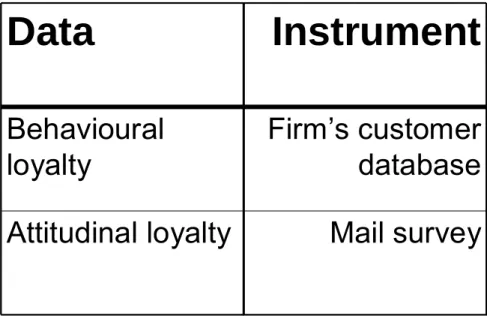
The data used in this study have been derived from two sources: a survey mailed to customers of the firm; and the firm’s customer database. In order to collect data on customer loyalty attitude, a mail questionnaire has been developed. Figure 1 shows the type of data gathered and the instruments used for data collection.
Mail survey
Attitudinal loyalty
Firm’s customer
database
Behavioural
loyalty
Instrument
Data
Figure 1: Instruments used for data collection
Data from the firm’s customer database were entered into the same database as the survey responses. The client code was the key that matched the survey responses with the behavioural data on each customer.
3.2 Operationalizing the constructs
Attitudinal loyalty was investigated through customer commitment. Customer commitment is viewed as a general attitude of attachment (e.g. Beatty and Kahle, 1988). Commitment was measured using six balanced seven-point Likert-type scales anchored ‘completely disagree’ (1) and ‘completely agree’ (7). The scales were adopted and modified from Mowday et al.’s (1979, 1982) and Porter et al.’s (1974) organizational commitment questionnaire, and used by, among others, Beatty and Kahle (1988), Kelley and Davis (1994), Morgan and Hunt (1994), Schijns and Schröder (1996), Schijns (1998), and Venetis (1997). Items capturing the attitudinal dimension of customer loyalty (i.e., customer commitment) are described in Table 1.
Table 1: items used for measuring commitment (attitudinal loyalty), correlations (.123 = pre-measurement; .123 = post-measurement)
Item Description U V W X Y Z
U I feel a strong sense of loyalty towards this firm
1 .515 .542 .473 .516 .534
V My positive feelings towards this supplier are a major reason to remain a customer of this firm
.544 1 .571 .485 .509 .572
W I’m willing to ‘go the extra mile’ to continue the relationship with this firm
.537 .560 1 .644 .686 .642
X I’m glad this firm is my supplier for office products and services
.490 .474 .619 1 .681 .673
Y The relationship my company has with this supplier is worth working for
.530 .496 .650 .662 1 .637
Z I feel involved with my supplier .535 .525 .592 .683 .633 1
The second data source, the firm’s customer database, was used to collect data on
to say, behavioural loyalty was measured using transactional data before-and-after the
introduction of the program. In particular, total revenues in the period between April up to and including September in the year before the introduction as well as total revenues in the same period of the year the program was introduced were used for analyses. Since the program does not make use of ‘points barriers’ the average total purchase amount is an applicable measure. Using actual behavioural data instead of ‘recalled measures’ the lack of reliability is minimized. Distinguishing participants and non participants in the loyalty program, the behavioural,
attitudinal, and selection effect of the loyalty program will be specified and further explored.
3.3 Analyzing the data
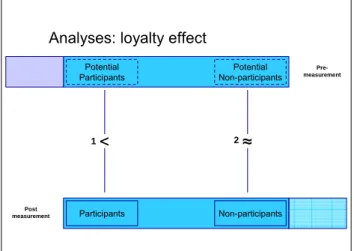
If there is a significant increase in loyalty, either behavioural or attitudinal, with respect to (potential) members (comparison 1), and no or a marginal (non-significant) increase in loyalty with respect to (potential) non-members (comparison 2), we suggest that the loyalty scheme has a loyalty effect (See Figure 2).
Analyses: loyalty effect
Pre-measurement
Post
measurement Participants Non-participants Potential Non-participants Potential Participants < ≈ 1 2
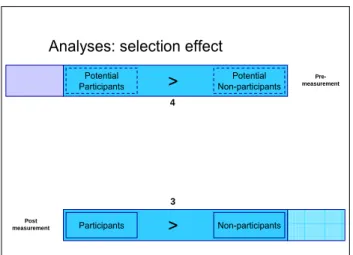
If there is a significant difference in loyalty, either behavioural or attitudinal, between participants and non-participants (comparison 3) that already existed before the introduction of the program (comparison 4), we suggest that the loyalty scheme has a selection effect (See Figure 3).
Analyses: selection effect
Pre-measurement
Post
measurement Participants Non-participants Potential Non-participants Potential Participants > > 4 3
Figure 3: analyzing the selection effect
An alternative way to assess the loyalty effect is by using Structural Equation Modeling. Figure 4 shows the cause-and-effect model for attitudinal loyalty.
Pre_loyalty Pre_U e1 1 1 Pre_V e2 1 Pre_W e3 1 Pre-X e4 1 Pre-Y e5 1 Post-loyalty Post_U e7 Post_V e8 Post_W e9 Post_X e10 Post_Y e11 1 1 1 1 1 1 Treatment effect d1 1 Pre-Z e6 1 Post_Z e12 1 Treatment: 1=participation 0=non-participation
Figure 4: measurementmodel for assessing the impact of a loyalty program on attitudinal loyalty
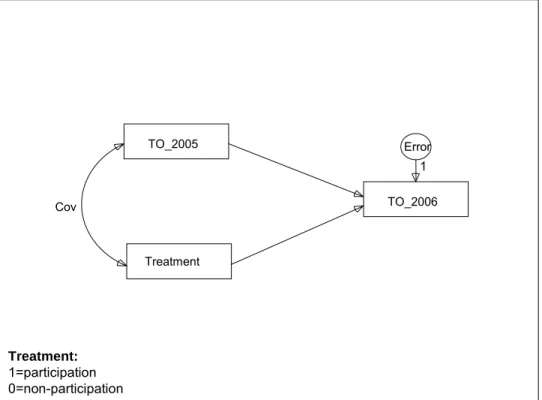
Conventional regression analysis is used for assessing the cause-and-effect relationship with respect to behavioural loyalty. That is, a single observed variable (total average revenues in the post-launch period) is predicted as a linear combination of two other observed variables (total average revenues in the pre-launch period, and (non-)participation in the program respectively).
TO_2006 TO_2005 Treatment Error 1 Cov Treatment: 1=participation 0=non-participation
Figure 5: regression analysis for assessing the impact of a loyalty program on behavioural loyalty
4. Research results
9,953 Questionnaires were mailed in order to collect pre-test data (pre-measurement). A total number of 1,991 usable questionnaires was received, resulting in an effective response rate of 20%. After the introduction of the loyalty scheme, these 1,991 respondents were invited to participate in the post-measurement. The response was 54%, and 1,080 respondents were included in the analyses, containing 495 non-participants and 585 participants.
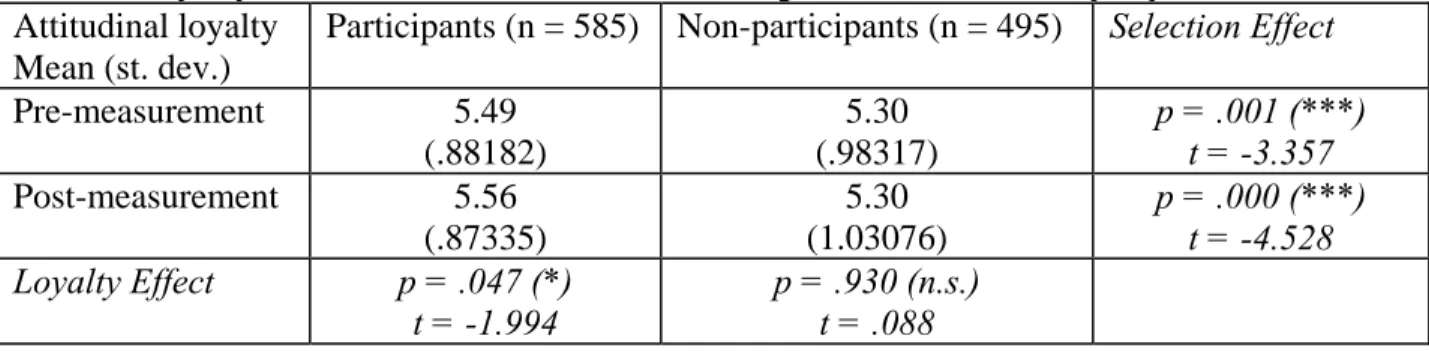
The scale used for measuring attitudinal loyalty (customer commitment) demonstrated an adequate internal consistency. The Cronbach’s alpha values for the pre- and post-measurement were .89, largely higher than Malhotra’s (1996, p. 305) minimum value of 0.60 for satisfactory internal consistency reliability. Attitudinal loyalty (customer commitment) increased significantly (p = .047) from 5.49 to 5.56 for participants, and did not increase for non-participants (see Figure 6a, and Table 2). Moreover, behavioural loyalty (average total revenues during April-September)
increased significantly (p = .000) from €3,027 to €3,455 for participants, and did not change significantly for non-participants (see Figure 6b, and Table 3). These results suggest the loyalty program helps building loyalty. We can accept hypotheses H1 and H2.
Attitudinal Loyalty 5,56 5,3 5,49 5,3 5,15 5,2 5,25 5,3 5,35 5,4 5,45 5,5 5,55 5,6 Pretest Posttest Participants Non-participants p= .047 (*) t= -1.994 p= .930 (n.s.) t= .088 Program introduction Behavioral Loyalty 3.455 1.645 3.027 1.710 0 500 1.000 1.500 2.000 2.500 3.000 3.500 4.000 Pretest Posttest Participants Non-participants p= .000 (***) t= -3.698 p= .509 (n.s.) t= .660 Program introduction
Figure 6a: Development attitudinal loyalty Figure 6b: Development behavioural loyalty
The loyalty program also has a selection effect. There is a significant difference in loyalty, both behavioural and attitudinal, between participants and non-participants that already existed before the introduction of the program. This leads us to accept H3.
In fact, the differences that existed before the introduction of the program increased due to the loyalty program. Participants became even more loyal after the introduction of the loyalty program. Tables 2 and 3 summarize the results for attitudinal and behavioural loyalty with respect to both the loyalty effect and the selection effect.
Table 2: loyalty effect and selection effect with respect to attitudinal loyalty
Attitudinal loyalty Mean (st. dev.)
Participants (n = 585) Non-participants (n = 495) Selection Effect Pre-measurement 5.49 (.88182) 5.30 (.98317) p = .001 (***) t = -3.357 Post-measurement 5.56 (.87335) 5.30 (1.03076) p = .000 (***) t = -4.528 Loyalty Effect p = .047 (*) t = -1.994 p = .930 (n.s.) t = .088 n.s. = non-significant; * = p≤.05; ** = p≤.01; *** = p≤.001
Table 3: loyalty effect and selection effect with respect to behavioural loyalty
Behavioural loyalty
Mean (st. dev.)
Participants (n = 585) Non-participants (n = 495) Selection Effect
Pre-measurement €3,026.59 (3,576.37) €1,709.89 (3,245.88) p = .000 (***) t = -6.339 Post-measurement €3,455.07 (4,232.29) €1,644.94 (2,568.28) p = .000 (***) t = -8.635 Loyalty Effect p = .000 (***) t = -3.698 p = .509 (n.s.) t = .660 n.s. = non-significant; * = p≤.05; ** = p≤.01; *** = p≤.001
The cause-and-effect model shown in figure 4 supports the results presented above. That is to say, the loyalty scheme contributes significantly to attitudinal loyalty. Since our variables are not distributed joint multivariate normal, our sample size exceeds 1,000 cases, and we use a relatively small model, we applied the Asymptotic Distribution Free (ADF) estimation procedure. The parameters for the model, suggesting a good fit, are: chi-square/df = 2.837; GFI = .996; AGFI = .994 and RMSEA = .041. Based on this model, the loyalty program has a significant effect on post-loyalty (t = 2.783; p = .005).
Pre_loyalty Post-loyalty Treatment .07** Treatment: 1=participation 0=non-participation .67*** .13*** R2=.42
Figure 7: structural model indicating the impact of a loyalty program on attitudinal loyalty (standardized regression weights)
Figure 7 also shows a significant correlation between pre-loyalty and program participation, supporting the existence of the program’s selection effect (t = 3.986; p = .000).
Regression analysis, as illustrated in Figure 8, suggests a significant positive effect of program membership on buying behaviour (t = 5.342; p = .000).
R2=.57 TO_2006 TO_2005 Treatment .73*** (t = 35.835; p = .000) .11*** (t = 5.342; p = .000) .19*** (t = 6.072; p = .000) Treatment: 1=participation 0=non-participation
Figure 8: regression analysis indicating the impact of a loyalty program on behavioural loyalty (standardized regression weights)
With respect to behavioural loyalty the selection effect of the loyalty program is also supported. The significant correlation between program participation and revenues suggests that high-spending customers are more willing to participate in the program.
5. Discussion
Loyalty programs aim at building a strong emotional connection, raise customer buying behaviour and retain profitable customers. In general, our results imply that the loyalty program investigated in our study succeeded in fulfilling these aims.
Attitudinal loyalty drives behavioural loyalty (Bandyopadhyay and Martell, 2006; Duffy, 1997; Hallberg, 2004). That is to say, buying behaviour is moderated by the individual’s attitudes. “The strength of these attitudes is the key predictor of a brand’s purchase and repeat patronage.” (Donio et al., 2006: 446). Therefore, in order to maximize effectiveness, the objective of loyalty programs must be to develop high levels of attitudinal loyalty among program participants, not just repeat buying. Higher levels of attitudinal loyalty increase customer retention by helping insulate the program against competitive offerings (Hallberg, 2004), and create real and perceived switching costs. “A program that achieves this objective may be the most cost-effective method of helping a brand move up the hierarchy of brand leadership” (Hallberg, 2004: 240).
Loyalty programs, in particular reward schemes, not only encourage customers to spend more, but they also encourage customers to become less and less sensitive to price, increasing profit margins. Such reward programs provide accumulating benefits and, over time, customers are weaned away from price as the sole purchasing criterion (Muller, 1998).
The selection effect implies that the loyalty program helps to identify and target loyal customers, allowing the firm to become more knowledgeable about its clients (‘know-how effect’) and enabling the firm to approach its most loyal customers more effectively and efficiently.
This study provides a valuable insight into the impact of (the introduction of) a customer loyalty program on loyalty (both behavioural and attitudinal loyalty), using an experimental
research methodology as an alternative to the most frequently used cross-section research design and Dirichlet models. It is important, however, to have a reliable gauge of whether customer loyalty is positively affected by the program relative to non-program participants. By building the measure into the evaluation process, marketers can assess the long-term impact of the program in a better way (Hallberg, 2004).
6. Conclusions
In this paper we have analyzed the loyalty effect and the selection effect of a loyalty program using an experimental research design. With respect to the loyalty effect it is concluded that the loyalty scheme is able to raise both attitudinal and behavioural loyalty. In addition, we found a significant difference in loyalty, both behavioural and attitudinal, between participants and non-participants that already existed before the introduction of the program. This finding indicates that the program has a selection effect too. The conclusion is that the loyalty program makes customers become more loyal, and that it attracts most loyal customers.
With respect to the differences between participants and non-participants, the results obtained are consistent with results achieved by other research (e.g. Gómez et al., 2006), i.e. participants are more loyal than non-participants. However, in addition to the results of e.g. Dowling and Uncles (1997), Gómez et al. (2006) and Sharp and Sharp (1997), and due to our research design, we also found that it is the loyalty program that contributes to an increase in both behavioural and attitudinal loyalty of participants. This result suggests that participants change their purchase behaviour and feel more committed since joining.
7. Directions for future research
We contend that there is little reason to expect that the customers of our office supply retailer would be different in any systematic way from the customers of other office supply retailers, and that this general framework – customers who participate in the loyalty program become more loyal (both behavioural and attitudinal) – should apply in other settings. However, some directions for future research can be indicated. In order to support or differentiate our results, we should find answers to the following questions.
The difference in time between the introduction of the loyalty program and the post-measurement was six months. Therefore the effects found in our study can be characterized as short-term effects. However, the effect of the loyalty program is interesting in the long run. Does the loyalty effect become even stronger, or will it crumble away as time goes by?
The loyalty program in our study was described as a reward program. Besides reward programs, other types of loyalty programs can be identified (for example, affinity programs, frequency programs, or customers’ clubs). “Each of these tools shows significant differences relating to its management and it is possible that this has an impact on the effect that it is able to obtain” (Gómez et al., 2006: 394). So, do other types of loyalty programs generate similar effects, using an experimental research design?
In addition, effectiveness of a loyalty program can be different depending on the type of product (Bolton et al., 2000; Verhoef, 2003). Thus, there is a need to extend this study to other types of products and services than office supplies in order to find out whether our results are supported.
References
− Baldinger, A.L. and Rubinson, J. (1996). “Brand Loyalty: The Link Between Attitude and Behaviour.” Journal of Advertising Research, Volume 36, Issue 6 (November/December), pp. 22-44
− Bandyopadhyay, S. and Martell, M. (2007). “Does attitudinal loyalty influence behavioural loyalty? A theoretical and empirical study.” Journal of Retailing and Consumer Services, Vol. 14, pp. 35-44
− Beatty, S.E. and Kahle, L.R. (1988). “Alternative hierarchies of the attitude-behaviour relationship: the impact of brand commitment and habit.” Journal of the Academy of Marketing Science, Vol. 16, Issue 1, pp. 1-10
− Bennett, R., Hartel C.E.J. and McColl-Kennedy, J.R. (2005). “Experience as a Moderator of Involvement and Satisfaction on Brand Loyalty in a Business-to-Business Setting 02-314R.” Industrial Marketing Management, Vol. 34, Issue 1, pp. 97-107.
− Bolton, R.N., Kannan, P.K. and Bramlett, M.D. (2000). “Implications of loyalty program membership and service experiences for customer retention and value.” Journal of the Academy of Marketing Science, Vol. 28, Issue 1, pp. 95-108
− Day, G.S. (1969). “A Two-Dimensional Concept Of Brand Loyalty.” Journal of Advertising Research, Vol. 9, Issue 3, pp. 29-35
− Dick, A.S. and Basu, K. (1994). “Customer Loyalty: Towards an Integrated Conceptual Framework.” Journal of the Academy of Marketing Science, Vol. 22, Issue 2 (Spring), pp. 99-113
− Donio, J., Massari, P. and Passiante, G. (2005). “Links between satisfaction, loyalty and profitability in a company: an integrative model for the agri-food sector.” An eBMS paper
accepted for the 11th. International Conference on Industrial Engineering and Engineering Management (IEEM), 23-25 April, Northeastern University, Shenyang, China
− Donio, J., Massari, P. and Passiante, G. (2006). “Customer satisfaction and loyalty in a digital environment: an empirical test.” Journal of Consumer Marketing, Vol. 23, Issue 7, pp. 445-457
− Dowling, G.R. and Uncles, M. (1997). “Do Customer Loyalty Programs Really Work?” Sloan Management Review, Vol. 38, Issue 4 (Summer), pp. 71-82
− Dowling, D. (1998). “Frequent Perks Keep Travelers Loyal.” American Demographics, September, pp. 32-36
− Duffy, D.L. (1997). The Loyalty Marketing Workbook, Cadmus Direct Marketing, Charlotte, NC
− Ehrenberg, A.S.C., Goodhardt, G.J. and Barwise, P.B. (1990). “Double Jeopardy Revisited.” Journal of Marketing, Vol. 54, pp. 82-91.
− Gounaris, S.P. (2005). “Trust and Commitment Influences on Customer Retention: Insights from Business-to-Business Services.” Journal of Business Research, Vol. 58, Issue 2, pp. 126-140.
− Grinnell, D.C. (2003). “Loyalty programs are subject to success if they are well crafted and properly executed.” Nation’s Restaurant News, Vol. 37, Issue 48 (December 1), pp. 24, 60 − Hallberg, G. (2004). “Is your loyalty programme really building loyalty? Why increasing
emotional attachment, not just repeat buying, is key to maximizing programme success.” Journal of Targeting, Measurement and Analysis for Marketing, Vol. 12, Issue 3, pp. 231-241 − Institute for Supply Management (2005), Principles and Standards of Ethical Supply
− Jacoby, J. and Chestnut, R.W. (1978). Brand Loyalty: Measurement and Management. John Wiley and Sons, New York.
− Kahn, B.E., Kalwani, M.U. and Morrison, D.G. (1986). “Measuring Variety Seeking and Reinforcement Behaviors Using Panel Data.” Journal of Marketing Research, Vol. 23, pp. 89-100.
− Kelley, S.W. and Davis, M.A. (1994). “Antecedents to Customer Expectations for Service Recovery.” Journal of the Academy of Marketing Science, Vol. 22, Issue 1 (Winter), pp. 52-61
− Kivetz, R. and Simonson, I. (2002). “Earning the Right to Indulge: Effort as a Determinant of Customer Preferences towards Frequency Program Reward.” Journal of Marketing Research, Vol. 39, Issue 2, pp. 155-170.
− Koslowsky, S. (2000). “Attitude and behaviour: A marriage made in heaven?” Journal of Database Marketing, Vol. 7, Issue 3, pp. 246-253
− Lam, S.Y., Shankar, V., Erramilli, M.K. and Murthy, B. (2004). “Customer Value, Satisfaction, Loyalty, and Switching Costs: An Illustration From a Business-to-Business Service.” Journal of the Marketing Science, Vol. 32, Issue, 3, pp. 293-311.
− Leenheer, J. Bijmolt, T.H.A., Van Heerde, H.J. and Smidts, A. (2002). “Do Loyalty Programs Enhance Behavioural Loyalty? An Empirical Analysis Accounting for Program Design and Competitive Effects.” Discussion Paper No. 2002-65, CentER, Tilburg University, The Netherlands.
− Leenheer, J. Bijmolt, T.H.A., Van Heerde, H.J. and Smidts, A. (2007). “Do Loyalty Programs Really Enhance Behavioural Loyalty? An Empirical Analysis Accounting for Self-Selecting Members.” International Journal of Research in Marketing, Vol. 24, pp. 31-47.
− Leenheer, J. (2004). The Adoption and Effectiveness of Loyalty Programs in Retailing. Center Dissertation Series, Tilburg University, The Netherlands.
− Liddy, A. (2000). “Relationship marketing, loyalty programmes and the measurement of loyalty.” Journal of Targeting, Measurement and Analysis for Marketing, Vol. 8, No. 4, pp. 351-362
− Malhotra, N.K. (1996). Marketing Research: An Applied Orientation, 2nd. Ed., Prentice Hall, New Jersey
− Meyer-Waarden, L. and Benavent, C. (2006). “The Impact of Loyalty Programmes on Repeat Purchase Behaviour.” Journal of Marketing Management, Vol. 22, pp. 61-88
− Morgan, R.M. and Hunt, S.D. (1994). “The Commitment-Trust Theory of Relationship Marketing.” Journal of Marketing, Vol. 58, Issue 3 (July), pp. 20-38
− Mowday, R.T., Steers, R.M. and Porter, L.W. (1979). “The Measurement of Organizational Commitment.” Journal of Vocational Behaviour, Vol. 14, pp. 224-247
− Mowday, R.T., Porter, L.W. and Steers, R.M. (1982). Employee-organizational linkages. Academic Press, New York
− Müller, S. (2007). “Loyalty Programs and Customer Loyalty: A Panel Data Analysis.” Proceedings of the 36th. EMAC Conference, Reykjavik, Iceland, 22-25 May
− Muller, E. (1998). Letter: “Customer Loyalty Programs.” Sloan Management Review, Vol. 39, Issue Winter
− O’Brien, L. and Jones, C. (1995). “Do Rewards Really Create Loyalty?” Harvard Business Review, Vol. 73, May-June, pp. 75-82
− Oliver, L.R. (1997). Satisfaction: A Behavioural Perspective on the Consumer. New York, McGraw-Hill
− Porter, L.W., Steers, R.M., Mowday, R.T. and Boulivan, P.V. (1974). “Organizational Commitment, Job Satisfaction, and Turnover among Psychiatric Technicians.” Journal of Applied Psychology, Vol. 59, Issue 5, pp. 603-609
− Pritchard, M.P., Howard, D.A. and Havitz, M.E. (1992). “Loyalty Measurement: A Critical Examination and Theoretical Extension.” Management Science, Vol. 38, pp. 155-164 − Rauyruen, P. and Miller, K.E. (2007). “Relationship Quality as a Predictor of B-to-B
Customer Loyalty.” Journal of Business Research, Vol. 60, pp. 21-31.
− Rosenspan, A. (1998). “Delusions Of Loyalty: Where Loyalty Programs Go Wrong.” Direct Marketing, February, pp. 24-27, 61
− Rundle-Thiele, S.R. (2005). “Elaborating Customer Loyalty: Exploring Loyalty to Wine Retailers.” Journal of Retailing and Consumer Services, Vol. 12, Issue 5, pp. 333-344. − Schijns, J.M.C. and Schröder, G.J. (1996). “Segment selection by relationship strength.”
Journal of Direct Marketing, Vol. 10, Issue 3 (Summer), pp. 69-79
− Schijns, J.M.C. (1998). Measuring and managing customer-organization relationships, thesis (Dutch text), Maastricht University, Datawyse Book productions, Maastricht
− Schultz, D.E. and Bailey, S.E. (2000). “Developing a total customer marketing programme.” Journal of Targeting, Measurement and Analysis for Marketing, Vol. 8, No. 4, pp. 303-313 − Sharp, B. and Sharp, A. (1997). “Loyalty programs and their impact on repeat-purchase
loyalty patterns.” International Journal of Research in Marketing, Vol. 14, Issue 5 (December), pp. 473-486
− Taylor, K. (2005). “Measuring the Impact of Loyalty Initiatives.” Marketing Journal, Vol. 2, Issue 4, p. 3
− Uncles, M.D., Dowling, G.R. and Hammond, K. (2003). “Customer Loyalty and Customer Loyalty Programs.” Journal of Consumer Marketing, Vol. 20, Issue 4, pp. 294-314. − Van Weele, A.J. (2005). Purchasing and Supply Chain Management – Analysis, Planning
and Practice. Thomson Learning, Business Press, 4th edition.
− Venetis, K.A. (1997). Service Quality and Customer Loyalty in Professional Business Services Relationships: An empirical investigation into the customer-based service quality concept in the Dutch advertising industry, thesis, Maastricht University, Maastricht − Verhoef, P.C. (2003). “Understanding the Effect of Customer Relationship Management
Efforts on Customer Retention and Customer Share Development.” Journal of Marketing, Vol. 67 (October), pp. 30-45
− Yi, Y. and Jeon, H. (2003). “Effects of Loyalty Programs on Value Perception, Program Loyalty, and Brand Loyalty.” Journal of the Academy of Marketing Science, Vol. 31, No. 3, pp. 229-240
Overzicht groene en gele MW-papers 2007 GROEN
Code Auteur(s) en titel
gr07-01 Marjolein Caniels en Cees Gelderman
The safeguarding effect of legal, economic and social control: The decisive role of mutual opportunism
gr07-02 Marjolein C.J. Caniëls, Adriaan Roeleveld, Janjaap Semeijn: Power and dependence perspectives on outsourcing decisions gr07-03 Kesidou, Caniels en Romijn
Mechanisms of Local Knowledge Spillovers: Evidence from the Software Cluster in Uruguay gr07-04 Caniels and Romijn
Actor networks in Strategic Niche Management: Insights from Social Network Theory
gr07-05 Savelsbergh, Van der Heijden en Poell
Explaining Differences in Team Performance. Does team learning behavior matter? gr07-06 Janssen. Kusters en Heemstra
Clustering ERP implementation project activities Gr07-07 M.C.J. Caniels en H.A. Romijn
Does innovation matter for LDC’s? Discussions and New Agenda GEEL
Code Auteur(s) en titel
ge07-01 Caniels, Van Eijck en Romijn: Development of new supply chains: Insights from Strategic Niche Management
Ge07-02 Caniels, Kesidiou, Romijn: The software sector in Uruguay: A Sectoral Systems of Innovation perspective