Materialistic Value and Credit Card Usage as Predictors of
Compulsive Clothing Buying among Young Adult Women
Meylisa Permata Sari
*and P. Tommy Y. S. Suyasa
Faculty of Psychology, Universitas Tarumanagara, Jakarta Barat 11440, Indonesia *E-mail: [email protected]
Abstract
This study aimed to determine the role of the centrality/success and happiness dimensions of materialistic value, and credit card usage to predict compulsive clothing buying behavior of young adult women, and to determine which factor can be a better predictor. Multiple regression analysis was conducted utilising IBM SPSS 21 to analyse the statistics. In all, 154 young adult women participated in this study. This research finds that centrality/successdimension, happiness dimension, and credit card usage can predict compulsive clothing buying among young women. Furthermore, the results also show that the dimension of materialistic value is a better predictor of compulsive clothing buying behavior compared to credit card usage. Further implications, limitations, discussion, and future research directions are discussed in the paper.
Materialistic Value dan Penggunaan Kartu Kredit sebagai Prediktor Compulsive Buying
terhadap Pakaian pada Wanita Dewasa Awal
Abstrak
Penelitian ini bertujuan untuk menganalisis peran dari dimensi centrality/success dan happiness dalam materialistic value, dan penggunaan kartu kredit dalam memprediksi perilaku compulsive buying terhadap pakaian pada wanita dewasa awal. Analisis regresi linear berganda digunakan menggunakan IBM SPSS 21 untuk menjalankan analisis statistik. Secara keseluruhan, 154 data dikumpulkan dari wanita dewasa awal. Hasil penelitian menemukan bahwa dimensi
centrality/success, happiness, dan penggunaan kartu kredit dapat memprediksi compulsive buying terhadap pakaian pada wanita dewasa awal. Hasil analisis juga menunjukkan bahwa dibandingkan dengan penggunaan kartu kredit, dimensi-dimensi dari materialistic value merupakan prediktor perilaku compulsive buying terhadap pakaian pada wanita dewasa awal. Implikasi, keterbatasan, diskusi, dan arahan untuk penelitian kedepan didiskusikan dalam artikel ini.
Keywords: compulsive clothing buying, materialistic value, credit card usage, young adult women
Citation:
Sari, M. P., & Suyasa, P. T. Y. S. (2017). Materialistic value and credit card usage as predictors of compulsive clothing buying among young adult women. Makara Hubs-Asia, 21(2): 83-91, DOI: 10.7454/mssh.v21i2.3503
1.
Introduction
Shopping in this day and age is not only done to purchase daily necessities, but rather to also purchase trivial products as a means to complement one’s lifestyle and reduce stress. Studies have shown that many individuals engage in unplanned, excessive shopping for pleasure (Dittmar, 2005b; Kukar-Kinney, Scheinbaum, & Schaefers, 2016). This phenomenon is commonly referred to as compulsive buying.
Compulsive buying is consistently defined as the act of shopping excessively and uncontrollably, often for
products that are not needed (Edwards, 1993; Mueller et al., 2011; Williams & Grisham, 2012). This kind of behavior is commonly associated with negative side-effects such as financial troubles (Joireman, Kees, & Sprott, 2010), low quality of life (Manolis & Roberts, 2012; Roberts & Jones, 2001), and disrupted social relationships (McElroy, Keck, Pope & Hudson, 1994; Workman & Paper, 2010). Due to the abundance of negative impacts of compulsive buying, this subject has received a lot of attention in research and literature amongst Western countries. This may be related to the high prevalence of compulsive buying, which is estimated to be between 1.8%-16% in the United States
(Koran, Abujaode, Large & Serpe, 2006), 5.8% in the United Kingdom (Dittmar, 2005a), and 6.9% in Germany (Mueller et al., 2010). However, studies on compulsive buying in Eastern countries are still limited (Kwak, Zinkhan, & Crask, 2003). As there are many negative effects of compulsive buying on many aspects of an individual’s life, it is very important to study the factors that influence compulsive buying in more depth. Compulsive buying is frequently discussed in the context of extreme clinical conditions (Black, 2001; Harvanko et al., 2013; Kellet & Bolton, 2009), but recent studies have shown that compulsive buying can be analyzed from the perspective of general buying (Mueller et al. 2011; Spinella, Lester & Yang, 2014, 2015). Further, research on compulsive buying is a common topic in the field of consumer behavior (Darrat, Darrat, & Amyx, 2016; Johnson & Attman, 2009). Based on these studies, results consistently show that compulsive buying behavior is more prominent amongst women (Black, 2001; Dittmar, 2005b; Mueller et al., 2011) and individuals who deeply care about their appearance (Shoham & Brenčič, 2003). For many young women, appearance is important because it can be a source of social acknowledgement and positive self-esteem (Akturan & Tezcan, 2007). Studies have also shown that clothing and apparel products are those which are frequently bought by compulsive buyers (Johnson & Attman, 2009; Park & Burns, 2005). This may explain why more women are involved in compulsive buying and why clothes are the product most frequently bought by compulsive buyers (Johnson & Attman, 2009; Park & Burns, 2005), as many women feel that appearance is important in order to gain social acceptance and increase their self-esteem (Akturan & Tezcan, 2007).
Other than finding different levels of compulsive buying between genders, empirical studies have found that there are various internal and external factors that may explain and help predict compulsive buying behavior (Kellet & Bolton, 2009; Mikołajczak-Degrauwe & Brengman, 2013). The value of materialism, or materialistic value, is often associated with compulsive buying behaviour (Dittmar, 2005b, 2008).
Richins and Dawson (1992) define materialistic value as the belief in the importance of material possessions. Materialistic value consists of three dimensions, which are acquisition centrality, acquisition as the pursuit of happiness, and possession-defined success (Richins, 2004). Although some previous studies find materialistic value to be a factor that is highly influential towards compulsive buying (Dittmar, 2005b; Donnelly, Ksendzova & Howell, 2013), there are still few studies that analyze the relationship between the dimensions of materialistic value and compulsive buying.
While previous studies consistently show that materialistic value is a multi-faceted construct(Lipovčan, Prizmić-Larsen & Brkljačić, 2015; Richins, 2004), many studies treat materialistic value as a unidimensional construct when analyzing the relation between materialistic value and compulsive buying (Donnelly et al., 2013; Johnson & Attman, 2009; Yurchisin & Johnson, 2004). Those who developed the concept of materialistic value suggested that researchers should measure it with its multiple dimensions (Richins, 2004; Richins & Dawson, 1992).
Previous studies use the Materialistic Value Scale (Griffin, Babin & Christensen, 2004; Lipovčan et al., 2015; Müller et al., 2013; Richins, 2004; Richins & Dawson, 1992) to show that materialistic value consists of several dimensions which are: physical possessions as the center of one’s life, the accumulation of possessions to increase happiness, and having possessions as a sign of success. Because empirical studies have shown that the dimensions of materialistic value are different from just materialism, this study will use the dimensions of materialistic value to predict compulsive buying behavior.
Apart from internal factors like materialistic value, compulsive buying is also influenced by external factors such as available means of payment. In the last few decades, studies have shown that means of payment influences buying behavior (Feinberg, 1986; Lo & Harvey, 2011, Wong & Lynn, 2017). The option to pay using a credit card has been shown to increase willingness-to-pay in many situations in comparison to the use of cash, such as giving bigger tips (Feinberg, 1986), buying unhealthy food (Thomas, Desai, & Seenivasan, 2010), and shopping excessively (compulsive buying) (Lo & Harvey, 2011; Norum, 2008; Park & Burns, 2005; Roberts, 1998).
Several studies that analyze the relationship between credit cards and compulsive buying show that the use of credit cards significantly relates to the increase in compulsive buying behavior (Norum, 2008; Park & Burns, 2005; Roberts, 1998). This may be because credit cards affect the stimulus to shop more than necessary (Feinberg, 1986; Park & Burns, 2005). Even though studies have found consistent results in this regard, those studies do not take into account the role that internal factors play in influencing compulsive buying. Therefore, we develop a framework to study compulsive buying and the factors that influence it in a more holistic way.
Mikołajczak-Degrauwe and Brengman (2013) suggest that internal factors are more influential than external factors towards compulsive buying, but there are very few studies that try to empirically analyse which factors are better predictors. Thus, this research has three main
aims, which are to analyse: (a) whether or not the dimensions of materialistic value can predict compulsive buying behaviour of clothing amongst young women; (b) whether credit card usage can be a predictor of compulsive buying behaviour of clothing amongst young women; and (c) whether the dimensions of materialistic value are better predictors of compulsive buying behaviour of clothing amongst young women compare to credit card usage.
Compulsive Buying
.
In general, there are five characteristics of compulsive buying, which are tendency to spend, feelings about shopping and spending, post-purchase guilt, compulsion/drive to spend, and dysfunctional spending (Edwards, 1993). Tendency to spend refers to the tendency of compulsive buyers to shop excessively, or binge. Compulsive buyers show a very high tendency to shop and find it very difficult to limit themselves (Faber, O’Guinn, & Kyrch, 1987; Lo & Harvey, 2011). Compulsive buyers describe themselves as “being out of control” completely when they are shopping (Faber et al., 1987), and often purchase products that they don’t need and may not even use (Park & Burns, 2005).Feelings/joy about shopping and spending refers to the level of enjoyment or satisfaction gained by individuals when they shop. Compulsive buyers feel very happy and satisfied when they shop (Faber et al., 1987), especially when the products bought enhance appearance (Johnson & Attman, 2009; Shoham & Brenčič, 2003).
Post-purchase guilt is the negative emotion felt by compulsive buyers after they shop excessively. The feelings that emerge are regret, disappointment and embarrassment because they have bought too much (Koran et al., 2006; Kukar-Kinney et al., 2016). Faber et al. (1987) states that compulsive buyers feel guilt and anxiety over their shopping activities.
Compulsion/drive to spend refers to the push and impulsiveness of compulsive buyers in their buying behavior. Faber et al. (1987) writes that compulsive buyers feel a push, impulse or desire to engage in shopping. Compulsive buyers feel an overwhelming urge to shop and find it incredibly difficult to overcome this urge (Mueller et al., 2011).
Dysfunctional spending is the level of damage felt by individuals as a result of their purchases. In general, although compulsive buyers accept the consequences of their buying behavior, they still choose to engage in it (Faber et al, 1987).
Materialistic Value
.
Richins and Dawson (1992) define materialistic value as the belief in the importance ofphysical objects and possessions in one’s life. People with materialistic values believe that acquiring possessions is the main goal of life, an indicator of success, and the key to happiness and self-definition. In its early stages of development, the concept of materialistic value had three dimensions, which are possessions as the center of one’s life, the accumulation of possessions to increase happiness, and having possessions as a sign of success. However, further studies conducted in several countries such as Russia (Griffin et al., 2004), Germany (Müller et al., 2013), and Croatia (Lipovčan et al., 2015) show that the dimensions of centrality and success do not have the psychometric properties to be considered different dimensions, and is thus combined as one dimension, while the dimension of happiness has consistently been shown to have a stable structure. Therefore, researchers generally use two dimensions in this concept.
Centrality/Success. Individuals with materialistic values, often referred to as materialistic individuals, consider possessions to be the most important things in their lives, and tend to measure their success and the success of others from material wealth (Dittmar, 2008; Richins, 2004). Possessions are not only valued from their ability to display one’s status, but also to project one’s desired self-image and create the image of having a perfect life (Dittmar, 2000). Materialistic people measure their own success from how able they are to own objects that project a desirable image (Speck & Peterson, 2010).
In order to believe that their lives have meaning and to show that they are successful individuals, compulsive buyers are pushed to be involved in excessive shopping (Dittmar, 2000; Yurchisin & Johnson, 2004), because they believe that more possessions equal more meaningful and successful lives (Speck & Peterson, 2010).
H1. The dimension of centrality/success is able to significantly predict compulsive buying of clothes among young adult women.
Happiness. Materialists see possessions as a basic key to happiness in their lives (Richins, 2004). People with strong materialistic values consider objects and possessions to be the largest source of satisfaction and dissatisfaction (Dittmar, 2005a, 2005b), and Dittmar (2008) finds that the desire to attain objects and possessions is unfulfillable. This means that the satisfaction gained from acquiring a new possession quickly deteriorates, only to be replaced with a new desire to acquire more possessions. This constant urge to buy causes individuals to engage in compulsive buying.
H2. The dimension of happiness is able to significantly predict compulsive buying of clothes amongst young adult women.
Credit Card Usage
.
Credit cards allow their holders to make purchases and/or withdraw money in an instant, and pay at a later given date (Adeyeye, 2008), which increases the opportunity for individuals to shop or make purchases beyond their financial capacity (Khare, 2013; Park & Burns, 2005). In an experiment to discover whether means of payment influenced buying behavior, Prelec dan Simester (2001) conducted a random assignment towards their participants to divide individuals with high shopping tendencies equally into two groups – the credit card group and the cash group. Results of the experiment showed that the group of credit card users paid significantly more on their purchases compared to the group of cash users, implying that the use of credit cards may motivate individuals to shop more than necessary.Some researchers explain that this phenomenon occurs because credit cards act as stimuli to shop (spend-facilitating stimuli) (Feinber, 1986; Prelec & Simester, 1994; Lie, Hunt, Peters, Veliu, & Harper, 2010), and reduce the pain of payment, which is the feeling of losing money usually felt when shopping (Prelec & Simester, 2001). The nature of credit cards influences individuals’ willingness-to-pay (Monger & Feinberg, 1997), which eventually pushes individuals to shop excessively and compulsively.
H3. Credit card usage is able to significantly predict compulsive buying of clothes among young adult women.
Compulsive buyers’ spending activities are based around the belief that having many possessions brings more happiness, shows success, and is the purpose of life (Dittmar, 2008; Johnson & Attman, 2009). This is different from the use of credit cards, because credit cards act as a stimulus to trigger compulsive buyers’ desire to shop (Feinberg, 1987; Park & Burns, 2005; Prelec & Simester, 2001). Therefore, this study assumes that materialistic value is better able to predict compulsive buying compared to credit card usage.
H4. The dimensions of materialistic value are significantly better able to predict compulsive buying of clothes among young adult women compared to credit card usage.
2.
Methods
Participants and Procedures. between 21 and 40 years old. The participants had to own a credit card, whether in their own name or someone else’s. The sampling method used in this study was the technique of
incidental sampling, which is a form of non-probability sampling.
The survey was distributed on two media forms, paper-and-pen and online. The researchers collected the data in several shopping centers in Jakarta. Apart from distributing the surveys in shopping centers, the researchers also used GoogleDocs to obtain data, in order to reach more participants. There was a total number of 154 participants in this study.
30.5% of the participants were between 20 – 22 years of age (M = 27.24). 37.7% of the participants had a partner or were engaged. More than half of the participants had completed an Undergraduate degree (55.2%), and most participants were working (69.5%). Almost half of the participants had more than one credit card (49.4%; M =
2.12). From 154 participants, almost all of them owned a credit card in their own name (88.3%), while the rest used a credit card in someone else’s name (11.7%). In general, the participants paid their own credit card bills (58.4%).
Materials. This study uses three measurement tools: the Compulsive Clothing Buying Scale (CCBS) to measure compulsive purchases of clothes, the Materialistic Value Scale (MVS) to measure materialistic value, and the
Pengguna Aktif Kartu Kredit (PAKK/Active Credit Card User) to measure credit card usage.
On the CCBS, MVS and PAKK measurement tools, participants were asked to fill in a questionnaire to evaluate themselves based on questions which incorporated the measurement scales.
Compulsive Clothing Buying Scale (CCBS). CCBS was developed by Johnson and Attman (2009) specifically to measure compulsive buying for clothing. CCBS consists of 13 questions using a Likert-type scale (1-5), with eight positive items and five negative items. One exemplary positive item is, “I have a strong desire to shop for clothes, even though I have limited time and money,”, and one exemplary negative item is, “Shopping for clothes does not bring me happiness.”
Cronbach’s Alpha was calculated to measure the internal consistency of the CCBS. After eliminating one question (r < 0.2), we obtained a Cronbach’s Alpha value of 0.884 for the CCBS. The higher the score for the variable of compulsive buying, the higher the feeling of happiness, comfort and satisfaction while shopping; the stronger the urge to shop; and the greater the feeling of guilt after excessive shopping.
Materialistic Value Scale (MVS). Conceptually, materialistic value consists of three dimensions, which are (a) centrality, (b) success, dan (c) happiness (Richin, 2004). Based on research by Griffin et al. (2004),
Müller et al. (2013), and Lipovčan et al. (2015), the dimensions of centrality and success psychometrically do not measure different things, and thus it is recommended by these studies to consider centrality and success as one dimension jointly. Thus, in this study, centrality and success are considered one dimension. The dimension of centrality/success was measured with ten questions, consisting of six positive questions and four negative questions. One exemplary positive item is “I admire people who own luxurious goods like houses, cars and clothes”, and one exemplary negative item is “To me, material possessions are not too important (are not the purpose of life).” After omitting two questions (r < 0.2), we obtained a Cronbach’s Alpha value of 0.815. The higher the participants’ score in this dimension, the more the participants viewed material possessions as an indicator of success.
The happiness dimension was measured by five questions consisting of three positive questions and two negative questions. One exemplary negative item is “My life would be better if I had more possessions that I do not own yet,” and one negative exemplary item is, “I feel that I have more than enough material possessions to enjoy life.” We obtained a Cronbach’s Alpha value of 0.840. The higher the score in this dimension, the more participants considered material possessions to be a primary source of happiness and wellbeing.
Pengguna Aktif Kartu Kredit (PAKK)/Active Credit Card User. To measure the intensity of credit card usage among participants, this study used PAKK (Fransisca & Suyasa, 2005) as a measurement tool. In order to be classified as an active credit card user, the participants were required to fulfil two criteria: that the participants filled in the questions pertaining to credit card usage (at least 6), and used up to at least half of their credit card limit. One positive exemplary item is “In my daily transactions, I prefer using my credit card,” and one negative exemplary item is, “I prefer paying with cash at restaurants”.
The measurement tool had ten questions, consisting of five positive items and five negative items, with response options having dichotomous scales. The response options were: (a) yes, if the question was in line with the participant’s condition, and (b) no, if the question is not in line with the participant’s question. On the positive options, the “yes” response was given a score of 1; on the negative options, the “yes” response was given a score of 0.
PAKK had a Cronbach’s Alpha score of 0.824. The higher the participants score on the credit card usage variable, the more often the participants use their credit cards as a means of payment when shopping.
3.
Results
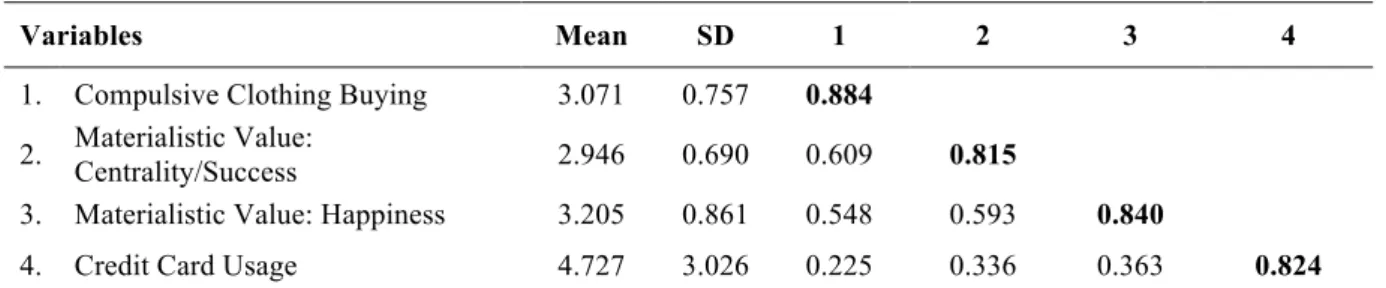
Table 1 shows the means, standard deviations, Cronbach’s alpha, and correlation between centrality/success, happiness, credit card usage, and compulsive clothing buying. This table shows that the variables in this study are significantly correlated with one another. Young adult women participants in this study had moderate compulsive buying tendencies towards clothes, along with moderate levels of centrality/success and happiness dimensions. In general, the participants of their study were categorized as passive credit card users.
Table 2 shows the results of our hypothesis testing. The linear regression results show that the dimension of centrality/success in materialistic value is significantly able to predict compulsive buying of clothes (β =
0.609, p < 0.01). The dimension of centrality/success was able to explain 36.7% of the variance in compulsive clothing buying, with the remainder being explained by other variables. This indicates that H1 is accepted. The results of the testing of Hypothesis 2 show that happiness was able to significantly predict compulsive clothing buying among young adult women (β = 0.48; p < 0.01). The dimension of happiness was able to explain 36.7% of the variance of compulsive clothing buying, with the remainder being explained by other variables.
Table 1. Mean, SD, Correlation, Cronbach’s Alpha of Variables
Variables Mean SD 1 2 3 4
1. Compulsive Clothing Buying 3.071 0.757 0.884 2. Materialistic Value:
Centrality/Success 2.946 0.690 0.609 0.815
3. Materialistic Value: Happiness 3.205 0.861 0.548 0.593 0.840
4. Credit Card Usage 4.727 3.026 0.225 0.336 0.363 0.824
Note: Emboldened numbers indicate the Cronbach’s Alpha of the measurement tools in this study. All variables were correlated significantly (p < 0.05).
In the testing of Hypothesis 3, it was found that credit card usage was able to significantly predict compulsive clothing buying among young adult women (β = 0.225;
p < 0.05). Credit card usage was able to explain 4% of the variance of compulsive clothing buying. Based on this analysis, H3 is accepted.
To test Hypothesis 4, we used multiple linear regression. Our results show that the dimensions of centrality/success, happiness, and credit card usage were able to significantly predict compulsive clothing buying among young adult women (F(154) = 56.127, p < 0.001). This model explains 42.60% of the variance in compulsive clothing buying among young adult women. From this analysis, it was found that the dimensions of centrality/success (β = 0.444; p < 0.01) and happiness (β = 0.297; p < 0.01) were significantly more able to predict compulsive clothing buying among young adult women in comparison to credit card usage (β = -0.033;
p > 0.05). Thus, H4 is accepted.
4.
Discussion
Our results show that the participants in this study had moderate levels of materialistic value. This is in line with findings from Dogan and Torlak (2014), who state that young adult women have moderate levels of materialistic value. One possible explanation is that the peak of an individual’s materialistic value usually occurs during early adolescence, and decreases upon entering adulthood (Chaplin & John, 2007).
Analysis showed that the young adult women in this study had low credit card usage. This is also in line with findings from previous studies that found that young adult women tend to have low credit card usage (Cankaya, Ucal & O’Neil, 2011). One possible explanation is that young adult women have low levels of financial confidence and low risk tolerance (Carpenter & Moore, 2008). Credit card use entails many risks such as fraud,
penalties, and debt, and thus young adult women tend to choose to not use credit cards.
Contrary to findings from previous studies that found high levels of compulsive buying among young adult women, this research found only moderate levels of compulsive clothing buying among young adult women. This can be explained by the moderate levels of materialistic value (in terms of the centrality/success and happiness dimensions) and the low levels of credit card usage among the participants of this research. This study finds results that are similar but more extensive than previous ones (Dittmar 2005b; Donnelly et al., 2013), which is that the dimensions of materialistic value are able to predict compulsive clothing buying. This study also found that credit card usage can predict compulsive behavior. This is in line with results from Lo & Harvey (2001), Norum (2008), and Park & Burns (2005).
In addition, this study found that materialistic value is a better predictor of compulsive clothing buying in young adult women compared to credit card usage. This finding is in accordance with findings from Dittmar (2005b) who states that materialistic value is the strongest predictor of compulsive buying, and the higher one’s materialistic value, the more intense the individual’s compulsive buying will be. Materialistic value psycho-logically motivates people to shop in order to achieve the purpose of life, such as achieving happiness, success and satisfaction. However, the desire to acquire more possessions appears continuously and is unfulfillable, which eventually leads to compulsive buying.
The dimension of happiness is the best predictor of compulsive clothing buying. This is because one of the main reasons individual engage in compulsive buying is to achieve a positive feeling. When individuals feel that
Table 2. Summary of Hypotheses Testing
Variabl e
Hypothesis 1 Hypothesis 2 Hypothesis 3 Hypothesis 4
B SE B β B SE B β B SE B β B SE B β MV-C/S 0.66 8 0.071 0.609** 0.486 0.085 0.444* * MV-H 0.482 0.060 0.548* * 0.261 0.069 0.297 * * CCU 0.56 2 0.19 8 0.225* -0.082 0.168 - 0.033 R 0.609 0.548 0.225 0.653 Adj. R2 0.367 0.296 0.044 0.414
Note: MV-C/S = Central/Success Dimension; MV-H = Happiness Dimension; CCU = Credit Card Usage *p < 0.01; **p < 0.001
happiness is obtained from owning possessions, they will continuously strive to obtain more possessions. When compared to the dimensions of materialistic value, credit card usage was found to be a weaker predictor of compulsive clothing buying. This supports Mikołajczak-Degrauwe and Brengman’s (2013) assumption that internal factors are more influential towards compulsive buying that external factors. There are several possible explanations for this. Firstly, there was an uneven distribution between active and passive participants (60:40), and this may have impacted the ability for credit card usage to be a significant influencing factor of compulsive buying in this study. Another potential reason is the early development of credit card usage in affluent countries (such as the United States and countries in Europe), which is starkly different from the setting of this study, Indonesia. Credit cards were developed in the United States since the 1920’s, and today, most places in the United States are facilitated with Electronic Data Chapters, including shopping centres, petrol stations, and fast food restaurants, which makes it very convenient to use credit cards (Jusoh & Lin, 2012). On the contrary, credit cards only entered Indonesia around the 1990’s, which is the place where this study was conducted. Many stores and shopping centres are not yet equipped with ECD facilities, limiting the potential for credit card usage in Indonesia.
Credit card usage is also limited because the fees make many people reluctant to use them (Khare, 2013). In various places were ECD facilities are available, an additional charge of approximately 3% is frequently applied as a merchant discount rate. This implies that many transactions may still be made with cash in the setting of this research. This means that young adult women who are compulsive buyers still buy clothes, either actively/passively with credit cards, or with cash. Even though this study provides extensive explanations on the relationship between the dimensions of materialistic value, credit card usage and compulsive clothing buying, this study still has its shortcomings. Firstly, this is a cross-sectional study, which is prone to common method variance, although this study still has findings that are in line with previous studies. Secondly, data was collected using self-sitting report data collection, which is susceptible to bias when participants provide the data. In light of these flaws, we suggest that future research should employ more advanced methods in collecting data, such as using experiments or longitudinal studies.
It is necessary to emphasize that the original Edwards scale (1993) was used to measure compulsive buying behavior in many categories including non-compulsive,
recreational, borderline compulsive, compulsive, and addicted. This study does not analyze compulsive buying across all those categories. Further studies may take into account those categories in order to gain a more comprehensive understanding on compulsive clothing buying.
Individuals who have high levels of materialistic value are advised to have caution, because this value may lead to excessive shopping or compulsive shopping. Individuals who are classified as compulsive buyers are encouraged to seek professional help, because this activity has negative effects on the social and economic life of the individual and the people around them. Close friends/family of compulsive buyers can assist compulsive buyers by inviting them to reconsider their values in life.
5.
Conclusions
This study aimed to discover whether or not the dimensions of centrality/success and happiness in materialistic value were able to predict compulsive clothing buying among young adult women; to find out whether credit card usage could predict compulsive clothing buying among young adult women; and to answer whether the dimensions of materialistic value are better predictors of compulsive clothing buying compared to credit card usage.
Results showed that the dimensions of centrality/success and happiness in materialistic value, along with credit card usage, were all able to predict compulsive clothing buying among young adult women. Further, the dimensions of materialistic value (centrality/success and happiness) were found to be stronger predictors of compulsive clothing buying compared to credit card usage.
References
Adeyeye, M. (2008). e-Commerce, business methods and evaluation of payment methods in Nigeria.
Electronic Journal Information Systems Evaluation,11, 1-6.
Akturan, U., & Tezcan, N. (2007). Profiling young adults: Decision-making styles of college students for apparel products. Société et Consommations, 6, 1-13. Black, D. W. (2001). Compulsive buying disorder: Definition, assessment, epidemiology and clinical management. CNS Drugs, 15, 17-27.
Cankaya, S., Ucal, M., & O’Neil, M. (2011). Effect of gender on credit card usage among university students in Turkey. MPRA, 43657, 1-11.
Carpenter, J. M., & Moore, M. (2008). Gender and credit behaviors among college student: Implications for consumer educators. Journal of Family & Consumer Sciences Education, 26(1), 42-47.
Chaplin, L. N., & John, D. R. (2007). Growing up in a material world: Age differences in materialism in children and adolescents. Journal of Consumer Research, 34, 1-14.
Darrat, A. A., Darrat, M. A., & Amyx, D. (2016). How impulse buying influences compulsive buying: The central role of consumer anxiety and escapism. Journal of Retailing and Consumer Services, 31, 103-108. Dittmar, H. (2000). The role of self-image in excessive buying. In A. Benson (Ed.), I shop, therefore I am: “Compulsive” buying and the search for self (pp. 105-132). New York, NY: Aronson.
Dittmar, H. (2005a). A new look at compulsive buying: Self discrepancies and materialistic values as predictors of compulsive buying tendencies. Journal of Social & Clinical Psychology, 24, 832-859.
Dittmar, H. (2005b). Compulsive buying – a growing concern? An examination of gender, age, and endorsement of materialistic values as predictors.
British Journal of Psychology, 96, 467-491.
Dittmar, H. (2008). Consumer, culture, identity and well-being. New York, NY: Psychology Press.
Dogan, V., & Torlak, O. (2014). The relationship between symbolic money meanings and materialism.
Business and Economics Research Journal, 5(2), 1-17. Donnelly, G., Ksendzova, M., & Howell, R. T. (2013). Sadness, identity, and plastic in over-shopping: The interplay of materialism, poor credit management, and emotional buying motives in predicting compulsive buying. Journal of Economic Psychology, 39, 113-125. Edwards, E. A. (1993). Development of a new scale for measuring compulsive buying behavior. Financial Counseling and Planning, 4, 67-84.
Faber, R. J., O’Guinn, T. C., & Krych, R. (1987). Compulsive consumption. Advances in Consumer Research, 14, 132-135.
Feinberg, R. A. (1986). Credit cards as spending facilitating stimuli: A conditioning interpretation. Journal of consumer research, 13(3), 348-356.
Fransisca & Suyasa, P. T. Y. S. (2005). Perbandingan perilaku konsumtif berdasarkan metode pembayaran.
Jurnal Phronesis, 7(2), 172-179.
Griffin, M., Babin, B. J., & Christensen, F. (2004). A cross-cultural investigation of the materialism construct: Assessing the Richins and Dawson's materialism scale in Denmark, France and Russia. Journal of Business Research, 57(8), 893-900.
Harvanko, A., Lust, K., Odlaug, B. L., Schreiber, L. R., Derbyshire, K., Christenson, G., & Grant, J. E. (2013). Prevalence and characteristics of compulsive buying in college students. Psychiatry Research, 210(3), 1079-1085. Johnson, T., & Attmann, J. (2009). Compulsive buying in a product specific context: Clothing. Journal of Fashion Marketing and Management,13, 394-405. Joireman, J., Kees, J., & Sprott, D. (2010). Concern with immediate consequences magnifies the impact of compulsive buying tendencies on college students' credit card debt. Journal of Consumer Affair, 44(1), 155-178. Jusoh, Z. M., & Lin, L. Y. (2012). Personal financial knowledge and attitude towards credit card practices among working adults in Malaysia. International Journal of Business and Social Science, 3(7), 176-183. Kellett, S., & Bolton, J. V. (2009). Compulsive buying: A cognitive–behavioural model. Clinical Psychology & Psychotherapy, 16(2), 83-99.
Khare, A. (2013). Credit card use and compulsive buying behavior. Journal of Global Marketing, 26(1), 28-40. Koran, L. M., Faber, R. J., Aboujaoude, E., Large, M. D., & Serpe, R. T. (2006). Estimated prevalence of compulsive buying behavior in the United States.
American Journal of Psychiatry, 163(10), 1806-1812. Kukar-Kinney, M., Scheinbaum, A. C., & Schaefers, T. (2016). Compulsive buying in online daily deal settings: An investigation of motivations and contextual elements. Journal of Business Research, 69(2), 691-699. Kwak, H., Zinkhan, G. M., & Crask, M. R. (2003). Diagnostic screener for compulsive buying: Applications to the USA and South Korea. Journal of Consumer Affairs, 37(1), 161-169.
Lie, C., Hunt, M., Peters, H. L., Veliu, B., & Harper, D. (2010). The "negative" credit card effect: credit cards as spending-limiting stimuli in New Zealand. The Psychological Record, 60(3), 399-411.
Lipovčan, L. K., Prizmić-Larsen, Z., & Brkljačić, T. (2015). Materialism, affective states, and life satisfaction: Case of Croatia. SpringerPlus, 4(1), 699. Lo, H., & Harvey, N. (2011). Shopping without pain: Compulsive buying and the effects of credit card
availability in Europe and the Far East. Journal of Economic Psychology, 32, 79-92.
McElroy, S. L., Keck, P. E., Pope, H. G., & Hudson, J. I. (1994). Compulsive buying: A report of 20 cases.
Journal of Clinical Psychiatry, 55, 242-248.
Manolis, C., & Roberts, J. A. (2012). Subjective well-being among adolescent consumers: The effects of materialism, compulsive buying, and time affluence.
Applied Research in Quality of Life, 7(2), 117-135. Mikołajczak-Degrauwe, K., & Brengman, M. (2013). The influence of advertising on compulsive buying— The role of persuasion knowledge. Journal of Behavioral Addictions, 3(1), 65-73.
Monger, J. E., & Feinberg, R. A. (1997). Mode of payment and formation of reference prices. Pricing Strategy and Practice, 5(4), 142-147.
Mueller, A., Claes, L., Mitchell, J. E., Faber, R. J., Fischer, J., & de Zwaan, M. (2011). Does compulsive buying differ between male and female students.
Personality and Individual Differences, 50, 1309-1312. Mueller, A., Mitchell, J. E., Crosby, R. D., Gefeller, O., Faber, R. J., Martin, A., et al. (2010). Estimated prevalence of compulsive buying in Germany and its association with sociodemographic characteristics and depressive symptoms. Psychiatry Research, 180(2), 137-142.
Müller, A., Smits, D. J., Claes, L., Gefeller, O., Hinz, A., & de Zwaan, M. (2013). The German version of the material values scale. GMS Psycho Social Medicine, 10, 1-9.
Norum, P. S. (2008). The role of time preference and credit card usage in compulsive buying behavior.
International Journal of Consumer Studies, 32, 269-275.
Park, H., & Burns, L. D. (2005). Fashion orientation, credit card use, and compulsive buying. Journal of Consumer Marketing, 22, 135-141.
Prelec, D., & Simester, D. (2001). Always leave home without it: A further investigation of the credit-card effect on willingness to pay. Marketing Letters, 12(1), 5-12.
Richins, M. L. (2004). The material values scale: Measurement properties and development of a short form. Journal of Consumer Research, 31, 209-219.
Richins, M. L., & Dawson, S. (1992). Materialism as consumer value: Measure development and validation.
Journal of Counsumer Research, 19, 303-316.
Roberts, J. A. (1998). Compulsive buying among college students: An investigation of its antedecents, consequences, and implications for public policy. The Journal of Consumer Affairs, 32(2), 295-319.
Roberts, J. A., & Jones, E. (2001). Money attitudes, credit card use, and compulsive buying among American college students. Journal of Consumer Affairs, 35(2), 213-240.
Shoham, A., & Brenčič, M. M. (2003). Compulsive buying behavior. Journal of consumer marketing, 20(2), 127-138.
Speck, S. K. S., & Peterson, T. (2010). Socialization of adult and young consumers into materialism: The roles of media and church in Peru. In R. W. Belk (Ed.),
Research in consumer behaviorvol. 12 (pp. 133-159). Bingley, UK: Emerald Group Publishing.
Spinella, M., Lester, D., & Yang, B. (2014). Compulsive buying tendencies and personal finances. Psychological Reports, 115(3), 670-674.
Spinella, M., Lester, D., & Yang, B. (2015). Compulsive buying tendencies. Psychological Reports,
117(3), 649-655.
Thomas, M., Desai, K. K., & Seenivasan, S. (2010). How credit card payments increase unhealthy food purchases: Visceral regulation of vices. Journal of Consumer Research, 38(1), 126-139.
Williams, A. D., & Grisham, J. R. (2012). Impulsivity, emotion regulation, and mindful attentional focus in compulsive buying. Cognitive Therapy and Research, 36(5), 451-457.
Wong, K. Y., & Lynn, M. (2017). The easy money effect: credit card spending and hard work reminder.
Journal of Consumer Marketing, (just-accepted), 00-00. Workman, L., & Paper, D. (2010). Compulsive buying: A theoretical framework. Journal of Business Inquiry, 9, 89-126.
Yurchisin, J., & Johnson, K. K. (2004). Compulsive buying behavior and its relationship to perceived social status associated with buying, materialism, self-esteem, and apparel-product involvement. Family and Consumer Sciences Research Journal, 32(3), 291-314.