University of South Carolina
Scholar Commons
Theses and Dissertations
2017
High Resolution Gravity, Helicopter Magnetic, and
Electromagnetic Study, Haile Gold Mine, South
Carolina
Saad Saud Alarifi University of South Carolina
Follow this and additional works at:https://scholarcommons.sc.edu/etd Part of theGeology Commons
This Open Access Thesis is brought to you by Scholar Commons. It has been accepted for inclusion in Theses and Dissertations by an authorized administrator of Scholar Commons. For more information, please [email protected].
Recommended Citation
High Resolution Gravity, Helicopter Magnetic, and Electromagnetic Study, Haile Gold Mine, South Carolina
by
Saad Saud Alarifi
Bachelor of Science King Saud University, 2010
Submitted in Partial Fulfillment of the Requirements
For the Degree of Master of Science in
Geological Sciences
College of Arts and Sciences
University of South Carolina
2017
Accepted by:
James N. Kellogg, Director of Thesis
Camelia C. Knapp, Reader
Gene M. Yogodzinski, Reader
ii
© Copyright by Saad Saud Alarifi, 2017
iii
DEDICATION
First of all, thanks to almighty God who has given me strength throughout my life
to complete this thesis.
I gratefully thank my parents, brother, and sister. Special thanks to my lovely wife
iv
ACKNOWLEDGEMENTS
I would like to thank Dr. James Kellogg for ongoing support in his capacity as a
mentor and adviser, as well as my other M.S. thesis committee members Dr. Camelia
Knapp, and Dr. Gene Yogodzinski.
Furthermore I would to thank my colleagues who helped me whenever I had
questions. Thanks for the support of the staff of the Andean Geophysical Laboratory.
I would like to thank James Berry, OceanaGold Exploration Head Geologist, and
Ken Gillian, for the high resolution gravity, magnetic and electromagnetic datasets and
the regional geological map.
Also, thanks go to Geosoft Inc. for donating academic licenses for the Oasis
montaj and 2-D GMSYS software.
I would not have had this opportunity without the full scholarship support from
v ABSTRACT
The goal of this research was to calibrate and test geophysical methods for the
detection of disseminated sulfides in the area of the Haile Gold Mine, South Carolina.
The work focused on the calibration of high resolution gravity, and helicopter
electromagnetic (EM) and magnetic data provided by OceanaGold. While high resolution
potential field data (gravity and magnetics) has not been proven to be effective at small
scales in exploration for disseminated sulfides, there is a strong regional correlation
between high amplitude gravity and magnetic anomalies and the most productive gold
mines in the Carolina terrane. Helicopter EM methods have been shown to be effective in
distinguishing sedimentary from volcanic-dominated sediments in the metamorphic rocks
of the Carolina terrane. The interpretation of the gravity and magnetic data utilized tilt
derivatives, reduced to pole anomalies (RTP), shaded relief, Power spectrum, Analytical
signal, Source parameter imaging (SPI), 3-D Euler deconvolution, upward continuation,
and 2-D forward density modeling. The most surprising result was that over the Haile
Mine, the residual gravity anomalies, tilt derivatives, and analytic signal show positive
anomalies correlated with the location of a disseminated ore body. The gravity field over
the ore body can be interpreted as produced by 4% pyrite and molybdenite.
Electromagnetic (EM) anomalies are also spatially associated with the Haile ore bodies.
Cultural signals in the EM data can be minimized with high pass filtering. The edges of a
vi
deconvolution, and analytic signal of the high resolution magnetic field. The RTP
magnetic field shows NW-trending Jurassic dikes as well as ENE-trending Alleghanian
vii
TABLE OF CONTENTS
DEDICATION………iii
ACKNOWLEDGEMENTS……….…………..……….iv
ABSTRACT………...v
LIST OF TABLES ………...……ix
LIST OF FIGURES……….………x
CHAPTER 1: INTRODUCTION………1
CHAPTER 2: DATA ACQUISITION………..10
CHAPTER 3: METHODOLOGY……….………14
CHAPTER 4: INTERPRETATION METHODS……….……….………25
CHAPTER 5: RESULTS……….………..………40
CHAPTER 6: DISCUSSION AND INTERPRETATION……….…….………..…83
CHAPTER 7: CONCLUSIONS……….………...…………86
REFERENCES………..88
APPENDIX A: THE COSTAL PLAIN AND DIKES DISTRIBUTION IN SOUTH CAROLINA………...95
viii
APPENDIX C: EXPANDED VIEW OF THE CENTRAL PART OF THE STUDY AREA………99
ix
LIST OF TABLES
Table 2.1: Survey block Boundaries………...…………...11
Table 4.1: Structural indices parameter values……….……….33
Table 4.2: Structural indices N for the gravity anomaly (GA), first derivative (FD), and second derivative (SD) gravity anomalies of some mass models………..33
Table 5.1: The initial densities value ….……….………..…56
Table 5.2: Mineral densities value……….57
Table 5.3: Depth estimates based on the TDR, ED of TMI, and ED of AS………….….74
x
LIST OF FIGURES
Figure 1.1: Gold mine locations in the Carolina Terrane………..…………..7
Figure 1.2: Map of the southeastern United States showing the Carolina and Appalachian terranes……….…………8
Figure 1.3: Geology of Carolina Terrane with the shear zones ……….….8
Figure 1.4: A geologic map of Haile Mine area at 300ft above sea level. On the left side three geological cross sections……….……9
Figure 2.1: The study area location………..………..…12
Figure 2.2: The flight lines (EM and Magnetic) and the gravity observation point map. Red color is from the USGC and green color is high resolution gravity from OceanaGold. The coordinates are (34 ˚ 42’0”-34 ˚32’0”’N and 80 ˚ 36’0”-80 ˚ 22’0”W)……….………12
Figure 2.3: A) The magnetometer bird. B) The AeroTEM II EM bird……….13
Figure 2.4: Geological map from OceanaGold………..13
Figure 3.1: Average densities of surface samples and cores based on laboratory
measurements……….…21
Figure 3.2: Magnetic susceptibility of source samples and cores from laboratory
measurements ………..…..22
Figure 3.3: The principle of helicopter method, shows the primary (induced) field related to the transmitter and the secondary (measured) field related to geology……….22
Figure 3.4: AeroTEM system………23
Figure 3.5: Rock conductivity parameters………..………..….23
xi
Figure 4.1: A three stage process using multiplication in the wavenumber domain can be more efficient than convolution in the space domain………39
Figure 4.2: Magnetic anomaly of total field before and after the reduction to pole
transformation that makes anomaly directly located above the source………….39
Figure 5.1: Bouguer gravity map………...…40
Figure 5.2: The 2-dimensional power spectrum of the Bouguer gravity map…………...42
Figure 5.3: The regional Bouguer gravity map………..…....43
Figure 5.4: The residual Bouguer gravity map………..………...……….…43
Figure 5.5: The B-B’ geological profile and its location on the geological map from Mobley et al. 2014. Expanded view of the residual Bouguer map showing the location of the B-B’ geological profile………..44
Figure 5.6: The analytic signal of the Bouguer gravity map. Dotted line may refer to the lithological boundaries of the metasedimentary and metavolcanic units………..45
Figure 5.7: An expanded view to the Haile Mine area. The geological map overlies the AS of the Bouguer gravity map. The boundary of the AS map is located in the western part of figure 5.6………...46
Figure 5.8: The tilt derivative of the Bouguer map. Solid line indicates the zero radial contour. The polygon is the boundary of the study area………48
Figure 5.9: The TDR of the regional Bouguer map. Dotted lines are the zero contours. The thick line is the felsic intrusion from OceanaGold’s geological map……….48
Figure 5.10: The TDR of the regional Bouguer map. The geological map from
OceanaGold overlies the TDR of regional Bouguer map. The orange color of the geological map indicates the lithologic boundary of the metavolcanic formation. The NW lines are mafic dikes. The white lines are possible faults………...49
Figure 5.11: The TDR of the residual gravity map. Some of these lineament edges are following the faults. The solid lines are possible faults from geological map…..49
Figure 5.12: Expanded view of the Haile Mine area. White line is the B-B’ profile. Pink polygon is the ore body from OceanaGold’s geological map………50
Figure 5.13: Source parameter image of Bouguer gravity (depth estimate grid)………..51
Figure 5.14: SPI solutions plotted on the SPI of the Bouguer map………...52
xii
Figure 5.16: The Euler deconvolution solutions of 2nd vertical derivative of the Bouguer map. The structural index is 1 which represents contacts. The Euler
solution depths plotted on the residual Bouguer map (above) and without the gravity map (below). The window size is 5. The Euler deconvolution solutions follow the dikes. A NNE trend (B-B’) is a possible fault and/or contact. A NW trend (C-C’) is follow the Jurassic dikes trend. An ENE trend (A-A’)…………54
Figure 5.17: 2-D density model. North is on the left side of the profile………57
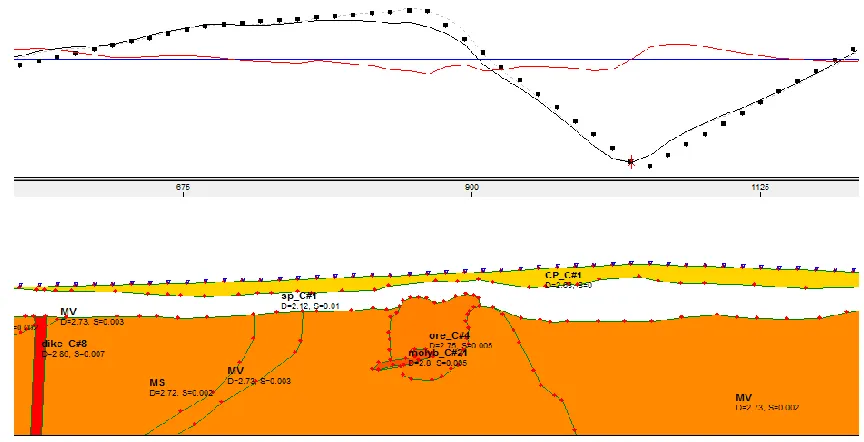
Figure 5.18: The 2-D density model zooms in to one of the ore bodies that is located on the right side of figure 5.17. MV metavolcanic (light orange); MS
metasedimentary (light orange); CP coastal plain (yellow); SP saprolite (white); dike (red); ore (orange)………..57
Figure 5.19: The 2-D density model zooms in to one of the ore bodies that is located on the right side of figure 5.17. MV metavolcanic (light orange); MS
metasedimentary (light orange); CP coastal plain (yellow); SP saprolite (white); dike (red); ore (orange)………..58
Figure 5.20: The Richtex = 2.72 gm/cc, ore = 2.75gm/cc (solid), and ore = 2.80 gm/cc (dashed). Calculated does not fit the observed gravity (dotted line)……….58
Figure 5.21: The Richtex = 2.72 gm/cc, ore = 2.85 gm/cc (solid line), and ore = 2.80 gm/cc (dashed line)………59
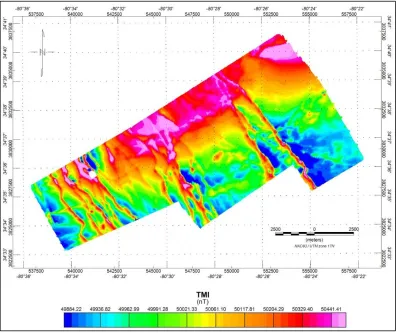
Figure 5.22: Total magnetic intensity of the study area……….…60
Figure 5.23: The magnetic anomaly of the total field before and after the reduced to the magnetic pole is applied over the 2-D density model. The anomaly of the reduced to magnetic pole is directly located above the source. North is on the left side of the profile………...61
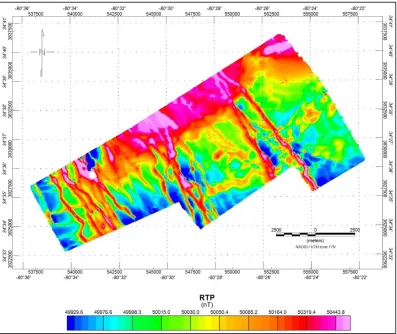
Figure 5.24: The reduced to the pole map (RTP)………..………....62
Figure 5.25: The shaded relief map of reduced to the magnetic pole ……….………..…63
Figure 5.26: 2-D power spectrum of total magnetic intensity data…………..………..…64
Figure 5.27: The regional total magnetic intensity map………..………..65
Figure 5.28: The residual total magnetic intensity map………..……..……….65
xiii
Figure 5.30: Upward continuation of 70 m applied to the AS of TMI map………..67
Figure 5.31: Upward continuation of 70 m applied on AS of TMI map. To improve the dynamic resolution, the color scale was changed to highlight the maximum
anomalies………...68
Figure 5.32: Tilt derivative of the reduced to the pole………..69
Figure 5.33: Upward continuation of 70 m of the TDR of the reduced to the pole map...70
Figure 5.34: Geological map superimposed on the upward continuation of 70 m of the TDR of the RTP map. The white lines are possible faults. The thick line is the felsic intrusive. The NW-SE lines are mafic dikes………70
Figure 5.35: Geological map superimposed on the upward continuation of 30 m of the TDR of the residual RTP map. The white lines are possible faults. The thick line is the felsic intrusive. The NW-SE lines are the mafic dikes……….………71
Figure 5.36: The SPI of TMI map. The sources depths range between 8 and 1188 m…..72
Figure 5.37: Geological map superimposed on the SPI of the TMI. The white lines are possible faults. The thick line is the felsic intrusive. The NW-SE lines are the mafic dikes……….73
Figure 5.38: Euler deconvolution solutions of the upward continuation of 70 m of the AS of TMI. The solution depths range between - 155.5 and 363.3 m. The SI=0, Depth tole = 15%, Win. Size= 5, and flying height is 32m………..75
Figure 5.39: Euler deconvolution solutions of TMI plotted on the upward continuation of 70 m of the AS of TMI. The solution depths range between - 155.5 and 529 m. The SI=0, Depth tole = 15%, Win. Size= 5, and flying height is 32m…………..75
Figure 5.40: Euler deconvolution solutions of the TMI plots on the TMI map. The solution depths range between - 155.5 and 529 m. The SI=0, Depth tolerance = 15%, Win. Size= 5, and flying height is 32m………76
Figure 5.41: Expanded view of the tilt derivative of the RTP map. The thick black contour line indicates the edge of the contact and localizes the contact location. The thin black contour lines are equal to - 45° and can be used for calculating depths on edges. For the best interpretation of depth estimation by the tilt
derivative method, points (A to D) are selected………76
Figure 5.42: The conductivity map………..…………..78
xiv
Figure 5.44: The cultural noise (dotted lines) plotted on the conductivity map…………79
Figure 5.45: The EM data after using a high pass filter to represent the noise. Black ovals indicate the observer noises that were defined from the dataset. Label A indicates a high tension power line from Google earth……….………79
Figure 5.46: Conductivity map after reducing the noise………80
Figure 5.47: The lithologic boundary of the metasedimentary formation (green color) superimposed on the conductivity map. The thick black line indicates the felsic intrusion……….80
Figure 5.48: A is the geological map of Haile Mine at 120 m above sea level. B is the unfiltered EM conductivity map. C is the geological map superimposed on the conductivity map. Note the correlation between the zones of high conductivity and the mapped ore bodies……….81
Figure 5.49: The EM conductivity after HP filter and the geological map. Note the high EM signal associated with the ore location and trend………81
Figure 5.50: Cross section shows the conductivity over the B-B’ profile. A conductive anomaly in the lower western part of the section is associated with an ore body. A low conductive anomaly is located just south of the dike. Left side is
north………...…82
1 CHAPTER 1
INTRODUCTION
1.1 Hypothesis
The meta-volcanic rocks of the Haile Mine area (Persimmon Fork Formation) are
characterized by slightly higher gravity, magnetic, and conductivity anomalies
than the meta-sedimentary rocks of the Haile Mine area (Richtex Formation).
The largest magnetic anomalies are associated with Jurassic mafic dikes.
Positive magnetic and EM anomalies are spatially associated with the Haile ore
bodies. These are produced by molybdenite, pyrite, or other disseminated ore
associated minerals.
1.2 Background
The Haile Gold Mine property, the Brewer gold mine to the northeast, and the
Ridgeway gold mine to the southwest, are located in the Carolina terrane (Figure 1.1),
part of a volcanic island arc that formed off the coast of Gondwana, hundreds of miles
from North America (Laurentia). The Carolina terrane extends for more than 500 km
from Virginia to Georgia, with a maximum width of 140km in central North Carolina. All
the gold deposits are hosted in similar geologic settings near the contact between
metamorphosed volcanoclastic and metamorphosed sedimentary rocks of Neoproterozoic
2
the Acadian-Neoacadian orogenic event. An intrusive magmatic and metamorphic
overprint is found mostly in the western portions of the Carolina terrane as a result of
oblique accretion with Laurentia, progressing from north to south. The Carolinia terrane
is separated from the Appalachian Inner Piedmont by the Central Piedmont low-angle
shear zone (Dennis and Wright 1997; Hibbard 2000; Hibbard et al. 2002).
The Carolina terrane is considered unrelated to other Appalachian terranes
because of differences in age and composition. Cambrian-age rocks with limestone and
shale formations comprise much of the Appalachian terranes. The Carolina terrane
contains low-grade meta-igneous and meta-sedimentary rocks of Neoproterozoic to Late
Cambrian age (Secor et al., 1983). The Carolina terrane is composed of greenschist facies
metamorphosed sedimentary and volcanic rocks bounded by amphibolite grade rocks of
the Charlotte belt to the northwest and the Kiokee belt to the southeast (Feiss, 1982),
Figure 1.2.
By U-Pb dating of zircon and the fossil evidence, the Carolina terrane is dated as
late Neoproterozoic to Cambrian age, 630 to 520 Ma (Hibbard et al. 2002). Rock type
transitions from felsic to mafic submarine volcanics (Persimmon Fork Formation) and
mudstones to turbidite clastics (Ritchtex Formation) suggest an intra-arc basin tectonic
setting (Ayuso et.al., 2005). U-Pb zircon dating of the meta-sediment and meta-volcanic
units at the Haile mine give an age range of 530 to 550 Ma, and Rhenium-Osmium dating
of the molybdenite minerals, and 40Ar/39Ar dating of biotite indicate that the
3
In the eastern Carolina terrane in South Carolina, the Long Town granite dated at
550 Ma intrudes the Persimmon Fork Formation. Dennis and Wright (1997) reported that
plutonic mafic- ultramafic complexes intruded the northwestern Carolina terrane along
the Piedmont suture. U-Pb gives ages for these complexes between 580 to 535Ma. They
are therefore not a result of accretion to North America, but occurred as a result of arc
rifting when the Carolinia terrane was located in peri-Gondwana.
The regional magnetic map of South Carolina is divided into two provinces along
a line known as the Fall Line: the Appalachian piedmont province is characterized by
highly deformed and metamorphosed sedimentary and igneous rocks of Precambrian and
Paleozoic age, and the Atlantic coastal plain sediments province consists of
semi-consolidated young sedimentary rocks of upper Cretaceous to recent age (Bell et al, 1974;
Snoke et al., 1977; Popenoe and Zietz 1977). The Coastal plain sand overlies older
igneous and metamorphic rocks. Popenoe and Zietz (1977) compiled a coastal plain
thickness map based on the well and seismic data (figure A.1). The coastal plain
thickness increases to the southeast. Near the Fall line, the basement rocks have a similar
composition to the Piedmont rocks (Daniels 1974). In general, mafic rocks are more
magnetic than felsic varieties, but this is “not always true” (Popenoe and Zietz 1977).
West of the Fall Line where the sources are exposed, two granite plutons (Liberty
Hill and Pageland) exhibit high magnetic and low gravity anomalies. Based on their
magnetic signature, these plutons were interpreted to have been emplaced after the last
regional metamorphic event. Northwest magnetic trends over the Atlantic coastal plain
are correlated with diabase dikes of Jurassic or Triassic age (Popenoe and Zietz 1977).
4 1.3 Stratigraphy
Three metavolcanic-dominated sequences of Neoproterozoic to Cambrian age
(Figure 1.3) comprise the bulk of the Carolina terrane. These sequences formed
separately in distinct tectonic settings (Snider et al. 2014, Hulse 2008).The Virgilian
sequence is the oldest, from north-central North Carolina to South-central Virginia,
interpreted to have been deposited in shallow water (Hibbard et al. 2002).
The Albemarle sequence extending from North Carolina to Georgia is the
youngest, and it contains the units that host most of the known gold deposits and most of
the new discoveries. It is estimated to be greater than 15 km thick (Nora et al 2012,
Hibbard et al 2002). The sequence is covered by onlapping sediments of the Atlantic
Coastal Plain which run right up against the gold deposits in the vicinity of Haile and
Brewer (Foley et al. 2002).
The Albemarle sequence in South Carolina is composed of four formations. The
metasedimentary rocks, which consist of 5 km of the Richtex, Emory, and Asbill Pond
formations overlie a 3-km thick sequence of the Persimmon Fork Formation (Hibbard et
al 2002; Mobely et al. 2014). The Persimmon Fork Formation is mainly composed of
felsic volcanic rocks, originally rhyodacitic to andesitic in composition. The main
minerals within this unit are quartz, albite, white mica, chlorite, and biotite; deposited in a
subaerial environment (Snider et al 2014). The Richtex Formation components are beds
of thin metamorphosed siltstones, mudstones, wackestones, and turbidite deposits. The
main minerals within this unit are quartz, white pyrite (generally less than 10 percent),
5
when strongly mineralized, the metasiltstone is highly silicified (Dennis and Wright
1997; Hibbard et al., 2002; Mobely et al., 2014).
The Richtex Formation and Emory Formation are equivalent in age. Regional
mapping shows that the Asbill pond is separated from the underlying Richtex by an
angular unconformity (Hibbard et al 2002). The Persimmon Fork appears to be
conformable with the overlaying Richtex and Emory Fm., based on regional map and
drill core observations (Mobley et al. 2014). The Richtex Formation occurs to the
northwest, while the Asbill pond Formation to the southeast with a regional anticline of
Persimmon Fork Formation separating them (Hibbard et al. 2002; Mobley et al 2014).
The Richtex and Persimmon Fork formations are the main rock elements found in
the study area. These formations are dissected by northwest diabase dikes, and intruded
by Carboniferous granites. Coastal Plain sediments and Saprolite of variable thickness
covered the units (Snider et al 2014). The Coastal Plain sands thin toward the west and
have a thickness of 23 m in the Haile area. Thick saprolite, a structureless,
unconsolidated, kaolin-rich, red-brown to white residuum has been derived from
weathering of the underlying bedrock. The saprolitic cover of the Haile site is thick over
the metavolcanic unit and thin over the metasedimentary unit, Figure 1.4 (Mobley et al.
2014; Berry et al 2015).
1.4 Mineralization
The deposit at Haile consists of multiple discontinuous ore bodies. The gold
mineralization is disseminated and associated with pyrite, pyrrhotite and molybdenite.
The mineralization occurs in silica rich rocks. The ore bodies trend northeast-southwest
6
dominant, pyrite is lesser (3 to 10 percent), and sericite is variable. Moving away from
the mineralized zone, quartz and pyrite decrease while sericite increases in abundance
(Snider et al 2014, Hulse et al. 2008). In North Carolina at Deep River Gold, based on the
vertical drill holes at depth between 92 and 236 m from Carolina Gold crop., Ltd, the
gold mineralization coincides with a zone of silicified rock, and dips shallowly to the
southwest (Rapprecht 2010). The Richtex Formation is the main host rock for gold
mineralization, where the gold deposits are located at or near the contact between felsic
volcanics and sedimentary sequences.
The Brewer mine is interpreted as a high sulfide epithermal porphyry while the
Haile mine is interpreted as a low sulfide epithermal pyrite deposit, from subvolcanic
intrusive to subaerial deposits, (Nora et al., 2012). Berry et al. (2016) indicated that the
Haile mine shows a low sulfide signature with the potassium feldspar present, but the
disseminated ore suggests a high sulfide deposit.
The Re-Os age of mineralization at the Haile Mine is 548.7±2 Ma, close to the
age of the host rocks at Haile and Ridgeway, 553±2 and 556±2 Ma, respectively (Mobely
et al 2014). The Haile ore is interpreted as a low-sulfidization style, hydrothermal deposit
driven by magmatism not by the later metamorphic events. Thus, the mineralization
occurred while the Carolina terrane was still located in a peri-Gondwana site (Mobely et
al 2014).
1.5 Structure
The Carolina terrane is bounded by late Paleozoic shear zones, the Modoc between
the Carolina Slate Belt and Kiokee Belt, the Nutbush Creek, and the Gold Hill shear
7
Thin Alleghanian age (311 Ma) alkaline dikes less than 2 m wide, some of them
lamprophyric in composition, are observed rarely in the area (Mobley et al 2014). These
ages are similar to the 314 ± 2 Ma age of the Dutchman Creek Gabbro that extends 500
km from North Carolina to Georgia. The correspondence of the ages indicates that the
lamprophyre dikes and the gabbro were produced during an episode of mafic magmatism
that occurred in the Haile area during the early Alleghanian (Mobley et al. 2014, Berry et
al. 2016). The Carboniferous (300 Ma) Pageland and Liberty Hill granites intruded
within a few miles of the mine area (Tuten 2013).
Many folds in the Haile Mine area are asymmetric with moderately dipping
northwestern limbs and steep to overturned southeastern limbs, (Mobley et al., 2014;
Snider et al., 2014), and the foliation in the region strikes east-northeast. NW-trending
diabase dikes of Jurassic age crosscut the Haile units. The diabase dikes vary from a few
cm to 40 m in thickness.
8
Figure 1.2: Map of the southeastern United States showing the Carolina and Appalachian terranes; modified after Vick et al. (1987).
9
10 CHAPTER 2
DATA ACQUISITION
2.1 Introduction
The study area (Figure 2.1) is located in the northern part of South Carolina
between Kershaw to the southwest and Jefferson to the northeast. The survey area
consisted of a single block with an area of 131 km² (50.3 sq. miles) over flat low lying
terrain in the 150-200m (500-650 ft) region. The survey block boundary co-ordinates are
tabulated in table 2.1. The base of survey operations was in Camden, approximately 25
km (15 miles) south of the survey area.
2.2 Data source
The high resolution land gravity data, collected over the study area in 2010, was
provided for this study by James Berry, Head Geologist, Haile Gold Mine, OceanaGold
Inc. Gravity data has been merged with USGS gravity datasets by Tuten (2013).
The high resolution helicopter EM and Magnetic survey was flown with a line
spacing of 328 ft (100 meters) in the eastern section and 164 ft (50m) in the west. The
control (tie) lines were flown perpendicular to the survey lines with a spacing of 3280 ft
(1000m) and 1640 ft (500 m). The data was acquired by AeroTEM in 2010, figure 2.2.
The nominal EM bird terrain clearance is 98.4 ft (30 meters), but can be higher in
11
magnetometer sensor is mounted in a smaller bird connected to the tow rope 70.2 ft (21.4
meters) above the EM bird and 49.9 ft (15.2) meters below the helicopter, Figure 2.3. A
second magnetometer is installed on the tail of the EM bird. Nominal survey speed over
relatively flat terrain is 46.6 miles/hr (75 km/hr) and is generally lower in rougher terrain.
Scan rates for ancillary data acquisition is 0.1 second for the magnetometer and
altimeter, and 0.2 second for the GPS determined position. The EM data is acquired as a
data stream at a sampling rate of 36,000 samples per second and is processed to generate
final data at 10 samples per second. The 10 samples per second translate to a geophysical
reading about every 4.9 to 8.2 ft (1.5 to 2.5 meters) along the flight path.
The geological map produced by OceanaGold (figure 2.4) was used to constrain the
geologic interpretation.
Table 2.1:Survey block Boundaries.
X Y
537098 3827584
539401 3823489
546654 3826603
548147 3824854
553864 3828992
555230 3827584
558387 3829248
12 Figure 2.1: The study area location.
13
Figure 2.3: A) The magnetometer bird. B) The AeroTEM II EM bird, from the Aeroquest report for Haile Mine June 2010.
14 CHAPTER 3
METHODOLOGY
3.1 Gravity method:
The gravity method is based on the measurement of variations in the gravitational
field of the earth to provide a better understanding of subsurface geology. Gravity
anomalies are often caused by deep-seated features, and the changes in the anomalies are
related to lateral variations in density (Telford et al 1976). A bar graph (figure 3.1) has
been prepared by J. Peters (Dobrin 1960) illustrating the average density of rocks
obtained from laboratory measurements on core and surface samples. Generally, basic
igneous and metamorphic have higher densities than sedimentary rocks (Dobrin 1960).
Gravity prospecting is usually used as a secondary method in mineral exploration
for detailed follow-up of magnetic and electromagnetic anomalies during integrated
base-metal surveys. Gravity and magnetic methods cover a large area with low cost compared
to other methods, such as seismic surveys. The gravity density variations are small and
uniform compared to changes in magnetic susceptibility, and the gravity anomalies are
much smaller and smoother than magnetic anomalies (Telford et al 1976).
The applications of gravity surveys to mineral deposit exploration includes rock
types, structures, and occasionally, ore bodies themselves (Wright, 1981; Hoover et al.
15
systems (Irvine and Smith 1990; Feebrey et al 1998; Morrel et al 2011). Morrel et al.
(2011) observed a positive gravity anomaly over an epithermal mine in New Zealand.
Also, in Iceland, Idaho and Japan, positive gravity anomalies were observed over
mines by Hochstein and Hunt, 1970, Criss et al. 1985, and Izawa et al. 1990 (Morrel et
al., 2011). Hinze (1960) showed that a positive gravity anomaly differential reflects the
greater density of the iron ore minerals as compared to the minerals of country rocks,
where the iron ore minerals have densities of 5.1 g/cc, while the country rock mostly
range between 2.6 to 3.0 g/cc.
Gravity applications are still widely used in the mining industry as an exploration
tool to map subsurface geology and to estimate ore reserves for some massive sulfide ore
deposits. Additionally, the gravity technique is sometimes applied to detect shallow faults
and paleochannels in hydrologic investigation (Nabighian et al. 2005, 65ND).
3.1.1 Basic theory:
3.1.1.1 Newton’s law
The theory behind gravitational is expressed by Newton’s law, which is based on
the force of mutual attraction between two particles of masses m1 and m2 which is
directly proportional to the product of the masses and inversely proportional to the square
of the separation r between the centers of mass:
16
Where F is the force on m₂, r₁ is a unit vector directed from m2toward m₁, r is the
separation between m1and m₂, and γ is the universal gravitational constant. (Telford et
al 1990).
3.1.1.2 Acceleration of gravity
The acceleration g of a mass m2 due to the presence of a mass m1 can be found
simply by dividing the force attraction F by the mass m2:
g= γm₁
r² r1
The acceleration of g belongs to the gravitational force per unit mass due to m1. If
m1 is the mass of the Earth, Mc, g becomes the acceleration of gravity and is given by
g= (γM˓ R²˓ ⁄ )r₁
R˓ is the radius of the Earth and r₁ extending downward the center of the Earth.
The acceleration value of gravity at the earth’s surface is about 980 cm/s2
(980gals). The g unit is milligal (mGal), where 1Gal = 1cm/s2= 0.01 mGal. (Telford et al
1990)
3.1.2 Theoretical gravity:
The surface of the earth is defined as an oblate ellipsoid. The average gravity
value varies from 978031.85 mGal to 983217.72 mGal between the equator and the pole
at sea level with the land above it removed. The formula can be written to describe the
17
gt= 978031.85 ( 1+ 0.005278895 sin2∅+ 0.000023462 sin4∅) mGal; where ∅ is latitude
of observe point (degree) (Telford et al 1990).
3.2 Magnetic method:
Magnetic prospecting is the oldest method of geophysical exploration, and it is
used in searching for oil and minerals. In oil prospecting it is used to define the thickness
of the sedimentary sequence, as it is less magnetic than metamorphic basement rocks, and
it can be used to estimate the depth to basement. Now, virtually all magnetic prospecting
for oil and minerals is carried out with aero-magnetic instruments (Dobrin 1960).
The magnetic method has much in common with the gravitational method, but the
magnetic field is much more complicated and variable. The magnetic field is bipolar,
non-vertical in direction, with sharp local anomaly variations, while the gravity field is
unipolar, vertical in direction, with smoother and regional anomalies (Telford et al 1976).
The sources of local magnetic anomalies cannot be very deep, the magnetic depth
is limited by the Curie isotherm of crustal rocks ≈ 550 C0, where rocks lose their
magnetic properties. Therefore, the sources of local magnetic anomalies must be
associated with features of the upper crust (Telford et al 1990).
In sedimentary regions, especially where the basement depth exceeds 1.5 km, the
magnetic contours are normally smooth and variations are small, reflecting the basement
sources rather than near-surface features. Larger magnetic anomalies commonly reflect
the susceptibility variations of basement rather than the basement relief (Telford et al
18
complex magnetic variations. Deep features are frequently camouflaged by higher
frequency magnetic effects originating nearer the surface (Telford et al 1990).
The separation of contour lines often provide a useful criterion for structure, the
closer the contours, the shallower the source. Any abrupt change in the contour spacing
suggests a discontinuity at depth, possibly a fault. In mineral prospecting where ore zones
are smaller and shallower, a flight-line spacing of 1.6 km or less is necessary to make
sure that an anomaly between the flight-lines will not be lost (Dobrin 1960).
The angle between the total field (F) and its horizontal component (H) is called
inclination (I). The total magnetic field pointed vertically downward at the north
magnetic pole is +900 inclination, and pointed vertically upward at the south magnetic
pole is -900 inclination. The field pointed horizontally at the magnetic equator is 00
inclination. The magnetic declination (D) of the total field is the angle between its
horizontal component (H) and the geographic north (X) (Dobrin 1960; Lillie 1999).
Magnetic susceptibility is the most significant property of rocks. A bar graph
(figure 3.2) has been prepared by J. Peters (Dobrin 1960) illustrating the average
magnetic susceptibilies of rocks from laboratory measurements on a large number of rock
samples, igneous, metamorphic, and sedimentary. Generally, igneous and metamorphic
rocks have higher susceptibilities than sedimentary rocks.
In mineral prospecting it is not usually possible to detect minerals other than
pyrrhotite, ilmenite, or magnetite (Dobrin 1960). Alteration zones are commonly evident
as ovoid or circular magnetic low. Usually, epithermal mineralization deposit are in
19
due to the lack of magnetic contrast (Irvine and Smith 1990). Hydrothermal alteration can
destroy magnetite, creating a broad, smooth magnetic low (Ford et al 2007). For example,
alteration in the Waihi-Waitekauri region caused a destruction of magnetism (Morrell et
al. 2011).
3.3 The helicopter time domain electromagnetic method (HTEM):
The electromagnetic survey is a very useful tool in mineral, groundwater and
hydrocarbon exploration (Smith 2010). All electromagnetic methods are based upon the
fact that the magnetic field varies in time - the primary field - and so, according to the
Maxwell equations, induces an electrical current in the conducting surroundings. The
associated magnetic and electrical fields are called the secondary fields. After the
transmitter is turned off, the secondary field from the current in the ground is equivalent
to the primary field (Sørensen et al. n.d). In other words, the transmitter loop generates
the primary EM field, while the receiver coil receives the secondary field (rock body),
(figure 3.3). The EM main method is inductive electrical conductivity, which is a
measure of how easily electrical current can pass through a material (Lane 2002).
In mineral prospecting, electromagnetic methods have been used quite
successfully in the mining industry. Helicopter systems have been effective in
near-surface mapping, but depth penetration is limited in areas with conductive overburden.
The HTEM systems are similar to ground electromagnetic systems (Allard 2007).
Fixed-wing time domain systems use high moment transmitters and have no rigid
geometry. These systems have much greater depth and less spatial resolution than a
20
made to adopt the advantage of the fixed-wing time domain to the helicopter. The
AeroTEM system is based on a rigid geometry, where the receiver coil is placed in the
middle of the transmitter loop. The transmitter is 40 m below the helicopter and 30 m
above the terrain. The magnetometer is separately towed at 10 m above the EM system.
The system also contains bucking coil, laser altimeters, and a global positioning system
(GPS) (figure 3.4) (Balch et al. 2003). The bucking coil is used to reduce the primary
field at the receiver (Allard 2007). Finally, the AeroTEM has the same advantages as
airborne and helicopter EM systems of achieving much greater depth penetration and
having excellent spatial penetration (Balch et al. 2003). The conductivity measurement
shows that the igneous and metamorphic rocks have a low conductivity compared to the
sulfides (> 10⁵ - conductor; < 10⁻⁸ - insulator; >10⁻⁸ < 10⁵ - semiconductor) (figure 3.5).
The electromagnetic system used in the study area is an Aeroquest AeroTEM II
time domain towed-bird system. The current AeroTEM II transmitter dipole moment is
50 kNIA. The AeroTEM bird is towed 36.6 meters (120 ft.) below the helicopter. The
wave-form is triangular with a symmetric transmitter on-time pulse of 1.10 ms and a base
frequency of 150 Hz. The current alternates polarity every on-time pulse. During every
Tx on-off cycle (300 per second), 120 contiguous channels of raw X and Z component of
the received waveform are measured. Each channel width is 27.78 microseconds starting
at the beginning of the transmitter pulse. This 120 channel data is referred to as the raw
streaming data. The AeroTEM system has one EM data recording streams, the newly
designed AeroDAS system which records the full waveform, (figure 3.6) (Aeroquest,
21
Overall, the electrical current flow is through moist or saturated pore space in soil
or rock. So, the bulk conductivity of geologic units is much greater than the minerals they
are composed of (Stewart 1981). Ore bodies are not the only cause for a high
conductivity signal, graphite, faults, shears, bodies of water, and man-made features can
also result in a high conductivity signal (Keary et al. 2002). Cultural noise “man-made
features” such as power lines, pipelines, buried pipes etc. generate an electromagnetic
field (Qian and Boerner, 1995). This cultural noise can be reduced by applying high
spatial frequency or Butterworth filters (Al-Fouzan et al. 2004). In general, resistivity is
low with hydrothermal alteration, when sulfides are concentrated and connected at about
5-percent volume or more, and with faulting. A high resistivity is associated with
silicification or intrusive zones (Hoover et al 1992).
22
Figure 3.2: Magnetic susceptibility of source samples and cores from laboratory measurements, prepared by J. Peters from Dobrin (1960).
23 Figure 3.4: AeroTEM system (Balch et al. 2003).
25 CHAPTER 4
INTERPRETATION METHODS
The main goal of interpretation of potential field data is to map subsurface
structures, e.g., faults and contacts. The interpretation in this study is constrained by
geological mapping by OceanaGold.
Much can be learned from potential field data through enhancement techniques
filters. These filters can be applied in either space or Fourier domain. The data is
converted from spatial-domain to wave-number domain by using fast Fourier transform
technique, then filters are applied. Next, the data is transformed back to space domain
(Whitehead and Musselman 2011; Reeves 2005).
The interpretation and analysis of potential field data was accomplished by
applying the following techniques: Tilt derivative, Reduced to the pole, shaded relief,
Power spectrum, Analytical signal, Source parameter image, Euler deconvolution,
Upward continuation, and 2D modeling.
Power Spectrum technique:
Several authors, such as Spector and Grant (1970) and Bhattacharya (1965),
explain the power spectrum method, based on using fast Fourier transform (FFT) to
analyze the potential field data. The FFT transformed the grid from space domain into
26
appropriate digital filter. Finally, the transform result of the Fourier coefficients is
inverted back into space domain, (figure 4.1) (Hildenbrand 1983; Reeves2005).
Spectral analysis of the potential anomaly field indicates an ensemble average
depth to the different sources of anomalies (Rama Rao et al. 2011; Whitenhead and
Musselman 2011; Reeves2005). Two dimension analysis of the power spectrum of field
data is a helpful tool to estimate the average depths of different magnetic horizons with
distinct changes in magnetic properties (Spector and Grant, 1970; Reddi et al., 1988).
In general, the curves of the power spectrum consist of two parts of linear
segments. The first part, which relates to deeper sources, is in the low frequency end
where the rate of power decay is linear and can be approximated by straight line. The
second part is in the high frequency end and relates to shallower sources (Spector and
Grant 1970; Reeves 2005).
This methodology is advantageous because it is statistically oriented, averaging
source depths over a region containing complex anomalies. Also, as it is based entirely on
the analysis of the wavelengths of anomalies, it is less affected by interference due to
overlapping anomalies and high-frequency noise than other methods (Hinze et al.
2013/p-368). This method has been used to map the depth of the Curie point isotherm (about 580
0C) where the rocks lose their ferromagnetic properties (Hinze et al. 2013/p-371).
Spector and Grant (1970) indicate that the relationship between the power
logarithm and wavenumbers is used to estimate the depth of the source body. The
logarithm of this factor is a linear slope approximately twice the depth of the linear
27
Low-pass filters, the deep-crustal or sub crustal sources in the regional field, pass
the long-wavelength anomalies (broad slow changes in the potential-field data), where
the high-pass filters pass the short-wavelength anomalies (residual) that usually belong to
shallow features. Thus, wavelength filters are used to isolate the deep seated anomalies
from the shallower anomalies. This isolation is based on the assumption that the cutoff
wavelength of this filter is related to the maximum depth of the source (Dobrin and Savit,
1988; Whitenhead and Musselman 2011; 2Geosoft).
To separate the regional and residual components of the potential fields, the
Butterworth filter tool was used. The Butterworth filter is excellent for applying
straightforward high-pass and low-pass filters to potential data as it can easily controls
the degree of filter roll-off (degree of the sharpness of the cutoff wavenumbers) while
leaving the central wavenumber fixed (Whitenhead and Musselman 2011). The
Butterworth enable rejection of the desired central range while keeping the low and high
“extremes” of frequency continuum (Whitenhead and Musselman 2011; 2Geosoft).
Tilt Derivative (TDR):
Tilt derivative is another method used to enhance the shallow geological sources
and to estimate the depth. Tilt derivative or tilt angle, or local phase, was first described
by Miller and Singh (1994) and refined by Verduzco et al. (2004) and has been developed
by Salem et al (2007; 2008). TDR is a normalized derivative based on the ration of the
vertical and horizontal derivatives of the field (Salem et al 2007). The method is not
based on the moving window study approach as in the Euler deconvolution method (Hinz
et al. 2013-p385). The TDR method assumes the source structures have buried 2D
28
The tilt derivative (Miller and Singh 1994; Verduzco et al. 2004) is defined as:
TDR= tan-1 (𝑉𝐷𝑅 𝑇𝐻𝐷𝑅)
Where VDR and THDR are first vertical and total horizontal derivatives,
respectively, of the total magnetic intensity T.
TDR= tan-1 ( 𝑑𝑇⁄𝑑𝑧 √(𝑑𝑇
𝑑𝑥)²+( 𝑑𝑇 𝑑𝑦)²
)
Where T is the 1st derivative of the field, while dT/dz, dT/dx, and dT/dy are 1st
derivative of the field in directions of x, y and z, respectively (Salem et al 2007, 2008).
The tilt depth technique (Salem et al. 2007) uses the reduced magnetic field and
supposes buried 2D vertical contacts, defined as
Tilt = tan-1 (ℎ𝑧)
Where h is horizontal distance (over contact) and z is the depth to the top of the
contact. This equation indicates that when the value of the tile angle is 00 (h=0) this is the
location of contact and equal to 450 when h=z and -450 when h=-z.
The tilt derivative range is between ±90o regardless or- π/2 and π/2 (radian) of the
amplitude of the vertical derivative or the absolute value of the total horizontal gradient
(Salem et al. 2007; 2008).
The zero contour of the tilt derivative map can be used to delineate the edges of
source bodies, and its negative values are outside the source (Miller and Singh 1994).
29
the depth to the top of the contact, half the physical distance between ±45 o contours
(Salem et al. 2007; 2008).
Salem et al. (2008) indicated that tilt derivative can be used on a magnetic grid to
estimate the depth and location of anomaly sources without prior knowledge of the
geometry of the sources. The result contains no information on either the geomagnetic
field strength or the susceptibility of source bodies, so by implication contains no
information on the subsurface magnetization. Nevertheless, the method contains
information on the depth of the source of the anomaly (Salem et al. 2010).
Salem et al. (2007) presented magnetic modeling that relates to a simple magnetic
body with vertical contact and magnetization (magnetic inclination of 90). The TDR
response is +90 above the source body and -90 away from these source body. To remove
the inclination dependency, the tilt derivative is applied to the reduction of the total
magnetic intensity map.
This method has some advantages: 1) it is dependent on the first order derivatives,
and thus is less subject to noise than other methods requiring higher-order derivatives; 2)
it can be used on a magnetic grid to estimate the depth and location of anomaly sources
without prior knowledge of the geometry of the sources; and 3) unlike the Euler method,
there is no need to choose and move window size, nor is there a problem of solution
clusters to contend with (Salem et al. 2007).
3-D Analytical signal method:
Analytic signal is a linear equation derived to provide the source location
30
source, Salem (2005). This technique is used to estimate the depth and locate the edges of
an anomaly’s source and approximate its geometry (Salem and Ravat, 2003).
Analytic-signal was first used by Nabighian (1972) and Blakely (1995).
This method assumes that causative sources are 2D geological structures, such as
contacts, dikes and horizontal cylinders (MacLeod et al. 1993; Salem 2003). It depends
on the 1st order derivatives of the horizontal and vertical of magnetic field, and the
source direction causing the anomalies. It shows maxima over magnetization contacts
(Roset et al. 1992) and a maximum value over the edge of the fault/contact.
Roset et al. (1992) indicated that the absolute amplitude value of the 3-D analytic
signal is easily derived by calculating the three derivatives of magnetic anomalies at
locations (x,y) using the expression
The analytic signal (AS) is the square root of the sum of the squares of the
derivatives in the x, y and z directions. Where ǝf/ǝx, ǝf/ǝy and ǝf/ǝz are the first vertical
and horizontal derivatives of the observed magnetic field. MacLeod et al. (1993)
mentioned that the use of a 3-D perspective presentation is to exhibit how the anomaly of
the AS peaks over the edges of the source.
The analytic signal can be used for delineating geological boundaries, as analytic
signal relies upon the strength and not the direction of the source’s magnetism (Dentith
31
calculated in the frequency domain using the fast Fourier transform technique (Blakely
1995; Salem 2004). An advantage of this method is that the magnetization direction does
not need to be known, because anomalies will be shifted properly over the top of the
source bodies (Hsu et al. 1998). Finally, the application of analytic signal does not have
to be limited to magnetic anomalies; it can also be applied to gravity, Roest et al. (1992).
3-D Euler deconvolution (ED) technique:
The Euler deconvolution is a common technique used in the interpretation of
magnetic and gravity data and to produce a map shows the depths and locations of the
geologic sources of the magnetic or gravity anomalies observed in a 2D grid. It’s an
inversion method used to estimate the depth and outline the boundaries of the source
bodies. For mineral exploration, the depth estimates are used to define the location and
depth of source that cause a magnetic or gravity anomaly (Whitehead 2010).
The method was developed by Thomson (1982) to interpret 2D pole reduced
magnetic profile and extended by Reid et al. (1990) to be applied to gridded data. An
advantage of the Euler deconvolution method is that it is independent of field direction,
dip, or strike of the anomaly feature, so the reduction to pole is unnecessary, as the source
positions can be accurately reproduced. Also, this technique assumes no particular
geological model.
The 3D Euler deconvolution is based on the Euler’s homogeneity equation, an
equation that relates the potential field (magnetic or gravity) and its gradient components
to the location of the source, with the degree of homogeneity N, which may be
32
change with distance of a field. For example, the magnetic field of a narrow 2-D dyke has
a structural index of N=1, while a cylinder or vertical pipe gives N=2. The step and
contact have a structural index of N=0 in magnetic. In a gravity field, a pipe has a
structural index of 1, while a sphere has a structural index of 2. The three gradients
(vertical and two horizontal gradients) of the potential field are normally calculated using
the Fast Fourier transform (FFT) (Thompson, 1982; Whitehead 2010).
The depth estimation resulting in Euler deconvolution relies mainly on structure
index (SI) choice. The SI parameter value relies on the source body type and the potential
field, table 4.1 summarizes the structural indices for simple models for magnetic and
gravity field (Whitehead 2010). Reid et al. (1990) indicated a structural index value of 0
for gravity data to detect faults, table 4.2 summarize the structural index for gravity of
simple mass model. The Euler solutions are located outside of the study area, due to
instability of the moving window of Euler solution. Can be taken into account in the
interpretation as fare as these solutions show good clustering (Saibi et al. 2006).
The depth tolerance determines which solutions are accepted (i.e. accepts
solutions with error estimate smaller than the specified tolerance). The default is 15
percent — typically a good starting value for a first pass at analyzing the data. A smaller
tolerance will result in fewer but more reliable solutions. The Window size determines
the area (in grid cells) used to calculate the Euler solutions. All points in the window are
used to solve Euler's equation for a source position (Whitehead 2010).
The Euler deconvolution in 3D is given by Reid et al. (1990)
33
Where (x0, y0, z0) is the position of a magnetic source whose total field T
observed at (x, y, z). The total field has a regional value of B (background value). N is the
structural index (SI). The gradients ǝT/ǝx, ǝT/ǝy and ǝT/ǝz are the first derivatives in the
direction of x, y and z.
The ED’s system uses a least squares method to solve Euler's equation
simultaneously for each grid position within a sub-grid (window). It is inverted the
Euler’s homogeneity equation over a window at every grid data, (Whitehead 2010).
Table 4.1: Structural indices parameter values after Whitehead (2010).
Table 4.2: Structural indices N for the gravity anomaly (GA), first derivative (FD), and second derivative (SD) gravity anomalies of some mass models, after Hinze et al (2013)
SI Magnetic field Gravity field
0.0 contact sill/dyke/step
0.5 thick step ribbon
1.0 sill/dyke pipe
2.0 pipe sphere
34 Two-dimensional gravity modeling:
Two-dimensional (2D) models consider the earth in two dimensions, i.e. it
changes with depth (the Z direction) and in the direction of the profile (X direction;
perpendicular to strike). 2D models do not change in the strike direction (Y direction). 2D
blocks and surfaces are presumed to extend to infinity in the strike direction. GM-SYS
allows profiles that dip to the strike of the model. The profile angle calculated from the
strike direction is entered as relative strike. For profiles perpendicular to the strike, the
relative strike is 900 (Geosoft GM-SYS, nd).
The 2-D modeling program provides a geological evaluation reasonableness
model based on any geological and geophysical previous data on the study area. The two
dimensional gravity modeling program is a technique that is based on fitting the gravity
parameters with the observed data from potential field.
Reduced to pole (RTP):
The Reduction of total magnetic field intensity to the pole process was illustrated
by Baranov (1957). The total magnetic intensity field was reduced to pole by using the
Gx’s technique (Phillips, J.D., 2007). The RTP was calculated using the inclination and
declination values of 63o and -7.20o, respectively. This filter is applied in the Fourier
domain and it migrates the observed field from observation inclination and declination, to
what the field would look like at the magnetic pole. This aids in the interpretation since
any asymmetry in the reduced to pole field can then be attributed to source geometry
and/or magnetic properties (3Geosoft technical notes). The anomalies result in the RTP
35
The magnetic anomaly shape relies not only on the susceptibility and shape of the
perturbing body, but also on the direction of its magnetization and direction of the
regional field. The RTP (Reduction of total magnetic field intensity to the pole) technique
transforms an anomaly into the anomaly that would be detected if the magnetization and
regional field were vertical. Thus, RTP removes the asymmetries caused by a nonvertical
magnetization or regional field and produces a simple set of anomalies to interpret
(Dobrin and Savit 1988). However, for an accurate interpretation of the magnetic data, it
has been suggested to reduce the total field to magnetic pole in order to remove the effect
of magnetic latitude on the anomalies (Bhattacharyya 1965).
Grant and Doddo (1972) stated that the reduction to magnetic pole filter requires
the azimuthal orientation of the sensor θ in order to perform the reduction to the pole.
This tool assumes that lines are relatively rectilinear, and calculates the orientation of
each line using the first and last point of the line. RTP can be calculated in the
wavenumber domain using the following equation,
L (θ) = I
(sin 𝐼𝑎+𝑖𝑐𝑜𝑠.cos (𝐷− θ))²
Where θ is the wavenumber direction, I is the magnetic inclination, D is the
magnetic declination and Ia is the inclination for amplitude correction. Ia is set to an
inclination greater than the true inclination of the magnetic field or less than the true
inclination in the Southern hemisphere (Macleod et al 1993).
Shaded-relief:
Shaded relief is “calculating the first horizontal derivative in the direction of a
36
enhance the image. This image is useful in the analysis of magnetic anomaly maps, since
the large gradients typical of magnetic anomalies are hard to interpret in contour maps.
Also, this method is useful in identifying lithologic-geology (Hinz et al. 2013; p
317-318). Short-wavelength anomalies associated with local sources are enhanced, similar to
the vertical derivative method (Hildenbrand and Kuchs 1988).
The shaded relief map presents magnetic anomalies as topography. It is used to
enhance and highlight most linear trends perpendicular to the illumination direction. The
surface reflection in shaded relief depends in the orientations of the topography related to
the position of the sun. (Dentith and Mudge 2014)
Source Parameter Imaging (SPI):
The source parameter imaging technique is a fast and easy method for calculating
the depth of source bodies. Its accuracy has been shown to be +/- 20% in tests on real
data sets with drillhole control. Its accuracy is similar to the Euler deconvolution method;
however, source parameter image produces a complete set of clear solution points and is
easier to use. Thurston and Smith (1997) indicated that the goal of the source parameter
image method is that the image result can be interpreted easily by someone who is not
familiar with magnetic interpretation, but is an expert in the local geology. Source
parameter image called “local wavelength” is a method based on the extension of the
complex analytical signal. The local wavenumber for the magnetic field given by
Nabighian (1972) as
K= 1
|𝐴|2 ( 𝜕²𝑇 𝜕𝑥𝜕𝑧 𝜕𝑇 𝜕𝑥− 𝜕²𝑇 𝜕𝑥² 𝜕𝑇 𝜕𝑧)
37 direction, and |𝐴| is the analytic signal amplitude.
Where
|𝐴| = √(𝜕𝑇 𝜕𝑥) ² + (
𝜕𝑇 𝜕𝑧) ²
The SPI techniques assumes either a 2-D sloping contact or a 2-D dipping
thin-sheet model. The grid solutions show the source depths and edge location. The depth
estimate results are independent of the magnetic inclination, declination, dip, strike and
any remanent magnetization (Thurston and Smith 1997).
The depth estimated directly over the source edge at location x=0
Depth = 1/Kmax
where Kmax is the maximum value of the local wavenumber K over the step source
(SPI.GX geosoft).
So, the SPI first calculates analytic signal and local phase and then finds the peak
values by using the Blakely and Simpson (1986) method. The Blakely method is
calculated each grid intersections and compared with its eight surrounding grid cells in
four directions (x-direction, y-direction, and both diagonals) to see if a peak is present.
These peak values are used to calculate depth solution that saved to a database (SPI.GX
geosoft; Blakely and Simpson 1986).
An advantage of this method is that the interference of anomalies is low, since the
second-order derivatives are generated by this method to create the image. The SPI
estimate source parameters from gridded data and this has two advantages. First, it
38
Second, there is no dependence on window selection or size operation, as other methods
require. In practice, the technique is used on gridded data by estimating the strike
direction at each grid point (Thurston and Smith 1997). The vertical derivative grid is
calculated in the frequency domain, and the horizontal derivatives are calculated in the
space-domain, using Geosoft (version 8).
Compared to the analytical signal, the local wavelength gives a better resolution
and has maximums that are inversely proportional to depth. The peaks of the local
wavelength and analytic-signal can be used either to map the edge or contact of the
source body. Nevertheless, the local wavelength presents more features and better
resolution (Thurston and Smith 1997).
The local wavenumber, like the analytic signal, is independent of source
magnetization and dip effects; however, parameter positions such as depth and horizontal
location can be determined directly from the magnetic field (Pilkington and Keating
2006).
The inversion of the local wavelength corresponds to the contact depth, where the
warm color indicates a high wavelength and cold color indicates the low wavelength. The
color bar shows the inverse of the local wavelength, it has units of meter.
Upward continuation filter:
The observation of an airplane can be “recalculated” on a different plane view.
Upward continuation is a “clean” filter as it has no side effects. It is changed the
measurement surface of potential field to another surface. Used to reduce the effects of
39
The wavenumber filter that creates upward continuation is defined as
F(w)= e-hw
Where h is distance in ground units, relative to the observation of the plane
w is wavenumber (radians/ground_unite)
Figure 4.1: A three stage process using multiplication in the wavenumber domain can be more efficient than convolution in the space domain, (Reeves 2005).
Figure 4.2: Magnetic anomaly of total field before and after the reduction to pole
40 CHAPTER 5
RESULTS
5.1 Gravity Data Results
The Bouguer gravity values (figure 5.1) increase gradually from 2.1 mGal in the
north to over 16 mGal in the western part of the study area. The changes in gravity
anomalies are related to density differences of the rocks. The Bouguer map shows low
gravity anomalies (blue color) to the north over the Pageland granite. High gravity
anomalies (pink color) to the west may be related metavolcanics and/or dikes. The low
gravity anomalies over the Haile Mine area are related to the increase in the thickness of
the metasedimentary section. The medium gravity values (green and yellow color) in the
central part of the study area are possibly related to the coastal plain sedimentary
sequence, showing N and NW trends.
41 Power spectrum technique:
The fast Fourier transform is applied on the Bouguer gravity grid to calculate the
2-dimensional power spectrum by using Oasis Montaj (Geosoft version 8.5). The power
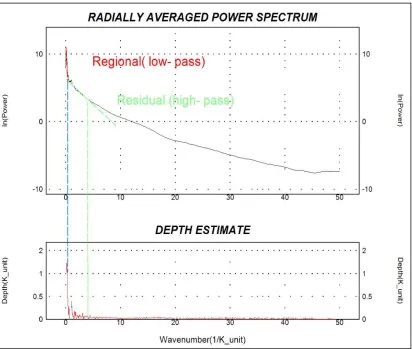
spectrum (figure 5.2) illustrate two linear segments relevant to regional and residual
components of the gravity field.
The 2-dimensional power spectrum (figure 5.2) shows deep-seated sources (low
frequency end), with wavenumbers < 0.38, and the average depth between 1.5 and 2 km.
The high frequency end represents the residual components of Bouguer gravity (figure
5.2), with average depths between 0.5 and 0.1 km.
The Butterworth filtering tool was applied in the wavenumber domain through
Oasis Montaj version 8.5. The Butterworth filter tool is carried out on the Bouguer
gravity grid; in terms of the filter parameters, the degree of filter function is 8 (default),
and the central wavelength cutoff value is 0.28 (cycle/ground).
Regional and residual maps of the Bouguer gravity data are shown in figure 5.3
and 5.4, respectively. The low gravity zone onthe northern part of the map, with an
amplitude that ranges between 2 and 6 mGal oriented in NE-SW direction, is associated
with the Pageland granite. The second zone on the western part of the map is
characterized by high gravity, with an amplitude that ranges between 15 and 19 mGal,
and is oriented in a NW-SE direction. This zone may be associated with mafic intrusions
and/or metavolcanic formations. The third zone is at Haile Mine area, has a medium
gravity value that ranges between 13.5 and 15 mGal, and trends NE-SW. This zone is
42
The residual map (figure 5.4) shows that amplitude values range between - 0.20
and 0.25 mGal. It is characterized by several minor circular and elongated anomalies
along the study area. The structural trends are in NW-SE, NE-SW and N-S directions.
The western part of the study area at Haile Mine site shows a high amplitude anomalies
of 0.15 mGal oriented in NE-SE and N-S trends. Figure 5.5 shows the B-B’ geological
profile and its location on the residual gravity map.
43 Figure 5.3: Theregional Bouguer gravity map.
Figure 5.4: The residual Bouguer gravity map.
Regional Bouguer (mGal)
44
Figure 5.5: The B-B’ geological profile and its location on the geological map from Mobley et al. 2014. Expanded view of the residual Bouguer map showing the location of the B-B’ geological profile.
3-D Analytical signal (AS) method:
The analytic signal was applied to the Bouguer gravity to provide the source
locations of the gravity anomalies, locate the sources edges in both horizontal and vertical
dimensions, and determine the main trends of these anomalies. It shows maxima over
contacts (Roset et al. 1992), and a maximum value over the edges of the fault/contact.
Figure 5.6 shows a high analytic signal (pink color) located in the west, north, and
north-east part of the study area, related to metavolcanics and the Pageland granite (felsic
intrusive), respectively. The high values of AS in the west and north part (dotted line)
may indicate the contact between metasedimentary and metavolcanic formations. The
analytic signal of the Bouguer map over the Haile mine in the western part of study area
N N
45
(small box in the western side of figure 5.6), shows maximum anomalies over the
metavolcanic units and also highlights some of the ore bodies in the Haile Mine area.
Figure 5.7 shows an expanded view to the small box in figure 5.6, where the Haile
mine area is located. It shows a geological map overlying the AS of the Bouguer map.
High AS anomalies correspond to the areas of ore bodies and metavolcanic units. The
metasedimentary rocks show a low AS anomaly.
The positions and trends of some peak analytic signals (red color) at the Haile and
the Brewer Mine areas are similar to TDR of the Bouguer and residual maps.
Figure 5.6: The analytic signal of the Bouguer gravity map. Dotted line may refer to the lithological boundaries of the metasedimentary and metavolcanic units.