Stanisław P. Radziszowski Department of Computer Science Rochester Institute of Technology Rochester, NY 14623, [email protected]
http://www.cs.rit.edu/~spr
first version: June 11, 1994; revision #16: January 15, 2021 http://www.combinatorics.org
ABSTRACT: We present data which, to the best of our knowledge, includes all known nontrivial values and bounds for specific graph, multicolor and hypergraph Ramsey numbers, where the avoided graphs are complete or complete without one edge. Many results per-taining to other more studied cases are also presented. We give refer-ences to all cited bounds and values, as well as to previous similar compilations. We do not attempt complete coverage of asymptotic behavior of Ramsey numbers, but rather we concentrate on their specific values.
Mathematical Reviews Subject Number 05C55
Revisions
1993, February preliminary version, RIT-TR-93-009 [Ra2] 1994, July 3 posted on the web at theElJC
1994, November 7 ElJCrevision #1 1995, August 28 ElJCrevision #2 1996, March 25 ElJCrevision #3 1997, July 11 ElJCrevision #4
1998, July 9 ElJCrevision #5
1999, July 5 ElJCrevision #6
2000, July 25 ElJCrevision #7 2001, July 12 ElJCrevision #8 2002, July 15 ElJCrevision #9
2004, July 4 ElJCrevision #10
2006, August 1 ElJCrevision #11 2009, August 4 ElJCrevision #12 2011, August 22 ElJCrevision #13 2014, January 12 ElJCrevision #14 2017, March 3 ElJCrevision #15 2021, January 15 ElJCrevision #16
Table of Contents 2
1. Scope and Notation 3
2. Classical Two-Color Ramsey Numbers 4
2.1 Values and bounds forR(k,l),k≤10, l≤15 4
2.2 Bounds forR(k,l), higher parameters 7
2.3 General results onR(k,l) 9
3. Two Colors:Kn−e,K3,Km,n 12
3.1 Dropping one edge from complete graph 12
3.2 Triangle versus other graphs 15
3.3 Complete bipartite graphs 16
4. Two Colors: Numbers Involving Cycles 20
4.1 Cycles, cycles versus paths and stars 20
4.2 Cycles versus complete graphs 21
4.3 Cycles versus wheels 23
4.4 Cycles versus books 25
4.5 Cycles versus other graphs 26
5. General Graph Ramsey Numbers in Two Colors 27
5.1 Paths 27
5.2 Wheels 27
5.3 Books 28
5.4 Trees and forests 30
5.5 Stars, stars versus other graphs 31
5.6 Paths versus other graphs 32
5.7 Fans, fans versus other graphs 33
5.8 Wheels versus other graphs 33
5.9 Books versus other graphs 34
5.10 Trees and forests versus other graphs 35
5.11 Cases forn(G), n(H)≤5 36
5.12 Miscellaneous cases 36
5.13 Multiple copies of graphs, disconnected graphs 37
5.14 General results for special graphs 38
5.15 General results for sparse graphs 39
5.16 General results 40
6. Multicolor Graph Ramsey Numbers 42
6.1 Bounds for classical numbers 42
6.2 General results for complete graphs 44
6.3 Cycles 46
6.4 Paths, paths versus other graphs 51
6.5 Special cases 53
6.6 General results for special graphs 54
6.7 General results 55
7. Hypergraph Ramsey Numbers 57
7.1 Values and bounds for numbers 57
7.2 Cycles and paths 58
7.3 General results for 3-uniform hypergraphs 60
7.4 General results 61
8. Cumulative Data and Surveys 62
8.1 Cumulative data for two colors 62
8.2 Cumulative data for three colors 64
8.3 Electronic resources 64
8.4 Surveys 65
9. Concluding Remarks 67
1. Scope and Notation
There is vast literature on Ramsey type problems starting in 1930 with the original paper of Ramsey [Ram]. Graham, Rothschild and Spencer in their book [GRS] present an exciting development of Ramsey Theory. The subject has grown amazingly, in particular with regard to asymptotic bounds for various types of Ramsey numbers (see the survey papers [GrRo¨, Nes˘, ChGra2, Ros2]), but the progress on evaluating the basic numbers themselves has been unsatisfactory for a long time. In the last few decades, however, considerable progress has been obtained in this area, mostly by employing computer algorithms. The few known exact values and several bounds for different numbers are scattered among many technical papers. This compilation is a fast source of references for the best results known for specific numbers. It is not supposed to serve as a source of definitions or theorems, but these can be easily accessed via the references gathered here.
Ramsey Theory studies conditions when a combinatorial object contains necessarily some smaller given objects. The role of Ramsey numbers is to quantify some of the general existen-tial theorems in Ramsey Theory.
Let G1,G2, . . . , Gm be graphs or s-uniform hypergraphs (s is the number of vertices in each edge). R(G1,G2, . . . , Gm ;s) denotes the m-color Ramsey number for s-uniform graphs/hypergraphs, avoiding Gi in color i for 1≤ i≤ m. It is defined as the least integer n
such that, in any coloring with m colors of the s-subsets of a set of n elements, for some i
the s-subsets of color i contain a sub-(hyper)graph isomorphic to Gi (not necessarily induced). The value of R(G1, G2, . . . , Gm ;s) is fixed under permutations of the first m
arguments. If s=2 (standard graphs) then s can be omitted. If Gi is a complete graph Kk, then we may write k instead of Gi, and if Gi =G for all i we may use the abbreviation
Rm(G;s) or Rm(G). For s=2, Kk−e denotes a Kk without one edge, and for s=3, Kk−t
denotes a Kk without one triangle (hyperedge).
The graph nG is formed by n disjoint copies of G, G∪H stands for vertex disjoint union of graphs, and the join G+H is obtained by adding all of the edges between vertices of
G and H to G∪H. Pi is a path on i vertices, Ci is a cycle of length i, and Wi is a wheel
with i−1 spokes, i.e. a graph formed by some vertex x, connected to all vertices of the cycle
Ci−1 (thus Wi = K1+Ci−1). Kn,m is a complete n by m bipartite graph, in particular K1,n is a star graph. The book graph Bi =K2+Ki =K1+K1,i has i+2 vertices, and can be seen as i
triangular pages attached to a single edge. The fan graph Fn is defined by Fn = K1+ nK2. For a graph G, n(G) and e(G) denote the number of vertices and edges, respectively, and δ(G) and ∆(G) minimum and maximum degree of G. Finally, χ(G) denotes the chromatic number of G. In general, we follow the notation used by West [West].
Section 2 contains the data for the classical two color Ramsey numbers R(k,l) for com-plete graphs, section 3 for the much studied two color cases of Kn − e, K3, Km,n, and section 4 for numbers involving cycles. Section 5 lists other often studied two color cases for general graphs. The multicolor and hypergraph cases are gathered in sections 6 and 7, respectively. Finally, section 8 gives pointers to cumulative data and to other surveys.
2. Classical Two-Color Ramsey Numbers
2.1. Values and bounds for R(k, l), k≤10, l≤15
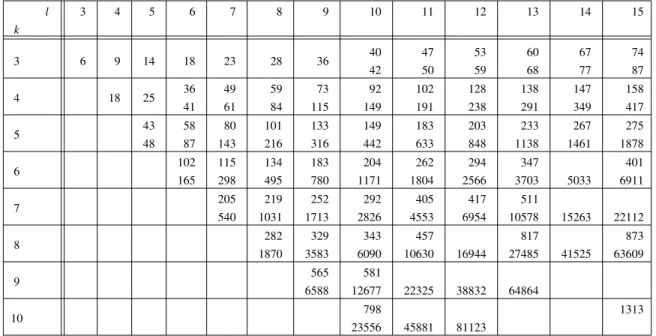
l 3 4 5 6 7 8 9 10 11 12 13 14 15 k 40 47 53 60 67 74 3 6 9 14 18 23 28 36 42 50 59 68 77 87 36 49 59 73 92 102 128 138 147 158 4 18 25 41 61 84 115 149 191 238 291 349 417 43 58 80 101 133 149 183 203 233 267 275 5 48 87 143 216 316 442 633 848 1138 1461 1878 102 115 134 183 204 262 294 347 401 6 165 298 495 780 1171 1804 2566 3703 5033 6911 205 219 252 292 405 417 511 7 540 1031 1713 2826 4553 6954 10578 15263 22112 282 329 343 457 817 873 8 1870 3583 6090 10630 16944 27485 41525 63609 565 581 9 6588 12677 22325 38832 64864 798 1313 10 23556 45881 81123
Table Ia. Known nontrivial values, lower bounds (2020) and upper bounds (2017) for two color Ramsey numbers R(k,l) = R(k,l; 2), for k≤10, l≤15.
For the best known upper bounds (2020) with k≥4 see Table Ib.
l 4 5 6 7 8 9 10 11 12 13 14 15
k
Ka2 GR Ka2 Ex5 Ex20 Kol1 Kol1 Kol2 Kol2
3 GG GG Ke´ry
GrY McZ GR GoR1 GoR1 Les GoR1 GoR1 GoR1
Ka1 Ex19 Ex3 ExT Ex16 HaKr1 ExT SuLL ExT ExT Tat
4 GG
MR4 MR5 Mac Mac Mac Mac Spe4 Spe4 Spe4 Spe4 Spe4
Ex4 Ex9 CaET HaKr1 Kuz ExT Kuz Kuz Kuz Kuz 2.3.h
5
AnM1 HZ1 HZ1 Spe4 Mac Mac HW+ HW+ HW+ HW+ HW+
Ka2 ExT ExT Kuz Kuz Tat Kuz Kuz 2.3.i
6
Mac HZ1 Mac Mac Mac HW+ HW+ HW+ HW+ HW+
She2 Tat Kuz Kuz XXER XSR2 XuXR
7
Mac HZ1 HZ2 Mac HW+ HW+ HW+ HW+ HW+
BurR Kuz Kuz 2.3.i XXER 2.3.i
8 Mac Ea1 HZ2 HW+ HW+ HW+ HW+ HW+ She2 XSR2 9 ShZ1 Ea1 HW+ HW+ HW+ She2 2.3.i 10 Shi2 HW+ HW+
References for Table Ia; all upper bounds for k≥4, l≥6 were improved in 2019 [AnM2], see Table Ib. HW+ abbreviates HWSYZH, as enhanced by Boza [Boza5], see 2.1.m.
l 5 6 7 8 9 10 11 12 13 14 15 k 4 25 40 58 79 106 136 171 211 257 307 364 5 48 85 133 194 282 381 511 673 861 1082 1342 6 161 273 427 656 949 1352 1865 2510 3308 4305 7 497 840 1379 2134 3216 8 1532 2683 4432 7647
Table Ib: Upper bounds for R(k, l), k≥4, l≥5. All of them were obtained by Angeltveit and McKay [AnM2] in 2019, except R(4, 5) [MR4], and they
improve over previously best known bounds reported in Table Ia.
We split the data into Table Ia with a separate table of references corresponding to it, and Table Ib of new upper bounds. In Table Ia, the known exact values appear as centered entries, lower bounds as top entries, and upper bounds as bottom entries. For some of the exact values two references are given when the lower and upper bound credits are different. In 2019, in a large computational project, Angeltveit and McKay [AnM2] obtained new upper bounds as reported in Table Ib. These, by using the classical recursive upper bound 2.3.a, lead to further improvements of other upper bounds on R(k,l) for k≥4, l≥6. For example, the bounds R(9, 9) ≤ 5366 and R(7, 12) ≤ 5081 implied by 2.3.a, but not reported in Table Ib, improve over those listed in Table Ia.
(a) The task equivalent to that of proving R(3, 3) ≤ 6 was the second problem in the Ku¨rscha´k Mathematics Competitions in Hungary in 1947 [BaLiu]. It also was the second problem in Part I of the William Lowell Putnam Mathematical Competition held in March 1953 [Bush].
(b) Greenwood and Gleason [GG] established the initial values R(3, 4) = 9, R(3, 5) = 14 and R(4, 4) = 18 in 1955.
(c) Ke´ry [Ke´ry] proved that R(3, 6) = 18 in 1964, but only in 2007 an elementary and self-contained proof of this result appeared in English [Car].
(d) All of the critical graphs for the numbers R(k, l) (graphs on R(k, l)−1 vertices without
Kk and without Kl in the complement) are known for k=3 and l=3, 4, 5 [Ke´ry], 6 [Ka2], 7 [RaK2, McZ], 8 [BrGS] and 9 [GoR1], and there are 1, 3, 1, 7, 191, 477142, and 1 of them, respectively. All (3, k)-graphs, for k ≤ 6, were enumerated in [RaK2], and all (4,4)-graphs in [MR2]. There exists a unique critical graph for R(4, 4) [Ka2]. Until 2015, there were 350904 known critical graphs for R(4, 5) [MR4], but the full set of such graphs was computed in 2016 [McK3], and there are 352366 of them.
(e) In [MR5], strong evidence is given for the conjecture that R(5, 5) = 43 and that there exist exactly 656 critical graphs on 42 vertices. The upper bound of 49 was established
in 1997 [MR5]. Angeltveit and McKay improved it by 1 to 48 in 2016 [AnM1].
(f) The graphs constructed by Exoo in [Ex9, Ex12-Ex20, Ex22], and some others, are avail-able electronically from http://cs.indstate.edu/ge/RAMSEY. Fujita [Fuj1] maintains a web-site with some lower bound constructions; in particular, it presents the bound
R(4, 8) ≥ 58 obtained independently from Exoo.
(g) Cyclic (or circulant) graphs are often used for Ramsey graph constructions. Several cyclic graphs establishing lower bounds were given in the Ph.D. dissertation by J.G. Kalbfleisch in 1966, and many others were published in the next few decades (see [RaK1]). Harborth and Krause [HaKr1] presented all best lower bounds up to 102 from cyclic graphs avoiding complete graphs. In particular, no lower bound in Table Ia can be improved with a cyclic graph on less than 102 vertices, except possibly for R(3, k) for
k ≥ 13. See also items 2.3.l and section 5.16.o [HaKr1]. Larger cyclic heuristic con-structions for R(3, k) were explored in [JiLTX1, JiLTX2]. Several best lower bounds from distance colorings, a slightly more general concept than circular graphs, are presented in [HaKr2].
(h) The claim that R(5, 5) = 50 posted on the web [Stone] is in error, and despite being shown to be incorrect more than once, this value is still being cited by some authors. The bound R(3, 13) ≥ 60 [XieZ] cited in the 1995 version of this survey was shown to be incorrect in [Piw1]. Another incorrect construction for R(3, 10) ≥ 41 was described in [DuHu].
(i) There are really only two general upper bound inequalities useful for small parameters, namely 2.3.a and 2.3.b. Stronger upper bounds for specific parameters were difficult to obtain, and they often involved massive computations, like those for the cases of (3,8) [McZ], (3,10) [GoR1], (4,5) [MR4], (4,6) and (5,5) [MR5, AnM1]. The bound
R(6, 6) ≤ 166, only 1 more than in [Mac], is an easy consequence of a theorem in [Walk] (2.3.b) and R(4, 6) ≤ 41. Since 2020, we know that R(6, 6) ≤ 161 [AnM2]. (j) T. Spencer [Spe4], Mackey [Mac], and Huang and Zhang [HZ2], using the bounds for
minimum and maximum number of edges in (4,5) Ramsey graphs listed in [MR3, MR5], were able to establish new upper bounds for several higher Ramsey numbers, improving on all of the previous longstanding best results by Giraud [Gi3, Gi5, Gi6].
(k) In Table Ia, only some of the higher bounds implied by 2.3.* are shown, and more simi-lar bounds could be derived. In general, we show bounds beyond the contiguous small values if they improve on results previously reported in this survey or published else-where. Some easy upper bounds implied by 2.3.a are marked as [Ea1].
(l) In 2009, we have recomputed the upper bounds in Table Ia marked [HZ2] using the method from the paper [HZ2], because the bounds there relied on an overly optimistic personal communication from T. Spencer. Further refinements of this method are studied in [HZ3, ShZ1, Shi2]. The paper [Shi2] subsumes the main results of the manuscripts [ShZ1, Shi2]. All these bounds are now improved by the bounds in Table Ib obtained in [AnM2].
(m) In 2013, Boza [Boza5] using the method of [HWSYZH], which is abbreviated as HW+ in Table Ia, computed the bounds marked HW+ by starting from better upper bounds for
smaller parameters. Most of the currently shown bounds are thus better than those origi-nally listed in [HWSYZH, HZ3]. All these bounds are now improved by the bounds in Table Ib obtained in [AnM2].
(n) In 2015, Exoo and Tatarevic obtained several lower bound improvements marked [ExT] in Tables Ia and IIa by using some modifications of general circulant constructions, but especially related to the quadratic residues Paley graph Q101 and the cubic residues graph
G127. More bounds by Tatarevic are reported in [Tat]. In 2016, Kuznetsov [Kuz] obtained several further new lower bounds building up on circulant graphs. Also in 2015 and 2016, somewhat surprisingly, Kolodyazhny [Kol1, Kol2] improved four longstanding lower bounds on R(3, k) in Table Ia.
(o) Some lower bounds in Table Ia, like for R(6, 8) or R(8, 8), may seem rather weak, yet they are not easy to improve. For comments on R(8, 8) see [ExT].
2.2. Bounds for R(k, l), higher parameters
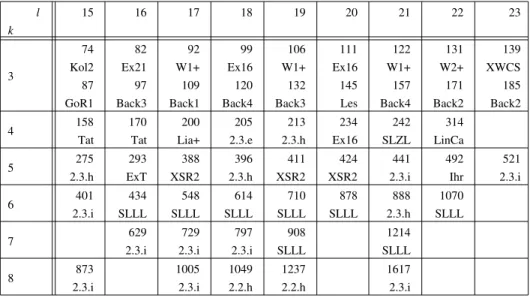
(a) The upper bounds in Tables Ia and IIa marked [GoR1, Les, Back1] were obtained mainly by deriving lower bounds for several cases of e(3, k, n), which denotes the minimum number of edges in n-vertex triangle-free graphs with independence number less than k. The study of e(3, k, n) was also the main tool for the results obtained in [GrY, GR, RaK2, RaK3, GoR2].
l 15 16 17 18 19 20 21 22 23
k
74 82 92 99 106 111 122 131 139
Kol2 Ex21 W1+ Ex16 W1+ Ex16 W1+ W2+ XWCS
87 97 109 120 132 145 157 171 185
3
GoR1 Back3 Back1 Back4 Back3 Les Back4 Back2 Back2
158 170 200 205 213 234 242 314
4
Tat Tat Lia+ 2.3.e 2.3.h Ex16 SLZL LinCa
275 293 388 396 411 424 441 492 521
5
2.3.h ExT XSR2 2.3.h XSR2 XSR2 2.3.i Ihr 2.3.i
401 434 548 614 710 878 888 1070
6
2.3.i SLLL SLLL SLLL SLLL SLLL 2.3.h SLLL
629 729 797 908 1214
7
2.3.i 2.3.i 2.3.i SLLL SLLL
873 1005 1049 1237 1617
8
2.3.i 2.3.i 2.2.h 2.2.h 2.3.i
Table IIa. Known bounds for higher two-color Ramsey numbers R(k,l), with references. Lower and upper bounds are given for k=3, only lower bounds for k≥4;
l 24 25 26 27 28 29 30 31 32
k
143 154 159 172 177 190 195 206 217
3
W1+ W2+ W1+ LiLi LiLi LiLi LiLi LiLi LiLi
l 33 34 35 36 37 38 39 40 41
k
224 230 242 252 264 272 284 294 308
3
LiLi Ji+ Ji+ Ji+ Ji+ Ji+ Ji+ Ji+ Ji+
l 42 43 44 45 46 47 48 49 50
k
318 332 338 354 360 380 384 402
3
Ji+ Ji+ Ji+ Ji+ Ji+ Ji+ Ji+ Ji+
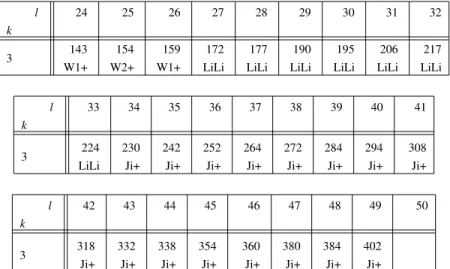
Table IIb. Known lower bounds for higher Ramsey numbers R(3, l) for l ≥ 24. W1+, W2+ and Ji+ abbreviate WSLX1, WSLX2 and JiLTX2, respectively.
k 11 12 13 14 15 16 17
lower bound 1597 1640 2557 2989 5485 5605 8917 reference 2.2.c Tat 2.2.c 2.2.c 2.2.c 2.2.c LuSL
k 18 19 20 21 22 23 24
lower bound 11005 17885 21725 30925 39109 49421 reference LuSL LuSL Ex23 Ex23 Ex23 Ex23
Table IIc. Known lower bounds for diagonal Ramsey numbers R(k,k) for k ≥ 11; All lower bounds for k ≥ 13 are from Paley graphs, see also 2.2.c below.
(b) Ramsey Calculus [Back1], is an extensive manuscript by Backelin, which, among other goals, addresses the derivation of e(3, k,n) and the corresponding realisers while avoid-ing reliance on computer assisted results as far as possible. It achieves the derivation of several lower bounds for e(3, k+1,n) better than those in [GoR1, RaK3, RaK4] for n
close to and above 13k /4. Better lower bounds on e(3, k, n) sometimes lead to better upper bounds on R(3, l), like for l = 18 and l = 20 [Back4]. Further improvements to bounds on e(3, k, n) were obtained in [Kru¨].
(c) The construction by Shearer [She2] (see also items 2.3.j, 6.2.k and 6.2.l), using the data obtained by Shearer [She4] for primes up to 7000, implies the lower bounds in Table IIc marked 2.2.c. An equivalent construction was studied by Mathon [Mat]. The first two bounds credited in Table IIc to [LuSL] also follow similarly from the data in [She4]. The same approach does not improve on the bound R(12, 12) ≥ 1639 [XSR2], later increased to 1640 [Tat]. The bounds in [Ex23] were obtained by extending data for Paley graphs beyond [Sha4] and improving on [LiaWXCS].
(d) The lower bounds marked [XuXR], [XXER], [XSR2], 2.3.e, 2.3.h and 2.3.i need not be cyclic. Several of the Cayley colorings from [Ex16] are also non-cyclic. All other lower
bounds listed in Table IIa/b were obtained by construction of circular graphs.
(e) The graphs establishing lower bounds marked 2.3.h can be constructed by using appropriately chosen graphs G and H with a common m-vertex induced subgraph, simi-larly as it was done in several cases in [XuXR].
(f) Yu [Yu2] constructed a special class of triangle-free cyclic graphs establishing several lower bounds for R(3, k), for k≥61. All of these bounds can be improved by the ine-qualities in 2.3.c and data from Tables Ia and IIa/b.
(g) Unpublished bound R(4, 22) ≥ 314 [LiSLW] improved over 282 given in [SuL]. [LinCa] obtained the same bound, and also R(4, 25) ≥ 458. Not yet published bounds
R(3, 23) ≥ 139 [XWCS] and R(4, 17) ≥ 200 [LiaWXS] improve over 137 and 182 obtained in [WSLX2] and [LuSS1], respectively. The bound R(9, 17) ≥ 1411 is given in [XuXR]. Large cyclic heuristic constructions for R(3, k) for k <50 were explored in [JiLTX1, JiLTX2].
(h) Two special cases, R(8, 18) ≥ 1049 and R(8, 19) ≥ 1237, can be obtained by applying 2.3.i and 2.3.h below. In both cases we start with the 816-vertex graph G, witnessing
R(8, 13) ≥ 817, obtained by 2.3.i. Next, for properly chosen graphs H in the application of 2.3.h, we have large common subgraphs of G and H, namely the 101-vertex witness of R(6, 6) ≥ 102 and the 204-vertex witness of R(7, 7) ≥ 205, respectively.
(i) One can expect that the lower bounds in Tables IIa/b are weaker than those in Table Ia, especially smaller ones, in the sense that some of them should not be that hard to improve, in contrast to the bounds in Table Ia.
2.3. General results on R(k, l)
(a) R(k,l) ≤ R(k−1, l)+R(k,l−1), with strict inequality when both terms on the right hand side are even [GG]. There are obvious generalizations of this inequality for avoiding graphs other than complete.
(b) R(k, k) ≤ 4R(k,k−2)+2 [Walk].
(c) Explicit construction for R(3, 3k+1) ≥ 4R(3, k+1)−3, for all k≥2 [CleDa], explicit construction for R(3, 4k+1) ≥ 6R(3, k+1)−5, for all k≥1 [ChCD].
(d) Explicit triangle-free graphs with independence k on Ω(k3/2) vertices [Alon2, CoPR]. For other constructive results in relation to R(3, k) see [BrBH1, BrBH2, Fra1, Fra2, FrLo, GoR1, Gri, KlaM1, Loc, RaK2, RaK3, RaK4, Stat, Yu1]. See also 2.3.3 and 2.3.4 below.
(e) The study of bounds for the difference between consecutive Ramsey numbers was ini-tiated in [BEFS], where the bound R(k,l) ≥ R(k,l−1) + 2k−3 , for k,l ≥ 3, was esta-blished by a construction. In 1980, Erdo˝s and So´s (cf. [Erd2,ChGra2]) asked: If we set ∆k,l = R(k,l) − R(k,l−1), then is it true that ∆k,k+1/ k→ ∞ as k→ ∞? Only easy bounds on ∆k,l are known, in particular for k = 3 we have 3 ≤ ∆3,l ≤ l . For some
dis-cussion of the roadblocks on the latter see [XSR2, GoR2, ZhuXR]. It is also known that
(f) A conjecture that R(k, l) ≥ R(k−1,l+1) for all 3 ≤ k ≤ l (called DC), its implications, evidence for validity, and related problems [LiaRX]. For the multicolor version of DC and its consequences see item 6.2.v.
(g) By taking a disjoint union of two critical graphs one can easily see that R(k, p)≥s and
R(k, q)≥t imply R(k,p+q−1) ≥s+t−1. Xu and Xie [XuX1] improved this construc-tion to yield better general lower bounds, in particular R(k, p+q−1) ≥ s+t+k−3. (h) For 2≤p≤q and 3≤k, if (k, p)-graph G and (k, q)-graph H have a common induced
subgraph on m vertices without Kk−1, then R(k,p+q−1)> n(G)+n(H)+m. In
particu-lar, this construction implies the bounds R(k,p+q−1) ≥ R(k,p) + R(k,q)+k−3 and
R(k, p+q−1) ≥ R(k,p) + R(k, q)+p−2 [XuX1, XuXR], with small improvements in some cases, such as using the term k− 2 instead of k−3 in the first bound [XSR2]. (i) R(2k−1, l) ≥ 4R(k, l−1) − 3 for l ≥ 5 and k ≥ 2, and in particular for k=3 we have
R(5, l) ≥ 4R(3, l−1) − 3 [XXER].
(j) If the quadratic residues Paley graph Qp of prime order p= 4t+1 contains no Kk, then
R(k, k) ≥ p+1 and R(k+1, k+1) ≥ 2p+3 [She2, Mat]. Data for larger p was obtained in [LuSL], and further for p up to 25000 in [Ex23]. See also 3.1.e, and items 6.2.k and 6.2.l for similar multicolor results.
(k) Study of Ramsey numbers for large disjoint unions of graphs [Bu1, Bu9], in particular
R(nKk, nKl) = n(k+l−1) + R(Kk−1, Kl−1) − 2, for n large enough [Bu8].
(l) R(k, l) ≥ L(k, l) + 1, where L(k,l) is the maximal order of any cyclic (k,l)−graph. A compilation of many best cyclic bounds was presented in [HaKr1].
(m) The graphs critical for R(k, l) are (k−1)−vertex connected and (2k−4)−edge connected, for k,l ≥ 3 [BePi]. This was improved to vertex connectivity k for k ≥ 5 and l ≥ 3 in [XSR2].
(n) All Ramsey-critical (k, l)−graphs are Hamiltonian for k ≥ l−1 ≥ 1 and k ≥ 3, except when (k, l) = (3, 2) [XSR2].
(o) Two-color lower bounds can be obtained by using items 6.2.m, 6.2.n and 6.2.o with
r = 2. Some generalizations of these were obtained in [ZLLS].
In the last seven items (1)-(7) of this section we only briefly mention some pointers to the literature dealing with asymptotics of Ramsey numbers. This survey was designed mostly for small, finite, and combinatorial results, but still we wish to give the reader some useful and representative references to more traditional papers studying the infinite.
(1) In 1947, Erdo˝s gave a simple probabilistic proof that R(k, k) > 2k /2 [Erd1]. In 1975, Spencer [Spe1] improved it to R(k, k) > √2e−1k2k /2(1+o(1)). More probabilistic asymptotic lower bounds were obtained in [Spe1, Spe2, AlPu].
(3) In 1995, Kim obtained a breakthrough result by proving that R(3, k) = Θ(k2/logk) [Kim]. The best known lower and upper bounds constants are 1/4 [BohK2, BohK3] and 1 (implicit in [She1]), respectively. An independent proof of the lower bound constant 1/4 and a conjecture that it is the best possible are presented in [FizGM].
(4) Other asymptotic and general results on triangle-free graphs in relation to R(3, k) can be found in [Boh, AlBK, AjKS, Alon2, CleDa, ChCD, CoPR, Gri, FrLo, Loc, She1, She3]. (5) Explicit constructions yielded the lower boundsR(4, k) ≥ Ω(k8/5), R(5, k) ≥ Ω(k5/3) and
R(6, k) ≥ Ω(k2) [KosPR]. For the same cases of k classical probabilistic arguments give Ω((k /logk)5/2), Ω((k /logk)3) and Ω((k /logk)7/2), respectively [Spe2]. These were improved to Ω(k5/2/(logk)2), Ω(k3/(logk)8/3) and Ω(k7/2/(logk)13/4), respectively, in [Boh, BohK1], and in general to R(s,t) ≥ Ω(t(s+1)/2/(logt)(s2−s−4)/(2s−4)), for fixed s and large t [BohK1].
(6) Explicit construction of a graph with clique and independence k on 2clog2k /log logk ver-tices was presented by Frankl and Wilson [FraWi], and further constructions by Chung [Chu3] and Grolmusz [Grol1, Grol2]. In 2012, the best explicit construction for large k
by Barak et al. [BarRSW] improved over [FraWi] by giving such a graph on 22( log logk)C
vertices for some c >1, or equivalently, on n vertices, where log logn = ( log logk)c. This was improved to log logn = ( logk)d, for a positive constant d, by Cohen [Coh] in
2016. Explicit constructions such as these are usually weaker than known probabilistic results.
(7) In 2009, Conlon [Con1] obtained the best until then upper bound for the diagonal case
R(k+1,k+1) ≤ k
2k k
−clogk /log logk.
In 2020, Sah [Sah] improved it to
R(k+1, k+1) ≤ k 2k e −c(logk)2 .
Other asymptotic bounds can be found, for example, in [Chu3, McS, Boh, BohK1] (lower bound) and [Tho] (upper bound), and for many other bounds in the general case of R(k,l) consult [Spe2, GRS, GrRo¨, Chu4, ChGra2, LiRZ1, AlPu, Kriv, ConFS7].
3. Two Colors: Kn −e, K3,Km,n
3.1. Dropping one edge from complete graph
This section contains known values and nontrivial bounds for the two color case when the avoided graphs are complete or have the form Kk−e, but not both are complete.
(a) The exact values in Table IIIa involving K3−e are obvious, since one can easily see that
R(K3−e,Kk ) = R(K3−e, Kk+1−e) = 2k−1 for all k≥2.
(b) More bounds (beyond those shown in Tables IIIa/b) can be easily obtained using Table Ia/b, an obvious generalization of the inequality R(k, l) ≤ R(k−1, l) + R(k, l−1), and by monotonicity of Ramsey numbers, in this case R(Kk−1,G) ≤ R(Kk −e,G) ≤ R(Kk,G).
H K3−e K4−e K5−e K6−e K7−e K8−e K9−e K10−e K11−e G K3−e 3 5 7 9 11 13 15 17 19 42 K3 5 7 11 17 21 25 31 37 45 30 36 41 K4−e 5 10 13 17 28 32 46 63 82 30 37 52 62 K4 7 11 19 32 49 74 105 136 171 66 69 K5−e 7 13 22 37 65 97 143 30 43 65 81 121 K5 9 16 33 62 102 175 275 381 511 45 66 83 K6−e 9 17 37 70 124 218 361 551 43 58 K6 11 21 53 110 205 371 620 949 1352 66 K7−e 11 28 65 124 247 465 807 1331 2142 28 65 80 K7 13 29 82 191 388 746 1325 2134 3216 36 69 K8 15 39 121 300 657 1345 2556 4432 7647 41 75 K9 17 56 167 49 K10 19
Table IIIa. Bounds on the Ramsey numbers R(G, H), for complete or missing one edge graphs G and H, but not both complete. Known exact values appear as centered entries, lower bounds as top entries, and upper bounds as bottom entries.
H K4−e K5−e K6−e K7−e K8−e K9−e K10−e K11−e
G
MPR WWY2
K3 ChH2 Clan FRS1 GrH Ra1 Ra1
GoR2 GoR2
AnM2 VO Ex14
K4−e ChH1 FRS2 McR McR
LidP LidP Ea1 Ea1
Boza6 Ex14 VO VO
K4 ChH2 EHM1
LidP LidP BZ7 BZ2 AnM2 AnM2
Ea1 Ea1
K5−e FRS2 CE+ VO VO Ea1 Ea1 HT+ HT+
Ex6 Ea1 VO VO VO
K5 BoH BZ7 LidP LidP Ea1 BZ7 AnM2 AnM2
Ex14 VO VO K6−e McR VO HZ3 LidP HT+ Ea1 HT+ McN/ VO Ea1 K6 ShWR BZ1 BZ7 ShZ2 BZ7 BZ7 AnM2 AnM2 VO
K7−e McR VO LidP Ea1 Ea1 HT+ HT+ HT+
Ea1 Ea1 Ea1
K7 LidP Ea1 Ea1 BZ7 BZ7 BZ7 AnM2 AnM2
VO Ea1
K8
LidP Ea1 BZ7 BZ7 BZ7 BZ7 AnM2 AnM2
VO Ea1
K9
Ea1 Ea1
VO
K10
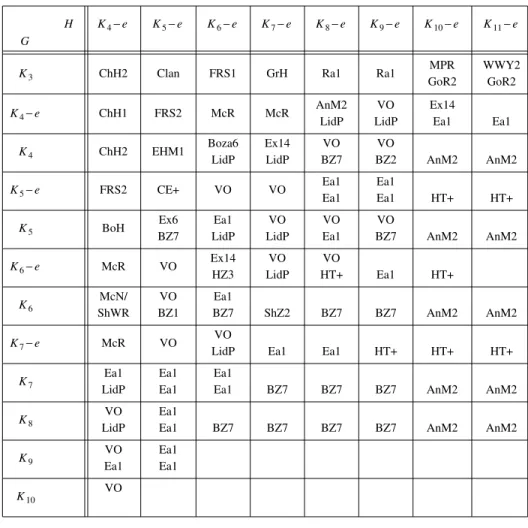
References for Table IIIa;
CE+ abbreviates ClEHMS, HT+ abbreviates HTHZ1 (see also 3.1.o below), for some details on BZ1, BZ2 and BZ7 see item 3.1.f.
k 11 12 13 14 15 16
lower 42 49 55 61 69 74
bound WWY2 VO GoR2 VO WWY2 Ea1
upper 45 53 62 71 80 91
bound GoR2 GoR2 GoR2 GoR2 GoR2 GoR2
Table IIIb. Lower and upper bounds for R(K3, Kk −e) for 11 ≤ k ≤ 16.
(c) Upper bounds for Ramsey numbers R(Kk,Kl −e) marked [AnM2] in references for Table IIIa are trivially implied by the bounds on R(Kk, Kl) in Table Ib. These were obtained in 2020 by Angeltveit and McKay using linear programming, and they improve over upper bounds in Table Ia. The upper bounds by Lidick´y and Pfender [LidP] use flag algebras.
(d) Two special exact values, and several other bounds were obtained by Van Overberghe [VO] in 2020. The surprisingly large exact values R(K5−e,K6−e) = 37 and
R(K5−e, K7−e) = 65 exploit some previously known strongly regular graphs on 27, 36 and 64 vertices, namely the Schla¨fli graph, NO−(6, 2) and VO−(6, 2) (see the website by A. E. Brouwer [Brou] for a great collection of strongly regular graphs). A lower bound
R(K4−e, K16−e) ≥ 82 is also in [VO].
(e) If the quadratic residues Paley graph Qp of prime order p= 4t+1 contains no Kk −e,
then R(Kk+1−e,Kk+1−e) ≥ 2p+1. In particular, R(K14−e,K14−e) ≥ 2987 [LiShen]. This was generalized to Kk −F for some small graphs F instead of an edge e(=K2) [WaLi]. See also item 2.3.j.
(f) This item follows personal communication from Boza [Boza5]. The upper bounds marked [BZ1] were obtained until 2012, while ones marked [BZ2] are from 2013. Several other improvements were obtained by Boza [Boza7] in 2014, marked also as [BZ7]. They are implied by [Boza6], the previous work [Boza1, Boza3, BoPo], the method of [HZ3], and the bounds given in [GoR2]. The enumeration of all (K6,K4−e )-graphs [ShWR] is used in [BoPo].
(g) All (K3,Kk −e)-graphs were enumerated for k ≤ 6 [Ra1] and k = 7 [Fid2, GoR2]. Full sets of (Kl,Kk −e)-graphs were posted for the parameters (K3, Kk −e) for k ≤ 7, (K4, Kk −e) for k ≤ 5, and (K5, Kk −e) for k ≤ 4 ([Fid2], available until 2014), and other full and restricted families at [BrCGM, Fuj1].
(h) The number of (K3,Kl −e)-critical graphs for l= 4, 5 and 8 is 4, 2 and 9, respectively [MPR]. There are 7 critical graphs for R(K3,K9−e), and at least 40 such graphs for
R(K3, K10−e) [GoR2].
(i) The critical graphs are unique for: R(K3,Kl −e) for l=3 [Tr], 6 and 7 [Ra1],
R(K4−e,K4−e) [FRS2],R(K5−e,K5−e) [Ra3] and R(K4−e, K7−e) [McR]. (j) All of the critical graphs for the cases R(K4−e,K4) [EHM1], R(K4−e,K5) and
R(K5−e,K4) [DzFi1] are known, and there are 5, 13 and 6 of them, respectively. The unpublished value of R(K4−e, K6) [McN] was confirmed in [ShWR], where in addition all 24976 critical graphs were found.
(k) It is known that R(K4, K12−e) ≥ 128 [Shao] by using one color of the (4, 4, 4;127)-coloring defined in [HiIr].
(l) If m ≤ n then R(K4− e,Km+n+1) ≥ R(3, m+1) + R(3, n+1) + n.
Study of the growth of R(K4− e, Kn) and its relationship to R(K3,Kn) [JiLSX]. (m) R(Kk −e, Kk −e) ≤ 4R(Kk−2,Kk −e) − 2 [LiShen].
For a similar inequality for complete graphs see 2.3.b.
(n) Study of the cases R(Km, Kn−K1,s) and R(Km −e, Kn −K1,s), with several exact values for special parameters [ChaMR]. This study was extended to some cases involv-ing R(Km −K3) [MonCR].
(p) The upper bounds in [HZ3] were obtained by a reasoning generalizing the bounds for classical numbers in [HZ2]. Several other results from section 2.3 apply, though check-ing in which situation they do may require lookcheck-ing inside the proofs whether they still hold for Kn −e. The upper bounds in the manuscript [HTHZ1] (abbreviated as HT+ in the references for Table IIIa) are based on [HZ3].
3.2. Triangle versus other graphs
(a) R(3, k) = Θ(k2/logk) [Kim].
For more comments on asymptotics see section 2.3.(3) and the items 3.2.p/q below. (b) Explicit construction for R(3, 3k+1) ≥ 4R(3, k+1)− 3, for all k≥2 [CleDa],
explicit construction for R(3, 4k+1) ≥ 6R(3, k+1)− 5, for all k≥1 [ChCD].
(c) Explicit triangle-free graphs with independence k on Ω(k3/2) vertices [Alon2, CoPR]. (d) R(K3,K7−2P2) = R(K3, K7−3P2) = 18 [SchSch2].
(e) R(K3,K3+ Km) = R(K3,K3+ Cm) = 2m+5, for m≥ 212 [Zhou1]. (f) R(K3,K2+ Tn) = 2n+3 for n-vertex trees Tn, for n≥ 4 [SonGQ],
R(K3,K1+ nK3) = 6n+1, for n≥ 3 [HaoLin].
(g) R(K3,G) = 2n(G)−1 for any connected G on at least 4 vertices and with at most (17n(G)+1)/15 edges, in particular for G= Pi and G= Ci, for all i≥ 4 [BEFRS1]. (h) R(K3,Qn) = 2n+1−1 for large n [GrMFSS], where Qn is the n-dimensional hypercube.
For related publications on the general case of R(Km, Qn) see [FizGMSS, ConFLS] and item 5.15.n.
(i) Relations between R(3, k) and graphs with large χ(G) [BiFJ],
further detailed study of the relation between R(3, k) and the chromatic gap [GySeT]. (j) R(K3,G) ≤ 2e(G)+1 for any graph G without isolated vertices [Sid3, GoK].
(k) R(K3,G)≤n(G)+e(G) for all G, a conjecture [Sid2].
(l) R(K3,G) for all connected G up to 9 vertices [BrBH1, BrBH2].
(m) R(K3,G) for all graphs G on 10 vertices [BrGS], except 10 cases (three of which, including G=K10−e, were solved [GoR2]). See also several items in section 8.1.
(n) R(nK3, nK3) = 5n for n≥2, R(mK3, nK3) = 3m+2n for m≥n≥2 [BES], and
R(c(nK3), c(nK3)) = 7n−2 for n≥2, where c(nK3) is any connected graph containing
n vertex disjoint triangles [GySa´3].
(o) Formulas for R(nK3, mG) for all G of order 4 without isolates [Zeng].
(p) For every positive constant c, and for ∆ and n large enough, there exists n-vertex graph
G with ∆(G) ≤ ∆ for which R(K3,G) > cn [Bra3]. (q) R(K3, Kk,k) = Θ(k2/logk) [LinLi2].
(r) For R(K3, Kn) see section 2, and for R(K3, Kn −e) see section 3.1.
(s) Since B1 = F1 = C3 = W3 = K3, other sections apply. See also [Boh, AjKS, BrBH1, BrBH2, FrLo, Fra1, Fra2, BiFJ, Gri, GySeT, Loc, KlaM1, LiZa1, RaK2, RaK3, RaK4, She1, She3, Spe2, Stat, Yu1].
3.3. Complete bipartite graphs
Note: This subsection gathers information on Ramsey numbers where specific bipartite graphs are avoided in edge colorings of Kn (as everywhere in this survey), in contrast to the often studied bipartite Ramsey numbers, which are not covered in this survey, where the edges of complete bipartite graphs Kn,m are colored.
3.3.1. Numbers
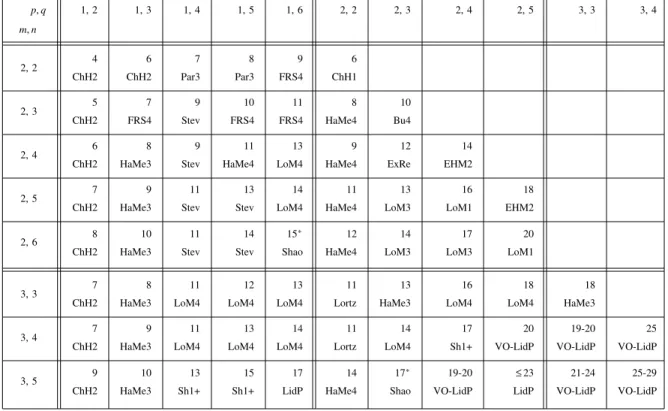
The following Tables IVa and IVb gather information mostly from the surveys by Lortz and Mengersen [LoM3, LoM4]. All cases involving K1, 2 = P3 are solved by a formula for
R(P3, G), which holds for all isolate-free graphs G, derived in [ChH2]. All star versus star numbers are given below in the item 3.3.2.a and in section 5.5.
p,q 1, 2 1, 3 1, 4 1, 5 1, 6 2, 2 2, 3 2, 4 2, 5 3, 3 3, 4 m,n 4 6 7 8 9 6 2, 2 ChH2 ChH2 Par3 Par3 FRS4 ChH1 5 7 9 10 11 8 10 2, 3
ChH2 FRS4 Stev FRS4 FRS4 HaMe4 Bu4
6 8 9 11 13 9 12 14
2, 4
ChH2 HaMe3 Stev HaMe4 LoM4 HaMe4 ExRe EHM2
7 9 11 13 14 11 13 16 18
2, 5
ChH2 HaMe3 Stev Stev LoM4 HaMe4 LoM3 LoM1 EHM2
8 10 11 14 15* 12 14 17 20
2, 6
ChH2 HaMe3 Stev Stev Shao HaMe4 LoM3 LoM3 LoM1
7 8 11 12 13 11 13 16 18 18
3, 3
ChH2 HaMe3 LoM4 LoM4 LoM4 Lortz HaMe3 LoM4 LoM4 HaMe3
7 9 11 13 14 11 14 17 20 19-20 25
3, 4
ChH2 HaMe3 LoM4 LoM4 LoM4 Lortz LoM4 Sh1+ VO-LidP VO-LidP VO-LidP
9 10 13 15 17 14 17* 19-20 ≤23 21-24 25-29
3, 5
ChH2 HaMe3 Sh1+ Sh1+ LidP HaMe4 Shao VO-LidP LidP VO-LidP VO-LidP
Table IVa. Ramsey numbers R(Km,n, Kp,q); unpublished result
m 2 3 4 5 6 7 8 9 10 11
n
12 14 17 20 21
6
HaMe4 LoM3 LoM3 LoM1 EHM2
14 17 19 21 24 26
7
HaMe4 LoM3 LoM3 LoM3 LoM1 EMH2
15 18 20 22-23 25 28 30
8
HaMe4 LoM3 LoM3 LoM3 VO-LoM3 LoM1 EMH2
16 19 22 25* 27* 29* 32 33
9
HaMe4 LoM3 LoM3 Shao Shao Shao LoM1 EHM2
17 21 24 27 27-29 29-31 33 36 38
10
HaMe4 LoM3 LoM3 LoM3 LoM3 VO-LoM3 VO-LoM3 LoM1 EHM2
18 ≥22 ≥25 ≥28 ≥29 ≥33 35 37 40 42
11
HaMe4 VO VO VO VO VO VO-LoM3 VO-LoM3 LoM1 EHM2
Table IVb. Known Ramsey numbers R(K2,n, K2,m) for 6 ≤ n ≤ 11, 2 ≤ m ≤ 11; unpublished results improving over [LoM3] are marked with a *.
(a) The next few easily computed values of R(K1,n,K2, 2), extending data in the first row of Table IVa, are 13, 14, 21 and 22 for n equal to 9, 10, 16 and 17, respectively. See function f (n) in 3.3.2.c of the next subsection below.
(b) Note that for graph G to avoid K1,n is equivalent to δ(G)< n. For general monotonicity we have, for example, that rows of Table IVb are nondecreasing, but we do not know if they are strictly increasing.
(c) Formula for R(K1,n,Kk1,k2, . . .,k
t,m) for m large enough, in particular for t=1,k1=2
with n≤5, m≥3 and n=6,m≥11, for example R(K1, 5,K2, 7) = 15 [Stev].
(d) The values and bounds for higher cases of R(K2, 2, K2,n ) are 20, 22, 22, 24, 25, 26, 27/28, 28/29, 30 and 32 for 12≤ n ≤ 21 , respectively. All of them were given in [HaMe4], except those for n = 14, 15 and 18, which were obtained in [Dyb1]. More exact values for prime powers √n and √n +1 can be found in [HaMe4].
(e) The known values of R(K2, 2, K3,n ) are 15, 16, 17, 20 and 22 for 6 ≤ n ≤ 10 [Lortz], and R(K2, 2,K3, 12) = 24 [Shao]. See Tables IVa and IVb for the smaller cases, and [HaMe4] for upper bounds and values for some prime powers √n.
(f) R(K2,n, K2,n) is equal to 46, 50, 54, 57 and 62 for 12 ≤ n ≤ 16, respectively. The first open diagonal case is 65 ≤ R(K2, 17,K2, 17) ≤ 66 [EHM2].
The status of all higher cases for n <30 is listed in [LoM1]. (g) R(K1, 4, K4, 4) = R(K1, 5,K4, 4) = 13 [ShaXPB]
R(K1, 4,K1, 2, 3) =R(K1, 4,K2, 2, 2) = 11 [GuSL]
R(K1, 15,K2, 2) = 20 [La2]
R(K2, 2,K4, 4) = 14 [HaMe4]
R(K2, 2,K4, 5) = 15 [Shao]
R(K2, 2,K4, 6) = 16 [Shao]
R(K2, 2,K5, 5) = R(K2, 3, K3, 5) = 17 [Shao]
(h) A number of general upper and lower bounds for R(Ks,t, Ks,t), in particular for small fixed s, and for some slightly off-diagonal cases were obtained in [LoM2]. They can be used to derive the upper bounds for the cases listed in (h) and (i) below.
(i) Several lower bounds of the form R(Ks,t,Ks,t) ≥ m from distance colorings, a slightly more general concept than circular graphs, were presented in [HaKr2] for the following triples (s, t,m): (3,6,38), (3,7,42), (3,8,43), (3,9,54), (4,5,42), (4,6,43), (4,7,54), (5,5,54). (j) 33 ≤ R(K3, 5,K3, 5) ≤ 33 [VO][LidP]
33 ≤ R(K4, 4,K4, 4) ≤ 49 [VO][LidP]
3.3.2. General results
(a) R(K1,n,K1,m) = n+m− ε, where ε =1 if both n and m are even and ε =0 otherwise [Har1]. It is also a special case of multicolor numbers for stars obtained in [BuRo1]. (b) R(K1, 3,Km,n ) = m+n+2 for m,n ≥ 1 [HaMe3].
(c) R(K1,n,K2, 2)=f (n) ≤ n+ √n +1, with f (q2) = q2+q+1 and f (q2+1 ) = q2+q+2 for every q which is a prime power [Par3]. Furthermore, f (n) ≥ n+√n − 6n11/40 [BEFRS4]. For more bounds on f (n) see [Par5, Chen, ChenJ, MoCa, WuSZR, ZhaBC1]. Summary of what is known and further progress are reported in two 2017 papers [ZhaCC2, ZhaCC3]. With f (22) = 28 obtained in [SunSh], the values of f (n) are known for all n ≤ 22. Also note item 4.3.e.
(d) R(K1,n+1,K2, 2) ≤ R(K1,n, K2, 2) +2 [Chen].
(e) R(K2,λ+1,K1,v−k+1) is either v+1 or v+ 2 if there exists a (v, k, λ)-difference set. This and other related results are presented in [Par4, Par5]. See also [GoCM, GuLi].
(f) Formulas and bounds on R(K2, 2, K2,n), and bounds on R(K2, 2, Km,n). In particular, we have R(K2, 2, K2,k) = n+k√n +c, for k=2, 3, 4, some prime powers √n and √n +1, and some −1 ≤ c ≤ 3 [HaMe4]. An improvement of the latter for some spe-cial cases of n was obtained in [Dyb1]. Asymptotics of R(K2, 2, Kn,n) is discussed in [LiuLi2], where in particular the lower bound R(K2, 2, Kn,n) = Ω(n3/2/logn) is presented. See also item 4.2.d.
(g) R(K2,n,K2,n) ≤ 4n−2 for all n ≥ 2, and the equality holds if and only if there exists a strongly regular (4n−3, 2n−2,n−2,n−1 )-graph [EHM2].
(h) Conjecture that 4n−3 ≤ R(K2,n, K2,n) ≤ 4n−2 for all n ≥ 2. Many special cases are solved and several others are discussed in [LoM1].
(i) R(K2,n−1, K2,n) ≤ 4n− 4 for all n≥ 3, with the equality if there exists a symmetric Hadamard matrix of order 4n− 4. There are only 4 cases in which the equality is still
open for 3≤ n≤ 58, namely 30, 40, 44 and 48 [LoM1].
(j) R(K2,n−s,K2,n) ≤ 4n−2s−3 for s≥ 2 and n≥ s+2, with the equality in many cases involving Hadamard matrices or strongly regular graphs. Asymptotics of R(K2,n, K2,m) for m>>n [LoM3].
(k) Some algebraic lower and upper bounds on R(Ks,n,Kt,m) for various combinations of n,
m and 1 ≤ t, s ≤ 3 [BaiLi, BaLX]. A general lower bound R(Km,n) ≥ 2m(n− n0.525) for large n [Dong].
(l) Upper bounds for R(K2, 2,Km,n) for m, n≥2 , with several cases identified for which the equality holds. Special focus on the cases for m = 2 [HaMe4].
(m) Let G be any isolate-free graph with p vertices and q≥ 2 edges. Then it holds that
R(K2, 2,G) ≤ 2q+1, with the equality for G = qK2 or G = K3, and
R(K2, 2,G) ≤ 2p+q−2. Some generalizations toR(K2,k, G) [JRB].
(n) Bounds for the numbers of the form R(Kk,n, Kk,m), specially for fixed k and close to the diagonal cases. Asymptotics of R(K3,n, K3,m) for m>>n [LoM2].
(o) R(nK1, 3,mK1, 3) = 4n+m−1 for n≥ m≥1, n≥ 2 [BES].
(p) Asymptotics for K2,m versus Kn [CaLRZ]. Upper bound asymptotics for Kk,m versus
Kn [LiZa1] and for some bipartite graphs Kn [JiSa].
(q) Special two-color cases apply in the study of asymptotics for multicolor Ramsey numbers for complete bipartite graphs [ChGra1].
4. Two Colors: Numbers Involving Cycles
4.1. Cycles, cycles versus paths and stars
Note: The paper Ramsey Numbers Involving Cycles [Ra4] is based on the revision #12 of this survey. It collects and comments on the results involving cycles versus any graphs, in two or more colors. It contains some more details than this survey, but only until 2009.
Cycles
(a) R(C3, C3) = 6 [GG, Bush],
R(C4, C4) = 6 [ChH1].
(b) R(C3, Cn ) = 2n−1 for n ≥ 4, R(C4, Cn) = n+1 for n ≥ 6,
R(C5, Cn ) = 2n−1 for n ≥ 5, and R(C6, C6) = 8 [ChaS].
(c) Result obtained independently in [Ros1] and [FS1], a new simpler proof in [Ka´Ros]:
R(Cm, Cn) = max{n−1+m /2, 2m−1} n−1+m /2 2n−1
for 4 ≤ m < n, m even and n odd.
for 4 ≤ m≤ n, m and n even, (m, n) =/ (4, 4), for 3 ≤ m≤ n, m odd, (m,n) =/ (3, 3),
(d) Characterization of all graphs critical for R(C4, Cn) [WuSR]. (e) R(mC3, nC3) = 3n+ 2m for n≥ m≥ 1, n≥ 2 [BES].
(f) R(mC4, nC4) = 2n+ 4m−1 for m≥ n≥ 1, (n,m)=/ (1, 1) [LiWa1]. (g) Formulas for R(mC4, nC5) [LiWa2].
(h) Formulas and bounds for R(nCm, nCm) [Den2, Biel1].
(i) Study of R(S1, S2), where S1and S2are sets of cycles [Hans].
A conjecture generalizing 4.1.c stated in [Hans] was proved in [WaCh2].
(j) Unions of cycles, formulas and bounds for various cases including diagonal, different lengths, different multiplicities [MiSa, Den2], powers of cycles [AllBS], disjoint cycles versus Kn [Fuj2], and their relation to 2-local Ramsey numbers [Biel1].
Cycles versus paths
Result obtained by Faudree, Lawrence, Parsons and Schelp in 1974 [FLPS]:
R(Cm,Pn) = m− 1+ n /2 max{m− 1+ n /2, 2n− 1} n− 1+ m /2 2n− 1 for 2 ≤ n ≤ m, m even. for 2 ≤ n ≤ m, m odd, for 4 ≤ m ≤ n, m even, for 3 ≤ m ≤ n, m odd,
For all n and m it holds that R(Pm,Pn) ≤ R(Cm,Pn) ≤ R(Cm,Cn). Each of the two ine-qualities can become an equality, and, as derived in [FLPS], all four possible combinations of
< and = hold for an infinite number of pairs (m, n). For example, if both m and n are even, and at least one of them is greater than 4, then R(Pm, Pn) = R(Cm, Pn) = R(Cm, Cn). For related generalizations see [BEFRS2].
Cycles versus stars
Only partial results for Cm versus stars are known. Lawrence [La1] settled the cases for odd
m and for long cycles (see also [Clark, Par6]). The case for short even cycles is open, and it is related in particular to bipartite graphs. Partial results for C4 = K2, 2 are pointed to in sub-sections 3.3.1 and 3.3.2, especially in the item 3.3.2.c. The most known general exact result [La1] is: R(Cm, K1,n) = m 2n+1 for m ≥ 2n. for odd m ≤ 2n+1,
Some new cases for even m not too small with respect to n were settled in 2016, in particular the exact values of R(C6, K1,n) for all n≤11 were completed in [ZhaBC5]. The equality
R(C6,K1, 12) = 17 was obtained in [SunSh]. The progress on asymptotics for large even m, and exact values for large even m and n not too large were obtained in [AllŁPZ].
4.2. Cycles versus complete graphs
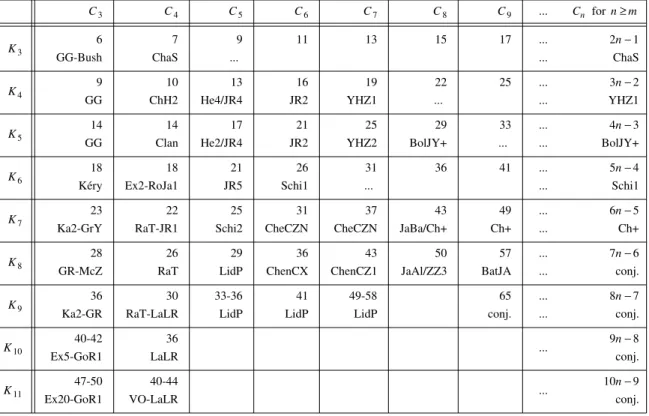
Since 1976, it was conjectured that R(Cn,Km ) = (n−1)(m−1) + 1 for all n≥ m≥ 3, except n= m= 3 [FS4, EFRS2]. Various parts of this conjecture were proved as follows: for
n ≥ m2−2 [BoEr], for n > 3 = m [ChaS], for n ≥ 4 = m [YHZ1], for n ≥ 5 = m [BolJY+], for n ≥ 6 = m [Schi1], for n ≥ m ≥ 7 with n ≥ m(m−2) [Schi1], for n ≥ 7 = m [ChenCZ1], and for n ≥ 4m+2, m ≥ 3 [Nik]. Open conjectured cases are marked in Table V by "conj."
In 2019, Keevash, Long and Skokan [KeeLS] proved the above conjecture for
n ≥ Clogm /loglogm for some absolute constant C≥ 1, and furthermore that for any ε>0 and n > n(ε), for the lower bound it holds that R(Cn, Km) > mlogm >> (n−1)(m−1) + 1 for all 3 ≤ n≤ (1− ε)logm /loglogm.
(a) The first column in Table V gives data from the first row in Table I.
(b) Joint credit [He2/JR4] in Table V refers to two cases in which Hendry [He2] announced the values without presenting the proofs, which later were given in [JR4]. The special cases of R(C6,K5) = 21 [JR2] and R(C7, K5) = 25 were solved independently in [YHZ2] and [BolJY+]. The double pointer [JaBa/ChenCZ1] refers to two independent papers, similarly as [JaAl/ZZ3], except that in the latter case [ZZ3] refers to an unpub-lished manuscript. For joint credits marked in Table V with "-", the first reference is for the lower bound and the second for the upper bound.
(c) Erdo˝s et al. [EFRS2] asked what is the minimum value of R(Cn,Km) for fixed m, and they suggested that it might be possible that R(Cn, Km) first decreases monotonically, then attains a unique minimum, then increases monotonically with n. If so, then the
results in [KeeLS] stated above imply that this transition of behavior happens at
n = Θ(logm /loglogm).
C3 C4 C5 C6 C7 C8 C9 ... Cn forn≥m
6 7 9 11 13 15 17 ... 2n−1
K3
GG-Bush ChaS ... ... ChaS
9 10 13 16 19 22 25 ... 3n−2
K4
GG ChH2 He4/JR4 JR2 YHZ1 ... ... YHZ1
14 14 17 21 25 29 33 ... 4n−3
K5
GG Clan He2/JR4 JR2 YHZ2 BolJY+ ... ... BolJY+
18 18 21 26 31 36 41 ... 5n−4
K6
Ke´ry Ex2-RoJa1 JR5 Schi1 ... ... Schi1
23 22 25 31 37 43 49 ... 6n−5
K7
Ka2-GrY RaT-JR1 Schi2 CheCZN CheCZN JaBa/Ch+ Ch+ ... Ch+
28 26 29 36 43 50 57 ... 7n−6
K8
GR-McZ RaT LidP ChenCX ChenCZ1 JaAl/ZZ3 BatJA ... conj.
36 30 33-36 41 49-58 65 ... 8n−7
K9
Ka2-GR RaT-LaLR LidP LidP LidP conj. ... conj.
40-42 36 9n−8
K10
Ex5-GoR1 LaLR ... conj.
47-50 40-44 10n−9
K11
Ex20-GoR1 VO-LaLR ... conj.
Table V. Known Ramsey numbers R(Cn,Km);
Ch+ abbreviates ChenCZ1, for comments on joint credits see 4.2.b.
(d) There exist constants c1, c2>0 such that c1(m3/2/logm) ≤ R(C4,Km) ≤ c2(m /logm)2.
The lower bound, obtained by Bohman and Keevash ([BohK1] in 2010, see also 4.2.j/k below) improved over an almost 40 years old bound c(m /logm)3/2 by Spencer [Spe2], using the probabilistic method. The upper bound was reported in a paper by Caro, Li, Rousseau and Zhang [CaLRZ], who in turn give the credit to an unpublished work by Szemere´di from 1980. A refined upper bound, R(C4, Km) ≤ (1+o(1))(m /logm)2, was presented by Liu and Li [LiuLi2] in 2021.
(e) Erdo˝s, in 1981, in the Ramsey problems section of the paper [Erd3] formulated a chal-lenge by asking for a proof of R(C4, Km) < m2− ε , for some ε > 0. To date, no such proof is known.
(f) Enumeration of all (Cn, K4)-graphs for n ≤ 7 [JaNR].
(g) A theta graph θn is obtained from the cycle Cn by adding one edge between some of its nonadjacent vertices. Summary of what is known about R(θn,Kk), and an additional
(h) Let C≤n be the set of cycles of length at most n, and let the girth g(G) be the length of the shortest cycle in graph G. Probabilistic lower bound asymptotics for R(C≤n,Km) [Spe2] currently is the same as for R(Cn,Km), for fixed n. However, there are clear differences already for girth 4 and 5 and small m: Backelin [Back1, Back2] found that
R(C≤4, Km) = 6, 8, 11, 15, 18 for m = 3, 4, 5, 6, 7, and that R(C≤5, Km) = 5, 8, 10, 13, 15, also for m = 3, 4, 5, 6, 7, respectively.
(i) Erdo˝s et al. [EFRS2] proved various facts about R(C≤n,Km), and in particular that it is equal to 2m−1 for n≥ 2m−1, and to 2m for m < n < 2m−1. The upper asymptotics for
R(C≤n, Km) is implied in the study of independence number in graphs with odd girth n
[Den1]. The following close to the diagonal exact values were obtained in [WuSL]:
R(C≤n, Kn) is equal to 2n and 2n+1 for odd n and even n, respectively, and
R(C≤n, Kn+1) = 2n+3 for odd n≥5 and even n≥16. (j) R(C≥n, Km1, ... ,m
k) = (k−1)(n−1) +m1 for m1≤
. . . ≤ m
k, 5mk−1+ 3mk ≤ n [PoSu1].
The same equality holds for R(Cn, Km
1, ... ,mk) for large mi’s and very large n [PoSu2].
(k) The best known lower bound asymptotics R(Cn,Km) = Ω(m(n−1)/(n−2)/logm), for fixed
n and large m, was obtained by Bohman and Keevash [BohK1]. Note that for n= 4 it gives the lower bound in 4.2.d above. See also [Spe2, FS4, AlRo¨] for previous results. (l) Upper bound asymptotics [BoEr, FS4, EFRS2, CaLRZ, Sud1, LiZa2, AlRo¨, DoLL2].
4.3. Cycles versus wheels
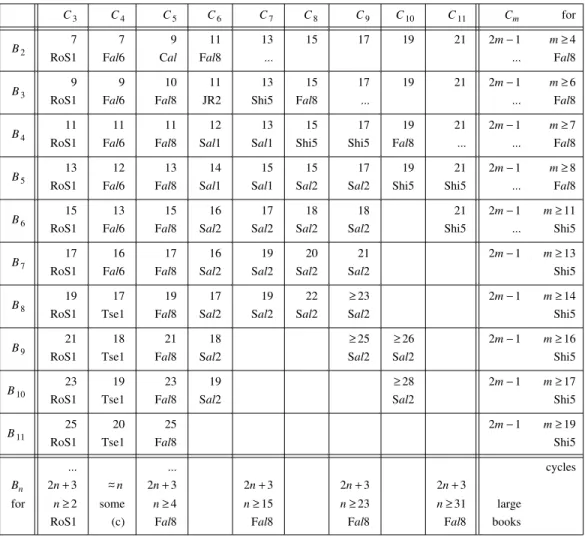
Note: In this survey the wheel graph Wn = K1+ Cn−1 has n vertices, while some authors use the definition Wn = K1+ Cn with n+1 vertices. For the cases involving W3 = C3 versus Cm see sections 3.2 and 4.2.
(a) R(C3, Wn ) = 2n−1 for n≥ 6 [BuE3]. All critical graphs have been enumerated. The critical graphs are unique for n= 3, 5, and for no other n [RaJi].
(b) R(C4, Wn ) = 14, 16, 17 for n = 11, 12, 13, respectively [Tse1],
R(C4, Wn ) = 18, 19, 20, 21 for n = 14, 15, 16, 17, respectively [DyDz2], and several higher values and bounds, including 9 cases of n between 18 and 44 [WuSR, WuSZR]. (c) R(C4, Wn ) ≤ n+ (n−1)/3 for n≥ 7 [SuBUB], which was improved to
R(C4, Wn ) ≤ n+ √n−2 +1 for n≥ 11 [DyDz2].
(d) R(C4, Wq2+1) = q2+ q+1 for prime power q≥ 4 [DyDz2],
exact values of R(C4, Wq2+2) and R(C4, Wq2−i) for special q and small i [WuSZR]. (e) R(C4, Wn ) = R(C4,K1,n−1) for n≥7 [ZhaBC1, ZhaBC2].
(f) Tight bounds on R(C4, Wn) for 46 ≤ n≤ 93 [NoBa]. (g) R(C7, Wn ) = 2n−1 for n=9, 10, 11 [ZhaZZ].
![Table Ib: Upper bounds for R (k, l), k ≥ 4, l ≥ 5. All of them were obtained by Angeltveit and McKay [AnM2] in 2019, except R (4, 5) [MR4], and they](https://thumb-us.123doks.com/thumbv2/123dok_us/1006034.2632506/5.918.183.728.99.330/table-ib-upper-bounds-obtained-angeltveit-mckay-anm.webp)