66
Chapter 3
High Performance Concrete
In this chapter a discussion on different aspects of high performance concrete (HPC)
has been made. Findings from various studies have also been included to understand the type and amount of materials to be included to achieve the desirable HPC performance properties.
3.1 Introduction
The concept of HPC has definitely evolved with time. Initially it was equated to high strength concrete (HSC), which certainly has some merit, but it does not show a complete and true picture. Other properties of the concrete must also be considered, and may even take priority over the strength criterion.
Use of supplementary cementitious materials (SCMs) is necessary for producing HPC. Concretes with these cementitious materials are used extensively throughout the world. In HPC, materials and admixtures are precisely selected and optimised to form higher strengths (early as well as ultimate) and higher durability as compared to
67 normal concrete. HPC is also called "durable" concrete because its strength and impermeability to chloride penetration improves the service life as compared with that of conventional PCC. Some of the major users of HPCs are power, gas, oil and nuclear industries. The applications of such concretes are increasing with the passage of time due to their enhanced structural performance, environment friendliness and low bearing on energy utilisation (Mehta, 1999).
Experience shows that there is variation in concrete performance as the source changes and proportions of SCMs added. In addition, SCM concrete often leads to a slower hydration, which can be successfully used in hot areas but acts as a challenge in colder environment. The lack in knowledge about the dissimilarity in performance of concrete incorporating SCMs from various sources is a big hurdle in its use by the construction sector. Therefore, application of HPC was generally made on architectural design, private sector and high rise buildings. Public agencies are more reluctant than the private sector in using these materials due to change in specifications, but the public sector now is dedicated to use this technology in the field.
HPC also provides enhanced mechanical properties (in terms of tensile and compressive strength) in precast industry in addition to strong stiffness. The advantages of HPC cannot be denied in cold areas where durability performance of concrete can resist penetration of chloride present in snow and water. This results in longer life for the embedded reinforcing steel and a reduction in the deterioration processes (Kuennen, 2004).
The method of proportioning of fundamental components and the admixtures offer the main difference between HPC and conventional concrete. A high dosage of water reducing admixture may lead to a required low water/cement, leading positive effects on concrete properties.
In essence, the proportioning of HPC consists of three interrelated steps:
1. Selection of suitable ingredients: OPC, SCMs, aggregates, water and chemical admixtures.
68 2. Determination of the relative quantities of these materials in order to produce, as economically as possible, a concrete that has the desired rheological properties, strength and durability.
3. Careful quality control of every phase of the concrete making process.
3.2 Material Combinations used for HPC
It is compulsory to get the maximum output of all of the materials involved in producing HPC. In many cases, however, concrete is classified as having ‘high performance’ exclusively because its strength is much greater than that of typically specified concrete. HPC is usually achieved by using very low water - binder ratios (w/b). Indeed, in a recent publication (Aitcin, 1998) the author defined HPC as essentially all concrete having a water - binder ratio not more than 0.40. Only in more recent times, recognition has been given to the fact that ‘high-strength’ concrete commonly offers other improvements in performance, such as higher flowability, higher elastic modulus, higher flexural strength, lower permeability, improved abrasion resistance and better durability (Aitcin, 1998). In spite of this, the term HPC continues to be used primarily for concrete suitable for high-strength application when one is looking for performance in terms of strength only.
Various materials used for making HPC are discussed separately below. However, it must be remembered that prediction with any certainty regarding the behaviour of each ingredient when combined in a concrete mixture is not realistic. Any material incompatibilities will be highly detrimental to the finished product. Thus, the result of any mix design process must be the extensive testing of trial mixes. HPC will normally contain not only OPC, aggregate and water, but also superplasticisers and SCMs. It is possible to achieve compressive strengths up to 98 MPa using FA or GGBS as the SCMs. However, to achieve strengths in excess of 100 MPa, the use of SF has been found to be essential, and it is frequently used for concretes in the strength range of 63-98 MP as well (Mindess, 1994).
69
3.2.1 Supplementary cementitious materials
HPCs are produced often with large quantities of these SCMs. Such applications not only will help to improve the strength and durability characteristics of HPC but will also help to dispose more of the industrial by-products which are major environmental threats.
The effects of SCMs on the pore structure and chloride permeability of concrete was examined by both Geiker et al. (1991) and Torii and Kawamura (1991). Using the AASHTO T 277 method, they found that the concrete with SCMs was much less permeable to chloride ions than the concrete without these materials regardless of curing and environmental conditions. Torii and Kawamura also found that at the surface of concretes with a SCM, the hydration of OPC was considerably low and coarse pores were developed when concrete with a SCM were stored in a dry condition for a long time. However, at the depth of 5 cm from the surface of concrete specimen there was little change both in the degree of hydration and the pore structure. Numerous similar studies (Malhotra 1990; Ellis et al. 1991; Dunstan et al. 1993; Dhir and Byars 1993; Dhir et at. 1993; Ozyildirim 1992, 1994; Ozyildirim and Halstead 1994 and Bilodeau et al. 1994) have also been published in the past several years. These studies are generally project specific with respect to constituent materials, curing methods, environmental exposures, and testing techniques. The results usually indicate the beneficial effects of FA, SF and GGBS; the three commonly used mineral admixtures.
3.2.2 Superplasticisers
In recent times, it is essentially impossible to make HPC (inclusive of HSC) at adequate workability in the field without the use of superplasticiser. Unfortunately, different superplasticiser will behave quite differently with different cements (even cements of nominally the same type). This is because of the variability in the minor components of the cement (which are not generally specified), and in part to the fact that the acceptance standards for superplasticisers themselves are not very tightly
70 written. Thus, some cements will simply be found to be incompatible with certain superplasticisers.
Currently six different types of superplasticiser are used (Bradly and Howarth, 1986; Rixom and Mailvaganam, 1999 and Ramachandran and Malhotra, 1998).
¾ Lignosulfonates ¾ Poly melamine ¾ Poly naphthalene ¾ Carboxylates ¾ Polyacrylates
¾ Based on polyphosphonates and different copolymers
Untill recently, Poly melamine and poly naphthalene were the principal source of commercial superplasticisers, but recently caboxylates are used extensively in spite of their high price (Aïtcin, 2008)
Superplasticiser dosage
There is no specific way of determining the required superplasticiser dosage. It must be determined after carrying out some sort of trial and error procedure. For the development of high strength, one should work with the lowest w/c possible, and thus the highest superplasticiser dosage rate. For high strength concrete, the dosage of the superplasticiser is kept normally 5 to 15 litres per cubic metre of concrete, depending on the solids content in the superplasticiser and its nature. Such a dosage allows a reduction in water content of about 45 to 75 kg/m3 of concrete (Aitcin and Neville, 1993). This is because HPC mix must be sufficiently workable for the solids to be dispersed in such a manner that dense packing is achieved, which requires deflocculation of cement particles. This is achieved by the use of a superplasticiser at a large dosage.
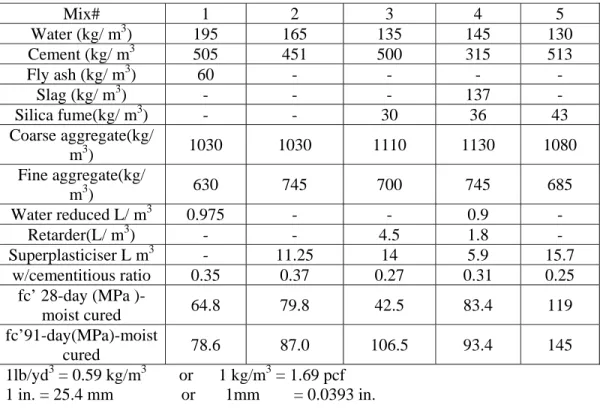
However, if the rheological properties of the HPC (in terms of strength) are very important, then the highest w/c consistent with the required strength should be used. Then the desired workability is achieved by adjusting the dosage of the superplasticiser. In general, some intermediate position must be found, so that the combination of strength and rheological properties can be optimised. Typical
71 superplasticiser dosages for a number of HPC concrete mixes are given in Tables 3.1 and 3.2.
Table 3.1: Mix proportions of interfirst plaza, Dallas (adapted from Cook, 1989)
1 cm max size aggregate 25 cm max size aggregate
Water (kg/ m3) 166 148
Cement, Type 1(kg/ m3) 360 357
Fly ash, class C (kg/ m3) 150 149
Coarse aggregate(kg/ m3) 1052 1183
Fine aggregate (kg/ m3) 683 604
Water reduced L/ m3 1.01 1.01
Superplasticiser L/ m3 2.54 2.52
w/cementitious ratio 0.33 0.29
fc’ 28-day (MPa )-moist
cured 79.5 85.8
fc’91-day(MPa)-moist
cured 89.0 92.4
1lb/yd3 = 0.59 kg/m3 or 1 kg/m3 = 1.69 pcf 1 in. = 25.4 mm or 1mm = 0.0393 in.
Table 3.2: Five examples of commercially produced high strength concrete mix designs (after Aitcin, Shirlaw and Fines, 1992)
Mix# 1 2 3 4 5 Water (kg/ m3) 195 165 135 145 130 Cement (kg/ m3 505 451 500 315 513 Fly ash (kg/ m3) 60 - - - - Slag (kg/ m3) - - - 137 - Silica fume(kg/ m3) - - 30 36 43 Coarse aggregate(kg/ m3) 1030 1030 1110 1130 1080 Fine aggregate(kg/ m3) 630 745 700 745 685 Water reduced L/ m3 0.975 - - 0.9 - Retarder(L/ m3) - - 4.5 1.8 - Superplasticiser L m3 - 11.25 14 5.9 15.7 w/cementitious ratio 0.35 0.37 0.27 0.31 0.25 fc’ 28-day (MPa )-moist cured 64.8 79.8 42.5 83.4 119 fc’91-day(MPa)-moist cured 78.6 87.0 106.5 93.4 145 1lb/yd3 = 0.59 kg/m3 or 1 kg/m3 = 1.69 pcf 1 in. = 25.4 mm or 1mm = 0.0393 in.
72
3.2.3 Aggregates
The aggregate properties, the most important with regard to HPC, are particle shape, particle size distribution, mechanical properties of the aggregate particles, and (in some cases) chemical reactions between the aggregate and the paste which may affect the bond. Unlike their use in ordinary concrete, where we rarely consider the strength of the aggregates, in HPC the aggregates may well become the strength limiting factor. Also, since it is necessary to maintain a low w/c to achieve high strength, the aggregate grading must be very tightly controlled.
3.2.3.1 Coarse aggregate
It is worth noting that for HPC (inclusive of HSC), the coarse aggregate particles themselves must be strong. A number of different rock types have been used for this purpose. These types include limestone, dolomite, granite, andesite, diabase, and so on. It has been suggested that in most cases the aggregate strength itself is not usually the limiting factor for high strength but sometimes, it is the strength of the cement-aggregate bond which controls (SHRP-C/FR-91-103, 1991). Like ordinary concretes, aggregates that may be vulnerable to alkali-aggregate reaction, or to D-cracking, should be avoided. This should be done even though the low w/c used will tend to reduce the severity of these types of reaction.
From both strength and rheological point of views, the coarse aggregate particles should be roughly equi-dimensional; either crushed rock or natural gravels, particularly if they are of glacial origin. Flat or elongated particles must be avoided at all costs. They are inherently weak, and lead to harsh mixes (Mindess, 1994). In addition, it is important to ensure that the aggregate is clean, since a layer of silt or clay will reduce the cement aggregate bond strength, in addition to increasing the water demand. Finally, the aggregates should not be highly polished (as is sometimes the case with river-run gravels), because this too will reduce the cement aggregate bond.
73 Not enough work has been carried out on the effects of aggregate mineralogy on the properties of HPC. However, a detailed study by Aitcin and Mehta (1990) involving four apparently hard strong aggregates (diabase, limestone, granite, natural siliceous gravel) revealed that the granite and the gravel yielded much lower strengths than the other two aggregates. These effects appeared to be related both to aggregate strength and to the strength of the cement aggregate transition zone. Cook (1989) has also pointed out the effect of the modulus of elasticity of the aggregate on that of the concrete. However, much work has to be investigated to relate the mechanical and mineralogical properties of the aggregate to those of the resulting high performance concrete.
It is commonly assumed that a smaller maximum size of coarse aggregate will lead to higher strengths (SHRP-C/FR-91-103,1991; FIP/CEB, 1990; Perenchio, 1973; Mehta and Aitcin, 1990 and ACI Committee 363, 1984), largely because smaller sizes will improve the workability of the concrete. However, this is not necessarily the case. While Mehta and Aitcin (1990) recommended a maximum size of 10-12 mm, they advised that 20-25 mm maximum size may be used for high strength concrete. On the other hand, using South African materials, Addis (1992) found that the strength of HPC increased as the maximum size of aggregate increased from 13.2 to 26.5 mm (Mindess, 1994). This is the area which needs to be further investigated. Durability of coarse aggregate particles is vital when the concrete containing the given aggregate is likely to be exposed to freezing and thawing.
3.2.3.2 Fine aggregate
The fine aggregate should consist of smooth rounded particles. These types of fine aggregate help in reducing the water demand. Normally, the fine aggregate grading should conform to the limits established by the British standard (BS 882, 1992) for normal strength concrete. However, it is recommended that the grading should lie on the coarser side of these limits; a fineness modulus of 3.0 or greater is recommended (SHRP-C/FR-91-103, 1991 and ACI Committee 363, 1984), both to decrease the water requirements and to improve the workability of these mixes with rich pastes. Like coarse aggregate, the sand must also be free of silt or clay particles.
74
3.2.4 Mix proportions
The proportioning (or mix design) of normal concretes is based primarily on the w/c 'law' first proposed by Abrams in 1918. At least for concretes with strengths up to 6000 psi (42MPa), it is assumed that almost any normal weight aggregates will be stronger than the hardened cement paste. There is, thus, no consideration of aggregate strength in the commonly used mix design procedures, such as those proposed by the American Concrete Institute ACI Standard 211.1 (1989). Similarly, the interfacial regions (or the cement-aggregate bond) are also not explicitly addressed. Rather, it is assumed that the strength of the hardened cement paste will be the limiting factor controlling the concrete strength.
For HPC, however, all of the components of the concrete mixture are pushed to their critical limits. HPC may be modelled as three-phase composite materials, (i) the hardened cement paste (HCP), the aggregate and the interfacial zone (between the hardened cement paste and the aggregate). These three phases must all be independently considered in the design process.
3.2.4.1 Water-binder ratio
For normal concretes, mix proportioning is based to a large extent on the w/c 'law'. For these concretes, in which the aggregate strength is generally much greater than the paste strength, the w/c determines the strength of the concrete for any given set of raw materials. For HPC, however, in which the aggregate strength, or the strength of the cement-aggregate bond, are often the strength controlling factors, the role of the w/c is less clear. Hence, it is necessary to use very low w/c to manufacture HPC. However, the relationship between w/c and concrete strength is not as straight forward as it is for normal strength concretes. Figure 3.1 shows a series of curves showing compressive strength versus water-binder ratio for HPC in terms of strength (Mindess, 1994).
75
Fig. 3.1: Compressive strength versus water-binder ratio (Mindess, 1994)
The sets of curves numbered 1, 2 and 3 show the strength range that might be expected for a given w/c. (Curve 1 is from Aitcin (1992); curve 2 is from Fiorato (1989); curve 3 is from Cook (1989). For comparison, the w/c vs strength curve for normal strength concrete is shown as curve 4 (Canadian Portland Cement Association, 1991). Figure 3.2 shows a similar series of w/b vs strength curves obtained by other investigators.
Curve 1 is from Addis and Alexander (1990) who used high early strength cement. Curve 2 is from Hattori (1979). Curves 3 and 4 are from Suzuki (1987); curve 3 is for OPC, and curve 4 for high early strength cement. Several conclusions may be drawn from Figs. 3.1 and 3.2. First, while strength clearly increases as the w/b decreases, there is a significant scatter of the results, which must be due to variations in the materials, used in different investigations. Second, and more important, the range of strengths for a given w/b increases as the w/b decrease. If one looks at all of the curves in Figs. 3.1 and 3.2, at a w/c of 0.45, the range in strength is from 37 MPa to 66 MPa. While at a w/c of 0.26, the range is from 78 MPa to 120 MPa. Therefore, the w/b by itself is not a very good predictor of compressive strength. The w/c vs strength relationship must thus be determined for any given set of raw materials.
Fig. 3 3 For n For H highe consi consi As di FA, G partic event produ total b 3.2: Compr .2.4.2Ceme normal concr HPC, howev er, ranging iderably, de iderations. iscussed bef GGBS or SF cular, the us t, the use o uction of HP binder conte essive stren entitious ma retes, cemen ver, the conte from about epending u fore, it is po F. For highe se of SF is r of SF (whic PC much ea ent. ngth versus w aterials cont nt contents a ent of cemen 500 to 650 upon worka ssible to ma er strengths, required for ch is now r asier. It is ge water-binde tent re typically ntitious mate 0 kg/m3). T ability, eco ake HPC (in however, S strengths m readily avai enerally add er ratio (Mi in the range erials (cemen The quantity onomy and n terms of st SCMs are ge much in exce ilable in mo ded at rates indess, 1994 e of 350 to 5 nt, FA, GGB y of SCMs heat of trength) with enerally nec ess of 98 MP ost areas) m of 5% to 10 76 4) 550 kg/m3. BS, SF) is may vary hydration hout using cessary. In Pa. In any makes the 0% of the
77
3.2.4.3 Superplasticisers
Careful mix design and aggregate grading can make it possible to achieve strengths of about 98MPa without superplasticisers. However, as they are readily available they are now almost universally used, since they make it much easier to achieve adequate workability at very low w/b.
3.2.4.4 Coarse to fine aggregate ratios
For normal concretes, the ratio of coarse to fine aggregate (for a 0.55 in 14 mm max size of aggregate) is in the range of 0.9 to 1.4 ( Canadian Portland Cement Association,1991). However, for HPC (inclusive of HSC), the coarse/fine is much higher. For instance, Peterman and Carrasquillo (1986) recommend a coarse/fine of 2. As seen in Tables 3.1 and 3.2, coarse/fine used in practice vary in the range of 1.5 to 1.8.
3.2.4.5 Quality control
It is necessary to pay careful attention to all aspects of HPC production (i.e. selection of materials, mix design, handling and placing). It can be emphasized too strongly that quality control is an essential part of the production of HPC and requires full cooperation among all the stake holders. Conventional NSC is a relatively forgiving material. It can absorb small changes in the constituent materials, mix proportions or curing conditions without any big change in its properties. However, HPC is not at all a forgiving material. Therefore, to ensure the quality of HPC, every aspect of the concrete production must be controlled, from the uniformity of the raw materials to proper batching and mixing procedures. Proper transportation, placement, vibration, curing and proper testing of the hardened concrete must be monitored. The quality control procedures, such as the types of test on both the fresh and hardened concretes, the frequency of testing, and interpretation of test results are essentially the same as those for ordinary concrete. However, Cook (1989) has presented data which indicate that for his HSC, the compressive strength results were not normally distributed, and the standard deviation for a given mix was not independent of test age and strength
78 level. This led him to conclude that the 'quality control techniques used for low to moderate strength concretes may not necessarily be appropriate for very HSC.
3.3 HPC performance
3.3.1 Aspects of HPC in the fresh state
The particular proportions of the ingredients of HPC, mainly, the high OPC content, the low water content and the high dosage of superplasticiser, influence the properties of the fresh concrete in some respects in a manner different from the usual mixes.
First of all, batching and mixing require great care. Because of the importance of thorough mixing, using the mixer at less than its rated capacity may be beneficial; a reduction of one-third, or even one-half, may be desirable (SHRP-C-364, 1993). A longer mixing time than usual is required to ensure homogeneity rather than a sticky mix. 90 seconds has been recommended (Larrard and Mailer,1992) but even longer periods may be desirable.
The sequence of feeding the ingredients into the mixer is best established by trial-and-error, and it can be complicated. In one case, some water and one-half of a superplasticiser were fed first; then, aggregate and cement; finally, the remainder of the water and the superplasticiser. Often, a part of the superplasticiser is added only immediately prior to the placing of concrete. An example of the effect of the mixing sequence upon slump loss of concrete with a w/c of 0.25, mixed during 225 seconds is shown in Fig. 3.3 (Kakizaki, 1992). Three sequences were used: (A) feeding all the ingredients simultaneously; (B) mixing cement and water prior to the feeding of the remaining ingredients; and (C) mixing cement and fine aggregate prior to the feeding of the remaining ingredients. Method A resulted in the lowest slump loss, but this observation may not be generally valid.
Some of the superplasticiser must be introduced early into the mixer in order to achieve adequate workability in the first place. The timing of adding the final portion of the superplasticiser is of particular importance.
It is, by en used. influe simpl Fig 3.3.2 There prese are sh advan but a partic conte streng shoul ready produ therefore, im nsuring comp At this st enced by th ly by a dark . 3.3: Effect Aspects of e exist no s ent informati hown. Binde ntage in usin also because cular interes ent of 542 kg gth at 28 da ld be empha y-mixed plan uction of HP mportant to patibility be tage, one m he carbon co colour of th t of sequenc concrete w hardened H standard, or ion on sever er of these m ng these var they allow st is Mix E g/m3 of whi ays was 114 asized that th nt (Aitcin a PC necessitat avoid the re etween the su more comme ontent of th he SF (De La ce of batchin with a w/b a HPC even typic ral successfu mixes contai rious SCMs a reduction of Table 3 ch only 30% 4 MPa but i his was not a and Neville, tes a very str eaction betw uperplasticis ent is perti he SF used; arrard et. al;
ng on slump and a SP (K
al, mix prop ful mixes. In
ins OPC and , partly beca in the dosa 3.3 which ha % was GGB it reached 1 a laboratory 1993). It i rict and cons
ween the sup ser and the P
nent. The w a high con 1992). p loss with ti Kakizaki, 199 portions of n Table 3.3, d/or SCMs. ause they ar age of super ad a w/b of S, and 10% 136 MPa at concrete bu is worth add sistent qualit erplasticiser Portland cem water requir ntent can be ime since m 92) HPC. It is different H There is an re cheaper t plasticiser. f 0.25, a to SF. The com the age of ut it was prod ding that co ty control. 79 r and C3A ment to be rement is e detected mixing of useful to PC mixes economic han OPC, A mix of tal binder mpressive 1 year. It duced in a ommercial
80
Table 3.3:Mix proportions of some high performance concretes(Neville, 1995a)
Ingredient (kg/m3) Mix A B C D E F G H I Portland cement 534 500 315 513 163 228 425 450 460 Silica fume 40 30 36 43 54 46 40 45 Fly ash 59 ‐ ‐ ‐ ‐ ‐ ‐ ‐ ‐ Ggbs ‐ ‐ 137 ‐ 325 182 ‐ ‐ ‐ Fine aggregate 623 700 745 685 730 800 755 736 780 Coarse aggregate 1069 1100 1130 1080 1100 1110 1045 1118 1080 Total water 139 143 150 139 136 138 1751 143 138
Water /cementitious material ratio 0.22 0.27 0.31 0.25 0.25 0.30 0.38 0.29 0.30
Slump, mm 255 ‐ ‐ ‐ 200 220 230 230 110
Cylinder strength
(MPa) at age (days) 1 ‐ ‐ ‐ ‐ 13 19 ‐ 35 36 2 ‐ ‐ ‐ 65 ‐ ‐ ‐ ‐ ‐ 7 ‐ ‐ 67 91 72 62 ‐ 68 ‐ 28 ‐ 93 83 119 114 105 95 111 83 56 124 ‐ ‐ ‐ ‐ ‐ ‐ ‐ ‐ 91 ‐ 107 93 145 126 121 105 ‐ 89 365 ‐ ‐ ‐ ‐ 136 126 ‐ ‐ ‐
81
3.3.3 Durability of HPC
One of the typical main features of HPC is its very low penetrability, resulting from a usually dense structure of the hydrated cement paste. HPC has been shown to provide high levels of resistance to durability phenomena such as chloride attack, alkali-silica reaction, freezing and thawing, and abrasion (Neville, 1995a). Therefore, HPC possesses a high resistance to external attack.
This is particularly true with respect to the ingress of chlorides into the concrete. For instance, tests similar to those of ASTM C 1202-94 on 3-month-old cores from columns made with 120 MPa concrete have shown negligible chloride ion permeability (Miao et. al; 1993). Even concrete with a w/b of 0.22, subjected to drying at 105°C was found, on subsequent exposure to chloride ions. It removes the evaporable water from the hardened cement paste. It has an extremely low permeability to chloride ions (Pigeon et al., 1993).
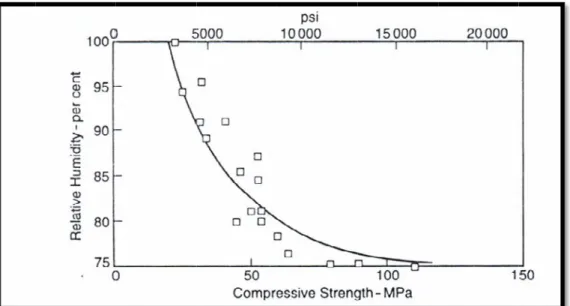
With respect to the risk of alkali-silica reaction, HPC containing SF can be expected to be particularly resistant because it has a very low permeability, which limits the mobility of ions in addition to low water content (Criaud and Cadoret, 1992). It should be remembered that the presence of water is essential for the alkali-silica reaction to take place. Figure 3.4 shows the very low relative humidity in the interior of concretes with 28-day strengths above 80 MPa (or 12000 psi) (Larrard and Larive, 1994). This stops the alkali-silica reaction. Indeed, no cases of alkali-silica reaction in HPC have been reported in the literature up to 1994, but the harmful effects of such a reaction take a very long time to visible themselves.
As far as the resistance to freezing and thawing is concerned, several aspects of HPC should be considered. Firstly, the structure of HCP is such that very little freezable water is present. Also, entrained air reduces the strength of HPC because the improvement in workability due to the air bubbles cannot be fully compensated by a reduction in the water content in the presence of a superplasticiser. Besides, air entrainment at very low w/b is difficult. It is, therefore, desirable to establish the maximum value of the w/b below which alternating cycles of freezing and thawing do not cause damage to the concrete.
Fig. and i Howe thawi prior inves (Kuk a lim other concr not av agent unles It is thawi conta no ad The b ASTM concr 3.4: Relatio its characte ever, some m ing. These i to exposure stigated that kko and Mata miting value
r hand, it is p rete will ens
vailable. Ev ts because th ss it is cured worth notin ing) selected ain entrained dequate curin behaviour o M C 666-92 rete to dry o on between ristic streng more factors nclude the c e to freezing the limitin ala, 1990). I is necessari possible that sure protectio ven greater u he surface z effectively a ng that mixe d so as to d air. The re ng, the water f HPC again 2 considers out. It is lik internal rel gth at the ag s also influen characteristic g and thawin ng value of t cannot be ily resistant t an air-void on from free uncertainty a zone of the and then drie
es (when co have a high eason for thi
r in the capil nst freezing to be usual kely that, un lative humid ge of 28 day
nce the resis cs of the cem ng (Pigeon e the w/b, re assumed tha to alternatin spacing fact ezing and th applies to the concrete is ed out. oncrete plac h strength a s requiremen llary voids m and thawin a test at an nder service dity in conc ys (Larrard stance of con ment and the et al., 1991) ferred to ab at concrete w ng freezing tor higher th hawing, how e resistance t likely to be cing in expo at the age o nt is that, be may freeze. ng is complic n early age conditions rete aged 3 and Larive ncrete to fre e efficiency . Also there bove, is 0.2 with a w/b be and thawin han necessar ever, reliabl to scaling by e vulnerable osure to free of several ho ecause there cated by the without allo in structure 82 months e, 1994) eezing and of curing e has been 5 or 0.30 elow such ng. On the ry in usual le data are y de-icing until and ezing and ours must e has been e fact that owing the es such as
83 bridge decks or dense overlays on decks, the surface zone of the concrete would dry out before exposure to freezing. This is because of the very low permeability of HPC that re-saturation could not take place. Consequently, in service, the exposure conditions are probably less severe than in the tests prescribed by ASTM C 666-92, especially in procedures in which requires both freezing and thawing to take place in water.
The abrasion resistance of HPC is very good, not only because of the high strength of the concrete, but also because of the good bond between the coarse aggregate and the matrix, which prevents differential wear of the surface. On the other hand, HPC has a poor resistance to fire because the very low permeability of HPC does not allow the ingress of steam formed from water in the hydrated cement paste. The absence of open pores in the surface zone of HPC prevents growth of bacteria which can be exploited in floor slabs in areas used by piglets and chickens, where a decrease in morbidity was reported (Gagne and Gaggon, 1994).
Because of its high cement content, HPC is sensitive to problems arising from the development of the heat of hydration of cement. Therefore, appropriate measures need to be taken. It is worth repeating that, because HPC is essentially a modification of ordinary concrete, it is affected by the various SCMs in the usual manner. For example, FA can be incorporated in HPC for the purpose of reducing the early development of the heat of hydration, as well as of improving workability and reducing slump loss.
There exist no consistent data which suggest that shrinkage or creep of HPC is different from what could be expected from the properties and proportions of the mix ingredients. The influence of SF is particularly relevant. SF concrete greatly reduces the movement of water, and therefore drying creep, the magnitude of creep is not affected by the volume/surface of the concrete element.
The Florida Department of Transportation (FDOT) investigated on the durability aspects of HPC. Mixes with a w/b of 0.44 and at FA replacement level from 20% to 50% of total binder content were cast. The design values were fixed for compressive strength equal to 5500 psi and that of chloride penetration resistance between 2000
84 and 3000 coulombs (Larsen, 1995). Maslehuddin et al; (1990) also evaluated that due to the replacement of OPC with FA or slag, there is an increase in the corrosion-resisting characteristics of concrete. They also concluded that concrete made with GGBS lowered the corrosion rate of steel. Ellis et al. (1991) made a comparison between different types of FA and found regarding FA that Class F is more effective than Class C in resisting chloride ion penetration. They also concluded that mixes containing Class F FA had comparable chloride penetration to those mixes achieved by adding SF or slag. Naik et al; (1992) studied the effects of blended FA (Class C and Class F) on the durability and mechanical properties of concrete. They found that mixes with blended FA showed better performance in resisting chloride ion penetration than those mixes without FA.
Hooton et al., (1997) studied the behaviour of SF concrete in connection with chloride resistance. Their findings confirmed that SF has a beneficial effect on chloride penetration resistance of concrete. They investigated that SF at 7% replacement level resulted in abrupt improvement in chloride penetration resistance. Duval and Kadri (1998) performed a study on the influence of SF on the workability and the strength development of HPC. They found that for concrete with w/b varying from 0.25 to 0.45, there is no considerable change in concrete workability by replacing SF with up to 10% OPC. Also, the slump loss of SF concrete increased with the increased percentage of SF for low w/c of 0.25, but for higher ratio (0.35), the loss was marginal. They also found that compressive strength increased with the SF content up to 20% and reached a maximum (15% higher) for a replacement level of 10 to 15%.
Oh et al., (2002) studied the effects of SF, FA, and GGBS on the chloride ion penetration resistance of HPC. The concrete containing SF showed the best performance among all the mixes in the rapid chloride ion permeability test. Concrete containing FA also proved to be good in the rapid chloride ion permeability test. It was found that the addition of FA greatly decreased the permeability of concrete even though the strength of FA concrete at 28 days was not improved. The replacement of cement with GGBS did not affect positively in resisting the chloride ion permeability.
85 Li et al., (1999) performed an investigation of chloride diffusion for HPC containing FA, SF, and chemical admixtures. They concluded that the resistance to chloride diffusion of HPC improved significantly when FA was used as CRM. An addition of 5% to 10 % SF in concrete with 25% FA content further enhanced the resistance of concrete to chloride diffusion.
Sherman et al., (1996) found that adding SF to a concrete with w/b of 0.46 was very significant in reducing penetration of chloride ions. Bayasi and Zhou (1993) also found that SF greatly enhanced the permeability resistance of concrete. Malhotra (1995) studied the effects of SF at replacement level of 12% with w/b of 0.30 and found that chloride ion penetration values were below 300 coulombs.
3.4 Concluding remarks
From the review of the high performance concrete in this chapter, the following points have been identified:
1. If silica fume is used in combination with other supplementary cementitious materials, then it is advisable to develop high performance concrete in terms of strength.
2. Much care is needed in each step of batching, mixing, curing, conditioning and testing high performance concrete.
3. A thorough research is required to investigate the influence of SCMs on the properties of high performance concrete.