Definabilit y and
Model Checking:
The Role of Orders and
C omp ositionalit y
Von der Fakultät für Mathematik, Informatik und Naturwissenschaften der RWTH Aachen University zur Erlangung des akademischen Grades eines Dok-tors der Naturwissenschaften genehmigte Dissertation
vorgelegt von Diplom-Informatiker
Tobias Ganzow
aus Seesen
Berichter: Univ.-Prof. Dr. Erich Grädel Dr. habil. Luc Segoufin
abstract
Finite model theory and descriptive complexity theory are concerned with assessing the expressive power of logics over finite models and with relating the descriptive resources needed for defining a class of structures to the computational complexity of the corresponding decision problem. In recent years, also the model theory and computational handling (e.g. of the model checking problem) of finitely representable infinite structures have gained much interest.
In the first part of this thesis we study how the expressive power of logics over finite structures is affected by the presence of orders. We will first review the concept of order-invariant definability where we allow formulae to use an additional order-relation that is not present in a given structure in such a way that the truth of the formula in the structure does not depend on the actual interpretation of the order relation, and show that, in the context of monadic second-order logic, order-invariance yields more expressive power than adding modulo-counting quantifiers.
Second, we investigate structures with weaker forms of orderings, namely locally ordered graphs, in which only the neighbourhoods of the vertices are linearly ordered. Using recent results on reachability algorithms by Reingold, we are able to show that the transitive closure of the edge re-lation in such graphs is definable in deterministic transitive closure logic (DTC) in a two-sorted setting, and this observation is the key to linking the descriptive power of DTC with counting to the computational power of logspace-bounded Turing machines.
The second part of the thesis is concerned with techniques for model checking weak monadic second-order logic (WMSO) on the class of
so-called inductive structures that allow for a finite representation via systems of equations, and which includes structures relevant for verification pur-poses such as the infinite binary tree, infinite lists, etc. Our new approach presents an algorithmic alternative to automata-theoretic methods, which exhibit certain drawbacks, and is based on a purely logical decomposition technique using the defining equations. Further, the deployed techniques can be extended to obtain a model checking algorithm for the extension of WMSO by an unbounding quantifier, and thus establish the decidability of its model checking problem on the class of inductive structures.
zusammenfassung
Die Grenzen der Audrucksstärke von Logiken auszuloten und Zusammen-hänge zwischen den für die Definition bestimmter Eigenschaften von Struk-turen benötigten deskriptiven Mitteln und der Komplexität der entsprechen-den Entscheidungsprobleme zu finentsprechen-den, sind zentrale Aspekte der Endlichen Modelltheorie und Deskriptiven Komplexitätstheorie. Vor allem in den letz-ten Jahren ist zunehmend auch die Modelltheorie und die algorithmische Handhabbarkeit von endlich repräsentierbaren unendlichen Strukturen in den Fokus der Forschung gerückt.
Im ersten Teil der Dissertation wird untersucht, wie sich das Vorhan-densein von Ordnungen in einer Struktur auf die Ausdrucksstärke von Logiken auswirkt, und zunächst das Konzept der sogenannten ordnungs-invarianten Definierbarkeit motiviert. Hierbei darf in einer Formel eine Ordnungsrelation verwendet werden, die nicht Bestandteil der Struktur ist, allerdings darf das Auswertungsergebnis der Formel innerhalb einer Struk-tur nicht von einer bestimmten (linearen) Ordnung der Elemente abhängen. Wir können zeigen, dass ordnungsinvariante monadische Logik zweiter Stufe (MSO) echt ausdrucksstärker ist als die Erweiterung von MSO um Modulo-Zählquantoren.
Anschließend untersuchen wir schwächere Arten von Ordnungen am Beispiel von lokal geordneten ungerichteten Graphen, in denen nur die Nachbarschaften von Knoten linear geordnet sind. Für diese Klasse können wir unter Ausnutzung eines vor wenigen Jahren von Reingold präsentierten Erreichbarkeitsalgorithmus zeigen, dass die transitive Hülle der Kantenrelati-on durch eine DTC-Formel definierbar ist, wenn die Graphen als zweisortige Struktur vorliegen. Aus diesem Resultat folgt schließlich, dass die
Ausdrucks-stärke von DTC mit Zählquantoren genau mit der Platzkomplexitätsklasse Logspace zusammenfällt.
Der zweite Teil der Arbeit widmet sich dem Auswertungsproblem von WMSO auf einer Klasse von unendlichen Strukturen, deninduktiven
Struk-turen, die durch endliche Gleichungssysteme repräsentiert werden können
und somit häufig bei Verifikationsproblemen anzutreffende Strukturen wie z.B. den unendlichen Binärbaum oder unendliche Listen umfassen. Im Ge-gensatz zu automatentheoretischen Methoden, die mit gewissen Nachteilen verbunden sind, wird ein Algorithmus entwickelt, der auf der Dekompositi-onsmethode beruht und damit direkt auf Formelebene arbeitet. Weiterhin wird gezeigt, wie sich der Ansatz erweitern lässt, um einen Algorithmus für das Auswertungsproblem von WMSO mit dem Unbeschränktheitsquantor auf induktiven Strukturen zu erhalten und somit dessen Entscheidbarkeit zu zeigen.
contents
1 Introduction ◆ 1 2 Preliminaries ◆ 9 2.1 Structures ◆ 9 2.2 Logics ◆ 10 2.3 Interpretations ◆ 152.4 Descriptive Complexity Theory ◆ 17
2.5 Games ◆ 17
I Order Invariance and Local Orderings ◆ 21
3 Order-Invariance vs. Counting in MSO ◆ 23
3.1 Counting MSO ◆ 24
3.2 The Ehrenfeucht-Fraïssé method for CMSO ◆ 26
3.3 CMSO on disjoint unions of structures ◆ 31 3.4 The Separating Example ◆ 34
3.5 Conclusion ◆ 44
4 Local Orderings ◆ 47
4.1 Locally Ordered Graphs ◆ 48
4.2 Reingold’s Algorithm ◆ 51
4.3 Defining Reachability in DTC ◆ 58
4.4 Canonisation of locally ordered undirected graphs ◆ 67 4.5 Discussion ◆ 72
Contents
II Compositional Model Checking ◆ 75
5 Compositional Model Checking of Weak MSO ◆ 77
5.1 Inductive Structures ◆ 78
5.2 Formulae with Restricted Variables ◆ 82
5.3 Decomposing Formulae ◆ 86
5.4 Model Checking Game for WMSO ◆ 96
5.5 Unbounding Quantifier ◆ 111
5.6 Conclusion ◆ 115 Bibliography ◆ 117
Index ◆ 123
list of figures
3.1 Grid with distinguished horizontal and vertical edges, a definable diagonal-edge relation ◆ 34
3.2 A cliquey(k,ℓ)-grid ◆ 36
3.3 A horizontally coloured cliquey(3, 5)-grid ◆ 36
3.4 Spoiler’s set move ◆ 40
3.5 Equivalence relation induced by Spoiler’s move—the grid falls into≤2kclasses ◆ 40
3.6 Duplicator’s response yielding equivalent matching parts ◆ 41
4.1 A non-rigid one-way locally ordered graph ◆ 50
4.2 p-Powering ◆ 55
4.3 Construction of an edge in the zig-zag product ◆ 55
4.4 Transformation of a graphGinto the regular graphGreg ◆ 59 4.5 Ordering of the connected components ◆ 70
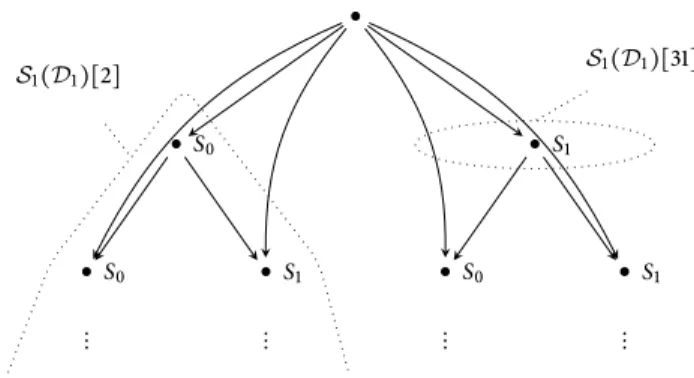
5.1 Inductive definition of the infinite binary treeT2≅ S1(D1) ◆ 81
5.2 Inductive definition of the infinite list of lists ◆ 81
5.3 SubgameG∃(φ,m)for checking whetherAm⊧ ∃X φ(X) ◆ 100
list of algorithms
4.1 RotH(i,(v,a0. . .ai−1),ai) ◆ 62 5.1 splitk(φ) ◆ 84 5.2 TNF(φ) ◆ 89 5.3 decomp(φ,m) ◆ 91 5.4 ENNF(φ) ◆ 1081
introduction
Assessing the potential and limits of the expressive power of logics is a central problem in finite model theory, and a wide range of methods and tools has been developed to conduct this task. The results we obtain in the first part of the thesis rely on Ehrenfeucht-Fraïssé games, which are a standard tool for proving limits of expressive power, and on the relationship between logical expressiveness and computational complexity, which is studied in descriptive complexity theory.
In 1974, Fagin lay the grounds of descriptive complexity theory by prov-ing a connection between the computational resources needed for decidprov-ing a property of structures and the logical resources needed for describing this property [Fag74]. In particular, he proved that a property of graphs (e.g. 3-colourability) is decidable in non-deterministic polynomial time if and only if the class of graphs exhibiting this property can be defined by a sen-tence of existential second-order logic. This lead to the notion ofcapturing a complexity class, i.e., in modern terms, Fagin’s result states that existential
second-order logic captures NP. Analogously, it was shown that similar correspondences can be obtained for various other logics. For example, least fixed-point logic captures Ptime on ordered structures, known as the Immerman-Vardi Theorem [Imm86, Var82], and transitive closure logic (TC) and deterministic transitive closure logic (DTC) capture NLogspace and Logspace, respectively, on ordered structures [Imm87, Imm88]. But the latter results expose a serious blemish: the characterisation only holds onorderedstructures.
In fact, characterisations of complexity classes on unordered structures are extremely scarce which is partly due to the particular weakness of many
1 Introduction
logics with respect to defining properties that involve counting on unordered structures. As of today, a very prominent open problem in descriptive complexity theory is to find a logic capturing Ptime onallfinite structures
if there is such a logic at all. Solving this problem in either way would have direct implications for the infamous question whether P equals NP, or at least show possible new routes to its answer.
In contrast to Turing machines that always work on the representation of a structure as a word, a formula is evaluated on a given structure as-is. Hence, the machine can possibly make use of a linear order that is necessarily induced by the representation of the structure as an (ordered) word, as long as its output does not depend on a particular representation, whereas the logic does not enjoy this advantage. This motivated the definition of order-invariancein the realm of logics: We call a formula order-invariant on a class
of structures if, for any structure in this class, the formula either holds for all possible orderings of the universe of the structure or if it does not hold for any possible ordering.
Denoting the set of order-invariantτ-formulae of a logicLbyL[τ]<-inv,
we obtain that LFP<-invcaptures Ptime, DTC<-invcaptures Logspace, and TC<-invcaptures NLogspace on the class of all finite structures. However, while it is not difficult to design formulae that are order-invariant by con-struction, already the decision problem whether a first-order formula is order-invariant on the rather restricted class of strings is undecidable as shown by Benedikt and Segoufin [BS05]. Hence, although we will speak of
order-invariant logicsin the following, it is important to keep in mind that
they lack an effective syntax which is a very important property of a reason-able logic and usually taken for granted. In particular, this aspect renders the above characterisations of the complexity classes rather unsatisfactory. With respect to definability, the question arises as to how much expres-sive power the order-invariant logic gains over the plain logic. If a logic has the interpolation property on a class of structures, it is, in particular,
closed under order-invariant sentencesin the following sense. Assume that a
formulaφ∈ L[τ∪ {<}]˙ is order-invariant. Then
φ⊧ (“<′is a linear order”→φ[< / <′]) =:φ′∈ L[τ∪ {<˙ ′}]
for any logicLthat is capable of axiomatising linear orders. Hence, there
exists an interpolantχover the common vocabularyτsuch thatφ⊧χand
χ⊧φ′, and ifφorder-invariantly defines a classKofτ-structures, thenKis
already defined by theτ-sentenceχ(see [EF99]). Since first-order logic has the interpolation property on the class of all (finiteandinfinite) structures,
it is closed under order-invariant sentences, i.e. order-invariant FO collapses to plain FO. However, in the finite, this is no longer the case. Gurevich showed that the class of Boolean algebras with an even number of atoms is order-invariantly FO definable, but not definable in plain FO. This implies that, in the finite, first-order logic is neither closed under order-invariant sentences, nor does it have the interpolation property. Otto later presented a further separating example involving a class of special graphs with attached Boolean algebras on which connectedness (of the graph component) is order-invariantly FO definable, but not even definable in infinitary logic with counting quantifiers [Ott00].
In both cases, the considered structures contain a Boolean algebra, and hence the classes have unbounded tree width. In contrast, Benedikt and Segoufin pursued the investigation of order-invariant FO on classes of bounded tree width, and show that order-invariant FO collapses to FO on strings and trees using algebraic characterisation theorems for FO-definable string and tree languages [BS09]. Furthermore, they show that order-invariant FO is at most as expressive as MSO on graphs of bounded degree or tree width. It would be desirable to obtain such an upper bound on the expressiveness in the general case, and it is conceivable that all order-invariantly FO definable queries are actually definable in plain MSO. In fact, all known queries separating order-invariant FO from plain FO are MSO de-finable. However, since they rely on quite different properties of the structure, it is questionable whether it is possible to devise a direct translation.
In Chapter 3, we focus on order-invariant MSO and counting MSO (CMSO), the extension of MSO by quantifiers that can specify the size of definable sets modulo fixed integers. We introduce an Ehrenfeucht-Fraïssé game characterising the expressive power of CMSO which will be the main tool in proving that order-invariant MSO is strictly more expressive than counting MSO on graphs, which confirms a long-standing open conjecture by Courcelle [Cou96, Conjecture 7.3].
A further question is whether we can capture complexity classes, if not on unordered structures, then at least on classes of structures that feature only weak forms of orderings. In particular this question was studied in the
1 Introduction
mid 1990’s for Logspace complexity classes and locally ordered graphs. A one-way (or two-way) locally ordered graph is equipped with one (or two) relations that induce, for each vertex, a linear order on its neighbours. In a one-way locally ordered graph, a ternary relation induces a linear order on the successors of each vertex, i.e. on the neighbours reachable from the vertex via outgoing edges, and in a two-way locally ordered graph, a second relation analogously induces linear orders on the predecessors of vertices. Etessami and Immerman proved that transitive closure logic with counting (TC+C) captures NLogspace on two-way locally ordered graphs [EI95b, EI00]. In general, TC+C is still too weak to define a linear order on the entire graph, but it is possible to define a canonical isomorphic copy of the graph on the number sort that comes with the counting extension. That is, a locally ordered graph provides strictly less structure than a linearly ordered graph, but this can be compensated by extending the logic.
In Chapter 4, we combine this approach with a recent result from complexity theory demonstrating the fruitful connections between the disci-plines. The deterministic space complexity of the reachability problem in undirected graphs was a longstanding open problem in complexity theory. For directed graphs, reachability is known to be NLogspace-complete which implies, by Savitch’s Theorem, that the problem is in Dspace(O(log2n)).
For undirected graphs, the problem was known to be complete for the rather artificial class SymLogspace (symmetric Logspace), which is, in fact, de-fined in terms of the problem. While the problem was believed to be in Logspace, it was not until 2005 that Reingold came up with a proof of this conjecture using a sophisticated argument involving expander graphs [Rei05]. Whereas other algorithms (e.g. Savitch’s) need logarithmic mem-ory per iteration or phase, and hence would only meet a logarithmic space requirement if the number of phases could always be reduced to a constant, the novel approach leads to an algorithm that only needs a constant amount of additional memory per phase.
By formalising Reingold’s algorithm, we obtain a DTC formula defin-ing the transitive closure of a locally ordered undirected graph with an auxiliary linearly ordered number sort. Combining this formula with the techniques used by Etessami and Immerman showing that TC+C captures NLogspace on two-way locally ordered graphs, we can prove our main result that DTC+C captures Logspace on undirected locally ordered graphs.
In Part II of the thesis, we shift our focus from finite structures to classes of structures that are, in general, infinite but still finitely representable. Those comprise well-known classes such as constraint databases or automatic structures—in this thesis, we study the class of structures representable via finite systems of equations, called inductive structures, and, in particular, we present a compositional method for model checking weak monadic second-order logic (WMSO) on this class.
The investigation of compositional model checking techniques started in the late 1950’s with the work of Feferman and Vaught [FV59] on first-order theories of structures that are obtained as generalised products of a possibly infinite, indexed family of structures. In particular, they showed how to reduce the first-order theory of a generalised product to the FO theory of the factors and the MSO theory of the index set. Towards this, they detailed an effective translation of FO formulae speaking about the generalised product to a sequence of formulae speaking about the factor structures and an MSO formula with access to predicates that encode, for each formula of the mentioned sequence, in which factors it is satisfied.
Around the same time, Büchi, Elgot and Trakhtenbrot independently es-tablished the connection between finite automata andweakmonadic
second-order logic [Büc60, Elg61, Tra61], where second-second-order quantifiers range over
finitesubsets of the universe. Decidability of the unrestricted MSO theory of (ω,<), also known as themonadic theory of one successor(S1S), was proved
by Büchi [Büc62] shortly afterwards. Later Rabin [Rab69] proved the de-cidability of the MSO theory of the binary tree, i.e. of themonadic theory
of two successors(S2S). The latter proof uses a translation of formulae into
tree-automata that accept a tree-encoding of a structure if and only if it is a model of the respective formula. Since an interpretation of a structure in the binary tree yields a reduction of its MSO theory to S2S, and hence implies decidability, Rabin’s Theorem became one of the most celebrated theorems in theoretical computer science.
It was only later, in 1975, that Shelah proved the decidability of the MSO theory of(ω,<)and other countable linear orders in his seminal paper
[She75] using purely logical methods and, in particular, the composition of monadic theories. However, this method received little attention among computer scientists until it was presented in a more accessible survey paper by Thomas [Tho97]. Furthermore, the original proof is based on a recursive
1 Introduction
computation of the theory involving the enumeration of all types of a given quantifier rank, and thus cannot be used as a basis for practical algorithms.
Consequently, the existing implementations of (weak) MSO model checking tools are mainly based on automata-theoretic techniques. Despite its importance for obtaining elegant theoretical results, Rabin’s Theorem is challenging for practical purposes. The construction of an automaton that is equivalent to the formula involves a complementation for each quantifier alternation and negation in the formula, and the complementation of Rabin tree automata presents several difficulties: The algorithm is difficult to un-derstand and implement, and the number of states grows exponentially. The situation is better for weak MSO, where complementation of the constructed automata, though still yielding an exponential blow-up, is easier than in the unrestricted case. Admittedly, since the complexity of (even the weak) MSO theory of(ω,<)is already non-elementary, no technique whatsoever can
perform equally well on all input instances.
The focus on weak MSO is based on two arguments. First, WMSO subsumes widely used temporal logics such as LTL and CTL which makes it a reasonably expressive logic. Furthermore, many problems arising in software or hardware verification where the domain of interest is often finite but not a priori bounded in size allow for a natural formalisation in weak MSO. Second, Shelah’s composition method could not be generalised to MSO on the binary tree so far. In fact, the question about a composition-based proof of the decidability of S2S is a major open problem, and has a close relationship to the challenge of understanding the algebraic structure of regular tree languages.
The best known tool for model-checking WMSO is MONA [HJJ+95, EKM98] which has been used to verify both hardware [BK95] and pointer manipulating programs [JJKS97]. It is a mature tool, but being based on automata, it only works on linear orders and trees such that more complex structures must first be encoded, which can decrease MONA’s performance considerably up to the point where it becomes unusable even for simple formulae.
In contrast, the approach we are presenting in Chapter 5 works directly on the much broader class of inductive structures which comprises classical structures such as(ω,<)and the infinite binary tree as well as practically
relevant structures such as doubly-linked lists or lists of lists. Not having to
interpret these structures in the binary tree makes the approach much more versatile and avoids inflating the formulae.
Our technique for decomposing the formulae yields decompositions that are similar to the reduction sequences described by Courcelle [Cou90] and Makowsky [Mak04], which follow the original idea of Feferman and Vaught. Whereas Courcelle shows how to obtain a reduction sequence for disjoint unions of structures without any connections between the compo-nents, and Makowsky exemplifies a construction for ordered sums of disjoint structures, we follow a different approach which matches our more general definition of inductive structures.
We continue to show how to combine the decompositions with the equations defining the inductive structure to obtain a model checking game. Such games have a long tradition and provide a particularly intuitive view on the semantics of a logical formalism. They are played by two opponents, called Verifier and Falsifier, and Verifier tries to prove that the formula is satisfied whereas Falsifier tries to disprove this.
For first-order or weak monadic second-order model checking, reach-ability games suffice. Positions consist of a formula (taken from the set of subformulae of the formula to be checked) and an interpretation of its free variables. Hence, the size of the game graph is determined by the product of the size of the structure and the size of the formula, i.e. it is finite if and only if the structure is finite. However, regardless of the structure, all possible plays are finite since the length of a play is bounded by the length of the formula.
The model checking game we present is, roughly speaking, obtained as the product graph of the subformulae and decompositions of formulae with initial unravellings of the inductive structure on which the formula is to be evaluated. In contrast to the naïve model checking game for WMSO sketched above, we obtain a game with a finite arena, and the players’ objectives are to reach terminal positions that are winning for them. However, since the game graph contains loops now, and running through a loop infinitely often is always bad for one of the players, we actually use a Büchi winning condition. Still, winning regions in Büchi games can be efficiently computed [GTW02]. Further, it is worth noting that, although the decomposition technique is not tied to WMSO but also works for MSO formulae, the game crucially relies on the limitation that set quantifiers only range over finite sets.
1 Introduction
Finally, we demonstrate the versatility and potential of this game-based approach by showing how it can be modified to allow for model checking WMSO extended with anunbounding quantifier(WMSO+U) introduced by
Bojańczyk [Boj04]. This establishes the decidability on inductive structures, i.e. in particular on the binary tree. Previously, decidability of WMSO+U has only been shown on labellings of(ω,<)[Boj09].
Acknowledgements
First of all, I would like to thank my supervisor Erich Grädel for giving me the opportunity to pursue my research interests, for providing the needed freedom, and his profound advice. Furthermore, I am very grateful to Luc Segoufin for his prompt readiness to commit himself to the task of acting as the co-examiner of this thesis.
I am very indebted to Sasha Rubin and Łukasz Kaiser for many inspiring discussions not only about cliquey grids and decomposing formulae, as well as Diana Fischer, Bernd Puchala, and Roman Rabinovich who were keen enough to agree to proofread a draft of this thesis and helped me improving the presentation. Many thanks also to the rest of my colleagues—Alex, Arnaud, Christof, Daniel, Dietmar, Frank, Henrik, Ingo, Jan, Jörg, Kari, Marcus, Martin, Michael H., Michael U., Michaela, Namit, Nico, Philipp, Stefan R., Stefan W., Vince, and Wladimir—who populated the MGI & i7 floor from early in the morning until late at night at times and who made my time at the institute very enjoyable.
Last but not least, I would like to express my deep gratitude to my family, and especially to my wife Astrid, for their continuing love, support, and encouragement.
2
preliminaries
We assume some basic familiarity with mathematical logic and algorithmic model theory, and will only briefly introduce the basic notions and concepts mainly for fixing the notation. For further details and introductory texts we refer the reader to [EF99, EFT94, Lib04].
We letNdenote the set of non-negative integers, and letN+∶=N− {0}. The initial subset{0, . . . ,n−1}ofNwill be denoted by[n]0, and we let
[n] ∶= {1, . . . ,n}denote the initial subset ofN+. Given a non-empty finite setM= {m1, . . . ,mk} ⊆finN+, let lcm(M) ∶=lcm(m1, . . . ,mk)denote the
least common multiple of all elements inM; for convenience, we define lcm(∅) =1. For finite setsXandYas well asMas before, we abbreviate that ∣X∣ ≡ ∣Y∣ (modm)for allm∈Musing the shorthand∣X∣ ≡ ∣Y∣ (modM).
2.1 Structures
Given a finite vocabulary or signatureτ= {R1, . . . ,Rm,f1, . . . ,fn}of
rela-tion symbolsRi and function symbols fi with associated arities ar(Ri)
and ar(fi), respectively, a τ-structureA = (A,(RAi )i∈[m],(fiA)i∈[n])is
determined by a non-empty set A called theuniverse of the structure and relationsRAi ⊆ Aar(Ri)
and functions fiA ∶ Aar(fi)
→ A interpret-ing the correspondinterpret-ing symbols inτ. A structure over a vocabulary that
does not contain any function symbols is calledrelational. In a relational structureA, every subsetU ⊂ Aof its universe induces the substructure
A∩U:= (U,(RAi ∩Uar(Ri)
)i∈[m]).
The class of all (finite) structures over a vocabularyτis denoted by Str(fin)[τ]. The index may be omitted if it is clear from the context that only
2 Preliminaries
finite structures are considered. Ifτcontains a binary relation symbol<, we
denote by Ord[τ]the class of linearly orderedτ-structures. For a fixed
vo-cabularyτ, we callK ⊆Str[τ]amodel classif it is closed under isomorphism.
A class of structures without a common vocabulary is called adomain, e.g. the domain of finite structures, the domain of finite graphs, the domain of finite words, and so on. Given a domainDand a vocabularyτ, we denote by D[τ]the class ofτ-structures inD. Throughout the whole thesis, we restrict
our attention to relational structures and sometimes allow constants (0-ary functions). The first part focuses on finite structures, whereas the structures investigated in the second part are, in general, infinite.
In Chapter 4, we investigate logics in the framework of many-sorted structures, and in particular on special two-sorted structures, so we narrow the definition to this specific case. Given a vocabulary τ = {R1, . . . ,Rm,f1, . . . ,fn}, a two-sortedτ-structureAconsists of two disjoint
universes,A1andA2, called the first sort and the second sort, respectively.
Each relation symbolRhas an associated arity ar(R) = (r1,r2)such thatR
is interpreted asRA⊆Ar1
1 ×Ar22. Each function symbol f also has an arity
ar(f) = (r1,r2)and a type tp(f) ∈ {1, 2}depending on whether the result
is an element from the second or the first sort, i.e.fA∶Ar11×Ar22→Atp(f).
2.2 Logics
We provide an overview of the syntax and semantics of those logics used and studied in the following chapters such as first-order logic and its transitive closure extensions, as well as second-order logics and counting extensions.
2.2.1 First-Order Logic
The set of terms over a vocabularyτcontains the constant symbols fromτ,
all variables from the countable set of variables Var, and ift1, . . . ,tar(f)are
τ-terms, thenf t1. . .tar(f)is aτ-term for all function symbolsf ∈τ. The set
of first-order formulae overτ, FO[τ], is obtained by closing the set of atomic
formulae built from relation symbols inτand the equality predicate applied toτ-terms under Boolean connectives such as¬,∧,∨and existential and
universal quantification over individual (first-order) variables. Variables not occurring inside the scope of a quantifier are calledfree, andboundotherwise. A formula without free variables is called asentence. Aτ-interpretationis
2.2 Logics
given by aτ-structureAtogether with a variable assignmentβ∶Var→A,
and yields an interpretation ofτ-terms by elements of the structure via
⟦x⟧A,β :=β(x) ⟦c⟧A,β :=cA
⟦f t1, . . . ,tar(f)⟧A,β := fA(⟦t1⟧A,β, . . . ,⟦tar(f)⟧A,β) .
Furthermore, aτ-interpretation(A,β)is called amodelof an FO[τ]
for-mulaφifβ∶free(φ) →Ais an assignment of all free variables andA,β⊧φ
according to the following semantics.
A,β⊧t1=t2 iff ⟦t1⟧A,β = ⟦t2⟧A,β
A,β⊧Rt1, . . . ,tar(R) iff (⟦t1⟧A,β, . . . ,⟦tar(R)⟧A,β) ∈RA
A,β⊧ ¬φ iff notA,β⊧φ
A,β⊧φ∧ψ iff A,β⊧φandA,β⊧ψ
A,β⊧φ∨ψ iff A,β⊧φorA,β⊧ψ
A,β⊧ ∃x φ(x) iff there ex.a∈As.th.A,β[x↦a] ⊧φ(x)
A,β⊧ ∀x φ(x) iff for alla∈A:A,β[x↦a] ⊧φ(x) .
Byβ[x↦a]we denote the function obtained fromβby either overriding
the assignment of the variablexor extending βby mappingx toa. In Chapter 5, we also allow the use of the propositional constants⊺denoting trueanddenotingfalsewith the obvious semantics thatA⊧ ⊺andA⊧ /
for all structuresA. We writeφ(x)to denote that the free variables of the
formula are amongx1, . . . ,xn, and instead ofA,β⊧ φ(x), we also write
A⊧φ(a)orA,a⊧φ(x)ifai =β(xi)for alli. Furthermore, we denote
byφAwith free(φ) = {x1, . . . ,xn}the set{(a1, . . . ,an) ∶ A⊧φ(a)}. 2.2.2 Second-Order Logic
Second-Order logic, SO, is obtained by allowing the same formula building rules as for first-order logic, but also allow the use of second-order variables representing relations of arbitrary arity and quantification over second-order variables. Since SO is a very powerful logic which is algorithmically hardly manageable, there are some common restricted fragments. We focus on
2 Preliminaries
relation variables, i.e. to sets. The semantics is obtained from the semantics of FO by adding the following two rules.
A,β⊧ ∃X φ(X) iff there ex.U⊆Asuch thatA,β[X↦U] ⊧φ(X)
A,β⊧ ∀X φ(X) iff for allU⊆A,A,β[X↦U] ⊧φ(X) .
Furthermore, we will investigate weak monadic second-order logic,
WMSO, which has the same syntax as MSO, but the semantics is altered such as to treat quantifiers as ranging over finite sets only, i.e.A⊧ ∃X φ(X)
if and only ifA⊧φ(U)for somefinitesetU⊆A, andA⊧ ∀X φ(X)if and
only ifA⊧φ(U)for allfinitesetsU⊆A. 2.2.3 Transitive Closure Logics
The transitive closure logic TC extends FO by an operator defining the transitive closure of definable relations, which is, in general, not possible in plain first-order logic. The syntax of FO is extended by the following formation rule
ifφ(x,y,z)is a(2k+l)-ary formula in TC,
then[tcx yφ(x,y,z)](u,v)is also a formula in TC.
The tuplezserves as parameters, and the tc-operator binds the variables inxandysuch that the free variables of the formula are those in{u,v,z}.
Towards the definition of the semantics, for a binary relationR, let TC(R):= {(a,b) ∶for somen∈Nthere ex.a0,a1, . . . ,ansuch that
a=a0,an=b, and(ai,ai+1) ∈Rfor all 0≤i<n} .
ThenA⊧ [tcx yφ(x,y,c)](a,b)if(a,b) ∈TC({(u,v) ∶ A⊧φ(u,v,c)}).
Disregarding the parameter tuple z, the formulaφdefines a 2k-ary re-lation, i.e. a binary “edge” relation on k-tuples of elements of A, and [tcx,yφ(x,y)]defines the transitive closure of this relation. Hence,
intu-itively,A⊧ [tcx,yφ(x,y)](a,b)if there exists a path ofφ-edges betweena
andb.
In Chapter 4, we investigate a variant calleddeterministic transitive
closure logic, DTC, where the formula[dtcx,yφ(x,y,z)](u,v)defines the
2.2 Logics
transitive closure over the deterministic part of the relation defined byφ.
Given a binary relationR, itsdeterministic part Rdetis defined as
Rdet= {(a,b) ∈R ∶ for allcsuch that(a,c) ∈R,b=c} ,
i.e. we only keep those edges which are unique outgoing edges of a ver-tex. Hence, A ⊧ [dtcx yφ(x,y,c)](a,b)if (a,b) ∈ TC(Rdet) where R:= {(u,v) ∶ A⊧φ(u,v,c)}, and since the deterministic part of a relation
is FO-definable, the formula[dtcx,yφ(x,y,z)](u,v) ∈DTC can be
trans-lated into the equivalent TC formula[tcx,yφ(x,y,z) ∧ ∀y′(φ(x,y′,z) → y=y′)](u,v).
Restricting the arity of the defining formulae, we obtain the syntactic fragments TCk and DTCk for all k > 0, in particular, in TCk it is only
possible to define transitive closures of 2k-ary relations, and indeed Grohe showed that these fragments form an infinite hierarchy in the sense that, for everyk, there are queries definable in TCk+1that are not definable in TCk
[Gro96].
On linearly ordered structures, all basic arithmetic operations such as addition, multiplication, exponentiation are DTC-definable. We present definitions for those operations that are used later in Chapter 4.
S(x,y) ≡ x<y∧ ¬∃z(x<z∧z<y) x+y=z ≡ [dtcaba′b′S aa′∧Sbb′](0,x,y,z) x−y=z ≡ [dtcaba′b′S a′a∧Sb′b](x,y,z, 0) x⋅y=z ≡ [dtcaba′b′S aa′∧b′=b+x](0, 0,y,z) ⌊x/y⌋ =z ≡ ∃x′(y⋅z=x′∧0≤x−x′<y) xy=z ≡ [dtcaba′b′S aa′∧b′=b⋅x](0, 1,y,z) l= ⌈logx⌉ ≡ 2l≥x∧2l−1<x .
Since all definitions are ultimately based on the successor relation, it is straightforward to extend them to the range ofk-tuples of variables
representing numbers between 0 andnk−1, wherenis the size of the universe
of the structure, by replacingS(x,y)by the following definition saying that
2 Preliminaries Sk(ι,ι′) = ⋁ ℓ<k ( ℓ−1 ⋀ j=1 (ιj=ι′j) ∧ι′ℓ=ιℓ+1∧ k ⋀ j=ℓ+1 (ιj=n−1∧ι′j=0)) .
2.2.4 Logics and Two-Sorted Structures
In logics expressing properties of two-sorted structures, variables are typed in the sense that individual (first-order) variables either range over the first or the second sort universe, and second-order variables have an associated arity(r1,r2), analogously to relation symbols, fixing their range toAr1
1 ×Ar22. To make the distinction for individual variables explicit, we will consider formulae built over disjoint sets of individual first-sort and second-sort variables, using lettersu,v,x,y, . . . for first-sort variables and Greek letters α,β, . . . ,µ,ν, . . . for second-sort variables. A formulaφ(x,µ), wherexis
a tuple ofrfirst-sort variables andµis a tuple ofssecond-sort variables,
consequently defines an(r1,r2)-ary relationR⊆Ar11×Ar22.
2.2.5 Counting extensions
The logics we have considered so far lack the ability to count the numbers of elements of arbitrarily large definable sets in general. This can, to different extents, be overcome by adding suitable counting constructs. One such extension which is investigated in Chapter 3 is the extension of monadic second-order logic by new quantifiers that can specify the size of definable sets modulo fixed integers. Another more powerful extension is obtained by introducing counting terms #x.φ(x)defining the number of elements
satisfyingφ. To allow for a sensible interpretation of such counting terms, this extension is usually studied on particular two-sorted structures where the first sort is the actual structure of interest and the second sort is a lin-early ordered set of at least the same size. Then every elementα of the
second sort represents the numberk= ∣{β∶β<α}∣, which yields a natural
interpretation of counting terms by elements of the second sort.
In particular, we associate with aτ-structureA= (A,R1, . . . ,Rn)the
canonical two-sortedτ∪ {<}-structureA∗ = (A,R1, . . . ,Rn) ⊍ (NA,<)
whereNA ∶= {0, . . . ,∣A∣}, and<is the usual linear order on the natural
numbers restricted toNA. In these special cases, we will frequently refer to the first sort as thevertex sort, and to the second sort as thenumber sort.
2.3 Interpretations
2.2.6 Queries and Expressive Power
We have discussed that a model class is an isomorphism-closed class of
τ-structures. Given aτ-sentenceφof some logicL, we denote by Mod(φ)
the model class of allτ-structures satisfyingφ. Furthermore, aτ-formula withkfree variables defines ak-aryglobal relationorquery
Q∶Str[τ] → {(a1, . . . ,ak) ∶ A⊧φ(a)} =:φA .
Ifφis a sentence, we obtain a 0-ary or Boolean query mapping each structure
to the empty set∅(orfalse) or to the set containing the empty tuple{◻}(or true) such that Mod(φ) = {A∈Str[τ] ∶ Q(A) = {◻}}. A prominent
exam-ple occurring frequently in this thesis is the Boolean query even selecting structures over a universe with an even number of elements. The notions of queries or classes of models allows to compare the expressive power of logics by specifying that a logicL′is at least as expressive asL, denotedL ⊆ L′, if,
for every sentenceφ∈ L[τ], there exists a sentenceφ′∈ L′[τ]such thatφ
andφ′define the same query, i.e. Mod(φ) =Mod(φ′).
Further, a logicLgives rise to an equivalence relation onτ-structures
by virtue of
A≡LB ∶ ⇐⇒ A∈Mod(φ)iffB∈Mod(φ)for allφ∈ L[τ] .
pointing out that no sentence of the logic can possibly distinguish structure AfromB. Especially in Chapter 3, we will study these equivalences and tools for deriving them in more detail.
2.3 Interpretations
Interpretations are a powerful tool for establishing decidability or undecid-ability of theories but also for obtaining definundecid-ability results.
Definition 2.1. LetLbe a logic, letσandτbe relational signatures, and letn
be a positive integer. Ann-dimensionalL(σ,τ)-interpretationIconsists of the following:
(1) a formulaδ(x1, . . . ,xn) ∈ L[σ], called thedomain formula,
(2) a formulaε(x1, . . . ,xn,y1, . . . ,yn) ∈ L[σ], defining equality of
2 Preliminaries
(3) formulaeφR(x1, . . . ,xr) ∈ L[σ], for eachR∈τ, whereris the arity of Rand eachxiis a tuple ofnvariables, defining the relations ofτ.
With every interpretationI, we can associate FO-definableadmissibility conditionsstating thatεdefines a congruence relation on the set of elements
satisfyingδwith respect to the relations defined by the formulaeφR. For anyσ-structureAsatisfying the admissibility conditions, the interpretation
Idefines the canonicalτ-structureI(A):= (δA
,(φAR)R∈τ)/εA, and we say
that aτ-structureBis interpreted inAifB≅I(A).
Furthermore, ann-dimensionalL(σ,τ)-interpretationI defines a
translation ofL[τ]-formulaeφintoL[σ]-formulaeI(φ)obtained by
re-placing each atomic formulax = ywithε(x,y), each atomR(x1, . . . ,xr)
withφR(x1, . . . ,xr), and by relativising and expanding the quantifiers, i.e.,
more precisely, by replacing
◆∀x φ(x)with∀x1, . . . ,xn(δ(x) →I(φ)(x)), and ◆∃x φ(x)with∃x1, . . . ,xn(δ(x) ∧I(φ)(x)).
These two translations induced by an interpretation are linked accord-ing to the followaccord-ing proposition.
Proposition 2.2. LetIbe anL(σ,τ)-interpretation. For anyσ-structureA satisfying the admissibility conditions ofI, and any formulaφ∈ L[τ], we
have
I(A) ⊧φ if and only if A⊧I(φ) .
The concept of interpreting structures directly translates into the two-sorted setting by modifying the definition such as to allow for the spec-ification of two domain formulae, one for each sort, and two formulae defining equality. Thus, anL(σ,τ)-interpretation of a two-sorted
struc-ture in another two-sorted strucstruc-ture is specified by two domain formulae
δ1(x1, . . . ,xn
1,α1, . . . ,αn2)andδ2(x1, . . . ,xm1,α1, . . . ,αm2), i.e. each
first-sort element of the interpreted structure is represented by a tuple of n1
first-sort andn2 second-sort elements, and each second-sort element is represented bym1first-sort andm2second-sort elements, two formulae
defining equalityε1(x,α,y,β)andε2(x,α,y,β), and, as before, formulae
defining the relations ofτwith the appropriate numbers and sorts of vari-ables. Such interpretations will be frequently used in Chapter 4.
2.4 Descriptive Complexity Theory
2.4 Descriptive Complexity Theory
The central aspect of descriptive complexity theory is the study of the re-lationship of the descriptive resources that are necessary for describing a property of structures in a logic to the computational resources needed for deciding that property. Since we only rely on high-level results, we do not give an introduction to details such as representing structures as input to Turing machines or representing classes of structures as decision problems. Further details can be found in [EF99, GKL+07, Lib04].
Definition 2.3. A logicLcapturesa complexity classCon a domainDof
finite structures if for all vocabulariesτand allK ⊆ D[τ], K<∈ Cif and only if there exists a sentenceφ∈ L[τ]
such thatK = {A∈ D[τ] ∶ A⊧φ} ,
whereK<= {(A,<) ∶ A∈ K, and<is a linear order onA}.
Note that the structures constituting the classesKin the definition are
neither necessarily ordered nor unordered. On the other hand, containment in a complexity class is only well defined for a class of ordered structures since a Turing machine only decides properties of an ordered representative of an unordered structure. However, it must accept or reject an input structureA for all possible orderings of its universe, i.e. the result of the computation must be order-invariant.
2.5 Games
We consider two-player games played on directed graphs. The underlying graph, calledarena, is given by a tripleA = (V,V0,E)such that(V,E)is a
directed graph andV0⊆Vis a subset of the vertices belonging to player 0.
Since every position belongs either to player 0 or to player 1, we do not need to specify the set of vertices of player 1 explicitly, but it is understood that
V1 := V ∖V0. AgameG(A, Win,v0)is given by an arenaA, a winning
condition Win, and an initial positionvo. It is played by moving a token
starting from the initial position, and, depending on whether the current position belongs to player 0 or player 1, the respective player moves the token along an edge of the arena. This continues until one of the players gets stuck,
2 Preliminaries
or, if there are no terminal vertices, it continues forever, and the generated finite or infinite pathπis called aplay. The winning condition specifies the subset of plays that are winning for player 0.
Astrategyfor playerσis a functionfσ∶V∗Vσ→Vthat tells the player
for each history of the play and at each of her positions where to move. The strategy fσis called awinning strategy for player σ from position vif playerσ
wins the game starting atvagainst her opponent by following the strategyfσ
no matter how her opponent plays. A strategy is calledpositionalif it can be represented as a function fσ ∶Vσ →V, i.e. if the next move only depends
on the current position but not on the history of the play. Astrategy with finite memoryis a functionfσ ∶Vσ×S→VwhereSis a finite set of memory
states. After every move, the memory is updated depending on the current position and the previous content according to a functionu∶V×S →S,
and the next move of playerσplaying according tofσis determined by the
current position in the game and the current memory content.
In the case that the arena contains terminal positions, we usually con-sider a reachability winning condition such that the player who gets stuck loses. If the arena admits infinite plays, these are either considered as draws or declared as winning for one of the players.
A crucial property of the games we consider isdeterminacywhich means that, from any positionv, exactly one of the players has a winning
strategy. Already in 1913, Zermelo proved, using the example of chess, the determinacy of finite reachability games
Theorem 2.4(Zermelo). In every finite reachability game, from each posi-tion exactly one of the players has a strategy to win or both players have a strategy to achieve a draw.
The games we consider in Chapter 5 belong to the class of infinite games. In these games, all plays are infinite which is achieved by prohibiting terminal positions in the arena. In general, the set of possible plays of an infinite game is uncountable, so the specification of a winning condition can already be very complex. However, rather simple winning conditions suffice for our purposes; we will consider Büchi games, parity games, and Muller games. Their respective winning conditions are specified in terms of an arena that is extended by a function Ω∶V →C= {0, . . . ,d}assigning
priorities (also referred to as colours) from a finite setCto the positions and
2.5 Games
the set inf(Ω(π))denoting the set of priorities that are seen infinitely often
during the playπas follows.
◆ The Büchi winning condition is defined by a setF⊆Csuch that
Win= {π∈Vω ∶ inf(Ω(π)) ∩F≠ ∅}. ◆ The parity winning condition is specified by
Win= {π∈Vω ∶ min{inf(Ω(π))}is even}.
◆ The Muller winning condition is given by a familyF ⊆ P (C)such that
Win= {π∈Vω ∶ inf(Ω(π)) ∈ F }.
These winning conditions are very simple from a topological point of view, in fact all these games are Borel games, and hence they are determined as shown by Martin [Mar75].
For parity and Muller games, there are even stronger determinacy results regarding the complexity of the winning strategies.
Theorem 2.5(Emerson & Jutla [EJ91]). Every parity game is determined in positional strategies.
Theorem 2.6(Gurevich & Harrington [GH82], and McNaughton [McN93]). Every Muller game is determined in finite memory strategies.
Büchi games also enjoy positional determinacy since they can easily be translated into parity games with only two priorities. For a direct proof see [GTW02].
Part I
3
order-invariance vs.
counting in mso
Certain properties are easily definable on structures that are equipped with particular relations. For example, on structures with a successor relation and on linearly ordered structures, we can easily express in MSO that the cardinality of the universe is even by stating that the set containing every other element of the order starting with the smallest one does not contain the largest element. We will see later that MSO fails to define this query (EVEN) on the class of plain sets. On the other hand, the property itself is not tied to ordered structures, and it is especially not a property of the order. Rather, since we are not interested in the actual elements contained in the set described above, the truth of the formula does not depend on a particular linear order at all.
Intuitively, whenever a property is definable on a class of ordered struc-tures such that the formula does not make a statement about the order but rather uses the order without depending on a particular interpretation, we say that the property isorder-invariantly definable. This concept is made more precise in the following definition.
Definition 3.1. Letτbe a relational vocabulary, and letφ∈ L[τ∪ {<}]˙ , i.e.φ
may contain an additional relation symbol<. Thenφis calledorder-invariant on a classKof τ-structuresif and only if(A,<1) ⊧φ ⇐⇒ (A,<2) ⊧φfor
allA∈ Kand all linear orders<1and<2onA.
Considering order-invariant MSO, Courcelle investigated the relation-ship between order-invariant MSO andcountingMSO (short CMSO), an
3 Order-Invariance vs. Counting in MSO
extension of MSO that allows to reason about cardinalities of sets modulo fixed integers. He showed that order-invariant MSO collapses to CMSO on the class of trees [Cou96], conjecturing that order-invariant MSO is strictly stronger than CMSO for general graphs [Cou96, Conjecture 7.3]. Further, results by Lapoire [Lap98] are claimed to imply the collapse of MSO<-invto CMSO on all classes of bounded tree width.
This chapter is devoted to the proof of Courcelle’s conjecture showing that this collapse does not occur in general. Towards this goal, we first introduce an Ehrenfeucht-Fraïssé game capturing equivalence of structures with respect to CMSO formulae and present a class of grid-like structures that is definable in order-invariant MSO but not in CMSO.
3.1 Counting MSO
The notion of (modulo-)counting monadic second-order logic (CMSO) can be introduced in two different, but nonetheless equivalent, ways. The first is to regard CMSO as an extension of MSO by modulo-counting first-order quantifiers.
Definition 3.2. Letτbe a signature andM⊆N+a set of moduli, then ◆every formulaφ∈MSO[τ]is also a formula in CMSO(M)[τ], and
◆ifφ(x) ∈CMSO(M)[τ]andm∈M, then∃(m)x.φ(x) ∈CMSO(M)[τ].
If we do not restrict the set of modulo-counting quantifiers being used, we obtain the full language CMSO[τ] =CMSO(N
+)
[τ]. The semantics of
plain MSO formulae is as expected, and we haveA⊧ ∃(m)x.φ(x)if and
only if∣{a∈A∶A⊧φ(a)}∣ ≡0 (modm). The quantifier rank qr(ψ)of a
CMSO[τ]formulaψis defined as for MSO-formulae with the additional
rule that qr(∃(m)x.φ(x)) =1+qr(φ), i.e. we do not distinguish between
different kinds of quantifiers.
Here we use an alternative but equivalent definition of CMSO, namely the extension of the MSO language by monadic second-order predicates
C(m) which hold true of a setXif and only if∣X∣ ≡ 0 (modm). As in
the definition above, formulae of the fragment CMSO(M)[τ]may only use
predicatesC(m)wherem∈M. The back-and-forth translation can be carried
out along the following equivalences which increase the quantifier rank by
3.1 Counting MSO
at most one in each step:
∃(m)x.φ(x) ≡ ∃X(C(m)(X) ∧ ∀x(X x↔φ(x))) and C(m)(X) ≡ ∃(m)x.X x .
Hence, if we obtainψ′as the translation of a formulaψ, then qr(ψ′) ≤
2⋅qr(ψ).
Furthermore, the introduction of additional predicatesC(m,r) (or,
equivalently, additional modulo-counting quantifiers∃(m,r)) stating for a
setXthat∣X∣ ≡r (modm)does not increase the expressive power since
they can be simulated as follows (increasing the quantifier rank byr+1): C(m,r)(X) ≡ ∃X0(“X0⊆X”∧“∣X0∣ =r”∧“C(m)(X∖X0)”),
where all subformulae are easily expressible in MSO.
It is an easy observation that, generalising the idea of how to express even on ordered structures, every CMSO formula is equivalent over the class of finite structures to an order-invariant MSO formula.
Proposition 3.3. CMSO⊆MSO<-inv.
Proof. A modulo-counting quantifier∃(q)can be translated in the following
way, stating that the set of elements satisfying φcan be partitioned into
qsubsetsX0, . . . ,Xq−1, each containing everyq-th element satisfyingφ,
such thatX0contains the minimal andXq−1contains the maximal element
satisfyingφ: ∃(q)x.φ(x) ∶= ∃X∃X0. . .∃Xq−1 ⎛ ⎜ ⎜ ⎜ ⎜ ⎜ ⎜ ⎜ ⎜ ⎜ ⎝ ∀x(X x↔φ(x)) ∧ “{X0, . . . ,Xq−1}is a partition ofX” ∧ ∃x(X0x∧ ∀y(Xy→x≤y)) ∧ ∃x(Xq−1x∧ ∀y(Xy→x≥y)) ∧ ∀x∀y(Sφ,<(x,y) → ( q−1 ⋀ i=0 Xix↔Xi+1(modq)y)) ⎞ ⎟ ⎟ ⎟ ⎟ ⎟ ⎟ ⎟ ⎟ ⎟ ⎠
whereSφ,<defines the successor relation on the subset of elements defined
byφthat is induced by an arbitrary order<on the universe of the structure.
Note however, that the quantifier rank of the translated formula grows depending on the parameter in the modulo-counting quantifier. q.e.d.
3 Order-Invariance vs. Counting in MSO
3.2 The Ehrenfeucht-Fraïssé method for CMSO
In this section, we develop the tools to prove inexpressibility results on counting MSO by means of the Ehrenfeucht-Fraïssé method, which provides a game-theoretic characterisation of the indistinguishability of structures with respect to CMSO sentences.Definition 3.4. Twoτ-structuresAandBare calledrank r/mod Mequivalent,
A ≡Mr B, ifA ⊧ φif and only ifB ⊧ φfor allφ ∈ CMSO(M)[τ]with
qr(φ) ≤r.
The Ehrenfeucht-Fraïssé game capturing the expressiveness of MSO parametrised by the quantifier-rank (cf. [EF99, Lib04]) can be naturally extended to a game capturing the expressiveness of CMSO parametrised by the quantifier rank and the set of moduli being used in the cardinality predicates or counting quantifiers.
Viewing CMSO as MSO with additional quantifiers∃(m)x.φ(x)for all min a fixed setMleads to a new type of move which is also described by
Nurmonen in the context of extending FO by modulo-counting quantifiers [Nur00]. Since a modulo-counting quantifier actually combines notions of a first-order and a monadic second-order quantifier in the sense that it makes a statement about the cardinality of a certainsetof elements, but,
on the other hand, behaves like a first-order quantifier binding anelement variable and making a statement about that particular element, the move capturing modulo-counting quantification consists of two phases. First, Spoiler chooses one of the structuresAorB, sayA, where he selects a set of elementsS⊆A. Duplicator answers with a setD⊆Bsuch that∣S∣ ≡ ∣D∣ (modM). In the second phase of the move, Spoiler and Duplicator select
elementsb∈Banda∈A, respectively, such thata∈Sif and only ifb∈D.
After the move, reflecting the first-order nature of the quantifier, only the two selected elementsaandbare remembered and contribute to the next position in the game, whereas the information about the chosen sets is discarded.
Due to the huge effort an additional move demands from descriptions of winning strategies for the two players, we prefer the approach to CMSO via second-order cardinality predicates, which yields an Ehrenfeucht-Fraïssé game that allows a much clearer description of winning strategies. Since we do not use additional quantifiers, we get along with exactly the same types of
3.2 The Ehrenfeucht-Fraïssé method forCMSO moves as in the Ehrenfeucht-Fraïssé game for MSO, and instead we modify the winning condition to take the new predicates into account.
Towards this end, we first introduce a suitable concept of partial iso-morphisms between structures.
Definition 3.5. With any structureAand any set M⊆finN+we associate the (first-order) power set structureAM∶= (P (A),(C(m,r))m∈M
0≤r<m), where
the predicatesC(m,r)are interpreted by the set of those elementsx∈ P (A)
such that∣x∣ ≡r (modm). (Note that first-order predicates in the power
set structureAMnaturally correspond to second-order predicates inA.) LetAandBbeτ-structures, and letM⊆finN+be a fixed set of
mod-uli. Then the mapping(A1, . . . ,As,a1, . . . ,at) ↦ (B1, . . . ,Bs,b1, . . . ,bt)is
called atwofold partial isomorphism betweenAandBwith respect to Mif (1) (a1, . . . ,at) ↦ (b1, . . . ,bt)is a partial isomorphism between the
ex-pansions(A,A1, . . . ,As)and(B,B1, . . . ,Bs)and
(2) (A1, . . . ,As) ↦ (B1, . . . ,Bs)is a partial isomorphism betweenAMand
BM.
3.2.1 The Ehrenfeucht-Fraïssé game
We propose the following Ehrenfeucht-Fraïssé game to capture the expres-siveness of CMSO where the use of moduli is restricted to a (finite) setM and formulae of quantifier rank at mostr.
Definition 3.6(Ehrenfeucht-Fraïssé game for CMSO). LetM⊆finN+and r∈N. Ther-round (modM) Ehrenfeucht-Fraïssé gameGrM(A,B)is played
by Spoiler and Duplicator onτ-structuresAandB. In each turn, Spoiler can choose between the following types of moves.
◆ Point move: Spoiler selects an element in one of the structures, and
Duplicator answers by selecting an element in the other structure.
◆ Set move: Spoiler selects a set of elementsXin one of the structures,
and Duplicator responds by choosing a set of elementsYin the other structure.
After r = s + t rounds, when the players have chosen pairs of sets (A1,B1), . . .(As,Bs)as well as pairs of elements(a1,b1), . . . ,(at,bt)in