A study on customer centric model to evaluate the effectiveness of CRM
Jong Hyeok, Kim (
[email protected]
)
Euiho, Suh ([email protected])
HyunSeok, Hwang ([email protected])
Pohang university of science and technology, Department of electrical and computer engineering
Abstract
Customer relationship management (CRM) has rapidly become one of the leading competitive business strategies in the new millennium. CRM is a broad term for managing business interactions with customers. The effectiveness of CRM can be measured as a satisfaction level achieved of CRM activities. As CRM has emerged as a major business strategy for e-commerce, evaluating its effectiveness is very important. But CRM evaluation studied only the CRM readiness in a company. At this point, we have to evaluate CRM quality to examine effectiveness in CRM. Yet little research has been conducted to evaluate CRM effectiveness.
Many people want to know the value of CRM and CRM performance. Because it is difficult to demonstrate tangible returns on the resources expanded to plan, develop, implement and operate CRM, we must measure the intangible attribute of these benefits, such as value enhance, effectiveness, innovation, service improvement, competitiveness, trust, and efficiency.
In this paper, we propose a customer-oriented evaluation model to evaluate effectiveness of CRM using a balanced scorecard and showing 4 different perspectives. The model consists of the following four perspectives: customer knowledge, customer interaction, customer value, customer satisfaction. These points are customer-oriented perspectives considering customers in the paradigm of e-business
1 . I n t r o d u c t i o n
1 . I n t r o d u c t i o n
One of the hottest strategies in business today is the transformation of enterprises to become customer-centric while still expanding revenue and profit. This strategy is known as Customer Relationship Management. To realize CRM success, business and IT executives must implement processes and technologies, and foster employee behaviors that support coordinated and more effective customer interactions throughout all customer channels. CRM involves the alignment of initiatives such as e-business, sales force effectiveness, customer service, customer relationship planning, enterprise resource planning (ERP) and supply chain management (SCM) with customer-accepted value propositions. New information technologies make this alignment possible, but it is not technology that drives it. CRM is, above all else, a business initiative.
The essence of CRM is to move organizations from a products -centric to customer-centric philosophy. In addition, the widely accepted principle that it costs between five and ten times more to recruit a new customer than to retain a current customer brings the CRM philosophy to life. The business desire is, therefore, to extract valid, previously unknown, and comprehensible information from a large database and use it for profit. CRM deploys many technologies and decision science applications like data mining and data warehousing to perform effectively. As enterprises pursue CRM strategies, they become aware that the costs and benefits of CRM initiatives are significant, and they strive to grasp the financial impacts and economic factors that contribute to their success. For enterprises to achieve ROI from CRM, investments in the application domains and technologies of CRM must contribute a tangible business benefit to the enterprise, as well as intangible benefits. The effectiveness of CRM can be measured as a satisfaction level achieved by CRM activities. As CRM has emerged as a major business strategy for e-commerce, evaluating its effectiveness is very important. Yet little research has been conducted to evaluate CRM effectiveness.
This paper is organized as follows: First, this paper presents the basic concept of CRM. In addition, this paper surveys various types of CRM models and CRM processes in section 1. We then survey the existing CRM evaluation model and the concept of balanced scored card in section 2. And we develop CRM evaluation model and suggest CRM evaluation framework in section 3. At last, We close our discussion by identifying the emerging issues in the area of CRM evaluation.
2. Customer Relationship Management
As we enter the period of the millennium, CRM changes many industries and influences many customers and businesses. CRM is a broad term for managing business interactions with customers - acquiring, analyzing and sharing knowledge with customers (Dawn Jutla et al, 2001). CRM can be described as the combination of business process and technologies that seek to understand a company’s customers in terms of the perspective of who they are, what they do, and what they are like(Couldwell, 1998)
Companies are becoming increasingly aware of the many potential benefits provided by CRM. Some potential benefits of CRM are as follows (Merlin Stone et al, 1996 ; Dawn Jutla et al, 2001)
l Increased customer retention and loyalty
l Higher customer profitability
l Creation value for the customer
l Customization of products and services
l Lower process, higher quality products and services
The premise is that customers who are retained are more profitable than new customers; that it is less expensive to sell an product to existing customers. Customer retention can be maximized by matching products and levels of service more closely to customer expectations. The central objective of CRM is , thus, to maximize the lifetime value of a customer to an organization (Joe, 2000).
The CRM model has been developed by many researchers based on various perspectives. Among many perspectives, Veith Korner et al proposed 7 perspectives to build CRM. They are customer interaction, customer profiling, virtual communities, value added, trust, processes, and controlling.
3. CRM measurement and evaluation
The cost to implement and maintain CRM is very high. The company has wondered the profit of CRM. Therefore, CRM must be evaluated according to the benefits which are delivered to a company. However, benefits of CRM are intangible and difficult to be translated into monetary value. The huge investment in CRM does not appear to have significantly raised economic productivity or corporate profits.
CRM change the economic infrastructure concerned with new methods of supply, distribution, marketing, service and management. Much money is being invested in CRM. However, the effectiveness of CRM has yet to be established. The following types of questions are being asked: Is investment in CRM really worthwhile? Is CRM application successful? Many people want to know the value of CRM and the performance CRM. Because it is difficult to demonstrate tangible returns on the resources expanded to plan, develop, implement, and operate CRM, we have to measure the intangible nature of benefits such as value enhancement, effectiveness, innovation, service improvement, competitiveness, trust, and efficiency.
The conventional financial/accounting methods of investment evaluation are currently the most widely used methods for marketing evaluation. Variants upon this theme include Net Present Value (NPV), Return on Investment (ROI) and Internal Rate of Return (IRR). These methods have the advantage of being investment evaluation settings. Their major drawback of evaluation, such as NPV, ROI, IRR, is that they focus on the estimation of cash flows and accounting criteria. They are not suitable for evaluating investments that are expected to yield benefits that are primarily intangible indirect or strategic (Wim Van Grembergen, 2002).
Multi-criteria methods may solve this problem because they account for tangibles as well as for intangible impacts. These methods include information economics, cost benefit analysis (CBA), return on management (ROM), value analysis, and investment portfolios. The major drawback of these methods is that they are necessarily based on substitutive measures of intangible costs and benefits. These methods have the difficulty that one must agree on scores (Mark Lycett et al, 2000).
To evaluate CRM, we need an evaluation tool which can assess tangible and intangible elements. A balanced score card which also considers intangible elements can be used to evaluate CRM. Many researchers used BSC to assess intangible elements and quality of many areas such as information system, info rmation technology, e-business projects, and knowledge management. BSC adds value by providing both relevant and balanced information in a concise way for managers.
Dawn Jutla(2001) suggested a method for evaluating e-CRM readiness. This research divided customer components into 4 perspectives. Framework analysis of this research labeled with components names such as engage, order, fulfill and support. But this paper studied only the CRM readiness evaluation in a company. At this point, we need a CRM
application evaluation of company. And we have to evaluate CRM quality due to examine effectiveness in CRM.
4. A model for evaluating the effectiveness of CRM
In the 1990s, Kaplan and Norton presented the BSC concept in the Harvard Business Review. Their basic idea is that the evaluation should be not only financial measures but also other perspectives such as customer satisfaction, internal business process, and innovation & learning.
Kaplan and Norton (1996) propose a three layered structure for the four perspectives: mission, objectives, and measures. Different market situations, product strategies, business units and competitive environments require different scorecards to fit their mission, strategy, technology and culture. The general BSC-framework can be adapted to the more specific needs of the monitoring and evaluation of the e-business projects and e-business BSC has emerged in practice. A generic e -business scorecard is proposed, and which consists of four perspectives: customer orientation, business contribution, operational excellence, future orientation (Win Ban G, 2001). Maris Martinsons (1999) developed a BSC for information systems that measured and evaluated IS activities from the following perspectives: business value, user orientation, internal process, and future readiness. Alea (2002) addressed the problem of developing measurement models for KM metrics and examined their sustainability and soundness in assessing knowledge utilization and retention of generating revenue.
We propose a customer-oriented evaluation model to evaluate CRM and show 4 different perspectives. Before developing a model, we identified interrelationships among different goals and critical success factors. Fig . 1 shows the CRM process of different goals and critical success factors.
First, a company accumulates a huge amount of customer information and creates a customer profile. Next, the company discovers large and hidden customer characteristics through many data mining tools and techniques. CRM has tremendous potential for collecting and storing customer preferences. This allows for new products to be created or existing products to be customized in innovative ways.
Secondly, the company integrates all relevant information on each customer across the enterprise in order to facilitate more effective planning, marketing and servicing. As customer requirements and expectations are met, loyal customers are created. Customer value can be added by product and service customization, additional information provision. and quality enhancement. Understanding and collecting customer needs are critical to conducting these value-adding activities.
Thirdly, satisfied, long-term customer relationships can be established, as channel aids employees to serve customers effectively and profitably. Finally, the company increases revenues and profits. Typically, business value can be added by improving brand image, establishing customer relationships, enhancing public relations, and generating sales leads.
Fig. 1 Cause and effect diagram in CRM process (Ales Berson, 2000)
In this paper, we propose a model to evaluate the effectiveness of a CRM, based on a balanced score card. As Fig. 2 shows, To develop the model, we first discover business objectives, critical success factors of CRM based on an extensive literature review. Next, we identify cause-and-effect relationships among these objectives, the factors which ensure the internal consistency of the model. The proposed model not only measures the contribution degree of CRM to the company but also provides a foundation for decision support framework for CRM strategy formulation.
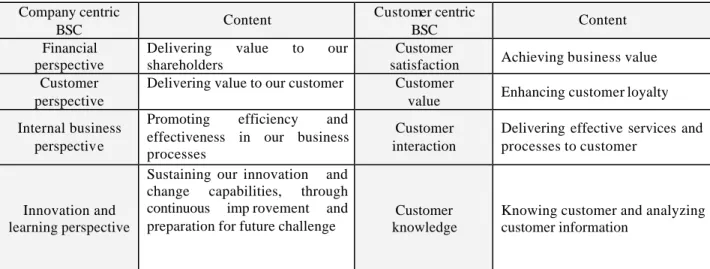
Table 1 Comparison of company centric BSC and customer centric BSC
Company centric BSC Content Customer centric BSC Content Financial perspective
Delivering value to our shareholders
Customer
satisfaction Achieving business value Customer
perspective
Delivering value to our customer Customer
value Enhancing customer loyalty Internal business
perspective
Promoting efficiency and effectiveness in our business processes
Customer interaction
Delivering effective services and processes to customer
Innovation and learning perspective
Sustaining our innovation and change capabilities, through continuous imp rovement and preparation for future challenge
Customer knowledge
Knowing customer and analyzing customer information
Traditional BSC perspectives are financial, customer, internal business , innovation and learning. To change customer-centric evaluation, we changed four perspectives. As Table 1 shows, The revised model consists of the following four perspectives: customer knowledge, and customer interaction, customer value, customer satisfaction.
Capture Customer information Create Customer profile
Segment customers
Increase customer knowledge
Implement Targeted customer care
Relationship programs
Targeted products & services Marketing programs Sales campaign Integrated Channel management Divest Unprofitable customer Increase Customer loyalty Improved Customer acquisition Increase Customer revenues Decrease Customer Costs Increase Profits Increase Value-added for the customer
Increased Marketing, sales, customer care effectiveness&efficiency
financial Customer satisfaction Customer interaction Customer value Customer knowledge Customer Internal business Innovation learning Capture Customer information
Create Customer profile Segment customers
Increase customer knowledge
Implement Targeted customer care
Relationship programs
Targeted products & services Marketing programs Sales campaign Integrated Channel management Divest Unprofitable customer Increase Customer loyalty Improved Customer acquisition Increase Customer revenues Decrease Customer Costs Increase Profits Increase Value-added for the customer
Increased Marketing, sales, customer care effectiveness&efficiency
financial Customer satisfaction Customer interaction Customer value Customer knowledge Customer Internal business Innovation learning
These perspectives are customer-oriented perspectives because the customer is crucial to e-business.
Fig. 2 CRM evaluation model
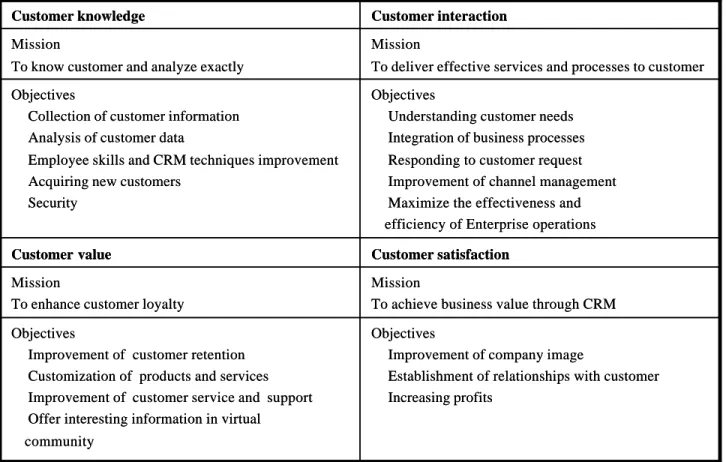
Fig. 2 shows a model for CRM evaluation. The customer knowledge perspective represents the evaluation of the customer segment and customer data management. Customer knowledge focuses on technological learning, understanding customer needs, and innovation, which enable meeting the future needs of customers and improving management processes. Therefore, it is critical that these organizations promptly familiarize themselves with the new technology. The customer interaction perspective represents the evaluation of customer services and management processes. Management and maintenance affect customer value, operational excellence, and quality CRM service. By managing and maintaining CRM more effectively, a company can satisfy its customers and achieve operational excellence. The customer value perspective represents the evaluation of customer loyalty and customer lifetime value. If the company is satisfied with the customer, then there will be no problem for customer deviation. To maintain this relationship, the company must continue to find ways to build the customer commitments and loyalty. In addition, the company must identify their valued customers and treat them accordingly. The customer satisfaction perspective represents the evaluation of business value and profits. Customer satisfaction is the feeling that a product or service meets customer expectations and determines whether the buyer will become a permanent customer or not
5. Measures for CRM
We propose an application framework for evaluating CRM effectiveness. We show how four perspectives can be measured. There are some reasons why performance measurement is so powerful in enhancing business. First, measurement removes the ambiguity and disagreement that surround high-level strategic concepts. Secondly, measurement provides the precise language for clearly communicating all levels what the organization wants to accomplish and how it intends to accomplish it. Thirdly, measurement allows the continual evaluation of corporate alignment on strategic goals. Lastly, measurement not only improves the probability but also speeds the pace at which change occurs.
CRM strategy
Company oriented evaluation
Customer oriented evaluation
CRM plan
Financial Customer Internal business Customer satisfaction Customer value Customer interactionInnovation and learning Customer knowledge
(segment & acquisition)
CRM vision
Evaluation analysis
& decision support
CRM strategy
Company oriented evaluation
Customer oriented evaluation
CRM plan
Financial Customer Internal business Customer satisfaction Customer value Customer interactionInnovation and learning Customer knowledge
(segment & acquisition)
CRM vision
Evaluation analysis
& decision support
Fig. 3 CRM evaluation missions and key success factors
5.1 Customer knowledge
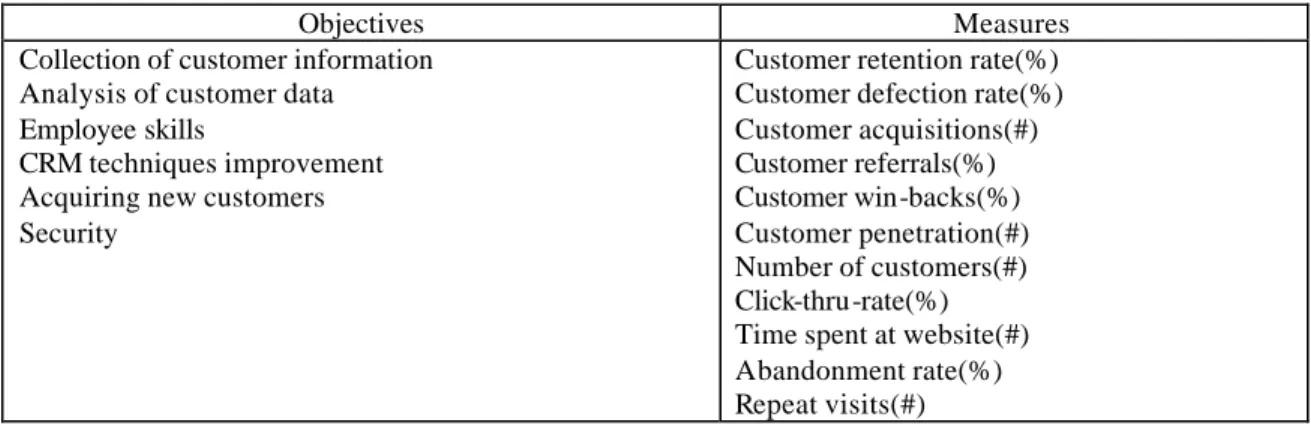
Present-day’s customers have such varied tastes and preferences that it is difficult to group them into a large homogenous population to develop marketing strategies. A customer wants to be served according to his or her individual and unique needs. To analyze customer needs, CRM uses appropriate data mining tools and data warehousing technique. To analyze personal information, we need to know customer history, such as the customer retention, defection, acquisitions, referrals, and win-backs. In the case of web marketing, we need click thru-rate, repetitive visits, and time spent at the website.
We can know customer characteristics by analyzing customer knowledge, for example, customer retentio n, customer defection, customer acquisitions. An enterprise using the web site in the CRM should incorporate web log data, for example, click-thru-rate, abandonment rate, and repeat visits.
In the current customer centric business environment, companies must understand data mining and data warehousing technology. A major problem is to filter, sort, process, analyze and manage this data in order to extract information relevant to the user. Data mining tasks are used to extract patterns from large data sets . Data mining tasks are divided into five categories, dependency analysis, class identification, concept, description, deviation detection, and data visualization. With the shift from mass marketing to one-to one relationship marketing, one area that can g reatly benefit form data mining is the marketing function (M. J Shaw, 2001). We need experts to use many techniques to analyze customer data. We must assess employee skill to use effectively customer information. We must consider security when we use customer information. We must assess security level of company to manage thoroughly customer information.
Objectives
Improvement of company image
Establishment of relationships with customer Increasing profits
Objectives
Improvement of customer retention Customization of products and services Improvement of customer service and support Offer interesting information in virtual
community
Mission
To achieve business value through CRM Mission
To enhance customer loyalty
Customer satisfaction Customer value
Objectives
Understanding customer needs Integration of business processes Responding to customer request Improvement of channel management Maximize the effectiveness and efficiency of Enterprise operations Objectives
Collection of customer information Analysis of customer data
Employee skills and CRM techniques improvement Acquiring new customers
Security
Mission
To deliver effective services and processes to customer Mission
To know customer and analyze exactly
Customer interaction Customer knowledge
Objectives
Improvement of company image
Establishment of relationships with customer Increasing profits
Objectives
Improvement of customer retention Customization of products and services Improvement of customer service and support Offer interesting information in virtual
community
Mission
To achieve business value through CRM Mission
To enhance customer loyalty
Customer satisfaction Customer value
Objectives
Understanding customer needs Integration of business processes Responding to customer request Improvement of channel management Maximize the effectiveness and efficiency of Enterprise operations Objectives
Collection of customer information Analysis of customer data
Employee skills and CRM techniques improvement Acquiring new customers
Security
Mission
To deliver effective services and processes to customer Mission
To know customer and analyze exactly
Customer interaction Customer knowledge
Table 2 Measures for customer knowledge
Objectives Measures
Collection of customer information Analysis of customer data Employee skills
CRM techniques improvement Acquiring new customers Security
Customer retention rate(%) Customer defection rate(%) Customer acquisitions(#) Customer referrals(%) Customer win-backs(%) Customer penetration(#) Number of customers(#) Click-thru-rate(%) Time spent at website(#) Abandonment rate(%) Repeat visits(#)
5.2 Customer interaction
The development of appropriate business processes is very important in order to make them operational. The processes can be divided into internal and external processes. The internal processes refer to the handling of the processes in the company internally, whereas the external processes describe the interactions between suppliers and customers. With the selection of strategic customer service, a company selects customer contact channels to deliver customer service. The goal is to create added value for customer needs by offering non-standard information. The customer is satisfied with the information provided it would be a source of competitive advantage. The customer relationship can be made by interacting customers. Relationship components follows; (Merlin stome, 1996)
l Contacts with company staff-front line and other,
l Outbound contact management – mail, telephone, sales visits, deliveries etc
l Physical service environment
l Transaction – price, value, term
To analyze customer interaction, some important measures must be considered, such as the number of cross-sales, recency, conversion rate, sales cycle time and so on.
Company interact with customer the offered communication channels. It is crucial that the customer can interact with the company through the channel of his choice. Channels involve classical communication channels, such as letter, fax, and telephone and new channels, such as call center, service center, web sites, and internet virtual communities. We must manage many channels efficiently and respond instantly. We must improve a channel management. Internal processes must connect and integrate many channels effectively. As the result of different technical developments, an enormous potential exists, especially the imperative of increasing interactivity between companies and customers (Veith Korner, 2000).
Table 3 Measures for customer interaction
Objectives Measures
Understanding of customer needs Integration of business processes Responding customer request Improvement of channel management
Maximize the effectiveness and efficiency of Enterprise operations
Marketing Campaign(%) Conversion rate (%) Revenue per conversion($) Number of cross-sales(#) Cross-sales attempts(%) Number of up-sales(#) Cost per conversion($) Sales cycle time(#) Recency(#) Service level(%)
5.3 Customer value
Customer value describes economic incentives, which help to arrange successfully the relationship with the customer. Customer value can be achieved through, for example, value added by relevant information in virtual communities, a
discount system, a loyalty program, and an attractive bundling of different products. Companies have a better chance of retain the customer when customer value strategy is relevant. As customers increasingly use company service and realize the added value it offers, they get used to being treated as indivisuals (Veith Korner, 2000).
A variety of different approaches are possible, for example, targeted information, customized products, customized web-pages, rewards and incentives. A company actively targets information to customers, including target advertising, promotions. Customization is not limited to the service that is offered. Customized products are probably the ultimate in personalized service and can command price premium. A company develops reward programs and purchase incentives. A company involves the customers directly by asking for feedback, points of view on products, and comments of suggestions on a range of topics (John Walsh, 2000).
We try to determine the customer value, so we need analyze such information as the customer life time value, customer profitability, share-of-wallet, and customer loyalty. CRM initiatives should provide mutually beneficial value to the customer and the company. Current customer profitability should be calculated, establishing a baseline and comparing new calculations to that baseline periodically. A company should calculate the lifetime value potential and use it as a guideline to tap customers who will be profitable in the future. Company should assess how successful they are at maximizing lifetime value of customers and customer segments.
Table 4 Measures for customer value
Objectives Measures
Improvement of customer retention Customization of products and services Improvement of customer service and support Offering interesting information in virtual community
Customer life time value($) Customer profitability(%) Customer lifetime revenue(%) Share-of-wallet(%)
Customer loyalty(%)
5.4 Customer satisfaction
The assessment of customer satisfaction is one of most important stages of the implemented model. The last vision of CRM is customer satisfaction. Customer satisfaction can be difficult to measure because it is hard to quantify. Customer satisfaction represents a modern approach for quality in enterprises and organizations, and serves the development of a truly customer-focused management and culture. Measuring customer satisfaction offers an immediate, meaningful, and objective feedback about customer preferences and expectations (G. Mihelis et al, 2001).
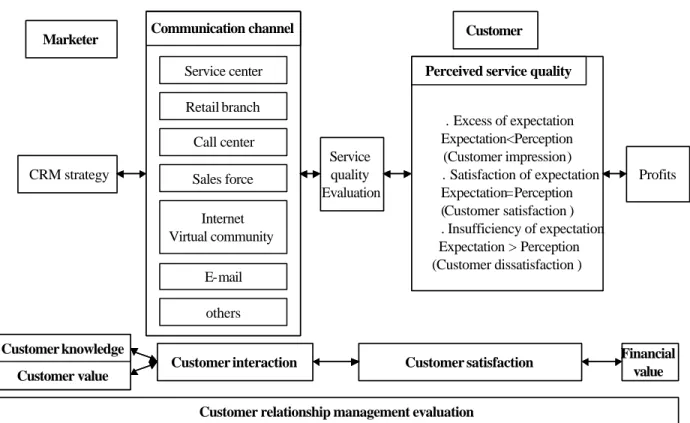
As Fig 4 shows, a company interacts with the customer into many communication channels in e-business. You can see a number of customer touch points and delivery channels that produce and consume information. There are many communication channels in CRM. For example, E-mail, web sites, virtual community, call center, service center and so on. This information needs to be integrated and analyzed in order to obtain a complete and accurate picture of the customers – their preferences, needs, complaints, and attributes that can make them life-long members of the organizational “network” of products and services (Ales Berson, 2000).
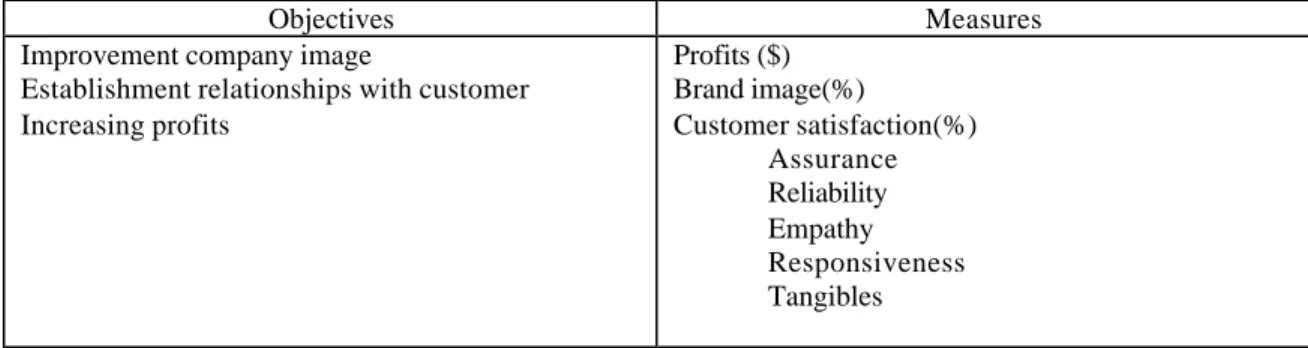
Among the four perspectives , the customer satisfaction perspective is the most important because customer satisfaction is ultimately reflected in a company’s profits. We will use a service quality evaluation tool to assess customer satisfaction. These measures include the number of customer complaints, response times, mean time to resolve issues, the number of contacts to problem resolution and the percentage of complaints which are successfully resolved. A customer satisfaction evaluation tool is based on a qualitative method such as SERVQUAL instrument. This approach evaluates all activities that are taken place on the CRM from the following five perspectives: reliability, responsiveness, empathy, t angibles, and assurance.
Table 5 Measures for customer satisfaction
Objectives Measures
Improvement company image
Establishment relationships with customer Increasing profits Profits ($) Brand image(%) Customer satisfaction(%) Assurance Reliability Empathy Responsiveness Tangibles
Fig. 4 Customer satisfactio n - Service quality
Parasuraman et al’s(1997) work resulted in a 45-item instrument, SERVQUAL, for assessing customer expectations and perceptions of service quality in service and retailing organizations. Underlying the 22 items are five dimensions that authers claim are used by customers when evaluating service quality, regardless of the type of service. The five dimensions consider distinct components of CRM service quality:
l Assurance: Knowledge and courtesy of CRM employees and their ability to inspire trust and confidence.
l Reliability: Ability to perform the promised service dependently and accurately
l Empathy: Caring, individualized attention the service provider gives its customers
l Responsiveness: Willingness to help customers and provide prompt s ervice
l Tangibles: Physical facilities, equipment, and appearance of personnel
Service quality for each dimension is captured by a difference score G(representing perceived quality for that item), where
G= P - E
And P and E are the average ratings of a dimension’s corresponding perception and expectation statement respectively (Parasurman A, 1988). As Fig. 4 follows, perceived service quality is three levels. Excess, satisfaction, and insufficiency of expectation are three levels of customer satisfaction. We investigate not only customer satisfaction but also business profit and brand image. After a company applies relationship marketing, they want to know how much profit accrues them and the change of brand image.
6. Conclusions
Customer relationship management (CRM) has rapidly become one of the leading competitive business strategies in the new millennium. CRM is a broad term for managing business interactions with customers. CRM complements the relationship marketing perspective. CRM includes direct business contacts with customers, channel partners indirect contacts with customers, and customer contact management in a supply chain. Many companies have collected and stored a wealth of data about their customers, suppliers, and business partners.
In this paper we investigate how to evaluate CRM. In order to evaluate, we developed CRM Balanced score card and
Communication channel Retail branch Call center Sales force Internet Virtual community E-mail others Service center CRM strategy Marketer Customer . Excess of expectation Expectation<Perception (Customer impression) . Satisfaction of expectation Expectation=Perception (Customer satisfaction ) . Insufficiency of expectation Expectation > Perception (Customer dissatisfaction )
Perceived service quality
Profits
Customer interaction Customer satisfaction Customer knowledge
Customer value
Financial value
Customer relationship management evaluation
Service quality Evaluation Communication channel Retail branch Call center Sales force Internet Virtual community E-mail others Service center Communication channel Retail branch Call center Sales force Internet Virtual community E-mail others Service center CRM strategy Marketer Customer . Excess of expectation Expectation<Perception (Customer impression) . Satisfaction of expectation Expectation=Perception (Customer satisfaction ) . Insufficiency of expectation Expectation > Perception (Customer dissatisfaction )
Perceived service quality
Profits
Customer interaction Customer satisfaction Customer knowledge Customer value Customer knowledge Customer value Financial value
Customer relationship management evaluation
Service quality Evaluation
presented objectives and measures. We suggested the evaluation framework for customer centric BSC model. This model provides a comprehensive CRM evaluation framework where practitioners assess their customer relationship management. This model is composed of 4 perspectives: customer knowledge, customer interaction, customer value, and customer satisfaction. We applied the SERVQUAL instrument to evaluate customer satisfaction. This model supports the decision of CRM business strategy and forms the basis for enhancing CRM. Through the CRM evaluation model, practitioners can clearly communicate important information and where and how function of an organization contributes to CRM strategy formulation. In future work, we will survey case study and apply this model to CRM evaluation.
7. Acknowledgement
The authors would like to thank the Ministry of Education of Korea for its financial support toward the Electrical and Computer Engineering Division at POSTECH through its BK21 program
Reference
[1] Alea M. Fairchild et al, knowledge Management Metrics via a Balanced Scorecard Methodology, proceeding of the 33rd Hawaii International conference on system science, 2002.
[2] Ales Berson, Building data mining applications for CRM, McGraw-Hill, 2000.
[3] Anderson, James C, “business marketing: understand what customers value”, havard business Review, November, 1998, pp54.
[4] D.H.Lee, A conjoint model for internet shopping malls using customer’s purchasing data, Expert systems with applications Vol 19, pp 59-66, 2000.
[5] Dennis Kundisch, Enabling eCCRM : Content Model and Management for Financial services, proceeding of the 33rd Hawaii International conference on system science, 2000.
[6] Joe Peppard, Customer Relationship Management in financial services, European Management journal Vol. 18, pp 312-327, 2000.
[7] James Brewton, Maximizing CRM performance with strategic performance measurement, http://www.crm-forum.com, 2002.
[8] Leyland F. Pitt et al, Service Quality: a measure of information systems effectiveness, MIS quarterly Vol 19, pp173-187, 1995.
[9] Lynette Lyals, Cross-functional Issues in the implementation of Relationship marketing through customer relationship management, European management journal, Vol 30, 2001.
[10] Maris Martinsons et al, The Balanced scorecard: a foundation for the strategic management of information systems, Decision Support Systems Vol 25, pp71-88, 1999.
[11] Mark Lycett , George M. Giaglis, Component-Based Information System : Toward a Framework for evaluation, proceeding of the 33rd Hawaii International conference on system science, 2000.
[12] Merlin Stone, Neil Woodcock, Muriel Wilson, Managing the change from Marketing planning to customer Relationship Management, Long Range Planning, Vol. 29, No. 5, pp 675-683, 1996.
[13] Michael J. Shaw, Chandrasekar Subramaniam, Gek Woo Tan, Michael E. Welge, Knowledge management and data mining for marketing, Decision Support Systems Vol 31, pp127-137, 2001.
[14] Nha Nguyen, Gaston Leblanc, Corporate image and corporate reputation in customers ’ retention decisions in services, Journal of retailing and Consumer Services, Vol 8, pp 227-236, 2001.
[15] Paracuraman, A.: Reflections on Gaining competitive advantage through customer value. Journal of the academy of marketing science Vol 25, 154-161,1997.
[16] Parasuraman, A, et al, SERVQUAL: a multiple item scale for measuring customer perceptions of service quality, Journal of Retailing Vol 64, 12-37, 1988.
[17] Rebeca Duray, Peter T. Ward, Glenn W. Milligan, William L.Berry, Approaches to mass customization, Journal of operation management, Vol 18, pp 605-625, 2000.
[18] R.Kaplan et al, The Balanced Score card : translating strategy into action, Harvard business school review, 1996. [19] S.C. Hui, G.jha, Data mining for customer service support, Information & Management Vol 38, pp1-13, 2000.
[20] Stella Mooraj, Daniel Oyon, Didier hostettler, The Balanced Scorecard : a necessary Good or an Unnecessary evil?, European Management Journal Vol. 17, pp481-491, 1999.
[21] Veith Korner, Management of customer relationship in business media – The case of the fijnancial industry, proceeding of the 33rd Hawaii International conference on system science, 2000.