TRANSDISCIPLINARY STUDENT VALIDATION OF A
MULTI-STAKEHOLDER WORK INTEGRATED
LEARNING MODEL
Cookie Govender and Marius Wait
University of Johannesburg
ABSTRACT
Work integrated learning (WIL) is designed to align theory to practice, expose future graduates to the workplace, and enable business and government to engage in a triple helix partnership, viewing future talent, advertising their employer brand, and meeting their organisational and national targets. Stakeholders in any WIL model or strategy include students, educators, business and government. Students are key stakeholders and should be consulted on the effectiveness of the model or strategy used. Empirical mixed-method research was conducted to determine whether and why students, as key WIL stakeholders, validated their WIL model. A single instrument was used to gather both quantitative and qualitative data in focus group sessions. The data were analysed abductively to include both inductive and deductive analysis. The findings reveal that most of the participants validated the Multi-Stakeholder WIL Model implemented in their study programme. Furthermore, most of the students validated all the phases and processes in the model, indicating that they found the model comprehensive, simple to implement and likely to be effective in providing them with a successful WIL experience. This validated model could be of benefit to all WIL stakeholders, especially educators, and the research method used to validate the model could benefit WIL project leaders. The study contributes to theory by adding to the body of knowledge on WIL, especially in Africa and South Africa. The research contribution is the single-instrument mixed method used to gather rigorous, rich data. The practical contribution is the awareness and strategy that managers and leaders can utilise in managing their WIL projects.
Keywords; multi-stakeholder, student, transdisciplinary, validation, WIL model, work integrated learning
INTRODUCTION
University students are the future graduates and future talent for the workplace in any country. Graduates are educated to become employable and fulfil socioeconomic roles, including being future-fit leaders in organisations, marketplaces and societies. Universities aim to empower graduates to contribute to and grow the local and global economy effectively and efficiently (Nicholas, 2017). In order to best align theory to practice, educators are encouraged to include work integrated learning (WIL) as part of the teaching and learning curriculum. Although WIL is practised in most countries, it is not yet a common feature in all qualifications in all universities (Patrick et al., 2008).
Furthermore, although WIL provides opportunities for business and government to meet their recruitment targets, view future talent close up and advertise their brand, neither business nor government has taken advantage of the triple helix partnership initiatives recommended to fight the war for talent. The triple helix partnership encourages connections between education, business and government in order to grow the national, continental and global economies (Etzkowitz, 2010). There are many benefits to incorporating WIL into future graduate study programmes, especially in transdisciplinary WIL projects. There is a gap in empirical research in terms of stakeholder buy-in of WIL models. The purpose of this paper is to obtain student validation of a new conceptual WIL model (Wait and Govender 2016). This paper is the first in a series of four papers seeking stakeholder validation namely student, educators, business and government. There are also many benefits for the multiple WIL stakeholders. Since students are key WIL stakeholders, they should be vocal about the WIL model selected to empower them to become future-fit leaders. Transdisciplinary WIL models are fashionable, especially if they are validated by their stakeholders.
For the purpose of this article, work integrated learning refers to the assessed, practical workplace experience gained by undergraduate students, and the key WIL stakeholders are understood to be students, educators, business and government. The motivation for this article is the conviction that students, as key stakeholders, should be consulted on their perspectives on WIL. The WIL model that is implemented should be viewed and validated from the student perspective. Furthermore, it is critical to understand each student as a unique stakeholder with their own past learning experiences. This article is based on the perceptions of final-year undergraduate students who are completing WIL as part of their qualification.
Empirical research was conducted to answer this research question: Do South African higher education students, as key WIL stakeholders, support and validate the Multi-Stakeholder WIL Model that is currently implemented in their study programme? The research objectives were to determine whether students, as key WIL stakeholders, validated the transdisciplinary Multi-Stakeholder WIL Model implemented in their disciplines and to understand their reasons for validating the model.
At a theoretical level, this study contributes to the body of knowledge on the WIL programmes in South African and African higher education institutions. At a research level, the study presents WIL project leaders with a method to validate their WIL models. At a practical level, the study bears positive implications for students, educators, business and government that become partners in WIL experiences. At a managerial and leadership level, the study contributes to strategy on the stakeholders, phases and processes involved in a WIL project.
LITERATURE REVIEW
The literature trends explored in this article are presented under the subheadings ‘WIL stakeholders’, ‘Students as key WIL stakeholders’, ‘Stakeholder support for transdisciplinary WIL models’ and ‘The Multi-Stakeholder WIL Model’.
WIL stakeholders
Work integrated learning is commonly known as ‘experiential learning’ or ‘cooperative education’. Workplace learning, as part of an academic curriculum, lacks a commonly used definition and has limited shared terminology. In this article ‘WIL’ is considered the umbrella term for the varieties of visible and invisible models, strategies, approaches, practices and theories related to a purposefully designed curriculum that integrates theory with actual
workplace practice and experience (Council for Higher Education, 2011; Coll and Zegwaard, 2011; Nicholas, 2017). WIL stakeholders manage to engage, connect, network and implement successful WIL projects no matter how visible or invisible, documented or unacknowledged are the many WIL activities undertaken by higher education institutions, WIL champions and practitioners. Furthermore, WIL practitioners benchmark their WIL projects via collaborative learning opportunities with peers, especially WIL project leaders, whereby they share expertise, best practice and resources (Nicholas, 2017).
Irrespective of the definition of WIL, the purpose of the WIL experience is to partner with the relevant stakeholders so that the key stakeholder, the student, is provided with the opportunity to bridge the gap between theoretical knowledge gained in the educational setting and practical experience in the world of work (Hall et al., 2017). Other WIL stakeholders include educators, business and government, who form partnerships designed to provide physical and/or digital workspaces that expose graduates-to-be to where and how professional work occurs (Oliver, 2015).
The WIL stakeholders are impacted by the expectations of students, employers, the profession, the university and government policy. Generally, WIL stakeholders report positive benefits from WIL, providing evidence of commitment to enhancing student learning experiences. There is evidence of strong partnerships between stakeholders that facilitate effective workplace learning for students (Patrick et al., 2008).
While students gain workplace experience of theoretical concepts, educators enhance student learning through practical, workplace exposure; consequently businesses gain potential future talent, and government gains validation for financial investment in graduates who are holistically developed and employable (Cooper et al., 2010). Ultimately graduates-to-be gain the skills, competencies, values and personal attributes that empower them to find and engage in meaningful paid work that benefits their careers. WIL stakeholders should collaborate to achieve successful WIL projects that benefit themselves, the workforce, the community and the economy (Oliver, 2015).
Students as key WIL stakeholders
As key WIL stakeholders, students are expected to engage in a range of appropriate workplace tasks and activities that are relevant to their current study and future careers. Student perceptions of the WIL project differ depending on the specific WIL environment and their current cognitive, social and emotional levels (Illeris, 2003). The higher education student is especially visible as a key stakeholder in a WIL model. These students undergo preparation, learning through experience and assessment, and gain study-related employment that contributes to individual, societal and economic growth. Students should lead, control and manage their WIL experience while other stakeholders ensure an effective, efficient and successful WIL project. In most WIL projects, students are viewed as the key stakeholders who collaborate with business, government and civil society to improve their knowledge, skills, values and attitude (Wiek et al., 2014).
As key stakeholders in WIL programmes or projects, students must be aware of who the other key stakeholders are and what their roles are. They must also be familiar with their WIL model, strategy or approach and the phases in that model or project. WIL models begin with student preparation and placement, continue with successful workplace experiential learning, and culminate with the submission of WIL evidence that can be assessed for promotion in the module and for qualification. If students as key WIL stakeholders are not familiar with, do not support, and do not validate the WIL model implemented in their discipline, the WIL project is less likely to succeed without challenges (Jackson et al., 2017).
The benefits for students undergoing successful WIL experiences and assessments include the following: theory and practice alignment; motivation for holistic theoretical and experiential learning; the opportunity to be foregrounded as future workplace talent; increasing opportunities for graduate employment; and ensuring a skilled, knowledgeable workforce in South Africa, Africa, BRICS countries and the global market. Students who manage their WIL experience successfully begin to create their own talent brand. As key stakeholders with value as prospective employees, WIL students market themselves as knowledgeable but willing to learn through
experience and skills development. Students present themselves to business, employers, industry, government and society as future-fit leaders worthy of employment upon graduation (Brackett and Rivers, 2014). According to Hall et al. (2017) students gain the following four attributes or traits from WIL experiences: communicative ability, global citizenship, discipline-specific knowledge, and professionalism. These traits are essential especially when youth unemployment is so high in South Africa, and nine out of ten businesses would rather hire people with experience than those without (Blom, 2015; Taylor and Govender, 2017).
Stakeholder support for transdisciplinary WIL models
Well implemented WIL models, especially those that create partnerships between educators, students, business and government, should be transdisciplinary or multidisciplinary in nature as this increases the chances of employability for graduates (Taylor and Govender, 2017). Transdisciplinary WIL models are those that can be used across different disciplines. The disciplines have similar stakeholders, phases and processes with different student cohorts. Stakeholders of the WIL model, especially in transdisciplinary academic contexts, should show support for the planning, preparation, implementation, monitoring and measuring of student success in the WIL process to ensure the success of the WIL project (Aini et al., 2016; Wait and Govender, 2016).
Stakeholders that support WIL models engage with other stakeholders, are aware of the WIL phases, enable the WIL processes and guide the WIL assessment. It is imperative that stakeholders agree, collaborate and jointly implement their specific roles in the WIL project (Klenk et al., 2015).
Transdisciplinary WIL practitioners benefit from seeking out expertise across disciplines to assist them to be more competent, knowledgeable and effective professionals. WIL practitioners who engage with and gain value from communities of practice (CoPs) also encourage students to form CoPs. Transdisciplinary WIL CoPs, in particular, have become valuable mechanisms for WIL practitioner development (Nicholas, 2017). Furthermore, WIL models that are implemented across disciplines in both the academic and the business contexts provide valuable research rigour. Research benefits for transdisciplinary WIL models include increased fairness, reliability, validity, relevance, sufficiency and opportunities for comparative studies (Reid et al., 2016).
The Multi-Stakeholder WIL Model
The WIL model on which this empirical study is based, named the Multi-Stakeholder WIL Model (Wait et al
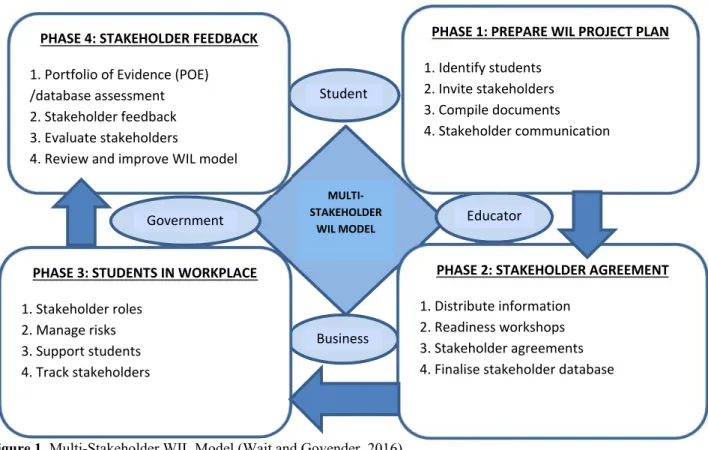
2016), is currently implemented in two disciplines (Human Resource Management and Marketing Management) within one mega-faculty in an African city university. The model consists of four key stakeholders, namely students, educators, business and government. Current literature is abound with WIL models that consist of three stakeholders namely; students, educators and business. However, government as a legislative custodian and as a fundamental triple helix partner should play a substantial role in financing WIL implementation, especially on the African continent. There are four phases in the model: preparing and planning; stakeholder agreement; supporting students; and stakeholder feedback (Wait and Govender, 2016). The processes involved in the implementation at each phase are presented in Figure 1.
Figure 1. Multi-Stakeholder WIL Model (Wait and Govender, 2016)
According to the literature trends, the stakeholders of the WIL model should be identified and supported, especially if the transdisciplinary, multi-stakeholder model is to succeed. Literature is limited in expressing the voices of key WIL stakeholders especially of the benefactors, the students. The next section will present the empirical research methodology where-in feedback from the students were captured.
RESEARCH METHOD
Empirical research was conducted to determine whether students validated the Multi-Stakeholder WIL Model and what their reasons were for doing so. The research method of this study is presented under the subheadings ‘Design and paradigm’, ‘Sample and participants’, ‘Instrument and procedure’, ‘Analysis’, ‘Ethical considerations’ and ‘Limitations’.
Design and paradigm
The research design of the study was a single-phase, embedded, mixed-method design (Plowright, 2012; Saunders et al., 2012). A single instrument was used to gather both quantitative and qualitative data during two focus group discussion sessions in two different disciplines. Since this study aimed to validate an existing model, the
Multi-MULTI‐ STAKEHOLDER WIL MODEL Government Business Educator Student PHASE 1: PREPARE WIL PROJECT PLAN 1. Identify students 2. Invite stakeholders 3. Compile documents 4. Stakeholder communication PHASE 2: STAKEHOLDER AGREEMENT 1. Distribute information 2. Readiness workshops 3. Stakeholder agreements 4. Finalise stakeholder database PHASE 3: STUDENTS IN WORKPLACE 1. Stakeholder roles 2. Manage risks 3. Support students 4. Track stakeholders PHASE 4: STAKEHOLDER FEEDBACK 1. Portfolio of Evidence (POE) /database assessment 2. Stakeholder feedback 3. Evaluate stakeholders 4. Review and improve WIL model
Stakeholder WIL Model, the mixed-method design suited the study as it allowed the researchers to gather both statistical (whether or not) data and narrative (why/reasons) data. Qualitative questions were embedded within the quantitative variables in one instrument administered in a single setting to gather all data required (Plowright, 2012; Mouton, 2012).
The research paradigm of this study was guided by pragmatist philosophy. Pragmatism is aimed at finding practical ways to determine the nature of reality (ontology) and views the nature of new knowledge (epistemology) as a concrete, co-created process (Creswell, 2014). The axiology (role of values in research) of pragmatists involves guiding participants ethically towards making informed decisions without influencing their decisions, resulting in value-free research (Plowright, 2012).
Sample and participants
The research population extends to all students undertaking WIL as part of their university study programme. The sample population of this study comprised final-year undergraduate students in the two disciplines of Human Resource Management and Marketing Management within one faculty. The purposive sampling strategy was used to select the participants (Trotter, 2012; Creswell, 2014; Boddy, 2016; Koumanov, 2017).
The selection criteria for the participants included in the study were the following: being a registered student in the selected disciplines of the university; having completed or undergoing the WIL experience; and being exposed to the Multi-Stakeholder WIL Model. The research participants (n=90) consisted of male and female students between the ages of 20 and 35 years. Participants from the two disciplines were registered for a final-year module that contained a mandatory WIL component assessed as part of the semester mark.
Instrument and procedure
An independently designed questionnaire was used as the instrument to gather data for this research study. The questionnaire is a valuable tool and a primary source for obtaining closed-ended and/or open-ended data (Zohrabi, 2013). Closed-ended questionnaires lend themselves to ease of analysis, while open-ended questionnaires lend themselves to a greater level of discovery; thus the two types of question in the same research instrument complement each other. The questionnaire designed for this study consisted of four sections: ‘Section A – Biographical data’, ‘Section B – Impressions of the Multi-Stakeholder WIL Model’, ‘Section C – Stakeholders and phases of the Stakeholder WIL Model’, and ‘Section D – Additional comments on the Multi-Stakeholder WIL Model’. Sections B and C comprised both closed-ended and open-ended questions. In the closed-ended questions, participants had to select only one response using the nominal scale of ‘Yes’, ‘No’ and ‘Both’. Each closed-ended question had an attached open-ended question to probe the participant’s reason for their response. Section D consisted of open-ended questions only.
The procedure of data gathering consisted of administering the instrument in a single phase or setting for each of the disciplines on two separate occasions. Participants were invited to the focus group discussion on the Multi-Stakeholder WIL Model. Both the closed-ended and open-ended questions were put to the group. The researchers acted as facilitators of the focus group discussions. The procedure applied for the data collection in this research study was as follows: invite participants; conduct a brief presentation on the Multi-Stakeholder WIL Model; distribute the questionnaire; ask a closed-ended question; request responses; request reasons; hold a brief discussion; request participants to complete the questionnaire to capture individual responses.
Analysis
Since both numerical and narrative data were gathered in this study, abductive content analysis was used to analyse and interpret the data (Plowright, 2012). Abductive analysis allows researchers to view the data both inductively (allowing meaning to emerge) and deductively (extracting meaning from the data). The numerical data were subjected to a frequency analysis (deductive), while the narrative data were scrutinised for the most common and appropriate reasons that supported and answered the research study questions (inductive). Triangulation of the quantitative and qualitative data concluded the mixed-method analysis (Creswell, 2014).
The responses of participants from the two focus groups were captured electronically using Microsoft Excel, allowing for easy manipulation of data both statistically and for narrative content. The quantitative data were assigned absolute values, while the qualitative data were assigned relative values (Mayring, 2015). The frequency responses of the quantitative findings are reported as percentages. The qualitative responses are reported as key words and phrases and in the direct quotations of participants. Quotes are followed by the participant’s unique identifying number in brackets.
Ethical considerations
Ethical clearance to conduct the research study was granted by the university. Participants granted consent to participate voluntarily in the study. The anonymity of participants was guaranteed with each completed questionnaire being allocated a unique identification number before analysis. Since no participant names are used, the confidentiality of responses is guaranteed. All data were used for research and development purposes only. The completed questionnaires and electronic files were stored safely during the research and are accessible only by the researchers.
FINDINGS
The quantitative and qualitative findings are reported under the following subheadings: ‘Biographical data’, ‘Impressions of the WIL model’, ‘Validation of key stakeholders’, ‘Validation of phases 1 to 4 of the model’, ‘Comments on the Multi-Stakeholder WIL Model’.
In the gender category, 42% of the participants were male and 58% were female. In respect of nationality, all of the participants (100%) were South African or African. In the age category, 82% of the participants were under 25 years of age and 8% were between 26 and 35 years of age. In terms of job experience, 40% of the participants had less than 1 year of experience and 59% had between 1 and 4 years of work experience. All participants had a school leaving certificate with university exemption, allowing them access to higher education.
Impressions of the WIL model
In terms of exposure to the Multi-Stakeholder WIL Model, 92% of the participants had had experience with this WIL model. The participants’ impressions of the model were described as ‘good’, ‘right’ and ‘useful’. The following are the direct thoughts expressed by the participants. Participant quotes are presented with the numerical identity of each participant in parenthesis.
It is a fantastic model identifying all stakeholders important in helping students gain knowledge of business. (P48)
I would like to believe that it is a great initiative for students to learn about the world of work. (P66) The participants’ feelings on how the model impressed them were described as ‘satisfied’, ‘helpful’, ‘motivating’ and ‘positive’. These are direct quotes from participants:
I feel that it is helpful and important to every student participating. (P1) Validates my importance as a stakeholder. (P36)
Validation of key stakeholders
Most of the participants (91 to 100%) perceived that the key WIL stakeholders must include students, educators, business and government. Participants stated that including the student, educator, business and government as key WIL stakeholders is ‘important’ and ‘applicable’. In the words of one participant: ‘Yes because students are the future employers or employees of the economy’ (P16).
With regard to the use of the Multi-Stakeholder WIL Model, 97% of the participants agreed with its use, and 94% stated that they would benefit from the implementation of this model. A majority of 66% of the participants stated that they would not change the Multi-Stakeholder WIL Model, and 24% stated that they would modify the model. In general, participants validated the model as ‘excellent’, ‘supportive’, ‘helpful’, ‘easy to understand’ and ‘gives direction’. In the direct words of a participant:
It is very helpful throughout the whole process of the programme. Especially in preparation and getting through it. It seems well thought through, put together and comprehensive. (P58)
Validation of phases 1 to 4 of the model
Phase 1 of the model is the preparation and planning phase, and 98% of the participants agreed that phase 1 should prepare and plan for WIL project implementation. Phase 1 of the model includes the following processes: identifying students; inviting stakeholders; compiling documents; and communicating to stakeholders. A majority of 98% agreed that these processes belong to phase 1. The reasons participants provided for these responses included the following:
Important phase in designing and implementing the programme. (P7) Yes planning is part of everything we do in the workplace. (P24)
Phase 2 of the model is the stakeholder agreement phase, and 80% of the participants agreed that phase 2 should gain agreement from stakeholders for WIL project implementation. Phase 2 of the model includes the following processes: distributing information; conducting readiness workshops; signing agreements; and finalising all stakeholders. All participants (100%) agreed that these processes belong to phase 2. The reasons participants provided for these responses included the following:
You have to select the best/most fitting organisation and they have to be ready to receive you. (P30) Because our agreement as students is regarded as important especially for the programme. (P68) Phase 3 of the model is the phase that supports students in the actual WIL implementation, and 96% of the participants agreed that phase 3 should support students for WIL project implementation. Phase 3 of the model includes the following processes: stakeholder roles; managing risks; supporting students; and tracking stakeholders. A majority of 99% agreed that these processes belong to phase 3. The reasons participants provided for these responses included the following:
Due to students being exposed to various challenges, support is needed. (P41) It is important for the learner to get some support from the stakeholders. (P63)
Phase 4 of the model gains stakeholder feedback, and 99% of the participants agreed that phase 4 should elicit stakeholder feedback during and after WIL project implementation. Phase 4 includes the following processes: assessing students; obtaining stakeholder feedback; evaluating the WIL project; and reviewing the WIL project. A majority of 99% agreed that these processes belong to phase 4. The reasons participants provided for these responses included the following:
Review, fix and implement and improve (is necessary for successful WIL). (P34) Because it will help the student to see whether their performance was good or not. (P37)
Comments on the Multi-Stakeholder WIL Model
Section D of the questionnaire requested open-ended additional comments on the Multi-Stakeholder WIL Model. Participants’ responses were as follows:
Very well planned, easy to follow. Guideline when feeling lost. Has a start and end objective in correct order. (P9)
Very exciting, can’t wait to do my WIL. (P17)
It explains the different roles of the stakeholders and helps me to gain some understanding. (P25)
DISCUSSION AND IMPLICATIONS
Significant findings from the biographical data relate firstly to the gender category, in which the majority of the participants were female (58%), which corresponds with the broader South African demographics, where females are in the majority. In respect of age, it is significant that 82% of the participants were younger than 25 years, as this reflects the trend in the broader South African population, where the youth are in the majority compared to other age groups. An unexpected and surprisingly significant finding is that 59% of the participants had between 1 and 4 years of work experience, which could indicate that students are trying to become employable before graduation in order to avoid being unemployed after graduation, which is an increasing problem, as stated by Taylor and Govender (2017). This finding may lend credibility to this research study, as only students with work experience can validate this model comprehensively. This finding warrants investigation, as full-time university students do not normally have work experience.
The findings reveal that the Multi-Stakeholder WIL Model is beneficial. The key stakeholders (students) who were participants in this study were familiar with this model and believed it could achieve its purpose to advantage. It is significant that 94% of the student participants agreed that the four WIL stakeholders (student, educator, business, government) had been accurately identified. These participants, the students, are future employees and employers and, as such, are future implementers of the WIL model; they will therefore need to be familiar with the WIL strategy, as supported by Jackson et al. (2017). Findings indicate that this WIL model is a practical, uncomplicated model that is easy to implement in the workplace and in higher education institutions. The implication is that this model could be readily applied in other disciplines, faculties and institutions.
It is significant that 98% of the participants agreed that, in phase 1, WIL project leaders must plan and prepare for WIL implementation, as this phase prevents poor performance, failure of WIL implementation and ineffective WIL projects, as supported by Aini et al. (2016) and Wait and Govender (2016). It is significant that all participants (100%) agreed that phase 2 is where stakeholders should become willing stakeholders, indicating that they would adhere to agreement clauses in the WIL model, as supported by Klenk et al. (2015). It is also significant that 99% of the participants agreed that phase 3 concerns the implementation of WIL, allowing for the key stakeholders to manage their working relationships with each other, as supported by Wiek et al. (2014).
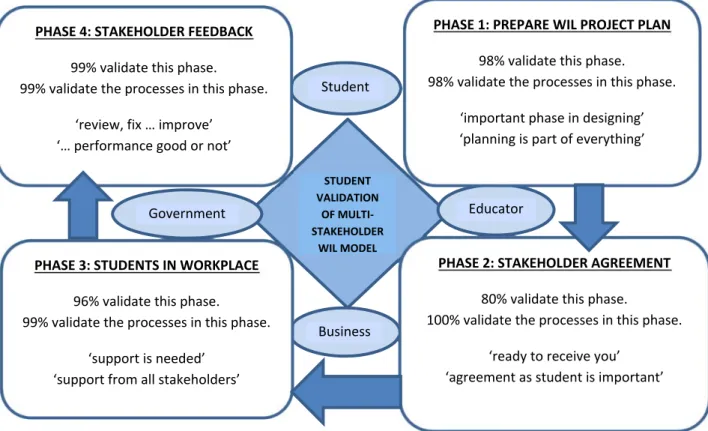
Concerning phase 4, it is significant that 99% of the participants agreed that this phase involves feedback from the implementation of WIL, allowing for effective communication between the key stakeholders. Furthermore, this allows eradication of ineffective and unsuccessful WIL implementation, as supported by Coll and Zegwaard (2011). Figure 2 presents the significant findings on whether and why students, as key WIL stakeholders, validate the Multi-Stakeholder WIL Model.
Figure 2. Student validation of the Multi-Stakeholder WIL Model
The first significant finding in the additional, general participant comments is confirmation that the phases and processes of this Multi-Stakeholder WIL Model are easily managed, meaningful to stakeholders and sequential in application. The second significant finding in this section is that this WIL model does motivate stakeholders to implement effective and successful WIL projects, as supported by Nicholas (2017).
There are five managerial implications of this research study. Firstly, higher education and business must collaborate and become stakeholders to promote WIL as part of the theoretical university curriculum, especially if future graduates are to be employable talent with the education and skills to grow the local and global economy. Secondly, educators and students must work as active partners during all four phases to ensure effective and efficient WIL projects. Thirdly, WIL students must form relationships with relevant government departments in South Africa in order to allow for funding of WIL projects. This would mitigate current concerns and protests, such as the ‘fees must fall’ issue and low graduate employability. Fourthly, this study has shown that the ease and sequential steps of the Multi-stakeholder WIL model allow other WIL project leaders to create a firm foundation for their stakeholders. Lastly, it allows for wider application of this model’s phases and processes and for effective implementation of WIL internationally.
The significance of this study is that educators, business and government as WIL stakeholders are made aware of students’ perception, roles and responsibilities. This will enable all WIL stakeholders to co-operate in synergy and to avoid pitfalls. This should ensure a closer working relationship amongst all stakeholders.
LIMITATIONS
The generalisability of the findings is limited due to this study being conducted in only one city university in a single country in Africa. Furthermore, although the study was conducted across two disciplines, the findings cannot be generalised across all disciplines as the student participants in the research were exposed to the Multi-Stakeholder WIL Model and other students were not.
STUDENT VALIDATION OF MULTI‐ STAKEHOLDER WIL MODEL Government Business Educator Student PHASE 1: PREPARE WIL PROJECT PLAN 98% validate this phase. 98% validate the processes in this phase. ‘important phase in designing’ ‘planning is part of everything’ PHASE 2: STAKEHOLDER AGREEMENT 80% validate this phase. 100% validate the processes in this phase. ‘ready to receive you’ ‘agreement as student is important’ PHASE 3: STUDENTS IN WORKPLACE 96% validate this phase. 99% validate the processes in this phase. ‘support is needed’ ‘support from all stakeholders’ PHASE 4: STAKEHOLDER FEEDBACK 99% validate this phase. 99% validate the processes in this phase. ‘review, fix … improve’ ‘… performance good or not’
CONCLUSION
WIL has multiple benefits, namely aligning theory to practice, exposing future graduates to the workplace, and advertising business and government organisations as employers of choice to future talent. While WIL allows business, government and education to engage in a triple helix partnership, all stakeholders can meet their organisational and national targets while educating and skilling graduates. Students, as key WIL stakeholders, should manage the effectiveness of their WIL model via awareness and validation of its processes.
This research study was conducted to determine whether and why students, as key WIL stakeholders, validated their WIL model. The conclusion from the findings confirms that the Multi-Stakeholder WIL Model and its phases and processes allow the WIL project leaders and stakeholders to easily manage the sequential application steps, each of which is meaningful to stakeholders, especially to students.
This paper recommends further research on the voices of other key stakeholders namely; educators, business and government to successfully validate the multi-stakeholder WIL model.
REFERENCES
Aini W, Kustono D, Dardiri A, et al. (2016) Work-based learning for enhancing the capacity of engagement: Lesson from stakeholders perspective literature. In AIP Conference Proceedings 1778. Melville NY: AIP
Publishing. DOI: http://aip.scitation.org/toc/apc/1778/1.
Blom R (2015) A work place-based learning policy: The national perspective. A presentation at the Department of Higher Education and Training Work Integrated Learning Workshop, Pretoria, March 19–20.
Boddy CR (2016) Sample size for qualitative research. Qualitative Market Research: An International Journal
19(4): 426–32.
Brackett MA and Rivers SE (2014) Transforming students’ lives with social and emotional learning. In: Pekrun R and Linnenbrink-Garcia L (eds) International Handbook of Emotions in Education. New York:
Routledge, pp. 368–87.
Coll R and Zegwaard KE (eds) (2011) International Handbook for Cooperative and Work-integrated Education.
2nd edn. Lowell, MA: World Association for Cooperative Education.
Cooper L, Orrell J and Bowden M (2010) Work Integrated Learning: A Guide To Effective Practice. New York:
Routledge.
Council for Higher Education (CHE) (2011) Work-Integrated Learning: Good Practice Guide. Pretoria: CHE.
Cresswell, J.W. (2014). Research design. Qualitative, quantitative and mixed method approaches (4th ed.). Thousand Oaks, CA: Sage.
Etzkowitz H (2010) The Triple Helix: University–Industry–Government Innovation in Action. New York:
Hall M, Pascoe D and Charity M (2017) The impact of work-integrated learning experiences on attaining graduate attributes for exercise and sports science students. Asia-Pacific Journal of Cooperative Education 18(2): 101–13.
Illeris K (2003) Workplace learning and learning theory. Journal of Workplace Learning 15(4): 167–78.
Jackson D, Rowbottom D, Ferns S, et al. (2017) Employer understanding of work-integrated learning and the challenges of engaging in work placement opportunities. Studies in Continuing Education 39(1): 35–51.
Klenk NL, Meehan K, Pinel SL, et al. (2015) Stakeholders in climate science: Beyond lip service? Science
350(6262): 743–44.
Koumanov KS (2017) Sample size determination in horticultural research: An empirical approach. Scientia Horticulturae 225: 416–21
Mayring P (2015) Qualitative content analysis: theoretical foundation, basic procedures and software solutions. Open Access Repository. www.ssoar.info
Mouton J (2012) How to Succeed in Your Master’s and Doctoral Studies: A South African Guide and Resource Book. Pretoria: Van Schaik.
Nicholas L (2017) Work integrated learning (WIL) practitioners’ perceptions of the value of communities of practice. Doctoral dissertation, Massey University, New Zealand.
Oliver B (2015) Redefining graduate employability and work-integrated learning: Proposals for effective higher education in disrupted economies. Journal of Teaching and Learning for Graduate Employability 6(1):
56–65.
Patrick CJ, Peach D, Pocknee C, et al. (2008) The WIL (Work Integrated Learning) Report: A National Scoping Study. Brisbane: Queensland University of Technology.
Reid RS, Nkedianye D, Said MY, et al. (2016) Evolution of models to support community and policy action with science: Balancing pastoral livelihoods and wildlife conservation in savannas of East Africa.
Proceedings of the National Academy of Sciences 113(17): 4579–84.
Plowright, D. (2012). Using mixed methods. Framework for an integrated methodology. London: Sage Publications Ltd.
Taylor S and Govender CM (2017) Increasing employability by implementing a work-integrated learning partnership model in South Africa – A student perspective. Africa Education Review 14. DOI:
10.1080/18146627.2016.1224585.
Trotter RT (2012) Qualitative research sample design and sample size: Resolving and unresolved issues and inferential imperatives. Preventive Medicine 22: 398–400.
Wait M and Govender CM (2016) Multi-stakeholder work integrated learning model for higher education – A transdisciplinary approach. South African Journal of Higher Education 30(2): 279–93.
Wiek A, Xiong A, Brundiers K, et al. (2014) Integrating problem-and project-based learning into sustainability programs: A case study on the School of Sustainability at Arizona State University. International Journal of Sustainability in Higher Education 15(4): 431–49.
Zohrabi M (2013) Mixed method research: Instrument, validity, reliability and reporting findings. Theory and Practice in Language Studies 3(2): 254–62.