Calcium halides are divalent salts that consist of one calcium ion asso-ciated with two halide ions. The halide ions that are commonly used in clear brine fluids include chlorides and bromides. Calcium halides are classified as ionic salts, which refers to its ability to disassociate com-pletely into ions in water.
Calcium halide is a manufactured product. Calcium bromide is pro-duced by the reaction of hydrobro-mic acid or bromine gas and limestone or slaked lime. Calcium chloride is produced by the reaction of hydrochloric acid and limestone or as a by-product of the Solvay process. The chemical properties of both salts are listed in Table 1. Calcium chloride and bromide salts have an unusually high heat of solu-tion. Dissolution of the dry salts should be done in a controlled man-ner due to the amount of heat gen-erated as the salts dissolve. Calcium chloride and bromide are hygro-scopic and deliquescent. The solid material, when exposed to the atmosphere, can absorb water until it forms a solution.
Calcium chloride and bromide salts are used in the oilfield as a single salt brine or as a multiple salt blend brine. Calcium halide brines can be blended as a combination of calcium chloride and bromide, and in combi-nation with zinc bromide salts. Cal-cium halide brines are used as completion and packer fluid and in formulation of PayZone® fluids. Cal-cium fluids have the desirable prop-erties to minimize formation damage cause by solid invasion, and shale dispersion.
Viscosity can be defined as the internal friction of a liquid. Viscosity is an important parameter for con-sideration in the oilfield due to its
impact on hydraulics. The viscosity of a fluid is used in calculating fluid behavior under dynamic conditions such as fluid flow regime, frictional pressure, equivalent circulating density and pump pressure. Cal-cium halide brines are nearly
New-tonian fluids. Newtonian fluids are defined as flu-ids that have a lin-ear shlin-ear stress to shear rate relation-ship. The viscosity of calcium halide brines as a func-tion of tempera-ture is given in Figure 1. The vis-cosity of mixed salt brines are sensi-tive to the compo-sition of the salts.
V I S C O S I T Y
C
ALCIUM
H
ALIDE
B
RINES
Figure 1: Viscosity of calcium halide brines 0 5 10 15 20 25 60 80 100 120 140 160 180 Temperature, deg. F Ap p a ren t Vi sco si ty, cp 9.5 ppg CaCl 11.6 ppg CaCl 12.8 ppg CaCl /CaBr 14 ppg CaCl /CaBr 14.2 ppg CaBr 2 2 2 2 2 2 2
Table 1. Physical Properties of Calcium Halide
Properties Calcium Chloride Calcium Bromide
CHEMICAL FORMULA CaCl2 CaBr2
MOLECULAR WEIGHT 110.99 199.91
CAS No. 10043-52-4 71626-99-8
EINECS No. 233-140-8 232-164-6
PHYSICAL APPEARANCE White granules/pellets White granules/crystals SOLID HYDRATES CaClCaCl2•2H2, CaCl2O, CaCl2•H22•4HO, 2O,
CaCl2•6H2O
CaBr2, CaBr2•4H2O,
CaBr2•6H2O
MELTING POINT 1424oF 1346oF
BULK DENSITY [anhydrous] 134.56 lb/ft3 208.88 lb/ft3
pH 7.0-7.5 7.0-7.5
HEAT CAPACITY @70oF 0.62 cal./g/oF
[11.6 ppg CaCl2]
0.47 cal./g/oF
[14.2 ppg CaBr2]
MAXIMUM BRINE
Calcium halide brines are nearly neutral in pH with values ranging from neutral to slightly alkaline. The alkalinity in calcium chloride and calcium bromide fluids is a by-prod-uct of its manufacturing process. The pH of calcium halide brines can be adjusted.
The pH can be raised with lime [CaO] and slaked lime [Ca(OH)2].
Other highly soluble alkaline materi-als such as caustic soda [NaOH] should be used with caution to avoid precipitation of calcium hydroxide [Ca(OH)2] in the brine.
The pH of calcium brines can be low-ered with acids such as acetic acid [CH3COOH], hydrobromic acid [HBr]
and hydrochloric acid [HCl]. The use of acids such as hydrofluoric [HF] and sulfuric [H2SO4] should be
avoided to prevent undesirable pre-cipitation. Extreme alteration of the brine pH may impact upon its corro-sion rates, fluid and formation com-patibility, and elastomer
compatibility.
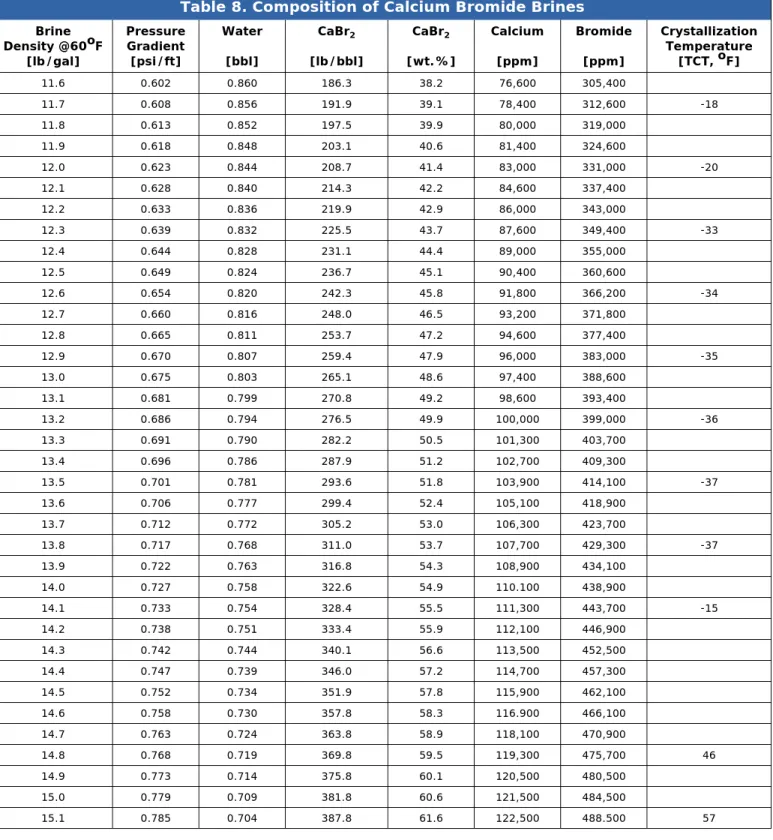
Brine crystallization temperature can be defined as the maximum temperature at which solids are formed. These solids can be salts and/or ice. All efforts should be made to avoid solids coming out of solution. The various problems that can arise from solids coming out of solution include loss in fluid density and solidifying of the entire fluid, causing plugging problems. The general measurement of crys-tallization temperature used in the oilfield is the true crystallization temperature (TCT). The data on TCT values as a function of composition for calcium halide brines are given in Appendix A, Tables 7 to 9. The recommended TCT of a brine should be several degrees lower than the lowest temperature that the fluid will encounter. The minimum ambi-ent temperature and seabed
tem-perature should be taken into consideration in determining the TCT of a working brine.
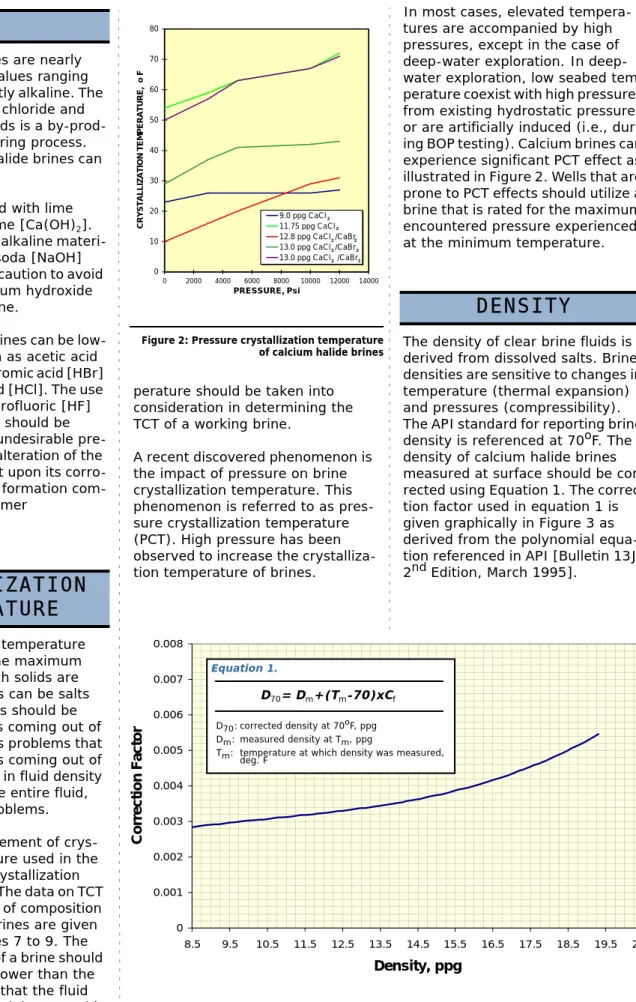
A recent discovered phenomenon is the impact of pressure on brine crystallization temperature. This phenomenon is referred to as pres-sure crystallization temperature (PCT). High pressure has been observed to increase the crystalliza-tion temperature of brines.
In most cases, elevated tempera-tures are accompanied by high pressures, except in the case of water exploration. In deep-water exploration, low seabed tem-perature coexist with high pressures from existing hydrostatic pressure or are artificially induced (i.e., dur-ing BOP testdur-ing). Calcium brines can experience significant PCT effect as illustrated in Figure 2. Wells that are prone to PCT effects should utilize a brine that is rated for the maximum encountered pressure experienced at the minimum temperature.
.
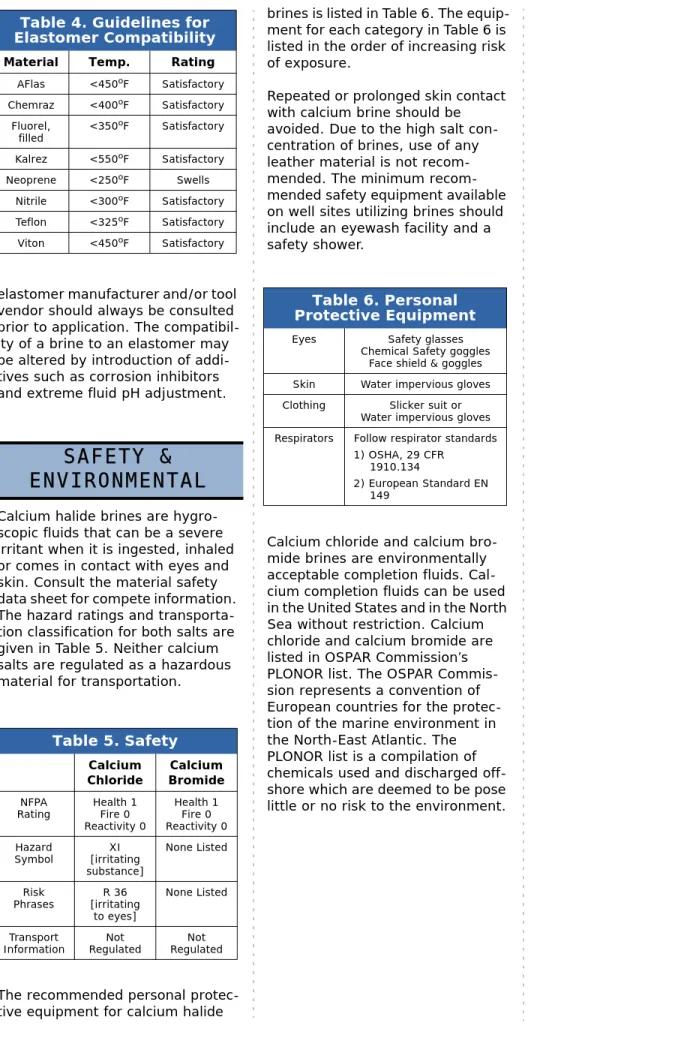
The density of clear brine fluids is derived from dissolved salts. Brine densities are sensitive to changes in temperature (thermal expansion) and pressures (compressibility). The API standard for reporting brine density is referenced at 70oF. The density of calcium halide brines measured at surface should be cor-rected using Equation 1. The correc-tion factor used in equacorrec-tion 1 is given graphically in Figure 3 as derived from the polynomial equa-tion referenced in API [Bulletin 13J, 2nd Edition, March 1995].
P
H
C R Y S T A L L I Z A T I O N
T E M P E R A T U R E
D E N S I T Y
Figure 2: Pressure crystallization temperature of calcium halide brines 0 10 20 30 40 50 60 70 80 0 2000 4000 6000 8000 10000 12000 14000 PRESSURE, Psi CRYSTALLIZATION TEM PERATURE, o F 9.0 ppg CaCl 11.75 ppg CaCl 12.8 ppg CaCl /CaBr 13.0 ppg CaCl /CaBr 13.0 ppg CaCl /CaBr 2 2 2 2 2 2 2 2 0 0.001 0.002 0.003 0.004 0.005 0.006 0.007 0.008 8.5 9.5 10.5 11.5 12.5 13.5 14.5 15.5 16.5 17.5 18.5 19.5 20.5 Density, ppg Correction Factor
Figure 3: Density correction factor
D70= Dm+(Tm-70)xCf
D70: corrected density at 70oF, ppg Dm: measured density at Tm, ppg
Tm: temperature at which density was measured, deg. F
In calculation of hydrostatic pres-sures or equivalent circulating den-sity exerted by a brine in the wellbore, simultaneous application of the thermal expansion and com-pressibility factors must be applied. These calculations are easily done by TETRA’s TP-Pro™ Program.
Calcium halide brines have rela-tively low to moderate corrosion when used at their natural neutral pH. Table 2 presents corrosion rates of various densities of calcium brines. The common factors that have a tendency to accelerate cor-rosion of calcium halide brines include high temperatures, intro-duction of oxidizers, and contami-nation of acidic gases such as carbon dioxide and hydrogen sul-fide.
Calcium chloride brines should be carefully screened for applications in chrome alloys to avoid chloride stress cracking. Chloride stress cracking is a phenomenon induced by physical stress in the presence of chloride fluids that can result in cat-astrophic failures. The factors that influence chloride stress cracking include alloy type, alloy hardness, temperature, stress, chloride con-centration, and contaminates. Sin-gle salt calcium bromide brines are sometimes utilized to avoid a chlo-ride brine system and its associated problems with chloride stress crack-ing.
Common additives used in corrosion treatment of calcium halide brines include oxygen scavengers, corro-sion inhibitors, anti-scaling agents and biocides. Oxygen scavengers are reducing agents that chemically react with elemental oxygen. Oxy-gen is one of the parameters that promotes corrosion and it is essen-tial to eliminate oxygen in wells uti-lizing chrome alloys. Oxygen scavengers are consumable addi-tives and require continuous treat-ment in an open system.
Corrosion inhibitors utilize a wide variety of chemistries to retard cor-rosion. Clear brine fluids are
gener-ally treated with a single application of corrosion inhibitors.
Anti-scaling agents are utilized in environments that are prone to induce scales. Anti-scaling agents are designed to alter the properties of the solids that form such that the particle size are smaller, dispersible and nonscaling. Formation of scales can promote localized corrosion and formation damage.
Biocides are used to kill bacteria that can produce corrosive by-prod-ucts such as sulfides or slime form-ers which can promote localized corrosion. Biocides should be added to the brine early in order to give the biocide sufficient kill time.
Calcium halide brines have some compatibility issues. The calcium ion is generally the problematic ion. It can be the source of scaling prob-lems such as calcium carbonate [CaCO3] and calcium sulfate
[CaSO4]. The solubilities of some
typically encountered calcium com-pounds are listed in Table 3. Calcium ions can also precipitate out poly-mers, surfactants and organics. Due
to these considerations, fluid addi-tives, formation water and other contacting fluids should be screened for compatibility with calcium halide brines prior to usage. The halide ion does not usually pose a significant
compatibility problem. It is highly soluble with most cations encoun-tered in the oilfield.
Calcium halide brines are generally compatible with most oilfield elas-tomers. A general recommended guideline for compatibility of cal-cium brines with elastomers is given in Table 4. Elastomer formulations are subjected to changes and vary with manufacturers. Therefore the
C O R R O S I O N
F L U I D
C O M P A T I B I L I T Y
T Table 3. Solubilities Compound Solubility in water @68oF Calcium Acetate [Ca(C2H3O2)2] 21.0 wt.% Calcium Carbonate [CaCO3] 0.14 wt.% Calcium Fluoride [CaF2] 0.0016 wt.% Calcium Formate [Ca(COOH)2] 13.9 wt.% Calcium Hydroxide [Ca(OH)2] 0.18 wt.% Calcium Sulfate [CaSO4] 0.2 wt.% Calcium Sulfide [CaS] 0.01 wt.%Table 2. Corrosion Rates of Calcium Halide Brines
Fluid Temp. Test
Period CouponMetal FluidBase InhibitedFluid
10.0 ppg CaCl2 210oF 30 days N-80 3.0 mpy 0.6 mpy
[TETRAhib™] 10.0 ppg CaCl2 210oF 30 days J-55 2.9 mpy 0.8 mpy
[TETRAhib] 10.0 ppg CaCl2 300oF 30 days N-80 5.5 mpy 1.2 mpy
[TETRAhib] 10.4 ppg CaCl2 240oF 30 days N-80 2.9 mpy 1.4 mpy
[TETRAhib] 10.4 ppg CaCl2 240oF 30 days 13 Cr 0.4 mpy 0.06 mpy
[TETRAhib] 12.5 ppg
CaCl2/CaBr2
240oF 30 days N-80 4.1 mpy 1.25 mpy
[TETRAhib] 12.5 ppg
CaCl2/CaBr2
240oF 30 days 13 Cr 0.5 mpy 0.08 mpy
[TETRAhib] 14.0 ppg
CaCl2/CaBr2
200oF 30 days S13 Cr 0.2 mpy 0.1 mpy
[TETRAhib™ Plus] 14.0 ppg
CaCl2/CaBr2
350oF 5 days N-80 66.2 mpy 4.5 mpy
elastomer manufacturer and/or tool vendor should always be consulted prior to application. The compatibil-ity of a brine to an elastomer may be altered by introduction of addi-tives such as corrosion inhibitors and extreme fluid pH adjustment.
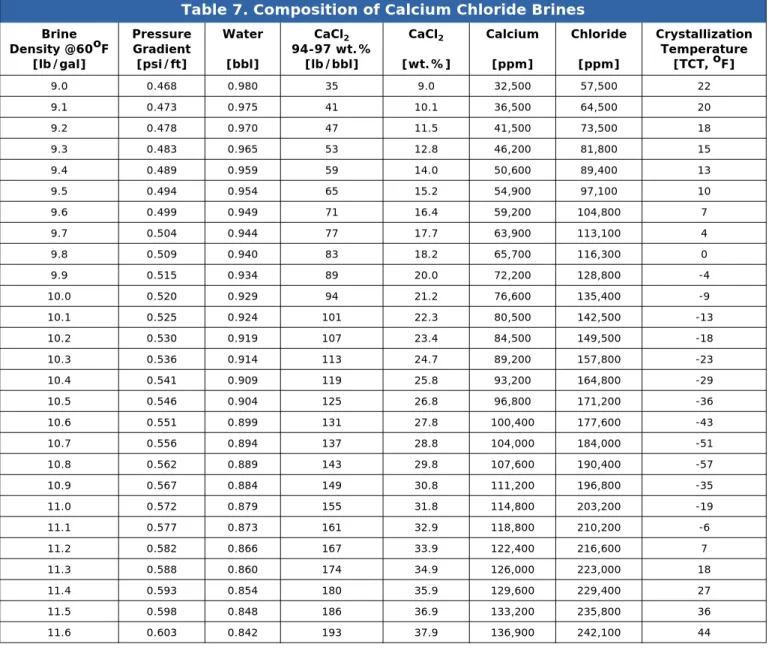
Calcium halide brines are hygro-scopic fluids that can be a severe irritant when it is ingested, inhaled or comes in contact with eyes and skin. Consult the material safety data sheet for compete information. The hazard ratings and transporta-tion classificatransporta-tion for both salts are given in Table 5. Neither calcium salts are regulated as a hazardous material for transportation.
The recommended personal protec-tive equipment for calcium halide
brines is listed in Table 6. The equip-ment for each category in Table 6 is listed in the order of increasing risk of exposure.
Repeated or prolonged skin contact with calcium brine should be avoided. Due to the high salt con-centration of brines, use of any leather material is not mended. The minimum recom-mended safety equipment available on well sites utilizing brines should include an eyewash facility and a safety shower.
Calcium chloride and calcium bro-mide brines are environmentally acceptable completion fluids. Cal-cium completion fluids can be used in the United States and in the North Sea without restriction. Calcium chloride and calcium bromide are listed in OSPAR Commission’s PLONOR list. The OSPAR Commis-sion represents a convention of European countries for the protec-tion of the marine environment in the North-East Atlantic. The PLONOR list is a compilation of chemicals used and discharged off-shore which are deemed to be pose little or no risk to the environment.
S A F E T Y &
E N V I R O N M E N T A L
Table 5. Safety
Calcium
Chloride BromideCalcium
NFPA
Rating Health 1Fire 0 Reactivity 0 Health 1 Fire 0 Reactivity 0 Hazard Symbol [irritating XI substance] None Listed Risk Phrases [irritating R 36 to eyes] None Listed Transport
Information RegulatedNot RegulatedNot
Table 6. Personal Protective Equipment
Eyes Safety glasses Chemical Safety goggles
Face shield & goggles Skin Water impervious gloves Clothing Slicker suit or
Water impervious gloves Respirators Follow respirator standards
1) OSHA, 29 CFR 1910.134
2) European Standard EN 149
Table 4. Guidelines for Elastomer Compatibility
Material Temp. Rating
AFlas <450oF Satisfactory Chemraz <400oF Satisfactory Fluorel, filled <350 oF Satisfactory Kalrez <550oF Satisfactory Neoprene <250oF Swells Nitrile <300oF Satisfactory Teflon <325oF Satisfactory Viton <450oF Satisfactory
APPENDIX A
Table 7. Composition of Calcium Chloride Brines
Brine Density @60oF [lb/gal] Pressure Gradient [psi/ft] Water [bbl] CaCl2 94-97 wt.% [lb/bbl] CaCl2 [wt.%] Calcium [ppm] Chloride [ppm] Crystallization Temperature [TCT, oF] 9.0 0.468 0.980 35 9.0 32,500 57,500 22 9.1 0.473 0.975 41 10.1 36,500 64,500 20 9.2 0.478 0.970 47 11.5 41,500 73,500 18 9.3 0.483 0.965 53 12.8 46,200 81,800 15 9.4 0.489 0.959 59 14.0 50,600 89,400 13 9.5 0.494 0.954 65 15.2 54,900 97,100 10 9.6 0.499 0.949 71 16.4 59,200 104,800 7 9.7 0.504 0.944 77 17.7 63,900 113,100 4 9.8 0.509 0.940 83 18.2 65,700 116,300 0 9.9 0.515 0.934 89 20.0 72,200 128,800 -4 10.0 0.520 0.929 94 21.2 76,600 135,400 -9 10.1 0.525 0.924 101 22.3 80,500 142,500 -13 10.2 0.530 0.919 107 23.4 84,500 149,500 -18 10.3 0.536 0.914 113 24.7 89,200 157,800 -23 10.4 0.541 0.909 119 25.8 93,200 164,800 -29 10.5 0.546 0.904 125 26.8 96,800 171,200 -36 10.6 0.551 0.899 131 27.8 100,400 177,600 -43 10.7 0.556 0.894 137 28.8 104,000 184,000 -51 10.8 0.562 0.889 143 29.8 107,600 190,400 -57 10.9 0.567 0.884 149 30.8 111,200 196,800 -35 11.0 0.572 0.879 155 31.8 114,800 203,200 -19 11.1 0.577 0.873 161 32.9 118,800 210,200 -6 11.2 0.582 0.866 167 33.9 122,400 216,600 7 11.3 0.588 0.860 174 34.9 126,000 223,000 18 11.4 0.593 0.854 180 35.9 129,600 229,400 27 11.5 0.598 0.848 186 36.9 133,200 235,800 36 11.6 0.603 0.842 193 37.9 136,900 242,100 44
APPENDIX A
Table 8. Composition of Calcium Bromide Brines
Brine Density @60oF [lb/gal] Pressure Gradient [psi/ft] Water [bbl] CaBr2 [lb/bbl] CaBr2 [wt.%] Calcium [ppm] Bromide [ppm] Crystallization Temperature [TCT, oF] 11.6 0.602 0.860 186.3 38.2 76,600 305,400 11.7 0.608 0.856 191.9 39.1 78,400 312,600 -18 11.8 0.613 0.852 197.5 39.9 80,000 319,000 11.9 0.618 0.848 203.1 40.6 81,400 324,600 12.0 0.623 0.844 208.7 41.4 83,000 331,000 -20 12.1 0.628 0.840 214.3 42.2 84,600 337,400 12.2 0.633 0.836 219.9 42.9 86,000 343,000 12.3 0.639 0.832 225.5 43.7 87,600 349,400 -33 12.4 0.644 0.828 231.1 44.4 89,000 355,000 12.5 0.649 0.824 236.7 45.1 90,400 360,600 12.6 0.654 0.820 242.3 45.8 91,800 366,200 -34 12.7 0.660 0.816 248.0 46.5 93,200 371,800 12.8 0.665 0.811 253.7 47.2 94,600 377,400 12.9 0.670 0.807 259.4 47.9 96,000 383,000 -35 13.0 0.675 0.803 265.1 48.6 97,400 388,600 13.1 0.681 0.799 270.8 49.2 98,600 393,400 13.2 0.686 0.794 276.5 49.9 100,000 399,000 -36 13.3 0.691 0.790 282.2 50.5 101,300 403,700 13.4 0.696 0.786 287.9 51.2 102,700 409,300 13.5 0.701 0.781 293.6 51.8 103,900 414,100 -37 13.6 0.706 0.777 299.4 52.4 105,100 418,900 13.7 0.712 0.772 305.2 53.0 106,300 423,700 13.8 0.717 0.768 311.0 53.7 107,700 429,300 -37 13.9 0.722 0.763 316.8 54.3 108,900 434,100 14.0 0.727 0.758 322.6 54.9 110.100 438,900 14.1 0.733 0.754 328.4 55.5 111,300 443,700 -15 14.2 0.738 0.751 333.4 55.9 112,100 446,900 14.3 0.742 0.744 340.1 56.6 113,500 452,500 14.4 0.747 0.739 346.0 57.2 114,700 457,300 14.5 0.752 0.734 351.9 57.8 115,900 462,100 14.6 0.758 0.730 357.8 58.3 116.900 466,100 14.7 0.763 0.724 363.8 58.9 118,100 470,900 14.8 0.768 0.719 369.8 59.5 119,300 475,700 46 14.9 0.773 0.714 375.8 60.1 120,500 480,500 15.0 0.779 0.709 381.8 60.6 121,500 484,500 15.1 0.785 0.704 387.8 61.6 122,500 488.500 57
Page 7 281.367.1983 www.tetratec.com For Internal Use Only
Focused on Energy. Dedicated to Service. TETRA Technologies, Inc.
25025 Interstate-45 North The Woodlands, TX 77380
APPENDIX A
Table 9. Composition of Calcium Chloride/Calcium Bromide Brines
Brine Density @60oF [lb/gal] Pressure Gradient [psi/ft] Water [bbl] CaCl2 [lb/bbl] CaBr2 [lb/bbl] Calcium [ppm] Chloride [ppm] Bromide [ppm] Crystallization Temperature [TCT, oF] 11.7 0.608 0.831 192.3 8.5 144,800 250,000 13,800 38 11.8 0.613 0.826 189.8 16.9 145,100 244,700 27,300 11.9 0.619 0.822 187.3 25.4 145,500 239,400 41,600 12.0 0.624 0.817 184.7 33.8 145,800 234,100 53,600 41 12.1 0.629 0.812 182.2 42.3 146,200 229,100 66,500 12.2 0.634 0.807 179.7 50.7 146,500 224,100 79,100 12.3 0.639 0.803 177.1 59.2 146,800 219,000 91,600 43 12.4 0.645 0.798 174.6 67.6 147,100 214,200 103,800 12.5 0.650 0.793 172.1 76.1 147,400 209,400 115,900 12.6 0.655 0.788 169.5 84.5 147,700 204,600 127,700 45 12.7 0.660 0.784 167.0 93.0 148,000 200,000 139,400 12.8 0.665 0.779 164.4 101.4 148,200 195,400 150,800 12.9 0.671 0.774 161.9 109.9 148,600 190,900 162,200 47 13.0 0.676 0.770 159.4 118.3 149,900 186,500 173,200 13.1 0.681 0.764 156.8 126.8 149,100 182,100 184,200 13.2 0.686 0.756 154.3 135.2 149,400 177,800 195,000 48 13.3 0.691 0.755 151.8 143.7 149,700 173,600 205,700 13.4 0.697 0.705 149.2 152.2 150,000 169,400 216,200 13.5 0.702 0.746 146.7 160.6 150,200 165,300 226,400 50 13.6 0.707 0.741 144.1 169.1 150,400 161,200 236,700 13.7 0.712 0.736 141.6 177.5 150,700 157,200 246,600 13.8 0.717 0.732 139.1 186.0 151,000 153,300 256,600 55 13.9 0.722 0.727 136.5 194.4 151,200 149,400 266,200 14.0 0.728 0.722 134.0 202.9 151,500 145,600 275,900 14.1 0.733 0.717 131.5 211.3 151,700 141,900 285,300 58 14.2 0.738 0.713 128.9 219.8 151,900 138,100 294,700 14.3 0.743 0.708 126.4 228.2 152,200 134,500 303,800 14.4 0.748 0.703 123.8 236.7 152,400 130,800 312,900 60 14.5 0.754 0.699 121.3 245.1 152,600 127,300 321,800 14.6 0.759 0.694 118.8 253.6 152,900 123,800 330,600 14.7 0.764 0.689 116.2 262.0 153,000 120,200 339,300 61 14.8 0.769 0.684 113.7 270.5 153,300 116,900 347,900 14.9 0.774 0.680 111.2 278.9 153,500 113,500 356,300 15.0 0.780 0.675 108.6 287.4 153,700 110,100 364,700 62 15.1 0.785 0.670 106.1 295.8 153,900 106,900 372,900