Published by Research-publishing.net, not-for-profit association
Dublin, Ireland; Voillans, France, [email protected] © 2014 by Research-publishing.net
Each author retains their own copyright CALL Design: Principles and Practice
Proceedings of the 2014 EUROCALL Conference, Groningen, The Netherlands Edited by Sake Jager, Linda Bradley, Estelle J. Meima, and Sylvie Thouësny
Rights: All articles in this collection are published under the Attribution-NonCommercial -NoDerivatives 4.0 International
(CC BY-NC-ND 4.0) licence. Under this licence, the contents are freely available online (as PDF files) for anybody to read,
download, copy, and redistribute provided that the author(s), editorial team, and publisher are properly cited. Commercial use and derivative works are, however, not permitted.
Disclaimer: Research-publishing.net does not take any responsibility for the content of the pages written by the authors of this book. The authors have recognised that the work described was not published before, or that it is not under consideration for publication elsewhere. While the information in this book are believed to be true and accurate on the date of its going to press, neither the editorial team, nor the publisher can accept any legal responsibility for any errors or omissions that may be made. The publisher makes no warranty, expressed or implied, with respect to the material contained herein. While Research-publishing.net is committed to publishing works of integrity, the words are the authors’ alone.
Trademark notice: product or corporate names may be trademarks or registered trademarks, and are used only for
identification and explanation without intent to infringe.
Copyrighted material: every effort has been made by the editorial team to trace copyright holders and to obtain their permission for the use of copyrighted material in this book. In the event of errors or omissions, please notify the publisher of any corrections that will need to be incorporated in future editions of this book.
Typeset by Research-publishing.net
Cover design: © Raphaël Savina ([email protected]) Fonts used are licensed under a SIL Open Font License
ISBN13: 978-1-908416-19-3 (Paperback - Print on demand, black and white)
Print on demand technology is a high-quality, innovative and ecological printing method; with which the book is never ‘out of stock’ or ‘out of print’.
ISBN13: 978-1-908416-20-9 (Ebook, PDF, colour) ISBN13: 978-1-908416-21-6(Ebook, EPUB, colour)
Legal deposit, Ireland: The National Library of Ireland, The Library of Trinity College, The Library of the University of Limerick, The Library of Dublin City University, The Library of NUI Cork, The Library of NUI Maynooth, The Library of University College Dublin, The Library of NUI Galway.
Legal deposit, United Kingdom: The British Library. British Library Cataloguing-in-Publication Data.
A cataloguing record for this book is available from the British Library.
for second/foreign language learners
Mei Lin
1, Anne Preston
2, Ahmed Kharrufa
3, and Zhuoran Kong
4 Abstract. Interactional communicative competence and higher-order thinking have been well documented as two of the biggest challenges for second/foreign language learners (EFL learners). This paper evaluates the use of digital tabletops as tools for problem-solving tasks in groups. The evaluation is based on a preliminary study of an application of the use of Digital Mysteries task with EFL learners in a Higher Education institution. It focuses more specifically on the extent to which collaborative learning platforms provided by interactive tabletops can promote and support the application of both thinking and linguistic skills for EFL learners. Based on an interdisciplinary perspective which draws from instructed second language learning and human-computer interaction fields, the evaluation considers moment-to-moment multimodal interaction of three groups of Chinese English language learners with and around the completion of the Digital Mysteries task. It seeks to identify what specific affordances in the design might benefit EFL learners in terms of thinking skills, interactional competence and linguistic performance, and by the same token, what might not. This paper concludes with a number of suggestions about how technologies designed for collaborative enquiry might be repurposed for higher-order thinking and language learning.Keywords: digital table, enquiry, interactional competence, higher order thinking.
2. [email protected]. 3. [email protected]. 4. [email protected].
How to cite this article: Lin, M., Preston, A., Kharrufa, A., & Kong, Z. (2014). Collaborative enquiry through the tabletop for second/foreign language learners. In S. Jager, L. Bradley, E. J. Meima, & S. Thouësny (Eds), CALL Design: Principles and Practice; Proceedings of the 2014 EUROCALL Conference, Groningen, The Netherlands
Collaborative enquiry through the tabletop for second/foreign language learners
1. Introduction
Research on communicative competence stresses the role of negotiation for meaning and students’ participation in oral communication. Participation and group tasks, however, do not automatically lead to negotiations for meaning. Digital Tabletops are an emerging technology offering good potential as a collaborative learning platform. A tabletop is a large horizontal display that allows students to interact with its contents directly using pens or touch. This technology is unique in combining the benefits of face-to-face collaborative learning that usually takes place around traditional tables with advantages gained from using computer technology (e.g. regulating the task, interaction with and around the tabletop, and logging the session for reflection).
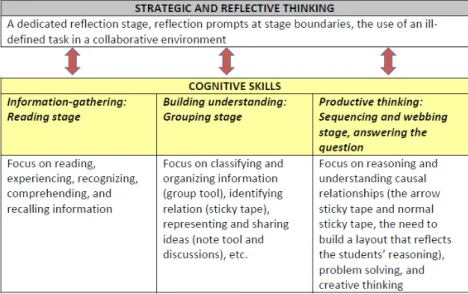
Digital Mysteries (Kharrufa, Leat, & Olivier, 2010) is a tool for the development and assessment of students’ higher-order-thinking. The pedagogical design was based on Moseley et al.’s (2005) thinking skills framework, and structures the completion of the Mysteries in three stages (Figure 1): reading (information gathering), grouping (building understanding) and sequencing (productive thinking). The Grouping stage focuses on developing meaning and organising ideas into groups while the sequencing stage puts a strong focus on reasoning and understanding causal relationships (through the use of the arrow shaped sticky tape).
Figure 1. Digital Mysteries three-stage structure and its mapping to Moseley et al’s. (2005) thinking skills model
Students are asked to solve open-ended mysteries based on a number of data slips via multiple pen-based interactions. Direct interaction with the application enables students to scale, move, group and regroup, and sequence in order to make sense of causal relationships of the different pieces of information. By physically manipulating data slips, students not only engage in the task, but will make their thinking visible on the tabletop and available for self and collective reflection and evaluation (Leat & Nichols, 2000).
An overall enforced structure is designed to help students go through the stages that correspond to progressing levels of thinking, i.e. reading, grouping, and reasoning. This study sought to identify what specific affordances a pen-based version of the Digital Mysteries tabletop application might benefit EFL learners in terms of collaboration and higher order thinking, and what might not.
2. Method
2.1. An interdisciplinary approach
The evaluation adopts an interdisciplinary approach which considers moment-to-moment multimodal interaction of three groups of Chinese EFL learners. The interactions were considered through the lens of three perspectives: Reasoning skills in the light of the Jewell’s (1996) Reasoning taxonomy; interactional competence and linguistic performance, guided by a conversation analysis for SLA approach, and interaction with the pedagogical-technological design of the user interface (Cummins, 2008; Kharrufa, Olivier, & Leat, 2010).
2.2. Synchronised audio and video files with transcripts
The completion of the Digital Mysteries were audio and video recorded for the three groups (Groups A, B, and C). Extracts were identified and synchronised with video logs. Synchronisation allowed examination of triggers of interaction (verbal and non-verbal) and of the extent to which this collaborative learning platform promoted and supported the application of both thinking and language learning skills for EFL learners.
2.3. Analysis
An initial three way independent analysis of the multimodal data was conducted. The authors then exchanged views on observed performance and outcome, linking
Collaborative enquiry through the tabletop for second/foreign language learners
3. Discussion
The findings suggested that although the students completed the same task with the same built-in structure for the stages, variations were observed among the three groups. Group A followed the three stages to the letter, though their answer to the question ‘Why Gail’s weekly shopping takes 40-minutes longer?’ was less satisfactory compared with that of Group B and C. Group C demonstrated a higher level of cognitive awareness in terms of sorting and sequencing the information from the outset. They produced longer sequences of talk involving negotiation for meaning and reasoning, and arrived at a more logical answer to the question than Group A, though less satisfactory than Group B. Group B divided jobs of reading and sorting at the first two stages, spent more time on sequencing and reflecting, and made the most logical argument.
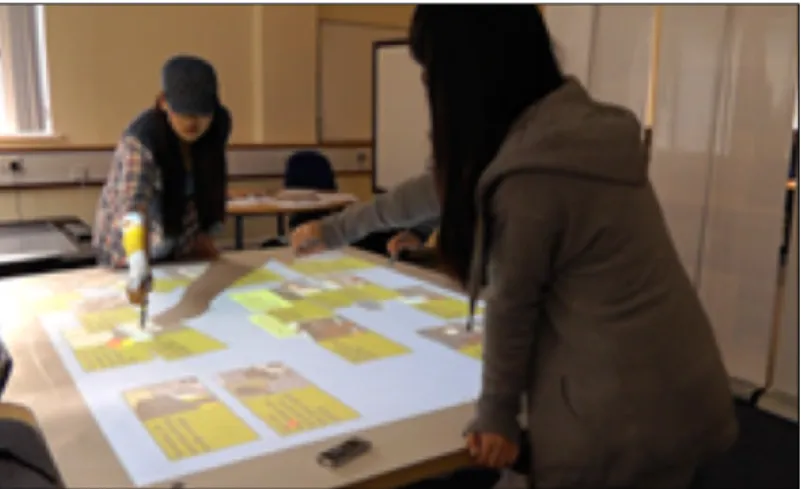
In terms of the role of the tabletop in mediating the task completion, direct interaction using the pens allowed students to engage with the organisation of the information (Figure 2).
Figure 2. Group C: sorting
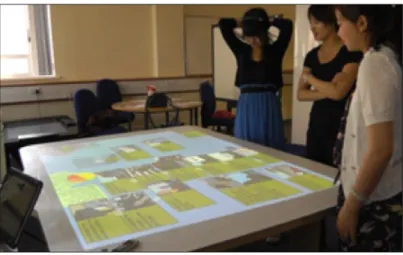
It was evident in more than one instance that the ability to enlarge the slips prompted reading aloud, encouraged discussions around its content, and pulled students together in the task. All the information visible on the table provided a space of learning (Walsh, 2011) to scan information, search for links between them, reflect on their thinking and make necessary changes (Figure 3). This facility made a high–cognitive-demand activity manageable (Cummins, 2008) with regard to both thinking and speaking in a foreign language.
Figure 3. Group B: Checking final layout of reasoning
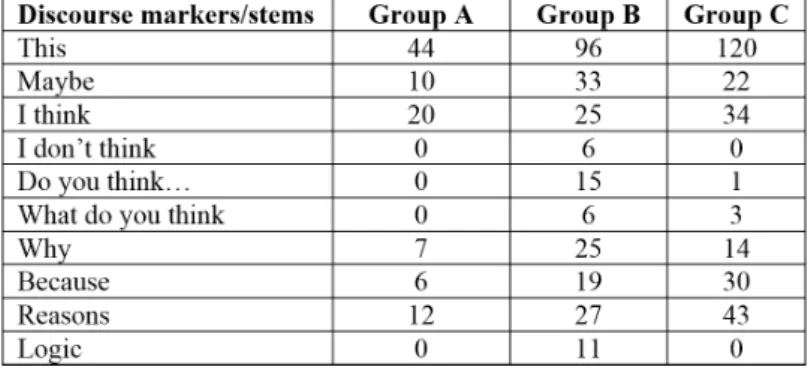
In addition, labelling groups of slips and sequencing generated a lot of talk of clarifications, differentiation of causes, reasons or effects, and evaluation or re-examination of their decisions. This resulted in a move to higher-order thinking. There was evidence of sequences consisting of proposals, acceptance, checking, and dispute to further the discussion (Jewell, 1996). As the thinking skills advanced, so did the organisation of the talk. Long and complex stretches of turn-taking reflected students’ interactional competence mediated by the table. Many examples implied the use of discourse markers. For instance, ‘maybe’ was used to seek confirmation or make comments during proposals. ‘This’ and ‘that’ were used as a way to signal joint attention to slips. The striking number of occurrences of ‘this’ in all three groups leads to the conclusion that it is used as an economic device in terms of working memory to spare more space for a speedy and fluent discussion of reasons as shown in Extract 1.
Extract 1: Group C
423 Gao: Also in the next, this lead to this. 424 Wan: This is maybe useful.
425 Hao: I think this one is the reason, can be the reason for these two. It is interesting to note a potentially close link between the use of the table and
Collaborative enquiry through the tabletop for second/foreign language learners
and also ‘interthinking’ (Littleton & Mercer, 2013). Here, although there was no ‘talk’ as such, there was still language processing going on (Table 1).
Table 1. Discourse markers used by students in solving Digital Mysteries
From a thinking skills perspective, students were going through stages of gathering and processing information, and seeking relationships between various slips. Sometimes the gathering and processing information were integrated with no clear separation. In terms of reasoning skills, argument construction called for critical evaluation of ideas proposed by others in the group (Jewell, 1996). In some cases, solutions were ‘on-hold’. Students did not reach a satisfactory solution but carried on with the activity until more information was available or noticed, making them rethink previous decisions.
From a language learning perspective, grouping and sequencing encouraged students reading and/or re-examining the slips at least more than once. This recycling of information helped EFL learners internalise the language they encountered.
4. Conclusions
This study investigated how digital technology might support EFL learners when engaged in higher-order thinking tasks. Our findings suggest that digital tabletop technologies hold a number of benefits for EFL learners engaged in collaborative enquiry. Importantly, these benefits comprise learning behaviours as they happen ‘on’ and ‘off’ the tabletop. Learners demonstrated a development in thinking critically as well as operationalising linguistic and interactional competences with, around and through the technology. How this type of activity might enhance learning in the longer-term is a fruitful next line of enquiry.
References
Cummins, J. (2008). BICS and CALP: Empirical and theoretical status of the distinction. In B. Street & N. H. Hornberger (Eds), Encyclopaedia of Language and Education (2nd ed.) (Volume 2: Literacy) (pp. 71-83). New York: Springer Science + Business Media LLC. Jewell, P. (1996). A reasoning taxonomy for gifted education. In M. T. McCann & F. Southern
(Eds), Fusing talents: Proceedings of the 6th national conference on gifted education Australian association for the education of the gifted and talented.
Kharrufa, A. S., Leat, D., & Olivier, P. (2010). Digital Mysteries: Designing for learning at the tabletop. In Proceedings of the ACM International Conference on Interactive Tabletops and Surfaces 2010, Saarbrücken, Germany, November 7-10, 2010, ITS’10.
Kharrufa, A. S., Olivier, P., Leat, D. (2010). Learning through reflection at the tabletop: A case study with Digital Mysteries. In Proceedings of World Conference on Educational Multimedia, Hypermedia and Telecommunications, Toronto, Canada June 28-July 2, 2010 (pp. 65-674).
Leat, D., & Nichols, A. (2000). Brains on the table. Diagnostic and formative assessment through observation. Assessment in Education: Principles, Policy & Practice, 7(1), 103-121. Littleton, K., & Mercer, N. (2013). Interthinking: Putting talk to work. Oxon: Routledge. Moseley, D., Baumfield, V., Elliot, J., Gregson, M., Higgins, S., Miller, J., & Newton, D.
(2005). Frameworks for thinking. Cambridge: Cambridge University Press. doi:10.1017/ CBO9780511489914