HISTOLOGICAL UPDATE OF THYROID LESIONS: A 5 YEAR STUDY
Dr. Shete Smita, *Dr. Khiste Jayashree, Dr. Pandit, G. A., Dr. Swati
Dr. VM Medical College, Solapur, Maharashtra
ARTICLE INFO ABSTRACT
The aim of this study is to review the histological types of thyroid lesions, their sex variation and mean age of presentation as well as toupdate available literature on prevalence of the common thyroid lesions. This study analyse the data from September
thyroid were studied. Non lesions (28 cases
lesions. Follicular adenoma
carcinoma was the most common malignant lesion (9 cases to 5th decade of lif
Copyright © 2015 Shete Smita et al. This is an open access article distributed under the Creative Commons Att distribution, and reproduction in any medium, provided the original work is properly cited.
INTRODUCTION
Thyroid gland is unique among endocrine organs in many ways. It is the largest endocrine gland in the body and first to develop in fetal life. (Chandanwale et al., 2012)
superficial location, it is the only one that is amenable to direct physical examination and biopsy. (Carcangiu and DeLellis, 1996) It is estimated that there are at least forty million individuals with thyroid disease in India. Most of them are women (James and Vineeth Kumar, 2012). Thyroid gland has been the subject of intense research and considerable attention due to the wide spectrum of diseases, ranging from functional and immunologically mediated enlargements to neoplastic lesions (Vander et al., 1968). The enlargements may be diffuse or nodular at times causing obvious physiological changes. In contrast, patients having papillary carcinoma of thyroid with secondaries in lymph node may remain asymptomatic till a very late stage. (Carcangiu and DeLellis, 1996)
patient may present with obvious metastatic disease wi undetectable primary lesion (occult/ hidden malignancy of thyroid). Thyroid carcinomas are the most common endocrine tumor. (NajumulHaq et al., 2009) It accounts for approximately 1% of all malignancies. (Vander et al., 1968; Najumul et al., 2009)Thyroid cancer is more prevalent in females as
*Corresponding author: Dr. Khiste Jayashree,
Dr. VM Medical College, Solapur, Maharashtra
ISSN: 0975-833X
Article History:
Received 25th June, 2015
Received in revised form 21st July, 2015
Accepted 17th August, 2015
Published online 16th September,2015
Citation: Shete Smita, Khiste Jayashree, Pandit, G. A., Swati Jindal and Vidiya Gurude year study”, International Journal of Current Research
Key words:
Non- neoplastic lesions, Neoplastic lesions, Goiter, Follicular adenoma, Papillary carcinoma.
RESEARCH ARTICLE
HISTOLOGICAL UPDATE OF THYROID LESIONS: A 5 YEAR STUDY
Dr. Khiste Jayashree, Dr. Pandit, G. A., Dr. Swati Jindal and Dr. Vidiya Gurude
Dr. VM Medical College, Solapur, Maharashtra
ABSTRACT
The aim of this study is to review the histological types of thyroid lesions, their sex variation and mean age of presentation as well as toupdate available literature on prevalence of the common thyroid lesions. This study analyse the data from September 2008 to October 2013. Total 127 specimens of thyroid were studied. Non-neoplastic lesions (99 cases-78%) were more common than neoplastic lesions (28 cases- 22%). The most common entity was goiter (87.87%) amongst non
lesions. Follicular adenoma was the most common benign lesion (14 cases
carcinoma was the most common malignant lesion (9 cases- 32.15%). Common age incidence was 3 decade of life with female predominance (F:M:8:1).
is an open access article distributed under the Creative Commons Attribution License, which distribution, and reproduction in any medium, provided the original work is properly cited.
gland is unique among endocrine organs in many ways. It is the largest endocrine gland in the body and first to ., 2012) Because of its superficial location, it is the only one that is amenable to direct (Carcangiu and DeLellis, It is estimated that there are at least forty million individuals with thyroid disease in India. Most of them are . Thyroid gland has earch and considerable attention due to the wide spectrum of diseases, ranging from functional and immunologically mediated enlargements to neoplastic The enlargements may be diffuse logical changes. In contrast, patients having papillary carcinoma of thyroid with secondaries in lymph node may remain asymptomatic till a (Carcangiu and DeLellis, 1996)Occasionally a patient may present with obvious metastatic disease with an undetectable primary lesion (occult/ hidden malignancy of Thyroid carcinomas are the most common endocrine It accounts for approximately
., 1968; Najumul Haq Thyroid cancer is more prevalent in females as
compared to males and it is more common in third to fifth decade of life (Hussain et al
lactational suppressant drugs and fertility medications have been implicated for the high incidence of thyroid carcinoma in females. (NajumulHaq et al., 2009; Memon
Health Organization (WHO) has classified seven perc world population as suffering from clinically apparent goiter. Most patients are in developing countries, where the disease is attributed to iodine deficiency.
Based on WHO classification (2004) neoplastic lesions.
MATERIALS AND METHODS
All surgical specimens of thyroid lesions during the study period were studied. Thorough and meticulous gross examination was done. After fixation in 10% formalin, bits were processed and paraffin embedded blocks were prepared. In case of encapsulated lesions, adequate representative area from tumor capsule
given. On 5µ thick sections haematoxylin and eosin staining was done. Special stains (e.g. congo re
immunohistochemistry were used whenever required.
RESULTS
During a period of 5 years from September 2008 to October 2013 a total number of 9868 surgical specimens were received, out of which 127 specimens were belonging to thyroid gland. International Journal of Current Research
Vol. 7, Issue, 09, pp.19970-19974, September, 2015
ee, Pandit, G. A., Swati Jindal and Vidiya Gurude, 2015. “Histological update of thyroid lesions: A 5
International Journal of Current Research, 7, (9), 19970-19974.
HISTOLOGICAL UPDATE OF THYROID LESIONS: A 5 YEAR STUDY
Jindal and Dr. Vidiya Gurude
The aim of this study is to review the histological types of thyroid lesions, their sex variation and mean age of presentation as well as toupdate available literature on prevalence of the common thyroid 2008 to October 2013. Total 127 specimens of 78%) were more common than neoplastic as goiter (87.87%) amongst non-neoplastic common benign lesion (14 cases-15%) and papillary 32.15%). Common age incidence was 3rd
ribution License, which permits unrestricted use,
compared to males and it is more common in third to fifth et al., 2005). Hormonal factors, lactational suppressant drugs and fertility medications have been implicated for the high incidence of thyroid carcinoma in ., 2009; Memon et al., 2002) World Health Organization (WHO) has classified seven percent of world population as suffering from clinically apparent goiter. Most patients are in developing countries, where the disease is attributed to iodine deficiency. (Kally and Snedden, 1985) Based on WHO classification (2004)9 we have classified our
MATERIALS AND METHODS
All surgical specimens of thyroid lesions during the study period were studied. Thorough and meticulous gross examination was done. After fixation in 10% formalin, tissue processed and paraffin embedded blocks were prepared. In case of encapsulated lesions, adequate representative area from tumor capsule-thyroid interface was 5µ thick sections haematoxylin and eosin staining was done. Special stains (e.g. congo red) and immunohistochemistry were used whenever required.
During a period of 5 years from September 2008 to October 2013 a total number of 9868 surgical specimens were received, out of which 127 specimens were belonging to thyroid gland.
OF CURRENT RESEARCH
So the thyroid lesions in our study constituted 1.29% of all surgical specimens. Table 1 shows frequency of individual thyroid lesion.
Table 1. Frequency of individual thyroid lesion
Type of lesion Total No. Percentage (%) NON-NEOPLASTIC 99 78
1.Thyroglossal duct cyst 05 3.94
2.Goiter 87 68.50
3.Hashimoto thyroiditis 07 5.51
NEOPLASTIC 28 22
A)Benign 15 11.81
1.Follicular adenoma 14 11.02 2.Hurthle cell adenoma 01 0.78
B)Malignant 13 10.24
1.Papillary carcinoma 09 7.09 2.Follicular carcinoma 01 0.78 3.Hurthle cell carcinoma 01 0.78 4.Medullary carcinoma 01 0.78 5.Undifferenciated carcinoma 01 0.78
Total 127 100
The commonest age group affected was 3rd -5th decade. Female predominance was noted with F:M ratio of 8:1 having 113 females (88.9%) and 14 males (11.03%). Neck swelling moving with deglutition was the most common presenting symptom followed by hoarseness of voice.
[image:2.595.44.281.121.276.2]Maximum patients were euthyroid 111(87.40%), 12 patients were hypothyroid (9.44%) and 4 were hyperthyroid (3.14%). Table 2 shows distribution of non-neoplastic lesions of thyroid and Table 3 shows distribution of neoplastic lesions of thyroid.
Table 2. Distribution of non-neoplastic lesions of thyroid
Type of lesion Total No. Percentage (%) 1.Thyroglossal duct cyst 05 5.05
2.Goiter 87 87.87
3.Hashimoto thyroiditis 07 7.07
Total 99 100
Table 3. Distribution of neoplastic lesions of thyroid
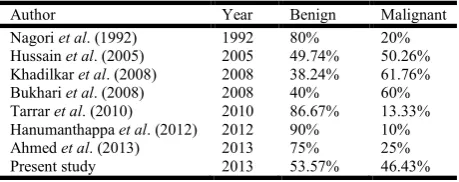
Table 4. Comparison of benign and malignant neoplasms of thyroid in different studies
[image:2.595.34.290.426.479.2]Author Year Benign Malignant Nagori et al. (1992) 1992 80% 20% Hussain et al. (2005) 2005 49.74% 50.26% Khadilkar et al. (2008) 2008 38.24% 61.76% Bukhari et al. (2008) 2008 40% 60% Tarrar et al. (2010) 2010 86.67% 13.33% Hanumanthappa et al. (2012) 2012 90% 10% Ahmed et al. (2013) 2013 75% 25% Present study 2013 53.57% 46.43%
Table 5. Comparative study of goiter in all thyroid lesions
Author Year Percentage (%)
Bron et al. (2004) 2004 72.54 Hussain et al. (2005) 2005 64 Khadilkar et al. (2008) 2008 66 Tarrar et al. (2010) 2010 69.23 Present study 2013 68.50
Table 6. Comparative study of Hashimoto thyroiditis in all thyroid lesions
Author Year Percentage (%)
Darwish et al. (2006) 2006 7 Swamy et al. (2011) 2011 6.66 Present study 2013 5.51
In the present study, there were 87 cases of goiter(68.50%) which were diagnosed as colloid goiter (51), multi- nodular goiter (36). The age range was 19-68 years, 82 were females and 5 were males.
All the 7 cases of Hashimoto thyroiditis were female with age ranging from 29 to 60 years. Grossly, cut surface was homogenous pale in appearance. Microscopically, follicles were atrophied and showed prominent oncocytic change of lining epithelium. Stroma showed dense and diffuse infiltration by lymphocytes forming lymphoid follicles with prominent germinal centers (Fig.1).
In follicular adenoma (14 cases- 11.02%) age ranged from 22 years to 42 years with 13 females and 1 male. Grossly, all adenomas were well circumscribed, encapsulated tumors with uniform gray-white cut surface. Microscopically, tumor was surrounded by thin fibrous capsule and thyroid tissue outside the capsule was compressed.
In single case of Hurthle cell adenoma (0.78%), cut surface was tan brown in colour. Microscopically, Hurthle cells having abundant granular eosinophilic cytoplasm arranged in follicular pattern were noted.
In the present study 9 cases of papillary thyroid carcinoma (32.15%) with age range 20-60 years were noted with 6 females and 3 males. On histological examination, 7 cases showed complex branching papillae and diagnosed as classical papillary thyroid carcinoma and two cases diagnosed as follicular variant of papillary thyroid carcinoma. All the nine cases of papillary thyroid carcinoma showed cells with ground glass nuclei, nuclear overlapping and nuclear grooving. Psammoma bodies were seen in 5 cases (Fig.2). Both cases of follicular variant of papillary thyroid carcinoma showed no evidence of metastasis. Two cases of classical papillary thyroid carcinoma showed cervical lymph node metastasis.
One case of follicular carcinoma (3.57%) was 66 years old female. Cut surface of tumor was light-tan to brown in colour. Microscopically, tumor showed round to oval cells having hyperchromatic nuclei with wide capsular as well as vascular invasion. One case of Hurthle cell carcinoma (3.57%) was 42 years female. Cut surface of tumor was tan-brown. Tumor cells
were pleomorphic with abundant eosinophilic granular cytoplasm and showed capsular and vascular invasion.
Single case of medullary carcinoma (3.57%) was 27 years Type of lesion Total No. Percentage (%)
A)Benign 15 53.57
1.Follicular adenoma 14 50 2.Hurthle cell adenoma 01 3.57
B)Malignant 13 46.43
1.Papillary carcinoma 09 32.15 2.Follicular carcinoma 01 3.57 3.Hurthle cell carcinoma 01 3.57 4.Medullary carcinoma 01 3.57 5.Undifferentiated carcinoma 01 3.57
[image:2.595.40.286.507.614.2] [image:2.595.48.278.651.742.2]female with tumor having gray-white cut surface and microscopically polygonal and spindle shaped cells. Stroma showed amyloid deposits.
Adjacent lymph node was replaced by tumor with amyloid deposition which was demonstrated by Congo red stain. Immunohistochemistry showed that the tumor cells were strongly positive for calcitonin and carcinoembryonic antigen (CEA) (Fig. 3,4).
Single case of anaplastic carcinoma (3.57%) was nodular with white-tan cut surface. Microscopically two types of cells, malignant spindle cells and squamous cells were noted. Areas of necrosis, capsular and vascular invasion were seen. Immunohistochemistry showed the spindle cells were positive for vimentin and epithelial component showed focal positivity for cytokeratin (CK19) (Fig.5).
DISCUSSION
(2006)In the present study, highest number of cases were seen in the 4th decade which was in accordance with Nagori et al. (1992), Khadilkar et al. (2008), Tarrar et al. (2010) studies. Female predominance was seen in both the non-neoplastic and neoplastic lesions in our study as well as in studies of Nagori et al. (1992), Khadilkar et al. (2008), Hanumanthappa et al. (2012) and Ahmed et al. (2013). Hanumanthappa et al. (2012) stated that the higher number of cases among females may be due to hormonal factors which are involved in its pathogenesis.
Thyroid function test in evaluation of thyroid lesions
In our study of 127 cases, 111 patients were euthyroid, 12 patients were hypothyroid and 4 were hyperthyroid. Most of the cases of neoplastic thyroid lesions were euthyroid. Chandanwaleet al1 stated that thyroid function test is just a preliminary tool in evaluation of nodular lesions of thyroid.
Goiter
In the present study, goiter was the most common lesion (87cases-68.50 %) In our study, the age ranged from 19 years to 70 years and female predominance was seen. Our findings were comparable with studies of Khadilkar et al. (2008) and Haq et al. (2009).
Hashimoto thyroiditis
Frequency of Hashimoto thyroiditis is comparable with other studies
Benign lesions Follicular adenoma
We found 14 cases of follicular adenoma constituting 11.02% ofall thyroid lesions and 50% of all neoplastic lesions. Our observation was closely related with the studies by Hussain et al. (2005) and Tarrar et al. (2010) Female predominance was observed in the present study. The age ranged from 29 to 42 years with F:M ratio 13:1. Our findings were correlated with Ahmed et al. (2013), Shah et al. (1983)(F:M ratio 16:1) and Darwish et al10.
Hurthle cell adenoma
Single case of Hurthle cell adenoma (0.78%) of all thyroid lesions and 3.57% of all thyroid neoplasms was observed in 45 years old male.
Malignant lesions
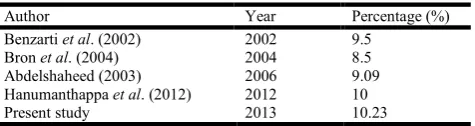
[image:4.595.46.284.692.755.2]Table 7 shows comparative study of malignant lesions
Table 7. Comparative study of malignant tumors in all thyroid lesions
Author Year Percentage (%) Benzarti et al. (2002) 2002 9.5
Bron et al. (2004) 2004 8.5 Abdelshaheed (2003) 2006 9.09 Hanumanthappa et al. (2012) 2012 10 Present study 2013 10.23
Papillary Thyroid Carcinoma (PTC)
Papillary thyroid carcinoma was the most common malignant
tumor in studies of Hussain et al. (2005) (77.84%), Arora et al. (2006)(54.54%), Khadilkar et al. (2008)(61.90%), Iqbal
et al. (2010)(65.95%), Ahmed et al. (2013) (75%) and our study (69.23%). Female predominance was seen in our study and in all the above studies.
Follicular carcinoma
Single case of follicular carcinoma constituted 0.78% of all thyroid lesions and 7.69% of all thyroid malignancies. The patient was 66 years old female. This finding is correlated with study of Haq et al. (2009).
Hurthle cell carcinoma
We got a single case of Hurthle cell carcinoma constituted 0.78% of all thyroid lesions and 7.69% of all thyroid malignancies.
Medullary carcinoma
Single case of medullary carcinoma in 27 years old female constituted 7.69% of all malignant tumors. Our result was
comparable with Arora et al. (2006) (6.6%) and Iqbal et al. (2010)(7.4%). Immunohistochemical test was done, the
tumor cells were strongly positive for calcitonin and CEA. Stroma showed amyloid deposition and showed positive staining for congo red.
Anaplastic (undifferentiated) carcinoma
Single case of anaplastic carcinoma in a 46 years female constituted 0.78% of all thyroid lesions and 7.69% of all malignant tumors. Our result was comparable with the study by Nagori et al. (1992)(9.09%) and Swamy et al. (2011) (9.09%). In our study immunohistochemical report showed the spindle cells were positive for vimentin and epithelial component showed focal positivity for CK19.
Conclusion
The present work is an attempt to study the frequency and histomorphological details of various thyroid lesions, to analyseand correlate them with clinical data. Histopathological studies not only help in pinpointing the diagnosis, but also help in deciding the line of treatment. The management of thyroid neoplasms depends upon the histopathological type of thyroid cancer, as the treatment offered to different thyroid cancer is different.
REFRENCES
Abdelshaheed F. Total thyroidectomy for clinically benign thyroid disease: A preferred option with capsular dissection Technique. Egyptian J Surg., 2006;25(3):149-154.
Arora R, Dias A. Iodine and Thyroid Cancer in Goa. Online J Health Allied Scs., 2006; 5(4):1-3.
Benzarti S, Miled I, Bassoumi T et al. Thyroid surgery (356 cases): the risks and complications. Rev LaryngolOtolRhinol., (Board) 2002;123(1):33-37.
Bron LP, O’Brien CJ. Total thyroidectomy for clinically benign disease of the thyroid gland. Br J Surg., 2004;91:569- 574.
Bukhari U, Sadiq S. Histopathological Audit of Goiter: A study of 998 thyroid lesions. Pak J Med Sci., 2008;24(3):442-6.
Carcangiu ML, DeLellis RA. Thyroid gland. In: Damjanov I, Linder J, eds. Anderson’s Pathology. Vol 2.10th ed. St. Louis: Mosby, 1996:1943-1979.
Chandanwale S, Singh N, Kumar H, Pradhan P, Gore C, Rajpal M. Clinicopathological correlation of thyroid nodules. Int J Pharm Biomed Sci., 2012;3(3):97-102. Darwish AH, Al Sindi KA, ElKafsi J. Pattern of Thyroid
Diseases - A Histopathological study. Bahrain Medical Bulletin., 2006;28(4):1-6.
DeLellis RA, Lloyd RV, HeitzPU.Eng C eds. Tumors of the thyroid and parathyroid. In: World Health Organization classification of Tumors. Pathology and Genetics of Tumors of Endocrine Organs. IARC press: Lyon, 2004:49-123.
Duntas LH. Environmental factors and autoimmune thyroiditis. Nat ClinPractEndocrinolMetab., 2008;4:454-460.
Hanumanthappa MB, Gopinathan S, Suvarna R et al. The incidence of malignancy in Multi-nodular goiter: A prospective study at a tertiary academic centre. J of clin and Diag Research, 2012;6(2):267-270.
Hussain N, Anwar M, Nadain N, Ali Z. Pattern of surgically treated thyroid disease in Karachi. Biomedica, 2005;21:18-20.
Iqbal M, Mehmood Z, Rasul S. Carcinoma thyroid in Multi and Uninodular Goiter. Pak J Surg., 2010;20(5):310-312. James R, Vineeth Kumar TV. Study on the prevalence of
thyroid diseases in Ernakulam city and Cherthala town of Kerala State ; India. Int J of Sci and Research Publications, 2012;3(2):1-3.
Kally FC, Snedden WW. Bull WHO.1985;18:5-173.
Khadilkar UN, Maji P. Histopathological study of solitary nodules of thyroid. Kathmandu University Med J., 2008;6(4)24:486-490.
Memon A, Darif M, Al Saleh K, Suresh A. Epidemiology of the reproductive and hormonal factors in thyroid cancer: evidence from a case control study in the Middle East. Int J Cancer, 2002;97:82-89.
Nagori LF, Algotar MJ. Solitary Solid thyroid nodule: A personal experience of 100 cases. Indian J of Surg., 1992;54(2):75-78.
NajumulHaq R, Ali Khan B, Ahmed Chaudhry I. Prevalence of malignancy in goiter - a review of 718 thyroidectomies. J Ayub Med Coll Abbottabad., 2009; 21(4):134-136. Shah JC, Trivedi PM, Oza RM. Thyroid tumors. A
clinicopathological study and management. Indian J surg., 1983;45:89-97.
Swamy GG, Madhuavani S, Swamy GM. Fine needle aspiration cytology - A reliable diagnostic tool in the diagnosis of thyroid gland enlargements. Nepal Med Coll J., 2011;13(4):289-292.
Tarrar AM, Wahla MS, Ilyas S et al. Solitary thyroid nodule; frequency of malignancy at combined Military Hosp Rawalpindi. Professional Med J., 2010;17(4):598-602. Vander JB, Gaston EA, Dawber TR. The significance of
nontoxic thyroid nodule: final report of a 15 year study of incidence of thyroid malignancy. Ann Int Med., 1968; 69:537.