special article
Effect of Bar-Code Technology on the Safety
of Medication Administration
Eric G. Poon, M.D., M.P.H., Carol A. Keohane, B.S.N., R.N., Catherine S. Yoon, M.S., Matthew Ditmore, B.A., Anne Bane, R.N., M.S.N.,
Osnat Levtzion-Korach, M.D., M.H.A., Thomas Moniz, Pharm.D., Jeffrey M. Rothschild, M.D., M.P.H., Allen B. Kachalia, M.D., J.D., Judy Hayes, R.N., M.S.N., William W. Churchill, M.S., R.Ph., Stuart Lipsitz, Sc.D.,
Anthony D. Whittemore, M.D., David W. Bates, M.D., and Tejal K. Gandhi, M.D., M.P.H.
From Brigham and Women’s Hospital (E.G.P., C.A.K., C.S.Y., M.D., A.B., O.L.-K., T.M., J.M.R., A.K., J.H., W.W.C., S.L., A.D.W., D.W.B., T.K.G.); Harvard Medical School (E.G.P., J.M.R., A.B.K., A.D.W., D.W.B., T.K.G.); Partners Information Systems (E.G.P., D.W.B.); and Faulkner Hospital (J.H.) — all in Boston. Address reprint requests to Dr. Poon at the Divi-sion of General Medicine Primary Care, Brigham and Women’s Hospital, 3/F, 1620 Tremont St., Boston, MA 02120, or at [email protected].
N Engl J Med 2010;362:1698-707. Copyright © 2010 Massachusetts Medical Society.
Abs tr act
BACKGROUND
Serious medication errors are common in hospitals and often occur during order transcription or administration of medication. To help prevent such errors, technol-ogy has been developed to verify medications by incorporating bar-code verification technology within an electronic medication-administration system (bar-code eMAR). METHODS
We conducted a before-and-after, quasi-experimental study in an academic medical center that was implementing the bar-code eMAR. We assessed rates of errors in order transcription and medication administration on units before and after imple-mentation of the bar-code eMAR. Errors that involved early or late administration of medications were classified as timing errors and all others as nontiming errors. Two clinicians reviewed the errors to determine their potential to harm patients and classified those that could be harmful as potential adverse drug events.
RESULTS
We observed 14,041 medication administrations and reviewed 3082 order transcrip-tions. Observers noted 776 nontiming errors in medication administration on units that did not use the bar-code eMAR (an 11.5% error rate) versus 495 such errors on units that did use it (a 6.8% error rate) — a 41.4% relative reduction in errors (P<0.001). The rate of potential adverse drug events (other than those associated with timing errors) fell from 3.1% without the use of the bar-code eMAR to 1.6% with its use, representing a 50.8% relative reduction (P<0.001). The rate of timing errors in medication administration fell by 27.3% (P<0.001), but the rate of poten-tial adverse drug events associated with timing errors did not change significantly. Transcription errors occurred at a rate of 6.1% on units that did not use the bar-code eMAR but were completely eliminated on units that did use it.
CONCLUSIONS
Use of the bar-code eMAR substantially reduced the rate of errors in order tran-scription and in medication administration as well as potential adverse drug events, although it did not eliminate such errors. Our data show that the bar-code eMAR is an important intervention to improve medication safety. (ClinicalTrials.gov number, NCT00243373.)
M
edication errors in hospitals arecommon1,2 and often lead to patient
harm. One study identified 6.5 adverse events related to medication use per 100 inpa-tient admissions; more than one fourth of these events were due to errors and were therefore pre-ventable.2 Among serious medication errors, about
one third occur at the ordering stage of the ication process, another third occur during med-ication administration, and the remaining third occur in about equal numbers during the tran-scription and dispensing stages.3
Health care information technology has been touted as a promising strategy for preventing medication errors.4-6 For example, computerized
physician-order entry has been shown to reduce the incidence of serious medication errors by 55%.7
Bar-code verification technology, ubiquitous in in-dustries outside the field of health care, is another example. Previous studies have shown that this technology can prevent errors in dispensing drugs from the pharmacy8 and in counting sponges in
the operative setting.9 At the bedside, the use of
bar-code technology to verify a patient’s identity and the medication to be administered is a prom-ising strategy for preventing medication errors, and its use has been increasing, most notably in Veterans Affairs hospitals.10 Bar-code medication
verification at the bedside is usually implement-ed in conjunction with an electronic mimplement-edication- medication-administration system (eMAR), allowing nurses to automatically document the administration of drugs by means of bar-code scanning. Because the eMAR imports medication orders electronically from either the physician’s order entry or the phar-macy system, its implementation may reduce tran-scription errors. Given its potential to improve medication safety, bar-code eMAR technology is being considered as a criterion for achieving “meaningful use” of health information technol-ogy and for obtaining financial incentives under the American Recovery and Reinvestment Act of 2009 in 2013.11
Evidence of the effectiveness of the bar-code eMAR technology, however, has been limited and mixed.12-17 Moreover, several studies have
high-lighted certain unintended consequences of its implementation, with some users either bypass-ing this technology or relybypass-ing on it too much, thus increasing the risk of new errors.18-22 Given
the uncertainties about the bar-code eMAR
tech-nology, we evaluated its implementation in a large tertiary care medical center to assess its effects on administration and transcription errors, as well as on associated potential adverse drug events.
Methods
Overview of Bar-Code eMAR Technology
Bar-code eMAR technology incorporates several technologies into the workflow of the nursing staff to ensure that the correct medication is adminis-tered at the correct dose at the correct time to the correct patient. Traditionally, medication orders placed by physicians are manually transcribed to the paper medication-administration record, which in turn is used by nurses to determine what med-ications to administer and when. With the bar-code eMAR, medication orders appear on the patient’s electronic record once the pharmacist has approved them. Furthermore, if a patient’s medication is overdue, the nurse will be alerted through an elec-tronic patient worklist.
In the traditional paper-driven process of ad-ministering drugs, the nurse manually verifies the dose and the patient’s identity before the medica-tion is given. Bar-code eMAR provides an addi-tional layer of safety by requiring nurses to scan the bar codes on the patient’s wristband and on the medication before it is administered. If the dose being scanned corresponds to a pharmacist-approved medication order and the patient is due for this dose, administration is automatically doc-umented. However, if the dose does not corre-spond to a valid order, the application issues a warning.
For a more detailed description of how nurses use this technology and for a list of the features it supported during the study period, see Appen-dix A and AppenAppen-dix B, respectively, in the Sup-plementary Appendix, available with the full text of this article at NEJM.org.
Study Design
Over a 9-month period in 2005, we determined the rate of errors related to transcribing orders and administering medications in 35 adult medical, surgical, and intensive care units in a 735-bed ter-tiary academic medical center. In the study year, physicians (or physician extenders) wrote approx-imately 1.7 million medication orders and nurses administered approximately 5.9 million doses of
medications. Using a prospective, before-and-after, quasi-experimental study design, we compared error rates in units that were using the bar-code eMAR technology with the rates in units that had not implemented it.
Rollout Plan
After a brief pilot period, the hospital began im-plementing the bar-code eMAR technology at the bedside in April 2005. Between 2 and 4 patient-care units began using this technology every 2 weeks until, by July 2005, all 35 units had com-pletely implemented it. Before each period of roll-out, nurses received 4 hours of hands-on class-room training in medication scanning and use of the eMAR application. During the 2-week rollout period, the hospital provided specially trained nurses during all nursing shifts on the participat-ing units to support the nurses who were learnparticipat-ing to use the new technology. The hospital’s infor-mation systems department also provided contin-uous onsite support during the rollout period.
The clinical decision was made to delay the rollout of the bar-code eMAR technology on on-cology units because of the complex protocols, dosing regimens, and specialized workflow for ad-ministering medications to these patients. There-fore, these units were not included in the study.
Study Outcomes
We defined two main outcomes for tion errors: errors in timing (involving administra-tions that were early or late by more than 1 hour) and errors unrelated to timing. These two out-comes were defined separately because there was no broad agreement in the literature regarding what constitutes an early or a late medication ad-ministration. The unit of analysis for administra-tion errors was the presence or absence of an error in the dose of medication administered during the observation period; the unit of analysis for tran-scription errors was the presence or absence of an error in the transcribed medication order.
Data Collection and Adjudication
Trained research nurses directly observed order transcription and medication administration in each study unit 2 to 4 weeks before the bar-code eMAR rollout and then 4 to 8 weeks afterward. Be-cause of the staggered nature of the rollout, ob-servations were made simultaneously in units with and those without the bar-code eMAR during
ap-proximately half the observation period, which lasted from February through October 2005.
We used a direct-observation method to mea-sure error rates.23 Research nurses shadowed staff
nurses on the observation units for 4 hours and, without knowing the physician’s medication or-ders, recorded details about the medications be-ing administered to patients. On the rare occasion when a research nurse believed that a medication was being administered erroneously by a staff nurse, the research nurse intercepted the istration and recorded that attempt as an admin-istration error. After completing the observation session, the research nurses, assisted by research pharmacists, reviewed the physicians’ orders and either the paper record of medication administra-tion (on units without the bar-code eMAR) or the eMAR (on units with the bar-code eMAR). Using these documents, they determined whether there were any transcription errors (i.e., errors in the transcription of physicians’ orders for medications administered during the observation period) or any administration errors (i.e., errors in admin-istering medications, based on what the nurses had directly observed).
Each administration error and transcription error was classified by a member of the study staff according to the type of error (Appendix C in the Supplementary Appendix). Each error was further adjudicated independently by two mem-bers of a multidisciplinary panel consisting of physicians, nurses, and pharmacists to confirm the presence of an error and the potential for that error to lead to patient harm (a subgroup known as potential adverse drug events). Harm was fur-ther classified as clinically significant, serious, or life-threatening.24 Any disagreements between the
two panel members concerning the presence of an error or the severity of potential harm were resolved by consensus.
Statistical Analysis
Rates of administration errors related to timing, those unrelated to timing, and transcription er-rors were compared between units with the bar-code eMAR and those without it. Unadjusted er-ror rates were compared with the use of the Rao–Scott chi-square test,25 accounting for
clus-tering by nurse (i.e., multiple observations of med-ications administered by the same nurse). To ad-just for possible confounders, such as unit type, we built clustered logistic-regression models26 with
presence of error as the dependent variable. Sta-tistical analyses were performed with the use of SAS software, version 9.1 (SAS Institute).
R esults
We observed 6723 medication administrations on patient units that did not have bar-code eMAR and 7318 medication administrations on patient units that did. Most of the observations occurred during a weekday nursing shift (7 a.m. to 3 p.m.). Table 1 lists the types of medications for which administration was observed and the characteris-tics of the patients who received them.
Nontiming Errors in Medication Administration
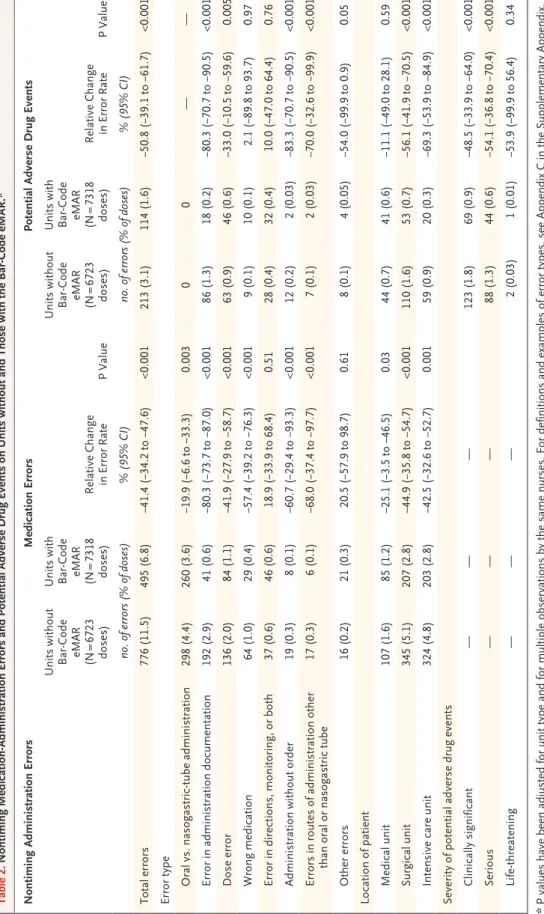
On units without the bar-code eMAR, we ob-served 776 nontiming medication-administration errors (an 11.5% error rate), whereas on units with the bar-code eMAR, we observed 495 nontiming medication-administration errors (a 6.8% error rate), representing a 41.4% relative reduction in the rate of such errors (P<0.001) (Table 2). The rate of potential adverse drug events due to non-timing administration errors fell from 3.1% to 1.6%, representing a 50.8% relative reduction (P<0.001). Significant reductions were seen in po-tential adverse drug events with a severity rating of significant (a 48.5% reduction) or serious (a 54.1% reduction); the rate of potential adverse drug events that were life-threatening did not change signifi-cantly.
We observed significant relative reductions in many subtypes of nontiming medication-admin-istration errors, including those that the bar-code eMAR was expected to reduce. For example, wrong-medication errors were reduced by 57.4%, wrong-dose errors by 41.9%, and administration-documentation errors by 80.3%. There were sig-nificant reductions in potential adverse drug events associated with administration-documentation errors (80.3% reduction) and wrong-dose errors (33.0% reduction).
Significant reductions were seen in rates of nontiming administration errors and of associ-ated potential adverse drug events on the surgi-cal units (44.9% and 56.1%, respectively; P<0.001 for both) and on the intensive care units (42.5% [P = 0.001] and 69.3% [P<0.001]). On the medical units, which had the lowest error rate at baseline among the three types of units, the rate of
medi-cal errors was reduced by 25.1% (P = 0.03), but the rate of potential adverse drug events was reduced by only 11.1% (P = 0.59).
Timing Errors in Medication Administration
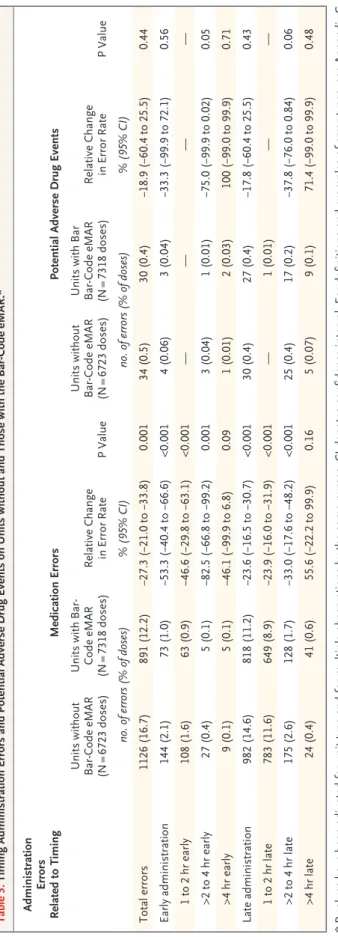
The overall incidence of medication doses direct-ly observed to be administered either eardirect-ly or late decreased from 16.7% without the bar-code eMAR to 12.2% with its use (a reduction of 27.3%; P = 0.001) (Table 3). The majority of these errors were due to administrations that were late by 1 to 2 hours, which fell by 23.9% with use of the bar-code eMAR. The incidence of potential adverse drug events due to late or early administration did not differ significantly between the units with and those without the bar-code eMAR technology.
Transcription Errors
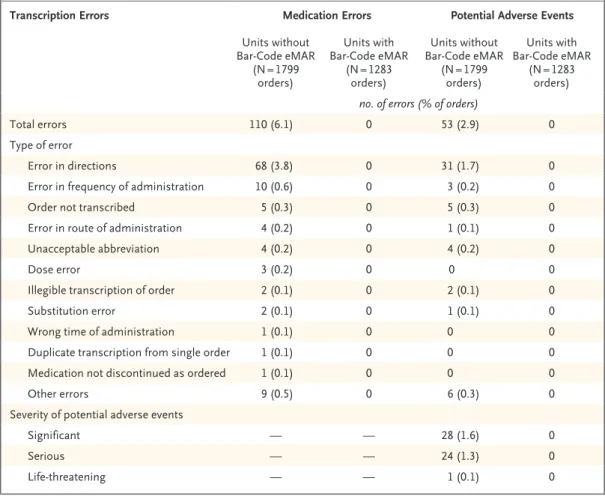
We reviewed 1799 orders on units without the bar-code eMAR and observed 110 transcription errors, of which 53 were potential adverse drug events, corresponding to 6.1 transcription errors and 2.9 potential adverse drug events per 100 medica-tion orders transcribed (Table 4). In the 1283 medication orders reviewed on units with the bar-code eMAR, no transcription errors occurred (P<0.001 for transcription errors and for poten-tial adverse drug events due to such errors, by Fisher’s exact test).
Errors intercepted by the bar-code eMAR dur-ing the 2 years after the implementation period are shown in Appendix D in the Supplementary Ap-pendix.
Discussion
The implementation of bar-code medication-ver-ification technology embedded in an eMAR was associated with a 41% reduction in nontiming ad-ministration errors and a 51% reduction in poten-tial adverse drug events from these errors. Errors in the timing of medication administration fell by 27%, although we did not see any significant change in associated potential adverse drug events. Transcription errors and associated potential ad-verse drug events were essentially eliminated. Be-cause the study hospital administers approximate-ly 5.9 million doses of medications per year, use of the bar-code eMAR is expected to prevent ap-proximately 95,000 potential adverse drug events at the point of medication administration every year in this hospital. The technology is also
ex-pected to reduce the number of late or early admin-istrations by about 270,000 per year. Given that the electronic order-entry system at the study hospital processed about 1.69 million medication orders during the study year, the eMAR system is also expected to prevent approximately 50,000 potential adverse drug events related to transcription errors.
Although pharmacists and nurses often inter-cept errors during the medication-ordering stage, errors made during the administration stage and,
to a lesser extent, during the medication-tran-scription stage often go undetected.3 This
find-ing highlights the need for highly reliable strate-gies such as bar-code technology to act as an additional safety net in medication administration. The close integration of the order-entry, pharmacy, and medication-administration systems ensures that nurses administer medications only after pharmacists have clinically reviewed the medica-tion orders (except for medicamedica-tions used in
emer-Table 1. Characteristics of 14,041 Observed Medication Administrations and 1726 Patients on Hospital Units with and Those without the Bar-Code eMAR.*
Characteristic Bar-Code eMARUnits without Bar-Code eMARUnits with P Value Medication administrations
Doses observed — no./total no. (%) 6723/14,041 (47.9) 7318/14,041 (52.1)
Medical unit 2008/6723 (29.9) 2232/7318 (30.5) <0.001†
Surgical unit 3528/6723 (52.5) 3856/7318 (52.7)
Intensive care unit 1187/6723 (17.7) 1230/7318 (16.8)
Classification of agent — no./total no. of
doses (%) 6723/14,041 (47.9) 7318/14,041 (52.1) <0.001† Antibiotic 571/6723 (8.5) 668/7318 (9.1) CNS, pain, psychiatric 954/6723 (14.2) 870/7318 (11.9) Cardiovascular 1090/6723 (16.2) 1180/7318 (16.1) Endocrine, cholesterol-lowering 488/6723 (7.3) 669/7318 (9.1) Gastrointestinal, nutritional 2062/6723 (30.7) 2128/7318 (29.1) Hematologic 668/6723 (9.9) 810/7318 (11.1) Pulmonary 149/6723 (2.2) 246/7318 (3.4) Renal, electrolytes 435/6723 (6.5) 415/7318 (5.7) Other 306/6723 (4.6) 332/7318 (4.5) Patients
Overall — no./total no. (%) 787/1726 (45.6) 939/1726 (54.4) <0.001†
Medical unit 204/787 (25.9) 261/939 (27.8)
Surgical unit 469/787 (59.6) 537/939 (57.2)
Intensive care unit 114/787 (14.5) 141/939 (15.0)
Women — % 0.41‡
Medical unit 47 52
Surgical unit 46 47
Intensive care unit 47 49
Age — yr 0.93§
Medical unit 64.3±17.1 64.6±16.5
Surgical unit 58.5±17.0 58.4±17.8
Intensive care unit 62.4±16.7 61.3±15.3
* Plus–minus values are means ±SD. CNS denotes central nervous system, and GI gastrointestinal. † The P value was calculated with the use of the chi-square test.
‡ The P value was calculated with the use of the Cochran–Mantel–Haenszel test. § The P value was calculated with the use of the stratified Wilcoxon test.
Table 2. Nontiming Medication-Administration Errors and Potential Adverse Drug Events on Units without and Those with the Bar-Code eMAR.* Nontiming Administration Errors Medication Errors Potential Adverse Drug Events Units without Bar-Code eMAR (N = 6723 doses) Units with Bar-Code eMAR (N = 7318 doses) Relative Change in Error Rate P Value Units without Bar-Code eMAR (N = 6723 doses) Units with Bar-Code eMAR (N = 7318 doses) Relative Change in Error Rate P Value no. of errors (% of doses) % (95% CI) no. of errors (% of doses) % (95% CI) Total errors 776 (11.5) 495 (6.8) −41.4 (−34.2 to −47.6) <0.001 213 (3.1) 114 (1.6) −50.8 (−39.1 to −61.7) <0.001 Error type Oral vs. nasogastric-tube administration 298 (4.4) 260 (3.6) −19.9 (−6.6 to −33.3) 0.003 0 0 — — Error in administration documentation 192 (2.9) 41 (0.6) −80.3 (−73.7 to −87.0) <0.001 86 (1.3) 18 (0.2) −80.3 (−70.7 to −90.5) <0.001 Dose error 136 (2.0) 84 (1.1) −41.9 (−27.9 to −58.7) <0.001 63 (0.9) 46 (0.6) −33.0 (−10.5 to −59.6) 0.005 Wrong medication 64 (1.0) 29 (0.4) −57.4 (−39.2 to −76.3) <0.001 9 (0.1) 10 (0.1) 2.1 (−89.8 to 93.7) 0.97 Error in directions, monitoring, or both 37 (0.6) 46 (0.6) 18.9 (−33.9 to 68.4) 0.51 28 (0.4) 32 (0.4) 10.0 (−47.0 to 64.4) 0.76 Administration without order 19 (0.3) 8 (0.1) −60.7 (−29.4 to −93.3) <0.001 12 (0.2) 2 (0.03) −83.3 (−70.7 to −90.5) <0.001 Errors in routes of administration other than oral or nasogastric tube 17 (0.3) 6 (0.1) −68.0 (−37.4 to −97.7) <0.001 7 (0.1) 2 (0.03) −70.0 (−32.6 to −99.9) <0.001 Other errors 16 (0.2) 21 (0.3) 20.5 (−57.9 to 98.7) 0.61 8 (0.1) 4 (0.05) −54.0 (−99.9 to 0.9) 0.05 Location of patient Medical unit 107 (1.6) 85 (1.2) −25.1 (−3.5 to −46.5) 0.03 44 (0.7) 41 (0.6) −11.1 (−49.0 to 28.1) 0.59 Surgical unit 345 (5.1) 207 (2.8) −44.9 (−35.8 to −54.7) <0.001 110 (1.6) 53 (0.7) −56.1 (−41.9 to −70.5) <0.001 Intensive care unit 324 (4.8) 203 (2.8) −42.5 (−32.6 to −52.7) 0.001 59 (0.9) 20 (0.3) −69.3 (−53.9 to −84.9) <0.001 Severity of potential adverse drug events Clinically significant — — — 123 (1.8) 69 (0.9) −48.5 (−33.9 to −64.0) <0.001 Serious — — — 88 (1.3) 44 (0.6) −54.1 (−36.8 to −70.4) <0.001 Life-threatening — — — 2 (0.03) 1 (0.01) −53.9 (−99.9 to 56.4) 0.34 * P values have been adjusted for unit type and for multiple observations by the same nurses. For definitions and examples of error types, see Appendix C in the Supplementary Appendix, available with the full text of this article at NEJM.org.
gencies), allowing patients to benefit more fully from pharmacists’ clinical knowledge. Preventing transcription errors is also important, especially since each erroneous transcription can lead to re-peated erroneous administrations. Given the high number of doses administered and orders tran-scribed in any acute care hospital, implementation of the bar-code eMAR could substantially improve medication safety.
The effect of the bar-code eMAR in our study was similar to the effect of the early implemen-tation of computerized physician-order entry, which reduced serious medication errors at the ordering stage by 55%.7 Decision support
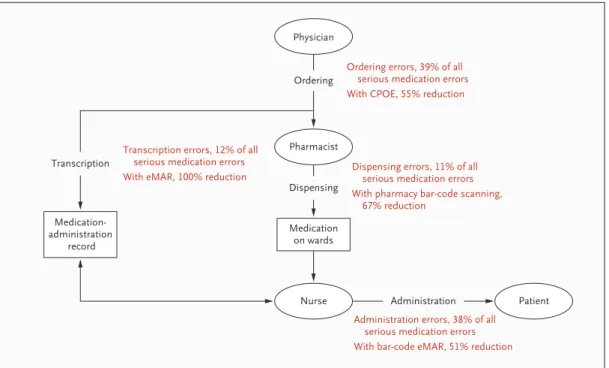
embed-ded within computerized physician-order entry systems is more likely to prevent errors that re-sult from bad judgment, insufficient knowledge, or incomplete clinical information when choos-ing a therapeutic plan; in contrast, the bar-code eMAR system is more likely to prevent errors as-sociated with memory lapses or mental slips in executing a therapeutic plan. As such, the two technologies would probably play complementary roles in improving medication safety in acute care hospitals. Further research is needed to determine the relative values of computerized physician-order entry and the bar-code eMAR system when re-sources do not permit a particular hospital to im-plement the two technologies simultaneously. The proportion of serious medication errors commit-ted and the magnitude of the reduction in serious errors by health information technology at the four stages of the inpatient medication process may inform that line of research (Fig. 1).
Our study suggests that the prevention of many of the potential adverse drug events could be at-tributed to the reduction in documentation errors. This finding may lead some to conclude that the eMAR component of the bar-code eMAR may have greater effect than the medication-verification component. However, our experience in studying the workflow of the medication-administration process suggests that the medication-verification component greatly facilitates the documentation process for nurses and may be an important fac-tor for its acceptance.27 Previous research in
hu-man-factors engineering also suggests that new errors may be introduced if busy clinicians are asked to select medications from a list of multiple medications due to be administered and then to document the administration times using a key-board and a mouse.28,29 In addition, by the time
Table 3. Timing Administration Errors and Potential Adverse Drug Events on Units without and Those with the Bar-Code eMAR.* Administration Errors Related to Timing Medication Errors Potential Adverse Drug Events Units without Bar-Code eMAR (N = 6723 doses) Units with Bar-Code eMAR (N = 7318 doses) Relative Change in Error Rate P Value Units without Bar-Code eMAR (N = 6723 doses) Units with Bar Bar-Code eMAR (N = 7318 doses) Relative Change in Error Rate P Value no. of errors (% of doses) % (95% CI) no. of errors (% of doses) % (95% CI) Total errors 1126 (16.7) 891 (12.2) −27.3 (−21.0 to −33.8) 0.001 34 (0.5) 30 (0.4) −18.9 (−60.4 to 25.5) 0.44 Early administration 144 (2.1) 73 (1.0) −53.3 (−40.4 to −66.6) <0.001 4 (0.06) 3 (0.04) −33.3 (−99.9 to 72.1) 0.56 1 to 2 hr early 108 (1.6) 63 (0.9) −46.6 (−29.8 to −63.1) <0.001 — — — — >2 to 4 hr early 27 (0.4) 5 (0.1) −82.5 (−66.8 to −99.2) 0.001 3 (0.04) 1 (0.01) −75.0 (−99.9 to 0.02) 0.05 >4 hr early 9 (0.1) 5 (0.1) −46.1 (−99.9 to 6.8) 0.09 1 (0.01) 2 (0.03) 100 (−99.0 to 99.9) 0.71 Late administration 982 (14.6) 818 (11.2) −23.6 (−16.5 to −30.7) <0.001 30 (0.4) 27 (0.4) −17.8 (−60.4 to 25.5) 0.43 1 to 2 hr late 783 (11.6) 649 (8.9) −23.9 (−16.0 to −31.9) <0.001 — 1 (0.01) — — >2 to 4 hr late 175 (2.6) 128 (1.7) −33.0 (−17.6 to −48.2) <0.001 25 (0.4) 17 (0.2) −37.8 (−76.0 to 0.84) 0.06 >4 hr late 24 (0.4) 41 (0.6) 55.6 (−22.2 to 99.9) 0.16 5 (0.07) 9 (0.1) 71.4 (−99.0 to 99.9) 0.48 * P values have been adjusted for unit type and for multiple observations by the same nurses. CI denotes confidence interval. For definitions and examples of error types, see Appendix C in the Supplementary Appendix, available with the full text of this article at NEJM.org.
we conducted the current study, our study hospi-tal had already implemented bar-code verification in the pharmacy, resulting in significantly fewer wrong medications found in the areas where medications are stored.8 Our results likely
repre-sent a lower boundary with respect to the effect of the medication-verification step. Further study may be necessary to address the relative impor-tance of the two main components of the bar-code eMAR.
Although the rate of medication-administra-tion errors fell substantially, not all errors were eliminated. There are two possible reasons for this. First, patient-safety technology is effective only if it is used as intended. Even though the study hospital expended substantial resources in the training of end users, 20% of the drugs admin-istered on units with the bar-code eMAR
tech-nology were given without the bar-code scanning step during the study period; this rate of non-compliance might be due in part to the learning curve in the early stages of implementation. Sec-ond, the study hospital used an early version of the software; several important improvements have been incorporated since this study was car-ried out, including improved functionality for in-travenous medication administration, sliding-scale dosing, fractional dosing, and nonstandard sched-uling of doses. These issues illustrate that the deployment of health information technology should be thought of not as a single event in time but rather as an iterative process that re-quires modifications and improvements.
This study has several limitations. First, the results reflect the experience of one hospital that already has fully implemented computerized
phy-Table 4. Transcription Errors, Medication Errors, and Potential Adverse Drug Events on Units without and Those with the Bar-Code eMAR for 3082 Orders Reviewed.*
Transcription Errors Medication Errors Potential Adverse Events
Units without Bar-Code eMAR (N = 1799 orders) Units with Bar-Code eMAR (N = 1283 orders) Units without Bar-Code eMAR (N = 1799 orders) Units with Bar-Code eMAR (N = 1283 orders) no. of errors (% of orders)
Total errors 110 (6.1) 0 53 (2.9) 0
Type of error
Error in directions 68 (3.8) 0 31 (1.7) 0
Error in frequency of administration 10 (0.6) 0 3 (0.2) 0
Order not transcribed 5 (0.3) 0 5 (0.3) 0
Error in route of administration 4 (0.2) 0 1 (0.1) 0
Unacceptable abbreviation 4 (0.2) 0 4 (0.2) 0
Dose error 3 (0.2) 0 0 0
Illegible transcription of order 2 (0.1) 0 2 (0.1) 0
Substitution error 2 (0.1) 0 1 (0.1) 0
Wrong time of administration 1 (0.1) 0 0 0
Duplicate transcription from single order 1 (0.1) 0 0 0
Medication not discontinued as ordered 1 (0.1) 0 0 0
Other errors 9 (0.5) 0 6 (0.3) 0
Severity of potential adverse events
Significant — — 28 (1.6) 0
Serious — — 24 (1.3) 0
Life-threatening — — 1 (0.1) 0
* Because results were zero for all observations in which the bar-code eMAR was used, we could not build multivariable models to compute adjusted P values. For definitions and examples of error types, see Appendix C in the Supplemen-tary Appendix, available with the full text of this article at NEJM.org.
sician-order entry for physicians and bar-code verification for pharmacy staff. Hospitals that choose to implement the bar-code eMAR technol-ogy without computerized physician-order entry, pharmacy bar-code verification, or both may find that it has a different effect on administration errors. For example, hospitals without computer-ized physician-order entry will probably not elim-inate transcription errors. Second, the study ex-amined potential adverse drug events, not actual adverse drug events. Although an earlier study es-timated that one actual adverse drug event occurs for every seven potential events,30 further research
will be needed to determine the true effect of the bar-code eMAR on adverse drug events. Third, the study hospital designed the application in close collaboration with users and clinical leaders who were willing to support a substantial change in workflow to improve the overall medication pro-cess. In addition, extensive resources were ex-pended to support the rollout, including adequate training, onsite support, adequate hardware, and a responsive software-development team. Orga-nizations interested in implementing the bar-code eMAR should consider these factors in order to
maximize their investment in this patient-safety technology, and future studies should evaluate vendor solutions implemented in the community setting. Fourth, the nurses observed in this study might have performed better because they were being watched (a phenomenon known as the Hawthorne effect); however, this effect probably applied equally to observations made or units with and without bar-code eMAR technology. Previ-ous studies have also suggested that the Haw-thorne effect is minimal after the subject is ini-tially exposed to the observer.31 Fifth, even though
observations were made simultaneously on the units with the bar-code eMAR and on those with-out it for part of the study period, the staggered rollout schedule meant that more observations were made on units without the bar-code eMAR during the early part of the study period. Our find-ings might therefore have been subject to a secu-lar effect, although it is unlikely that this effect would have been substantial over a period of 9 months.
Taken together, our findings show that the bar-code eMAR technology improves medication safe-ty by reducing administration and transcription Physician Pharmacist Ordering Medication on wards Medication-administration record Nurse Patient Dispensing Transcription Administration
Ordering errors, 39% of all serious medication errors With CPOE, 55% reduction
Transcription errors, 12% of all serious medication errors
With eMAR, 100% reduction Dispensing errors, 11% of allserious medication errors With pharmacy bar-code scanning,
67% reduction
Administration errors, 38% of all serious medication errors With bar-code eMAR, 51% reduction
Figure 1. Effect of Health Information Technology at Key Stages in the Process of Medication Use.
Data on errors during the four phases of medication use are from Leape et al.3 The percent reduction in ordering errors with the use of computerized physician-order entry (CPOE) is from Bates et al.7 The percent reduction in dis-pensing errors with bar-code scanning in the pharmacy is from our previous study.8 The percent reduction in medi-cation-administration errors with the bar-code eMAR technology and the percent reduction in transcribing errors are from the current study.
errors, providing support for the inclusion of this technology as a 2013 criterion for achieving mean-ingful use under the American Recovery and Re-investment Act. Given challenges in implement-ing this technology, however, further research should focus on identifying factors that will lead to its optimal implementation.
Supported by a grant (HS14053-02) from the Agency for Health-care Research and Quality.
Disclosure forms provided by the authors are available with the full text of this article at NEJM.org.
We thank Erica Featherstone for her assistance with data man-agement; Erin Hartman for her editorial assistance; Sue Schade, chief information officer at the study hospital, for providing a list of features of the bar-code eMAR system available at the time of the study; and Micheal Sweet for providing data on warnings issued by the system after the initial implementation period.
References
Brennan TA, Leape LL, Laird NM, et
1.
al. Incidence of adverse events and negli-gence in hospitalized patients. N Engl J Med 1991;324:370-6.
Bates DW, Cullen DJ, Laird N, et al.
2.
Incidence of adverse drug events and po-tential adverse drug events. JAMA 1995; 274:29-34.
Leape LL, Bates DW, Cullen DJ, et al.
3.
Systems analysis of adverse drug events: ADE Prevention Study Group. JAMA 1995; 274:35-43.
Bates DW. Using information
tech-4.
nology to reduce rates of medication er-rors in hospitals. BMJ 2000;320:788-91.
CPOE, bedside technology, and patient
5.
safety: a roundtable discussion. Am J Health Syst Pharm 2003;60:1219-28.
Bates DW, Gawande AA. Improving
6.
safety with information technology. N Engl J Med 2003;348:2526-34.
Bates DW, Leape LL, Cullen DJ, et al.
7.
Effect of computerized physician order entry and a team intervention on preven-tion of serious medicapreven-tion errors. JAMA 1998;280:1311-6.
Poon EG, Cina JL, Churchill W, et al.
8.
Medication dispensing errors and poten-tial adverse drug events before and after implementing bar code technology in the pharmacy. Ann Intern Med 2006;145:426-34.
Greenberg CC, Diaz-Flores R, Lipsitz
9.
SR, et al. Bar-coding surgical sponges to improve safety: a randomized controlled trial. Ann Surg 2008;247:612-6.
Wright AA, Katz IT. Bar coding for
10.
patient safety. N Engl J Med 2005;353:329-31.
Health IT Policy Committee. Final
11.
meaningful use objectives and measures: 2011–2013–2015. Washington, DC: Depart-ment of Health and Human Services, Of-fice of the National Coordinator for Health Information Technology, 2009. (Accessed April 9, 2010, at http://healthit.hhs.gov/ portal/server.pt/gateway/PTARGS_0_ 10741_888532_0_0_18/FINAL%20MU%20 RECOMMENDATIONS%20TABLE.pdf.)
Johnson CL, Carlson RA, Tucker CL,
12.
Willette C. Using BCMA software to im-prove patient safety in Veterans Adminis-tration medical centers. J Healthc Inf Man-ag 2003;16(1):46-51.
Puckett F. Medication-management
13.
component of a point-of-care information system. Am J Health Syst Pharm 1995; 52:1305-9.
Yang M, Brown M, Trohimovich B,
14.
Dana M, Kelly J. The effect of bar-code enabled point-of-care technology on med-ication administration errors. In: Lewis R, ed. The impact of information technology on patient safety. Chicago: Healthcare In-formation and Management Systems So-ciety, 2002:37-56.
Paoletti RD, Suess TM, Lesko MG, et
15.
al. Using bar-code technology and medi-cation observation methodology for safer medication administration. Am J Health Syst Pharm 2007;64:536-43.
Franklin B, O’Grady K, Donyai P,
Jack-16.
lin A, Barber N. The impact of a closed-loop electronic prescribing and admin-istration system on prescribing errors, administration errors, and staff time: a before-and-after study. Qual Saf Health Care 2007;16:279-84.
Mahoney CD, Berard-Collins CM,
17.
Coleman R, Amaral JF, Cotter CM. Effects of an integrated clinical information sys-tem on medication safety in a multi-hos-pital setting. Am J Health Syst Pharm 2007;64:1969-77.
Patterson ES, Cook RI, Render ML.
18.
Improving patient safety by identifying side effects from introducing bar coding in medication administration. J Am Med Inform Assoc 2002;9:540-53.
McDonald CJ. Computerization can
19.
create safety hazards: a bar-coding near miss. Ann Intern Med 2006;144:510-6. [Er-ratum, Ann Intern Med 2006;145:235.]
Cochran GL, Jones KJ, Brockman J,
20.
Skinner A, Hicks RW. Errors prevented by and associated with bar-code medication administration systems. Jt Comm J Qual Patient Saf 2007;33:293-301.
DiConsiglio J. Creative ‘work-arounds’
21.
defeat bar-coding safeguard for meds:
study finds technology often doesn’t meet the needs of nurses. Mater Manag Health Care 2008;17:26-9.
Koppel R, Wetterneck T, Telles JL,
22.
Karsh BT. Workarounds to barcode medi-cation administration systems: their oc-currences, causes, and threats to patient safety. J Am Med Inform Assoc 2008;15: 408-23.
Barker KN, Flynn EA, Pepper GA,
23.
Bates DW, Mikeal RL. Medication errors observed in 36 health care facilities. Arch Intern Med 2002;162:1897-903.
Folli HL, Poole RL, Benitz WE, Russo
24.
JC. Medication error prevention by clini-cal pharmacists in two children’s hospi-tals. Pediatrics 1987;79:718-22.
Rao JNK, Scott AJ. On simple
adjust-25.
ments to chi-square tests with sample sur-vey data. Ann Stat 1987;15:385-97.
Zeger SL, Liang KY. Longitudinal data
26.
analysis for discrete and continuous out-comes. Biometrics 1986;42:121-30.
Poon EG, Keohane CA, Bane A, et al.
27.
Impact of barcode medication adminis-tration technology on how nurses spend their time providing patient care. J Nurs Adm 2008;38:541-9.
Koppel R, Metlay JP, Cohen A, et al.
28.
Role of computerized physician order en-try systems in facilitating medication er-rors. JAMA 2005;293:1197-203.
Woods DD, Patterson ES, Cook RI.
29.
Behind human error: taming complexity to improve patient safety. In: Carayon P, ed. Handbook of human factors and ergo-nomics in health care and patient safety. Mahwah, NJ: Lawrence Erlbaum Associ-ates, 2007:459-76.
Bates DW, Boyle DL, Vander Vliet MB,
30.
Schneider J, Leape L. Relationship between medication errors and adverse drug events. J Gen Intern Med 1995;10:199-205.
Flynn EA, Barker KN. Medication
er-31.
ror research. In: Cohen MR, ed. Medica-tion errors: causes and prevenMedica-tion. Wash-ington, DC: American Pharmaceutical Association, 1999.