MMF&I THESIS
FINANCIAL DISINTERMEDIATION
KELLY WRIGHT – 0602746P
SUPERVISOR: PROF KALU OJAH
WITS BUSINESS SCHOOL - 2010
ii Thesis submitted in fulfilment of the requirements for the degree of
Master of Management in Finance & Investment in the
FACULTY OF COMMERCE LAW AND MANAGEMENT WITS BUSINESS SCHOOL
at the
UNIVERSITY OF THE WITWATERSRAND
Supervisor: Signature:
DECLARATION
I, Kelly Jade Wright declare that the research work reported in this dissertation is my own, except where otherwise indicated and acknowledged. It is submitted for the degree of Master of Management in Finance and Investment at the University of the Witwatersrand, Johannesburg. This thesis has not, either in whole or in part, been submitted for a degree or diploma to any other universities.
iii
ABSTRACT
This paper aims to make an empirical contribution to the discussion of the role of banks and to find out if banking is a declining industry. It takes into account that the role of banks is declining in the United States and the fact that the American economy usually sets the trend for the other economies. This implies that there are increasing trends of disintermediation, securitization and an increase in the importance of nonbank financial intermediaries (Schmidt, Hackethal and Tyrell 1997). This paper seeks to find out if this is indeed the case in the U.S and if so then is it happening in other European and African economies. Another important reason for this study is to find out what factors are causing the structures of financial systems to change and what impact these changes have on financial institution intermediation. Comparisons are made between developed countries in Europe and developing countries in Africa to observe the trends of intermediation/disintermediation.
1.1 Problem Statement ... 6 1.2 Purpose of Study ... 7 1.3 Questions of Study ... 7 1.4 Significance of Study ... 7 1.5 Background Literature ... 8 1.6 Methodology ... 9
1.7 Outline of the Study ... 9
2. LITERATURE REVIEW ... 9
2.1 Theory of Financial Intermediation... 9
2.2 Globalization and Economic Growth ... 12
2.3 Regulations and Policy Implications... 15
2.4 Changes in the Structure and Functions of Financial Systems ... 19
Figure 1: A Summary of Financial Intermediation Levels ... 22
2.5 Technology ... 22
2.6 Securitization, Derivatives and Other Financial Instruments ... 23
Figure 2: United States – Individual Ownership of Corporate Equity (1966-1995) ... 24
Figure 3: United States – Selected Institutional Share (1966-1995) ... 25
Figure 4: United States - Mutual Fund/Householder Equity Ownership (1966 -1995) ... 26
Table 1: Traditional Financial Instruments... 27
Table 2: Recent Financial Innovations ... 27
Figure 5: United States - Federal Mortgage Pools (1966 -1995)... 29
Figure 6: United States - Consumer Credit & Loans (1966 -1995) ... 30
2.7 Problems with Financial Institutions in Developing Countries ... 30
3. DATA AND METHODOLOGY ... 32
3.1 Measuring the Size of the Banking Industry ... 32
3.1.1 Assets ... 32
3.1.2 Employment ... 33
3.1.3 Revenues, Earnings, and Value Added ... 33
3.2 The Concept of Intermediation and Securitization Ratios ... 33
3.3 The Data ... 33
Financial Disintermediation – Kelly Jade Wright
4. RESULTS ... 35
4.1 Number of Institutions and Employees ... 35
Table 3: Number of Institutions (1980 -2008) ... 36
Table 4: Number of Employees (1979 -2008) ... 37
4.2 Assets to Total Financial Assets ... 38
Figure 7: Deposit Money Banks Assets to Total Financial Assets (1973 -2005) for Kenya, Nigeria and South Africa ... 38
Figure 8: United States - Deposit Money Banks Assets to Total Financial Assets (1960 -2005) ... 39
Figure 9: Other Financial Institution Assets to Total Financial Assets (1973-2005) in Kenya, Nigeria and South Africa ... 40
Figure 10: United States Other Financial Institution Assets to Total Financial Assets (1960 -2005) ... 40
4.3 Assets to GDP ... 41
Figure 11: Deposit Money Bank Assets to GDP (1960 -2005) for the US, Germany, France and the UK... 42
Figure 12: Deposit Money Bank Assets to GDP (1966 -2005) for Botswana, Kenya, Nigeria and SA ... 42
Figure 13: United States – Other Financial Institutions Assets to GDP (1960 - 2005) ... 43
Figure 14: Other Financial Institutions Assets to GDP (1962 -2005) for Kenya, Nigeria and SA ... 44
Figure 15: Liquid Liabilities to GDP (1960 -2005) for the US, Germany, France and the UK ... 45
Figure 16: Liquid Liabilities to GDP (1960 -2005) for the US, Germany, France and the UK ... 45
Figure 17: Bank Deposits to GDP (1960 -2005) for the US, Germany, France and the UK ... 46
Figure 18: Bank Deposits to GDP (1966 -2005) for Botswana, Kenya, Nigeria and SA ... 47
4.4 Performance Measures ... 47
Figure 19: Average Return on Equity (1988 -2008) for Germany, France, the UK and the US ... 48
Figure 20: Average Return on Equity (1992 -2008) for Botswana, Kenya, Nigeria and SA ... 48
Figure 21: Average Return on Assets (1988 -2008) for Germany, France, the UK and the US ... 49
Figure 22: Average Return on Assets (1992 -2008) for Botswana, Kenya, Nigeria and SA ... 50
5. DISCUSSION AND CONCLUSION ... 51
Financial Disintermediation – Kelly Jade Wright
1.
INTRODUCTION
1.1
Problem Statement
Disintermediation is the act of removing funds from savings banks or other financial institutions and placing them into short-term investments on which the interest-rate yields are higher (David L. Scott 2003). In a world of perfect financial markets it would not be necessary to have financial intermediaries when lending and borrowing money because transactions would be costless, securities could be purchased in any denomination and we could assume perfect information about the quality of the financial instruments we are trading (Ritter, Silber and Udell). However, in the real world there are many reasons for financial intermediation. There are transaction costs as you need to bring the lender and borrower together and this can be costly when the lender/borrower is an individual or small institution. The way to reduce these costs is to use financial intermediaries. Portfolio diversification is also an important reason for financial intermediation as when investments are spread over a large number of securities the risk you are exposed to, is greatly reduced. The option of portfolio diversification is not available to small investors with limited funds. Another advantage of using intermediation is that intermediaries have access to information about the market, they are effective in analysing credit risk and they are specialists in using this information in the right way. Buyers and sellers are not equally informed about each other. The reasons for this are that it is difficult to determine credit worthiness of small businesses and consumers, the borrower knows more than the lender about the borrower’s future performance and borrowers may understate risk. Intermediaries endeavour to know all of this information which is referred to as asymmetric information mitigation.
There has been quite an evolution of financial intermediaries over the years as these institutions are very dynamic. The relative importance of the different types of institutions has changed, Pension Funds and Mutual Funds have become more important and depository institutions (except credit unions) and life insurance companies have become less important (Ritter, Silber and Udell). These changes are due to changes in regulations and new financial and technological innovations.
After conducting a study in the U.S, one gets an impression that the dominant role of banks in the financial market is declining. Since the state of the economy in the U.S is usually an indication of what will happen in other countries one can expect that due to the trend in disintermediation, the role of banks in other developed countries is on the decline too.
An empirical analysis has been done on whether there has been a transformation of the financial systems in three of the major European economies namely, France, Germany and the United Kingdom (Schmidt, Hackethal and Tyrell 1997). It was found that there was not a general trend towards disintermediation. There was also not a trend towards a transformation from bank-based capital to market-based financial systems or any real loss of importance of the banks to the markets. Although the results differed for all three countries, it was observed that in France there were some major signs of transformation and also a decline in the role of banks there. There was, however, a common pattern in the findings of the study: the intermediation chains in all three countries were lengthening. There was a trend towards securitization of bank liabilities and this change might cause the funding costs of banks to increase which may in turn put banks under pressure. In France this change is so obvious that it could affect the stability of the financial system.
Financial Disintermediation – Kelly Jade Wright
Changes in economic behaviour and institutions can be called revolutions and one of these revolutions is the apparent trend toward disintermediation. In the U.S financial disintermediation is a growing trend and as the rest of the world’s economies follow that of the U.S there might be a general trend towards disintermediation, securitization and an increase in the importance of nonbank financial intermediaries and financial markets (Schmidt, Hackethal and Tyrell 1997).
1.2
Purpose of Study
The purpose of this study is to investigate why revolutions in the banking and financial world cause problems that need to be addressed. Specifically it aims to find out if there is a trend toward disintermediation and securitization, in developed countries in Europe, as well as in emerging markets in Africa. It also aims to find out if the structures of financial systems are changing with the importance of banks declining.
1.3
Questions of Study
1. What financial revolutions are happening in the banking and financial industries in the developed countries and in the emerging markets of the world?
2. Is there a general trend toward disintermediation, with banks losing importance to the markets in developed countries namely the US, France, Germany and the UK and in developing countries such as South Africa, Nigeria, Botswana and Kenya?
3. Is there a pattern of structural change within the financial systems of these countries?
1.4
Significance of Study
This paper aims to make an empirical contribution to the discussion of the role of banks and to find out if banking is a declining industry. It takes into account that the role of banks is declining in the United States and the fact that the American economy usually sets the trends for the other economies. This implies that there are increasing trends of disintermediation, securitization and an increase in the importance of nonbank financial intermediaries (Schmidt, Hackethal and Tyrell 1997). This paper seeks to find out if this is indeed the case in the U.S and if so then is it happening in other European and African economies.
Another important reason for this study is to find out what factors are causing the structures of financial systems to change. Hopefully at the end of this paper some important conclusions will be drawn about disintermediation and the differing roles of banks in developed and developing countries the former being the U.S, France, Germany, the U.K and the latter, South Africa, Nigeria, Botswana and Kenya. The results of this study will benefit policy makers, banks and governments, as they will gain a greater understanding about disintermediation and the areas of their economies that this supposed growing trend will affect.
Financial Disintermediation – Kelly Jade Wright
1.5
Background Literature
Financial systems play a vital role in modern economics as their chief function is to distribute limited capital to competing investment alternatives. They also observe the performance of firms in order to make sure that the capital is been used efficiently. Therefore a financial system that is not functioning like it should be has many consequences for the bigger economy. One of the main characteristics of the global financial system that has come to attention in recent decades is the trend towards disintermediation (Grahl and Teague 2005).
In an intermediated financial system strong banks stand between households, which are the main suppliers of financial resources, and the corporate, public sector or private agents that utilize these resources. It is therefore the bank that has a direct liability towards the savers who are its depositors. When banks are the main means for the mobilization of the savings of the public, company shares are not usually actively traded. The control of the companies tends to be mostly in the hands of a few ‘inside’ investors with a close relationship to the company management (Grahl and Teague 2005).
In a disintermediated system, the borrowers and the users of equity capital issue securities which are then held directly by the providers of funds. The providers of funds then assume all the risks involved with this transaction. Only very wealthy households purchase securities directly and therefore most securities are purchased through institutional investors, such as investment trusts or pension funds. This in turn allows such trusts and funds to aggregate small individual sums in order to carry out diversified purchases of securities on a large scale. This type of investment differs from that of traditional bank intermediation as the individual saver is exposed to all the risks of the security market but is also entitled to the gains which may come about as a result of the security prices rising (Grahl and Teague 2005).
Financial globalization has not only created increasingly complex interactions among existing financial systems but has also changed the structure of these systems. Conventional banking activities have been replaced to a great extent by governments and corporations financing their activities by the direct sale of securities to the investing public. It is this change in financial systems that is known as disintermediation, or when the role of direct financing such as securitization is emphasized.
There are a few factors that have caused a rise in disintermediation but the most significant cause has been the emergence of the global economy itself: an increase in interactions between economic agents on a global scale (Grahl and Teague 2005). The financial system in the U.S has led the way with this development because of its financial sophistication. To a certain extent financial globalization can be understood as the transformation and internationalization of the U.S financial system. In most other countries, with special attention to those in Europe, this transformation has been a little bit slower and traditional bank intermediation still prevails (Grahl and Teague 2005). In the paper ‘Disintermediation and the Role of Banks in Europe: an International Comparison’ by Schmidt, Hackethal and Tyrell that this paper is based on there is an empirical analysis on three major European economies, Germany, France and the United Kingdom, in order to establish if there is indeed a trend toward disintermediation and structural changes within the financial systems of
Financial Disintermediation – Kelly Jade Wright
the countries in the study. This paper verifies that the French financial system has some significant signs of change whereas there is no definitive evidence that the systems within the United Kingdom and especially Germany, are changing.
Hopefully by the end of this paper an empirical contribution will be made towards the study of financial-system transformation and on the ways in which the role of banks are changing in Europe and in Africa.
1.6
Methodology
The measurement of intermediation and securitization ratios is based on the concept of the economy as a set of factors that interchange financial assets. I intend to search for data relating to this for the U.S and for each European and African country that I have proposed in this study. If, however, I am not able to obtain relevant data this study will be purely based on interpreting the results of other similar studies and gathering the collective results of as many academic papers as I can find relating to this topic. Due to the difficulty of finding data my study may also be limited in terms of the countries that it investigates. I think by researching and reading enough papers on disintermediation and the ever changing structures of financial systems I will be able to gather enough information to come to a comprehensive conclusion on this topic.
1.7
Outline of the Study
This paper will be structured in the following way. Section 2 will give the literature review of this study with special attention on recent financial revolutions in the world and the impact of these on intermediation. Section 3 takes a look at the data and methodology that will be used in this study in order to show if disintermediation is indeed a growing trend. Section 4 will present the results of this study and address the specific questions that were proposed for this study and finally Section 5 will draw conclusions about this study and the policy implications of disintermediation.
2.
LITERATURE REVIEW
2.1
Theory of Financial Intermediation
This section introduces financial intermediation and explains why most lending/borrowing takes place through intermediaries and not by the borrowers going directly to the lenders. An explanation
Financial Disintermediation – Kelly Jade Wright
of the fundamental reasons why banks exist, and the advantages they have as intermediaries and also why their roles have seemed to decline in recent years, will be given. The literature in this section draws largely from Davis (2006).
Consider a company planning to invest in a new production facility but not having the necessary funds to do so. Then consider an individual with a surplus of funds not wanting them to just sit around, but wanting them to gain a return. It would seem logical for the company in need of capital to seek out the individual with funds so that they could borrow the funds from the individual and put them to good use. This is not, however, the case and it is here that financial intermediaries such as banks come into the picture. Bank loans are generally the most important source of external funding for firms although shares and bonds have also increasingly become more important sources of finance in recent years.
There are three main reasons why financial intermediaries exist: 1. Different requirements of lenders and borrowers 2. Transactions costs
3. Problems arising out of information asymmetries.
Firstly firms wanting to borrow funds to finance investment will usually want to repay the borrowing over the expected life of the investment. Also, these claims issued by firms will have a relatively high default risk reflecting the nature of the business investment. On the other hand, lenders will be looking to hold assets which are relatively liquid and low-risk. In order to resolve this problem of conflicting requirements of lenders and borrowers, a financial intermediary will hold the long term, high-risk claims of borrowers and finance this by issuing liabilities, called deposits, which are highly liquid and have low default risk.
Secondly due to transaction costs it is difficult for a lender to find an appropriate borrower. Transaction costs include search costs, verification costs, monitoring costs and enforcement costs. Both the lender and borrower will have to incur the costs of finding information about a suitable lender/borrower. The lender will then have to verify the information provided by the borrower and once a loan is created the lender must monitor the activities of the borrower, particularly to ensure that a payment date is not missed. Lastly the enforcement costs require the lender to ensure enforcement of the terms of the contract, or recovery of the debt in the event of default.
Lastly, asymmetric information refers to a situation where one party in the contract has more information than the other party. This problem arises in most types of transactions not just financial ones. A classic example is the sale/purchase of a second hand car. The seller has more information about the condition of the car than the buyer does and this makes the buyer reluctant to buy the car unless he can acquire more information from a mechanic. In the financial context the borrower will have more information about the potential returns and risks of the investment project for which the funds are to be used. The existence of asymmetric information creates problems for the lender, both before the loan is made, at the verification stage, and after, at the monitoring and enforcement stages.
Financial Disintermediation – Kelly Jade Wright
The biggest problem that arises out of asymmetric information is moral hazard. This problem occurs after the loan is made and refers to the risk that the borrower might engage in activities that are undesirable or immoral from the lenders point of view - such as activities that make it less likely that the loan will be repaid. In particular, they may take more risks as; a person is more likely to behave differently when they are using borrowed funds compared to when they are using their own funds. The question to ask at this point is how do banks overcome these problems? Financial intermediaries transform assets as they can hold the long-term, high-risk, claims issued by borrowers and finance this by issuing deposit claims with the characteristics of low-risk and short-term. Therefore a financial intermediary transforms the characteristics of the funds that pass through it by mismatching the maturity of the assets it holds with the maturity of the liabilities it issues. Not only does the bank transform the maturity and liquidity of the funds but it also transforms other characteristics such as default risk and the size or denominations of the contracts. The way the financial intermediary achieves this asset transformation is by managing the associated risks. The risks associated with maturity transformation are reduced by diversifying funding sources.
Intermediaries reduce transactions costs as they have developed expertise and because their large size enables them to take advantage of economies of scale. For example, fixed costs of asset evaluation mean that intermediaries have an advantage over individuals because they allow such costs to be shared. Similarly, trading costs mean that intermediaries can more easily be diversified than individuals (Gurley and Shaw, 1960). Lastly they also reduce the problems that arise from asymmetric information. They are able to reduce the adverse selection problem because they develop expertise in information production that enables them to select good credit risks. Banks have a particular advantage as they have access to information from customers transaction accounts held within the bank. Banks reduce the moral hazard problem by introducing restrictive covenants into their loan contracts1.
We have just seen why banks exist and why they are good at what they do, but there is evidence that the traditional roles of banks are on the decline. This may be due to a significant reduction in transaction costs and asymmetric information in recent decades (Allen and Santomero, 1998). Over time, the importance of traditional banks that take deposits and make loans has being reduced. Other forms of financial intermediaries such as pension funds and mutual funds have grown significantly and there are also new financial markets such as financial futures and options (Allen and Santomero, 1998).
Allen and Santomero (1998) argue that many current theories of intermediation are too heavily focused on functions of institutions that are no longer essential in many developed financial systems. These theories focus on products and services that are no longer as important to intermediaries as they used to be and don’t account for the new activities which have become the central focus of many institutions. The authors (Allen and Santomero) propose that too much emphasis is placed on the role of intermediaries as agents that reduce the frictions of transaction costs and asymmetric information, as these factors may once have been central but they have
Financial Disintermediation – Kelly Jade Wright
become increasingly less relevant. They believe that there are two new roles that intermediaries currently play, namely: facilitators of risk transfer and dealing with the increasingly complex maze of financial instruments and markets. They suggest that reducing participation costs, which are the costs of learning about effectively using markets as well as participating in them on a day to day basis, play an important role in understanding the changes that have taken place.
Banks have existed since the earliest times, with their function being taking deposits mainly from households and making loans to economic agents requiring capital. In contrast to this, financial markets and non banks have only become more important recently, and even then only in a few countries, mainly the US, Canada and the UK (Allen and Santomero, 1998). Financial systems in many countries have undergone a dramatic transformation in recent years. Transaction costs have fallen and information has become cheaper and more readily available. Financial markets such as the stock and bond markets have grown dramatically in size and there has been extensive financial innovation which accelerated in the 1970’s and 1980’s.
Therefore, there are many reasons why the role of banks might be declining and that there may be a trend towards disintermediation. Some of the key factors that could be causing this are globalization, economic growth, regulations and policy implications, the changing structure of financial systems, technology, securitization and derivatives. These factors are discussed below.
2.2
Globalization and Economic Growth
A well-functioning financial market is essential for sustaining economic growth both by supporting activity in the short-term and by allocating resources to investment for the longer term (de Serres et al., 2006). The relationship between finance and economic growth is an important one that has received a substantial amount of attention in economic development literature during recent decades. Financial institutions play an important role in a country’s economic development (Atindéhou et al., 2005). Schumpter also made the observation many decades ago that financial markets play a significant role in the growth of the real economy as they channel funds from savers to borrowers in an efficient way in order to facilitate investment in physical capital and spur innovation and its attendant creative destruction process. King and Levine (1993a) found evidence to support the view that the level of financial development is a predictor of future economic development and future productivity improvements. The effectiveness of economic policy is also positively associated with how well financial markets work and most studies come to the conclusion that the financial development of a country enhances efficiency in the allocation of resources, thus stimulating the growth process. In economies with unsophisticated financial systems, there are fewer investment opportunities, implying a higher probability that resources are wasted on unproductive uses (Demergüç-Kunt and Maksimovic, 1996; Greenwood and Jovanovic, 1990). Patrick (1966) characterized the relationship between finance and economic growth in terms of two main hypotheses: the ‘supply-leading’ hypothesis and the ‘demand-following’ hypothesis. The ‘supply-leading’ hypothesis states that financial institutions are created and the supply of their assets, liabilities and related financial services, in advance of demand for them, especially the demand of entrepreneurs in the modern, growth-inducing sectors. ‘Supply leading’ has two main
Financial Disintermediation – Kelly Jade Wright
purposes: It transfers resources from traditional (non-growth) sectors to modern sectors and it promotes and stimulates an entrepreneurial response in these modern sectors. In the ‘demand-following’ environment, economic growth leads to the demand for financial services. Due to this there is a creation of modern financial institutions, their assets and liabilities, and related services in response to the demand for these by investors and savers in the real economy (Atindéhou et al., 2005). The question then is whether the financial sector drives economic development or whether it is economic growth that drives the formation of new financial institutions. Both answers are supported by many theoretical arguments.
Financial institutions play an intermediary role and provide services such as savings collection, risk management and management control (Atindéhou et al., 2005). Banks increase the productivity of an investment by directing funds towards less liquid, but more profitable, technologies. This increase in productivity causes rapid economic growth. In addition to this, a developed and close-to-enterprise banking system reduces information asymmetry between firms and banks, and this allows better investment choices and encourages economic growth (Bencivenga and Smith, 1991). Financial markets also increase economic growth, by facilitating transactions on firm’s stocks and by allowing economic agents to diversify their portfolios (Levine, 1991). A high financial growth rate is positively related to real economic growth. There is, however, also evidence that finance may have a negative effect on economic growth when constraints exerted by government on the banking system may slow financial system development and thus economic growth too (McKinnon, 1973, Shaw, 1973 and Levine, 1993b). These specific constraints will be discussed in the following sub-section.
The impact of economic growth on finance has a bit less support in the literature. Therefore the question is still a concern and one that needs further research. Robinson (1952) argues that economic development favours an increase in the demand for financial services, which leads to development of the financial sector. Greenwood and Jovanovic (1990) have a basic hypothesis which states that access to financial institutions is expensive and therefore economic units cannot access services offered by financial intermediaries without incurring high fixed costs. They then go on to argue that due to the fact that economic growth reduces the importance of these fixed costs, one would expect the size of financial intermediaries’ customers to increase, which would result in an increased volume in the intermediaries’ activities. This means that economic growth drives the development of financial intermediaries and therefore also overall financial development. A stable macroeconomic environment provides the backdrop against which sound financial intermediation can take place in both the formal and informal sectors (Rau, 2004). Research shows that reckless monetary and fiscal policies lead to run-away inflation that in turn causes high nominal interest rates. High rates fail to bring about positive rates of return for investors. They do however bring about exchange rate deterioration that reinforces high inflation and this continues in a vicious circle. Inflation is effectively a tax on investment and is detrimental to long-run economic growth (Rau, 2004). It is a constraint on growth because it increases uncertainty about the macroeconomic environment, which disrupts investment and saving decisions. Fisher (1993, 1991) even suggests that high inflation is evidence of ineffectual macroeconomic policy. Inflation also has a negative effect on financial markets.
Recently, studies have expanded the work by McKinnon (1973) and Shaw (1973), who emphasized the importance of price stability as a necessary condition for financial intermediaries to evolve in the
Financial Disintermediation – Kelly Jade Wright
development process. Inflation disturbs financial intermediation as it discourages long-term contracting by emphasizing informational problems and by increasing moral hazard problems in the banking sector (McKinnon, 1991). High uncertainty therefore makes the financial system less efficient in allocating resources and more fragile. Due to this uncertainty, high inflation upsets the maturity transformation role of the financial system and therefore limits long-term investment and the growth process (Allen and Ndikumana, 1998).
An important problem in African countries such as Botswana, Nigeria and Kenya related to macroeconomic stability is indebtedness. Debt is a serious macro constraint for these developing countries. Funds also do not readily flow in from foreign countries because of the inconvertibility of most African currencies. Due to this problem, foreign investors have no interest in getting involved in the micro-finance activities of these countries since repatriation of returns is difficult (Rau, 2004). Being country specific, the economic performance of Nigeria has deteriorated since 1997. This is due to the growth rate of GDP which has been decreasing since that year (Atindéhou et al., 2005). Nigeria has, however, had a high average growth rate but it has also experienced a high variability in its growth rate. One important aspect that the study done by Atindéhou et al. (2005) noted is that the credits granted to the economy of Nigeria by financial institutions (particularly banks) did not reach the goal of driving economic growth. This could be due to their volume, management and also their orientation towards key sectors of the economy of these countries. Importantly one must note that credit measurement does not account for the informal financing in these countries which will be discussed in a later sub-section. Also due to the sub-optimal role that credit institutions play in these countries it becomes more evident that the national or regional stock exchanges can play a complementary role in the financing of economic growth.
Botswana and South Africa have experienced steady growth and are now converging to high income levels. These two countries have also showed strong signs of development of their financial systems supported by fast growing capital markets (Allen and Ndikumana, 1998). A recent International Monetary Fund (IMF) Occasional Paper, Mehran, et al. (1998), rank the financial sectors of Botswana and South Africa consistently in the upper and middle levels of development, with South Africa being responsible for the Finance and Investment Sector of Southern African Development Community (SADC). Allen and Ndikumana (1998) found that there is a positive correlation between financial development and growth of real per capita GDP in South Africa and Botswana and liquid liabilities of financial institutions as a measure of size, have indicated that there is a positive and significant relationship between economic growth and the size of the financial system.
The banks of a country also differ dramatically in size relative to the size of the economy of the country. In the US the relatively small size of banking reflects the development of other forms of intermediation, but in other countries it simply shows the underdevelopment of the financial sector. Bank concentration also differs substantially across countries because in small economies the five largest banks account for almost all of the deposits made while in larger economies they control far less of the market for deposits (Barth et al., 2001).
Financial Disintermediation – Kelly Jade Wright
2.3
Regulations and Policy Implications
Sound regulation and supervision are important in making sure that financial market institutions, specifically banks, function well and that financial stability is sustained (Davis, 2009). Banking regulations are needed because of the existence of asymmetric information between lenders and borrowers. The uncertainty about the returns to projects for loans that have been advanced can lead to instability in the financial system, which once in motion cannot easily be stopped by private markets alone. In addition, information asymmetries between regulatory authorities and lenders create moral hazard for institutions that are “too big to fail” given the impact they have on the wider economy. Regulation is a way of addressing these problems. There are three central objectives of regulation and supervision (OECD, 2007):
Prevention of systemic risk: maintaining the stability of, and confidence in, the financial system.
Consumer/investor protection: protecting investors and borrowers from excessive risk of loss or financial harm arising from failure, fraud, manipulation or other forms of misconduct. Conduct of business: ensuring effective, efficient and reliable functioning of financial markets with the proper working of competitive forces.
One of the underlying reasons that banking regulation is needed is due to the mismatch between short-term funding of banks and the long-term nature of banks’ loans such as retail mortgages. The mismatching of this maturity makes banks fragile as they normally operate with low levels of liquid assets (cash, short-term government bonds) to invest in higher yielding illiquid assets, while providing “liquidity insurance” to depositors (Diamond and Dybvig, 1983).
The regulation of banks is aimed at achieving stability, of both individual institutions and the system as a whole. Capital adequacy standards influence the overall amount of risk that is taken through the amount of capital held to cover unexpected losses, as well as giving equity holders an incentive to monitor the amount of risk-taking by the banks. Restrictions on liquidity and funding practices aim to ensure that institutions have sufficient liquid assets on hand to meet short-term liabilities (Davis, 2009).
Regulation has generally been blamed for contributing to the decline of the commercial banking industry in the US. There is a common perception that the size of the commercial banking industry has been on the decline, in recent years, relative to that of all other financial institutions in the US. Restrictive regulations which were imposed primarily in earlier years when banking was relatively more important are often blamed for contributing to this decline (Kaufman and Mote, 1994). Banks are also now facing competition from less regulated firms or segments of the financial services industry (Lynn Reaser, 2006).
The regulatory approach developed by the UK authorities has been well regarded (IMF, 2003) and many countries have followed the model of a single supervisor for all financial firms (Davis, 2009). Restrictions on the banking system in the UK were eased considerably during the 1970’s and quantitative controls almost completely disappeared with the abolition of the “corset” arrangement on bank balance-sheet growth in 1980. UK banks entered into the investment banking industry after the 1986 “Big Bang” deregulation of the equity markets. The modern model of banking, applicable to
Financial Disintermediation – Kelly Jade Wright
the large domestic UK banks, relies more on funds from wholesale money and bond markets than small banks (Davis, 2009). The financial system of the UK is an integral part of the EU single-market in financial services.
European single-market legislation provides much of the basic framework for regulation and often follows international agreements (OECD, 2009). Individual countries in the Eurozone, specifically France and Germany for this study, have their own say on how this framework is transposed into their own national requirements. Bank supervision remains a national responsibility and the national authorities of the specific country have the primary responsibility in most areas for institutions within their jurisdiction. They do however have much less control over the activities of branches of banks based in other EU countries, which may enter the domestic market using the EU banking passport system.
The UK has relied on three institutions for their financial stability. Firstly the Financial Services Authority (FSA) is responsible for financial and banking regulation. Next, the Bank of England contributes to the stability of the system through monetary policy. Lastly the Treasury is responsible for the overall architecture of the system and aspects affecting public finances. Cooperation has intensified between these institutions since the recent financial crisis as they have all been required to work together when dealing with failing banks, the recapitalization of the banking system and other measures to support the supply of credit (Davis, 2009).
South Africa has a fairly well regulated and sophisticated financial sector that is among the most advanced sectors in the world in terms of its depth, structure and liquidity, which encompasses the banking, insurance and security industries. It includes financial service providers such as intermediaries and facilitators such as stockbrokers, securities underwriters and investment bankers (Daniels, 2004). Each of these industries is regulated by an independent regulatory authority – The Registrar of Banks in the case of the banking institutions (comprised of the Bank Supervision Department of the South African Reserve Bank), and the Financial Services Board in the case of the insurance industry and the securities market, although the Johannesburg Stock Exchange is the de facto daily regulator of the latter (Hawkins, 2002). Hawkins also notes that:
Since the opening of the economy associated with the democratic elections in 1994, the sector has experienced the promulgation of regulatory legislation in each of the industries, which has improved the level of compliance with the relevant international standards body. In the case of the banking industry, this is the Bank for International Settlements (BIS) in Basle. In the insurance industry, the international Association of Insurance Supervisors (IAIS) sets the core principles, and for the securities industry the International Organisation of Securities Commissions (IOSCO) sets the standards. The recent changes in legislation have resulted in a financial sector that largely meets existing requirements of each of these regulatory authorities.
There are political factors that need to be taken into account when it comes to successful intermediation in African countries like South Africa, Nigeria, Botswana and Kenya. Firstly state-owned financial institutions are generally inefficient and lead to the blurring of boundaries between the political-cum-economic activities of the state and the economic activities of the financial institution. Secondly corrupt governments force state-owned as well as private financial institutions
Financial Disintermediation – Kelly Jade Wright
to extend credit to particular favoured individuals and institutions on grounds other than economic. Lastly the general conditions of political instability lead to economic instability, which in turn leads to financial instability. Financial instability then leads to reduced capital flows into a country and reduced financial intermediation through a loss of confidence in rights enforcement (Rau, 2004). In many African countries, central bank leadership is politically determined and the institution itself may lack autonomy. The outcome is unfortunate as the central banks’ ability to supervise the financial system coherently is compromised (Rau, 2004). There is also the case of over-regulation by preventing foreign players in local markets.
Countries in Africa namely Botswana, Nigeria and Kenya do not always have the best credit and saving policies for the stimulation of financial intermediation. More often than not the credit policies in place are warped rather than supportive of intermediation since credit is directed on political rather than economic grounds. Investment and trade policies are also largely fragmented and therefore not supportive of entrepreneurship, which, in turn, does not stimulate intermediation (Rau, 2004). New evidence suggests that the banking sector development as well as the stock market development have a fundamental impact on economic growth. Banking is more deeply entrenched in the economies of Botswana, Nigeria and Kenya than the securities markets and other non-bank sectors but still, distinct challenges face policymakers in trying to ensure that both banks and markets reach their full functional potential.
The Nigerian authorities introduced an array of direct controls in the banking system in the 1970’s. These were implemented through ownership as well as through interest rate and credit controls. Many foreign owned banks were nationalized, as no Nigerian purchaser could be found and this was part of an “indigenization wave” that had the goal of securing domestic majority ownership of strategically important sectors. These shares were formally warehoused for future sale while effectively they were used for political influence in these banks. During this time entry into the banking system was restricted as a floor for deposits and a ceiling for lending interest rates were established as well as a credit allocation quota of up to 70% of a bank’s portfolio (Beck et al., 2005). In 1986 Nigeria undertook a broad program of financial liberalization. Both interest rates and entry into the banking system were liberalized and credit allocation quotas were loosened. The government also maintained a multiple exchange rate regime and this allowed quick entry of many new players into the banking system (Beck et al., 2005). These were mainly merchant banks that specialized in foreign exchange operations. In the years following this, the number of banks tripled from 40 to nearly 120, employment in the financial sector doubled and the contribution of the financial system to GDP almost tripled (Lewis and Stein, 2002).
This financial sector boom was accompanied by financial disintermediation. Relative to GDP, deposits in financial institutions as well as credit to the private sector decreased over the period 1986 to 1992. The increasing number of banks and human capital in the financial sector was thus directed into arbitrage and rent-seeking activity rather than financial intermediation (Beck et al., 2005). The bubble started to burst by 1990. Increasing signs of distress were shown by the merchant bank sector as well as government owned banks. Many banks were scrutinized and had their licenses taken away. In mid 1993, political uncertainty following a failed transition to civilian rule caused a bank run, which resulted in paralysis of the financial system, temporary closures and bank failures (Beck et al., 2005). Finally, in 1994, the new military government
Financial Disintermediation – Kelly Jade Wright
reintroduced exchange and interest rate controls. Following this was an inflationary burst, rising black market premium on the Naira and an economic decline which resulted in windfall gains for some connected market participants, while deepening the overall distress in the financial system (Beck et al., 2005).
The decade 1995 to 2005 was particularly distressing for the Nigerian banking industry, with the magnitude of it reaching an unprecedented level and therefore making it an issue of concern to the regulatory institutions, policy analysts and general public. The need for a major revamp was obvious (Elumilade, 2010). In light of the overhauling of the financial system, the Central Bank of Nigeria introduced a drastic reform program that changed the banking landscape of the country in 2004. Many Nigerian banks had a very low financial base and they were therefore encouraged to merge. Before the reform there were 89 banks in operation and afterwards more than 80 percent of them merged into 25 banks. The other 14 that did not finalize their consolidation before the expiration of the deadline were liquidated (Elumilade, 2010). Looking at the 25 new banks that emerged as a result of the consolidation, it can be seen that most of the banks that were regarded as distressed and unsound regrouped under new names or fused into existing perceived strong banks. This was not necessarily to correct the inefficiency in their operating system but just to meet the mandatory requirements to remain afloat and to continue business as usual (Elumilade, 2010). It is still an unanswered question as to whether these mergers and acquisitions increase the market power of the banks and create a monopoly which in turn will increase bank interest rates and reduce output (financial intermediation).
One thing that can be seen however, are the positive performance effects of privatization of Nigerian banks, even in an economy with weak institutions and a macroeconomic and regulatory environment that was hostile to financial intermediation. Government owned banks performed significantly worse in terms of profitability and loan portfolio quality than privately owned banks and privatization helped to close this gap (Beck et al., 2005). There are however boundaries of privatization as Beck et al. (2005) did not find any performance improvement beyond other private banks in the Nigerian banking system.
The following paragraph summarizes the financial liberalisation in Kenya from Pill and Pradhan (1997):
Domestic financial liberalisation in Kenya is a fairly recent event. Ceilings on bank interest rates were not removed until July 1991. The central bank continued to announce guidelines for the sectoral composition of bank credit expansion, although these were not strictly enforced after interest rate liberalisation. International financial liberalisation is even more recent. Offshore borrowing by domestic residents has been permitted only since 1994 and portfolio capital inflows from abroad were restricted until January 1995. Supporting structural and institutional reforms have yet to be fully implemented. Many banks remain publicly owned and competition among them is limited.
Financial Disintermediation – Kelly Jade Wright
2.4
Changes in the Structure and Functions of Financial Systems
There is an “extreme” view that financial markets allow efficient allocation of resources and intermediaries have no role to play, but this is clearly the opposite of what is observed in practice. Historically, banks and insurance companies have played a central role and this appears to be true in most economies except in emerging economies which are still at the early stages (Allen and Santomero, 1998). Even in these emerging economies the development of intermediaries tends to lead the development of financial markets themselves (McKinnon, 1973). Banks have existed since ancient times, accepting deposits from households and making loans to economic agents that require capital. In contrast, financial markets have only become important recently, and even then only in a few countries, mainly the UK and US. However, in the UK and the US, banks and insurance companies have played a major role in the transformation of savings from the household sector into investments in real assets. The literature in this section draws primarily from Allen and Santomero (1998)
Financial systems in many countries have undergone a radical transformation in recent years. Financial markets such as the stock and bond markets have grown significantly in size. There has also been widespread financial innovation and this includes the introduction of new financial products, such as various mortgage backed securities and other securitized assets, as well as derivative instruments such as swaps and complex options. All of these financial instruments have grown dramatically in volume. There are also new exchanges for financial futures, options and other derivative securities that have appeared and become major markets. The interesting thing about this increase in the breadth and depth of financial markets is that it has been as a result of increased use of these instruments by financial intermediaries themselves and non-financial firms. These instruments have not been used to any extent by households. In fact, the opposite has happened. The increased size of the financial markets has coincided with a major shift away from direct participation by individuals in financial markets towards participation through various kinds of intermediaries.
The importance of different types of intermediaries over this time period has also changed quite significantly. Bank and insurance companies’ share of assets has fallen, while mutual funds and pension funds assets have dramatically increased in size. New types of intermediaries like nonbank financial firms have emerged, which raise money entirely by issuing securities and not at all by taking deposits. The outcome is that traditional intermediaries have declined in importance even as the sector itself has been expanding. In response to this, when we have a look at the activities of traditional institutions such as banks and insurance companies, we find that they too have changed. Banks that used to take deposits and make loans found that the possibilities for securitizing loans meant that they did not need to keep all the loans they could originate on their balance sheet. During the same time, insurance firms realized that their actual function was only a minor part of their asset management potential and these firms also innovated and widened their range of products and services.
Financial markets for equity and debt are increasingly being taken over by intermediaries such as mutual and pension funds. The transactions volume in these markets and those trading more complicated financial claims have become dominated by these same intermediaries, as well as the participants representing the standard institutions, i.e., commercial and investment banks and
Financial Disintermediation – Kelly Jade Wright
insurance companies. It can be observed that the operations of most large banks and insurance companies have changed drastically over time, with trading activity occupying the bulk of their endeavours.
The largest and most important change in intermediaries’ activities that has occurred in the last thirty years is the growth in the relevance of risk management activities undertaken by financial intermediaries. The change in the breadth of the markets that are available for hedging risk has not inspired many individual or corporate customers to manage their own risk. It has however, ultimately meant that risk management has now become a central activity of many intermediaries. There is not sufficient literature as to why risk management should play such a focal role in the activities of intermediaries, or why they should be the ones offering these services and what value they bring to the original activities of intermediaries. An important point is, however, made by Merton (1989) and Merton and Bodie (1995). Their contribution to literature suggests that financial systems should be studied in terms of a “functional perspective” instead of an “institutional perspective”. A functional perspective is one based on the services the financial system provides, such as enabling a transfer of economic resources through time. In contrast, the central focus of an institutional perspective is on the activities of existing institutions such as banks and insurance companies. The authors argue that it is favourable to focus on the functional rather than the institutional perspective as over long periods of time functions have been a lot more stable than institutions. Institutions have come and gone, evolved and changed, but functional needs persist while packaged differently and delivered in significantly different ways.
Barth et al. (2001) made some interesting observations when studying the role of banks in countries of different income levels. They found there was a clear trend for the restrictiveness of bank activities to decline as one moves from the lower income countries to the higher income countries. They also found that countries of all income levels on average place fewer restrictions on non-financial firms owning banks than vice versa. More generally, the least restricted activity or cross-ownership arrangement is the cross-ownership of banks by non-financial firms among lower income countries. They observed that developing countries place more limitations on foreign bank ownership of domestic banks and foreign bank entry through branching than developed countries. Germany and the US are two countries that emphasize the differences in banking industries and in ways of regulating banks. Total bank assets as a percentage of GDP are 313 percent in Germany, but only 66 percent in the US. These figures explain why Germany is said to have a bank-based financial system, while the US is described as having a capital market-based system. However, at the same time the number of banks per 100,000 people is about the same in the two countries. The percentage of government owned banks in Germany is about 42 percent and at the other end of the spectrum are the UK and the US for which the government ownership figures are zero percent. Germany and the US also have low figures of 4.5 and 5 percent respectively, of total commercial bank assets accounted for by foreign-owned banks. Banks also differ dramatically in their size relative to the economy. In a country like the US the relatively small size of banking reflects the development of other forms of intermediation, but in many other countries it simply indicates the underdevelopment of the financial sector. Bank concentration also differs drastically as in small economies (an example being South Africa), the 5 largest banks account for almost all the deposits, while in larger economies they control far less of the market for deposits (Barth et al., 2001).
Financial Disintermediation – Kelly Jade Wright
Allen and Santomero (2001) discuss the fact that the US financial system has been altered over the years in a very complex way. Firstly, relative to nonbank intermediaries, the share of assets held by banks is declining. Bank assets are not, however declining relative to total financial assets. They also noticed a shift away from directly held assets towards non-bank intermediaries. Lastly, they observed that the activities that banks engage in have altered significantly. Banks in the US have moved away from the traditional role of taking deposits and making loans to firms and consumers, to fee-producing activities such as trusts, annuities, mutual funds, mortgage banking, insurance brokerage and transactions services.
The financial systems in Nigeria, Kenya and Botswana are dual systems, consisting of a formal financial system and an informal financial sector. The formal financial sector is comprised of the Central Bank, the banking sector and non-banking financial institutions. The banking sector in these countries consists of commercial, development, corporative and savings banks and the other financial institutions include government statutory agencies, finance companies, leasing companies and insurance companies. The banking sector is dominated by commercial banks as they hold the largest share of the systems’ total assets (Atindéhou et al., 2005).
Informal finance is an important characteristic in African financial systems. It is defined by Chandarvakar (1998) as the “totality of legal financial activities and transactions which are not, however, recorded and regulated and which fall outside the sphere of the official financial institutions”. Since these informal activities are not recorded in official accounts, there are no reliable statistics on their scope in countries’ financial systems. They do, however, provide financial services such as savings, money lending and money keeping to many classes of agents that formal financial institutions find unattractive: households, small firms and micro and rural enterprises (Atindéhou et al., 2005).
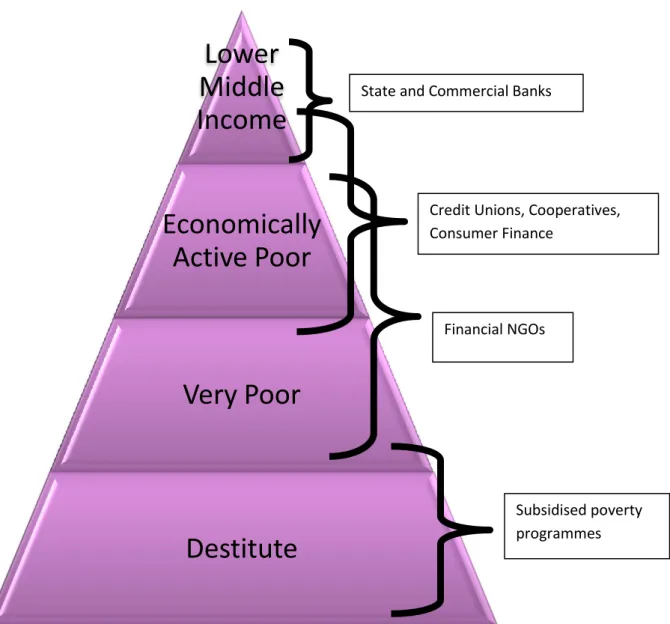
The diverse needs of poor people in Africa require a variety of savings and credit products to meet these needs. These products need to address short, medium and long term needs through disciplined, small regular savings, small irregular savings or irregular larger lump sum savings. Poor people generally want a mix of highly liquid, semi-liquid and illiquid savings products. Figure 1 on the next page summarises the nature of financial intermediation in terms of service providers and the client base served.
Lower, middle-income and wealthier consumers are typically served by the mainstream formal financial sector. Economically active, but poor consumers are often not targeted by the formal financial sector and often find mainstream financial services to be unaffordable and unresponsive. The poor therefore depend on the services provided by credit unions, community-financing initiatives, financial services co-operatives and financial NGO’s (Rau, 2004).
The banking industry has experienced an unprecedented level of consolidation as mergers and acquisitions among financial institutions have become a general phenomenon globally. Consolidation in banking has been encouraged partly as a way to mobilize resources in a declining industry. In the US, between 1993 and 1996, nearly 1500 mergers were recorded (Piloff, 1996) and a similar experience was observed in Europe too (Schenk, 2000).
Financial Disintermediation – Kelly Jade Wright
Evidence from African countries suggests that there is a growing need for a diversity of services, rather than “credit only” programmes, which is preferable in addressing the needs of the poor. Financial institutions help clients by facilitating payments and transfers, managing liquidity, taking deposits and providing mechanisms for savings, credit, equity building, and dealing with risk (Rau, 2004). Each one of these services can help the poor to enable themselves and the incorporation of these services clearly will alter the nature of banks’ intermediation.
Figure 1: A Summary of Financial Intermediation Levels
Source: Littlefield, 2002
2.5
Technology
The financial sector has always been an early adopter of innovations in information and communications technology. Internationalization of finance has been one consequence and it has helped lower the cost of equity and loan capital on average, even though it has also heightened vulnerability to capital flows (Rau, 2004). The technological revolution has also significantly reduced
Lower
Middle
Income
Economically
Active Poor
Very Poor
Destitute
State and Commercial Banks
Credit Unions, Cooperatives, Consumer Finance
Financial NGOs
Subsidised poverty programmes
Financial Disintermediation – Kelly Jade Wright
the cost of information and reduced information asymmetry (Allen and Santomero, 1998). Technology has not, however, reduced the need for intermediation services or encouraged direct lending by households. Research and data actually suggests the opposite. The decline in frictions which were allegedly the market imperfections that led to a need for intermediation services has not reduced the demand for them (Allen and Santomero, 1998).
There is a common view that banks are losing out to a wide range of nonbank competitors such as finance companies, mutual funds, and private pension funds that are offering traditional types of banking products more efficiently. This is could be due to either technological advances eliminating advantages previously enjoyed by banks or the fact that these competitors are free of costly regulations imposed on banks (Kaufman and Mote, 1994).
Botswana, Nigeria and Kenya are still a significant way behind international norms when it comes to the relevant infrastructure that will facilitate delivery to rural populations. South Africa, however, has started making use of technological advances in financial services, such as smart cards but like other African countries have made no dent in the rural population space (Rau, 2004).
2.6
Securitization, Derivatives and Other Financial Instruments
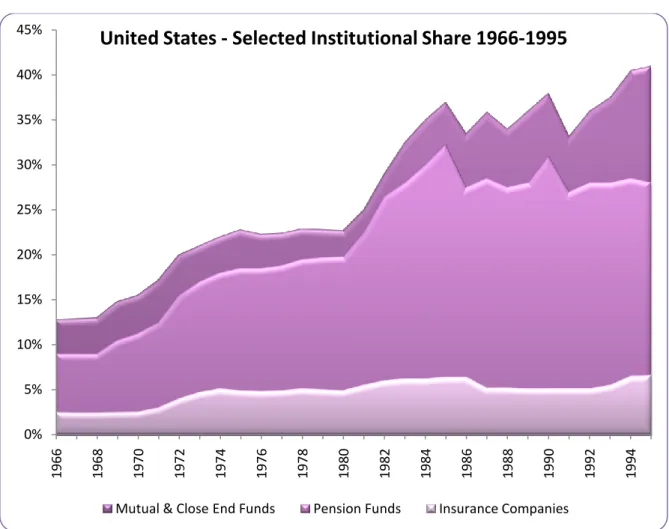
Markets for traditional instruments have grown rapidly in recent years. This is not only in absolute terms but also in relative terms. The literature in this section is for the most part derived from Allen and Santomero (1998). There has been a distinct long-term increase of market capitalization of corporate equity as a percentage of GDP in the US. However, one of the most significant features of markets for traditional instruments in the past few decades is the fact that there has been a drop in use by individuals. The ownership of corporate equity by individuals in the US has fallen from about 85% in the mid -1960’s to around 50% in recent years (see Figure 2). Figure 3 indicates how the share of mutual and closed end funds, pension funds and insurance companies has correspondingly changed. Financial claims held directly by households have fallen quite drastically and intermediation has become more important as the chief source of new financial resources flowing into the capital markets over the past few decades. As can be seen in Figure 4 the ratio of mutual fund holdings to households’ equity ownership has risen from about 5% in 1980 to around 25% by 1995.
In virtually all countries government securities have been the most important type of instrument traded in financial markets. Banks and insurance companies, in the nineteenth and early twentieth century, played the central role in transforming savings by households into investments in real assets by firms. Banks would receive deposits from households and make loans to firms and insurance companies would issue policies and lend the proceeds to firms or invest in securities markets. In UK and US markets for securities issued by firms were significant in terms of the assets outstanding but in most other countries this was not the case until the post-war era. Individuals rather than intermediaries were the predominant participants in the equity and bond markets of the US and UK. In addition to the equity and bond markets in the US there are also the exchanges in Chicago where commodity futures were traded starting in the mid-nineteenth century.
Financial Disintermediation – Kelly Jade Wright
Figure 2: United States – Individual Ownership of Corporate Equity (1966-1995)
Source: Board of Governors of the Federal Reserve System – Flow of Funds Accounts
The markets themselves have also changed significantly especially in the 1970’s and 1980’s. Table 1 summarizes the traditional financial instruments and Table 2 reviews some of the new and most important financial innovations that have occurred. The most successful type of innovation has probably been the development of an assorted kind of derivatives securities. These new derivatives include financial futures and options listed on exchanges and new over-the-counter (OTC) instruments such as swaps.
40% 45% 50% 55% 60% 65% 70% 75% 80% 85% 1966 1968 1970 1972 1974 1976 1978 1980 1982 1984 1986 1988 1990 1992 1994
United States - Individual Ownership of Corporate Equity
1966-1995
Financial Disintermediation – Kelly Jade Wright
Figure 3: United States – Selected Institutional Share (1966-1995)
Source: Board of Governors of the Federal Reserve System – Flow of Funds Accounts
0% 5% 10% 15% 20% 25% 30% 35% 40% 45% 1966 1968 1970 1972 1974 1976 1978 1980 1982 1984 1986 1988 1990 1992 1994
United States - Selected Institutional Share 1966-1995
Financial Disintermediation – Kelly Jade Wright
Figure 4: United States - Mutual Fund/Householder Equity Ownership (1966 -1995)
Source: Board of Governors of the Federal Reserve System – Flow of Funds Accounts
0% 5% 10% 15% 20% 25% 1966 1968 1970 1972 1974 1976 1978 1980 1982 1984 1986 1988 1990 1992 1994