Measuring and Mitigating Security and Privacy Issues
on Android Applications
Candidate: Supervisor:
Lucky Onwuzurike Dr. Emiliano De Cristofaro
Examiners: Professor Lorenzo Cavallaro,Kings College London Dr. Steven MurdochUCL Computer Science
A thesis submitted in partial fulfilment of the requirements for the degree of Doctor of Philosophy
Information Security Research Group Department of Computer Science University College London
Declaration
I, Lucky Onwuzurike, confirm that the work presented in this thesis is my own. Where information has been derived from other sources, I confirm that this has been appropriately indicated in the thesis.
Abstract
Over time, the increasing popularity of the Android operating system (OS) has resulted in its user-base surging past 1 billion unique devices. As a result, cybercriminals and other non-criminal actors are attracted to the OS due to the amount of user information they can access. Aiming to investigate security and privacy issues on the Android ecosystem, previous work has shown that it is possible for malevolent actors to steal users’ sensitive personal information over the network, via malicious applications, or vulnerability exploits etc., presenting proof of concepts or evidences of exploits. Due to the ever-changing nature of the Android ecosystem and the arms race involved in detecting and mitigating malicious applications, it is important to continuously examine the ecosystem for security and privacy issues.
This thesis presents research contributions in this space, and it is divided into two parts. The first part focuses on measuring and mitigating vulnerabilities in applications due to poor implementation of security and privacy protocols. In particular, we investigate the implementation of the SSL/TLS protocol validation logic, and properties such as ephemer-ality, anonymity, and end-to-end encryption. We show that, despite increased awareness of vulnerabilities in SSL/TLS implementation by application developers, these vulnerabilities are still present in popular applications, allowing malicious actors steal users’ information. To help developers mitigate them, we provide useful recommendations such as enabling SSL/TLS pinning and using the same certificate validation logic in their test and develop-ment environdevelop-ments. The second part of this thesis focuses on the detection of malicious applications that compromise users’ security and privacy, the detection performance of the different program analysis approach, and the influence of different input generators dur-ing dynamic analysis on detection performance. We present a novel method for detectdur-ing malicious applications, which is less susceptible to the evolution of the Android ecosystem
(i.e., changes in the Android framework as a result of the addition/removal of API calls in new releases) and malware (i.e., changes in techniques to evade detection) compared to previous methods.
Overall, this thesis contributes to knowledge around Android apps with respect to, vulnerability discovery that leads to loss of users’ security and privacy, and the design of robust Android malware detection tools. It highlights the need for continual evaluation of apps as the ecosystem changes to detect and prevent vulnerabilities and malware that results in a compromise of users’ security and privacy.
Impact Statement
The problems we address in this thesis as well as the analysis, results, and tools we present herein, contribute to the advancement of research in the Androidappifiedworld and business processes. Specifically, the problem of vulnerabilities in applications (apps) as well as the dissemination of malware masked as legitimate apps impacts our daily lives due to the increasing number of always-on, always-connected devices that these apps run on. Finding solutions or ways to mitigate these problems is at the center of the antivirus industry and research dedicated to systems security. To address these problems, we conduct experiments, develop novel techniques which we implement in easy-to-use tools, and present the results in peer-reviewed publications. Thus, the work in this thesis contributes to knowledge in the research community and industry.
One of our findings is that previously known security vulnerabilities around the imple-mentation of SSL certificate validation are still prevalent in popular apps. We believe this is as a result of developers misunderstanding the security risks behind their decisions. For ex-ample, developers who do not want to pay for certificates signed by a recognized certificate authority (CA), use self-signed certificates on their app’s endpoint. When they encounter errors during test due to the Android operating system (OS) not accepting self-signed cer-tificates, they often copy vulnerable code from online forums such as Stack Overflow. To help developers mitigate this problem, we provide publicly available code sample that does certificate validation correctly with both self-signed and CA-signed certificates.
Furthermore, the process of detecting malicious apps has developed into a cat-and-mouse game. When antivirus engines begin to detect malicious apps, the malware authors are forced to evolve their technique so as to evade detection. This, in turn, requires antivir-uses to update their database (in cases where detection is based on signatures) or retrain their detection model (in cases where the detection applies machine learning). If malware
authors modify their evasion technique frequently, then antivirus engines may also need to be updated frequently – which might be costly. In this thesis, we present a novel technique for detecting malicious apps that does not require frequent update or retraining to still be effective. For example, we achieve relatively high detection performance when predicting samples one or two years newer/older than the samples used for training. Our technique which we implement as a tool called MaMaDroid, is publicly available for free and can be leveraged by antivirus developers or individuals in detecting malicious apps.
Finally, the different works that form this thesis have been published in international conference proceedings and online repositories; thus, other researchers working in this field of research can access and use them as references for their work.
Acknowledgments
I give all glory to God for how far He has brought me, His grace that is abound in me, and His mercies that has sustained me.
I thank all the people that has made my PhD journey pleasant, fruitful, and one that I will forever remember all the days of my life. First on the list is my primary supervisor, Dr. Emiliano De Cristofaro. Thank you for all the times you asked “why?” and “and so?”. These questions made me introspect my research decisions and methods, and helped me to express my thoughts clearly. I also extend my gratitude to my secondary supervisor, Dr. Gianluca Stringhini for all the times you were available to answer questions and to help me formulate some of my thoughts.
A huge thank you also to every member of the UCL Information Security Group (ISG), the faculties and students especially members of thebestoffice – Room 6.22. You made my time at UCL worthwhile and I am looking forward to working with all of you again. Special thanks also goes to Sebastian Meiser and Mary Maller for their feedback on selected Sections of my thesis. Also, to Jeremiah Onaolapo for all the nation building and “leadership” discussions we had and for your numerous feedback on diverse topics.
To my parents, brothers, sister, and church family, thank you for your love, encour-agement, and support. To my friends, I say thank you for all the laughs, support and time together. In particular, to Nasiru “El Pistolero” Mohammed for the barbecues you organized, our summer trips, and for proofreading a chapter of my thesis. I also want to acknowledge my sponsors, Petroleum Technology Development Fund (PTDF) for their support.
Finally, to everyone I have coauthored a paper with, thank you for all the invaluable lessons on management, communication, and team work you taught me.
Contents
Declaration 3 Abstract 5 Impact Statement 7 Acknowledgments 9 1 Introduction 17 1.1 Thesis Objectives . . . 20 1.2 Summary of Contributions . . . 22 1.3 Thesis Structure . . . 23 1.4 Publications . . . 23 2 Background 26 2.1 Android App Components . . . 262.1.1 The Primary App Components . . . 26
2.1.2 Other App Components and Definitions . . . 27
2.2 SSL/TLS Protocol . . . 28
2.3 Program Analysis . . . 30
2.4 Machine Learning . . . 32
3 Literature Review 35 3.1 Security and Privacy in the Android OS . . . 35
3.1.1 Vulnerabilities . . . 35
3.1.2 Framework API Abuse . . . 37
3.2 Apps: A Driver for Security and Privacy Loss . . . 39
3.2.1 Vulnerabilities . . . 39
3.2.2 Malware . . . 41
3.3 Security and Privacy in Android App Stores . . . 46
3.3.1 Apps on the Store . . . 46
3.3.2 User Reviews . . . 48
4 Experimenting with SSL/TLS Vulnerabilities in Android Apps 50 4.1 Motivation . . . 50 4.2 Methodology . . . 51 4.2.1 Static Analysis . . . 52 4.2.2 Dynamic Analysis . . . 54 4.2.3 Datasets . . . 55 4.3 Results . . . 56
4.3.1 Static Analysis . . . 56 4.3.2 Dynamic Analysis . . . 57 4.4 Discussion . . . 59 4.4.1 Analysis of Results . . . 59 4.4.2 Recommendations . . . 64 4.4.3 Open Problems . . . 66 4.4.4 Limitations . . . 67 4.4.5 Concluding Remarks . . . 67
5 Experimental Analysis of Popular Anonymous, Ephemeral, and End-to-End Encrypted Apps 69 5.1 Motivation . . . 69
5.1.1 The Research Problem . . . 69
5.1.2 The Research Roadmap . . . 70
5.2 Methodology . . . 71 5.2.1 App Corpus . . . 71 5.2.2 Experimental Setup . . . 74 5.3 Results . . . 77 5.3.1 Static Analysis . . . 77 5.3.2 Dynamic Analysis . . . 78 5.4 Discussion . . . 80 5.4.1 Anonymity . . . 80 5.4.2 Ephemerality . . . 82 5.4.3 End-to-End Encryption . . . 83 5.4.4 Limitations . . . 83 5.4.5 Concluding Remarks . . . 84
6 MaMaDroid: Detecting Android Malware by Building Behavioral Models using Abstracted API Calls 85 6.1 Motivation . . . 85
6.1.1 The Research Problem . . . 85
6.1.2 The Research Roadmap . . . 86
6.2 Design and Implementation of MaMaDroid . . . 88
6.2.1 App Behavior as Markov Chains (MaMaDroid) . . . 88
6.2.2 App Behavior as Frequency of API Calls (FAM) . . . 96
6.3 Dataset . . . 97 6.3.1 Dataset Preprocessing . . . 98 6.3.2 Dataset Characterization . . . 100 6.4 Evaluation . . . 101 6.4.1 Evaluating MaMaDroid . . . 101 6.4.2 Evaluating FAM . . . 107
6.4.3 The Effectiveness of the Modeling Approach: FAM vs MaMaDroid 113 6.4.4 The Effectiveness of Abstraction: FAMvs DroidApiMiner . . . . 115
6.5 Discussion . . . 122
6.5.1 Case Studies of False Positives and Negatives . . . 124
6.5.2 Evasion . . . 126
6.5.3 Possible Bias . . . 127
6.5.4 Limitations . . . 129
6.5.5 Concluding Remarks . . . 130
7 A Family of Droids: Analyzing Behavioral Model-based Android Mal-ware Detection via Static and Dynamic Analysis 131 7.1 Motivation . . . 131
7.1.1 The Research Problem . . . 131
7.1.2 The Research Roadmap . . . 133
7.2 AuntieDroid: Overview and Implementation . . . 134
7.2.1 Virtual Device . . . 135
7.2.2 App Stimulation . . . 136
7.2.3 Trace Parsing . . . 138
7.2.4 Feature Extraction and Classification . . . 139
7.3 Experimental Setup . . . 140
7.3.1 Overview of Experiments and Detection Approaches . . . 140
7.3.2 Datasets . . . 141
7.3.3 Dataset Preprocessing . . . 141
7.4 Evaluation of Detection Approaches . . . 143
7.4.1 Static Analysis . . . 144
7.4.2 Dynamic Analysis . . . 145
7.4.3 Hybrid Analysis . . . 147
7.5 Comparative Analysis of Detection Approaches . . . 148
7.5.1 Detection Performance . . . 148
7.5.2 Misclassifications . . . 150
7.6 Discussion . . . 155
7.6.1 Challenges with Dynamic Analysis . . . 157
7.6.2 Limitations . . . 158
7.6.3 Concluding Remarks . . . 159
8 Conclusion and Future Work 160 8.1 Conclusion . . . 160
8.2 Future Work . . . 163
Bibliography 164 Appendices 179 A SSL 180 A.1 Complete List of Apps Investigated . . . 180
List of Tables
4.1 Distribution of examined apps by number of downloads. . . 56
4.2 Known vulnerable TrustManager and SocketFactory subclasses . . . 57
4.3 Sensitive data sent via HTTP. . . 58
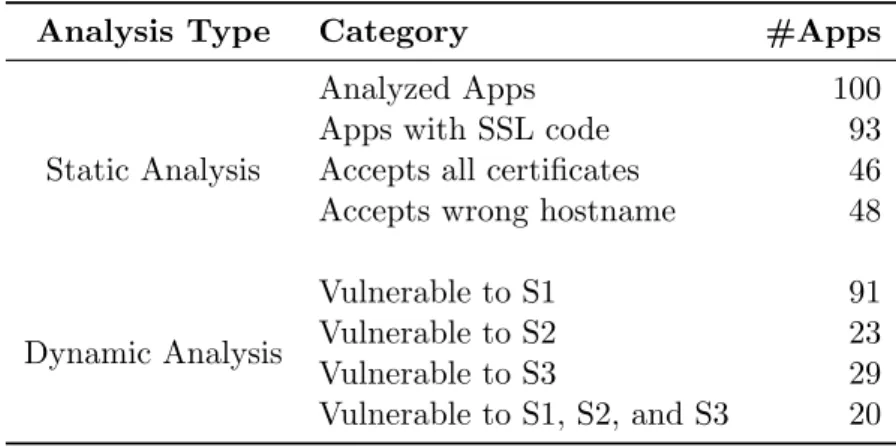
4.4 Summary of results. . . 59
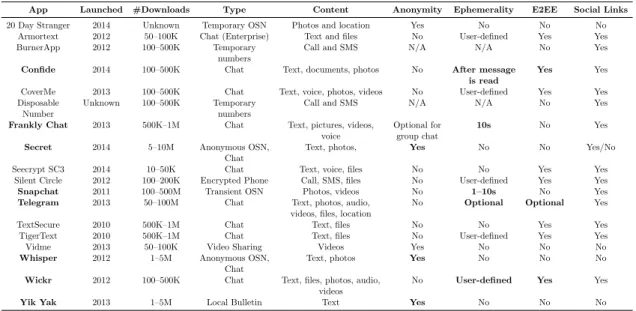
5.1 Selection of 18 smartphone apps providing at least one among ephemerality, anonymity, or end-to-end encryption. . . 72
5.2 Summary of dynamic analysis results. . . 79
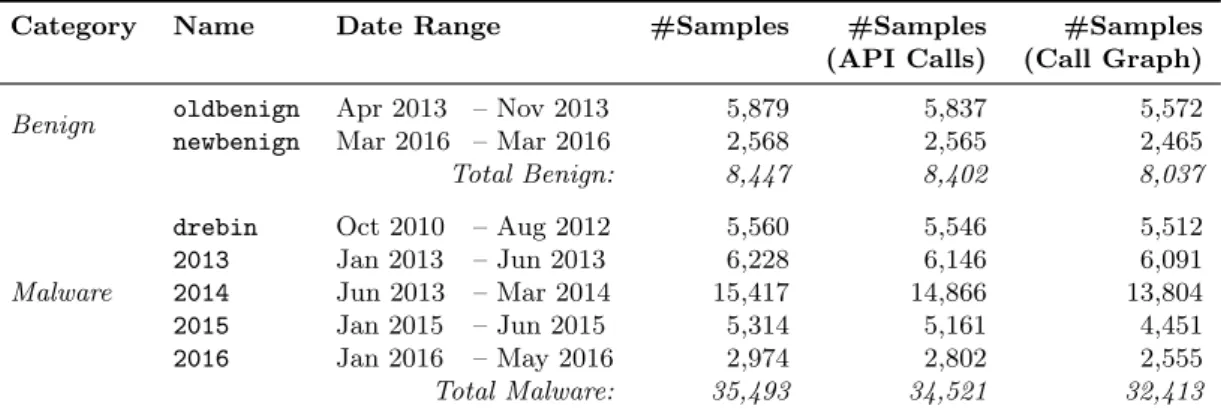
6.1 Overview of the datasets used in our experiments. . . 98
6.2 Precision, Recall, and F-measure obtained byMaMaDroid. . . 103
6.3 Precision, Recall, and F-measure (with Random Forests) of FAM. . . 109
6.4 F-measure of FAM and MaMaDroid in family and package modes when trained and tested on dataset from the same year. . . 114
6.5 F-Measure of MaMaDroid(MaMa) vs its variant using frequency analysis (FAM). . . 115
6.6 F-measure of FAMand MaMaDroidin family and package modes as well as,DroidApiMiner[14] when trained and tested on dataset from the same year. . . 117
6.7 F-Measure of MaMaDroid(MaMa) vs our variant using frequency analysis (FAM) vs DroidApiMiner(Droid) [14]. . . 118
7.1 Reasons why apps fail to install on the virtual device. . . 142
7.2 Datasets used to evaluate each method of analysis. . . 143
7.3 Results achieved by all analysis methods while using human and Monkey as app stimulators during dynamic analysis. . . 144
List of Figures
2.1 SSL Handshake. . . 29
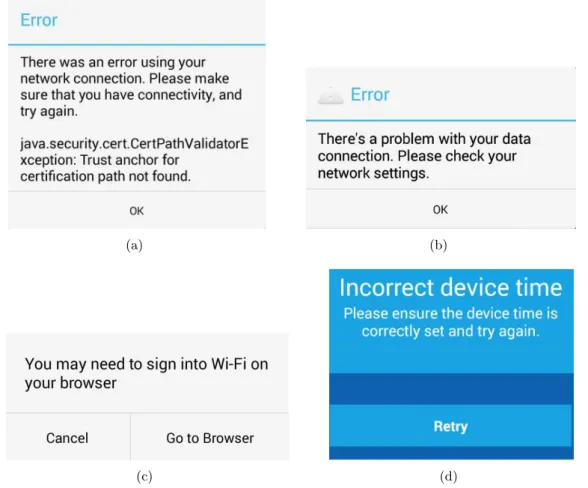
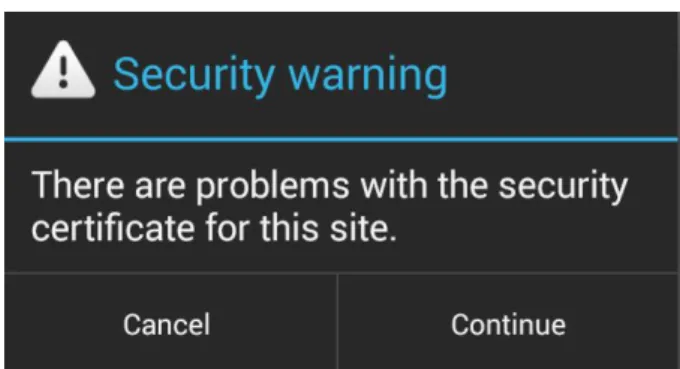
4.1 Warnings presented to users as a result of non-validation of an SSL certificate. 60 4.2 Certificate warning displayed by Job Search app in S2 and S3. . . 63
5.1 Dynamic analysis setup. . . 75
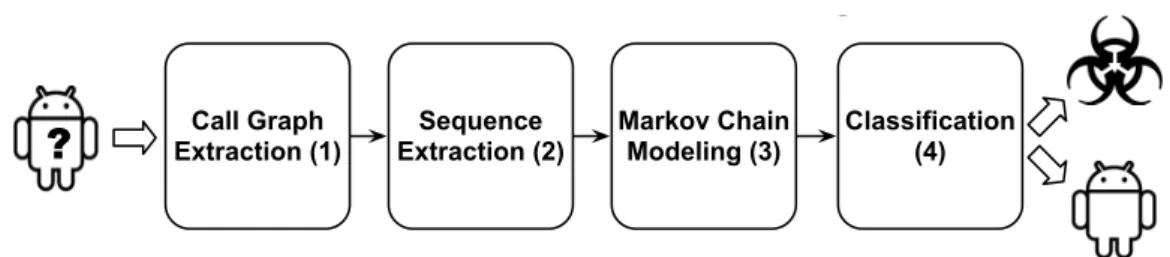
6.1 Overview of MaMaDroid’s operation. . . 88
6.2 Code from a malicious app (com.g.o.speed.memboost) executing commands as root. . . 89
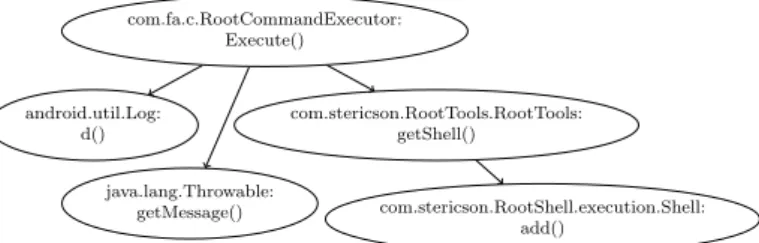
6.3 Call graph of the API calls in the try/catch block of Figure 6.2. . . 90
6.4 Sequence of API calls extracted from the call graphs in Figure 6.3. . . 91
6.5 An example of an API call and its family, package, and class. . . 91
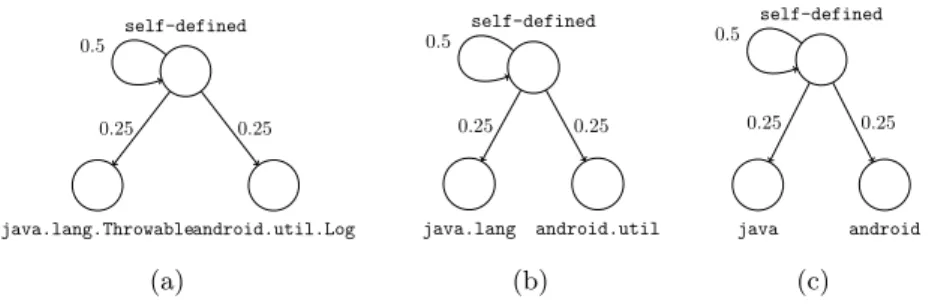
6.6 Markov chains originating from the call sequence in Figure 6.4. . . 94
6.7 CDF of the number of API calls in different apps in each dataset. . . 99
6.8 CDFs of the percentage of android (a) and google(b) family calls in our dataset. . . 100
6.9 F-measure of MaMaDroidclassification with datasets from the same year using three different classifiers. . . 102
6.10 F-measure achieved by MaMaDroid using older samples for training and newer samples for testing. . . 106
6.11 F-measure achieved byMaMaDroid using newersamples for training and older samples for testing. . . 108
6.12 F-measure achieved by FAM with datasets from the same year and the different modes of operation. . . 110
6.13 F-measure achieved by FAM using older samples for training and newer samples for testing. . . 112
6.14 F-measure achieved by FAM using newer samples for training and older samples for testing. . . 113
6.15 CDF of the number of important features in each classification type. . . 125
7.1 High-level overview of AuntieDroid. . . 134
7.2 Aggregated sequence of API calls. . . 139
7.3 CDF of the percentage of (a) code covered in benign and malicious apps when they are stimulated by Monkey and human, and (b) API calls that are dynamically loaded during dynamic analysis. . . 145
7.4 CDF of the percentage of code covered (a) when apps are stimulated by humans and Monkey, and (b) when the correctly classified and misclassified apps are stimulated by humans and Monkey. . . 148
7.6 CDF of the number of features present (out of the 100 most important features) in each classification type for all analysis methods (with human during dynamic analysis). . . 152 7.7 CDF of the number of features present (out of the 100 most important
features) in each classification type for all analysis methods (with Monkey during dynamic analysis). . . 153 7.8 Number of false negatives in each analysis method and when the apps are
Chapter 1
Introduction
In this chapter, we present the research questions this thesis addresses and summarize the research approaches we used to address them. We present a summary of our contributions, outline the thesis structure and finally, highlight the contributions of the author of this thesis to the publications that form this thesis.
In June 2015, there were 2.6 billion active smartphones worldwide, with each smart-phone generating an average monthly data traffic of 1 GB [78]. By June 2016, these numbers had increased to 3.2 billion and 1.4 GB, respectively [79]. Moreover, IDC estimates that 87% of all smartphones worldwide run Android [120]. With these numbers, it is not sur-prising that attackers target the Android ecosystem, as exploiting possible vulnerabilities would lead to a compromise of a large user base.
As of January 2018, there were more than 3.5 million applications (apps) on the Google Play Store (the main market for Android apps) [24]. These apps are designed to meet diverse user needs that include banking, communication, social networking, gaming etc. and thus, handle both sensitive and non-sensitive user information. Cybercriminals target the mobile ecosystem on the basis of the information it handles, and they usually do so by exploiting vulnerabilities in apps developed by other developers or by designing their own apps to steal user information. For example, as of August 2016, there are 20 apps with over one billion downloads (on unique devices) [22] implying that an attacker that is able to exploit a vulnerability in any one of these apps, will have access to information they can sell at a very high price on the black market. Other non-criminal actors also target the ecosystem by using user information to serve them advertisements. They usually do
so by collecting information about users that allow them profile the users for effective ad targeting. These security and privacy issues i.e., information exfiltration and user profiling motivate the need to examine the Android ecosystem to ensure these issues are mitigated. Overall, developments in the Android ecosystem have attracted the attention of the research community, with several research studies highlighting vulnerabilities that lead to security and privacy violations or usability issues. The security and privacy issues brought to light include: transmitting sensitive information in the clear [121], accepting invalid SSL certificates [82], permissions abuse [41], malware masked as legitimate apps [226], memory corruption [72], privilege escalation [39] etc. and they usually have varying impact depending on their severity, version of the OS and the corresponding user base, ease of implementation, and type of devices affected. In Chapter 3, we review research efforts on the Android ecosystem.
One area which has attracted the attention of the research community is the continuous increase in the number of Android malware.1 As smartphones have become ubiquitous, they are used to carry out sensitive operations, e.g., financial transaction, or to control home appliances or medical devices. Thus, it has become profitable for malicious actors to write malware cloaked as legitimate apps that steal information from devices or hold their users to ransom. As a result, several research works have designed tools to classify an app as either malicious or benign using, e.g., the use of dangerous permissions [25, 47], sequence of calls [42], fingerprinting [43, 66], and frequency analysis to determine API calls used mostly by malware [14]. These tools are based on a program analysis type (i.e., static, dynamic, or hybrid analysis), which along with the techniques used, effects the detection performance of the tools. For example, Chen et al. [55] show that “known best-performing” malware classifier tools perform badly when tested on new malware datasets. This is moreso because, as both Android malware and the operating system itself evolve, it is very challenging to design robust malware detection tools that can operate for long
periods of time at an acceptable high detection rate without the need for modifications or costly retraining. Thus, more research work is needed to design better malware classifiers that are robust to these changes.
Another line of work focuses on the secure transfer of information over the network. Unlike web browsers, which provide visual feedback to users on the application layer transfer protocol being used, browser apps do not. The absence of visual feedback on non-browser apps means usage of such apps is based on trust that developers are sending confidential data securely, i.e., over SSL and in a way that is not susceptible to Man-in-the-Middle (MiTM) attacks. Thus, users are not aware that sending sensitive data via some of these apps is not secure and as a result, they do not take any step to protect themselves. This visual difference between browsers and non-browser apps that may result in different user behavior, motivates a number of research projects. These projects examined the implementation of SSL by non-browser apps and the SSL libraries these apps use, finding a number of vulnerabilities that allowed them conduct successful MiTM attacks [82, 101, 189]. Vulnerabilities exposed include trusting all certificates, accepting all hostnames for a certificate, accepting self-signed certificates, or using customized libraries that skip one or two of the certificate validation process. As it is important to transmit confidential or sensitive data such as: login credentials, files, bank details, IMEI number, geolocation etc., securely, it is crucial that researchers continuously investigate the implementation of SSL by developers and to also help them solve difficult challenges relating to implementing security protocols. Also, in an attempt to outdo competitors providing similar services, some developers advertise that their apps enhance users’ security or privacy due to the protocols they implement in these apps. Thus, it is also important to analyze whether such claims match the reality of what a user experiences and whether the implementation of the protocols are void of vulnerabilities.
Although several studies have investigated the security and privacy concerns associated with Android, discovering vulnerabilities, and providing detection and mitigation tools etc.,
as time passes, new concerns arise, malicious actors evolve their techniques, old vulnerab-ilities are not fixed etc. These concerns thus motivate the need to continuously investigate the Android ecosystem to ensure they are measured and mitigated. Therefore, this thesis presents research efforts in this area.
1.1
Thesis Objectives
The main objective of this thesis is to measure and mitigate security and privacy issues on Android apps. To do so, this section first highlights the research problems we investigate, and then presents a summary of the methodology we employ to address them.
This thesis is divided into two parts. In the first part, we measure and mitigate security and privacy issues in apps that pose risks to users unintentionally due to vulnerabilities. Whereas in the second part, we measure and mitigate security issues in apps that are designed tointentionallyput users at risk. Overall, this thesis aims to address the following research questions:
RQ1 Are vulnerabilities in SSL implementations that enable successful man-in-the-middle attacks of network connections prevalent in Android apps? If so, can we provide better recommendations that help address these problems?
RQ2 Do apps that claim to provide security and privacy properties that protect user in-formation actually do?
RQ3 Can we design new malware detection tools that are more robust to malware and Android framework evolution than the state-of-the-art?
RQ4 Does having humans test apps during dynamic analysis improve malware detection compared to pseudorandom input generators such as Monkey [107]?
to each other in terms of malware detection performance when the same technique is used to build the detection models?
To address these research questions, we carry out a set of experiments which we sum-marize following, and describe in more details in Chapter 4 – 7.
With respect to RQ1, we statically and dynamically investigate the SSL implementa-tions of popular apps (i.e., apps that have been downloaded at least 10 million times on Play Store). During dynamic analysis, we define three attack scenarios that allow us to test for different vulnerabilities (Chapter 4). To address RQ2, we investigate apps that claim to provide three specific security and privacy properties (that is, anonymity, end-to-end en-cryption, and ephemerality). We then compare our observation of the operations of these apps in the presence of an adversary that aims to violate these properties, to the expected behaviors when the security and privacy properties are implemented properly (Chapter 5). With respect to RQ3, we design and implement a system called MaMaDroid, which employs a novel approach in the detection of malware by abstracting API calls to fine-grained levels and then, modeling the behavior of the apps from the sequence of abstracted calls as Markov chains. We evaluate it using datasets spanning several years and compare it to a state-of-the-art detection system (Chapter 6). To address RQ4, we modify a virtual device that is designed to crowdsource human inputs for testing Android apps by integrating the detection technique used by MaMaDroid into it. We then instantiate the modified virtual device by using both pseudorandom (Monkey) and user-generated inputs. Finally, to address RQ5, we evaluate each analysis method (i.e., static, dynamic, and hybrid analysis), using the same modeling approach (i.e., a behavioral model relying on Markov chains built from the sequences of abstracted API calls), the same features, and the same machine learning classifier (Chapter 7).
1.2
Summary of Contributions
This thesis investigates the security and privacy issues in Android apps that are con-sequences of vulnerabilities and malicious intent. In measuring and mitigating these issues, we make the following contributions.
1. We show that despite increased awareness of SSL vulnerabilities, many popular apps still have these vulnerabilities; as a result, they leak users’ private information. We provide recommendations and tested code sample that can help address the problem of poor SSL implementation by Android app developers and finally, we investigate why static and dynamic analysis yield slightly different results.
2. Our work shows that ephemeral messaging apps, i.e., apps with “disappearing” mes-sages are not always ephemeral as we can recover “expired” mesmes-sages. Similarly, anonymous apps can identify their users across multiple sessions (even after unin-stalling and re-inunin-stalling the apps), while also not making it clear to whom a user is anonymous.
3. We design and implement MaMaDroid, an Android malware detection tool that employs a novel approach in the detection of malware by abstracting API calls to their class, package, or family, and model the behavior of the apps through the sequences of API calls as Markov chains. We show that MaMaDroid can detect unknown malware samples from the same year as the training set with an F-measure of 0.99, with the detection accuracy still considerably high years after (i.e., 0.75 after two years), implying that MaMaDroid is robust to evolution in malware development and changes in the Android API. We also demonstrate the effect of abstraction to MaMaDroid’s detection performance by abstracting API calls and using frequency analysis technique to model apps, showing that our approach performs better than other frequency analysis techniques without abstraction likeDroidApiMiner.
4. We perform a comparative analysis of the different analytical methods i.e., static, dy-namic, and hybrid in malware detection, showing that hybrid analysis performs best and that static analysis is at least as effective as dynamic analysis depending on how an app’s input is generated during dynamic analysis. To perform malware detection that employs the same technique as MaMaDroid, we implement AuntieDroid, a virtual device that extendsChimpand allows for the collection of the method traces (from which features are extracted) produced by an app when executed. We find that pseudorandom input generator outperforms human users largely due to better code coverage. Our work also shows that dynamic code loading is prevalent in the wild, which could in theory be used by malware developers to evade static analysis tools.
1.3
Thesis Structure
The rest of the thesis is organized as follows. Chapter 2 provides background information on Android app components and the program analysis and machine learning algorithms applied in this thesis. Chapter 3 reviews prior work on the security and privacy of the Android ecosystem. Chapter 4 and 5 present work that measures vulnerabilities present in apps that, when exploited by malevolent actors, would lead to security and privacy issues. Chapter 6 and 7 discuss our efforts to mitigate security and privacy issues resulting from maliciously crafted apps. In Chapter 8, we conclude and discuss possible future works.
1.4
Publications
The works that comprise this thesis have been published or are currently under submission at various international journal and conference venues and have been done in collaboration with other coauthors. This section reports where the work in each chapter have been published and my contributions towards their completion.
Conference on Security & Privacy in Wireless and Mobile Networks (WiSec) [157] in collaboration with Dr. Emiliano De Cristofaro. My contributions in this study include: collecting the data, designing and implementing the methodology, analyzing the results as well as writing a draft of the paper.
• The work presented in Chapter 5 has been published and presented at the 2016 NDSS Workshop on Understanding & Enhancing Online Privacy [158] and as a poster at the 2016 ACM Conference on Security & Privacy in Wireless and Mobile Networks (WiSec) [159] in collaboration with Dr. Emiliano De Cristofaro. My contributions in this study include: collecting the data, designing and implementing the methodology, analyzing the results, and the write up.
• The work presented in Chapter 6 is currently under submission after revision at the ACM Transactions on Privacy and Security (TOPS) [160] while a shorter version has been published and presented at the 2017 Annual Symposium on Network and Dis-tributed System Security (NDSS) [144] in collaboration with Enrico Mariconti, Dr. Panagiotis Andriotis, Dr. Emiliano De Cristofaro, Dr. Gordon Ross, and Dr. Gian-luca Stringhini. My contributions in this study include: collecting the data (the be-nign sample used in our evaluation); implementing the module of MaMaDroidthat performs call graph extraction and call graph parsing into sequences; re-implementing the API call abstraction (i.e., as presented in the extended version [160] and in this thesis) module; implementing API call abstraction to classes in MaMaDroid and evaluating it; implementing and evaluating the variant of MaMaDroid i.e., FAM; re-implementing DroidApiMiner from the code provided by its authors as well as evaluating it; investigating the detection performance of MaMaDroid in compar-ison to FAM; investigating the detection performance of FAM in comparison to DroidApiMiner; investigating the reasons for the false positives and false negatives exhibited byMaMaDroid; analyzing the results of the evaluation I performed; and
writing the sections of the paper that describe the tasks I performed.
• The work presented in Chapter 7 has been published and presented at the 2018 An-nual Conference on Privacy, Security, and Trust (PST) [156] in collaboration with Mario Almeida, Enrico Mariconti, Dr. Jeremy Blackburn, Dr. Gianluca Stringhini, and Dr. Emiliano De Cristofaro. My contributions in this study include: collecting the data (i.e., the dataset we use for evaluation) and data preprocessing; evaluat-ing the static analysis usevaluat-ing MaMaDroid’s code; implementing the trace parsing, feature extraction, and classification in AuntieDroid; evaluating AuntieDroid; implementing and evaluating the hybrid analysis version of MaMaDroid; performing a comparative analysis of the detection methods w.r.t. detection performance and misclassifications within each analysis method; analyzing the results; and writing the sections of the paper that describe the tasks I performed.
Chapter 2
Background
In this chapter, we present background information of the key components of an Android app, program analysis, SSL/TLS protocol, and machine learning; which are the building blocks of the work in this thesis.
2.1
Android App Components
2.1.1 The Primary App Components
Android app components are the building blocks that comprise an Android app and they serve as the entry points via which a user or the Android OS can interact with an app. There are four types of app components, namely:
Activity. An activity is a user interface that serves as the entry point for a user into an app. That is, the visual information an app wishes to display to a user is contained in an activity of the app. Similarly, if an app wishes to collect user input, the forms are placed in an activity and displayed to a user.
Service. A service is an app component that runs in the background and is used to perform long-running tasks or tasks for a remote process. For example, a service can be used to sync data in an app with a remote server (e.g., syncing emails by an email app) without disrupting the use of the app or to play music in the background while another app is in the foreground. A service does not provide an interface via which users can interact with it.
to system or app-defined event announcements. Because a broadcast receiver can be used to respond to system-wide events, it allows an app define operational flows different from user flows. That is, an app can perform a sequence of operations without user intervention. For example, an email app can be designed to start a service that starts syncing emails whenever it receives a broadcast that the device is connected to the Internet. Similarly, apps can also initiate broadcasts; for example, a contact app can let other apps know via a broadcast when a new contact is added. Because broadcast receivers are “another well-defined entry into the app, the system can deliver broadcasts even to apps that aren’t currently running.”1
Content Provider. A content provider is an app component that is used to manage data that is either private to an app or that is shared with other apps. Typically, the con-tent/data is stored in a persistent storage location such as the file system, SQLite database, web, or shared preferences. Multiple apps can query or modify the data on a content pro-vider if it permits it and the apps have permission to do so. For example, Android provides a content provider that manages the contact information in an address book, allowing apps with permission to access it, to query the content provider, e.g., to read contact details about a particular contact.
2.1.2 Other App Components and Definitions
Manifest. The Manifest is a file that declares all the components (i.e., activity, service, broadcast receiver, and content provider), that comprises an Android app. It also con-tains information about permissions, minimum API level, external libraries, and hardware features that the app requires to function correctly.
Android Package (apk). apk is an Android archive file format that contains the compiled source code, manifest, resources, assets, and libraries of an app.
API Call. It is a request made to an Application Program Interface (API) to perform a task. In the Android appified world, an API call is a request to the Android framework.
Permission. Permissions are access control mechanisms defined and enforced by Android to protect resources and assets such as: files, sensors, hardware properties etc. An app will onlyhave access to these protected assets if they have been granted permission to them by a user. Because access to assets are done via API calls, permissions are mapped to API calls i.e., the OS will only execute certain API callsif and only ifthe app has the necessary permission.
2.2
SSL/TLS Protocol
The SSL/TLS (written as SSL from now on) protocol is a security protocol that is used to encrypt data between two communicating parties. This section presents an introduction of the handshake protocol that begins the setting up of SSL between two parties, man-in-the-middle (MiTM) attacks that target parties employing SSL, and how the protocol is implemented by Android app developers.
SSL Handshake. To establish a secure connection between two parties – denoted as client (or app) and server – the client initiates the so-called SSL handshake, beginning with cli-ent hello, as depicted in Figure 2.1. Next, the client verifies the identity of the server: if the verification is not implemented correctly, an attacker can impersonate the server, thus leading to information leakage. Verification involves checking the chain-of-trust in server’s certificate [62], hostname [116], and certificate validity [62, 179]. It may also include verify-ing server’s certificate serial number, key usage etc., or any developer-specific requirements. Failure in the verification should lead to termination of the connection.
SSL MiTM Attacks. In a MiTM attack, an attacker sits between two communicating parties and intercepts, read, modify, and/or relay messages between the parties, making them believe that they are instead talking directly to each other. In a MiTM attack
Figure 2.1: SSL Handshake.
over SSL, an attacker must subvert the certificate verification in the SSL handshake to be successful. The attacker does so aiming to, e.g., read and/or modify encrypted traffic between the client and server. The attacker succeeds if one of the following holds:
• The client accepts all certificates as the server’s;
• The client does not verify the identity of anyone claiming to be the server;
• The server’s certificate is forged by the attacker;
SSL Implementation in Android. To provide security between apps and servers, app developers turn to SSL over HTTP (HTTPS) sockets. Specifically, they rely on the an-droid.net, javax.net.ssl, and java.security.cert packages which can be used to create secure sockets, administer, and verify certificates and keys. java.security.cert provides classes and interfaces for verifying the revocation status of a certificate. The javax.net.ssl package provides developers withTrustManagerand HostnameVerifierinterfaces, which are used in the SSL certificate validation logic. TrustManager manages all Certificate Authority (CA) certificates used in assessing a certificate’s chain-of-trust validity. Only root CAs trusted by Android are contained in the default TrustManager. The HostnameVerifier
interface performs hostname verification whenever a URL’s hostname does not match the hostname in the peer’s identification credentials.
Developers can use theTrustManagerandHostnameVerifierprovided by the Android SDK as is or customize it to fit their need. Customization usually involves using developer-specified credentials, validation logic on TrustManager and/or HostnameVerifier inter-face. Reasons for customization can include any of the following:
• Certificate issued by a CA unknown to the OS
• Use of self-signed certificate
• Pinning peer credential (“SSL pinning”)
• Server configuration sending incomplete certificate chain
• Use of a single certificate for multiple hosts
SSL Pinning involves coupling a host’s trusted credential (e.g., an X.509 certificate or a public key) to its identity. Any credential received other than the one coupled will not be accepted as valid for the host, whether or not the credential is issued by a valid CA or it is trusted by the OS. This is usually done when a developer knows beforehand the trusted credentials of the host.
2.3
Program Analysis
The work presented in this thesis has involved one or more forms of program analysis. Here, we first introduce program analysis and then the methods (i.e., with respect to execution of the program) we have employed in our workin the context of analyzing Android apps.
Program analysis offers static compile-time techniques for predicting safe and com-putable approximations to the sets of values or behaviors arising dynamically at runtime when executing a program [151]. That is, it is an analysis performed to determine the
correctness, robustness, and safety of a program. It is applied in program optimization – detecting and avoiding redundant/superfluous computations – and program validation – ensuring that a program does what it is supposed to do (correctness) or reducing the likelihood of malicious behavior (safety). In order for an analysis to be computable, the result of the analysis is usually reached from an approximation of a program behavior. The analysis can be performed statically, dynamically, or a combination of both.
Static Analysis. This is a program analysis method that automatically analyzes a program (in this work, apps) without executing it by examining the source or byte code. The pros of using this analysis are that: it analyzes all portions of the source code and depending on the constraints (e.g., context or path sensitivity), it can be scalable and fast. At the same time, it has the following cons: it overestimates the code i.e., some portions of code it analyzes may never be executed during runtime and it cannot analyze any code that is loaded during runtime.
Dynamic Analysis. In this program analysis method, a program must be executed for it to be analyzed. This approach has the following pros: it is able to examine portions of code that are dependent on the runtime environment; it is able to examine any code that is loaded during execution; and it examines portions of code that are reachable following any number of execution paths. The cons of this approach include: it may be limited due to how inputs to the app are generated during test; it only examines portions of code that are executed during runtime; and the environment may influence the behavior of the examined app.
Hybrid Analysis. Hybrid analysis is program analysis that combines both static and dynamic analysis in the examination of an app. It inherits the pros of both static and dynamic analysis and some of the cons inherent in one approach that the other does not address.
There are four main approaches to program analysis, which include: abstract interpret-ation, control flow analysis, data flow analysis, and type and effect systems [151]. Abstract
interpretation is a technique used to derive an abstract semantics from which information can be obtained about a program (concrete semantics) i.e., it is used to approximate a pro-gram [63]. While control flow analysis is a technique that is used to determine the control flow or the execution order of statements or instructions in a program. Data flow analysis is a technique used to analyze the flow of data in a program in order to determine their values at each point of the program and how they change over time. While type and effect systems are an approach for augmenting static type systems to reason about and control a program’s computational effects [145].
2.4
Machine Learning
In this section, we introduce machine learning (with a focus on classification) and the ma-chine learning algorithms we employ to solve the classification problems our work addresses. Machine Learning (ML) is an inductive process that involves automatically building a classifier for classifying or clustering objects into categories or classes by observing the characteristics (i.e., features) of a set of objects [183]. This process can either besupervised or unsupervised. In the former, a set of objects (aka ground truth) are manually classified into classesC1...nby a domain expert using a set of observed features represented as vector,
and the goal is for a classifier to automatically learn from these features, and be able to predict the classes inC1...nof new unseen objects using their features. Whereas in the latter,
the goal is for a classifier to cluster objects using their features, into different clusters, each of which can be assigned a class and meaning. In this thesis, we employ supervised ML as the goal of our experiments (in Chapters 6 and 7) is to classify an app into one of two classes: benign or malicious.
Training, Validation, and Test Sets. Typically, in supervised learning, the objects used to train and assess models are divided into three: training, validation, and test sets. The training, validation, and test sets are used to, respectively, fit the models, estimate
pre-diction error for model selection, and assess the generalization error of the final chosen model [93]. Validation of models can also be performed using the k-fold cross validation approach, in which k different models are built by partitioning the initial objects into ap-proximately equal-sizedksets: O1, O2, ..., Ok, and then iteratively applying a train-and-test
approach on the partitions using a different partition as the test set in each iteration. The final evaluation metric values of the model is obtained by computing the average of the effectiveness of each individual model.
The ML algorithm used to fit models in the training phase depends on several factors that include: the type of problem, the size of the objects’ features in relation to the size of the total amount of objects, number of classes of the objects, time to train the models etc. There are several ML algorithms used for solving classification-related problems; here, we only introduce the three algorithms we use in our work. We refer readers seeking to know more about ML and ML algorithms to prior works [34, 93, 141, 183].
K-Nearest Neighbor (KNN).KNN [92] is an ML algorithm that is used for classification and regression. In solving a classification problem, it attempts to predict the class of a data point (object) based on the class of a predefined k number of training examples (objects) closest in distance to the data point. Generally, larger k values suppresses the effects of noise on the classifier, but makes the class boundaries of the data points less distinct. Random Forests. Random Forests [36] is an ensemble ML algorithm that builds several independent tree-structured estimators (classifiers) from a subset of the training data and then returns the average of their predictions as the prediction of the classifier. The larger the number of estimators, the longer the time taken to train and classify samples but the better the classifier. Although, beyond a certain number of estimators, there exists no significant increase in the prediction results of the classifier.
Support Vector Machine (SVM).SVM [113] is an ML algorithm that is used for classific-ation, regression and outliers detection. It operates by finding the hyperplane – a decision boundary that splits the input variable space by their class – that creates the biggest
mar-gin between the training data points of different classes [93]. The marmar-gin is calculated as the distance from the hyperplane to only the closest points and only these points, called the support vectors are relevant in defining the hyperplane and in the construction of the classifier [37]. SVM is very effective when processing objects with high dimensional spaces but may suffer from overfitting when the number of features of each object is much greater than the number of objects.
Classification Metrics. There are several evaluation metrics used to show the effective-ness of an ML classifier. Here, we only describe the metrics in the Scikit-learn Python library [162], which we use in our work.
Precision. Precision shows the ability of a classifier to predict correctly, the class of an object. It is given as the ratio tp/(tp+f p) where tp is the number of true positives, i.e., positive objects correctly predicted as positive ones and f p the number of false positives, i.e., negative objects wrongly predicted as positive objects.
Recall. Recall shows the ability of a classifier to find all the positive [or relevant] objects. It is given as the ratiotp/(tp+f n) where f nis the number of false negatives, i.e., positive objects wrongly predicted as negative ones.
F1-Score. The F1-Score also known as F-Measure or F-Score, is the harmonic mean or weighted average of the precision and recall of a classifier. It is given as:
F1 = 2∗(P recision∗Recall) (P recision+Recall)
Other metrics in the Scikit-learn Python library [162] that can be used to evaluate a classifier include: Accuracy, Area Under the Curve (AUC), Receiver operating character-istic (ROC) curve, Brier score, Cohen’s kappa etc.
Chapter 3
Literature Review
In this chapter, we review prior work on the security and privacy of the Android OS, Android apps, and app market.
Over the years, as Android’s popularity increased, the research community has invest-igated its security, usability, users’ security and privacy, Android apps etc. In this chapter, we review studies that investigate: (i) the security and privacy of the Android OS, focusing on vulnerabilities discovered as well as API abuse; (ii) apps that pose security and privacy risk either because of the vulnerabilities they contain or because they are malicious; and (iii) the markets that distribute these apps, focusing on the characteristics of the apps that comprise the markets and the measures if any, employed to vet the apps.
3.1
Security and Privacy in the Android OS
3.1.1 Vulnerabilities
We report here, prior work that examined the security of the Android OS, reporting vul-nerabilities that allow for malicious activities.
Privilege Escalation. One of the approaches used in Android to provide security is the im-plementation of access control and sandboxing. That is, system resources and components as well as inter-process communications are protected by permissions that an app must possess for it to access them. Consequently, each app is assigned aUserIdwhich is mapped to a set of permissions granted to the app at installation or run time and can be modified1
1
Prior to Android version 6.0, the permission is fixed at installation time and cannot be modified after-wards by the app or the user.
at any time by the user. During runtime, a reference monitor checks whether access to protected resources or inter-component communication should be permitted. Several stud-ies [39,68,71,87] have investigated this access control mechanism in Android and show that it is vulnerable to the confused deputy attacks [110], allowing apps to perform operations or access resources they do not have permission for. Even though Bugiel et al. [39] propose possible solutions to this problem, these attacks are still possible [114] four years after, highlighting the importance of continuous research work and development of deployable solutions to known Android security and privacy problems.
Device Rooting. Device rooting is another form of privilege escalation that exploits vul-nerabilities (such as mishandling copy-on-write2, setuid resource exhaustion failure3) in the Android kernel, allowing apps execute arbitrary code in the kernel rather than exploit-ing the confused deputy problem. Apps that exploit these vulnerabilities pose a serious security and privacy risk, as they can execute any command with elevated privilege, mask their activities, and are hard to remove. Several studies [109,115,226] have discovered apps packed with root exploits, which have consequently led to the development of techniques for detecting rooted devices or apps containing root exploits [80, 115]. Recently, Suarez-Tangil and Stringhini [191] reported the increased use of native code by malicious apps which often contain vulnerability exploits; one of which is used to root a device. This corroborates the findings of Ho et al. [115] that known malicious apps that employ root exploits, all do so via third-party native code.
Memory Corruption. One method via which memory corruption occurs is via buffer/heap overflow. A number of research efforts [72, 112, 186] have discovered vulnerabilities in the Android framework that allows a number of possible attacks, such as remote code execution, data exfiltration, and privilege escalation. For instance, vulnerabilities in the Stagefright media framework of Android was exploited using integer overflow and allowed an attacker
2
https://access.redhat.com/security/vulnerabilities/DirtyCow
remotely execute code on the device [72].
Other vulnerabilities that have been reported in previous studies include: data residue vulnerability – a vulnerability that results from uncleared data (e.g., files, database, cap-abilities, etc.) of an uninstalled app being inherited by a new app, thus resulting in privacy leaks or privilege escalation [221]; side channel leakages that allow for runtime information gathering attacks [220].
A comprehensive list of security vulnerabilities that have been discovered on Android are available in the CVE database [12] and the vulnerabilities that have been patched by Google are available in the Android Security Bulletin [11]. Usually, these vulnerabilities are exploited by malicious actors via two mechanisms: drive-by download and malicious apps [147]. This thesis focuses on vulnerability measurement and mitigation on apps since they form a primary mechanism for vulnerability exploitation. A review of studies that have investigated vulnerabilities in potentially benign apps as well as malicious apps designed to exploit these vulnerabilities is presented in Section 3.2.
3.1.2 Framework API Abuse
Here, we discuss API calls that are intended by Google to allow developers perform certain operations but have been used to carry out malicious activities. These API calls may or may not have been deprecated or modified.
Permissions Abuse. Several research studies [21, 28, 74, 85, 87, 182] have investigated the use of permission by app developers, with Au et al. [27] mapping permissions to their cor-responding API calls. While permissions serve as an access control mechanism to protect access to device and user information, they have been overly abused by developers request-ing many permissions they often do not need [41]. These overly-permissioned apps pose privacy risks to users, especially when they have vulnerabilities malicious apps can exploit; thus, they serve as side-channels for leaking data. Also, the Android framework allows developers define custom permissions which they can use to regulate access to their app
components by other apps. Work by Sellwood and Crampton [184] and more recently by Tuncay et al. [201], show how these can be abused to perform privilege escalation attacks and unauthorized access to components. Finally, Sadeghi [178] presents a number of tools for detecting and preventing security issues that are permission-induced.
GUI Confusion. The Android framework provides API calls for drawing views and activ-ities as well as allowing a developer choose where to position them. Prior works [32,89,138, 152] show that these API calls can be used maliciously in GUI attacks that can result in tapjacking, clickjacking, privacy leaks etc. Specifically, they show that an app can draw on top of other apps using theaddView,startActivity,moveTaskToFront,moveTaskToBack, and the setView and show (for Toasts) methods. Depending on the flags set in these meth-ods, an app can use them to intercept user inputs by either switching the UI the user intends to interact with or allow the inputs pass through from the intended UI. Bianchi et al. [32] developed a tool that detects and mitigate these GUI attacks and informs users of an app whether the GUI they are interacting with belongs to the app or another app. Recently, Fernandes et al. [89], Ren et al. [176], and Kraunelis et al. [131] show that these defense mechanisms are not sufficient and that GUI attacks are still possible.
Dynamic Code Loading. The Android framework provides developers with API calls that allow them dynamically load and execute code either from resources or the Internet. Previous studies [142, 167, 222] show that these API calls are used by malware to load malicious code or as an evasion technique to prevent detection. For example, before apps are made available for download on Play Store, they are first examined for maliciousness and other characteristics that Google has defined in its vetting process [136,199]. To defeat this vetting process malicious developers can submit their apps without the malicious blocks of code and dynamically load these blocks of code when the apps are running on users’ devices.
3.2
Apps: A Driver for Security and Privacy Loss
While the Android OS may provide measures that enhance users’ security and privacy, apps that run on the OS may yet expose users to security and privacy risks either intentionally (i.e., malware) or unintentionally (i.e., as a result of vulnerabilities). In this section, we review studies that examine security and privacy loss via Android apps.
3.2.1 Vulnerabilities
Here, we review prior works that investigate vulnerabilities in apps that could result in the loss of users’ security and privacy when exploited by malevolent actors.
Privacy Leaks. In late 2013, researchers from Gibson Security discovered a flaw in Snapchat’s API that allows an adversary to reconstruct Snapchat’s user base (including names, aliases, phone numbers) within one day as well as the mass creation of bogus accounts [208]. Ikram et al. [121] investigated the security and privacy risks of apps with VPN permission, find-ing that 18% of the apps they analyzed implement tunnelfind-ing protocols without encryption, thereby exposing users to security and privacy loss. As a result of some apps transmitting user information in plain text or accessing and transmitting sensitive information without the knowledge of users, a number of research efforts have designed tools that track sensitive information flow on a device. In particular, TaintDroid [76] taints the sources (e.g., device sensors) of sensitive information and tracks their flow whether they lead to sinks (e.g., network socket) whenever an app accessed them. AppAudit [215] employs hybrid analysis to detect information leakage at a true positive rate of 99.3% and no false positives. SSL/TLS Implementation Vulnerabilities. Another means of privacy leakage in Android apps is via vulnerable SSL implementation. This usually involves implementing vulnerable
TrustManagers and HostnameVerifiers that allow successful MiTM attacks (see Sec-tion 2.2). Several studies show that apps [82, 95, 189] and the underlying libraries [38, 101] used by apps contain vulnerabilities that result in the leakage of user information. Fahl et
al. [82] employ static analysis to discover vulnerabilities in Android apps. They comple-ment their analysis with a manual dynamic analysis of the apps to confirm their results. While they attempt to discover vulnerabilities via static and dynamic analysis, their work does not investigate whether these analysis types yield differing results and why. Conti et al. [61] and Sounthiraraj et al. [189] introduce tools (respectively, MITHYSApp and SMV-Hunter) for automated SSL vulnerability discovery. While MITHYSApp is designed to run on users’ device, SMV-Hunter employs static analysis for large-scale automated SSL MiTM Vulnerability (SMV) discovery. Kranch and Bonneau [130] perform a measurement study of the adoption and understanding of HTTP Strict Transport Security (HSTS) and public key pinning. Their study reveals a lack of understanding of these security features and that cookies can be leaked from domains that implement key pinning to malicious scripts in HTTP domains they load resources from.
Georgiev et al. [101] studied the libraries and APIs used in SSL implementation by apps, finding that they are broken largely due to bad API design that leads to developers misin-terpreting and misunderstanding parameters and return values. Similar to [101], Brubaker et al. [38] implemented a means for large-scale adversarial testing of certificate validation logic in different SSL libraries. Their study reveals that there are validation discrepancies between popular SSL libraries such as OpenSSL and NSS, where one library accepts a cer-tificate that another rejects. Bates et al. [29] introduce CERTSHIM, a tool for cercer-tificate verification retrofitting that is dynamically hooked to SSL and data transport libraries to prevent SSL vulnerabilities. For a survey of other proposed solutions to detecting and fix-ing the SSL vulnerabilities, and general SSL usage in Android apps, readers can see [210] and [174], respectively.
Although, these works have highlighted important vulnerabilities in SSL implementa-tions by Android app developers, it is interesting to evaluate after several years, whether these vulnerabilities are still prevalent especially in very popular apps with millions of downloads. As reported by Fahl et al. [83], developers with vulnerable apps make their
apps vulnerable usually because they want to use self-signed certificate as against buying one and also to circumvent errors – copying SSL code from platforms such as Stack Over-flow.4 This is confirmed by Fischer et al. [91] who recently showed that 183k apps contain insecure TLS code copied from Stack Overflow. Therefore, providing developers code that do not result in security errors and/or safe use of self-signed certificate might help mitigate these vulnerabilities.
3.2.2 Malware
Here, we review prior works that detect apps developed to act maliciously. The research community has developed a number of ways to examine these apps, with each approach having pros and cons. The approaches generally used are static, dynamic, and hybrid analysis. While static analysis allows for the overestimation of the code in an app, it does not capture runtime behavior of apps. Although dynamic analysis captures runtime behavior of the apps under analysis (AUA), it does not analyze behavior of the AUA not observed during runtime as a result, may falsely classify the behavior of the AUA. To obtain the best of static and dynamic analysis, they are combined in a hybrid manner to examine AUA. Below, we review studies that have employed these approaches to detect malicious apps.
3.2.2.1 Static Analysis
Android malware detection based on static analysis aims to classify an app as malicious or benign by relying on features such as permission request, usage or sequence of API calls, Intent, etc. extracted from the app’s apk.
Permissions. Prior works [77, 118, 180, 182] have introduced techniques that build features from the permissions requested by apps, leveraging the fact that malware often tend to request dangerous or unneeded permissions. However, this approach may be prone to false
positives as benign apps may also request dangerous permissions [77]. Moreover, since Android 6.0, the permission model allows users to grant permissions at runtime when they are required for the first time, thus some dangerous permissions might never actually be granted (in fact, app developers often request permissions that are never used [85]). API Calls. Prior work has also relied on the usage of specific API calls or the sequence of calls for malware detection. DroidAPIMiner [14] performs classification based on the API calls that are more frequently used by malware. It relies on the top 169 API calls that are used more frequently in their malware set than in their benign set, along with data flow analysis on calls that are frequent in both benign and malicious apps, but occur up to 6% more in the latter. TriFlow [148] ranks apps based on potential risks by using the observed and possible information flows in the apps. DroidMiner [217] studies the program logic of sensitive Android/Java framework API functions and resources, and detects malicious behavior patterns. Hou et al. introduce HinDroid [117], which represents apps and API calls as a structured heterogeneous information network, and aggregates the similarities among apps using multi-kernel learning. Finally, ASTROID [88] uses common subgraphs among samples as signatures for identifying unknown malware samples, while RevealDroid [97] employs supervised learning and obfuscation-resilient methods targeting API usage and intent actions to identify their families.
However, due to changes in the Android API as well as the evolution of malware, systems based on the usage of specific API calls require frequent retraining as new API versions are released and new types of malware are developed. Deprecation and/or addition of API calls with new API releases is quite common, and this might prompt malware developers to switch to different API calls. Also, systems that model the API calls as signatures can be evaded by polymorphism and obfuscation, or by call re-ordering attacks [129].
Manifest and Byte Code. The manifest of an app has also been used in the detection of malware as features such as permissions, intent filters etc. can be used to distinguish between malicious and benign apps. Droidmat [214] uses API call tracing and manifest
files to learn features for malware detection. Teufl et al. [200] apply knowledge discovery processes and lean statistical methods on app metadata extracted from the app market, while Gascon et al. [100] rely on embedded call graphs. MAST [47] statically analyzes apps using features such as permissions, presence of native code, and intent filters and measures the correlation between multiple qualitative data. Similarly, RiskRanker [109] detects zero-day Android malware by assessing the potential security risks of apps. It examines an app to detect certain behaviors it classifies asunsafe, such as native code encryption and dynamic code loading which in conjunction with “attack code” that can exploit known vulnerabilities could pose risk to users. Canfora et al. [44] follow two approaches in the detection of malware: 1) a Hidden Markov model (HMM) to identify known malware families and 2) a structural entropy that compares the similarity between the byte distribution of the executable file of samples belonging to the same malware families.
Drebin [25] learns malware and goodware patterns offline, with the trained model transferred to a device where it identifies malware by performing a broad static analysis on the apps on the device. This is achieved by gathering numerous features from the app’s manifest (intents, hardware components, app components) as well as the app’s byte code (restricted and suspicious API calls, network addresses, permissions). Malevolent behavior is reflected in patterns and combinations of extracted features from the static analysis. For instance, the existence of both SEND SMS permission and theandroid.hardware.telephony
component in an app might indicate an attempt to send premium SMS messages, and this combination can eventually constitute a detection pattern. Alas, techniques based on de-compiled code can be evaded using dynamic code loading, reflection, and the use of native code [167, 173].
Machine Learning. Machine learning techniques have also been applied to assist Android malware detection. Chen et al. [53] proposed KUAFUDET that uses a two-phase learning process to enhance detection of malware that attempts to sabotage the training phase of machine learning classifiers. Similarly, Transcend [126] presents a framework for identifying
aging machine learning malware classification models, i.e., it uses statistical metrics to compare the samples used for training a model to new unseen samples to predict degradation in the detection accuracy of the model.
3.2.2.2 Dynamic Analysis
Dynamic analysis based techniques attempt to detect malware by capturing the runtime behavior of an app, targeting either generic malware behaviors or specific ones. Droid-Trace [224] uses ptrace (a system call often used by debuggers to control processes) to monitor selected system calls that allow for the execution of dynamic payloads, and clas-sify their behavior as, e.g., file access, network connection, inter-process communication, or privilege escalation. Canfora et al. [42] extract features which they then use to classify an app as malware or benign from the sequence of three system calls by executing the apps on a Nexus 5 smartphone, while Lageman et al. [132] model an app’s behavior during execution on a VM using both system calls and logcat logs. CopperDroid [196] employs dynamic analysis to automatically reconstruct malware behavior by observing executed system calls. While CrowDroid [40], a lightweight client running on a device, captures system calls gen-erated by apps and sends them to a central server, which builds a behavioral model of each app. Using strict sequences of system or API calls could be more easily evaded by malware, which may map the strict sequences as signatures and then add unnecessary calls to evade detection .
Finally, Chen et al. [56] propose a Markov chain-based model that dynamically analyze system and developer-defined actions from intent messages (used by app components to communicate with each other at runtime). They then probabilistically estimate whether an app is performing benign or malicious actions at run time but obtain low accuracy (an average of 0.67) overall.
Prior work typically perform dynamic analysis using automated input generators to exercise apps when the device is running. These generators exercise apps using random
fuzzing [140, 218], concolic testing [20, 102], or generating pseudorandom input [107]. How-ever, this might be inadequate due to the low probability of triggering malicious behavior, and can be side-stepped by knowledgeable adversaries, as described by Wong and Lie [212]. In addition, dynamic analysis techniques can only detect malicious activities if the code exhibiting malicious behavior is actually triggered during the analysis.
3.2.2.3 Hybrid Analysis
A number of tools have combined static and dynamic analysis, e.g., by using the former to analyze an apk and the latter to determine what execution paths to traverse, or by combin-ing features extracted uscombin-ing both static and dynamic analysis. Andrubis [134] is a malware analysis sandbox that extracts permissions, services, broadcast receivers, activities, pack-age name, and SDK version from an app’s manifest as well as the actual bytecode. It then dynamically builds a behavioral profile using static features as well as selected dynamic ones, such as reading/writing to files, sending SMS, making phone calls, using crypto-graphic operations, dynamically registering broadcast receivers, loadingdexclasses/native libraries, etc. Chen et al. [54] introduce StormDroid which extracts static features, such as permissions and API calls, and extend their features vector to add dynamic behavior-based features. While their experiments show that their solution outperforms, in terms of accur-acy, other antivirus systems, the quality of their detection model critically depends on the availability of representative benign and malicious apps for training. MADAM [181] ex-tracts five groups of features (system calls, sensitive API calls, SMS, user activity, and app metadata) at four different layers – kernel, application, user and package – which are used to build a behavioral model for apps, and uses two parallel classifiers to detect malware.
Marvin [133] uses features from both static and dynamic analysis to award malice scores (ranging from 0 to 10) to an app and classify as malware, apps with scores greater than 5, while CuriousDroid [46], an automated user interface (UI) interaction for Android apps, integrates Andrubis [134] as its dynamic module in order to detect malware. It decomposes
an app’s UI on-the-fly and creates a context-based model, generating series of interactions that aim to emulate real human interaction. IntelliDroid [212] introduces a targeted input generator that integrates with TaintDroid [76] aiming to track sensitive information flow from a source (e.g., a content provider such as contact list database) to a sink (e.g., network socket). It allows the dynamic analysis tool to specify APIs to target and generates inputs in a precise order that can be used to stimulate the Application Under Analysis (AUA) to observe potential malicious behavior.
Since there are several entry points into an Android app (e.g., via an activity, service, and broadcast), dynamic