PRIVACY-PRESERVING RANKED SEARCH
OVER ENCRYPTED CLOUD DATA
by Cengiz ¨
Orencik
Submitted to the Graduate School of Engineering and
Natural Sciences
in partial fulfillment of the requirements for the degree of
Doctor of Philosophy
Sabanci University
Spring, 2014
c
Cengiz ¨Orencik 2014 All Rights Reserved
Acknowledgments
I wish to express my gratitude to my supervisor Erkay Sava¸s for his invaluable guidance, support and patience all through my thesis. I am also grateful to Murat Kantarcıo˘glu for his guidance and valuable contributions to this thesis. I would like to thank him for welcoming me to the friendly and encouraging environment of Data Security and Privacy Lab, University of Texas at Dallas (UTD).
Special thanks to my friend Ay¸se Sel¸cuk, for her help in parallelisation of the code and her kind suggestions. I am grateful to all my friends from Cryptography and Information Security Lab. (i.e., FENS 2001), Sabanci University and Data Security and Privacy Lab, UTD for being very support-ive.
I am indebted to the members of the committee of my thesis for reviewing my thesis and providing very useful feedback.
I am grateful to T ¨UB˙ITAK (The Scientific and Technological Research Council of Turkey), for the Ph.D. fellowship supports. This thesis is also par-tially supported by T ¨UB˙ITAK 1001 Project under Grant Number:113E537. Especially, I would like to thank my family, for being there when I needed them to be. I owe acknowledgment to them for their encouragement, and love throughout difficult times in my graduate years.
PRIVACY-PRESERVING RANKED SEARCH
OVER ENCRYPTED CLOUD DATA
Cengiz ¨Orencik
Computer Science and Engineering Ph.D. Thesis, 2014
Thesis Supervisor: Assoc.Prof.Dr. Erkay Sava¸s
Keywords: Searchable Encryption, Privacy, Cloud Computing, Ranking, Applied Cryptography, Homomorphic Encryption
Abstract
Search over encrypted data recently became a critical operation that raised a considerable amount of interest in both academia and industry, es-pecially as outsourcing sensitive data to cloud proves to be a strong trend to benefit from the unmatched storage and computing capacities thereof. In-deed, privacy-preserving search over encrypted data, an apt term to address privacy related issues concomitant in outsourcing sensitive data, has been widely investigated in the literature under different models and assumptions. Although its benefits are welcomed, privacy is still a remaining concern that needs to be addressed. Some of those privacy issues can be summarized as: submitted search terms and their frequencies, returned responses and their relevancy to the query, and retrieved data items may all contain sensitive information about the users.
In this thesis, we propose two different multi-keyword search schemes that ensure users’ privacy against both external adversaries including other autho-rized users and cloud server itself. The proposed schemes use cryptographic techniques as well as query and response randomization. Provided that the
security and randomization parameters are appropriately chosen, both the search terms in the queries and the returned responses are protected against privacy violations. The scheme implements strict security and privacy re-quirements that essentially can hide similarities between the queries that include the same keywords.
One of the main advantages of all the proposed methods in this work is the capability of multi-keyword search in a single query. We also incorporate effective ranking capabilities in the proposed schemes that enable user to retrieve only the top matching results. Our comprehensive analytical study and extensive experiments using both real and synthetic data sets demon-strate that the proposed schemes are privacy-preserving, effective, and highly efficient.
S
¸ ˙IFRELENM˙IS
¸ BULUT VER˙IS˙I ¨
UZER˙INDE
MAHREM˙IYET KORUMALI ve SIRALAMALI KEL˙IME
ARAMA
Cengiz ¨Orencik
Bilgisayar Bilimi ve M¨uhendisli˘gi Doktora Tezi, 2014
Tez Danı¸smanı: Erkay Sava¸s
Anahtar S¨ozc¨ukler: Arama Yapılabilir S¸ifreleme, Mahremiyet, Bulut Bili¸sim, Sıralama, Uygulamalı Kriptografi, Homomorfik S¸ifreleme
¨ Ozet
Hem akademik hem de end¨ustri ¸cevrelerinde, hassas bilgi i¸ceren verilerin bulut hizmeti veren firmalara aktarılması akımının ba¸slamasıyla, ¸sifrelenmi¸s veri ¨uzerinde arama yapmak ¸cok kritik ve ¨onemli bir i¸slem haline geldi. Bulut yapısının, ¸cok y¨uksek depolama ve hesaplama kapasitesini uygun fiyatlarla kullanıcılara sunuyor olması, bu akımın temel ¸cıkı¸s noktasıdır. Problemin ¨
oneminden dolayı, ¸sifrelenmi¸s veri ¨uzerinde mahremiyet korumalı arama yap-mak, literat¨urde farklı modeller altında geni¸s ¸caplı bir ¸sekilde incelenmi¸stir. Bulut yapısının faydaları kabul edilmekle birlikte, aktarılan verilerin mahremiyeti konusu hala ¸c¨oz¨ulmesi gereken bir problemdir. Sorgu sırasında g¨onderilen anahtar terimlerin i¸ceri˘gi, sorgu terimlerinin kullanım sıklı˘gı, geri d¨onen ver-ilerin i¸ceri˘gi, bu verilerin sorgu ile ne oranda ¨ort¨u¸st¨u˘g¨u gibi bilgilerin tamamı kullanıcılarla ilgili hassas bilgiler olarak nitelendirilebilir. Mahremiyet koru-malı arama metotları, bu hassas bilgilerin korunmasını hedeflemektedir.
Bu ¸calı¸smada iki farklı mahremiyet korumalı anahtar kelime arama y¨ontemi ¨
sunucusunun kendisine kar¸sı verilerin mahremiyetini sa˘glıyor. Mahremiyeti sa˘glamak i¸cin, kriptografik y¨ontemlerin yanı sıra, sorguları ve d¨onen cevapları rastgele hale getirme y¨ontemlerinden de faydalanıyoruz. G¨uvenlik parame-trelerinin do˘gru bir ¸sekilde ayarlanması sa˘glandı˘gı taktirde, ¨onerdi˘gimiz y¨ontemler hem sorguların hem de buluta aktarılan verilerin mahremiyetini koruyacak niteliktedir. ¨Onerdi˘gimiz y¨ontemler arama yapmanın dı¸sında, e¸sle¸sen verileri sorgu ile alakalarına g¨ore sıralama ¨ozelli˘gine de sahiptir. Bu ¨ozellik sayesinde sadece sorgu ile en alakalı e¸sle¸smeler d¨ond¨ur¨ulebilmektedir. Hem ger¸cek, hem de sentetik olarak yaratılmı¸s veri k¨umeleri ¨uzerinde yaptı˘gımız detaylı anali-zler, ¨onerdi˘gimiz y¨ontemlerin mahremiyeti koruyan ve y¨uksek oranda do˘gru sonu¸cları hızlı bir ¸sekilde d¨ond¨urebilen yapılar oldu˘gunu g¨ostermektedir.
Contents
Acknowledgments . . . iii Abstract . . . iv ¨ Ozet . . . vi 1 INTRODUCTION 1 1.1 Motivation . . . 2 1.2 Contributions . . . 4 1.3 Outline . . . 5 2 RELATED WORK 6 3 PRELIMINARIES 11 3.1 Homomorphic Encryption . . . 11 3.1.1 Unpadded RSA . . . 12 3.1.2 Paillier . . . 12 3.1.3 Damgard-Jurik . . . 133.1.4 Fully Homomorphic Encryption . . . 14
3.2 PCPA-Secure Encryption . . . 14
3.3 Hash Functions . . . 15
3.3.1 Hash-based Message Authentication Code . . . 16
3.4 Distance Functions . . . 17
3.4.1 Hamming Distance . . . 18
3.4.2 Jaccard Distance . . . 18
3.5 Relevancy Score . . . 19
3.6 Success Rate . . . 20
4 HMAC-BASED SECURE SEARCH METHOD 21 4.1 System and Privacy Requirements . . . 22
4.2 Framework of the HMAC-based Method . . . 26
4.3 The HMAC-based Ranked Multi-Keyword Search . . . 29
4.3.1 Index Generation (basic scheme) . . . 29
4.3.2 Query Generation . . . 32
4.3.3 Oblivious Search on the Database . . . 33
4.3.4 Document Retrieval . . . 35
4.4 Query Randomization . . . 36
4.4.1 Correlation Attack . . . 42
4.4.2 Experiments on Correlation Attack . . . 47
4.4.3 Hiding Dummy Elements . . . 48
4.4.4 Success Rates . . . 51
4.5 Hiding Response Pattern . . . 55
4.5.1 Analysis on Selecting Number of Fake Entries . . . 57
4.5.2 Correlating Match Results . . . 58
4.5.3 Experimental Results . . . 63
4.6 Ranked Search . . . 63
4.7 Privacy of the Method . . . 67
4.8 Complexity . . . 73
4.8.1 Implementation Results . . . 76
5 MINHASH-BASED SECURE SEARCH METHOD 82
5.1 Single Server Framework . . . 83
5.1.1 Security Model . . . 85
5.2 Single Server MinHash-based Method . . . 86
5.2.1 Secure Index Generation . . . 86
5.2.2 Query Generation and Search . . . 90
5.2.3 Document Retrieval . . . 91
5.3 Privacy for the Single Server Model . . . 92
5.4 Experiments (Single Server) . . . 95
5.5 Two Server Framework . . . 99
5.6 Two Server Security Model . . . 102
5.7 The Two Server MinHash-based Method . . . 104
5.7.1 Secure Index Generation with Query Obfuscation . . . 104
5.7.2 Randomized Query Generation . . . 109
5.7.3 Secure Search . . . 109
5.8 Analysis of the Method of the Search Pattern Hiding . . . 112
5.8.1 Expected Jaccard Distance . . . 114
5.9 Security Analysis of the Two Server Method . . . 118
5.10 Compressing Content Vector . . . 125
5.11 Experiments (Two Server) . . . 127
5.12 Chapter Summary . . . 134
6 CONCLUSIONS and FUTURE WORK 136 6.1 Future Directions . . . 138
List of Figures
4.1 Architecture of the search method . . . 27 4.2 Normalized difference of the Hamming Distances between two
arbitrary queries and two queries with the same genuine search features, where U = 60. . . 40 4.3 Histograms for the Hamming distances between queries . . . . 43 4.4 Values of Dissimilarity Function (Equation (4.9)) for different
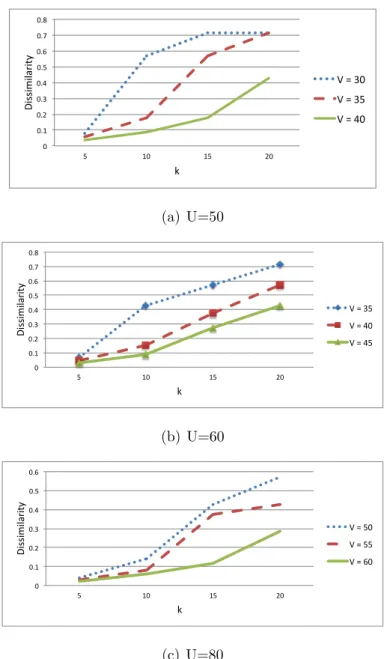
parameters . . . 45 4.5 Histograms that compare the number of 0’s coinciding in k
queries with a common search term and those with no common search term where U=60 and V=40 . . . 48 4.6 Number of 0’s in each bit location for 500 genuine and 500
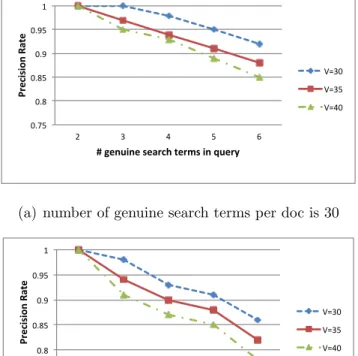
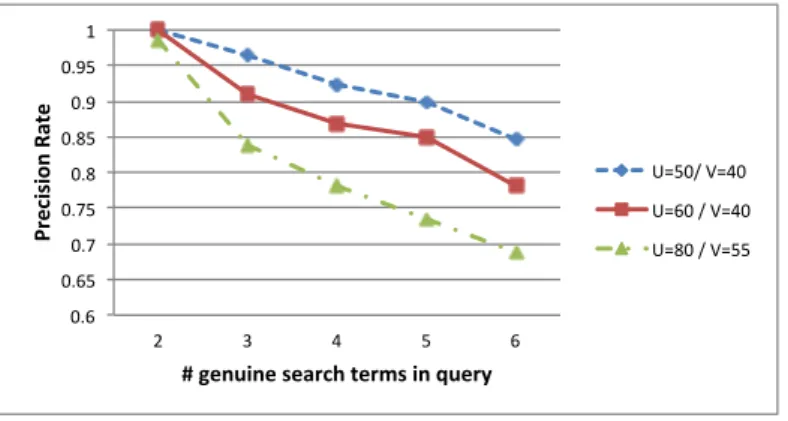
fake entries (for (c)) . . . 50 4.7 Effect of V in precision rate, whereU = 60 . . . 52 4.8 Effect of increase in the total number of keywords (m+U) per
document on HMAC size (l) and index entry size (r) . . . 53 4.9 Precision comparison, where number of genuine search terms
per document ism = 40 . . . 54 4.10 pF values with respect to V0, where U = 60 and V = 40 . . . . 58 4.11 Timing results . . . 78 5.1 Framework of the model with a single server . . . 84
5.2 Success Rates as λ change for t = 15 . . . 96 5.3 Impact of number of keywords in a query andton the precision
(a) and recall (b) rates . . . 97 5.4 Timings for index construction for λ= 150 . . . 98 5.5 The framework of the method with two non-colluding servers . 100 5.6 Precision rates, where η is 2, 3 and 4 with various λ values . . 128 5.7 Recall rates, where η is 2, 3 and 4 with variousλ values . . . 129 5.8 Precision and recall rates, where t% of documents with
non-zero scores are retrieved . . . 131 5.9 Timing results for index generation as data set size changes
for various λ values . . . 132 5.10 Timing results for the search operation as data set size changes
List of Tables
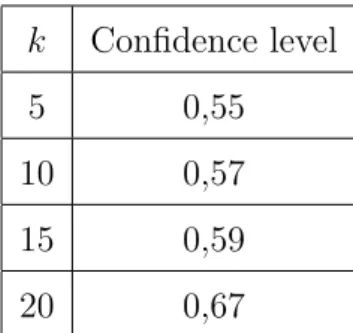
4.1 Confidence levels of identifying queries featuring the same search term . . . 49 4.2 Number of matching documents per level . . . 67 4.3 Communication costs incurred by each party (in bits) . . . . 75 4.4 Computation costs incurred by each party . . . 76 5.1 Pc¯(i) for different φ values . . . 117
List of Algorithms
1 Index Generation . . . 31
2 Query Generation . . . 34
3 Ranked Search . . . 65
4 Single Server Index Generation . . . 89
5 Single Server Query Generation . . . 90
6 Single Server Document Retrieval . . . 93
7 Two Server Index Generation . . . 108
8 Two Server Query Generation . . . 110
9 Two-Server Secure Search and Document Retrieval . . . 111
Chapter 1
INTRODUCTION
The data storage requirements increase as huge amounts of data need to be accessible for users. The associated storage and communication requirements are a huge burden on organizations, which show, a strong proclivity of out-sourcing their data to remote servers. Outout-sourcing data to clouds provides effective solutions to users that have limited resource and expertise for stor-age and distribution of huge data at low costs. However, data outsourcing engenders serious privacy concerns. Protecting the privacy is an essential re-quirement, since the cloud providers are not necessarily trusted. Therefore, some precautions are required to protect the sensitive data from both the cloud server and any other non-authorized party.
Cloud computing has the potential of revolutionizing the computing land-scape. Indeed, many organizations that need high storage and computational power tend to outsource their data and services to clouds. Clouds enable its customers to remotely store and access their data by lowering the cost of hardware ownership while providing robust and fast services [1]. It is ex-pected that by 2015, more than half of Global 1000 enterprises will utilize external cloud computing services and by 2016, all Global 2000 will benefit
from cloud computing to a certain extent [2].
1.1
Motivation
While its benefits are welcomed in many quarters, some issues remain to be solved before a wide acceptance of cloud computing technology. The security and privacy of remote data, are among the most important issues, if not the most important. Particularly, the importance and necessity of privacy-preserving search techniques are even more pronounced in the cloud applications. The large companies that operate the public clouds like Google Cloud Platform [3], Amazon Elastic Compute Cloud [4] or Microsoft Live Mesh [5] may access the sensitive data such as search and access patterns. Hence, hiding the query and the retrieved data has great importance in ensuring the privacy and security of those using cloud services. A trivial approach can be encrypting the data before sharing with the cloud. However, the advantage of the cloud data storage is completely lost if data cannot be selectively searched and retrieved. Unfortunately, off-the-shelf private key encryption methods are not suitable for applying search over cipher-text.
One of the most important operations on the remote data is the secure search operation. Although there are several approaches for searchable en-cryption, the basic setting is almost the same for all. There is a set of authorized users and a single or multiple semi-trusted servers. The data is assumed to be accessible to the authorized users. Due to the sensitive nature of the documents, the users do not want the server or other users to learn the content of their documents. Moreover, due to the number of users, the search operations can be executed very frequently. Hence, the search opera-tion should not only protect the privacy of the users and the data but also
should be highly efficient.
To facilitate search on encrypted data, an encrypted index structure (i.e., secure index) is stored in the server along with the encrypted data. The authorized users have access to a trapdoor generation function which enables them to generate valid trapdoors for any arbitrary keyword. This trapdoor is used in the server to search for the intended keyword. It is assumed that the server does not have access to the trapdoor generation function, and therefore, can not ascertain the keyword searched for. We assume all the entities in the system are semi-honest and do not collude with each other.
Considering the large data set sizes, a single keyword search query usually matches with lots of data items, where only few are relevant. Moreover, users need to apply several queries and take the intersection of the corresponding results, which impose a serious burden of both computation and time on the user. A multi-keyword search, instead can incorporate a conjunction of several keywords in a single query. Moreover, instead of returning undiffer-entiated results, the matching results can further be ranked according to the relevancy to the query. By increasing the search constraints and applying ranking, only the most relevant items will be returned to the user, which reduces both the computation and communication burden on user.
A typical scenario that benefits from our proposal is that a company out-sources its document server to a cloud service provider. Authorized users or customers of the company can perform search operations using certain keywords on the cloud to retrieve the relevant documents. The documents may contain sensitive information about the company, and similarly, the keywords that the users search may give hints about the content of the doc-uments hence, both must be hidden. Furthermore, the queried keywords themselves may reveal sensitive information about the users as well, which
is considered to be a privacy violation by users if learned by others.
In this thesis, we propose two different novel privacy-preserving and effi-cient multi-keyword search methods. The both methods return the matching data items in a rank-ordered manner.
1.2
Contributions
This thesis presents two novel multi-keyword search methods for applying secure search over encrypted cloud data. The design of a secure search (i.e., searchable encryption) method is challenging since it must satisfy strict pri-vacy requirements while still being highly efficient.
The major results of this thesis are summarized as follows:
• We adapt some of the existing formal definitions for the security and privacy requirements of keyword search on encrypted cloud data for our problem and also introduce some new privacy definitions.
• We propose two multi-keyword search schemes. The first one is based on keyed cryptographic hash functions. The second one is based on locality sensitive hashing (LSH) (i.e., MinHash), which ensures privacy and security requirements in the most strict sense.
• We utilize ranking approaches for the both search methods that base on term frequencies (tf) and inverse document frequencies (idf) of the keywords. The proposed ranking approaches prove to be efficient to implement and effective in returning documents highly relevant to the submitted queries.
• We apply the search method on a two server setting that averts correla-tion of a query with the corresponding matching document identifiers.
• For theMinHash based search method, we utilize a novel approach that reduces the number of encryption and the communication overhead by more than 50 times through combining several encryption in a single cipher-text.
• We provide formal proofs that the proposed methods are privacy-preserving in accordance with the defined requirements.
• We implement the proposed schemes and demonstrate that it is efficient and effective by experimenting with both real and synthetic data sets.
1.3
Outline
The organization of this thesis is as follows: The literature on secure search is reviewed in detail in Chapter 2, . In Chapter 3, we examine the related well known topics that are going to be used throughout the thesis. In Chapter 4, we introduce our first secure keyword search approach that is based on HMAC functions. The experimental results and security proofs of this approach are also provided in this chapter. In Chapter 5, we provide yet another secure search method which is based on locality sensitive hash (LSH) functions. We propose two different models in this LSH based method. The first one is a single server method which is very efficient but has some security flows. The second one, two server model, provides better security requirements but it is slower than the single server model due to required homomorphic encryption operations. The formal security analysis and extensive cost analysis of both single and two server models are provided in this section. Finally, in Chapter 6 we conclude the thesis.
Chapter 2
RELATED WORK
Privacy-preserving search over encrypted data and searchable encryption methods have been extensively studied in recent years. A trivial approach is sending a copy of the entire encrypted data set to the user and let the user does the search. This trivial approach provides information theoretic privacy since the server cannot learn any information about the searched keywords or accessed files. Nevertheless, this approach brings an enormous computation burden on the user and do not benefit from the utilities of cloud comput-ing. Any useful method for search over encrypted data must provide better efficiency compared to the trivial approach.
There are three main models in search over encrypted data methods [6]. The first model is the vendor system. In this scenario, the data stored on a server is public, but the user wants to apply search without revealing the in-formation on the data accessed, to the server administrator. Private Informa-tion Retrieval (PIR) protocols provide soluInforma-tions for this scenario [7, 8, 9, 10]. The problem of PIR was first introduced by Chor et al. [7]. Later, Groth et al. [11] propose a multi-query PIR method with constant communication rate. However, the computational complexity of the server in this method is
very inefficient to be used in large databases. On the other hand, PIR does not address as to how the user learns which data items are most relevant to his inquiries.
The second scenario is the store and forward system, where a user can apply search over the data which is encrypted under the user’s public key. This scenario is suitable for secure email applications, where the senders know the receivers’ public keys. A public key encryption with keyword searching (PEKS) scheme for this scenario, was first proposed by Boneh et al. [12]. Several subsequent improvements on the PEKS method are proposed [6, 13, 14, 15]; both for single and conjunctive keyword search settings.
The third model is the public storage system (i.e., database outsourcing scenario), where a user outsources his sensitive data to a remote server in an encrypted form. Several authorized users can then apply search over the encrypted data, without leaking any sensitive information about the queried keywords to the remote database administrator. In this thesis, we consider the public storage system scenario.
Related work for this scenario can be analyzed in two major groups: single keyword and multi-keyword search. While the user can only search for a single feature (e.g., keyword) per query in the former, the latter enables search for a conjunction of several keywords in a single query.
Most of the privacy-preserving keyword search protocols existing in the literature provide solutions for single keyword search. Goh [16] proposes a se-curity definition for formalization of the sese-curity requirements of searchable symmetric encryption schemes. One of the first privacy-preserving search protocols is proposed by Ogata and Kurosawa [17] using RSA blind signa-tures. The scheme is not very practical due to the heavyweight public key operations per database entry that should be performed on the user side.
Later, Curtmola et al. [18] provides adaptive security definitions for privacy-preserving keyword search protocols and proposes a scheme that satisfies the requirements given in the definitions. Another single keyword search scheme is proposed by Wang et al. [19] that keeps an encrypted inverted index to-gether with relevancy scores for each keyword-document pair. This method is one of the first work that is capable of ranking the results according to their relevancy with the search term. Recently, Kuzu et al. [20] proposed an-other single keyword search method that uses locality sensitive hashes (LSH) and satisfies adaptive semantic security. Different from the other work, this scheme is a similarity search scheme, which means that matching algorithm works even if typos exist in the query.
All the work that are given above, are only capable of conducting single keyword search. However, in the typical case of search over encrypted data for public storage system scenario, the size of the outsourced data set is usually huge and single keyword search will inevitably return an excessive number of matches, where most will be irrelevant for the user. Multi-keyword search allows more constraints in the search query and enables the user to access only the most relevant data. Raykova et al. [21] proposed a solution using a protocol called re-routable encryption. They introduce a new agent called query router (QR) between the user and the server. User sends the queries to the server through the QR to protect his anonymity with respect to the server. Security of the user’s message with respect to the QR is satisfied by confidentiality (i.e., encryption). They utilize bloom filters for efficient search. Although this work is presented as a single keyword search method, the authors also show a trivial multi-keyword extension. Wang et al. [22] proposed a multi-keyword search scheme, which is secure under the random oracle model. The method uses a hash function to map keywords into a fixed
length binary array. Later, Cao et al. [23] proposed another multi-keyword search scheme that encodes the searchable database index into two binary matrices and uses inner product similarity during matching. This method is inefficient due to huge matrix operations and it is not suitable for ranking.
Bilinear pairing based solutions for privacy-preserving multi-keyword search are also presented in the literature [15, 24, 25]. In contrast to other keyword search solutions that are based on either hashing or matrix multi-plications, the results returning from bilinear pairing based solutions are free from false negatives and false positives (i.e., only the correct results return). However, computation costs of pairing based solutions are prohibitively high both on the server and on the user side. Moreover, bilinear pairing based schemes provide neither any additional privacy for hiding access or search patterns of users, nor any solution for ranking the matching results accord-ing to their relevancy with the queries. Therefore, pairaccord-ing based solutions are not practical for many applications.
The privacy definition for almost all of the existing efficient privacy-preserving search schemes, proposed for the public storage system, allows the server to learn some information due to efficiency concerns. Although the data is encrypted, it may not always ensure privacy. If an adversary can observe a user’s access pattern (i.e., which items are accessed) to an encrypted storage, some information about the user can still be learned. In the case, there is a need for hiding the access patterns, Oblivious RAM [26] methods can be utilized for the document retrieval process. Oblivious RAM hides the access pattern by continuously applying a re-order process on the memory as it is being accessed. Since in each access, the memory location of the same data is different and independent of any previous access, the access pattern is not leaked. However the Oblivious RAM methods are not
practical even for medium sized data sets due to incurred polylogarithmic overhead. Specifically, in real world setups ORAM yields execution times of hundreds to thousands of seconds per single data access [26]. Recently Stefanov et al. [27] present a simple Oblivious RAM protocol with a small amount of client storage, named Path ORAM. The method Path ORAM re-quires log2N/logXbandwidth overhead for block sizeB =XlogN, which is asymptotically better than the best known ORAM scheme with small client storage for block sizes bigger than Ω(log2N).
Chapter 3
PRELIMINARIES
The fundamental problem of search over encrypted data is examining the similarity between queries and encrypted data items. We use two different encryption methods, homomorphic encryption and PCPA-secure encryption, for ensuring the privacy of the data. Similarly two different hash functions, MinHash and HMAC, are used to deduce a similarity between secure index entries of the sensitive data and an encrypted query. We also utilize some of the well-known metrics used in information systems to estimate the order of relevancy of the matching results. In this Chapter, we present the definitions and the basics of these techniques.
3.1
Homomorphic Encryption
Homomorphic encryption is a type of encryption that allows some opera-tions on the ciphertext, where the result of the operation is an encrypted version of the actual result. For instance, two numbers, encrypted with ho-momorphic property, can be securely added or multiplied without revealing the unencrypted individual numbers.
Homomorphic encryption schemes are suitable for various applications such as e-voting, multi-party computation and secure search. Due to the importance of the homomorphic property, several partially or fully morphic cryptosystems are proposed in the literature. While partially homo-morphic encryptions provide either addition or multiplication operation, fully homomorphic systems can provide both at the same time but less efficiently. We present some homomorphic cryptosystems in the following sections.
3.1.1
Unpadded RSA
In the RSA encryption [28] method, if the public key modulus is m, the exponent is e and the private message is x ∈ Zm, the encryption is defined as:
Enc(x) = xe mod m
The homomorphic property is then,
Enc(x1)·Enc(x2) = xe1x e 2 modm = (x1 ·x2)e mod m =Enc(x1·x2).
3.1.2
Paillier
In the Paillier cryptosystem [29], if the public key modulus ismand the base is g and the private message isx∈Zm, the encryption is defined as:
Enc(x) = gx·rc mod m2,
where r∈Z∗
m is randomly chosen.
• Enc(x1)·Enc(x2) =Enc(x1+x2)
• Enc(x1)x2 =Enc(x1·x2)
These homomorphic properties can be shown as,
Enc(x1)·Enc(x2) = (gx1 ·rm1 )(g x2 ·rm 2 ) mod m 2 =gx1+x2 ·(r 1r2)m modm2 =Enc(x1+x2 mod m). Enc(x1)x2 = (gx1 ·r1m) x2 modm2 =gx1·x2·(rx2 1 ) m modm2 =gx1·x2·(r 3)m mod m2 =Enc(x1·x2 mod m).
The Paillier cryptosystem provides semantic security against chosen-plaintext attacks. Intuitively, given the knowledge of the ciphertext (and length) of some unknown message, it is not feasible to extract any additional informa-tion on the message.
3.1.3
Damgard-Jurik
The Damgard-Jurik [30] cryptosystem is a generalization of the Paillier cryp-tosytem, where the modulus is ms+1 instead of m2 for some s ≥ 1. If the
public key modulus ismand the base isgand the private message isx∈Zms,
the encryption is defined as:
Enc(x) = gx·rms mod ms+1,
where r∈Z∗
The homomorphic property is then, Enc(x1)·Enc(x2) = (gx1 ·rm s 1 )(g x2 ·rms 2 ) mod m s+1 =gx1+x2 ·(r 1r2)m s modms+1 =Enc(x1+x2 mod ms).
3.1.4
Fully Homomorphic Encryption
The homomorphic encryption methods given above provide either additive or multiplicative homomorphic property. The cryptosystems that supports both additive and multiplicative homomorphic encryption are known as fully homomorphic encryption. These methods are very powerful such that any circuit can be homomorphicly evaluated without revealing any of the the unencrypted parameters.
The first fully homomorphic encryption system is proposed by Craig Gen-try [31] which utilizes lattice-based cryptography. Later some subsequent work [32, 33] are proposed on fully homomorphic encryption systems, how-ever, any of the proposed fully homomorphic encryption methods is very costly and not suitable for many practical applications.
In this thesis, we use the Paillier cryptosystem (Section 3.1.2) as the homomorphic encryption method.
3.2
PCPA-Secure Encryption
A symmetric encryption method is secure against chosen plaintext attacks if the encrypted outputs (i.e., ciphertexts) do not reveal any useful information on the unencrypted messages (i.e., plaintexts). Curtmola et al. [18] defines a stronger security notion as pseudo-randomness against chosen plaintext
attacks (PCPA), that guarantees the ciphertexts are indistinguishable from random numbers. Formally, PCPA-security is defined as follows[18].
Definition 1. PCPA-security
Let two ciphertexts c0 and c1 are generated as follows:
c0 =Enc(msg)
c1 ∈RC, where C denotes the ciphertext space.
A bit b is chosen at random, given msg and cb, adversary A guesses the
value of b as b0.
The encryption method is said to be PCPA-secure if for all polynomial-size adversaries A,
P r[b0 =b]≤ 1
2+negl,
where negl is a negligible value.
PCPA-security satisfies a slightly stronger security compared to indis-tinguishability against chosen-keyword attacks (IND2-CKA), introduced by Goh [16]. While IND2-CKA provides indistinguishability between two ci-phertexts, PCPA provides indistinguishability between a ciphertext and a random number.
3.3
Hash Functions
In secure search concept, the search is applied on a secure index instead of the actual documents, where the details are explained in the subsequent sections. We utilize special hash functions to deduce a similarity between the secure index entries of the sensitive data and an encrypted query. Each data item
is represented by an entry in the secure index. The important property of the secure index is that, it should be possible to compare two index elements and estimate a distance between them without leaking any other information. Although the exact similarity cannot be deduced, they still provide a good approximation. Moreover, the accuracy of the similarity further increases as hash functions with larger output size are used. We utilize the Hash-based Message Authentication Code (HMAC) and the MinHash functions in this thesis.
3.3.1
Hash-based Message Authentication Code
In cryptography a hash-based message authentication code (HMAC) [34] is used for constructing a fix sized message authentication code utilizing a cryp-tographic hash function and a secret crypcryp-tographic key. The crypcryp-tographic strength of the HMAC depends upon the cryptographic strength of the un-derlying hash function, the size of its hash output, and the size of the secret key. In this thesis, we use SHA based HMAC functions for the HMAC based secure search method.
3.3.2
MinHash
In the MinHash based method we proposed, a well-known technique, called locality sensitive hashing [35] is used. Each document is represented by a small set called signature. The important property of signatures is that, it should be possible to compare two signatures and estimate a distance between the underlying documents from the signatures alone. The signatures are composed of several elements, each of which is constructed using the MinHash functions. They provide close estimates and the larger the signatures the more accurate the estimates.
To MinHash a set, pick a permutation of the rows. The MinHash value is the number of the first row in the permuted order, in which the corresponding element is in the set. The formal definition is as follows.
Definition 2. MinHash: Let ∆ be a finite set of elements, P be a permu-tation on ∆and P[i] be the ith element in the permutationP. MinHash of a set D⊆∆ under permutation P is defined as:
hP(D) =min({i|1≤i≤ |∆| ∧ P[i]∈D})
In the proposed MinHash based method, for each signature, λ different random permutations on ∆ are used so the final signature of a set D is:
Sig(D) = {hP1(D), . . . , hPλ(D)},
where hPj is the MinHash function under permutation Pj. We use the
Min-Hash signatures as an approximation method that maps the given items into several buckets (λ) using different hash functions. The functions are chosen such that while similar items are likely to be mapped into the same buckets, dissimilar items are mapped to different buckets with high probability.
3.4
Distance Functions
A distance function is a metric used for describing the notion of closeness for elements of some space. A distance function d, on a set X is a function
X×X →R.
For allx, y, z ∈X, this function is required to satisfy the following conditions: 1. d(x, y)≥0 (non-negativity)
2. d(x, y) = 0⇔x=y (identity of indiscernibles) 3. d(x, y) = d(y, x) (symmetry)
4. d(x, z)≤d(x, y) +d(y, z) (triangle inequality)
We use two well-known distance functions in this thesis.
3.4.1
Hamming Distance
The Hamming distance between two strings of equal length, is defined as the number of symbols in which they differ [36]. Intuitively, it measures the minimum number of substitutions required to change one string into the other one.
In this thesis we use the Hamming distance on binary strings.
Example 1. Let x and y are “1011101” and “1001001” correspondingly. Then the Hamming distance between x and y, d(“1011101”,“1001001”) = 2
3.4.2
Jaccard Distance
The Jaccard distance is a metric that measures the dissimilarity between two sets. Intuitively, the Jaccard distance is the ratio of the number of different elements in the two sets to the union.
Formally, the Jaccard distance between the sets A and B is defined as:
Jd(A, B) = 1−
|A∩B|
|A∪B| (3.1)
= |A∪B| − |A∩B| |A∪B| .
3.5
Relevancy Score
In order to sort the matching results according to their relevancy with the query, a similarity function is required. The similarity function assigns a relevancy score to each of the matching results corresponding to a given search query.
Four fundamental metrics are widely used in information systems for calculating relevancy [37]:
• Term frequency(tfw,D) is defined as the number of times a keyword
w appears in a document D. Higher term frequency implies that the document is more relevant to queries that contains the corresponding keyword w.
• Inverse document frequency measures rarity of a keyword within the database collection. Intuitively a keyword that is rare within the database but common in a document results in a higher relevancy. The inverse document frequency of a keyword w is obtained as:
idfw = log
|D|
dfw
where|D|is the total number of document entries and dfw is document frequency of w (i.e., total number of documents containing w).
• Document length (Density), results in a higher score for the shorter of the two documents which contain equal number of keywords.
• Completenessresults in a higher score for the documents that contain more keywords.
A commonly used weighting factor for information retrieval is the tf-idf weighting [37]. Intuitively, it measures the importance of a keyword within
a document for a database collection. The weight of each keyword in each document is calculated using the tf-idf weighting scheme that assigns a com-posite weight using both term frequency (tf) and inverse document frequency (idf) information. The tf-idf of a keyword w in a document D is given by:
tf-idfw,D = tfw,D ×idfw.
Note that, the ratio inside the idf’s log function is always greater than or equal to 1, hence, the value of idf is greater than or equal to 0. Consequently, the resulting tf-idf is a real number greater than or equal to 0.
3.6
Success Rate
Two of the best metrics for analyzing the success of a search method are the precision and recall metrics, which are widely used in the secure search literature [20, 23, 38]. LetR(F) be the set of items retrieved for a query with feature setF andR∗(F) be a subset ofR(F) such that, the elements ofR∗(F) include all the features inF. Further let D(F) be the set of items in the data set that contains all the features inF. Note thatR∗(F)⊆R(F) andR∗(F)⊆
D(F). Precision (prec(F)), recall (rec(F)), average precision (aprec(F)) and average recall (arec(F)) for a setF ={F1, . . . , Fn} are defined as follows:
prec(F) = ||RR∗((FF))||, aprec(F) = Pn i=1 prec(Fi) n (3.2) rec(F) = ||RD∗((FF))||, arec(F) =Pn i=1 rec(Fi) n (3.3)
The methods compare the expected and the actual results of the evaluated system. Intuitively, precision measures the ratio of correctly found matches over the total number of returned matches. Similarly recall measures the ratio of correctly found matches over the total number of expected results.
Chapter 4
HMAC-BASED SECURE
SEARCH METHOD
In this chapter, we propose an efficient system where any authorized user can perform a search on an encrypted remote database with multiple key-words, without revealing neither the queried keykey-words, nor the information of the documents that match with the query. The only information that the proposed scheme leaks is the access pattern which is also leaked by almost all of the practical encrypted search schemes due to efficiency reasons.
Wang et al. [22] propose a trapdoorless private multi-keyword search scheme that is proven to be secure under the random oracle model. The scheme uses only binary comparison to test whether the secure index contains the queried keywords, therefore, the search can be performed very efficiently. However, there are some security issues that are not addressed in the work of Wang et al. [22]. We adapt their indexing method to our scheme, but we use a different encryption methodology to increase the security and address the security issues that are not considered in [22]. While a preliminary version of the work introduced in this chapter, is presented in the EDBT/ICDT
conference [39], the full version of the work is published in the journal of Distributed and Parallel Databases [40].
4.1
System and Privacy Requirements
The problem that we consider is privacy-preserving keyword search on public storage system, where the documents are simply encrypted with the secret keys unknown to the actual holder of the database (e.g., cloud server). We consider three roles consistent with the previous works [23, 22]:
• Data Controller is the actual entity that is responsible for the estab-lishment of the database. The data controller collects and/or generates the information in the database and lacks the means (or is unwilling) to maintain/operate the database.
• Users are the members in a group who are entitled to access (part of) the information of the database.
• Serveris a professional entity (e.g., cloud server) that offers information services to authorized users. It is often required that the server be oblivious to the content of the database it maintains, the search terms in queries and the documents retrieved.
LetDi be a document in the sensitive databaseD, andFi ={w1, . . . , wm} be the set of features (i.e., keywords) that characterizesDi. Initially, the data controller generates a searchable secure indexI, using the feature sets of the documents in D and sends I to the server. Given a query from the user, the server applies search over I and returns a list of ordered items. Note that this list does not contain any useful information to the third parties. Upon receiving the list of ordered items, the user selects the most relevant
data items and retrieves them. The details of the framework are presented in Section 4.2.
The privacy definition for search methods in the related literature is that, the server should not learn the searched terms [23]. We further tighten the privacy over this general privacy definition and establish a set of privacy requirements for privacy-preserving search protocols. A privacy preserving multi-keyword search method should provide the following user and data privacy properties (first intuitions and then formal definitions are given):
1. (Query Privacy) The query should not leak information of the corre-sponding search terms it contains.
2. (Search Pattern Privacy) Equality between two search requests (i.e., queries) should not be verifiable by analyzing the queries or the re-turned list of ordered matching results.
3. (Access Control) No one can impersonate a legitimate user.
4. (Adaptive Semantic Security) All the information that an adversary can access, can be simulated using the information that is allowed to leak. Hence, it is guaranteed that the only information leaks in the proposed method, is the one that is is told to be leaked.
An algorithmAis probabilistic polynomial time (PPT) if it uses random-ness (i.e, flips coins) and its running time is bounded by some polynomial in the input size or a polynomial in a security parameter. In cryptography, an adversary’s advantage is a measure of how successfully it can attack a cryp-tographic algorithm, by distinguishing it from an idealized version of that type of algorithm.
Definition 3. Query Privacy: A multi-keyword search protocol has query privacy, if for all probabilistic polynomial time adversaries A that, given two different feature sets F0 and F1 and a query Qb generated from the feature
set Fb, where b ∈R{0,1}, the advantage of A in finding b is negligible. Definition 4. Access Control: A multi-keyword search protocol provides access control, if there is no adversary A that can impersonate a legitimate user with probability greater than , where is the probability of breaking the underlying signature scheme.
Definition 5. Search Pattern (Sp)is the frequency of the queries searched,
which is found by checking the equality between two queries. Formally, let
{Q1, . . . , Qn}be a set of queries and{F1, . . . , Fn}be the corresponding search feature sets. Search pattern Sp is an n×n binary matrix, where
Sp(i, j) = 1, if Fi =Fj, 0, otherwise for i, j ≤n.
Intuitively, any deterministic query generation method reveals the search pattern.
Definition 6. Search Pattern Privacy: A multi-keyword search protocol has search pattern privacy, if for all polynomial time adversaries A that, given a query Q, a set of queries, Q ={Q1, . . . , Qn} and the corresponding
match results that returns, the adversary cannot find the queries in Q that are equivalent with Q.
Definition 7. Access Pattern (Ap) is the collection of data identifiers
and R(Fi) be the collection of identifiers of data elements that matches with
the feature set Fi, then Ap(Qi) =R(Fi).
Intuitively, if access pattern is leaked, given a query Q of a feature set
F, an attacker does not learn the content of F but learns which are the documents in the data set that contains the features in F.
Definition 8. History (Hn): Let D be the collection of documents in the
data set and Q = {Q1, . . . , Qn} be a collection of n queries. The n-query history is defined as Hn(D,Q).
Definition 9. Trace (γ(Hn)): LetC ={C1, . . . , Cl}be the set of encrypted user profiles, id(Ci) be the identifier ofCi and|Ci|be the size ofCi.
Further-more, let Dsig(Qi) be the digital signature of queryQi, |Dsig(Qi)| be the size
of Dsig(Qi), I be the searchable index and |I| be the number of all elements,
fake and genuine, in I.
The trace of Hn is defined as:
γ(Hn) = {(id(C1), . . . , id(Cl)),(|C1|, . . . ,|Cl|),|Dsig(Q)|,|I|, Ap(Hn)}. (4.1) We allow to leak the trace to an adversary and guarantee no other infor-mation is leaked.
Definition 10. View (v(Hn)) is the information that is accessible to an
adversary. Let Dsig(Q) be the list of digital signatures of queries in Q and,
id(Ci), C, Q and I are as defined above. The view of Hn is defined as:
v(Hn) ={(id(C1), . . . , id(Cl)), C,I,Q,Dsig(Q)}. (4.2) Definition 11. Adaptive Semantic Security: [18]
A cryptosystem is adaptive semantically secure, if for all probabilistic polynomial time algorithms (PPTA), there exists a simulator S such that, given the trace of a history Hn,S can simulate the view ofHnwith probability 1−, where is a negligible probability.
Intuitively, all the information accessible to an adversary (i.e., view (v(Hn))) can be constructed from the trace (γ(Hn)) that is allowed to leak.
4.2
Framework of the HMAC-based Method
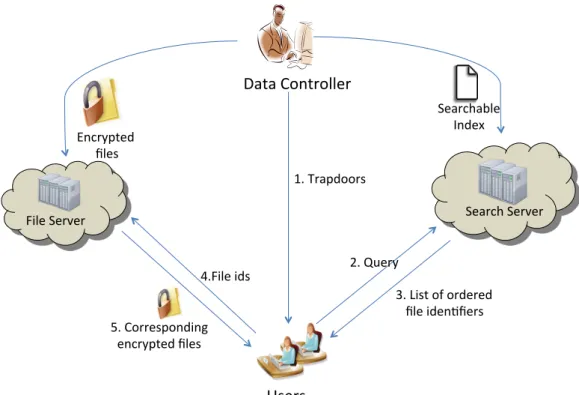
In this section, we provide the interactions between the three entities that we consider: Data Controller, Users and Server, which are introduced in Section 4.1. Due to the privacy concerns that are explained in Section 4.3.4, we utilize two servers namely: search server and file server. The overview of the proposed system is illustrated in Figure 4.1. We assume that the parties are semi-honest (“honest but curious”) and do not collude with each other to bypass the security measures; two assumptions which are consistent with most of the previous work.
In Figure 4.1, steps and typical interactions between the participants of the system are illustrated. In an off-line stage, the data controller creates a search index element for each document. The searchable index file I is cre-ated using a secret key based trapdoor generation function where the secret keys1 are only known by the data controller. Then, the data controller up-loads the searchable index file to the search server and the actual encrypted documents to the file server. We use symmetric-key encryption as the encryp-tion method since it can handle large document sizes efficiently. This process is referred as the index generation henceforth and the trapdoor generationis
Encrypted files
Searchable Index
2. Query
3. List of ordered file iden=fiers Data Controller Users Search Server File Server 1. Trapdoors 4.File ids 5. Corresponding encrypted files
considered as one of its steps.
When a user wants to perform a search, he first connects to the data con-troller. He learns the trapdoors (cf. Step 1 in Figure 4.1) for the keywords (i.e., features) he wants to search for, without revealing the keyword infor-mation to the data controller. Since the user can use the same trapdoor for many queries containing the corresponding features, this operation does not need to be performed every time the user performs a query. Alternatively, the user can request all the trapdoors in advance and never connects again to the data controller for the trapdoors. One of these two methods can be selected depending on the application and the users’ requirements. After learning the trapdoor information, the user generates the query (referred as
query generationhenceforth) and submits it to the search server (cf. step 2 in Figure 4.1). In return, he receives meta data2 for the matched documents in a rank ordered manner as will be explained in subsequent sections. Then the user retrieves the encrypted documents from the file server after analyzing the meta data that basically conveys a relevancy level of the each matched document, where the number of documents returned is specified by the user. The proposed scheme satisfies the privacy requirements as defined in Sec-tion 4.1 provided that the parameters are set accordingly. For an appropriate setting of the parameters, the data controller needs to know only the frequen-cies of the most commonly queried search terms for a given database. By performing a worst case analysis for these search terms, the data controller can estimate the effectiveness of an attack and take appropriate countermea-sures. The necessary parameters and the methods for their optimal selections are elaborated in the subsequent sections.
2Metadata does not contain useful information about the content of the matched
4.3
The HMAC-based Ranked Multi-Keyword
Search
In this section, we provide the details for the crucial steps in the proposed HMAC-based secure search method, namely index generation, trapdoor gen-eration, query generation and document retrieval.
4.3.1
Index Generation (basic scheme)
Recently Wang et al. [22] proposed a conjunctive keyword search scheme that allows multiple-keyword search in a single query. We inspire from the scheme in [22] and develop an index construction scheme with better privacy properties.
The original scheme uses forward indexing, which means that a searchable index file element for each document is maintained to indicate the search terms existing in the document. In the scheme of Wang et al. [22], a secret cryptographic hash function, that is shared between all authorized users, is used to generate the searchable index. Using a single hash function shared by several users forms a security risk since it can easily leak to the server. Once the server learns the hash function, the security of the model can be broken, if the input set is small. The following example illustrates a simple attack against queries with few search terms.
Example 2. There are approximately 25000 commonly used words in En-glish [41] and users usually search for a single or two keywords. For such small input sets, given the hashed trapdoor for a query, it will be easy for the server to identify the queried keywords by performing a brute-force attack. For instance, assuming that there are approximately 25000 possible keywords in a database and a query submitted by a user involves two keywords, there
will be 250002 < 228 possible keyword pairs. Therefore, approximately 227
trials will be sufficient to break the system and learn the queried keywords, if the underlying trapdoor generation function is known.
We instead propose a trapdoor based system where the trapdoors can only be generated by the data controller through the utilization of multiple secret keys. The keywords are mapped to a secret key using a public mapping function namedGetBinwhich is defined in Section 4.3.2. The usage of secret keys eliminates the feasibility of a brute force attack. The details of the index generation algorithm which is adopted from [22] are explained in the following and formalized in Algorithm 1.
Let D be the document collection where |D| = σ. While generating the search index entry for a document D ∈ D that contains the keywords {w1, . . . , wm}, we take HMAC (Hash-based Message Authentication Code) of
each keyword with the corresponding secret keyKidwhich produces anl =rd bit output (HMAC: {0,1}∗ → {0,1}l). Let x
i be the output of the HMAC function for an input wi and the trapdoor of a keyword wi be denoted asIi, where Iij represents the jth bit ofIi, (i.e., I
j
i ∈GF(2), where GF stands for Galois field [42]). The trapdoor of a keywordwi,Ii = (Iir−1, . . . , I
j
i, . . . , Ii1, Ii0) is calculated as follows.
Thel-bit output of HMAC,xi can be seen as anr-digit number in base-d, where each digit is d bits. Also let xji ∈ GF(2d) denotes the jth digit of xi and we can write
xi =xri−1, . . . x
1
i, x
0
i.
After this, each r-digit output is reduced to r-bit output with the mapping from GF(2d) to GF(2) as shown in Equation (4.3).
Iij = 0, if xji = 0, 1, otherwise. (4.3)
As a last step in the index entry generation, the bit-wise product of trap-doors of all keywords (Ii, ∀i ∈ {1, . . . , m}) in the document D is used to obtain the final searchable index entry ID for the document D as shown in Equation (4.4)
ID =mi=1Ii, (4.4)
where is the bit-wise product operation. The resulting index entry ID is an r-bit binary sequence and its jth bit is 1, if for all i, jth bit of Ii is 1, and 0 otherwise.
Algorithm 1 Index Generation
Require: D: the document collection,
Kid: secret key for the bin with label id
for all documents Di ∈ D do for all keywords wij ∈Di do
id← GetBin(wij) xij ←HMACKid(wij) Iij ←Reduce(xij) end for index entry IDi ← jIij end for return I ={ID1, . . . ,IDσ}
In the following section, we explain the technique used to generate queries from the trapdoors of feature sets.
4.3.2
Query Generation
The searchable index file of the database is generated by the data controller using secret keys. A user who wants to include a search term in his query, needs the corresponding trapdoor from the data controller since he does not know the secret keys used in the index generation. Asking for the trapdoor openly would violate the privacy of the user against the data controller, therefore a technique is needed to hide the trapdoor asked by the user from the data controller.
Bucketization is a well-known data partitioning technique that is fre-quently used in the literature [43, 44, 45, 46]. We adopt this idea to distribute keywords into a fixed number of bins depending on their hash values. More precisely, every keyword is hashed by a public hash function, and certain number of bits in the hash value is used to map the keywords into one of the bins. The number of bins and the number of keywords in each bin can be adjusted according to the security and efficiency requirements of the system. In our proposal for obtaining trapdoors, we utilize a public hash function with uniform distribution, named GetBin, that takes a keyword and returns a value in {0, . . . ,(δ−1)} where δ is the number of bins. All the keywords that exist in a document are mapped by the data controller to one of those bins using the GetBin function. Note that, δ is smaller than the number of keywords so that each bin contains several elements, which provides ob-fuscation. The GetBin function has uniform distribution, therefore each bin will have approximately equal number of items in it. Moreover, δ must be chosen deliberately such that there are at least$ items in each bin where$
is a security parameter. Each bin in the index generation phase has a unique secret key used for all keywords in that bin.
follows. When an authorized user connects to the data controller to obtain the trapdoors for a set of keywords, he first calculates the bin IDs of the keywords and sends these values to the data controller. The data controller then returns the secret keys of the bins requested for, which can be used by the user to generate the trapdoors3 for all keywords in those bins. Alterna-tively, the data controller can send the trapdoors of all the keywords in the corresponding bins resulting in an increase in the communication overhead. However, the latter method relieves the user from computing the trapdoors. Subsequent to obtaining the trapdoors, the user can calculate the query in a similar manner to the method used by the data controller to compute the searchable index. More precisely, if there are n keywords in a user query, the following formula is used to calculate the privacy-preserving query, given that the corresponding trapdoors (i.e., I1, . . . , In) are available to the user:
Q=n j=1Ij.
Finally, the user sends this r-bit query Q to the search server. The users’ keywords are protected against disclosure since the secret keys used in trapdoor generation are chosen by the data controller and never revealed to the search server. In order to avoid impersonation, the user signs the messages using a digital signature method.
4.3.3
Oblivious Search on the Database
A user’s query, in fact, is just an r-bit binary sequence (independent of the number of search terms in it) and therefore, searching consists of as simple operations as binary comparison only. If the search index entry of the
3In fact,I
i, which is calculated for the search termwi as explained in Section 4.3.1 is
Algorithm 2 Query Generation
Require: a set of query features F ={w01, . . . , w0n} for all w0i ∈F do
id ←GetBin(wi0)
if Kid∈/ previously received keys then send id to Data Controller
get Kid from Data Controller end if xi ←HMACKid(w 0 i) Ii ←Reduce(xi) end for query Q← iIi return Q
document (IR) has 0 for all the bits, for which the query (Q) has also 0, then the query matches to that document as shown in Equation (4.5).
result(Q,IR) = match, if ∀j Qj = 0 ⇒ IRj = 0,
not match, otherwise.
(4.5)
Note that, the given query should be compared with the search index entry of each document in the database. The following example clarifies the matching process.
Example 3. Let the user’s query be Q = [011101] and two document index entries be I1 = [001100] and I2 = [101101]. The query has the 0 bit in 0th and 4th bits therefore, those bits must be 0 in the index entry of a document in order to be a match. Here the query matches with I1, but does not match with I2 since0th bit of I2 is not 0.
Subsequent to the search operation, the search server sends a rank ordered list of meta data of the matching documents to the user, where the underlying rank operation is explained in Section 4.6. The meta data is the search index entry of that document, which the user can analyze further to learn more about the relevancy of the document. After analyzing the meta data, the user retrieves ciphertexts of the matching documents of his choice from the file server.
To improve security, the data controller can change the HMAC keys pe-riodically whereby each trapdoor will have an expiration time. After the expiration, the user needs to get the new trapdoors for the keywords he wants to use in his queries. This will alleviate the risk when the HMAC keys are compromised.
4.3.4
Document Retrieval
The search server returns the list of pseudo identifiers of the matching doc-uments. If a single server is used for both search and file retrieval, it can be possible to correlate the pseudo identifiers of the matching documents and the identifiers of the retrieved encrypted files. Furthermore, this may also leak the search pattern that the proposed method hides. Therefore, we use a two-server system similar to the one proposed in [20], where the two servers are both semi-honest and do not collude. This method leaks the access pattern only to the file server and not to the search server, hence prevents any possible correlation between search results and encrypted doc-uments retrieved.
Subsequent to the analyzes of the meta data retrieved from the search server, the user requests a set of encrypted files from the file server. The file server returns the requested encrypted files. Finally the user decrypts the files
and learns the actual documents. The distribution of the document decryp-tion keys can be performed using state-of-the-art key distribudecryp-tion methods and is not within the scope of this thesis.
In case access pattern also needs to be hidden, Oblivious RAM [47, 27] methods can be utilized for the document retrieval process instead. However, these methods are too expensive to be practical even on medium sized data-sets, due to incurred polylogarithmic overhead.
4.4
Query Randomization
Search pattern is the information of equality among the keywords of two queries that can be inferred by linking one query to another. If an adversary can test the equality among two queries, he may learn the most frequent queries and correlate with the frequently searched real keywords that may be learned from statistics such as Google Trends [48]. The proposed basic scheme fails to hide the search pattern since the search index entries are generated in a deterministic way. Any two query generated from the identical feature sets, will be exactly the same. In order to hide the search pattern of a user, we introduce randomness into the query generation phase. This process is known as query randomization, which should be carefully implemented so that the queries do not leak information about the search patterns. In this section, we analytically demonstrate the effectiveness of the proposed query randomization method. Note that, the query randomization does not change the response to a given query.
For introducing non-determinacy into the search index generation, we generate a set U with |U | = U, whereby the elements of U are dummy keywords that do not exist in the dictionary (i.e., they are simply random
strings). TheU dummy keywords are added in every index entry along with the genuine keywords. While generating a query, the user first randomly creates a setV where|V| =Vand V ⊂ U. Then the query is composed using all elements of V together with the genuine search terms. The number of different choices ofV fromU is calculated as CVU, where Cknis the number of
k-combinations from a set with n elements.
We can formalize the discussion as follows. Let Qi ={Qi1, Qi2, . . . , Qiµ}
be the set of queries that are generated from the same search features using different dummy keywords. Furthermore, let Qx be the set of all possible other queries. Given two queries Qi ∈ Qi and Qj, identifying whether Qj ∈ Qi orQj ∈ Qx must be hard.
We use the Hamming distance metric for evaluating the similarity of two queries, which is defined in Section 3.4.1. We define two new functions to analytically calculate the expected Hamming distance.
Definition 12. Scarcity Function (F(x)) The scarcity function F(x) is the expected number of 0’s in a query, where x is the number of keywords.
Definition 13. Overlap Function (C(x)) The overlap function C(x) is the expected number of 0’s that coincide in the corresponding bit positions of an x keyword query (Qa) and a single keyword query (Qb).
Recall that r is the size of a query, d is the reduction value (cf. Sec-tion 4.3.1) and Q[i] is the ith bit of Q. The functions are calculated as follows:
Proposition 1. For the Scarcity and Overlap functions we can write, F(x) =F(x−1) +F(1)−C(x−1) C(x) = r−1 X i=0 P(Qa[i] = 0, Qb[i] = 0),
where P(a, b) is a joint probability distribution.
Note that, the initial case for F(x) is F(1) = r
2d and C(x) is calculated as follows: C(x) = r−1 X i=0 P(Qa[i] = 0, Qb[i] = 0) =rF(x) r F(1) r = F(x) 2d .
The expected Hamming distance between two queries (i.e., Q1 and Q2)
withxkeywords each, where they have ¯x≤xcommon keywords, is calculated as in the following.
Proposition 2. The Expected Hamming distance between two queries with
¯
x common keywords, can be calculated as follows:
∆ (Q1, Q2) =
(F(x)−F(¯x)) (r−F(x))
r +
F(x)(r−F(x))
r .
This can be seen by the simple derivation: ∆ (Q1, Q2) = r−1 X i=0 P (Q1[i]6=Q2[i]) =r·P (Q1[1]6=Q2[1]) =r·[P (Q1[1] = 0)P (Q2[1] = 1|Q1[1] = 0) +P (Q1[1] = 1)P (Q2[1] = 0|Q1[1] = 1)] =r· F(x) r F(¯x) F(x) ·0 + F(x)−F(¯x) F(x) · r−F(x) r +r−F(x) r F(x) r = (F(x)−F(¯x)) (r−F(x)) r + F(x)(r−F(x)) r , (4.6)
where P(A|B) is the conditional probability of A given B.
Each query chooses V keywords out of U dummy keywords. While com-paring two arbitrary queries, the expected number of dummy keywords that exists in the both queries (EO) is calculated as in the following.
Proposition 3. The expected number of dummy keywords that both queries contain can be calculated as follows:
EO(V) = V X i=0 V i U−V V −i U V i. (4.7)
The first query chooses V keywords. The probability that i (i ≤ V) keywords that is chosen by the second query also exist in the first one, is calculated as follows: i keywords are chosen from the set of keywords that are also selected by the first query and (V −i) keywords are chosen from the set of not-selected keywords. Then we use summation to calculate the expected value in (Equation (4.7)). Note that, EO(V) is a monotonically increasing function (i.e., V ≥V0 ⇔EO(V)≥EO(V0)).
A possible way of choosing an optimum parameter setting is shown in the following example.
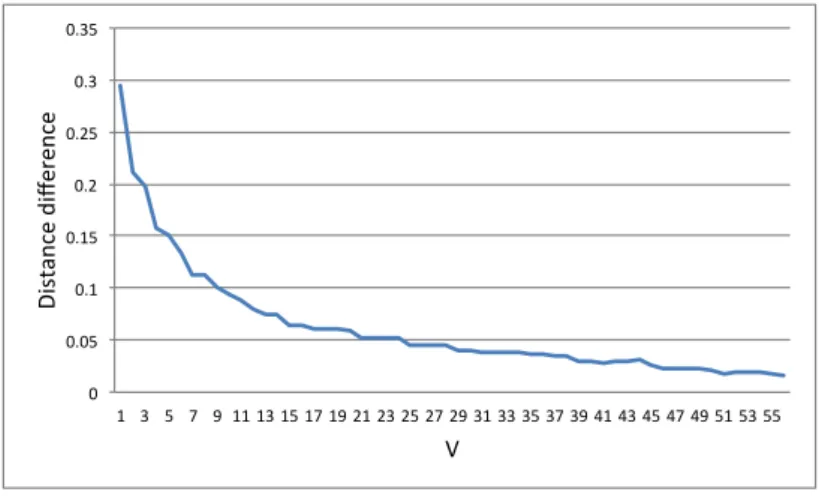
Example 4. We use 448 bits as the query size (r) and the largest U for this query size that provides sufficient accuracy (i.e., high precision rate; cf. Section 4.4.4) is found as 60. Any further increase inU necessitates increas-ing the query size, which causes an increase in communication, computation and storage requirements (cf. Section 4.8). Using the formulae in (Equa-tion (4.6) and (4.7)), the normalized differences between ∆(Qi, Qj) for two
in Figure 4.2. The normalized difference is calculated using the equation,
∆(Qi, Qj)−∆(Qiα, Qiβ) ∆(Qi, Qj)
.
One can observe from Figure 4.2 that, when U is fixed as 60, V = 30 is the smallest value, which ensures that the distance between the two queries
Qi ∈ Qi and Qj ∈ Qi/ is sufficiently close to the distance between Qiα ∈ Qi
and Qiβ ∈ Qi. Note that, any V ≥ 30 can also be used. The parameter
setting that we used in our tests, is discussed more formally in Section 4.8.
0 0.05 0.1 0.15 0.2 0.25 0.3 0.35 1 3 5 7 9 11 13 15 17 19 21 23 25 27 29 31 33 35 37 39 41 43 45 47 49 51 53 55 D is tan ce d iff er en ce V
Figure 4.2: Normalized difference of the Hamming Distances between two arbitrary queries and two queries with the same genuine search features, where U = 60.
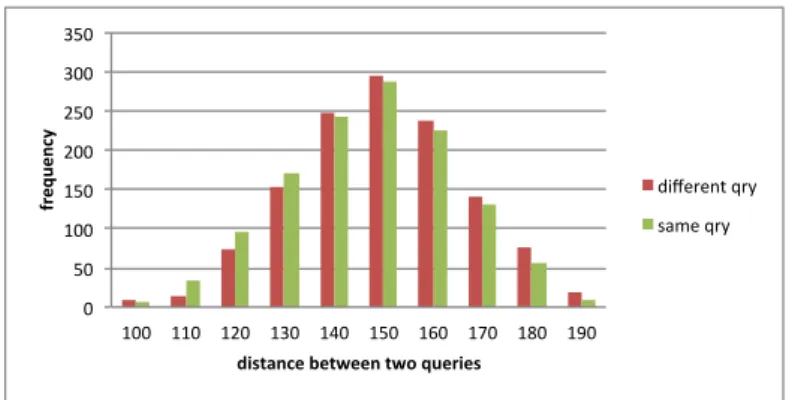
In order to demonstrate the usefulness of our analysis, we conducted an experiment using synthetic query data for the case, where adversary does not know the number of genuine search terms in a query. We generate a synthetic data set for a set of queries with the parameters V = 30 and U = 60 being fixed. The set contains a total of 250 queries, where the first 50 queries contain 2 genuine search terms each, the second 50 queries contain 3 genuine search terms each, and so on. And finally, the last set of 50 queries contains
6 genuine search terms each. We create another set that contains only 5 queries, which includes 2, 3, 4, 5 and 6 genuine search terms, respectively. The distances between pairs of queries, in which one query is chosen from the former set and the second one from the latter, are measured to obtain a histogram as shown in Figure 4.3(a). Consequently, a total of 250×5 = 1250 distances are measured. We also obtain another histogram featuring a total of 1250 distances between pairs of queries, whereby queries in a pair contain the same genuine search terms with different dummy keywords. Both histograms are given in Figure 4.3(a), where it can be observed that adversary cannot do better than a random guess to identify whether given two queries contain the same genuine search terms or not.
We also conduct a similar experiment, in which we assume that the ad-versary has the knowledge of the number of search terms in a query. A set containing a total of 1000 queries is generated, whose subsets with 200 queries each contain 2, 3, 4, 5 and 6 genuine search terms, respectively. A single query is then created using 5 genuine search terms. We measure the distances of the single query to all 1000 queries in the former set of queries and create the corresponding histogram (i.e., a total of 200×5 = 1000 distances are measured). We compared this with the histogram for 1000 measurements of the distance between two queries with five identical search terms as shown in Figure 4.3(b). As can be observed from the histogram in Figure 4.3(b), 20% of the time, distances between two queries are 150 and they are totally indistinguishable. In 45% of the time, the distances are smaller than 150, where the adversary can guess Qj ∈ Qi with 0.6 confidence. In 35% of the time, the distances are greater than 150 and the adversary can guessQj ∈ Q/ i with 0.7 confidence. In accordance with these resul