State Capacity: How Structural Adjustment
Programs Affect Bureaucratic Quality in
Developing Countries
1 Bernhard Reinsberg University of Cambridge Alexander Kentikelenis Bocconi University Thomas Stubbs Royal Holloway Lawrence King University of MassachusettsThe administrative ability of the state to deliver effective policy is essen-tial for economic development. While sociologists have long devoted at-tention to domestic forces underpinning state capacity, the authors focus on world system pressures from Western-dominated international orga-nizations. Scrutinizing policy reforms mandated by the International Monetary Fund (IMF), the authors argue that“structural conditions” exert deleterious effects on bureaucratic quality by increasing the risk of bureaucrats falling prey to special interests and narrowing potential policy instruments available to them. The authors test these arguments using a new data set on IMF conditionality from 1985 to 2014. Their analysis shows that structural conditions—especially conditions on pri-vatization, price deregulation, and public sector employment—reduce bureaucratic quality. Using instrumentation techniques, the authors also discount the possibility that the relationship is driven by the IMF imposing structural conditions precisely in countries with low bureau-cratic quality. A careful reconsideration of IMF policy reforms is there-fore required to avoid undermining local institutions.
The administrative ability of the state to design and implement effective pol-icy is an essential condition for economic development (Amsden 1989; Wade
© 2019 by The University of Chicago. All rights reserved. 0002-9602/2019/12404-0006$10.00
1We thank Timon Forster, Hector Rivera, Stefanie Walter, and Sebastian Ziaja for help-ful comments. Funding by the University of Cambridge (Centre for Business Research
1990; Evans 1995; Evans and Rauch 1999; Kohli 2004; Mazzucato 2015). Drawing on the work of Max Weber, sociologists have suggested several pathways underpinning the development of capable bureaucracies. One perspective posits that cultural factors—like a Protestant work ethic—are important for determinants of state capacity development, by commanding citizens’obedience (Weber 1930; Anderson 1991; Gorski 1993). Others em-phasize the role of economic modernization, contending that industrial soci-eties—unlike agrarian ones—have more complex needs best addressed by a central state (Smelser 1964; Gellner 1983; Geddes 1994). The resource needs of warfare also drive many countries to discipline state officers, thereby de-veloping a functioning bureaucracy (Tilly 1990; Mann 1995; Hechter 2000). Scholarship in global and transnational sociology has also elaborated on the ways in which international forces affect the capabilities of states. First, mimetic and normative isomorphism results in the gradual spread of policy scripts that circulate transnationally, as states adopt and adapt them to suit their purposes (DiMaggio and Powell 1991; Meyer et al. 1997; Drori and Meyer 2006; Chorev 2012; Pinheiro, Chwieroth, and Hicks 2015). For exam-ple, Hwang (2006) shows the worldwide rise of national development plans in the postwar era, following dominant norms in the world polity on state planning. In contrast to the soft and slow normative-isomorphic processes, world systems and dependency theories emphasize structural inequali-ties inherent to contemporary globalization (Wallerstein 1974; Cardoso and Faletto 1979; Chase-Dunn 1998). Within this framework, powerful inter-governmental organizations—like the European Union or the World Bank— are central actors that undergird and perpetuate the dependency of“ periph-eral”nations (developing countries) on the capitalist“core”(e.g., Hanley, King, and Tóth 2002; Panitch and Gindin 2012). To do so, these organizations make theirfinancial or technical support to developing countries conditional on the introduction of certain reforms that—explicitly or implicitly—favor the inter-ests of the West and weaken bureaucratic quality (Hamm, King, and Stuckler 2012; Ban 2016).
In this article, we build a theoretical and empirical bridge between world systems theory and the Weberian-inspired political sociology arguments on state capacity. While these two strands of scholarship have hitherto devel-oped in little dialogue, we argue that their insights can be fruitfully com-bined to develop a distinctive global and transnational sociological perspec-tive on the determinants of state capacity. Our analysis focuses on the activities of the International Monetary Fund (IMF)—one of the world’s most powerful international organizations—which has been able to set the
and Cambridge Political Economy Society Trust) is gratefully acknowledged. Direct cor-respondence to Bernhard Reinsberg, Centre for Business Research, 12 Trumpington Street, Cambridge CB2 1QA, United Kingdom. E-mail: [email protected]
broad parameters of economic reform in the developing world (Halliday and Carruthers 2007, 2009; Kentikelenis and Seabrooke 2017). This power stems from the organization’s systemic role in upholding globalfinancial sta-bility, which endows it with extensive resources and an unrivaled position as a global lender of last resort. Through the practice of“conditionality,”the IMF can mandate far-reaching policy changes, including the overhaul of state administrations (Babb and Carruthers 2008). The IMF contends that such policies are necessary for securing macroeconomic stability (Khan and Knight 1983), while critics point to devastating and counterproductive ef-fects on developing countries (Babb 2005; Evans and Sewell 2013; Sassen 2014). For example, IMF programs have been linked to the retrenchment of public services, the dismantlement of state bureaucracies, and civil unrest (Walton and Ragin 1990; Hanley et al. 2002; King and Sznajder 2006).
A major shortcoming of this scholarship is that IMF lending programs— the main mechanism by which this prototypical Western-dominated multilat-eral organization shapes periphmultilat-eral states—are generally treated as“black boxes”: it is assumed that they all contain a similar set of promarket and antistate reforms that devastate public sectors. We question the merits of this simple narrative. Using new data on conditionality, we examine the extent to which distinct components of IMF programs have a differential impact on bureaucratic quality. In particular, we distinguish between two types of IMF conditionality: structural conditions, or intrusive reforms that seek to transform countries’political economies via deregulation, liberalization, and privatization; and stabilization conditions, which are less intrusive broad tar-gets on macroeconomic indicators intended to reduce balance-of-payments deficits (Polak 1991; Toye 1994; Vreeland 2007; Dreher 2009; Woo 2013). We posit that structural conditions diminish the ability of states to recruit, train, and retain qualified personnel, and so we expect them to reduce bureaucratic quality.
Empirically, we study the effects of IMF conditionality on state capacity in developing countries from 1985 to 2014. Using data from the International Country Risk Guide as a measure of bureaucratic quality, we find that structural conditions reduce bureaucratic quality and that stabilization con-ditions exert no significant effect. Further analysis reveals that, more specif-ically, conditions that require privatization of state-owned enterprises, lift-ing of price regulations, and reductions in the number or wages of civil servants underlie the negative effect of structural conditions. In addition, using data from the Business Environment and Enterprise Performance Surveys, wefind thatfirms experience more bribery by public officials when countries under IMF programs face more structural conditions. Our results are significant even after accounting for nonrandom selection into IMF pro-grams and the potential endogeneity of conditionality. Confidence in our
findings is also bolstered by the fact that they are consistent across both perception- and experience-based measures of bureaucratic quality.
By casting light on the erstwhile undertheorized relationship between state capacity and world systems and dependency theories, our article integrates previously disparate insights from national-level political-sociological argu-ments (e.g., Skocpol 1979; Mann 1986; Evans and Rauch 1999) and global and transnational sociology (e.g., Hanley et al. 2002; King and Sznajder 2006; Li and Hicks 2016). In doing so, we document how the dynamics of political-bureaucratic development are inextricably linked not only to broad global forces (like trade or war) but also to specific global actors: organiza-tions—whether intergovernmental, nongovernmental, or private—that dif-fuse cultural scripts of legitimate state structure. Such scripts can entrench the rationalities of global capitalism (Kentikelenis and Seabrooke 2017), with profound implications for the developmental trajectories of low- and middle-income countries.
Ourfindings also contribute to other branches of social scientific inquiry on state capacity, including political science (e.g., Hendrix 2010; Fortin-Rittberger 2014; Cingolani, Thomsson, and de Crombrugghe 2015) and eco-nomics (e.g., Bräutigam and Knack 2004; Rodrik, Subramanian, and Trebbi 2004; Kaufmann, Kraay, and Mastruzzi 2008; Broich, Szirmai, and Thoms-son 2015). To our knowledge, we present thefirst systematic inquiry into the effects of IMF conditionality on state capacity. Further, we contribute to so-ciologically informed policy debates by demonstrating the malleability of state capacity within a shorter time horizon than sociologists have come to expect based on earlier research. Finally, we offer methodological contribu-tions to studies on the consequences of reform programs mandated by inter-national organizations. In using a compound instrumentation technique to account for endogeneity of conditionality, our estimates lend themselves to causal interpretation, while other interpretations—for example, that coun-tries with weak state capacity might receive systematically different condi-tions—can be ruled out.
STATE CAPACITY, BUREAUCRATIC QUALITY, AND THE WORLD SYSTEM
Bureaucratic Quality as a Key Ingredient of State Capacity
Sociologists have long recognized that capable states require professional bureaucracies—characterized by legal rationality, hierarchical organization, and incorruptible staff—committed to delivering high-quality public ser-vices (Weber 1978; Skocpol 1979; Mann 1986). In their seminal article, Evans and Rauch (1999) unpack“Weberianness”as a synonym for bureaucratic quality, comprising meritocratic staffing, professional training, long-term
career opportunities in the public sector, competitive salaries, and performance-based rewards. Using surveys to collect information on these variables for 35 countries, theyfind that Weberianness positively correlates with economic growth. More recently, researchers from the Quality of Government Insti-tute assembled an expert-survey data set on the structure of public bureau-cracies for 159 countries, covering three dimensions of bureaucratic quality: professionalization, openness, and impartiality (Dahlström et al. 2015). Us-ing these data, Nistotskaya and CUs-ingolani (2016) show that countries in which bureaucracies are more insulated from day-to-day oversight by individual politicians have more effective business regulation and higher rates of busi-ness entry. Teorell (2015)finds that having an impartial, depoliticized, and incorruptible bureaucracy reduces the risk of interstate conflict.
Yet, robust bureaucratic quality also requires links between state bureau-crats and societal actors, notably business. For example, Block (1987) draws on the experience of high-income countries to show that when business in-terests acquire too much influence over the state administration, state pol-icies will be least successful in solving societal problems. In a development context, the economic trajectory of the East Asian“tiger”countries high-lights the importance of well-targeted industrial policy interventions aimed at addressing key impediments to catching up with high-income countries (Amsden 1989; Wade 1990; Evans 1998; Kohli 2004). These interventions are most impactful under conditions of“embedded autonomy”of the state bureaucracy; that is, a state-society arrangement in which bureaucrats en-joy autonomy from, but also close ties to, business elites to devise and im-plement successful policies (Evans 1995). In other words, embeddedness re-quires that bureaucrats have a close eye on the needs of businesses to identify the appropriate development policies. Indeed,“only a well-trained bureaucracy will be able to manage the strategic collaboration. . .between the private sector and the government with the aim of learning where the most important bottlenecks are”(Rodrik 2014, p. 485). Effective delivery of public services is endangered, however, if bureaucrats fall prey to partic-ularistic interests (Rothstein and Teorell 2012).
World Systems, Dependency, and State Capacity in the Developing World
While scholars have long discussed domestic forces underpinning state ca-pacity (e.g., Gellner 1983; Gorski 1993; Geddes 1994), in this article we focus on its international determinants. To be sure, we are not thefirst to draw attention to global factors. For example, Tilly (1990) shows that the threat of war increased pressures for states to build centralized administrations. However, we are interested in those determinants of administrative
struc-tures that denote agency by some global actors. In this regard, the IMF as an“agent of neoliberalism”(Babb and Kentikelenis 2018; also Hironaka 2014, pp. 77–103) represents an international force that exerts direct policy pressure toward unleashing market forces in developing countries (Wade 2001, 2002).
One body of scholarship in global and transnational sociology has em-phasized mimetic and normative isomorphic processes that result in the gradual spread of policy scripts circulating transnationally, as states adopt them to suit their purposes (Meyer et al. 1997; Schofer and Hironaka 2005; Drori and Meyer 2006; Frank, Longhofer, and Schofer 2007; Chorev 2012; Schofer et al. 2012; Boyle, Kim, and Longhofer 2015; Longhofer et al. 2016; Broome, Homolar, and Kranke 2017). In relation to the IMF, mimetic iso-morphism occurs when states emulate the behavior of more successful countries that have adopted the organization’s policy advice (Henisz, Zelner, and Guillén 2005; Dobbin, Simmons, and Garrett 2007; Pinheiro et al. 2015), and normative isomorphism describes how IMF staff interact with local
of-ficials via technical assistance to bring about new state norms (Chwieroth 2007; Broome and Seabrooke 2015).
In contrast to these soft and slow isomorphic processes, we deploy in-sights from dependency and world systems theories to understand how IMF lending programs affect state capacity.2These theories emphasize that
countries interact in a hierarchical global economic architecture in which core or advanced nations reproduce conditions of underdevelopment for pe-ripheral or developing nations (Wallerstein 1974, 1979; Amin 1976). The earliest studies in this tradition argued that the economic penetration of de-veloping countries by advanced countries—in the form of exploitative trade and investments in natural resources—stunted economic development in the former through transfers in surplus to the latter (Baran 1957; Frank 1967). The consequences of dependency for state capacity remained gener-ally undertheorized, but the implication was that underdevelopment would persist. As Wallerstein (1979, p. 20) explained, strong“state machineries in core areas has as its direct counterpart the decline of the state machineries in peripheral areas.”Indeed, since potentially taxable surpluses shifted to ad-vanced nations through exploitative relationships, peripheral states were consigned to perennially limited public revenues to invest in building up ca-pable bureaucracies (Kentor 1981).
2To be sure, dependency and world systems theories are not entirely equivalent; most notably, the former argued that the capitalist world economy had a bimodal core-periphery structure, while the latter added appreciation for the“semi-periphery”(Karataşlı2017). However, in relation to state capacity, both theories reach similar conclusions: weak state capacity prevails ( Wallerstein 1979).
Importantly, one strand of world systems thinking articulated state ca-pacity as an essential component for peripheral states to improve their po-sition among peripheral countries; that is, to achieve so-called dependent development (Evans 1979). Rather than a paragon of Weberianness (as
de-fined above), the dependent-development state is primarily the instrument of the national-industrialist capitalist class allied with international capital (Evans 1979). By implication, such states are proficient at advancing the in-terests of ruling economic and political elites, often in the context of authori-tarianism. Yet, they lack the bureaucratic apparatus necessary to effectively deliver public goods. For example, over the 1960s and 1970s, the captured bureaucracy of Kenya under President Jomo Kenyatta delivered concentrated benefits to political and economic elites of the president’s own ethnic group (the Kikuyu) but failed to implement policies that would improve the long-run developmental trajectory of the country or the well-being of nonaligned ethnic groups (Leys 1975; Stubbs 2015).
While initial studies on trade exports and investments in raw material production or agriculture focused on relationships of colonial dominance, scholars soon emphasized new forms of dependency consolidated in the postwar period. They argued that foreign aid constituted an extension of the relationship of dependency that served to preserve or widen economic disparities between core and peripheral nations (Dos Santos 1970; Hayter 1971; see also Moyo 2009). In this context, donor states provide aid to in-crease the likelihood that governments of the periphery will tolerate the con-tinuation of outflows of private profits and interest on past debts (Hayter 1971). Such aid may support governments by providing a short-term solu-tion to economic difficulties, but in the long term it perpetuates dependence on continued foreign aidflows (Hayter 1971). A separate strand of literature also highlighted how aid may undermine state capacity: countries with greater foreign aid revenue are less reliant on tax revenues drawn from cit-izens and thus face less domestic pressure to maintain popular legitimacy through investment in effective public institutions (Bräutigam and Knack 2004; Moss, Pettersson, and Van de Walle 2006).
More recent perspectives document how internationalfinancial institutions (IFIs)—the IMF, the World Bank, and regional development banks—deepen core-periphery dependency relations (Bradshaw and Huang 1991; Shandra et al. 2004; Harper and Snowden 2017). These studies posit that IFIs inhibit economic development by siphoning surplus from developing countries in the form of debt and interest payments on loans. Further, the practice of condi-tionality gives creditors—the high-income countries controlling IFI opera-tions—unparalleled leverage to alter the political economies of borrowing countries in the interests of the West (Stone 2002; Babb 2009). Most conspic-uously, Western business andfinancial interests have benefited from securing contracts and expanding their access to developing countries implementing
structural adjustment programs (Wedel 1998; Gould 2003; Sassen 2014). This evidence is in line with the expectations of world systems theory: the condi-tionalities of the IMF and development banks entrench developing countries within the periphery of the global economic architecture. However, scholars have yet to macrocomparatively examine the specific impact of international organizations—like the IMF—on state capacity, even though qualitative case studiesfind evidence of a negative effect (Ban 2016).
In short, according to world systems and dependency theories, weak states occupy peripheral positions in the world economic order and are kept compli-ant through their dependence on foreign investment, aid, and loans from IFIs. In this context, these institutions affirm the power inequities inherent in glob-alization (Halliday and Carruthers 2009). The empirical challenge, then, is to identify how world system pressures affect state capacity in the developing world, and—to this end—we focus on the case of the activities of the IMF, widely considered“the world’s most powerful agen[t] of economic reform” (Halliday and Carruthers 2007, p. 1137). In other words, this organization serves as a“strategic research site”(Merton 1987), offering an analytical lens for empirical scrutiny into the organizational apparatus of the world system and its impact on state capacity.
IMF CONDITIONALITY AND BUREAUCRATIC QUALITY
To what extent and how does IMF conditionality affect bureaucratic qual-ity, a key element of state capacity? The substantive content of conditional-ity reflects the belief in neoclassical economics—an intellectual tradition
firmly located in core capitalist nations (Fourcade-Gourinchas and Babb 2002)—that states should perform a minimal role in the economy (Callaghy 1989, p. 116). According to this line of thinking, government interventions in the economy, especially through industrial policy, crowd out the private sector and spur rent seeking and inefficient allocation of resources (e.g., Krueger 1974). Having embraced such ideas during training at prestigious economics departments (like the University of Chicago) and emboldened by the rise to power of free-market ideologues (like Ronald Reagan and Mar-garet Thatcher), IMF staff put antistate economic theories into policy prac-tice from the 1980s onward (Babb 2009; Nelson 2014; Kentikelenis and Seabrooke 2017). Structural adjustment programs rolling out“Washington consensus” policies of privatization, liberalization, and deregulation be-came ubiquitous across the developing world (Williamson 1990; Summers and Pritchett 1993; Babb 2009). As world systems perspectives would predict, lending programs under IMF auspices generally failed to promote economic growth (Dreher 2006), and their socioeconomic consequences were deleterious (Babb 2005; Sassen 2014; Kentikelenis 2017, 2018; Stubbs and Kentikelenis 2017; Daoud and Reinsberg 2018; Reinsberg et al. 2019).
Examining the causes of poor performance, political economists have noted the paradox that structural adjustment programs assume states’capability to implement complex economic and administrative policies and simultaneously stipulate reforms that hollow out the state, most notably by defunding or re-structuring the bureaucracy (Callaghy 1989; Haggard and Kaufman 1989; Biersteker 1990; Haggard and Kaufman 1992, p. 25; Waterbury 1992). Even-tually, this reality caught up with IMF staff, who—from the 1990s—started to promote the“good governance”agenda, itself a set of Western norms about how states should be organized (Kiely 1998). These efforts centered on reduc-ing corruption by limitreduc-ing the scope of bureaucratic authorizations, introduc-ing tax reforms, increasintroduc-ingfiscal transparency, and removing price subsidies on government services (Mitra et al. 2016). Critics of this approach have long noted that, while many elements of this policy agenda are desirable, they are neither necessary nor sufficient criteria for spurring development (Kiely 1998). The tailoring, sequencing, and pacing of reforms is of utmost importance but rarely given appropriate treatment in blanket one-size-fits-all good gover-nance prescriptions (Grindle 2004). Indeed, countries that have managed to escape underdevelopment built up bureaucratic capacities despite not meet-ing most tenets of this policy agenda (Wade 1990).
We build on—but also depart from—world systems accounts of the role of powerful international organizations. After all, these organizations are devel-oped to solve global coordination problems, and membership carries some privileges and opportunities for countries that join (Barnett and Finnemore 2004). For example, a key mandate of the IMF is to help countries achieve balance-of-payments stability, a factor contributing to economic development and not ipso facto dependency inducing. What matters is how this mandate is put to practice. Our starting premise is that not all IMF programs are alike and that we need to consider the content of specific conditions. Following pre-vious studies and the IMF’s own classificatory schema, we distinguish be-tween“structural conditions” and“stabilization conditions”(e.g., Vreeland 2007; Dreher 2009; Woo 2013). This distinction is useful because it allows us to untangle the bureaucratic quality effect of quantitative reductions in state activity in the economy from the effect of qualitative changes in the ways that states govern societies.
Structural Conditions and Bureaucratic Quality
Since the mid-1980s, the IMF advocated structural conditions to tackle the purported root causes of economic weakness (Nowzad 1981; Khan and Knight 1983; Polak 1991). Structural conditions have attracted criticism be-cause they impinge on the sovereignty of borrowers, while at the same time failing to demonstrate effectiveness in resolving economic crises (Easterly 2005). We add to this criticism that structural conditions undermine
bu-reaucratic quality through their impact on the behavior of state bureaucrats and private businesses.
Structural conditions lower the ability of the state to attract or retain qual-ified personnel. These conditions cut deeply into public sector entitlements, including working conditions, social security, average pay, and additional benefits. For example, Armenia’s 1995 IMF program required the govern-ment to“finalize a plan to. . .eliminat [e] or merge ministries”(IMF 1995, p. 16). In 1996, Georgia was asked to“reduce the number of ministries and committees”(IMF 1996, p. 25). The IMF also pushed for wage cuts and greater wage dispersion. For example, in Bulgaria, the government was required to “submit. . .amendments to the Labor Code with provisions making hiring,
firing, and working hours moreflexible”(IMF 2000, p. 68). In addition, struc-tural conditions ask countries to cede ownership of state-owned enterprises to private actors. The IMF argues that these measures are necessary to im-prove the business climate, foster job creation, and support growth over the medium term (IMF 2014), identifying the public sector as the major cause of
fiscal deficits and sluggish performance (Waterbury 1992, p. 183). But these measures carry important downsides for the bureaucracy, as job insecurity and reduced pay may result in resignations, early retirements, or reduced will-ingness to deliver public services impartially.
From the perspective of business actors, structural conditions seek to re-move privileges (i.e., rent extraction) in selected sectors of the economy. For example, in its program with Bulgaria, the IMF mandated issuance of a de-cree that eliminated tariff quotas and exemptions. The same agreement mandated lower import tariffs for a range of goods and a reduction in the dispersion of tariff rates. Other conditions seek to eliminate state subsidies, price guarantees, and regulatory protections. From the perspective of the IMF, the rationale for these measures“stems from the purposes of the IMF and the importance of open trade regimes for sustainable growth, durable macro-economic stabilization, and balance of payments viability”(IMF 2001b). How-ever, threatened by the removal of protection, businesses will increase their efforts to lobby state bureaucrats to prevent the envisaged policy changes (Haggard and Kaufman 1989, p. 223). As a consequence of structural condi-tions, business actors may thus paralyze the state administration with requests to protect their privilege.
Stabilization Conditions and Bureaucratic Quality
The IMF considers economic crises to primarily be the result of excessive de-mand; consequently, its policy conditions seek to reduce aggregate demand (Polak 1991). For this purpose, the IMF mandates stabilization conditions on macroeconomic variables such as external debt, thefiscal balance, and inflation rates. Stabilization conditions specify broad targets on these
mac-roeconomic variables with a view to achieve balance-of-payments stabiliza-tion in the short term.
To be sure, adjustment toward stringent stabilization targets can worsen economic crises (Przeworski and Vreeland 2000; Dreher 2006; Dreher and Walter 2010) and impose high social costs (Babb 2005; Kentikelenis 2017; Stubbs et al. 2017; Stubbs and Kentikelenis 2018). However, with respect to bureaucratic quality, stabilization conditions are neutral. This is because these conditions do not necessarily change the ways in which the state carries out its functions (Tanzi 1998). For example, almost all IMF programs re-quire ceilings on government debt (Kentikelenis, Stubbs, and King 2016), as excessively high debt-to-GDP ratios increase borrowing costs and the likelihood of economic shocks. But there are several ways in which govern-ments can limit their indebtedness: they may renegotiate the terms of existing debt contracts to ease debt service, reduce government subsidies, and boost tax collection; they may also take measures to promote economic growth, which reduces the debt-to-GDP ratio.
In short, stabilization conditions do not oblige governments to enact specific reforms but leave them with some discretion in how to achieve economic pol-icy objectives. Governments will use this discretion to protect the state-society relationships that are vital to policy implementation. More specifically, gov-ernments will avoid alienating business interests and imposing burdens on the public sector unless explicitly forced to do so by respective structural con-ditions, as these interest groups are well-organized lobbies whose cooperation is required for policy implementation (Haggard and Kaufman 1992, p. 25; Caraway, Rickard, and Anner 2012). Thus, unlike structural conditions, sta-bilization conditions allow governments to circumvent difficult reforms that drain their implementing capacity. By leaving unaffected the ways in which states govern their relationships with important societal actors, stabilization conditions do not have the same negative impact on bureaucratic quality as structural conditions do.
DATA AND METHODS
Our initial data set comprises 141 developing countries observed from 1985 to 2014.3We collapse all information into three-year periods.4At most 11
pe-riods are available per country. Arranging the data in three-year pepe-riods has two advantages. First, our substantive interest is in how IMF programs af-fect state capacity over the medium term. State capacity is an inherently
3We exclude high-income countries because they already have high bureaucratic quality in the period under study and almost no IMF programs, which would unduly raise the strength of our results.
slow-moving variable, so a focus on medium-term effects is justified be-cause building capable states is almost impossible in the short run. Second, short-term measurement of state capacity is plagued with subjectivity bias, which implies that measures may react to events unrelated to what they are supposed to measure (Stubbs, King, and Stuckler 2014). Averaging obser-vations over several yearsfilters out noise due to perception bias; it also en-hances the statistical properties of variables with discrete measurement lev-els (Dreher and Siemers 2009).
Research Design Dependent Variables
State capacity is operationalized as BUREAUCRATICQUALITY, measured
us-ing the correspondus-ing perception-based indicator from the International Country Risk Guide (ICRG). It scores high in“countries where the bureau-cracy has the strength and expertise to govern without drastic changes in policy or interruptions in government services. In these low-risk countries, the bureaucracy tends to be somewhat autonomous from political pressure and to have an established mechanism for recruitment and training”(PRS Group 2015).5The ICRG indicator on bureaucratic quality is widely used in
the literature on state capacity (e.g., Van Rijckeghem and Weder 2001; Bäck and Hadenius 2008; Broich et al. 2015). To ease interpretation, we re-scale the variable to range from 0 to 100.
To check the validity of our outcome measure, we correlated the ICRG in-dicator with two widely used alternative cross-sectional measures of bureau-cratic quality (see the online appendix). First, the ICRG measure is highly correlated with the Weberianness index and specifically its subcomponents on merit-based recruitment, competitive salaries, and bureaucratic quality (Evans and Rauch 1999). Second, the ICRG measure is strongly correlated with professionalism and impartiality of public administration, as measured by the Quality of Government Institute (Dahlström et al. 2015). Furthermore, following the methods proposed by Kurtz and Schrank (2007), we conduct auxiliary regressions to verify that the ICRG measure is not biased by per-ceived changes in bureaucratic quality, proxied by contemporaneous eco-nomic growth (see the online appendix). Using these empirical tests, we ar-gue that the ICRG indicator closely captures the notion of bureaucratic quality.
In addition to using the ICRG measure, we examine an experience-based measure of bureaucratic quality that does not suffer from potential perception 5The codebook does not provide information as to how bureaucratic quality is being as-sessed but notes that assessments are made on the basis of subjective analysis of the avail-able information.
bias: the percentage offirms experiencing acts of bribery by public officials, available from the Business Environment and Enterprise Performance Sur-vey (BEEPS; European Bank for Reconstruction and Development and World Bank 2016). While freedom from corruption is not tantamount to bu-reaucratic quality, a public administration that is relatively free of corruption is likely to be more capable than one that is mired by corruption (Rothstein and Teorell 2012). Indeed, empirical studies often rely on corruption as a proxy for administrative quality (Adserà, Boix, and Payne 2003; Bäck and Hadenius 2008; Charron and Lapuente 2010). We thus consider the BEEPS measure to be an appropriate alternative to the ICRG measure.
Independent Variables
As discussed earlier, our expectation is that not all parts of an IMF program affect bureaucratic quality. Different program elements—such as loan re-sources, loan conditions, and technical advice—may have different effects. Allowing for such effect heterogeneity, we employ several measures.
In regressions that seek to establish the total effect of IMF programs, we use a binary variable indicating the presence of an IMF PROGRAMin the relevant
period. This variable captures the overall effect of IMF involvement (e.g., Vreeland 2003; Atoyan and Conway 2006; Nooruddin and Simmons 2006). We subsequently conduct regressions among observations with IMF pro-grams that include the number of STRUCTURALCONDITIONSand STABILIZATION
CONDITIONSin these programs.6
For robustness tests, we use additional indicators, such as the total number of conditions (Dreher and Vaubel 2004; Copelovitch 2010). Referred to as ALL
CONDITIONSin regression outputs, the total number of conditions captures the
overall depth of conditionality. In addition, we test separately for the impact of conditions on the PUBLICSECTOR, PRIVATIZATION OFSTATE-OWNEDE NTER-PRISES, and PRICEDEREGULATION.
We only count binding conditions in each category, which include so-called prior actions and performance criteria (Dreher 2009; Copelovitch 2010; Woo 2013; Stubbs et al. 2017). This choice is appropriate because bind-ing conditions directly determine scheduled disbursements of loans: failure to implement them can lead to program suspensions. In contrast, nonbinding conditions serve as markers for broader progress assessment, and nonim-plementation does not automatically suspend loan payments (IMF 2001a).
6It is useful to include both conditions in one regression to untangle the effects of both types of conditionality. Woo (2013) includes only the number of structural conditions along with a program dummy, which is problematic because the estimate on structural conditions may also pick up some effects of stabilization conditions to the degree that both types of conditions are correlated.
IMF variables are drawn from a newly constructed database on IMF condi-tionality from 1985 to 2014 (Kentikelenis et al. 2016). All above variables are lagged by one period to allow for some delay in the realization of effects.
Control Variables
We rely on a set of control variables drawn from the literature on state capac-ity. Most studies focus on the macrohistorical determinants of state capacity, which include legal origin, geography, and ethnolinguistic fractionalization (e.g., Alonso and Garcimartín 2013; Savoia and Sen 2015). Our inclusion of countryfixed effects obviates the need to control for these time-invariant mea-sures; subsequently, we thus focus on time-varying correlates of bureaucratic quality (Bräutigam and Knack 2004; Bäck and Hadenius 2008; Charron and Lapuente 2010). Bureaucratic quality is driven by a range of socioeconomic factors. First, we include the natural log of GDPPER CAPITA, given that
wealth-ier states are better able to sustain capable bureaucracies (e.g., Bäck and Hadenius 2008). We also include the level of democracy measured by the P OL-ITYIV INDEX(Marshall, Gurr, and Jaggers 2015). Citizens in democracies hold
government more accountable and are able to express demands for public goods, which should increase incentives to invest into a capable bureaucracy (Bäck and Hadenius 2008; Charron and Lapuente 2010; Fortin-Rittberger 2014). Empirical studies also show a positive effect of democracy on gover-nance quality, measured by the control of corruption (Montinola and Jack-man 2002), bureaucratic quality (Bäck and Hadenius 2008), and various in-dexes of governance (Adserà et al. 2003; Charron and Lapuente 2010). In addition, we measure the incidence of CIVILWAR(Gleditsch et al. 2002), which
negatively affects the extractive capacity of the state and thereby reduces its capacity (Centeno 2002; Besley and Persson 2008) and is in contrast to exter-nal war that offers incentives to invest in state capacity (Tilly 1990; Besley and Persson 2008; Lektzian and Prins 2008). The above control variables are used in most studies on state capacity, and therefore we consider them a minimal set.
In robustness checks, we expand the set of control variables to include variables on integration into the world economy and access to nontax re-sources. In particular, TRADEOPENNESSmay indicate the entrenchment of
exploitative trade relationships with core nations that diminish resources in peripheral nations to build state capacity (Kentor 1981); alternatively, it may increase pressures for redistribution and hence the need for a more sophisticated bureaucratic apparatus (Bäck and Hadenius 2008). We trans-form this variable using the natural logarithm to normalize its distribution. Economists have also noted the potential benefits of foreign direct invest-ment (FDI) for state institutions (Bengoa and Sanchez-Robles 2003; Alfaro,
Kalemli-Özcan, and Sayek 2009), whereas dependency theorists view it as an additional transfer in surplus to the core (Baran 1957; Frank 1967); we therefore include the natural log of FDI INFLOWSas a percentage of GDP.
Aid dependence—measured by OFFICIAL DEVELOPMENTASSISTANCE(ODA)
per capita—could both enhance and diminish bureaucratic quality. While it provides resources that can be used to build administrative capacity (Jones and Tarp 2016), it also represents nontax revenue and hence might reduce accountability (Moss et al. 2006; Djankov, Montalvo, and Reynal-Querol 2008). Finally, we include the natural log of OILPRODUCTIONper capita as
another important source of nontax revenue (Humphreys 2005; Thies 2010; Ross 2013).7The online appendix presents descriptive statistics (table B1) and
detailed variable definitions (table B2).
In addition to these variables, we always include a lagged dependent var-iable, countryfixed effects, and periodfixed effects. Inclusion of the lagged dependent variable reflects the fact that bureaucratic quality moves rather slowly, while also addressing concerns about serial correlation (Keele and Kelly 2005). Countryfixed effects absorb all unobserved time-invariant het-erogeneity, and periodfixed effects capture period-specific factors that affect all countries equally with respect to bureaucratic quality. Finally, we also checked for potential nonstationarity in the dependent variable (table B7) using the augmented Dickey-Fuller test, which rejects the null hypothesis that panels contain a unit root (P< :001).
Methods
Our analysis proceeds in two steps. First, we estimate the total effect of IMF programs on bureaucratic quality by comparing the evolution of bureau-cratic quality for countries that underwent IMF programs and those that did not. Second, for all countries under IMF programs, we compare coun-tries with specific conditions to those without, thus estimating the effect of conditionality (among panel observations with IMF programs).8This
ap-proach enables us to isolate the kinds of conditions with the strongest im-pact on bureaucratic quality.
This approach involves two challenges. Thefirst one is the well-known sample selection bias, which arises because borrowing countries are inherently different from nonborrowing countries, and these differences may be sys-tematically related to bureaucratic quality. The conventional approach to
7Unless otherwise stated, control variables are drawn from the Quality of Government Institute database (Teorell et al. 2016).
8We conduct the instrumental variables analysis using multiequation maximum-likelihood estimation with correlated errors, available through Stata module cmp (Roodman 2011).
address nonrandom selection is a Heckman model (see the online appendix). The main idea is to explicitly model the selection into IMF programs and then use the so-called inverse Mills ratio as an additional predictor in the bureaucratic quality equation. We employ a standard set of variables from previous literature to explain selection of countries into IMF programs. To enhance the reliability of the estimation, at least one of those variables should serve as an“exclusion restriction”—a variable that explains program partic-ipation but does not affect bureaucratic quality except through its impact on program participation. Following previous literature, we argue that the align-ment of voting patterns between the borrowing country and the Group of Seven countries in the United Nations General Assembly (UNGA) fulfills this criterion because political allies of big powers receive favorable treat-ment in the IFIs (Thacker 1999; Barro and Lee 2005; Dreher, Sturm, and Vreeland 2009). At the same time, the voting behavior of IMF borrowers is plausibly unrelated to bureaucratic quality. We therefore include the var-iable UNGA VOTEALIGNMENT(Bailey, Strezhnev, and Voeten 2015). In
ad-dition, we include the number of COUNTRIES UNDERPROGRAMS, since
pro-gram participation is affected by the extent to which the IMF has resources available; this in turn depends on the current number of program countries (Vreeland 2003, p. 88). Moreover, past involvement of a country in an IMF program reliably predicts current participation (Easterly 2005). We thus in-clude PASTPROGRAM, a dummy variable indicating whether a country had a
program before. These three variables—along with regional effects and time period dummies—explain a significant proportion of IMF programs and therefore constitute our baseline variables in the selection equation. In an ex-tended specification presented in the online appendix, we add macroeconomic fundamentals, including foreign reserves, debt service, current account bal-ance, as well as political factors, notably the incidence of national elections. In preview of ourfindings, wefind that different specifications for the selection model do not affect our main results.
An additional challenge—not relevant for previous research that only used program dummies to identify the effect of IMF programs—is potential en-dogeneity of conditions. For example, countries may be more likely to obtain certain types of policy conditions from the IMF precisely because their bu-reaucratic quality is weak to begin with. In this case, our estimates would
re-flect this selection process rather than the genuine impact of conditions on our outcome of interest. To address this challenge, we use an instrument for IMF conditionality. In our case, a valid instrument is a variable that predicts the number of conditions (relevance criterion) but affects bureaucratic qual-ity only through its impact on conditionalqual-ity (exclusion criterion). Instruments are hard tofind, but we are able to draw on an instrumentation strategy that has been popularized mainly in aid effectiveness research (e.g., Bun and Har-rison 2014; Nunn and Qian 2014; Lang 2016). For each type of condition, we
construct a compound instrument based on the interaction of the within-country average of these conditions and the period-specific budget constraint of the IMF as measured by the number of COUNTRIES UNDERPROGRAMS. This
instrument is relevant because if the IMF needs to assist more countries, its budget constraint becomes binding, and it will require more conditions to safe-guard repayment (Vreeland 2003; Dreher and Vaubel 2004; Lang 2016). The instrument is valid, too, because even if there were endogeneity between the time-variant budget constraint and bureaucratic quality, the exclusion restric-tion would only be violated if the unobserved variables driving this relarestric-tion were correlated with the country-specific average of conditionality (see, e.g., Bun and Harrison 2014; Lang 2016; Stubbs et al. 2018). In all regressions that involve conditionality, we control for the nonselection hazard, in order to remove potential bias due to an unrepresentative sample.9
RESULTS
Total Effect of IMF Programs
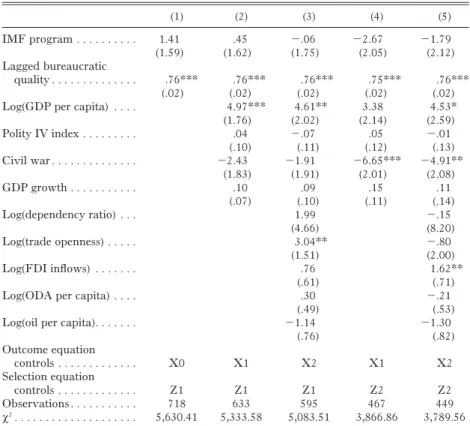
We utilize multivariate analysis using data aggregated into three-year peri-ods. Table 1 reveals no significant relationship between IMF programs and bureaucratic quality. Thisfinding holds for alternative sets of control vari-ables. Model 1 includes no control variables except for the lagged dependent variable (called X0) in the outcome equation and minimal controls in the se-lection equation (Z1). Model 2 adds the most commonly used control vari-ables to the outcome stage—income per capita, democracy, civil war, and economic growth (X1). Model 3 includes additional variables related to de-mographics, economic integration, and resource endowments (X2). The last two models extend the set of variables in the selection equation to include macroeconomic variables from the World Development Indicators (World Bank 2015)—currency reserves, debt service, and external balance—and in-dicators for national elections from the Database of Political Institutions (Beck et al. 2001) to capture political motivations for requesting IMF sup-port (Z2). Inclusion of these variables reduces the number of observations; therefore, a trade-off exists between model fit versus model parsimony and estimation efficiency.
In general, wefind that coefficient estimates of control variables in the out-come equation depend on the specification of the selection equation. Model 5 yields results consistent with theoretical expectations; for example, factors re-lating positively to bureaucratic quality include income per capita and FDI inflows, while civil war is negatively related.
9We are concerned that data are not missing at random, which could bias our results. As we show in the online appendix, this concern is unwarranted: missingness in the depen-dent variable is unrelated to IMF program status and a host of other control variables.
The Effects of IMF Conditionality
Following our theoretical discussion, we explore whether structural condi-tions are harmful for bureaucratic quality. By conditioning on observacondi-tions with IMF programs, we essentially compare a program country under a spe-cific conditionality profile to the same country under a different conditional-ity profile. Inclusion of an inverse Mills ratio addresses potential selection bias from only considering countries under IMF programs.
Table 2 presents regression results of bureaucratic quality on two key types of IMF conditions. Consistent with theoretical expectations, wefind that structural conditions reduce bureaucratic quality; stabilization
condi-TABLE 1
Total Effect of IMF Programs on Bureaucratic Quality
(1) (2) (3) (4) (5) IMF program . . . 1.41 .45 2.06 22.67 21.79 (1.59) (1.62) (1.75) (2.05) (2.12) Lagged bureaucratic quality . . . .76*** .76*** .76*** .75*** .76*** (.02) (.02) (.02) (.02) (.02)
Log(GDP per capita) . . . . 4.97*** 4.61** 3.38 4.53* (1.76) (2.02) (2.14) (2.59) Polity IV index . . . .04 2.07 .05 2.01 (.10) (.11) (.12) (.13) Civil war . . . 22.43 21.91 26.65*** 24.91** (1.83) (1.91) (2.01) (2.08) GDP growth . . . .10 .09 .15 .11 (.07) (.10) (.11) (.14) Log(dependency ratio) . . . 1.99 2.15 (4.66) (8.20) Log(trade openness) . . . 3.04** 2.80 (1.51) (2.00) Log(FDI inflows) . . . .76 1.62** (.61) (.71)
Log(ODA per capita) . . . . .30 2.21
(.49) (.53)
Log(oil per capita). . . 21.14 21.30
(.76) (.82) Outcome equation controls . . . X0 X1 X2 X1 X2 Selection equation controls . . . Z1 Z1 Z1 Z2 Z2 Observations . . . 718 633 595 467 449 v2. . . . 5,630.41 5,333.58 5,083.51 3,866.86 3,789.56
NOTE.—Sample includes all observations arranged in three-year periods. The dependent variable is BUREAUCRATICQUALITY(0–100). Standard errors clustered on countries shown in
parentheses. * P<.10. ** P<.05. *** P<.01.
tions do not have a significant impact. Note that these estimates can be in-terpreted causally as a result of instrumentation. Using model 5 to interpret effect magnitudes, wefind that one structural condition reduces bureaucratic quality by, on average, 1.24 points on a 0–100 scale (P<:05), all else equal. For an increase by 1 standard deviation (SD5 3:27), bureaucratic quality reduces by 4.04 points (one-fifth of its standard deviation). Given our dy-namic model specification, a 1 standard deviation increase in the number of structural conditions thus exerts a cumulative impact of 18.4 points (almost 1 standard deviation of bureaucratic quality).10Hence, the near-universal
adoption of structural adjustment measures in the 1990s has substantive long-lasting effects.
The above results are credible for at least two reasons. First, our models include numerous control variables, which represent a more stringent test for our variables of interest. In particular, two-way fixed effects and a lagged dependent variable absorb a lot of variation. It is therefore not sur-prising that none of the control variables reach statistical significance. Sec-ond, our diagnostic statistics for the compound instruments are strong. The Kleibergen-PaapF-statistics are far above the conventional threshold of 10— a critical value below which the potential bias from weak instruments be-comes too large to compensate for the original bias from not using any instru-ments at all (Staiger and Stock 1997). TheF-statistics in our regressions imply that the bias from weak instruments is less than 5% of the endogeneity bias (Stock and Yogo 2005).
Further Analyses
We conduct additional analysis to ensure that our keyfindings are not driven by alternative explanations. In particular, we verify that structural condi-tions, rather than a more general burden of adjustment arising from a high number of program conditions, are responsible for the decline in bureaucratic quality. To discard this alternative interpretation, we examine the impact of ALL CONDITIONSon bureaucratic quality, again using compound
instru-mentation to mitigate potential endogeneity. As shown in table 3, the num-ber of conditions alone does not undermine bureaucratic quality. While the point estimate indeed is negative (mirroring the negative total effect of IMF programs earlier), it is not significant. It also is harder tofind a strong instrument for the total number of conditions, most likely because there is less variation in the number of conditions than in the specific content of conditions.
10This is computed as follows:b
S=ð12aÞ, whereais the coefficient on the lagged depen-dent variable, and ßSis the coefficient on structural conditions.
In addition, our theory sheds some light on potential mechanisms through which conditionality affects bureaucratic quality, notably policy conditions on public sector employment, privatization of state-owned enterprises, and deregulation of prices. As discussed previously, public sector reforms man-dated by the IMF may have detrimental effects on the ability of states to re-tain qualified personnel. As shown in table 3, wefind significantly negative effects in three models (notably, the ones with the more credible set of control variables but with fewer observations included). Effect magnitudes are strong, given that each public sector condition is associated with a decline in bureaucratic quality by 4.49 points on average.
Conditions on the privatization of state-owned enterprises are thought to reduce bureaucratic quality by lowering the permissible range of instru-ments through which state administrations can influence market exchange. By removing states as stakeholders of businesses, privatization leads to a reduction in theflow of information between state bureaucrats and business representatives. Table 3 corroborates our expectations of a significantly neg-ative effect of privatization conditions on bureaucratic quality. Regardless of model specification, coefficient estimates are substantively large and sta-tistically significant (P<:05); each privatization condition is associated with a decline in bureaucratic quality by up to 8.64 points.
Conditions on deregulating prices can reduce bureaucratic quality by re-moving the specific instruments necessary to devise smart industrial policies. Table 3 indeed shows a deleterious effect of price deregulation conditions on bureaucratic quality in four models. Substantively, each such condition re-duces bureaucratic quality by up to 2.68 index points (P<:05). Diagnostic statistics do not suggest weak-instrument bias.
The above results reveal the specific types of structural conditions that adversely affect bureaucratic quality, as echoed by previous qualitative re-search. For example, structural conditions have compromised the ability of some African states to adequately respond to the Ebola outbreak. While re-forms to the remuneration of public health workers mandated by IMF con-ditions led to the emigration of qualified personnel, the decentralization of health care systems made it more difficult for state authorities to mobilize a coordinated response to the outbreak (Kentikelenis et al. 2015).
A remaining concern is the possibility thatfindings are driven merely by changes in perceptions about bureaucratic quality. Therefore, we verify that our argument holds using the BEEPS measure of the percentage of
firms experiencing acts of bribery by public officials. In order to include countryfixed effects, we discard all countries with less than two survey waves, which leaves us with 125 observations from 43 countries overall. As before, wefirst scrutinize the total impact of IMF programs before con-sidering the two types of IMF conditions. Table 4 shows the results. Col-umn 1 tests for the overall impact of IMF programs using country-level
TABLE 2 Structural Conditions versus Stabilization Conditions (1) (2) (3) (4) Structural conditions . . . . . . . . . . . . 2 1.14* 2 .99* 2 1.02* 2 1.15* 2 (.61) (.58) (.55) (.69) Stabilization conditions . . . . . . . . . . .64 .62 .06 .56 (1.68) (3.16) (4.30) (4.19) Inverse Mills ratio. . . . . . . . . . . . . . . 2 .62 2 .09 2 .47 2.24 (1.53) (1.61) (1.52) (2.73) Lagged bureaucratic quality . . . . . . .82*** .79*** .79*** .76*** (.03) (.03) (.03) (.04) Log(GDP per capita) . . . . . . . . . . . . 10.98 5.61 12.20 (21.53) (35.31) (28.81) Polity IV index . . . . . . . . . . . . . . . . . 2 .16 2 .15 2 .10 (.33) (.32) (.40) Civil war . . . . . . . . . . . . . . . . . . . . . . 2 3.63 2 4.74 2 8.50 2 (11.75) (17.10) (15.39) GDP growth . . . . . . . . . . . . . . . . . . . 2 .38 2 .14 2 .38 (1.62) (1.82) (2.15) Log(dependency ratio) . . . . . . . . . . . 1.31 2 (37.16) Log(trade openness) . . . . . . . . . . . . . 2.87 (3.24)
Log(FDI in fl ows) . . . . . . . . . . . . . . . 2 .19 1.08 (1.74) (1.17) Log(ODA per capita) . . . . . . . . . . . . .54 2 1.84 (12.81) (15.09) Log(oil per capita) . . . . . . . . . . . . . . . 2 2.59 2 2.40 (6.82) (9.20) Outcome equation controls. . . . . . . . X 0 X 1 X 2 X 1 X 2 Selection equation controls . . . . . . . . Z 1 Z 1 Z 1 Z 2 Z 2 Observations . . . . . . . . . . . . . . . . . . . 421 388 377 298 289 Log likelihood . . . . . . . . . . . . . . . . . . 2 5,158.53 2 4,568.57 2 4,431.46 2 4,258.75 2 4,323.90 F -statistic (joint) . . . . . . . . . . . . . . . . 49.30 82.23 61.91 82.23 61.91 N OTE .— Samp le only includes coun try-period observa tions with IMF progra ms arrange d in three -year per iods. The depend vari able is B UR EAUCRA TIC Q UALIT Y (0 – 100). S TRUCTUR AL C ONDIT IONS is instrumented using the intera ction betwee n the coun spe ci fi c m ean of str uctura l con ditions and the number of cou ntries under IMF prog rams in a period. S TABI LIZATION C ONDITI is in strumented using the intera ction bet ween the countr y-speci fi c mean of stabilization conditions and the number of cou under IMF program s in a period. Count ry-clust ered sta ndard errors shown in paren theses. * P < .10. ** P < .05. *** P < .01.
controls. When a country undergoes a program, its reported incidence of corruption increases by roughly 18%. Column 2 suggests that structural conditions further increase corruption: each additional structural condition increases the percentage of firms experiencing acts of bribery by 2.7% (P<:05). The effect of stabilization conditions remains insignificant. In the subsequent models, we add control variables available from the BEEPS survey related tofirm characteristics. This improves modelfit but turns the effect of IMF programs and the inverse Mills ratio insignificant. The nega-tive effect of structural conditions becomes even stronger (P< :05), while stabilization conditions tend to mitigate corruption in this model (P<:10). Overall, the replicability of our results using an experience-based measure of bureaucratic quality increases our confidence in the main results.
TABLE 3
Further Regressions on IMF Conditionality and Bureaucratic Quality
(1) (2) (3) (4) (5) All conditions . . . 2.39 2.50 2.65 2.71 2.96 (.43) (.54) (.64) (.65) (.76) Public sector conditions . . . 22.45* 21.77 21.98 23.83* 24.49** (1.47) (1.47) (1.62) (2.07) (2.15) Privatization conditions . . . 28.18** 27.52** 28.21** 27.82** 28.64** (3.58) (3.48) (3.87) (3.77) (4.00) Price deregulation conditions . . . 22.55** 22.42** 22.58** 22.30 22.68** (1.05) (1.06) (1.01) (1.46) (1.35) Outcome equation controls . . . X0 X1 X2 X1 X2 Selection equation controls . . . Z1 Z1 Z1 Z2 Z2 Observations . . . 421 388 377 298 289 Log likelihood . . . 23,725.12 23,312.63 23,208.46 23,001.81 22,904.99 F-statistic . . . 7.70 4.63 3.99 4.63 3.99 NOTE.—Each panel corresponds to a separate set of regressions in which we test for the ef-fect of the respective condition. Samples only include country-period observations with IMF programs (while including an inverse Mills ratio for selection correction), arranged over three-year periods. The dependent variable is BUREAUCRATICQUALITY(0–100). The respective
number of conditions is instrumented using the interaction between the country-specific mean of these conditions and the number of countries under IMF programs in a period. All control variables are included but suppressed for reasons of limited space.F-statistic shown is for“all conditions,”whileF>25 for all other conditions. Country-clustered standard errors shown in parentheses.
* P<.10. ** P<.05. *** P<.01.
Robustness Tests
The online appendix includes the results of all estimating equations as well as further robustness tests. With respect to selection into IMF programs, we
find that past programs, low reserves in months of imports, current account deficits, and executive elections are robust predictors of current programs. Coefficients on UNGA voting patterns are not always statistically signifi -cant but have the expected sign. With respect to the determinants of struc-tural conditions, wefind that low per capita income, absence of civil war, low growth, and small inflows of FDI are significant determinants.
We also used an alternative definition of our conditionality variables that deducts the number of conditions for which countries obtained a waiver during the course of the adjustment program (table B3). In exceptional cir-cumstances, but also as a result of intervention of big powers on behalf of their geopolitical allies, the executive board can waive certain conditions in order to help countries pass the staff review on their loan program (Babb and Carruthers 2008, p. 20). Taking waivers into account does not
substan-TABLE 4
Incidence of Corruption and IMF Conditionality
(1) (2) (3) (4) IMF program . . . 17.95* 18.40** 7.82 8.17 (9.51) (8.90) (9.26) (7.82) Structural conditions . . . . 2.70** 3.97** (1.28) (1.77) Stabilization conditions. . . 2.79 2.90* (.59) (.50)
Inverse Mills ratio. . . 210.22** 210.70** 25.44 25.34
(4.65) (4.18) (4.22) (3.32)
Fixed effects . . . Yes Yes Yes Yes
Country controls . . . Yes Yes Yes Yes
Firm controls . . . No No Yes Yes
WithinR2. . . . .19 .65 .22 .62
Observations . . . 125 125 123 123
F-statistic (joint) . . . 54.13 . . . 50.79 NOTE.—Dependent variable is the percentage offirms in the BEEPS survey reporting at
least one incident of corruption by public sector officials. Data are average over three-year pe-riods. As the BEEPS data contain an insufficient number of repeated time observations for the compound instrument approach, we use internal instruments as a second-best alternative. In this approach, we predict the (lagged) number of conditions by their second lag, standard con-trols, and time dummies. The exclusion restriction requires that there is no independent impact of twice-lagged conditionality on the outcome other than through its effect on lagged condition-ality. Robust country-clustered standard errors in parentheses.
* P<.10. ** P<.05. *** P<.01.
tively alter the results. Coefficient estimates on structural conditions remain negatively significant in most models, while stabilization conditions remain insignificant. Applying the waiver correction to issue area conditions, we
find that labor conditions remain statistically significant in only two models, privatization conditions remain negatively significant throughout all spec-ifications, and the four estimates on price deregulation previously found to be significant also remain significant. Effect magnitudes are comparable, and instrument diagnostics are strong.
Finally, we show that our results do not hinge on the assumption that countries have high levels of bureaucratic quality to begin with. To be sure, state-society arrangements—such as embedded autonomy—require a pro-fessionalized bureaucracy (Haggard and Kaufmann 1992, p. 20); hence, structural conditions will have the most detrimental impact where they un-dermine intact state-society arrangements (while having less impact where such arrangements do not exist in thefirst place). However, even weak states have some pockets of bureaucratic quality (McDonnell 2017, p. 483); therefore, bureaucratic quality can decline as a result of conditionality, even in low-capacity states. We conduct a series of regressions excluding the (pur-portedly) least capable states; our argument would be supported if our ef-fects remained similar, while it would be refuted if efef-fects were to subside without these weak states. We use three different indicators of weak capac-ity: fragile states (World Bank 2016), low-income countries (gross national income per capita below US$1,025), and countries in the lowest decile of ini-tial bureaucratic quality. Our main results are unaffected by these sample restrictions.
DISCUSSION AND CONCLUSION
This article examined the impact of structural adjustment programs on the bureaucratic quality of developing countries. These programs coerce govern-ments of nations in the global periphery to adopt policy reforms that— explic-itly or implicexplic-itly—favor the interests of core capitalist nations and are thus ideal sites to study world system pressures. We used a data set of up to 141 developing countries observed over three-year periods from 1985 to 2014 and deployed an appropriate econometric toolkit tofind that structural con-ditions lead to lower bureaucratic quality. Further probing into the policy is-sues targeted by conditionality, wefind that conditions on state-owned enter-prise privatization, price deregulation, and—to a lesser extent—public sector employmentflexibility have a significantly negative effect on bureaucratic quality. Our argument is further bolstered by converging results on two sep-arate indicators of bureaucratic quality—a perception-based measure from ICRG and an experience-based measure fromfirm surveys.
Before discussing broader implications of ourfindings, we note two lim-itations. First, our results are based primarily on a subjective measure of state capacity. To be sure, subjective measures are widely used in the rele-vant literature (Adserà et al. 2003; Bräutigam and Knack 2004; Broich et al. 2015). Among these indicators, the ICRG index is still the most widely avail-able (covering the period from 1984 to 2014), and its values can be com-pared over time. Another advantage is that they seek to measure capacity rather than willingness to provide public goods. However, subjective mea-sures are not uncontroversial, mainly due to perception biases (Kurtz and Schrank 2007; Stubbs et al. 2014). To mitigate this concern, we averaged all observations into three-year periods to smooth out unsystematic varia-tion while also testing the validity of the ICRG measure in auxiliary multi-variate tests. Furthermore, we replicated ourfindings using a more objec-tive measure of bureaucratic quality based on experienced corruption of
firms with government officials, reported to the BEEPS.
A second limitation pertains to the more general problem of identifying causal relationships. Because of our use of instrumental-variable estima-tion, the negative effect of structural conditions on bureaucratic quality has a causal interpretation, while the main competing interpretation—that countries with weak state capacity receive systematically different condi-tions—can be ruled out. But definitive answers to complex cause-and-effect questions are rarely possible to obtain using the nonexperimental research designs typical of the social sciences and deployed in this study (Morgan and Winship 2007). Econometric innovations have emerged to ameliorate some of these concerns, but for every strategy there are untestable assumptions, such as the perennial problem of instrument excludability, as well as the possibility—however remote—that factors correlate with each other by hap-penstance. While we employed the most rigorous econometric methods avail-able (replete with checks for robustness of results), ultimately case studies that gather both quantitative and qualitative data on mechanisms at the national level of analysis on why particular countries adopt particular IMF programs would further strengthen confidence in ourfindings.
More broadly, our study builds a theoretical and empirical bridge between world systems theory and Weberian-inspired political sociology. World sys-tems perspectives give a broad-brush account of the emergence and entrench-ment of weak states in developing countries as a direct result of the enrichentrench-ment of advanced economies; alternatively, Weberian-inspired political sociology provides rich macrohistorical narratives rooted primarily in domestic political processes, which emphasize professional bureaucracies as an essential prdition for the development of a capable state. We showed that the global econ-omy is structured in a way that undermines state capacity in poor countries and elucidated a set of causal mechanisms by which this process operates. By identifying the features of IMF programs that undermine bureaucratic
quality, we also demonstrated that state capacity is amenable to direct policy intervention within much shorter time frames than sociologists had previously assumed. Taken together, our study offers a conceptual and methodological toolkit that enables scholars to intersect domestic and world systems level analyses, as the practices of international organizations—of which the IMF is but one important case—entrench global power asymmetries.
Viewed in this light, future research can take on the task of developing nuanced, mechanism-driven explanations of how the world system operates under the contemporary political-economic institutional environment. This can include tracing additional global-national or global-subnational links that lock in underdevelopment and critically examining success cases of pe-ripheral countries that have managed to carve out specific paths to develop-ment (Cardoso 2009). An additional avenue for research is to advance anal-yses of the structure of contemporary globalization based on class (e.g., Block 1978; Sklair 2001) or epistemic privilege (e.g., Seabrooke and Tsingou 2014; Ban, Seabrooke, and Freitas 2016; Seabrooke and Henriksen 2017). Interna-tional organizations, via the establishment of global rules and norms, assert and reinforce privileges of a transnational capitalist elite, and sociologists have long held the methodological tools necessary to advance these debates in a rigorous fashion (e.g., Domhoff 1990; Etzion and Davis 2008; Mizruchi 2016).
Given that social scientists from diverse subdisciplines concur that state capacity is decisive for development and that bureaucratic quality is an es-sential component of state capacity, ourfindings will appear as a major con-cern for policy makers. While to date no study examines the disaggregated impact of IMF conditionality on economic growth, previous work has estab-lished a significantly negative effect of IMF programs per se (Dreher 2006). Our article thus provides a plausible microfoundation for this result: IMF conditionality serves to undermine the state capacity underlying successful development policies that trigger sustained growth. Moreover, state capacity seems only to become increasingly important as we witness how so-called failed states can destabilize their neighbors, or even high-income countries further afield, via large-scale refugeeflows or by fomenting extremism that threatens global peace. Indeed, failed states have moved center stage in recent academic debates (Risse and Krasner 2014), while also conjuring nightmarish perceptions of unbridled chaos in popular media. As the antithesis of capable states, they lack the ability to protect their borders and implement policies that could appease their peoples. Ironically, these are also the very sites that the IMF and other international organizations will be most intimately in-volved with in the future, potentially replete with detailed policy prescrip-tions designed to shape political economies in the image of Western countries. Beyond our concern with state capacity, our study offers important les-sons for all international organizations to consider. Deploying a conceptual