Haidl, M., Steuwer, M., Dirks, H., Humernbrum, T. and Gorlatch, S. (2017)
Towards Composable GPU Programming: Programming GPUs with Eager Actions
and Lazy Views. Proceedings of the 8th International Workshop on Programming
Models and Applications for Multicores and Manycores, Austin, TX, USA, 04-08
Feb 2017, ISBN 9781450348836.
There may be differences between this version and the published version. You are
advised to consult the publisher’s version if you wish to cite from it.
© The Authors 2017. This is the author's version of the work. It is posted here for
your personal use. Not for redistribution. The definitive Version of Record was
published in Proceedings of the 8th International Workshop on Programming
Models and Applications for Multicores and Manycores, Austin, TX, USA, 04-08
Feb 2017, ISBN 9781450348836,
http://dx.doi.org/10.1145/3026937.3026942
.
http://eprints.gla.ac.uk/146597/
Deposited on: 28 August 2017
Enlighten – Research publications by members of the University of Glasgow
http://eprints.gla.ac.uk
Towards Composable GPU Programming:
Programming GPUs with Eager Actions and Lazy Views
Michael Haidl
*Michel Steuwer
†Hendrik Dirks
*Tim Humernbrum
*Sergei Gorlatch
**University of Münster, Germany †University of Edinburgh, UK
{ michael.haidl, hendrik.dirks, t.hume, gorlatch }@wwu.de [email protected]
Abstract
In this paper, we advocate acomposable approach to pro-gramming systems with Graphics Processing Units (GPU): programs are developed as compositions of generic, reusable patterns. Current GPU programming approaches either rely on low-level, monolithic code without patterns (CUDA and OpenCL), which achieves high performance at the cost of cumbersome and error-prone programming, or they improve the programmability by using pattern-based abstractions (e.g., Thrust) but pay a performance penalty due to ineffi-cient implementations of pattern composition.
We develop an API for GPUs based programming on C++ with STL-style patterns and its compiler-based implemen-tation. Our API gives the application developers the native C++ means (views and actions) to specify precisely which pattern compositions should be automatically fused during code generation into a single efficient GPU kernel, thereby ensuring a high target performance. We implement our ap-proach by extending therange-v3library which is currently being developed for the forthcoming C++ standards. The composable programming in our approach is done exclu-sively in the standard C++14, with STL algorithms used as patterns which we re-implemented in parallel for GPU. Our compiler implementation is based on the LLVM and Clang frameworks, and we use advanced multi-stage programming techniques for aggressive runtime optimizations.
We experimentally evaluate our approach using a set of benchmark applications and a real-world case study from the area of image processing. Our codes achieve performance competitive with CUDA monolithic implementations, and we outperform pattern-based codes written using Nvidia’s Thrust.
[Copyright notice will appear here once ’preprint’ option is removed.]
1. Introduction
Graphics Processing Units (GPUs) are nowadays an inher-ent part of computing at small and large scale: from robotics applications accelerated with embedded GPUs up to large scientific simulations. Developing such applications is chal-lenging as GPU code is often developed separately from the main CPU application, in a low-level programming language such as CUDA. Achieving high performance on GPUs is de-manding even for experienced programmers; it is currently achieved by writing low-level, hand-optimizedkernel func-tions. It would be highly desirable to use a single ming language and take advantage of convenient program-ming abstractions while achieving high performance.
The research community has recognized this challenge and moved towards unified CPU/GPU programming in C++ in the newest versions of CUDA and projects like C++ AMP [12] and SYCL [16]. At the same time higher-level abstractions have been proposed in form of libraries such as Thrust [2] and SkelCL [19] which provide reusable program-ming patterns, customizable by developers for particular ap-plications. Unfortunately, these libraries introduce signifi-cant overhead when applications are composed of multiple patterns, each executed in a separate kernel, while in low-level code a single efficient kernel would be used. Therefore, programmers currently either benefit from the composable high-level patterns but pay a performance penalty for using these abstractions, or they achieve high efficiency for the cost of writing low-level and non-composable code.
In this paper, we present acomposable GPU program-ming approach which enables developers to compose their applications from simple and reusable patterns. The main contribution of our approach is the implementation of pattern composition that guarantees that composed patterns are ex-ecuted in a single efficient GPU kernel. Our implementation is a compiler-supported library that extends therange-v3
li-brary [13] which is currently developed as the next gener-ation of the C++ Standard Template Library (STL). In our approach, programmers obtain full control to either a) use patterns expressed as STLalgorithmsandactionswhich are computed eagerly on the GPU or b) useviewswhich our im-plementation guarantees to fuse during code generation and execute in a single GPU kernel.
Our LLVM-based, C++-to-GPU code generator uses
multi-staging optimizations to embed values only known
at CPU runtime into the kernel code which is then JIT com-piled and executed on the GPU. This allows to specialize the kernel code for the particular input size and particular number of threads executing the kernel.
Our experimental evaluation demonstrates that compos-able code written using our approach achieves the same performance as low-level monolithic implementations in CUDA and outperforms composable code written using Thrust.
This paper makes the following main contributions:
•Enabling composable GPU programming by enriching
therange-v3library with GPU-enabled algorithms;
•Giving programmers full control and better predictability about kernel fusion by choosing between eager actions and algorithms and lazy views;
•Implementing JIT code generation which takes advan-tage ofmulti-stagingto optimize GPU code based on val-ues known at runtime of the CPU program.
The remainder of the paper is organized as follows: In Section 2 we recap related work on GPU programming and we motivate the necessity for writing efficient composable GPU code. Section 3 introduces our API with ranges and GPU-enabled algorithms. Section 4 introduces actions and views and show how these give the programmer precise con-trol over kernel fusion. Section 5 explains our C++-to-GPU code generation process and our enhanced compiler opti-mizations (in particular multi-staging). Section 6 evaluates our approach, and Section 7 concludes the paper.
2. Background and Related Work
GPU programming using the current low-level programming models such as OpenCL and CUDA is challenging. Special
kernelfunctions are executed in parallel on the GPU by
ex-plicitly specifying the number of executing threads running in parallel. OpenCL and CUDA clearly separate thehost pro-gramrunning on the CPU from theGPU program(kernel) which is written in a subset of the C/C++ programming lan-guage with GPU-specific extensions.
1 __global__ void partialDotProduct (float* a ,
2 float* b ,
3 float* res ){
4 extern __shared__ float* tmp ;
5 int lid = threadIdx .x;
6 int gid = lid + blockIdx .x * blockDim .x;
7 tmp [ lid ] = a[ gid ] * b[ gid ];
8 __syncthreads () ;
9 for (int i = get_local_size (0) /2; i >0; i *=2) {
10 if ( lid < i) tmp [ lid ] += tmp [ lid + i ];
11 __syncthreads () ; }
12 if ( lid == 0) res [ blockIdx .x] = tmp [ lid ];}
Listing 1: GPU Kernel in CUDA computing a dot product.
Listing 1 shows a simple, unoptimized CUDA kernel, adopted from the Nvidia toolkit [14] that computes a dot product of vectorsaandb. In line 7 each thread multiplies
the corresponding elements of the two vectors with each other. A tree-based reduction is performed by a group of threads (calledblockin CUDA): in each iteration of the loop in line 9 the number of active threads which add up two el-ements (line 10) is halved. Finally, one thread of each block writes the computed result back into memory (line 12). The barriers in lines 8 and 11 ensure a consistent view of the memory across all threads. As synchronization across blocks is not possible, the summation of all results computed by the blocks cannot be performed in this kernel and must either be done on the host or in another CUDA kernel. The imple-mentation in Listing 1 is not very efficient on modern GPUs and can be significantly optimized [9] which makes the code significantly more complex. But even the simple dot product code is not trivial: it works in a hierarchical CUDA address space (global and shared memory) and requires barrier syn-chronization, making it prone to subtle bugs like deadlocks and race conditions.
One popular way to overcome this low-level program-ming style is to provide reusable generic parallel patterns, also known as algorithmic skeletons. Thrust [2], Bolt [1], Accelerate [11], and SkelCL [19] follow this approach. 1 float dotProduct (const vector <float>& a ,
2 const vector <float>& b) {
3 thrust :: device_vector <float> d_a = a;
4 thrust :: device_vector <float> d_b = b;
5 return thrust :: inner_product (
6 d_a . begin () , d_a . end () , d_b . begin () , 0.0 f); }
Listing 2: Optimal dot product implementation in Thrust using a domain-specific library function.
Listing 2 shows the implementation of the dot product in Thrust using a single library call. This implementation is straightforward and relies on an optimized GPU pattern writ-ten by experts and tuned for performance. Unfortunately, it uses a very domain-specific library function (inner_product)
which limits its applicability for other applications. 1 float dotProduct (const vector <float>& a ,
2 const vector <float>& b) {
3 thrust :: device_vector <float> d_a = a;
4 thrust :: device_vector <float> d_b = b;
5 thrust :: device_vector <float> tmp (a. size () );
6 thrust :: transform ( d_a . begin () , d_a . end () ,
7 d_b . begin () , tmp . begin () ,
8 thrust :: multiplies < floal >() );
9 return thurst :: reduce ( tmp . begin () , tmp . end () ) ;}
Listing 3: Generic and composable, but non-optimal Thrust implemenation of dot product
In Listing 3, the dot product is implemented in Thrust us-ing two smaller but more universal patterns:transformand
pattern composition: two kernels are launched and a tem-porary vectortmpis required to store the intermediate
re-sult oftransform. This loss of efficiency is the reason why
Thrust offers the specificinner_productfunction: high
per-formance is not achievable by composing universal patterns. In the next sections, we present our approach where higher-level programs can be expressed as a composition of universal patterns without a performance loss.
3. Programming with Ranges and
GPU-Enabled Algorithms
Our suggested composable API for GPUs is inspired by the Standard Template Library (STL) which is widely used in C++ programming. The STL consists of three main components: 1) containers: collection data types such as
std::vectororstd::set, 2)algorithms: reusable operations
on containers such asstd::accumulateorstd::sort, 3)
it-erators: glue containers with algorithms, such that the same
algorithm is reusable for different containers. This library design has proven to be highly flexible and is one of the main reasons of the STL’s success.
3.1 From Iterators to Ranges
The existing STL with iterators does not allow to compose algorithms easily. Listing 4 shows the dot product example using two STL algorithms with iterators:transformto
ap-ply the binarymultfunction to the corresponding elements
of the input containersaandb, andaccumulateto sum up
all the values of a sequence. These two algorithms do not compose nicely, becausetransformreturns only a single
it-erator, whileaccumulateexpects a pair of iterators as its first
two arguments describing the start and end of the input con-tainer. Furthermore, a temporary vectortmpis required, as
the transform algorithm has to write the computed interme-diate result into a container. The algorithm cannot allocate this temporary container itself, because the iterator abstrac-tion hides the type of container (in this case avector) from
the algorithm.
1 float dotProduct (const vector <float>& a ,
2 const vector <float>& b) {
3 auto mult = [](auto x , auto y){return x * y ;};
4
5 vector <float> tmp (a. size () );
6 transform (a. begin () , a. end () , b. begin () ,
7 tmp . begin () , mult );
8 return accumulate ( tmp . begin () , tmp . end () ,0.0 f);
9 }
Listing 4: Dot product implementation using iterators. Listing 5 shows how we can overcome these composability problems using the recentrange-v3library [13] that replaces
iterators withranges. Theaccumulatecall now takes its input
as the single first argument compared to two separate itera-tors in Listing 4. Ranges are composable, because they carry information about the start and end points of a container, i.e.
1 float dotProduct (const vector <float>& a ,
2 const vector <float>& b) {
3 auto mult = [](auto p){
4 return get <0 >( p) * get <1 >( p); };
5
6 return
7 accumulate (
8 view :: transform ( view :: zip (a ,b) , mult ) ,0.0 f); }
Listing 5: Dot product implementation using composable ranges.
ranges combine the information scattered across the first two arguments ofaccumulate into a single value. This change,
together with the introduction of views— lazily computed ranges, which we will discuss in more detail in Section 4 — allows to write the dot product example in a concise and composable style in Listing 5. Here thezipfunction creates
pairs of elements from vectorsaandbwhich are then
mul-tiplied and summed up. Composability is a central feature of therange-v3library: it allows and encourages developers
to use the pipe symbol|to denote composition (similar to
thebashshell). Therefore, we can also rewrite lines 7–8 of
Listing 5 as explicit composition of patterns:
view::zip(a,b) | view::transform(mult) | accumulate(0.0f)
The idea of our approach is to bring this range-based ab-straction to GPU programming.
3.2 GPU-enabled containers and algorithms
We extend the range-v3library with a GPU-enabled
con-tainer and GPU-enabled algorithms to allow programmers to write GPU applications in a composable way.
For storing data on the GPU we introduce thegpu::vector
container which provides a range-based interface to access its elements. We use type traits to ensure statically that the GPU-enabled algorithms only operate on data stored in a
gpu::vector. Data is transferred to the GPU by copying data
into agpu::vector, e.g., by using thegpu::copyfunction as
in Listing 6, and transferred back by copying such a con-tainer into a regular STLvector.
Our algorithm implementations for the GPU using ranges currently covers the three central algorithms –gpu::for_each,
gpu::transform, andgpu::reduce – and is currently being
extended to cover all algorithms of the recently standardized parallel STL [10]. Thefor_eachandtransformalgorithms
apply a given function to every element of the input range in parallel. Thetransformwrites the result of each function
ap-plication into an output range (this algorithm is also known asmapin functional programming). Thefor_eachalgorithm
produces no result directly, but is executed for its side ef-fects. This allows, for example, to write computed values to memory in a less structured fashion than using transform.
Thereducealgorithm performs a parallel reduction using a
see that already using these three algorithms as patterns al-lows us to express many interesting applications, especially when combined with views (lazily evaluated ranges) as dis-cussed in Section 4.
3.3 First GPU example
Listing 6 shows a code of the dot product using our API with
thegpu::reducealgorithm. Notice how close the
implemen-tation is compared to Listing 5. In line 6 the input vectorsa
andbare copied to the GPU, and then their pairwise
multi-plication results (line 7) are summed up in line 8. Our API implementation (described in Section 5) guarantees to fuse the operations expressed as views into a single efficient GPU kernel. In the example, the zip and the vector multiplica-tion in lines 6 and 7 are fused together with the reducmultiplica-tion in line 8. We will discuss the implementation of views in the next section.
1 float dotProduct (const vector <float>& a ,
2 const vector <float>& b) {
3 auto mult = [](auto p){
4 return get <0 >( p) * get <1 >( p); };
5
6 return view :: zip ( gpu :: copy (a) , gpu :: copy (b))
7 | view :: transform ( mult )
8 | gpu :: reduce (0.0 f); }
Listing 6: GPU dot product using composable patterns.
3.4 Summary
In our API, ranges combined with GPU algorithms and GPU containers enable a natural way to program GPUs in C++ similar to the programming approach widely known from the STL. To achieve composability, programs are written by combining small and simple-to-understand patterns which greatly simplify programming as compared to traditional low-level programming approaches like CUDA. Next we discuss the key idea for achieving high performance in our composable approach: guaranteed kernel fusion using views.
4. Eager Actions and Lazy Views
Therange-v3 library introduces two new consructs to the
STL —actionsandviews — which enhance the compos-ability. We exploit views and actions for GPU programming: by using them programmers can control the fusion of com-putations expressed by patterns into a single GPU kernel.
4.1 Actions
Actionsperform (potentially mutating) in-place operations
on containers, i.e., actions do not require an externally pro-vided output container, such as the temporary vector tmp
in Listing 4. Actions are implemented with the STL algo-rithms and, therefore, we implemented corresponding ac-tions for our GPU-enabled algorithms. Acac-tions return a ref-erence to the modified container and, therefore, compose nicely with other actions.
4.2 Views
Views are the counterpart to actions and describe
non-mutating operations on ranges. Views, like actions, compose nicely and are designed to be used together with each other and with the algorithms described earlier.
An example for a view isview::transform(mult)in
List-ing 6. It applies a given function (in this casemult) to its
input range. When executed on the CPU, this computation is not performed eagerly by writing the computed result to some (temporary) memory location, but rather an object (the
view) is created which behaves like a range and performs the computation lazily, i.e., on-demand once an element in the range is requested. The view object holds references to its input range and the function to be called. When the view is iterated over, it evaluates the requested elements. Views are implemented as first class objects which can be stored in variables and passed to and returned from functions.
When views are composed with each other or with algo-rithms, they are evaluated only when the finally computed range is accessed. For example, in Listing 6 the zip and
transformviews are composed with thegpu::reduce
algo-rithm. The implementation ofreduceiterates over the input
range to sum up all of its elements. Inside of this iteration, the pairwise multiplication expressed by the two views is performed, i.e., it is automatically fused by our API imple-mentation into the impleimple-mentation of the reduce algorithm. When we compile this code for the GPU, as described in Section 5 this API design ensures that only a single GPU ker-nel is emitted which performs thezipandtransform
compu-tations inside of the iteration code of thereducealgorithm.
Together with our GPU-enabled algorithms, this guaran-teed behavior of the views let programmers reason precisely about the cost of operations and the number of GPU kernels launched. Views allow to write composable and elegant code without paying a performance penalty, as we will see in our experimental evaluation.
4.3 Provided Views
The range-v3 library offers currently over 40 views (e.g.,
filter or generate) which can be used together with our
GPU algorithms. This greatly enhances the flexibility of our GPU programming approach. Interestingly, some views such
asrepeatrepresent infinite ranges; thetakeandtake_while
views can be used to limit such infinite ranges. In our ap-proach kernel fusion is directly tied to the available views. The possibility to fuse two kernels corresponds to the ability to express a computation as a view which can be performed lazily and, therefore, folded into another computation.
The benefit of reusing the existing views from therange-v3
library is ensured by our LLVM-based GPU code generator which compiles arbitrary C++ code for the GPU. There are only minor not supported exemptions, such as virtual func-tions or excepfunc-tions which are not used in the STL.
4.4 GPU evaluation of views
Some computations can be expressed in our API only using views and without ever using an action or algorithm. In such cases, the evaluation will happen implicitly when the final view is iterated over, e.g., when printing the result or copying it into a data container. By default, this evaluation happens sequentially on the CPU. To allow programmers to perform such computations on the GPU, we implemented a variation of the C++ standardasyncfunction. Ourgpu::asyncfunction
takes an arbitrary function whose return value is fixed to be
agpu::vectorand, therefore, if in the function
implementa-tion a view is returned then it is implicitly evaluated on the GPU in parallel and the result is written into agpu::vector.
1 auto saxpy (float A , const vector <float>& X ,
2 const vector <float>& Y) {
3 return gpu :: async ([=](auto a , const auto& x ,
4 const auto& y){
5 auto ax = view :: zip ( view :: repeat (a) , x)
6 | view :: transform ( mult );
7 return view :: zip (ax ,y)
8 | view :: transform ( plus ) ;} , A , X , Y) ;}
Listing 7:saxpyon GPU using views andgpu::async.
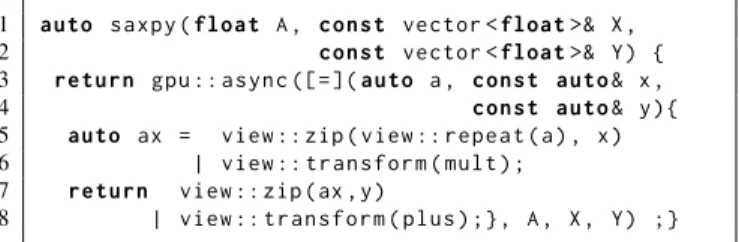
Listing 7 shows an implementation of thesaxpy
com-putation which only uses views and no algorithms or ac-tions. Our gpu::async function is used in line 3 to
evalu-ate the views on the GPU. First,a⇥xis computed where
ais a scalar and x is a vector, before the result is added
to the vector y. We use four views (twice zip and twice
transform) to describe the computation which is nested in-side agpu::async. All views are fused together during code
generation and evaluated in a single GPU kernel which pro-duces agpu::vector. Thegpu::asyncfunction ensures that
all input containers are automatically copied togpu::vector
objects if they are not already of that type. This ensures that all data used ingpu::asyncis available on the GPU. 4.5 Summary
With the support of actions and views, our GPU extension of
therange-v3library encourages a compositional
program-ming style. We make use of this style for GPU programprogram-ming by combining actions and views with our GPU-enabled al-gorithms and providing a natural way to evaluate lazy views in parallel on the GPU viagpu::async. The views provide a
simple mechanism for the programmer to express programs compositionally while being guaranteed that the views are fused together into a single GPU kernel. We will now look at our GPU code generation and discuss optimizations ap-plied when generating GPU kernel code.
5. Code Generation and Optimization
Our API with GPU-enabled algorithms and containers is implemented as a C++ library compiled using PACXX [8] — our LLVM-based compiler generating GPU code from C++ code. In this section, we briefly describe the general
design of PACXX and then we focus on a particular feature, called multi-staging, which allows us to optimize the GPU code based on values only known at host runtime.
5.1 Overview of PACXX
PACXX transforms C++ code using a combination of offline and online compilation to a representation executable on different kinds of GPUs: PTX on Nvidia GPUs, and SPIR on AMD GPUs. Executable PACXX Runtime Online Compiler LLVM IR to SPIR LLVM NVPTX OpenCL
Backend BackendCUDA
LLVM IR
SPIR PTX
OpenCL Runtime AMD GPU Intel MIC
CUDA Runtime Nvidia GPU
#include <algorithm> #include <vector> #include <iostream> template< class ForwardIt, class T > void fill(ForwardIt first, ForwardIt last, const T& value) { for (; first != last; ++first) { *first = value; } } C++ PACXX Offline Compiler LLVM libc++ Clang Frontend
Figure 1: Key components of PACXX.
Figure 1 shows an overview of the PACXX implementa-tion which comprises two main components:
1) ThePACXX Offline Compiler based on the open-source Clang compiler, and
2) ThePACXX Runtimelibrary consisting of a just-in-time compiler and a GPU execution runtime.
Correspondingly, C++ code is compiled by PACXX in two stages: 1) theoffline compilation stage separates GPU and CPU code and prepares the executable for the PACXX runtime, 2) the online compilationstage just-in-time com-piles the GPU code during program execution using our LLVM-based online compiler in the PACXX runtime library. Stage 1: Offline Compilation In PACXX, code to be ex-ecuted on a GPU is written as a pacxx::kernel function
supported by PACXX. Based on this kernel function, the PACXX offline compiler marks the code executed on the GPU by annotating every function called from inside the kernel function with a PACXX-specific C++ 11 generalized attribute. Using generalized attributes of C++ has the advan-tage that the code remains valid C++ and other compilers have the freedom to ignore PACXX custom annotations.
After the annotations are added, two passes are per-formed: the first pass prepares the GPU kernel generation at runtime, and the second pass compiles the CPU program. In the kernel compilation pass, the program’s abstract syntax tree (AST) is lowered to the LLVM intermediate representation (IR), and functions with the PACXX-specific attribute are marked as kernel code in the IR. Then the following steps transform and optimize the IR:
1) dead code elimination removes all IR nodes beside the code reachable from the kernel;
2) function calls are inlined into the kernel functions; 3) -O3equivalent optimizations are performed; 4) the IR is embedded in the executable.
At runtime the prepared IR is loaded, then JIT-compiled and optimized for the target GPU before execution.
In the host compilation pass, the PACXX offline com-piler lowers the AST to LLVM IR a second time, but this time replacing calls to kernel functions with PACXX run-time calls which manage data transfers and launch the corre-sponding kernel. The compilation of the host C++ program is performed as usual, by generating an executable which is statically linked against the PACXX runtime library. Stage 2: Online Compilation During program execution, the PACXX runtime loads the IR previously embedded in the executable by the PACXX offline compiler, performs addi-tional, GPU-specific optimizations, such as loop-unrolling and rearranging load instructions. Finally, the IR is com-piled to GPU code using one of the two LLVM back-ends: PTX [15] together with the CUDA runtime library when targeting Nvidia GPUs, and SPIR [7] for GPUs with an OpenCL implementation (e.g., from AMD or Intel).
5.2 GPU Algorithm Implementations
We implemented three GPU-enabled STL algorithms to be used together with therange-v3library. We are discussing
their efficient implementations for Nvidia GPUs here. This implementation is not portable, but we intend to incorporate recent related work in the future which uses a functional techniques to generate efficient GPU implementations from portable pattern-based representations [20].
Transform and For_Each Thegpu::transformalgorithm
applies a given function in parallel to every element of its input range and stores the produced results in the output range. The gpu::for_each algorithm is a special case of
transform, where its given function does not produce a result directly but is rather executed for its side effects. Therefore, we concentrate on the implementation ofgpu::transform.
1 auto kernel = pacxx :: kernel (
2 [ func ](auto in , auto out , size_t size ) {
3 auto id = Thread :: get () . global ;
4 if ( id .x >= size ) return;
5 *( out + id .x) = func (*( in + id .x));
6 } ,{{( distance + 127) / 128} , {128}}) ;
7
8 kernel ( in . begin () , out . begin () , size );
Listing 8: Implementation ofgpu::transform.
Listing 8 shows the implementation ofgpu::transformfor
an Nvidia GPU. For each element of the input range, a GPU thread is launched which: a) loads one element form the global memory, b) applies the given function (func) to the
element, and c) stores the result back to the global memory of the GPU. Our implementation configures the underlying
kernel to use 128 threads per block. This is a platform-specific choice, and auto-tuning [4] or similar techniques can be used to pick appropriate values.
Reduce To efficiently implement the gpu::reduce
algo-rithm, we make use of themulti-stage programmingsupport in PACXX [8] for embedding values known at the runtime of the host program into the GPU code. This enables ad-ditional optimization opportunities like aggressive loop un-rolling. PACXX provides a dedicated function (stage) which evaluates expressions prior to the GPU kernel execution and the computed values are then automatically embedded into the GPU program.
1 template <class InRng , class T , class Fun >
2 auto reduce ( InRng && in , T init , Fun && fun ) {
3 // 1. preparation of kernel call
4 ...
5 // 2. create GPU kernel
6 auto kernel = pacxx :: kernel (
7 [ fun ](auto&& in , auto&& out ,
8 int size , auto init ) {
9 // 2a. stage elements per thread
10 int ept = stage( size / glbSize );
11 // 2b. start reduction computation
12 auto sum = init ;
13 for (int x = 0; x < ept ; ++ x) {
14 sum = fun ( sum , *( in + gid ));
15 gid += glbSize ; }
16 // 2c. perform reduction in shared memory
17 ...
18 // 2d. write result back
19 if ( lid = 0) *( out + bid ) = shared [0];
20 }, glbSize , lclSize );
21 // 3. execute kernel
22 kernel (in , out , distance ( in ) , init );
23 // 4. finish reduction on the CPU
24 return std :: accumulate ( out , init , fun ); }
Listing 9: Implementation sketch of the gpu::reduce
algorithm making use of multi-staging.
Listing 9 shows a sketch of the implementation of the
gpu::reduce algorithm in PACXX. For brevity and clarity
we concentrate on the parts relevant for the multi-staging op-timization. After some preparations, a GPU kernel is created in line 6 using the PACXX-provided kernelfunction. The
following lambda expression contains the code executed on the GPU which calls the reduction operationfunin line 14.
In line 10 we make use of thestagefunction: it indicates that the expression passed as its argument is evaluated on the CPUpriorto the kernel call and that the evaluated value is embedded into the GPU code as a compile-time constant. Here this value is the number of elements processed per thread which is used as the upper bound in the following loop in line 13. As a consequence of the staging, this loop can be completely unrolled, since the upper bound is now known at the GPU compilation time, which results in a sig-nificant performance gain as we will see in the evaluation section. The kernel continues with a reduction performed in shared memory, synchronized across all threads in the
same block (indicated in line 17); finally, the first thread of each block writes the computed result back to global mem-ory (line 19). This kernel is launched in line 22, and in the last line the results of all blocks are reduced to the final re-sult on the CPU. Note that the user-provided functionfunis
used seamlessly on both GPU and CPU. This is possible due to the two-pass compilation approach performed by PACXX when generating code for CPU and GPU (Section 5.1).
5.3 Implementation of Multi-Staging in PACXX
This section describes how the stage function is
imple-mented in PACXX. In the kernel compilation pass, the staged code, e.g.,size / glbSize in Listing 9, is separated
from the kernel code and used to generate a corresponding function which is embedded in the binary and will be eval-uated at runtime on the host prior to the execution of the kernel. Thestagefunction call is removed from the kernel and replaced by a dummy call instruction which acts as a placeholder and is replaced at runtime with the value ob-tained from evaluating the staged function on the host.
When a kernel is executed at runtime, three steps are performed:
1) the kernel’s parameters and launch configuration are set; 2) the staged functions are just-in-time compiled, evaluated,
and the kernel’s IR is modified;
3) the kernel is just-in-time compiled and launched. To evaluate the staged function in step 2), its IR is loaded from the executable and just-in-time compiled for the host architecture. The function is then evaluated and in the ker-nel’s IR the placeholder call instructions are replaced with the evaluated constant value. After the staged values have been embedded into the kernel program, PACXX performs additional optimizations on the code such as aggressive un-rolling to take advantage of the new knowledge introduced by the staged values. Finally, the kernel program is lowered to either PTX [15] or SPIR [7] code linked with the corre-sponding CUDA or OpenCL runtime and executed.
The compiled kernel code is cached by PACXX to mini-mize the just-in-time compilation overhead. All staged func-tions are evaluated again if the kernel is launched multiple times: PACXX checks if the staged values have changed and only performs a kernel recompilation if necessary.
6. Experimental Evaluation
In this section we evaluate our composable GPU program-ming approach. We are interested in the performance of the composable C++ code compared to low-level monolithic CUDA code and high-level Thrust code, as well as the per-formance impact of multi-staging and the overhead caused by our JIT compiler at runtime.
6.1 Experimental Setup
We evaluate our approach on a system equipped with one Nvidia K20c GPU and an Intel Xeon E5-1620v2 CPU. The operating system is Ubuntu 16.04.01 LTS, and CUDA ver-sion 7.5 is used with the corresponding driver (verver-sion 361). All benchmarks are compiled by Nvidia’snvcccompiler with-O3and-arch=sm_35. In advance, a warm-up kernel is executed to bring the GPU into the P0 state (highest perfor-mance). The kernel execution timings are recorded using the Nvidia command line profiler (nvprof). We perform 1000 iterations of each algorithm and report the average runtimes. For benchmarks with multiple kernels (e.g., Thrust bench-marks where reduceis used), we sum up the runtimes of the individual kernels. Throughout the plots we show the speedupS= TT hrust,CU DATP ACXX over Thrust and CUDA.
For benchmarks which study the advantage of multi-staging in PACXX, we also compare to CUDA code which is JIT compiled and has been optimized by applying the same multi-stage optimization manually. We use the Nvidia Runtime Compilation library (nvrtc) for the JIT compila-tion which was introduced in CUDA 7.5. We also evaluate against the most recent CUDA beta version 8.0.27.1.
6.2 Performance of Composable GPU Programming
In this subsection we evaluate the performance achieved for code written with our composable API compared to code written in Thrust and CUDA. We use four small bench-marks: vector addition (vadd),saxpy,dot product, and a vec-torsum. We evaluate a larger application in Section 6.5. Implementation of Benchmarks We showed the imple-mentations of the dot product in Listing 6 and saxpy in Listing 7. Both benchmarks are written as a composition of views. In case of thedot productthe views are fused with a finalgpu::reduce. Thesaxpycode uses only views and our
gpu::async function. Thevadd benchmark usesview::zip
together withgpu::transform. Thesumbenchmarks makes no use of views and only usesgpu::reduce.
The CUDA implementations of these benchmarks are low-level codes operating on raw pointers and exploiting the parallelism explicitly. The simple CUDA code of the
dot product shown in Listing 1 highlights additional
prob-lems, such as thread synchronization. Our pattern-based API clearly avoids these pitfalls and raises the level of abstraction significantly. We used an optimized CUDA version of List-ing 1 for the performance comparison.
The Thrust implementations of our benchmark appli-cations also avoid the pitfalls of CUDA, but do not al-low for a composable programming style. Thedot product
is implemented using the specialized inner_product
func-tion, as shown in Listing 2. Thesum benchmark used the
thrust::reduce function and the vadd and saxpy
bench-marks are written usingthrust::transform. Different to our
API, a monolithic style is used in the Thrust implementa-tions.
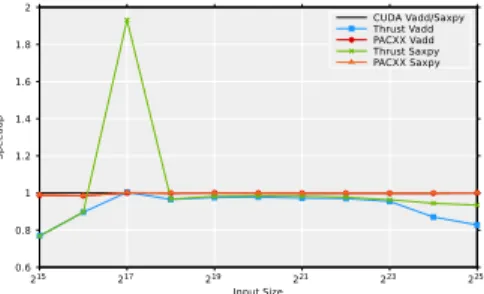
Performance Results We evaluate each benchmark with 11 input sizes of single precision floating point values. Fig-ures 2 and 3 show the performance results compared to the optimized CUDA code. The results for the vector addition and saxpy benchmark (Figure 2) show that our API imple-mented using PACXX achieves equal performance to the low-level CUDA kernels. Thetransformimplementation in
Thrust uses 1024 threads per block and launches a fixed number of blocks. Using this strategy, each thread computes multiple elements and Thrust achieves significantly better performance for the217input size of the saxpy benchmark.
0.6 0.8 1 1.2 1.4 1.6 1.8 2 215 217 219 221 223 225 Sp e e du p Input Size CUDA Vadd/Saxpy Thrust Vadd PACXX Vadd Thrust Saxpy PACXX Saxpy
Figure 2: Speedup of our approach and Thrust compared to CUDA for thevector additionandsaxpybenchmark.
Figure 3 shows the performance of our approach fordot
productandsum in comparison to Thrust and CUDA. All
three approaches follow different implementation strategies for these benchmarks. The CUDA version from Nvidia’s SDK [14] uses a tree-based reduction in local memory and avoids synchronization inside a warp. The Thrust reduction algorithm computes the result in two GPU kernels while the PACXX and the CUDA versions execute only one GPU kernel and finish the computation on the CPU. Using two kernels with Thrust yields a significant overhead for smaller input sizes, which is clearly visible in the graph. The multi-staging optimized gpu::reduceimplementation in PACXX
clearly outperforms the Thrust reduction and even beats the low-level CUDA code for larger input sizes.
0 0.2 0.4 0.6 0.8 1 1.2 215 217 219 221 223 225 Sp e e du p Input Size CUDA Dot/Sum Thrust Dot PACXX Dot Thrust Sum PACXX Sum
Figure 3: Speedup of our approach and Thrust compared to CUDA for thedot productandsumbenchmarks.
Summary This section shows that our composable pro-gramming style using views does not introduce a perfor-mance overhead. In contrary, our optimized GPU-enabled
algorithms outperform the corresponding low-level CUDA and Thrust code. Even the specialized inner_product
im-plementation of Thrust used in the dot product benchmark is outperformed by our composable implementation where views are fused with our generic reduction algorithm.
6.3 Performance Impact of Multi-Staging
We continue our evaluation by studying the multi-stage op-timization applied in PACXX. As described in Section 5, multi-staging is used in ourgpu::reducealgorithm to
spe-cialize the generated GPU code at runtime for the particular input size, which enables aggressive loop-unrolling.
0.9 0.95 1 1.05 1.1 1.15 1.2 1.25 1.3 1.35 1.4 215 217 219 221 223 225 Sp e e du p Input Size Dot Sum Dot +MS Sum +MS
Figure 4: Performance improvement via multi-stage (MS) optimization for thedot productandsumbenchmarks.
Figure 4 shows the relative performance improvement when applying multi-staging in thegpu::reducealgorithm,
for thedot product benchmark shown in Listing 6 and for the sum benchmark that adds up all elements of an array. We observe that multi-staging improves performance by up to1.35⇥depending on the input size. For input sizes larger than224, the performance advantage declines, as the number of threads in a block is increased and, therefore, the num-ber of loop iterations executed by each individual thread de-creases: the effect of unrolling the loop becomes less visible. The improvements for the dot product are lower, because the kernel performs more loads from the global memory which dominate the kernel runtime, making the loop unrolling a less important performance factor.
6.4 Just-in-time Compilation Overhead
PACXX performs an offline and an online compilation step. In this section, we study the overhead introduced at runtime by the PACXX JIT compiler by comparing the compilation times of PACXX with the JIT compiler librarynvtrcrecently
introduced for CUDA.
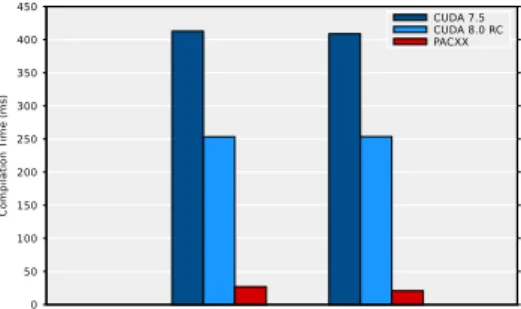
Figure 5 shows the compilation time for the sum and the dot product benchmarks. We compare PACXX withnvrtc
from CUDA 7.5 and 8.0 RC. The compilation of PACXX is 15 times (for dot product) and almost 20 times (for sum) faster as compared to CUDA 7.5, and 9-12 times faster com-pared to CUDA 8.0 RC. This is because the PACXX offline compiler prepares the GPU code generation and, therefore, the PACXX JIT compiler operates directly on the LLVM IR.
0 50 100 150 200 250 300 350 400 450 Dot Sum CUDA 7.5 CUDA 8.0 RC PACXX C o m p ila ti o n T im e (ms )
Figure 5: The just-in-time compilation overhead for thedot
productandsumbenchmarks.
The costly front-end operations — parsing, semantic checks and building of the abstract syntax tree — are not performed in PACXX at runtime as done innvrtc.
6.5 Application Study: FlexBox
FlexBox [5] is a flexible MATLAB image processing tool-box for finite-dimensional convex variational problems which often consist of non-differentiable parts with linear opera-tors. FlexBox uses GPUs to accelerate the solution of such image processing tasks. It offers a high-level notation famil-iar to applied mathematicians. This notation is mapped in FlexBox’s implementation to computational patterns which are executed on the GPU.
FlexBox Background FlexBox takes advantage from the fact that many variational problems in image processing can be written in the form
arg min
x G(x) +F(Ax), (1)
where Adenotes a linear operator and both G and F are proper, convex and lower-semicontinuous functions. Prob-lem (1) refers to the so-called primal formulation of the min-imization problem andxis known as the primal variable. It
can be shown (see [17]) that minimizing (1) is equivalent to solving the primal-dual formulation
arg min
x arg maxy G(x)+< y, Ax > F
⇤(y). (2)
FlexBox uses a primal-dual scheme [3] to avoid (compu-tationally) inefficient operator inversion and to get reliable error estimates. The primal-dual scheme can be sketched up as follows: For⌧, > 0and a pair(ˆx0, y0)2 X⇥Y we iteratively (kdenotes the iteration) solve:
yk+1=prox F⇤(yk+ Axˆk) (3)
xk+1=prox⌧G(xk ⌧ATyk+1) (4)
ˆ
xk+1= 2xk+1 xk (5)
Here,prox⌧G(resp. F⇤) denotes the proximal operator: prox⌧G(y) := arg min
v
||v y||2 2
2 +⌧G(v) (6)
which can be interpreted as a compromise between mini-mizingGand being close to the input argumenty. The ef-ficiency of primal-dual algorithms relies on the fact that the prox-problems are computationally efficient to solve.
In the primal-dual algorithm (5), the application of the linear operatorAcan be decoupled as follows:
˜
y:=yk+ Ax˜k, andx˜:=xk ⌧ATyk+1. (7)
As stopping criterion, FlexBox uses the primal-dual residual proposed in [6].
Image Denoising with FlexBox As an example we eval-uate the Rudin-Osher-Fatemi (ROF) model [18] which has very popular applications in image denoising. An example image showing the effect of denoising is shown in Figure 6a. The primal formulation reads
arg min u 1 2||u f|| 2 2+↵|| u||1,2, (8) where the first part fits the unknown u to the input image f and the second part refers to the isotropic total variation, which penalizes the total sum of jumps in the solution.
While originally implemented in MATLAB, FlexBox of-fers an additional C++ backend to increase execution effi-ciency. FlexBox was recently extended with GPU capabili-ties based on Thrust. FlexBox is written in an object-oriented and modular way. Throughout the code, algorithms such as
transformandreduceare used to implement the
mathemat-ical transformations which can be applied to an image in any order (required by equations like (8)). Adding GPU ex-ecution to FlexBox using Thrust is fairly easy: STL algo-rithms are replaced by the Thrust equivalents and Thrust’s
thrust::device_vectoris used instead ofstd::vector.
Profiling the Thrust version shows that 11 GPU kernels are executed in each iteration of our denoising application. A part of the data flow graph showing computations operating on data is presented in Figure 6b (left). Following the modu-lar implementation of FlexBox, the two computations shown in the graph result in two kernel executions in Thrust with a temporary vector required that stores the result of multiply-ing each element ofx˜with .
We re-implemented FlexBox using our composable pro-gramming approach. Only slight modifications to the source code were required. Functions with Thrust algorithms now use corresponding views from our API which are automati-cally fused. Figure 6b (right) shows the data-flow graph with our API. The two computations are fused into a single effi-cient kernel, despite the fact that these two computations are described in separate header files. We were able to reduce the number of kernels executed in the denoising benchmark from 11 to 9 kernels. Furthermore, no more temporary vec-tors are needed which reduces the memory footprint on the GPU.
(a) Image used in the FlexBox evaluation: the source image (left) and the denoised image (right). y * A x ^ x^ x^ y * * A fused Kernel Data
(b) Data-flow graph of implementations in Thrust (left) and our API (right) where two operations are fused into a single kernel.
0.9 1 1.1 1.2 1.3 1.4 1.5 1.6 1.7 1.8 500 1000 1500 2000 2500 3000 Sp e e du p Resolution Thrust PACXX (c) Performance improvements of PACXX: 1.6⇥ compared to Thrust. Figure 6 Comparing the performance of the image denoising ap-plication implemented with FlexBox, we see that the im-plementation using views in our API outperforms Thrust by1.6⇥. This demonstrates the advantages of our approach which improves composabilityand improves performance due to the user-controlled fusion of views into efficient GPU kernels.
7. Conclusion
This paper presented acomposableGPU programming ap-proach using C++ and the STL. Generic, reusable patterns are composed to develop real-world GPU programs. This raises the abstraction level and avoids many issues of low-level coding in CUDA and OpenCL. In contrast to compa-rable approaches, such as Thrust, our implementation com-bineseager actions and algorithmswithlazy viewswhich are guaranteed to be fused into efficient GPU kernels. Our LLVM-based compiler uses multi-stage programming tech-niques to aggressively optimize GPU code at runtime with negligible runtime overhead. Our approach shows compa-rable performance to low-level CUDA code and signifi-cant performance improvements of up to 1.6⇥ compared to Thrust code, as demonstrated by our real-world image denoising application.
Acknowledgments
We thank Nvidia Corp. for generously donating the hard-ware used in our experiments.
References
[1] AMD. Bolt C++ template library. 2014. Version 1.2. [2] N. Bell and J. Hoberock. Thrust: A productivity-oriented
library for CUDA.GPU Computing Gems Jade Edition, 2011.
[3] A. Chambolle and T. Pock. A first-order primal-dual
algo-rithm for convex problems with applications to imaging.J. of
Mathematical Imaging and Vision, 40(1):120–145, 2011.
[4] C. Cummins, P. Petoumenos, M. Steuwer, and H. Leather. Autotuning OpenCL workgroup size for stencil patterns. In
ADAPT@HiPEAC 2016, 2016.
[5] H. Dirks. A flexible primal-dual toolbox. arXiv preprint
arXiv:1603.05835, 2016.
[6] T. Goldstein, M. Li, X. Yuan, E. Esser, and R. Baraniuk. Adaptive primal-dual hybrid gradient methods for
saddle-point problems.arXiv preprint arXiv:1305.0546, 2013.
[7] K. O. W. Group. The SPIR specification. 2014.
[8] M. Haidl, M. Steuwer, T. Humernbrum, and S. Gorlatch. Multi-stage programming for GPUs in C++ using PACXX. InGPGPU@PPoPP. ACM, 2016.
[9] M. Harris. Optimizing parallel reduction in CUDA. 2007.
[10] isocpp. Technical Specification for C++ Extensions for
Par-allelism [N4578], 2015.
[11] T. L. McDonell, M. M. T. Chakravarty, G. Keller, and B.
Lipp-meier. Optimising purely functional GPU programs. InICFP.
ACM, 2013.
[12] Microsoft. C++ AMP: Language and programming model. 2012. Version 1.0.
[13] E. Niebler and C. Carter. N4569: C++ extensions for ranges.
2016.https://github.com/ericniebler/range-v3.
[14] Nvidia. The CUDA software developer kit. . Version 7.5. [15] Nvidia. PTX: Parallel thread execution ISA. . Version 4.2. [16] R. Reyes and V. Lomüller. SYCL: Single-source C++
accel-erator programming. InParCo, volume 27 of Advances in
Parallel Computing. IOS Press, 2015.
[17] R. T. Rockafellar. Convex analysis. Princeton University
Press, 2015.
[18] L. I. Rudin, S. Osher, and E. Fatemi. Nonlinear total
varia-tion based noise removal algorithms. Physica D: Nonlinear
Phenomena, 60(1):259–268, 1992.
[19] M. Steuwer, P. Kegel, and S. Gorlatch. SkelCL — A portable
skeleton library for high-level GPU programming. InIPDPS
Workshop Proceedings, pages 1176–1182. IEEE, 2011. [20] M. Steuwer, C. Fensch, S. Lindley, and C. Dubach.
Generat-ing performance portable code usGenerat-ing rewrite rules: from high-level functional expressions to high-performance OpenCL