Study of consensus protocols and
improvement of the Federated Byzantine
Agreement (FBA) algorithm
A Master’s Thesis Submitted to the Faculty of the Escola T`ecnica d’Enginyeria de Telecomunicaci´o de Barcelona Universitat Polit`ecnica
de Catalunya by
ASPASIA ZOI
In partial fulfilment of the requirements for the degree of MASTER IN TELECOMMUNICATIONS ENGINEERING
Advisor: LE ´ON ABARCA, OLGA and ESPARZA MARTIN, OSCAR
Title of the thesis:
Study of consensus protocols and improvement
of the Federated Byzantine Agreement (FBA) algorithm
Author:
ASPASIA ZOI
Advisor:
LE ´
ON ABARCA, OLGA and ESPARZA MARTIN,
OSCAR
Abstract
At a present time, it has been proven that blockchain technology has in-fluenced to a great extent the way of human interaction in a digital world. The operation of the blockchain systems allows the peers to implement digital transactions in a Peer to Peer (P2P) network in a direct way without the need of third parties. Each blockchain determines different rules for the record of the transactions in the ledger. The transactions are inserted in blocks and each one, in turn, is appended to the chain (ledger) based on different consensus algorithms. Once blocks have been inserted in the chain, the consensus has been reached and the blocks with corresponding transactions are considered immutable.
This thesis analyses the main features of the blockchain and how the con-sensus can be achieved through the different kinds of concon-sensus algorithms. In addition, a detailed reference for Stellar and Federated Byzantine Agreement (FBA) consensus protocols is made in order to explain these algorithms, their limitations as well as their improvement. The development of a reputation mechanism is necessary to the improvement of above algorithms.
Revision history and approval record
Revision Date Purpose0 10/3/2019 Creation 1 6/9/2019 Revision 2 16/10/2019 Correction 3 Written by: Date 15/9/2019
Name Aspasia Zoi
Position Project Author
Reviewed and approved by: Date
Name
Position Project Supervisor
Reviewed and approved by: Date
Name
Contents
Abstract 1
Revision history and approval record 2
Contents 4 List of Figures 5 List of Tables 7 1 Overview 8 1.1 Thesis organization . . . 9 2 Blockchain 10 2.1 Types of networks . . . 10 2.1.1 Centralized . . . 10 2.1.2 Decentralized . . . 11 2.1.3 Distributed . . . 11 2.2 Blockchain . . . 12 2.3 Types of Blockchain . . . 14 2.3.1 Public Blockchain . . . 14 2.3.2 Private Blockchain . . . 14 2.3.3 Consortium Blockchain . . . 15 2.4 Architecture of Blockchain . . . 16 2.4.1 Hash . . . 16
2.4.2 Public and Private Keys . . . 17
2.4.4 Structure of blocks . . . 20
3 Consensus 22 3.1 What is Consensus? . . . 22
3.2 Byzantine General Problem . . . 22
3.3 Consensus Algorithms . . . 25
3.3.1 Proof-Based consensus algorithm . . . 25
3.3.1.1 Proof of Work (PoW) . . . 25
3.3.1.2 Proof of Stake (PoS) . . . 29
3.3.1.3 Delegated Proof of Stake (DPoS) . . . 32
3.3.1.4 Leased Proof of Stake (LPoS) . . . 35
3.3.2 Vote-Based consensus algorithm . . . 36
3.3.2.1 Practical Byzantine Fault Tolerance (PBFT) . . . 36
3.3.2.1.1 PBFT in Hyperleder Sawtooth 39 3.3.2.2 Federated Byzantine Agreement (FBA) . . . 40
3.3.2.3 Stellar Consensus Protocol (SCP) . . . 45
3.3.3 Analysis of consensus protocols . . . 49
4 Improvement of FBA algorithm 53 4.1 Overview of Stellar and FBA consensus protocol . . . 53
4.2 Incentive to be validator . . . 53
4.3 Incentive to be full validator . . . 54
4.4 Development of reputation mechanism . . . 55
4.4.1 General explanation of the mechanism . . . 55
4.4.2 Measurement of the reputation . . . 57
4.4.3 Mechanism of grouping full validators . . . 58
5 Conclusion 61
List of Figures
2.1 Centralized network . . . 10
2.2 Decentralized network . . . 11
2.3 Distributed network . . . 12
2.4 Example of hash function . . . 17
2.5 Implementation of transaction . . . 18
2.6 Structure of Merkle tree . . . 19
2.7 Structure of blocks . . . 21
3.1 Coordinate and uncoordinated attack . . . 23
3.2 System with three nodes . . . 24
3.3 System with four nodes . . . 25
3.4 Procedure of PoW . . . 26
3.5 Case of fork . . . 28
3.6 Double spend attack . . . 29
3.7 Example of double spending attack . . . 31
3.8 Example of voting procedure in DPoS . . . 32
3.9 Example of validation procedure in DPoS . . . 33
3.10 Form of canonical chain . . . 34
3.11 Fork with one peer behaving maliciously . . . 34
3.12 Fork with the majority of peers behave maliciously . . . 35
3.13 Procedure of message authentication code . . . 37
3.14 Procedure of PBFT algorithm . . . 39
3.15 Procedure of PBFT algorithm in Hyperledger Sawtooth . . . 40
3.17 Example of tier quorum . . . 42
3.18 Example of parallel tier quorum . . . 43
3.19 Quorum intersection . . . 43
3.20 Federated voting procedure . . . 45
3.21 example of v-blocking . . . 46
3.22 Example of nomination phase . . . 48
3.23 Example of ballot protocol . . . 49
4.1 Percentage of reward distribution . . . 55
List of Tables
2.1 Summary of the three types of blockchain . . . 16
1
Overview
The rapid development of information technology and data digitization has contributed to the creation of a new digital cryptocurrency. The idea of creating digital cryptocurrency based on innovative Blockchain technology was that of Bitcoin and it was proposed by Satoshi Nakamoto in 2008 [17]. By the passage of the time, blockchain is also used by other fields besides cryptocurrency like financial, healthcare, supply chain etc.
Blockchain is mainly a distributed ledger that is completely open to everyone in public networks. Each participant can communicate directly to any other in the network as there is no central authority in the P2P network. When a transaction happens, the sender of the transaction signs this transaction using its private key and sends it to the network. Then, some other peers according to the rules determined by the network can validate this transaction verifying the integrity of this by checking the signature of the sender using its public key. Once the transaction has been validated is inserted to the block and after the specific number of transactions in the block or after a specific time according to the different types of blockchain, the block is appended to the chain. In addition, the ledger is stored in a number of peers in the network according to the different kinds of blockchain regulation and the rest of the peers can request it in order to have a copy of this ledger. When the transactions have been recorded in the blockchain, it is impossible to alter that transactions and can be considered immutable. The blocks in the chain are considered immutable as each block except from the transactions contains the hash of the block and the hash of the previous block. In addition, this hash is unique for each block and in case of changing at least one transaction or for example just one letter, the whole hash will be changed.
Blockchains build trust across a business network through the combination of a dis-tributed ledger, smart contracts, and consensus. The term smart contracts was firstly used by Nick Szabo in 1997 [28], a long time before Bitcoin was created. They refer to com-puter programs which are intended to reach to an agreement through credible transactions without the presence of third-parties. Each party must trust the other party that will fulfil the requirements of the contract. Smart contracts have the same kind of agreement, but removes the need for trust between the various parties. This is due to the fact that a smart contract is a piece of code that is stored on a computer without someone to violate and is able to perform or to impose a predetermined agreement using a network Blockchain when and if concrete achievements are met. Moreover, the contract is automatically activated when it complies certain conditions which are agreed by the parties involved.
According to the consensus protocol, each P2P network based on Blockchain can work properly only when all the participants or the majority of them in the network agree on a specific block in order to be inserted in the chain. Through that procedure, the participants can validate and verify the transactions in order to attach them to the ledger. The process of data validation in a P2P network requires the use of complex algorithms such as Proof-of-Work [17], Proof-of-State [20] [19] and Practical Byzantine Fault Tolerance (PBFT) [22].
The next chapter will determine the operation of different kinds of blockchain based on different consensus protocols.
1.1
Thesis organization
The main purpose of this thesis is the improvement of the Federated Byzantine Agreement (FBA) consensus algorithm [15]. Although FBA is based on a distributed ledger, it has been proven that FBA behaves like a centralized network. The aim of the thesis is to lead the network to be more decentralized though the implementation of my proposed algorithm. Before implementing this algorithm, a fully examination of some consensus algorithms was necessary in a cooperation with my colleague Gavriel Christofi in order to compare and improve the limitations of the FBA algorithm.
This thesis consists of five chapters where the second and the third chapter is a state of the art in blockchain and were implemented in a cooperation with Gavriel Christofi. An overview of each chapter will be explained in the following:
• Chapter 1: This chapter makes a brief reference of what is blockchain, when it was appeared and how it works.
• Chapter 2: This chapter, in a cooperation with Gavriel Christofi, analyses the different types of blockchains and the main techniques that a blockchain uses like hash, digital signatures and Merkle root.
• Chapter 3: This chapter is, also, in a cooperation with Gavriel Christofi, where a further explanation of what is consensus is made. In addition, it presents different kinds of consensus algorithms and how they operate in their blockchains.
• Chapter 4: This chapter illustrates our proposal in order to eliminate the cen-tralization appeared in Stellar and FBA consensus algorithms. So, a reputation mechanism is developed in order to make these algorithms more decentralized. • Chapter 5: This chapter refers to the final conclusion of this thesis and future work
2
Blockchain
2.1
Types of networks
When Satoshi Nakamoto [17] referred to the blockchain and the decentralised systems, a new era of different types of networks was born. Until 2008, the most typical type of network was the centralised network in which all the decisions were taken and the procedures in the system were controlled by a central authority. In order to implement a financial transaction between client A and B, a client A had to contact a bank to make the desired transaction by waiting some days for the transaction process paying some fees. Once the blockchain was invented, users have more active role on the network as they can make transactions directly without the need of third parties or they can notice which actions are taking place in the network. This can be achieved through distributed and decentralized networks. Τhese three different types of network have many usages but in
this thesis only the use of the blockchain is going to be analyzed. However, a trustful dynamic network requires some specific rules that users should follow. The transaction should be immutable. This can be achieved through consensus algorithms, which are not necessary in centralized networks.
2.1.1 Centralized
In this type of network, all the peers are connected to a central authority. For example, all the clients communicate through a single server. The central authority is responsible for determining its own rules that the rest of the network should conform to. Users have to send a request to the central authority in order to implement a transaction and after that they have to wait for the response to proceed.
The main advantages of the centralized network is that the decision making is taken in a fast manner as only the central authority is responsible for this action. In addition, the participation of users in the network does not require expensive and specialized equipment as the only duty of users is to execute transactions. Furthermore, in the centralized network, the information of the users such as identity and address is kept secure as any operation is implemented through the central server and not directly between the users.
However, the centralized network suffers from a single point of failure. In case of any failure of the central server, the network goes down and then users cannot implement any request. In addition, another drawback of this type of network is lack of scalability: the case of high traffic could lead to the bottleneck where transactions would be implemented in a slow manner. Based on the high traffic issue, the centralized network is vulnerable to Denial of Service (DoS) and Distributed Denial of Service attack (DDoS) attacks where the attackers send a massive amount of data to the central authority in order to disrupt it to implement the proper procedures.
2.1.2 Decentralized
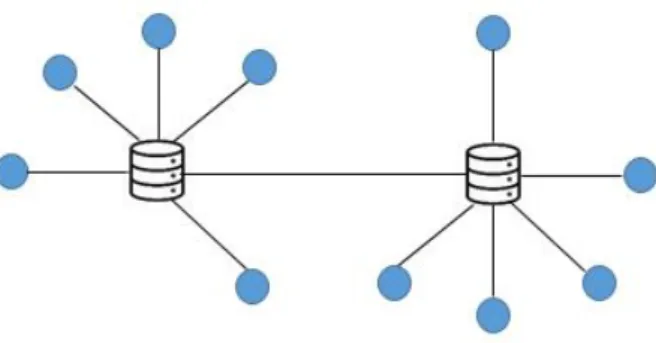
This network is the evolution of centralized network as eliminates some disadvantages, mainly the single point of failure. The network is controlled by multiple central nodes where users are connected to them. In addition, all the information is stored in all the central nodes unlike the centralized network where the data is stored only in a central authority. Furthermore, the peers can communicate directly each other without the need of third parties presence.
In case of failure of a central node, the network will keep operating as there are other central nodes to which users can connect in order to implement their transactions. In decentralized networks, the information is stored in multiple users and so it is difficult for any attacker to change this information in all the users. Furthermore the identities and the addresses of the users are difficult to be detected from a malicious node. It is impossible to track a specific user as the data is conveyed through different central nodes. Another advantage of this type of network is the absence of bottleneck as multiple nodes are responsible for different implementations.
On the other hand, users need to buy expensive equipment in order to act as central nodes for the validation of the transactions. Furthermore, central nodes can be selfish and can take decisions that act on their own interests and not on the whole network. Finally, the bigger the network, the more difficult could be to reach an agreement and, as a result, the speed for all the procedures in the network slow down.
Figure 2.2: Decentralized network
2.1.3 Distributed
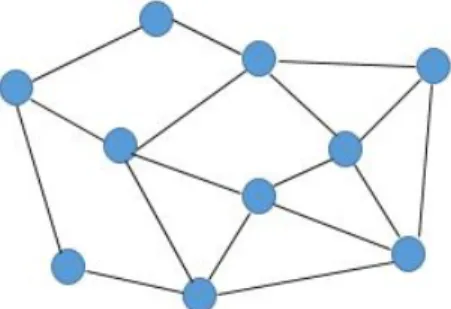
The distributed network consists of nodes that are all connected to each other and the communication is accomplished without the presence of a central node. All the participants
in the network can have an active role in the network. For example, one percentage of the nodes in the network are responsible to store all the data that happens in the network and the rest of the peers can get a copy of the recorded data by requesting. Another percentage is responsible for controlling if everyone conforms to the network rules. If a part of the network collapses, the network will continue to operate normally, since communication can be done through the rest of the nodes.
The main advantage of a distributed network is the low latency due to the absence of central authorities and the geographically spread of the network. On the other hand, the main disadvantage of this network is the fact that is difficult to reach consensus because it is highly dependent on the size of the network. More peers in network, more complicated is.
Figure 2.3: Distributed network
2.2
Blockchain
The term blockchain refers to a chain of blocks which was firstly described in 1991 by researchers, Stuart Haber and W. Scott Stornetta in order to timestamp a Digital docu-ment without being tampered [13]. In addition, in 1992, those researchers in collaboration with Dave Bayer improved the efficiency of this procedure by introducing the Merkle root, where the integrity of the data is checked in a efficient way [26]. In 2008, Satoshi Nakamoto published the first paper introducing the term chain of blocks describing an electronic cash system between peer to peer [17]. Through this paper, a new era of cryptocurrency was born and especially that of BITCOIN [17]. With the passage of the years, the term “chain of blocks” changed to what we call today blockchain.
Blockchain is a decentralized and distributed ledger across the network that can main-tain and record transactions between peers unchangeably and securely. Each participant in the network can communicate directly each other without the need of the presence of the central authority. The P2P network determine some certain rules where all the peers who belong to this network should conform to. When the transactions are implemented between peers, every participant has to check the validity of these transactions according to the specific rules and then, these transactions are stored into a block. The blocks are linked to each other making a chain. Each block contains the hash of the previous block maintaining the transactions unharmed and making in this way the block immutable. So, the chain becomes more secure as the insertion of a new block verifies all the previous blocks. For example, if an attacker wishes to tamper the contents of the block, not only should she modify the data in that block but also the data of all the subsequent blocks [29]. The modification of the block is difficult to be implemented and it will be explained
in more detail in the next chapter.
According to the operation of the blockchain, this technology makes use of cryptog-raphy and hash functions in order to protect and keep the identity of each user unique in the network. Each peer in the network has a pair of keys, the public and the private key. When a peer wants to make a transaction should sign his own transaction with his private key. Then the rest of the participants have to verify this transaction by checking the signature of the sender using its public key [9]. This procedure eliminates the need of the central authority to control the whole network as peers can implement transactions through their keys. Furthermore, another reason of no need of centralized authority is that every participant in the network has a replica of the updated ledger which includes all the blocks of the chain with the corresponding transactions.
All the peers in the P2P network have the right to join or to leave the network at any time they wish. The issue of the public blockchain is that the participants do not know each other, and as a result peers cannot know whom they can trust in the network. This problem can be prevented with the consensus algorithms which require all the peers or the majority of them to agree to the network rules as to reach the finality of the blocks that are stored in the ledger.
Except for the distributed ledgers and the consensus, blockchain can assure, also, trust and security through the smart contracts. It is an application that was introduced in the second generation of blockchain and especially in Ethereum. Smart contract is executed on top of the blockchain, and it is a set of computer programs that include codes and agreements in the form of business logic, between two or more parties without the need of third parties. When specific criteria are met, then the smart contracts are executed automatically in order to obtain the output and this result is stored and replicated in all participants in the network to provide immutability.
Despite of all these advantages, there are some limitations in the blockchain, which does not make it as trustable as seems. Some of the most typical limitations of blockchain are:
• Scalability: due to the consensus mechanisms, each peer in the network has to validate the transaction as a result the bigger the network is, slower the performance of processing transaction will be.
• Anonymity and data privacy: although in the case of public ledgers, where the peers are anonymous, when the transaction is occurred it is recorded in the blocks where each participant of the network can know about this transaction. Through these records, anyone has the possibility to identify other users as to learn private information of these users.
• Security: there is a possibility of a “51% attack”, where if more than a half number of the peers lies, these lies will become the truth and then can persuade the rest participants of the blockchain. As a result, it would be able to have the control of the blockchain in order to change or remove the transactions.
2.3
Types of Blockchain
The blockchain can be implemented in three different categories, the public or permis-sionless, the private or permissioned and the consortium or Federated blockchain. Each type of blockchain has different characteristics and when the producers or businesses want to create a new blockchain, they can choose the specific type according to their needs in attempts to implement their own services. Some of these characteristics are the number of users that can take part in the network as their rights of participation to the verification of the transactions or the insertion of the blocks in chain etc.
2.3.1 Public Blockchain
In the permissionless blockchain everyone who wishes to join the network can take easily part in that and has, also, the right to read and write to the ledger. When a user joins the network, he is updated by all the information existing in the network and he has the right to make and validate transactions as to insert the block in the ledger [6]. Furthermore, due to the anonymity of peers in the public network, the users do not trust each other and for this reason, the network uses an incentive mechanism making the users to participate in the network. When users verify and validate transactions and blocks, the network gives them rewards, in order to encourage more and more participants to join that.
The public networks usually are more secure than the other types of blockchain as there is no presence of central authority and peers can keep their anonymity. In addition, in case that some nodes fail, this does not affect the normal operation of the network as each node in the network is fully aware of the transaction in the ledger. Furthermore, the security can be achieved through the consensus algorithms such as proof of work (PoW) and proof of stake (PoS) [29]. Through these algorithms, users have to prove that they have spent an amount of energy (PoW) or hold an amount of money (PoS) in order to be active members in the consensus process. Bitcoin and Ethereum are examples of this type of the blockchain.
One of the main limitations of public blockchain is that it needs a huge amount of resources like computational power and an expensive equipment in case of proof of work in order to ensure consensus in the network updating all the nodes. According to the previous case usually the transactions fees in the permissionless network tend to be high. In addition, each node has to possess a huge space of storage in order to record the transactions. For example, in Bitcoin, the size of the blockchain file is at about 217.8 GB so far [3]. The verification of transactions as the validation of the blocks is too slow on the grounds that each one has to be validated by the whole network. Finally, public networks can suffer from what is known 51% attack where a group of miners manipulate the majority of computing power on the network and thus they are able to choose what transactions can be valid regarding to their own perspective.
2.3.2 Private Blockchain
Unlike the public blockchain where everyone can join the network, in private network, the network administrators give the permission to a specific number of users to participate in the network. This kind of network consists of a small group of participants who are known each other. The network usually does not require any consensus algorithm due to
the fact that all nodes are trusted. In case of malicious behavior, the peers become aware of this situation and they can solve the problem following the certain rules where network has established. In this permissioned network, every peer has different participation rights than the permissionless network where all the participants have the same rights. In this case, a small number of participants is responsible for the validation of the transactions and the insertion of the blocks into the chain. In addition, the ledger is not necessary to be replicated to the entire network. For example, a business in order to make an agreement, can communicate only with peers who are associated with this agreement and once the deal is carried out, then the whole network can be informed with this agreement if the business wishes.
Private networks present better performance than the public networks as the trans-actions are stored and validated only by a specific number of peers and not by the whole network. Furthermore, the cost of the transaction fees is cheaper as there is no need for huge computational power to reach finality. As described previously, when a peer be-haves badly, the network can detect immediately this abnormal behavior, it fixes it and uses consensus protocols and it reaches finality much quicker unlike public network where achieving consensus could take time.
On the other hand permissioned blockchain have security issues. Due to the reason that the network consists of a limited number of peers, it gets easier for the attacker to take control of the entire network. In addition, this type of network tends to be centralized as only some peers are responsible for the normal operation of the network. Finally, the participants of the network are controlled from the business or the organization which are the owners of the network. This means that as the information is not published in the whole network, they can control or modify the transactions in their own perspectives. Hyperledger Fabric and R3 Corda are some platforms that uses private networks.
2.3.3 Consortium Blockchain
The consortium blockchain is permissioned and semi decentralized due to the small number of the participants and the hierarchy of the peers. Instead of public network where everyone can have access and participation for the consensus to the network, this type of blockchain relies on the predetermination of selected peers for the validation of the transaction and the insertion of the block in the ledger. For instance, if a network consist of 30 members, only the 2/3 of the peers (20) have to sign in one block in order to be valid. Furthermore, in this blockchain each participant knows every peer in the network having different rights from each other like in permissioned network.
Consortium blockchains, more or less, present the same advantages and disadvantages as the permissioned blockchains. It is not based on PoW like in case of public, but it is adapted from Practical Byzantine Fault Tolerance (PBFT), Proof of Activity (PoA) and other consensus algorithms as the peers trust each other. In addition, MultiChain and Hyperledger platforms are highly based on this type of networks.
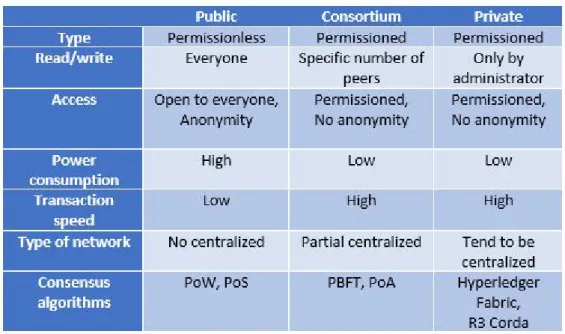
The table 2.1 summarizes the main characteristics of these three different types of blockchain.
Table 2.1: Summary of the three types of blockchain
2.4
Architecture of Blockchain
The main purpose of blockchain is to eliminate the central authority. In order to achieve this, blockchain had to invent new features to provide security in the network. The following subsection will analyse the main characteristics of the blockchain.
2.4.1 Hash
One of these features is the use of the Hash function which keep the identity of each user and the contents of each block in the chain unique. Specifically, the hash function is similar to identification of the person through its fingerprint. For example, not only does a transaction include the asset will be sent but also the address of the sender and the receiver. Through the hash function, the network can prevent the peers from imitating other participants in the network as it can confirm that a transaction originated from the real sender.
The hash function is a mathematical algorithm which converts an input of a variable size into an output of a fixed size. For example, Bitcoin uses the Secure Hash Algorithm SHA-256 where the input can be 264 bits and the output of this algorithm is a fixed size of 32 Byte [29]. This function is characterized as not irreversible and the result of this algorithm represents a unique digital fingerprint which cannot be invertible. Furthermore, a slight difference in the input data leads to a new hash creation and as it is depicted in the figure 2.4, the deletion of only one exclamation mark changes completely the obtained output.
In blockchain, hash plays a significant role to keep the block secure and immutable in the chain as each blockheader of the block includes the hash of the previous block. As a result, it’s impossible for an attacker to modify the contents of a block because not only must he change the single block but also all the subsequent blocks in the chain.
Figure 2.4: Example of hash function
2.4.2 Public and Private Keys
Every peer in the blockchain network owns a pair of asymmetric keys, the public and the private key. These keys play a significant role not only on the creation of the transactions but also the validity of these transactions. The private key is secret and is only known by each user. This key is used to digitally sign the transactions in order to prove the authenticity. The public key is visible by everyone in the network as it represents the address of each user by hashing this key. In addition, the public key is used to verify if the specific transaction was executed by the real sender. Furthermore, hashing the public key gives an extra privacy to the user.
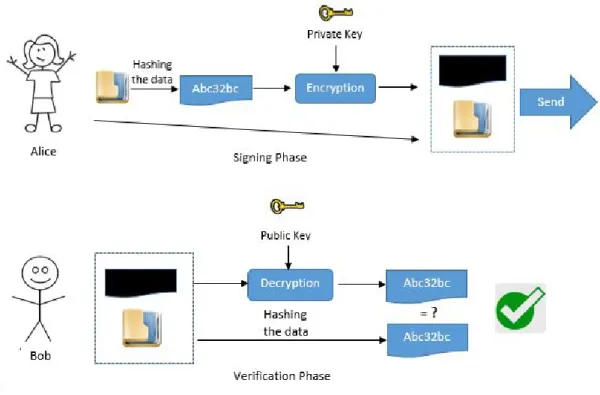
The picture 2.5 depicts the whole procedure needed for the implementation of the transaction. The digital signature consists of two phases[1]: the signing phase where is generated by using the private key and the second one is the verification phase where anyone can verify the digital signature.
Alice wants to execute a transaction with Bob. In order to make this transaction, she has to follow some steps.
• Alice, firstly, has to create a hash of all the data that correspond to this transaction. • In addition, she creates a digital signature by encrypting the hash which was obtained
by the data of this transaction with her private key.
• Finally, she sends the digital signature as the data of the transaction to Bob. Then, Bob can verify if Alice is the real sender of this transaction.
On the other hand, once Bob has already received the data of the transaction and the digital signature of Alice, he has to implement two procedures to crosscheck the validity of Alice’s transaction.
• Bob has to decrypt Alice’s digital signature by using her public key in order to get the hash.
• Secondly, Bob has to use the same hash algorithm as Alice in order to calculate the hash of the data.
If the results of the hash coincide then it is clear that the verification was implemented successfully without tampering the data and Alice is the real sender of the transaction.
Figure 2.5: Implementation of transaction 2.4.3 Merkle root
In all types of blockchain and especially, in that of public network, the number of users that can take part in the network could be very high from thousands to millions of users as a result, the bigger the network is, more transactions are executed in the network. In order to be implemented, these transactions are stored firstly in the blocks before appending to the chain. Hundreds to thousands of transactions can be included in every block. Once a block has been inserted to the chain, then each user is informed about this situation and stores a full replica of the ledger. However, that operation cannot be implemented normally when the users have a limited capacity in their devices such as mobile phones and laptops, as there is no enough space to store the updated replica of the ledger. For this reason, the inventor of Bitcoin, Satoshi Nakamoto, was the first that made use of Merkle tree root in blockchain in attempts to resolve the issue of the storage space. This technique was invented by Ralph Merkle in 1979.
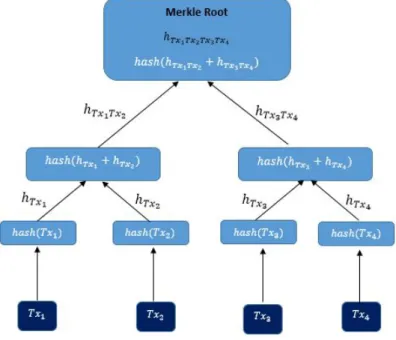
Merkle root is included in the blockheader of each block which belongs to the chain and represents a single hash value of the whole transactions corresponding to a specific block. Especially, Merkle root works as a binary tree which consists of hashes. An example of Merkle root is depicted in figure 2.6 supposing that a certain block consists of four transactions Tx1, Tx2, Tx3 and Tx4. These transactions are located at the bottom of the tree where a hash of each transaction is calculated separately hTx1, hTx2, hTx3 and hTx4 through a cryptographic hash function. Then, the hashes of these transactions known also as children are grouped in pair of two creating two new hashes hTx1Tx2 and hTx3Tx4 which are called parents. Especially, the concatenation of hTx1 and hTx2 is hashed and produces the hTx1Tx2. These hashes represent the parents and the leaves. This procedure is continued until reaching the final single hash known as Merkle root. As referred previously, Bitcoin makes use of SHA-256 cryptographic hash function and in the case of Merkle root, this function is used twice in order to obtain the hash result [1]. For instance, hTx1 = hash(hash(Tx1). Furthermore, the number of transactions included in
each block should be even as the following example with the four transactions. However, in case of existing an odd number of transactions in the block i.e. 5 transactions, then the fifth transaction has to be paired with itself to create an even number of transactions and subsequently this pair is hashed creating a new parent hTx5Tx5.
Figure 2.6: Structure of Merkle tree
On the other hand, not only was Merkle root used to overcome the storage issue, but also to crosscheck if a specific transaction or a number of transactions belongs to a certain block. This can be achieved by checking only some intermediate hashes of the Merkle tree. Given these hashes known as Merkle path, the verifier should calculate a single hash value and then he has to compare it with root hash. If both hashes are the same, then the transaction belongs to this Merkle root or it has not been tampered with. Let’s assume that Bob receives the root hash hTx1Tx2Tx3Tx4 from a trusted source and Alice wants to prove to Bob that the Tx1 transaction exists in this specific root hash and the data is not tampered. So, Alice has to send the Tx1 transaction, the hTx2 and the hTx3Tx4 to Bob. He, in turn, should calculate the h’Tx1, the h’Tx1Tx2 and h’Tx1Tx2Tx3Tx4. Finally, he has to compare if both root hashes are the same hTx1Tx2Tx3Tx4= h’Tx1Tx2Tx3Tx4. In case of Bitcoin, where more than a thousand of transactions can be included into 1 Mb block, users have to produce only log2N hashes (from 10 to 12 hashes) to verify a single transaction. N is the number of the whole transactions that exist in the block. As a result, the computational effort can be reduced through the Merkle tree.
The Merkle root is a useful tool, especially for the users that they do not have available large space storage. In blockchain, the users can be divided in two categories: full nodes and light clients [27].
• Full nodes are responsible for downloading a replica of the ledger which consists of the genesis block until the last appended block in the chain as to verify the authenticity of the transactions which are recorded in the blockchain. Users are served as a full node need a huge amount of storage in order to store the updated replica. Nowadays, the size of the blockchain in Bitcoin has reached almost 250.6 GB [4] and this size is going to be increased as each block is generated every 10 minutes.
which corresponds to 80 Bytes per block cite3. As a result, users with a limited capacity can have an active role in the network as light clients. They make use of the Simplified Payment Verification (SPV) [1][27]in order to check the authenticity of the transaction. When a user wants to verify a transaction, it makes use of Bloom filter (Bitcoin) in order to find only the associated transaction by asking for a full node. Once the full node has detected the desired transaction that corresponds to the Bloom filter, then the node informs the light client by sending to him the blockheader of the corresponding block as the Merkle path.
2.4.4 Structure of blocks
As mentioned previously, blockchain is a chain which consists of many blocks. Each block depends on the previous block as each one includes the hash of the previous block. Furthermore, such a feature makes a blockchain more secure because it is very difficult to modify the block without changing the subsequent blocks. As a result, the blocks inserted to the chain are immutable and neither can be deleted nor tampered with. The blocks differ from blockchain to blockchain and constitute the records of the transactions as the blockheader which contains some specific data.
When the transactions occur, every validator has a right to pick a number of transac-tions, verify them and insert them into a block. The number of transactions that can be stored in a block depends highly on the size of the block and the transaction. For example, the number of transaction in Bitcoin is limited as the size of the block is only 1 MB. In addition, validators can usually choose which transaction wishes based on the fees of each transaction. In Bitcoin, the transaction with the highest fees submitted by the producers of each transaction are selected quicker than those transactions with low fees.
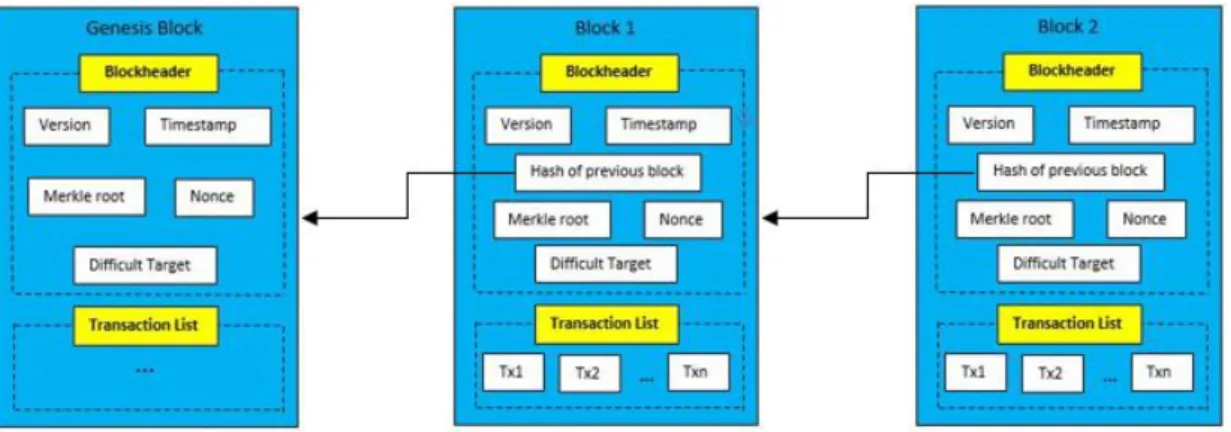
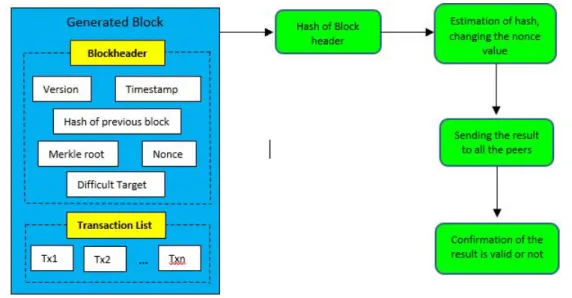
Besides the transaction list which is included in the block, the blockheader is, also, part in that[1][30]. Blockheader consists of six fields:
• Version: it indicates the version number of upgrades and changes in the protocol used by a validator.
• Timestamp: it indicates the time where a block is generated.
• Hash of the previous block: this hash points to the previous block. Especially, all the data that are included in the block are inserted in a cryptographic hash function in order to obtain a single hash value. This hashed result is stored in the next block in the blockchain.
• Merkle root: as refereed to earlier, it is a single value of hash which represents the summary of all the transaction included in the block. Firstly, once the transactions have been hashed, they are grouped in a pair of two producing a new hash. This operation is continued until only one single hash is fount.
• Nonce: it is used in Proof of Work (PoW) algorithm by the miners and it is the only field in the block that can be changed. Modifying the nonce, miners have to solve the difficult mathematical puzzle in attempts to prove that the hash of the block header is lower or equal to the difficult target.
• Difficult target: it is a target threshold which is determined by the network every two weeks in order to follow the rules of Bitcoin where a new block is generated every
10 minutes. For instance, if the time that the blocks are inserted in the blockchain is less than 10 minutes per block, then the difficulty target should increase.
Figure 2.7: Structure of blocks
According to the sequence of the blocks, the block which is generated firstly in the chain is known as genesis block and is, also, referred to as block zero. Each block in the blockchain can be identified through a block height number which is always a positive integer number and increases by one every time that a block is inserted to the blockchain. For example, the second block which is inserted by the genesis block is referred to as block 1 and so on. A blockchain is depicted in the above figure 2.7 which consists of the genesis block and another two blocks. Furthermore, it illustrates how the block are linked to each other as the contents of them.
3
Consensus
3.1
What is Consensus?
In a centralized network, the central authority is responsible for the validation of the transactions providing security and trust to the entire network. However, in a distributed and a decentralized network, the peers interact only each other as there is not any central authority. In this case, for better maintenance of the network, all the peers have to follow a set of rules determined by the network and come to an agreement over a single block which will be inserted in the chain. This agreement in the blockchain is achieved through consensus algorithms. Nowadays, there are a lot of consensus algorithms where each one is used by a different type of blockchain. For example, in permissionless networks, the most common consensus protocols are Proof of Work (PoW) and Proof of Stake (PoS) while the permissioned networks make use of practical Byzantine Fault Tolerance (PBFT) etc.
The main purpose of consensus algorithms is to solve the problem that is created when any node in the network try to reach a consensus either in the presence of malicious behaviour of the peers or any faulty process exists in the network. These issues are known as forking and Byzantine General Problem. Forking can happen when two peers propose simultaneously a new block or when a peer wants to behave maliciously creating the same block twice. In both cases, consensus mechanism can solve this problem by choosing the longest chain of the blockchain. Furthermore, the byzantine general problem occurs when there is not unanimity in the network between the peers agreeing for a single piece of data on the grounds that some of them can misbehave sending erroneous messages or being faulty due to the crash of the system etc. As a result agreement can not be reached.
As referred previously, the distributed network suffers from some issues such as an abnormal behaviour of the peer or the network. However, two main categories of consensus mechanisms have been developed in order to overcome these problems [18]:
• Proof-Based consensus algorithm: it is used in permissionless networks where every peer in the network can be a validator to verify the block and insert it in the chain giving the sufficient proof to the network that a validator deserves to participate in. For instance, Bitcoin uses the PoW consensus algorithm and a validator (miner) has to consume a huge amount of energy in order to solve the mathematical puzzle and append the block to the chain.
• Vote-Based consensus algorithm: this type of algorithm is used in permissioned net-works based on multiple rounds of votes in order to achieve consensus. For example, Hyperledger Sawtooth makes use of PBFT where a lot of messages are exchanged between the participants in the network in attempts to reach the consensus.
3.2
Byzantine General Problem
The ”Problem of the Byzantine generals” was originally described by Marshall Pease, Robert Shostak and Leslie Lamport in 1982 [14] and was based on the scenario that parts
of the Byzantine army camped outside the walls of an enemy city are facing problems with the creation of a joint action plan due to the possibility of transmitting unreliable information. In detail, each part is administered by its own general and it has been decided that after a certain period of monitoring of the enemies, all the generals should agree on a joint action plan. So in order to achieve the necessary communication and the coordination of all generals, it is safeguards to transfer the necessary information and news from the one part of the army to another. At this point it should be noted that in the given historical period the transmission of information was made exclusively by messengers of each troop. However, this method of transmitting information poses risks of falsifying the information, because some informants who have betrayed the troop and allied with opponents, they have the ability to transmit false information in order to prevent (law-abiding) generals from coming to an agreement.
So, on the basis of the above, it is clear that the generals must use an algorithm which guarantees that:
• The action plan to be implemented is a unanimous decision by all the generals involved.
• The possible existence of a limited number of informants who have betrayed their troops will not lead to the manipulation of the data and therefore to the adoption of a harmful action plan.
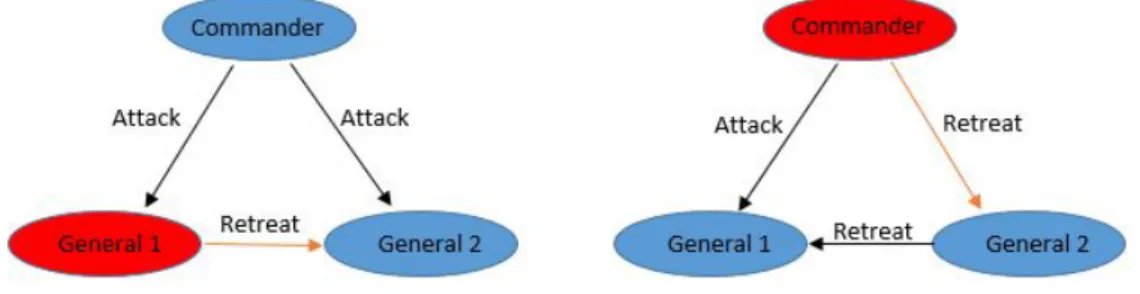
Figure 3.1 illustrates two examples of Byzantine general problem in a presence of honest and dishonest soldiers. The example appeared in the left icon depicts the successful attack in the city as all the army following the general’s command will attack at the same time. On the other hand, the second example represents the unsuccessful attack when there are some traitors trying to manipulate the order of the commander. In more detail, the general (Commander) gives an order of attack to the army but a part of the army are traitor and falsifies the order in retreat.
Figure 3.1: Coordinate and uncoordinated attack
It is therefore obvious that without the existence of synchronicity and integrity in the information exchanged, it is impossible to implement a unanimous and reliable action plan, because the risk of carrying forged orders from traitors informants always exists.
This method can correlate with the distributed system where generals represent the honest nodes and the generals who betray the troops represent the malicious nodes in the
network. Lamport, Shaostak and Pease proved that if at least the 2/3 of the network acts honestly, then there will be a unanimous decision in the entire network. Especially, they determined a condition which indicates that if the number of malicious nodes is equal or exceeds the 1/3 of all the nodes, then the system will not work properly.
n ≥3f+1
Where n is the total number of nodes in the network and f the number of malicious nodes.
The above condition can work properly if the whole network consists of at least four nodes. In the case of three nodes where one of those nodes behaves maliciously, agreement cannot be reached between of them as each node receives two different messages. As depicted in Figure 3.2, there is one commander and two generals. Commander and general 2 act honestly but general 1 is a traitor and wants to change the decision of the commander. Therefore, general 2 cannot make a decision as received both attack from commander and retreat from general 1. In normal case, general 2 should trust the commander as he posses higher position in hierarchy than general. However, what happens if commander behaves maliciously? This leads to the same scenario as previously, since commander sends attack to general 1 and retreat to general 2. So, General 1 does not know what decision can take.
Figure 3.2: System with three nodes
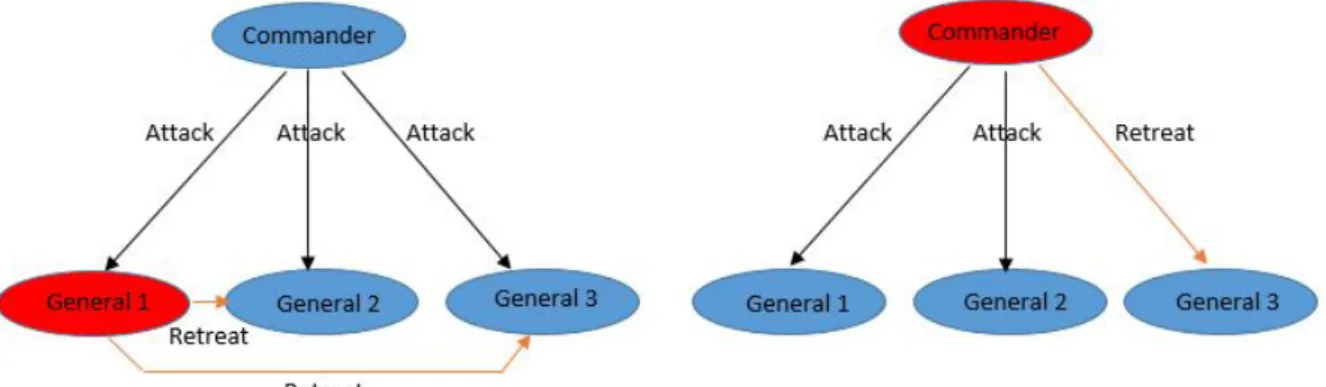
In case of four nodes where one of them is a malicious node, generals can reach agreement as the 2/3 of the nodes in the system behaves honestly. Each general informs the other ones in the system about the command they have received. According to Figure 3.3, General 2 receives two attacks from the commander and the general 3 and one retreat from the general 1 acting as a traitor. As a result, general 2 takes into account the majority of the messages that he received and then he will attack. In addition, in case that commander sends erroneous messages, generals could be possible to reach in agreement, as two of the three generals will get the same messages. For example, all generals receive two attacks and one retreat.
Figure 3.3: System with four nodes
3.3
Consensus Algorithms
3.3.1 Proof-Based consensus algorithm
3.3.1.1 Proof of Work (PoW)
The Proof-of-Work (PoW) is an algorithm in attempts to achieve consensus to ensure the validity of the transactions as the creation of blocks. Although, the concept of this algorithm was first developed in 1993 by Cynthia Dwork and Moni Noar trying to solve the problem of spam emails, the term ”Proof of Work” was first referred and formalized in a 1999 paper by Markus Jakobsson and Ari Juels. Later, this algorithm became widely known through the founder of Bitcoin, Satoshi Nakamoto, who used this mechanism to reach consensus successfully between many nodes on the network and he used it as a way to secure the Bitcoin Blockchain.
To understand the operation of the proof-of-work algorithm should be taken account that each time a transaction is executed in the Bitcoin network, it is recorded and is stored in a temporary block. Thus, once the block has been confirmed with all the validated transactions included in that block, then this block is inserted to the chain sending a replica of this record to the rest of the participants in the network. The validity of those transactions as the insertion of the next block in the chain are implemented successfully through the use of Proof-of-Work consensus protocol. The above process is called mining and is done by the miners who are trying to solve a difficult mathematical cryptographic puzzle in attempts to obtain the appropriate result determined by the difficult target. Once miner obtains that, it informs all the participants in the network about the result and then the participants verify this validity in an easy way reaching the consensus.
Especially, every time that a new block is generated, all the verified participants should include all the valid transaction into the block as the HASH of the previous block. In addition, in the new block, the block header consists of some other fields like the Merkle root, difficult target and the Nonce. All the fields included in the blockheader as the procedure of the PoW are depicted in the figure 3.4.
In Bitcoin, using an encryption algorithm called as SHA-256 hash, miners have to solve the difficult mathematical puzzle by modifying the nonce in order to prove that the hash of the block header is lower or equal to the difficult target. Always, the output of a
Figure 3.4: Procedure of PoW
SHA-256 hash will be 256 bits long regardless of the size of the input. hash blockheader +nonce) ≤Difficult target
For example, if the difficult target for the network is 0000 and the base string is ”Hello, world!”, then miners should find the desired result changing the value of nonce until the hash (Hello World! nonce) gives at least 0000. The rest bits of the hash does not affect the selection of the desired result.
Hash ”Hello, world!0”)⇒1312af178c253f84028d480a6adc1e25e81caa44c749ec81976192e2ec934c64 Hash ”Hello, world!1”)⇒e9afc424b79e4f6ab42d99c81156d3a17228d6e1eef4139be78e948a9332a7d8 Hash ”Hello, world!2”)⇒ae37343a357a8297591625e7134cbea22f5928be8ca2a32aa475cf05fd4266b7
...
Hash ”Hello, world!4249”)⇒c004190b822f1669cac8dc37e761cb73652e7832fb814565702245cf26ebb9e6 Hash ”Hello, world!4250”) ⇒0000c3af42fc31103f1fdc0151fa747ff87349a4714df7cc52ea464e12dcd4e9
As shown in the example, the computer tried 4251 times to calculate the hash that gave the first 0000 bits. Furthermore, this obtained result is sent to all participants of the network and they, in turn, have to verify this result hashing the phrase with the corresponding nonce. If the validation is done successfully, then the block is verified and the miner can receive the rewards as a small amount of transaction fees. The miners, usually, choose the transactions with the highest fees in order to get included in the block. But the number of these transactions is limited because is fully depended on the block size which is 1 MB. The transactions fees are determined by the peers that execute the own transactions. More the fees that peers pay, faster the time to valid these transactions.
Especially, a reward should be given to the miner after the insertion of a given number of blocks. For example, in Bitcoin, a reward is given after at least 6 validated blocks appended to the chain making the block immutable. Nowadays, the rewards of miners are 12.5 bitcoins but during the 2016, the block reward was at 25 bitcoins. The amount
of reward is halved every 210000 blocks and this happens in interval of four years. This procedure of halving rewards will keep going until the total amount of bitcoins reach the 21 million in 2140. Then, the generation of bitcoins will be stopped as a result, miners will not get the rewards but they will keep receiving the transaction fees.
Due to the different CPUs that exist worldwide, some miners can solve the crypto-graphic puzzle in less than 10 minutes or they want more than the expected time to have a result. For this reason, the network determines a difficult target every two weeks in order to follow the rules of Bitcoin where a new block is generated every 10 minutes. If the time that blocks are inserted in the blockchain is less than 10 minutes per block then the difficulty target should increase and vice versa. The value of the difficult target can be obtained from the following equation:
N ew Dif f iculty=Old Dif f iculty∗Actual time of last2016Blocks 20160minutes
The period of two weeks consists of 20160 minutes. During these two weeks, if every new block is generated every 10 minutes, then it will consist of 2016 blocks. In case that the blocks are generated every 9 minutes, then 2240 blocks will be generated in two weeks, 224 blocks more than the normal situation. As a result, the network should calculate only the actual time of the first 2016 blocks needed to calculate the new difficult target. Therefore, the time that corresponds to 2016 blocks are 18144 minutes and having the old difficult target and the actual time of last 2016 blocks, the network can calculate the new difficult target.
There is a case that two or more miners can find the same or different result where the hash of the block header is lower or equal to the difficult target by solving the cryptographic mathematical puzzle simultaneously. Each miner tries to solve its own cryptographic puzzle as each block includes different transactions.
In that case, the miners should broadcast the result to the rest of the participants of the network, which leads to the creation of the forking. As depicted in the following figure 3.5, fork can consist of more than two chains. In a normal situation, miners will choose in which chain they are going to mine because every time that a miner tries to mine a block consumes a huge amount of energy. They have the right to mine in more than one chain but this is needless due to the reason that the miner’s reward will be smaller than the cost of energy he is going to consume. Furthermore, the fork will be stopped when one chain overtakes the other chains. So, the longest chain is chosen giving the reward to the miners belonging to this chain and the other ones are discarded without miners taking any reward.
The main goal of PoW is to prevent cyber-attacks such as Sybil attack and Distributed Denial of Service attack (DDoS). Sybil attack occurs where a single entity creates multiple fake identities in order to control the majority of the network. If the attackers control more than the half of the peers in the network they can execute a double spend attack imple-menting which transaction they want and preventing transactions from other users to be validated. In addition, they can modify validated transactions that have already inserted in the block. In PoW, an effective attack is costly and time consuming on the grounds that every device wastes a huge amount of energy in attempts to solve the mathematical puzzle and that makes the PoW algorithm more secure. For this reason, Sybil attack can not be implemented. The purpose of the DDoS attack is to delay the transaction
valida-Figure 3.5: Case of fork
tion of the peers by sending a flooding of fake transactions in the network. The Bitcoin can validate up to 7 transactions per second, the size of each block is only 1MB and each block is inserted to the chain at about 10 minutes. As a result, only a specific number of transactions will be included in each block, some transactions will never be validated, and they will be discarded. Bitcoin, solved this problem by introducing transaction fees. Therefore, the miners include to their blocks the transaction with the highest fees.
The PoW suffers from what is known as 51% attack, where a group of miners manip-ulates the majority of computing power on the network and thus they are able to choose what transactions can be valid regarding to their own perspective. This can be easily achieved through the mining pools in which a lot of peers cooperate in order to find the solution of the cryptographic puzzle in a faster manner. They are given more chances to solve the cryptographic puzzle rather than other peers who are not included in the mining pool as a result they can control the network. In addition this cooperation leads to the centralization.
However, the presence of 51% attack leads usually to another issue that exists in the blockchain, called as double spent attack. Such an attack happens when a malicious peer wants to spend the same amount of coins on the blockchain twice. Every time that a transaction is executed, a vendor must wait n confirmations of blocks and then provide the product to the sender of the transaction. The n number of confirmations depends on the types of the payments, namely how fast or slow a transaction is implemented [12]. The slow payments are those that provide the most secure way of payments on the grounds that a vendor has to wait at least 6 confirmation in order to send the product and the time which is needed to the confirmation operation corresponds approximately to one hour.
On the other hand, the vendors do not need to wait 6 confirmations to make an exchange in fast payments. In this case, they usually do not wait for confirmations or just waiting for one or two confirmations. So, there is a possibility of a double spent attack where a malicious attacker creates a fork by putting its real transaction (a purchase of a product) in the block of the first branch and its fake transaction (the same amount of coins is sent to another account controlled by the attacker) in the block of the second one. The second branch, in essence, is produced by malicious peers and is not published to the entire network. This branch will be published when a malicious attacker receive the product and when this chain overtakes the real chain. As a result, all the transaction included in the real chain is discarded and the fake chain wins. According to the following figure 3.6, it illustrates the real chain in the light blue boxes where Alice wants to buy a t-shirt and the fake chain is represented by the yellow blocks in the second chain.
Figure 3.6: Double spend attack
as miners require a huge amount of computation power and expensive equipment in order to execute the mathematical algorithms. Furthermore, PoW has some performance lim-itations. The first one is the low throughput as the average number of transactions that can be committed are 7 transactions per second, unlike Mastercard that executes 10000 transactions per second [2]. Furthermore, PoW suffers from the high latency since a block can be considered as valid after at least 6 verified blocks (1 hour) appended to the chain. For this reason, cryptocurrencies like Nxt makes use of other consensus algorithms like a PoS in attempts to improve these limitations. There is also another cryptocurrency called Ethereum which makes use of PoW but it attempts to switch to PoS.
3.3.1.2 Proof of Stake (PoS)
Even though the purpose of this Proof-of-Stake algorithm is the same as the Proof-of-Work algorithm, the process for validating the transactions is completely different. The main objective of this technique aims to avoiding long computationally expensive sequences of cryptographic operations leading to high energy consumption. The first idea of the PoS was proposed in the online forum bitcointalk.org in 2011, but the first cryptocurrency that made use of this method was the Peercoin in 2012 and Nxt followed in 2013.
Unlike the PoW algorithm where miners try to solve the mining operation, in the PoS, there are validators or forgers to proceed to that operation. The purpose of the forgers is to validate the transactions as to create new blocks. The selection of the forgers is done through the amount of coins (stake) that each peer holds in the network. The participant that owns a bigger amount of stake has a bigger probability to be a forger. For example, if Alice is holding 100 tokens, Bob 80 tokens, Daniel 60 tokens and Luis 20 tokens, then Alice has 5 times more chances to be the forger or validator than Luis. Despite PoW, where miners get the rewards when they solve the mathematical puzzle, in PoS, forgers receive only the transaction fees from the corresponding block.
amount of stake in the network, he will always be chosen as a forger for the creation of the block. As a result, he would be the only one who would earn the transaction fees controlling the whole network. In order to prevent the above problem different cryptocurrencies make use of different methods. For example, the selection of the forger in Peercoin is based not only on stakes but also the coin age where is the amount of time that the forgers hold this stake. In addition, Nxt cryptocurrency chooses randomly forgers based on their stake. Through the randomization and the coin age, PoS prevents the issue of centralization, something which happens in PoW through the mining pools.
The coin age that Peercoin [20] makes use, refers to a numeric value which indicates the number of coins that belongs to the user multiplied by the duration in days that a user hold the coin. For example, if Alice received 20 coins from Bob and held it for 30 days, then the coin age of Alice is 600 coins-days. In order to proceed to the verification of the transactions or to the creation of a new block, forgers should be waiting for a minimum of 30 days without spending any coin. Usually, the user which holds huger amount of coins and bigger duration than others, he will have the probability of being chosen to forge the next block. Every time that a forger validates a new bock, then a coin age of this forger is being zero and returns at its initial state waiting at least 30 days to be forged again. In addition, the maximum period where the participant can be forger is 90 days. Otherwise, the participant who held old and huge amount of stakes would be able to control the Blockchain.
In Nxt[19] cryptocurrency, the block is generated on average every 60 seconds. In order a peer to be selected as a forger, he should be waiting for a minimum of 1440 confirmed blocks without changing their amount of stake. Through this technique, Nxt prevents the users to using the same stakes in different accounts in order to valid the transactions and generate new blocks. After that, all users can be selected as a forger in a random way. When a validator is chosen then he can validate up to 255 transactions including them in the block. The block size in this cryptocurrency is 42 KB and a forger can choose which transactions wants, usually according to their fees. The Nxt can validate up to 100 transactions per second. Despite Bitcoin, in Nxt the transactions have deadline and this is 24 hours. This means that if a transaction remained in the transaction pool for more than 24 hours and one second then this transaction is rejected. In addition the block can be finalized after the insertions in chain of ten confirmed blocks at about 14 minutes.
One of the main advantages of PoS is that participants do not need to invest a huge amount of money in order to get the reward. There is no need for solving mathematical puzzles and this results less energy consumption as no expensive equipment. So, they can spend their money to buy more coins (stakes) in order to increase the possibility to be a forger and to receive the transactions fees. In addition, PoS provides faster processing of transactions compared to PoW. As in PoW, 51% attack is also possible in PoS but this is very difficult and expensive to implement due to the fact that a hacker should buy and control more than the half of the stake in the network where is a very huge amount of coins.
On the other hand, PoS suffers from what is known as “nothing at stake”. The issue can occur anytime the forks appear. Fork is happened when the chain of the blockchain is divided in two or more chains. This can be taken place for two reasons, the first one is due to malicious action and the second one is when two forgers propose a new block simultaneously. The last one is more difficult to happen in PoS as each forger is chosen by the system in a random way and it is responsible for inserting the block in a specific
timeslot. Furthermore, this issue appears more often in the PoW algorithm where all the validators try to solve the mathematical puzzle at the same time. The ideal scenario in case of forking is that the forgers should choose only one of the multiple chains, like in PoW. However, as referred above, it costs them nothing to take part in all the chains. So, the optimal strategy is that all the forgers can support multiple chains without the fear of having something to lose and always they can get the transaction fees from the longest chain of the wining fork.
Usually forgers use forks in order to implement double spent attack as they have ‘’nothing at stake” to lose. An example of how forgers can proceed to double spend attack is illustrated in the figure 3.7.
Figure 3.7: Example of double spending attack
Supposing that Alice is an attacker and she wants to execute double spent attack by changing her coins to bitcoins. Firstly, once fork has be created, Alice sends the coins to be exchanged in the above chain and the same coins are sent by Alice to herself in order to implement double spent attack. When the transaction becomes valid, then Alice can buy the bitcoins. In order to get the Bitcoin without paying any cost, when Alice is given the turn to validate the next block again, she will validate the block only in the second chain. While all forgers continue validating blocks in both chains, the second will be the longest chain as Alice stopped validating the block in the first chain. As a result, the first chain be dropped and Alice has achieved to add a new amount of coins at her stake by stealing the Bitcoin off an exchange as the transaction fees of the blocks that she insert in the chain. In addition, another cryptocurrency like the Ethereum tried to solve these problems by locking their stake as a deposit in order to be forgers. In this way, forgers are given the incentive to act always honestly, otherwise in case of fraudulent behaviour they are going to lose their deposit.
Another limitation of PoS is that the poorest participants in the network may never have the chance to be forgers in order to validate the transactions getting the corresponding transaction fees. This is unfair because the richer participants have always the greater
possibility to be forgers than the others and PoS makes stronger only the richer participants in the network. Leased Proof of Stake (LPoS) solves that domination problem as will be described in the next chapters.
3.3.1.3 Delegated Proof of Stake (DPoS)
Dan Larimer created DPoS in 2013 in order to overcome the limitations of PoW and PoS providing better scalability, flexibility and security in the network. Initially, this consensus algorithm was used in BitShares platform [5] and with the passing of time, DPoS was used from different projects like by Steem, EOS, Ark and Lisk etc. making some changes in the protocol. The main purpose of DPoS is to give the right to all participants that hold stakes (stakeholders) to be an active member through the voting procedure in order to solve the issues in the blockchain in a democratic and fair way.
Unlike the PoS where only the richest participants have the opportunity to take part in the validation of the transaction and the creation of the blocks in order to get the fees, in DPoS, all stakeholders have a significant participation role in the network. Stakeholders are responsible for electing the witnesses and delegates in order to execute the appropriate operations. Each participant has the right to vote in or out any number of witnesses or delegates he wishes in real time. The voting procedure can be valid only when more that 50% of stakeholders participate in election of the witnesses or delegates. In addition, each stakeholder cannot vote one specific participant more than once.
The figure 3.8 depicts the voting procedure by the stakeholders in order to elect the witnesses and the delegates. The yellow circles depict the peers that want to be voted from the other users in the network (witnesses) and the blue ones represent the stakeholders. The voting procedure happens in real time and the stakeholders can vote as many peers as they want to be a witness or delegate according to their stake they have. In BitShares, the list of the votes is updated every day and the number of witnesses amounts to 101. As a result, in the end of each day the top 101 candidates with the highest votes become the witnesses.
Figure 3.8: Example of voting procedure in DPoS
Furthermore, the votes of each stakeholder depends on the number of stakes that hold and this operation is known as Stake-weighted voting. For example, Alice has 100 coins and Bob 60 coins. If Alice wishes to vote two witnesses, Tom and Charlie, then both of them will receive the 50% of her voting weight. Bob, in turn, will vote only one witness, Bill, and so this witness will receive the 100% of his voting weight. As a result, Bill has a greater voting power than the others and then he will become the witness. Sometimes, this property benefits the weaker stakeholders as they can get the votes from
richer stakeholders and can be witnesses or delegates. In addition, another feature of DPoS is that users have the right to choose others trustful users in order to vote on their behalf.
Witnesses are responsible for validating the transactions and creating the blocks. As referred, they are elected by the Stakeholders of the network who have the right to vote out the witnesses at any time they want leading witnesses to behave honestly. In case of behaving badly, witnesses can lose the transaction fees of the block creation as their reputation. In addition, the number of witnesses is limited depending on the different projects that exist so far. For instance, EOS has a specific number of 21, BitShares with Lisk 101 and ARK 51 witnesses.
In BitShares, the list of active witnesses is updated every one day after the end of vote counting. The validation of the blocks in DPoS is done in rounds. Each block is produced by the witnesses every two seconds and the validation can be executed only once for each witness until the round is completed. The previous procedure is depicted in the figure 3.9. Assuming that the system has four witnesses the 1, 2, 3 and 4 which are responsible for inserting the block in the chain. In each round, each witness has a specific time slot that can validate the transaction and the insertion of the block in the chain. For example in the first round, witness 4 will be the first one which will insert the block, then follows the witness 1 and etc. In case that witness 3 misbehaves in its specific time slot, then the block is skipped and the next block is given the turn to be validated by the next witness which is 2. Due to that behaviour, witness 3 can lose its reputation and the transaction fees of this block. Once the round has finished, then witnesses are mixed randomly and the procedure starts again with witnesses validating new blocks as appears in the second round of the figure.
Figure 3.9: Example of validation procedure in DPoS
The majority of the projects that make use of the DPoS consensus protocol, except of the witnesses, presents, also, the delegates. Although delegates are elected in a similar manner to witnesses, their purpose is to propose changes for better maintenance of the network. Some of the proposed parameters that have to be changed are the block size, block interval and the amount of transaction fees that witnesses will receive. Once the changes have been implemented, the stakeholders, in turn, have a specific period of time (i.e BitShares two weeks) to decide if they proceed to the modification of parameters or not. Usually, changes in the network are not implemented easily because bigger the network is, more difficult for 51% of stakeholders to vote for changing the network. In few words, neither the witnesses nor the delegates are able to control the network, but the Stakeholders are they who have the greatest power in the network.
Compared to PoW and PoS, DPoS provides better performance in terms of confirma-tion of transacconfirma-tions. For example, PoW and PoS validate 7 transacconfirma-tions per second and 8 transactions per second respectively. However DPoS, theoretically, can achieve 100.000 transactions per second but in practice only 3300 transactions have been proven so far. In addition, all the participants have an active role on the network due to the real time voting, as a result, the network becomes more secure rather than the other consensus protocols.