Bivariate Gaussian random fields:
models, simulation, and inference
Inauguraldissertation zur Erlangung des akademischen Grades eines
Doktors der Naturwissenschaften der Universit¨
at Mannheim
vorgelegt von
Olga Moreva
aus Moskau, Russland
Dekan: Dr. Bernd L¨ubcke, Universit¨at Mannheim
Referent: Prof. Dr. Martin Schlather, Universit¨at Mannheim
Korreferent: Prof. Dr. Tilmann Gneiting, Karlsruher Institut f¨ur Technologie Tag der m¨undlichen Pr¨ufung: 22. Juni 2018
Abstract
Spatial data with several components, such as observations of air temperature and pressure in a certain geographical region or the content of two metals in a geological deposit, require models which can capture the spatial dependence structure of individual components and the relationship between them. In a wealth of applications, multivariate Gaussian random fields are sensible models for multivariate spatial data and their second order structure specifies the marginal correlations and the cross-correlations between the components. In this thesis we focus on covariance models and simulation techniques for bivariate fields.
In Chapter 2 we summarize some definitions and facts from univariate and multivariate Geostatistics which are essential for the subsequent chapters.
Chapter 3 introduces two novel bivariate parametric covariance models, the powered ex-ponential (or stable) covariance model and the generalized Cauchy covariance model. Both models allow for flexible smoothness, variance, scale, and cross-correlation parameters. The smoothness parameter is in (0,1]. Additionally, the bivariate generalized Cauchy model allows for distinct long range parameters. The results are based on general sufficient conditions for the positive definiteness of 2×2-matrix valued functions. These conditions are easy to check, since they require only computing the derivatives of a bivariate covariance function and calculating an infimum of a function of one variable. We also show that the univariate spherical model can be generalized to the bivariate case with spherical marginal and cross-covariance functions only in a trivial way.
Circulant embedding is a powerful algorithm for fast simulation of stationary Gaussian ran-dom fields on a rectangular grid in Rn, which works perfectly for compactly supported
co-variance functions. Cut-off circulant embedding techniques have been developed for univariate random fields for dimensions up to R3 and rely on the modification of a covariance function
outside the simulation window, such that the modified covariance function is compactly sup-ported. In Chapter 4 we propose extensions of the cut-off approach for bivariate Gaussian random fields. In particular, we provide a method for simulating bivariate fields with a bi-variate powered exponential covariance model and the full bibi-variate Mat´ern covariance model for certain sets of parameters. On the way we extend the cut-off circulant embedding method even for univariate models.
In Chapter 5 we illustrate the use of the bivariate powered exponential model for a data example.
Zusammenfassung
R¨aumliche Daten mit mehreren Komponenten, wie Beobachtungen von Lufttemperatur und Atmosph¨arendruck in einer bestimmten geographischen Region oder der Gehalt von zwei Met-allen in einer geologischen Lagerst¨atte, erfordern Modelle, die die r¨aumliche Abh¨ angigkeitsstruk-tur einzelner Komponenten und die Beziehungen zwischen ihnen erfassen. In einer Vielzahl von Anwendungen sind multivariate Gauß’sche Zufallsfelder sinnvolle Modelle f¨ur multivariate r¨aumliche Daten und ihre Struktur zweiter Ordnung spezifiziert die marginalen Korrelationen und die Kreuzkorrelationen zwischen den Komponenten. Diese Arbeit konzentriert sich auf Kovarianzmodelle und Simulationstechniken f¨ur bivariate Felder.
Kapitel 2 fasst einige Definitionen und Fakten der univariaten und der multivariaten Geo-statistik zusammen, die grundlegend f¨ur die folgenden Kapitel sind.
Kapitel 3 stellt zwei neuartige bivariate parametrische Kovarianzmodelle vor, das potenzex-ponentielle (oder stabile) Kovarianzmodell und das verallgemeinerte Cauchy-Kovarianzmodell. Beide Modelle erm¨oglichen flexible Gl¨attungs-, Varianz-, Skalierungs- und Kreuzkorrelationspa-rameter. Der Gl¨attungsparameter ist in (0,1]. Zus¨atzlich erlaubt das bivariate verallgemeinerte Cauchy-Modell verschiedene Langzeitparameter. Die Ergebnisse basieren auf hinreichenden Bedingungen f¨ur die positiv Definitheit von 2×2-Matrix-wertigen Funktionen. Diese Bedin-gungen sind einfach zu ¨uberpr¨ufen, da nur die Ableitungen einer bivariaten Kovarianzfunktion berechnet werden m¨ussen, und das Infimum einer Funktion von einer Variablen zu bestimmen ist. Zudem wird gezeigt, dass das univariate sph¨arische Modell nur auf triviale Weise auf den bivariaten Fall mit sph¨arischen marginalen und Kreuzkovarianzfunktionen verallgemeinert werden kann.
Circulant Embedding ist ein leistungsf¨ahiger Algorithmus zur schnellen Simulation von sta-tion¨aren Gauß’schen Zufallsfeldern auf einem rechteckigen Gitter inRn, der perfekt f¨ur
Kovar-ianzfunktionen mit kompaktem Tr¨ager funktioniert. Cut-off circulant Embedding Techniken wurden f¨ur univariate Zufallsfelder f¨ur Dimensionen bis zu R3 entwickelt und basieren auf
der Modifikation einer Kovarianzfunktion außerhalb des Simulationsfensters, sodass die mod-ifizierte Kovarianzfunktion einen kompakten Tr¨ager hat. In Kapitel 4 werden Erweiterungen des Cut-off-Ansatzes f¨ur bivariate Gauß’sche Zufallsfelder vorgeschlagt. Insbesondere wird eine Methode zur Simulation von bivariaten Feldern mit einem bivariaten exponentiellen Kovarianz-modell und dem vollst¨andigen bivariaten Mat´ern-Kovarianzmodell f¨ur bestimmte Parameter-s¨atze bereitgestellt. Dabei wird die Cut-off circulant Embedding-Methode auch f¨ur univariate Modelle erweitert.
Kapitel 5 illustriert die Verwendung des bivariaten potenzexponentiellen Modells anhand eines Datenbeispiels.
Acknowledgements
I am indebted to my advisor Prof. Dr. Martin Schlather, whose solid support and guidance made my thesis work possible. I owe a lot of gratitude to him for always being there for me and I really appreciate his willingness to meet me at short notice even in busy times. His ability to explain difficult things clearly helped me many times to establish the direction of my research. I would like to thank Prof. Dr. Tilmann Gneiting for being a great second dissertation advisor. I am especially grateful for his valuable and extremely prompt feedback on my papers. Workshops in HITS organized by Prof. Dr. Tilmann Gneiting broadened my mathematical horizon and provided inspiration for my research. I also thank Prof. Dr. Sebastian Engelke for orginizing my stay at ´Ecole Polytechnique F´ed´erale de Lausanne in the end of 2016.
I am grateful to all my colleagues for many interesting discussions during seminars and workshops at the RTG 1953. My special thank goes to Elias Stehle, Alexander Kalinin and Artem Makarov for their help during my first months in Mannheim. I would like to express my sincere gratitude to Dr. Kirstin Strokorb, Dr. Eva L¨ubcke and Stefan Schnabel for their extensive support. Many thanks to Lena Reichmann for cheerful conversations and pleasant lunch times. I am immensely grateful to Dr. Martin Dirrler for the attentive proofreading of my thesis, his useful comments, and the constant encouragement.
Financial support by the Deutsche Forschungsgemeinschaft (DFG) through the Research Training Group RTG 1953 ’Statistical Modeling of Complex Systems and Processes’ and by Mannheim University through the dissertation completion grant is also gratefully acknowl-edged.
Finally, I have no words to express my gratitude to my family and my boyfriend Nikolaj for their continuous support, unconditional love and unshakable faith in me.
Contents
1 Introduction 3
2 Preliminaries 7
2.1 Multivariate covariance functions . . . 7
2.2 Variograms . . . 10
3 Bivariate covariance models 13 3.1 Models obtained by spectral approach . . . 13
3.2 Necessary condition for positive definiteness . . . 20
3.3 Sufficient condition for positive definiteness . . . 22
3.4 Bivariate powered exponential model . . . 26
3.5 Bivariate generalized Cauchy model . . . 30
3.6 Discussion . . . 33
4 Simulation of univariate and bivariate fields 35 4.1 Circulant embedding algorithm for compactly supported covariance functions . 35 4.2 Cut-off circulant embedding algorithm for univariate fields . . . 37
4.3 Cut-off simulations for the parametric variogram model . . . 45
4.4 Cut-off techniques for bivariate fields . . . 51
4.5 Discussion . . . 53
5 Data analysis with bivariate covariance models 57 5.1 Data example: content of copper and zinc in Swiss Jura . . . 57
5.2 Implementation details . . . 64
6 Bibliography 67
1 Introduction
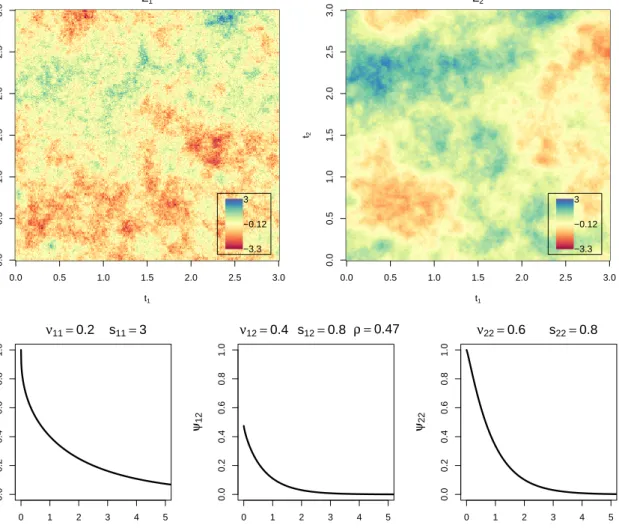
Multivariate data measured in space arise in a variety of disciplines including soil science (Lark and Papritz, 2003), ecology (Pelletier et al., 2009), mining (Zawadzki et al., 2013), geology (Mery et al., 2017) and meteorology (Hewer et al., 2017). Air temperature and pressure in a certain geographical region or the content of two metals in a geological deposit are the examples of spatial processes with two components. Spatial dependence within and between the components is exploited in particular when the component of interest is not exhaustively sampled, whereas the measurement of other components can be easily carried out, e.g. in soil sciences (Goovaerts (1999) and Atkinson et al. (1992)). An appropriate multivariate spatial covariance model gives more sensible results for spatial interpolation than univariate models, see for example Cressie and Zammit-Mangion (2016). In environmental and climate sciences it is important to model spatial meteorological data jointly in order to reflect spatial dependence within and between components adequately (see the discussions in Feldmann et al. (2015), Berrocal et al. (2007), and Gel et al. (2004)); otherwise the obtained results might be unsound. Multivariate Gaussian random fields, characterized by their mean and covariance functions, are the basis for modeling spatial data in these areas. Classical textbooks on univariate and multivariate geostatistics include Cressie (1993), Chil`es and Delfiner (1999), Lantuejoul (2001), Wackernagel (2003), and Goovaerts and Goovaerts (1997). For simplicity, in the theoretical part of the thesis we consider zero mean random fields. Then a covariance function describes the properties of the corresponding Gaussian random field. Consider, for example, a realization of a Gaussian random field with two components shown in two upper plots in Figure 1.1. This field has the bivariate Mat´ern covariance model (Gneiting et al., 2010), which is plotted under the realizations. The functions ψ11 and ψ22, called marginal covariances, describe the
properties of the first and the second field respectively. The behavior of the covariance function at the origin largely reflects the smoothness of the corresponding field (Gneiting, 2002). In the bivariate Mat´ern model the smoothness of each field is controlled by the corresponding parameterνii>0, i= 1,2. In Figure 1.1, ν22> ν11 and therefore the realization on the right
hand side is smoother than the one on the left hand sight. The scale parametersii>0,i= 1,2, controls the decay of the marginal correlation with the distance. For example, the correlation of any two observations of the first field for the larger distance is higher than the correlation of any two observations of the second field, therefore the upper left plot is more colorful than the upper right one. The middle picture in the lower panel of Figure 1.1 is the graph of the cross-covariance functionψ12, which describes the covariance structure between the two components.
The scale parameter s12 controls the correlation decay between the components. Thus, the
correlation between the observation of the first field and the observation of the second field is maximum at zero distance and it decreases as the distance increases. While the maximum of a marginal covariance function is always at the origin, the maximum of the cross-covariance function (assuming positive correlation between a given variable pair) may be shifted away from the origin, which is typical when one component affects another component with some delay (Wackernagel (2003), Hansen (2018)). However, we focus on covariance functions which
4 Chapter 1. Introduction 0 1 2 3 4 5 0.0 0.2 0.4 0.6 0.8 1.0 r ψ11 ν11=0.2 s11=3 0 1 2 3 4 5 0.0 0.2 0.4 0.6 0.8 1.0 r ψ12 ν12=0.4 s12=0.8 ρ =0.47 0 1 2 3 4 5 0.0 0.2 0.4 0.6 0.8 1.0 r ψ22 ν22=0.6 s22=0.8 0.0 0.5 1.0 1.5 2.0 2.5 3.0 0.0 0.5 1.0 1.5 2.0 2.5 3.0 Z1 t1 t2 3 −0.12 −3.3 0.0 0.5 1.0 1.5 2.0 2.5 3.0 0.0 0.5 1.0 1.5 2.0 2.5 3.0 Z2 t1 t2 3 −0.12 −3.3
Figure 1.1: A realization of a bivariate Gaussian random field (upper two plots) with the bivariate Mat´ern covariance model (lower three plots). The stationary and isotropic covariance function depends on the distance r between the locations. The lower left and the right plots show the marginal covariance functionsψ11 andψ22, respectively.
depend only on the distance between observations, i.e. they are invariant with respect to the location of observations and the direction of the separation vector.
A covariance function must guarantee that the variance of an arbitrary linear combination of observations of any involved components, taken at arbitrary spatial locations is nonnegative. In this thesis we concentrate on constructing matrix-valued functions that satisfy this require-ment, on simulation techniques which are suitable for these functions and on inference with them. In Chapter 2 we summarize some definitions and facts from univariate and multivariate Geostatistics which are crucial for the subsequent chapters.
A comprehensive overview of recent covariance functions for multivariate geostatistics is found in Genton and Kleiber (2015) and Schlather et al. (2015). Among these models is the linear model of coregionalization (LMC), see Goulard and Voltz (1992) and Wackernagel (2003). Although it is widely used by practitioners, it lacks flexibility, since all direct and cross variograms share the same set of basic structures. This means, in particularly, that the
5
smoothness of any component is equal to the smoothness of the roughest latent process, and, thus, the standard approach LMC does not admit individually distinct smoothness properties, unless structural zeros are imposed on the latent process coefficients (Gneiting et al. (2010) and Goovaerts and Goovaerts (1997)). Models with compact support are introduced in Du and Ma (2013), Porcu et al. (2013), Daley et al. (2015) and Schlather et al. (2017). Kleiber (2017) studies the properties of multivariate random fields in the frequency domain. Cressie and Zammit-Mangion (2016) develop a conditional approach for constructing multivariate models. Genton and Kleiber (2015) pose the question how to characterize a parameter set of the valid multivariate powered exponential (or stable) model. In Chapter 3 we give a partial answer to this question, providing sufficient conditions for the positive definiteness of a bivariate model. In a similar way we can also formulate sufficient conditions for the positive definiteness of the bivariate generalized Cauchy model. These models are flexible, intuitive and easily interpretable: in both models three parameters characterize the smoothness of the covariances of process components and the cross-covariance. Further three parameters model the long-range behaviour in the bivariate Cauchy model. The smoothness parameters of marginal covariances in both models are restricted to values in (0,1]. The results are based on general sufficient conditions for the positive definiteness of a 2×2-matrix valued functions. These conditions require only computing the derivatives of a bivariate covariance function of order two and three inRand inR3, respectively, and calculating an infimum of a function of one variable. We also
show that the univariate spherical model can be generalized to the bivariate case with spherical marginal and cross-covariance functions only in a trivial way. We collect some new bivariate models, whose construction follows directly from Schoenberg’s theorem.
Development of many multivariate covariance models led to the increasing interest in sim-ulation algorithms. Cholesky decomposition is not suitable for samples with a larger number of locations, not least because the computing time of the algorithm is cubic in the number of variables. For functions possessing spectral densities with closed formulae, the spectral turn-ing bands algorithm can be used (Arroyo and Emery (2017) and Emery et al. (2016)). The multivariate turning bands method is implemented in the R packageRandomFields(Schlather et al., 2017). Both turning bands methods are faster than the Cholesky decomposition and can be performed for any configuration of the target locations, but they produce realizations that are only approximately Gaussian. Under certain conditions on a covariance function the multi-variate version of the circulant embedding algorithm, presented in Chan and Wood (1999) and explained in detail in Helgason et al. (2011), produces Gaussian realizations. However, simi-larly to the univariate case, for many multivariate covariance models that do not have compact support exact simulation is not possible. Cut-off circulant embedding techniques have been developed for univariate random fields for dimensions up to R3 and rely on the modification
of a covariance function outside the simulation window, such that the modified covariance function is compactly supported. In Chapter 4 we propose extensions of the cut-off approach for univariate and bivariate Gaussian random fields. In particular, we provide a method for simulating bivariate fields with a bivariate powered exponential covariance model and the full bivariate Mat´ern covariance model for certain sets of parameters on a grid.
In Chapter 5 we illustrate the use of the bivariate exponential model for a data example on the content of copper and zinc in the top soil of a 14 km2 region in Swiss Jura. We compare the performance of bivariate powered exponential model to the traditional linear model of coregionalization and the bivariate Mat´ern model.
2 Preliminaries
We briefly summarize some basic definitions and facts about covariance functions and var-iograms of univariate and multivariate Gaussian random fields, which are necessary in the subsequent parts.
There is sometimes a confusion between the notions multidimensional and multivariate in the literature. Hereinafter we call a random field Z univariate if it has only one component, and multivariate if it has m ≥ 1 components, i.e. Z(x) = (Z1(x), . . . , Zm(x)), x ∈ Rn. In
Chapters 3 and 4 we will be concerned withbivariatefields, i.e.m= 2. The term multidimen-sional refers to the index set ofZ, i.e. to the dimension ofx. For example, a one dimensional univariate field is just a temporal stochastic process, a two dimensional univariate field is a ’classical’ random field and a three dimensional bivariate fieldZ(x) = (Z1(x), Z2(x)) has two
components withx∈R3.
The finite dimensional distributions of a multivariate Gaussian random fieldZ(x) are multi-variate normal and thus the distribution of the field is uniquely characterized by its mean and covariance function. For simplicity, we assume in the theoretical part of the thesis that the random field is centered, i.e.EZ(x) = 0 for allx∈Rn. We denote the covariance function by
C(x, y) = Cov(Z(x), Z(y)), x, y∈Rn. Clearly, a covariance function C of a multivariate field
is a matrix-valued function, whose diagonal elementsCii(x, y), i= 1, . . . , m, are the marginal covariance functions and the off-diagonal elementsCij(x, y) are the cross-covariance functions of the components of the process 1≤i6=j ≤m. The content of the next two sections is based mostly on Wackernagel (2003), Chil`es and Delfiner (1999) and Yaglom (1987).
2.1 Multivariate covariance functions
A covariance functionC is calledstationary if for any x, h∈Rn andi, j = 1, . . . , mit holds:
Cij(x+h, x) =Cij(h,0) =:Cij(h).
A stationary multivariate covariance function is not necessarily an even or odd function. In general, we have
Cij(−h)6=Cij(h), but
Cij(h) =Cji(−h).
Cisstationary and isotropicif additionallyC(h1) =C(h2) wheneverkh1k=kh2k, i.e. marginal
covariance functions and cross-covariance functions depend only on the distance between the variables locations. Hereinafter we write C(r) instead of C(h) with r =khk, whenever C is stationary and isotropic.
We denote by Φn the set of continuous functionsϕ: [0,∞)7→Rsuch that the map (x, y)7→
ϕ(||x−y||) is positive definite on Rn. Analogously, Φmn denotes the class of mappings ϕ = [ϕij(·)]mi,j=1 : [0,∞)7→Rm×m with eachϕij being continuous, such that
C(x, y) = [ϕij(||x−y||)]mi,j=1, x, y∈Rn,
8 Chapter 2. Preliminaries
is anm×m matrix-valued covariance function onRn.
We recall that a covariance function must be positive definite, i.e. it guarantees that the variance of an arbitrary linear combination of observations of any involved componentsZi(x),
i= 1, . . . , m, taken at arbitrary spatial locations is nonnegative. That is, C is symmetric and for any p∈N, a1, . . . , ap ∈Rm,and x1, . . . , xp ∈Rn it must hold
p X
i=1
aTi C(xi−xj)aj ≥0.
Reversely, for each positive definite function C there exists a Gaussian random field with C
being its covariance function. Thus, the terms covariance function and positive definite function are interchangeable.
Example 2.1 (Linear model of coregionalization, Goulard and Voltz (1992); Wackernagel (2003))
The basic statement of the linear model of coregionalization (LMC) is that each variable Zi,
i = 1, . . . , m, of a multivariate field Z is a linear combination of p independent univariate stationary random fields with unit variance {Yk, k= 1, . . . , p}.
Zi(x) = p X
k=1
aikYk(x), x∈Rn.
The resulting multivariate covariance is
Cij(h) = p X
k=1
aikajkρk(h), h∈Rn,
where ρk(h) is a correlation function of Yk and A = [aik]m,pi,k=1 is a m×p full rank matrix.
Although this model is widely used among practitioners, it lacks flexibility and its limitations are discussed in Gneiting et al. (2010)
Example 2.2 (Convolution)
Suppose that c1, . . . , cm are real-valued functions on Rn which are both integrable and
square-integrable. The matrix-valued function defined by equation
Cij(h) = (ci∗cj)(h), h∈Rn, i, j = 1, . . . , m,
where the asterisk∗denotes the convolution operator, is a matrix-valued covariance function on
Rn (Theorem 2 in Gneiting et al. (2010)). These models are introduced in Ver Hoef and Barry
(1998) and Gaspari and Cohn (1999); the multivariate parsimonious Mat´ern covariance model (Gneiting et al., 2010) serves as an example of this construction. Kleiber (2017) discusses the properties and limitations of this class of models.
For a better understanding of the properties of a covariance function it is often useful to examine its Fourier transform. A stationary covariance functionC has the following spectral representation
C(h) = Z
Rn
2.1. Multivariate covariance functions 9
where the increments ∆F(x) = F(x+ ∆x) −F(x) of the matrix-valued function F(x) are positive semidefinite matrices for all x ∈ Rn and ∆x ≥ 0 (componentweise). The diagonal
elements Fii(x), i = 1, . . . , m, are real, non-decreasing and bounded; the off-diagonal terms
Fij(x), i6=j, i, j= 1, . . . , m,are in general complex-valued and of finite variation. Conversely, any matrix of continuous functionsC(h) is a matrix-valued covariance function, if the matrices of increments ∆F(x) are positive semi-definite for any x ∈ Rn and ∆x ≥ 0. This result is a multidimensional generalization of Cramer’s theorem (Cramer, 1940), which is itself a multivariate generalization of Bochner’s theorem (Bochner, 1955) and can be found in Gikhman and Skorokhod (2004), Yaglom (1987), and Wackernagel (2003).
When the Cij are additionally absolutely integrable, there exists a spectral density matrix such that
C(h) = Z
Rn
eihh,xif(x)dx for all h∈Rn
andf(x) is a positive semi-definite matrix for all x∈Rn, see Yaglom (1987).
IfC is stationary and isotropic, the Fourier transform in (2.1) can be replaced by a Hankel transform, that is,
C(r) = 2(n−2)/2Γn 2
Z ∞
0
(ru)−(n−2)/2J(n−2)/2(ru)dG(u), r ≥0, (2.2)
whereGij are the functions of bounded variation having the property that the matrix ∆G(u) =
G(u+ ∆u)−G(u) is positive semidefinite for allu,∆u >0 (Yaglom, 1987). Analogous Hankel transform for the spectral density reads
C(r) = (2π)n/2
Z ∞
0
(ru)−(n−2)/2J(n−2)/2(ru)un−1f(u)du, r≥0,
where [f(u)]mi,j=1 is a positive semi-definite matrix for all u ≥0. This result is a nultivariate generalization of Schoenberg’s theorem (Schoenberg, 1938). The inversion formula for the spectral densityf, which exists if R∞
0 r n−1|C(r)|dr <∞, is f(u) = (2π)−n/2 Z ∞ 0 (ur)−(n−2)/2J(n−2)/2(ur)rn−1C(r)dr,
see for example Stein (1999). In the subsequent Chapters 3, 4 and 5 we restrict our attention to stationary and isotropic bivariate covariance models, whose components stem from the same family, i.e. to models of the form
C(r) = σ12ψ11(r) ρσ1σ2ψ12(r) ρσ1σ2ψ12(r) σ22ψ22(r) , (2.3)
where σi > 0 is the variance of the field Zi, ψij(·) = ψ(·|θij, sij) is a continuous univariate stationary and isotropic correlation function, which depends on a scale (or range) parameter
sij >0, i, j = 1,2,and another optional parameterθij = (θij1, ..., θkij) withk∈N(e.g. smooth-ness, long range behaviour). Necessarily,|ρ| ≤ 1. Note that isotropy implies ψ12(r) =ψ21(r).
Furthermore, we choose σ1 = σ2 = 1, since the general case follows immediately from the
following fact: C(r) = σ1 0 0 σ2 × ψ11(r) ρψ12(r) ρψ12(r) ψ22(r) × σ1 0 0 σ2 .
10 Chapter 2. Preliminaries
For instance, the multivariate Mat´ern model (Gneiting et al., 2010; Apanasovich et al., 2012) is a representative of this class with
ψ(r|ν, s) = 2
1−ν Γ(ν)(sr)
νK ν(sr),
wheres >0 is a scale parameter,ν >0 is a smoothness parameter andKν is a modified Bessel function of the second kind. The bivariate powered exponential model (Moreva and Schlather, 2017) also belongs to the class (2.3) with
ψ(r|α, s) =e−(sr)α,
wheres >0 is a scale parameter and α∈(0,2] is a smoothness parameter.
The class given by (2.3) can be seen as a generalization of the class of separable models introduced by Mardia and Goodall (1993), where a multivariate covariance factorizes into a product of a covariance matrixR and a univariate correlation functionψ(·), i.e.
Cij(r) =Rijψ(r), r≥0, i, j= 1, . . . , m.
That is, a separable model assumes that all components share the same spatial correlation structure and differ only in their variances. In particular, the scale parameter is the same for both marginal and cross-covariances. The class (2.3) is more flexible allowing each field to have distinct smoothness, scale, and variance parameters and admitting flexible cross-correlation between the fields. Given a univariate correlation function ψ, our goal in Chapter 3 is to find the parameter sets for which the functionC in (2.3) is a valid covariance function. Clearly, if the components are uncorrelated, i.e.ρ = 0, thenC is always a bivariate covariance function. Thus, we are interested in the cases when|ρ|>0.
2.2 Variograms
In Section 4.3 we focus on intrinsically stationary univariate random fields. Intrinsic station-arity is a weaker assumption than stationstation-arity. A random fieldZ withE(Z(x)−Z(y))2 <∞,
x, y∈Rn is called intrinsically stationary ifE(Z(x+h)−Z(x)) andE(Z(x+h)−Z(x))2 do
not depend onx for all h∈Rn. Then we define thevariogram
γ(h) = 1
2E(Z(x+h)−Z(x))
2.
We recall that a function γ :Rn 7→ R is negative definite, if for any p ∈ N, x1, . . . , xp ∈Rn,
anda1, . . . , ap ∈R, such thatPpi=1ai = 0, the following inequality holds
p X i=1 p X j=1 aiγ(xi−xj)aj ≤0.
Theorem 2.3 (Gneiting et al. (2001))
If γ is a real symmetric function in Rn satisfyingγ(0) = 0, the following properties are
equiv-alent.
2.2. Variograms 11
(ii) The function γ is negative definite.
(iii) For alla >0,exp(−aγ(·)) is a covariance function.
The equivalence of (i) and (ii) mimics the characterization of covariances as positive definite functions. Theorem 2.3 extends known result (see the references in Gneiting et al. (2001)) by removing the additional assumption of continuity ofγ.
A stationary random field is always intrinsically stationary, but the converse is not true: the Wiener process is a counterexample. A stationary field has a bounded variogram γ which is linked with the covariance functionC by the relation
γ(h) =C0−C(h), h∈Rn, (2.4)
whereC0 =C(0).If the variogramγ(h) of an intrinsically stationary random field is bounded,
there exists a constant C0 > 0 such that C(h) = C0 −γ(h) is a covariance function. The
minimal value of C0 is of great interest because higher variances can always be achieved by
adding a spatially constant, independent Gaussian random variable to a random field. Gneiting et al. (2001) give the minimal value of C0 for bounded variograms. If γ is unbounded, then
(2.4) can hold locally, i.e. for|h| ≤r and somer >0.The existence and minimum value of C0
in (2.4) is discussed in Gneiting et al. (2001).
Finally, the rate with which a variogram γ(h) of a centered field can increase to infinity is constrained by lim khk→∞ γ(h) khk2 = 0, h∈R n.
3 Bivariate covariance models
We discuss a sufficient condition and a necessary condition for the positive definiteness of models from the class (2.3). We consider some examples of this class and introduce novel bivariate models, built on Schoenberg’s theorem and on the sufficient condition. This chapter is partially based on Moreva and Schlather (2017).
3.1 Models obtained by spectral approach
We collect some new examples of the class (2.3). The proof of positive definiteness (or the contrary) of these models is based on Schoenberg’s theorem. Hereinafter we denote by fij the spectral density of a correlation function ψij, i, j = 1,2. By Schoenberg’s theorem, a matrix-valued functionC in (2.3) is positive definite if and only if
f11(r)f22(r)−ρ2f122 (r)≥0 (3.1)
for allr >0.
Surprisingly, not all univariate models can be generalized to the multivariate case in a non-trivial way. For example, the univariate spherical model,ψ(r|s) = 1−23sr+12(sr)3
+, r≥0,
s > 0, is widely used in geostatistics, but its bivariate generalization, defined by (2.3) is not a covariance function unless the components are independent or the model is separable. To prove this fact, we first need the following auxiliary results.
Lemma 3.1
Let (uk)k∈N be a sequence such that uk−ak ↑ b for some a > b > 0 as k tends to infinity.
Then for any s <1, there exists a k0 ∈N such that uk0/s6=uk for all k∈N.
Proof. We prove the lemma by contradiction. Suppose that there exists an s < 1 such that for all k ∈ N there is lk ∈ N with uk/s = ulk. First note that there exists N ∈ N such that
for every k≥ N the corresponding uk lies inside the interval (b+a(k−1), b+ak) and there exists a decreasing sequenceεk↓0, εk∈(0, a),such that
uk=b+ak−εk.
For anys <1, there is n∈Nand 0≤c <1 such thata/s=an−ac. Consider the following cases.
(i) c= 0. There existnb ∈N andcb ∈[0,1) such thatb/s=b+a(nb−cb). Then we have
ulk = uk s = b+ak−εk s =b+a(nb−cb) +ank− εk s =b+a(nb+nk)− acb+ εk s .
We chooseklarge enough so that 0< acb+ εsk < a. Since
b+a(nb+n−1)< ulk < b+a(nb+n),
we get lk = nb+n and εnb+n = acb+εk/s. But then it follows that εlk > εk, which
cannot be true, since (εk)k∈N is a decreasing sequence.
14 Chapter 3. Bivariate covariance models
(ii) c >0. By our assumption, for uk+1 there exists lk+1 > k+ 1, such that uks+1 = ulk+1.
We obtain uk+1 s = uk+a−(εk+1−εk) s = uk s + a s − εk+1−εk s =ulk +an−ac− εk+1−εk s =b+alk−εlk+an−ac− εk+1−εk s =b+a(lk+n)− ac+εlk+ εk+1−εk s
Choose k large enough, so that 0 < ac+εlk +
εk+1−εk
s < a. Then lk+1 = lk+n and
εlk+n=ac+εlk+
εk+1−εk
s . Note thatεlk+n→acwhenk→ ∞, which is a contradiction,
sincec >0.
Lemma 3.2
LetC be anm-variate continuous covariance function. Then the set of roots offij is a superset of the roots offii and the roots of fjj for anyi, j= 1, . . . , m.
Proof. The lemma follows directly from Schoenberg’s theorem.
Theorem 3.3
Let C be stationary and isotropic covariance function from class(2.3) with ψij(r) =ψ(r/sij),
r ≥ 0, sij >0, i, j = 1,2, and let f be the spectral density of ψ. Suppose that there exists a positive strictly increasing sequence (uk)k∈N such that the following properties hold:
(i) for any s <1, there is a k0 ∈Nwith uk0/s6=uk for all k∈N,
(ii) the elements of the sequence (uk)k∈N constitute all positive roots of f.
Then either ρ= 0 or s11=s12=s22.
Proof. Without loss of generality we assume s11 ≤ s22. First note that the positive roots of
fij form the sequence (sijuk)k∈N and we denote by Aij the set of positive roots of fij, i.e. Aij ={sijuk, k ∈N}, i, j= 1,2. We consider three cases:
• s12> s11, thens11u1∈/ A12and by Lemma 3.2, the functionCcannot be positive definite.
• s12 < s11, then by condition (i) there exists k0 such that ss1211uk0 6=uk for all k∈N and
therefores11uk0 ∈/A12. By condition (ii)s11uk0 ∈A11. Then by Lemma 3.2, the function C cannot be positive definite.
• s12=s11< s22. This case is treated analogously to the previous one.
The generalization of Theorem 3.3 to a multivariate covariance function C follows immedi-ately from the properties of positive definite matrices.
3.1. Models obtained by spectral approach 15
Corollary 3.4
Let C be stationary and isotropic multivariate covariance function C with Cii(r) = ψ(r/sii), Cij(r) =ρijψ(r/sij), sij >0,|ρij| ≤1, i, j = 1, . . . , m, i6=j,and letf be the spectral density of
ψ. Suppose that there exists a positive strictly increasing sequence(uk)k∈N such the conditions
(i) and (ii) of Theorem 3.3 hold. Then for alli, j= 1, . . . , meitherρij = 0or sij =sfor some
s >0.
Theorem 3.5
The bivariate spherical model
" 1−3 2s11r+ 1 2(s11r) 3 + ρ 1− 3 2s12r+ 1 2(s12r) 3 + ρ 1−3 2s12r+ 1 2(s12r) 3 + 1− 3 2s22r+ 1 2(s22r) 3 + # ,
with r ≥ 0, sij > 0, |ρ| ≤ 1, i, j = 1,2, belongs to the class Φ23 if and only if ρ = 0 or
s11=s12=s22.
Proof. The spectral density of the univariate spherical correlation functions is
f(u) = 3s
π2u6(ucos(u/2s)−2ssin(u/2s)) 2
Clearly,f is pseudo periodic and takes infinitely many zeros onu >0. We denote byuk,k∈N,
the roots of the function ˜f(u) =u−tan(u) onu >0. Then the roots of the spectral densityfij are 2sijuk, k ∈N, i, j = 1,2. Noting that uk ↑ π2 +πk as k → ∞, we apply Lemma 3.1 and Theorem 3.3 and prove the theorem.
Remark 3.6
It is possible to construct a bivariate covariance model with the spherical marginal covariance functions using the convolution approach, see Example 2.2 and Du and Ma (2013). In Example 2.2 inR3 we take
c1(x) =1{kxk≤a/2}, c2(x) =1{kxk≤b/2},
where x ∈R3, a, b >0. We assume without loss of generality that a > b. Then the marginal
covariance functionsC11, C22 are
C11(r) = Z R3 1{kx−yk≤a/2}1{kyk≤a/2}dy= πa3 6 1−3 2 r a+ 1 2 r a 3 + C22(r) = Z R3 1{kx−yk≤b/2}1{kyk≤b/2}dy= πb3 6 1−3 2 r b + 1 2 r b 3 + ,
and the cross-covariance function is
C12(r) =C21(r) = Z R3 1{kx−yk≤a/2}1{kyk≤b/2}dy = πb3 6 , r ≤ a−b 2 π 12r a+b 2 −r 2 r2−3 4(a−b) 2+r(a+b) , a−2b ≤ r ≤ a+b 2 , 0, r ≥ a+b 2 . where r=kxk.
16 Chapter 3. Bivariate covariance models
Theorem 3.7 (Bessel I model) The bivariate Bessel I model
2n−22Γ n 2 " Jn−2 2 (s11r)(s11r) −n−22 ρJ n−2 2 (s12r)(s12r) −n−22 ρJn−2 2 (s12r)(s12r) −n−22 J n−2 2 (s22r)(s22r) −n−22 # , (3.2)
where sij >0, i, j = 1,2,belongs to the class Φn2 if and only if ρ= 0 or s11=s12=s22.
Proof. Similarly to Theorem 3.5, if ρ = 0 or s11 = s12 = s22 the function defined by (3.2)
belongs to Φ2n. In remains to show that for other parameter values (3.2) is not in Φ2n. The functionψ(r) = 2n−22Γ(n
2)(sr)
−n−2 2 Jn−2
2 (sr), r
≥0,s >0,has the spectral representation (2.2) with spectral distrubution function
Gs(u) = (
0, u≤s,
1, u > s
By Schoenberg’s theorem the function (3.2) is positive definite if and only if the matrix ∆G(u) = Gs11(u+ ∆u) ρGs12(u+ ∆u) ρGs12(u+ ∆u) Gs22(u+ ∆u) − Gs11(u) ρGs12(u) ρGs12(u) Gs22(u)
is positive definite for any u ≥ 0 and ∆u ≥ 0. First, consider the case s11 =s22. This case
splits into two subcases.
• s11=s22,s12> s11. Chooseuandu+ ∆usuch thats11< u < s12< u+ ∆uand observe
that the matrix
∆G(u) = 1 ρ ρ 1 − 1 0 0 1 = 0 ρ ρ 0
is not positive definite.
• s11=s22,s12< s11. Chooseuandu+ ∆usuch thatu < s12< u+ ∆u < s11 and observe
that the matrix
∆G(u) =
0 ρ
ρ 0
is not positive definite.
Ifs116=s22, we assume without loss of generality thats11< s22. Then the following cases are
possible.
• s11 ≤s12< s22. Choose u and u+ ∆u such that u < s11≤s12 < u+ ∆u < s22. Then
we get ∆G(u) = 1 ρ ρ 0
3.1. Models obtained by spectral approach 17
• s11 < s22≤s12. Choose u and u+ ∆u such that s11 < u < s22 ≤s12 < u+ ∆u. Then
we obtain that the matrix
∆G(u) = 1 ρ ρ 1 − 1 0 0 0 = 0 ρ ρ 1
is not positive definite.
• s12< s11< s22. Chooseu and u+ ∆u such thatu < s12< u+ ∆u < s11< s22.
∆G(u) =
0 ρ
ρ 0
is not positive definite
Remark 3.8 (Cardinal sine model)
A special case of the Bessel model with n= 3 is a cardinal sine. Theorem 3.7 asserts that the following model "sin(s 11r) s11r ρ sin(s12r) s12r ρsin(s12r) s12r sin(s12r) s12r # ,
where sij >0, i, j = 1,2,belongs to the class Φ32 if and only if ρ= 0 or if s11=s12=s22.
From Schoenberg’s theorem it follows the Bessel I model cannot be generalized to fields with a number of components higher than two, unless the components are independent or the model is separable.
If we replace n−22 by νij > n−22, i, j = 1,2, in the Bessel I model (3.2) then the resulting model is valid for some parameter set, which is described by the following theorem.
Theorem 3.9 (Bessel II model) The bivariate Bessel II model
ϕ(r) = " 2ν11Γ(ν 11+ 1) Jν11(s11r) (s11r)ν11 ρ2 ν12Γ(ν 12+ 1) Jν12(s12r) (s12r)ν12 ρ2ν12Γ(ν 12+ 1) Jν12(s12r) (s12r)ν12 2 ν22Γ(ν 22+ 1) Jν22(s22r) (s22r)ν22 # , (3.3)
where νij >(n−2)/2, sij >0, i, j= 1,2, and Jν is a Bessel function of the first kind, belongs to the classΦ2n if and only ifs12≤min{s11, s22} and its cross-correlation parameterρ satisfies
the following inequality.
ρ2≤ Γ(ν11+ 1)Γ(ν22+ 1) Γ(ν12+ 1)2 Γ(ν12− n−22)2 Γ(ν11−n−22)Γ(ν22−n−22) s4ν12 12 s2ν11 11 s 2ν22 22 22ν12−ν11−ν22× (3.4) inf 0<u<s2 12 (s211−u)ν11−n/2(s2 22−u)ν22−n/2 (s212−u)2ν12−n .
In particular, this can be written as one of the following cases:
18 Chapter 3. Bivariate covariance models
(ii) ifν12=n/2, ν11≥n/2, ν22≥n/2, the bivariate Bessel II model is inΦ2n if and only if
ρ2 ≤ 1 Γ(n2 + 1)2 Γ(ν11+ 1)Γ(ν22+ 1) Γ(ν11+ 1−n2)Γ(ν22+ 1−n2) s212n s2ν11 11 s 2ν22 22 2n−ν11−ν22× (s211−s212)ν11−n/2(s2 22−s212)ν22−n/2,
(iii) ifν12=n/2, (n−2)/2< ν11≤n/2, (n−2)/2< ν22≤n/2, the bivariate Bessel II model
is inΦ2n if and only if ρ2 ≤ 1 Γ(n2 + 1)2 Γ(ν11+ 1)Γ(ν22+ 1) Γ(ν11+ 1−n2)Γ(ν22+ 1−n2) s212n sn 11sn22 2n−ν11−ν22,
(iv) if ν12=n/2, and ν11, ν22 are not as in (ii)-(iii), the infimum in (3.4) is attained either
atu= 0 or u=s212 or at
u= (n/2−ν11)s222 + (n/2−ν22)s211
/(n−ν11+ν22),
(v) if ν11, ν22 > (n−2)/2 and ν12 > n/2 the infimum is attained either if u = 0, or if
u∈(0, s12) is a solution of the quadratic equation,
(ν11+ν22−2ν12)u2 + (n−ν11−ν22)s212u+ (2ν12− n 2)(s 2 22+s211)u−(ν22s211+ν11s222)u (3.5) + (ν11− n 2)s 2 22s212+ (ν22− n 2)s 2 11s212+ (n−2ν12)s211s222= 0.
Proof. The spectral density of the Bessel covariance function ψ(r) = 2νΓ(ν+ 1)(sr)−νJν(sr),
r≥0, s >0, ν >(n−1)/2,inRn is f(u) = u−n−22 πn2 Γ(ν+1) s2ν2νΓ(ν+1−n 2) s2−u2ν− n 2 , u≤s, 0, u > s,
see for example Chapter 22.2 in Yaglom (1987). Clearly, by Schoenberg’s theorem the function (3.3) cannot be positive definite ifs12>min{s11, s22}. Assume now that s12≤min{s11, s22}.
Then the function (3.3) is positive definite if and only if inequality (3.4) holds true. Let us examine the function under infimum
w(u) = (s 2 11−u)ν11−n/2(s222−u)ν22−n/2 (s2 12−u)2ν12−n , whereu∈[0, s2
12]. Consider the following cases.
(i) n2 −1≤ν12< n2, thenw(s12) = 0.
(ii) - (iv) ν12=n/2, then w(u) = (s211−u)ν11−n/2(s222−u)ν22−n/2. The derivative ofw(u) is
w0(u) =−(s211−u)ν11−n/2−1(s2
22−u)ν22−n/2−1×
3.1. Models obtained by spectral approach 19
The first two factors in the round brackets are positive for u ∈ [0, s212]. If ν11 ≥ n/2 and
ν22≥n/2, then the term in square brackets is nonnegative and the derivative is nonpositive.
Therefore, w(u) is nonincreasing and the minimum is reached at u=s12. If ν11≤n/2 and
ν22 ≤ n/2, the term in square brackets is nonpositive and the derivative is nonnegative.
Therefore, w(u) is nondecreasing and the minimum is reached atu= 0. For other values of
ν11 and ν22 the minimum of w(u) on [0, s212] is attained either atu= 0 or u=s12 or at
u= (n/2−ν11)s222 + (n/2−ν22)s211
/(n−ν11+ν22).
(v) If ν11, ν22>(n−2)/2 andν12> n/2 we analyze the derivative of w(u),
w0(u) =−(ν11−n/2)(s211−u)ν11 −n/2−1(s2 22−u)ν22 −n/2(s2 12−u)n −2ν12 −(ν22−n/2)(s211−u)ν11 −n/2(s2 22−u)ν22 −n/2−1(s2 12−u)n −2ν12 −(n−2ν12)(s112 −u)ν11−n/2(s222 −u)ν22−n/2(s212−u)n−2ν12−1 =−(s211−u)ν11−n/2−1(s2 22−u)ν22−n/2−1(s212−u)n−2ν12−1 ×[(ν11−n/2)(s222 −u)(s212−u) + (ν22−n/2)(s211−u)(s212−u) + (n−2ν12)(s211−u)(s222−u)].
The first three factors are positive foru∈[0, s212]. The term in square brackets is quadratic inu and equals to (ν11+ν22−2ν12)u2 + (n−ν11−ν22)s212u+ (2ν12− n 2)(s 2 22+s211)u−(ν22s211+ν11s222)u + (ν11− n 2)s 2 22s212+ (ν22− n 2)s 2 11s212+ (n−2ν12)s211s222.
Thus,w(u) attains its minimum either atu= 0 or ifuis a solution of (3.5) that is in [0, s212].
Corollary 3.10
If in Theorem 3.9s11=s12=s22=s, s >0,then the two following cases are possible:
1. ν12<(ν11+ν22)/2, then the Bessel II model is in Φ2n if and only if ρ= 0, 2. ν12≥(ν11+ν22)/2, then the Bessel II model is in Φ2n if and only if
ρ2 ≤ Γ(ν11+ 1)Γ(ν22+ 1)
Γ(ν12+ 1)2
Γ(ν12−n−22)2
Γ(ν11−n−22)Γ(ν22−n−22)
.
Although Schoenberg’s theorem provides necessary and sufficient conditions for a matrix-valued function to be positive definite, for many covariance models there exists no closed formulae for their spectral densities. But even if there are analytical formulae, Schoenberg’s theorem often leads to cumbersome expressions, which are impossible to calculate analytically and very hard to minimize numerically. Consider, for example the Hole effect model.
20 Chapter 3. Bivariate covariance models
Theorem 3.11 (Hole effect model) The bivariate Hole effect model
e−s11rcos(b 11r) ρe−s12rcos(b12r) ρe−s12rcos(b 12r) e−s22rcos(b22r) , (3.6) where sii≥ √
3bii, sij >0, bij >0, i= 1,2, belongs to the class Φ23 if and only if
ρ2 ≤ inf u≥0 s11s22 s2 12 u2+ 2(s211+b211)u+ (s112 +b211)(s211−3b211) (u2+ 2u(s2 11−b211) + (s112 +b211)2)2 × u2+ 2(s222+b222)u+ (s222 +b222)(s222−3b222) (u2+ 2u(s2 22−b222) + (s222 +b222)2)2 × (u2+ 2u(s212−b122 ) + (s212+b212)2)4 (u2+ 2(s2 12+b212)u+ (s212+b212)(s212−3b212))2 . (3.7) Proof. The spectral density ofψ(r) =e−srcos(br), r≥0, s >0, b >0,is
f(u) = 1 2π2u Z ∞ 0 re−srsin(ur) cos(br)dr = 1 4π2u Z ∞ 0 re−sr(sin(r(u+b)) + sin(r(u−b)))dr = 1 4π2u Z ∞ 0 re−srsin(r(u+b))dr+ Z ∞ 0 re−srsin(r(u−b))dr = 1 4π2u 2s(u+b) (s2+ (u+b)2)2 + 2s(u−b) (s2+ (u−b)2)2 = s 2π2u u+b (s2+ (u+b)2)2 + u−b (s2+ (u−b)2)2 = s 2π2u 2u(s4−2s2b2+ 2s2u2−3b4+ 2b2u2+u4) (s2+ (u+b)2)2(s2+ (u−b)2)2 = s π2 u4+ 2(s2+b2)u2+s4−2s2b2−3b4 (s2+ (u+b)2)2(s2+ (u−b)2)2 = s π2 u4+ 2(s2+b2)u2+ (s2+b2)(s2−3b2) (u4+ 2u2(s2−b2) + (s2+b2)2)2 .
By the inequality (3.1) the function (3.6) is positive definite if and only if the inequality (3.7) holds true.
3.2 Necessary condition for positive definiteness
The condition ν12 <(ν11+ν22)/2 in the bivariate Mat´ern model (Gneiting et al., 2010)
nec-essarily leads to the independence of the components. In the forth section of their article, the authors only very briefly discuss the origin of this condition. Similar restrictions are imposed on smoothness parameters in the bivariate powered exponential model and the bivariate gen-eralized Cauchy model in Sections 3.4 and 3.5. Since this kind of constrains is common for many models of type (2.3) we look at it in detail and explain additionally similar conditions on long-range parameters in the bivariate generalized Cauchy model.
3.2. Necessary condition for positive definiteness 21
These constraints come from the multivariate version of Schoenberg’s theorem and the Tauberian theorems (Bingham, 1972; Leonenko, 1999). Tauberian theorems link the prop-erties of a univariate correlation function with those of its spectral measure. We first need the notion of slow variation.
A function L: (0,∞)7→[0,∞) is said to beslowly varying at infinity (at zero), if for every
λ >0, it holds
L(λr)
L(r) →1 as r→ ∞(r→0).
We write f ∼· g ast→t0,t0 ∈[0,∞],for two functionsf and g on [0,∞), if f is
asymptot-ically proportional tog, i.e.f(t)/g(t)→A,A >0,ast→t0. Theorem 3.12 (Abelian and Tauberian theorems)
Let F be a spectral measure on [0,∞) of a stationary and isotropic univariate correlation function ψ in Rn and let L be a function varying slowly at infinity.
• If 0< α <2, then 1−ψ(r)∼· rαL(1/r) as r →0+ (3.8) if and only if 1−F(u)∼· L(u) uα as u→ ∞. (3.9) If α= 2, relation (3.8)is equivalent to Z r 0 u[1−F(u)]du∼· L(r) as r→ ∞ or to Z r 0 u2F(du)∼· L(r) as r→ ∞.
If α = 0, the relation (3.8) implies the asymptotic equivalence (3.9). Conversely, (3.9) implies(3.8)withα = 0if[1−F(u)]is convex foru sufficiently large, but not in general.
• Let 0< β < n. If ψ(r)∼· L(r)r−β as r→ ∞, then F(u)∼· L 1 u uβ as u→0 +. Corollary 3.13
Let the spectral densities fij of a matrix-valued function C in (2.3) be decreasing. Let θij = (αij, βij)in equation(2.3)parametrize the behaviour ofψ(r|θij, sij)at the origin and at infinity respectively, i.e. 1−ψ(r|θij) · ∼rαij as r→0+, ψ(r|θij) · ∼r−βij as r→ ∞, αij ∈ (0,2), βij ∈ (0, n), i, j = 1,2. Then C in (2.3) with α12 < (α11+α22)/2 or β12 <
22 Chapter 3. Bivariate covariance models
Proof. Theorem 3.12 implies that the spectral densitiesfij admit the following relations
fij(r) · ∼r−αij−n asr→ ∞, fij(r) · ∼rβij−n asr→0 +. (3.10)
Combining (3.10) and (3.1) gives the assertion of the corollary.
In Corollary 3.13 we assumed for simplicity that sij = 1, i, j = 1,2, because distinct scales would not change the asymptotics. Additionally, we choseL(1/r) to be equal to some constant, which is indeed the case for the examples below.
Example 3.14 (Powered exponential correlation function)
Let ψ(r) =e−rα, r >0, α∈(0,2), then observe that 1−ψ(r) ∼· rα as r →0+ and L(r) = 1. The corresponding measureF varies at infinity as follows
1−F(u)∼· u−α asu→ ∞.
Since the function ψ decreases rapidly enough at infinity, the densityf of F exists and
f(u)∼· u−α−n as u→ ∞.
The latter matches with the series representation off in Nolan (2005). Thus, by Corollary 3.13, the bivariate powered exponential model of the form (2.3) requires necessarily α12 ≥ (α11 +
α22)/2 unless ρ= 0.
Example 3.15 (Generalized Cauchy correlation function)
Let ψ(r) = (1 +rα)−β/α, r, β >0, β < n, α ∈(0,2). Then 1−ψ(r)∼· βαrα as r →0+, so in this caseL(r) = αβ. The spectral density f of ψ decays at infinity as follows
f(u)∼· u−α−n as u→ ∞.
This matches the series representation for the spectral density of the Cauchy covariance in Lim and Teo (2009). Analogously, the spectral density f behaves at the origin as
f(u)∼· uβ−n as u→0.
Thus, by Corollary 3.13, the bivariate generalized Cauchy model of the form (2.3) requires necessarilyα12≥(α11+α22)/2 and β12≥(β11+β22)/2 unless ρ= 0.
3.3 Sufficient condition for positive definiteness
Porcu and Zastavnyi (2011) provide the following construction principle for multivariate co-variance models.
Theorem 3.16 A. Let (Ω,F, µ) be a measure space and E be a linear space. Assume that the family of matrix-valued functionsA(x, u) = [Aij(x, u)] :E×Ω7→Rm×m satisfies the
following conditions:
(a) for every i, j= 1, . . . , m and x∈E, the functions Aij(x,·) belong to L1(Ω,F, µ);
3.3. Sufficient condition for positive definiteness 23 Let C(x) := Z Ω A(x, u)dµ(u) = Z Ω Aij(x, u)dµ(u) m i,j=1 , x∈E.
ThenC is a positive definite matrix-valued function in E.
B. Conditions (a) and (b) in part A are satisfied when A(x, u) = k(x, u)g(x, u), where the maps k(x, u) : E ×Ω 7→ R and g(x, u) = [gij(x, u)]mi,j=1 : E ×Ω 7→ Rm×m satisfy the
following conditions:
a) for everyi, j = 1, . . . , mandx∈E, the functionsk(x,·)gij(x,·)belong toL1(Ω,F, µ);
b) k(·, u) is positive definite for µ-almost every u∈Ω;
c) g(·, u) is a positive definite matrix-valued function or g(·, u) = g(u) is a positive semidefinite matrix for µ-almost every u∈Ω.
Starting from known functions k and gij, Porcu et al. (2013) and Daley et al. (2015), see also Schlather et al. (2017), construct new compactly supported multivariate covariance func-tions. Our approach inspired by Gneiting (1999) and Sironvalle (1980) is different; we consider the model (2.3) as a candidate for a multivariate covariance function and then find the corre-spondinggij, which depend on parameterssij,θij, and the parameter set which guarantees its positive definiteness.
The following theorem provides sufficient conditions for positive definiteness of a bivariate modelC in (2.3).
Theorem 3.17
A matrix-valued functionC defined by equation(2.3) belongs
a) to the class Φ21 if ψij(r), i, j= 1,2,is continuously differentiable in (0,∞) with piecewise existing second derivative in(0,∞) and the following conditions hold:
(i) rψij0 (r)→0 as r→ ∞ and rψ0ij(r)→0 asr →0, (ii) ψij0 (r) is integrable in (0,∞), i, j= 1,2,
(iii) the matrix
ψ1100 (r) ρψ0012(r)
ρψ1200 (r) ψ2200 (r)
(3.11) is positive definite for almost all r≥0.
b) to the class Φ23 if ψij(r), i, j = 1,2 is twice continuously differentiable in (0,∞) with piecewise existing third derivative in(0,∞) and the following conditions hold:
(i) rψij0 (r)→0, r2ψ00ij(r)→0 asr → ∞ and rψij0 (r)→0, r2ψ00ij(r)→0 asr →0, (ii) ψij0 (r),rψij00(r) are integrable in (0,∞), i, j= 1,2,
(iii) the matrix
ψ1100 (r)−rψ00011(r) ρ(ψ0012(r)−rψ12000(r))
ρ(ψ0012(r)−rψ12000(r)) ψ0011(r)−rψ11000(r)
(3.12) is positive semidefinite for almost allr ≥0.
24 Chapter 3. Bivariate covariance models
Proof. In Theorem 3.16 B we take a Euclidean space Rn, n ∈ {1,3},as E and the Lebesgue
measure asµ. We first prove the assertion inR. We takek(r, u) = 1−ru+, gii(u) =uψii00(u),
i= 1,2,and g12(u) = g21(u) = ρuψ1200 (u) for r ≥ 0, u > 0 and such that ψij00(u) are defined. We check the conditions of Theorem 3.16 B consequently. Conditions (i) and (ii) allow us to apply integration by parts in the following integral, see for example Chapter 10.13 in Apostol (1974), Z ∞ 0 uψij00(u)du=uψij0 (u)|∞0 − Z ∞ 0 ψij0 (u)du=ψij(0)<∞. (3.13) From equation (3.13) follows the condition a) in Theorem 3.16.B. Clearly,k(·, u) is a positive definite function inRforu >0 and therefore in Theorem 3.16 holds. Condition c) in Theorem
3.16.B is satisfied due to condition (iii). Then the following matrix-valued function is positive definite " R∞ 0 1− r u +uψ 00 11(u)du ρ R∞ 0 1− r u +uψ 00 12(u)du ρR∞ 0 1− r u +uψ 00 12(u)du R∞ 0 1− r u +uψ 00 22(u)du # . (3.14) To simplify function (3.14) we apply integration by parts again. Forr≥0 we have
Z ∞ 0 1− r u +uψ 00 ij(u)du= Z ∞ r (u−r)ψij00(u)du = Z ∞ r (u−r)dψ0ij(u) = (u−r)ψij0 (u) ∞ r − Z ∞ r ψij0 (u)du =ψij(r). Thus, (3.14) and (2.3) are the same matrices.
The proof forR3is analogous withk(r, u) = 1−ru+−2ru
1− ru22 +andgii(u) = 1 3(uψ 00 ii(u)−
u2ψ000ii(u)), i = 1,2, g12(u) = 13ρ(uψ0012(u)−u2ψ12000(u)), r ≥ 0, u > 0 and such that ψij(u)000,
i, j= 1,2,are defined. Applying again integration by parts we obtain
Z ∞ 0 1−r u + − r 2u 1− r 2 u2 + (uψ00ij(u)−u2ψij000(u))du = Z ∞ r 1− 3r 2u + r3 2u3 (uψij00(u)−u2ψij000(u))du = Z ∞ r u− 3r 2 + r3 2u2 (ψij00(u)−uψ000ij(u))du = Z ∞ r u− 3r 2 + r3 2u2 ψij00(u)du− Z ∞ r u2−3ru 2 + r3 2u ψ000ij(u)du = Z ∞ r u− 3r 2 + r3 2u2 ψij00(u)du− Z ∞ r u2−3ru 2 + r3 2u dψij00(u) = Z ∞ r u− 3r 2 + r3 2u2 ψij00(u)du − u2−3ru 2 + r3 2u ψ00ij(u) ∞ r + Z ∞ r 2u−3r 2 − r3 2u2 ψij00(u)du
3.3. Sufficient condition for positive definiteness 25 = Z ∞ r 3 (u−r)ψ00ij(u)du = 3 Z ∞ r (u−r)dψij0 (u) = 3 (u−r)ψij0 (u) ∞ r −3 Z ∞ r ψij0 (u)du = 3ψij(r). Remark 3.18
Two following conditions are sufficient for condition (iii) in Theorem 3.17, part a):
ψ00ii(r)≥0, i= 1,2, r ∈A, (3.15) and ρ2 ≤ inf r∈A ψ1100 (r)ψ2200(r) ψ1200(r)2 , (3.16) where A={r≥0 :ψij00(r), i, j= 1,2, exist}.
Two following conditions are sufficient for condition (iii) in Theorem 3.17, part b):
ψ00ii(r)−rψii000(r)≥0, i= 1,2, r ∈B, (3.17) and ρ2≤ inf r∈B (ψ0011(r)−rψ11000(r))(ψ0022(r)−rψ22000(r)) (ψ1200 (r)−rψ00012(r))2 , (3.18)
where B = {r ≥ 0 : ψ000ij(r), i, j = 1,2, exist}. The infimum in inequalities (3.16) and (3.18) is taken over all r > 0 with ψ1200(r) 6= 0 and ψ1200 (r)−rψ00012(r) 6= 0 respectively. Note that the inequalities (3.15) and (3.17) must hold only for marginal covariance functions, but not for the cross-covariance functions, This allowsα12 to take values in(0,2]in the bivariate powered
exponential model and the bivariate generalized Cauchy model.
The functions k(r, u) are equal to the Euclid’s hat functions, k(r, u) = hn(r/u), n = 1,3, (Gneiting, 1999). Thus, Theorem 3.17 can be generalized to higher dimensions with the cor-responding functionshn, but it requires the calculation of higher order derivatives.
Let the following functionC be a covariance function of a stationary and isotropicm-variate Gaussian random field,
C(r) = 2ψ 11(r) ρ12ψ12(r) . . . ρ1mσmψ1m(r) σ2ρ12ψ12(r) 2ψ22(r) . . . ρ2mσmψ2m(r) .. . ... . .. ... ρ1mσmψ1n(r) ρ2nσmψ2m(r) . . . σm2ψmm(r) , (3.19)
whereψij,i, j= 1, . . . , m, as in (2.3). Then Theorem 3.17 can be generalized in the following way.
Theorem 3.19
26 Chapter 3. Bivariate covariance models
a) to the class Φ21 if ψij(r), i, j = 1, . . . , m, is continuously differentiable in (0,∞) with piecewise existing second derivative in(0,∞) and the following conditions holds
(i) rψij0 (r)→0 as r→ ∞ and rψ0ij(r)→0 asr →0, i, j= 1, . . . , m,
(ii) ψij0 (r) is integrable in (0,∞), i, j= 1, . . . , m,
(iii) the matrix
ψ1100 (r) ρ12ψ1200(r) . . . ρ1mψ001m(r) ρ12ψ1200 (r) ψ2200 (r) . . . ρ2mψ001m(r) .. . ... . .. ... ρ1mψ0012(r) ρ2mψ200m(r) . . . ψmm00 (r)
is positive semidefinite for almost allr ≥0.
b) to the class Φ23 if ψij(r), i, j = 1, . . . , m, is twice continuously differentiable in (0,∞) with piecewise existing third derivative in(0,∞) and the following conditions holds
(i) rψij0 (r) → 0, r2ψij00(r) → 0 as r → ∞ and rψij0 (r) → 0, r2ψij00(r) → 0 as r → 0,
i, j= 1, . . . , m,
(ii) ψij0 (r),rψij00(r) are integrable in (0,∞), i, j= 1, . . . , m,
(iii) the matrix
ψ0011(r)−rψ11000(r) ρ12(ψ1200 (r)−rψ00012(r)) . . . ρ1m(ψ001m(r)−rψ1000m(r)) ρ12(ψ0012(r)−rψ12000(r)) (ψ2200 (r)−rψ00022(r)) . . . ρ2m(ψ002m(r)−rψ2000m(r)) .. . ... . .. ... ρ1m(ψ100m(r)−rψ0001m(r)) ρ2m(ψ002m(r)−rψ2000m(r)) . . . (ψmm00 (r)−rψ000mm(r))
is positive semidefinite for almost allr ≥0.
3.4 Bivariate powered exponential model
The univariate powered exponential correlation function
ψ(r|α, s) = exp(−(sr)α),
s >0, α ∈ (0,2], generalizes the exponential correlation function (α = 1) and the Gaussian correlation function (α = 2). It permits the full range of allowable values for the fractal dimension (Gneiting, 2002). Unlike the Mat´ern model, the univariate powered exponential correlation function does not allow for a smooth parametrization of the differentiability of the field paths. Indeed, the paths are continuous and non-differentiable for α < 2 and infinitely often differentiable for α = 2. Nevertheless, the powered exponential covariance may be a good alternative for non-differentiable fields, as it is easy to calculate. Univariate powered exponential covariance is used in Rundel et al. (2013), Guillot and Santos (2009), Henderson et al. (2002), and Kent and Wood (1997), for example.
Each marginal covariance functions of the bivariate powered exponential model,
3.4. Bivariate powered exponential model 27
are of powered exponential type with smoothness parameter αii ∈ (0,2] and scale parameter
sii>0, i= 1,2.The cross covariance functions,
C12(r) =C21(r) =ρexp(−(s12r)α12), (3.21)
are also a powered exponential function with colocated correlation ρ, smoothness parameter
α12∈(0,2] and scale parameter s12>0.
To describe a parameter space, for which the matrix-valued function (3.20) and (3.21) is a covariance function, we define auxiliary functionsqα,s((n) r),n∈ {1,3},by
qα,s(1)(r) =α(sr)α−α+ 1,
qα,s(3)(r) =α2(sr)2α−3α2(sr)α+ 4α(sr)α+α2−4α+ 3.
Theorem 3.20
A matrix-valued functionC given by equations(3.20) and(3.21)with αii∈(0,1], i= 1,2,and
α12∈(0,2],belongs to the class Φn2, n∈ {1,3}, if
ρ2≤ α11α22s α11 11 s α22 22 α2 12s 2α12 12 inf r>0 " rα11+α22−2α12e2(s12r)α12−(s11r)α11−(s22r)α22 ×q (n) α11,s11(r)q (n) α22,s22(r) (qα(n12),s12(r))2 # . (3.22)
In particular, the infimum in(3.22)is positive if and only if one of the following conditions is satisfied (i) α12=α11=α22 and sα1211 ≥ sα11 11 +s α11 22 2 , (ii) α12=α11> α22 and s12>2−1/α11s11, (iii) α12=α22> α11 and s12>2−1/α22s22, (iv) α12>max{α11, α22}.
Moreover, ifα12<(α11+α22)/2 is inΦ2n, n∈N,if and only if ρ= 0.
Proof. Functions ψij(r|αij, sij), i, j = 1,2,of the bivariate powered exponential model satisfy the requirements of Theorem 3.17. The derivatives ofψij(r|αij, sij) are
ψ0(r|αij, sij) =−αijs αij ij rαij −1e−(sijr)αij, ψ00(r|αij, sij) =αijs αij ij rαij −2e−(sijr)αij(α ij(sijr)αij −αij + 1), ψ000(r|αij, sij) =−αijsijαijrαij−3e−(sijr) αij ×(3αij((sijr)αij−1) +α2ij((sijr)2αij−3(sijr)αij+ 1) + 2).
• inRwe plug in the derivatives into inequality (3.16). Then we get
ρ2 ≤inf r>0 ψ00(r|α11, s11)ψ00(r|α22, s22) (ψ00(r|α 12, s12))2 = α11α22 α212 sα11 11 s α22 22 s2α12 12 inf r>0 h rα11+α22−2α12e2(s12r)α12−(s11r)α11−(s22r)α22 × (α11(s11r) α11−α 11+ 1)(α22(s22r)α22−α22+ 1) ((α12(s12r)α12−α12+ 1))2 i .
28 Chapter 3. Bivariate covariance models • inR3 we first calculate ψ00(r|αij, s11)−rψ000(r|αij, sij) =αijsαijijrαij−2e−(sijr) αij (αij(sijr)αij−αij + 1) +αijsαijijrαij−2e−(sijr) αij (3αij((sijr)αij −1) +α2ij((sijr)2αij−3(sijr)αij+ 1) + 2) =αijs αij ij r αij−2e−(sijr)αij [α ij(sijr)αij−αij + 1 + 3αij(sijr)αij−3αij +α2ij(sijr)2αij−3α2ij(sijr)αij+α2ij + 2 =αijs αij ij r αij−2e−(sijr)αij α2 ij(sijr)2αij−3α2ij(sijr)αij+ 4αij(sijr)αij +αij2 −4αij + 3]. (3.23) Analogously to the previous case, we plug in (3.23) into inequality (3.18) and obtain the desired inequality (3.22).
All factors of the right-hand side of (3.22) are positive forr >0 meaning that the infimum can be zero only atr= 0 orr =∞. Clearly, the infimum is positive for the parameter values given in (i)−(iv) and it is zero otherwise. The caseα12< α11+2α22 is discussed in Section 3.2.
Since inequality (3.22) provides only a sufficient but not a necessary condition for the positive definiteness, a zero infimum in inequality (3.22) does not imply that the model defined by (3.20) and (3.21) is not a valid covariance model. Consider, for example, a bivariate exponential model, i.e. a model with α11 =α12 =α22 = 1 in (3.20) and (3.21). It is a special case of the
bivariate Mat´ern model and a necessary and sufficient condition for its positive definiteness can be calculated from Theorem 3 in Gneiting et al. (2010).
Corollary 3.21
The bivariate exponential model belongs to the class Φ2n, n∈N,if and only if
ρ2≤ s11s22 s2 12 inf r>0 (s2 12+r2)1+n (s2 1+r2)1/2+n/2(s22+r2)1/2+n/2 . (3.24)
In particular, this can be written as one of the following cases:
1. ifs12≤min{s11, s22} the bivariate exponential model is in Φ2n, n∈N,if and only if
ρ2 ≤
s212 s11s22
n
2. if min{s11, s22} ≤s12≤max{s11, s22} the infimum in (3.24) is attained either if r = 0,
or in the limit as r→ ∞ or if
r2= s
2
11s212+s212s222−2s211s222
s211+s222−2s212 .
3. ifs12≥max{s11, s22} the bivariate exponential model is in Φ2n, n∈N,if and only if
ρ2 ≤ s11s22
3.4. Bivariate powered exponential model 29
We compare Corollary 3.21 with the sufficient condition from Theorem 3.20 in R. The
corresponding inequality for ρis the following
ρ2 ≤ s 2 11s222 s4 12 inf r>0e (2s12−s11−s22)r. (3.25) In particular,
1. if 2s12−s11−s22≥0 the bivariate exponential model is valid in Rif
ρ2≤ s
2 11s222
s412
2. if 2s12−s11−s22 <0 the infimum in (3.25) is zero and attained in the limit as r → ∞
and thereforeρ= 0.
Thus, the sufficient condition for the bivariate exponential model (3.25) is more restrictive than the criterion in Corollary 3.21.
The bivariate Gaussian model is a special case of the bivariate powered exponential model withαij = 2, i, j= 1,2. The spectral density of model admits the closed-form expression and therefore the following criterion for positive definiteness can be formulated.
Theorem 3.22
The bivariate Gaussian model
"
e−(s11r)2 ρe−(s12r)2 ρe−(s12r)2 e−(s22r)2
#
, (3.26)
withsij >0,|ρ| ≤1, i, j= 1,2,belongs to the class Φ2n if and only if (i) s212≤2s211s222/(s211+s222) and ρ2 ≤(s122 /(s11s22))n
or
(ii) s212>2s211s222/(s211+s222) and ρ= 0.
Proof. The Gaussian correlation function ψ=e−(sr)2, r≥0, s >0,has the spectral density
fs(u) = 1 2nπn/2sne
−u2
4s2, u≥0.
By Schoenberg’s theorem, function (3.26) is positive definite if and only if
ρ2≤ s 2n 12 sn11sn22r>inf0e − r2 4s211− r2 4s222+2 r2 4s212 = s 2n 12 sn11sn22r>inf0e r2 4s211s222s212(2s 2 11s222−s212s211−s212s222) (3.27) Consider the following cases:
1. s212 ≤2s211s222/(s211+s222),then the exponent in (3.27) is increasing in r, the infimum is attained at zero andρ2≤(s212/(s11s22))n.
2. s212>2s211s222/(s211+s222),then the exponent in (3.27) is decreasing in r, the infimum at attained at infinity andρ= 0.
The bivariate powered exponential model is implemented in the R package RandomFields
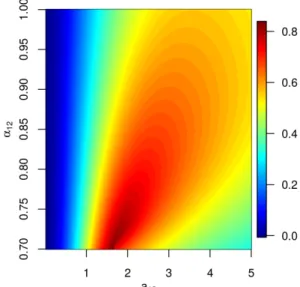
(Schlather et al., 2017). Figure 3.1 provides an example of the maximum attainable |ρ| in inequality (3.22) that have been found numerically. For details on implementation see Sec-tion 5.2.
30 Chapter 3. Bivariate covariance models
Figure 3.1: The maximum attainable|ρ|in inequality (3.22) for the bivariate powered exponential covariance model in R. The
parameters areα11= 0.2, α22= 0.5,s11=
2, s22= 3.
Figure 3.2: The maximum attainable|ρ|in inequality (3.30) for the bivariate Cauchy covariance model inR. The parameters are
α11 = 0.5, α22 = 0.9, β11 = 2, β12 = 2.5,
β22= 2.1,s11= 2, s22= 2.5.
3.5 Bivariate generalized Cauchy model
The univariate generalized Cauchy model,
ψ(r|α, β, s) = (1 + (sr)α)−β/α,
has been introduced in Gneiting (2000); Gneiting and Schlather (2004). Heres >0 is a scale parameter,α∈(0,2] is a smoothness parameter andβ >0 controls the long range behaviour of the field. The model was applied to many fields of science and technology, including network traffic (Li and Lim, 2008), hydrology (Koutsoyiannis, 2005) and medicine (Muniandy and Stanslas, 2008).
Each marginal covariances of the bivariate generalized Cauchy model,
Cii(r) =σ12(1 + (siir)αii)−βii/αii, (3.28) is of generalized Cauchy type with variance parameter σi, smoothness parameter αii ∈(0,2], long range parameterβii>0 and scale parameter sii>0,i= 1,2.Each cross covariance,
C12(r) =C21(r) =ρσ1σ2(1 + (s12r)α12)−β12/α12, (3.29)
is also of generalized Cauchy type with the colocated correlation coefficient ρ, smoothness parameterα12∈(0,2], long range parameterβ12>0 and scale parameter s12>0.
![Figure 4.2: Exponential covariance function and its cut-off version. The two functions coincide on [0,1].](https://thumb-us.123doks.com/thumbv2/123dok_us/9471479.2822070/46.892.334.577.126.384/figure-exponential-covariance-function-cut-version-functions-coincide.webp)