HOW DOES NOTATIONAL COMPETENCE AFFECT STUDENT UNDERSTANDING AND PERFORMANCE IN MATHEMATICS?
Joash Mochogi Geteregechi Kenyatta University
Marguerite Miheso-O’Connor Kenyatta University
Samson Rosana Ondigi Kenyatta University [email protected]
Mathematics is a discipline that communicates using a highly specialized language. This language makes use of notations and symbols in unique ways that require thorough
understanding by those studying it. This study was designed to measure how student mastery of the notations relates to their performance in mathematics. The study used a correlational study design where competence in notations was correlated with performance. Competence in notations and performance in mathematics were measured using tests designed to measure the two. The findings indicate that student mastery of notations highly correlates with their performance in the subject thus recommending that they should be taken more seriously by teachers and authors of mathematics textbooks.
Key words: Mathematical Notation, Mathematical Language, Symbolism, Notational Competence and Mathematics Performance.
Introduction
Mathematical knowledge is an important requirement amongst members of any society (Geteregechi, 2013). This knowledge is crucial since it has a wide range of applications. For instance, mathematical knowledge is a requirement for employment, in the study of other subjects, for communication, among others (Bell, 1983). It is due to this fact that mathematics has been made a core subject in many education systems in the world. It is for the same reasons that many colleges and universities across the world offer more mathematics lessons than any other subject (A. Orton, D. Orton, & Frobisher, 2004). However, unsatisfactory performance in mathematics amongst students has been a concern for a long time not only in specific countries but also on a global platform (Pisa, 2003).
Researchers in mathematics education have identified several factors responsible for students’ poor performance in mathematics. Among these factors are teachers and students’ attitude towards the subject (Mohamed and Waheed, 2011), teachers’ proficiency in
Importance of Notations to the Learning of Mathematics
Mathematical notations form part of the wider mathematical language. However, most researchers exploring the field of mathematical language within the mathematics education community have paid attention only to the syntactic and semantic part of the language, that is, the meaning and use of various terminologies in different contexts in mathematics (Njoroge, 2003). Since symbols and notations lie at the heart of mathematics, their use in its study is therefore, inevitable. Although a few researchers have paid attention to notations, even fewer have looked at how competence in these notations relates to student performance in
mathematics. The focus of this study was how secondary school students’ mastery of mathematical notations impacts their understanding and achievement in mathematics.
According to Muller and Kohlhase (2008), depending on the context, mathematical notations form 30 to 60% of any mathematical text. Hence, for someone to effectively decode mathematical text, they must be well versed with the notation. The main purpose of these notations is to cut short what would otherwise be long and bulky sentences (Chirume, 2012) into fewer characters to enhance communication. Although the notations are supposed to enhance communication, they may however, achieve the contrary by complicating communication and acquisition process (Muller and Kohlhase, 2008). In mathematics classrooms, student familiarity with such notations is crucial if they are to understand
mathematics (Stage, 2001) and articulate the mathematical ideas properly. It also allows them to do independent studies effectively as some books make use of notations without explaining their meaning in different contexts (Geteregechi, 2013). In a classroom set up, as the teacher talks, he/she writes on the board. However, the teachers usually speak a lot but end up writing very little in form of notations- they literally ‘speak’ the notations. For example ‘=’ is spoken as ‘equals to’, while ‘√’ is spoken as ‘the square root of’. If students are unfamiliar with, or have a different understanding of some notations used during mathematics lessons, they are likely to learn very little, or nothing at all due to poor communication and misrepresentation of mathematical concepts and processes.
An example in which misuse/misinterpretation of notation leads to hampered communication and subsequent failure is provided below:
The notation ‘!’ means factorial while the notation ‘%’ means percentage. Therefore, 4! = 4 x 3 x 2 x 1 = 24 while 4% = 4/100 = 0.04. In this case, the notations represent
mathematical operations/processes. If a student takes ‘!’ for ‘%’, they will definitely fail regardless of whether or not they know how to perform the operations factorial and percentage. This is a likely situation since it is possible to have such notations used in examinations without their names being given. Such misunderstanding and confusion may arise during classroom teaching if the teacher does not emphasize on what various notations stand for and how the notations are used in various contexts within
mathematics. For instance, the use of -1 as a superscript may have different meanings depending on the context. For example, if ‘y’ is a number, then y-1 = 1/y holds but if ‘y’
is a function, then y-1 = 1/y does not hold.
Communication in a Mathematics Classroom
During a mathematics lesson, teachers and students share information. The teacher sends information to the students and the students send feedback. By using feedback from the students, the teacher clarifies misunderstandings and misconception amongst students with an aim of creating shared meaning. Mathematical language plays a crucial role during this communication process. Unlike other languages such as English, mathematical language makes use of specialized symbols and notations in a specialized manner (Esty, 2011,
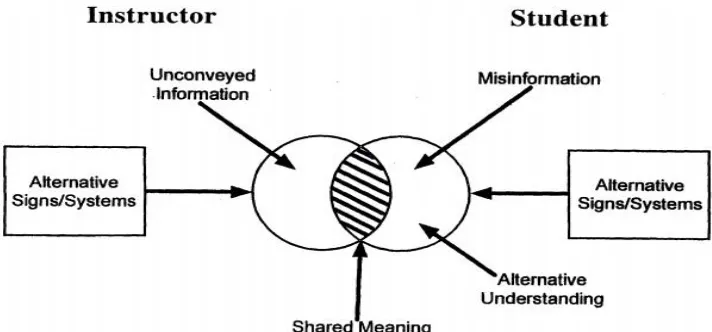
Figure 1 shows how, during a classroom discourse, the use of notations may hamper or enhance learning:
Fig.1: A Semiotic View of Mathematics Learning - Adapted from Stage (2001)
According to the figure, the interaction between students and the teacher during a mathematics lesson is aimed at creating shared meaning. This is represented by the shaded region. The bigger this region is, the better the understanding of the symbol system and hence better communication. Students with a bigger shared meaning may be said to be more
competent in mathematical notation. However, there could be some misinformation on the part of the student or un-conveyed information on the part of the teacher. Students in this category misuse mathematical notation by misrepresenting concepts and mathematical
operations. This distorts meaning and hence leads to failure. The role of the teacher therefore, is to try as much as possible to increase the shared meaning of the notational system. This study set out to find out the relationship between students competence in mathematical notation and their performance in mathematics.
The difficulties associated with notations include the fact that the mathematical community has not been able to take full control of them. Several notations are known to cause ambiguities and misunderstanding amongst learners (Chirume, 2012). It is common practice to have mathematicians from different parts of the world using different notations in expressing the same mathematical ideas. By so doing, these notations hamper communication during the learning process. If notations were to be controlled and harmonized, their use would cause less confusion and hence enhance student learning and performance in mathematics.
Methods Study Design and Sample Size
The current study is a quantitative correlational study that sought to find out whether secondary school students’ competence in mathematical notation was related to their performance in the subject. The study was carried out amongst the form two students in Nyamira North Sub-county in Kenya. The researcher sampled 340 students out of an accessible population of 2941 form two students in the sub-county. The sampled students were drawn from seven schools. The sub-county had a total of thirty-seven schools by the time the study was conducted.
Research Instruments
section measured student ability to convert mathematical word statements into notation form while the second part measured their ability to convert notational statements into word format. The total score from the two sections was computed into a percentage and used as the
students’ competence in mathematical notation. The second test was a Test of Performance (TOP). The items in this test were obtained with slight modifications from the Kenya National Examinations Council (KNEC), which is a credible examining body in Kenya. This made the test valid. Both tests were subjected to a pilot study after which relevant modifications were made. Their reliabilities were also computed using the Kuder-Richardson formula 20 and found to be high (TOP, α = 0.89, NCT, α = 0.82).
Data Collection
The instruments were administered to the sampled students with the help of their teachers of mathematics. This was done in the evening during the official school breaks. The two tests were administered on different days starting with the Notations Competence Test (NCT) and then the Test of Performance (TOP). Students were allowed enough time to finish all the tasks in the instruments.
Results and Discussion
In this section, the analysis of the data and results are presented. This analysis focused on demographic characteristics such as gender and age, student performance on the NCT and TOP as well as the correlation of the scores using Pearson’s product moment coefficient. Demographics of the Sample
The demographics considered in this study were student’s gender and age. These characteristics are provided alongside the mean scores both in the NCT and the TOP. Table 1 shows how these were distributed:
Table 1: Demographic Characteristics
From Table 1, that there were more male students (60%) than female students (40%). On performance, it is evident that male students outperformed their female counterparts both in the NCT and the TOP.
There were more students aged 13-15 (64.4%) than there were in the age brackets 16-19 (29.7%) and above 19 (5.9%). In Kenya, most students join secondary school at the age of 13 and 14. This therefore accounts for this high number of students at 13-14. However, there were also some students aged over 19 years. Although repetition of classes, without the consent of the parent and student, is not allowed in Kenya, it has been reported that some schools do force students to repeat when they do not perform well. This pressure by teachers on students to perform stems from the ministry of education, which promotes and demotes teachers based more on student performance in academic work than other competences. Another possible explanation to this is that since the government of Kenya introduced free secondary education, many students who had opted out of school due to lack of school fees decided to enroll and continue with their studies. The students aged over 19 posted the least scores both on the NCT and TOP. Again, this could be explained by the fact that they have been out of school for long and are therefore rusty in mathematics.
Characteristic Levels Frequency Percentage of Total
NCT Score (%)
TOP Score (%)
Gender Male 204 60 61 62
Female 136 40 42 49
Age (Years) 13-15 219 64.4 50 57
16-18 101 29.7 47 53
Student Competence in Notations Versus Performance in Mathematics
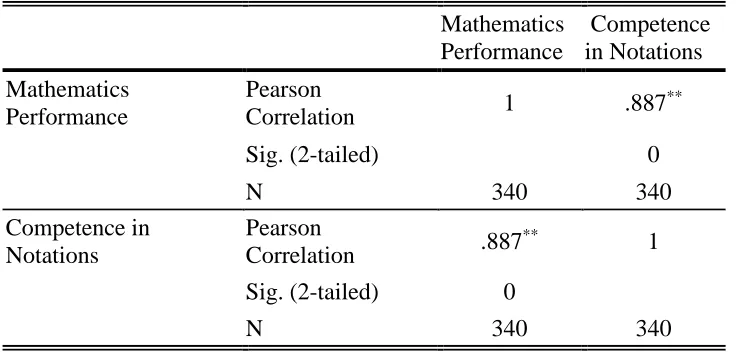
In order to find the relationship between student’s competence in mathematical notations and their performance in mathematics, the researcher used Pearson’s product moment coefficient. The Statistical Package and Software Solution’s (SPSS) output for the correlation between students’ NCT scores and the TOP scores were as shown in table 2:
Table 2: Correlation Between Student Competence in Mathematical Notation and Performance in Mathematics
Mathematics Performance
Competence in Notations Mathematics
Performance
Pearson
Correlation 1 .887
**
Sig. (2-tailed) 0
N 340 340
Competence in Notations
Pearson
Correlation .887
** 1
Sig. (2-tailed) 0
N 340 340
** Correlation is significant at the 0.05 level (2-tailed)
Table 2 shows that the correlation between students’ competence in mathematical notation and performance in mathematics is strongly positive (r = 0.887). This relationship was found to be significant at α=0.05. The implication of this therefore, is that high
competence in mathematical notations leads to higher achievement in mathematics. It can be inferred that, students who are competent in mathematical notation find the reading, listening and writing of mathematical ideas/statements easier than their counterparts who are not. Similar findings have been supported by Chirume (2012), who in his study reported that student misunderstanding and subsequent misuse of symbols and notations could hinder student understanding and even lead to low achievement in mathematics. Luna and Fuscablo (2002) conducted a study on mathematical notation and recommended that they should be integrated in other subjects and topics at the start of a given course as this will allow better understanding of the concepts involved. According to Foster (2007), the teaching of algebraic concepts should be accompanied with effective articulation of symbols and their use as this gives students a deeper understanding of the concepts and lead to higher performance.
Conclusion and Recommendations
References
Bell, A. W., A review of Research in Mathematics Education: Part A: Research on Learning and Teaching Mathematics. Oxford: Nfer-Nelson Publishing Company. (1983).
Chirume, S. (2012). How does use of mathematical symbols influence understanding of mathematics by secondary school students? International Journal of Social sciences and Education, 3(1).
Esty, W., (2011).The Language of Mathematics. URL: http://www.augustusmath.hypermath.net
Stage F.K. (2001) Symbolic Discourse and Understanding in a College Mathematics Classroom. The Journal of
General Education. 50(3), Retrieved from: http://www.jstor.org/stable/27797880.
Muller and Kohlhase (2008). Context Aware Adaptation: A case study on Mathematical; Notations. Centre for
Discrete Mathematics and Theoretical Computer Science (CDMTCS) Research Report Series-341, Nov 2008).
Njoroge, B. (2003). Relationship between Mathematical Language and Students' performance in Mathematics in
Public Secondary Schools in Nairobi Province, Kenya. Masters Thesis, Kenyatta University. Kenya. Pp. 27 Luna, C.A. & Fuscablo, L.G., (2002). Enhancement of Student Problem Solving Performance through
Mathematical Symbolism. Proceedings of ICME10-Topic Study Group 9, pp . 1-10.
Foster, D. (2007). Making meaning in Algebra examining students‟ understandings and misconceptions.
Assessing Mathematical Proficiency. 53 , 163-176 Retrieved from
http://www.msri.org/communications/books/Book53/contents.html