The MT model transformation language
Technical report TR-05-02, Department of Computer Science, King’s College London
Laurence Tratt
[email protected]
Contents
1 Introduction 4
2 Running example 4
3 The QVT-Partners model transformations approach 5
3.1 Overview . . . 5
3.2 Pattern language . . . 6
3.3 Complete example . . . 8
3.4 Issues with the approach . . . 10
3.4.1 Inappropriate imperative language . . . 10
3.4.2 Underpowered patterns . . . 10
3.4.3 Scoping rules . . . 11
3.5 Summary . . . 11
4 The MT Language 11 4.1 Basic details . . . 12
4.2 Matching source elements with patterns . . . 14
4.3 Pattern language . . . 14
4.4 Producing target elements . . . 15
4.5 Example . . . 16
4.6 Running a transformation . . . 17
5 Tracing information 18 5.1 Visualizing tracing information . . . 18
5.1.1 Alternative visualizations . . . 19
5.2 Standard tracing information creation mechanism . . . 20
5.3 Augmenting or overriding the standard mechanism . . . 22
6 Towards more sophisticated transformations 23 6.1 Extending the running example . . . 24
6.2 Pattern multiplicities . . . 25
6.2.1 Variable bindings in the presence of multiplicities . . . 27
6.3 Extended example . . . 27
6.4 Pruning the target model . . . 30
6.5 Combinators . . . 32
7 Implementation 32 7.1 MT Grammar . . . 32
7.2 Outline of the implementation . . . 34
7.3 Translating rules . . . 34
7.4 Translating a rules source model clauses . . . 35
7.5 Translating patterns . . . 36
7.6 Translating variable bindings . . . 37
7.7.1 A simplified translation . . . 38
7.7.2 Ensuring the complete evaluation of nested pattern expressions . . . 39
7.8 Translating set patterns . . . 41
7.9 Translating Converge expressions when used as patterns . . . 42
7.10 An example translated pattern . . . 42
7.11 Translating pattern multiplicities . . . 43
7.12 Standard functions . . . 45
7.13 Embedding Converge code within DSLs . . . 45
7.14 Extending the Converge grammar . . . 46
7.15 Preventing unintended interaction between translated and embedded code . . . 47
7.15.1 Assigning to variables in outer blocks . . . 47
7.16 Generating tracing information from nested model patterns . . . 48
7.17 Summary of the implementation . . . 49
8 Related work 49
9 Future work 51
10 Summary 52
A Converge grammar 53
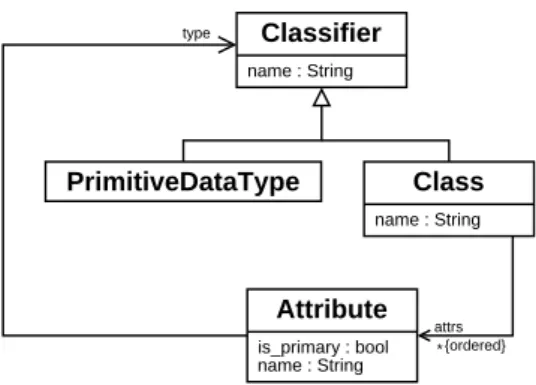
Classifier name : String PrimitiveDataType Class name : String Attribute is_primary : bool name : String attrs type *{ordered}
Figure 1: ‘Simple UML’ meta-model.
1. Introduction
This paper presents a unidirectional stateless model transformation language MT, implemented as a DSL within Converge. MT shares several aspects in common with model transformation languages such as the QVT-Partners approach [QVT03b]. That is it is a rule-based system, utilising patterns. However there are a number of advances over, and significant differences from, previous approaches. Some of these are a side-effect of implementing MT as a DSL within Converge; some are the result of experimentation with a concrete, but malleable, implementation. For example, MT allows normal Converge imperative expressions to be embedded within it. In a wider context, MT is used as the basis for a change propagating transformation language which will be presented in a later paper.
This paper comes in three main parts. Firstly the running example is introduced, followed by an introduc-tion to the QVT-Partners model transformaintroduc-tion approach. The QVT-Partners approach is then used as the basis for the MT language, which is introduced partly through example. Finally the implementation of the MT language as a DSL in Converge is discussed in more detail.
2. Running example
This paper makes use of a simple running example of a transformation from a UML like modelling language to a model of relational databases. The chief reason for using this example is the ability to compare the result with its implementation in other model transformation approaches (e.g. [DIC03, OQV03, QVT03a]. The example also has the virtue that it can be easily considered in ‘simple’ and ‘advanced’ variants. Whilst the advanced variant does exercise a reasonable number of features of any given model transformation approach, it is still of an appropriate size for this paper.
The original example is defined in [QVT03a]. The simple variant is as follows. A meta-model for a simple UML modelling language is given in figure 1. A corresponding meta-model for simplified relational
databases is given in figure 2. In essence, the transformation takes in a Class and transforms it to a
Tableof the same name. Attribute’s whose type is aPrimitiveDataType(e.g. string, integer)
are transformed to a column of the same name and the same primitive data type. Attribute’s whose
type is aClass(i.e. the type refers to another user class) are transformed to a number of columns: the
transformation recursively ‘drills down’ through a class’s non-primitively typed attributes until it reaches attributes with primitive datatypes. At each point in the recursion the name of the current class along with a ‘ ’ character is appended to the column name. The net result of this is that non-primitive data types are flattened.
*{ordered} Table name : String columns Column name : String type : String
Figure 2: Simplified relational database meta-model.
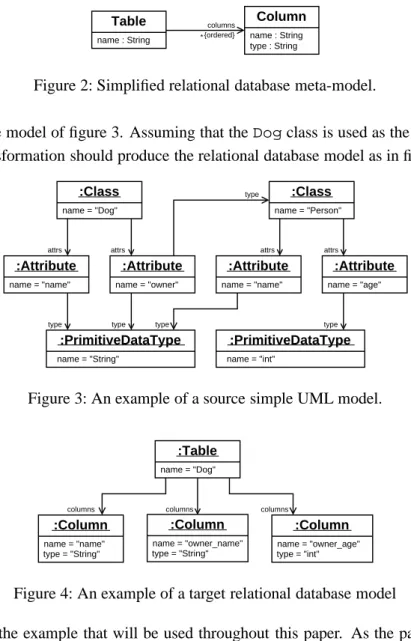
Consider the source model of figure 3. Assuming that theDogclass is used as the input class, an
imple-mentation of this transformation should produce the relational database model as in figure 4.
:Class name = "Person" :Attribute name = "name" :Attribute name = "age" :Class name = "Dog" :Attribute name = "name" :Attribute name = "owner" attrs type
attrs attrs attrs
:PrimitiveDataType name = "String" :PrimitiveDataType name = "int" type type type type
Figure 3: An example of a source simple UML model.
columns :Column name = "name" type = "String" name = "owner_name" type = "String" :Column name = "owner_age" type = "int" :Column :Table name = "Dog" columns columns
Figure 4: An example of a target relational database model
This is the core of the example that will be used throughout this paper. As the paper progresses, I will progressively add complexity to the example.
3. The QVT-Partners model transformations approach
In this section, I explain some relevant aspects of the QVT-Partners approach, since the MT language shares several factors in common with the QVT-Partners approach. Whilst the QVT-Partners approach has the concept of ‘specification’ and ‘implementation’ transformations (known as relations and mappings
respec-tively1), for the purposes of this paper, transformation specifications are largely irrelevant and are
conse-quently ignored. The QVT-Partners approach also defines a diagrammatic syntax for transformations which is similarly ignored.
3.1. Overview
A transformation in the QVT-Partners approach consists of a number of mappings. A mapping consists of one or more source domains (analogous to a function parameter) and a target imperative body. Each domain
1
The author of this paper takes full responsibility for his decision to use these names — given their multiple overloaded meanings in the wider field, in retrospect they were not the best possible choices.
consists of one or more patterns to match against. Patterns are written in a language designed to make expressing constraints over models succinct; they are analogous to textual regular expressions as found in e.g. Perl [WCO00]. Imperative bodies consist of a single expression in an extended OCL variant that is capable of side effects. Using the meta-models presented in the previous section, a simple mapping for transforming a class to a table would look as follows:
mapping Class_To_Table { domain { (Class)[name = n, attrs = A] } body { let
columns = A->collect(attr columns = Set{} | columns + Attr_To_Column(attr))
in
(Table)[name = n, columns = columns] end
} }
The intuitive meaning of this is hopefully fairly straightforward. TheClass To Tablerule will match
against aClass model element, with the pattern binding whatever name the class has to the variable n
and whatever attributes it has to the variableA. The imperative body then creates a corresponding Table
whose name matches the source class. It should be noted that although theTableexpression in the body
appears to be a pattern, this is something of a syntactic illusion: the pattern-esque syntax is simply syntactic
sugar for object creation and slot updating. Attr To Columnrefers to another mapping, which is used
to transform each attribute in the source class into one or more database columns which are then placed within the target table.
3.2. Pattern language
In the context of this paper, the most important novel aspect of the QVT-Partners approach is its pattern language. Its aim is to provide a concise textual notation for expressing constraints over models, thereby reducing the time needed to write and to comprehend a transformation. In this subsection, I provide a brief background of patterns before informally explaining the QVT-Partners pattern language.
Many computer users are familiar with textual pattern languages e.g. via operating system commands
such asls *.txt. One can obtain a crude gauge of the popularity of textual regular expressions by the fact
that suitable libraries are found as standard in many modern programming languages such as Perl, Python and Ruby. However whilst pattern languages are commonly thought of as being suitable only for matching against text, they can be used to match against other, much richer, datatypes. For example program transfor-mation patterns match against complex AST’s [Big98]. Intuitively, designing a pattern language involves a compromise between providing a concise notation for capturing common constraints, and providing a com-pletely general mechanism — the more cases a pattern language can express, the less concise it is likely to be. Many pattern languages are thus tailored for the common case as opposed to the general case. Tex-tual regular expressions, for example, are typically defined as finite-state automata which can not express a
seemingly simple constraint such as ensuring that a string contains balanced open and close brackets2. It is
therefore desirable that when a pattern languages’ expressive limit is reached, a suitable escape mechanism into a more powerful, if verbose, system is available.
2
Note that some implementations of regular expressions are no longer ‘regular’ in the formal sense of that word. For example, modern Perl contains an experimental feature which can express the balanced brackets constraint.
The QVT-Partners approach provides a specific pattern language for expressing constraints over models. By providing many of the benefits known to textual regular expressions users, several of the problems concerned with identifying elements in a model are addressed. The QVT-Partners approach is important in this respect because most current model transformation approaches do not provide pattern languages. Although it could be argued that graph transformation approaches utilise pattern languages, I believe that these lack any significant expressive power, particularly when compared to textual regular expressions; for the purposes of this paper, I therefore do not consider graph transformation approaches to have pattern languages.
The QVT-Partners approach provides a small pattern language for expressing constraints over models. A slightly simplified version of the grammar for the pattern language is as follows:
hpatterni::= ‘_’ | hset patterni | hseq patterni | hobj patterni | hexpressioni
hset patterni::= ‘{’ [hpatterni* (‘|’hpatterni)*] ‘}’ hset patterni::= ‘[’ [hpatterni* (‘|’hpatterni)*] ‘]’
hobj patterni::= ‘(’hvari[ ‘,’hvari] ‘)’ ‘[’ [hfield patterni(‘,’hfield patterni)*] ‘]’ hfield patterni::= hvari‘=’hpatterni
hvari::= ‘ID’
| ‘_’
The reference to the rule expression is a reference to a rule which contains the extended OCL variants’ grammar.
The QVT-Partners approach identifies three main types of patterns: set, sequence, and object patterns. Although not explicitly noted as such, variables in patterns are essentially patterns themselves. To ensure consistency with the rest of this paper, I refer to object patterns as model element patterns. All types of pattern share in common one thing: given a particular model element, they will either succeed or fail to match against it.
Set and sequence patterns are similar to those used in function parameters in functional programming
languages such as Haskell. For example a set patternSet{1, 6 | R}will match successfully against a
set that contains at least two items1and 6; a new set containing all of the original sets items other than1
and6will be bound toR. Intuitively, variable names mean ‘match anything and bind’; henceforth these will
be referred to as variable bindings. If the same variable name appears more than once in the same scope, all instances of that variable name must match against equivalent objects (the definition of object equality in the QVT-Partners approach is inherited from the MOF [OMG00]). The special variable ‘ ’ matches against anything and immediately discards the result; multiple instances of ‘ ’ do not need to match against equivalent objects.
Although relatively simple, model element patterns are the backbone of the pattern language. Model element patterns specify the type that matching model elements must conform to, and an optional ‘self’ variable which will be bound to the element matched against. The model element then specifies a number
of a slots and a pattern against which each slot in the model element must match against. The terse power of model element patterns is best demonstrated by example. Consider first the following model element pattern:
(Dog, d)[name = n, owner = (Person)[name = "Fred"]]
This pattern will match successfully against a model element which is of typeDogand whose owner is
Fred. After the match the variabledwill point to the particularDogelement matched, andnwill contain the
dog’s name. This pattern is approximately equivalent to the following Converge-esque pseudo-code function which returns a dictionary of bindings if the source element is matched successfully, failing otherwise:
func match(element): if not element.conforms_to(Dog): return fail d := element n := element.name if not element.owner.conforms_to(Person): return fail if element.owner.name != "Fred": return fail return Dict{"d" : d, "n" : n}
Although it may seem more logical to have used OCL to express this, it should be noted that expressing the creation and update of bindings in OCL would require complex encodings. Partly due to this difficulty, the QVT-Partners approach defines a new calculus in order to have a suitable semantic domain. The calculus is given an operational semantics, and directly implements several pattern matching primitives; it can be seen to be similar to the imperative object calculus of Abadi and Cardelli [AC96] extended with pattern matching. Using Converge pseudo-code as the target translation of the example pattern avoids the need to define and explain the calculus.
As this example translation clearly shows, the model element pattern is not only considerably terser than its equivalent pseudo-code, but is arguably easier to comprehend. Since the pseudo-code has to
explic-itly embed certain aspects of the model transformation (e.g. thereturn failstatements) the important
aspects of the pattern are obscured. This is simply a recasting of the problem of expressing model transfor-mations in GPL’s. Even though the pattern language is simple, it neatly solves many such problems.
3.3. Complete example
The running example expressed in the QVT-Partners approach is as follows:
mapping Class_To_Table { domain { (Class)[name = n, attrs = A] } body { let
columns = A->collect(attr columns = Set{} |
columns + or(Primitive_Type_Attr_To_Column("", attr), User_Type_Attr_To_Column("", attr))
in
(Table)[name = n, columns = columns] end } } mapping User_Type_Attr_To_Column { domain { (String, prefix)[]
} domain {
(Attribute)[name = n, type = (Class)[name = ct, attributes = A]] } body { let new_prefix = if prefix == "" then n else prefix + "_" + n end in
for A->collect(attr attrs = Set{} |
attrs + or(Primitive_Type_Attr_To_Column(new_prefix, attr), User_Type_Attr_To_Column(new_prefix, attr))) end } } mapping Primitive_Type_Attr_To_Column { domain { (String, prefix)[] } domain {
(Attribute)[name = n, type = (PrimitiveDataType)[name = pt]] } body { Set{(Column)[name = if prefix == "" name = n else name = prefix + "_" + n end, type = pt]} } }
One feature in particular that requires explanation is theorfunction used in theClass To Tableand
User Type Attr To Columnmappings. oris not a normal function call, but is a built-in combina-tor which lazily executes the mappings passed as arguments to it in order until one succeeds and produces a value. Note that unlike most rule-based systems, the QVT-Partners does not provide a function which takes
an element and attempts to find a rule which will transform it. Although theorcombinator can provide the
same functionality, its repeated use becomes tiresome due to the continuous hard-coding of mapping names required.
The overall structure of this transformation is fairly simple. TheClass To Tableis the top-level
mapping which takes in a a class and iterates through its attributes, invoking other mappings to produce
columns. Attributes are transformed in one of two ways. Both theUser Type Attr To Columnand
Primitive Type Attr To Columnmappings take two arguments: a string and an attribute. The string represents the current column name prefix being built up as the transformation drills into user data
types. Attributes which have a primitive data type are transformed by thePrimitive Type Attr To Column
mapping into a single column. Attributes which have a user data type are transformed by theUser Type Attr To Column
into one or more columns; the User Type Attr To Column mapping is the recursive mapping
which drills into user data types.
Although the example from section 2 has been successfully expressed in the QVT-Partners approach, the result is perhaps more verbose than one may have expected. Indeed, somewhat surprisingly, a simple GPL equivalent of this example is smaller. One might thus reasonably expect that expressing such a
trans-formation in the QVT-Partners approach has other benefits. Since mappings only allow the expression of unidirectional stateless transformations, the only potential gain over a GPL approach is the possibility of au-tomatically created tracing information. Unfortunately the QVT-Partners approach does not explain explain how rules can create such tracing information in practise. Since the GPL equivalent is likely to be more readily understood by a far wider range of people, the overall benefits of this approach are not clear cut. In the following subsection I outline three issues which are indicative of the problems of the QVT-Partners approach.
3.4. Issues with the approach
As the verbose example in section 3.3 may suggest, the QVT-Partners approach has a number of minor flaws and limitations which hamper practical use. In this subsection I outline, in approximately descending order, three areas which are indicative of where the QVT-Partners falls short of its intended goals. These points are instructive in understanding several of the design decisions made in the MT language of section 4.
3.4.1. Inappropriate imperative language
The imperative bodies of mappings are written in a so-called ‘extended OCL’, which is intended to allow users familiar with OCL the chance to reuse that knowledge in an imperative setting. This has an immediate negative effect: extending OCL with imperative constructs means that the often desirable properties OCL
had as a purely side-effect free language are lost3. Conversely when it comes to acting as a normal GPL,
the resulting language is decidedly unwieldy since it lacks appropriate constructs for common operations. For example, there is no explicit sequencing mechanism: the imperative body consists of exactly one OCL
constraint, and sequencing can be achieved clumsily via theletexpression.
3.4.2. Underpowered patterns
The pattern language defined in the QVT-Partners approach is novel in the context of model transformations, and potentially very useful. However as the relatively simple definition in section 3.2 may suggest the pattern language is lacking in significant expressive power.
The pattern language itself is limited in two main ways:
1. Within model element patterns it is only possible to check for the equality of slots. For example, it is not possible to use a model element pattern to express that a match against an object should succeed provided a given slot does not match a particular value.
In order to sidestep this problem, users must add additional OCL in awhenclause.
2. Model element patterns can only match against a fixed number of elements. A model element pattern, for example, can only match successfully against one, and only one, model element. Note that whilst set and sequence patterns can match against sets and sequences of arbitrary lengths, only a fixed number of elements can be explicitly identified within any given set or sequence.
There is no general solution to this problem. Typically a new mapping needs to be added so that
iteration in awhenclause can control the number of times another mapping is successfully matched.
3
OCL 2.0 is not in fact entirely side-effect free; however the situations in which this property is violated are largely irrelevant in the context of this paper.
3.4.3. Scoping rules
Since a bare variable name in a slot constitutes a variable binding, the QVT-Partners approach has fragile scoping rules, since it is difficult to distinguish a variable binding from a variable reference. Consider the
simple example of section 3.2(Dog, d)[...].Dogis a reference to theDogmodel class, whereasdis
a variable binding which will be set to the self value of the object which matches the model element pattern. This means that it is impossible to express that a model element pattern should match against a particular
element. For example, in a meta-circular system where a classMis an instance of theSingleton
meta-class, the model element pattern (Singleton, M)[...] will create a local variable M rather than
ensuring that it matches against the element pointed to byM.
The QVT-Partners approach allows awhenclause to be scoped over all domains establishing a constraint
across domains since it does not create any new variable bindings. However it is not possible to introduce
a similar clause (often calledwherein similar approaches) scoped over all domains which introduces new
variable binding without introducing ambiguities. Consider the following example: should thex in the
pattern bind the value ofslotto the variable, or should it ensure thatslotcontains the value introduced
in thewhereclause?
mapping X { domain { (E)[slot = x] } where { x := 5 } }
In the QVT-Partners approach, scoping ambiguities are avoided by disallowing several potentially useful features that may introduce new variable bindings. However the end result is that whilst expressions such
as in (Dog, d)[...] are statically resolvable, they are confusing for users. The overall effect of the
scoping rules are to severely limit the possibilities for extending or embedding the language.
3.5. Summary
The QVT-Partners approach provides a number of innovations compared to other model transformation approaches, most notably the use of patterns. However in practise the simplistic nature of the approach means that it falls somewhat short in its aim to allow users to express model transformations more easily than in GPL’s.
In the next section of this paper, I define a new model transformation language MT which takes elements of the QVT-Partners approach, adding extra features and addressing some of the approaches flaws.
4. The MT Language
The MT language is a new unidirectional stateless model transformation language, implemented as a DSL within Converge. MT transforms instances of the typed modelling language TM [Tra05] into new instances of TM. In essence, MT defines a natural embedding of model transformations within Converge, using declar-ative patterns to match against model elements in a terse but powerful way, whilst allowing normal impera-tive Converge code to be embedded within rules.
Because MT is implemented as a DSL within Converge, it has existed as a a concrete implementation from shortly after its original design was sketched out. This has proved to be significant, since practical experience with the approach has been rapidly fed back into the implementation. Rapid development has been facilitated by the flexible environment provided by Converge. The ability to experiment with the implementation has ultimately led MT to contain a number of insights and distinct differences from other approaches. Such insights range from a more sophisticated pattern language to suitable ways to visualize model transformations. In the wider context of this paper, MT is also important as the basis of a change propagating language, to be described in a later publication.
In this section I first highlight the main features of MT, then present an MT version of the running ex-ample, before showing how MT transformations are run in practise. This section is intended to present the basic features of MT, before more advanced features are described in section 6.
4.1. Basic details
An MT transformation has a name and consists of one or more rules, the ordering of which is significant. Rules are effectively functions which define a fixed number of parameters and which either succeed or fail depending on whether the rule matches against given arguments. Rules and functions in MT are essentially synonymous as in approaches such as TXL [Cor04]. If a rule matches successfully, one or more target elements are produced and it is said to have executed; if it fails to match successfully, nothing is produced. Rules are comprised of: a source matching clause containing one or more source patterns; an optional when clause on the source matching clause; a target producing clause consisting of one or more expressions; and an optional where clause for the target production clause.
An MT transformation takes in one or more source elements, which are referred to as the root set of source elements. The transformation then attempts to transform each element in the root set of source elements using one of the transformations rules, which are tried in the order they are defined. If no rule matches a given element, an exception is raised and the transformation is aborted.
The general form of an MT transformation is as follows:
import MT.MT $<MT.mt>:
transformation transformation name rule rule name:
srcp: pattern1 ... patternn src when: expr tgtp: expr1 ... exprn tgt where: expr1 ... exprn
Thesrcpandsrcp whenclauses are collectively said to form thesource model clauses;
simi-larly thetgtpandtgtp whenclauses are collectively said to form thetarget model clauses.
Transformations are translated by MT into a Converge class with the name of the transformation; rules are translated to functions of the same name within the class. In order to run a transformation, the transformation class is instantiated; each class can be instantiated multiple times. Transformation classes have additional functions for e.g. extracting tracing information (see section 4.6).
Transformation rules contain normal Converge code in expressions; such expressions can reference vari-ables outside of the model transformation DSL fragment. This is an important aspect of MT since it allows users to use normal Converge functions arbitrarily, and without penalty. In other words, when the model transformation language itself is inadequate in a particular respect, a normal reusable Converge function can be defined outside of the model transformation, but which can be called from within any model transforma-tion.
MT transformations hold a record of tracing information, which is automatically created as transformation rules are executed. Each rule executed adds a new trace. Each trace is a tuple, encoded as a Converge list, of
the form[[source elements], [target elements]]. The source elements that are stored in
the tracing information do not necessarily constitute the entire universe of elements passed via parameters to the transformation. By default, only elements matched by non-nested model element patterns are recorded in the tracing information. Section 5.2 details the default tracing creation mechanism, and explains how it can be augmented or overridden.
A simple example of a transformation and a rule is as follows:
$<MT.mt>:
transformation Classes_To_Tables rule Class_To_Table:
srcp:
(Class, <c>)[name == <n>, attrs == <A>] tgtp:
(Table)[name := n, cols := columns] tgt_where:
columns := []
for attr := A.iterate():
columns.extend(self.transform([""], [attr]).flatten())
This rule is the MT analogue of the rule in section 3.1. Note how normal Converge code is interspersed amongst the MT DSL (see section 7.13 for implementation information). Since transformations are
trans-lated to Converge classes, to access functions ‘internal’ to the transformation, one must use the self.
prefix. Thetransform function, for example, takes source elements and tries each rule in the
trans-formation in succession until it finds one which successfully matches the elements and produces values.
If the transformfunction does not find a suitable rule then, by default, an exception is raised. The
transformfunction is also used internally by the transformation as the mechanism used to transform the root set of source model elements. Section 6.3 shows an example of a rule that can guarantee that the
transformrule can be made to succeed on any given input.
In the following subsections I explain in more detail how rules match and produce elements, including a detailed examination of the pattern language and pattern multiplicities.
4.2. Matching source elements with patterns
Each pattern in thesrcpclause of a rule corresponds to a domain in the QVT-Partners approach. Arguments
must be passed as lists rather than sets; whilst TM elements can be placed into Converge sets, users may wish to transform non-hashable elements such as lists. Each list contains the top-level model elements which each pattern can match against. Elements can exist, directly or indirectly – that is as top-level elements, or by being reachable via the graph that constitutes a model – in one or more arguments. In order to avoid
the problems noted in section 3.4.3, variable bindings are surrounded by angled brackets ‘<’ and ‘>’ to
distinguish them from normal Converge variable references.
The matching algorithm used by MT is intentionally simple. Each pattern in turn attempts to match against the top-level source elements passed in the appropriate argument. Each time a pattern matches it produces variable bindings which are available to all subsequent patterns. If a pattern fails to match, control backtracks to previous patterns (in the order of most recently called), which attempt to generate another match given the variable bindings and arguments available to them. The generation of an alternative match causes new variable bindings to produce, which allows the rule to attempt another match of later patterns. Thesrc whenclause, if it exists, is tried once all patterns have been matched successfully; it is essentially a guard over patterns. If it fails, patterns are requested to generate new matches exactly as in the failure of a pattern to match. The implementation details of such behaviour are largely hidden from the user by the use of patterns.
The order that patterns are defined in thesrcpclause is significant, for two separate reasons. Most
ob-viously it is necessary to ensure that users sequence variable bindings and references to the bound variables correctly. However there is a second reason that, whilst less obvious, is critical to the performance of larger transformations. Making the order of patterns significant allows users to make use of their domain knowl-edge to order them in an efficient way. Consider a rule which has two independent patterns x and y where x tends to match against many source elements, but y against few. Placing x first in thesrcpclause means that when y fails x will try to produce more values; if x can produce multiple matches, y may be executed
many times unnecessarily. If y is placed first in thesrcpclause then if it fails to match against its input the
rule fails without ever trying to match x. Sensible ordering of patterns in this way can lead to a significant boost in performance as unnecessary matches are not evaluated.
Each pattern is translated to a Converge generator, which provides a natural mechanism for lazily generat-ing all possible matches. Translated patterns are co-joined to make use of Converge’s backtrackgenerat-ing abilities.
Note that thesrc whenclause, if it exists, must be a single Converge expression which either succeeds or
fails given variable bindings generated by patterns in thesrcpclause.
4.3. Pattern language
MT’s pattern language is essentially a super-set of that found in the QVT-Partners approach. MT defines a number of pattern expressions: model element patterns, set patterns, variable bindings, and normal Converge expressions. Patterns written in the latter language can be directly translated into MT with only minor syntactic changes.
There are two significant differences between the two pattern languages. Firstly – as noted in the section 4.2 – variable bindings in MT must be surrounded by angled brackets to ensure harmony between MT and Converge’s scoping rules. Secondly, model element patterns in MT can contain comparisons other than equality between slots; henceforth these are known as slot comparisons. Any of the standard Converge
comparison operators can be used in slot comparisons. A model element pattern in MT is said to consist of zero or more slot comparisons.
As a trivial example of slot comparisons, one can take the model element pattern example from section 3.2 (making the necessary minor syntactic modifications), and change it to find dogs whose owner is not Fred:
(Dog, <d>)[name == <n>, owner == (Person)[name != "Fred"]]
This same example would necessitate an OCL constraint in awhenclause in the QVT-Partners approach.
Allowing different types of slot comparison in model element patterns opens up new possibilities. Since MT allows the same slot name to appear in more than one slot comparison, one can test a slot for multiple conditions as in the following model element pattern:
(Person)[age >= 18, age <= 25]
There is one other additional feature in the MT pattern language. Since model elements are Converge objects, slot comparison is not entirely synonymous with attribute comparison, since slots may contain functions. MT’s model element patterns therefore provides support for functions as shown in the following example:
(Person)[calc_wage() > 18000]
Functions in slot comparisons can be passed an arbitrary number of arguments passed to them; all arguments are normal Converge expressions.
Pattern multiplicities are not considered to be a part of the core pattern language, but are a significant enhancement in MT over the QVT-Partners approach; they are detailed in section 6.2.
4.4. Producing target elements
When an MT rule executes it produces one or more target elements. An exception is raised if a rule executes but fails to produce any elements. The number of elements produced is determined by the number of
expressions in thetgtpclause. If thetgtpclause has a single expression, then the rule produces a single
element; if it contains more than one expression, then the rule produces a list whose length is the same
as the number of expressions in thetgtpclause. Each expression is a normal Converge expression, but
with an important addition. The MT DSL admits model element expressions by extending the Converge
grammar ruleexpr(see section 7.14 for implementation details). Model element expressions differ from
model element patterns both conceptually and syntactically. Conceptually a model element expression is an imperative, creational action. There is therefore no concept of a ‘self’ variable in a model expression. Furthermore, to reinforce the notion that model expressions are imperative actions, slot assignments use the
normal Converge assignment operator:=.
Expressions intgtphave an optionalforsuffix which allows a single expression to generate multiple
values. If one ignores the obvious syntactic difference of the relative location of the keyword, theforsuffix
works largely as its normal Converge counterpart, taking a single expression and continuously pumping it
for values until it fails. Variables defined in theforsuffix are scoped only over the single expression in the
tgtpclause that it suffixes. AssumingCOLSis a list, a typical usage of this feature is as follows:
Note that if the above example was the only expression in atgtp, the result of the rule would be a list of
lengthCOLS.len(). However, if the expression was the first of two in atgtp, the rule would produce a
list of length two, with the first element being a list of lengthCOLS.len(). Section 9 suggests a possible
extension to MT which would allow a rule to produce a number of elements not solely determined by the
number of expressions in itstgtp.
Thetgt whereclause, if it exists, is a sequence of Converge expressions which are executed before
thetgtpclause. Variables in the tgt whereclause are automatically scoped over the tgtpclause.
Unlike thesrc whenclause, there is no notion of success or failure with thetgt whereclause, which
is simply a helper function for the tgtpclause. Note that expressions in the tgt whereclause can
contain model element expressions.
4.5. Example
The following is a complete Converge module which implements the running example: 1 import Sys
2 import Relational, Simple_UML
3 import MT.MT
4
5 func concat_name(prefix, name):
6 if prefix == "":
7 return name
8 else:
9 return prefix + "_" + name
10 11 $<MT.mt>: 12 transformation Classes_To_Tables 13 14 rule Class_To_Table: 15 srcp:
16 (Class, <c>)[name == <n>, attrs == <A>]
17
18 tgtp:
19 (Table)[name := n, cols := columns]
20
21 tgt_where:
22 columns := []
23 for attr := A.iterate():
24 columns.extend(self.transform([""], [attr]).flatten())
25
26 rule User_Type_Attr_To_Column:
27 srcp:
28 (String, <prefix>)[]
29 (Attribute)[name == <n>, type == (Class)[name == <cn>, attrs == <CA>]]
30
31 tgtp:
32 self.transform([concat_name(prefix, n)], [ca]) for ca := CA.iterate()
33
34 rule Primitive_Type_Attr_To_Column:
35 srcp:
36 (String, <prefix>)[]
37 (Attribute)[name == <n>, type == (PrimitiveDataType)[name == <pn>]]
38
39 tgtp:
40 [(Column)[name := concat_name(prefix, n), type := pn]]
The overall structure of this transformation is deliberately similar to the version in the QVT-Partners ap-proach of section 3.3. One important difference is that the repetitive code which builds up the column prefix
is factored out into a normal top-level function concat name— this contributes towards making the
A slight difference between the MT transformation and the QVT-Partners approach equivalent is that the
User Type Attr To Columnrule produces a list which contains list of columns. The outer list will
be of lengthCA.len(), with each entry in the list being of arbitrary length. Consequently theflatten
function call in line 24 is necessary to remove the nesting that will be present if theUser Type Attr To Column
rule is called.
4.6. Running a transformation
Details of how to run a model transformation, including details such as the format of its inputs and outputs and so on, are surprisingly absent from descriptions of the majority of model transformation approaches. Since this is one of the most important practical aspects of model transformations, I believe it is important to be explicit about how transformations are run. In this subsection I detail the process of running a MT transformation.
Running a transformation in MT involves instantiating a transformation class and passing it model ele-ments. The transformation then executes, attempting to find a rule to transform each element in the root set of source elements. If the transformation is successful in transforming the root set of elements, a trans-formation object will be returned. The transtrans-formation object can then be queried to find the target model elements produced and the corresponding tracing information. The format of MT’s inputs and outputs is
simple. Source elements must be instances of elements defined in aTM.model classblock (note that
built-in Converge types such as strings and ints are defined to be valid TM model elements). Similarly target elements will be TM model elements.
The following example creates a simple input model and then executes the Classes To Tables
transformation: dog := Simple_UML.Class("Dog") person := Simple_UML.Class("Person") dog.attrs.append(Simple_UML.Attribute("name", Simple_UML.String)) dog.attrs.append(Simple_UML.Attribute("owner", person)) person.attrs.append(Simple_UML.Attribute("name", Simple_UML.String)) person.attrs.append(Simple_UML.Attribute("age", Simple_UML.Integer)) transformation := Classes_To_Tables(dog)
The target elements produced by the transformation can be accessed via theget targetfunction. Since
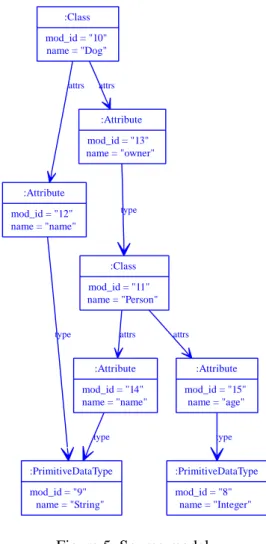
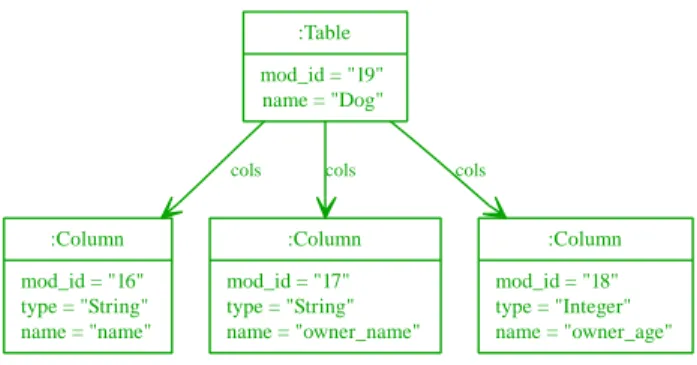
both the source and target elements are TM model elements, one can apply the standard TM visualization to our example. The source model is shown in figure 5, with the target model in figure 6. Note that the colours given to the source and target models will be used in the remainder of this paper: source elements are shown in blue, target elements in green.
If an element passed to thetransformfunction can not be transformed by any of the available rules,
an exception is raised showing the offending element(s) and the transformation is aborted. Users may catch such an exception if desired, however one may reasonably ask why the transformation does not attempt to recover gracefully in such instances. Unfortunately this seems to be unrealistic in the general case for the
following reason. Since thetransformfunction is called with the expectation that it will return a result,
when it fails to find a suitable rule to transform a given element it is unable to fulfil the callers expectation
that an element will be returned. In order to maintain this expectation, transformcould conceivably
return a ‘dummy’ target element as a placeholder. However such a dummy element would be unlikely to satisfy the constraints on the target meta-model, and would thus generally cause an exception to be raised.
:Class mod_id = "10" name = "Dog" :Attribute mod_id = "12" name = "name" attrs :Attribute mod_id = "13" name = "owner" attrs :PrimitiveDataType mod_id = "9" name = "String" type :Class mod_id = "11" name = "Person" type :Attribute mod_id = "14" name = "name" attrs :Attribute mod_id = "15" name = "age" attrs type :PrimitiveDataType mod_id = "8" name = "Integer" type
Figure 5: Source model.
In the, probably small, number of situations where the dummy element did not cause an error, it is then less than clear that the resulting target model will be of significant use to the user. Section 6.3 shows an example
of a ‘default’ rule which guarantees that thetransformfunction can not fail.
5. Tracing information
In this section I describe how MT deals with tracing information. First I show how tracing information is visualized, then describe the standard mechanism for creating it, before showing how the user can augment or override the default tracing information created.
5.1. Visualizing tracing information
Section 4.6 showed how a MT transformation can be run, and used the default visualization capabilities of TM to visualize the source and target models of a transformation. However, MT transformation instances also store tracing information (see section 4.1) relating source and target elements. Visualizing tracing information is an interesting challenge, and one that has hitherto received scant attention in the setting of model transformations. MT and TM cooperate together to present a simple visualization of tracing information that also allows users to build up a detailed picture of how the transformation executed.
Trans-:Table mod_id = "19" name = "Dog" :Column mod_id = "16" type = "String" name = "name" cols :Column mod_id = "17" type = "String" name = "owner_name" cols :Column mod_id = "18" type = "Integer" name = "owner_age" cols
Figure 6: Target model.
formation instances contain two separate lists of equal length related to tracing information. The first list contains tuples (encoded as lists) relating source and target elements. The second list contains the name of the transformation rule which created the corresponding entry in the first list. The fact that they are stored separately is a simple implementation detail — conceptually these two lists can be considered to constitute one single piece of information.
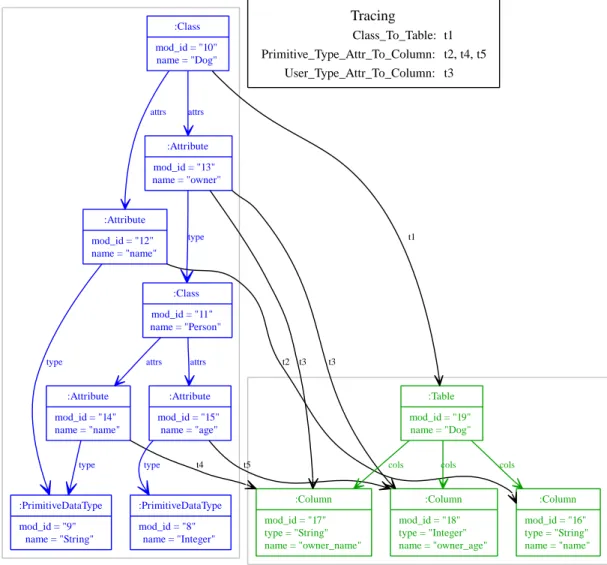
TheTM.Visualizermodule defines a functionvisualize trace(transformation)which takes a transformation instance and visualizes it complete with tracing information. The result of visualizing the tracing information for the example model of section 4.6 can be seen in figure 7. The original source model is on the left in blue, with the target model on the right in green. The black lines between source and target elements are the traces between source and target elements. Individual traces always run from a single source element to a single target element. Each trace has a name of the form tn where n is an integer starting from 1. The integer values reflect the traces position in the execution sequence; trace numbers can be compared to one another to determine whether a rule execution happened earlier or later in the execution sequence. Trace names can be looked up in the ‘Tracing’ table at the top right of figure. The tracing table contains the name of each rule which was executed at least once during the transformation. Against each rule name are the names of traces; each trace name represents an execution of that rule. Note that a single rule execution can create more than one trace; however each trace created in a single execution will share the same name.
Although the visualization of tracing information may seem simple, it allows one to infer a great deal of useful information about the execution of a transformation. This information is useful both for analysis and debugging of a transformation. At a simple level, one can use the names of tracing information to determine which rule consumed which source elements and produced which target elements. For example the ‘t1’ trace
from the source class to the target table is a result of theClass To Tablerule. One can also deduce
from this traces name that it was the result of the first rule execution in the system. Similarly since two
traces share the name ‘t4’, one can determine that a rule – in this caseUser Type Attr To Column
– created more than one target element in a single execution.
Although this subsection has talked about how tracing information is stored and visualized, and what the visualization can be used for, it has not discussed how the tracing information is created. Section 5.2 explains how tracing information is created, and how users can control its creation.
5.1.1. Alternative visualizations
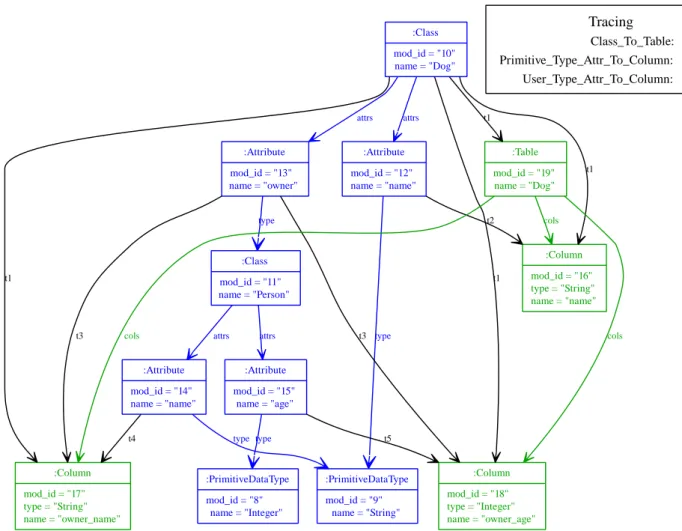
The tracing information in figure 7 is visualized with the source and target models formatted exactly as they were when presented individually in figures 5 and 6. Whilst this visualization works well for small
trans-:Class mod_id = "10" name = "Dog" :Attribute mod_id = "12" name = "name" attrs :Attribute mod_id = "13" name = "owner" attrs :Table mod_id = "19" name = "Dog" t1 :PrimitiveDataType mod_id = "9" name = "String" type :Column mod_id = "16" type = "String" name = "name" t2 :Class mod_id = "11" name = "Person" type :Column mod_id = "17" type = "String" name = "owner_name" t3 :Column mod_id = "18" type = "Integer" name = "owner_age" t3 :Attribute mod_id = "14" name = "name" attrs :Attribute mod_id = "15" name = "age" attrs type t4 :PrimitiveDataType mod_id = "8" name = "Integer"
type t5 cols cols cols
Tracing
Class_To_Table: t1 Primitive_Type_Attr_To_Column: t2, t4, t5
User_Type_Attr_To_Column: t3
Figure 7: Visualizing tracing information.
formations, larger transformations with greater volumes of tracing information tend to become unreadable as the strict formatting of the source and target models forces traces to overlap with each other. There is
thus an alternative form of visualization available via the visualizersvisualize trace clustered4
function where the source and target elements can be formatted directly alongside one another. Figure 8 shows this alternative visualization. Note that the diagram colouring now becomes critical to distinguish source and target model elements from one another. Due to its general lack of cluttering, this is generally the preferred visualization when tracing information is involved, and is used in the remainder of this paper.
5.2. Standard tracing information creation mechanism
Section 5.1 showed how MT and TM can visualize the tracing information automatically created by MT transformations. In this subsection I outline how the default tracing information is created by MT. Most, if not all, model transformation approaches are currently somewhat vague on this subject. There is therefore little prior art to use as a basis, or point of comparison, for any such mechanism. MT takes a simple approach to the problem to ensure that its behaviour is predictable from a users perspective – this is vital to ensure that
4
:Class mod_id = "10" name = "Dog" :Attribute mod_id = "12" name = "name" attrs :Attribute mod_id = "13" name = "owner" attrs :Table mod_id = "19" name = "Dog" t1 :PrimitiveDataType mod_id = "9" name = "String" type :Column mod_id = "16" type = "String" name = "name" t2 :Class mod_id = "11" name = "Person" type :Column mod_id = "17" type = "String" name = "owner_name" t3 :Column mod_id = "18" type = "Integer" name = "owner_age" t3 :Attribute mod_id = "14" name = "name" attrs :Attribute mod_id = "15" name = "age" attrs type t4 :PrimitiveDataType mod_id = "8" name = "Integer" type t5
cols cols cols
Tracing
Class_To_Table: t1 Primitive_Type_Attr_To_Column: t2, t4, t5
User_Type_Attr_To_Column: t3
Figure 8: Visualizing tracing information with the free layout of source and target model elements.
users can make informed choices about when and where to add or override tracing information (see section 5.3).
As standard, tracing information in a rule is created between all source elements matched by non-nested model element patterns, and all target elements produced by model element expressions, nested or otherwise. Non-nested model element patterns are defined to be those which are not nested within another model element pattern. For example in the following model element pattern, tracing information will be created
only from instances of theDogmodel class:
(Dog, <d>)[name == <n>, owner == (Person)[name != "Fred"]]
It may initially seem somewhat arbitrary to try to minimise the source elements used in tracing information whilst maximising the target elements used. The reason for minimising the source elements used is due to a simple observation: individual source elements are often matched in more than one rule execution. This then causes some source elements to be the source for large numbers of traces which can obscure the result of the transformation. Empirical observations of MT transformations suggest that when model elements are matched via nested model element patterns, they are also matched as a non-nested model element pattern during a separate rule execution. In the case of target elements, a different challenge emerges. Rather than trying to create an ‘optimum’ amount of traces one wishes to ensure that, as far as is practical, every target element has at least one trace associated with it. Since target element expressions are inherently localised to individual rule executions it is highly unusual for an element created by such an expression to
be the target of more than one trace. Thus it is important to ensure that nested target element expressions have traces associated with them. Section 7.16 shows how nested model element patterns can be made to contribute towards tracing information if desired (that section also shows the large number of extra, largely uninteresting, traces created).
The standard tracing information mechanism can be seen in practice by comparing the visualized trace information of figure 8 with the transformation that created it in section 4.5.
5.3. Augmenting or overriding the standard mechanism
Whilst the standard tracing creation mechanism performs well in many cases, users may wish to augment, or override, the default tracing information created. Users may wish to add extra tracing information to emphasise certain relationships within a transformation, or to remove certain tracing information that un-necessarily clutters the transformation visualization. MT provides a simple capability for augmenting, or overriding, the default tracing information created by the standard mechanism.
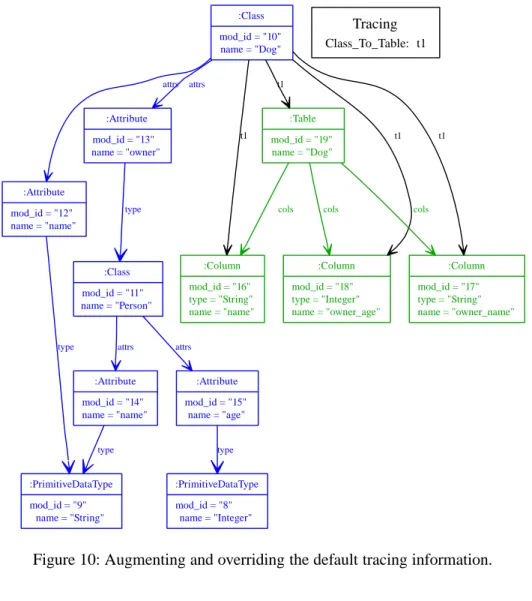
For example, using the MT example presented in section 4.5 as a base, imagine that one wishes to add extra traces between the source class and all target columns. In order to achieve this one makes use of
the optionaltracing addclause on MT rules. This clause must contain a single Converge expression
which evaluates to a tuple relating source and target model elements. The tuple is then added to the tracing
information created automatically by the rule. The newClass To Tablerule looks as follows:
rule Class_To_Table: srcp:
(Class, <c>)[name == <n>, attrs == <A>] tgtp:
(Table)[name := n, cols := columns] tgt_where:
columns := []
for attr := A.iterate():
columns.extend(self.transform([""], [attr]).flatten()) tracing_add:
[[c], columns]
Note that sincec is a single element it needs to be placed within a list to create a valid trace tuple. The
tuple in thetracing addclause is then added to the tracing information automatically created by the
rule – hence the new traces have the same tracing number (in this case ‘t1’) as the default traces for the rule execution. Figure 9 shows the resulting visualization of the transformation with the extra tracing information added in.
In some circumstances, users may wish to entirely override the default tracing information, rather than
simply augmenting it. Thetracing overrideclause in a rule turns off the rules default tracing
gener-ation, replacing it with the tuple returned by the single Converge expression in the clause.tracing add
andtracing overrideare thus mutually exclusive clauses within a rule. Whilst maintaining the
ad-ditional tracing information created by our modified Class To Table rule, assume one now wishes
the other two rules in the transformation to be prevented from generating any tracing information at all. In
order to achieve this,tracing overrideclauses which contain tuples relating the empty set of source
elements to the empty list of target elements are defined. The modified rules are as follows:
rule User_Type_Attr_To_Column: srcp:
(String, <prefix>)[]
:Class mod_id = "10" name = "Dog" :Attribute mod_id = "12" name = "name" attrs :Attribute mod_id = "13" name = "owner" attrs :Table mod_id = "19" name = "Dog" t1 :Column mod_id = "16" type = "String" name = "name" t1 :Column mod_id = "17" type = "String" name = "owner_name" t1 :Column mod_id = "18" type = "Integer" name = "owner_age" t1 :PrimitiveDataType mod_id = "9" name = "String" type t2 :Class mod_id = "11" name = "Person" type t3 t3 :Attribute mod_id = "14" name = "name" attrs :Attribute mod_id = "15" name = "age" attrs type t4 :PrimitiveDataType mod_id = "8" name = "Integer" type t5 cols cols cols Tracing Class_To_Table: t1 Primitive_Type_Attr_To_Column: t2, t4, t5 User_Type_Attr_To_Column: t3
Figure 9: Augmenting the default tracing information.
tgtp:
self.transform([concat_name(prefix, n)], [ca]) for ca := CA.iterate() tracing_override:
[[], []]
rule Primitive_Type_Attr_To_Column: srcp:
(String, <prefix>)[]
(Attribute)[name == <n>, type == (PrimitiveDataType)[name == <pn>]] tgtp:
[(Column)[name := concat_name(prefix, n), type := pn]] tracing_override:
[[], []]
The result of running the transformation with its three rules altered can be seen in figure 10. As this example shows, users can completely customise the tracing information created by MT to their own needs.
6. Towards more sophisticated transformations
The previous section introduced the basics of the MT language, via a simple version of the running example. In this section, I delve into some of the more advanced aspects of the MT language which allow more
:Class mod_id = "10" name = "Dog" :Attribute mod_id = "12" name = "name" attrs :Attribute mod_id = "13" name = "owner" attrs :Table mod_id = "19" name = "Dog" t1 :Column mod_id = "16" type = "String" name = "name" t1 :Column mod_id = "17" type = "String" name = "owner_name" t1 :Column mod_id = "18" type = "Integer" name = "owner_age" t1 :PrimitiveDataType mod_id = "9" name = "String" type :Class mod_id = "11" name = "Person" type :Attribute mod_id = "14" name = "name" attrs :Attribute mod_id = "15" name = "age" attrs type :PrimitiveDataType mod_id = "8" name = "Integer" type
cols cols cols
Tracing
Class_To_Table: t1
Figure 10: Augmenting and overriding the default tracing information.
complex and sophisticated transformations to be expressed. In order to explore these aspects fully, I first present a more complex version of the running example.
6.1. Extending the running example
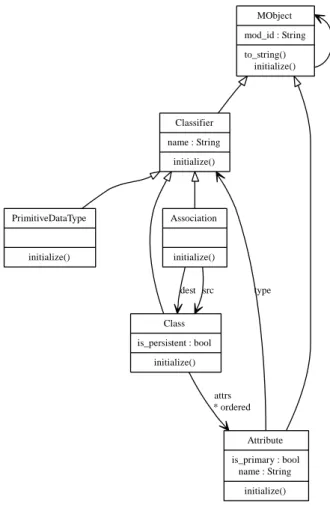
In this subsection I define the ‘advanced’ variant of the running example. The overall idea is, as before, to translate UML-esque class models into relational database models. In order to make the example more challenging, the ‘Simple UML’ meta-model is extended in several ways as can be seen in figure 11. These extensions extend the required transformation as follows:
• Associations are added to the meta-model. Associations add a significant degree of complexity to the
meta-model because a classes ‘real’ attributes are determined by the union of the attributes it directly links to, and the associations for which it is a source.
• Attributes can be marked as being part of a classes primary key by having theis primaryattribute
set to true. Note that associations play no part in determining a classes primary key.
• Classes which have theis persistentattribute set to true will be converted to tables; references
to such classes (via attribute types or associations) will result in the classes primary key attributes
MObject mod_id : String to_string() initialize() of Classifier name : String initialize() Attribute is_primary : bool name : String initialize() PrimitiveDataType initialize() Class is_persistent : bool initialize() Association initialize() attrs * ordered type dest src
Figure 11: Extended ‘Simple UML’ meta-model.
attribute set to true will not be transformed into tables, and will have their attributes drilled into, as in the simple transformation.
The relational database meta-model is also extended, as shown in figure 12. The extended meta-model allows tables to define primary keys and foreign keys. Note that, since the TM data model allows nested data types to be expressed, foreign keys are defined as a sequence of sequences of columns.
6.2. Pattern multiplicities
One of the problems noted in section 3.4.2 with the QVT-Partners approach is that model element patterns can only match against a fixed number of elements. Some very simple transformations naturally consist only of rules which match against a fixed number of elements in the source model. However, many, if not most, non-trivial transformations contain rules which need to match against an arbitrary number of source elements. Expressing such transformations in the QVT-Partners approach requires cumbersome work arounds.
To solve this problem, MT adapts the concept of multiplicities found in many textual regular expression languages. Each source pattern in MT can optionally be given a multiplicity. Multiplicities specify how often a given source pattern can, or must, match against its source elements. Multiplicities are therefore a constraint on the universe of model elements passed in the parameter corresponding to the patterns position
MObject mod_id : String to_string() initialize() of Table fkeys : Seq(Seq(Column)) name : String initialize() Column type : String name : String initialize() pkey * ordered cols * ordered
Figure 12: Extended relational database meta-model.
an associated variable binding. The following example of a pattern multiplicity will match zero or more
associations, assigning the result of the match to theassocsvariable:
(Association, <assoc>)[name == n] : * <assocs>
The syntax for multiplicities is inspired by Perl-esque regular expression languages. The following mul-tiplicities, and possible qualifiers, are defined in MT:
m Must match exactly m source elements.
* Will match against zero or more source elements.
* ! Must match against every source element.
* ? Will match against the minimum possible number of source elements.
m .. n Must match no less than m, and no more than n source elements.
m .. n ? Will match against the minimum number of source elements oncemelements have been
matched, but will not exceed n matches.
m .. * Must match no less than m elements.
m .. * ? Will match against the minimum number of source elements oncemelements have been
matched.
As with Perl-esque textual regular expressions, multiplicities default to ‘greedy’ matching — that is, they will match their pattern against the maximum number of elements that causes the multiplicity to be satisfied.
When backtracking in asrcpclause calls upon a multiplicity to provide alternative matches, it then returns
matches of lesser lengths. The concept of greedy and non-greedy matching is however much simpler in the case of textual regular expressions since text is an inherently ordered data type. Thus the length of matches is calculated by determining how many characters past a fixed starting point a match extends. In contrast to this, model elements have no order with respect to one another, and thus MT has to take a very different approach to the concepts of greedy and non-greedy matches. MT defines the length of a multiplicities match as the number of times the multiplicity matched; however since model elements are not ordered, this does not present an obvious way of returning successively smaller matches. In order to resolve this problem in the case of greedy matching, MT creates the powerset of matches, and iterates over it, successively returning
sets with smaller number of elements when called upon to do so. Note that whilst MT guarantees that with
greedy matching|matchn| ≥ |matchn+1|, it makes no guarantees about the order that sets of equal size in
the powerset will be returned.
The?qualifier reverses the default greedy matching behaviour, attempting to match the minimum number
of elements that causes the multiplicity to be satisfied, successively returning sets of greater size from the
powerset when called upon to do so. The!qualifier is the ‘complete’ qualifier which ensures that the pattern
matches successfully against every model element passed in the patterns appropriate argument. Whilst the?
qualifier, in a slightly different form, is standard in most textual regular expression languages, the!qualifier
is specific to MT.
6.2.1. Variable bindings in the presence of multiplicities
Variable bindings in patterns suffixed by multiplicities need to be treated differently from variables in bare patterns. When a multiplicity is satisfied, its associated variable binding is assigned a list of dictionaries. Each dictionary contains the variable bindings from a particular match of the pattern. The need for different treatment of variable bindings inside and outside multiplicities is most easily shown by examining what would happen if they were treated identically. Consider the following incorrect MT code:
(Association)[src == (Class)[name = n]] : * <assocs> (Class, <c>)[name == n]
A first glance may suggest that when the rule these patterns are a part of runs, cwill be set to the class
which has the same name as the associations source class. However, the example is nonsensical sincenhas
no single value. Indeednmay have no value at all, since it will be bound to zero or more class names as the
multiplicity attempts to match the model pattern as many times as possible. As this example shows,nhas
no meaning outside of the multiplicity it is bound in; however it clearly has a meaning in the context of the multiplicity.
In order to resolve this quandary, MT takes a two stage approach. Within multiplicities, local variable bindings are accessed as normal. At the end of each successful match, MT creates a dictionary relating variable binding names to their bound values. The list of these values is then assigned to the variable binding associated with the multiplicity. Thus the variable bindings for each individual match can be accessed. To illustrate this, I reuse the original multiplicities example:
(Association)[src == (Class)[name = <n>]] : * <assocs>
Printing theassocsvariable would lead to output along the following lines:
[Dict{"n" : "orders"}, Dict{"n" : "parts"}]
TheMTmodule provides a convenience function mult extract(bindings, name)which iterates
over a list of dictionaries, as generated by a multiplicity, and extracts the particular bindingnamefrom each
dictionary, returning a list. A standard idiom in MT is to use this function with a self variable binding in a model element pattern, which allows a user to determine all the model elements matched by a particular pattern multiplicity.
6.3. Extended example
In this subsection I show the MT version of the extended example. The added complexity in this version of the transformation over the original simpler version is due to three considerations:
1. Classes can not be transformed in isolation – all associations for which a class is the source must be considered in order that the table that results from a class contains all necessary columns.
2. Classes which are marked as persistent must be transformed substantially different from those not marked as persistent.
3. Foreign keys and primary keys reference columns. It is important that the column model elements pointed to by a table are the appropriate model elements, and not duplicates. Th
The MT example is as follows:
$<MT.mt>:
transformation Classes_To_Tables rule Persistent_Class_To_Table:
srcp:
(Class, <c>)[name == <n>, attrs == <attrs>, is_persistent == 1] (Association, <assoc>)[src == c] : * <assocs>
tgtp:
(Table)[name := n, cols := cols, pkey := pkeys, fkeys := fkeys] tgt_where:
cols := [] pkeys := [] fkeys := []
for aa := (attrs + MT.mult_extract(assocs, "assoc")).iterate(): a_cols, a_pkeys, a_fkeys := self.transform([""], [aa])
cols.extend(a_cols) pkeys.extend(a_pkeys) fkeys.extend(a_fkeys) rule Primary_Primitive_Type_Attribute_To_Columns: srcp: (String, <prefix>)[]
(Attribute)[name == <attr_name>, type == (PrimitiveDataType)[name == \ <type_name>], is_primary == 1] tgtp: [col] [col] [] tgt_where:
col := (Column)[name := concat_name(prefix, attr_name), type := type_name] rule Non_Primary_Primitive_Type_Attribute_To_Columns:
srcp:
(String, <prefix>)[]
(Attribute)[name == <attr_name>, type == (PrimitiveDataType)[name == \ <type_name>], is_primary == 0]
tgtp:
[(Column)[name := concat_name(prefix, attr_name), type := type_name]] []
[]
rule Persistent_User_Type_Attribute_To_Columns: srcp:
(String, <prefix>)[]
(Attribute, <attr>)[name == <attr_name>, type == (Class, <class_>) \ [name == <class_name>, attrs == <attrs>, is_persistent == 1]] tgtp:
cols [] [cols]