Public Administration Master’s Projects Public Administration
12-2018
Informal Rulemaking and Democratic
Participation FDA – Food Labeling, FCC – Net
Neutrality, a Text Mining Study
Casey Shannon [email protected] Advisor Dr. Buonanno First Reader Dr. Buonanno Second Reader Dr. Rivera
Follow this and additional works at:https://digitalcommons.buffalostate.edu/mpa_projects
Part of theAmerican Politics Commons,Other Legal Studies Commons,Other Public Affairs, Public Policy and Public Administration Commons,Policy Design, Analysis, and Evaluation Commons,Policy History, Theory, and Methods Commons,Political Theory Commons,Public Administration Commons,Public Policy Commons, and theSocial Policy Commons
Recommended Citation
Shannon, Casey, "Informal Rulemaking and Democratic Participation FDA – Food Labeling, FCC – Net Neutrality, a Text Mining Study" (2018).Public Administration Master’s Projects. 26.
Informal Rulemaking and Democratic Participation FDA – Food Labeling, FCC – Net Neutrality, a Text Mining Study
Casey M. Shannon
In partial fulfillment of requirements for PAD 690 Masters Project SUNY Buffalo State
First Reader: Dr. Buonanno Second Reader: Dr. Rivera
Abstract
The Administrative Procedure Act (APA) is supposed to make the rulemaking process at the administrative level democratic. This study will look at two examples of federal regulatory agencies – Food and Drug Administration (FDA) and the Federal Communications Commission (FCC). The topics are food labeling, and net neutrality respectively. The APA highlights the process of notice and comment rulemaking. The APA is evaluated in the literature review for effectiveness and shortcomings. Interest groups play a key role in the policy making process; interest groups inform and mobilize citizens, and then coordinate commenting on agency rule propositions. This can sometimes lead to what is called astroturfing, or large amounts of identical posts. Most of the general public are not aware of notice and comment rulemaking. Public participation and access to information, especially through the internet is very important in a modern democracy. This is what makes the net neutrality so important. Also, obesity and diseases like diabetes are on the rise in America. This is a serious concern, and having updated food labels is a great way to make sure people know what is in their food to make healthy
choices. The comments were added up to see how many were for and against the two mentioned laws. The results for FCC show that most comments came from interest groups, most were opposed to repealing net neutrality, however, it was repealed. The results for the FDA were most of the comments came from either health professionals or consumers, and most people felt the FDA was not doing enough but still largely supported most of the revisions. The FDA made the decision to extend the compliance deadline for updated nutrition facts labels.
Table of Contents
Chapter 1: Introduction ... 5
Chapter 2: Literature Review ... 17
Administrative Procedure Act ... 18
Interest group involvement in democracy ... 30
Political Participation ... 55
FDA ... 61
FCC ... 70
Chapter 3: Methods ... 79
Chapter 4: Discussion ... 91
Chapter 5 Implications and Conclusions ... 94
References ... 99
Box 1 Administrative Procedure Act ... 6
Box 2 Interest groups lobbying FDA... 50
Box 3 Interest groups lobbying the FCC ... 54
Box 4 Food Label law ... 69
Box 5 Net Neutrality Time Line ... 73
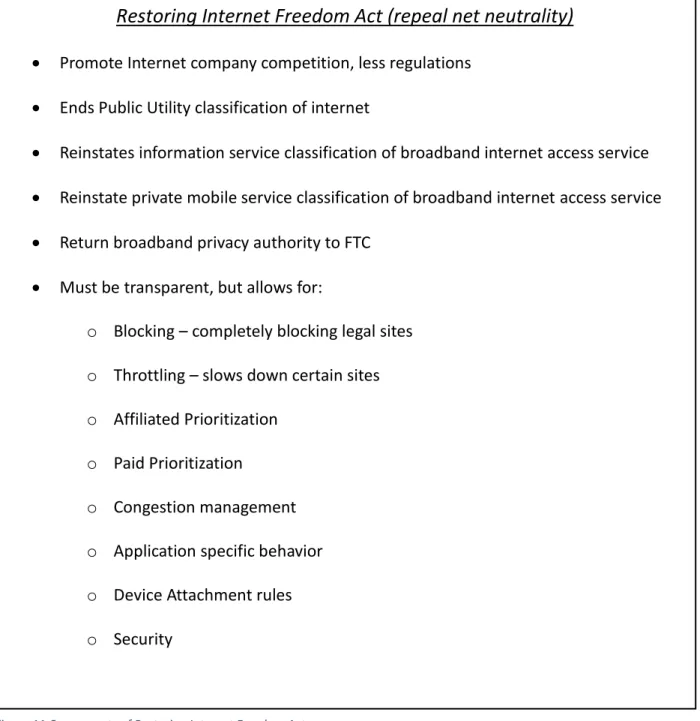
Box 6 Summary statement Restoring internet freedom act ... 76
Table 1 Types of rulemaking ... 23
Table 2 Programs considered ... 80
Table 4Key Phrases ... 81
Figure 1 Seven basic foods ... 10
Figure 2 Food Pyramid ... 11
Figure 3 Updated Pyramid ... 12
Figure 4 nutrition facts label ... 13
Figure 5 Policy universe/conflicting interests ... 31
Figure 6 Political Organizations as intermediaries in the political system ... 40
Figure 7 Iron Triangle ... 42
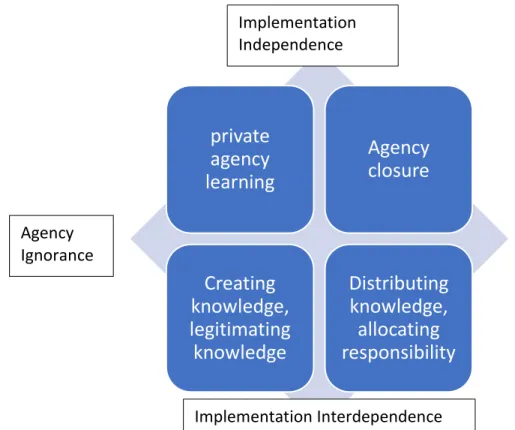
Figure 8 Participation in American Bureaucracy matrix ... 56
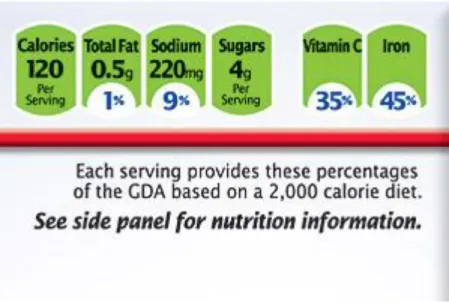
Figure 9 Nutrients at a glance ... 62
Figure 10 Components of Restoring Internet Freedom Act ... 77
Figure 11Tally of Comments, FDA ... 82
Figure 12Condensed tally of comments, FDA ... 83
Figure 13Breakdown of commenters, FDA ... 85
Figure 14Breakdown condensed commenters, FDA ... 85
Figure 15 Tally of comments, FCC ... 87
Chapter 1: Introduction
Administrative agencies were created to carry out legislation. Congress delegates power to agencies to regulate and update existing laws when necessary, and without administrative agencies, there would be no institution to carryout repercussions for violations (Kiewiet & McCubbins, 2018). There became a need for more openness in government. Government overreach became exceptionally problematic according to conservatives after the Great
Depression era (Carpenter, 2018). The number of agencies has risen drastically over time. They have also expanded in scale, range of duties, and bureaucratic intricacy. The New Deal created a lot more government programs that required a larger bureaucracy which in turn led to the need for more checks and balances to be sure that the administrative side of government did not become too powerful. “A major aim of the New Deal was to use government as an agent in balancing the relationship between contending forces in society, particularly industry and labor” (Loomis & Cigler, 1991, p. 11). The Wagner Act was passed in the 1930’s and that gave the right to form unions which were some of the first interest groups. After passing the New Deal, FDR created the Brownlow Commission to conduct a report on procedural problems and conceivable solutions. This led to the creation of the APA (Warren, 2010a).
The purpose of this study was to evaluate notice and comment rulemaking to see if it is democratic. The purpose of agencies reviewing the comments is an attempt to make the
legislative administrative process more democratic, by creating another form of review, or check, however, the agencies are not required to make any changes. Interest groups are a very large player in notice and comment rulemaking politics as well. This paper analyzed two rules in two different agencies in order to have a comparison. The first rule was food labeling law in the Food and Drug Administration. The rule being studied was Food labeling: Revision of the
Nutrition and Supplemental facts label 2012. The other agency is the Federal Communications Commission. The rule being studied was the repeal of net neutrality also known as the Restoring Internet Freedom Act. This study examined if the majority of the comments were in favor or against each law and compared that to the final action of the agency.
“The APA is the most comprehensive, authoritative and enduring legislation governing administrative practice in the U.S. today” (Warren, 2010b). This quote exemplifies the
importance of the APA in administrative law. The APA covers numerous topics. Warren believes that the APA is the most essential document regarding administrative law. Some scholars say that the APA is running smoothly, and others see it as a stepping stone and that it is not complete. Walker states that the APA needs to be modernized and highlights many ways in which this can be accomplished (Walker, 2017). Many other scholars have written on the issue and are discussed in the literature review such as Rubin, Dooling, Woods and others.
(Warren, 2010a)
Administrative Procedure Act
• Mandates administrators to have their procedures and actions available to the public
• Allows those injured by the actions of administrators to testify
• Permits those that need to be seen by the agency to have access to council
• Makes administrators give away unclassified information if citizens desire it
• Administrators are responsible for providing proof in certain cases
• Injured persons have the right to reasonable information, so they can provide their thoughts and feedback
• Agencies are required keep records of everything
• Providing remedies in the agency
• Making agencies quasi-independent for administrative law judges to improve the integrity of any hearings
• Give judicial branch the power to review agency policies and decisions
• Trying to limit unnecessary discretion Box 1 Administrative Procedure Act
Figure 1 listed above, illustrates the functions of the APA. In summary, the APA does many things. One of the major functions is that it requires agencies to disclose information if it is not classified if the public desires it. So, part of the APA is to make sure there is transparency in government. It also provides protection for those injured by agency actions so they can have representation, and the agency enforcing the regulation must have proof that the injured is in violation. The APA also makes the process more democratic, because it (a) brings in an outside judge when using adjudication to make the process less biased, (b) gives the power to the
supreme court to review all agency decisions to watch for overstep, and (c) congress also has the power to review agency behavior and can take away any agency at any time. In conclusion, the APA provides more transparency and provides protections against over use of power, as well as making the process more democratic (Warren, 2010a).
There are two major types of rulemaking under the APA. One is formal, and the other is informal. Informal rulemaking refers to discretion. Discretion is day to day administrators making decisions based on past practices and their training that doesn’t involve the public in the process. The other form of informal rulemaking is through notice and comment boards. Then there is formal rulemaking. Adjudication is a form of formal rulemaking that is quasi-judicial, meaning it resembles a trial format. In adjudication there is an administrative judge present and the agencies as well as those affected by them meet to discuss the circumstances. Another form of formal rulemaking is negotiated rulemaking (Warren, 2010b).
Access to information is crucial to the American democracy. Many people get their information from the internet now. “Democracy requires an informed and involved citizenry, yet this is possible only if the citizens have access to information about their government and the
opportunity to participate in political discourse” (Schement, 2009). Access to news via internet and cable is disparate among minority groups. Groups that have limited access to electronic news are older generations, African Americans, Hispanics, and those of lower income. So even before net neutrality was repealed, there was already a problem with unequal distribution to access to news (Schement, 2009).
Net neutrality was repealed by Ajit Pai, the commissioner of the FCC. It is unclear where the comments came from and if it is truly representative of the public. There was a finding that peoples’ information was stolen from a website and fake comments were posted on the FCC’s rule and comment boards on the net neutrality board (Fung, 2017). The FDA is one of the oldest regulatory agencies. It is good to have more than one agency to compare, to have a better
understanding of the process. The FDA’s notice and comment board on food labeling is a more typical example of what goes on in notice and comment rulemaking. The FCC’s net neutrality repeal was much more politicized and got more attention, and therefore provides an interesting comparison between a normal case and an unusual case.
The FDA was functioning before its official creation in 1930. When Teddy Roosevelt was in office, he passed the Pure Food and Drug Act. The research was first being done under the Department of Agriculture. Eventually it became its own separate agency under the
Department of Health and Human Services. The FDA’s organization structure is first the office of the commissioner, and then the four underneath are: regulating medical products and tobacco, foods, global regulatory operations and policy, and operations (FDA, 2016).
Dr. Harvey Washington Wiley was the first head of the FDA. It was very important to him to set the precedent that food and drugs must be accurately labeled. At the time when he was starting out, companies were not being honest about what was in their products. For example,
one company labeled their product strawberry jam, but it actually contained no strawberries, and instead had hay seeds, pulped apple skins and some glucose (Hilts, 2003, p. 22). Dr. Wiley was a very firm believer in making sure food was properly labeled and not at all misleading, which was taking things farther than Roosevelt at first thought was necessary (he thought if it was safe it was good enough), but this led to setting the precedent that food should not only be safe to consume, but also accurately labeled (Hilts, 2003).
American consumers have so many choices of what to eat today, but have difficulty making healthy choices. One potential reason is that food labeling is not as effective as it could be. One problem the U.S. faces today is the health of its citizens. One in three adults in the U.S. are obese. Obesity is on the rise and it leads to many chronic health problems such as diabetes. Statistics show that 9.4% of the U.S. population is diabetic (National Institute of Health, 2017).
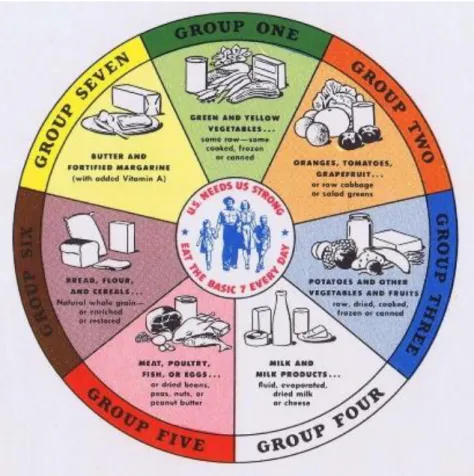
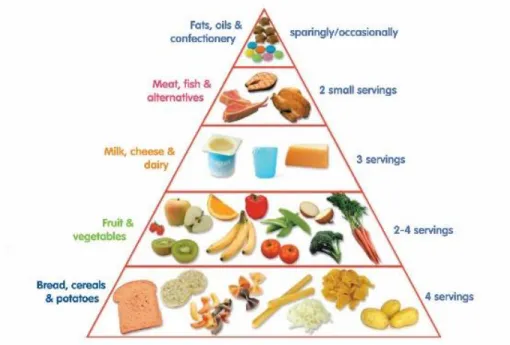
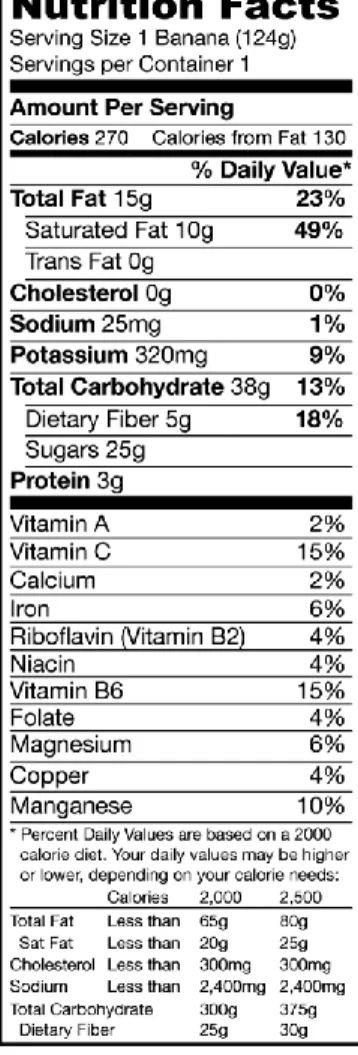
Front of package food labeling is helpful but also confusing when consumers are trying to decide which food item to purchase when they are bombarded with information on the package. There has been effort throughout history to encourage healthy choices using both education and visuals. First there were the basic seven foods, and then the food guide pyramid, and now nutrition facts. The seven basic foods are as follows:
Figure 1 Seven basic foods
Food Pyramid example:
Figure 2 Food Pyramid
Updated to add exercise:
Figure 3 Updated Pyramid
(Nuelle, 2016)
Figure 4 Nutrition facts label
(n.a., 2018c)
The FCC was created by the Communications Act of 1934. This replaced the Federal Radio Commission and transferred that work to the FCC (Paglin, 1989). It wasn’t so much a new agency, rather than a reorganization and consolidation of existing laws. This merged telecommunications common carrier laws and radio regulation into the same agency (Paglin, 1989).
The FCC has seven bureaus. They are Consumer and Governmental Affairs, Enforcement Bureau, International Bureau, Media Bureau, Wireless Telecommunications Bureau, Wireline Competition Bureau, and the Public Safety and Homeland Security Bureau. Then there are ten offices. They are: Office of Administrative Law Judges, Office of Communications Business Opportunities, Office of Engineering and Technology, Office of General Counsel, Office of the Inspector General, Office of Legislative Affairs, Office of the Managing Director, Office of Media Relations, Office of Strategic Planning & Policy Analysis, and Office of Workplace diversity (Wallechinsky, 2016). Currently the FCC is headed by Ajit Pai. The FCC has a very specific mission. “The Federal Communications Commission regulates interstate and
international communications by radio, television, wire, satellite, and cable in all 50 states, the District of Columbia and U.S. territories. An independent U.S. government agency overseen by Congress, the Commission is the federal agency responsible for implementing and enforcing America’s communications law and regulations” (Federal Communication Commission, 2018a). The FCC also states their strategic goals. Their goals are: promoting economic growth and national leadership, protecting public interest goals, making networks for everyone, and lastly, promoting operational excellence (Federal Communication Commission, 2018a).
This is what the Communications Act of 1934 did. Title one section one states that the purpose of the act is to create the FCC. There are a few sections and titles that are relevant to the topic of democracy, net neutrality, and freedom of information in this act that are mentioned. Also, in Title one, it highlights the importance of not discriminating against access to
communication services based on race, color, religion, national origin or sex. As stated in the introduction, there is a divide on access based on these things, though not intentional. Many of these divisions are based on factors such as poverty, age, and education level. Other factors are
rural versus urban. Some rural areas do not have good cellular service, internet access and cable ("Communications Act of 1934," 1934).
Title 1 section 10 is important as well. Section 10 (A) deals with regulatory flexibility. The commission must determine if regulations are necessary, and consistent with the public interest. Section 10 (B) focuses on how the FCC actions affect the market. The purpose is to promote competition ("Communications Act of 1934," 1934).
Section 11 (A)(B) is the biennial review of regulations. Every other year the FCC must review their regulations to determine necessity and modify if something is no longer necessary for public interest. ("Communications Act of 1934," 1934).
In Title II section 254 of U.S.C. 47, in regards to internet, the statute goes over universal service principals ("Communications Act of 1934," 1934). This includes that the service must be good quality and the rates must be just, reasonable and affordable ("Communications Act of 1934," 1934). The statute also covers that services must be provided in rural and high cost areas, and must be available for schools, health care, and libraries ("Communications Act of 1934," 1934).
Before there was internet there was Arpanet. The invention of this led to the invention of the internet (Altschiller, 1995). Arpanet was first designed as a network to connect computers within the Department of Defense (Altschiller, 1995). Altschiller refers to the dawning of the internet as the third wave economy. He states first wave was farming economy and the second wave was the industrial economy. The creation of the internet has made many changes to life as we know it. One way that it has impacted the economy is online shopping. Another way is online business communication like business websites, instant messaging customer service, and the increased use of email over other uses like standard mail and faxing. Another way that
Altschiller says that the internet affects the economy is it provides a different platform for advertising. The creation of the internet also led to more developments in communications like video messaging and so forth (Altschiller, 1995).
The advent of new communication technology led to the creation of the FCC. Communication technology in all forms is extremely important to the function of modern democracy, from where you get your news, to how you communicate about politics with peers, the sharing of information, and the ability to just google anything you want to know at the click of a button.
In 2010, Comcast and NBCU merged (Crawford, 2013). Comcast is the largest internet and cable provider and this merge made them even larger. Comcast has a lot of control on how much they can charge people especially with the way the system is set up. Americans have less access, worse service, and pay more for internet and cable than in Europe (Crawford, 2013). Comcast and Verizon are two of the biggest supporters of the repeal of net neutrality.
Through the examination of the notice and comment boards of the FCC and the FDA on the topics of net neutrality and food labeling respectively, the process of notice and comment rulemaking was analyzed. The goal of the study was to determine if the agencies are taking note of the comments and using that as a basis to move forward with the legislation. By looking at these examples, the results would show if the process is truly democratic. This study was significant because no one has compared the FDA and FCC comments yet, and used them to measure democracy in administrative rulemaking.
Chapter 2: Literature Review
Introduction:
Notice and comment rulemaking is an instrumental process in the creation and
implementation of rules. Regulatory agencies like the FDA and FCC, are what makes America function. Congress and the president may pass legislation, but it is up to administrative agencies to develop the process, and specific details, as well as implementation of laws. Regulations are meant to protect the public, and keep corporations in check. The APA is what governs regulatory agencies.
The first section of the literature review is scholarly critiques of the APA. The following section is addressing the inter-relationship of interest groups, agencies, and public participation. Next is the discussion of the specific issues in the context of the FDA, and then the FCC. Ever changing technology has a large impact in public knowledge of current issues, and this also impacts participation. Participation is very important for a functioning democracy. Many people are not familiar with notice and comment rulemaking processes. The way they do sometimes get involved is through submitting comments through interest groups.
Administrative Procedure Act
Dooling analyzed notice and comment rulemaking processes in the digital age, and he reviewed the APA requirements (2011). “E-rulemaking has been described as the use of digital technologies in the development and implementation of regulations” (Dooling, 2011).
Technology has changed significantly, but notice and comment rule making remains unchanged. The process of rulemaking involves electronic notices of propositioned and conclusive
rulemakings. It involves disclosing supportive files. Next the agencies must have it open to receive public comments and responses to the proposed rule. Another part of the process is organizing the rulemaking records in what is called electronic dockets, an electronic filing system. The dockets are restricted access only. They are used to store, sort, and manage comments before they are posted to regulations.gov. The APA requires notices to be posted on the federal register, however, this does not prevent some agencies from doing more, like provide advance notice, and reaching out to the public. Some agencies host public meetings online, or use various forms of social meetings as an attempt to reach out to the public (Dooling, 2011).
Sometimes organized campaigns send duplicate comments; sometimes as letters and sometimes electronically. Dooling mentions a study by John M. de Figueiredo, which analyzed if e-rulemaking increases the number of comments (Dooling, 2011, p. 899)? The study looked at the FCC over the years of 1994-2004. The finding was that the comments shifted from paper to online, but did not significantly increase the number of comments (Dooling, 2011). Online advocacy creates many duplicates of comments which is sometimes referred to as notice and spam. Software that does natural language processing can be utilized to detect the number of duplicates. This can be a more cost-effective alternative to having staff read them themselves.
The APA requires agencies to provide as much opportunity as possible for people to respond. They accept mail, courier, fax, email, and postings on regulations.gov. Some people leave voicemails, but often they get lost in transition. Dooling encourages agencies to utilize software to keep track of and analyze comments. It is a better way than trying to read all of them. It is also more efficient and cost effective to keep electronic dockets, because it doesn’t require as much staff to do the work (Dooling, 2011).
Comments are always processed before they are published online. The comments are sent to agency staff and logged by them and then entered in to an electronic docket or a physical copy is filed. Screening is done before the information is posted. Staff members look for the following things: is the information legally obtained; are they providing personal information that should not be available to everyone to read; are they revealing a trade secret; and is the information confidential. Agencies make sure the information is not copyrighted. Finally, the comments are screened for obscene and/or threatening language. One way to speed up the process that Dooling suggests, is to create a feedback loop to automatically screen for inappropriate content (Dooling, 2011). A feedback loop is software that could detect inappropriate content and notify the user, so they can alter it.
The same conflicts of opinions on the APA when it was drafted have persisted through time and are in alignment with the classic conservative and progressives debate on the purpose and role of government. In one view, the APA provides too many requirements and restrictions on agencies which makes carrying out their duties difficult. In the other view, the APA has too few restrictions and regulations which allows agencies too much authority. These two views are in conflict with how to solve the problems of the statute (Rubin, 2003).
The APA relies too much on public participation. Most participation comes from or is organized by interest groups and corporations. The majority of the comments come from lawyers and lobbyists. The general public is less likely to be informed on the issues and the internal working of the administrative agency (Rubin, 2003).
Rubin asserts that modern America is an administrative state, and the APA is not written in a way that recognizes this, and does not properly address the problems. Rulemaking is inherently legislative rather than judicial; however, the APA requires that in order to exercise formal rulemaking, the best process must be adjudication. Formal rulemaking for all intents and purposes is null. Formal rulemaking requires a hearing which is impractical and causes delay in new regulations. In order for agencies to put this into practice, they would need to have to do quasi-judicial hearings with overbearing amounts of clients in their jurisdiction. There is a well-known FDA example of this. There was a hearing on how many peanuts need to be in peanut butter. It was between 3% points that they were deciding. The hearing took many years and produced a document that was over 1,000 pages (Rubin, 2003).
There is the option of informal rulemaking. This is a much more practical approach to agency rulemaking. This is the process of giving notice to those affected by new regulations, and providing for a comment period, then followed by agency reviewing comments, and then posting the final rule. This process is what is used most of the time for new regulations. The democratic problem with this is that agencies are not required to respond or make changes to the final law based on these comments (Rubin, 2003).
Not all agency rulemaking is creating regulations. Some things agencies do are plan future actions, evaluate prior actions, allocate resources, negotiate, and all of this is informal adjudication (Rubin, 2003). These are typical office duties that are done in any corporation.
Rubin gives a very thorough analysis of what he feels about the APA. He believes that the APA has been out of date since the day it was written because it fails to address the
increasing development of the administrative state. He recommends transitioning to a new administrative oriented APA. The reason is the advent of the administrative state itself, the transition from a system of the basic three branches, to a fourth, the implementation and discretion of regulations now being carried out by government agencies staff workers. Rubin believes that the APA is inefficient and counterproductive the way it is written. He thinks it is imposing the wrong rules, and in some areas where there should be rules, there is not guidance at all (Rubin, 2003).
The central notion of the APA is control through private participation. This requires government actions to be publicized for public scrutiny. Two examples of legislation passed in that light following the APA were the Freedom of Information Act (FOIA), and the Government in the Sunshine Act. These laws increased public accessibility to government information. If someone requests information, as long as it is not considered top secret or confidential, the government is required to provide the information requested. These laws also require
government agencies to have websites with information available for the public to learn about what the agency does. The APA also highlights procedural requirements for both rulemaking and adjudication. Lastly, the APA allows injured peoples to challenge an agency decision or action if they think it may violate the constitution or law (Rubin, 2003).
Rubin defines a few things based on the APA, adjudication as, “agency process for the formulation of an order.” He defines order as, “the whole or part of a final disposition whether affirmative, negative, injunctive, or declaratory in form” (Rubin, 2003, p. 123) These definitions suggest that order represents a subset of administrative actions like final disposition, and agency
actions lie outside that defined category. The statute does not impose procedural limits on informal adjudication. It is hard to define at what point informal adjudication becomes the final disposition (Rubin, 2003).
Some people, mainly conservatives or libertarians, feel that the government is too large and there needs to be more control over the administrative section of government. Here are some ways that the administrative agencies are checked. The executive branch, the legislative branch, and the courts all check the administrative branch. The executive branch exercises control by setting the agenda and appointing agency heads. The legislative branch creates laws that are approved by the president then have to be carried out by the agency that handles that type of work. Sometimes the laws are not written clearly, and agencies have to work out the logistics. For example, when the Clean Air Act was passed, congress wrote that air quality should be kept at an acceptable level. Then the Environmental Protection Agency (EPA), had to determine what exactly was considered acceptable, and how they were going to reach that goal. This is highlighted in the case Whitman V. American Trucking Association, Inc. Christine Whitman was the head of the EPA at the time and imposed regulations for ambient air quality. In this case the court granted deference, citing Chevron, which means the agency was correct in their decision (Warren, 2010b). Rubin is not fond of the Chevron doctrine. He thinks that the courts should be more involved with the process of rulemaking rather than saying the agency knows best, in most situations. Most of the time, very few read the federal register or challenge decisions, unless they are professional lobbyists or lawyers (Rubin, 2003). Congress is
sometimes called the watchdog of the administrative agencies. It is mainly their duty to make sure they are doing what they are supposed to be doing. However, congress is already so busy
with all of their other duties and obligations that they do not spend much time at all reviewing agency actions (Warren, 2010b).
These are the four categories of administrative action.
Formal Rulemaking Informal rulemaking
Formal adjudication Informal adjudication
Table 1 Types of rulemaking
According to Rubin, formal procedures are all those required by statute to be more on the record after opportunity for an agency hearing –and all others fall under informal procedures. Rubin argues that formal rulemaking is null or impractical because it requires the agency to provide parties potentially affected by the rule with an oral hearing in which they can present witnesses and can examine opposing witnesses. Informal adjudication is pretty much anything that doesn’t fall under the other boxes. Rubin states that executive action would be a better term for informal adjudication. It is also sometimes referred to as agency discretion. Informal rulemaking or agency discretion is used instead of formal rulemaking. Notice and comment rulemaking is a form of informal rulemaking. Agency discretion is informal rulemaking,
meaning, that day to day decisions are made on the job while enforcing their legislation by using interpretations for the law, and by following past practices (Rubin, 2003).
These are Rubin’s suggestions for a new and improved APA. The first step should be for the agency to identify the goal of the rule. It should be very clear and concise. Next the goal of the rule should be submitted to the President and congress for approval. It should then be publicized for other agencies and the public to view and comment on. Then the agency should be moving on to other steps of policy making. The final goal must be instrumentally rational. To be instrumentally rational means that the law is going strictly by hard facts rather than politics
or other estranged influences. Then the courts will make sure that it is indeed rational. This would displace the chevron doctrine, because the supreme court would have to review all of the rules first (Rubin, 2003).
Courts are sometimes tempted to ban ex parte contacts in informal rulemaking. It is important that judges are impartial decision makers (Rubin, 2003). It is important to have an impartial decision maker, instead of being influenced by ex parte contacts (Rubin, 2003).
Walker feels that the APA needs to be modernized. The APA has only been modified sixteen times since its adoption in 1946, and only four of these changes were significant, and nothing significant has been done in 40 years. The most recent change was making information available electronically in 1996. In 1966, the Freedom of Information Act was passed. In 1974, the Privacy Act was passed, which referred to individuals’ privacy when coming to government records regarding the FOIA. In 1976, the Government in the Sunshine Act was passed. Then in 1976 as well, a waiver of sovereign immunity was passed. More changes have been made also through the courts; the Supreme Court, and the D.C. Circuit Court. The courts established some administrative common law doctrines (Walker, 2017). President Trump passed a law that for every new regulation an agency creates, two need to be eliminated to offset costs and cut back on regulations (Walker, 2017). There were nine recommendations made by the American Bar Association (ABA) to update the APA. In April of 2017, a bipartisan law was introduced called the Regulatory Accountability Act of 2017 which includes seven of the nine recommendations (Walker, 2017). The first recommendation is that the agency disclose all data, studies and research that were used to make the final decision after the comment period had elapsed. The second recommendation is to make complete records assessible to the public. The third
and 30 days for less significant legislation. The fourth recommendation is to update the definition of rule in the APA. The fifth recommendation is regarding midnight rules, which refers to when new administrations are in office, they sometimes make policy adjustments on rules, and this suggestion would require that there be another notice and comment period before the president can just undo something. The sixth recommendation is that there should be
mandatory retrospective review on old rules. The seventh suggestion is regarding the executive order 12,866 – Unified Regulatory Agenda. This requires agencies to give notice of planned rule-making semi-annually. The APA currently does not address this. The recommendations are that the agency maintain a website containing the regulatory agenda, and they must update the agenda in real time, and explain how rules were resolved, list all active rulemaking, and make reasonable efforts to accurately classify all agenda items. The seventh recommendation is updating rulemaking exemptions. They should repeal exemptions from notice and comment rulemaking for public loans, grants and benefits. Also, they should narrow exemptions for public property and contacts, and military or foreign affairs functions. The final recommendation is regarding post-promulgation of notice and comment rules. APA allows the notice and comment process to be bypassed if there is a good cause. Good cause is if it is in the public’s interest to not do the notice and comment process. The problem is that this is happening much more than it should and is on the rise. Between 2003 and 2010, 35% of major rules were not put up for notice and comment. It is 44% for non-major rules. 65% of the time they post them publicly after the fact. The recommendation is that if an agency chooses to do this, they must allow for a notice and comment period after they have implemented it and they have to post any changes made since the comments. They also need to set a target date for the process. These were all recommendations by the American Bar Association (Walker, 2017).
The house passed a bipartisan bill called the Regulatory Accountability Act of 2017. This bill addressed many of the ABA suggestions and some other reforms of the administrative state. The bill has many parts and they are: All Economic Regulations Are Transparent Act (ALERT), Providing Accountability Through Transparency Act, Evaluation Before
Implementing Executive Wishlist Act (Review Act), Separation of Powers Restoration Act, Small Business Regulatory Flexibility Act, and the Regulatory Accountability Act (Walker, 2017). This law will require agencies to publish timely information about developing regulations and they must also provide a summary in plain English that anyone can understand. The Review Act allows for judicial review of new laws that cost over a billion dollars. The Separation of Powers Restoration Act calls for the elimination of the Auer and Chevron doctrine. The Small Business Regulatory Flexibility Improvement Act will require agencies to consider the new regulations impacts on small businesses (Walker, 2017).
One way that administrative agencies are checked is through congressional oversight. There are two main ways that congress can check administrative agencies; police patrols or fire alarms. The police patrol model is very centralized, active and a direct way to regulate agencies. Police patrol strategy utilizes regular surveillance. The fire alarm oversite model is more
reactive. Congress will establish rules in legislation that allow citizens and interest groups to evaluate administrative decisions and charge agencies with violating the rules, and then the agency, courts or congress can respond. The fire alarm system is much more practical than the police patrol system. Congress has not neglected its oversight responsibility (McCubbins & Schwartz, 2018).
Administrative agencies sometimes have autonomy. “Bureaucratic autonomy occurs when bureaucrats take actions consistent with their own wishes, actions to which politicians and
organized interests defer even though they would prefer that other actions (or no action at all) be taken” (Carpenter, 2018, p. 316). Bureaucratic autonomy happens because agencies achieve political legitimacy because of their reputation of expertise, efficiency and moral grounding (Carpenter, 2018). During the progressive era, late 1800’s and early 1900’s, bureaucracy was on the rise for the first time. At the same time, congress was spending more time on committees, and the committees were working closely with executive agency officers which led to a comfortable relationship. Uncertainty about bureaucracy was declining because of this
relationship and the media had an impact on this as well. The rural and urban press were writing positively about the agencies like the Department of Agriculture and the post office. This made the public more comfortable with the administrative state. All this led to more bureaucratic autonomy (Carpenter, 2018).
A study was done on how state level agencies promote public participation and access in rulemaking. Woods conducted a survey that was sent to 991 state agencies in fifteen different states to be filled out by the agency directors. This was a quantitative study because it was a survey. The researcher came up with the following conclusions. Public participation is influenced by a variety of actors. The results showed that besides interest groups, public notifications of agency rules and more access procedures increases the influence of other agencies, courts and the governor. The courts appeared as being the least influential to agency rule-makers (Woods, 2009). This may be because typically the courts do not respond unless there is a known reason to be involved in an administrative law case. Often times they just site the Chevron case and leave it at that. Interest group involvement leads to increased information and substance for agency rulemaking. Increased interest group involvement is not looked highly upon by the courts. The results also show that agency directors that have been in their positions
for longer time, seem to feel that there is less interest group involvement in rulemaking. One finding was that states with more interest groups did not report larger interest group involvement in agency rulemaking. One other important finding, that should be expected is that certain state agencies such as social services and criminal justice organizations had less public participation and interest group involvement than other more regulatory agencies (Woods, 2009).
Public participation in rulemaking is small in scale. Many administrators feel that involving public participation is a burden and try to avoid it when possible. Agencies do not have strong incentives to take public comments seriously. Public comments seem to have little effect to alter agency regulations in reality (Woods, 2009).
A survey was sent to federal employees to gage agency rule-makers feelings and attitudes towards the newer e-rulemaking process (Lubbers, 2010). Lubbers used a convenience sample and snowball technique to get his sample. The researcher had 18 different agencies, 4 that were listed under other. The majority of respondents were from the Department of Transportation (DOT), followed by Department of Homeland Security (DHS), followed by Environmental Protection Agency (EPA), followed by Department of Labor (DOL). The majority of the
respondents worked in the majority of their day in rulemaking. There were a few who only spent 5-10% of their time on rulemaking. The majority of the respondents were attorneys. Other employee respondents were policy experts, technical experts, economists, and political scientists. There were some that were not listed. Some of the ones falling under other category were
regulations analysts, one who has a JD degree, writers and editors, and information technology professionals, and lastly, project managers (Lubbers, 2010). Most of the respondents were in the age range of 40-59 and have been working in the field for 5-10 years. Many of the
utilized a Likert scale. The majority of respondents said that it is the same or easier to do their job with e-rulemaking. One way that it makes it easier, is people can look at the same
rulemaking docket without getting in each-others way, since it is now on the computer (Lubbers, 2010). Even though the process is much easier for them, there are many worries that the survey results highlight. Some of the information in the docket is inappropriate, risky or confidential; for example, confidential business information, ensuring protection of personal privacy, copyright violations, and obscene language (Lubbers, 2010). Agency rule-makers were less worried about integration of scanned paper comments with email and electronically submitted comments. Agency rule-makers felt the risk of information destruction or loss of information was less of a concern with e-rulemaking (Lubbers, 2010). There has only been an incremental increase in comments since electronic rulemaking (Lubbers, 2010). Comments with new or useful information have stayed the same. The amount of identical comments is either the same or a little more. The value of comments from average citizens is the same. There are more comments responding to comments already in the docket than before electronic rulemaking. The amount of questions to rulemaking the office receives is the same as before e-rulemaking
(Lubbers, 2010). There are more comments that are opinion and not supported by facts. People are concerned about the possibility of hacking with rulemaking being electronic (Lubbers, 2010).
Interest group involvement in democracy
During the creation of the constitution there were federalists and antifederalists.
Antifederalists were not in favor of an overarching federal government. Antifederalists wanted the states to have separate autonomy. Federalists wanted a national government with federalism, which means layers of government broken down between interrelationships between national, state, county and local (Brutus, 2018). In a large republic, the public good could be sacrificed to many other views (Brutus, 2018). In a small republic, the interests of the public are easier to see and there are fewer abuses. In a free republic, the laws must be derived from the consent of the people (Brutus, 2018). The antifederalists warned that having a senate and representatives in a federalist government would lead to problems of gridlock and could prevent laws from being passed to help the public good because of conflicts of opinion from a large group of people (Brutus, 2018).
Vanhanen quoted Lipset’s definition of democracy. Democracy can be defined: as a political system which supplies regular constitutional opportunities for changing the governing officials, and a social mechanism which permits the largest possible part of the population to influence major decisions by choosing among contenders for political office (Vanhanen, 2000).
There needs to be a peaceful transfer of power from one election to the next. There are two basic dimensions of democracy: competition, and participation (Vanhanen, 2000). Competition refers to competition between political parties. There cannot be a democracy if there is only one political party. There also needs to be at least 30% of support for a smaller party to be
considered a legitimate multiple party system. Participation refers to the people voting. Vanhanen states that 10% of political participation or more is a good measure of democracy (2000).
Schattschneider argues that political scientists idealize democracy based on the principles that philosophers like Aristotle came up with, the ideas of everyone in society getting together to make decisions by a majority vote. People are measuring modern democracy based on an outdated society and comparing it to America and other developed nations, where this type of law-making is not practical. The writer argues for a new redefinition of democracy for modern society (Schattschneider, 1960).
Democracy is a competitive political system in which competing leaders and organizations define the alternatives of public policy in such a way that the public can participate in the decision making process (Schattschneider, 1960, p. 141).
In the book The Semisovereign People, the author calls America semisovereign for a few reasons. One is that despite having universal suffrage, still only a small percentage of the
population choses to vote. This non-involvement leads to a less democratic society since not every voice is being heard. He also talks about the idea of the competition of conflicts. First, conflict is contagious, as similar as the idea of an outdoor fight that escalates as more actors get involved. All of these actors contribute to the shift for the most prominent conflict or issue that the populations feel needs to be addressed. The development of organized interests and big business contributes to the competition of power and attentions. Every shift an actor makes influences the whole policy universe (Schattschneider, 1960).
Schattschneider creates a similar image to figure 6. The circle represents the policy universe, and the lines represent specific issue interests. Any time power shifts in one line, it shifts the dynamic of the policy universe. The lines would intersect in a different spot for example. This represents that conflicts compete for attention and every change in actors can result in a shift in public policy direction (Schattschneider, 1960). These lines can represent interest groups
interests for example the Natural Resource Defense Council and the fight against the use of toxic pesticides in farming. Another line could be the National Rifle Association’s fight to protect the second amendment. The conflicts do not have to be related. The diagram simply suggests the fights of interest for relevance and public opinion.
There is also the idea of Dualism. Business and government are competing interests. The Republican party represents the ideas of business and the Democratic party represents unions more so. The division of government and business creates an equilibrium that allows for a democracy. Since the industrial revolution, business has been growing more powerful and wealthy, and that wealth can buy power. Government keeps business in check by competing for power which creates stalemates but allows for more than one interest to be heard
(Schattschneider, 1960). “Competition is the life of government. To destroy the equilibrium is to Figure 6 political universe
destroy one government and to create another” (Schattschneider, 1960, p. 125). “The major parties are now the most highly competitive large scale organization in American society, more competitive than business (which usually competes marginally,) or the churches or the labor unions” (Schattschneider, 1960, p. 95).
Interest group liberalism is a new form of liberalism. It came about between the 1960’s and 1970’s. Interest group liberalism is “optimistic about government, expects to use
government in a positive and expansive role, is motivated by the highest sentiments, and possesses a strong faith that what is good for government is good for society” (Theodore Lowi, 1979, p. 51). Lowi believes that interest group liberalism is flawed for the following reasons:
1. Pluralist component has badly served liberalism by propagating the faith that a system built primarily upon groups and bargaining is self-corrective
2. Pluralist theory is also comparable to laissez-faire economics in the extent to which it is unable to come to terms with the problem of imperfect competition
3. The pluralist paradigm depends upon an idealized conception of the group
(Theodore Lowi, 1979, pp. 57 - 58)
Lowi believes that with the rise of the administrative state, that capitalism is on a
downward spiral and socialism could be coming. Lowi fears that this could lead to reduced civil liberties. He believes this can be corrected by the emergence of the idea of juridicial democracy (Theodore Lowi, 1979).
The idea of interest groups is not new, as there were interest groups (or factions or associations) even during the building of the constitution. The nature of interest groups has changed over time (Loomis & Cigler, 1991). There has been a significant rise of interest groups
since the early 1960’s. Currently, the majority of interest group headquarters are now in
Washington D.C.. Major technology changes like computers and internet have led to better and more effective lobbying. There has also been a rise of single interest groups, which are groups that only focus on specific issues. Campaign finance laws have changed over time as well and there has been a rise of political action committees (PAC). Interest groups are increasingly involved with bureaucracy (Loomis & Cigler, 1991). “Interest groups are natural phenomenon in a democratic regime – that is, individuals will band together to protect their interests” (Loomis & Cigler, 1991, p. 2). Madison also believed that it was in mans’ nature to be involved in groups like factions (Loomis & Cigler, 1991).
People began to become wary of interest groups especially during the industrial age where there was a rise in monopolies and political corruption. This distrust remains today. One contributor to this is the rise of PAC’s. There is an ongoing debate whether interest groups are positive or negative. Political scientists normally see interest groups more positively than the general public (Loomis & Cigler, 1991). This idea comes from Madison’s federalist papers and the growth of modern America (Loomis & Cigler, 1991). Interest groups are at the center of politics and policy making (Loomis & Cigler, 1991).
Pluralist theory assumes that within the public arena there will be countervailing centers of power within the governmental institutions and among outsiders. Competition is implicit in the notion that groups as surrogates for individuals, will produce products representing the diversity of opinions that might have been possible in the individual decisions days of democratic Athens (Loomis & Cigler, 1991, p. 4).
There are two major themes of criticism regarding pluralist theory. The first is that some interests continuously lose in the policy making process, while others frequently are successful (Loomis & Cigler, 1991). The other criticism is that inequality of results continues to be an important part of group politics. This is argued by Theodore Lowi. All interest groups get something, but will not get everything. This is the idea of interest group liberalism. It is
proliferation of groups and their growing access to government. Interest groups liberalism is only a little different than pluralism. The main difference is that it is sponsored pluralism, with
government being the biggest sponsor (Loomis & Cigler, 1991).
A primary western liberal idea is the notion that as long as there are multiple interests, there will never be a majority, and this is a public good (Theodore Lowi, 1974). Lowi feels that there is an insufferable sum of optimism in the connection linking interests and the consent to govern (1974). There are three major assumptions in modern mass democracy. They are: the free access of interests to the political system, inputs of demand and support, and to produce maximum legitimacy with minimum force. Interest groups are able to comment on agency rulemaking and lobby Washington. Interest groups can act as inputs to demand certain laws, or to support certain laws. Maximum legitimacy with minimum force refers to interest groups that are backing and legitimizing public policy and influencing the approval of the masses. This is minimum force by government, still producing maximum legitimacy (Theodore Lowi, 1974). Madison, a liberal, wrote in the federalist 10 paper, free interaction of a multitude of interests produces a public good, and this prevents tyranny (Theodore Lowi, 1974). Liberals found republics superior to democracies. A republic can be defined as a government in which a
scheme of representation takes place (Theodore Lowi, 1974). This means that elected politicians are in office and represent the public interest in law making (Theodore Lowi, 1974).
Alexis de Tocqueville wrote about associations which are similar to the modern interest group in his book Democracy in America (Goldhammer, 2009). Tocqueville was a French political philosopher writing during the 1800’s. He traveled to America to learn about our democracy and made comparisons to how things were in France. There was just a revolution and now Louis Phillipe was in power at the time he was writing. Louis Phillipe outlawed political associations because he felt that it would lead to him being overthrown, because that is how he started his own revolution. Tocqueville disagreed strongly with Louis Phillipe’s law (Goldhammer, 2009). Tocqueville mentions the free trade association convention of 1831 as a great example of an association in American democracy. Tocqueville believed that associations were partially responsible for the success of American democracy and that associations could reject the extortions of democracy (Goldhammer, 2009). Tocqueville was very wary of absolutism. Absolutism comes about when the country pursues its own interest instead of the peoples’. In France there were intermediary bodies that at one time had a say such as the bourgeoise, nobility, religious leaders and others. When Louise Phillipe took over, he squashed them under his foot (Goldhammer, 2009). Tocqueville believed that political associations and interest groups can create an intermediary group between government and the masses.
Associations give the lower class a voice to compete with the upper class and the most popular opinion would win (Goldhammer, 2009).
Group theory is the notion that people who have a collective interest, work together to achieve their goal. Interest groups are an example of one of these groups (Olson, 2018). Mancur Olson is in opposition to the idea of pluralism, he writes about it in the article “The Logic of Collective Action,” and he states the problem is the free rider (Loomis & Cigler, 1991). Voluntary membership to a union is a good example of the free rider problem. If you are not a
member of the union, but the union works to get a raise, whether you put in the work or not, you still get the benefits (Olson, 2018). Olson used the rational economic man model to come up with this theory. It is the economic idea of measuring opportunity costs with benefits such as time, money, and what you get for it (Loomis & Cigler, 1991). The key to interest group formation and survival is the provision of selective benefits (Loomis & Cigler, 1991). Different from Olson’s philosophy is Terry Moe’s, who believes that non-material incentives such as fellowship and self-satisfaction are enough to motivate group formation (Loomis & Cigler, 1991).
Government has acted in a way that encourages the development of interest groups. One way is through the Wagnar Act. This made collective bargaining a right. Citizen participation in government has two major missions. One is that citizens can act as a watch dog over agencies, and on the other side of the spectrum citizens act as an advocate for its programs (Loomis & Cigler, 1991).
Principle agent theory is a political science term that describes the relationship between authorities and those who carry out public policy. The principal is congress, and the agent is the administrative agencies. Congress delegates power to administer policies and update laws to the administrative agencies. “Organizations can be defined as networks of overlapping or nested principal agent relationships.” (Kiewiet & McCubbins, 2018, p. 39) This means that there are multiple layers of larger and smaller principle and agents in government. For example, more than one agency, and power dynamics within agency besides the obvious interaction between agencies and the legislative, executive or judicial branch. By delegating the division of labor, and the development of specialization, congress gives agency some power. This means that agencies are delegated tasks to complete and are experts in their fields. Collective action is the
idea that groups contribute resources to provide a public good that they may or may not need. There is the problem of agencies having hidden information for example, who are the best workers. There can be a conflict of interest between what the principle wants, and what the agent wants, hidden information or actions can hurt this relationship. There can sometimes be agents that collude together to change direction of policy. The problem is that resources or power, given to an agent for the function of moving the interest forward of the principle, can be turned against them (Kiewiet & McCubbins, 2018).
Significant split in opinions on issues by citizens are crucial for the emergence of interest groups (Loomis & Cigler, 1991). There are several factors that lead to the development of
interest groups. The constitution allows for free speech, freedom of association, and the freedom to peacefully assemble. Federalism and separation of powers makes for many entry ways for policy influence. Political parties are also less unified in the U.S. in comparison to other countries which allow for more influence by interest groups (Loomis & Cigler, 1991). Lastly, American culture and values also exemplify interest group involvement. Alexis de Tocqueville believed that the ideas of individualism and the need for personal achievement lead to citizens wanting to join groups so that they can be influential in reaching some of their own needs (Loomis & Cigler, 1991). “Not only do Americans see themselves as joiners, but they actually tend to belong to more political groups than do people of other countries” (Loomis & Cigler, 1991, p. 6).
Interest groups do not appear from nowhere. Even when there is a group with a need, it may take time before they band together for a cause and become active politically. Typically, there is an economic need or a significant technological change, that leads to a need for
few points in history that led to the creation of interest groups. One was the industrial revolution, another was following the civil war, and around the time of the 1960’s – there was a rise in business centered interest which also led to counter interest regarding issues like consumer protection and environmental concerns (Loomis & Cigler, 1991).
Truman’s theory of group proliferation suggests that the interest group universe is inherently unstable. Groups formed from an imbalance of interests in one area induce a subsequent disequilibrium, which acts as a catalyst for individuals to form groups as counterweights to the new perceptions of inequity (Loomis & Cigler, 1991, p. 7).
Political parties are seen as similar to interest groups (Beck & Hershey, 2001). PAC’s and interest groups serve as intermediaries between citizens and government. Parties nominate candidates that make policy and stand for certain issues. Intermediary groups are always in competition in a fight for political power. Parties also compete with each other and with other interests. Some view parties as important marks of modern government. It is important to democracy and especially in the beginning for the continuing of a democracy. Some founding fathers were not in favor of the idea of political parties. Madison definitely opposed what he called political factions, which are similar to the idea of parties and interest groups. Political parties have formed anyway naturally. We have a two party system in America (Beck & Hershey, 2001).
Figure 7 Political Organizations as intermediaries in the political system
(Beck & Hershey, 2001)
Figure 5 shows how all of the parts play together in order to come up with a public policy. The pieces of the puzzle are political parties, citizens, media, legislature, executive branch, the supreme courts, interest groups and PAC’s, and they all influence public polices, laws, decisions and rules (Beck & Hershey, 2001)
Interest Groups Political Action Committees Political Parties Legislatures , executives, courts Individual Citizens Media Public policies (laws, decisions, rules)
A study was done on interest groups in democracy in the EU, but much of this is relevant to the United States. The public is not always engaged and interested in politics. There has been increasing distrust and pessimism regarding politics (Maloney, 2009). Interest groups help to motivate and engage citizens. Governments like having interest groups (Maloney, 2009). Interest groups provide policy legitimacy and civic vibrancy (Maloney, 2009). Public policy results are more legitimate if it appears to be a clear problem that was addressed. Interest groups often mobilize citizens to be in favor of certain polices, or get out and vote. They often will endorse a candidate that is in line with their cause. Civic vibrancy is good because it can build a common identity for a policy, solve problems and yield new ideas (Maloney, 2009).
America was built on capitalist ideology, liberalism and pluralism. Capitalism comes from the economist Adam Smith. Adam Smith believed in laissez faire economics which meant that government should not get involved in the economy and the invisible hand would regulate the economy. Adam Smith believed that capitalism would benefit all classes of society. This ended up being wishful thinking. There were ills of capitalism like extreme differences from the wealthy and the working class. This led to Marxist hypothesis that the working class would rise up and communism would be the solution. However, what happened instead was pluralism. Pluralism displaced the capitalist ideology, because the emergence of other interest groups forces such as labor unions began to bridge the gap between workers and industry. During the Great Depression the new idea of new liberalism or the idea of expansion of government to step in to provide a minimum standard of living for the working class came about. There was a conflict between old liberalism which is now redefined as conservatism, and new liberalism. New liberalism is similar to the ideals of the democratic party platform, as well as conservatism is similar to the ideas of republicans and libertarian parties. It comes down to the debate of
whether to expand or contract government and reflects the ideas of the federalists and antifederalists ideas of large and small government (Theodore Lowi, 1979).
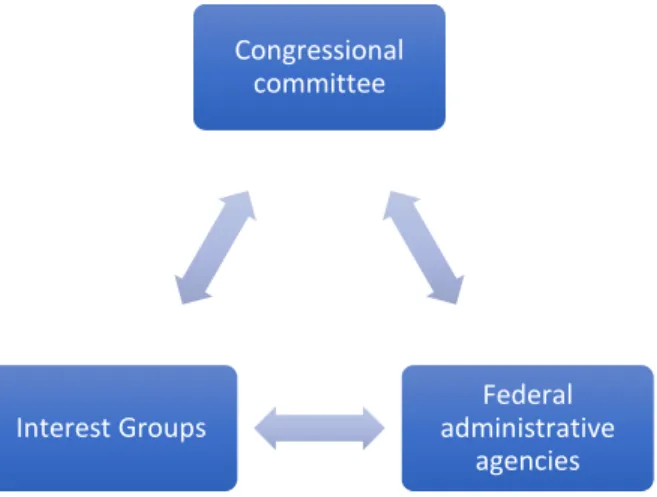
Interest groups can be defined as a group of people drawn to or acting together in support of a common purpose or concern "Dictionary.com" 2018). The literature shows a few different theories explaining interest groups. One is called the iron triangle. The iron triangle is a three-pronged diagram or way to visualize policy being created. The iron triangle is made up of congress, bureaucrats and interest groups. All of these sections influence the direction of public policy (N.A., 2018a). Anderson defines an iron triangle like this, an iron triangle ideally involves a pattern of symbiotic relationships among some congressional committees (or
subcommittees), and an administrative agency or two, and the relevant interest groups centered on a policy area (2015, p. 74). It is symbiotic because they all work together and benefit one another in a way similar to a cycle which is envisioned as a triangle with arrows pointing in either direction.
See Figure 2 below.
Figure 8 Iron Triangle
Congressional committee Federal administrative agencies Interest Groups
Interest groups can help administrative agencies in many ways. They have the ability to sway public opinion on related issues, raise awareness, and secure agency budgets (Yackee, 2006). Interest groups help resist too much political control (Yackee, 2006). Interest groups also help agencies when they disagree with the presidential directions (Yackee, 2006). It is a give and take relationship that is sometimes mutually benefiting. Interest groups are typically viewed as an indirect influence on congress but they are additionally a direct influence on regulatory agencies (Yackee, 2006).
Martino Golden conducted a similar study looking at interest group involvement in agency rulemaking. He looked at three agencies and multiple rules per agency. The study focused on the Environmental Protection Agency (EPA), the National Highway and Traffic Safety Administration (NHTSA), and the Housing and Urban Development Agency (HUD). These agencies were chosen because they all serve different clientele and therefore are
influenced by different interest groups; secondly, all three agencies took on a lot of regulatory authority around the 1970’s. Regulations were chosen under the Clinton administration. There were a total of 10 rules being analyzed (Martino Golden, 1998). The study was analyzed by going through the comments. There were multiple findings in his research. The majority of comments to NHTSA and the EPA were from businesses. The percentage of citizen
involvement in all rules never was above 11% (Martino Golden, 1998). Eight out of ten rules changed minimally as a result of the comments. The agency was most likely to make changes if there was a consensus among commenters (Martino Golden, 1998). He also found that there is hardly significant influence based on comments in notice and comment rulemaking. From his study, he did not find a clear pattern on whose voice was heard the most. Ultimately, it is the agency that makes the final decision (Martino Golden, 1998). He also stresses that it is issue
networks not iron triangles that are most prevalent in notice and comment rulemaking (Martino Golden, 1998).
A study measured the degree of interest group influence on federal agency rulemaking. Forty rules were chosen with a total of 1,693 comments. Under the Department of Labor, the agencies Occupational Safety and Health Administration, and the Employment Standard Administration and under the U.S. Department of Transportation, the Federal Railroad
Administration, and the Federal Highway Administration were chosen. The researchers chose only rules with comments between 2 and 200 in order to use normal situations (McKay & Yackee, 2007). The dependent variable was rule change. The researchers used a three-point scale to assess the direction of change between initial writing and the final rule. The scale was more government involvement, same government involvement or less regulations. The unit of analysis was the rule. There were two predictive variables to measure the level of conflict in comments. The first was interest group split which is basically tallying the amount for and against, and the second was comment intensity differential which was the number and degree of change desired (McKay & Yackee, 2007). The findings showed that the squeaky wheel gets the grease. They also tested to see how competitive competing interest were, if lobbying on one side led to more on the other. The statistics showed that they were not able to make the claim with confidence (McKay & Yackee, 2007).
George M. Guess and Paul G. Farnham provide good explanations and examples of interest groups involvement in public policy making in the text “Cases in Public Policy
Analysis” (2011). The literature suggests that a key difference between iron triangle and issue networks is that iron triangles tend to be viewed more positively then issue networks. Issue networks are looked at as an entity that slows down the process of law making. “Issue networks