2351-9789 © 2015 Published by Elsevier B.V. This is an open access article under the CC BY-NC-ND license (http://creativecommons.org/licenses/by-nc-nd/4.0/).
Peer-review under responsibility of AHFE Conference doi: 10.1016/j.promfg.2015.07.872
Procedia Manufacturing 3 ( 2015 ) 3214 – 3221
ScienceDirect
6th International Conference on Applied Human Factors and Ergonomics (AHFE 2015) and the
Affiliated Conferences, AHFE 2015
Perceived discomfort glare from an adaptive driving beam headlight
system compared with three low beam lighting configurations
Ian J. Reagan*,Matthew L.Brumbelow
Insurance Institute for Highway Safety, 1005 N Glebe Rd, Arlington, VA 22201, United States
Abstract
Adaptive driving beams (ADB) avoid glare for approaching or leadingdrivers but otherwise provide high beam lighting. Audi’s implementation uses a matrix of LED units to deactivate individual LEDs when it detects leading or approaching vehicles. A test track study measured perceived discomfort glare by having 20 participants view and rate headlight configurations from five roadway approaches. The headlight conditions included an Audi A8 with ADB, the A8 with ADB deactivated (resulting in an LED low beam pattern that met European specifications), a 2013 Mazda 3 with low beam adaptive curve HID headlights, and a 2014 Dodge Durango SUV with low beam HID headlights. Five approaches included left and right gradual and sharp curves and a straight approach. Participants rated glare comfort on a scale from 1 to 9, with higher ratings indicating more acceptable glare. Glare from the Durango was rated as less comfortable (M = 6.15) than the other three systems. The Mazda 3 (M = 6.82) received more acceptable glare ratings than the Durango. The A8 ADB(M = 7.25) received more acceptable glare ratings than the Durango and the Mazda 3 but was notrated differentlyfrom the A8 low beam LED condition (M = 7.36). Mean and maximum illuminance measuresfor the approach vehiclescorresponded well with subjective ratings.These findings demonstrate the promise for adaptive driving beam headlight systems, and the tested adaptive driving beam system is presently available for use in the European market. However, FMVSS108 requires discrete high and low beam settings, which does not allow adaptive driving beam systems in the United States.Measuring illuminance dynamically may provide an alternative regulatory approach.
© 2015 The Authors. Published by Elsevier B.V. Peer-review under responsibility of AHFE Conference.
Keywords:Crash avoidance technologies; Vehicle headlighting; Discomfort glare
* Corresponding author. Tel.: +1-703-247-1500; fax: +1-703-247-1588.
E-mail address:[email protected]
© 2015 Published by Elsevier B.V. This is an open access article under the CC BY-NC-ND license (http://creativecommons.org/licenses/by-nc-nd/4.0/).
1. Introduction
Motor vehicle headlights provide illumination for drivers to maintain control of the vehicle and avoid crashing into hazards and increase conspicuity so other road users can see the vehicle. An additional goal of vehicle lighting design is to deliver this visibility and conspicuity while minimizing glare for oncoming or leading vehicles. Regulations associated with these goals are specified in the U.S. Federal Motor Vehicle Safety Standard (FMVSS) No. 108 [1].The safety standard includes separate requirements for low and high beam settings. To reduce glare, low beam requirements specify the maximum amounts of light that are allowed above a horizontal plane that would introduce glare to other drivers. In contrast, requirements are written to ensure that high beams provide minimum amounts of light above this plane.
FMVSS 108 has remained largely unchanged since the 1960s, and the language of the safety standard has become a limiting factor in recent innovations in motor vehicle headlamps.Adaptive driving beam systems exemplify this. Vehicles with adaptive driving beam headlights are intended to provide visibility levels associated with high beam lighting without causing increased glare to other drivers and without the driver needing to manually switch between upper and lower beams. Rather than manually switching between the two states, adaptive driving beams continuously and automatically modulate beam patterns to achieve maximum illumination using sensors to detect which portions of the beam need to be dimmed to reduce glare for drivers of approaching or leading vehicles. Despite the appeal of this approach, vehicles with adaptive driving beams are unavailable in the United States because the systems fail the upper and lower beam requirements specified in FMVSS 108. However, these systems are available outside the U.S. market, most notably in Europe.
The current paper documents the results of a testtrack study with volunteer subjects that compared the illuminance and perceived discomfort glare from the Audi LED matrix adaptive driving beam system with three vehicle low beam headlight configurations.
2. Method
2.1. Experimental design
The factorial design had two repeated independent measures: headlight system and roadway curvature. There were four headlight systems and five roadway approaches. The primary outcome variable was subjective ratings of perceived glare made by observers who sat in a stationary vehicle as a test driver drove vehicles with the four tested headlight systems toward the observer vehicle. The test driver drove each of the four test vehicles on each of the five roadway approaches, and each participant provided one discomfort glare rating of each tested system for each of the five roadway approaches. Thus, each participant provided a total of 20 subjective glare ratings during an experimental trial. In addition to the ratings, illuminance (measured in lux) was recorded as described below.
2.2. Participants
Twenty drivers (10 male, 10 female) aged 30-50 (M = 41.3) completed the study. All passed vision screening tests (Snellen acuity and contrast sensitivity), had held a valid driver’s license for an average of 24 years, and did not have nighttime driving restrictions on their licenses. The drivers indicated that they drove several times per week and, on average, drove at least once a week at night. Therefore, the sample represented experienced drivers with normal to good vision who indicated weekly exposure to driving at night.
2.3. Materials
2.3.1. Tested light systems
The vehicle lighting systems included the Audi A8 sedan with LED adaptive driving beam activated, Audi A8 LED low beam (adaptive driving beam deactivated), a 2013 Mazda 3 sedan with HID adaptive curve headlights with lower beams activated, and a 2014 Dodge Durango SUV with HID headlights also tested with lower beams. The matrix lighting system used an array of individual LEDs that produces upper beam lighting when activated.
However, the system used sensors to detect light from approaching vehicles and, when such light was detected, the system deactivated the individual LEDs that would otherwise illuminate approaching or leading vehicles. When the adaptive driving beam was deactivated, the Audi headlights produced low beam LED lighting that met European specifications.
2.3.2. Roadway approaches.
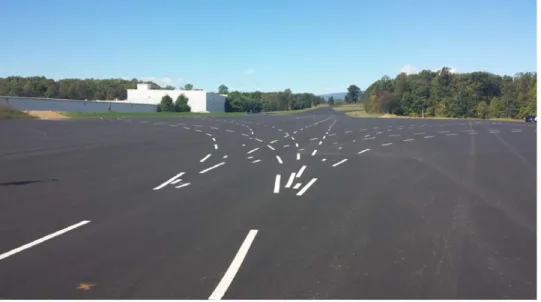
The five roadway approaches were configured on a flat test track (Figure 1).One approach came from straight in front of the observer vehicle. Gradual left and right curves with radii of 180 m and sharp left and right curves with radii of 80 m comprised the remaining roadway approaches. Note that “left” and “right” assumes the perspective of the observer vehicle, which was stationed at the convergence point where the five roadway approaches ended. Thus, for example, for left curves, the experimental driver was steering to his right but approaching from the observer’s left.
2.3.3. DeBoer rating scale
This scale consists of ratings from 1 to 9, with higher numbers indicating more acceptable levels of glare. The following verbal descriptors served as scale anchors: 9 – just noticeable, 7 – satisfactory, 5 – just permissible, 3 – disturbing, 1 – unbearable.
2.3.4. Instrumentation
In addition to the DeBoer discomfort glare ratings, illuminance, measured in lux, was recorded at a point near the observer’s head to obtain an objective measure of light entering the observer vehicle from the test vehicle’s headlights. The illuminance meter was a Konica Minolta model T-10A. A logging system in the observer vehicle captured video and audio during the glare rating task in combination with the illuminance readings and a GPS time signal (Racelogic, model Video VBOX Pro). Video was recorded at 30Hz, and the illuminance and GPS time was recorded at 20Hz. A combination inertial and GPS measurement system (Oxford Technical Solutions, model RT2002) recorded dynamic vehicle data in the test vehicles at 100Hz. Using the common GPS time signal, the distance between the test and observer vehicles was synchronized with the illuminance meter readings.
2.4. Procedure
2.4.1. Intake and training
The informed consent and protocol were reviewed and approved by CIRBI, an external IRB. After providing informed consent, the participants completed visual acuity and contrast sensitivity tests. Upon completion of the intake procedures, participants were escorted to the test track. First, the researcher instructed the participant to sit in the driver seat of the observer vehicle.He explained the DeBoer scale, the layout of the five approach lanes, the rating process for each pass of an experimental vehicle, and then answered participants’ questions. Next, participants completed two practice trials. The researcher then reviewed the ratings with the participant to confirm that he or she understood the scale’s directionality. Importantly, the DeBoer scale may be interpreted as reversed. That is, the scale ranges from 1 to 9, with higher ratings indicating less perceived glare.
2.4.2. Experimental trials
The experimental drives began with the first vehicle and approach combination prescribed by the counterbalance sheet. The test vehicles’ speeds were 30 mph for the gradual curves and straight approaches and 20 mph for the sharp curve approaches. For all approaches, the researcher in the observer vehicle obscured the participant’s view with a cardboard screen as the approach began. The screen shielded participants from exposure to headlight beams that occurred before the vehicle entered the curve. Once the experimental vehicle passed these critical points in the curve, the researcher removed the screen. The screen also was used for the straight approach to control exposure time to the headlights. Typical test vehicle travel distances (and corresponding times) for which the observers were exposed to the headlights were 60 m (6.9 s) for sharp curves and 100 m (7.5 s) for gradual curves and straight approaches.For all participants, the observer vehicle was a BMW 3 series sedan that idled with its headlights on in low beam mode throughout each trial. The participant sat in the driver seat with hands on the wheel to approximate the experience of a driver approaching the experimental vehicles.
Once the screen was removed, participants were told to look toward the direction of the approaching vehicle. The researcher instructed them that while it was not necessary to stare into the headlights, and that they could avert their gaze whenever it became uncomfortable, they should look in the direction of the approach as much as possible. This instruction was intended to address the difficulty in managing the consistency of free-gazing participants encountered by other lighting researchers [2].
Participants verbally indicated their ratings at the conclusion of each pass made by the experimental vehicles, and the researcher recorded them.This process continued for each pass until each assigned lighting condition was rated on the five roadway approaches as prescribed by the counterbalancing procedure. After the final pass by the experimental vehicle, participants completed a guided open-ended questionnaire about the headlight conditions observed. After completing the questionnaire, a researcher debriefed participants by summarizing the goal of the study and answered any participants’ questions.
3. Results
Table 1 contains means with standard deviations and minimum and maximum DeBoer ratings for each combination of headlight system and roadway approach. Lower ratings indicate less acceptable perceived discomfort glare. The lowest rating for the Durango (3 – “disturbing” discomfort glare) was recorded for each of the five approaches made by the vehicle.The lowest rating for the Mazda low beam adaptive curve HID and AudiLED adaptive driving beam conditions (4 – falling between “just permissible” and “disturbing”) was recorded for both left curve approaches and the gradual right curve approach for the Mazda adaptive curve HID but only the gradual right approach for the Audi LED adaptive driving beam. No participant rated an approach made by the Audi low beam LED condition below 5 – “just permissible.” The meanratings were analyzed for statistically significant differences between the systems, the roadway approaches, and for the interaction between the headlight systems and roadway approaches using a mixed modeling approach with SAS statistical software version 9.3. The pcriterion for statistical significance was p< .05.
There was no statistical interaction between roadway approach and headlight system: F(12, 228) = 1.42, p= .16. Thus, ratings of glare were not dependent upon different combinations of headlight system and roadway approach.
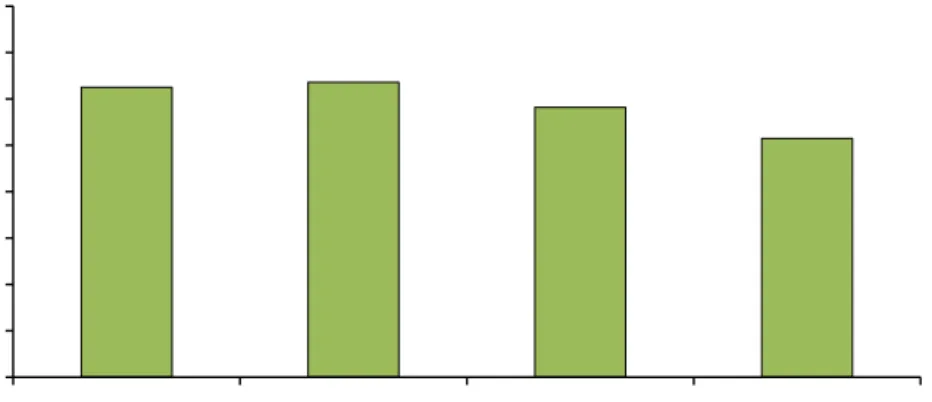
There was a main effect for headlight system F(3, 57) = 34.82, p< .0001 (Figure 2). Collapsing across roadway approach, participants rated the Dodge Durango SUV low beam HID lights as having significantly less acceptable glare (M = 6.15) than both Audi conditions (adaptive driving beam M =7.25; low beam LED M = 7.36) and the Mazda adaptive curve low beam HID condition (M = 6.82). Additionally, ratings of the low beam adaptive curve HID condition indicated significantly less acceptable glare than either of the Audi conditions. Finally, there was no significant difference between the matrix-on and matrix-off headlight condition for the Audi.
There was also a main effect for roadway approach F(4,76) = 8.10, p< .0001. Collapsing across headlight systems, left curves (M = 6.60) were generally rated as more glaring than right curves (M = 7.23) and straight approaches (M = 7.03).
Table 1. Mean (standard deviation), minimum and maximum discomfort ratings by headlight system and roadway approach.
Light system Roadway approach Mean (SD) Min Max
Mazda 3 low beam adaptive curve HID Sharp left 6.4 (1.19) 4 9
Gradual left 6.15 (1.42) 4 9
Straight 7.2 (1.36) 5 9
Gradual right 7.1 (1.41) 4 9
Sharp right 7.25 (1.16) 5 9
Audi low beam LED (adaptive driving beam off) Sharp left 7.35 (0.99) 5 9
Gradual left 6.95 (0.94) 6 9
Straight 7.6 (1.23) 6 9
Gradual right 7.2 (1.32) 5 9
Sharp right 7.7 (0.98) 6 9
Audi LED adaptive driving beam Sharp left 7.15 (1.09) 5 9
Gradual left 6.85 (1.35) 5 9
Straight 7.55 (1.10) 5 9
Gradual right 7.15 (1.46) 4 9
Sharp right 7.55 (1.05) 6 9
Dodge Durango SUV low beam HID Sharp left 5.95 (1.50) 3 8
Gradual left 6 (1.56) 3 8
Straight 6.55 (1.73) 3 9
Gradual right 6.4 (1.57) 3 9
Fig. 2. Mean ratings of perceived discomfort glare for four headlight systems.
The illuminance readings were captured with a sensor mounted next to the head of the observers. Figure 3 shows the mean and maximum illuminance for each headlight condition, separated by the five roadway approaches, as well as an overall average for all five approaches. The mean and maximum illuminance values were in general agreement with the rankings of perceived discomfort glare for the systems. The Dodge Durango SUV low beam HIDs, which had the most perceived discomfort glare, also had the highest mean and maximum illuminance readings on every approach. There were very minor differences in the illuminance measures between the A8 with and without the matrix system activated. Overall, the Mazda 3 low beam adaptive curve HID headlights produced similar readings as both A8 conditions, with the main exception being slightly higher maximum lux values on the right curve approaches.
Left curve approaches generally had higher mean and maximum illuminance readings for the Audi with and without the adaptive driving beam activated as well as for the Mazda 3 low beam adaptive curve HIDs, and this was in line with the main effect for curve type in the perceived glare ratings. However, the Durango low beam HIDs produced higher illuminance values for right curve approaches, and the Durango was the only headlight system with higher mean DeBoer ratings for the sharp left curve than for the sharp right curve (Table 1).
Fig. 3. Illuminance measures by headlight system.
1 2 3 4 5 6 7 8 9 Audi A8 adaptive driving beam (matrix on) Audi A8 low beam LED (matrix off) Mazda 3 low beam adaptive curve HID Dodge Durango low beam HID Unbearable Just permissible Disturbing Satisfactory Just noticeable 0.0 1.0 2.0 3.0 4.0 5.0 6.0
Mean Max Mean Max Mean Max Mean Max
Illuminance (lx)
4. Conclusion
This experiment evaluated perceived glare and illuminance readings from four different headlight systems across five different roadway approach scenarios. Observers sat in a stationary vehicle on a test track and gazed towards the four test vehicles in a procedure that simulated conditions on two-lane roads when two vehicles converge as they pass in opposite directions. Four of the scenarios simulated drivers whose vehicles approach each other on gradual and sharp horizontal curves, and the fifth scenario was an approach simulating a straight road. The results indicated that the Audi A8 sedan, which was used for two of the four headlight conditions (LED adaptive driving beam and LED low beam) was associated with more acceptable glare than the Mazda 3 sedan low beam adaptive curve HID and Dodge Durango SUV low beam fixed HID headlights. Further, there was no difference between mean ratings of perceived discomfort glare for the Audi A8 adaptive driving beam and Audi A8 low beam LED conditions. Thus, the participants’ subjective ratings indicate that this implementation of an adaptive driving beam worked as intended in terms of avoiding the introduction of excessive discomfort glare to drivers approaching a vehicle with the adaptive driving beam system. Additionally, participants rated curves when the test driver approached from the left to have more discomfort glare than approaches from the right or straight ahead. For both left curve approaches, the test vehicles’ headlights crossed the drivers’ line of sight, whereas the test vehicles’ headlights did not do so when approaching from the right.
The results of the discomfort ratings must be considered in the context of the scale anchors. Although the ranges associated with the glare ratings indicated some participants experienced discomforting levels of glare from three of the four systems, even the system with the highest perceived discomfort (Dodge Durango low beam HID) had mean ratings of glare that fell between “satisfactory” and “just permissible.” In a previous iteration of assessing perceived glare from different headlight systems, we included an upper beam condition to benchmark the lower beam systems studied [3]. The results for the high beams indicated much more disturbing levels of glare than the low beam conditions tested. One of the low beam conditions assessed in Reagan et al. [3] was included in this current evaluation (Mazda 3 low beam HID adaptive curve headlights). It is interesting to note the consistency between the mean subjective ratings, collapsing across roadway approaches, for the Mazda low beam HID adaptive curve headlights in the previous (M = 6.83) and current (M = 6.82) studies. Each study used the same experimental procedure but used different samples of 20 experienced drivers with good vision in the same age range (30-50 yearsold).
The illuminance meter readings taken during the experiment indicate good correspondence with the subjective glare ratings between the four headlight conditions. For example, the rank order of the four tested headlight conditions by maximum illuminance across the five approaches indicated the least illuminance for the Audi low beam LED system, followed by the Audi LED adaptive driving beam and Mazda adaptive curve HID low beam, then the Durango low beam HID system. Similarly, the subjective discomfort ratings indicated the least and most discomfort for the Audi low beam LED and Dodge Durango low beam HID conditions, respectively, with the Mazda 3 low beam HID adaptive curve and the Audi LED adaptive driving beam conditions falling between. This correspondence supports the concept of an objective performance based evaluation of glare using photometric measurements.
The illuminance readings indicated little difference between the two Audi conditions. In only one of the five approaches (gradual right) did the mean or maximum illuminance values for the two Audi conditions differ by more than 0.1-0.2 lux, which is within the range of expected measurement error of the instrumentation. In general, the Audi adaptive driving beam system produced similar glare illuminance as the Mazda adaptive curve HID low beam. The slightly higher maximum readings for the Mazda on the right curve approaches can be explained by that vehicle’s adaptive swiveling functionality, which shifts the beam pattern toward oncoming traffic for that direction. While these two systems produce similar glare illuminance, the Audi adaptive driving beam system provides full high-beam visibility illuminance in other locations while the Mazda visibility is limited by the FMVSS 108 low beam requirements. Both the Mazda and Audi had glare illumination values well below that of the Dodge Durango SUV low beam fixed HID system, indicating that allowing adaptive driving beams in the United States would have a smaller effect on glare than the effect associated with the range of headlamp mounting heights already built into the U.S. vehicle fleet.
The absence of a decrease in discomfort glare or increase in glare illuminance observed for the LED matrix adaptive driving beam tested in the current study, when combined with the visibility benefits to drivers of vehicles with such a headlight system, presents an optimal scenario for driving in the dark. In 2013, more than 4,700 pedestrians were killed in the United States, and more than 75% of these fatalities occurred at dusk, during the night, or at dawn [4]. Improving visibility with better headlight systems would likely help drivers detect and avoid striking pedestrians, wildlife, and other low-conspicuity road hazards when light levels are low. Adaptive curve lower beam headlights can increase drivers’ detection reaction time by as much as one-third of a second [5], and analysis of insurance data indicates vehicles with adaptive curve headlights have fewer claims than the same vehicles without adaptive curve headlights [6,7,8,9]. While the current study has not compared the visibility benefits, adaptive driving beam systems offer a benefit even on straight road sections, and a system with a wide enough beam pattern and/or that adapts to curves may provide even greater benefits on curves. However, the federal government would first need to revise the language in FMVSS 108 to allow fitment of adaptive driving beams in vehicles sold for use on U.S. roads.
Acknowledgment
This work was supported by the Insurance Institute for Highway Safety. The authors would like to thank Rob Tabor, Tim Frischmann, and Alex Pinelli for assistance with data collection.
References
[1] Office of the Federal Register. Code of Federal Regulations; Title 49 Transportation, Part 571 Federal Motor Vehicle Safety Standards, Standard No. 108 Lamps, Reflective Devices, and Other Associated Equipment. National Archives and Records Administration, Washington, DC, 2011.
[2] J.D. Bullough. Visual Performance from Automobile Headlamps along High-Speed Curves. Advances in Natural and Applied Sciences. 3(2009)35-42.
[3] I.J. Reagan, T. Frischmann, M.L. Brumbelow. (Submitted). Test Track Evaluation of Headlight Glare Associated with Adaptive Curve HID, Fixed HID, and Fixed Halogen Low Beam Headlights, Ergonomics.
[4] National Highway Traffic Safety Administration. Traffic Safety Facts, 2013 Data; Pedestrians. Report no. DOT HS-812-124. U.S. Department of Transportation, Washington, DC, 2015.
[5] I.J. Reagan, M. Brumbelow, T. Frischmann. On-road Experiment to Assess Drivers’ Detection of Roadside Targets as a Function of Headlight System, Target Placement, and Target Reflectance. Accid. Anal. Prev. 76 (2015) 74-82.
[6] Highway Loss Data Institute. Mazda Collision Avoidance Features: Initial Results. HLDI Bulletin 28(13). Arlington, VA, 2011. [7] Highway Loss Data Institute. Acura Collision Avoidance Features: Initial Results. HLDI Bulletin 28(21). Arlington, VA, 2011. [8] Highway Loss Data Institute. Mercedes-Benz Collision Avoidance Features: Initial Results. HLDI Bulletin 29(7). Arlington, VA, 2012. [9] Highway Loss Data Institute. Volvo Collision Avoidance Features: Initial Results. HLDI Bulletin 29(5). Arlington, VA, 2012.