by
Carmen van der Merwe
March 2015
Thesis presented in fulfilment of the requirements for the degree of
Master of Engineering (Research) in the Faculty of Industrial Engineering at Stellenbosch University
Supervisor: Dr ACJ van Rensburg Co-supervisor: Prof CSL Schutte
i DECLARATION
By submitting this thesis electronically, I declare that the entirety of the work contained therein is my own, original work, that I am the sole author thereof (save to the extent explicitly otherwise stated), that reproduction and publication thereof by Stellenbosch University will not infringe any third party rights and that I have not previously in its entirety or in part submitted it for obtaining any qualification.
Date: November 2014
Copyright © 2015 Stellenbosch University All rights reserved
ii ABSTRACT
Numerous problems with product quality and time-to-market launches can be traced back to the management of the product lifecycle. This research assignment provides insight into how an integrated value proposition design framework can address these issues by shifting the focus of product lifecycle management from being product-centric to being customer-centric. This framework combines tools, methods and processes from a variety of disciplines such as Systems Engineering, Marketing, Project Management, and Financial Management. The application of the framework during the product lifecycle management process is that of a planning and communication tool to ensure integration between multifunctional teams to increase customer value proposition quality and decrease product time to market. This research assignment was implemented in a new product development case study within a leading Telecommunications company in South Africa.
Key words
Customer segmentation, Refined Kano’s model, Blue Ocean strategy, Quality Function Deployment, Bass model, Generalised Bass model, Customer Lifetime Value, Net Present Value, and Goodwill.
iii OPSOMMING
Die bestuur van ‘n produk se lewensiklus veroorsaak verskeie probleme wat gepaard gaan met die kwaliteit van produkte en die verlengde tydperk wat dit neem om produkte aan die mark bekend te stel. Hierdie navorsingswerk verduidelik hoe die geïntegreerde waarde-stelling raamwerk die probleme met betrekking tot die bestuur van produkte se lewensiklusse aanspreek. Die raamwerk verskuif die fokus van die bestuur van ‘n produk se lewensiklus, wat produk-gesentreerd is, na ‘n kliënt-gesentreerde fokus. Die raamwerk maak gebruik van tegnieke, metodes en prosesse verkry uit die dissiplines van Sisteem Ingenieurswese, Bemarking, Projek bestuur en Finansiële bestuur. Die toepassing van die raamwerk verbeter die bestuur van ‘n produk se lewensiklus deur beplanning en kommunikasie te fassiliteer tussen multi-funksionele spanne. Genoemde raamwerk bevorder die samewerking tussen multi-funksionele spanne, verbeter die waarde-stellings aan kliënte, verhoog die kwaliteit van produkte en verkort die tydperk van produk bekendstelling aan die mark. Bogenoemde navorsingswerk is geïmplementeer in ‘n vooraanstaande Telekommunikasie maatskapy in Suid-Afrika, op ‘n nuwe produkontwikkeling gevallestudie.
iv ACKNOWLEDGEMENTS
I would like to thank my supervisor Dr Antonie van Rensburg for the continuous support, constructive criticism, and motivation. You guided me to become the best scholar I can be - for which I am sincerely grateful. I would also like to take this opportunity to thank my family who supported me emotionally throughout this journey.
v TABLE OF CONTENTS
1 CHAPTER ONE: INTRODUCTION ... 1
1.1 RESEARCH PROBLEM ... 2
1.1.1 Management’s misperception about PLM ... 3
1.1.2 Universal product lifecycle management issues ... 3
1.1.3 Integration and communication issues within the PLM... 5
1.1.4 PLM complexity ... 5
1.1.5 Product-centric versus customer-centric PLM focus ... 6
1.1.6 The problem statement ... 6
1.1.7 Research assumption ... 6
1.2 RESEARCH AIM ... 7
1.2.1 The aim statement ... 7
1.2.2 The research objective ... 7
1.3 RESEARCH SCOPE ... 8
1.4 LITERATURE SUMMARY ... 8
1.5 RESEARCH DESIGN AND METHODOLOGY ... 9
1.5.1 Research procedure ... 9
1.6 CONCEPTS AND DEFINITIONS ... 10
1.7 CHAPTER OUTLINE ... 11
1.8 INTRODUCTION - CONCLUSION ... 12
2 CHAPTER TWO: LITERATURE REVIEW ... 13
2.1 PRODUCT LIFECYCLE MANAGEMENT (PLM) ... 14
2.2 EXISTING LITERATURE, AND ITS LIMITATIONS ... 15
2.3 THE VALUE CREATION PROCESS ... 16
2.3.1 Marketing objectives ... 17
2.3.2 Value analysis ... 18
2.3.3 Blue Ocean strategy ... 18
2.3.4 The Refined Kano’s model ... 19
2.3.5 The value creation process analysis ... 21
2.4 QUALITY FUNCTION DEPLOYMENT ... 22
2.5 CUSTOMER SEGMENTATION ... 23
2.6 CUSTOMER EXPERIENCE ... 24
2.7 CUSTOMER LIFETIME VALUE ... 26
2.8 PRODUCT LIFETIME UPTAKE MODELLING... 28
vi
2.8.2 The Bass model ... 29
2.8.3 Bass model parameter estimation ... 30
2.8.4 The Bass model structure ... 31
2.8.5 The generalised Bass model ... 32
2.8.6 Monte Carlo simulation ... 33
2.9 GOODWILL FIRM VALUE ... 34
2.10 MODELLING SOFTWARE ... 34
2.11 LITERATURE REVIEW - CONCLUSION ... 35
3 CHAPTER THREE: RATIONALE OF THE INTEGRATED VALUE PROPOSITION DESIGN FRAMEWORK... 36
3.1 EXISTING PLM PRACTICES ... 36
3.2 NEW APPROACH TO PLM ... 38
3.3 DETAILED OBJECTIVES OF THE INTEGRATED VALUE PROPOSITION DESIGN FRAMEWORK ... 39
3.4 THE INTEGRATED VALUE PROPOSITION DESIGN FRAMEWORK ... 40
3.5 RATIONALE – CONCLUSION ... 41
4 CHAPTER FOUR: FUNCTIONAL DECOMPOSITION OF THE INTEGRATED VALUE PROPOSITION DESIGN FRAMEWORK... 42
4.1 VALUE PROPOSITION STRATEGY... 43
4.1.1 Market analysis ... 43
4.1.2 Customer value proposition statement ... 43
4.1.3 Customer value proposition design motivation ... 44
4.1.4 Key stakeholders ... 45
4.2 CUSTOMER SEGMENTATION ... 46
4.3 VALUE CREATION PROCESS ... 47
4.3.1 Theoretical classification of the Refined Kano’s attributes ... 50
4.3.2 Kano questionnaire classification of the Refined Kano’s attributes ... 51
4.3.3 Quality function deployment ... 55
4.4 CUSTOMER EXPERIENCE DESIGNS ... 57
4.4.1 The customer journey map ... 58
4.4.2 Touch points ... 59
4.5 FUNCTIONAL DECOMPOSITION OF THE INTEGRATED VALUE PROPOSITION DESIGN FRAMEWORK – CONCLUSION ... 59
5 CHAPTER FIVE: THE ECONOMICS OF THE INTEGRATED VALUE PROPOSITION DESIGN FRAMEWORK... 61
vii
5.1.1 The Bass model and its parameters ... 62
5.1.2 The Bass model extensions ... 68
5.1.3 Accounting for risk ... 74
5.1.4 Conclusion on the product lifetime uptake model ... 77
5.2 CUSTOMER LIFETIME VALUE ... 77
5.2.1 Customer lifetime value model input parameters ... 78
5.2.2 Customer lifetime value (CLV) modelling ... 81
5.3 PRODUCT NET PRESENT VALUE ... 83
5.4 GOODWILL FIRM VALUE ... 84
5.5 CUSTOMER SEGMENT RATE CARD ... 86
5.6 ONE-PAGE DESIGN ... 87
5.7 CODE ... 89
5.7.1 Customer segmentation modelling... 89
5.7.2 Customer segmentation parameters ... 90
5.7.3 The product lifetime uptake model ... 91
5.7.4 CLV modelling ... 93
5.7.5 The goodwill firm value ... 94
5.8 ECONOMICS OF THE INTEGRATED VALUE PROPOSITION DESIGN FRAMEWORK – CONCLUSION ... 94
6 CHAPTER SIX: IMPLEMENTATION APPROACH ... 95
6.1 DESIGN PRINCIPLES ... 95
6.2 CRITICAL SUCCESS FACTORS ... 96
6.3 THE SCOPE OF IMPLEMENTATION ... 97
6.3.1 The scope of the product ... 97
6.3.2 The scope of the project ... 98
6.4 IMPLEMENTATION PLAN ... 98
6.4.1 Implementation roadmap ... 99
6.4.2 Implementation phases and key milestones ... 100
6.4.3 Resource allocation ... 101
6.4.4 Performance measurement ... 102
6.5 IMPLEMENTATION APPROACH – CONCLUSION ... 102
7 CHAPTER 7: CASE STUDY OF A POST-PAID PRICE PLAN PRODUCT ... 103
7.1 BACKGROUND TO THE POST-PAID PRICE PLAN PRODUCT ... 104
7.2 THE FUNCTIONAL TASKS WITHIN THE FRAMEWORK ... 105
7.2.1 Function 1: Value proposition strategy ... 105
viii
7.2.3 Function 3 – 6: Value creation process ... 110
7.2.4 Function 7: Customer experience ... 127
7.3 THE ECONOMICS OF THE CASE STUDY ... 131
7.3.1 Segmentation model ... 131
7.3.2 Customer segment, product and organisation parameters ... 132
7.3.3 Product lifetime uptake model ... 133
7.3.4 Customer lifetime value model ... 139
7.3.5 Goodwill firm value model ... 140
7.4 CUSTOMER SEGMENT RATE CARD ... 144
7.5 INTEGRATED VALUE PROPOSITION DESIGN FRAMEWORK: ONE-PAGER ... 145
7.6 CASE STUDY – CONCLUSION ... 147
8 CHAPTER 8: CONCLUSION ... 149
8.1 EMPIRICAL FINDINGS ... 150
8.2 IMPLICATION FOR PROCEDURE ... 151
8.3 THEORETICAL IMPLICATIONS ... 152
8.4 LIMITATION OF THE STUDY ... 153
8.5 RECOMMENDATIONS FOR FUTURE RESEARCH ... 153
8.6 CONCLUSION ... 154
9 REFERENCES ... 155
10 APPENDIX A ... 159
ix LIST OF TABLES
Table 1: Theoretical Kano's model classification form ... 50
Table 2: Kano's matrix ... 52
Table 3: Kano's category summary ... 53
Table 4: Refined Kano's importance rating... 54
Table 5: Case study, competitive analysis: Unlimited offers... 106
Table 6: Unlimited price plan product - customer value propositions ... 107
Table 7: Case study, theoretical classification of the case study CVPs ... 111
Table 8: Case study, Refined Kano's attributes ... 111
Table 9: Case study, Customer segmentation parameters... 133
Table 10: Case study, The number of customers adopting the product via a natural diffusion in the market... 134
Table 11: The number of customers adopting the product according to the generalised Bass model ... 136
Table 12: The Monte Carlo simulation parameters ... 137
Table 13: Product lifetime uptake model results summary ... 138
Table 14: Case study, Customer lifetime value modelling parameters ... 139
Table 15: Case study, CLV results ... 139
x LIST OF FIGURES
Figure 1: Research design ... 9
Figure 2: Research procedure ... 10
Figure 3: Product Life Cycle (Jeong, 2010) ... 14
Figure 4: Value Creation Model (Yang & Sung, 2010) ... 17
Figure 5: Refined Kano's Model ... 20
Figure 6: House of Quality Template ... 22
Figure 7: Principle of Customer Lifetime Value Modelling (Gupta et al., 2006:140) ... 27
Figure 8: Diffusion of innovation (Rogers, 1983) ... 29
Figure 9: The Bass model structure ... 31
Figure 10: Current approach to PLM ... 37
Figure 11: New approach to PLM ... 38
Figure 12: Outline of the integrated value proposition design framework ... 40
Figure 13: The integrated value proposition design framework ... 41
Figure 14: The integrated value proposition design framework process ... 42
Figure 15: A value chain activity breakdown (VCOR) ... 44
Figure 16: Customer segmentation implementation procedure ... 46
Figure 17: Customer profile template ... 47
Figure 18: The value creation process analysis ... 48
Figure 19: Refined Kano's model information sheet ... 51
Figure 20: Kano's questionnaire ... 52
Figure 21: Customer satisfaction diagram ... 54
Figure 22: Value creation process QFD roll-out ... 55
Figure 23: Customer journey map template ... 58
Figure 24: Customer touch-points template ... 59
Figure 25: Bass model with a high innovator and imitator rate ... 63
Figure 26: Cumulative Bass model with high innovator and imitator rate ... 64
Figure 27: Bass model with medium innovator and imitator rate ... 64
Figure 28: Cumulative Bass model with medium innovator and imitator rate ... 65
Figure 29: Bass model with low innovator and imitator rate ... 65
Figure 30: Bass model with low innovator and imitator rate ... 66
Figure 31: Bass model curve with imitator rate greater than innovator rate ... 67
Figure 32: Bass model curve with innovator rate greater than innovator rate ... 67
Figure 33: The generalised Bass model ... 68
Figure 34: Bass model extension of a variable market size due to external influences ... 72
Figure 35: Generalised Bass model extension of a variable market size due to internal influences . 73 Figure 36: Product lifetime uptake model... 76
Figure 37: Product lifetime uptake model scenario analysis ... 76
Figure 38: Product NPV calculation ... 83
Figure 39: Goodwill firm value calculation outline ... 85
Figure 40: Customer segment rate card template ... 86
Figure 41: One-page design ... 88
Figure 42: Integrated value proposition design framework modelling steps ... 89
Figure 43: Product scope sizes ... 97
Figure 44: Implementation roadmap structure ... 99
Figure 45: Framework implementation phases ... 100
Figure 46: Multifunctional teams within the framework ... 101
Figure 47: Case study involvement within PLM ... 103
xi
Figure 49: Case study, Value creation process backward analysis ... 112
Figure 50: Case study, Marketing objectives OFD, backward analysis ... 114
Figure 51: Case study, Value categories QFD, backward analysis ... 115
Figure 52: Case study, Blue Ocean strategy QFD, backward analysis ... 116
Figure 53: Case study, Refined Kano's attributes QFD, backward analysis ... 117
Figure 54: Case study, CVP QFD, backward analysis ... 119
Figure 55: Case study, Value creation process, forward analysis ... 120
Figure 56: Case study, Refined Kano's attributes QFD, forward analysis ... 121
Figure 57: Case study, Blue Ocean strategy QFD, forward analysis ... 122
Figure 58: Case study, Value categories QFD, forward analysis ... 123
Figure 59: Case study, Marketing objectives QFD, forward analysis ... 123
Figure 60: Case study, Backward analysis marketing objectives pie chart ... 124
Figure 61: Case study, Forward analysis marketing objectives pie chart ... 124
Figure 62: Case study, Backward analysis Refined Kano's model quality attributes pie chart ... 126
Figure 63: Case study, Forward analysis Refined Kano's model quality attributes pie chart ... 126
Figure 64: Case study, Customer journey CVP template ... 127
Figure 65: Case study, Customer journey QFD ... 128
Figure 66: Case study, Customer touch points CVP template ... 129
Figure 67: Case study, Customer touch points QFD ... 130
Figure 68: Case study, Customer value band ... 131
Figure 69: Case study, Unlimited price plan product’s natural diffusion in the market ... 133
Figure 70: Case study, Unlimited price plan product’s natural cumulative diffusion in the market134 Figure 71: Case study, Generalised Bass model product uptake ... 136
Figure 72: Case study, Product lifetime uptake model ... 137
Figure 73: Case study, Unlimited product uptake scenarios ... 138
Figure 74: Case study, Unlimited monthly NVP, natural product diffusion, and constant price CLV ... 141
Figure 75: Case study, Cumulative unlimited monthly NVP, natural product diffusion, and constant price CLV ... 141
Figure 76: Case study, Unlimited monthly NPV, generalised Bass model diffusion with varying price CLV ... 142
Figure 77: Case study, Unlimited cumulative monthly NVP, generalised Bass model diffusion with varying price CLV ... 143
Figure 78: Case study, Elite customer segment profile parameters ... 144
xii LIST OF ABBREVIATIONS
PLM Product Lifecycle Management
CLV Customer Lifetime Value
QFD Quality Function Deployment
NPV Net Present Value
VAS Value Added Services
CVP Customer Value Proposition
KPI Key Performance Indicators
1
1
CHAPTER ONE: INTRODUCTION
The custom of value exchange between two or more parties is an age-old tradition. Organisations spend hours preparing and strategising different value offerings because a customer value proposition offers a strategic advantage; it is the golden apple that offers differentiation. Bringing a successful customer value proposition to the market offers significant advantages to the organisation, as it guarantees future survival.
In an ever-competing world where breakthrough innovations are harder to obtain, and where it is even more difficult to differentiate product and service offerings from those of one’s competitors, organisations have to start competing on management practices (Straub & Kirby, 2014). This research is based on the principle that formal practices on value proposition design add economic growth by combining contributions from Systems Engineering, Marketing, Project Management, and Financial management disciplines.
A product is a value offering to a customer that consists of a combination of tangible and intangible components. Product Lifecycle Management (PLM) entails the process of managing the entire lifecycle of the product from initiation to product withdrawal and replacement. New product development efforts are managed by the implementation of PLM, which forms a knowledge management process inside the organisation, integrating resources, stakeholders, data, and business processes in order to provide an information outline of the product. Traditionally PLM is used as a business strategy to establish a product-centric organisational focus through which the organisation effectively and continually delivers products to its customer base over time to guarantee organisational growth.
The research assignment introduces an approach to the implementation of PLM by shifting the predominately product-centric focus to a customer-centric focus. The shift towards customer centricity within PLM is done by creating an engineering framework of processes, principles, and methods that introduces key concepts such as multi-functional team integration and business process parallelisation into PLM. The framework is used as a planning and communication tool to extend PLM. The purpose of the integrated value proposition design framework is to reduce variation in process schedules, and to align design specifications around the voice of the customer whilst maintaining flexibility among stakeholders in the process, with the intended effect of reduced time to market and increased product quality.
2
The research assignment is established in a case study that was conducted during a seven-month period within the marketing division of a leading telecommunications company in South Africa. The case study involves an explanatory analysis of the integrated value proposition design framework on a new product development initiative.
This chapter provides an introduction to the research assignment. It consists of a statement of the research problem, a formulation of the aim, nature, and scope of the research, a brief review of the existing literature, the research design and methodology, a list of key concepts and definitions, and a chapter outline.
1.1 RESEARCH PROBLEM
PLM as a business strategy plays a particularly important role in managing new product development initiatives. Several product failures can be traced to inadequate implementation of PLM. Examples of such failures are that creative ideas fail to be invented; products are not launched on time; critical milestones are missed; once the products are launched, they do not sell in the market; poor capacity planning; and misleading returns on investments. The most common problems that hinder the successful implementation of PLM are due to the level of complexity and the lack of strong leadership between multifunctional teams in PLM implementation.
Numerous research studies have been conducted on the central problems in PLM. The researchers’ findings on the central problems in PLM points to five main causes:
a. Management’s misperception about PLM b. Universal product lifecycle management issues
c. Integration and communication issues within the PLM d. PLM complexity, and
e. Product-centric versus customer-centric PLM focus.
During the seven-month period in which the case study was conducted, similar causes of problems in PLM were found while closely monitoring the way-of-work of the product development teams. The most prominent problems were that over 80 percent of new product launches were late, incomplete products were launched; many products were unsuccessful; the improvements in management processes were small and followed an eighteen-month cycle; and lengthy decision-making processes.
3
The problem statement is the result of a comparison analysis between the five main causes of problems in PLM found in the literature and the specific problems experienced within the case study. The relationships between the five causes of problems in PLM and the specific problems identified in the case study are compared and listed below.
1.1.1 Management’s misperception about PLM
PLM is often not considered by management as a strategic business tool but as an engineering tool associated with large IT investments. This statement forms the first cause of problems in PLM. In an attempt to improve PLM, organisations tend to implement IT software as a PLM solution to control product engineering efficiency, instead of implementing PLM as a business strategy. Senior management transfer their responsibility for PLM to a functional engineering level, and are misled by thinking that improvements in product engineering efficiency are similar to improvements in PLM. In contrast, if PLM is implemented as a business strategy, the improvements in the product PLM could apply to the entire organisation. It is found that improvements in a product’s business activities are easier to obtain and have a greater impact on the success of the product than do improvements in product engineering efficiency (Johansson, Kazemahvazi, Henriksson, & Johnsson, 2013:56-58).
Within the case study the problem experienced is not that PLM is implemented in the organisation as an IT system, but that there is no formal procedure for PLM implementation to begin with. Senior management does not fully grasp the importance of PLM in new product development initiatives. It is found that they fully transfer their strategic decision-making responsibilities for PLM implementation to a tactical-planning employee; and so, when the product has to be developed, the product development process is held up through lack of senior management involvement within PLM.
1.1.2 Universal product lifecycle management issues
The second cause of problems in PLM consists of four universal problems associated with the management of new product initiatives within PLM, as identified by Van de Ven (1986: 590). The first problem is that of managing humans, especially in large and successful organisations, which are generally more focused on protecting their existing products and services than on generating innovative new ideas.
The second problem is the challenge of transforming an idea into a product as a collective achievement. It only takes one person to propose an idea, but for the idea to be successfully
4
invented and implemented, it requires the co-operation of various groups of individuals. It is often found that a promising idea will not be successfully invented due to a lack of energy and commitment amongst multifunctional groups.
The third problem involves the structural problem of managing multiple functions, resources, and disciplines as a whole. Individuals involved in the product development process can get so tangled up in their own functional responsibilities that they can easily lose sight of the process as a whole. The fourth problem is a lack of leadership. The development of a product has to adapt to current organisational structures and practices. It is often found that the existing management strategies are very rigid and do not allow for flexibility in the process to adapt to the requirements of current product development. There is a lack of strategic leadership to transform the existing management practices to optimise the innovation’s go-to-market cycle strategy (Van de Ven, 1986:591).
The universal problems in managing new product initiatives within the early phases of PLM relate to the problems experienced in the case study, where it was observed that the decision-making processes in PLM are drawn out and time-consuming, with average product development initiatives taking one thousand days – three years – to complete. This problem is partly due to the organisation’s inability to manage humans effectively, as summarised in the second cause of problems in PLM; and partly due to the first cause – that of senior management transferring their responsibilities to lower-level employees. Senior management are more focused on protecting their existing product portfolios than initiating new and innovative products. Thus the responsibilities of PLM, especially in the early design phases of PLM, are transferred to lower-level employees. PLM issues that require immediate decision-making are often held up because senior management are too occupied with other responsibilities to give immediate attention to the PLM decision at hand, and the employee responsible for PLM implementation does not have the authority to make on-the-spot decisions.
Within the case study it was also observed that the organisation has a lack of strong leadership to overcome the challenges of inflexible business processes. The PLM project leaders are bound by the senior managements’ authority. The lack of strong leadership implies that the organisation is not able to transform a product idea into a launch-ready product as a collective achievement, and the organisation does not have the skill to manage the multiple functions, resources, and disciplines as a whole. Many product initiatives are never implemented due to the PLM multifunctional teams’ lack of energy and commitment to realise the product initiative, and due to poor leadership.
5
1.1.3 Integration and communication issues within the PLM
The third cause of problems in PLM arises from the issues associated with the lack of integration and communication within PLM. Kessler, Bierly, and Gopalakrishnan (2001:80) define the syndrome”, which applies to the failures in projects due to insufficient communication. The “vasa-syndrome” was framed by taking a sixteenth century new product development disaster, the Swedish warship called Vasa, as an example of common managerial failures that can still apply today.
According to Kessler et al., the most prominent challenges that an organisation faces during the new product development stage in PLM are the deficiency in learning ability, a poor knowledge and information feedback system, communication barriers, a lack of ability to recall insights from previous products, and the inability of senior management to set clear objectives. To counter the “vasa-syndrome”, an organisation needs to emphasise the importance of the knowledge gained from previous experiences and the importance of sharing the knowledge, together with improving the information systems that need to be in place to overcome communication barriers and poor organisational retention capabilities (Ameri & Dutta, 2005:577).
The third comparison between the central problems in PLM and the problems identified in the case study applies to the organisation’s lack of integration and communication within PLM. There is a definite lack of integration amongst the individuals in the multifunctional teams responsible for PLM implementation. The individual stakeholders are mostly focused on their own responsibilities, and failed to show enthusiasm for realising the product as a whole.
Generally within the telecommunications industry, the necessary IT infrastructure is in place to capture accurate data on the Key Performance Indicators (KPIs) for PLM downstream activities – but there is a major gap in capturing, storing, and documenting the product during the earlier PLM stages. There is no formal structured methodology to capture and model the product concepts, resulting in a weak information feed-back system.
1.1.4 PLM complexity
The fourth cause of problems in PLM involves its complexity. The implementation of PLM requires the co-operation of various individuals in multifunctional teams. The level of complexity in PLM increases as the number of stakeholders in the decision-making process increases (“Product lifecycle management problems costing operators dear, survey finds”, 2013). It is essential to ensure
6
that all the stakeholders involved in the decision-making process are integrated in order to make consolidated decisions.
As observed within the case study, the implementation of PLM within the organisation is very complex. The PLM teams, gathered from multiple disciplines, are too large to be efficient. In the case study it was found that up to 65 individuals were involved in the product design phase of the PLM implementation of a single product, with little formally-managed relating between them. The complexity of the PLM effort grew as the number of individuals in the decision-making process increased. This degree of complexity results in many product delivery date revisions throughout the product lifecycle.
1.1.5 Product-centric versus customer-centric PLM focus
The fifth cause of problems in PLM identifies the challenges that organisations experience with a centric focus as opposed to a customer-centric focus. An organisation that is product-centric has a strong focus on increasing engineering efficiency and reducing costs, whereas a customer-centric organisation places strong emphasis on identifying the needs and preferences of the customer. Often a product-centric organisation will disregard the need of the customer in favour of lowering production costs and increasing the efficiency of the products (Sembhi, 2010). This results in a failure to identify potential market opportunities.
The implementation of PLM observed in the case study has a strong product-centric focus, with very little ability to capture and translate the needs of the customer into appropriate product and service specifications. The product design teams rely on copying competitor products for product innovation and product functionality, instead of delivering the required value to the customer. 1.1.6 The problem statement
The main problems associated with the current methodologies of PLM implementation are that PLM has a strong product-centric focus, and that there is a lack of integration between resources, stakeholders, data, and business processes. This leads to prolonged go-to-market lifecycles for new products, poorly-managed product portfolios for existing products, and unsuccessful product launches.
1.1.7 Research assumption
The research assumption is that the integration of resources, stakeholders, data, and business processes within PLM, together with the shift towards customer-centricity within PLM, will
7
improve with the formal design of customer value propositions for new and existing product initiatives.
1.2 RESEARCH AIM
The product development process is a core business process that generates income for an organisation. The PLM is an essential business strategy that ensures that the product development process will be successful. PLM’s aim is to capture accurate information about the success of the product development and product portfolio management processes, and to create a knowledge feed-back loop that guides stakeholders to make accurate and informed decisions regarding the product. The research assignment addresses the research problems by shifting the product-centric focus of PLM to being customer-centric, with the assumption that greater PLM implementation results will be achieved by instituting formal practices for the design of customer value propositions for products. This implies that the success of a product is measured according to the value being added to the customer, and that the information captured within PLM should revolve around the customer. The research assignment intends to address the research problems by combining various best practice principles, tools, and methods to facilitate the shift towards customer-centricity, and by improving the integration of the multifunctional teams within PLM. Given the intention of the research assignment, the formal statements of the research aim and the research objective are given below.
1.2.1 The aim statement
The aim of this research assignment is to reduce complexity in the PLM by aligning product design specifications around the voice of the customer, whilst maintaining flexibility among the stakeholders with the intended effect of reducing time-to-market and increasing product quality.
1.2.2 The research objective
The objectives of this research assignment are to design an engineering framework that is a top-down customer-centric approach of best practice processes, principles, and methods to illustrate a complete process of value creation and value measurement, and to introduce key concepts such as multifunctional team integration and business process parallelisation into PLM. The intention of the framework is to extend the current PLM process to include a comprehensive customer-centric analysis throughout the entire product lifecycle, particularly applicable to the early product design phases of PLM implementation.
8
1.3 RESEARCH SCOPE
The scope of the research assignment consists of a framework that is particularly applicable to the early design phases within PLM and that covers the entire spectrum of PLM implementation. The framework is a top-down tool that provides a systematic methodology to facilitate a shift towards customer-centricity within PLM, and includes best practice project management principles to ensure multifunctional team integration. The framework ranges from a tactical planning and measurement tool to a strategic planning, communication, forecasting, and decision-making tool. The rationale of the framework is presented in Chapter 3, which provides a comprehensive overview of its scope.
1.4 LITERATURE SUMMARY
PLM is a business strategy that was developed in the early 1960s as organisational capabilities to manage information improved. The initial motivations for PLM implementation were to shorten the go-to-market lifecycles of new products, to lower production costs, to optimise production volumes, and to improve the quality of products by monitoring the production processes (Rudeck, 2014). Since the 1980s, PLM has evolved from being an engineering functional implementation tool to becoming a business strategy, making use of information feed-back capabilities. Executives use the PLM as a strategic advantage (Johansson et al., 2013:56-58). Although the application of PLM is relatively new, much research has been conducted on PLM (cf. Gecevska, Chiabert, Anisic, Lombardi & Cus, 2010:323; Ameri & Dutta, 2005:577; Zeng, Liu, Maletz & Brisson, 2009:3).
PLM is a business strategy used to create a product-centric environment. Little research is available on shifting the PLM process from product-centric to customercentric. Research studies have until now been focused on the design of customer value propositions and the effect of customer value propositions in business markets (cf. Hassan, 2012; Anderson, Narus & van Rossum, 2006:1) as separate entities from PLM.
The framework delivered in this study aims not only to function as a tool to design customer value propositions that will shift the PLM focus towards customer-centricity, but also to trace the value creation process from product quality attributes to marketing objectives, and to promote the integration amongst resources, stakeholders, data, and business processes. Yang and Sung (2010:925) present a value creation process that is the closest research available to what the framework aims to achieve. The value creation process connects best practice methodologies such as the Refined Kano’s model, the Blue Ocean strategy, value analysis, and marketing strategy objectives, to illustrate a value-creating path between marketing objectives and product quality attributes. This study expands the value creation process by including quantitative decision-making
9
tools, customer experience designs, stochastic simulation and forecasting modelling, and project management principles.
1.5 RESEARCH DESIGN AND METHODOLOGY
The research design of the study is illustrated in Figure 1. As mentioned in the research objective statement (Section 1.2.2), the objective of the framework is to combine best practice principles, processes, and methods. Therefore the research design is intended to capture the best practices, and to combine the best practices in a framework that will adhere to the research objectives. These best practices include customer concepts such as customer lifetime value (CLV), customer segmentation, and customer experience; a value creation process with methods such as marketing strategy, value analysis, Blue Ocean strategy, and the Refined Kano’s model; stochastic simulation and forecasting modelling methods such as the generalised Bass model, Monte Carlo simulation, and customer lifetime value modelling; and, lastly, best practice project management principles.
The research methodology used within the study is a mixed-method one. The study is driven as a qualitative research assignment within the functional decomposition of the integrated value proposition design framework, and the framework is supported by a stochastic simulation and forecasting model that is conducted as a quantitative research assignment.
Figure 1: Research design
1.5.1 Research procedure
10
Figure 2: Research procedure
A literature review is prepared, consisting of the best practices identified in Figure 1. The rationale of the framework is discussed. The current way of PLM implementation is compared with the new approach suggested in the research assignment, on which the rationale of the framework is established. Thereafter the theoretical background on the best practice principles, processes, and methods is used to create the integrated value proposition design framework functional tasks decomposition. The stochastic simulation and forecasting model supporting the framework is designed, developed, tested, and applied. An implementation approach for the framework is configured. The framework is descriptively applied to a case study. Lastly, a conclusion is drawn on the success of the framework in respect of the framework objectives, and future research opportunities are recommended. Figure 2 is used throughout the research assignment to indicate the research assignment’s progression.
1.6 CONCEPTS AND DEFINITIONS
Product Lifecycle Management (PLM) entails the process of managing the entire lifecycle of a product from initiation to product withdrawal and replacement. It forms a knowledge management process within an organisation that integrates resources, stakeholders, data, and business processes in order to provide an information outline of the product (Gecevska et al., 2010:323).
A value proposition is the encapsulation of the expectation of the customer to experience value through the promises of the organisation. Being able to create successful value propositions offers significant strategic advantages to an organisation. The concept of a value proposition can be applied to an entire organisation, business unit, product, or service – as long as the process of value exchange can be defined between a ‘supplier’ and a ‘customer’ (Barns, Blake, & Pinder, 2009:21).
A product-centric organisation’s aim is to introduce leading products into the market, making use of its internal ability to deliver successful high-tech, cutting-edge products. Organisational strategies are defined according to the product and its supporting KPIs, such as product revenue per year, or number of new products realised per year (Sheth, Sisodia, & Sharma, 2000: 55).
A customer-centric organisation focuses on delivering the best solution to the customer by designing products and services that are customised for specific customer segment needs. Such
11
organisations typically have KPIs such as customer lifetime value (CLV) and customer satisfaction (Sheth, Sisodia, & Sharma, 2000: 55).
A multifunctional team is a group of individuals from various business units who are brought together to achieve an objective. Each individual in a multifunctional team contributes to the objective in a unique manner (Shen, 2002).
A product is a tangible or intangible – or a combination of tangible and intangible – offering that is defined in terms of product quality attributes or customer value propositions.
An innovation involves the process of translating an idea into an invented product that delivers value to a customer, or for which a customer will pay in return.
The economics of an organisation attempt to explain how wealth is created within the organisation.
1.7 CHAPTER OUTLINE
Chapter one: Introduction. The Introduction of the research assignment focuses on the research problems at hand, as well as the research aim, objectives, scope, and methodology to address the problems.
Chapter two: Literature review. The literature review is a succinct study of PLM and the role of industrial engineering within PLM. Thereafter the literature review presents a theoretical background to the processes, methods, and tools used in the integrated value proposition design framework.
Chapter three: Rationale of the integrated value proposition design framework. The rationale of the framework states the reasons behind the approach to PLM implementation suggested by this research assignment. The rationale of the framework also presents the detailed objectives and outline of the integrated value proposition design framework.
Chapter four: Functional decomposition of the integrated value proposition design framework. This chapter is dedicated to the application of the functional tasks within the framework, and the relationships between the tasks within it.
Chapter five: The economics of the integrated value proposition design framework. This chapter describes the detailed analytics that are the most fundamental to apply within a customer-centric organisation. The stochastic simulation and forecasting modelling methods are described,
12
and a stochastic simulation and forecasting model is presented that forecasts an organisation’s goodwill firm value from the product lifetime uptake model and CLV predictions.
Chapter six: Implementation approach of the integrated value proposition design framework. This chapter is dedicated to the method of implementing the integrated value proposition design framework via multifunctional teams within an organisation.
Chapter seven: Case study. The integrated value proposition design framework is validated in a case study. In this chapter, an explanatory analysis of the integrated value proposition design framework is presented, and the results of the case study are discussed.
Chapter eight: Conclusion. A conclusion is offered on the integrated value proposition design framework, its application, and the associated advantages of implementation. The limitations of the research assignment are listed, and the future research opportunities are identified.
1.8 INTRODUCTION - CONCLUSION
This introduction to the research assignment emphasises the problems associated with PLM. The most prominent of them concern the complexity of PLM implementation. The introduction states that the research assignment attempts to shift the focus of PLM towards customer-centricity, and aims to improve multifunctional team integration within PLM. This is done by delivering a framework that strengthens the implementation of PLM to capture customer-centric information within PLM.
13
2
CHAPTER TWO: LITERATURE REVIEW
A literature review is conducted to provide a comprehensive theoretical description of the processes, methods, and tools used to create the integrated value proposition design framework. The literature review is the cornerstone of the research assignment on which the following chapters are built. It follows the four steps listed below:
a. Succinct background on the PLM
The first part of the literature review delivers a brief and clearly-expressed background to PLM, which consists of a summary of the history of PLM, the description of a product as referred to within the research assignment, and a clarification of the meaning of a product lifecycle as used within an organisation and within PLM.
b. Limitations of the existing literature in comparison with the research assignment objectives
The available literature that complies with the objectives of the research assignment is identified, together with its limitations in terms of the existing literature’s lack of compliance with the research objectives.
c. Detailed theoretical description of the processes, methods, and tools embedded within the integrated value proposition design framework.
Given that the theoretical concepts form a fundamental part of the integrated value proposition design framework, the following sections within the literature review are exclusively given to providing a detailed theoretical description of the existing literature, and of the methods and tools used to extend the existing literature to create the integrated value proposition design framework.
d. Conclusions on the literature review
A conclusion on the literature review is presented, leading to the following chapter – the rationale of the integrated value proposition design framework.
14
2.1 PRODUCT LIFECYCLE MANAGEMENT (PLM)
The core principles of PLM emerged in the early 1960s as a strategic management procedure to optimise new product development processes and preserve existing portfolios for an organisation. Early PLM research recognises the importance of keeping a record of a product’s performance over time, and how the knowledge of a product’s historical performance pattern can be used in new product development processes as a strategic advantage (Levitt, 1965:81). The knowledge of a product’s performance over its lifecycle in a market was particularly used to formulate pricing policies for new products (Dean, 1976). Nonetheless, PLM was only established as a formal business strategy in the late 1970s. Seeing that more research progressively became available, and that more institutions and marketing practitioners implemented PLM, Gardener (1986:1) states that PLM is the pivot for all marketing practices; and this statement is just as applicable today.
A product is a value offering to a customer that consists of a combination of tangible and or intangible components. Zeng et al. (2009:2) identify that a product consists of three main components: the first is the core product component (which consists of the product’s value propositions); the second is the tangible product component; and the third is the strengthened product component (which includes all intangibles associated with the product, such as brand awareness).
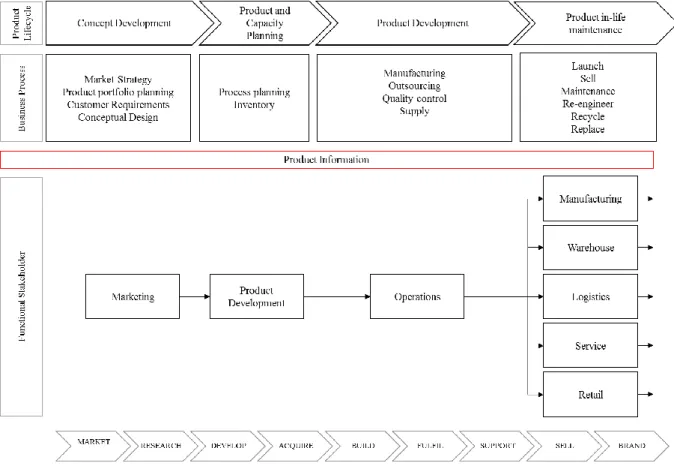
Product lifecycle is a marketing concept that describes the stages a product goes through in the product maturity cycle. Figure 3shows the generally accepted stages of a product’s lifecycle, from launching a product in a market to withdrawing the product from a market (Jeong, 2010). There is no prescribed way to define the lifecycle stages of a product. The stages of a product’s lifecycle depend on the product, the organisation, and the market environment.
15
Data for the product and the customer is captured at every stage in the lifecycle of the product. In PLM the data captured at the numerous product lifecycle stages is transformed into an information knowledge system that is used as a business strategy to rapidly improve the time-to-launch of new products and to improve the management of existing product portfolios (Ameri & Dutta, 2005:577).
2.2 EXISTING LITERATURE, AND ITS LIMITATIONS
The objectives of the research assignment, as stated in Chapter 1, Section 1.2.2, are divided into two distinct parts. The first part is to design an engineering framework that is a top-down customer-centric approach, to illustrate a complete process of value creation and value measurement. This is done by combining various best practice processes and methods in a meticulously-chosen manner to demonstrate a value creation procedure from the organisation’s objectives towards the organisation’s customer value propositions, and contrariwise, together with a means to measure the impact of the value creation on the firm value of the organisation.
The second part of the research objectives is to introduce key concepts such as multifunctional team integration and business process parallelisation into PLM. This is accomplished by extending the existing PLM processes with a framework that is designed to optimise multifunctional team integration and communication by making use of best practice tools and design principles.
Given that PLM is predominantly product-centric, there is little research available on the attempt to shift the organisational focus within PLM towards customer-centricity. Therefore the scope in which the existing literature was studied ranged over numerous disciplines – in particular, the disciplines of Systems Engineering, Marketing, Project Management, and Financial Management. The primary research work that was identified from the existing literature, and that partially complied with the objectives of this research assignment, was the value creation process that Yang and Sung designed and published in 2010. They introduced the notion that it is not sufficient for an organisation only to satisfy their customers: it also has to create value for their customers. They delivered a process that traces product quality attributes through various channels towards the marketing objectives by making use of four methods: the Refined Kano’s model, the Blue Ocean strategy, value analysis, and marketing objectives.
The value creation process is used as a foundation for the integrated value proposition design framework. The research assignment extends the value creation process to comply fully with the research objectives by addressing six limitations of the value creation process.
16
The first limitation of the value creation process is that it is not supplemented by a quantitative measurement tool to perform and implement the process steps within the PLM of a new product development effort, or the management of existing product portfolios.
The second limitation of the value creation process is that it fails to target a specific customer segment for a product. This limitation is addressed with customer segmentation.
In order for the value creation process to be used as a value proposition design procedure in a complete customer-centric approach, the third limitation of the value creation process is that it does not incorporate customer experience designs, such as a customer journey and touch-point analysis.
Yang and Sung mention in their article how an organisation can obtain firm value in return for delivering value to their customers. However, customer lifetime value modelling is not explicitly included within the value creation process – which is the fourth limitation of the value creation process.
The value creation process defines a product according to customer perceptions. However, the value creation process does not include a forecast of the product’s uptake by customers in a market. Therefore the fifth limitation of the value creation process is that it does not forecast a product’s uptake in a market.
The sixth limitation is that the value creation process does not define the value obtained by the organisation through the value creation process, and does not provide a means to quantitatively measure the firm value obtained.
The next sections of the literature review describe, first, the value creation process and the theoretical methods used within it; then the various theoretical concepts used to extend the value creation process into an integrated value proposition design framework are provided.
2.3 THE VALUE CREATION PROCESS
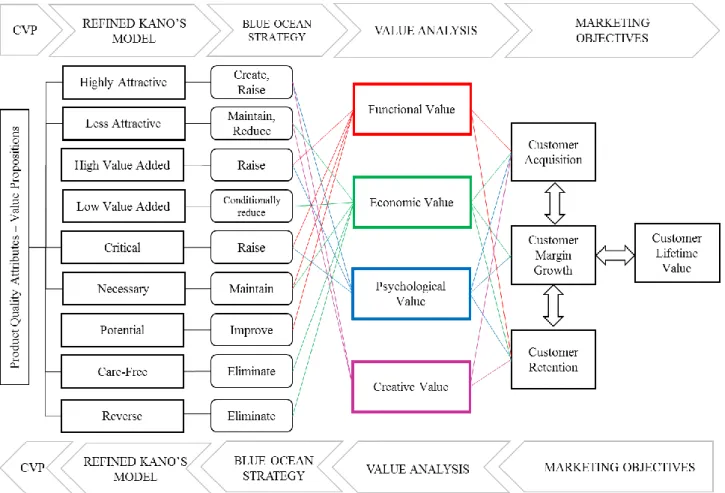
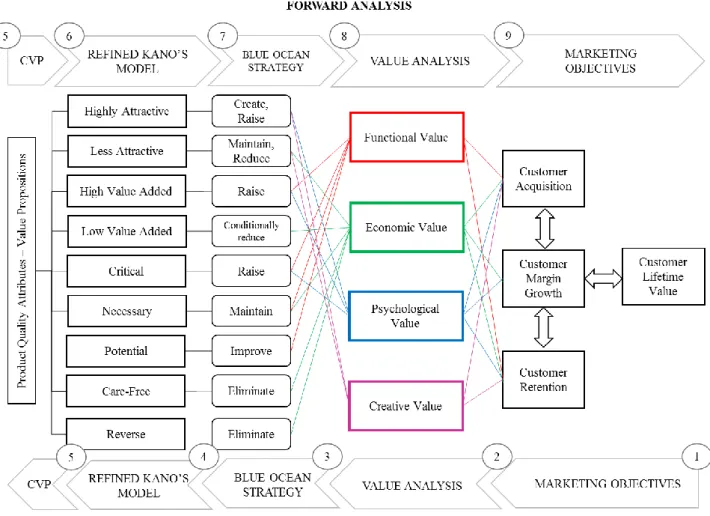
There are a number of theoretically defined value creation processes (cf. Payne & Frow, 2005; Payne; Yang & Sung 2005). However, for the purpose of this research assignment the value creation process of Yang and Sung (2010:927) was the most accessible process to use in compliance with the research assignment objectives. Yang and Sung designed a model of the value creation process that suggests possible useful actions to enhance customer value, and in return illustrates how the added customer value will be realised in an organisation’s marketing objectives. The value creation model, as illustrated in Figure 4, combines the Refined Kano’s Model and the
17
Blue Ocean strategy to identify in which value categories customers will obtain value, and in which marketing strategy it will be realised: in customer acquisition, customer retention, or customer growth.
Figure 4: Value Creation Model (Yang & Sung, 2010)
The value creation process can be used in a forward and backward approach. The theoretical description on each entry of the value creation process is discussed; thereafter the analysis of the integrated value proposition design framework is reviewed.
2.3.1 Marketing objectives
There are many definitions of and theories about marketing strategy. For the purpose of this article, the objective of marketing strategy is to increase sales through encouraging customer retention, customer acquisition, or customer growth.
Customer acquisition refers to a new customer making a purchase for the first time (Gupta, Hanssens, Hardie, Kahn, Kumar, Lin, Ravishanker, & Sriram 2006:144). Customer acquisition plays a major role in new markets, when the repeat purchases in a market are infrequent, when an existing market is in a rising phase, and when the costs of transferring between competitors are low (Ang & Buttle, 2006:296).
18
Customer retention refers to the probability that a customer will repeatedly make a purchase (Gupta
et al., 2006:144). Customer retention is an extremely important strategy in a mature market. The costs associated with retaining existing customers are considerably lower than those for acquiring new customers. Customer retention involves having a relationship with a customer with the aim of lengthening customer lifetime (Ang & Buttle, 2006:84).
Customer growth – also known as customer margin expansion – refers to a strategy aimed to grow an individual customer’s spending behaviour. Customer growth depends on a customer’s past spending behaviour and on the organisation’s ability to upsell to the customer (Gupta et al., 2006:144).
2.3.2 Value analysis
Customer value is the trade-off between what a customer knows a product or service costs, and the value that the customer perceives to obtain from it. Customer value depends on how much a product or service contributes to fulfilling customer needs, and how the product or service varies from other competing products or services (Lam, Shankar, Erramilli & Murthy, 2004:295). Value can be added to a customer in four value categories: economic value, functional value, psychological value (Gupta & Lehmann, 2005:7), and creative value (Yang & Sung, 2010:925). Economic value is the financial benefit a customer obtains when using a product or service. Functional value is the practical benefits that a customer receives from the performance or the features of the product or service. Psychological value is the benefits associated with the intangible values of the product or service – for example, brand names. Lastly, creative value is the value added to the customer when they are using the breakthrough idea for the first time.
2.3.3 Blue Ocean strategy
According to Kim & Mauborgne (2004), the business space consists of two types of market environments: ‘Red Oceans’ and ‘Blue Oceans’. Red Oceans represent all the known market environments today. In red ocean environments, organisations know who their competitors are, and there are clear rules for competition. Organisations caught in a Red Ocean aim to overtake the competition and to increase their share of the existing market demand. New products are launched to match or to beat the competition. Blue Oceans represent unknown market environments: in a Blue Ocean the market demand is created rather than battled over between competitors. Blue Oceans can be created in two ways: either by creating a new market environment, or by altering the existing red ocean market in such a way that a new market is created.
19
The Blue Ocean strategy is a strategic tool set used to exemplify a product or service in a current market. It is known as the ‘value innovation’, as it differentiates an organisation so that it transforms the market into a new environment, propelling the organisation forward as an industry leader. The Blue Ocean strategy offers four possible strategic actions for the organisation: Create
new offerings that the industry has never seen before; Raise to change existing offerings well beyond the industry norm; Reduce to lower existing offerings well below the industry norm; and
Eliminate offerings that the industry takes for granted (Kim & Mauborgne, 2005). 2.3.4 The Refined Kano’s model
Kano’s model is a best practice quality measurement tool used in product and service development processes to classify product and service attributes according to how customers perceive them. The Kano’s model classifications of quality attributes are key design principles. These classifications measure the effect that a product quality attribute has on customer satisfaction. This provides a logical reasoning to make detailed cost-versus-customer-satisfaction trade-off decisions (Rashid, 2010).
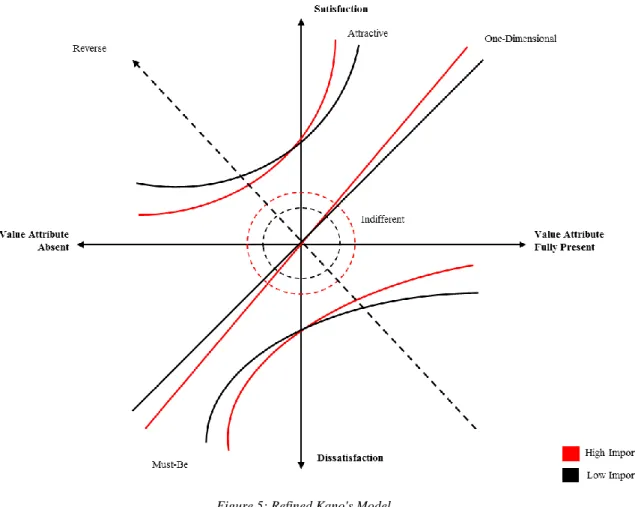
The model classifies product attributes into five categories: Must-Be attributes, One-Dimensional
attributes, Attractive attributes, Indifferent attributes, and Reverse attributes.
Attractive quality attributes lead to utmost customer satisfaction when present in a product. However, customers do not expect to find attractive quality attributes present. The result is no customer dissatisfaction when attractive quality attributes are absent in a product, but extreme customer satisfaction when present. A One-Dimensional quality attribute is an attribute that represents a linear relationship between a customer’s perception that the quality attribute will satisfy their need and the quality attribute’s ability to fulfil it. Better fulfilment in one-dimensional attributes helps to improve customer satisfaction, and contrariwise. Must-Be quality attributes are attributes that result in absolute customer dissatisfaction when absent from a product, but that, when present, do not contribute to customer satisfaction. A customer assumes that Must-Be quality attributes will be present in a product. Indifferent quality attributes do not contribute to either customer satisfaction or dissatisfaction. Reverse quality attributes result in absolute customer dissatisfaction when present, and customer satisfaction when absent.
Yang (2005:1129) improved the Kano’s model and developed a Refined Kano’s model to take into account a customer’s perception of the degree of importance of a quality attribute. The model extended the Kano’s model to consist of nine quality attributes.
20
Figure 5: Refined Kano's Model
Attractive attributes with a high importance become Highly Attractive quality attributes. These are an organisation’s strategic offerings as they, in essence, attract new customers. Attractive attributes with a low importance are Less Attractive quality attributes. Less Attractive attributes are attractive quality attributes that customers perceive as less important in a product or service; these quality attributes can be removed in cost-versus-quality trade-offs.
One-Dimensional attributes with a high importance are High Value-Added quality attributes. These attributes should be maximised because they generate customer satisfaction to a great extent. One-Dimensional attributes with a low importance are Low Value-Added quality attributes. These do not contribute significantly to customer satisfaction; however, organisations cannot avoid these attributes because their absence will cause customer dissatisfaction.
Must-Be attributes with a high importance become Critical quality attributes. These are vital in a product, for they represent the core quality attributes a product must have to function successfully. Must-Be attributes with a low importance are Necessary quality attributes. Organisations should meet these requirements at a desired level in order to avoid customer dissatisfaction.
21
Indifferent attributes with a high importance are Potential quality attributes. These attributes have the potential to turn into attractive quality attributes if they are improved. Indifferent attributes with a low importance are Care-Free quality attributes; these should be completely avoided.
2.3.5 The value creation process analysis
The model allows the decision makers to use a forward and backward analysis to align customer lifetime value through the appropriate strategies of acquisition, retention, and growth to the product quality attributes. The value creation process is analysis in a forward and backward manner.
The forward analysis of the value creation model starts on the left of Figure 4 by classifying product value propositions according to the Kano’s refined quality attributes. Thereafter the model recommends which Blue Ocean strategy to use in reaction to a Refined Kano’s quality attribute. The effect on customer value that the Blue Ocean strategy has, in conjunction with a Refined Kano’s quality attribute, is illustrated in the model. Lastly, the customer value is translated into marketing objectives that result in an optimised customer lifetime value.
The value creation model in a forward analysis can be used as both a tactical and a strategic tool. Tactically the model guides stakeholders to make immediate decisions, to formulate the product value propositions according to the customer, and to realise a value creation process. Strategically, the forward analysis validates whether the product value propositions will realise the organisation’s marketing objectives.
A backward analysis can likewise be applied to the value creation model. The backward analysis starts by identifying and prioritising the marketing objectives for a product; thereafter it links the marketing objectives with the customer value categories in order to recognise the customer value categories that need to be fulfilled. The value creation model in a backward analysis can be used as a strategic tool to identify useful actions to optimise the marketing objectives. The value creation model functions as a planning tool to communicate the marketing objectives from senior executives through to marketing managers performing the work.
22
2.4 QUALITY FUNCTION DEPLOYMENT
To overcome the first limitation of the value creation process, quality function deployment (QFD) is recommended as a quantitative measurement tool to implement the value creation process by prioritising the entries within the process.
The QFD is a very efficient communication and decision-making tool: it takes a subjective attribute and converts it into an objective attribute that can be measured and quantified. Within the QFD the ‘House of Quality’ enables cross-functional team communication through analytical measurements to ensure accurate and quantifiable results. The QFD’s House of Quality brings structure, comparative measurement, and prioritisation into any decision-making process (Hauser & Clausing D. 1988:1).
The integrated value proposition design framework is implemented by using various roll-outs of the House of Quality. The literature review provides an overview of the theoretical application of QFD used in later chapters (Chapters 4 and 7) of this research assignment.
Figure 6 illustrates a House of Quality template.
Figure 6: House of Quality Template
Our Company A Competitor #1 B Competitor #2 C Competitor #3 D 1= Lowest 5 = Highest 1 2 3 4 5 Attribute 1 1 Attribute 2 1 Attribute 3 1 Attribute 4 1 Attribute 5 1 Attribute 6 1 Attribute 7 1 Attribute 8 1 Attribute 9 1 Attribute 10 1 0 0 0 0 0 Competitive Evaluation 1 1 1 1 1 Importance Rank 1 1 1 1 1 0 0 0 0 0 Relative % Raw score 0 0 0 0 0 A tt ri b u te 6 A tt ri b u te 7 A tt ri b u te 8 A tt ri b u te 9 A tt ri b u te 1 0 Im p o r ta n c e R a ti n g A tt ri b u te 1 A tt ri b u te 2 A tt ri b u te 3 A tt ri b u te 4 A tt ri b u te 5 Interactions/Roof Area: SP = Strong Positive WP= Weak Positive WN= Weak Negative SN = Strong Negative Relationships: 9 = Strong 3 = Moderate 1 = Weak 0 or Blank = No Relationship Importance Rating: 1 = Low Importance 3 = Moderate Importance 5 = High Importance 1 2 3 4 5 6 7
23
The House of Quality is a comparative tool that matches two entries against each other. The order of completing the House of Quality is marked from one to seven in Figure 6. The first step is to fill in the attributes of entry one; thereafter the attributes of entry one are ranked according to their priorities. The third step entails a competitive evaluation of entry one’s attributes according to the competitor offerings; this step is optional. The fourth step is to fill in the attributes of entry two into the House of Quality. Step five rates the relationship between the attributes of entry one against the attributes of entry two, varying from robust to weak. Step six prioritises the attributes of entry two relative to the attributes of entry one. Lastly, step seven rates the attributes of entry two according to their correlation against each other. The ultimate objective of the House of Quality is to obtain the importance rating of entry two in step six.
The QFD not only extends the value creation process to overcome its first limitation; it also functions as a communication tool between stakeholders, thus helping the research assignment to comply with the objective of improving integration and communication between PLM stakeholders.
2.5 CUSTOMER SEGMENTATION
The second limitation of the value creation process is that it fails to target the value creation and measurement methods for a specific customer segment. Therefore the theoretical concept of ‘customer segmentation’ is included within the literature review.
Customer segmentation is the practice of dividing customers into different groups of individuals who have similar needs and characteristics. These target groups, known as customer segments, are alike in specific ways such as gender, age, interests, spending behaviour, and demographics. How the customers are grouped into customer segments varies between organisations and industries. Traditionally it is recommended that customer segmentation should group customers according to their demographic, geographic, and psychological information in order to obtain a subjective presumption about the customer segment. Today customer segmentation is more focused on dividing customers into value bands to obtain an objective presumption about the customer segment. The practice of ‘value band customer segmentation’ groups customers according to the amount of revenue that individual customers generate for the organisation (Epetimehin, 2011:62-63).
The purpose of value band customer segmentation is to increase customer value or profitability by carefully selecting a specific target group for a product or a campaign. The three key elements to