Evaluation of Voice over Internet Protocol Quality of Service
1FASIKU, AyodejiIreti
1,
Department of Computer Engineering Ekiti State University, Ado Ekiti,
Ekiti State, Nigeria.
1
2
OBASANYA TayoDorcas
2
Department of Computer Engineering Ekiti State University, Ado Ekiti,
Ekiti State, Nigeria.
2
Abstract
The fact that Visual and vocal communication can be transferred through various channels such as Public Switched Telephone Network (PSTN) and packet switched network is undisputable. Voice over Internet protocol (VoIP) is a thriving technology that has been increasingly popular in recent times due to its affordability and reduced cost in making calls over an existing network infrastructure. However, the quality of VoIP is mainly impaired by jitter, delay, packet loss and some other parameters. This research was carried out to evaluate voice quality in VoIP experimentally and to select an appropriate voice compression and decompression scheme depending on the Quality of Service of VoIP under different scenarios using simulation method. A VoIP network was simulated and deployed using Riverbed modeler academic edition 17.5 and the behavior and quality of VoIP was studied and analyzed under different scenarios. The results of the analysis and the performance evaluation presented in this work will help organizations understand how well VoIP will perform on a local network prior to its adoption, it can also guide researchers and designers to design a network for VoIP deployment and it will give network operators an opportunity to select the codec for better services of VoIP for customer satisfaction.
Keywords: VoIP, QoS, PSTN, Codec, simulation, Modeler, Voice Compression, Voice Decompression
INTRODUCTION
In the present world of telecommunication, the prevalence of Voice over Internet Protocol (VoIP) technology in organizations has risen geometrically. The history of this VoIP began with conversations by a few computer users over the Internet. Voice over Internet Protocol (VoIP) technology unites the worlds of telephony and data, by enabling the transfer of data and voice content (i.e. phone calls and faxes) over the Internet, Intranet or other packet-switched network using either a dedicated IP telephone set or a network computer that can accommodate a VoIP software. Internationally, many businesses have implemented Voice over Internet Protocol (VoIP) as an alternative to the traditional plain old telephone system known as Public Switched Telephone Network (PSTN) [1][2].
In VoIP technology the voice signal is first separated into frames, which are then stored in data packets, and finally transported over IP network using voice communication Protocol. The two most widely used protocols for VoIP are the International Telecommunications Union (ITU) standard H.323 and the Internet Engineering Task Force (IETF) Standard Session Initiation Protocol (SIP). Both are signaling protocols that set up, maintain and terminate a VoIP call. There is also the Media Gateway Control Protocol (MGCP) that provides a signaling and control protocol between VoIP gateways and traditional PSTN (Public Switched Telephone Network) gateways.
Quality of Service (QoS) is fundamental to the operation of a VoIP network that meets users’ quality expectations. Quality of
Service (QoS) can be defined as the network ability to provide good services that satisfy its customers. In other words, QoS is used for measuring the degree of users’ satisfaction. When degree of user satisfactions is high then it means the QoS is also high[3]. Among the factors affecting quality of service are: Delay which is the time interval between the instant that the talker speaks and the listener hears, Jitter i.e. the variation in arrival rate of voice packets at the destination, Packet Loss that happens when the network is congested with too much traffic or bandwidth is overrun and when the network quality is poor, Echo, Throughput, Load and Mean Opinion Score (MOS) which is a measure of voice. Encoding techniques play main role in the performance of the VoIP network. In general, there are twelve encoding techniques available. The common ones are G.711, G.723 and G.729A. These three are compared to know the one that will provide the best voice quality in VoIP technology. This research concentrates mainly on evaluating quality of service in VoIP by analyzing the factors affecting it and comparison between various encoding techniques.
The rest of this paper is structured as follows. Section 2 provides a review of related work while Section 3 discusses the design and simulation of networks under various scenarios. Section 4 presents analysis of the results obtained in the experiments and Section 5 concludes the paper by summarizing our contributions and stating recommendations.
RELATEDWORK
Lutfallah [4] worked explicitly on how to facilitate adequate quality of service by discussing various factors affecting voice quality. The factors he discussed are delay, jitter, packet loss, link errors, echo and Voice Activity Detection (VAD). He measured voice quality using Mean
Opinion score and E-model. He also used echo canceller and initiation of Voice Activity Detection (VAD) as network design suggestions and he tested his result with a software tool called “Westplan”. In his results, he concluded that the performance of IP telephony depends heavily on the bandwidth. Therefore, various techniques which will help to save bandwidth should be used for a successful VoIP implementation. The strength of the work was centered majorly on how to lessen voice quality problems. The limitation in the work is the network design suggestions which are not interoperable.
Mojtaba and Amanian[5]tried to increase the quality of service in VoIP networks by increasing the reliability factor so that besides establishing a secure connection, we can prevent premature call failure and thereby be able to increase trust factor in the quality of services of the networks. It was titled increase reliability factor of quality of services in VoIP networks and they discussed some of the challenges and attacks on VoIP infrastructure. Some of these attacks reduce the quality of the service and its reliability. They stated that most approaches for secure communication between two servers are focused on encryption and they pay less attention to the improvement of the quality of services. They tried to establish a secure connection between VoIP servers in order to avoid probable disconnection and so that the reliability of the quality of services can be increased using “Wire Shark” software. They implemented two cases and measured the amounts of packaged exchanged.In their result, no package is dropped and there is a secure communication because router doesn’t realize RTP packages. This is the major strength of their research. Also, RTP packets are exchanged in the form of UDP packets; so, routers and firewalls are not aware of RTP packets and users can easily
exchange their packages. The drawback is that measuring packets loss alone is not enough to determine the quality of service Alsahlany[6] analyzed and evaluated the performance of VoIP based integrated wireless LAN/WAN taking into account various voice encoding schemes in his research titled “performance analysis of VoIP traffic over integrating wireless LAN and wan using different codecs”. He explained that parameters of QoS are required to increase the performance of a VoIP system. In his evaluation, codecs of ITU standards for audio compression and decompression were used. The author in his approach used OPNET simulator for network modelling and he implemented three different scenarios to evaluate the difference in performance and to determine the best audio encoding schemes for utilizing VoIP integrating wireless LAN/WAN. The codecs he compared are G.729A, G.723.1 and G.711. In his results, he concluded that voice jitter variation in case of codec G.723.1 is higher and hence poor. The strength of this approach is that the author was able to evaluate the codec that will reduce VoIP quality out of the three codecs he used as case study. The limitation of the author’s work is that is approach was designed for wireless networks alone which implies that his result may not be applicable in cabled network where VoIP is being deployed. Kulkarni et al [7] in their research titled performance evaluation of VoIP in mobile Worldwide Interoperability for Microwave Access (WIMAX); performed a simulation and emulation study for VoIP traffic in a mobile WIMAX system using EXata 2.0.1. EXata is a comprehensive suite of tools for emulating large wired and wireless networks. It uses simulation and emulation to predict the behavior and performance of networks to improve their design, operation, and management. In their result, they justified that both simulation and emulation studies are
effective and efficient techniques to evaluate the performance of any new upcoming network. The simulation studies proved that G.711 has more in and out traffic as its bandwidth consumption is highest among all the codecs, this is justified by emulation results. The delay or jitter performance of G.723.1 is good comparatively to other codecs, during the emulation time actually this was experienced.
This research however focuses on measuring the Quality of Service parameters in the implementation of a VoIP network design using the Riverbed modeler as a simulation tool and their characteristics were analyzed and evaluated. Various encoding techniques of voice signal are also compared.
NETWORK DESIGN AND
SIMULATION
Simulation is a beneficial technique to deploy, run and forecast the performance of a system. In this research work, it is needed to check the performance of various Voice over Internet Protocol (VoIP) codecs and measure VoIP Quality of Service (QoS) so simulation is the best option to plan and design the network, deploy it and test various scenarios. The simulation tool utilized for the purpose of studying voice quality and behavior of different codecs in alternate environment and scenario is Riverbed Modeler academic edition 17.5. All the components required for the implementation and design process are available in the object palette of the modeler.
EXPERIMENTAL NETWORK
DESIGN
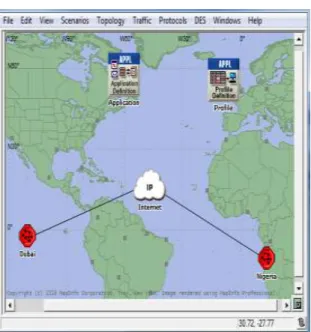
In the VoIP network that was simulated, there are two companies that are located in two different countries namely: Dubai and Nigeria. Eachcompany occupies two floors and there are fifteen workstations on each floor. The local area network (LAN)
structure for both companies is the same. Workstation on each floor can communicate with workstations on different floor within the same building using VoIP. To make our VoIP network more interesting, workstations on each floor can also communicate using VoIP with workstations on any floors in the second company located in the other country.
The purpose of building two LANs is because it is necessary to simulate communications within the same building and communications between two different buildings as local and long-distance VoIP communication respectively and observing how parameters such as jitter, end-to-end delay and packet loss ratio change in both situations. Figure 1 shows the Simulation model of VoIP network and figure 2 shows the LAN network in each subnet.
Fig 1: Simulation of VoIP network
Fig 2: LAN Structure in each subnet Four different scenarios were simulated. In scenario one, long distance conversation pair was created between the two companies and two local conversation pairs within the Nigerian company. One on the same floor and one conversation pair between two different floors in order to implement local and long-distance VoIP calls. In scenario two, how the Internet Quality of Service (QoS) affects the quality of VoIP was observed using the discard ratio. Initially the packet discard ratio was 0.5%, after which it was changed to 1% and 5% under the performance metrics attributes of the IP cloud. Scenario three was simulated to test the performance of the encoding techniques and their effects on VoIP quality of service. The last scenario was simulated to compare a non-busy VoIP network with a busy VoIP where in the busy VoIP network two different link capacities (PPP DS1 and PPP DS3) were used as they have different throughput.
SCENARIO ONE
Comparison Between Local and Long-Distance VOIP Communication
The graphs below are the results obtained for scenario one. In the graphs below, the blue graph represents call made within the same company across different floor, the brown graph represents call made within the same company on the same floor and the green graph represents call made
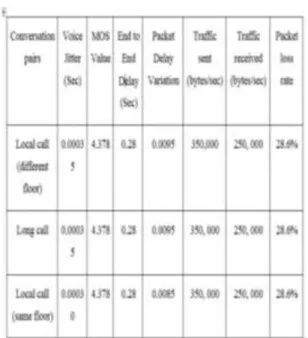
between the two companies. Figures 3, 4, 5, 6, 7, 8 and 9 represent jitter, MOS value, end to end delay, packet delay variation, traffic sent, traffic received and traffic sent/received respectively and table 1 shows the summary of result.
Fig 3: Jitter (seconds) in Long-Distance and Local Conversation Pairs.
Fig 4: MOS value in Long-Distance and Local Conversation Pairs.
Fig 5: End to End Delay in Long-Distance and Local Conversation Pairs.
Fig 6: Packet delay variation in Long-Distance and Local Conversation Pairs.
Fig 7: Traffic sent (bytes/sec) in Long-Distance and Local Conversation Pairs.
Fig 8: Traffic received (bytes/seconds) in long-distance and local conversation
pairs.
Fig 9: Traffic sent and received (bytes/sec) in long-distance and local conversation
pairs.
Table 1: Summary of result obtained in scenario one
SCENARIO TWO
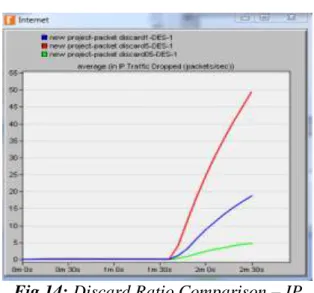
Observation of VoIP Quality Under Different Discard Ratio (Internet QoS) The following graphs were obtained after simulating the scenario for jitter, MOS value, End to End delay, packet delay variation, traffic sent and traffic received. In the graphs, the green colour represents 0.5%, the blue colour represents 1% and the red colour represents 5%.
Fig 10: Discard Ratio Comparison – Jitter (seconds).
Fig 11: Discard Ratio Comparison – MOS value.
Fig 12: Discard Ratio Comparison – End to End delay (seconds).
Fig 13: Discard Ratio Comparison – packet delay variation.
Fig 14: Discard Ratio Comparison – IP traffic dropped (packets/second). Figures 10, 11, 12, 13 and 14 show the jitter, MOS value, delay, packet delay variation and traffic dropped respectively while Table 2 shows the summary of the results captured in scenario two.
Table 2: Summary of results obtained in scenario two.
SCENARIO THREE
Different Encoder Schemes Usage and Their Effects on VoIP Quality
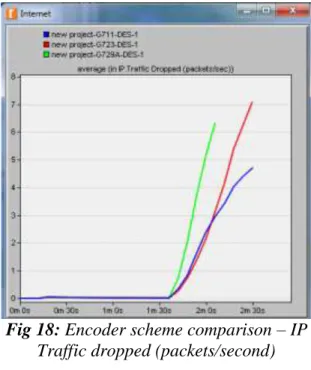
The following graphs were gotten after simulation. In the graphs, the blue colour represents G.711, the red colour represents G.729A and the green colour represents G.723.
Fig 15: Encoder scheme comparison – Jitter (seconds).
Fig 16: Encoder scheme comparison – MOS value.
Fig 17: Encoder scheme comparison – End to End delay (seconds)
Fig 18: Encoder scheme comparison – IP Traffic dropped (packets/second) Table 3: summary of results obtained in
scenario three.
Figures 15, 16, 17 and 18 depicts results obtained for jitter, MOS value, delay and traffic dropped for scenario three respectively and table 3 summarizes the result.
SCENARIO FOUR
Comparison Between aBusy Network and a Non-Busy VoIP Network
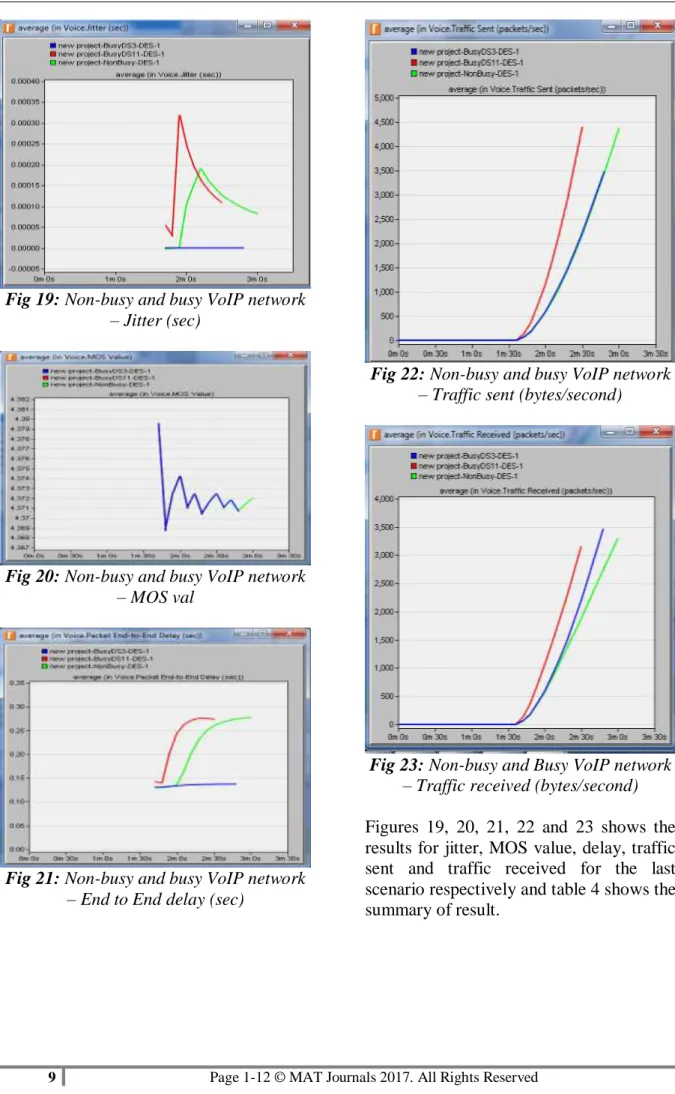
In the graphs below, the green colour is for the non-busy VoIP network, the red colour is for the busy VoIP network with PPP DS1 and the blue colour is for the busy VoIP network with PPP DS3 link.
Fig 19: Non-busy and busy VoIP network – Jitter (sec)
Fig 20: Non-busy and busy VoIP network – MOS val
Fig 21: Non-busy and busy VoIP network – End to End delay (sec)
Fig 22: Non-busy and busy VoIP network – Traffic sent (bytes/second)
Fig 23: Non-busy and Busy VoIP network – Traffic received (bytes/second) Figures 19, 20, 21, 22 and 23 shows the results for jitter, MOS value, delay, traffic sent and traffic received for the last scenario respectively and table 4 shows the summary of result.
ANALYSIS OF RESULT
In the first scenario where conversation pairs between short and long distances were compared, only the jitter and packet delay variation of the long distance conversation pair are slightly different from that of the short distance. MOS value, delay and packet loss are the same and these are the most important parameters in determining voice quality. This implies that distance doesn’t really affect speech quality in VoIP.
In the second scenario simulated to observe how internet quality of service affects speech quality in a VoIP network, for voice jitter, network with 10% discard ratio has the highest jitter. In term of end-to-end delay, network with 10% discard ratio has the longest End-to-End Delay, compared with the other two discard ratios. It indicates that network with higher discard ratio has lower end-to-end delay time. As the discard ratio increases, more packets are discarded during transmission causing faster link throughput. The increase in link throughput causes packets arriving at the earlier than the expected time. Early packet arrival can also deteriorate the quality of VoIP as it makes the voice message incomprehensive. From Table 2, it clearly shows that the higher the discard ratio in a network, the more packet
loss occurs in that network. Furthermore, the higher the discard ratio in a network, the lower the MOS value in that network. It is reasonable as more voice packets are discarded in a network, the voice quality is greatly deteriorated and it explains the drop in the MOS value. The Internet QoS affects the quality of VoIP since different Internet QoS tends to have different packet discard ratio. Packet discard ratio can alter jitter, end-to-end delay and packet loss which are all VoIP deterioration factors. From the result summarized in table 3, for scenario three it is evident that a network with G.711 codec is more efficient because it has the shortest End-to-End delay and the least jitter with the best MOS value. This means that G.711 has higher quality than the other two codecs. The MOS result from the simulation makes sense because by standard; this codec has a high compression rate of 64Kbps. This makes delay shorter and leads to high voice quality.
The summary of results shown in table 4 implies that the quality of VoIP deteriorates as the VoIP network gets busy. When the VoIP network becomes busy, overload happens and causes larger fluctuation in jitter, longer end-to-end delay, lower MOS value and more packet loss. The solution is to change the link capacity and the replacement of DS1 link by the DS3 link that eliminates the overload because the DS3 link has much faster data rate than the DS1 link. As a result, in order to improve the voice quality in a busy VoIP network, it is essential to use a high capacity link such as DS3, Optical Carrier OC24 and Optical Carrier OC48.
CONCLUSION AND RECOMMENDATION
VoIP is the ability to make telephone calls (i.e., to do everything we can do today with the PSTN) over IP-based data networks with a suitable quality of service
(QoS) and a much superior cost/benefit. It will continue to be widely used in the future since it has many advantages. In this project, a VoIP network was successfully simulated using Riverbed modeler and factors that deteriorate the quality of VoIP such as jitter, voice end-to-end delay, packet loss and Internet QoS were studied under four different scenarios using Riverbed modeler. In order to evaluate the performance of a VoIP network, statistical and graphical analysis were presented to find out comparison patterns among the factors. This is very important and useful as the comparison pattern can tell what is happening in VoIP conversation for each network scenario.
In the results obtained for the first scenario, it was discovered that quality of VoIP does not really depend on the distance between the communication nodes though the quality in short distance VoIP communication is still a bit better than that of long distance. In the second scenario simulated, there was a clear evidence that the Internet Quality of Service (QoS) affects the quality of VoIP. Poor Internet QoSintroduce higher packer discard ratio; thus, more voice packets are dropped causing the voice message incomprehensive. The characteristics of three codecs were evaluated and analyzed in the third scenario using the graphical results obtained. The simulation result shows that VoIP service perform best under G.711 codec. Considering the possible overload of the network capacity, a non-busy and busy VoIP networks were compared in another scenario. It was found out that the quality of VoIP deteriorates as the VoIP network gets busy. When the VoIP network becomes busy, overload happens causing larger fluctuation in jitter, longer end-to-end delay, more packet loss and lower MOS value. The solution to fix these parameters is to change the link capacity. As a result, in order to improve the voice quality in a busy VoIP network,
it is essential to use a high capacity link such as Digital Signal 3 (DS3), Optical Carrier (OC24 and OC48). Therefore, to achieve the best VoIP network performance, organizations deploying this service should consider the distance, use high internet quality of service, select the best encoder scheme and use a high capacity link to connect the nodes.
Designing an encoding technique that is better than G.711 can be considered as a future work. Also, in future studies more realistic traffic applications such as FTP, database and E-mail can be considered together with VoIP.
REFERENCES
1. U. Lydia, "Voice over Internet Protocol (VoIP) as a communication tool in South Africa business," South Africa, 2009.
2. D. K. Angelos, "A comprehensive Survey of Voice over IP Security Research," in IEEE Communications Survey and Tutorials, New York, 2010.
3. D. K. Richard, J. W. Thomas and F. Steffen, "Security Consideration for Voice over IP System," in Recommendation of The National Institute of Standard Technology,
Computer Security Division,
Information Technology Laboratory National Institute of Standards and Technology, Gaithersburg, 2015. 4. T. Lutfallah, "Analysis of Voice
Quality Problems of Voice over Internet Protocol," Monterey, 2003. 5. E. S. Mojtaba and M. Amanian,
"Increase reliability factor of quality of services in VoIP networks," International Journal of Information
and Communication Technology
Research, vol. 5, no. 6, pp. 1-7, 2015. 6. A. M. Alsahlany, "Performance
Analysis of VoIP Traffic over Integrating Wireless LAN and WAN Using Different Codecs," International
Journal of Wireless & Mobile Networks, vol. 6, no. 3, pp. 79-89, 2014.
7. S. Kulkarni, H. J. Thontadhary and J. T. Devaraju, "Performance Evaluation Of VoIP In Mobile WIMAX; Simulation And Emulation Studies," International Journal on Computer Science and Engineering, vol. 3, no. 3, pp. 1124-1130, 2011.
Authors’ Brief
FASIKU, AyodejiIretiis a lecturer at the Department of Computer Engineering, Ekiti State University, Ado Ekiti. He is currently pursuing his PhD degree in Computer Engineering at ObafemiAwolowo University, Ile-Ife,Osun State, Nigeria. He received a B.Tech. (Hons) Degree in Computer Engineering from LadokeAkintola University of Technology, Ogbomoso, Nigeria. He holds
a Master of Technology(M.Tech) degree in Computer Science from Federal University of Technology,Akure, Nigeria. His research interest is in Computer Architecture and Artificial Intelligence. He is a Registered Engineer with the Council for the Regulation of Engineering in Nigeria, CORENand a member of Nigeria Society of Engineers.He can be reached [email protected].
OBASANYA, TayoDorcasis a lecturer at
the Department of Computer Engineering, Ekiti State University, Ado Ekiti. He is currently pursuing his PhD degree in Computer Engineering at ObafemiAwolowo University, Ile-Ife, Osun State, Nigeria. She received a B.Tech. (Hons) Degree in Computer Engineering from Federal University of Technology, Minna, Nigeria. He holds a Master of Technology(M.Sc) degree in Computer Science from ObafemiAwolowo University, Ile - Ife, Nigeria. Her research interest is in Mobile Computing. She is a Registered Engineer with the Council for the Regulation of Engineering in Nigeria, CORENand a member of Nigeria Society of Engineers.She can be reached [email protected]