Mining for Secure Web based Business Intelligence
Applications
A.V.Krishna Prasad and
Dr.S.Ramakrishna
SVU Tirupathi A.P. India
Dr.P.Suresh Varma
Principal and Professor of CS
ANU Rajahmundry A.P. India
D.Shravani
Research Scholar CS
Rayalaseema University
Kurnool A.P. India
ABSTRACT
Web Based Business Intelligence applications uses integrated and intensified technologies like Web 2.0 architectures, Agile Modeling, and Service-orientation (or Web Services). Applying Mining strategies to Web based Business Intelligence application will eventually provide benefits to Business Intelligence users, Decision makers, and importantly Web application architects. In this paper, we discuss about Mining for Web based Business Intelligence Applications. We validate our approach with a suitable exemplar CRM Application. This research entitled ―Designing Dependable Web Services Security Architecture Solutions‖ addresses the innovative idea of Web Services Security Engineering using Web Services Security Architectures with a research motivation of Secure Service Oriented Analysis and Design. It deals with Web Services Security Architectures for Composition and Contract design in general, and Authentication and authorization (access control) in particular, using Agile Modeled Layered Security Architecture design, which eventually results in enhanced dependable privacy requirements, Secure Policies and Trust negotiations. All the above findings are validated with appropriate case studies of Web 2.0 Services, BPEL for Role Based Access Control, a secure stock market financial application, and their extension for spatial mobile application for cloud etc. All this research paves a way to Secure Web Engineering (or) Secure Web Science.
General Terms
Security Architectures, Web Services, Designing Solutions, Dependable Privacy Requirements, Web Services Mining, Business Intelligence, CRM
Keywords
Web Services, Security Architectures, Dependability
1.
RESEARCH ON WEB SERVICES
MINING
Now days, most of the Business Intelligence applications are developed as Web based applications with little Web Engineering principles used in developing them. Web based Business Intelligence applications are using an integration of specific technologies like Web 2.0 architectures, Agile modeling, and Service-orientation (or Web Services). Applying Mining approaches to Agile Modeled Web 2.0 architectures will eventually provide valuable insights to Business Intelligence users, Decision makers, and importantly Web application architects. When all these different technologies are integrated together for the development of Business Intelligence web based applications, it creates many research challenges pertaining to insights of decision making regarding architectures of the developed application, its inherent security of that architecture or its requirements etc.
These insights are required for maintenance of this application or in its future scalability issues.
Agile Modeling Agile modeling embraces change as a part of the software development process. [2] In most approaches, change is usually considered a bad word. Agile developers work in pairs, create many prototypes of their solutions, and incorporate user’s feedback throughout the entire process. Agile software development has encouraged developers to tailor their methods to meet their specific needs. Agile modeling using Unified Modeling Language is geared towards small development projects with tight deadlines, like building Web front ends.
Web 2.0 Architectures The relationship between Web 2.0 design patterns, models, and architecture artifacts are based on Web 2.0 technologies like search engine optimization, web services, wikis etc. to name a few for our consideration. Models guides Reference architectures and finally specialized architectures refines reference architectures, accounts for domain specific requirements, and also enables solution patterns. [3]
Web Services A Web service [9] is defined as an interface which implements the business logic through a set of operations that are accessible through standard set of Internet protocols. The extensible Markup Language (XML) based protocols namely Simple Object Access Protocol (SOAP) [15], Web Service Description Language (WSDL) [1] and Universal Description, Discovery and Integration (UDDI) [17] are the three major building blocks of Web services. Mining approaches to Web Based Business Intelligence applications
Mining Agile Architectures Agile software development methods are used to build secure systems. There are different methods defined in agile development as extreme programming (XP), scrum, feature driven development (FDD), test driven development (TDD), etc. Agile processing includes the phases as agile analysis, agile design and agile testing. These phases are defined in layers of Model Driven Architecture (MDA) to provide security at the modeling level which ensures that ―security at the system architecture stage will improve the requirements for that system‖.
Mining Web 2.0 architectures Traditionally, to mine web 2.0 architectures in general, we use the methodology for mining patterns from examples, hence capture the knowledge, and then construct models and architecture based on the commonalities in the patterns. Design patterns are micro architectures that have proved to be reliable, easy to implement and robust. Three types of Design Patterns i.e. Creational Design Patterns, Structural Design Patterns and Behavioral Design Patterns. Design Patterns are described by listing the intents, motivations, applicability, structure (UML diagrams), participants, collaborations, consequences,
implementation details are known as related patterns. The structure of the patterns is represented in Graphs or Matrices (Abstract Class Matrix, Generalization Matrix, Association Matrix etc). The pattern descriptions are easy to modify to suit the needs of users by using Design Pattern Markup Language. Reality Mining is a mashup pattern in terms of MIT which states that, it is the collection of machine-sensed environmental data pertaining to human social behavior. Mining Web Services
Web Service mining is a search process aiming at the discovery of interesting and useful compositions of existing web services. In order to explore Web Service business, ensure a correct reliable modeling and execution, analyzing and tracking Web Services Executions. This will enable them to be well understood and controlled. The Web Service paradigm promises to enable rich, flexible and dynamic interoperability of highly distributed and heterogeneous network enabled services. The idea of Web Services Mining is that, makes use and applying of Web Services and Service Oriented Architectures in the area of Data Mining. Web Service Mining describes about the Web Service, selection of Web Service, Individual Service Mining and Mining Service Dependencies. A Web Service is a self-contained software component offering a well defined interface, accessible through standardized protocols such as SOAP by remote clients in a loosely coupled way, thereby enabling flexibility and reusability. The user interaction of Web Service executions are recorded and placed into logs/lookups. These logs are preprocessed for storing in data base, monitored and used to create a new model in mining process. The selection of Web Service phase involves in selection of an appropriate service required by an application from the service lookups. The service usage denotes statistical information regarding the number of service executions and can be computed by different parameters such as usage per user, per activity with average execution time of a service and any other related information. Mining service dependencies are generated in the form of data sets by using the Frequent-Sequence mining algorithm applied on log records. The benefits of discovering logical dependencies within the sets of services gives knowledge about implicit links between services and detection of certain tight logical links between services may be used by service providers as recommendations for publishing them as a composite service.
Web Logs
Username_activityid:Serviceid_Serviceinstance:timestamp Ex:Kp_act1:01_getBseInfo:stockListPrice_10.02
Service Selection
Web service discovery is a process of accurate matching of web service from UDDI and it has become hard to locate a web service which feeds the exact user requirements. Usually a single web service is not enough to meet the user requirements. Discovery process faces two main challenges. 1) Finding exactly matched web service. 2) Satisfying end user needs with a single web service
Precision : This is the fraction of the returned results that are relevant.
Precision = Number of Relevant Services retrieved / Number of Retrieved Services
Recall: This is the fraction of the relevant services in the collection that were returned by the system.
Recall = Number of Relevant Services Retrieved / Number of retrieved services.
Service Selection & Service Usage:
The selection of Web Service phase involves in selection of an appropriate service required by an application from the service lookups.
The service usage denotes statistical information regarding the number of service executions and can be computed by different parameters such as usage per user, per activity with average execution time of a service and any other related information.
MINING FOR SERVICE DEPENDENCY:
Mining Service dependencies are generated in the form of data sets by using the Frequent-Set mining or Frequent– Sequence Mining algorithm applied on log records.
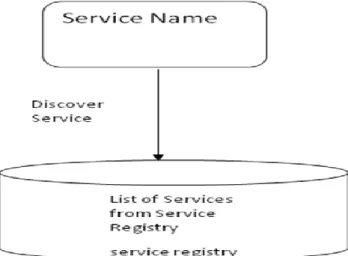
The below Figure 1 will demonstrate this process of Web Services Mining.
Figure 1 Web Services Mining approach
2.
RESEARCH ON WEB SERVICES
SECURITY ARCHITECTURES USING
AGILE MODELING
The Research Questions addressed in this research are: 1. How can Agile Modeled Layered Security Architectures design be used for Web Services Security Architectures, with a motivation of Dependable Privacy Requirements?
2. How can we extend the above approach for Web 2.0 Services Security Architectures?
3. How can we validate this approach for Spatial Mobile Web Services Security Architectures for Cloud case study?
The research methodology followed is as follows:
The research has been done in various stages and thesis is organized into these six phases: First introduction to Web Services Security Architectures Design and Development, Introduction to research title, software architecture security using Model Driven Architecture, Agile Methods are discussed so that the problem statement can be designed.
Second, a detailed literature survey was conducted on Web Services Security Architecture, Model Driven Architecture, Agile Methodology, Security patterns for Agile Layered Security Architecture, UML 2.0, and Secure UML to find out basis for the thesis. Third, we design Agile Modeled Layered Security Architectures for Web Services, with initial case study validations using on simple secure Web Services Design using Agile Modeled Test Driven Development. Fourth, Designing Solutions using Agile Modeling for Web 2.0 Services Security Architectures and its implementations are discussed. Fifth, Dependability (Privacy Requirements) for Web Services Security Architectures is discussed with its implementations of a Financial application for Secure Stock Market. Sixth, a case study on spatial web services Security Architectures is carried for validating the research results. Our research entitled ―Designing Dependable Agile Layered Security Architecture Solutions‖ addresses the innovative idea and novel implementations of Security Engineering for Software Engineering using Agile Modeled Layered Security Architectures for Dependable Privacy Requirements, with a validation of an exemplar case study of Web Services Security Architectures. Securing the Software Architecture in any application at design phase is known as Security Architectures, and we focus on authentication and authorization of the user. Now a day most of the applications are developed as a Layered Security Architecture Pattern, typically we have user presentation layer, Business Logic Layer and Database access layer. Now Agile modeling is used in all applications design (but Agile Modeled Architectures are given little importance) because of shortened developed time, with customer collaborations with developers and importantly with Test Driven Development approaches. Securing Agile Modeled architectures, which being an iterative development, will provide enhanced Dependable Security Requirements in terms of Privacy of user, in its successive iterations. All this research paves a way for Secure Web Engineering.
This paper discusses the latest and advantages in secure software development process in an early stage. The primary focus is on security considerations early in the life cycle, i.e. at the system architecture stage, which has the potential to improve the requirements engineering in software system. The ultimate goal is to have a better quality product. Initially we discuss about the Research Methodology for Designing Dependable Agile Layered Security Architecture Solutions. Later on we discuss about dependability of data and application layers by Agile Modeled Security Architectures, validated with a case study of Web Services Security Architectures.
Research on Security Architectures Software Engineering covers the definition of processes, techniques and models suitable for its environment to guarantee quality of results. An important design artifact in any software development implementation is the Software Architecture. Software Architectures important part is the set of architectural design rules. A primary goal of the architecture is to capture the architecture design decisions. An important part of these design decisions consists of architectural design rules. In a Model Driven Architecture (MDA) context, the design of the system architecture is captured in the models of the system. MDA is known to be layered approach for modeling the architectural design rules and uses design patterns to improve the quality of software system. And to include the security to the software system, security patterns are introduced that offer security at the architectural level. More over, agile software
development methods are used to build secure systems. There are different methods defined in agile development as eXtreme Programming (XP), scrum, Feature Driven Development (FDD), Test Driven Development (TDD), etc. Agile processing includes the phases as Agile Analysis, Agile Design, and Agile Testing. These phases are defined in layers of MDA to provide security at the Modeling level which ensures that, ―Security at the system architecture stage will improve the requirements for that system‖.
Research Problem Statement Our research entitled ―Designing Dependable Agile Layered Security Architecture Solutions‖ addresses the innovative idea of Security Engineering for Software Engineering using Agile Modeled Layered Security Architectures for Dependable Privacy Requirements with a validation of case study of Web Services Security Architectures. The key research questions addressed are: How a failure addresses a specific security service at a specific layer impact other (interdependent) layers? Also how successful implementation of a security service had an affect on the rest of the system? [2] How can agile methods be used to generate effective security requirements? In what ways do these agile methods change the development of security requirements? How is the outcome of emergent security development different from more traditional forms? [3] Organization of Research Methodology. First, we introduce to secure software engineering, security architectures design and development, introduction and overview of research title, software security architecture using Model Driven Architecture, Agile Methods, Case study of Web Services Security Architectures are discussed so that the problem statement can be designed. Second, a detailed literature survey was conducted on Secure Software Engineering, Model Driven Architecture, Agile methodology, Security Patterns for Agile Layered Security Architectures, UML 2.0, and Secure UML, Web Services Security Architectures, to find out basis for the thesis. Third, we design Agile Modeled Layered Security Architectures, with validations of case study for Web Services Security Architectures, with a initial case study validations using on simple secure Web Services Design using Agile Modeled Test Driven Development. Fourth, we design solutions using Agile Modeling for Layered Security Architectures with case study of Web 2.0 Services Security Architectures and its implementations. Fifth, Dependability (regarding Privacy requirements) Agile Modeled Layered Security Architectures with a case study of Web Services Security architectures are done, with implementation of a financial application for Secure Stock Market using Web Services.
3.
IMPLEMENTATIONS AND
VALIDATIONS
3.1
Spatial Secure Design of CRM Web
Services Application
The purpose of the implementation is to develop a Report in which we can track the customer’s location, the details and the driving directions to the customer’s location. Today there are several web-based maps available on market. Companies like Google, Microsoft and Yahoo provide their own Application Programming Interface (API) for integration web-based maps in applications.
The CRM Application is designed to allow users to track customers and potential customers based on the usage of web service Interfaces. In this implementation we use Google search API to retrieve the details of the customers and
MapPoint API is used to generate the map and driving directions to that particular location.
Features: It enables the user to add, update, and delete contact information for a specified contact. It allows the user to navigate among the contact records. It displays the web pages with the given information. It retrieves a map of the contact’s city and state/region. It also retrieves the driving directions to the customers location. The geographic location and distribution of customers is a critical piece of information that is usually missing from customer relationship marketing and data mining applications.
People tend to shop where it is convenient, which usually means close to home or work, hence travel time is important for retail response to promotion. Hence we illustrate the use of spatial modeling and analysis for understanding customer loyalty, assessing competitive threat, identifying customers likely to defect, and targeted print media promotion choices. WEB APIS Web APIs are a set of application programming interfaces that can be called over standard Internet protocols. Web APIs generally allow remote computers on different platforms to talk to each other using methods that were previously very difficult.
Representational State Transfer(REST) uses HTTP-GET to retrieve data. Similarly HTTP-POST is used to retrieve data as well as updates.
Simple Object Access Protocol(SOAP) is used for communication in between the client and the server.
We integrate features from the Google API and the Microsoft MapPoint API into the CRM Application to further extend its capabilities.
The application uses the Google API to retrieve the first five sites that mention the customer.
The Microsoft MapPoint API retrieves directions to the customer’s location.
GOOGLE API
The Google API is currently available using SOAP with the HTTP protocol. Google has made several of its popular features available in an API to developers to use in their own applications.
The Google API supports search requests, retrieving pages from the Google cache, and spelling suggestions. Five Creative Ways to Use the Google API:
1—Build a Google Search Feature 2—Return Random Pages
3—Save the Results of a Google Search to a File 4—Use Google to Check Spelling
5—Use the Google Cache to Retrieved Web Site That Is No Longer Available
MapPoint API
The MapPoint API is implemented as an XMLWeb service that can be called using the SOAP protocol. MapPoint supports various features such as finding addresses, finding non-addressable places, reverse geocoding, address parsing, finding nearby places, custom locations, routing, map rendering, and Points of Interest (POI).
Five Creative Ways to Use the MapPoint API:
1—Obtain Driving Directions 2—Retrieve a Map
3—Perform a Geocode Lookup 4—Find Nearby Places
5—Obtain Information on Points of Interests
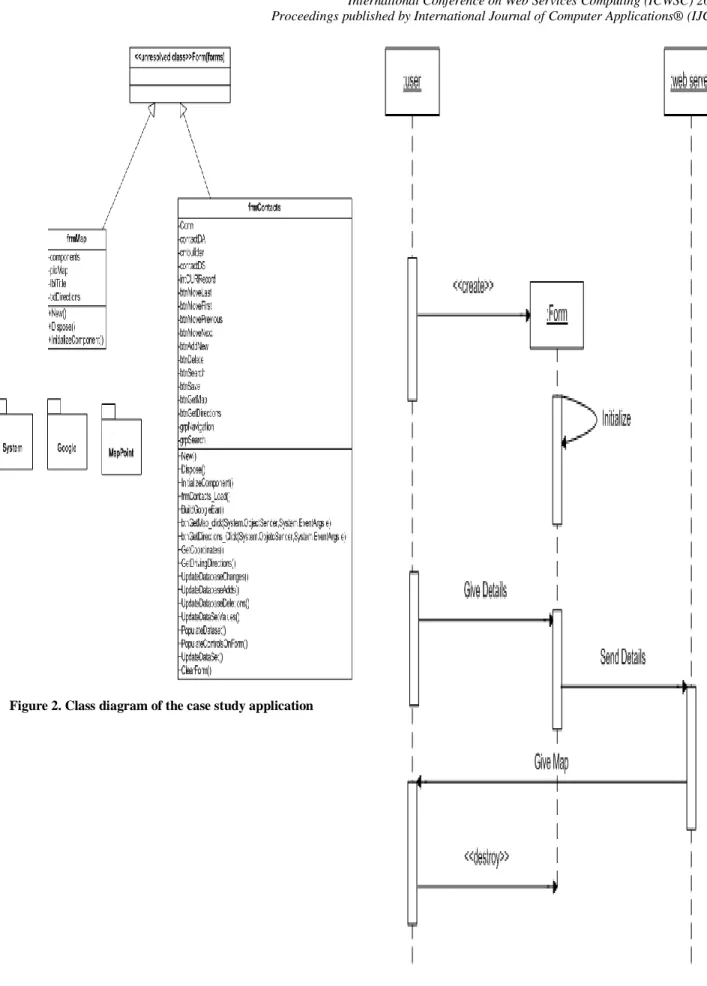
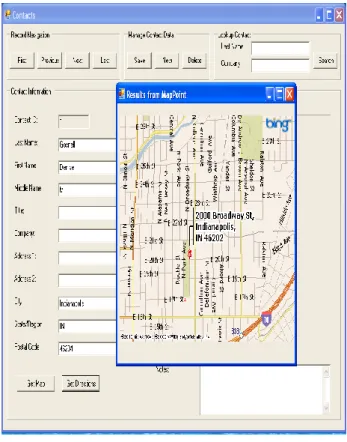
We believe firmly that the true Enterprise Portal is what is beyond CRM -A highly functional, customizable, low-cost, high ROI interface through which the organization can transact with the world. Enterprise portals require different thinking however from the software in a box concept. The starting point for any enterprise portal implementation is to redefine the word ―Customer‖ – in essence to reclaim it from the Customer Relationship Management acronym of CRM. You see, a customer of an enterprise portal is anyone who uses it: staff, management, executives, existing customers, new customers, stakeholders, suppliers…it can be a long list. And for each customer there needs to be a secure role and permissions based access mechanism. These roles and permissions need to extend into the heart of the enterprise software systems so that a supplier accessing the portal gains a completely different experience from a member of staff. Refer to Figure 2, 3, 4 below, which provides the class diagram, sequence diagram and execution screen shot of this application respectively
Figure 2. Class diagram of the case study application
Figure 4 Execution screen shot of the application
4.
CONCLUSIONS
Place This paper had discussed about Research Methodology on Designing Dependable Agile Layered Security Architecture Solutions – Web Services Case Study. In this research the major part is given to model architectural design rules using Model Driven Architecture (MDA) so that architects and the developers are responsible to automatic enforcement on the detailed design and easy to understand and use by both of them. This MDA approach is implemented in use of agile strategy in three different phases covering three different layers to provide security to the system. With this procedure a conclusion has been given that with the system security the requirements for that system are improved. This research summarizes that security is essential for every system at initial stage and upon introduction of security at middle stage must lead to the change in the system i.e. an improvement to system requirements.
5.
REFERENCES
[1] Athula Ginge and San Murugesan, ―Web Engineering: A Methodology for Developing Scalable, Maintainable Web Applications‖, Cutter IT Journal Vol.14, No.7 pp. 24-35, July 2001
[2] Cenzic Inc., ―Web Application Security Trend Reports‖, 2009.
[3] David Geer, ―Taking Steps to Secure Web Services‖, IEEE, October 2003.
[4] D.K.Smetters, R.E.Grinter, ―Moving from the design of usable security technologies to the design of useful secure applications‖, ACM New Security paradigms workshop September 2002 pp 82 – 89
[5] Durai Pandian M et.al., ―Information Security Architecture – Context aware Access control model for Educational applications‖, International Journal of
Computer Science and Network Security, December 2006
[6] Ferda Tartanoglu et al, ‖Dependability in the Web Services Architecture‖, Architecting Dependable Systems, LNCS 2677, pp. 90 – 109, 2003
[7] Gunnar Peterson, ―Security Architecture Blueprint‖, Arctec Group, LLC, 2007
[8] Halvard Skogsrud,‖ Modeling Trust Negotiation for Web Services‖, IEEE February 2009
[9] Heiko Tillwick, Martin S Olivier, ―A Layered Security Architecture: Design Issues‖, in Proceedings of the Fourth Annual Information Security South Africa Conference (ISSA 2004), July 2004.
[10] Jim Highsmith, Alistair Cockburn ―Agile Software Development: The Business of Innovation‖, IEEE Computer September’2001 pp: 120:122
[11] J.J.Whitmore,‖A method for designing secure solutions‖, IBM systems Journal, Vol 40 No 3 2001 pp. 747-768 [12] John Hunt, ―Agile Software Construction‖, Springer
Verlag publishers 2006
[13] Lorenzo D Martino, Elisa Bertino, ― Security for Web Services: Standards and Research Issues‖, International Journal of Web Services Research, Oct-Dec 2009, pp. 48-74, Idea Group Publishing USA 2009
[14] Mark Harman, Afshin Mansouri,‖Search based Software Engineering: Introduction to the special issue of the IEEE Transactions on Software Engineering‖, November December 2010, pp. 737 – 741
[15] Martin Naedele, ―Standards for XML and Web Services Security‖, IEEE April 2003
[16] Massimo Barloletti, et. al.‖ Semantics-Based Design for Secure Web Services‖, IEEE Transactions on Software Engineering, Vol 34, No.1, January 2008
[17] Matt Bishop, ―Computer Security: Art and Science‖, Pearson Education, 2003
[18] NIST Draft, ― Guide to Secure Web Services‖, September 2006
[19] Ross Anderson,‖ Security Engineering: A guide to building Dependable Distributed Systems‖, Wiley publishers, 2003.
[20] Satoshi Makino, Takeshi Imamura, Yuichi Nakamura. ‖Implementation and Performance of WS-Security‖, International Journal of Web Services Research, Jan-March 2004, pp. 58-72, Idea Group Publishing USA 2004
[21] Sasikanth Avancha, ―A Framework for Trustworthy Service Oriented Computing‖, ICISS 2008, pp. 124 – 132.
[22] Sandeep Chatterjee,‖ Developing Enterprises Web Services an Architects Guide‖, Pearson, 2004
[23] Sarah Spiekermann, Lorrie Cranor,‖Engineering Privacy‖, IEEE Transactions on Software Engineering‖, Vol 35 No 1 January February 2009 pp. 67 – 82
[24] Spyros T Halkidis et. al., ―Architecture Risk Analysis of Software Systems based on Security Patterns‖, IEEE
Transactions on Dependable and Secure Computing Vol 5 No. 3, July – September 2008, pp. 129 – 142
[25] Vipul Gupta, et. al., ―Sizzle: A standards-based end-to-end security architecture for the embedded Internet‖, Elsevier, Pervasive and Mobile Computing, 2005
[26] Wei She, et. al. ,‖Enhancing Security Modeling for Web Services using Delegation and Pass-on‖, International Journal of Web Services Research, Jan-March 2010, pp. 1-21, Idea Group Publishing USA 2010
[27] Wembo Mao, ―Modern Cryptography: Theory and Practice‖, Pearson education, 2004