PERFORMANCE MANAGEMENT DEVELOPMENT SYSTEM IN LIMPOPO REGION OF THE CORRECTIONAL SERVICES DEPARTMENT
by
EDZISANI DANIEL NDOU
Submitted in accordance with the requirements for the degree
of
Magister technologiae
in the subject
Public Administration and Management
at the
University of South Africa (UNISA)
Supervisor: Prof. L. C. van Jaarsveldt
Co-Supervisor: Mr. S.J. Tsoabisi
July 2013
Open
Declaration of own work Student no.: 37256386
I, Edzisani Daniel Ndou. Student number 37256386, declare that "Performance management development system in Limpopo region of the Correctional Services Department" is my own work and that all the sources used as reference in this research are acknowledged by means of complete references.
~
s~
d.oi.J o 7-15 Date
Summary
The study focuses on an overview of the performance management and the development system in the Department of Correctional Services with special focus on Limpopo province, Mpumalanga province and Northwest province (which is referred to as
Limpopo region in this research). The main research question was "what does the current performance management development system in the Department of Correctional
Services in the Limpopo region look like?"
The relevant literature was consulted and in order to gain a clear view and understanding of performance management in general. The overview focuses on the general concept of performance management so as to understand it, its origin, purpose, benefits, advantages and disadvantages. The second part focuses on the performance management system in the general Public Service. This was done in order to establish whether there is any alignment between general performance management and what is being implemented in the Public Service. It was established that there is no difference between the general concept of performance management and what is being implemented in the Public Service in general. The main focus is on the policy used in the Public Service. The last part deals with the research question and focuses on the Department of Correctional Services in particular in the previously demarcated region.
The Performance Management and Development System Policy was used to determine if there is any alignment between the general performance management, performance
management in the Public Service and what is being implemented in the Department of Correctional Services. The findings show that there is no difference between the
Performance Management and Development System being applied in the different areas. Several minor challenges were picked up, based on the findings of the internal audit on performance management, and relevant recommendations are provided. In general, based on the findings and percentage of compliance, the research shows that the Performance Management and Development System is being effectively implemented in the Limpopo region of the Department of Correctional Services.
Acknowledgements
First and foremost, I would like to thank the almighty God for giving me the strength to finish this work. It took a very long seven years and many times I wanted to give up but the still voice in me kept on encouraging me and telling me to carry on. I must indicate that it was not easy, but it has been worth it.
I would like to thank my supervisor Professor L.C. van Jaarsveldt: thank you very much Professor for being patient with me. I can still vividly remember all the emails you sent me when I submitted work that could now be regarded as substandard. Sometimes I would wake up at night and ask myself "do I have to put myself through this?" I would like to thank you so much because every time I followed your guidance, you would always respond positively and encourage me to continue. Professor, thank you so much, you were called to do what you do. Without your guidance it would not have been possible to finish this work. Please do the same for others as well.
To my loving family, my wife Muvhulawa Eunice, my son Nduvho and my daughter Mpho, without you my life would not be what it is. Thank you so much for bearing with me for all these years. I spent a lot of time working on my laptop and most weekends in the library doing my work but you always understood. You tolerated me when I brought heaps and heaps of books which were most of the time left on the table. I always pushed myself to the limit because I wanted our kids to have someone to look up to in the family. To my mother Dorah Ndou, you mean everything to me and you are so special, your intelligence for a person with no formal education is amazing. Thank you for being a good parent to me. I know my father would have been very proud if he was still alive.
To my extended family, especially my brothers and their families, thank you for giving me the credit even if sometimes I didn't deserve it. Your gestures somehow encouraged me to do more.
I would also like to thank my former colleague, Ms Jane Moate, for all the assistance she gave me when I was doing this work. Without you it would not have been easy, thank
you for tolerating an my telephone caHs and emails and for assisting me in collecting information I needed.
To an lhose who aspire to study further, let me tell you that if you put your mind to it, it js possible. you can achieve whatever you want to achieve. May the mercies and grace of God be upon you all forever. Thank you.
List
·
of abbfleviations
and acronyms
A A P ... Assessment Appeal Panel DCS ... Department of CorrectionaJ Services DMC ... Departmental Moderating Committee DPSA ... Departmenl of Public Services and Administration EPMDS ... Employee Perfonnance Management and Development System GAF ...•.•.•.•.•....•.•.•....•..•..•.... General Assessment Factors HR •.•... Human Resources IRC ... Intermediate Review CommiUee KRA ... Key Result Area LMN ... Umpopo, Mpumalanga and Northwest OSD ... OccupationaJ Specific Dispensation P A ... Performance Agreement PMOS ... Performance Management and Development System PSCBC ... Pllblic Services Co-ordinating Bargaining CouncH SMS ... ... Senior Management Services TQM ... Total Quality Management
TABLE OF CONTENTS
Chapter l Introdudion and .research design
1. J General inrroduction •...•....•.•.•... J
1.2 Motivation for lhe research topk ... 2
J .3 Problem statement. ... 3
J .4 Research aim and objective ... 4
1.5 Conceptual analysis ... 4
J .5. 1 Performance managemenl system ... .4
J .5.2 Performance management. ... 5 J .5.3 Performance ... 5 1.5.4 Implementation ... 5 1.5.5 Effectiveness ... 6 1 .5.6 Problem ...
6
l.5.7 System ... 7 1.5.8 Development. ... , ... 7 1.5.9 Prov]nce ... 7I. 6 Preliminary li rerature review ... 8
1. 7 Research melbodology ... B J. 7. I Resear-ch design ... 8
I .7.2 Units of observation ... 9
J • 7. 3 Research tnethods ... , ... 9
1.8 Framework for rhis research project. ... lO Chapter 2 A general overview of performanee management 2. 1 Introduction ... 1 l 2.2 The origin of performance management. ... 12
2. 3
The meaning of performance managemenl ... 132.4 The purpose of performance management ... 15
2.4.2 Administrative purpose ... 15
2.4.3 Developn1ental purpose ... 16
2.5 Bene
firs of performance rnanagemenl
... l7 2.5. l Advantages of performance management ... 172.5.2 Disadvantages of performance management ... 19
2.6 Implementing performance managemenl ... 20
2.7 Performance appraisal methods ... 21
2.7.1 Wrinen essays ... 22
2.7.2 Critical incidents ... 22
2.7.3 Graphical rating scale ... 22
2.7.4 Behaviourally anchored racing scales ... 22
2.7.5 Multiple person comparisons ... 22
2.8 Cycles of performance management. ... 23
2.8.1 Role definttion ... 23
2.8.2 Perfonnance agreement. ... 24
2.8.3 Personal development planning ... , ... 24
2.8.4 Performance ... 25
2.8.5 Performance review ... 25
2.9 Conclusion ... 27 Chapter 3 Overview of Performance Management Development Systems in the South African Public Service 3.1 Introduction ... 29
3.2 Scope of application of Performance Management and Development System Framework in the Department of Public Service and Administration ... 30
3.3 Objectives of Performance Management and Development System in the Public Service ... 31
3.3. 1 Goal of the Performance Management and Development System ... 31
3.3.2 Objectives of Performance Management and Development System ... 31
3.3.3 Principles of Performance Management and Development System ... 32
3.4.1 Performance planning and agreement. ... 34
3.4.1.1 The performance agreement ... 34
3.4. J .2 The work plan ... 36
3.4.] .3 Persona1 development plan according to Public Service Employee Perfonnance Management and Developmenr Sysrem Framework ... 37
3.4.1.4 Pro]onged absence and staff movement ... 38
3.4. 1.5 Amendments to the performance agreement ... 39
3.5 Performance monitoring, rating and assessment.. ... 39
3.5.1 Performance monitoring .... ...
39
3.5.2 Categories of performance and rating scale ... 40
3.5.3 Performance review ... 41
3.5.4 Annual performance assessment. ... 42
3.6 Performance moderation ... 42
3.6. J Normal djstribution curve of performance categories ... 43
3.6.2 The intermediate review committee ... .43
3.6.3 Departmental moderating committee ... 43
3.6.4 Assessme.nt appeal panel. ... 44
3.6.5 Disagreements over rating and assessment. ... 44
3.7 Outcomes of performance assessment and recognition ... 44
3.7.1 Probatjon ... 45
3. 7.2 Managing performance that is not fully effective ... .45
1.7.3 Pay progression ... 47
3. 7 A Departmental performance incentive scheme ... ..47
3.7.5 Performance bonus ... 47
3. 7.6 Budget for incentives ... .48
3.7.7 Non-financiaJ incentives ... .48
3.8 System evaJuation and review ... 49
Chapter 4 Performance Management and Development System in the Correctional Services: Limpopo region
4. J Introduction ... 51
4.2 Overview of the Department of Correctional Services ... 52
4.2.1 The early 1900s ... 52
4.2.2 The 1945 Landsdowne Commission on Penal and Prison Reform ... 52
4.2.3 Prisons in the 1960 and 1970s ... 53
4.2.4 The Prison Department in the 1980s ... 53
4.2.5 Prison reforms in the 1990s ... 53
4.2.6 Transformation of Correctional Services in a democratic South Africa ... 54
4.2.7 Strategic realignment of the Department of Correctional Services since 2000 .... 54
4.3 Background of performance management in the Department of Correctional Services ... 55
4.4 Policy statement and objectives of the Department of Correctional Services ... 57
4.5 Performance and Career Management Policy principles for the Department of Correctional Services ... 59
4.5.1 Performance Management and Development System for officials on salary levels 2 to 12 and professionals ... 60
4.5.2 Career management in the Department of Correctional Services ... 62
4.6 Performance and Career Management Policy implementation in the Department of Correctional Services ... 63
4. 7 Performance and Career Management Policy monitoring in Department of Correctional Services ... 64
4.8 Policy evaluation and policy review process for performance management. ... 65
4.9 People involved in the performance management and development system in the Department of Correctional Services in Limpopo region ... 67
4.10 Current state of performance management in the Department of Correctional Services in Limpopo region ... 68
4.11 Problems and challenges experienced in Limpopo region with the implementation of the Department of Correctional Services Performance and Career Management policy ... 68
4. J 1.1 Assessment forms not signed ...•...•...•.... 69
4. J J .2 Assessment forms not fully completed ... 69
4.1 1.3 Summary morivation not signed ... 70
4.11.4 Electronic calculator not used properly ... 70
4. J J .5 Incorrect assessment template used ... 70
4.1 1.6 No workpJans included ... 7l 4.ll.7 Incorrect dates enlered ... 71
4.12 Conclusion ... 72
Chapter 5 Conclusion and recommendations S. I Introduction ... 73
5.2 Research summary ... 74
5.3 Final concJusion ... 79
5.4 Recomn1endations ... 81
List of figures Figure 2.1 ... 26 Figure 3.1 ... 40 Figure 4.1 ... 55 Figure 4.2 ... 67 Figure 4.3 ... 68
CHAPTER 1
INTRODUCTION AND RESEARCH DESIGN 1.1 General introduction
Performance management ensures that the performance of all employees in the
organisation is managed in a uniform way. There should therefore be a common means of managing performance that is known to all employees of the organisation. Employees in the organisation must know exactly what employer's expectations are regarding
performance. Performance management must cover a specific period of time, for example in government, normally from the beginning to the end of the financial year, that is, from the beginning of April to the end of March the following year. When performance management is in place it helps both the employer and employees to focus their energy on specific and definable targets.
Performance management benefits the department since the general performance can be improved because it can be measured. This also applies to the Department of Correctional Services in Limpopo region because if it is managed properly, the performance of the whole region can be improved. Although in the case of this research the organisation is owned by the government and is solely responsible for the management of all
correctional facilities in general, the standards and performance in the correctional service are always measured against the two privately managed prisons (Kutama Sinthumule in Limpopo province and Mangaung in the Free State province) since these correctional facilities function very well. The Bill of Rights enshrined in the Constitution of the Republic of South Africa, 1996 chapter 2 compels the Department of Correctional Services to incarcerate inmates in a humane and safe environment.
The Department of Public Service and Administration, through the Public Service Regulations (200 1 :Part VIII B.l), indicates that an executing authority will determine a system for performance management and development for employees in the department other than employees who are members of the senior management services (SMS),
framework, the performance management system developed was to be implemented fully by all government departments with effect from 1 April 2001, taking into account the provisions of paragraph 4 of Annexure 1, which states that subject to collective
agreements regarding the performance management and development system, any
department which is ready to implement a new performance management and
development system could do so between July 1999 and April2001. The Department of Correctional Services developed its own performance management system in 2001 which was improved in 2008. This research was based on the current performance management development system (PMOS) which was re-developed in 2008 and is currently still in use in the Department of Correctional Services.
For the purpose of this research the definition by Armstrong and Stephens (2005:275-276) pertaining to performance management will be used. They state that performance management is a strategic and integrated process which delivers sustained success to organisations by improving the performance of the people who work in them and by developing the capabilities of individual contributors and teams. They also indicate further aims of performance management as to obtain better results from the organisation, teams, and individuals by understanding and managing performance within an agreed framework of planned goals, standards and competence requirements.
1.2 Motivation for the research topic
This research was selected because of the important role that performance management plays in the Department of Correctional Services. Therefore an overview of the current PMOS that exists in the Department of Correctional Services in Limpopo region was investigated because the researcher is familiar with the region than the rest of other regiOns.
The performance management and development system document for the Department of Correctional Services was developed in 2008 with the purpose of improving the
levels 2 to 12). This research focused on providing an overview of the implementation of PMOS by both managers and non-managers of the Department of Correctional Services in the Limpopo region.
The performance management audit report of 2012 was used extensively in this research since this report was important in revealing how effective the PMOS is or whether there are serious problems or challenges in implementing the PMOS in the Limpopo region.
The researcher focused on giving a comprehensive overview of performance
management that looked at all its aspects so that at the end of the research a complete picture of the process and all aspects involved was obtained.
1.3 Problem statement
Performance management is an integral part of the Department of Correctional Services and must therefore be implemented, used and managed properly. The Department of Correctional Services can only manage to fulfill its legal mandate of ensuring safe custody and development of inmates if its performance is geared towards the goal. This research considered the PMOS as it is currently being used in the Department of Correctional Services in the Limpopo region.
The research problem was formulated as follows: What does the current performance management development system in the Department of Correctional Services in the Limpopo region entail?
Secondary questions that arise from the above problem statement include:
1. What is performance management?
2. What is the purpose of performance management?
3. How did performance management develop and come into being?
4. What does the performance management system used by the South African government look like?
1.4 Research aim and objective
The main objective of this research is to understand the PMDS currently being used in the Department of Correctional Services in the Limpopo region. The unit of analysis for this research was the Department of Correctional Services in the Limpopo region. The points of focus were the role and function of performance management in general and the process of performance management specifically.
The research was aimed at exploring what performance management is. In so doing, the meaning of performance management as well as the development and origins of
performance management was also looked at. Secondly, this research explained the purpose of the performance management system in the Department of Correctional Services by giving an overview of the performance management process currently being used in the Department. Thirdly, this research explained how performance management was implemented and is currently being used in the South African government. This research also made reference to legislation being used by the South African government to promote performance management.
Finally this research looked at the implementation of the PMDS in the Limpopo region. The findings of this research could benefit the Department of Correctional Services, specifically in the Limpopo region with regard to the effective implementation and use of the PMOS.
1.5 Conceptual analysis
The conceptual analysis provides a clarification of the key concepts in the problem statement and research objective, which are as follows.
1.5.1 Performance management system
According to Gambir (2006:433-434) a performance management system is "a system of information specification, monitoring, assessment, evaluation, and reporting of the
performance of individuals, programs, or agencies. To be useful, such a system should be integrated with corporate management so that appropriate action, if any, may be taken subsequent to a performance appraisal". A performance management system has to be carefully managed as any perception of its weakness will serve to undermine confidence in it and will delimit its effectiveness for both employees and the organisation.
1.5.2 Performance management
According to Noe, Hollenbeck, Gerhart and Wright (2010:768) performance management can be described as the means through which managers ensure that employees' activities and outputs are congruent with the organisational goal. According to Luecke (2006: ix), performance management is defined as "to measure and improve the effectiveness of people in the workplace". Daniels and Daniels (2004:7) describe performance
management as "a technology for creating a workplace that brings out the best in people while generating the highest value for the organisation" Walters ( 1995:3) defines
performance management as the totality of the day-to-day work of managers.
1.5.3 Performance
Fox and Meyer ( 1995:94) describe performance as "the way in which planned action takes place or objectives are reached; operational behavior directly related to the organisation's effectiveness: performance= ability+ motivation". Daniels and Daniels (2004:7) describe performance as "a unit that consists of a situation, behaviours, tasks, and results, which are combined to produce a specific accomplishment". Smither and London (2009:586) define performance as "what the organisation hires one to do, and do well. Performance is not the consequences or result of action, it is the action itself'. For the purpose of this research, performance will be defined as what the employees are employed to do and how they do it.
1.5.4 Implementation
Fox and Meyer (1995 :61) describe implementation as "action to put into operation policy or programmes, which result in the creation of links in the contingent chain to attain the objective envisaged". Cloete ( 1995:38) describes implementation as "the carrying out of
a law, regulation, rule, command or other directive by officials working under direction of political office-bearers. Shafritz ( 1985:263) describes implementation as "a process of interaction between the setting of goals and actions geared to achieving them" as well as "an ability to forge subsequent links in the causal chain so as to obtain the desired results". For the purpose of this research implementation will mean how the theoretical concept is put into practice.
1.5.5 Effectiveness
Fox and Meyer (1995:41) describe effective (ness) as "a criterion according to which an alternative is recommended if it results in the achievement of a valued outcome". In particular, it refers to a condition in which a focal organisation, using a finite amount of resources, is able to achieve stated objectives as measured by a given set of criteria, and the extent to which a programme is achieving or failing to achieve its stated objectives. Reaching effectiveness means in essence examining the links in the cause and effect chain that stretches from the status quo to the benefits, changes and impacts the
programme's design intends. Effective organisations have the ability to anticipate change, to communicate this to the units concerned, to adapt activities and, at the same time, to anticipate and avoid mistakes, and to effect the necessary adaptations. Lockett ( 1992:51) describes effectiveness as "a comparison of outcomes against strategic objectives, in other words, does the organisation achieve what it set out to achieve?" Cloete ( 1995:27) describes effective/effectiveness as satisfactory output of goods or services to achieve set objectives. Shafritz ( 1985: 166) describes effectiveness as the extent to which an
organisation accomplishes some predetermined goal or objective; more recently, the overall performance of an organisation from the viewpoint of some constituency. Effectiveness is not entirely dependent on the efficiency of a programme because programme outputs may increase without necessarily increasing effectiveness.
1.5.6 Problem
According to the Concise Oxford Dictionary (2006: 1143) a problem can be described as "an unwelcome or harmful matter needing to be dealt with and overcome. A thing that is difficult to achieve". This is the definition that is going to be used for this research.
1.5.7 System
Fox and Meyer ( 1995: 125) describe a system as "an organised or complex whole. The set of elements or parts that are interrelated and work together toward achieving common goals. The sum total of systems that are configured in a way that differentiates and separates them from other actions." Cloete (1995:74) describes a system as a hierarchical structure of workplaces such as a state department, or a set of activities such as the system of activities to collect Inland Revenue. Shafritz (1985:522) describes a system as "any organised collection of parts that is united by prescribed interactions and designed for accomplishment of a specific goal or general purpose". For the purpose of this research, definition by Shafritz will be used.
1.5.8 Development
Fox and Meyer (1995 :36) describe development as "the process of improving the quality of all human lives". Three equally important aspects of development are: raising people's living levels, that is their income and consumption levels of food, medical services and education through "relevant" economic growth processes; creating conditions conducive to growth of people's self-esteem through the establishment of social, political and economic systems and organisations which promote human dignity and respect; and increasing people's freedom to choose by enlarging the range of choice variables, for example increasing varieties of consumer goods and services. According to Noe et al. (2010:87) development involves acquiring knowledge, skills, and behaviour that improve an employee's ability to meet the challenges of a variety of existing jobs or jobs that do not yet exist. For the purpose of this research development will be described as the process of improvement as described above.
1.5.9 Province
According to the Oxford Dictionary (2006: 1156) province is defined as "a principal administrative division of a country or empire. For the purpose of this research Limpopo province, Mpumalanga province and Northwest province are three provinces (LMN)
which are in the northern part; northwest and northeast of South Africa respectively, they are referred to herein as Limpopo region.
1.6 Preliminary literature review
The literature review included books, journals, newspapers and official documents. The research revealed information relevant to the Department of Correctional Services and to performance management but not specifically related to how PMDS is being used in the Department of Correctional Services in Limpopo region, which was looked at in this research.
The research is not in any way a duplication of any previous research that has been undertaken in this regard. The researcher reviewed different sources including published books, unpublished and published dissertations and theses, articles in journals as well as articles in different local newspapers, to get a clear understanding of performance management and the problems related to it. The researcher also looked at the policies within the Department of Correctional Services and the broader government of South Africa to complete this research.
1.7 Research methodology
Bearing in mind that the research objective is to understand the use and development of performance management in the Department of Correctional Services in the region, it was necessary to select an appropriate research design (either empirical or non-empirical) to conduct this research (Mouton, 2001 :55).
1.7.1 Research design
According to Weiman and Kruger ( 1999:7) there are two types of research designs, namely qualitative and quantitative research designs. The quantitative method is more concerned with laboratory studies whereas the qualitative focuses on people and other information sources such as files. As the unit of analysis for this research will focus on
the Department of Correctional Services in the region, the appropriate design for this research seems to be a qualitative design. The above research objective implies that the research focused on providing an overview of the role and function of performance management in general and the current use of performance management in the Department of Correctional Services in the Limpopo region specifically.
1.7.2 Units of observation
The research material used is scholarly literature. A literature survey of the relevant books and journal articles helped in providing insight into the various discourses on the purpose and function of performance management. According to Vander Yen and Scherer-Rath (2004:35) the normative approach consists of norms and guidelines that help in guiding an individual's thoughts and actions. A normative approach is used to answer the question "What should be" for example "What should the performance management system in the Department of Correctional Services in the Limpopo region look like?"
Information about performance management was collected from official documents, for example, policy papers, acts, bills and government circulars. This research also relied on reading and analysing official documents, for example, previous years' performance management moderation documents and policies. Accordingly, reading and analysing texts was used as the main method of this research.
1. 7.3 Research methods
Bearing in mind that the units of observation for this research are predominantly written material, the method that was applied can be classified as content analysis. This involved obtaining the information from the literature relevant to the topic as well as relevant documents from the Department of Correctional Services. Due to the fact that the topic researched is well documented, it was important to compare the practice in the
Department of Correctional Services against what is available in other literature. By analysing the different contents relevant to the topic, the researcher was able to take a
1.8 Framework for this research project
The preliminary framework for this research project indudes the following areas of information for the relevant chapters:
Chapter 1 contains the general introduction to the research. It also provides the background and motivation for the study and all the other headings for the whole research.
Chapter 2 focuses on what performance management is and how it has developed. This includes all stages of the process and how it is supposed to be implemented.
Chapter 3 provides an overview of the use of performance management in the South African government and indicates why performance management is important for the South African government.
Chapter 4 indicates how performance management is currently used in the Department of Correctional Services in the Region and also considered an overview of the
implementation of PMDS within the Department of Correctional Services in Region. Chapter 5 contains the conclusions and findings of the research with regard to the performance management implementation in the Department of Correctional Services in the Limpopo region. Recommendations are also made with regards to the improvement of the PMDS in the Department of Correctional Services Limpopo region.
CHAPTER2
A GENERAL OVERVIEW OF PERFORMANCE MANAGEMENT
2.1 Introduction
This chapter will focus on providing an overview of performance management in general. This overview will include explanations about the origin and meaning of performance management, as well as information about the purpose of performance management, the benefits of performance management and the different stages of performance
management.
Performance management plays an important role in any organisation and can benefit an organisation in different ways by, for example, promoting increased performance. If performance management is implemented correctly, it can benefit the employer as well as the employees since their performance will always be recognised formally through a reliable process known nationally and internationally as the performance management system. According to Kearney and Berman ( 1999:304-306) there are several areas which need to be checked or taken care of before the appropriate performance management system or tool is determined, namely, validity/accuracy, understandability, time lines, potential for encouraging perverse behaviour, uniqueness, data collection cost,
controllability and comprehensiveness.
This chapter therefore consists of a comprehensive literature study that relied on the reading and analysing of books and journal articles. A literature study was conducted to get a clear understanding of the origin, role and functions, purpose, benefits and different stages of performance management. The origin of performance management is looked at next.
2.2 The origin of performance management
Armstrong (2001:473) states in his background to performance management that
performance management is a phrase first coined in the mid-seventies but which was not recognised as a distinctive approach until the mid-1980s, growing out of the realisation that a more continuous and integrated approach was needed to manage and reward performance. According to Williams ( 1998: I) performance management gained prominence in the late 1980s/early 1990s because it addressed problems which were identified from performance appraisal systems, for example, the lack of management commitment, the destruction of team work by performance appraisal, the measuring of objectives or standards which fostered mediocrity, the focus on short-term (local) rather than long-term (general) objectives and the decrease in self-esteem, increased fear, and reduced productivity and motivation caused by performance appraisal systems. Myland ( 1992:86) defines performance appraisal as a systematic means of ensuring managers and their staff meet regularly to discuss past and present performance issues, and to agree what future action is appropriate on both sides. Spangenberg (1994:14-15) indicates that performance management came about as a response to performance appraisal problems being experienced by total quality management (TQM) supporters. Examples of these problems are the same as those given above, namely, the destruction of team work by performance appraisal and the measuring of objectives or standards which fostered mediocrity. The Concise Oxford English dictionary (2006: 1523) describes total quality management as a system of management based on the principle that every member of staff must be committed to maintaining high standards.
Pinnington and Edwards (2000: 160) indicate that performance management systems grew in popularity during the 1980s because they were thought to facilitate rigorous
specification of performance standards and measures, and increase the likelihood of achieving organisational goals at a time when organisations needed to respond to increasingly competitive business conditions. This was mainly done to deal with the performance challenges that they had at the time, for example, a lack of management
commitment to the system. Today, most organisations still make use of performance management systems.
Looking at the above information, it is clear that these authors indicate that performance management developed as a way of trying to address performance challenges that were being encountered at the time. Apart from the origin of performance management, the meaning of performance management will be looked at next.
2.3 The meaning of performance management
Performance management has since its inception in the 1980s and early 1990s been described and explained differently by various authors. Van Dooren, Bouckaert and Halligan (20 1 0:30), for example, describe performance management as a type of management that incorporates and uses performance information for decision making. Poister (2003: 12) describes performance management as the process of directing and controlling employees and work units in an organisation and motivating them to perform at higher levels. Noe et a/ (20 10:351) describe performance management as the process through which managers ensure that employee's activities and outputs are congruent with the organisation's goals. Performance management is central to gaining a competitive advantage, for example, it may cause the performance in the organisation to improve, which will give an organisation an edge over its competitors in terms of performance.
Gilley et a/ (2002: 11) describe performance management as "a process of obtaining regular employee feedback, tracking actual performance along the measurement dimensions established in the goals, feeding back performance information to relevant subsystems, taking corrective action if performance is off target and resetting goals so that the organisation is continually adapting to external and internal reality". The external and internal reality that Gilley et al refers to includes increased productivity which is internal and the ability to withstand competition from other competitors which is an external reality. Heery and Noon (2001 :265) describe performance management as the process of linking the overall business objectives of the organisation with departmental
objectives, team objectives, and individual objectives. It involves setting targets, constantly reviewing progress towards those targets, and taking remedial action where there are training/developmental shortfalls. Sutherland and Canwell (2004:211) agree with Heery and Noon (200 1 :265) and describe performance management as a systematic and data-oriented approach to managing employees based on positive reinforcement as the primary driver to maximise their performance. Performance management assumes that there will be a disparity between what employees are currently achieving (on the basis that they have to work and perform to a standard) and the possibility that they desire to perform better (based on the assumption that they have desires to perform more
effectively if given the opportunity and encouragement).
Plachy ( 1988: 1) describes performance management as communication: a manager and an employee together arrive at an understanding of what work is to be accomplished, how it will be accomplished, how work is progressing toward the desired results, and finally, after effort is expended to accomplish the work, whether after performance the agreed-upon plan has been achieved. Therefore it can be concluded that performance
management involves the supervisor and the supervisee. Silverstein (2007:4) builds on what Plachy ( 1988: 1) wrote by stating that performance management is "a process-oriented approach to evaluating and supporting employees. Ideally, performance management takes place from the moment the employee is hired to fill a position at an organisation to the moment the individual leaves. Lastly, Armstrong and Stephens (2005:275-277) define performance management as strategic and integrated processes which deliver sustained success to organisations by improving the performance of the people who work in them and developing the capabilities of individual contributors and teams. On evaluating these definitions from different authors, it can be seen that they place emphasis on a number of different aspects related to performance management. For the purpose of this research, performance management will be defined as the process of ensuring that performance standards are set between the supervisor and the supervisee and that performance is measured against these standards on a regular basis for the duration of the performance period with the objective of improving performance. After
discussing the meaning of performance management, the purpose of performance management is looked at next.
2.4 The purpose of performance management
Since the meaning of performance management is focused on measuring performance to improve it, Armstrong and Stephens (2005:275-278) state that the purpose of
performance management is to obtain better results from the organisation, teams and individuals by understanding and managing performance within an agreed framework of planned goals, standards and competence requirements. According to Noe et al
(1994:237-238), the purpose of performance management is divided into three categories, namely, strategic, administrative and developmental purposes that will be explained next.
2.4.1 Strategic purpose
A performance management system must link employees' activities with organisational goals. It will be very difficult for an organisation to achieve its goals if the performance of its employees is not aligned accordingly. If the strategic goals of the organisation are known and are also reflected in the employees' performance agreement, a great deal can be achieved for the organisation. The proper implementation of performance management systems assist in ensuring that the strategic objectives of the organisation are achieved.
2.4.2 Administrative purpose
Information on performance management can also be used in administration-related matters or decisions, for example, pay raises, performance bonuses or recognition of individual performance, promotions, retention and terminations and retrenchments. Although this purpose is of vital importance, it is very difficult to get accurate
information regarding performance management if managers are not prepared to comply with the performance management system policy of the organisation because this may lead to having the wrong information regarding performance in the organisation. Therefore it is important to make sure that management complies with and completes performance management documents.
2.4.3 Developmental purpose
Developmental purposes helps to ensure that the causes of poor performance are identified during the performance management processes whereafter training
interventions can be implemented if the performance gap is caused by a lack of training. Training can, for example, assist in developing certain skills, for example, the ability to
utilise a computer or machine, lack of which causes poor performance. If these
performance gaps are identified but no intervention is implemented, the purpose of identifying these poor performance gaps is defeated. Once these gaps are identified, there must be some intervention to address them, for example, additional training.
Apart from the strategic, administrative and developmental purposes Cascio (2003:334-335) states that there are five purposes for performance appraisal:
• Firstly, the justification of employment decisions, for example, to develop marginal or low performers, to train, transfer, or discipline staff, to justify merit increases (or
no increase), or even to reduce the size of the workforce.
• Secondly, to validate being tested which includes correlating test results with appraisal results to evaluate the hypothesis that test scores provide job performance feedback to employees. However, if appraisals are not done carefully, or if
considerations other than performance influence appraisal results, the appraisal cannot be used legitimately for any purpose.
• Thirdly, performance appraisals provide feedback to employees and thereby serve as vehicles for personal and career development.
• Fourthly, they can also help to identify developmental needs of employees and to establish objectives for training programmes. This will assist in ensuring that all training needs are being taken care of, which will assist the organisation to grow. • Fifthly, performance appraisal can help to diagnose organisational problems by
identifying training needs and personal characteristics to consider in recruiting new staff. They also provide a basis for distinguishing between effective and ineffective performers.
Although Cascio gives five purposes for performance management as compared to Noe et
al (1994:237-238) who give only three, it can be seen that they agree on certain aspects
related to performance management. For example, performance management can assist management to take decisions on the direction that the organisation should take, as well as to identify low performers, to train, transfer, or discipline staff, to justify salary increases (or no increase), and as a basis for reducing the size of the workforce. In addition to the purpose of performance management as outlined by Cascio and Noe et al above, the benefits of performance management are looked at and explained next.
2.5 Benefits of performance management
According to Plachy ( 1988:206), the benefits of performance management can include performance-based pay, pay increases and performance incentive rewards. Spangenberg ( 1994:208-232) classifies rewards in two different categories: individual and group performance rewards. With individual rewards there is merit pay and competence-based pay. Under group and organisational performance there is gain sharing, profit sharing and employee share ownership. As shown by the two authors above, there are quite a number of options that can be used as far as performance benefits are concerned. Organisations can choose what is suitable for them in terms of ensuring that the intended goals are achieved. It is true that if performance is not measured, it will be difficult, if not
impossible, to implement the benefits referred to above. Apart from the rewards related to performance management, Murphy and Cleveland (1995:326-338) and Hackett
( 1996:103-1 06) state that there are a number of advantages and disadvantages associated with the performance management system. They categorise the advantages and
disadvantages as follows:
2.5.1 Advantages of performance management
The advantages of making use of performance management, according to Hackett ( 1996: 103-1 06) can include the following:
• Performance management can increase the quality of organisational decisions based on performance management results. An organisation can, for example, make decisions such as promoting someone based on good performance.
• Performance management increases the quality of individual decisions, for example,
when people know that their performance is being measured, they can increase their efforts when doing their work.
• Performance management can enhance the relationship between the organisation and
its members by clearly indicating what is expected of each individual in the organisation.
• Performance management can provide a foundation for organisational diagnosis and
change by indicating what aspects within the organisation need attention and are not functioning properly. Performance management identifies key skills, the skills which are basic and important for the organisation to achieve its strategic goals.
• Performance management helps to identify training needs, which will assist the
organisation to offer training focused on specific skills gaps.
• Performance management can improve the current performance in an organisation as
individual employees can be motivated to be more productive.
• Performance management can improve communication as regular communication
between the supervisor and supervisee makes it easy for the communication to take place and this can enhance productivity.
• Performance management enhances commitment. Employees become more
committed because they realise that their performance is being recognised.
• Potential can be identified. It is easy to identify those employees who can be
developed to do more and better work for the organisation.
• Performance management can assist in ensuring that disciplinary documentation is
available if the person is to be disciplined for poor performance. Because performance is always recorded, information is always accessible.
• Performance management can also assist in determining the salary of a person where
salary is linked to performance. This will address any disputes because the basis of the decision will be available on record. According to Hackett ( 1996: 103-1 06), the
above mentioned are the advantages of performance management. They show that performance management can assist in achieving goals.
2.5.2 Disadvantages of performance management
According to Hackett ( 1996: 103-1 06) there are also disadvantages that need to be managed when performance management is being implemented:
• Performance management overemphasises the individual and underemphasises the
team.
• Performance appraisal systems can send mixed messages, for example, people might
tend to focus more on their own performance rather than looking at the team or organisation's performance.
• Performance management creates administrative problems, as in order to implement
it, money needs to be spent, especially if it is to be implemented correctly.
• Implementation problems can arise once the system is being used. Chances are that
the system might not be used for what it was intended, for example, it might be used as the basis for retrenching those who are not performing.
• Assessment problems such as bias, the halo effect (the tendency for an impression
created in one area to influence opinion in another area), stereotyping and over-emphasis of negative information can also influence the process if it is not monitored correctly.
Apart from the rewards related to performance management Murphy and Cleveland ( 1995:326-338) also confirm that there are advantages and disadvantages associated with a performance management system. Although performance management has advantages and disadvantages, it is still used by many organisations and governments to evaluate the performance of employees. However, before it is possible to determine the advantages and disadvantages, performance management must first be implemented. The
2.6 Implementing performance management
Implementing performance management in an organisation is not an easy process. According to Kearney and Berman (1999:304-306) there are several areas which need to be checked or taken care of before the appropriate performance management system or tool is determined, namely, validity/accuracy, understandability, time lines, potential for encouraging perverse behaviour, uniqueness, data collection costs, controllability and comprehensiveness. A number of steps have to be taken to implement a performance management system in an organisation that does not have such a system in place. A number of aspects need to be considered before a performance management system can be put in place. According to Spangenberg (1994:40-43) there are six steps that should be focused on when implementing performance management:
• Step 1: Strategy-In order to ensure that performance management achieves what it
is intended to achieve, it is important that a strategy be put in place to attain the goals of the organisation. It is even better if the strategy of the organisation is planned for the long term, for example, for the following 5 to 10 years.
• Step 2: Leadership - Besides ensuring that the organisation has a clear strategy in
place, there is also a need to ensure that there is strong top leadership in the organisation. Strong leadership will assist in ensuring that the performance
management system is producing results because it will ensure that leaders within the organisation serve as positive role models for the organisation.
• Step 3: Culture-It is important to ensure that before any performance management
system is put in place, the issue of culture be taken into consideration. Both people and process-based systems will fail if they are incompatible with the organisation's culture or if they are not an integral part of a planned programme of culture change. It is therefore very important to ensure that performance management system in the organisation is compatible with the culture before it is introduced.
• Step 4: Management - It is important to ensure that all management levels
understand the process before it is introduced. Management can assist in determining whether the new system will be a failure or a success. Once there is buy-in or
understanding of the new performance management system by management, it will be easy to convince the rest of the organisation.
• Step 5: Employees - For the performance management system to work, it must be implemented by all staff members; employees always outnumber managers in any organisation. When dealing with employees, it is also important to ensure that they understand performance management and that their literacy levels are at the level where they are able to understand the whole process. Without employees
understanding the whole performance management system, it can fail because its success is solely dependent on employees understanding and accepting it.
• Step 6: Trade union buy-in - Last but not least of what must be done before a new performance management system is introduced, is to ensure that there is buy-in of the system by the trade unions. Unfortunately, if there is no-buy in from the unions the whole system will fail because trade unions have the potential to influence employees negatively if they do not support the idea. The researcher agrees with Spangenberg that if these six areas are not given the attention they deserve, the whole PMDS can fail.
Looking at the above areas, it is very important to ensure that all these steps are
considered before any performance management process is introduced in an organisation. Failure to pay attention to the steps highlighted above might lead to failure of a newly implemented performance management system. The appraisal methods that forms part of the performance management system will be explained next.
2. 7 Performance appraisal methods
Performance appraisal can be explained as the method of measuring performance at regular times for a specific period of time. Robbins ( 1997:289-291) states that the following methods should be considered when performance appraisal is carried out:
2.7.1 Written essays
This is probably the simplest method of appraisal. It consists of writing a narrative description of employees' strengths, weaknesses, past performance, potential and
suggestions for improvement. The written essay requires no complex forms or extensive training to complete.
2.7.2 Critical incidents
Critical incidents focus the appraiser's attention on those behaviours that are key in making the difference between executing a job effectively or ineffectively. With this method, the appraiser writes down anecdotes that describe what the employee did that was especially effective or ineffective.
2.7.3 Graphic rating scales
One of the oldest and most popular methods of appraisal is the use of graphic rating scales. In this method a set of performance factors, such as quantity and quality of work, attendance, depth of knowledge, cooperation, loyalty, honesty and initiative are listed.
2. 7.4 Behaviourally anchored rating scales
Bars in the graph combine major elements from the critical incident and graphic rating scale approaches: the appraiser rates the employees on items along a continuum, but the points are examples of actual behaviour on the given job rather than a general description of traits.
2. 7.5 Multiple person comparisons
Multiple person comparisons evaluate an individual's performance against the performance of one or more others. It is a relative rather than an absolute measuring device. The three most popular comparisons are group order ranking, individual ranking (when an individual's performance is measured alone), and paired comparisons (when more than one employee/groups are compared).
Wade and Ricardo (2001:147-149) indicate that performance appraisal is neglected and it is normally a stand-alone process which is not linked to anything (strategy or business plan). People responsible for it are normally not interested in doing it; they also do not understand its purpose and importance. It is therefore important to ensure that
performance appraisal is done correctly.
The information given above shows that there are different options that can be used to implement performance appraisal. It is always important to ensure that the option that an organisation chooses should be able to achieve the goal for which it is intended. This is not a one-size-fits-all process, and an organisation should use the implementation method that best suit it. Following hereunder, the cycle of performance management will be discussed.
2.8 Cycle of performance management
There are different stages in performance management cycle and how they are implemented differs from organisation to organisation. According to Armstrong
( 1999:439-450) a performance management system can follow a cycle which includes the following.
2.8.1 Role definition
During this stage of the cycle, the whole framework of performance management is set out. Issues such as the purpose of the role of performance management, the key result areas or principal accountabilities and the key competencies that indicate what the role holder has to be able to do and the behaviour required to perform the role effectively are explained. After this stage the employee and the supervisor will be in a position where they understand each other and their roles because they will know exactly what is expected of each other.
2.8.2 Performance agreement
According to Armstrong ( 1999:439-450), during this stage the supervisee and the
supervisor sign the performance agreement. This will be made easy by the fact that both will understand their roles by now. Elements that will be given attention under this stage include the following:
• Objectives and standards of performance- the results to be achieved are defined in
terms of targets and standards.
• Performance measure and indicators- the extent to which objectives and standards
of performance have been achieved is assessed.
• Competency assessment - how the level of competency will be assessed, including a
discussion to clarify expectations by reference to the competence profile in the role definition and agreements on the sort of evidence that will be useful in assessing competency, is defined.
• Core values or operational requirements- the performance agreement may also refer
to the core development which individuals are expected to uphold in carrying out their work. Certain general operational requirements may also be specified in areas such as health and safety, budgetary control, cost reduction and security.
2.8.3 Personal development planning
Performance personal development planning is one of the most important parts of a performance management development system. All performance gaps identified during performance are addressed during this stage. Some of the salient features of personal development planning are:
• In the performance development stage supervisor and supervisee agree on the plan
which sets out the actions employees intend to take to develop themselves in order to extend their knowledge and skills, increase their levels of competence and improve their performance in specified areas.
supervisor and the supervisee, focusing on the developmental areas as identified by the two parties. This is very important because the improvement of performance is dependent on this intervention.
2.8.4 Performance
According to Armstrong ( 1999:439-450), performance should be managed throughout the year. In this stage, action is taken to implement the performance agreement and personal development plan as individuals carry on with their day-to-day work and their planned learning activities. This stage also includes a continuous process of providing feedback on performance, conducting informal progress reviews, updating objectives and, where necessary, dealing with performance problems and counseling.
2.8.5 Performance review
This is the last stage of the cycle; it is the formal evaluation stage when a review of performance over a period takes place, covering achievements, progress and problems as the basis for a revised performance agreement and personal development plan. It can also lead to performance ratings.
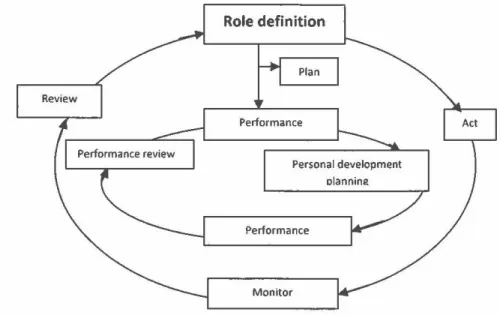
The process of performance management as explained above can also be illustrated by the figure 2.1 hereunder. The circle represents the cycle with the arrows moving clock wise indicating where the cycle starts (with role definition) and also the activities in sequence up to performance review.
Figure 2.1: The performance management cycle
Role definition
Performance
Monitor
Source: (Swan, I 991 :47)
Looking at figure 2.1 and information on performance management it can be seen that a performance agreement, performance development planning, and performance review are important aspects. When comparing this information with what Swan ( 1991 :46-50) states as relevant to performance management hereunder, it indicates that although the
information is presented differently, the process of performance management is the same. Swan ( 1991 :46-50) further provides the following eight steps for performance
management:
• The performance plan and development plan must be agreed on by the manager and employee.
• On-going feedback, coaching, counseling, and documentation are maintained for the following year.
• As the time of appraisal approaches and prior to writing the performance appraisal, the manager should encourage employees to do self-evaluation.
• Managers should complete the "report card" portion of the performance appraisal form so that general information or overview about performance can also be reflected on the card.
• Managers must preview appraisal with their own managers or human resources department.
• Managers should schedule appraisal meetings with employees. • A manager must conduct appraisal discussions.
The process of performance management always starts with the development of a
performance agreement because this document or agreement outlines what the employee is expected to do and gives the time frames within which these activities are supposed to be finalised. This foundation becomes the most important aspect of the whole
performance management system. The last stage as highlighted above by the author is the performance review or appraisal. Once this stage is completed, the whole process starts afresh because all the steps form part of a cycle of repetitive events.
2.9 Conclusion
This chapter provided an overview of performance management, its meaning, its benefits and the stages involved. It also indicated that performance management is an important tool that can be used in any organisation. If performance management is properly managed, it can benefit both the organisation and employees.
The views of different authors on the subject of performance management were
considered and evaluated. The purpose of performance management was also explained. For the purpose of this research, the purpose of performance management can be seen as the system that is implemented to ensure that the performance of individuals in the organisation is managed so that the goals of the organisation can be achieved. The
different stages of a performance management system were also explained in this chapter. The different stages or cycles of performance management were identified and discussed. Each step in the performance management cycle is important as is their interdependence.
This chapter highlighted the fact that performance management is a crucial process in any organisation and for it to reap the benefit of the process performance management must be implemented correctly.
The next chapter will provide an overview on the use of performance management in the South African public service. It will also indicate why performance management is important for the South African government and provide an overview of the Performance Management and Development System for the Public Service as developed by the
CHAPTER3
OVERVIEW OF PERFORMANCE MANAGEMENT AND DEVELOPMENT SYSTEM IN THE SOUTH AFRICAN PUBLIC SERVICE
3.1 Introduction
The previous chapter, Chapter 2, provided an overview of performance management in general which included amongst others an explanation of the origin and meaning of performance management, as well as information about the purpose of performance management, its benefits and different stages. This chapter will focus on the overview of Performance Management and Development System in the South African Public Service.
The Public Service Act no 38 of 1994 as amended makes provision for the
implementation of a Performance Management and Development System for the Public Service. This Act allows departments to develop their own Performance Management and Development System (PMDS) to suit their own needs and environment. However, this is only relevant to government employees from post levels 2 to 12. As there was no
uniformity on how the PMDS was implemented in the public service in general, the Department of Public Service and Administration drafted a framework to be adopted by all national departments and provincial governments. This chapter will focus on the above-mentioned PMDS framework which was introduced in 2007 to serve as a guideline so that when government departments develop their own performance management system, they are sure to align it with that of the Department of Public Service and Administration.
This chapter consists of reading and analysing of the PMDS framework from the Department of Public Service and Administration (DPSA). This chapter focuses specifically on the PMDS that is currently being used in the Public Service. It explains the scope of application of the PMDS in the public service, (the aims of the PMOS in the public service, the performance cycle, performance planning and agreement, performance
moderation, the outcome of performance assessment and recognition and system
evaluation & review). First the scope of application of the PMDS in the public service
will be looked at.
3.2 Scope of application of Performance Management and Development System
Framework in the Department of Public Service and Administration
As mentioned in the introduction, the framework for the PMDS in the public service was developed by the DPSA is only applicable to employees who are at post levels 2 to 12. This framework was decided on by the Minister of Public Service and Administration and was developed in an attempt to improve the performance management system in the public service. This framework was introduced in 2007 for implementation by all departments in the South African Public Service, and is similar to and must be linked with the Senior Management Services PMDS. It is a distinct policy framework and system and is not applicable to departmental components or teams but only to individual performance assessment. According to the Employee Performance Management and Development System (EPMDS) framework (2007:8) this framework also encourages the utilisation of one standardised PMDS for all government departments. Utilisation of more than one system can cause confusion and disparities in government departments and with employees.
As previously stated, this chapter and this research will therefore only focus on the performance management system for employees from salary level 2 to salary level 12 (these are the employees at lower levels from production to supervisory or middle management). The objectives of performance management in the public services will be dealt with hereunder.
3.3 Objectives of Performance Management and Development System in the Public Service
This section will focus specifically on the main objectives of the Performance
Management and Development System in the Public Service. These objectives include a number of different aspects that the PMDS framework seeks to achieve. Hereunder these aspects will be discussed in detail.
3.3.1 Goal of the Performance Management and Development System
According to the EPMDS framework (2007: 10) the goal of the framework in public service performance management is aimed at planning, managing and improving employee performance. The goal of performance management is to optimise every government employee's output in terms of quality and quantity, thereby improving the Department or public service's overall performance and service delivery.
According to the EPMDS framework (2007: 10) the introduction of a performance management system in the public service was done to improve the performance of all public servants. If performance management is implemented correctly in the public service, performance should improve. The next aspect will focus specifically on the objectives of performance management in the public service.
3.3.2 Objectives of Performance Management and Development System
In order to achieve individual excellence and achievement, it is important to ensure that the objectives of performance management are clearly stipulated so that it is easy to attain or achieve them. According to the EPMDS framework (2007: 10) the objectives for the Department of Public Service and Administration performance management system are to:
• establish a performance and learning culture in the public service, ensuring that everyone in the public service is aware of what must be achieved;
• improve service delivery: public servants must be aware of the importance of improving service delivery;