Employee Retention and Turnover in Global Software
Development: Comparing In-house Offshoring and Offshore
Outsourcing
Julian M. Bass
University of SalfordSarah Beecham, Mohammed
Abdur Razzak
Lero, the Irish Software Research Centre,
University of Limerick, Ireland sarah.beecham,abdur.razzak@lero.
ie
John Noll
University of East LondonABSTRACT
Poor employee retention (high staff turnover) has a negative impact on software development productivity and product quality. Further, offshore outsourcing has a widely held repu-tation for particularly poor employee retention. Interestingly, in-house sites (regardless of location) do not suffer such high levels of staff turnover.
We want to understand the factors affecting employee retention in-house and offshore outsourced settings, to better understand the potential impact of staff turnover on global software development.
The research employed a mixed-method approach compris-ing two empirical case studies in industry involvcompris-ing 62 practi-tioners at three international companies conducting in-house and offshore outsourced software development. We collected practitioner perceptions of causal factors for employee reten-tion and performed a cross-case analysis to triangulate our findings.
Practitioners cited employment policies, work-life balance, workplace innovation, product quality, alignment of offshore work hours with onshore, long working hours and adverse impact on health as factors affecting staff retention. In-house offshore have more family friendly employment policies. In the outsourcing sector, the focus on customer satisfaction sometimes leads to less attractive work patterns.
Offshore outsourcing service providers could improve de-velopment team member retention by improving work-life balance and adopting more family friendly employment poli-cies.
Permission to make digital or hard copies of part or all of this work for personal or classroom use is granted without fee provided that copies are not made or distributed for profit or commercial advantage and that copies bear this notice and the full citation on the first page. Copyrights for third-party components of this work must be honored. For all other uses, contact the owner/author(s).
ICSE’18, May 2018, Sweden
© 2018 Copyright held by the owner/author(s). ACM ISBN 123-4567-24-567/08/06. . . $15.00 https://doi.org/10.475/123_4
CCS CONCEPTS
•Software and its engineering→Software creation and man-agement;Software development process management;
Col-laboration in software development;
KEYWORDS
In-house Offshore, Offshore Outsourced, SME, Large Enter-prise, Global Software Development, GSD, Employee Re-tention, Employee Turnover, Motivation, Self-Determination Theory
ACM Reference Format:
Julian M. Bass, Sarah Beecham, Mohammed Abdur Razzak, and John Noll. 2018. Employee Retention and Turnover in Global Software Development: Comparing In-house Offshoring and Offshore Out-sourcing. InProceedings of International Conference on Global Software Engineering (ICGSE) (ICSE’18).ACM, New York, NY, USA, 10 pages. https://doi.org/10.475/123_4
1
INTRODUCTION
Staff turnover has a negative effect on software development projects [1, 26]; GSD projects are not immune to this effect: turnover can exacerbate the effects of global distance [18], to the extent that Ebert and Jha cite staff turnover as one of the top five risks to GSD projects [12].
Offshoreoutsourcing(to a third party service vendor)
ap-pears to experience higher turnover than offshoreinsourcing
(to an offshore team of company employees) [25]. Yet, while there is empirical evidence indicating that offshore outsourc-ing is prone to high staff turnover, there seems to be little research intowhy this is the case.
As such, in this study, we attempt to discover the reasons behind higher turnover in offshore outsourcing teams, as compared to offshore insourcing. We interviewed members of three organizations: a large outsourcing vendor in India, an offshore software development laboratory (also in India) of a multi-national industrial products company, and a medium-sized software product company with globally distributed teams. We observed that the outsourcing firm experienced relatively high staff turnover, while the other two companies had much lower turnover. We also found important differ-ences in the experidiffer-ences reported by participants from the three companies, including employment policies, work-life
balance, innovation, product quality, work hours, and the way each handles temporal distance. These differences appear to have an effect on motivation, which in turn affects turnover: the participants from the outsourcing firm reported issues such as anti-social working hours and persistent overtime that could negatively affect motivation, while the other partici-pants reported positive experiences in areas such as work-life balance, technical challenges, and team “connectednes,” all of which have been identified as positive motivators for software engineers.
We hypothesize that the fundamental differences in the relationship between the offshore site and the onshore “home” site shape the working environment, and hence the motivation of the developers at the offshore site(s): the relationship between the client (home) site and the outsourcing team is defined by the contract, while developers at offshore sites of a company are employees of that company, and so have a more collaborative relationship with their peers at the home site.
This paper is structured as follows: The next section presents previous research on global software development in agile projects, followed by a description of our research methods in Section 3. In Section 4, we describe our empirical findings, which is followed by a discussion in Section 5. Fi-nally, we provide conclusions and possible future directions in Section 6.
2
BACKGROUND
2.1
Global Sourcing Strategies
While there are many variants of sourcing strategies in GSD, in this paper we focus on two types, namely,Outsourcing,
andOffshoring, as shown in Fig. 1. Where our case study
out-sourcing organizations leverage external third party resources in their software development, and our offshore organization leverages resources from a different country (within the same organization). These definitions reflect the empirically agreed terminology for reporting GSD research in [35]. Of note in [35] is the distance expected, where in an offshore situation time difference limits can be “perceived as small and large have to be defined differently than in the onshore situation. For offshoring, non-overlapping work hours are expected and hence it is more a matter of how many overlapping hours there are between two sites”. The authors definesmall as
being 4 hours or less different (meaning most of the working day will overlap), whereaslarge is defined as more than 4
hours, implying a small overlap in working hours. This dif-ference in time overlap was further measured in [27], along with geographic, and cultural distance; the values for these dimensions are summarized in Table 1.
2.2
Software Engineer Turnover in GSD
GSD projects are shown to suffer from high staff turnover [12, 18]. Demotivated software development team members have been shown to reduce productivity [8] and software quality [23]; conversely, high levels of motivation can have a positive effect on staff retention [17]. Software developers
Table 1: Degree to which different dimensions of “global dis-tance” increase overall separation between teams. Values are median survey responses, where participants rated each item on a 5-point scale (0 - Not at all, 1 - A little, 2 - Moderately, 3 - A lot, 4 - Very much).
Dimension/Size of distance Effect
Geographic Distance
Different building on same campus A little Different towns in same region (two
hour drive) Moderately
Less than three hour flight
(Frank-furt to Helsinki) A lot Transcontinental flight (New York to
San Francisco) Very much
Intercontinental flight (London to
Shanghai) Very much
Temporal Distance
Transcontinental (five hour overlap) A little Intercontinental (three or four hour
overlap) Moderately
Global (one or two hour overlap) A lot
No overlap Very much
Cultural Distance
Uneven language skills Moderately/A lot East/West divide in culture A lot Different national culture Moderately Differenalt organizational culture A lot
Figure 1: Detail from GSD Project Sub-Ontology according to Vizcaino et al, 2016 [39])
are likely to stay longer in the job if they are satisfied [3] whereas “even organizations that offer competitive salaries and work with leading-edge technologies experience high levels of dissatisfaction and higher than desired turnover among their IT staff.” Given that job satisfaction [3, 36], motivators and de-motivation [13, 22, 31] are considered predictors of staff turnover, we look at how working in a distributed environment might influence motivation.
Traditionally software engineers were thought of as intro-verted, and this view was supported by many studies coming from Couger and colleagues’ who measured Social Needs
Figure 2: Model of Software Engineer Motivation (adapted from Beecham et al. 2008 [5])
Strength of engineers [9] in their Job Diagnostics Survey. This view is not universal, as seen in the body of more recent research that identified software engineers as sociable people [5]. Certainly, the need for software engineers to communicate and relate to others is crucial in a GSD context [28]; this
relatednessis one of the three dimensions of Ryan and Deci’s
“self determination theory” [34] (Fig. 3). The new software engineer profile may therefore reflect the changing demands of the role [6].
Fig. 2 shows the relationship between characteristics, con-trols and moderators, motivators, and outcomes. The level to which the needs (defined by a software engineer’s charac-teristics) are met by the motivators will impact on tangible outcomes (note that “Job retention” is an outcome). For example, Hall et al. [17] found a positive correlation between software engineer motivation and employee turnover. An-other outcome is project success, where Verner et al. [37] found a positive correlation between motivation and software engineering/management agreements on project success.
Table 2 gives a breakdown of software engineer character-istics as listed in Beecham et al [5], and how these needs are met by working in a distributed environment (as extracted from [4]:
As shown in Table 2, need for stability (within the orga-nization and geographically), and being introverted are not compatible with operating in a changing world (with low compatibility).
Looking at the motivators, also in [5], there are several factors that are likely to threaten motivation, for example the study on motivation in GSD [4] hypothesized that, based on case study observations, both extrinsic and intrinsic moti-vators are challenged.
Table 3 lists external extriinsic influences (not directly
related to the job itself), that are challenged by working in distributed teams or remotely. Work/life balance and Sense of belonging/supportive relationships are a lot more difficult to achieve when considering global distance. Especially where there is little time overlap in core working hours, as described in Section 2.1.
We often turn to the open source community to understand what motivates developers to develop software (independent of extrinsic rewards such as salary). In the empirical study of Lin et al, they note that motivation of open source developers to participate, and by implication remain, in open source
Table 2: Software Engineer Characteristics and GSD Role
Characteristic Compatibility
1 Need for stability (organisational
sta-bility) Low
2 Technically competent High 3 Achievement orientated (e.g. seeks
promotion) Medium
4 Growth orientated (e.g. challenge,
learn new skills) High 5 Need for competent supervising Medium 6 Introverted (low need for social
in-teraction) Low
7 Need for involvement in personal
goal setting Medium
8 Need for feedback (needs recognition) Medium 9 Need for Geographic stability Very Low 10 Need to make a contribution
(worth-while/meaningful job) High 11 Autonomous (need for independence) High
12 Need for variety High
13 Marketable High
14 Need for challenge High
15 Creative High
16 Need to be sociable/identify with
group High
Figure 3: Self-determination Theory Psychological Con-structs.
projects is influenced by the identification of participants, the transformational leadership of leaders and an active manage-ment style, and the emotions of developers [20]; their study of five open source projects suggests that, to retain develop-ers, they need to contribute early to a project, and focus on coding rather than documentation. Developers working on open source projects are working in virtual teams, and could be considered to have similar experiences as those developers working in multi-site commercial projects.
3
METHODS
A mixed method approach has been adopted comprising two case studies and a cross-case analysis. The first phase (Case Study A) comprised a multiple case study of 53 practitioners from two multinational companies; employing a Glaserian grounded theory analysis of documentary sources, practice observations and interview transcripts [2, 16].
Table 3: Extrinsic motivation challenged by virtual team practices Extrinsic Factor Virtual Team Practice (drawn from case study) Rewards and incentives (e.g. scope for
increased pay and benefits linked to performance)
Requires objective measurement, and as such is independent of location – however making sure that rewards are given to each employee fairly across different locations may not be achievable, e.g. some remote workers were not able to take time off in lieu for working long hours and overtime.
Good management (senior manage-ment support, team-building, good communication).
Becomes even more important when working remotely – extra pressures, extra layer of complexity requires experienced and confident managers to deal with unforeseen problems. A recurring theme was that remote projects required experienced managers that can communicate well with both customers and all team.
Sense of belonging/ supportive
rela-tionships Difficult to feel supported when your counterpart might be sleeping during your core work-ing hours. However the organisation had a strong corporate culture, clearly communicated in all interviews.
Work/life balance (flexibility in work times, caring manager/ employer, work location)
Extremely difficult to achieve, when there is a lot of travel, working away from home (and family), and keeping work hours down to core times seems impossible. It was rare to
hear any reports of people working sustainable hours when working remotely. Employee participation/ involvement/
working with others Some experienced managers working remotely, did not want to participate with the widerorganisation; finding interference from higher management to be a negative influence. They tended to want to be left alone to sort out their customer facing issues. A fine balance needs to be struck between participation, and a top-down style of management that imposes the processes.
Appropriate working conditions/ envi-ronment /equipment/ tools / physical space /quiet
Working conditions specially affected remote workers. For example, when working onsite with customers they often did not have any influence on where they work, or how and sometimes, when. They were not able to separate themselves from being on call to the customer: there was a tension between dealing with customer demands and their tangible deliverables.
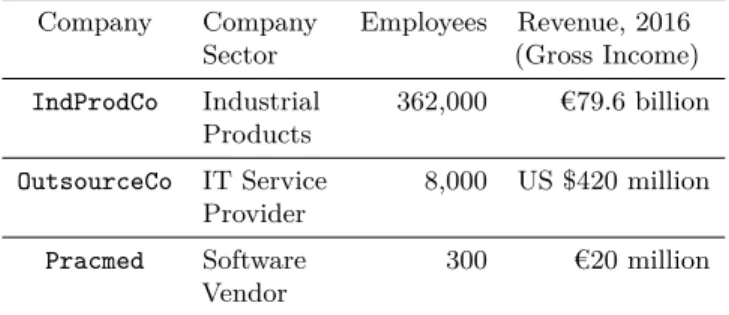
Sufficient resources Resources were scarce in terms of people – (individuals were stretched to fill the gaps). Table 4: Case study company characteristics
Company Company
Sector Employees Revenue, 2016(Gross Income)
IndProdCo Industrial Products 362,000 €79.6 billion OutsourceCo IT Service Provider 8,000 US $420 million Pracmed Software Vendor 300 €20 million
In addition to Case Study A, during our second phase, we conducted a 14 month longitudinal embedded case study (Case Study B) in a medium sized software development
company.
Finally, we employed a cross-case analysis to triangulate our findings.
3.1
Case Study A
3.1.1 Research Sites. The companies selected for inclusion
in this study are from a population of large enterprises en-gaged in outsourced or off-shore software development, as shown in Table 4.
Intensity sampling, which targets a larger number of in-terview participants with different responsibilities within the same unit of analysis, was employed to obtain richness and depth in the study [30, p. 234]. Perspectives from partici-pants with different responsibilities were obtained in order to triangulate the data. Responsibilities included: developers, testers, project management, programme management and corporate-level executives.
The Indian IT Services company (known here as Out-sourceCo) selected for the study, is a well-known mid-sized vendor in the worldwide software service outsourcing sector. OutsourceCo has Fortune500 company clients in Europe and North America and specialises in the travel sector.
The industrial products company (known here as Ind-ProdCo) has headquarters in Europe and has divisions in industrial automation and health. The software development centre in India is one of several worldwide technology centres.
3.1.2 Data Collection.The study was supported with
doc-umentary sources, such as publicly available white papers, technical reports, case studies, descriptions of vendor capa-bilities and web hosted marketing materials.
On-site visits to secure work environments enabled first-hand observation of working practices and workplace en-vironments. Scrum teams coordination meetings (stand-up meetings) were observed. Distributed scrum teams use
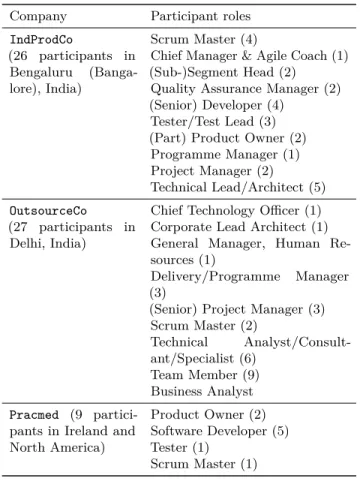
video-Table 5: Case study participants Company Participant roles
IndProdCo
(26 participants in Bengaluru (Banga-lore), India)
Scrum Master (4)
Chief Manager & Agile Coach (1) (Sub-)Segment Head (2)
Quality Assurance Manager (2) (Senior) Developer (4)
Tester/Test Lead (3) (Part) Product Owner (2) Programme Manager (1) Project Manager (2) Technical Lead/Architect (5) OutsourceCo (27 participants in Delhi, India)
Chief Technology Officer (1) Corporate Lead Architect (1) General Manager, Human Re-sources (1)
Delivery/Programme Manager (3)
(Senior) Project Manager (3) Scrum Master (2) Technical Analyst/Consult-ant/Specialist (6) Team Member (9) Business Analyst Pracmed (9
partici-pants in Ireland and North America)
Product Owner (2) Software Developer (5) Tester (1)
Scrum Master (1)
and audio-conferencing technology to enable virtual team coordination meetings.
However, the primary data collection technique employed in the study was face-to-face interviews conducted with 53 practitioners performed between May 2012 and March 2016, as shown in Table 5. The interviews were typically 50 minutes long and structured using an open-ended interview guide. Probing questions were used to encourage interviewees to raise any topics, issues and concerns outside the scope of scripted interview questions.
3.1.3 Data Analysis.Audio interview recordings were
tran-scribed and then imported into a qualitative data analysis software tool, Nvivo V9 [29]. Audio interviews and each cor-responding transcript were then reviewed for consistency.
A Glaserian approach to grounded theory was used for data analysis [14]. Topics were identified within the interview data and then coded into concepts by comparing within and between interview participants. Next, these concepts were iteratively grouped and refined into selected interview categories using constant comparison.
Descriptions of each selected category, with illustrative example quotations as evidence, were used to create examples of memo writing [15, Chapter 12]. These memos evolved and
changed during the analysis where categories are refined and sharpened.
3.2
Case Study B
Case Study B was a participant-observer study, focusing on a development team from a medium-sized Irish-based software company that develops practice and lab management software for the optical industry.
Pracmed employs approximately seventy staff members in its software development organization, including support and management staff. Pracmed’s annual sales approache20 million, from customers across the British Isles, continental Europe, Scandinavia, North America, and China.
Case Study B focused on TeamA, whose responsibility is to tailor the company’s product for a large customer in North America. The members of TeamA are distributed over four countries on two continents (see Table 5), with up to eight hours difference in timezones between locations. They are using Scrum to develop their software, with two weekly sprints.
3.2.1 Data Collection.We observed TeamA from
Janu-ary, 2016 to March, 2017. Specifically, one of the authors observed approximately 200 of TeamA’s Scrum ceremonies, including daily standups, sprint planning, backlog grooming, and sprint retrospectives. Due to team members being dis-tributed across Europe and North America, the observations were made via video conference for each ceremony. The same author also conducted semi-structured interviews of each member of TeamA, which were recorded and transcribed. The interviews took approximately one hour and followed an interview protocol available from [7].
The observer also made contemporaneous hand-written notes during both the ceremony observations and interviews. Finally, the interviewer summarized the interviews using a mind-map, and presented the result to five interviewees in an online workshop to validate the insights gained from the interviews.
3.2.2 Data Analysis. Given that Case Study A was
com-pleted by the start of the data analysis phase of Case Study B, we took a deductive approach that attempted to find evidence in support of, or contradictory to, the themes gen-erated by Case Study A. We examined interview transcripts for comments illustrating or elaborating these themes, and our observational notes for events related to themes.
3.3
Cross Case Analysis
While the case study approach is well established in software engineering [33], this research has employed a cross case (or cross site) analysis to explore similarities and differences among cases [24]. We use multiple cases in order to establish the range of generality and conditions of applicability of each approach [16].
Our approach does not synthesise data from multiple case studies [10, 11], but rather use a cross case analysis to facili-tate the comparison events, activities, and processes consid-ered important for each case [19, 24]. We have purposively selected the Case Study A and Case Study B in order to contrast features of the in-house offshore and outsourced offshore context.
4
RESULTS
4.1
Length of Service
The results here confirm anecdotal evidence of high staff turnover in the offshore outsourcing sector. Length of service: “21
2 years” (Senior Software Engineer, OutsourceCo). “I have
been working [here] for 1 year” (Scrum Master, OutsourceCo). Length of service: “11
2 years” (Senior Software Engineer,
OutsourceCo). Length of service: “I have been working here for the last 2 years” (Software Engineer, OutsourceCo).
There is an expectation of high staff turnover in the out-sourcing sector “if you work for a company like [a major Indian outsourcing company] or something. . . within 2 years you generally shift companies” (Developer, IndProdCo).
In contrast, working in-house for an international company even in an offshore location, there is improved retention, “I have been working here for 81
2 years. I joined as a fresher right
out of college” (Developer, IndProdCo), “101
2 years I have
worked here” (Architect, IndProdCo), “11 years” (Quality Manager, IndProdCo), “Fourteen years about to complete” (Quality Assurance Manager, IndProdCo) and “91
2 years”
(Technical Lead, IndProdCo).
Participants witness long service and high staff retention in the in-house offshore sector “[in] my team of 9 only 3 people are freshers. Otherwise, everyone has 8, 9, 10 years experience” (Developer, IndProdCo). Indeed, theaveragelength of service
on TeamA was over 7 years, with one senior member having over 20 years tenure. Three of TeamA’s members started with Pracmed as interns, and four have spent almost their entire careers with the company. Interestingly, one of TeamA’s members used to work for an outsourcing vendor in India before joining Pracmed in Ireland.
4.2
Employment Policies
The positive employment ethos of working in-house for an international company is reflected in the offshore location, “they have good policies, employee related policy” (Developer, IndProdCo). Such policies include inculcating a collegial and supportive work environment,
“we have open communication with colleagues. We share a lot of things. We help others. This helps to reduce a lot of tension and pressure in the workplace” (Test Lead, IndProdCo).
and “everyone is so supportive for getting the job done” (Senior Developer, IndProdCo). Practitioners describe a high
level of autonomy in their work “nobody ringing me saying, ‘Okay, you have to do this, this, this.’ Because we are
self-organised basically” (Technical Lead, IndProdCo).
Pracmed also tries to treat its offshore staff as equal to those at the home office: every year,alldevelopment staff are
flown to Dublin for a week-long developer conference. Also, Pracmed has an ambitious growth-by-acquisition strategy; they make substantial efforts to integrate development teams from acquired companies into their organization.
4.3
Work-life Balance
Practitioners describe respect from the employer towards home life “we come here for professional work, but we have another place to go after work that is to our family” (Senior Developer, IndProdCo), “[IndProdCo ] respects our family as well” (Architect, IndProdCo) and “if there is any prob-lem, I can go home whenever required” (Technical Lead, IndProdCo).
Employee-friendly policies are seen as supporting staff retention, “If I have an emergency [at home], I don’t need to worry if I have leave or not – my manager approves [time off]. There is work-life balance. . . that is one reason why many people stick with the company” (Scrum Master, IndProdCo).
Another example, from Pracmed, involved a project man-ager who considered resigning to spend more time with her young children; Pracmed made adjustments to her work schedule to accommodate this need.
4.4
Workplace Innovation
Practitioners at IndProdCo describe workplace innovation as a driver for staff retention,
“[we have an] innovative culture, where we are allowed to think freely and come up with our own ideas. Then, we can file our own invention dis-closures. Those are discussed and taken forward for patent filing” (Architect, IndProdCo)
We did not find any evidence of innovation patenting in OutsourceCo.
4.5
Product Quality
Many practitioners at IndProdCo emphasised the importance of product quality “Quality is always a challenge for us, but [IndProdCo ] always has a focus on quality” (Quality Assurance Manager, IndProdCo) and “there are a lot of [quality assurance] processes. . . we are minimising the defects” (Chief Manager, IndProdCo).
Lean practices are used to ensure the focus on quality “there is ‘stop the line,’ where the team is empowered to raise an issue related to quality” (Product Owner, IndProdCo).
Senior management monitors product quality during the development process “each version of the product. . . has five quality gates, wherein quality at every stage is being checked. And then it is reported to higher management” (Project Manager, IndProdCo).
Practitioners at IndProdCo describe this commitment to product quality as a driver for staff retention, “It’s also a reputed company, which produces a good quality prod-uct. . . This helps us to stay longer in [IndProdCo ]” (Test Lead, IndProdCo)
Pracmed also places emphasis on quality: junior developers are required to have their code reviewed by a senior developer. But this is seen as positive: “you do have a better product at the end of the sprint. There are a lot of checks and balances within the sprint at the same time there [is] more and more communication.” (Junior Developer, Pracmed)
4.6
Alignment with Onshore Work Hours:
Antipattern
Some outsourcing teams are required to shift their usual work hours to maximise time shared with onshore clients, for exam-ple “we are four and a half hours ahead right now, so we have half day when we really can talk to [the clients] and organise any meetings” (Senior Project Manager, OutsourceCo).
normally our working hours in India are 9 to 6 but we are working from 11 to 8. And as a team lead, I stay in the daylight saving times I stay one hour more, so that we get a full two hours of overlapping with the team at onshore (Technical Analyst, OutsourceCo).
Again, “[normally] we leave at 8pm, so by 9pm I’m at home. . . [the onshore client] is providing us with [taxi] cabs [to get home]” (Software Engineer, OutsourceCo).
It is not clear if shifting work hours is a requirement from clients, or if outsourcing vendors offer to shift work hours as an inducement to attract customers. None of the teams at IndProdCo reported aligning work hours to the onshore corporate headquarters time zone. This is also true of Pracmed; despite being highly distributed across Europe and North America, there is no attempt to synchronize working hours.
Rather, TeamA sometimes tries to take advantage of the time difference: “It would helpful if everybody was in the same room but in our case. . . we have the advantage of people in different time-zones. They [DBA in Dublin] are given some work that I am doing at the moment then will be working on it during the day. Then the DBA can handover to me in the next morning.” (Senior. Developer, TeamA)
by having Senior Developers in Dublin do code reviews of North American developers’ output.
4.7
Work Hours: Antipattern
Outsourcing vendors require staff members to work additional hours, for example “towards the end of a sprint we may be putting extra hours, sometimes” (Senior Project Manager, OutsourceCo). For some team members the need to work late happens if there is a technical problem “sometimes if there is a challenge on the team. It does put pressure on us. So that we give some extra hours” (Scrum Master, OutsourceCo).
Practitioners do not view the need to work long hours positively, “sometimes we have to stay [at work] late, so it feels bad” (Software Engineer, OutsourceCo).
In contrast, working in-house for an international company “the work is really good, in the sense that you have regular timeslots of nine hours, they don’t
ask you to work on Saturdays, Sundays. The work-life balance is really good here” (Developer, IndProdCo).
This quote is illustrative of several similar comments made about working hours at IndProdCo.
In contrast, Pracmed has an unwritten “9 to 5” policy: while we observed occasional examples of senior team mem-bers working late to solve an urgent customer problem, in general Pracmed seems to adopt a sustainable pace philos-ophy with flexible working hours to accommodate school schedules and other family requirements.
4.8
Adverse Impact on Health
In the outsourcing environment, long work hours are consid-ered unhealthy by practitioners. For example, “that pressure [to deliver] comes after every sprint, at the end of every sprint. It is not healthy I fear” (Senior Project Manager, OutsourceCo).
Similarly,
“If one day we stretch to 12 working hours, it’s more than enough. So, if you’re continuously working 12 hour days, your health goes down. You can’t think anymore” (Senior Software En-gineer, OutsourceCo).
We found no evidence of practitioners identifying negative health impacts of work at IndProdCo or Pracmed.
5
DISCUSSION
The findings from our cross case analysis identify issues around employment policies, work-life balance, workplace innovation, onshore work hours alignment, working hours, and impact on health.
We found evidence of family friendly policies at IndProdCo and Pracmed. For example, time-off from work to deal with a family emergency, sustainable work hours, a culture of communication and respect were all cited as important by practitioners.
In contrast, at OutsourceCo there seemed to be a much more immediate focus on client satisfaction leading to issues around long working hours as well as evening and weekend working.
We observed another important distinction in the area of product innovation and product quality. For IndProdCo and Pracmed there was a sense of pride and ownership of the product being produced. The commitment to quality was striking in practitioner responses. While at OutsourceCo the product belongs to the client and the commitment quality was sometimes subsumed by the need for productivity to meet client demands.
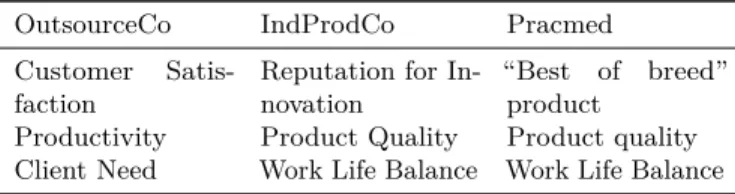
These findings can be summarised, as shown in Table 6, by saying that in OutsourceCo client satisfaction was achieved through productivity and responsiveness to customer de-mands; while in IndProdCo and Pracmed, there was a greater emphasis on product quality and product innovation.
Previous studies have shown that developer motivation and attrition are linked: highly motivated developers are more
Table 6: Outsourced and In-house Comparison factors OutsourceCo IndProdCo Pracmed Customer
Satis-faction Reputation for In-novation “Best of breed”product Productivity Product Quality Product quality Client Need Work Life Balance Work Life Balance likely to remain in their current jobs, while lack of motivation may result in attrition [5, 38].
This may be part of the reason that some GSD projects experience high staff turnover, and others do not: the nature of the work, and the working environment, in different kinds of GSD may reduce or exacerbate staff turnover.
Ultimately, software developer motivitation can be distilled into three factors, as proposed by Ryan and Deci [34] in their self determination theory. These three factors – relatedness, competence, and autonomy – capture the software developer’s need to be part of a team, to learn new skills and develop existing skills, and to exercise those skills to the best of his or her ability; Ryan and Deci also note, however, that these dimensions need to be balanced: autonomy without competence can lead to stress, while lack of connectedness can lead to a feeling of isolation [28, 34].
Are our results consistent with self determination theory? We consider the three dimensions in turn:
Relatedness.The employment policies of both IndProdCo
and Pracmed help to promote a sense of belonging, to one’s team and to the larger organization. It could also be argued that a degree of relatedness is necessary for innovation: ex-change of both ideas and experience among developers would help innovative ideas progress to implementation.
Competence.Competence is crucial for quality: quality
soft-ware cannot be produced by unqualified developers. Compe-tence is also a necessary pre-requisite to innovation: in a tech-nical context, innovation derives from engineering skill that enables a developer to carry an idea through to a patentable innovation.
Autonomy.We noted an emphasis on individual autonomy
at IndProdCo. This is somewhat less true of Pracmed at the individual level, but at the team level, Pracmed’s develop-ment teams follow the Scrum philosophy of self-organization. In previous research, we have hypothesized that competent developers will not be motivated unless they have sufficient autonomy to exercise their competence [28]. It appears that, in the case of our offshoring companies, both conditions are met.
5.1
Implications for Practice
Our findings show that IndProdCo and Pracmed have done an excellent job in creating an attractive workplace culture, evidenced by the length of service and low staff turnover we observed.
There are attractions to working in the outsourcing sector. Such companies provide opportunities to work with many clients, technologies and cultures in a relatively short period of time, when compared with a traditional career path of moving job from one company to another.
However, in the outsourcing context, line and personnel managers need to make more strenuous efforts to create an attractive working environment. Greater effort to collate and reward innovations could be a useful tool. But our evidence suggests that paying attention to work life balance and em-ployment policies would seem to be key.
5.2
Limitations
We have adopted four criteria for exploring the trustworthi-ness of naturalistic research findings, following the approach of [21, Chapter 11]:
∙ Credibility,
∙ Transferability, ∙ Dependability, and
∙ Confirmability.
In ‘real-world’ research it is not easy to manipulate exper-imental variables to establish causal relationships [32]. As a consequence, the quality criteria we have adopted attempt to address broad questions of research validity and reliability.
Credibility, in a sense, relates to the ‘truthfulness’ of the research. We seek to conduct research in such a way that the findings are found ‘credible’ by researchers and study participants.
Transferability addresses the applicability of research from one group of study participants to another given a similar context. From this perspective, we need to understand the circumstances affecting each group to judge their similarity in order to understand the likely application of the research findings.
Dependability relates to the consistency or repeatability of the research.
Confirmability in research concerns researcher neutrality or objectivity in their interactions with the study context. A new and independent observer should be expected to draw similar conclusions from their findings in confirmable research.
The mixed-method research approach we adopted enabled us to triangulate findings from OutsourceCo and IndProdCo in Case Study A and TeamA from Pracmed in Case Study B.
We also performed a methodological triangulation by using an embedded participant observation study in Case Study B as opposed to the multi-case study approach in Case Study A. These strategies together minimise researcher bias (con-firmability) and enhance transferability of the findings.
We have attempted to demonstrate a rigorous approach to data collection and data analysis in order to enhance research credibility and dependability.
6
CONCLUSIONS
This research takes as its starting point the observation that poorly motivated software team members have a negative
impact on productivity and product quality. We have in-vestigated the question: What do practitioners perceive to be the causes of high staff turnover? And then focusing on
the question: How do practitioners explain staff turnover for in-house offshore and offshore outsourced projects?We
observed significant differences in length of service between the in-house and outsourced work context.
In order to explain the differences in length of service, this research adopted a mixed methods approach comprising a multi-case study involving two large multinational companies and a longitudinal embedded case study in a medium sized software development company.
In Case Study A, 53 practitioners were interviewed to compare and contrast the in-house offshore setting (an off-shore development centre that is part of a larger international company) and an offshore outsourcing service provider.
In Case Study B, a participant observation study was con-ducted over a 14 month period. A geographically distributed team was investigated in-depth, including interviews with 9 of its members.
Our cross case analysis findings highlight issues around employment policies, work-life balance, workplace innovation, onshore work hours alignment, working hours and impact on health.
In the outsourcing context, development team members are client-facing and expected to contribute to achieving good customer satisfaction. Emphasis on good customer satisfac-tion focuses on development team productivity; with poor productivity being masked for the client by long working hours within the development team. While innovation and elegant solutions are desirable there is a pervasive awareness that the development artefacts produced by the team belong to the onshore client.
In the in-house offshore context, in contrast, the team are very much nurturing their own product. The development artefacts produced by the team belong to the team. Of course the team are incentivised by client satisfaction, but through a focus on product innovation and quality. Employment policies and employer commitment to work-life balance are designed to nurture and retain good quality staff.
We speculate that offshore outsourcing service providers could reduce staff member turnover by improving work-life balance and adopting more family friendly employment poli-cies. Further, outsourcing service providers could reward innovation more effectively and structure contracts to enable software product ownership to improve staff retention.
7
ACKNOWLEDGMENTS
The authors are grateful to the companies and interviewees who participated in Case Study A. Thanks also go to Inter-national Institute for IT, Bangalore who provided hospitality during several research visits. The research benefited in part from travel funding from the UK Deputy High Commission, Bangalore; Science and Innovation Network. Accommodation and sustenance was provided by OutsourceCo during the data collection visit to Delhi, India.
REFERENCES
[1] Tarek K. Abdel-Hamid. 1989. A Study of Staff Turnover, Acquisi-tion, and Assimilation and Their Impact on Software Development Cost and Schedule.Journal of Management Information Systems 6, 1 (summer 1989), 21–40.
[2] Steve Adolph, Wendy Hall, and Philippe Kruchten. 2011. Us-ing grounded theory to study the experience of software devel-opment. Empirical Software Engineering16, 4 (Aug. 2011), 487–513. https://doi.org/10.1007/s10664-010-9152-6
[3] Ritu Agarwal and Thomas W. Ferratt. 2001. Crafting an HR strategy to meet the need for IT workers.Commun. ACM44, 7 (2001), 58–64. https://doi.org/partially
[4] Sarah Beecham. 2014. Motivating Software Engineers working in Virtual Teams across the Globe. InSoftware Project Management in a Changing World, Claes Wohlin and Guenther Ruhe (Eds.). Springer, Germany, 255–282.
[5] Sarah Beecham, Nathan Baddoo, Tracy Hall, Hugh Robinson, and Helen Sharp. 2008. Motivation in Software Engineering: A systematic literature review.Information and Software Technol-ogy50, 9 (Aug. 2008), 860–878. https://doi.org/10.1016/j.infsof. 2007.09.004
[6] Sarah Beecham and John Noll. 2015. What motivates software en-gineers working in global software development?. InInternational Conference on Product-Focused Software Process Improvement.
Springer, Cham, 193–209.
[7] Sarah Beecham, John Noll, and Mohammad Abdur Razzak. 2017. Lean Global Project Interview Protocol. Available at http://www.lero.ie/sites/default/files/Lero_TR_2017_ 02_Beecham_Noll_Razzak-Lean%20Global%20Project% 20Interview%20Protocol.pdf. (2017).
[8] Barry W. Boehm. 1981.Software Engineering Economics(1st ed.). Prentice Hall, Englewood Cliffs, N.J.
[9] J. Daniel Couger and Robert A. Zawacki. 1980.Motivating and managing computer personnel. Wiley, New York. 213 pages. [10] D. S. Cruzes and T. Dybå. 2010. Synthesizing Evidence in Software
Engineering Research. InProceedings of the 2010 ACM-IEEE International Symposium on Empirical Software Engineering and Measurement (ESEM ’10). ACM, New York, NY, USA, 1:1–1:10. https://doi.org/10.1145/1852786.1852788
[11] D. S. Cruzes and T. Dybå. 2011. Research synthesis in software engineering: A tertiary study.Information and Software Tech-nology53, 5 (May 2011), 440–455. https://doi.org/10.1016/j. infsof.2011.01.004
[12] C. Ebert, B. K. Murthy, and N. N. Jha. 2008. Managing Risks in Global Software Engineering: Principles and Practices. In IEEE International Conference on Global Software Engineering (ICGSE 2008). 131–140. https://doi.org/10.1109/icgse.2008.12 [13] S. A. Frangos. 1998. Motivated humans for reliable software products.Microprocessors and Microsystems21, 10 (1998), 605– 610. http://dx.doi.org/10.1016/S0141-9331(98)00062-3 [14] B. G. Glaser. 1992.Basics of Grounded Theory Analysis:
Emer-gence vs. Forcing. Sociology Press, Mill Valley.
[15] B. G. Glaser. 1998.Doing Grounded Theory: Issues and Discus-sions. Sociology Press, Mill Valley.
[16] B. G. Glaser and A. L. Strauss. 1967. Discovery of Grounded Theory: Strategies for Qualitative Research. Aldine, Chicago,
IL.
[17] T Hall, S Beecham, J Verner, and D Wilson. 2008. The impact of staff turnover on software projects: the importance of understand-ing what makes software practitioners tick (Refillunderstand-ing the Pipeline: Meeting the Renewed Demand for Information Technology Work-ers). InACM-SIGMIS CPR ’08 Conference.
[18] H. Holmstrom, E. O. Conchuir, P. J. Agerfalk, and B. Fitzger-ald. 2006. Global Software Development Challenges: A Case Study on Temporal, Geographical and Socio-Cultural Distance. In Global Software Engineering, 2006. ICGSE ’06. International Conference on. 3–11. https://doi.org/10.1109/icgse.2006.261210 [19] S. Khan and R. VanWynsberghe. 2008. Cultivating the Under-Mined: Cross-Case Analysis as Knowledge Mobilization.Forum Qualitative Sozialforschung / Forum: Qualitative Social Re-search9, 1 (Jan. 2008). https://doi.org/10.17169/fqs-9.1.334 [20] B. Lin, G. Robles, and A. Serebrenik. 2017. Developer turnover
in global, industrial open source projects: Insights from applying survival analysis. InProceedings - 2017 IEEE 12th International Conference on Global Software Engineering, ICGSE 2017. 66–75.
[21] Y. S. Lincoln and E. G. Guba. 1985. Naturalistic Inquiry(1st ed.). SAGE Publications, Inc, Beverly Hills, Calif.
[22] B. L. Mak and H. Sockel. 2001. A confirmatory factor analysis of IS employee motivation and retention.Information & Management 38, 5 (2001), 265–276. https://doi.org/no
[23] S. McConnell. 1998. Problem programmers.IEEE Software15, 2 (March 1998), 128, 127, 126–. https://doi.org/10.1109/52.663801 [24] M. B. Miles and A. M. Huberman. 1994.Qualitative Data Anal-ysis: An Expanded Sourcebook (2nd ed.). Sage Publications, Inc.
[25] Nils Brede Moe, Geir Kjetil Hanssen, et al. 2012. From offshore outsourcing to offshore insourcing: Three stories. InGlobal Soft-ware Engineering (ICGSE), 2012 IEEE Seventh International Conference on. IEEE, 1–10.
[26] Robbie T. Nakatsu and Charalambos L. Iacovou. 2009. A com-parative study of important risk factors involved in offshore and domestic outsourcing of software development projects: A two-panel Delphi study. Information and Management 46 (2009), 57–68.
[27] John Noll and Sarah Beecham. 2016. Measuring Global Distance: A Survey of Distance Factors and Interventions. InInternational SPICE Conference on Process Improvement and Capability Determination in Software, Systems Engineering and Service Management. Dublin, Ireland. http://lero.ie/sites/default/files/ 2015_TR_02_Sarah%20Beecham_John%20Noll_Measuring% 20Global%20Distance%20A%20Survey%20of%20Distance% 20Factors%20and%20Interventions.pdf
[28] John Noll, Mohammad Abdur Razzak, and Sarah Beecham. 2017. Motivation and Autonomy in Global Software Development: An Empirical Study. InProceedings of the 21st International Con-ference on Evaluation and Assessment in Software Engineering. ACM, 394–399.
[29] NVivo. 2013. NVivo 9 Help. http://help-nv9-en.qsrinternational. com/nv9_help.htm. (2013). [accessed 10-09-2017].
[30] M. Q. Patton. 2002.Qualitative Research & Evaluation Methods (3rd ed.). Sage Publications, Inc, Thousand Oaks, California.
[31] C. M. Ridings and L. B. Eder. 1999. An Analysis of IS technical career paths and job satisfaction.SIGCPR Comput. Pers.20, 2 (1999), 7–26. https://doi.org/no
[32] Colin Robson. 2011. Real World Research(3rd ed.). John Wiley and Sons Ltd., Chichester, UK.
[33] P. Runeson, M. Höst, A. Rainer, and B. Regnell. 2012.Case Study Research in Software Engineering: Guidelines and Examples. Wiley-Blackwell, Hoboken, NJ.
[34] Richard M. Ryan and Edward L. Deci. 2000. Self-determination theory and the facilitation of intrinsic motivation, social devel-opment, and well-being. American psychologist55, 1 (2000), 68.
[35] Darja Šmite, Claes Wohlin, Zane Galvin,a, and Rafael Priklad-nicki. 2014. An empirically based terminology and taxonomy for global software engineering.Empirical Software Engineering19, 1 (2014), 105–153.
[36] D. C. Smith and H. L. Speight. 2006. Antecedents of turnover intention and actual turnover among information systems per-sonnel in South Africa. Proceedings of the 2006 ACM SIG-MIS CPR conference on computer personnel research: Forty four years of computer personnel research: achievements, chal-lenges & the future. Claremont, California, USA(2006), 123–129. https://doi.org/no
[37] June Verner, S Beecham, and N Cerpa. 2010. Stakeholder Disso-nance: Disagreements on project outcome and its impact on team motivation across three countries. InACM SIGMIS CPR ’10. [38] J. M. Verner, M. A. Babar, N. Cerpa, T. Hall, and S. Beecham.
2014. Factors that motivate software engineering teams: A four country empirical study. Journal of Systems and Software92 (June 2014), 115–127. https://doi.org/10.1016/j.jss.2014.01.008 [39] Aurora Vizcaíno, Felix García, Mario Piattini, and Sarah Beecham. 2016. A validated ontology for global software development. Com-puter Standards & Interfaces46 (2016), 66–78.
![Figure 1: Detail from GSD Project Sub-Ontology according to Vizcaino et al, 2016 [39])](https://thumb-us.123doks.com/thumbv2/123dok_us/8996643.2797489/2.918.477.837.230.800/figure-gsd-project-sub-ontology-according-vizcaino-et.webp)