Damian Borth
Visual Learning of
Socio-Video Semantics
Dissertation
genehmigt vom Fachbereich Informatik der Universit¨at Kaiserslautern zur Verleihung des akademischen Grades
Doktor der Naturwissenschaften (Dr. rer. nat.)
Dekan:
Prof. Dr. Klaus Schneider, Universit¨at Kaiserslautern Berichterstatter:
Prof. Dr. Thomas Breuel, Universit¨at Kaiserslautern Prof. Dr. Andreas Dengel, Universit¨at Kaiserslautern
Vorsitzender der Promotionskommission: Prof. Dr. Hans Hagen, Universit¨at Kaiserslautern
Datum der Aussprache: 11. Juli 2014
Acknowledgements
I would like to express my gratitude to all those who have helped and supported me during the completion of this thesis. First, I would like to thank Prof. Thomas Breuel for his trust and guidance throughout the time of my dissertation research. I also want to thank Prof. Andreas Dengel, who provided comments, suggestions, and supported my research beyond the scope of this dissertation. I am also grateful to Prof. Shih-Fu Chang for the opportunity to visit his lab and to collaborate on visual sentiment analysis, and to Prof. Klaus Madlener for his support during my early years in academia. In particular, I would like to thank Adrian Ulges, without his mentorship and constant support this dissertation would not have been possible.
Next, I would like to thank all my colleagues at MADM and IUPR for all their fruitful discussions, pointers to related work, and answers to technical questions. This includes in particular colleagues and students who either contributed with their work to this thesis or reviewed it: J¨orn Hees, Tim Althoff, Adrian Ulges, Christian Schulze, Christian Kofler, Armin Stahl, Joost van Beusekom, Markus Koch, Alexander Arimond, Marco Schreyer, and Jane Bensch.
An dieser Stelle m¨ochte ich mich auch bei all denen bedanken, welche daf¨ur gesorgt haben, dass ich das Wesentliche nicht aus den Augen verloren habe: Myriam f¨ur ihre Unterst¨utzung und Gedult, meine Br¨uder Arthur und Waldemar f¨ur die Erinnerung, dass es ein Leben ausserhalb der Forschung gibt, und meine Eltern f¨ur ihre Hilfe und ihr Vertrauen w¨ahrend dieser Zeit.
Abstract
Today’s ubiquity of visual content as driven by the availability of broadband Internet, low-priced storage, and the omnipresence of camera equipped mobile devices conveys much of our thinking and feeling as individuals and as a society. As a result the growth of video repositories is increasing at enourmous rates with content now being embedded and shared through social media. To make use of this new form of social multimedia,concept detection, the automatic mapping of semantic concepts and video content has to be extended such that concept vocabularies are synchronized with current real-world events, systems can perform scalable concept learning with thousands of concepts, and high-level information such as sentiment can be extracted from visual content. To catch up with these demands the following three contributions are made in this thesis: (i)concept detection is linked to trending topics,(ii) visual learning from web videos is presented including the proper treatment of tags as concept labels, and(iii) the extension of concept detection with adjective noun pairs for sentiment analysis is proposed.
In order for concept detection to satisfy users’ current information needs, the notion of fixed concept vocabularies has to be reconsidered. This thesis presents a novel concept learning approach built upon dynamic vocabularies, which are automatically augmented withtrending topicsmined from social media. Once discovered, trending topics are evaluated by forecasting their future progression to predict high impact topics, which are then either mapped to an available static concept vocabulary or trained as individual concept detectors on demand. It is demonstrated in experiments on YouTube video clips that by a visual learning of trending topics, improvements of over 100% in concept detection accuracy can be achieved over static vocabularies (n=78,000).
To remove manual efforts related to training data retrieval from YouTube and noise caused by tags being coarse, subjective and context-depedent, this thesis suggests an automaticconcept-to-query map-ping for the retrieval of relevant training video material, andactive relevance filteringto generate reliable annotations from web video tags. Here, the relevance of web tags is modeled as a latent variable, which is combined with an active learning label refinement. In experiments on YouTube, active relevance filtering is found to outperform both automatic filtering and active learning approaches, leading to a reduction of required label inspections by 75% as compared to an expert annotated training dataset (n=100,000). Finally, it is demonstrated, that concept detection can serve as a key component to infer the sen-timent reflected in visual content. To extend concept detection for sensen-timent analysis, adjective noun pairs (ANP) as novel entities for concept learning are proposed in this thesis. First a large-scale visual sentiment ontology consisting of 3,000 ANPs is automatically constructed by mining the web. From this ontology a mid-level representation of visual content – SentiBank – is trained to encode the visual pres-ence of 1,200 ANPs. This novel approach of visual learning is validated in three independent experiments on sentiment prediction (n=2,000), emotion detection (n=807) and pornographic filtering (n=40,000). SentiBank is shown to outperform known low-level feature representations (sentiment prediction, pornog-raphy detection) or perform comparable to state-of-the art methods (emotion detection).
Altogether, these contributions extend state-of-the-art concept detection approaches such that con-cept learning can be done autonomously from web videos on a large-scale, and can cope with novel semantic structures such as trending topics or adjective noun pairs, adding a new dimension to the understanding of video content.
Contents
1 Introduction 1
1.1 Video Retrieval . . . 2
1.2 Visual Learning of Semantics . . . 3
1.3 Goal and Outline of this Thesis . . . 6
1.3.1 Dynamic Vocabularies by Trending Topics Discovery . . . 7
1.3.2 Training Data Retrieval and Active Relevance Filtering . . . 8
1.3.3 Adjective Noun Pairs for Visual Sentiment Analysis . . . 8
1.4 Presented Framework . . . 9
2 An Overview of Concept Detection in Video Content 11 2.1 Problem Statement . . . 12
2.2 Applications . . . 14
2.3 Video Structure . . . 16
2.4 Concept Detection System Architecture . . . 17
2.4.1 Training Phase . . . 18
2.4.2 Application Phase . . . 18
2.5 Concept Detection Pipeline . . . 19
2.5.1 Shot Segmentation . . . 19
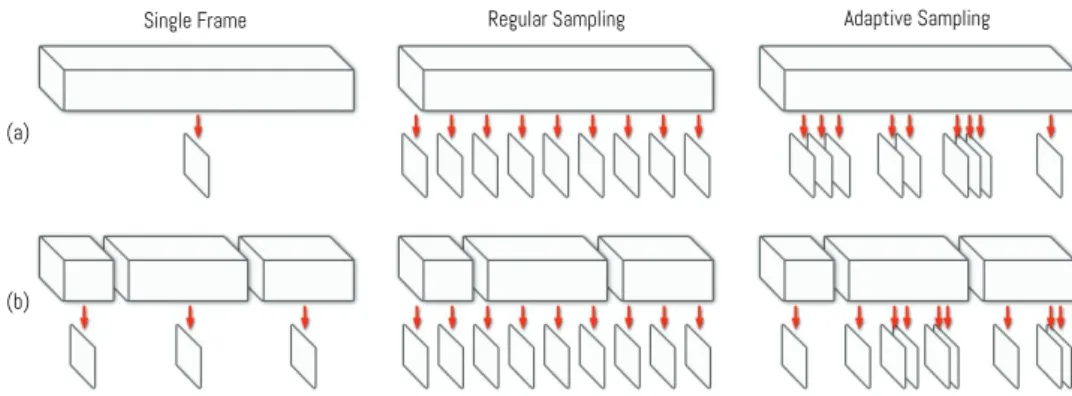
2.5.2 Keyframe Extraction . . . 20
2.5.3 Feature Extraction . . . 21
2.5.4 Statistical Classification by Supervised Learning . . . 24
2.5.5 Intra-concept Fusion . . . 26
2.5.6 Concept Relation Modeling / Inter-concept fusion . . . 26
2.5.7 Pipeline Configuration . . . 27
2.6 System Evaluation . . . 27
2.6.1 Methodology . . . 28
2.6.2 Performance Measures . . . 28
2.7 Label Acquisition Characteristics . . . 29
3 Dynamic Vocabularies by Trending Topics Discovery 33 3.1 Introduction . . . 34
3.2 Related Work . . . 36
3.2.2 Multi-Channel Analyses . . . 37
3.2.3 Forecasting Behavioral Dynamics . . . 38
3.2.4 Social Multimedia Applications . . . 39
3.2.5 Vocabularies for Concept Detection . . . 39
3.3 Trending Topics Detection & Analysis . . . 41
3.3.1 Trending Topic Discovery . . . 41
3.3.2 Lifetime Analysis of Trending Topics . . . 43
3.3.3 Cross-Media Topic Category Analysis . . . 45
3.3.4 Classes of Pattern Recurrence . . . 47
3.4 Forecasting of Trending Topics . . . 48
3.4.1 Discovering Semantically Similar Topics . . . 49
3.4.2 Nearest Neighbor Sequence Matching . . . 50
3.4.3 Forecasting . . . 51
3.4.4 Evaluation . . . 52
3.5 Evolving Vocabularies for Concept Detection . . . 58
3.5.1 Concept Detection System with a Static Vocabulary . . . 58
3.5.2 Concept-to-Trend Mapping . . . 61
3.5.3 Training of Visual Trend Detectors . . . 62
3.5.4 Expanding the Concept Vocabulary . . . 63
3.5.5 Experimental Evaluation . . . 63
3.6 Discussion . . . 67
4 Training Data Retrieval and Active Relevance Filtering 69 4.1 Introduction . . . 70
4.2 Related Work . . . 72
4.2.1 Label Acquisition with Active Learning . . . 72
4.2.2 Visual Learning from Web Labels . . . 73
4.2.3 Dealing with Label Noise . . . 74
4.3 Concept-to-Query Mapping . . . 75
4.3.1 Automatic Keyword Selection . . . 76
4.3.2 Automatic Category Assignment . . . 77
4.4 Active Relevance Filtering . . . 78
4.4.1 Basic Concepts . . . 78
4.4.2 Active Learning . . . 80
4.4.3 Automatic Relevance Filtering . . . 82
4.4.4 Active Relevance Filtering . . . 83
4.5 Experimental Evaluation . . . 84
4.5.1 Comcept-to-query Mapping . . . 84
4.5.2 Weak Label Impact & Automatic Relevance Filtering . . . 86
4.5.3 Active Learning . . . 88
4.5.4 Active Relevance Filtering . . . 89
5 Adjective Noun Pairs for Visual Sentiment Analysis 93
5.1 Introduction . . . 94
5.2 Related Work . . . 96
5.2.1 Textual Sentiment Analysis . . . 96
5.2.2 Visual Sentiment Analysis . . . 97
5.2.3 Visual Learning with Ontologies and Concept Combinations . . . 97
5.3 Framework Overview . . . 99
5.3.1 Psychological Foundation . . . 99
5.3.2 Ontology Construction . . . 100
5.3.3 Detector Bank Training . . . 101
5.3.4 Application Domains . . . 101
5.4 Visual Sentiment Ontology . . . 101
5.4.1 Data-driven Sentiment Word Discovery . . . 102
5.4.2 Adjective Noun Pair (ANP) Construction . . . 104
5.4.3 Link back to Emotions . . . 107
5.4.4 Flickr CC Dataset & Visualization Tool . . . 107
5.5 VSO Structure Construction and Analysis . . . 107
5.5.1 Methodology . . . 108
5.5.2 VSO Structure . . . 109
5.5.3 VSO Analysis . . . 111
5.6 SentiBank . . . 113
5.6.1 Reliability of ANP labels . . . 113
5.6.2 ANP Detector Training . . . 115
5.6.3 SentiBank Construction . . . 116
5.6.4 Special Visual Features . . . 117
5.7 SentiBank Applications . . . 117 5.7.1 Sentiment Prediction . . . 117 5.7.2 Emotion Classification . . . 122 5.7.3 Digital Forensics . . . 123 5.8 Discussion . . . 124 6 Discussion 127
A Fixed Vocabulary Concepts 129
List of Figures
1.1 Overview of visual recognition tasks . . . 4
1.2 An illustration of the proposed concept detection framework . . . 9
2.1 Examples of video keyframes for semantic concepts . . . 12
2.2 Hierarchical structure of a video clip . . . 16
2.3 Overview of a concept detection system architecture . . . 17
2.4 Illustration of a shot boundary detection by adaptive thresholding . . . 20
2.5 Overview of different keyframe extraction methods . . . 21
2.6 Motion and audio descriptor illustration . . . 24
2.7 Plot of uploaded blank videos on YouTube . . . 31
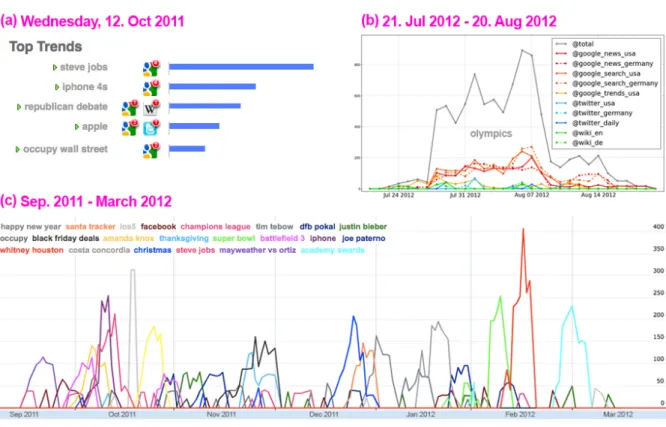
3.1 Idea of dynamic vocabularies for concept detection . . . 35
3.2 Visualization of trending topic clustering . . . 36
3.3 Overview of trending topics and visualization of examples . . . 37
3.4 Delay between media channel pairs . . . 43
3.5 Media channel delay histograms . . . 44
3.6 Lifetime histograms of top 200 trending topics . . . 45
3.7 Categorization of trending topics split by media channel . . . 47
3.8 Classes of behavioral signals with respect to recurrence . . . 48
3.9 System overview of the presented forecasting framework . . . 49
3.10 Example of “2012 Summer Olympics” properties and their semantically similar topics . . . 50
3.11 MAPE forecasting error . . . 56
3.12 Trending topics forecasting visualization . . . 57
3.13 Time consumption for SVM concept detector training . . . 60
3.14 Correlation between trending topics and video uploads on YouTube . . . 64
3.15 Quantitative results of trending topic recognition . . . 65
4.1 Samples images from YouTube illustrating weakly labeled video . . . 71
4.2 Proposed framework for active relevance filtering . . . 75
4.3 Overview of difference label refinement strategies . . . 79
4.4 Detector performance degradation caused by the use of pseudo labels . . . 86
4.5 Concept detection performance with active learning as compared to active relevance filtering 88 4.6 Comparison of active learning and active relevance filtering . . . 89
5.1 Sample tweets conveying it sentiment mainly visually . . . 94
5.2 Adjective noun pair samples . . . 95
5.3 Overview of the proposed visual sentiment ontology construction framework . . . 98
5.4 Plutchnik’s wheel of emotions with its 24 emotions . . . 99
5.5 Sentiment word examples . . . 102
5.6 Co-occurrence matrix of tags associated with emotions queries . . . 104
5.7 Frequency graph of image download from Flickr . . . 107
5.8 VSO visualization interface using a Treemap . . . 108
5.9 VSO construction methodology . . . 109
5.10 Distribution of adjectives and nouns from the VSO . . . 110
5.11 Sample ANPs and its detector performance visualization . . . 114
5.12 ANP detector performance overview . . . 115
5.13 AP@20 vs. frequency of 1,553 ANP detectors ranked by detector performance. . . 116
5.14 Samples of the photo tweet dataset . . . 118
5.15 Photo tweet dataset and number of images by hashtag . . . 119
5.16 Sentiment prediction results by hashtag . . . 121
5.17 Sentiment prediction visualization . . . 122
5.18 Emotion classification results . . . 123
5.19 Top 50 SentiBank detectors within digital forensic domain . . . 124
B.1 Groups of adjective derived from the VSO . . . 135
List of Tables
3.1 Top 30 international trending topics during observation period . . . 40
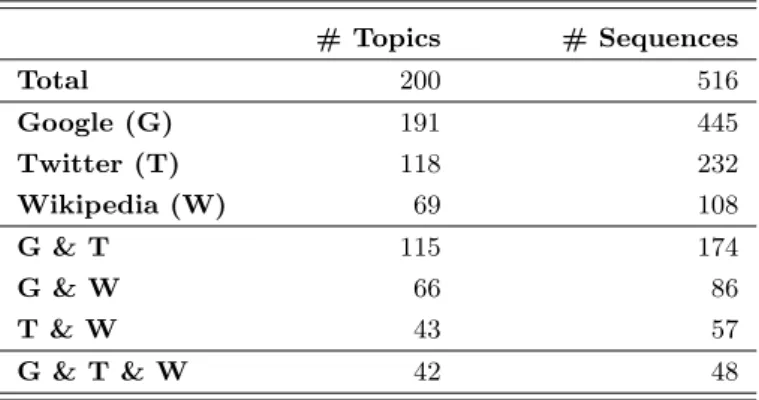
3.2 Trending topics dataset overview . . . 41
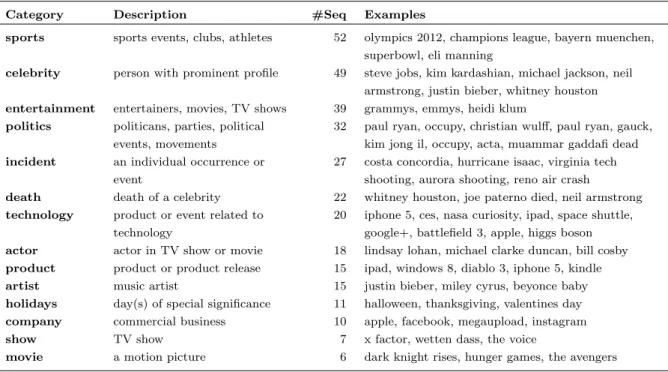
3.3 List of categories and trending topic examples . . . 46
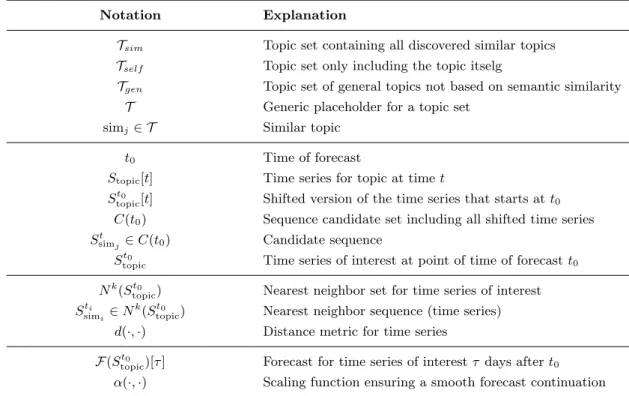
3.4 Summary of formal notation for time-series forecasting . . . 51
3.5 A representative set of trending topics along with their nearest neighbor topics . . . 53
3.6 RMSE forecasting error . . . 54
3.7 Visualization of trending topics detections . . . 66
4.1 Automatic keyword selection for query construction . . . 76
4.2 Automatic category assignment for query construction . . . 77
4.3 Active learning as used in concept detection . . . 81
4.4 Active relevance filtering as embedded in concept detection . . . 83
4.5 Concept-to-query mapping results . . . 85
4.6 Overview of detector performance degradation per concept . . . 87
5.1 Statistics of the visual sentiment ontology construction process . . . 103
5.2 Top ANPs for representative emotions from Plutchik’s emotion model. . . 105
5.3 Adjective antonyms relations as found in the VSO . . . 111
5.4 Adjective supportive relation as found in the VSO . . . 112
5.5 Comparison of tweet sentiment prediction accuracy . . . 120
5.6 SentiBank pornography and CSA detection performance . . . 124
Chapter 1
Introduction
Currently, traditional media is experiencing a major shift towardssocial media. In the same way interac-tion in social media is to an increasing degree enriched with images and videos. This combinainterac-tion gives rise to a new type of content being coined associal multimedia. Examples illustrating this development are the Arab Spring in the Middle East in 2012, where public protests were organized, communicated, and propagated by means of social media, or the Boston Marathon Bombings on April 15th2013, where the
majority of media coverage – including official sources such as the police and the FBI – was distributed by social platforms like Twitter and YouTube instead of through traditional media. One triggering key element of this trend is the upload and distribution of images and videos over the Internet minutes after such incidents happen. This is possible because of the availability of broadband Internet, low-priced storage, and the omnipresence of camera equipped mobile devices allowing people to record, publish, share, and consume digital images and videos without effort. This ubiquity of visual content conveys much about our thinking and feeling as it reflects our personal life and ourselves as a society.
As the world is turning towards visual communication [SW09], the sizes of image and video databases are growing with enormous rates. Nowadays, users are generating large amounts of video material and are publishing it online via video platforms like “YouTube”, “Vimeo”, or “Dailymotion”1. YouTube, as the most prominent provider in this area, stores about 100 hours of new video content every minute on its database and delivers over six billion hours of videos to its users every month [YOU13]. Additionally, live-streaming services like “Ustream” or “Justin.tv”2 form another quickly growing area for digital video broadcasting. Besides web video sharing platforms and live streaming services a third form of digital video is moving towards the Internet: streamed video on demand. Platforms such as “Netflix” or “Amazon Instant Video”3 are starting to conquer this market and they are followed by traditional TV broadcasters like News Corp. and Time Warner. In contrast to these commercial consumer efforts digital video streams are recorded and stored in other contexts including efforts to digitalize a nation’s broadcast archives [HSdRS12], to preserve cultural heritage [PKA+07], to maintain public safety by surveillance camera monitoring [BBC06], and to augment reality or record our surroundings4.
Summarizing, there is not only an immense amount of digital video already stored digitally, but
1www.youtube.com,www.vimeo.com,www.dailymotion.com 2www.ustream.com,www.justin.tv
3www.netflix.com,www.amazon.com/Instant-Video/ 4www.google.com/mobile/,www.google.com/glass/
1.1. VIDEO RETRIEVAL
also a rapidly growing trend to make even larger quantities of video content available online. This is particularly reflected in a recent report by CISCO [Inc12], according to which global internet video traffic will account for 55% percent of all consumer Internet traffic (excluding P2P traffic) in 2016.
1.1
Video Retrieval
Unfortunately this content is of no use if not made accessible by system providing means to search in it. According to Jain and Hampapur [JH94], the purpose of digital video is to entertain (e.g. TV shows, music videos), to inform (e.g. news broadcasts, documentaries), to communicate (e.g. video conferencing), and to analyze (medicine, surveillance). Considering each of these areas, different types of retrieval mechanisms are required. In the literature three major groups of access mechanisms to visual databases can be found: “query-by-sketch” [SC97, CDBP99, Ege97] or “query-by-example” [FSN+95, NBE+93, BSUB08, dRSW08], where a sketch or an image is given as an example and similar images are returned from the database, and “query-by-text” (also referred to as “textual-search”) [NBS+02], where the user formulates a textual query and the retrieval system returns images or videos stored in the database that are associated with the given keywords. While the first two query approaches might favor a browsing kind of exploration of the database, the latter one is considered to be a more natural querying mechanism to the user [YH07] and is therefore used almost exclusively in the context of search engines (it is also the preferred query mechanism for video platforms like YouTube). This thesis will focus on “textual-search” driven video retrieval.
However, to employ “textual-search” an index containing the mapping between keywords and videos must be built. This requires the labeling of the audio-visual video stream by keywords describing its content. According to Snoek and Worring [SW09] two types of semantic labeling approaches exist to build such an index.
Human-driven Indexing: One way to build a textual index is to let experts label the database man-ually according to predefined concepts describing objects (“airplane flying”), scene types (“cityscape”) and activities (“person playing soccer”) appearing in the videos. This is done by trained experts pro-viding professional annotations according to given vocabularies [AQ08]. This approach is common in large broadcasting archives or media companies. A recently prominent form of volunteer-based labeling is social tagging, the tagging of content in online user communities. While these approaches aim to provide searchable annotations (or tags) [GH06], they are prone to spam [KEG+08], include numbers, misspellings [CBP09], are subjective or non-relevant [UBB10], and often incomplete [BJC+13]. Another approach for label acquisition is crowdsourcing provided by services like Amazon Mechanical Turk or CrowdFlower5. Here, the labeling process is defined as a micro task which is paid and executed by a vast amount of workers from all over the world. While being considered as a valid alternative to trained ex-perts the identification of reliable workers is important since high-volume but low-quality workers might bias overall judgments [SOJN08]. A further example for acquiring annotations are games with a pur-pose [VA06]. This approach wraps the labeling task into a game which is played for pleasure and creating labels as a side effect of playing the game. While being very successful [VABHL03] some tasks that require domain knowledge or prior training are not suitable for this type of labeling approach [VAD08].
CHAPTER 1. INTRODUCTION
In conclusion, to build an index, human-driven labeling is often impracticable due to the large amount of video data being created [SW05, Ulg09].
Machine-driven Indexing: Another way to build a textual index is to derive descriptive labels au-tomatically by analyzing the available meta-data [WCGH99, SW05]. This can be done either by using filenames or surrounding text close to the image or video [CSBB97]. These approaches are usually used by traditional search engines. Unfortunately, in today’s mobile device driven world such meta-data is often not available or not useful. For example there is no surrounded text in a personalized media archive, and given that filenames are often auto-generated during recording e.g. on a mobile phone, they lead to non-descriptive alpha-numeric strings such as e.g. IMG 1126.avi. Another approach towards automatic label acquisition is the expansion of social tags for indexing purpose. This can be achieved either by the expansion of available tags and the co-occurence of other tags in folksonomies as found on Flickr [SvZ08, HBU12] or by the utilization of social network structures i.e. to find descriptive tags based on the ones the uploader’s friends are using [SDLW10]. Unfortunately this approach is only useful to a particular extent i.e. if tags are already associated with an image or video. They fail if users do not tag their content. An additional way to index videos is closed captioning. Closed captions are often provided for professional TV content such as news broadcasts and can be used for a linguistic analysis of video content [DZS+02]. However, although much of the content broadcast contains closed captions, personal content is often unscripted, thus not providing any closed captions.
Obviously, much of a video’s information is captured by the video stream itself. Therefore great research effort is spent oncontent-based methods analyzing the audio-visual signal of a video. Besides the analysis of the audio stream [USBS12, CCC+11], automatic speech recognition (ASR) was successfully used for video database indexing [dJGHN99, HOdJ07] and is considered as a promising approach for domains such as news broadcast, political speeches or interviews. However, with the progress made in content-based image retrieval [RHC99, SWSJ00, DJLW08, DKN08], the analysis of the visual signal of a video stream became one of the very promising general purpose approaches for machine-driven indexing when no meta-data is available. With this in mind, this thesis focuses on the analysis of visual content.
1.2
Visual Learning of Semantics
A challenge of today’s research endeavors at the intersection of information retrieval, computer vision, and machine learning is to answer the question if we can build machines capable of learning to perceive visual content as humans do? Once able to build such machines, we could automatically index large amounts of video content and finally provide fine grained access to unexploited video repositories.
Unfortunately, as naturally as humans are capable of perceiving their surroundings visually, just as challenging this undertaking is for machines. In the literature this is known as thesemantic gap[SWSJ00], which describes:
“. . . the lack of coincidence between the information that one can extract from the visual data and the interpretation that the same data have for a user in a given situation.”
An adaptation of this definition can also be found in [SW09], where the authors speak about the lack of correspondence between low-level features (i.e. raw pixel values) that machines can extract from videos
1.2. VISUAL LEARNING OF SEMANTICS
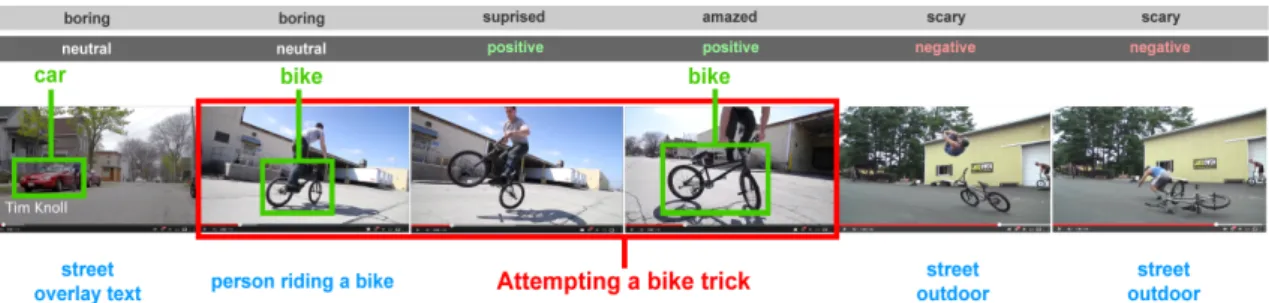
Figure 1.1: An overview of several visual recognition tasks. We can see a video sequence of a person riding a bicycle and performing a bike trick. The different visual recognition tasks are marked as following: Green: object detection, Blue: semantic concept detection, Red: multimedia event detection,Light Grey: affective or emotional classification,Dark Grey: visual sentiment analysis.
and the high-level conceptual interpretation a human associates with perceived visual content in a given situation. In this thesis, whenever a reference to thesemantic gap is given, the original definition from Smeulders et al. [SWSJ00] is meant. This includes the objective appearance of visually present entities in images or videos such as objects (“car”, “bike”), locations or scene types (“street”, “beach”), as well as general activities taking place (“interview”, “soccer”) or the performance of complex events (“attempting a bike trick”). In contrast, whenever in this thesis a remark to a more subjective interpretation of visual content is given such as being related to affect (“romantic”, “funny”), emotion (“sad”, “happy”), or sentiment (“positive”, “neutral”, “negative”), a reference toaffective gap[MH10] is made, which describes the mismatch between low-level features and the feelings or opinion being reflected by the image or video. Over the last years several visual recognition tasks were defined, all aiming to achieve capabilities comparable to human perception with the goal to auto-extract different semantic and affective aspects from video content. An overview of the broad spectrum of these different visual recognition tasks can be found in Figure 1.1. The figure shows a video sequence highlighting a person riding a bicycle during daytime in an urban environment. In the middle of the video this person attempts to perform a jumping trick with his bicycle, which at first is successful but later in the video clip fails, causing an accident.Video sequences like this could be found in millions of videos on platforms such as YouTube. However, even in such a casual user-generated video clip the visual recognition task such as object detection [EVGW+10] (green frames), semantic concept detection [SOK06, SOK09] (blue captions), multimedia event detec-tion [CCC+11, MGvdSS13a] (red frames), affective or emotional categorization [YvGR+08] (light grey bar), or visual sentiment analysis [BJC+13] (dark grey bar) can be performed. In the first couple of frames we see the object “car” and “bike” highlighted by a green frame. The second to forth frame – wrapped by a red frame – show the multimedia event “attempting a bike trick”, whereas the blue captions at the bottom of the frames describe semantic concepts such as “person riding a bike”, “scenes showing a street”, or “outdoor scenes”. The top of the figures illustrates in light grey the affective emotional labels e.g. “amazing” and in dark grey the changing sentiment from “positive” to “negative” towards the end of the video clip. Both grey bars are obviously related to the successful and failing bike trick.
It can be argued that a particular visual recognition task is a sub-task of another one or can be used as an intermediate step to solve more complex visual recognition tasks. For example, Li [LSFFX10] proposed to use a bank of multiple object detectors for scene classification with semantic concepts. In the same manner, Mazloom suggested the selection of the most informative semantic concepts for subsequent
CHAPTER 1. INTRODUCTION
multimedia event detection [MGvdSS13a]. This thesis will propose a similar arrangement: while focusing on concept detection, it will also utilize a detector bank to solve another visual recognition task, the task of recognizing sentiment in visual content.
Concept Detection
The task to detect generic concepts in visual content is commonly known as concept detection [NS04a, SWvG+06a, JYCN08]. Given an input image or video clip, concept detection systems use statistical learning to infer the presence of target concepts by calculating their probabilities for appearance from low-level features of the given content. Please note that throughout the research community this task has been also referred to asimage and video annotation[FML04, WHS+06],high-level feature extraction [SOK06, SOK09],semantic indexing [SMH04, OAM+12], orautomatic tagging [DJLW07, USKB10].
Although far from the accuracy of human annotations [YH08b, Ulg09], concept detection is of practical use as it helps to describe and understand visual content. One of the most prominent tasks it is aiming to solve is image and video search. For this purpose concept detection is applied to map visual content to a set of set of generic target concepts. These identified concepts are then used as a foundation for textual search in image and video databases [SOK09, SWdR+08]. Further applications of concept detection are content-management of TV archives [HSdRS12], content-based recommendation systems [YMH+07, RMZL12], or the support of content-based or context-sensitive advertising [MHL08, UKB12, BL12]. Finally, concept detection can be utilized for the filtering of offensive content such as pornography or violence [DPN08, JUB09, USBS12] or the suggestion of keywords for uploaded videos [USKB10, TAP+10, HBU12]. The practical applications of concept detection are of great value to cope with the massive amounts of today’s growth rate of image and video content.
Usually, the set of generic concepts – or concept vocabulary – covered by concept detection systems consists of a broad spectrum of entities including objects (“chair”, “telephone”), locations and scene types (“desert”, “cityscape”), or activities taking place (“interview”,“people singing”). This requires concept detection systems to cover hundreds or even thousands of target concepts moving way beyond thenarrow categorization of content [SWSJ00] with its small intra-class and large inter-class variability [SW09]. For example, even for the limited domain of TV news broadcast Hauptmann et al. [HYL07] argued that: (i)with a moderate detector performance,(ii)retrieval systems demand concept vocabularies of several thousands of detectors to reach the retrieval quality of a web search engine. Such a defined level of search accuracy can be considered sufficient for the general user.
These are two very challenging conditions. Condition (i) requires the construction of robust detec-tors dealing with well-studied issues known from computer vision such as illumination changes, occlu-sion, or clutter. Furthermore, it also requires generic systems to deal with different domains, ranging from TV news broadcast [NKK+05] over consumer video [JYC+11], television [AQ07b, SOU09] to web video [OAM+11, Ulg09, TAP+10]. More importantly, condition(ii)requires to scale up vocabulary sizes significantly. This however is considered as a major problem of concept detection [Ulg09] as it demands labeled training datasets serving as the foundation for supervised machine learning, the underlying tech-nology of current concept detection systems [SW09]. In practice, this means that for every semantic concept to be included in the concept vocabulary we require up to hundreds of labeled samples to train a corresponding detector properly. So far, ground truth training samples have been acquired manually, i.e. a human operator labels videos or video shots with respect to concept presence. Thereby, concepts are
1.3. GOAL AND OUTLINE OF THIS THESIS
well defined according to a given concept vocabulary [NST+06]. This time-consuming and cost-intensive effort [AQ08, SWvG+06a, YH08a] indeed leads to high quality training material, but suffers significantly from a scalability problem. A second problem restricting the full potential of concept detection is its tendency to overfit to small manually required training datasets with the results of poorly generalized detectors [YH08b]. Moreover, the current setup of concept detection systems makes it infeasible to react to changing demands of users’ information needs such as the timely visual detection of trending topics of e.g. sport events such as “Olympics 2012”, incidents such as the “Costa Concordia” accident, or product releases such as the new “iPhone”. Finally, while approaches exists to infer affect or emotion in visual content [JDF+11, WJH+12] there is a lack of methods for sentiment prediction from visual content. This kind of automatic assessment – however – would lead to a more comprehensive description of visual content in the context of online social interaction, where people express their opinion and emotions on a regular base. From the above mentioned shortcomings and drawbacks in concept detection I derive the following goals and contributions of this thesis.
1.3
Goal and Outline of this Thesis
This thesis presents strategies to address the scalability problem and its subsequent negative effects on concept detection as outlines in the previous section. The work aims to provide scalable concept learning by the reduction of manual annotation effort in using alternative training sources such as web video. This allows to synchronize concept detection with real world events matching users’ information need, and enables systems to go beyond the detection of semantic concept offering sentiment analysis on visual content for opinion mining. To this end, the focus of this thesis is on the visual learning of semantic concepts with the attention towards social media driven information sources coining this combination: visual learning of socio-video semantics.
To achieve the above objectives, the presented strategies cover various aspects of visual concept detection systems. By aligning concept detection to users’ information needs, the notion of fixed concept vocabularies has to be re-thought and a closer connection to real-world events must be established. This is done by mining social media sources for popular topics which are either mapped to an already available concept vocabulary or as a detector directly trained on demand. Starting from the underlying need for labeled training data, web video as an alternative training source is utilized. This novel information source was first exploited for semantic concept detection by Ulges [Ulg09], where user-generated tags were utilized as concept labels for visual learning. The advantages of such cost free labels acquisition – however – are limited by cumbersome query construction practice required for training data retrieval from online platforms such as YouTube and their weakly labeled nature. User-generated tags have to be considered as pseudo labels for classifier training and therefore need additional treatment or refinement. Finally, being able to provide detectors covering what people are talking about i.e. trending topics, concept detection is extended to answer how people feel about particular topics. This is accomplished by a novel enhancement at the very end of the processing pipeline: the utilization of a large-scale visual sentiment ontology represented by a detection bank of adjective noun pair concepts for sentiment analysis. Concluding, the following three contributions are presented for the visual learning of socio-video semantics:
CHAPTER 1. INTRODUCTION
1. enabling concept detection to adapt their concept vocabularies dynamically to user interest by on-the-fly detector training in a scalable on-demand setup.
2. detector training on web video by automatically retrieving training data and effectively handling web video’s pseudo labels.
3. extending concept detection to adjective-noun-pairs enabling the prediction of sentiment being reflected in visual content.
Each strategy will be covered in a separate chapter of this thesis and is outlined in one of the following subsections.
1.3.1
Dynamic Vocabularies by Trending Topics Discovery
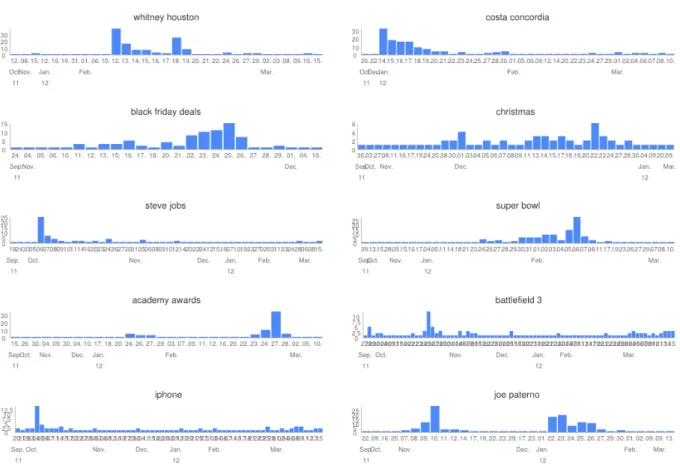
The first contribution of this thesis presents a novel approach towards forming dynamic vocabularies for video concept detection. The key idea is to automatically expand concept vocabularies with trending topics that are mined automatically on other media like Google, Wikipedia or Twitter. To achieve this, trends from different media channels are first clustered and then aggregated to form daily trending topics. An important condition to construct concept vocabularies dynamically is to predict the most popular trending topics for detector training. This is done by forecasting the life cycle of trending topics at the very moment they emerge. The presented fully automated approach is based on a nearest neighbor forecasting technique, exploiting the assumption that semantically similar topics exhibit similar behavior. Being able to identify such high-impact trending topics, this chapter evaluates several visual learning strategies for extending concept detection to auto-detect these topics in new videos, either by linking them to a static concept vocabulary, by a visual learning of trends on-the-fly, or by an expansion of the vocabulary.
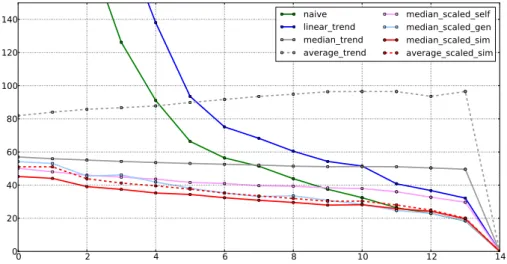
Following, this work presents the first comprehensive study of various trending topics characteristics across three major online and social media streams, covering thousands of trending topics during an observation period of an entire year. Results from this study show that a typical trending topic “lives” up to 14 days with an average of 5 days. Surprisingly, the analysis indicates that Wikipedia as a media channel is as quick as Twitter when it comes to the first appearance of a trending topic. Furthermore, in real-world experiments, it is shown that on a large-scale dataset of Wikipedia page view statistics the presented forecasting method performs about 9−48k views closer to the actual viewing statistics compared to baseline methods, and achieves a mean average percentage error of 45-19% for time periods of up to 14 days. This demonstrates the capability to forecast the impact of trending topics for evolving vocabularies in concept detection. Finally, in experiments on 6,800 YouTube clips and the top 23 target trends from the first half-year it is shown that a direct visual classification of trends (by a “live” learning on trend videos) outperforms an inference from static vocabularies, and that further improvements can be achieved by a combination of both approaches.
In addition, this chapter presents a concept detection system named lookapp, which provides real-time trending topic mining and on-demand state-of-the-art detector training. This system is built upon third-party cloud computing services (Google AppEngine and PiCloud), which allow to parallelize the construction (i.e. features extraction and classifiers training) of detectors and extend concept detection on-the-fly with new semantic concepts.
1.3. GOAL AND OUTLINE OF THIS THESIS
1.3.2
Training Data Retrieval and Active Relevance Filtering
A difficult challenge in concept detection based on web-video is to retrieve proper visual training content from web platforms like YouTube or Vimeo. Prior download of video content for concept learning a query has to be constructed and send to the platform to retrieve a list of matching video presumably showing the concept. As such platforms usually offer API access to their databases, the underlying query construction can be arbitrarily complex demanding a careful query construction. This chapter presents an approach which offers an automaticconcept-to-query mapping for training data acquisition from YouTube, the largest video platform available. Queries are automatically constructed by a keyword selection and a category assignment using ImageNet [DDS+09] and Google Sets as external information sources. Results demonstrate that the proposed method reaches retrieval results comparable to queries constructed by humans, thus providing 76% more relevant content for detector training than using only concept names as retrieval queries would do.
Despite these improvements, and because web-video tags are user-generated, they can only serve as weak indicators of concept presence [Ulg09]. Such pseudo labeled web video contains lots of non-relevant content. So far, there are two general strategies to overcome this label noise problem: (1) a manual refinement supported by active learningsample selection [AQ08], (2) an automatic refinement using relevance filtering [USKB08b]. This thesis also presents a highly efficient approach combining these two strategies in an interleaved setup: manually refined samples are directly used to improve relevance filtering, which again provides a good basis for the next active learning sample selection. Results demonstrate that the proposed combination – called active relevance filtering – outperforms both a purely automatic filtering and a manual one based on active learning. For example, by using 50 manual labels per concept, an improvement of MAP 5% over an automatic filtering is achieved, and 6% over active learning. By annotating only 25% of pseudo positive samples in the training set, a performance comparable to training with expert annotated ground truth is reached.
1.3.3
Adjective Noun Pairs for Visual Sentiment Analysis
As the third contribution of this thesis the challenge of sentiment analysis from visual content is tack-led. In contrast to existing methods which infer sentiment or emotion directly from low-level fea-tures [LFXH12, JWW+12], this work proposes a novel approach based on understanding the seman-tics of images. This is rendered possible by introducing a large-scale ontology of 3,000 Adjective Noun Pairs (ANP). This Visual Sentiment Ontology (VSO) is based on psychological theory [Plu80] and the proposed construction method is fully data-driven, i.e. it automatically mines online sources such as Flickr and YouTube for sentiment words, which serve as the building elements for ANPs discovery of the final VSO. This chapter also presents SentiBank, a novel mid-level representation framework, which is built upon the VSO and encodes concept presence of 1,200 ANPs from visual content. This bank of concept detectors allows the differentiation between visual concepts such as “cute dog” and “dangerous dog” and therefore allow a unique understanding of more complex labels such as sentiment. In addi-tion, this mid-level representation of visual content can be utilized for the filtering of explicit content such as pornography or child sexual abuse (CSA) material in a way that it simultaneously provides an explanation for its detection – a system requirement demanded by law-enforcement units.
CHAPTER 1. INTRODUCTION
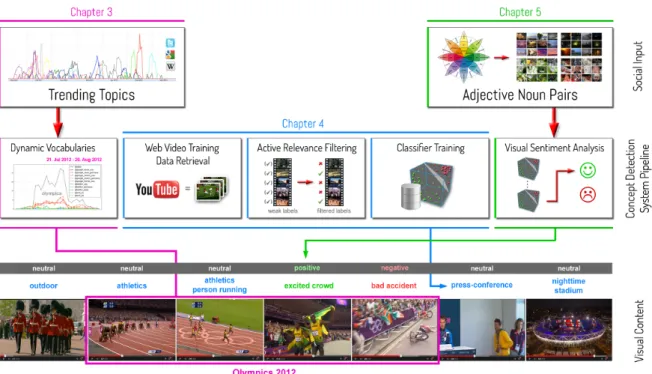
Figure 1.2: An illustration of the proposed concept detection approach utilizing social input from trending topic detection and a visual sentiment ontology. To automatically detect a trending topic (pink) in unknown visual content, the proposed framework is able to take a discovered trending topic dynamically into its concept vocabulary, retrieve automatically web video and filter non-relevant content for its detector training (blue). Furthermore, the framework is capable of analyzing visual content for the sentiment it conveys (green, red).
proposed mid-level representation demonstrates an improved prediction accuracy by 13% (absolute gain) with a joint visual-text approach over state-of-the-art text only methods. In experiments on real-world pornographic content and CSA content, the proposed approach outperformed all porn detection baselines and contributed significantly to differentiate pornographic content from CSA content (a very challeng-ing setup, where traditional porn detection approaches lack in accuracy) Additionally, the compilation of detected ANPs allows to provide unique insights into pornographic content and CSA content. In summary, the presented visual sentiment analysis effort - being the first of its kind - creates a large publicly available resource consisting of a concept ontology, a detector library, and the training/testing benchmark for visual sentiment analysis.
1.4
Presented Framework
Concluding, the aforementioned contributions present a novel approach for an efficient visual learning of socio-video semantics from the Web. The outlined framework is illustrated in Figure 1.2: Trending Topics are mined from several social media streams. A discovered trending topic such as “Olympics 2012” is identified and added dynamically to the concept detection vocabulary. This triggers the concept detection system to automatically retrieve web video content and to filter non-relevant material for training. To detect this trending topic, the resulting detector can either be used stand-alone (pink) or be employed in combination with an already available concept detection vocabulary (blue) by a mapping
1.4. PRESENTED FRAMEWORK
of semantic concepts such as “athletics” to the target topic “Olympics”. Moreover, in interplay with a large-scale visual sentiment ontology of adjective noun pairs such as “excited crowd” or “bad accident” the proposed framework performs sentiment analysis on the visual content of the video clip (green, red). Finally, given a video stream to be processed, the system can be used to annotate visual content on different levels of target labels such as semantic concept, trending topic, and sentiment label.
Chapter 2
An Overview of Concept Detection
in Video Content
Nowadays, most video search technology, be it for large-scale online video platforms such as YouTube or video archives of television broadcasters, rely on human-driven indexing i.e. manually generated descrip-tions, annotations or tags. As seen in Section 1.1 this type of indexing is prone to spam, misspellings, subjectivity, and is incomplete or non-relevant and therefore not practicable for many applications. Even if done by professional annotators for archiving purposes, this approach does not scale with the im-mense amount of audio-visual content currently being produced [WCGH99, Sme07, SW05]. A solution to this problem is concept detection, a machine indexing mechanism, which provides access to video content by analyzing the audio-visual video stream for the presence of semantic concepts such as objects (“chair”, “telephone”), locations and scene types (“desert”, “cityscape”), or activities taking place (“inter-view”,“people singing”). Throughout recent years of intensive research the academic community referred to this challenging task also asimage and video annotation[FML04, WHS+06],high-level feature extrac-tion[SOK06, SOK09],semantic indexing[SMH04, OAM+12], orautomatic tagging [DJLW07, USKB10]. In this thesis the widely established term “concept detection” [SW09] will be adopted.
This chapter provides an overview of concept detection research with a focus on video content. Approaches which are specific to the contributions of this thesis (as outlined in Section 1.3) are described later in their corresponding chapters. This chapter starts with the outline of the problem statement and the definition of concept detection (Section 2.1). It further lists its most important application areas (Section 2.2) and provides an introduction to the structure of video material (Section 2.3). Then, the chapter continues with an overview of concept detection in the context of employed architectural frameworks (Section 2.4) and frequently used approaches and methods (Section 2.5). To this end, it introduces common means f ˜Aijr system evaluation (Section 2.6) and closes with an examination of label acquisition in Section 2.7.
2.1. PROBLEM STATEMENT
(d) (c)
(b) (a)
Figure 2.1: Example keyframes of YouTube videos displaying the presence of different semantic concepts. As seen,(a)different textual descriptions such as “person riding a bike” or “bike stunts” might match the same visual content,(b)descriptions are subjective or require prior knowledge to recognize e.g. a “bride”,(c)require exact specifications in form of restrictions to physical objects only excluding animations of objects, or(d)may display the semantic concept (e.g. “shots of an airplane flying”) from an unusual point of view.
2.1
Problem Statement
Concept Detection aims to analyze the audio-visual content of video to automatically infer the presence of semantic concepts. To make this compact description more formal, the notion of a “semantic concept” and “concept presence” has to be provided in more detail. As outlined in the introduction of this chapter, a semantic concept can be anything from the broad range of objects, locations, scene types, or activities taking place. Snoek and Worring define a semantic concept as:“. . . an objective linguistic description of an observable entity”[SW09]. Although this definition does capture the idea of a concept itself and its presence in video content, a more specific notation is desirable. Consider the following five examples of concepts definitions as illustrated in Figure 2.1:
c1:= “a person riding a bike” c2:= “bike-stunts”
c3:= “attempting a bike trick”
c4:= “bride: a woman on her wedding day” c5:= “shots of an airplane flying”
It can be seen that the three concept definitionsc1, c2, c3 match the visual content in the keyframes of Figure 2.1 (a). Interestingly, they all come from different backgrounds and serve different purposes:
c1 describes a NIST TRECVID concept of theSemantic Indexing Task (SIN)[OAF+10], c2 is retrieved from the actual YouTube video, where the uploader of the video decided to assign the tag “bike-stunts” to his video clip, and c3 can be found as a description of one of the events in the Multimedia Event Detectiontask [OAM+13]. Although all three concept descriptions come from different recognition tasks or are created with different intentions (intrinsic as given by a YouTube user or explicit as defined by the NIST TRECVID annotation protocol) they might match the same visual content i.e. agree to concept presence in Figure 2.1 (a). Furthermore, the initial definition of a concept by Snoek and Worring [SW09] emphasizes the importance of objectiveness in a concept description. However, looking at Figure 2.1 (b) andc4, which displays a keyframe from the wedding of Prince William and Kate Middleton, depicts a “bride, a woman on her wedding day”, a semantic concept from LSCOM (ID: 132) [NST+06]. This
CHAPTER 2. AN OVERVIEW OF CONCEPT DETECTION IN VIDEO CONTENT
might look like an objective match of concept presence for c4 and a person who grew up in a western culture, but it might lead to disagreement for somebody with a different cultural background, rendering this concept definition to be subjective rather than objective. As illustrated, even for such apparently well-defined concepts, concept presence might be judged differently by different people.
Nevertheless, this difficulty in providing a concept definition can be eased by establishing further rules or protocols guiding the understanding of concept presence. The NIST TRECVID benchmark is one of the leading instances doing so for video content1. For its SIN task the definitions of concept presence are further enriched by restrictions such as: “physical objects representing the target, such as photos, paintings, models, or toy versions of the concept, will not be grounds for judging the concept to be true”. Such a restriction is illustrated in Figure 2.1 (c). The top keyframes shows an Airbus 380 during its test flight obviously displaying the concept c5, an airplane flying. However, considering the bottom keyframe of an animated airplane flying – according to the restriction of the NIST TRECVID SIN task – this keyframe does not contain the semantic concept of an airplane flying. Similarly, for NIST TRECVID’s MED task, the organizers decided to provide event kits describing the event concept by additional information such as its event name, definition, explication (textual exposition of the terms and concepts), evidential descriptions, and illustrative video examples [OAF+10].
Although such additional restrictions can help to convey what is meant by the semantic concept, they unfortunately can not solve the problem of ambiguity entirely. For example, Figure 2.1 (d) depicts some keyframes for conceptc5 demonstrating ambiguity of a concept description. The keyframes show the inside of an airplane flying as tagged by some YouTube users. In such a case the description of an airplane flying is correct. It even confirms the previously mentioned SIN protocol for concept judgments – however – it displays the concept from a very different point of view, which increases the difficulty to recognize the concept, even if user assessment of the concept was correct.
Altogether, this has the following consequences; First, we recognize that different concept descriptions can be correctly depicting the same concept and the same textual concept description can lead to a high variability of visual content. This is especially true for web video as found on platforms such as YouTube. Furthermore, it is important to note that even with a clear textual description of a semantic concept the corresponding visual content representing the concept as seen might not be captured entirely or be ambiguous. Still – to provide a canonical definition of semantic concepts, this thesis adopts the definitions from Ulges [Ulg09], which considers relevance as the defining criteria for semantic concepts taking its high variability of real-word user generated content on YouTube into account [Ulg09, NMP10, TAP+10].
Definition: “Concept Detection” Concept detection is the task of inferring if a semantic concept
c is present in a video X i.e. if a concept c is visible in a video X. A concept detection system is built upon a set of target conceptsV oc :={c1, ...cn} and analyses incoming video clips, which can be
of different structural granularity (please refer to Section 2.3 for more details). The goal of concept detection is to estimate scores φc1, ..., φcn indicating whether a concept ci ∈ V oc appears inX. This output may also be interpreted as a probability of concept presence for ci (often after transformation
by an appropriate monotonic function). But for many retrieval applications it is sufficient to directly rank videos by sorting them according to their scores. The described multi-class scores estimation is usually divided into multiple binary classification problems, i.e.the score φci for each concept ci ∈V oc
2.2. APPLICATIONS
is calculated independently and correlations between concepts are considered in subsequent processing steps.
The most prominent method to model the mappingφcis by using a statistical classification algorithm
(e.g., an Artificial Neural Network or a Support Vector Machine). Such supervised machine learning approaches require a training step prior to their application, to estimate model parameter for the final classifierfc :=X →φc. For this purpose, concept detection systems are usually separated into an offline
phase for training and an online phase for application. For classifier training, the system requires positive and negative samples, i.e. training videos withlabels denoting the presence or absence of the conceptc,
Dc :={(xi, yi)| x1, . . . , xn, yi ∈ {−1,1}}. These labels have to be acquired up-front classifier training
either by experts providing annotations according to a controlled vocabulary or by YouTube or Flickr users providingtags. This thesis adopts this differentiation between the notations oflabels,annotations, andtags.
2.2
Applications
Current concept detection systems apply machine learning, allowing to scale up vocabulary of target concepts if labeled training samples are available. Similarly to information retrieval, which is concerned with the representation, storage, organization, and access of information items [BYRN+99, SM86], con-cept detection focuses on the analysis of video material to bridge the semantic gap with the goal to provide descriptions of video content. And although the performance of such systems with respect to quantity and quality is far from optimal [HYL07, YH08b], recent improvements in content analysis are promising [SS10] and the practical benefit of such systems would allow to advance in the following areas:
Video Search As introduced in Chapter 1, one of the major goals of concept detection is to ren-der textual search on video possible. Such applications are usually based on a fixed vocabulary of a target concept and a query processing engine utilizing the underlying index of detected semantic con-cepts [CH05, SWWdR08, SWdR+08]. One of the most prominent research efforts in this area is the TRECVID Search task [OAR+09], which aims to provide search and browsing tools for human analysts, who are looking for segments of video clips containing semantic concepts, which might be peripheral or ac-cidental to the original subject of the video. Such a query processing can be either realized by the use of a vector space model to match a query against the semantic description of a concept [NZKC06, SWvG+06b], the restriction to query classes [YYH04, ZSC+06], local context analysis [YH06], or the use of exter-nal sources [Fel98, KNC05]. For an evaluation of video search using concept detection please refer to [NHT+07]. Although such a mapping of textual queries to visual content strongly depends on the quality of concept detection systems, which is far from careful manual annotations [YH08b], it can be considered as a key building block of modern content-based video retrieval systems [SW09].
Video Tagging With the emergence of online video sharing platforms the amount of video content being uploaded has increased rapidly. On platform like YouTube, every uploader of a video clip is asked to tag his content i.e. define annotations for his video. Concept detection can help in recommending tags, which semi-automatically can be selected by the user [ATY09, TAP+10]. This process of selecting a subset of possible tags, although not effortless, is more convenient for the user than defining his own
CHAPTER 2. AN OVERVIEW OF CONCEPT DETECTION IN VIDEO CONTENT
tags. Contrary to recommending tags during the upload of video content, the concept detection of video material can be performed retrospectively on the entire video database to auto-tag or predict tags for video clips providing a basic indexing [WHS+06, CEJ+07, NMP10, YT11].
Video Recommendation While video search is a very active task for a user, video recommendation is a passive mechanism of video consumption. Similar to tag recommendation, users find the binary decision (decide whether to watch a recommended video clip or not) more convenient than the sometimes exhausting work of formulating the right search query. Hence, video recommendation plays an important role in the context of content discovery unknown to the user, which play an important role on video-on-demand platforms and online video sharing platforms [DLL+10]. The visual analysis of video content by concept detection is considered as one of the alternatives available to cold start (i.e. no user history) video recommendation. Such systems can therefore be used for either the recommendation of video a digest [YMH+07] or the personalized delivery of video content [LFKS09].
Content-based Advertising in Video One further application of concept detection is realized in the context of targeted advertising. As video distribution is a costly venture [Sil] it requires more sophisticated monetization channels than traditional TV broadcasting. One promising instrument in this regard is the semantic linkage of advertising with the content of video clips [SSW07, BLS01, MHL09] or images [WYZ+09, MHL08]. Similar in motivation is the prediction of demographic groups (gender, age) for advertising by the identification of semantic concepts present in video clips [UBK13]. Here, concept detection plays a crucial role in situations where a video clip is freshly uploaded (i.e. viewer statistics are unknown) and only little information is given by the uploader.
Video Archiving The current rapid growth of online multimedia collections is not the only source of video material to profit from concept detection. As long as TV broadcasting exists, visual content produced is archived. This material, although digitalized, is unfortunately not made accessible due to the annotation effort associated with it. Here, concept detection is playing a crucial role in granting efficient access to such digital archives maintained by TV stations. Especially news broadcasting and documentaries with contemporary witnesses reporting about historical events are of interest because of their role to preserve our cultural heritage visually [YOU11]. With respect to this application scenario concept detection systems can be trained to cover a controlled vocabulary of target concepts, providing automatically searchable annotations [HSdRS12]. This way such archives can be made accessible for either educational or journalistic purposes.
Content Filtering The recent advances in network technology allow for seamless distribution and sharing of all types of visual content. Unfortunately, this circumstance is exploited for the unrestrained spread of offensive, harmful, and illegal video material over the Internet. The forensic detection of this material poses a difficult challenge as police forces find themselves confronted with a flood of digital content e.g. during their fight against child sexual abuse (CSA). A concept detection approach can be used to either identify specific content and therefore reduce the amount of manual investigation needed, or to filter specific content for parental control. Such approaches were already proposed to detect violence [DSDVL02, LW09], nudity [USBS12, JUB09, DPN08] or illegal pornography[US11] in visual content.
2.3. VIDEO STRUCTURE
Video
Scenes
Shots
Frames
Figure 2.2: An illustration of the hierarchical structure of a video clip organized according to units of temporal granularity. The entire video clip (first level) can be organized in scenes of narrative context (second level), which itself can be split into shot defined by a single camera recording operation (third level). Each shot is comprised at the lowest level of a set of adjacent frames (fourth level).
As outlined above, the range of applications, which can be built upon concept detection is broad and tackles not only commercial interest but can also help in the context of societal hurdles. These applications render the automatic detection of semantic concepts as a rewarding research area. Having said that, before we go into detail about how state-of-the-art concept detection system look, we should look how video as a medium is structured.
2.3
Video Structure
A video clip is organized in temporal units that define a chronological story for the audience [Mar04, SS02]. Nowadays in the age of mobile phones, user-generated content and platforms like YouTube a narrative storytelling may not always be recognizable but nevertheless the fundamental hierarchical structure [NH01] as illustrated in Figure 2.2 is still a valid representation of video clips.
This structural composition usually consists of different levels of temporal granularity. On top of this hierarchy, the entire video clip can be seen as a global unit of the content enclosed. This first level is usually further organized inscenes of narrative context such as e.g. dialogue, atmospheric or transition scenes, just to mention a few prominent scenes or logical story units [HLB99]. These scenes can be split into shots, the basic unit of motion picture production. A shot is defined as a sequence of continuous frames that are recorded through a single camera operation. Two shots are concatenated by atransition, which can be either abrupt (e.g. a hard cut or a black frame) or gradual (like wipes, dissolves, fades). The last level in this hierarchy is the single frame. Alone in isolation a frame is nothing more than a spatial plane, rasterized into pixels, equivalent to a digital image or photo. However, exploited as a consecutive sequence of frames it enables the illusion of motion in video.
With respect to content analysis for concept detection, the lower two levels (the frame level and the shot level) are of particular interest. While the shot level provides temporal information, which can be beneficial for detection, the frame level allows for the spatial analysis of content as known from
content-CHAPTER 2. AN OVERVIEW OF CONCEPT DETECTION IN VIDEO CONTENT
Figure 2.3: An overview of a current state-of-the-art concept detection system. For each target concept a separate training phase (top pipeline) is required to construct a statistical model which is specific for this target concept. This model will be used in the application phase, where an unknown video is tested against the previously trained classifier. Furthermore, this overview also illustrates common components of a concept detection processing pipeline.
based image retrieval (CBIR) [SWSJ00] and is therefore considered as the basic unit of analysis in many state-of-the-art concept detection systems [ABC+03, JYCN08, SW09, USKB10].
This is also driven by to the availability of concept annotations for the visual content of a video clip. Originally, annotations are given at shot level of a video clip [SOK09], However, because of the adjacency to image analysis, it is also common to work with annotations on frame level to allow for more temporal accuracy of content description [USKB08b]. In contrast to this, an exception has appeared with the rise of user-generated video on the Internet, where videos are tagged by the uploaded. Here, only global annotations for the entire video clip are provided (which is subject to this thesis and handled in Chapter 4). Further, the frame and shot level also define prominent fragments for the evaluation of concept detection system performance as seen in more detail in Section 2.6.
2.4
Concept Detection System Architecture
A major research effort in the context of concept detection is the TRECVID [Sme05] benchmark, which initially addresses concept detection in its High-Level Feature Extraction task [SOK09] and now in its Semantic Indexing (SIN) task [SOK09]. This benchmark aims to evaluate the performance of different concept detection systems on common, standardized datasets, compare results and allow an exchange of experience within the research community.
One of the most notable observations in this regard is the dominance of systems utilizing supervised machine learning as an underlying technique for the inference of concept presence in videos [CEJ+06, NJW+09, ea11]. This agreement of how concept detection systems are built nowadays is also reflected by the definition of concept detection from Section 2.1. Concluding, supervised machine learning provides a generic strategy to construct classifiers, each specifically trained to detect one particular target concept. Therefore an intrinsic property of such systems, is the separation of a preliminarytraining phase, which usually takes place offline, and an application or testing phase, which composes the online detection process [SOK09, SW09]. Such a system architecture can be seen in Figure 2.3 as described in more detail in the following.
2.4. CONCEPT DETECTION SYSTEM ARCHITECTURE
2.4.1
Training Phase
The goal of the training phase is to create a statistical model specifically trained to detect the presence of a target concept such as e.g. “soccer scenes” in visual content. Such a training step is mandatory and must be performed for each of the target concepts ci ∈V oc, defined by the vocabulary of the concept
detection system. Also, the construction of statistical models – often also called classifiers or detectors – is often very time consuming but nonrecurring for the lifetime of such a system, this phase is usually completed offline.
To train a single classifier fci for the target concept ci, one requires a labeled training dataset
Dtrain ∈ Dc. Such a dataset is a labeled set of visual samples (xi, yi)∈ Dtrain representing the target
concept. Its acquisition is usually done by experts manually annotating video data [AQ08] or recently by the use of tags from web sharing platforms such as YouTube [Ulg09, USKB10, UKBB09], Flickr [LSWS12] or both [KLS13]. Both label acquisition sources have their advantages and disadvantages (see Section 1.1). While the manual process provides very accurate labels it is lacking in scalability due to the very time-consuming effort which is associated with it. Using tags as labels solves the labeling effort because of their free availability on web platforms but they are facing other challenges as discussed later in this chapter, in Section. 2.7.
A common procedure in detector training is to first segment all training videos into shots and to extract representative keyframes. Then for each keyframe, features are extracted describing its content in the form of numerical values. These features are then used for classifier training, yielding a statistical model ready for the application phase. It is common in current concept detection systems to train several feature (and classifier) combinations for the same concept if the features can provide additional clues about visual content such as with color features and texture features. As illustrated in Figure 2.3 this would technically imply to train three individual statistical models (indicated by the colors blue, green, and pink) for the same concept, but each with different features selected as input.
2.4.2
Application Phase
The goal of the application phase is to detect the presence of a target concept in unlabeled videos. To accomplish this, the output of the training phase – the statistical model, representing a target content in features space – is used to analyze an input video. Since the application of a classifier is usually less time consuming, this phase of a concept detection system is often realized online.
Similarly to the training phase the input video is segmented into shot level and keyframes are ex-tracted. These keyframes are processed to extract the same numeric features describing their visual content as in the training phase and simultaneously each feature is then fed into its trained statistical model for the target concept. On concept level this includes all feature classifier combinations avail-able from training. As an output, these classifiers provide detection scores, which differ from feature to feature. For example the concept “soccer scenes” will have a different detection score when using color information than when using texture information rending the detection scores as complementary information for the visual presence of the target concept. These individual scores are then fused into a single concept score (intra-concept fusion) for one single target concept. As a last step, a concept relation modeling (inter-concept fusion) is performed, which takes concept correlations into account to refine the final detection output accordingly. Such a refinement is feasible due to the correlation of supporting