University of South Florida
Scholar Commons
Graduate Theses and Dissertations
Graduate School
2011
Combining Natural Language Processing and
Statistical Text Mining: A Study of Specialized
Versus Common Languages
Jay Jarman
University of South Florida, [email protected]
Follow this and additional works at:
http://scholarcommons.usf.edu/etd
Part of the
American Studies Commons
, and the
Databases and Information Systems Commons
This Dissertation is brought to you for free and open access by the Graduate School at Scholar Commons. It has been accepted for inclusion in Graduate Theses and Dissertations by an authorized administrator of Scholar Commons. For more information, please contact
Scholar Commons Citation
Jarman, Jay, "Combining Natural Language Processing and Statistical Text Mining: A Study of Specialized Versus Common Languages" (2011).Graduate Theses and Dissertations.
Combining Natural Language Processing and Statistical Text Mining: A Study of Specialized Versus Common Languages
by
Jay Jarman
A dissertation submitted in partial fulfillment of the requirements for the degree of
Doctor of Philosophy
Department of Information Systems and Decision Sciences College of Business
University of South Florida
Major Professor: Donald J. Berndt, Ph.D. Stephen L. Luther, Ph.D.
Balaji Padmanabhan, Ph.D. Rosann W. Collins, Ph.D.
Date of Approval: September 30, 2011
Keywords: data mining, machine learning, computational linguistics, decision tree, rule mining
Dedication
I would like to dedicate this work to my wife, Cari Jar-man. I don’t know how anyone could do this without a support system. She is the most important person in my support system and has been there for me while I followed my dream. I am eternally grateful to her and will never be able to express my gratitude. Cari, I appreciate everything you do and I love you with all my heart.
Acknowledgments
Funding for this research came from the Consortium for Healthcare Informatics Research, [HIR-09-002] HSR&D Center of Excellence, James A. Haley Veterans Hospital, Tampa, FL. This dis-sertation presents the findings and conclusions of the authors and does not necessarily represent the Department of Veterans Affairs (VA).
I would also like to acknowledge both the VA and specifically Steve Luther. I was given an oppor-tunity to be on a research team and work with some of the best informaticians in this country and for that I will always be grateful.
I would like to acknowledge the help and collaboration of James McCart and Varol Kayhan. Finally, I would like to acknowledge Don Berndt, my chair and mentor. When he came to me and asked if I’d like to do some mining research with the VA I had no idea that it would turn into a career and that I would gain so many new friends and collaborators. I’m truly appreciative of this opportunity.
Table of Contents
List of Tables . . . vii
List of Figures . . . ix
Abstract . . . xi
Chapter 1 Introduction . . . 1
1.1 Why the medical domain? . . . 2
1.2 Research Questions . . . 4
1.2.1 Research Question One - Specialized Language vs Common Language . . 6
1.2.2 Research Question Two - Rule-based Classifiers . . . 7
Approach One - Classification Rules . . . 8
Approach Two - Decision Tree Induction (DTI) . . . 8
Chapter 2 Research Methodology . . . 10
2.1 Computational Linguistics . . . 10
2.1.1 Terminology . . . 12
2.1.2 Form . . . 13
Morphology . . . 13
Roots and Stems . . . 13
Tense, Plurality, and Gender . . . 14
Derivation and Compounding . . . 14
Affix . . . 14 Applications . . . 14 Syntax . . . 14 Syntactic Rules . . . 16 Applications . . . 17 Phonology . . . 17 2.1.3 Meaning . . . 18 Semantics . . . 18 Applications . . . 18 Pragmatics . . . 19 Applications . . . 19
2.2 Natural Language Processing (NLP) . . . 20
2.2.1 Vocabularies and Language Systems or Terminologies and Ontologies . . . 20
Controlled Vocabulary . . . 21
Ontology . . . 21
Unified Medical Language System (UMLS) . . . 24
Semantic Network . . . 25
SPECIALIST Lexicon . . . 26
2.3 Computational Learning Theory . . . 26
Probably Approximately Correct . . . 27
Vapnik-Chervonenkis Theory . . . 27
Algorithmic Learning Theory . . . 27
2.3.1 Machine Learning . . . 27
Types of Machine Learning . . . 28
Machine Learning Algorithms . . . 29
2.3.2 Information Theory . . . 29
Entropy . . . 31
Mutual Information . . . 31
Information Gain . . . 31
Information Gain Ratio . . . 32
2.3.3 Deductive vs Inductive Reasoning . . . 32
2.4 Statistical Text Mining (STM) . . . 33
2.4.1 Structure . . . 34
2.4.2 Identifying Patterns . . . 36
2.4.3 Evaluation and Interpretation . . . 36
Confusion Matrix . . . 36
Evaluation Metrics . . . 37
Chapter 3 Data . . . 39
3.1 Cohort . . . 40
3.2 Collection . . . 41
3.3 De-Identification and PHI . . . 41
3.4 Annotation . . . 42
3.5 Dataset . . . 43
Chapter 4 Medically Relevant Terminology vs Common Language Study . . . 45
4.1 Abstract . . . 45 4.2 Introduction . . . 45 4.3 Background . . . 47 4.4 Methods . . . 48 4.4.1 Data Set . . . 48 Cohort . . . 48 Collection . . . 49
Annotation and Partitioning . . . 49
4.4.2 Process . . . 50 NLP . . . 51 Text Mining . . . 52 4.5 Results . . . 54 4.6 Discussion . . . 55 4.6.1 Error Analysis . . . 56 Misspellings . . . 57 Clinician Judgments . . . 57
Fall History . . . 57
Templates/Grammar . . . 58
4.6.2 Limitations . . . 59
4.6.3 Future Work . . . 59
4.6.4 Conclusion . . . 60
Chapter 5 Rule Mining Study . . . 61
5.1 Abstract . . . 61 5.2 Introduction . . . 61 5.3 Background . . . 62 5.4 Methods . . . 65 5.4.1 Data Set . . . 65 Cohort . . . 65 Collection . . . 66
Annotation and Partitioning . . . 66
5.4.2 Process . . . 67 1. Concept Extraction . . . 67 2. Rule Mining . . . 67 3. Contrast Sets . . . 68 4. Rule Creation . . . 68 5. Rule Evaluation . . . 68 5.5 Results . . . 69 5.6 Discussion . . . 71 5.6.1 Error Analysis . . . 72
5.6.2 Limitations and Future Work . . . 73
5.6.3 Conclusion . . . 74
Chapter 6 Decision Tree Induction Study . . . 75
6.1 Abstract . . . 75
6.2 Introduction . . . 75
6.3 Background . . . 77
6.3.1 Decision Tree Induction . . . 77
Decision Selection . . . 79 6.3.2 Pruning . . . 79 6.3.3 Production Rules . . . 81 6.4 Methods . . . 81 6.4.1 Data Set . . . 81 Cohort . . . 81 Collection . . . 82
Annotation and Partitioning . . . 82
6.4.2 Process . . . 83
Step 1. Concept Extraction . . . 83
Step 2. Statistical Text Mining (STM) . . . 85
Step 3. DTI . . . 86
Step 3a. DTI - Criterion . . . 86
Step 3c. DTI - Adjust Minimum Leaf Size . . . 87
Step 3d. DTI - Prune . . . 88
DTI - Production Rules . . . 90
6.4.3 Results . . . 90 6.5 Conclusions . . . 92 6.5.1 Error Analysis . . . 92 6.5.2 Future Work . . . 93 6.5.3 Concluding Remarks . . . 94 Chapter 7 Conclusion . . . 95 7.1 Research Question 1 . . . 95 7.2 Research Question 2 . . . 97
7.2.1 Approach 1: Classification Rule Mining . . . 98
7.2.2 Approach 2: Decision Tree Induction . . . 98
7.3 Other Contributions . . . 99 7.4 Future Work . . . 100 7.4.1 Ontology Development . . . 101 7.4.2 NLP . . . 101 WSD . . . 101 Acronym Detection . . . 102 Templates . . . 102 Cascading Errors . . . 103 7.5 Final Discussion . . . 103 References . . . 104
Appendix A Terms and Definitions . . . 116
Appendix B Tools . . . 117
B.1 Negation . . . 117
B.2 MetaMap/MMtx . . . 118
B.3 UIMA/cTAKES . . . 118
B.4 GATE . . . 119
Appendix C SAS Enterprise Miner . . . 120
C.1 Graphical User Interface . . . 120
C.1.1 1 - Project . . . 120 C.1.2 2 - Properties . . . 121 C.1.3 3 - Tab Bar . . . 121 C.1.4 4 - Diagram Workspace . . . 122 C.2 Pipeline . . . 122 C.2.1 TMPTRAINCUI . . . 123 C.3 Data Partition . . . 123 TMPTESTCUI . . . 124 C.3.1 Text Miner . . . 124 Parse . . . 125 Transform . . . 125
Cluster . . . 125
C.3.2 Regression . . . 125
C.3.3 Model Comparison . . . 125
C.3.4 SAS Code . . . 125
Appendix D General Architecture for Text Engineering (GATE) . . . 131
D.1 Graphical User Interface . . . 131
D.1.1 1 - Navigation . . . 131
D.1.2 2 - Loaded Processing Resources . . . 131
D.1.3 3 - Selected Processing Resources . . . 133
D.1.4 4 - Corpus . . . 133
D.1.5 5 - Parameters . . . 133
D.2 Pipeline Processing Resources . . . 133
D.2.1 Document Reset PR . . . 133
D.2.2 ANNIE English Tokeniser . . . 133
D.2.3 JAPE Transducer . . . 134
D.2.4 RegEx Sentence Splitter . . . 134
D.2.5 JAHVAOpenNLPPOSTagger . . . 134
D.2.6 JAHVAOpenNLPChunker and JAHVAPhraseTagger . . . 134
D.2.7 JAHVAUMLSConceptFinder . . . 134
D.2.8 JAHVAConceptNegator . . . 135
D.2.9 JAHVAConceptWriter . . . 135
D.2.10 Nonconcept Counter (JAPE Tranducer) . . . 136
D.2.11 JAHVAAnnotationWriter . . . 136
D.2.12 JAHVAAnnotationCountWriter . . . 137
D.2.13 JAHVATokenFrequencyWriter . . . 137
Appendix E RapidMiner . . . 138
E.1 Graphical User Interface . . . 138
E.1.1 1 - Overview . . . 139
E.1.2 2 - Operators and Repository . . . 139
E.1.3 3 - Process . . . 139
E.1.4 4 - Parameters . . . 140
E.1.5 5 - Monitoring and Help . . . 140
E.2 DTI Process . . . 140
E.2.1 TrainCUIs . . . 141
E.2.2 Process Document . . . 141
E.2.3 Validation . . . 142
Term Weightings . . . 142
Numerical to Binomial . . . 143
Remember . . . 143
Decision Tree . . . 144
Apply Model (Term Weights) . . . 144
Numerical to Binomial . . . 145
Apply Model (Decision Tree) . . . 145
Log . . . 146
E.2.4 Test CUIs . . . 146
E.2.5 Preprocess Document . . . 147
E.2.6 Recall . . . 147
E.2.7 Apply Model (Term Weightings) . . . 147
E.2.8 Numerical to Binomial . . . 148
E.2.9 Apply Model (DT) . . . 148
E.2.10 Performance . . . 148
Appendix F Regulation . . . 150
F.1 HIPAA . . . 150
F.2 HITECH . . . 151
F.3 Effect on Research . . . 151
Appendix G Mind Map . . . 153
Appendix H Information Systems Research Framework . . . 155
List of Tables
Table 1 Computational Linguistic Terminology . . . 12
Table 2 Language Nomenclature . . . 20
Table 3 Vocabulary Relationships . . . 22
Table 4 Vocabulary Types . . . 23
Table 5 Ontology Definitions . . . 25
Table 6 Machine Learning Algorithms . . . 30
Table 7 Term-By-Document Matrix . . . 35
Table 8 Evaluation Metrics . . . 38
Table 9 Inter-rater Reliability Kappa Scores (%) . . . 43
Table 10 Intra-rater Reliability Kappa Scores (%) . . . 43
Table 11 Cohort description . . . 49
Table 12 Term-by-Document Matrix . . . 53
Table 13 Token Make-up of TEXT Data Set . . . 54
Table 14 Token Make-up of CMN and CUI Data Sets . . . 54
Table 15 Text mining and regression settings . . . 55
Table 16 LR Comparison (%) . . . 55
Table 17 Top 5 Predictive Terms from Text Mining TEXT and CUIS . . . 56
Table 18 Example Item Sets . . . 64
Table 19 Example Rules . . . 65
Table 20 Cohort description . . . 66
Table 21 Concepts in Itemsets . . . 69
Table 22 Highest Predictive Itemsets . . . 70
Table 23 Top Predictive Item Set Combinations on TRAIN (%) . . . 70
Table 24 Top Predictive Item Set Combinations on TEST (%) . . . 71
Table 25 Evaluation Comparison of Different Data Sets . . . 72
Table 27 C4.5 Requirements . . . 78
Table 28 Cohort description . . . 82
Table 29 Term-by-Document Matrix . . . 85
Table 30 Evaluation Metrics for Best Model All Terms (%) . . . 86
Table 31 Evaluation Metrics for Best Model Minimal Leaf (%) . . . 88
Table 32 Pruned Trees Eval Metrics (%) . . . 90
Table 33 Evaluation Comparison of Different Data Sets (%) . . . 91
Table 34 Results from all studies(∗p <0.001)(∗ ∗p <0.05) . . . 100
List of Figures
Figure 1 Research Question Approaches . . . 5
Figure 2 Dissertation Map . . . 6
Figure 3 Controlled Vocabularies . . . 22
Figure 4 Model of Learning from Examples . . . 29
Figure 5 Inductive/Deductive Reasoning . . . 33
Figure 6 Confusion Matrix and Evaluation Metrics . . . 37
Figure 7 Episode of Care Hierarchy . . . 40
Figure 8 Breakdown of Terms . . . 46
Figure 9 Study Process . . . 50
Figure 10 CONSORT Flow Diagram . . . 51
Figure 11 Flow of Rule Mining/Classification Process . . . 63
Figure 12 Rule Accuracy . . . 71
Figure 13 Example Decision Tree . . . 78
Figure 14 Flow of Decision Tree/Classification Process . . . 84
Figure 15 Model Accuracy Based on Terms Used . . . 87
Figure 16 Model Accuracy Based on Minimal Leaf Size . . . 88
Figure 17 4 Level Decision Tree . . . 89
Figure 18 % Difference Between Decision Tree and STM Classifiers . . . 91
Figure 19 Breakdown of Terms . . . 96
Figure 20 Accuracy of Text, Medically Relevant Terms, and Common Language . . . 97
Figure 21 Graph of accuracy for all models . . . 99
Figure C.22 SAS Enterprise Miner Graphical User Interface . . . 121
Figure C.23 Sample Tab . . . 122
Figure C.24 Model Tab . . . 122
Figure C.25 Text Miner Tab . . . 122
Figure C.27 TRAINING Data Partition Properties . . . 124
Figure C.28 TEST Data Partition Properties . . . 124
Figure C.29 Text Miner Properties . . . 126
Figure C.30 Regression Properties . . . 127
Figure C.31 SAS Code Component . . . 128
Figure C.32 Actual Classification Variable . . . 129
Figure C.33 Predicted Classification Variable . . . 130
Figure C.34 Data Set Variables Properties . . . 130
Figure D.35 GATE Graphical User Interface . . . 132
Figure D.36 JAHVA UMLS Concept Finder Parameters . . . 135
Figure D.37 JAHVA Concept Negation Parameters . . . 135
Figure D.38 JAHVA Concept Writer Parameters . . . 136
Figure D.39 JAHVA Annotation Writer Parameters . . . 136
Figure D.40 JAHVA Annotation Count Writer Parameters . . . 137
Figure D.41 JAHVA Token Frequency Writer Parameters . . . 137
Figure E.42 RapidMiner Graphical User Interface . . . 138
Figure E.43 Main DTI Process . . . 140
Figure E.44 Process Document Parameters . . . 141
Figure E.45 Validation Operator . . . 142
Figure E.46 Term Weights Parameters . . . 143
Figure E.47 Decision Tree Parameters . . . 144
Figure G.48 Dissertation Mind Map . . . 154
ABSTRACT
This dissertation focuses on developing and evaluating hybrid approaches for analyzing free-form text in the medical domain. This research draws on natural language processing (NLP) techniques that are used to parse and extract concepts based on a controlled vocabulary. Once important con-cepts are extracted, additional machine learning algorithms, such as association rule mining and decision tree induction, are used to discover classification rules for specific targets. This multi-stage pipeline approach is contrasted with traditional statistical text mining (STM) methods based on term counts and term-by-document frequencies. The aim is to create effective text analytic pro-cesses by adapting and combining individual methods. The methods are evaluated on an extensive set of real clinical notes annotated by experts to provide benchmark results.
There are two main research question for this dissertation. First, can information (special-ized language) be extracted from clinical progress notes that will represent the notes without loss of predictive information? Secondly, can classifiers be built for clinical progress notes that are rep-resented by specialized language? Three experiments were conducted to answer these questions by investigating some specific challenges with regard to extracting information from the unstructured clinical notes and classifying documents that are so important in the medical domain.
The first experiment addresses the first research question by focusing on whether relevant patterns within clinical notes reside more in the highly technical medically-relevant terminology or in the passages expressed by common language. The results from this experiment informed the subsequent experiments. It also shows that predictive patterns are preserved by preprocessing text documents with a grammatical NLP system that separates specialized language from common language and it is an acceptable method of data reduction for the purpose of STM.
Experiments two and three address the second research question. Experiment two focuses on applying rule-mining techniques to the output of the information extraction effort from
experi-ment one, with the ultimate goal of creating rule-based classifiers. There are several contributions of this experiment. First, it uses a novel approach to create classification rules from specialized language and to build a classifier. The data is split by classification and then rules are generated. Secondly, several toolkits were assembled to create the automated process by which the rules were created. Third, this automated process created interpretable rules and finally, the resulting model provided good accuracy. The resulting performance was slightly lower than from the classifier from experiment one but had the benefit of having interpretable rules.
Experiment three focuses on using decision tree induction (DTI) for a rule discovery ap-proach to classification, which also addresses research question three. DTI is another rule centric method for creating a classifier. The contributions of this experiment are that DTI can be used to create an accurate and interpretable classifier using specialized language. Additionally, the re-sulting rule sets are simple and easily interpretable, as well as created using a highly automated process.
Chapter 1 Introduction
A central challenge in knowledge discovery is handling both structured and unstructured data. Structured data are the typical elements one might find stored in a database, carefully selected at-tributes and their associated data types such as numbers, dates, or limited-length character strings. These data are typically part of planned data collection efforts with associated data quality con-cerns expressed through integrity constraints and business rules. Unstructured data are the inher-ently ambiguous free-form passages of text or semi-structured lists and tables of data that are nat-ural human language artifacts. With the advent of the Internet and World Wide Web protocols, there are vast amounts of unstructured data available on-line with no end in sight. Of course, this immense collection of information lacks any central planning, data quality standards, or easily in-terpreted meta-data, making its use a challenging endeavor. Data analytic techniques including traditional statistics, machine learning, and data mining have been successfully applied to struc-tured data collections. Modern technology has made it possible not only to search for but to also collect and store massive amounts of unstructured textual documents. There is a need to be able to analyze and draw conclusions concerning these data. Text mining, while not as mature as data mining, is being applied to many disciplines in the hope of uncovering unexpected and perhaps counter-intuitive new knowledge.
A series of classic studies in medicine provide motivation for further research in this area. Swanson and Smallheiser pursued a stream of research that looked at connecting important, but bibliographically unrelated topics, by uncovering linkages through intermediate topics. Swanson’s first effort in this regard connected fish oil with the treatment of Raynaud’s syndrome (Swanson, 1986a). While this first research was somewhat serendipitous and largely conducted by hand, it provided promising results and a framework for a more automated discovery process. His original discovery was prompted by reading two unrelated literature collections, leading to the hypothe-sis that fish oil might be useful in the treatment of Raynaud’s syndrome. Patients suffering from
Raynaud’s disease have problems related to blood flow in the extremities. Swanson then found the literature on fish oil and its beneficial effects on blood viscosity, making the connection and formulating a hypothesis. His second discovery followed a similar logical process, connecting magnesium with migraine headaches (Swanson, 1988). These discoveries led to work on more au-tomated hypothesis generation approaches based on text mining the medical literature (Swanson, 1987, 1989, 1990; Smallheiser and Swanson, 2007a, b, 1998).
This dissertation focuses on developing and evaluating hybrid approaches for analyzing free-form text in the medical domain. This research draws on natural language processing (NLP) techniques that are used to parse and extract concepts based on a controlled vocabulary. Once im-portant concepts are extracted, additional machine learning algorithms, such as association rule mining and decision tree induction, are used to discover classification rules for specific targets. This multi-stage pipeline approach is contrasted with traditional statistical text mining (STM) methods based on term counts and term-by-document frequencies. The goal is to create effective text analytic processes by adapting and combining individual methods. The methods are evaluated on an extensive set of real clinical notes annotated by experts to provide benchmark results.
Traditional “bag of words” methods create classifiers with acceptable performance and rules can be constructed using these methods as well. So why combine NLP with STM? Sizes of databases are constantly growing. Currently, there are over one billion progress notes available in VA databases. By combining these techniques, they can be used as a method of data reduction. Initial results from this research show it is possible to reduce the amount of data used to create the classifiers by as much as 75%. The terms used to create the classifiers can be reduced by as much 50%. Rules created from specialized language are more likely to be interesting and more easily interpretable because much of the noise is removed.
1.1 Why the medical domain?
Imagine your 85 year old grandfather goes to the hospital for a routine out patient procedure. Grandpa has fallen a couple times in the past year and received a few bruises but he’s embarrassed so he does not mention this to the admissions nurse. His procedure is completed without any com-plications and he is in recovery waiting for you to come pick him up. He decides he needs to use the restroom and gets out of his bed without requesting assistance and falls on the floor and breaks
his hip along with some other injuries. Grandpa now becomes an inpatient and his quality of life is altered for his remaining years. There are two issues with this scenario. First, and most im-portantly, Grandpa now has a very painful and lengthy recovery ahead of him. Also, the older a person is when they experience a fall-related injury, the less likely they are to have a meaningful recovery. Secondly, had everything gone as expected, Medicare and his coinsurance would have covered the cost of his procedure. Now, because the injury happened inside the hospital, the hospi-tal is financially responsible for his medical bills for the treatment of his fall-related injuries. Had the hospital staff known that your Grandfather was at risk for a fall, simple precautions could have been in place to prevent the fall.
Falls are an important health care issue especially among aging veterans. A history of a pre-vious fall is one of the most important clinical indicators that identifies an elderly patient as high risk for additional falls and targets them for fall prevention programs (Ganz et al., 2007). However, information about fall-related injuries (FRIs) in administrative databases has been found to be sig-nificantly under-coded, thereby limiting a clinicians access to information about a history of falls (Luther et al., 2005).
With the evolution of the electronic health record (EHR), ever increasing amounts of struc-tured and unstrucstruc-tured data are being made available for research purposes. An EHR is made up of both structured and unstructured data. More and more of this information is aggregated at the point of patient contact by smart devices or captured as clinicians use mobile devices to create clinical or pharmaceutical orders. Data such as vitals, demographic data, lab results and medical codes are stored in structured data fields. In addition to the more structured data, the art of care-ful observation and documentation has a long tradition in medicine. Clinicians are trained to use the SOAP (Subjective, Objective, Assess, Plan) system for documenting the more subtle on-going issues that are not easily captured through formal medical coding systems or the EHR structured data fields. Much of the information stored in unstructured data is information provided by pa-tients to clinicians. In other words, when a patient expresses how they feel or where a specific pain has been occurring, this type of data is mainly stored in unstructured data. The most obvious arti-fact of this documentation process is the large number of unstructured clinical notes that are also an important component of the EHR. Specifically, the Veterans Health Administration, the largest health care system in the US, has imported all veterans’ health records into its EHR system, which
at this time exceed one billion progress notes.
Components necessary for this research are the controlled vocabularies of medical terms. Creating such vocabularies is a very labor intensive and time consuming activity,and even though controlled vocabularies have been created for numerous fields of research in many different dis-ciplines, the development of controlled vocabularies in medicine are especially well-developed and well-funded. Foremost is the Unified Medical Language System (UMLS) Metathesaurus cre-ated by the National Library of Medicine (NLM). The Metathesaurus is a vocabulary database containing biomedical and health related concepts as well as relationships among the concepts. It is comprised of more than 100 source vocabularies, each representing hundreds, thousands, and sometimes millions of health related terms. Because well-developed controlled vocabularies are a necessary component of this research stream, this makes medicine an attractive area on which to perform data/text mining research.
1.2 Research Questions
There are two main research questions this dissertation addresses. The first, can information (spe-cialized language) be extracted from clinical progress notes that will represent the notes without loss of predictive information? This is addressed by the experiment in Chapter 4. With this ques-tion emerge some interesting issues to be addressed. Specifically, is the locus of predictive infor-mation in specialized language, common language, or a combination and does the quality (i.e., coverage) of the controlled vocabulary affect the specialized language? In other words, is the qual-ity of a controlled vocabulary covering a mature area better that one covering an emerging area? The second research question is, can classifiers be built for clinical progress notes that are repre-sented by specialized language? Three criteria were used to decide on the approaches to be used to answer this question. First, the approaches had to allow for automated rule extraction. Secondly, the resulting classifier had to be interpretable and finally, the classifier needed to be accurate. Two approaches allowed this question to be answered while still adhering to these criteria. The first approach uses modified association rule techniques to create classification rules. This approach provided a classifier that supplied rules and was interpretable, however, even though it had ac-ceptable accuracy we felt another approach might provide a more accurate model. The second ap-proach uses a decision tree induction (DTI) process to create a decision tree and production rules.
This approach created rules and was interpretable just as the first method, however, the accuracy achieved with this classifier was much better.
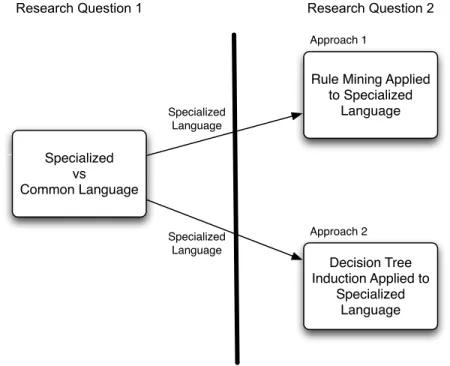
Figure 1 shows the two research questions as well as the experiments used to answer them. The results from the first research question are used to inform the next two experiments used to answer the second research question.
Specialized vs Common Language Decision Tree Induction Applied to Specialized Language Rule Mining Applied
to Specialized Language Approach 2 Approach 1 Specialized Language Specialized Language Research Question 2 Research Question 1
Figure 1.: Research Question Approaches
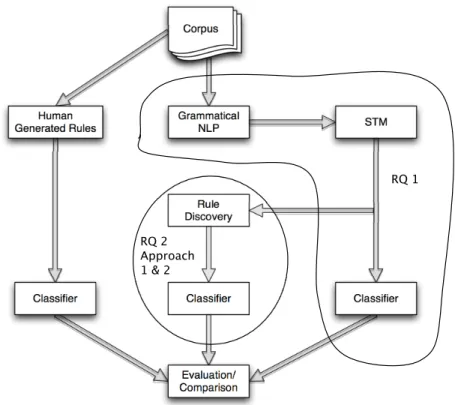
Figure 2 provides an overview of the research landscape and interrelationships between the three experiments in this dissertation. In order to classify documents in health care, decision-making rules are often handcrafted by clinical experts (Hayes and Weinstein, 1990; Hayes et al., 1990). The left side of figure 2 shows this method of classification. This dissertation concentrates on more automated, machine learning methods of classification. Research question one uses a hy-brid methodology utilizing grammatical NLP in conjunction with machine learning. The results of this are used to inform the two approaches used to answer research question two. The next sec-tions describe each of the research quessec-tions in more detail.
Corpus Grammatical NLP DocumentCorpus STM Classifier Rule Discovery Classifier Human Generated Rules Classifier Evaluation/ Comparison RQ 1 RQ 2 Approach 1 & 2
Figure 2.: Dissertation Map
1.2.1 Research Question One - Specialized Language vs Common Language
Medical progress notes are comprised of specialized language (medically-relevant terminology) and common language. The first experiment focuses on whether relevant patterns within clinical notes reside more in the highly technical medically-relevant terminology or in the passages ex-pressed by common language. Of course, it is likely that a combination of both medically-relevant and common language is used to express many thoughts regarding the progress of care. Yet, there is still an interesting question to be resolved in determining the locus of clinically relevant pat-terns. There is a natural experiment in separating the two languages and assessing the predictive power of the language subsets. This experiment addressed the first main goal of this dissertation and the results from this experiment informed the subsequent approaches that address research question two. The research question this experiment sought to answer is using statistical text min-ing (STM) for the purpose of classification, which set of terms from progress notes will provide better accuracy: (1) all terms (2) only medically-relevant terms (MRTs) or (3) terms based on common language?The contribution of this experiment is that it shows that predictive patterns
are preserved by preprocessing text documents with a grammatical NLP system that separates spe-cialized language from common language and it is an acceptable method of data reduction for the purpose of STM.
This research described a way to reduce EHR text notes to only medically-relevant terms by using a grammatical NLP system to extract medical concepts from progress notes. These medically-relevant terms were used in a statistical text mining process in order to classify the notes as either FALL or nFALL. Evaluation metrics were collected and all were slightly better when compared to those for text mining the raw progress notes. This shows that important patterns are not lost by re-moving common language, effectively reducing the information to be processed and in turn max-imizing efficiency. Since no loss occurred, this extracted data can serve as a foundation for other data mining research such as targeted information extraction and even clinical discovery.
1.2.2 Research Question Two - Rule-based Classifiers
An accurate classifier was created in the first experiment to answer research question one. Since logistic regression was used to create the model, it is difficult for a human to interpret in spite of its accuracy. For research question two, the goal was not only to see if classifiers can be built for clinical progress notes represented by specialized language, but also can those classifiers be rule based in order to improve their human interpretability. Three criteria were used to select the ma-chine learning methodology for creating the classifiers. The first is criterion is automated. Human can create rules but this is time consuming and expensive. One goal is to create an automated pro-cess for generating rules. The second criterion is interpetable. An accurate classifier can be cre-ated using many different machine learning methodologies, some of which, result in models that are not easily interpretable by humans. We wanted the rules generated for the classifier to be in-terpretable. The third criterion is accurate. This should be self explanatory because an inaccurate model is obviously useless. We also wanted this model to be more accurate than simply assign-ing a sassign-ingle classification to every case. Two approaches were used to answer this research ques-tion taking the criteria into consideraques-tion. The main contribuques-tion of the experiments performed to answer research question two is that predictive patterns are preserved by preprocessing text doc-uments with a grammatical NLP system that separates specialized language from common lan-guage.
Approach One - Classification Rules
The first approach focuses on applying rule-mining techniques to the output of the information extraction effort resulting from the first research question, with the ultimate goal of creating rule-based classifiers. Association rule mining is one of the most widely used data mining techniques. In particular, market basket analysis relies on using rule mining on the often very large collections of shopping basket data collected at point-of-sale terminals. Most of the time, rule mining is ap-plied to structured data. In addition to research question two, this approach addresses a couple of research questions specific to it. First,Can traditional association rule mining procedures be used to generate rules (frequent item sets) using specialized language? Secondly, can these rules be used with acceptable accuracy for classification purposes?There are several contributions from this approach. First, it uses a novel approach to create classification rules from specialized lan-guage and to build a classifier. The data is split by classification and then rules are generated. Sec-ondly, several toolkits were assembled to create the automated process by which the rules were created. Third, this automated process created interpretable rules and finally, the resulting model provided good accuracy.
There are other methods for creating a classifier that might have better performance such as support vector machines (SVMs), which are especially useful where large variable sets ex-ist. A dilemma arises using other methods in that the resultant predictive model cannot always be interpreted by a human. One of the benefits of creating a classifier with rules is that the rules themselves are interpretable. This approach used the data set from the first research question ex-periment based on the extracted medically-relevant terms. A rule-based classifier was used to classify this data set. The resulting performance was slightly lower than from the classifier from the first experiment but had the benefit of having interpretable rules. Another dilemma that ex-ists within association rule mining is extracting meaningful and interesting rules. By mining using only medically-relevant terms, most terms that create uninteresting or not meaningful rules are eliminated before the mining process begins.
Approach Two - Decision Tree Induction (DTI)
Approach two focuses on using DTI for a rule discovery approach to classification. DTI is an-other rule centric method for creating a classifier. It is a method whereby the process iteratively
selects a set of attributes that most effectively splits the sample data into subsets to create a classi-fier. The tree is made of nodes which are either leaf nodes indicating the classification or decision nodes that specify a test to be carried out on a single attribute value. Of course, these pathways through the decision nodes are basically rules and a decision tree classifier is human interpretable. The research question this approach seeks to answer iscan decision tree induction be used to clas-sify clinical progress notes represented by specialized language?There are several contributions, which are the result of this approach. First, DTI can be used to create an accurate and interpretable classifier using specialized language. Secondly, the resulting rule sets are simple and easily inter-pretable. Third, an automated process is used to create rule sets.
There was no significance in the difference in the performance of the STM classifier from the first experiment versus the DTI model from this approach. However, the resultant classifier from the DTI process was much more interpretable, where as the model from the STM process would be nearly impossible for a human to interpret.
Chapter 2 Research Methodology
This chapter is organized in four sections, two are theoretically based and the other two are ap-plication based. The first section is a theoretical discussion of computational linguistics and how these theories lay the ground work for NLP. The second section is a discussion on how computa-tional linguistics are applied, specifically, an explanation of NLP and how it is used in this disser-tation. The third section is a theoretical discussion of computational learning theory and informa-tion theory and how they lay the ground work for STM. The fourth secinforma-tion is a discussion of the STM techniques used to complete the three studies.
2.1 Computational Linguistics
The Association for Computational Linguistics defines computational linguistics as “...the scien-tific study of language from a computational perspective.” Computational linguistics is based on linguistic theories and how mathematics can be applied. Computational linguists are interested in providing computational models of various kinds of linguistic phenomena. There are two schools of thought where processing language is concerned. One is statistically based where probabilities are associated with possible meanings and the most probable outcome is the correct one. The sec-ond is based on linguistics and the only way to gain understanding of text is to learn the rules of the language. STM is based on the first approach. Computational linguistics is based on the sec-ond approach.
When computers began to be thought of as useful for interpreting text there were two groups of scientists interested in this: cryptographers and linguists. Cryptographers were generally statis-ticians and saw the computer as being used for translation. Probabilities are associated with pos-sible meanings and the most probable outcome is the correct one. Warren Weaver, a pioneer in machine translation, published along with Shannon landmark work on communications
(Shan-non and Weaver, 1949). Linguists, not being mathematicians, saw the computer as being used to implement linguistic theories. Computational linguists develop formal models simulating aspects of the human language faculty and implement them as computer programs. The creation of CYK (Cocke, Younger, Kasami) is generally thought of as the birth of computational linguistics (Cocke, 1969; Kasami, 1965; Younger, 1967). Chomsky, one of the most famous linguists, published this sentence inSyntactic Structures, “Colorless green ideas sleep furiously” Chomsky (1957). It is grammatically correct but semantically nonsensical. He used it show the inadequacy of probabilis-tic models of grammar and the need for more structured models.
Real world applications based on computational linguistics include applications in natu-ral language understanding such as machine translation, spoken dialog systems, and question an-swering as well as NLP which include information retrieval (IR), information extraction (IE), and concept/term extraction. For the purposes of this dissertation, this section will only concentrate on computational linguistics from an NLP perspective. Because of the use of body language and other non-verbal cues, people are able to relax the rules of language and still effectively communi-cate verbally. Written communications can many times be written using relaxed language rules but without the verbal cues, effective communication can be hampered. This creates a need for com-putational linguistics because not all written utterances are grammatically correct. IE, translation, and grammar checking also create a need for computational linguistics.
Linguistics can be broken down into two categories: form and meaning.
• Form
– Morphology - Study of internal structures of words and how they can be modified – Syntax - Study of how words combine to form grammatical sentences
– Phonology - Study of sounds (signs) as discrete, abstract elements in the speaker’s mind that distinguish meaning
• Meaning
– Semantics - Study of the meaning of words (lexical semantics) and fixed word combina-tions (phraseology) and how these combine to form the meanings of sentences
– Pragmatics - Study of how utterances are used in communicative acts, and role played by context and nonlinguistic knowledge in the transmission of meaning
The technologies used in this dissertation are mainly concerned with form, however, mean-ing has a secondary consideration. This section discusses the theoretical aspects of computational linguistics. The following subsections will provide definitions for terminology used within the sec-tion and an explanasec-tion of the two categories. Unless otherwise stated, the informasec-tion provided in this section applies to the American English language. Most of the basics of computation lin-guistics applies to languages in general. However, this dissertation is concerned with American English, therefore, that is the concentration of this section.
2.1.1 Terminology
This sections provides definitions of terms, ideas, and theories used throughout this chapter.
Table 1: Computational Linguistic Terminology
Terminology Explanation
Affix A morpheme that is attached to a word stem to form a new word.
Morpheme The smallest unit in a language, which can be assigned a
mean-ing.
NP Noun Phrase - A phrase containing a noun and other modifying
words such as adjectives, adverbs, and other nouns.
VP Verb Phrase - A phrase containing a verb and modifying adverbs.
Context Free Grammar (CFG)
A formal grammar in which every production rule is of the form
V →wwhereV is a single nonterminal symbol andwis a string of terminals and or nonterminals. Used in linguistics to describe the structure of sentences and words in natural language. Bottom-up Parsing A strategy for analyzing unknown information that attempts to
identify the most fundamental units first, and then to infer higher-order structures from them.
CYK Cocke, Younger, and Kasami. Sometimes referred to as CKY, is a
parsing algorithm for context free grammars that uses bottom-up parsing and dynamic programming.
2.1.2 Form Morphology
Morphology deals with strings that make up words and these strings are combined to make sen-tences. It also attempts to uncover the rules that govern the creation of words (Trost, 2003). Re-gardless the language, the smallest unit in a language, which can be assigned a meaning is a mor-pheme. Each language contains hundreds of thousands or even millions of words. In contrast, languages contain some 10,000 morphemes, an order of magnitude smaller than the number of words. There are semantic morphemes called roots such asdog,red, andtake. There are also ab-stract morphemes that imply plurality and tense such ass. A free morpheme forms a word on its own such asdog. Bound morphemes occur only with other morphemes such assindogs. Each language has grammatical rules that control how these morphemes are connected to create words.
Much of the parsing technology in an NLP pipeline has its background in morphology. The parser finds tokens, then words. The part of speech for each word is computed and used to cre-ate phrases. This being done correctly starts with determining word boundaries correctly. If the words cannot be determined correctly, all subsequent steps will also be incorrect. These technolo-gies were used in the first experiment to extract medically-relevant terms from the progress notes. More detail on this can be found in Chapter 4 and in Appendix D. Vocabularies and ontologies as well have underpinnings in morphology. The basic unit for both is words. From there words are combined to create terms. These are explained in more detail in a subsequent section. The fol-lowing sections discuss the core theoretical foundations that underpin critical components of NLP pipelines.
Roots and Stems The root of a word is the base morpheme for the word with no affixes. For example, the root ofdegradeis the morphemegradewith the affix morphemederemoved. A sim-ilar concept is stemming. A stem is the base form of a word. One example is the stem forgave,
gives, andgivingisgive.Giveis the base form for each of those words but not the root. Another example is the stem fordegradesanddegradingisdegradewhile the root fordegradesisgrade. A stemming NLP component was used in the NLP pipeline in experiment one, which focused on assessing the predicative power of specialized versus common language. More detail on this can be found in Chapter 4.
Tense, Plurality, and Gender Some languages mark words with tense, plurality, and gender while others do not (Trost, 2003). For example, Latin based languages mark words with gender such as in Italian pomodoro (tomato - masculine), and cipolla (onion - femine). On the other hand, Japanese does not mark plurality on nouns.
Derivation and Compounding New words can be created using derivation and compounding (Trost, 2003). By using derivation, affix morphemes are added to stems to create a new word that is also a different part of speech from the original word. For example, the nounhospitalizecan be derived fromhospitalby adding the affix morphemeize. By compounding, a new word is created by joining two base morphemes. For example, by compoundingdoorandbell, a new word, door-bellis created.
Affix There are different types of affix morphemes that can be joined to stem morphemes. A pre-fix afpre-fix is joined to the beginning of a stem (Trost, 2003). For example, by adding the prepre-fixunto
commoncreatesuncommon. A suffix affix is a morpheme joined to the end of a stem. A common suffix is to add ansto a stem to make it plural.
There are also rules for affixes. Multiple suffixes can be added to stems to create new words, however, there are rules that control the order for affixes. For instance, the suffixesizeandation
can be added tohospitalto createhospitalization. Those same suffixes cannot be added in a differ-ent order. The stringhospitalationizeis not a word.izemust be connected to a noun and creates a verb.ationmust be connected to verbs and creates nouns.
Applications There are several practical applications of the morphological theories in NLP. Word processors apply morphology theories in hyphenation, spell checking, and grammar check-ing. Grammar rules are used in NLP parses to determine parts of speech. Stemming is another NLP component used to convert words into their stem forms.
Syntax
Syntax is the study of the rules used to construct phrases and sentences in natural languages (Ka-plan, 2003). Just as there are rules that govern how words are made by combining letters, there are grammatical rules that govern how words are combined to make phrases and sentences. In order
for a grammatical NLP parser to make sense of a phrase, it must first be parsed into its grammati-cal components. There are several syntactic theories that are behind this technology. A major goal of syntactic theories is to define a notation that can be used to create rules that define a grammar. Theories that were once popular are now considered to be out dated but they were instrumental in the development of newer, more explanatory theories. A few syntactic theories are explained below. What these theories have in common is that they map a sentence into a tree structure. The root is the sentence, next are the phrases such as NPs and VPs, then the parts of speech, and finally the words that comprise the sentence. How these theories differ is how the tree is built and what can further be done with the tree.
• In 1957, Chomsky publishedSyntactic Structureswhere he laid out the original generative theory, Transformational Grammar (Chomsky, 1957). In this theory, a sentence can be rep-resented by a deep structure and a surface structure. The deep structure is the starting point and maps a sentence in a tree of phrases representing the sentence. This tree goes through a series of transformations where one tree is the input for a subsequent transformation until the final tree, the surface structure, is created. The sentences of the language are the strings that appear at the bottom of the surface structures. One example is to transform an active declara-tive sentence into the passive equivalent. It is possible to go from a deep structure to a surface structure but it is next to impossible go from a surface structure to a deep structure.
• Generalized Phrase Structure Grammar (GPSG) - Developed in the late 70s by Gerald Gazdar. It is a framework for describing the syntax and semantics of natural languages (Gazdar et al., 1985). One of its goals is to show that syntax of natural language can be described by CFG, however, Gazdar has since argued that this is not true. Much of the innovations from GPSG were later incorporated into Head Driven Phrase Structure.
• Head-Driven Phrase Structure Grammar (HPSG) - Developed by Carl Pollard and Ivan Sag. It is used in NLP because it is organized in a modular way. It uses the concept of a sign which has a type hierarchy and its features describe its properties (Phonological, Syntactic, and Se-mantic) (Pollard and Sag, 1988). Grammatical rules are expressed through the constraints signs place on each other.
LFG views language as being made up of structures that are grammatical functions and syn-tax (Bresnan, 1976). A sentence is broken into phrases such as verb phrases (VP) and noun phrases (NP) and then further broken into parts of speech until finally are the words of the sen-tence.
Syntactic Rules In English, words comprise a sentence if there is a noun and verb, as in:
Bob visited.
One grammatical rule from this could be: A sentence can consist of noun-verb sequence.
Take this one step further and examine the sentence:
Bob visited Mary
Now another rule can be created.
A sentence can consist of a noun-verb-noun sequence.
So far these have been simple sentences. Do the rules hold when the sentence becomes more complex? Take for example the sentence:
The man from city visited old woman.
There are more words in this sentence than previous examples but the previous rule still ap-plies: man visited woman. More rules need to be created to compensate for the additional words. The concept of aphrasebecomes important now. A phrase is a contiguous sequence of related words. The first phrase in the sentence above isThe man from the city. The second phrase isold woman. Now and additional rule can be created that describes this sentence.
A sentence can consist of NP - VP - NP.
In addition, rules can be made that qualify what comprises a NP or a VP. Syntactic rules describe how sentences are constructed but are not concerned with meaning. In other words, a sentence can be grammatically correct a not make any sense. A popular game, Mad Libs, allows
players to create nonsensical sentences that are syntactically correct. Leonard Stern and Roger Price created the game and published the first book of the game in 1958. Players are given sen-tences with words missing. They are told to give a word based only on the part of speech. Those words are entered along with the original words provided and a grammatically correct sentence is formed, however, this sentence most likely is nonsensical because the player supplying the words is unaware of the other words supplied by the game. The game is good for a laugh but it is also a good exercise in syntax by looking at how sentences are formed by parts of speech and phrases.
Applications NLP parsers are grounded in syntactic theories which enable them to correctly parse text into its correct parts of speech. This is one of the beginning steps in most NLP pro-cesses. For example, to perform a lookup, the application must have the correct word to lookup and its part of speech. The pipeline used in experiment one parses text eventually into words and determines whether each word is a medically-relevant term or not. The details on how this is ac-complished are in Chapter 4.
Phonology
This dissertation concentrates only on written language due to the fact that the progress notes are written. However, much of this same background applies to spoken language as well. There are language recognition systems that are used to convert natural spoken language into a form that a computer can understand then NLP is performed on that. The IBM Watson computer application is one example of that (Ferrucci et al., 2010). Phonology is briefly mentioned here even though no spoken technology is used in this dissertation.
Phonology is the study of sounds as they are used in language. Computational phonology is the study of computational techniques used to represent and process phonological information (Bird, 2003). Humans have a vocal apparatus capable of creating an infinite variety of sounds. Human language takes this infinite number of sounds and reduces them into a sound system con-sisting of a few dozen categories of sounds called phonemes.
It should be noted that phonemes do not match one to one to the number of letters in an al-phabet. The letterthas multiple phonemes associated with it and many vowel phonemes are as-sociated with multiple letters such asou. The number of phonemes in the English language also
varies from dictionary to dictionary. For instance, theAmerican Heritage Dictionaryuses 25 con-sonant and 18 vowel phonemes on the other hand, theLongman Pronunciation Dictionaryuses 24 consonants and 23 vowels (Ladefoged, 2001).
2.1.3 Meaning Semantics
Semantics is the study of the meaning of language. Computation semantics is the area of compu-tational linguistics that uses a compucompu-tational approach to natural language to acquire the meaning (Lappin, 2003). Semantics is concerned with how the meanings of individual words contribute to the meaning of the phrase or sentence containing those words.
There are two approaches to computational semantics. First, is static where each sentence meaning is self-contained. Secondly, is dynamic where the semantic interpretation of a sentence is dependent on previous sentences in the discourse. In using dynamic approaches, a dialog record is constructed that allows the meanings of previous sentences to be used in the interpretation of subsequent sentences.
Syntax and semantics are tied together. Once a sentence has be analyzed and parsed into its syntactic components, computational semantics computes systematically the sentence’s mean-ing from the words (Lappin, 2003). In many models, a syntactic structure is two dimensional in that it contains both syntactic and semantic information. The Parallel Correspondence Model (PCM) is an approach that encodes both syntactic and semantic information. There are several the-ories that utilize this approach. GPSG, HPSG, and LFG discussed in the previous section use the PCM model. In Fernandez et al., they propose a HPSG approach that applies semantic meaning to phrases and sentences based on questions previously listed in the discourse (Fernandez et al., 2011).
Applications The biggest application of semantics within NLP is Word Sense Disambiguation (WSD). Homonyms exist in the English language, which are words that have different meanings but are spelled and pronounced the same. Take for instance, the wordcold. Cold can be used to describe how one feels, the temperature outside, an illness, and many other meanings. NLP parsers used to extract meanings from words are grounded in semantic theories. The pipeline used in
ex-periment one does not have a WSD module. At the time, a WSD module for medical terminology could not be located. Currently, this is a growing area of research within medical informatics.
Pragmatics
Closely related to semantics is pragmatics. Pragmatics is the study of the meaning of linguistic messages in terms of context (Leech and Weisser, 2003). Mostly, pragmatics is related to speech rather than the written word, however, it is discussed here because it has some practical applica-tions in the field of NLP.
Illocutionary Acts, also known as Speech Acts, is one of the philosophical foundations of pragmatics (Austin, 1962; Searle, 1969). A speech act conveys meaning through action. Up until this point most approaches to language had been treated as a statement that can be treated as either true or false (Leech and Weisser, 2003). Statements such asI promiseare a verbal action rather than stating something that is true or false. Speech acts characterizes verbal actions as one of three categories of acts: locution, illocution, and perlocution.
Locution is the actual utterance and its apparent meaning (Austin, 1962). The utterance,
Don’t run in front of carsin its locutionary meaning is an utterance stating not to run in front of cars. It does not convey whether the cars are moving or parked or where the cars are located. How-ever, given the same utterance, from a speaker to a hearer next to a busy highway and the meaning is taken not to run out into the traffic in front of the moving cars. This is the illocutionary mean-ing. Now given the same statement in the same situation and it prevents the hearer of the utterance from running out in front of cars and getting hurt, that is the perlocutionary meaning. The per-locutionary meaning is dependent on two things: whether the hearer understands the utterance and whether the hearer is willing to comply with the utterance.
Applications There are many applications for pragmatics in speech recognition and yet not as many with written text. One of the areas in NLP where pragmatic theories are applied are the use of pronouns. Pronouns are used extensively in writing and many utterances contain multiple pro-nouns, some referring to people and others referring to objects. The challenge is to determine who or what the noun is that the pronoun is referring. Pragmatic theories underpin the technology used by NLP processes to determine these references.
2.2 Natural Language Processing (NLP)
NLP is concerned with the interaction between natural language, human language as opposed to computer language, and computers. This section discusses NLP and associated technologies that are grounded in computational linguistic theories.
2.2.1 Vocabularies and Language Systems or Terminologies and Ontologies
The process of classifying information is as old as language itself. There is a nomenclature used to represent language and the different tools used to classify language. A great deal of disagree-ment exists in the literature concerning the meanings of some of these terms. What follows is the nomenclature that will be used throughout this dissertation as well as the definitions. Since there is disagreement, this should alleviate confusion caused by any preconceived definitions. Table 2 lists some common terms used throughout this dissertation.
Table 2: Language Nomenclature
Terminology Explanation
Document Used to describe a unit of text. Has nothing to do with the way it is physically stored. It is a logical unit.
Word (Graphic) A string of contiguous alphanumeric characters with space on either side: may include hyphens and apostrophes, but no other punctuation marks (Kucera and Francis, 1967).
Lexeme Corresponds to a set of words taken by a single word (Kucera and Francis, 1967). The result of stemming. For example, “give”, “gave”, “gives”, “giving”, and “given” all stem to the lexeme give.
Token The basic unit in a document. Can represent a word, number, symbol, or letter. e.g. “Heart attack” contains two tokens; “Heart” and “attack”. “B/P: 110/70” contains the other types of tokens. Both “B” and “P” are letter tokens. “/” and “:” are symbol tokens and “110” and “70” are number tokens. For the purposes of this dissertation, a token is sur-rounded by spaces.
Term/Concept A single word or multiple contiguous words that represent a concept. The two words in “heart attack” represent a single concept, therefore, those two words can be a single term. “Heart” by itself is also a term. A term can represent one or many concepts. e.g. “cold” can represent a descriptive concept for temperature or it can represent a common illness. A concept can also be represented by one or many terms. e.g. “heart attack” and “myocardial infarction” represent a single concept.
Controlled Vocabulary
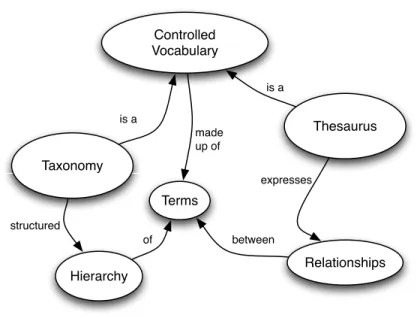
In the field of computational linguistics, terms are brought together in collections to be used for processing. A controlled vocabulary is the basic collection used. There are different types of con-trolled vocabularies and the ANSI/NISO standard Z39.19-2005 (Ano, 2005), which covers vo-cabularies and the development of them, explains in detail how controlled vovo-cabularies are con-structed, formatted, and managed. A controlled vocabulary in its basic form is a list of terms to be used for processing. This is also the foundation for all other vocabulary collections. The goal of a controlled vocabulary is to achieve consistency. Without consistency, the other vocabulary col-lections would be ineffective. The standard defines relationship indicators and how they are used. Figure 3 shows the relationship between the different types of controlled vocabularies. Table 3 list the different relationships that can be expressed by terms in the different types of controlled vocabularies which are listed in table 4. Disciplines other than medicine use controlled vocab-ularies as well. The Art and Architecture Thesaurus (AAT), the Getty Thesaurus of Geographic Names (TGN), the Union List of Artist Names (ULAN), and the Cultural Objects Name Author-ity (CONA) are all vocabularies that contain information on art, architecture, and material culture and are all vocabularies that are created, maintained, and copyrighted by the The Getty Research Institute (The Getty Research Institute, 2011). The Library of Congress Subject Headings (LCSH) has been maintained since 1898 to catalog materials held by the US Library of Congress (Library of Congress, 2011) . LCSH is also used internationally. The Labourline Thesaurus is published by Labour Canada Library Services and consists of industrial relations/human resource management terms (Chaplan, 1995). Another vocabulary resource is the Taxonomy Warehouse (TW:, 2011). This is a repository of vocabularies and contains over 670 vocabularies covering 73 subject do-mains. Vocabularies covering practically anything from Academic Link Thesaurus for Universities to Zoological Record Thesaurus can be found at the Taxonomy Warehouse.
Ontology
Early students of Aristotle used the term metaphysics to refer to what Aristotle referred to as “first philosophy.” Ontology has also been used as an alternative for metaphysics. The term ontology was first published in 1613 independently by two different philosophers, Goclenius and Lohard (Goclenius, 1613; Lorhard, 1613). Goclenius implies that ontology is concerned with abstract
enti-Controlled Vocabulary Taxonomy Thesaurus Terms Hierarchy Relationships between expresses structured is a is a made up of of
Figure 3.: Controlled Vocabularies
Table 3: Vocabulary Relationships
Relationship Explanation Expressed
By
Example
Equivalency Used when more than one term can be used to express a single concept or lexi-cal variants.
USE & USED FOR
“MI” & “my-ocardial in-farction” and “orthopedic” & “orthopaedic” Hierarchy Express broad to narrow or narrow to
broad relationships. Also known as “isa” “hasa” BT, NT “broken femur” is a “fracture” and “central nervous sys-tem” has a “spinal cord.”
Association Sibling and derivational relationships. RT “broken femur”
and “broken radius” are sib-lings.
Table 4: Vocabulary Types
Vocabulary Explanation Example
Synonym Ring Used exclusively in information re-trieval. Ensures when a concept is used in a search, any document containing that concept or any synonymous concept can be retrieved.
Searching for all documents pertaining to heart attack, a syn-onym ring is used to also re-trieve documents pertaining to MI, Myocardial Infarction, and any of the other many concepts that represent heart attack. Taxonomy Controlled vocabulary with hierarchical
structure to it.
Thesaurus Controlled vocabulary with order and structure added so relationships between terms are represented by the standard-ized relationship indicators.
UMLS Metathesaurs, a the-saurus of medical concepts and relationships made up of con-trolled vocabularies such as ICD
1and MeSH2(Cimino et al.,
2008; Tuttle et al., 2008).
Lexicon The vocabulary including its words and
expressions for a language. An inven-tory of a languages lexemes. It is also synonymous with thesaurus.
ties and formal structures (Munn and Smith, 2008). The German philosopher, Christian Wolff used the term when referring to Aristole’s “first philosophy” (Wolff, 1736). The computer and infor-mation science disciplines have adopted the ontology to be a formal representation of knowledge. Today, some refer to taxonomies, thesauri, terminology, and ontologies interchangeably. There is much discussion as to what an ontology is as can be seen by the many definitions in table 5 (Al-berts, 1993; Wielinga and Schreiber, 2010; van Heijst et al., 1997). Even though these definitions differ, they all have the concept of expressing knowledge.
One of the most widely referenced definitions of ontology is from Gruber.
Ontologies: vocabularies of representational terms - classes, relations, functions, objects constants - with agreed-upon definitions, in the form of human readable text and machine-enforceable, declarative constraints on their well-formed use. Definitions may include re-strictions on domains and ranges, placement in subsumption hierarchies, class-wide facts inherited to instances, and other axioms.
The Penman Upper Model and the Generalized Upper Model, a descendant of the Penman Upper Model, are examples of linguistic ontologies that exist (Bateman, 1990). The General Up-per Model ”provides a domain- and task-independent classification system that supports sophisti-cated natural language processing while significantly simplifying the interface between domain-specific knowledge and general linguistic resources.”
Unified Medical Language System (UMLS)
In 1986, The National Library of Medicine (NLM) formed a multidisciplinary multi-site team to create the UMLS (Humphreys et al., 1998).“The purpose of NLM’s Unified Medical Language System (UMLS) is to facilitate the development of computer systems that behave as if they ‘un-derstand’ the meaning of the language of biomedicine and health (National Library of Medicine, 2010).” The UMLS consists of three knowledge sources: Metathesaurus, Semantic Network, and SPECIALIST Lexicon. These tools are provided by the National Library of Medicine and are freely available to anyone possessing a license which is also free.
Table 5: Ontology Definitions
Author Definition
Wielinga and Schreiber An ontology is a theory of what entities can exist in the mind of a knowledgeable agent
Alberts An ontology for a body of knowledge concerning
a particular task or domain describes a taxonomy of concepts for that task or domain that define the semantic interpretation of the knowledge
van Heijst An ontology is an explicit knowledge level
speci-fication of a conceptualization, which may be af-fected by the particular domain and task it is in-tended for
Gruber A specification of a representational vocabulary
for a shared domain of discourse - definitions of classes, relations, functions and other objects - is called an ontology.
Metathesaurus
The Metathesaurus is a large vocabulary database. The contents of this database are provided by source vocabularies such as SNOMED-CT, DSM, and MeSH. The Metathesaurus provides con-cepts which allow terms from different source vocabularies to be map to concon-cepts. These concon-cepts allow users to link these heterogeneous source vocabularies together. The Metathesaurus also pro-vides relationships between concepts, both parent/child and sibling. For example, the concept ‘myocardial infarction’ has a parent concept ‘structural disorder of the heart’, which has a parent ‘heart disease’ and a sibling ‘infarction.’ These concepts can be represented by terms from differ-ent source vocabularies. Of the three knowledge sources, the Metathesaurus is the most widely used (Chen et al., 2007). For the purposes of this dissertation, the UMLS Metathesaurus is consid-ered a thesaurus and not an ontology.
Semantic Network
The Semantic Network currently contains 135 semantic types and 54 relationships. These se-mantic types are categories in which to group the concepts in the Metathesaurus. There are also semantic grouping such as organisms, anatomical structures, biologic function, chemicals, and