S O C I A L I Z AT I O N P E R S P E C T I V E k é v i n d a n i e l a n d r é c a r i l l o
a t h e s i s
submitted to the Victoria University of Wellington in fulfilment of the requirements for the degree of
Doctor of Philosophy in
Information Systems
Victoria University of Wellington 2014
Attracting a large number of new contributors has been seen as a way to ensure the survival, long-term success, and sustainability of Free/Libre/Open Source Software (FLOSS) communities. However, this appears to be a necessary, but not a sufficient condition, as the well-being of FLOSS communities also relies on members perform-ing behaviours that nurture and protect the community.
Despite a large body of research on FLOSS communities, few studies have been un-dertaken to explore the influence of a participant’s socialization experience on their contribution behaviour. In addition, there has been relatively little research that has adopted a community-level view of FLOSS community participants’ contribution that goes beyond the mere notion of writing lines of code.
The purpose of this study is to develop and rigorously test a socialization model that predicts contributor behaviour in the FLOSS community context.
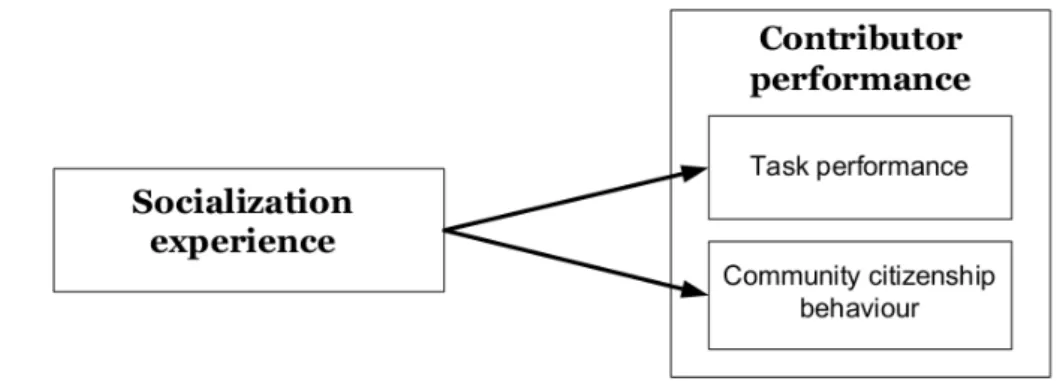
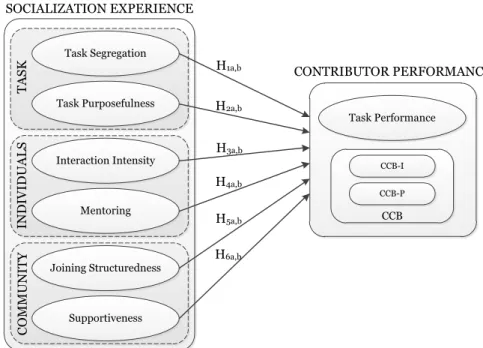
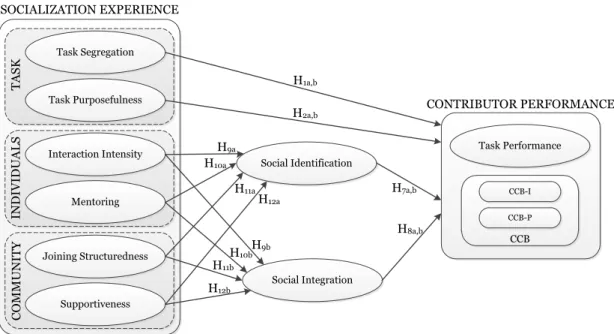
Drawing upon theories of socialization and citizenship behaviours from organiza-tional behaviour research, this research develops and tests two separate but related research models. The first model proposes the direct impact of socialization factors on two performance-related dependent variables: task performance and community citi-zenship behaviours. The second model hypothesizes a mediating effect of two prox-imal socialization variables, social identification and social integration, between the socialization factors and the dependent variables.
An exploratory study involving eleven FLOSS community leaders, managers, and experienced members was first conducted, to investigate the key variables that char-acterize FLOSS community newcomer socialization experience as well as the various instances of citizenship behaviours that are specific to the FLOSS community context. The analysis of the interview data revealed the existence of six socialization variables: task segregation, task purposefulness, interaction intensity, mentoring, joining struc-turedness, and supportiveness. Two sets of FLOSS community citizenship behaviours (CCB) were identified drawing on the citizenship behaviour literature. The first set, labelled CCB-I, comprised citizenship behaviours directed towards the benefit of indi-viduals. The second set, CCB-P, included citizenship behaviours directed towards the benefit of the project. The findings were integrated in the two conceptual models.
Subsequently, a research instrument was developed, following an extensive purifi-cation process that consisted of card sorting and expert review rounds, and a survey pretest. A pilot study assessed responses from46 FLOSS contributors from two large FLOSS communities. Overall, the scales demonstrated high reliability and showed ad-equate construct validity. The analysis of the pilot study suggested the existence of a third CCB dimension, named CCB-C, that characterizes citizenship behaviours that are oriented towards the benefit of a project’s community.
The main study was based on an online survey involving 327 respondents from twelve large FLOSS communities. Using Partial Least Squares (PLS), the collected data was used to test the two models. The results showed the overall superior predictive capability of the model hypothesizing the mediating effect of both social identification and social integration.
Task performance was found to be directly predicted by task purposefulness as well as by interaction intensity and supportiveness through the mediation of social identification. Meanwhile, CCB was found to be impacted by the direct effect of task segregation and task purposefulness, and by interaction intensity and supportiveness through the mediation of both social identification and social integration. The exis-tence of the third CCB dimension, CCB-C, was confirmed.
I would like to express my sincere gratitude to the many people who helped me dur-ing this venture.
To Sid Huff, my primary supervisor, thank you for having been an extraordinary mentor. Your wisdom, experience, and diligence have infused me with an energy and faith in doing ’high-quality’ research I can only hope will continue to grow.
To Brenda Chawner, my secondary supervisor, thank you for your constant support, availability, and energy for pushing me to always surpass myself.
My partner Karine and son Arthur - for your love and for having been the sunshine that helped me go through difficult times and complete this journey.
To my friends and colleagues, Eusebio Scornavacca and Jean-Gregoire Bernard - for your support and insights.
To my fellow PhD students and colleagues from the School of Information Manage-ment - for their involveManage-ment and valuable support.
To the many FLOSS passionates who believed in my research and opened the door of the FLOSS world to me.
To Victoria University of Wellington for having given me the opportunity to embark on this wonderful, life-changing journey.
To my parents, family, friends.
1 i n t r o d u c t i o n 1
1.1 Research problem, questions and research objectives 2 1.1.1 Problem statement 2 1.1.2 Research questions 3 1.2 Research Design 3 1.3 Significance of research 4 1.3.1 Academic value 4 1.3.2 Practitioner value 4 1.4 Delimitations 5 1.5 Thesis outline 5 2 l i t e r at u r e r e v i e w a n d i n i t i a l r e s e a r c h m o d e l s 7 2.1 Chapter Outline 7
2.2 Theorization of the FLOSS environment under study 7 2.2.1 Commons-based peer production 8
2.2.2 Beyond the bazaar stereotype 9
2.2.3 Theoretical boundaries: Community-organization hybrids 9 2.3 Free/Libre/Open Source Software communities 11
2.3.1 A condensed history of the Free/Libre/Open Source Software
movement 11
2.3.2 Free Software vs. Open Source Software 12
2.3.3 From software glitch to the notion of FLOSS community 13 2.3.4 FLOSS Project artifacts 13
2.3.5 Community roles 14
2.3.6 Relationship between core and non-core developers 17
2.3.7 Multiple roles and non-programming/non-technical tasks in FLOSS
communities 17
2.3.8 Shift from a FLOSS project-centered to a community-centered
focus 18
2.4 Individual contribution behaviour and performance in FLOSS
communit-ies 20
2.4.1 Contribution and performance in FLOSS research 20
2.4.2 A reconceptualization of performance and contributor behaviour 23 2.5 Towards the importance of newcomer socialization 28
2.6 Socialization literature and FLOSS socialization 30
2.6.1 Differences between FLOSS socialization and organizational so-cialization 30
2.6.2 The socialization literature tradition 32 2.6.3 Past FLOSS research about socialization 33 2.6.4 Van Maanen and Schein’s socialization tactics 36
2.6.5 Refinements of Van Maanen and Schein’s model by Jones (1986) 38 2.6.6 Aspects of Van Maanen and Schein’s socialization tactics in large
and complex FLOSS projects 39
2.6.7 Overall socialization framework in organizational behaviour 41 2.6.8 Socialization and performance 43
2.7 Summary of literature review and research gaps 48
2.8 Preliminary research models 49
2.8.1 Conceptualization of the main notions 50 2.8.2 Preliminary research models 51
3 r e s e a r c h d e s i g n 53
3.1 Theoretical perspective of this research 53 3.1.1 Ontology 53
3.1.2 Epistemology 54
3.2 Perspectives about methodology selection 55 3.3 Chapter summary 56
4 q ua l i tat i v e a s s e s s m e n t o f f l o s s n e w c o m e r e x p e r i e n c e a n d c o n -t r i b u -t o r p e r f o r m a n c e 57
4.1 Introduction 57
4.2 Methodological choices 57
4.2.1 Interviews vs. focus groups 57
4.2.2 Recorded semi-structured interviews 58 4.2.3 Sampling 59
4.3 Data analysis procedure 60 4.3.1 Data reduction 60 4.3.2 Data display 63
4.3.3 Conclusion drawing and verification 65 4.4 Interview participants’ characteristics 66
4.4.1 Interview procedure 66 4.5 Results 68
4.5.1 Relevance of performance operationalization 68
4.5.2 Findings about FLOSS community citizenship behaviours 69 4.5.3 Interview findings about socialization in FLOSS communities 79 4.6 A FLOSS socialization model 88
4.7 Chapter summary 90
5 c o n c e p t ua l m o d e l s a n d r e s e a r c h h y p o t h e s e s 91 5.1 Conceptual definitions 91
5.2 Dual investigation and conceptual models 92 5.3 First research model 92
5.4 Second Conceptual Research Model 96 5.4.1 Overall description 96
5.4.2 Social identification 97
5.4.3 Relationship between socialization experience and social identi-fication 99
5.4.4 Social integration 101
5.4.5 Relationship between socialization experience and social integ-ration 103
5.5 Chapter Summary 106 6 m e t h o d o l o g y 107
6.1 Methodological choices 107 6.1.1 Survey method 107
6.1.2 Online survey versus regular survey 108 6.2 1st Phase 109
6.3 2nd Phase 109
6.3.2 Expert panel 123 6.3.3 Card sorting 131 6.3.4 Survey design 143 6.3.5 Pretest 145
6.3.6 Pilot study 146
6.3.7 Refinements before survey administration 165 6.4 3rd Phase 167
6.4.1 Survey administration and data collection 167 6.4.2 Dataset release under a FLOSS license 172 6.4.3 SEM technique : Partial least squares 173 6.5 Chapter Summary 174
7 r e s u lt s 175
7.1 Respondent demographics 175 7.2 Dataset characteristics 177
7.3 Validation and measurement of CCB as a second-order construct 179 7.4 Measurement model evaluation 180
7.4.1 Criteria for measurement model evaluation 180 7.4.2 Exploratory Factor Analysis 182
7.4.3 Measurement model1: Results 186 7.4.4 Measurement model2: Results 187 7.4.5 About the dimensionality of CCB 189 7.5 Structural model evaluation 189
7.5.1 Criteria for structural model evaluation 189 7.5.2 Structural Model1: Results 200
7.5.3 Structural Model2: Results 201 7.6 Subsequent analyses 202
7.6.1 CCB estimation: Repeated items vs. Two-Step 206 7.6.2 Full mediation vs. partial mediation 206
7.7 Chapter Summary 207
8 d i s c u s s i o n a n d i n t e r p r e tat i o n o f t h e f i n d i n g s 209 8.1 Introduction 209
8.2 Answering the research question 209
8.3 FLOSS socialization under the social scientist’s theoretical microscope 211 8.3.1 Task segregation 212 8.3.2 Task purposefulness 212 8.3.3 Mentoring 213 8.3.4 Interaction intensity 213 8.3.5 Joining structuredness 213 8.3.6 Supportiveness 213
8.4 It’s not only about writing code. 213
8.5 Modelling the socialization phenomenon 215 8.6 Yes, FLOSS socialization matters. 216
8.6.1 Predictors of task performance 216
8.6.2 Predictors of Community Citizenship Behaviours 218 8.6.3 Predictors of social identification 219
8.6.4 Predictors of social integration 220 8.7 Contributions of the Study 220
8.7.1 Theoretical contributions 220 8.7.2 Theoretical conjectures 223
8.7.3 Practical contributions 227 8.8 Limitations 228
8.9 Directions for Future Research 229 8.10 Summary 230 Appendices 233 a h u m a n e t h i c s c o m m i t t e e a p p r ova l s 235 b q ua l i tat i v e d ata a na ly s i s 241 c j o n e s’ (1 9 8 6) m e a s u r e m e n t s c a l e s 249 d c a r d s o r t i n g p r o c e d u r e 251 e t e r m s o f t h e o d c o p e n d ata b a s e l i c e n s e (o d b l) 255 f s u r v e y i n s t r u m e n t u s e d f o r t h e m a i n s u r v e y 257 b i b l i o g r a p h y 267
Figure1 Initiation and growth cycle of a FLOSS project (adapted from
Al Marzouq, Zheng, Rong & Grover, 2005) 14
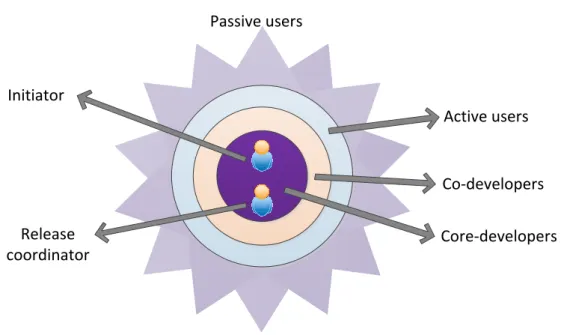
Figure2 Onion-shape structure of FLOSS communities (adapted from Crowston et al.,2005, and Crowston and Howison,2005) 16 Figure3 Onion-model of FLOSS community organizational hierarchy
(Jensen and Scacci,2005,2007) 16
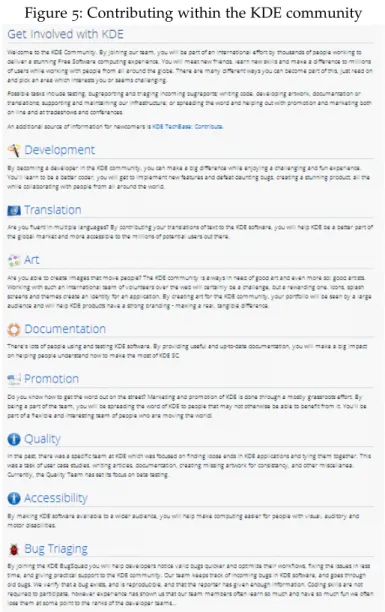
Figure4 Contributing within the GNOME community 18
Figure5 Contributing within the KDE community 19
Figure6 Koha bug reporting guidelines 26
Figure7 KDE community code of conduct 27
Figure8 Development tools for the GNOME platform 32
Figure9 Jones’ (1986) classification of socialization tactics 39
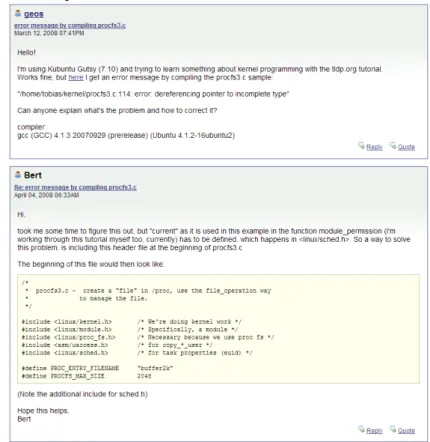
Figure10 Linux kernel newbie community 41
Figure11 Example of collective socialization in the KernelNewbie
com-munity 42
Figure12 Saks et al. (2007)’s model of socialization tactics and newcomer
adjustment 43
Figure13 Bauer et al. (2007)’s model of newcomer adjustment during or-ganizational socialization 43
Figure14 First conceptual model 51
Figure15 Second conceptual model 52
Figure16 Miles and Huberman’s (1994) data analysis components 60 Figure17 FLOSS socialization experience - Model 90
Figure18 First conceptual model 94
Figure19 Second conceptual model 97
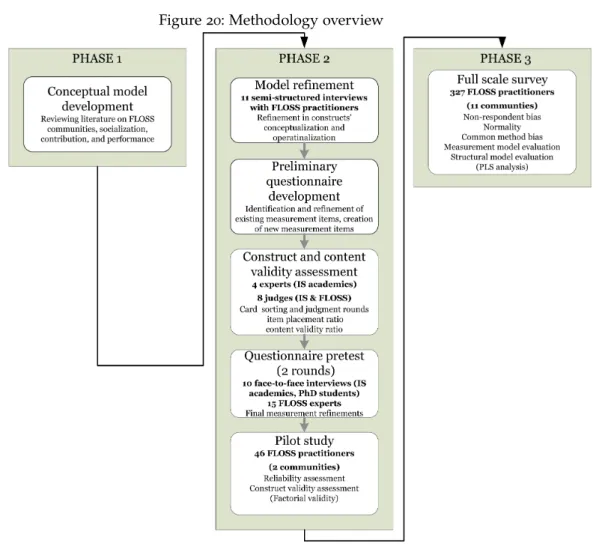
Figure20 Methodology overview 107
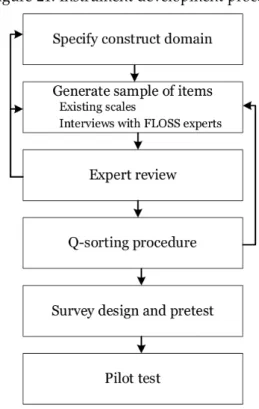
Figure21 Instrument development process 110 Figure22 Survey invitation in Perl blog post 149 Figure23 Message on Perl Foundation’s website 149 Figure24 LibreOffice mailing list invitation 151
Figure25 Survey invitation page in researcher’s blog 170 Figure26 Survey invitation in a project’s ’planet’ 171 Figure27 Survey invitation in Linux.com 171
Figure28 PLS Model building for second-order constructs- Repeated In-dicators and Two-Step approaches 180
Figure29 Structural Model1 200
Figure30 Structural Model2 203
Figure31 FLOSS socialization framework 212 Figure32 Performance-related measures 215 Figure33 Summary of the results 217
Figure34 Low number of contributors / Low complexity- Conjectured social-ization models 224
Figure35 Low number of contributors / High complexity- Conjectured social-ization models 225
ization models 226
Figure37 Non-software commons-based peer production projects - Con-jectured socialization models 227
L I S T O F TA B L E S
Table1 Van Maanen and Schein’s socialization dimensions (1979) 37
Table2 Open coding - Coding examples 62
Table3 Axial coding - Coding examples 64
Table4 Interviewees’ characteristics 67
Table5 Interview findings - Instances of CCB-I behaviours 70 Table6 Interview findings - Instances of CCB-P behaviours 74 Table7 Fromformal tacticstotask segregation:definitions 81 Table8 Fromcollective tacticstointeraction intensity:definitions 82 Table9 Task purposefulnessandjoining structuredness:definitions 86 Table10 Fromserial tactics tomentoring:definitions 87
Table11 Frominvestiture tactics tosupportiveness:definitions 89 Table12 Summary of conceptual definitions 93
Table13 Pool of items before expert panel and card sorting procedure -1 113
Table14 Pool of items before expert panel and card sorting procedure -2 114
Table15 Pool of items before expert panel and card sorting procedure -3 115
Table16 Task performance measurement items 117
Table17 Pool of CCB-I items before expert panel and card sorting pro-cedure -1 120
Table18 Pool of CCB-P items before expert panel and card sorting
pro-cedure 121
Table19 Organizational identification scale 122 Table20 Social integration scale 123
Table21 Refinedtask segregationitems - Expert panel 125 Table22 Refinedinteraction intensityitems - Expert panel 126 Table23 Refinedtask purposefulnessitems - Expert panel 126 Table24 Refinedjoining structurednessitems - Expert panel 127 Table25 Refinedmentoringitems - Expert panel 128
Table26 Refined supportiveness items - Expert panel 128 Table27 Refined Task Performance items - Expert panel 129 Table28 RefinedCCB-Iitems - Expert panel 130
Table29 RefinedCCB-Pitems - Expert panel 132
Table30 First sorting round: Individual judge’s construct labels 134
Table31 Inter-judge agreement 135
Table32 Landis and Koch’s Kappa statistics nomenclature 136 Table33 Items Placement Score – Round1 136
Table34 Inter -judge agreement – Socialization 138 Table35 Items Placement Score – Round2 139 Table36 Task Purposefulness Items - Rephrasing 139 Table37 Inter -judge agreement – Performance 141 Table38 Items Placement Score – Socialization 141 Table39 Rephrasing after first round of pretest 147 Table40 Demographics of the respondents - pilot test 150
Table41 Reliability assessment - Socialization experience constructs 157 Table42 Results of EFA - Socialization constructs 159
Table43 Reliability assessment - Social identification and social integra-tion 160
Table44 Results of EFA - Social identification/integration 160
Table45 Results of EFA - CCB Dimensions 162
Table46 Reliability assessment - CCB dimensions 164 Table47 Reliability assessment - Task performance 164 Table48 Results of EFA - CCB / Task Performance 166
Table49 Modified layout of the consent information page 167 Table50 FLOSS project description 169
Table51 Respondent demographics 176
Table52 Roles/Tasks performed by respondents 177 Table53 Outer model evaluation strategy 181
Table54 Results of EFA - Socialization constructs 184 Table55 Social identification/integration 185
Table56 Results of EFA - CCB Dimensions 186
Table57 MODEL 1- consistency reliability, indicator reliability, conver-gent validity of socialization constructs 188
Table58 MODEL 1- consistency reliability, indicator reliability, conver-gent validity of performance constructs 189
Table59 MODEL1- Cross-loadings1 190
Table60 MODEL1- Cross-loadings2 191
Table61 MODEL1- Fornell–Larcker criterion 191
Table62 MODEL1- Item loading issues 192
Table63 MODEL2- Consistency reliability, indicator reliability, and con-vergent validity of socialization constructs 192
Table64 MODEL2- Consistency reliability, indicator reliability, and con-vergent validity of remaining constructs 193
Table65 MODEL2- Cross-loadings1 194
Table66 MODEL2- Cross-loadings2 195
Table67 MODEL2- Fornell–Larcker criterion 195
Table68 MODEL2- Item loading issues 196
Table69 Loadings of CCB dimensions 196
Table70 Summary of the criteria for structural model evaluation 197
Table71 MODEL1- Results summary 201
Table72 MODEL1- Cohen’s (1988) pseudo F-test (ƒ² effect size) 201 Table73 MODEL1- Predictive relevance (Q² and q²) 201
Table74 MODEL2- Results summary 203
Table75 MODEL2- Cohen’s (1988) pseudo F-test (ƒ² effect size) 204 Table76 MODEL2- Predictive relevance (Q² and q²) 204
Table78 MODEL1- Hypothesis tests 205
Table79 MODEL2- Hypothesis tests 205
1
I N T R O D U C T I O NThe prominence garnered by Free/Libre/Open Source Software (FLOSS) projects in a broad range of applications is now unquestionable. Operating systems such as the Linux kernel, GNU, or FreeBSD projects, server and client software like Apache Web Server, Eclipse, Joomla, Mozilla Firefox, or else PHP and Python FLOSS program-ming languages are all testaments to the overall attractiveness and success of FLOSS development as a viable alternative to the conventional proprietary model of produc-ing software (Hahn, Moon & Zhang, 2008). A key feature that differentiates FLOSS projects from traditional proprietary software projects is the reliance on an active and dedicated community consisting of talented individuals whose skills tap into a wide spectrum of software-related domains.
Despite the success of the overall FLOSS movement, research has demonstrated that FLOSS projects are characterized by high project abandonment rates (Stewart,
Ammeter & Maruping, 2006). Reasons that explain project failure vary but it certainly
makes the FLOSS movement less attractive for contributors and poses certain risks for adopters and users of FLOSS applications (Chengalur-Smith, Sidorova & Daniel, 2010). Past FLOSS research has highlighted the fact that communities suffer from a lack of new developers’ enrolment (Hahn et al., 2008) and a lack of sustained partici-pation (Fang & Neufeld, 2009). As a result, large FLOSS projects have now reached a point where ensuring survival, long-term success, and sustainability has become cru-cial.
However, ensuring the continuing enrolment of newcomers is not, in and of itself, a guarantee that new members will perform well and help to sustain their FLOSS com-munities. A FLOSS community that attracts a large number of new contributors from which a majority does not successfully or satisfactorily carry out project tasks may not prosper in the long run and may even disappear. One of the key factors for main-taining the strength of FLOSS communities concerns the manifestation of citizenship behaviours among members, behaviours such as altruistic sharing and helping (Hars
& Ou, 2002; Kuk, 2006; Sowe, Stamelos & Angelis, 2008; Wu, Gerlach & Young,
2007). If such citizenship behaviours begin to fade, the survival of the community may be seriously jeopardized.
Because of the specificity of development processes and the technical complexity of the multiple projects within each FLOSS community, newcomers may be confronted with community entry obstacles before engaging in project participation. Communi-ties have traditionally believed that access to the source code repository and to the interaction logs (such as mailing lists or forums) was sufficient for prospective contrib-utors to attain a necessary level of performance, and engage in citizenship behaviours. FLOSS communities are becoming aware that such efforts are not sufficient, and unless more is done, their sustainability is endangered. Adopting a wide range of strategies, they have launched various initiatives to attract new participants but also to ensure that appropriate contributor behaviours are generated from new contributors. Some
FLOSS communities have created sub-communities of newcomers that create more col-lective socialization experiences such as KernelNewbies for the Linux Kernel project or GNOME Love. Formal mentoring programs such as the Google Summer of Code have also been developed for the same reason. From 2005and 2012, the Summer of Code program has brought together more than3000student participants and mentors from more than100countries worldwide to take part in various FLOSS projects. Mentoring was found to be an effective way of bridging the gap between core developers and “newbies” (or novices) by emphasizing the acceptance and integration of new
devel-opers within FLOSS communities, and by pairing newcomers with role models who demonstrate good community practices. Other communities specifically recommend that new members perform a pre-defined series of peripheral tasks before engaging into more complex project work.
Furthermore, to date there has been no careful scientific investigation of the effec-tiveness of such initiatives. There is then a need for FLOSS communities and academic researchers to collaborate in order to help communities design appropriate socializa-tion practices that generate satisfactory contributor behaviours. The first step to un-dertake on this research avenue, is to clearly understand which socialization factors have an impact on contributor behaviour and which do not.
The socialization literature within the organizational behaviour domain has pro-vided a wealth of theoretical insights over the past30 to40years. These findings pro-vide a useful starting point for deriving a FLOSS-specific socialization model. Further-more, the concept of participation within FLOSS communities has mostly been viewed from a code-centric perspective, using project archival data. Participation within a FLOSS community goes well beyond writing lines of code, fixing bugs, and submit-ting patches. A richer conceptualization is necessary to understand better the deeper functioning of FLOSS communities. This research aims to address these gaps.
1.1 r e s e a r c h p r o b l e m, q u e s t i o n s a n d r e s e a r c h o b j e c t i v e s 1.1.1 Problem statement
FLOSS communities are directly dependent on the capacity of the members to success-fully carry out tasks in line with community performance expectations. The success of FLOSS communities is also tied to the initiatives undertaken by members to nurture and protect the community through various non-task related efforts such as altruistic behaviours of sharing and helping (Hars & Ou, 2002; Kuk, 2006; Wu et al., 2007).
One of the unique features of FLOSS communities is that members shape their own integration: they are free to enrol or not into any socialization programmes provided by the communities. They are also free to get involved with other newcomers or not. The experience through which an individual goes during the socialization phase is unique to each individual based on the behaviour and interaction undertaken by new-comers with the software project and the rest of the community. As a result, it is not enough for FLOSS communities to make sure socialization resources and initiatives are available for potential newcomers. Communities need to identify the practices that generate behaviours which are aligned with a community’s values and goals.
Accurately assessing the impact of an individual’s socialization process on his/her behaviour within a community requires thoroughly understanding and conceptualiz-ing participation. Past FLOSS research has suffered from a too restrictive performance-driven perspective towards participation, the measurement of which was based on archival data available from project repositories. The question here is not to debate whether this approach is appropriate or not, but rather to assess whether such a lim-ited view of participation is sufficient for the actual needs of FLOSS communities. The performance-driven view may omit essential aspects of member participation that are crucial for FLOSS communities, but which cannot be captured by conventional mea-sures such as the number of lines of code written by a contributor.
To accurately assess the impact of socialization, there is a need to adopt a more encompassing view of member participation by revising and reconceptualizing the concept and by using an approach that is more consistent with the actual function-ing of FLOSS communities. A thorough review of the organizational behaviour lit-erature identified numerous studies which have examined the concept of citizen-ship behaviours and which appeared particularly insightful when attempting to re-conceptualize the notion of participation in the FLOSS community context. In partic-ular, the socialization literature suggested the importance of potential mediators (also called socialization proximal outcomes) between socialization factors and contributor behaviour. These factors need to be investigated, and their measurement validated in the FLOSS community context.
1.1.2 Research questions
The overarching research question guiding this study is:
What socialization factors influence contributor behaviour in FLOSS communities?
The review of the FLOSS and broader organizational behaviour literatures around socialization and citizenship behaviours resulted in the following subsidiary research questions:
1. What are the key factors that characterize the socialization experience of new-comers in FLOSS communities?
2. What are the different instances of citizenship behaviour in the FLOSS commu-nity context?
3. What are the important proximal socialization factors in the FLOSS community context?
4. What is the influence of such proximal socialization factors on contributor be-haviour?
5. What socialization factors influence the identified proximal socialization factors? 1.2 r e s e a r c h d e s i g n
This research relies on a three-phase mixed-method approach (Creswell & Clark, 2007) that consists of an overall quantitative study in which a qualitative component is
em-bedded. The first phase involved the collection of interview data to explore the new-comer experience and citizenship phenomena, which led to the design of two alterna-tive conceptual models in line with the findings from the review of the literature. The second phase includes the design and validation of a questionnaire instrument to test the models. The final phase includes the collection of data from FLOSS community members, using an online survey, to quantitatively test (using Partial Least Squares analysis) the research models.
1.3 s i g n i f i c a n c e o f r e s e a r c h 1.3.1 Academic value
This research project addresses the lack of strong theoretical foundations in the study of FLOSS communities and practices. The review of the FLOSS literature revealed the extensive use of approaches and conceptual models that are not theoreticall well-grounded. This research drew insights from the socialization literature and integrated results from FLOSS socialization studies to conceptualize FLOSS participant socializa-tion using strong theoretical insights. To do so, this research adds to the FLOSS stream of research by generating two generic FLOSS socialization conceptual models that, we hope, will trigger further research efforts in the FLOSS community context.
Furthermore, the notion of participation within FLOSS communities has been re-strictive due to a lack of theoretical considerations and an extensive use of archival data. By introducing the notion of FLOSS community citizenship behaviours, this project re-conceptualized participation using insights from organizational behaviour literature and past FLOSS studies to provide a more encompassing and FLOSS-specific perspective that reflects more the FLOSS reality.
This study also contributes to construct specification and measurement by devel-oping a socialization framework based on six newly-designed theoretical constructs. So far, the definition and measurement of performance within FLOSS communities had been oversimplified. The previously used constructs have been mainly software-centric and measured using archival data. This study developed and validated a survey questionnaire instrument that measured individual performance (using two dependent variables: task performance and community citizenship behaviours) in a much broader sense that is more in line with the actual functioning of FLOSS commu-nities. This study also illustrates the effective use of primary (survey) data in under-standing the FLOSS phenomenon.
1.3.2 Practitioner value
This research project addresses two important issues faced by FLOSS communities. On the one hand, this research helps FLOSS communities in understanding the social-ization factors that contribute to the successful socialsocial-ization of new members. It thus helps communities to tailor proper socialization initiatives that help to develop con-tributors who behave more in line with the values and sustainability of communities.
On the other hand, this study also helps FLOSS communities to better understand the inner individual mechanisms that influence contributor behaviour. In spite of the importance of the spread of citizenship behaviours to ensure the survival of a com-munity, the investigation of the individual factors that lead to citizenship behaviours is a novel approach in FLOSS research. In addition, the finer understanding of perfor-mance provided in this research also benefits communities in helping them to better understand the full range of ways in which individuals contribute. On the other side of the coin, this research benefits FLOSS participants themselves, by providing insights into the practices with which they should engage when joining a new FLOSS commu-nity.
Finally, this research indirectly contributes to virtual communities more generally. Both socialization and contributor behaviour are concerns within a wide range of virtual communities (not just FLOSS communities). The study’s findings may be to some extent extrapolated to the domain of all virtual communities.
1.4 d e l i m i tat i o n s
This research focuses solely on the socialization experience and contributor behaviours of FLOSS community members. The notion of socialization has strong organizational connotations. As a result, this research particularly applies to FLOSS groups that have some organizational aspects that are usually present within communities that consist of more than a handful of programmers collaborating on some FLOSS-licensed soft-ware project. Adopting a socialization approach assumes the presence of a minimum of structural and hierarchical features that characterizes FLOSS projects of a certain size. This project will consistently use the term FLOSS community (instead of project, group, or any other term) to emphasize this important assumption throughout this research.
1.5 t h e s i s o u t l i n e
This chapter has outlined the research questions and objectives, the proposed research design, its anticipated value to academics and industry, as well its delimitations. Chap-ter 2 reviews the relevant literature with the purpose of establishing the theoretical boundaries and foundations of this research; it ends with the development of two pre-liminary conceptual models. Chapter3details the proposed research design. Chapter 4presents the results of the qualitative phase of this research, the goals of which were to delineate key socialization factors in FLOSS communities and to identify important instances of FLOSS community citizenship behaviours. Chapter5combines the litera-ture streams analyzed in Chapter2and the results of Chapter4, to extend and modify the two conceptual FLOSS socialization research models to their final, testable state. Chapter6 outlines the research methodology used for this study. Chapter 7presents the evaluation of the measurement and structural models as well as the findings of the main survey. Finally, Chapter8 discusses the findings, and summarizes the main contributions of this research, and its limitations.
2
L I T E R AT U R E R E V I E W A N D I N I T I A L R E S E A R C H M O D E L S2.1 c h a p t e r o u t l i n e
This chapter reviews and discusses the literature relevant to this study. In order to develop a firm understanding of the accumulated literature in this field, several re-search streams have been considered for this review. The chapter concludes with an introduction of the two initial conceptual models that guided this research.
The chapter begins with the theorization of the FLOSS environment under investi-gation followed by a delimitation of the theoretical boundaries of the research. It con-tinues with a brief summary of the FLOSS history that provides some background in-formation about FLOSS communities. Then, the key characteristics of FLOSS projects and communities are discussed. In the following subsection, the concepts of contrib-utor behaviour and performance are reviewed in FLOSS research, leading to a re-conceptualization of the concept of performance. In the next subsection, the justifica-tion of the use of a socializajustifica-tion approach as a relevant strategy to tackle the research problem, is provided. The subsequent subsection reviews the socialization tradition in the domains of organizational behaviour and FLOSS research, accompanied by a re-view of the socialization concepts emphasized and used in this research. In addition, a subsection summarizes the findings and research gaps drawn from the review of the literature and consequently derives the subsidiary research questions that led this research project. Finally, the last subsection combines the results into two initial con-ceptual models that were refined into testable models at a later stage of this research (discussed in Chapter 5). Some additional literature is discussed in Chapter5 in the context of the development of the specific hypotheses that were tested in this research.
2.2 t h e o r i z at i o n o f t h e f l o s s e n v i r o n m e n t u n d e r s t u d y
FLOSS development is an alternative software production mode that significantly dif-fers from the traditional firm-based proprietary model. At the theoretical level, FLOSS communities are software-producing social entities that have unique characteristics and mechanisms which significantly differentiate them from organizations; thus ren-dering the IS body of knowledge about conventional software development inapplica-ble to some extent. Besides,’FLOSS project’ shall be taken as an umbrella term since the extensive variation between the different FLOSS development initiatives prevents from making any generalisations about the way projects work. FLOSS projects sig-nificantly differ along a variety of attributes. For instance, FLOSS project size ranges from one to several thousands contributors; the way a handful of programmers work on a software project cannot be similar to the way a community of thousands of in-dividuals collaborate on a project involving a much broader spectrum of tasks such as marketing, design, or licensing. Similarly, project complexity can vary from simple utilities such as a password manager or a plain text editor to much more modular projects like operating systems or programming platforms.
As a result, it is important to clearly define the theoretical boundaries of the IT ar-tifact under investigation (Orlikowski & Iacono, 2001) which will allow to determine the generalizability scope of the results as well as the degree of generalizability to other related environments. The following two subsections introduce the theoretical context of the social entities under study. The section ends by delimiting the theo-retical boundaries of this research: large and complex projects are conceptualized as software-producing community-organization hybrids relying on commons-based peer production.
2.2.1 Commons-based peer production
FLOSS projects can be seen as a particular type of commons where individuals collec-tively collaborate to produce software artifacts that are non-rival public goods (English
& Schweik, 2007). The term “commons” refers to “a particular institutional form of
structuring the rights to access, use, and control resources” (Benkler, 2006, p.60) that can be understood as the opposite of the term ’property’. Indeed, the notion of ’prop-erty’ relies on the principle that law allows people or entities to have the authority to determine how a given resource can be used (for instances it can be sold, rented, or given away). The asymetric allocation of power that determines the notion of own-ership towards resources is the basis of the conventional transaction-based view of markets and firms (Coase, 1937; Williamson, 1979).
Since Garett Hardin’s (1968) famous article “The Tragedy of the Commons”, there has been a widespread interest in understanding how natural resources seen as ’com-mons’ can be successfully managed (Feeny, Berkes, McCay & Acheson, 1990). Indeed, Hardin predicted the over-harvesting and eventual destruction of common-based re-sources such as water, fish stock, forests, or the atmosphere. By treating software production inputs and outputs as public goods, the extrapolation of Hardin’s claim to the FLOSS movement raises concern about the viability of the FLOSS production model.
The term “commons-based peer production” was introduced by Yochai Benkler (2002; 2006) to characterize an alternative model of production that consists of gen-erating information-based products through digitally networked environments. ’Peer production’ is a form of social production that is an alternative to other forms of production such as contract- or market-based, managerial-firm based, or else state-based production (Benkler & Nissenbaum, 2006). It relies on two main assumptions. First, peer production is decentralized as contributors collaborate without relying on any form of market pricing or managerial hierarchy. Authority to participate and con-tribute mainly resides within individual agents. Second,social cues and motivations gov-ern the coordination of agents instead of prices or commands (Benkler & Nissenbaum, 2006). ’Commons-based’ emphasizes that both inputs and outputs of the production process can be freely accessed, shared, and used.
FLOSS development has been seen as the “quintessential instance of commons-based peer production” (Benkler, 2006, p.63). The FLOSS production model has now spread to various instances of information, knowledge, and cultural goods production
(Benkler & Nissenbaum, 2006; Berry & Moss, 2008) which vary along several
peer production has three main attributes that characterize the produced objects. Mod-ularity refers to the extent to which a product is organized into modules and sub-modules. Granularity characterizes the sizes of the project’s modules. The more fine-grained or small in size, modules are, the more a project can draw from a large pool of contributors. Finally, low-cost integration must be enabled through efficient quality control mechanisms on modules and also efficient integration mechanisms of the mod-ules.
This research project conceptualizes the FLOSS production model using the notion of commons-based peer-production as defined by Yochai Benkler (2002; 2006).
2.2.2 Beyond the bazaar stereotype
Early works on FLOSS development made use of a ’bazaar’ metaphor to describe the functioning of FLOSS projects. The term was coined by Eric Raymond in an essay he wrote based on his observations of the Linux kernel development process ( Ray-mond, 1999). He described it “as a great babbling bazaar of differing agendas and approaches [...] out of which a coherent and stable system could seemingly emerge only by a succession of miracles” (p.2). More recent studies have critisized the overall lack of structure and organization that the bazaar metaphor implies when character-izing FLOSS projects. Fitzgerald(2006), for instance, studied the gradual shift of the FLOSS projects from ’bazaar-like’ to more structured entities. Fitzgerald qualifies the overall development process as Open Source Software (OSS) 2.0 and highlights the use of planning purposive strategies, complex analysis and design, organized imple-mentation subphases, and the increase of the number of paid developers to justify his claim. This research follows Fitzgerald’s line of thought by arguing that FLOSS development now stands somewhere between two ends of a spectrum: unstructured bazaar-like entities and structured organisational settings.
2.2.3 Theoretical boundaries: Community-organization hybrids
This research project focuses on a particular category of FLOSS projects: large and complex projects. Such entities thus inherit features that characterize the nature of commons-based peer production that is the digitally-enabled co-creation of information-based products through a production process relying on the use of inputs and outputs that are treated as non-rival public goods. In addition, FLOSS production is thus in-herently decentralized and social cues and motivations are key drivers that govern how such projects function (more details are provided in further subsections).
This research more precisely focuses on complex software projects such as operat-ing systems, desktop environments, or programmoperat-ing platforms, that are character-ized by a high level of modularity. Linux desktop environment projects (e.g. KDE or GNOME) for instance, consist of a vast collection of tools, more or less independent from each other, that address all functions of operating systems such as application launching, file handling, or window and task management. The high granularity of such commons-based projects pertains to the nature of software itself as contributions can start from modifying a single line of code up to submitting patches or entire software modules. Furthermore, as it will be developed further in this thesis,
contri-butions in large and complex FLOSS projects are not limited to code-related tasks as such projects involve a wide array of tasks. Documentation and translation are for instance important areas from which granularity is also high as contributors can start from correcting a single typo error, to writing a documentation paragraph, or even translating an entire set of documentation pages.
The term large characterizes the population of contributors instead of the software artifact itself. This research focuses on FLOSS projects relying on a large number of contributors which justifies the community-perspective that is adopted. For instance, a majority of projects hosted on the FLOSS forge SourceForge1
have between one and five contributors. Such projects may or may not be instances of commons-based peer production but they do not belong to the category of entities that are under in-vestigation in this research. The overall organizational-community approach adopted in this research is inappropriate to study small projects hosted on Sourceforge that have a handful of contributors. Furthermore, some FLOSS projects may be complex but not large and would lay outside the scope of this research. The Linux distribu-tion, Linux Mint2
, is a complex software project that involves a rather small num-ber of contributors (in total, 22 individuals contributed within the last year as of 14 February 2014) according to Ohlo3, a website tracking down the activity of the main FLOSS projects. The Ohlo website reports a number of several hundreds to several thousands contributors for complex projects such as GNOME, KDE, or Ubuntu for instance, thus justifying to consider them as large projects. Even though there exists no number threshold to distinguish a group from a community, the appropriateness of using an organizational-community approach is questionable when considering ’smaller’ projects such as LinuxMint since some of the organizational assumptions would be invalid in such contexts.
Moreover, large and complex FLOSS projects rely on a population of contributors that function in a rather structured and organized manner that contradict the implica-tions of the chaotic bazaar-view. As mentionned byFitzgerald(2006), the software pro-duction process, from the planning to the implementation phase, relies on procedures that are used in convential IT organizations that produce and maintain software, sug-gesting the presence of some degree of organization and authority. Besides, a majority of large and complex FLOSS projects now rely on either non-for-profit organizations (also called ’foundations’) and/or corporate sponsors that take an active role in deter-mining the goals and direction of the projects. Finally, the commonly accepted view about the peripheral participation of newcomers that assumes that socialization en-tirely depends on newcomer motivation and initiatives is another erroneous belief in the case of large FLOSS projects. Indeed, a number of projects now rely on organized joining processes and more and more events and programs are being run to attract and help integrate newcomers. As a result, large and complex FLOSS projects are neither ’bazaars’ nor conventional organizations but rather lay in a spectrum between
’bazaar-like’ entities and organizations. They shall thus be seen as community-organization hybrids that have a mix of features characterizing either communities or organiza-tions.
1 http://sourceforge.net/
2 http://www.linuxmint.com
In conclusion, this research investigates the influence of socialization on contrib-utor performance in large and complex FLOSS projects. The theoretical particular-ities of this research resides in the fact that such entparticular-ities can be seen as community-organization hybrids that produce complex software artifacts through commons-based peer production processes, which clearly delimitates the theoretical boundaries of this research. Moreover, the dual nature (organization and community) of large and com-plex FLOSS projects strongly compromises the applicability of traditional organiza-tional research as well research on digitally-enabled communities when investigating issues related to socialization, contribution, and individual performance.
The following sections and subsections describe key features and mechanisms that characterize large and complex FLOSS projects in order to provide a deeper under-standing of the social entities that were studied during this research. The termFLOSS communities is consistently used throughout this thesis to refer to the population of contributors that is associated with large and complex FLOSS projects.
2.3 f r e e/l i b r e/o p e n s o u r c e s o f t wa r e c o m m u n i t i e s
FLOSS communities are complex social entities that are influenced by the origin of the FLOSS movement and its core beliefs. This subsection starts with some background in-formation about the FLOSS movement. Then, it describes key characteristics of FLOSS communities and their members. The subsection concludes with considerations about the gap between FLOSS researchers and practitioners.
2.3.1 A condensed history of the Free/Libre/Open Source Software movement
The Free/Libre/Open Source Software (FLOSS) movement is the descendant of the hacker tradition which started at Massachusetts Institute of Technology where some students started calling themselves “hackers” in the beginning of the1960’s (Himanen, 2002). The term “hacker” itself existed before that period, it referred to individuals who "program enthusiastically."
The hacker culture is said to have been born within the Tech Model Railroad Club (TMRC), a student club which progressively shifted to computers and programming
(Raymond, 1999). Their influence was spread far wider after 1969, the first year of
the ARPAnet, the first transcontinental, high-speed computer network, which later be-came the Internet. The use of the ARPAnet network allowed isolated hacker groups, which had developed their own ephemeral local culture, to unite as a “networked tribe”(Raymond, 1999). The hacker culture then became a “new way of life, with a philosophy, an ethic and a dream” (Levy, 1984, p.27).
In the1970s and early1980s, realizing the economic potential of the nascent software industry, software companies started distributing only binary copies of computer pro-grams in order to prevent computer programmers from studying and modifying their software (Moerke, 2000; Simon, 1996). In1980, the US copyright law was extended to computer programs, strengthening the control of software companies on source code and computer programs. In 1983, Richard Stallman, a hacker from the MIT Artificial Intelligence Laboratory, announced the launch of the GNU project as a means to
ex-press his frustration towards the overall change in computer and software culture. He then founded the Free Software Foundation (FSF) in October1985.
Free/Libre/Open Source Software community practices are strongly influenced by the values and norms inherited from the early hacker movement. Such values have shaped the key characteristics but also the social dynamics of FLOSS communities.
In1998, The label ’open source’ was adopted during a session held at Palo Alto, Cal-ifornia, in reaction to Netscape’s January1998announcement of a source code release for its Internet browser called Navigator. The term open source was chosen with the deliberate intention to keep some distance from the ideological and confrontational connotations of the term “free software” and in order to attract the attention of corpo-rations from the software industry. The Open Source Initiative was founded the same year by Bruce Perens and Eric S. Raymond, to promote open source software. Ever since both the Free Software Foundation and Open Source Initiative have gained in-creasing momentum and attracted numerous individuals from throughout the world. Academics and practitioners who wanted to address both movements commonly re-ferred to the Free/Open Source Software movement (or FOSS).
The term libre softwarestarted being used some years later as the result of the dis-ambiguation of the term free as highlighted in the famous statement from Richard Stallman: “Free software is a matter of liberty, not price. To understand the concept, you should think of free as in free speech, not as in free beer" (Stallman, 2002, p. 43). The first use of the acronym FLOSS is often attributed to Rishab Aiyer Ghosh, an Open Source Initiative board member and researcher. In recent years, the label Free/Libre/Open Source Software movement (or FLOSS) has been progressively ac-knowledged by both academics and members of the Free Software and Open Source Initiative to address this overall shift in the software landscape.
2.3.2 Free Software vs. Open Source Software
The Free Software Foundation (FSF) has been maintaining a definition that helps de-termining whether a software is a free software or not4
. The definition is centered around four core beliefs about software freedom that are:
• The freedom to run the program, for any purpose.
• The freedom to study how the program works, and modify it.
• The freedom to access to source code and the freedom to redistribute copies. • The freedom to distribute copies of modified versions of the program to others,
allowing to help and contribute to the community.
The definition of free software denotes an overall emphasis on software users and freedom towards the use of software. The FSF regularly evaluates the licenses that potentially qualify as free software and keeps records of those licenses on its web-site5
. The Open Source Initiative has also maintained a definition of open source soft-ware6
. The definition addresses various aspects centered around the overall notion
4 http://www.fsf.org/philosophy/free-sw.html
5 http://www.gnu.org/licenses/license-list.html
of software distribution, summarized in 10 clauses. It specifies issues related to free redistribution, access to source code, rights to generate derived works, and absence of discrimination towards individuals or fields. Licensing aspects include distribution, non-restrictiveness, and technology neutrality. OSI regularly evaluates the licenses that comply with the OSI definition and maintains a list of licenses on its website7
.
2.3.3 From software glitch to the notion of FLOSS community
The embryo of a typical FLOSS project is a software idea in the mind of one developer, answering a specific software need. FLOSS projects are often initiated to fulfill a need that cannot be met by proprietary software applications (Nelson, Sen & Subramaniam, 2006). As a result, projects are usually developed alone or by a very small group be-fore being accessible to other potential contributors through the Internet (Crowston
& Howison, 2006). The founders’ ideas are then expressed into working code,
gener-ally submitted to one of the FLOSS repositories, and potentigener-ally start attracting more developers and users. If the project is successful, It then further develops quickly and gathers features and capabilities that in turn attract additional developers and users
(Crowston & Howison, 2006).
English and Schweik (2007) found that a majority of FLOSS projects disappear
af-ter a short amount of time due to a lack of user and developer inaf-terest, thus leading to project abandonment. An analysis of the Sourceforge repository projects confirmed that most FLOSS projects fail:58% do not move beyond the alpha developmental stage, 22% remain in the planning phase,17% remain in the pre-alpha phase, and some be-come inactive (S.-Y. T. Lee, Kim & Gupta, 2009). Similarly,Stewart, Darcy and Daniel (2006) found that most FLOSS projects do not even last a year.
By gaining more attention and participation, a FLOSS software usually becomes more usable and in turn the number of individuals joining the community keeps in-creasing (provided the software continues meeting the developers’ interest). A growth cycle starts that feeds both the community and development of the software. As the community grows, it becomes more diverse by encompassing additional roles that are less programming-oriented (Al Marzouq et al., 2005). FLOSS project roles are further described in section2.3.5. The initiation phase and growth cycle of FLOSS projects is represented in Figure1, which is based on works fromAl Marzouq et al.(2005). 2.3.4 FLOSS Project artifacts
Due to the diversity of FLOSS projects, there is not a single development environment. Nonetheless, it is still possible to highlight the most recurrent development tools that are used in a majority of projects. In order to handle the assembling and versioning of source code submitted by FLOSS developers, a revision and version control system such as Concurrent Versions System (CVS) (Fogel, 1999), is usually used. The source code repository and the revision control system of a FLOSS project give access to the complete history of files and source code. Git has been among the most common dis-tributed revision control systems. Git was initially designed and developed by Linus Torvalds for managing the development of the Linux kernel (Cornford, Shaikh &
Figure1: Initiation and growth cycle of a FLOSS project (adapted from Al Marzouq et al., 2005)
1
2
3
4
Initiator FLOSS software FLOSS communityUser and potential contributor User and potential
contributor User and potential
contributor Contributes initial
prototype
Software generates interest
and attracts more users The new users increase the size of
the community
The community contributes more back
to the software
borra, 2011). The use of software utilities to automate testing, compiling and bug
reporting is also a common practice. Users’ wishes of most wanted features may also be integrated in the bug tracking system. Bugzilla is among the most commonly used bug tracking and testing software (Raghunathan, Prasad, Mishra & Chang, 2005). It was written for the nascent Mozilla.org project to replace Netscape’s proprietary bug tracking system.
Interactions among the contributors of a FLOSS project can be enabled through var-ious Internet-related communication means such as mailing lists, FAQs, forums, mes-sage boards, Internet Relay Chat (IRC), and instant messaging. A number of FLOSS projects are hosted on “software forges” (Riehle et al., 2009) such as GNU Savan-nah or SourceForge which integrate all the above components in one single platform. However, large FLOSS projects tend to have their own independent platform and web-site such as it is the case for Linux distribution projects such as Debian8
, Gentoo9 , or Fedora10
.
2.3.5 Community roles
Early research studies of the FLOSS phenomenon that examined communities often focused on identifying the various roles played by each member and the tasks per-formed within projects. Past research has mainly focused on the software develop-ment process, omitting other important roles that are less programming-oriented or
8 http://www.debian.org
9 http://www.gentoo.org
even non-technical. In addition, the emphasis on software development also led to neglecting the consideration that participants may take part in several projects and sub-projects, assuming different roles. These limitations are further explained in sec-tion2.3.7.
Early research articles made the assumption that in FLOSS projects, the people who contribute code to a project are always users of the code produced (Gacek & Arief, 2004). In these studies, FLOSS contributors were mapped within a developer/non-developer categorization (Gacek & Arief, 2004; G. L. Lee & Cole, 2003; Sen, 2007). Among developers, researchers introduced another dichotomous classification which sees developers are being either core or non-core developers (Fielding, 1999; G. L. Lee
& Cole, 2003; Mockus, Fielding & Herbsleb, 2002). Combining both notions of
core/non-core developers and non-developers,Nakakoji, Yamamoto, Nishinaka, Kishida
and Ye(2002) andYe and Kishida(2003) were among the first to introduce a more
ex-haustive list of roles performed by FLOSS members by identifying eight distinct role categories within an onion-like model.Gacek and Arief(2004) preferred a hierarchical view, mostly referring to the same roles mentioned in Nakakoji et al. (2002) and Ye
and Kishida(2003).
Further attempts to understand the social structure of FLOSS projects extended the ’onion-like’ model (Crowston, Heckman, Annabi & Masango, 2005; Crowston &
Howison, 2005, 2006) (see Figure 2). The authors proposed the following categories:
passive users, active users, co-developers, and core developers (within which were in-cluded initiator and release coordinator). The authors highlighted that the outer layer has a “virtually unknowable boundary” (Crowston & Howison, 2005, p.7) consisting of passive users of the software who do not speak on either the project’s discussion lists or forums.
Based on the integration of the results of the above works,Jensen and Scacchi(2005, 2007) proposed a more comprehensive model that focuses instead on a project com-munity rather than the software project itself (see Figure3). This approach is more in line with the one adopted in this research project and will be further detailed.
One of the limitations of the proposed models concerns their static nature. Indeed, it was shown that the core group of a FLOSS project does not persist for long periods of time; new generations take the lead over after a certain amount of time (Herraiz,
Robles, Amor, Romera & González Barahona, 2006). Furthermore, the onion model
tends to assume that a new contributor, starting as a user, has to work his way through all layers of the onion model in order to reach the core developer level. By studying the concurrent versions system (CVS) used within the GNOME community,Herraiz
et al. (2006) found that there was no typical joining pattern for new members,
limit-ing the predictive power of the onion model.Jensen and Scacchi (2007) confirmed the shortcomings of the onion model in terms of role migration and advancement pro-cesses. A relevant strategy to encompass the dynamic nature of FLOSS communities within a model is to rely on a socialization perspective (Ducheneaut, 2005; Fang &
Neufeld, 2009; Qureshi & Fang, 2010). This is the position adopted in this research
to investigate the main research question; it will be elaborated in greater detail later in the literature review.
Passive users Active users Co-developers Core-developers Initiator Release coordinator
Figure2: Onion-shape structure of FLOSS communities (adapted from Crowston et al.,2005,
and Crowston and Howison,2005)
Passive users and Observers Active users
Community Managers Core Developers
Project Managers Developers
Figure3: Onion-model of FLOSS community organizational hierarchy (Jensen and Scacci,2005, 2007)
2.3.6 Relationship between core and non-core developers
The onion-shape structure of FLOSS communities implies that the number of core-developers of a FLOSS project is generally small (Aberdour, 2007). This aspect has been confirmed by academic research for individual FLOSS projects such as Apache
(Mockus, Fielding & Herbsleb, 2000), Linux (G. L. Lee & Cole, 2003), or FreeBSD
(Dinh-Trong & Bieman, 2005).Crowston and Howison (2006) recommend a number
from3to10core members in order for a FLOSS community to be ’healthy’.
Among the core members of a FLOSS project, an individual may play the role of project leader (such as is the case with Linus Torvalds for the Linux project), who is often the person who has initiated the project. He or she is responsible for the vision and overall direction of the project (Nakakoji et al., 2002). Core developers are usually in charge of maintaining the high modularity of projects (Aberdour, 2007) and con-trol the architecture and direction of development (Mockus et al., 2002). In general, they have been with the project for a long time (occasionally since the project’s incep-tion) and have made significant contribution to the system (Amrit & van Hillegers-berg, 2010). Core members/contributors, also called maintainers (Robles,
Gonzalez-Barahona & Michlmayr, 2005; Shaikh & Cornford, 2003) are usually in charge of
submitting most of the code (Crowston & Howison, 2005). For instance, a case study
from Mockus et al. (2002) revealed that development within the Apache community
was quite centralized with only about 15 developers contributing more than 80 per-cent of the code for new functionality.
Contributing developers (also known as peripheral developers or co-developers), occasionally contribute new features and functionality to the system (Amrit & van
Hillegersberg, 2010). Frequently, the core developers review their code before
inclu-sion in the code base. Their main task is usually to submit patches of computer code and bug reports that may be tested and reviewed by either core members or else by peripheral members depending on the overall size and structure of the FLOSS com-munity. Subsequently, core members usually select and retain some of the submitted patches to produce an official release, which then goes through more cycles of tests, and code improvements (G. L. Lee & Cole, 2003). By displaying interest and ability, co-developers may move from the periphery to the core. The periphery of a FLOSS project is usually an obscure zone in which passive and active users (who test new releases, write documentations), bug reporters, bug fixers, and peripheral developers interact.
2.3.7 Multiple roles and non-programming/non-technical tasks in FLOSS communities As noted in Sections 2.3.5 and 2.3.6, past FLOSS research has largely focused on tasks and roles that are directly related to the software development process. This approach is justified for projects of small size or else for those that are close to the initiation phase during which, in general, only developers are involved. Nonetheless, the omission of non-programming and non-technical roles appears questionable when a FLOSS project grows to the point that the project gains the support of an active com-munity that takes part in every aspect of the project. In such cases, individuals may be assigned one or several roles (Gacek & Arief, 2004; Scacchi, 2007) and may be in charge of various tasks that may go well beyond bug reporting, patch submission, or
simply writing code.
Some research efforts have identified some of the roles that are performed by in-dividuals within a FLOSS community (Jensen & Scacchi, 2007). In studying role mi-gration within the Mozilla, Apache, and NetBeans communities, Jensen and Scacchi (2007) identified the presence of a wide set of tasks such as quality assurance roles, source code versioning roles (e.g. CVS manager, CVS committer, etc), project planning, usability, licensing, and marketing roles.
To date, large FLOSS communities try to involve more and more contributors into documentation and translation tasks, graphical and other artistic tasks, and even project promotion through the organization of various events. For instance, large com-munities such as KDE and GNOME encourage newcomers to contribute in translation, documentation, accessibility, or project promotion tasks (see Figure4and5).
Figure4: Contributing within the GNOME community
Source: http://www.gnome.org/get-involved/ (accessed on19June,2013)
2.3.8 Shift from a FLOSS project-centered to a community-centered focus
The previous sections have demonstrated that past FLOSS research has provided insights in understanding the various tasks and roles performed by individuals in
Figure5: Contributing within the KDE community
Source: http://www.kde.org/community/getinvolved/ (accessed on19June,2013) FLOSS software development practices. By focusing on the technical side of the devel-opment of given FLOSS projects, past research has generated a vast array of findings that help in explaining various project/group related issues such as FLOSS project suc-cess (Grewal, Lilien & Mallapragada, 2006; S.-Y. T. Lee et al., 2009; Subramaniam,
Sen & Nelson, 2009) or project/team performance (Colazo & Fang, 2010; Stewart
& Gosain, 2006). An extensive literature review of FLOSS research published in2010,
indicated that around60% of the identified papers had adopted a group/project level of analysis (Crowston, Wei, Howison & Wiggins, 2011).
The nature of large FLOSS projects presupposes a community of individuals con-tributing to the project (Fang & Neufeld, 2009). In other words, a FLOSS project can-not exist without the support of an active community. As pointed by Brian Behlendorf, cofounder of Apache:
To us, the primary benefit of using Apache was using it as part of the community at large rather than just using it for the1s and0s it represented.
It thus seems that FLOSS project success strongly depends on the well-being of the community of participants involved in the project. This research investigates the indi-vidual factors that lead to contributor behaviours which positively affect the sustain-ability and success of FLOSS communities.
Before being able to effectively address important aspects of community success and sustainability, it is important to first re-conceptualize the notion of contributor behaviour. The purpose of this research is to study the individual behaviours that en-gender the effectiveness and well-being of FLOSS communities. Therefore individual contribution must be conceptualized at the community level instead of the tradition-ally used software/project level. This logictradition-ally affects both the definition and under-standing of a contributor’s behaviour and actions within a FLOSS community. Writing lines of code or reporting and fixing bugs comprise but a small fraction of tasks that can be performed to contribute to a FLOSS community. In turn, re-conceptualizing contributor behaviour must be accompanied by a reconsideration of the concept of in-dividual performance which has been overall considered from a project development perspective in past FLOSS research. Addressing individual performance with respect to a FLOSS community must go hand-in-hand with a conceptualization of the notion of contributor behaviour.
Therefore, the following subsection reviews past research that has investigated ei-ther contributor behaviour and/or individual performance in the context of FLOSS communities and other forms of virtual communities. Then, a following subsection introduces the conceptualization adopted in this research based on insights from sem-inal works in the organizational behaviour field.
2.4 i n d i v i d ua l c o n t r i b u t i o n b e h av i o u r a n d p e r f o r m a n c e i n f l o s s c o m -m u n i t i e s
FLOSS studies have relied on a wide range of perspectives when assessing the be-haviour of FLOSS community contributors. Some authors have adopted a techno-centric approach by assessing member participation within a project through program-ming related measures such as number of lines of code written in a project source code (Roberts, Hann & Slaughter, 2006). Others have chosen a broader community-based perspective such as knowledge sharing activities (e.g. Kuk, 2006). Because of such diverging understandings and conceptualizations of member behaviour, there is no commonly accepted way to assess individual performance in FLOSS research. This subsection first reviews FLOSS studies that investigated various individual be-havioural aspects of FLOSS contributors, starting from joining projects, to contributing, and performance. Then, we propose a reconceptualization of the notion of contributor behaviour based on seminal works in the organizational behaviour field.
2.4.1 Contribution and performance in FLOSS research
FLOSS practices started attracting the attention of IS researchers when they realized that a totally different software development methodology could engender high qual-ity software such as the Linux operating system or the Apache web server. As a result, a number of research projects investigated individual contribution and performance