A Distributed Security Infrastructure for Carrier Class Linux
Clusters
Makan Pourzandi, Ibrahim Haddad, Charles Levert
Miroslaw Zakrzewski, Michel Dagenais
Open Systems Lab, Ericsson Research Canada
8400 D´
ecarie Blvd, Town of Mount-Royal (QC) Canada H4P 2N2
[email protected], [email protected], [email protected] [email protected], [email protected]
Abstract
Traditionally, the telecom industry has used clusters to meet its carrier-class requirements of high avail-ability, reliavail-ability, and scalavail-ability, while relying on cost-effective hardware and software. Efficient clus-ter security is now an essential requirement and has not yet been addressed in a coherent fashion on clus-tered systems. This paper presents an approach for distributed security architecture that supports ad-vanced security mechanisms for current and future security needs, targeted for carrier-class application servers running on clustered systems.
Keywords: Linux, Security, Carrier Class
Clus-ters, Distributed Infrastructure, IPSec, LSM.
1
Introduction
The interest in clustering from the telecommunica-tion industry originates from the fact that clusters address carrier-class characteristics such as guaran-teed service availability, reliability, and scaled per-formance, using cost-effective hardware and soft-ware. There are several efforts on going to use Linux as basic block for building next generation telecom clusters [12, 7]. These carrier-class characteristics have evolved and now include requirements for ad-vanced levels of security. However, there are few efforts to build a coherent distributed framework to provide advanced security levels in clustered sys-tems.
Our work targets implementing security mecha-nisms for soft real-time distributed carrier-grade
applications running on large-scale Linux clusters. These clusters are dedicated to run only one appli-cation. They must provide five nines availability (99.999% uptime) that includes hardware upgrade and maintenance and operating system and applica-tions upgrades. In such clusters, software and hard-ware configurations are under the tight control of administrators. The communications between the nodes inside the cluster and to external computers are restricted.
In this paper, we present the rationale behind devel-oping a new architecture, named Distributed Secu-rity Infrastructure (DSI). We describe the main el-ements of this architecture, and discuss our prelim-inary results. DSI supports different security mech-anisms to address the needs for telecom application servers running on clustered systems. DSI provides applications running on clustered systems with dis-tributed mechanisms for access control, authentica-tion, integrity of communications, and auditing. The paper is organized as follows: Section 2 illus-trates the need for a new approach to security re-quirements for carrier-class clustered servers. Sec-tions 3 and 4 discuss the DSI architecture and its characteristics. Sections 5 to 12 present the main elements of the design. Section 13 compares our approach to other related work. Section 14 presents some preliminary results. Section 15 concludes with our ongoing work and future plans.
2
The need for a new approach
There exist many security solutions for Linux clus-tered servers ranging from external to cluster
solu-tions, such as firewalls, to internal solutions such as integrity checking software. However, there is no so-lution dedicated for clusters. The most commonly used security approach is to package several existing solutions. Nevertheless, the integration and man-agement of these different packages is very complex, and often results in the absence of interoperability between different security mechanisms. Additional difficulties are also raised when integrating these many packages, such as the ease of system main-tenance and upgrade, and the difficulty of keeping up with numerous security patches and upgrades. Carrier-class clusters have very tight restrictions on performance and response time. Therefore, much pressure is put on the system designer while design-ing security solutions. In fact, many security so-lutions cannot be used due to their high resource consumption.
Currently implemented security mechanisms are based on user privileges and do not support authen-tication and authorization checks for interactions between two processes belonging to the same user on different processors. However, for carrier-class applications, there are only a few users running the same application for a long period without any in-terruption. Applying the above concept will grant the same security privileges to all processes created on different nodes for a long period of time. This is due to the fact that the granularity of the basic entity for the above security control is the user. For carrier-class applications, some classes of actions re-quire fine-grained access control to some resources, or enforcement of specific security policies, or both. Therefore, the user-based granularity is not suffi-cient. By consequence, DSI is based on a more fine-grained basic entity: the individual process.
3
DSI characteristics
As part of a carrier-class clusters, DSI must com-ply with carrier-class requirements such as reliabil-ity, scalabilreliabil-ity, and high availability. Furthermore, DSI to answer the needs explained in 2 supports the following requirements:
• Coherent framework: Security must be coher-ent through differcoher-ent layers of heterogeneous hardware, applications, middleware, operat-ing systems, and networkoperat-ing technologies. All
mechanisms must fit together to prevent any exploitable security gap in the system. There-fore, DSI aims at integrating together different security solutions and adapting them to soft real-time applications.
• Process level approach: DSI is based on a fine-grained basic entity: the individual process.
• Maximum performance: The introduction of
security features must not impose high perfro-mance penalties. Perforperfro-mance can be expected to degrade slightly during the first establish-ment of a security context; however, the impact on subsequent accesses must be negligible. It is possible to disable security by security admin-stration decision.
• Pre-emptive security: Any changes in the se-curity context will be reflected immediately on the running security services. Whenever the security context of a subject changes, the sys-tem will re-evaluate its current use of resources against this new security context.
• Dynamic security policy: It must be possible to support runtime changes in the distributed security policy. Carrier-class server nodes must provide continuous and long-term availability and thus it is impossible to interrupt the service to enforce a new security policy.
• Transparent key management: Cryptographic
keys are generated in order to secure connec-tions. This results in numerous keys that must be securely stored and managed.
• Framework supports fast detection and reac-tion to security inidents.
4
Architecture
DSI targets clusters and, in doing so, introduces original contributions to their security. Some of its parts, however, such as its Access Control Service and its use of security contexts and identifiers, owe much to existing propositions, such as Security En-hanced (SE) Linux [5].
Primary Security
Server Node
Node 1 Node 2 Node 3
SM SS SM SM
Proc123 Proc978 Proc222
Kernel
Secure Communication Channel
Secondary
Data Traffic
Inside the Cluster
Security and O&M/IDS
Outside the Cluster
SS Security Server SM Security Manager Authenticated Encrypted Communications Primary Security Server Node
Node 1 Node 2 Node 3
SM SS SM SM
Proc123 Proc978 Proc222
Kernel
Secure Communication Channel
Secondary
Data Traffic
Inside the Cluster
Security and O&M/IDS
Outside the Cluster
SS Security Server SM Security Manager Authenticated Encrypted Communications
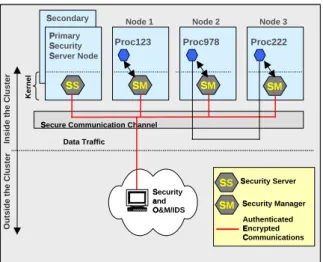
Figure 1: Distributed Architecture of DSI
4.1
Distributed architecture: Inside the
cluster
DSI has two types of components: the manage-ment components and security service components. DSI management components define a thin layer of components that includes a security server, secu-rity managers, and a secusecu-rity communication chan-nel (Figure 1). The service layer is a flexible layer, which can be modified or updated through adding, replacing, or removing services according to the needs of the cluster.
The security server is the central point of manage-ment in DSI, the entry point for secure operation and management, and alarms coming from the in-trusion detection systems from outside the cluster. It is the central security authority for all the secu-rity components in the system. It is responsible for the distributed security policy. It also defines the dynamic security environment of the whole cluster by broadcasting changes in the distributed security policy to all security managers.
Security managers enforce security at each node of the cluster. They are responsible for locally en-forcing changes in the security environment. Se-curity managers only exchange seSe-curity information with the security server. The secure communication channel provides encrypted and authenticated com-munications between the security server and the se-curity managers. All communications between the security server and the outside of the cluster take place through the secure communication channel.
Security Context Repository
Security Context Security Manager
Security Policy Key Repository
Key Management Auditing Service Access Control Service Authentication Service Integrity Service Security Context Repository
Security Context Security Manager
Security Policy Key Repository
Key Management Auditing Service Access Control Service Authentication Service Integrity Service
Figure 2: DSI Services
To avoid a single point of failure, the security ser-vices run on an equally hardened secondary secu-rity server as hot swappable services. These nodes are securehardened versions of Linux distributions to maximize security. All connections from and to these nodes are encrypted and authenticated. The security mechanisms are on widely known, proved, and tested algorithms.
For the security mechanisms to be effective, users must not be able to bypass them. Hence, the best place to enforce security is at the kernel level; all security decisions, when necessary, are implemented at kernel level through DSI Security Module (DSM) [9]. This module is loaded on each node by the security manager upon its initialization.
4.2
Service based approach
The DSI architecture at each node is based on a set of loosely coupled services (Figure 2).
The security manager controls different security ser-vices on the node. This service-based architecture has the following advantages:
• The service implementation is separated from
the rest of the system. By keeping the
same API, the service implementation can be changed without affecting the application. However, an API for accessing security services is provided at user level for applications with special security needs (Section 10.1).
• It runs only predefined services according to the needs, performance issues, or security environ-ment. In addition, services can be replaced on run time without major drawback on the run-ning application. This enables the architecture
to be modified and to resist changes throughout the system’s lifetime.
• It is possible to add, remove, or update dif-ferent services without administrative interven-tion. This reduces configuration errors due to the numerous security patches that need to be applied manually.
The security manager discovers the different ser-vices. Each service, upon its creation, sends a pres-ence announcement to the local security manager, which registers these services and provides their ac-cess mechanisms to the internal modules. There are two types of services: security services (access con-trol, authentication, integration, auditing) and curity service providers that provide services to se-curity managers.
The security management is implemented at all levels of DSI. There is a complete chain of com-mands from security adminstrators (human beings) of the cluster to different DSI components inside each nodes kernel. The adminstartors access the Se-curity Server through the SCC. The SeSe-curity server interprete the commands and propagate them to the Security Managers. Security managers trans-late these to control settings for different security services. For example, security administrator de-tecting a back door on some software used indi-cates that some external IP can not accessed from cluster nodes. This is sent to the Security Server and translated as modification in DSP forbidding all connection to defined IP address. Propagated through SCC to security managers, this policy de-cision is enhanced at DSM level.
5
Security Server
The security server is the reference for all security managers and has the authority to declare a node as compromised. It subscribes to all updates to keep its cache of different security contexts up to date, which makes it the ideal candidate for running In-trusion Detection Systems (IDSs). It has a local cer-tification authority1 (CA). This last issues the
cer-tificates for secondary certification authorities run by the security managers. The primary tasks for se-curity server include auditing, triggering alarms and
1We mean that the CA is used for using inside the cluster.
warnings to inside and outside the cluster, manag-ing the distributed security policy, receivmanag-ing, inter-preting and propagating security management op-erations to security managers.
6
Security Manager
The security manager enforces security on each node. It is primarily a lookup service to register different security services and service providers and connect them together. The security manager is in-stantiated at boot time with digital signatures to make certain that it is not replaced with a mali-cious security manager. Upon its creation, it joins the DSI framework and exchanges keys with the se-curity server. Each sese-curity manager must publish any change to the security contexts of its local enti-ties involved with remote entienti-ties and subscribe to changes in the security contexts of remote, related entities (see Section 8). The primary tasks for se-curity managers include access control, process au-thentication, audit management, alarm publication, key management, as well as maintenance, and up-date of the locally stored distributed security policy.
7
Secure
Communication
Channel
(SCC)
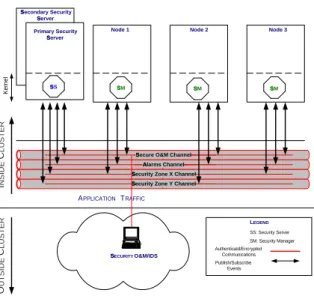
The secure communication channel provides secure communications for the security components inside and outside the cluster. Within the cluster, it pro-vides with authenticated and encrypted communi-cations among security components (Figure 3). It supports priority queuing to send and receive out-of-band alarms. It is coupled to the security manager by an event dispatching mechanism. For large-scale clusters, an event driven approach based on sub-scription to events from defined channels reduces the system load compared to the polling mechanisms. Further more, the benefits of this approach are:
• It does not present a single point of failure. • It gives the possibility of event filtering,
there-fore less bandwidth used, and less time used for treating irrelevant information before discard-ing it.
Secure O&M Channel Alarms Channel
Security Zone Y Channel Security Zone X Channel
APPLICATION TRAFFIC Kernel SS Primary Security Server Node 1 Secondary Security Server I NSIDE C LUSTER O UTSIDE C LUSTER SECURITY O&M/IDS Node 2 Node 3 SM SM SM S un . . . . . . . . . S P A RC 1 0 S un SS: Security Server SM: Security Manager Authenticatd/Encrypted Communications Publish/Subscribe Events LEGEND
Figure 3: SCC is based on an event driven logic and different channels
The secure communication channel provides chan-nels for alarms and warnings, security management, service discovery, and distribution of the security policy. It also provides a portability layer to avoid dependency on the low-level communication mech-anisms.
8
Security Context
For efficiency, a security identifier (SID) is defined as an integer that corresponds to a security con-text. All entities in the cluster have a SID. This SID is added at kernel level and cannot be tam-pered by users. For example, a structure containing SID is added to the structure presenting the process in kernel [9].
We define Cluster SID (CSID) as the pair of SID as-sociated to the subject and the node where the sub-ject belongs to. CSID is transferred across proces-sors by security managers and interpreted through the whole cluster. Once the security context for a subject is needed outside of the local processor (for instance if this process accesses a remote object), its CSID is sent to the security manager of the node containing the object. The CSID propagation inside the cluster is based on SelOpt open source software implementation[8]. To avoid retransmissions, secu-rity managers rely on caching mechanisms.
To ensure the pre-emptive access control, the se-curity manager of the node containing object sub-scribes through SCC to the event of a possible change in the security context of the access initiator entity.
9
A Coherent Vision: Security
Con-texts and the Distributed Security
Policy (DSP)
Security configuration must be kept simple. Follow-ing this approach, DSI relies on a centralized se-curity policy stored and managed on the sese-curity server. However, to maintain the cluster’s scalabil-ity, read-only copies of the policy are pushed from the security server to the individual security man-agers through the SCC. This Distributed Security Policy (DSP) is an explicit set of rules that governs the configurable behavior of DSI. Each node, at se-cure boot time, relies on a minimal security policy that is either stored in flash memory or downloaded along with its digital signature. As soon as the DSP becomes available on a node, it prevails.
DSP allows a configurable behavior for security ser-vices. The DSI administrator (a human being) ma-nipulates the primary copy of the DSP that resides on the security server. Thus, it must be represented
in a human readable format. The basic update
mechanism for DSP is to push a full copy of each new version of the policy through the SCC. How-ever, given the mere size that the policy can take, an incremental update mechanism will be made avail-able.
There can be several possible originating sources for the security policy rules. Manual configuration by the DSI administrator allows the most flexibility, but it rapidly becomes cumbersome. Thus, default policy rules are inferred from the very nature of the various software packages that are installed and run-ning on the system. These default rules codify good security practices. The DSP should only need to be updated because of events such as the installa-tion of new software components, but it should not be updated whenever ordinary recurring events oc-cur. A security session manager handles this kind of events by updating the security context repository. A security context defines privileges associated with each entity. It is defined uniquely through the whole cluster, but it is the responsibility of the security
manager who created it.
10
Access Control Service (ACS)
Access control can be defined as the prevention of unauthorized use of a resource [4]. It relies on the notions of subject (or access request initiator), ob-ject (or target), environment, decision, and enforce-ment. The Access Control Service (ACS) assumes that the subjects have been properly authenticated (see Section 11). DSI allows verifying the access control privileges even when subjects and objects are located on different nodes in the cluster. In or-der to simplify, we handle the access control in two levels: local when subject and object are on the same node and remote when they are on different nodes.
The local access control at each node is based on SID added to the structure in the kernel which, rep-resents each entitiy (e.g. process, socket...). For local access control, the access rights are the func-tions of the security IDs of the subject (SSID) and the object (TSID). They are enhanced through DSI Secure Module, which we implemented??.
10.1
Remote access control
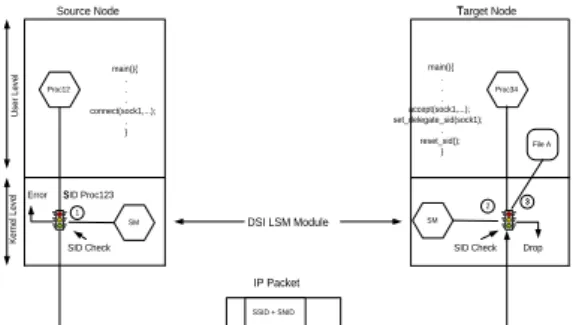
For remote access control, we extend the local access control mechanisms by adding a new parameter: the security node ID. Therefore, the access rights are no more just the functions of the subject and target security IDs, but as well, the function of the security node ID (SNID). The SSID along with the SNID are sent to the node containing the object added to each IP packet as IP options (Figure 4).
A first level of access control based on SSID is done at this level, by the security manager on the source node. This is completely transparent to the process initiating the communication.
The second level of security check is done by the security manager on the target node based on SSID and NSID. This is also transparent to the process receiving the communication. Till this point, the access control decision is transparent. It is granted or denied based on SSID and NSID (i.e. CSID). This level of access control is enough for majority of
the applications.
For applications with needs for finer grained access control, DSI provieds an API allowing to take into account the SSID and NSID when making access decision to resoucre on target node.
We believe that it is not possible to implement an enough flexible and useable fine grained access con-trol based only on platforme. For fine grained secu-rity the application needs to collaborate with the se-curity mechanisms provided by the platforme. The application through DSI API asks to be set a new SID based on the SSID and NSID. Notice that the SSID and SNID are not revealed to the application. The application asks to change the SID based on the communication mechanism. For example, for a server process it means to pass the socket as an ar-gument to DSI API. The security manager sets the new SID for the server process based on the origi-nal SID of the server (TPSID) and SSID and NSID vehiculed by each IP packet.
Therefore the final access control decision is based on SSID, SNID, TPSID, and TSID.
Remark that DSI targets the carrier class platforms, with software environment under tight control with few applicatins running on the cluster. Therefore, even if the support of an additional API for secu-rity is a burden for application developers, we be-lieve that only a small pourcentage of applications need to be modified. As for the majority of applica-tions, transparent support of grant/deny based on SSID and SNID provided by the security managers is enough.
10.2
ACS architecture
The ACS that runs on the cluster’s processors is comprised of two parts:
• A kernel-space part: This part is responsible for implementing both the enforcement and the decision-making tasks of access control. These two responsibilities are separated, as advocated by [3]. The kernel-space part maintains an in-ternal representation of the information upon which it bases its decisions. This part is im-plemented as a Linux Security Module (LSM): DSI Security Module (DSM) [6].
Proc34 Proc12 SM SM SID Proc123 Error SID Check
SID Check Drop
DSI LSM Module main(){ . . . connect(sock1,...); . } main(){ . . . accept(sock1,...); set_delegate_sid(sock1); . reset_sid(); } 1 3 2 File A User Level Kernel Level SSID + SNID IP Packet
Source Node Target Node
Figure 4: Secure Remote access control:
Fol-lowing security checks are done: 1) local check by the security manager (SM), if access agreed the Node ID (SNID) and Process SID (SSID) are added to each IP packet sent to the node 2) Application transparent check by the SM based on SNID and SSID, if access agreed the connection is established 3) For some applications with special security needs, the application can choose to further enhance the se-curity by taking into account the SSID and NSID. To do this, the applciation needs to use DSI API (i.e.;set delegate sid).
• A user-space part: This part has many respon-sibilities. It takes the information from the Dis-tributed Security Policy and from the Security Context Repository, combines them together, and feeds them to the DSM in an easily us-able form. It also takes care of propagating back alarms from the kernel space part to the security manger, which will feed them to the Auditing and Logging Service and if necessary propagate to the security server through SCC.
Both parts are started and monitored by the lo-cal Security Manager (SM). The SM also introduces them to other services and subsystems of the infras-tructure with which they need to interact.
10.3
ACS principles of operation
The ACS aims to provide fine-grained access con-trol (at a sub-system call level). It respects the minimization principles of least privilege to limit the propagation and damage caused by eventual security breaches. As such, it provides defense in
depth. The ACS that is running on a processor
must make as little assumptions as possible about other processors, including whether they have been
compromised. For that reason, an ACS instance
is always the one making access decisions about re-sources that are local to its processor. For the initial design of the ACS, only grant/deny decision will be considered. Other more involved decisions would in-volve rate limiting and total usage limiting. Actions other than access control decision, such as interpo-sition and active reactions, are not implemented ei-ther.
11
Authentication and
communica-tion integrity services
The authentication standard for now is the authen-tication by assertion. It means that the program ac-cessing resources on remote processors asserts that it does this in behalf of a user. Neither the user schema nor the assertion only can be trusted seri-ously in an environment exposed to external attacks. Local authentication in DSI is based on local verifi-cation by the DSM of each subject at node level. The remote authentication of a process is the re-sult of the local authentication of the process at the source node by DSM and the authentication of the node containing the subject to the target node. IPSec is used for authenticating each node inside the cluster.
Developing for carrier class clusters, we have strong constraints on performance. IPSec has the advan-tage of covering both TCP and UDP2. To avoid
ap-plying the same policy to all IP traffic between two nodes (in particular, to avoid encrypting all data be-tween two nodes), three IP addresses corressponding to three different subnetworks are assigned to each node. Each subnetwork defines a security policy: No security, authenticated only (IPSec AH mode), au-thenticated and encrypted (IPSec ESP mode). Fil-tering rules are further more used at netwroks el-ements (switches. . . ) and at network interfaces of each node to enhance further the security rules. The security manager at each node, based on SID of the sending process and the target node ID, and the target SID3according to the DSP transparently
2The necessity of support of efficient security protocol for
UDP is one of the main reasons why we have chosen IPSec.
defines the security policy (e.g. subnetwork) to use: No Security, AH, or ESP.
Integrity and confidentiality of communications be-tween two nodes is supported by use of IPSec ESP mode when necessary.
FreeS/WAN IPSec implementation has been used between nodes[2], however the support for IPSec AH mode is an issue. FreeS/WAN practiceoppurtunistic encryption, which means that ESP mode is used even when AH mode is asked for. somehow in some cases for performance issues, it is though preferable to support AH mode without encryption load. At the end, wqe hope that the support for certificates will integrate the FreeS/WAN and will be not only supported as a patch.
12
Auditing Service
The auditing services are responsible for monitoring and auditing data and reporting security related in-formation. This information may be used for several different purposes: intrusion and denial of service attacks detections, providing evidence in case of lit-igation or inquiries.
Auditing service for each node is responsible for an-alyzing the logs, detect the possible attack patterns, trigger the alarms, and propagate them through SCC. This service is responsible for functionality re-lated to the lawful intercept.
This service has increase functionality on security server. It also monitors the internal network for the cluster and the distributed logs in order to detect at-tacks using Snort IDS [13]. This service on security server is related to external IDS through SCC. The auditing service is connected to external log servers when needed. The connection between the auditing service and external loggers is not through SCC for performance reasons.
The requirements for this service are currently being defined.
node.
13
Related work
This work distinguishes itself by being focused on the design of a security infrastructure targeted for clustered servers as compared to previous work that is focused on single computers or on clusters of general-purpose Linux machines. In addition, DSI takes into account all the issues related to security management starting at the design level. Some of the related work includes CorbaSec, the CORBA security service that handles the security issues re-garding access control and authentication for inter-actions between different objects. CorbaSec does not take into account all aspects of security for ex-ample detection and reaction mechanisms like DSI and guarantees the security at middleware level in-dependantly from platform considerations.
On the other hand, Security Enhanced (SE) Linux from the National Security Agency (NSA) [5] or the Linux Security Module [6] (LSM) effort run on a single computer; they do not extend to a cluster. Finally, Grid Security Infrastructure (GSI) was sub-sequently developed, based on existing standards, to address the security requirements that arise in Grid environments [1]. The DSI approach is more fine-grained and is based on modifying the OS to enhance security mechanism (as explained in Sec-tion 10.1). The approach of DSI is possible because the software and hardware configuration in the clus-ter is under tight control. In practice, DSI supports a coherent vision of security throughout the whole cluster as GSI supports secure interoperable mech-anisms between different trust domains for multiple users.
14
Results
We performed preliminary experiments on a cluster of Linux nodes. The fact that the source code of the Linux kernel is available and well documented is a major advantage for developing DSI on Linux based clusters.
So far, a secure boot mechanism for a diskless Linux system was implemented. Using secure boot with digital signatures, a distributed trusted computing base (DTCB) will be available as of the boot of the cluster nodes. The kernel at secure boot is small
enough to be thoroughly tested for vulnerabilities. Furthermore, the use of digital signatures for bina-ries and a local certification authority will prevent malicious modifications to the DTCB.
We also implemented a security module based on Linux Security Module (LSM) that enforces the se-curity policy as part of the DSI access control service [6]. This module is integrated with SCC and pro-vides distributed access control mechanisms. DSI currently supports pre-emptive and dynamic secu-rity policy at the process level throughout the whole cluster.
At this time, we are implementing the distributed security policy. In order to ease administration and maintenance of this policy, we completed a study to devise methods to reuse information already con-tained in package management systems (such as RPM for Linux) in order to generate part of the security policy, or to push such information to the package [10]. Specification of the exact language used to express the policy and of the compilation and loading mechanisms remains to be completed. We implemented a secure communication channel based on OmniORB, an open-source
implementa-tion of Corba [11]. The implementation of SCC
is independent from the communication middleware used. As mentioned in Section 7, SCC logics are im-plemented on top of a portability layer. This makes the implementation independent of any communi-cation middleware used. The choice of CORBA as communication middleware for SCC was motivated by the following factors:
• Support from CORBA standard and
implemen-tations for distributed real-time and embedded systems.
• Support for advanced security mechanisms by CorbaSec.
• Interoperability.
15
Conclusions and future works
In this paper, we presented the need for a new se-curity approach for carrier-class applications run-ning on Linux clusters. Based on our motivations
to develop a coherent solution addressing the secu-rity needs of carrier-class servers, we proposed a new design for a secure distributed infrastructure. We presented the main elements of this design and dis-cussed some of the preliminary results. We believe that this design is a practical approach to enhance security for large-scale Linux clusters with carrier-class needs.
To complete DSI, we plan to collaborate with Open Source projects and initiatives, and other organiza-tions on the design and development of this secure infrastructure.
Acknowledgements
We thank David Gordon and Dominc Pellerin for their contributions to DSI. Also, we thank Marc Chatel and Bruno Hivert for their sanity checks on our design and implementation.
References
[1] Foster I., Kesselman C., Tsudik G., Tuecke G., A Security Architecture for Computational Grids, 5th ACM Conference on Computer and Communication Security.
[2] http://www.freeswan.org/ .
[3] ISO 10181-3: Security Frameworks for Open Systems: Access Control Framework, ISO, (1996).
[4] ITU-U Recommendation X.800: Security Ar-chitecture for Open Systems Interconnec-tion for CCITT ApplicaInterconnec-tions, ITU-T (then CCITT), (1991).
[5] Loscocco P.: Security-Enhanced Linux, Linux 2.5 Kernel Summit, San Jose (Ca) USA, (2001),
http://www.nsa.gov/selinux/docs.html. [6] Linux Security-Module (LSM) framework,
(2001),http://lsm.immunix.org.
[7] MontaVista Linux Carrier Grade Edition 2.1,
http://www.mvista.com/products/mvl cge/mvlcge overview.html
[8] Morris, J. ”Selopt: Labeled
IPv4 networking for SE Linux”,
[9] M. Zakrzewski, ”Mandatory Access Control for Linux Clustered Servers”, Ottawa Linux Sym-posium 2002.
[10] C. Levert, M. Dagenais, “Security Policy Gen-eration through Package Management”, Ot-tawa Linux Symposium 2002.
[11] OMNI ORB,http://www.uk.research.att.com/omniORB/
[12] Open Source Development Lab,
Carrier-Grade Linux Working Group,
http://www.osdl.org/projects/cgl/