I
Balancing Institutional Needs with Generic
Functionality in Information Systems
The Biography and Evolution of the DHIS 2
Tracker following two implementations in Palestine
Øystein Gammersvik
Master’s thesis at the Department of Informatics
UNIVERSITY OF OSLO
© Øystein Gammersvik 2015
Balancing Institutional Needs with Generic Functionality in Information Systems:
The Biography and Evolution of the DHIS 2 Tracker following two implementations in Palestine Øystein Gammersvik
http:// duo.uio.no
III
Balancing Institutional Needs with Generic
Functionality in Information Systems
The Biography and Evolution of the DHIS 2 Tracker
following two implementations in Palestine
Øystein Gammersvik
V
Abstract
This thesis explores two aspects of the development and implementation of a generic configurational software platform - the localisation or adaptation of such a platform to a specific local context, and the evolutionary developments taking place in such a platform. It further explores how these two aspects mutually influence each other.
The study undertaken as part of this thesis work falls under the umbrella of HISP research. The Health Information Systems Programme (HISP), is a global network of several loosely
connected nodes, working on multiple projects around the world to build, implement, support and improve Health Information Systems (HIS) based a generic software platform, the DHIS 2. This thesis investigates the aspects of adaptation, generic development and their mutual
interplay through a qualitative and pariticipatory case study of two different HISP projects targeting DHIS 2 implementations in the West Bank and Gaza in Palestine. These two
implementation efforts were based on the DHIS 2 Tracker, a module for collecting, analysing and tracking data on individuals over time. In addition to explore the aspects of adaptation and generic development, the thesis provides an historical account of the evolution of the DHIS 2 Tracker module to give a broader view of the software's biography.
The major technical and organisational factors influencing the adaptation of DHIS 2 in Palestine are highlighted. It is further shown how the adaptation of DHIS 2 in Palestine has influenced developments in the generic DHIS 2 platform, partly through generification of functionality originally needed for a specific use case. Lastly it is shown how improvements in the generic platform may accommodate further adaptations through configuration.
VII
Acknowledgements
I would first of all like to thank my supervisors, Lars Kristian Roland and Knut Staring. A special thanks to Johan Ivar Sæbø for invaluable guidance in the last critical stages of the writing process.
Thanks to the great people at HISP UiO, saving the world iteration by iteration, for introducing me to DHIS 2 and the Palestinian projects. A special thanks to Ola for all support, guidance and input in the implementation process. Thanks to all participants, informants and contributors to the projects. A heartfelt thanks to the PPS team in Ramallah and Norway for taking good care of me in the West Bank. Thanks to Ingvild and Mahima for being great dining companions. Thanks to Mike and Ane for being great bar (?) companions. To all fellow '9th graders', thank you for sharing coffee breaks and frustrations, and for all encouragements along the way.
Finally, to my family: Thank you for being there! Cartamundi!
Øystein Gammersvik November 2015
IX
Contents
1 Introduction ... 1 1.1 Motivation ... 1 1.1 Research context ... 2 1.2 Research objectives ... 3 2 Background ... 52.1 Health Information Systems ... 5
2.2 HISP ... 5
2.3 DHIS 2 ... 6
2.4 The birth and evolution of the DHIS 2 Tracker ... 9
2.4.1 Introducing an individual tracking system in DHIS 2 ... 9
2.4.2 Incorporating the DHIS 2 Tracker as an integral DHIS 2 module ... 10
2.4.3 Generifying the DHIS 2 Tracker ... 11
2.5 State of Palestine ... 12
2.6 Palestinian Perineum and birth complication Study ... 14
2.7 harmonized Reproductive Health Registries ... 15
3 Literature review ... 17
3.1 Organisational software ... 17
3.2 Generic software systems ... 18
3.3 Generic systems and configurations ... 19
3.4 Technological progress, innovation and innofusion ... 20
3.5 Generification ... 22
3.5.1 Generification of DHIS ... 23
3.5.2 Open generification: Embedding and disembedding ... 24
3.5.3 Circulating translations and constellation effects ... 24
4 Research approach ... 26 4.1 Research context ... 26 4.1.1 Epistemological stance ... 27 4.1.2 The cases ... 28 4.2 Methodology ... 28 4.3 Data collection ... 30
4.3.1 Participation and participatory observation ... 30
4.3.2 Interviews, discussions and informal talks ... 32
4.3.3 Documents ... 33
4.4 Modes of analysis ... 34
4.5 Reflections on the research approach ... 36
5 Implementing DHIS 2 for the PPS and hRHR cases in Palestine ... 38
5.1 Palestinian Perineum and birth complication Study ... 38
5.1.1 Premise for the DHIS 2 implementation ... 39
5.1.2 Implementation ... 39
5.1.3 Training ... 41
5.1.4 Improving the electronic form and start of data entry ... 43
5.2 harmonized Reproductive Health Registries ... 44
5.2.1 NIPH joining forces with HISP ... 44
5.2.2 First hRHR prototype ... 45
5.2.3 Implementing indicator support as rules ... 46
5.2.4 From prototype to Palestine project ... 48
5.2.5 From indicator rules to program rules ... 50
6 Discussion ... 58
6.1 Adapting the generic DHIS 2 platform to Palestine ... 58
6.1.1 Two implementation approaches: Bottom-up versus top-down? ... 58
6.1.2 Localising configurations by embedding ... 60
6.2 Developments in the DHIS 2 generic core ... 62
6.2.1 PPS – Small improvements through innofusion ... 62
6.2.2 hRHR – New functionality from a generic health model ... 64
6.2.3 Generic development and generification ... 66
6.3 Various influences in the hRHR case ... 67
6.3.1 Constellation effects ... 68
6.3.2 Multifaceted treatment guideline representations ... 69
6.3.3 A coarser view on influence ... 72
7 Conclusion ... 74
7.1 Main factors influencing the adaptation of DHIS 2 in Palestine ... 74
7.2 Adaptation of DHIS 2 in Palestine influencing developments in the generic DHIS 2 platform ... 77
7.3 The mutual influence between localisation and generification ... 78
7.4 Reflections ... 79
7.5 Future work ... 80
References ... 1
XI
List of Figures
Figure 1 - DHIS 2 layers: Core, configurable layer and add-ons (adapted from Roland et
al., forthcoming) ... 8
Figure 2 - Data model for DHIS 2 Tracker (Early Individual Records version) ... 11
Figure 3 - Data model for DHIS 2 Tracker (Generic Tracker/Event Capture version) ... 12
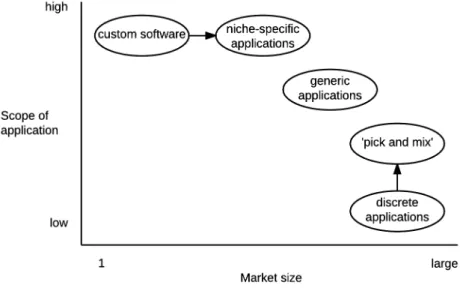
Figure 5 - Volume/variety characteristics of organizational software (from Procter and Williams, 1996) ... 18
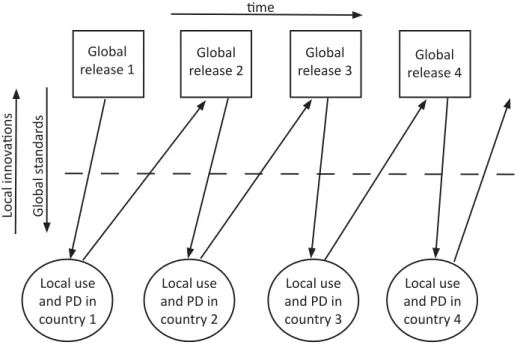
Figure 6 - Evolutionary global toolbox design (source: Titlestad et al., 2009, p. 42) ... 23
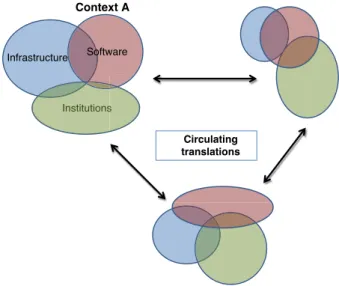
Figure 7 - Circulating translations (Sahay et al., 2013, p. 314) ... 25
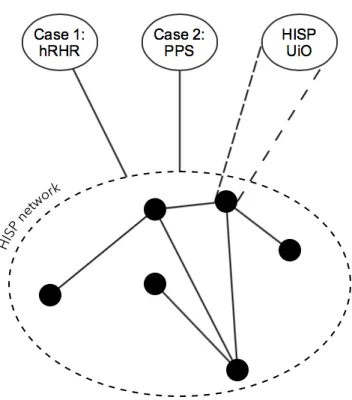
Figure 8 - The HISP network and the investigated cases ... 28
Figure 9 - Training seminar on DHIS 2 data registration in the West Bank ... 42
Figure 10 – On-site training in DHIS 2 data registration ... 43
Figure 11 - Data model for program rules (source: Frost and Bekken, 2015) ... 51
Figure 12 - Globally defined treatment flow chart (source: Frost and Bekken, 2015) ... 53
Figure 13 - Locally adapted treatment flow chart (source: Frost and Bekken, 2015) ... 54
Figure 14 - Particularisation of the generic by forking ... 61
Figure 15 - Managing time-limited particularisation to avoid freezing the particular ... 65
Figure 16 - A generic health model and a generic software platform acting on getting affected by the same implementation ... 73
Table 1 - Timeline and key processes in the development of DHIS 2 (source: Sahay et al.,
2013, pp. 305-306) ... 7
Table 2 - Characteristics for case study, action research and action case compared (Braa and Vidgen, 1999) ... 29
Table 3 - Overview of data sources ... 31
Table 4 - Breakdown of meetings with different groups of people ... 32
Table 5 - Overview of interviews ... 32
Table 6 - PPS project: Timeline of events ... 38
Table 7 - Treatment algorithms organised as rules in an Excel table ... 47
Table 8 - Characteristics highlighting differences between the cases ... 56
Table 9 - Source of requirements in the observed implementations ... 59
Table 10 - Different types of treatment guideline representations ... 70
Table 11 - Treatment guideline representations - Degrees of context coupling tightness ... 71
XIII
List of appendices
Appendix A List of meetings ... 6
Appendix B Excerpts of transcribed developer interview ... 8
Appendix C Thematic breakdown of interview ... 9
Appendix D PPS training seminar: Agenda and exercises ... 10
Appendix E PPS training seminar: DHIS 2 demo notes ... 11
Appendix F Paper form for PPS Study (final version) ... 12
Appendix G Requirements for the NIPH tracker ... 14
XV
Abbreviations
DHIS District Health Information System
FOSS Free and Open Source Software
HISP Health Information Systems Programme
hRHR harmonized Reproductive Health Registries
NIPH Norwegian Institute of Public Health
PMNCH Partnership for Maternal, Newborn & Child Health
PNIPH Palestinian National Institute of Public Health
PPS Palestinian Perineum and Birth Complication Study
RHR Reproductive Health Registries
RMNCH Reproductive, Maternal, Newborn and Child Health
Introduction
1
1
Introduction
This thesis seeks to explore how localisation and generification processes play out in practice in one global open source project, targeting the health sector in several countries across the world, namely the District Health Information System 2 (DHIS 2).
1.1
Motivation
A system, according to the Shorter Oxford English Dictionary, is a “set or assemblage of
things connected, associated, or interdependent, so as to form a complex unity; a whole composed of parts in orderly arrangement according to some scheme or plan; rarely applied to a simple or small assemblage of things” (cited in Fleck, 1993a).
Organisations are complex systems (Morel and Ramanujam, 1999). They often need ways to organise and manage their structure and their data. To organise their structure they usually adopt a hierarchical organisation. Previously, a combination of filing cabinets and the minds of the employees were the solution for managing their data. In today’s computer age, most organisations have introduced computer systems to better manage their data. Computer information systems enable us to organise data and their interconnected relationships, and networked computer systems enable data to be easily shared. As data have become more available, manageable and easier to share, the amount and complexity of data and information systems used in organisations have increased.
When organisations set out to procure new computer-based information systems, they may at the extremes choose to have custom software built specifically to match their needs and particularities, or buying generic off-the shelf systems. The complexity of organisations and their data, combined with organisations’ tendency to evolve themselves, their data and their computer systems, makes it difficult to find ready-made off-the-shelf solutions fitting their exact needs. On the other hand custom systems can be very expensive. Despite organisations’ complexity, complex generic systems have been deployed across a vast range of
organisations. Developing generic systems that work across organisations is however a challenging task.
Scholars in the field of Science and Technology Studies (STS) (also referred to as Science,
Technology and Society) and other fields have investigated how generic systems are made to
work within specific contexts. They have largely focused upon localisation of software, i.e. the process of adapting the software to fit the context, or adapting the organisation to match the software. Pollock and Williams (2009) shifted the focus to rather consider how such systems are built to work across a diverse range of settings. By examining the development and evolution of complex integrated enterprise systems for the educational sector they conceptualised the term generification to refer to strategies employed by software suppliers in order to make generic systems.
1.1
Research context
The empirical basis for this thesis is drawn from two cases, two DHIS 2 implementation efforts for two different contexts in Palestine, plus an inquiry into the HISP team in Oslo responsible for coordinating the different implementation efforts around the world, as well as leading the development of the DHIS 2 software.
HISP was in 2013 approached by two different health projects aiming to implement systems to collect data on individuals in Palestine related to pregnancies and childbirths – The
Palestinian Perineum and birth complication Study (PPS) and the harmonized Reproductive
Health Registries (hRHR) Initiative. The data to be collected had some similarities, but the overall scope and context of the projects were quite distinct. HISP had some previous experiences with implementations based on a DHIS 2 Tracker module for collecting and tracking data on individuals related to pregnancies, but this module was still a relatively new part of the DHIS 2 software. As such, this gave opportunity for HISP to get more experience with tracker implementations, while at the same time establishing contacts in a part of the world where HISP previously has had little experience.
One of these projects was also initiated by a national public health institute, the Norwegian Institute of Public Health (NIPH, 2008), which has a long-term goal of implementing similar systems in several countries around the world, and a larger budget to support this. As HISP partnered up with the NIPH, this allowed more time and dedicated resources to be used on the DHIS 2 Tracker than previously had been the case.
Introduction
3
1.2
Research objectives
In order to implement DHIS 2 based systems in Palestine, the software had to be adapted to meet the envisioned use cases and the workflows of the local users. This process is known as localisation. The foundation for these implementations is the DHIS 2 – a generic software platform that is based on input from many other implementation projects, and which continuously needs to fit with diverse local requirements. Successfully constructing such generic software to fit with a multitude of diverse local requirements is termed generification. This thesis seeks to study the interplay of such localisation and generification processes with the designated research objective:
Exploring the mutual influence between localisation and generification
In order to understand the mutual influence of localisation and generification, it is important to understand how localisation and generification plays out on a more granular level. To investigate this, an in-depth and participatory case study of two DHIS 2 implementation efforts in Palestine has been carried out, thus seeking to explore the overarching research objective through these research questions:
•What are the main factors influencing the adaptation of DHIS2 in Palestine? •How does the adaptation of DHIS 2 in Palestine
1.3
Structure of the thesis
Chapter 1 - Introduction This chapter.
Chapter 2 - Background
Explains central topics and terminologies relevant for understanding the rest of the thesis – HIS, HISP, HISP UiO and DHIS. It further provides some context and background for the study objects investigated through this study: The evolution of the DHIS 2 Tracker and information about Palestine and the two cases.
Chapter 3 - Literature review
Reviews literature and research used as a theoretical background for the thesis covering organisational software, generic software systems, configurational technologies and configurations, innofusion and generification.
Chapter 4 - Research approach
Present the research approach, methodology and methods used for data collection and analysis.
Chapter 5 - Implementing DHIS 2 for the PPS and hRHR cases in Palestine Presents an empirical account of the two investigated implementation efforts. Chapter 6 - Discussion
Provides a broader discussion where the empirical data drawn from the investigated cases are examined and discussed in light of the literature reviewed.
Chapter 7 - Conclusion
Background
5
2
Background
This chapter aims to explain some central topics and terminologies relevant for understanding the rest of the thesis: The landscape of Health Information Systems (HIS), the Health
Information Systems Programme (HISP), the HISP team at the University of Oslo (HISP UiO) and the DHIS (District Health Information System). It further provides some context and background for the study objects investigated through this study, covering the evolution of the DHIS 2 Tracker, some general information about Palestine and some more specific background and context of the two cases in Palestine.
2.1
Health Information Systems
The type of information system considered in this study falls into the category of Health Information Systems (HIS), which covers all systems dealing with health information. There are a vast number of different categories of health information systems with different
terminologies, which may also have different meanings to different people (Braa and Sahay, 2012, Waegemann, 2003, Afzal et al., 2011). Two broad categories however are, systems dealing with aggregate data for decision-making and management, commonly referred to as Health Management Information Systems (HMIS), and systems handling data records on individuals, referred to as e.g. Electronic Medical Records (EMR), Electronic Health Records (EHR) and Personal Health Records (PHR) (Afzal et al., 2011, Waegemann, 2003).
2.2
HISP
HISP, an acronym for the Health Information Systems Programme, is a global network of several loosely connected nodes, working on multiple projects across the world to build, implement, support and improve Health Information Systems (HISP UiO, 2015c, Braa et al., 2004). The network is coordinated from the University of Oslo, where it all started in 1994 as an action research project targeting the health system in post-apartheid South Africa, using a participatory design approach. Central to this first project was the development of the DHIS (District Health Information System) software.
Following the success of the initial HIS implementation in South Africa, HISP gradually evolved from a more traditional action research project into a more network based action research project, dubbed “Networks of Action” (Braa et al., 2004), and can today, as (Braa
and Sahay, 2013, p. 236) describes it, be seen as a “global research, development and action
network”.
Such a network-based approach contrasts with a more hierarchical organisation, which is reflected by the coordinating body, the HISP team at the University of Oslo (HISP UiO), which coordinates and supports rather than direct and control, HIS implementations. Internally as well, HISP UiO has historically been a small team with a flat organisation and not very well defined roles. Stemming from the rapid growth in the last years in the number of implementations, users and user organisations connected to the HISP network, HISP UiO has now more clearly defined and formalised its project organisation and areas of focus in a strategy document (HISP UiO, 2014). The strategy document outlines the structure and focus areas of the HISP UiO Management Group:
”HISP UiO is governed by a management group located at the University of Oslo. This group has monthly meetings and has the following participants: Project manager, senior academic staff, country implementation coordinator, technology coordinator, partner coordinator, open source community manager and secretary. The overall aim of the HISP management group is to secure a sustainable DHIS 2 core by proactively handling changing demands. The mandate of the management group covers 5 areas to focus on: DHIS 2 Software Development; Implementation Activities by HISP UiO Employees; Implementation Sub-contracting; Interaction with Partners; and Coordination of DHIS 2 related research.”
– HISP UiO (2014, p. 8)
2.3
DHIS 2
The DHIS 2 is a free and open source software platform, developed over 20 years, consisting of several different modules, which can be selected and combined to form systems for data collection and management. Although it is primarily used for implementing Health
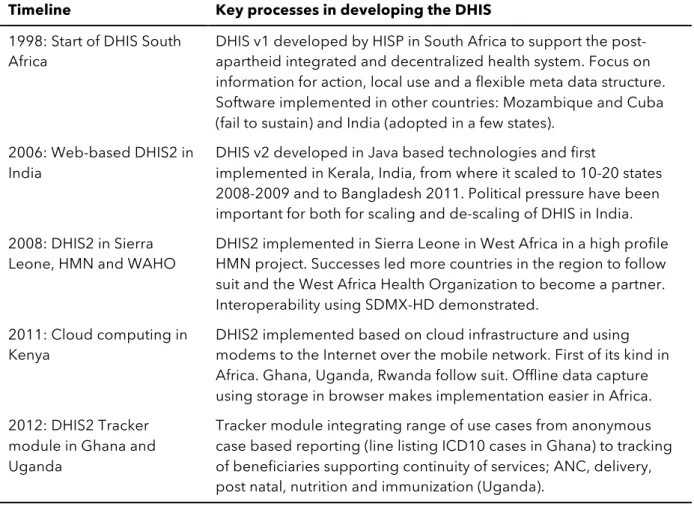
Information Systems, it has a flexible metadata data model, which can be configured through the user interface to manage (almost) any type of data. Table 1 below (from Sahay et al., 2013, pp. 305-306) outlines key points and processes in the evolution of the DHIS from its
Background
7 initial release as an offline MS Access based desktop application in South Africa, to the full-blown configurable DHIS 2 software platform in use today.
Table 1 - Timeline and key processes in the development of DHIS 2 (source: Sahay et al., 2013, pp. 305-306)
Timeline Key processes in developing the DHIS
1998: Start of DHIS South
Africa DHIS v1 developed by HISP in South Africa to support the post-apartheid integrated and decentralized health system. Focus on information for action, local use and a flexible meta data structure. Software implemented in other countries: Mozambique and Cuba (fail to sustain) and India (adopted in a few states).
2006: Web-based DHIS2 in
India DHIS v2 developed in Java based technologies and first implemented in Kerala, India, from where it scaled to 10-20 states 2008-2009 and to Bangladesh 2011. Political pressure have been important for both for scaling and de-scaling of DHIS in India. 2008: DHIS2 in Sierra
Leone, HMN and WAHO DHIS2 implemented in Sierra Leone in West Africa in a high profile HMN project. Successes led more countries in the region to follow suit and the West Africa Health Organization to become a partner. Interoperability using SDMX-HD demonstrated.
2011: Cloud computing in
Kenya DHIS2 implemented based on cloud infrastructure and using modems to the Internet over the mobile network. First of its kind in Africa. Ghana, Uganda, Rwanda follow suit. Offline data capture using storage in browser makes implementation easier in Africa. 2012: DHIS2 Tracker
module in Ghana and Uganda
Tracker module integrating range of use cases from anonymous case based reporting (line listing ICD10 cases in Ghana) to tracking of beneficiaries supporting continuity of services; ANC, delivery, post natal, nutrition and immunization (Uganda).
From its inception to the present, the main focus with DHIS has primarily been to support the management of routinely collected aggregate health data to be used for decision-making, with a focus on statistics. In the initial years, the design and development followed trajectories largely relying upon participatory design approaches, influenced in part by political motives of empowerment. One guiding principle was that the data collected should be used for decision making at the level where it was collected. In South Africa, this was the health districts (which influenced the name of the software as well – the District Health Information System). See Braa and Hedberg (2002) for an in-depth presentation of the initial case in South Africa.
While the development in the initial years was very much a collaborative effort within the HISP network, with developers travelling and users participating, when the development of the second version was initiated, this was mainly done at the University of Oslo. The DHIS 2
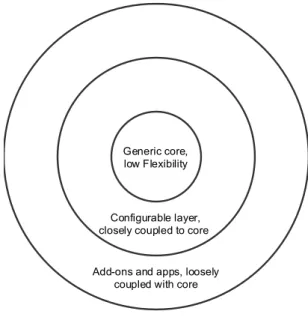
was built as a web application using open source Java technologies. The data model and functionalities from the initial version were to a large extent replicated in DHIS 2, but this time using a more modular architecture. Figure 1 below (adapted from Roland et al.,
forthcoming) shows a very rough overview of a layered architecture in use today, the layers representing different levels of flexibility in terms of facilitating user adaptations or
modifications.
Figure 1 - DHIS 2 layers: Core, configurable layer and add-ons (adapted from Roland et al., forthcoming)
Seen from the side of the DHIS 2 platform, the generic core or DHIS 2 core is where the most basic building blocks of the software reside, including the data model, business logic and a web API. The configurable layer consists of functionality for populating the metadata structure with implementation specific metadata, including the user interfaces supporting this configuration work. Add-ons and apps is where users may define their own components communicating with the system via the API, either as apps integrated and hosted with the DHIS 2 platform, or as standalone applications or systems communicating with a DHIS 2 environment. The user interfaces included with the DHIS 2 platform for operating the system, can be said to be part of the generic core, although there currently is an on-going process of re-making these integral interfaces as more loosely coupled apps.
The DHIS 2 platform is developed by the HISP network, with a core base of developers located at HISP UiO doing much of the development, but also coordinating developers around the world. DHIS 2 is currently implemented in 47 countries (HISP UiO, 2015b).
Add-ons and apps, loosely coupled with core Configurable layer, closely coupled to core
Generic core, low Flexibility
Background
9
2.4
The birth and evolution of the DHIS 2 Tracker
This section gives an overview of the common historical backdrop for the two cases in Palestine – the evolution of the DHIS 2 Tracker module in DHIS 2.
2.4.1
Introducing an individual tracking system in DHIS 2
Following the release of DHIS 2, there were several discussions on how the system should be further developed to accommodate existing and emerging user needs, while continuing to be relevant for the existing user base. A logical trajectory for further development was to go beyond the notion of routinely collected aggregated data, and somehow connect this aggregate data with data on the individuals constituting the aggregates.
In parallel with the rebirth of DHIS as DHIS 2, another Open Source health information
system targeting developing countries saw the light of day. OpenMRS1 is an Electronic
Medical Record (EMR) system in development since 2004. This project shares many
similarities with the DHIS 2 in terms of visions, principles, processes and technologies used. A possible solution for connecting the aggregate data in DHIS 2 with data on individuals, were seen to be a tight or full integration of OpenMRS with DHIS 2. This was heavily discussed in the HISP team and in several DHIS 2 implementation projects. Over the years, there have even been several implementation efforts to integrate OpenMRS with DHIS 2 (see for example Braa et al., 2010, Adetuwo, 2013). It was however decided not to pursue a full integration for the global software, but rather make a new system closely connected to DHIS 2 for managing individual records.
The main reason for not going down the integration path was that the OpenMRS and other EMR systems didn’t have the wanted functionalities. EMR systems are more focused on clinical consultations and recording diagnosis during consultations, while HISP were looking for a simpler approach for registering events with key data, tracking them over time and space through a health program, and aggregating the data. Another reason was that existing EMRs primarily were targeting hospitals with a notion of patients, doctors and diagnosis, while many of the DHIS 2 implementations were targeting rural areas often managed by community health workers (Gizaw, 2011). In addition, it was considered that it would be more difficult for the users to handle two different user-interfaces and user-experiences.
As such, a new system for managing individual records was initiated by HISP in 2008. The Name Based Information Tracking System (NBITS) was initiated as a result of a need to improve data quality and timeliness of aggregate reporting in India, by connecting the aggregates with name-based information on individuals (Gizaw, 2011). In addition, during design and prototyping of the new system, there were also discovered other desirable features such a system could incorporate, like scheduling of appointments and due dates for
consultations or events.
The initial data-model for NBITS was designed by analysing requirements from India and
incorporated a program-stage-model, i.e. a model based on the notion that an individual may
have several visits or encounters (stages) during a progress through a larger health program (Gizaw, 2011). For instance, during pregnancy care, a woman may have several visits leading up to the birth, and later some check-ups after the birth. Although the data-model was based on requirements from India, HISP made an effort to make it generic so it could be used in other contexts as well. The look and feel of NBITS was designed to be similar to the one in DHIS, and an import/export component was developed to facilitate data exchange with other systems, such as aggregating data for DHIS 2.
2.4.2
Incorporating the DHIS 2 Tracker as an integral DHIS 2 module
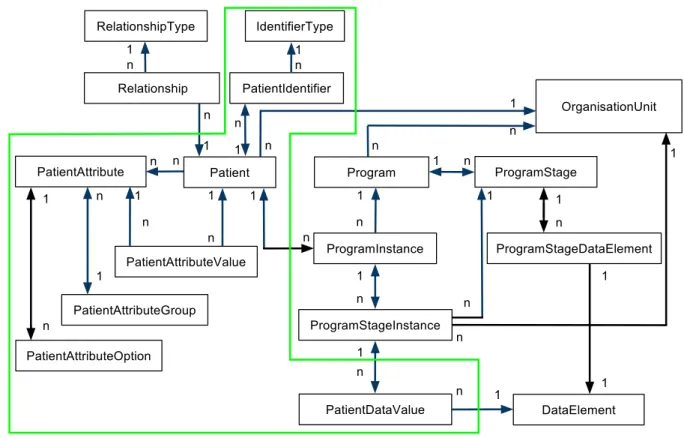
Following the development of the standalone NBITS system, a new integral DHIS 2 module for tracking individuals was made based on the earlier implementation in India (Sahay et al., 2013). This module evolved through implementation efforts in Uganda and Ghana starting 2011-2012, where requirements were gathered by travelling HISP facilitators. Much functionality was accumulated from requirements in Uganda. Figure 2 shows a snapshot of the data model for the DHIS 2 Tracker somewhere along its development life cycle. The green border encapsulates all classes directly related to the concept of a ‘Patient’, which was the name for the individual entities that could be tracked in the system. The ‘Program’ and ‘ProgramStage’ classes can also be seen, showing the ancestry from the original program-stage-model originating from NBITS in India. The initial DHIS 2 Tracker module was named ‘Individual Records’.
Background
11
Figure 2 - Data model for DHIS 2 Tracker (Early Individual Records version)
2.4.3
Generifying the DHIS 2 Tracker
Following the initial release of the Individual Records module, several countries
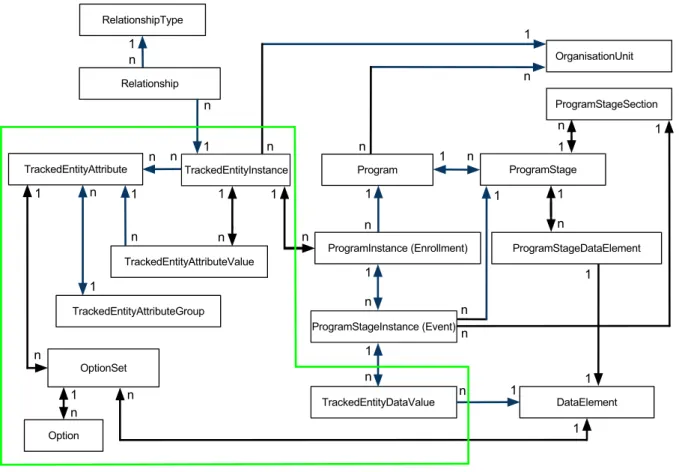
implemented DHIS 2 based tracking systems. As the initial DHIS 2 Tracker was to a large extent based on accumulated requirements for some specific use cases, it didn’t match every new use case as the user base grew. Some countries had a need to track other things than patients or even persons and tweaked the tracker to allow the tracking of for instance lab samples. The core DHIS 2 development team started a process to make the DHIS 2 Tracker more generic. The 2.15 release of DHIS 2 (2014) included a new tracking module called ‘Event Capture’ for capturing anonymous single events, dissociated from any identifiable entities. This release also included a change in the underlying metadata model, allowing other entities than persons to be tracked. Figure 3 shows the new data model for this version, with the classes inside the green border reflecting the changes from ‘Patient’ to ‘Tracked entities’. Yet another tracking module named ‘Tracker Capture’ was released with version 2.16 of DHIS 2 (2015). The new Event and Tracker Capture modules were built with a more modular architecture on top of the web API.
Figure 3 - Data model for DHIS 2 Tracker (Generic Tracker/Event Capture version)
As the DHIS 2 Tracker is more novel and has seen less extensive use than the routine data capture part of DHIS 2, it not yet as mature and stabilised.
2.5
State of Palestine
When we hear about Palestine in the media, it’s often about acts of violence or other events related to the Israeli-Palestinian conflict, which is not strange considering the long history of the conflict. It is close to impossible to give an overview of Palestine without touching upon at least some of the historical events that have shaped what Palestine looks like today. After the end of a period of increased Israeli-Palestinian conflict between 2000 and 2005, the following years were dominated by tensions and conflict between the two major Palestinian political factions, Fatah and Hamas, resulting in a political deadlock and the takeover of the Gaza Strip by Hamas in 2007 (Giacaman et al., 2009). As a consequence of this internal Palestinian political struggle, the Palestinian territory has been politically as well as
Background
13 In 1994, shortly following a resolution
agreement between Israel and Palestine known as the Oslo I Accord, the newly established self-governing body, the Palestinian National Authority (PNA) established a Ministry of Health to administer health care in the West Bank and Gaza (ibid.). However, because of the geographical as well as the political divide between Fatah and Hamas, as of 2007, PNA de facto no longer has control of Gaza, resulting in a situation where there are two ministries of health today; One Ministry of Health of the State of
Palestine, and another Ministry of Health of the Gaza Strip.
After the United Nations General Assembly (2012) passed resolution 67/19 on 29 November 2012, upgrading Palestine from ‘observer status’ to a ‘non-member observer State’ within the United Nations system, UN now uses the designation ‘State of Palestine’ in official
documents. There are 4.7 million people (estimate2) living in the Palestinian territory today. The last major escalation of the Israeli-Palestinian conflict occurred between 7 July and 26 August, when the people in Gaza faced the worst intensification of hostilities since the Israeli occupation in 1967 (United Nations OCHA oPt, 2015). During this conflict, 2,200
Palestinians were killed, 11,231 were injured, 18,000 housing units were destroyed or severely damaged and 62 hospitals and clinics were damaged, resulting in a significant deterioration of the humanitarian situation.
Health profile
The health status in Palestine is comparable to its neighbouring countries excluding Israel (oPt HNC, 2011). Estimates of life expectancy at birth have stalled at around 72-73 years (WHO EMRO, 2014), with life expectancy in 2014 being 73.2 years (MOH, 2015). Mortality
2 Palestinian Central Bureau of Statistics (2015a)
indicators have had continuous improvement even the last decade, with the infant mortality rate being 18.2 deaths per 1000 live births in 2014 compared with 20.8 deaths per 1000 in 2005, and under-five mortality rate being 21.7 deaths per 1000 in 2014 compared with 24.6 per 1000 in 2005 (Palestinian Central Bureau of Statistics, 2015b, WHO, 2015b). Similarly, the maternal mortality ratio showed a decrease from 37.3 deaths per 100 000 live births in 2000 to 32.0 in 2010 (WHO EMRO, 2014), although according to UNFPA (2015), maternal mortality rates were estimated to nearly have doubled in Gaza during the 12 months from July 2014 to July 2015. While communicable diseases of childhood have been largely controlled with effective immunisation programmes, indicators relating to childhood malnutrition, conflict-related injuries and chronic diseases and have worsened to an extent that non-communicable diseases have overtaken communicable diseases as the main causes of morbidity and mortality (WHO EMRO, 2014). Giacaman et al. (2009) also emphasize that life quality in Palestine has proved to be worse than in almost every other country and that mental disorders, psychological distress and fear are highly prevalent. Adding to that, most publications addressing the health situation in Palestine stress the fact that access to health services is restricted or limited, especially for the population in Gaza and certain areas in the West Bank (see for example: Giacaman et al., 2009, WHO, 2015b, WHO EMRO, 2014, oPt HNC, 2011).
2.6
Palestinian Perineum and birth complication Study
During childbirth, perineal injuries or tears are common. Such tears may be painful, and may also have more long-term negative effects on women’s quality of life. The more severe cases of perineal tears are called obstetric anal sphincter injuries (OASIS). Clinical intervention studies in Norway have shown that the incidence of OASIS for women during childbirth has been reduced by 40-70%, by improving the use of a manual hands-on support technique (Hals et al., 2010, Laine et al., 2008, Laine et al., 2012, Laine et al., 2013).
The Palestinian Perineum and Birth Complication Study (PPS), aims to reduce the incidence of perineal tears in Palestine by using the same support technique (Oslo University Hospital et al., 2015, Vikanes et al., 2013). The technique will be taught to health personnel using two methods: by an animated training video and by hands-on training by professionals. A
multicenter intervention study will explore if there are differences in the outcomes of the two methods, and if the attitudes of the health personnel towards the different methods affect the
Background
15 outcome. In total six hospitals have been chosen as participants for the study, three in Gaza and three in the West Bank. During the PPS study, data will be collected in several phases. At first baseline data will be collected before training is provided. Then there will be two
additional data collection periods, after each of the training methods are provided. In addition to data on perineal tears, there will also be collected other data related to the pregnancies and childbirths.
Following each childbirth data will be registered in a paper form of two pages. Researchers affiliated with the PPS study were in need of a computer system to store data from the paper forms, in order to do computer analysis of the registered data. For this, they approached HISP UiO requesting assistance in implementing such a system. An account of this implementation process will be presented in section 5.1.
2.7
harmonized
Reproductive Health Registries
In 2000, a UN initiative established a set of eight international development goals called the Millennium Development Goals (MDGs) (United Nations, 2015) to be reached by 2015. Two of these goals target maternal and child health; MDG number 4 aims to reduce child mortality and MDG 5 aims to improve maternal health. The Millennium Development Goals Report 2014 (United Nations, 2014, p. 5) states that “child mortality has been almost halved, but more progress is needed” and that “much more needs to be done to reduce maternal mortality”.
As stated in the same report, lack of data is hampering the required policymaking needed to
accomplish the MDGs because “sustainable data are needed for sustainable development”
(United Nations, 2014, p. 7).
The harmonized Reproductive Health Registries (hRHR) Initiative is “a global initiative to improve maternal and child health data” (NIPH, 2013a). It is a collaboration between the Norwegian Institute of Public Health (NIPH) and the World Health Organization (WHO). The means for improving health data is to facilitate for countries to develop Reproductive Health Registries (RHR) or eRegistries (NIPH, 2013b). The eRegistries should provide care providers with a clinical support tool to use when seeing patients. A patient registry should be built up from data entered into the tool. Information should be made available for managers and policymakers to improve quality of care.
The hRHR Initiative is based on the Essential Interventions, Commodities and Guidelines for Reproductive, Maternal, Newborn and Child Health (RMNCH) published by The Partnership for Maternal, Newborn & Child Health (PMNCH) (2011). PMNCH is hosted by the WHO, who also partnered with PMNCH in the publication. A set of indicators was developed associated with each of these interventions together with the Mater Centre for Translating Research into Practice (TRIP Centre, 2014) in Australia. The indicators also define a set of data points needed to calculate the indicators (Wojcieszek et al., 2013).
The hRHR Initiative, through the NIPH, approached HISP UiO, exploring the possibility for
using DHIS 2 as a foundation implementing the eRegistries. A detailed account of this implementation process will be presented in section 5.2.
Literature review
17
3
Literature review
3.1
Organisational software
The complexity of organisations and their data, combined with organisations’ tendency to evolve themselves, their data and their computer systems, makes it a challenging task to develop generic software that work across organisations.
Greatest success in the design of organisational software has been with discrete applications supporting well-defined activities (Procter and Williams, 1996). The initial application of IT in organisations was low-level tools to simplify and routinize clerical work. Generic
computer-based tools were introduced where stable sets of tasks could be generalised across different organisations (e.g. payrolls, accounting, spreadsheets, word-processors) (Procter and Williams, 1996).
As routine activities became automated, development of organisational software shifted towards more complex integrated systems for information sharing, communication, planning and decision-support (Procter and Williams, 1996). Such systems need to be more tightly knit to the context and particularities of the organisations they support. Consequently there has been a tendency for developing custom software for such systems.
Despite this tendency, there have also been examples of integrated systems being deployed across organisations. In the 1990s some suppliers managed to sell-on custom-built solutions for the financial sector as niche-specific applications to other organisations with broadly similar context and activities (Pollock and Williams, 2009). In the manufacturing industry, integrated systems have a long history (Fleck, 1994, Fleck et al., 1990, Jacobs and Weston, 2007). The rationale for these systems is to manage the production process. Materials Requirements Planning (MRP I for short) systems usually cover inventory management and materials control, while the wider Manufacturing Resource Planning (MRP II for short) goes beyond the production process itself to cover software modules for planning, scheduling, sales order processing etc. The ultimate goal for these systems is Computer-Integrated Manufacture (CIM). The UK Department of Trade and Industry coined the term Computer-Aided Production Management (CAPM) in the 1980s to promote the development of these types of systems (Fleck et al., 1990). This term however, did not gain much momentum. It
was superseded by the term Enterprise Resource Planning (ERP) that was proposed by the Gartner Group in the early 1990s (Jacobs and Weston, 2007). This term was introduced to refer to integrated enterprise systems, targeting whole enterprises, not exclusively in the manufacturing industry. Today, ERP systems are in use in a range of different types of organisations. As Pollock et al. (2007) put it:
”[ERP systems] appear oblivious to the form, function, culture or even geography of organizations. Such has been their ability to transcend their place of production that they are now described as 'generic' or even 'global' solutions.”
3.2
Generic software systems
Generic software systems differ from specialised custom or bespoke systems in that they have a broader applicability across a range of users. Figure 5 (from Procter and Williams, 1996) shows the volume/variety characteristics of organisational software arranged by their scope and market size.
Figure 5 - Volume/variety characteristics of organizational software (from Procter and Williams, 1996)
If we look at the entire software ecosystem, we can see generic discrete applications supporting well-defined activities at the one end, and custom systems at the other. For the users, custom systems might have a better fit with their context and particularities, but
Literature review
19 between the best possible organisational fit on the one hand, and on the other hand reducing their costs.
For software suppliers, initial research and development of novel technologies (especially of complex integrated systems) have a high cost in terms of time investment and risks. Once the software is designed, developed and matured however, recycling or reusing source code is cheap. If suppliers are able to successfully deploy their products to other markets, they can increase their revenue significantly. This can be achieved by pursuing to sell-on custom systems as niche-specific solutions to similar organisations, or by offering generic systems that are adapted to fit the organisation’s particularities (Procter and Williams, 1996, Williams et al., 2005). Another strategy is to offer generic systems as configurational technologies
(Fleck, 1993a)where users can ‘pick and mix’ a working configuration from more or less
standard components, with the possibility of combining with custom components (Williams et al., 2005). Such a configuration of standard components offers a cheaper solution than custom systems.
3.3
Generic systems and configurations
Fleck (1993a) characterizes generic systems and configurations and distinguishes between them. The dictionary tells us that a configuration is an “arrangement of parts in a particular form or figure” (Oxford English Dictionary). This definition is somewhat looser or less systematic than that of a system. Fleck states that:
”Configurations comprise assemblies of technological and nontechnological components, including human factors, built up to meet local contingencies”
Fleck states that a configuration is in fact a system; in the sense that any associated elements standing in interaction is a system. He argues however, that configurations can be thought of as a special subset of system, distinguished from another type of system: a generic system. Fleck characterizes generic systems as having:
(a)Generic identity, that is, an identity across instances;
(b)Systematicity, that is, an underlying coherence which governs how components relate and are integrated; and
(c)A system dynamic, that is, an inherent logic which strongly structures development over time.
Generic identity is characterized by the system incorporating explicit standards in terms of functionality and performance, and by the existence of a market for the generic system. The generic identity may be associated with an underlying systematicity, relating to the existence of standard components and a standard way of building the system from the components. With the existence of generic identity, further development of the generic system must adhere to the existing systems’ functionality and performance. Therefore, a system dynamic guides the further development along natural trajectories where incremental improvements can be made within a stable set of defined parameters, without altering the operating functionality. In contrast, Fleck argues, configurations don’t have these characteristics. He emphasises configurations’ need to conform to the particularities of the users at the place and time of application. To match the particular contingencies of the users, components (both
technological and non-technological) can be combined in a wide (if not arbitrary) range of combinations. As such, there is no clear generic identity between configurations. This also parallels the lack of a system dynamic directing the development, which makes
configurations more prone to changes over time. Without a system dynamic, and because the users’ needs are difficult to fully predict in advance and may also vary over time, this opens up for innovations at the point of application, i.e. in the configuration itself.
Fleck argues that the differentiation between generic systems and configurations are a matter of degree. The degree of maturity and stability has implications for the existence of generic identity, systematicity and a system dynamic. Sometimes configurations and generic systems may form a superpattern where an initial configuration eventually may give rise to a generic system, once requirements have stabilized and some commonality have been identified for which there is a market. In other cases configurations and generic systems may be aligned as distinct phases in a development process and form a life-cycle superpattern, where
configurations represent the early stages of a larger life cycle, and a generic system represents the later stages when knowledge and requirements have become stabilized.
3.4
Technological progress, innovation and innofusion
Traditional deterministic views of technological progress, assumed that technological
innovation was inevitable, and would emerge in correspondence to market needs (Williams et al., 2005). According to these views, technological innovations could then simply be diffused
Literature review
21 into areas of application. These traditional views however, were not well equipped to match the experiences of technological change, which were increasingly seen as problematic, in at least two ways. Firstly, technology was often experienced to lead to unintended or
undesirable consequences. Secondly, it was increasingly recognized that successful
technological innovations were difficult to achieve by just applying technological knowledge to existing or emerging demands.
“Technology, of itself, has no power, does nothing. Only in association with human agency and under determinate conditions of operation, does technology act on the world”
– Fleck (1993a, p. 15) Various authors (see for example Pinch and Bijker, 1984, Wild, 2002) have recognized that organised combinations of technology and people are appropriate units of analysis for designing, developing and understanding technology, technological innovations and technological operation.
Scholars in the field of Science, Technology and Society (STS) (also known as Science and Technology Studies) and other fields have developed various models to describe
technological innovation. The traditional linear model corresponds with the traditional deterministic view that technological innovations could simply be diffused from suppliers to users. The linear model has been widely criticised for its simplicity and lack of fit with the more complex reality 3. It was experienced that successful technological innovation was difficult to achieve and that technology in many cases could not simply be diffused into areas of use. In many situations users had to either adapt the technology to fit their needs or to undergo (often unwanted) organisational change to align the organisation with the technology.
The importance of user contribution to the innovation process has been increasingly recognized and various more elaborate models take this into account. Fleck (1990, 1993a, 1993b, 1994) conceptualised the term innofusion (the collapsed process of innovation and diffusion) to emphasise that technological innovation doesn’t end with research, design and development, but continues through implementation and use at the point of application.
3 Critique of the linear model has also been criticised for addressing a model that
was never intended to represent an analytical tool, but rather just a simplistic view of more elaborate innovation models (Edgerton, 2004).
Hence, through innofusion, innovation happens through internal learning processes involving a range of actors, users as well as implementers and suppliers. Fleck emphasises that
innofusion is central to the shaping of configurations. Fleck (1993a) also characterises innofusion as a form of evolution, one in which mutation and selection is collapsed together such that new characteristics can be developed by recombining components in a
configuration in direct response to user needs and then directly transmitted to succeeding generations. This contrasts with a Darwinian form of evolution where selection happens through a selection environment, separate from a mutation stage. In case of technical systems, the Darwinian selection environment typically is the marketplace, where users choose whether or not to adopt certain technological innovations.
3.5
Generification
Generification is a concept developed by Pollock et al. (2003), drawing attention to how software is built to work across multiple contexts. Pollock and Williams (2009) notes how scholars in STS and Information Systems (IS) research have largely focused on challenges with appropriation, integration and diffusion of technology in organisations, and various localisation efforts involved in bridging the gap between supplier offerings and user needs. Such localisation efforts imply processes of adapting technological artefacts to match the area of application and/or aligning the organisation to fit with workflows imposed by the
technological artefacts. Scholars in STS and IS research, they claim, have noted that apart from the most simple artefacts, organisational information systems become tightly coupled with the particularities of 'time and place' for which they are produced, and that such particularisation implies that organisational information systems cannot travel across contexts.
Through a long-term research project studying several ERP suppliers, including the large
software company SAP, Pollock et al. (2003, p. 318) conceptualised the term generification
as “the supplier strategy of taking a technology that has worked in one place and attempting to make it work elsewhere, and, in principle, ‘everywhere’”. They show that creating generic systems takes a delicate effort involving various generification strategies in which users and suppliers strive towards the common resolution of bridging the particular and the generic.
Literature review
23
“As a result of this generification work, software packages can circulate and user communities can grow; that is to say, diverse organizations and standard technologies can be brought together.”
– Pollock et al. (2007, p. 275)
3.5.1
Generification of DHIS
The DHIS software has similarly displayed the ability to circulate amongst diverse contexts, and expanding DHIS developer, implementer and user communities continue to grow as the software is adopted by an increasing number of countries and organisations. Several authors have explored the nature of scalability and sustainability of the DHIS, focusing on different aspects.
Titlestad et al. (2009) have explored the changing nature of participatory design (PD) in the development of DHIS from its inception and onward towards more distributed
implementation and design processes. They use the term shared or global toolbox to refer to technological and non-technological components being circulated amongst the various DHIS implementations; software as well as practices, documentation and training material.
Complementing the notion of a global toolbox, they describe an evolutionary process (Figure
6) for how this toolbox has evolved through multiple “cycles of innofusion where the global
and local mutually influence each other” (Titlestad et al., 2009, p. 42).
Figure 6 - Evolutionary global toolbox design (source: Titlestad et al., 2009, p. 42)
Global
release 1 release 2Global release 3Global release 4Global
Local use and PD in country 1 Local use and PD in country 2 Local use and PD in country 3 Local use and PD in country 4 Loc al innov a ons me Global st andar ds
This evolutionary process represents an iterative generification process where the generic software evolves through multiple successive local innovations at the point of application.
3.5.2
Open generification: Embedding and disembedding
Gizaw (2014) builds further upon this evolutionary view on DHIS and introduces the notion of open generification as a framework for building software serving diverse local
requirements. The notion of open generification draws attention to the open and collaborative nature of open source software development, where changes or innovations might just as well occur outside the control of a software supplier, as under the supplier's control.
Central to this framework is the mechanisms of embedding and disembedding. Embedding is the process of fitting or aligning the software to the context of use. This can in the context of DHIS 2 be achieved through utilising the software's configurability or further customising the software through local innovations. Disembedding is the reversed process where contextual contingencies are disembedded from a particular configuration with the goal of creating a generic software package generified to accommodate diverse user needs.
3.5.3
Circulating translations and constellation effects
Sahay et al. (2013) conceptualised a model called “circulating translations” (Figure 7 below) to describe global scaling of Health Information Systems (HIS), focusing on how three different dimensions of an information system (software, institutions and hardware) influence each other within and across contexts. The model distinguishes between two different levels of influence: interaction effects between the three dimensions within the same context and, constellation effects between dimensions across contexts.
Literature review
25
Figure 7 - Circulating translations (Sahay et al., 2013, p. 314)
Sahay et al. (2013) emphasise with the circulation translations how artefacts changes over time through many small steps of translations, where the three dimensions mutually influence each other. At each step of translation, there may be occurrences of loss and gain as the artefacts circulate – each move forward may leave something behind.
An important point to note is that the circulating translations model points to circulation of non-technological components as well as software components, similarly to the global toolbox described by Titlestad et al. (2009).
Circulating translations Institutions Software Context A Infrastructure Institutionss
4
Research approach
This chapter presents the research approach used for data collection and analysis during this study. A brief overview of the research approach and the investigated cases is first presented, to give an overview of the research context, which also has influenced the choice of methods. This section is followed by a more detailed presentation of the methodology and methods used.
4.1
Research context
This study falls under the umbrella of HISP research. From its inception 20 years ago, most research within the HISP network has followed a participatory action research approach, with the HISP network as a whole being dubbed "Networks of Action" (Braa et al., 2004). This study is as such part of the bigger action research project that is HISP.
The HISP network is working on multiple projects around the world, two of which are targeting maternal and child health in Palestine. With the Palestinian Perineum and Birth Complication Study (PPS), HISP is collaborating with a bilateral research team in Norway and Palestine to use DHIS 2 to collect data for research on birth complications in the West
Bank and Gaza. With the harmonized Reproductive Health Registries (hRHR) project, HISP
is in partnership with the Norwegian Institute of Public Health (NIPH), who again is working with several partners, including the Palestinian National Institute of Public Health (PNIPH)
and the World Health Organization (WHO), through the hRHR Initiative, to establish
electronic health registries primarily in low and middle-income countries, with Palestine being the first implementing country.
Throughout this study, my role in these projects was to partake in some practical work involved with getting DHIS 2 to work in these contexts, while at the same time studying the interplay between the implementation efforts in Palestine and the continuous development and evolution of the DHIS 2 software. The practical work encompassed implementation planning, requirements engineering, server configuration, configuring DHIS 2 to
accommodate the needs for the projects, as well as the training of end-users in using the implemented system.
Research approach
27 Through this practical work, I met with many different people, ranging from DHIS 2
software developers, through public health specialists and project coordinators, to health service providers in Palestine, who in the end would be using the implemented systems. Although this study is part of the larger action research project within the HISP network, it is by itself not an action research project, but rather a mix of case study and action case
research. This will be elaborated in section 4.2.
4.1.1
Epistemological stance
Studying Information Systems’ (IS) development and implementation ‘in-context’ implies facing complex and intertwined organisational structures or configurations (Walsham, 1995). To understand, learn and ultimately disseminate any valuable knowledge from social and socio-technical phenomena encountered in these settings, I believe it to be counter-productive and extremely difficult trying to reduce and control the settings in order to learn an 'objective truth'. The constantly changing nature of IS development and implementation, tightly
connected to the time and place of action, makes it further (almost) impossible to replicate research findings.
“Generalizability from […] case studies relies on the plausibility and cogency of the inductive reasoning from them, rather than being based on
statistical inference from a representative sample as is the case for many positivist research designs.”
– (Walsham, 1993, p. 247) For these reasons, I ventured into this study with an open mind, applying an interpretive epistemological stance.
4.1.2
The cases
Figure 8 - The HISP network and the investigated cases
The empirical basis for this thesis is drawn from two cases, two implementation efforts of the DHIS 2 Tracker for two different contexts in Palestine, plus an inquiry into the HISP team in Oslo, responsible for coordinating the different implementation efforts around the world, as well as leading the development of the core DHIS 2 software.
The cases and the research context, together with my epistemological stance, form the basis for the methodology and the methods chosen and presented through the rest of this chapter.
4.2
Methodology
The methodological framework for this thesis’ was mainly that of the case study. As the study contained elements of participatory action as well, the overall methodology can be said to lie somewhere between the case study and the action case.
The intended research outcome of this study was to gain understanding through interpreting empirical data from the two cases. As the research was not simply a passive affair, but also involved more practical work, it encompassed an interventionary element as well.
Research approach
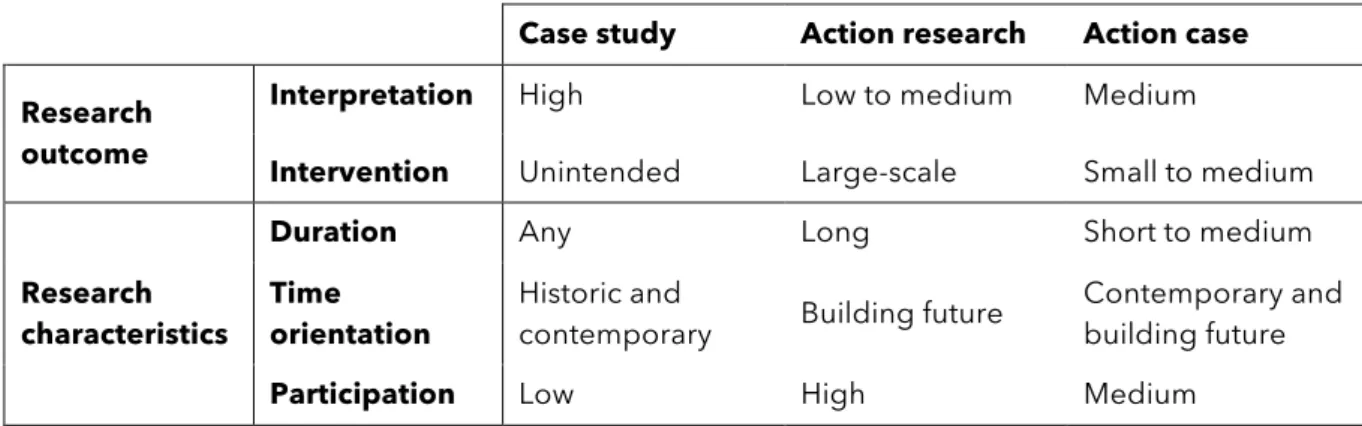
29 According to Braa and Vidgen (1999), case studies and action research are purified research methodologies, where the case study follows an interpretive approach while action research adheres to an interventionary approach. Braa and Vidgen (ibid.) identify and conceptualise action case as a hybrid methodology, balancing an interpretive approach with intervention. Table 2 shows characteristics of action case compared to action research and case study.
Case study Action research Action case
Research outcome
Interpretation High Low to medium Medium
Intervention Unintended Large-scale Small to medium
Research characteristics
Duration Any Long Short to medium
Time orientation
Historic and
contemporary Building future
Contemporary and building future
Participation Low High Medium
Table 2 - Characteristics for case study, action research and action case compared (Braa and Vidgen, 1999)
Braa and Vidgen (ibid.) emphasise that interventionary dynamics of in-context IS research promote a critical perspective where the researcher aims to make deliberate interventions to achieve some desireable change in the organisational setting, and that this perspective is particularly evident with successful large-scale action research projects. However, they imply that interventions in action case promote a critical perspective as well. Similarly, Braa and Vidgen (ibid., p. 41) state that "participation by organisational actors in the research activity is an essential feature of interventionary research", although a lower level of participation is required for action case research.
The practical work undertaken during this study was more about supporting the adaptation of DHIS 2 in order to gain understanding of localisation and generification processes, than about a desire to make a change in an organisational setting. In that respect, the methodology for this study lies somewhere between action case and case study.
4.3
Data collection
The empirical resources for this thesis are drawn from the two cases targeting Palestine, from members of the HISP team at UiO, and from previous research on HISP and DHIS 2. The sources and methods used for data collection throughout this study, can broadly be divided in three categories, which will be elaborated in this section:
• Participation and participatory observation
• Interviews, discussions and informal talks
• Documents
4.3.1
Participation and participatory observation
“[Being an involved researcher] is good for in-depth access to people, issues, and data. It enables observation or participation in action, rather than merely accessing opinions as is the case in an interview-only study.
– (Walsham, 2006, p. 321) As stated in section 4.2, participation in practical work, mainly involving supporting the adaption of DHIS 2, was undertaken in order to gain understanding of localisation and generification processes in play.
The nature and level of participation were somewhat different in the two cases. With the PPS case, my role was to implement the DHIS 2 platform for use as a data collection tool for conducting research in Palestine, and to train health workers in data entry using the
implemented system. In the hRHR project, I was mainly involved in the planning and
requirements stages during a transition phase from an early prototype to an extended implementation effort. The difference in nature and level of participation reflected the difference in character, complexity and scope of the two projects.
These are some of the participatory actions that were undertaken during the study:
• Requirements grooming and planning
• DHIS 2 server configuration
• DHIS 2 system configuration and implementation
• Testing of implemented DHIS 2 system