___________________
ISSN 1823- 5514, eISSN 2550-164X Received for review: 2017-05-08 © 2017 Faculty of Mechanical Engineering, Accepted for publication: 2017-06-01
Universiti Teknologi MARA (UiTM), Malaysia. Published: 2017-08-15
Social Media Sentiment Analysis of
Thermal Engineering Students for
Continuous Quality Improvement in
Engineering Education
Wandeep Kaur, Vimala Balakrishnan*Faculty of Computer Science and Information Technology, University of Malaya
Baljit Singh
Faculty of Mechanical Engineering, Universiti Teknologi Mara
ABSTRACT
In an academic institution, deciphering the opinions of students is the key that ensures the institution continues to strive within the education industry. Extracting implicit information from student opinions are vital in ensuring the standard of education continuously improves, ultimately leading to student retention and increase number of student intake within the institution. Sentiment analysis is a field of study that is interested in extracting sentiments from opinions extracted from written text. These techniques determine if an opinion is penchant towards positivity or negativity. The main aim of this paper is to conduct a preliminary analysis on the opinions of students taking Thermal Engineering (MEC551) from Universiti Teknologi Mara (UiTM) with regard to course tools. Data collected from Facebook was subjected to cleaning and pre-processing. A supervised machine learning algorithm was employed for sentiment classification purpose which was implemented using Rapid Miner. Algorithms were compared and results indicate Support Vector Machine (93.6%) outperformed Naïve Bayes (90.1%) and K-Nearest Neighbour (90.2%) in terms of accuracy and was able to correctly classify the text accordingly. This in return indicates students were very much interested in being able to interact and discuss on questions and queries via Facebook as well as address some fears they had related to exams and assignments seamlessly with their classmates as well as lecturer.
Keywords: Sentiment Analysis, Student Feedback, Thermal Engineering, Social Media
264
Introduction
Data is the incipient currency of this age where every corporation is inordinately fascinated with getting a public opinion of their products and services. Organizations acknowledge the gravity of proper feedback in gaining an understanding on the needs and wants of their customers hence providing them with an edge to create the needed niche in the market [1,2]. The desideratum of the hour is not just receiving good feedback but additionally performing analysis on the feedback available to extract valuable information that ameliorates the standard of the organization [3]. In tandem with changing times, it is crucial to evaluate student’s opinions about the course and major course tools. Academic institutions recognize the need of collecting student feedback data as imperative to continuously improve their course and tutorship [4]. Such feedback is not only necessary to ensure the courses offered are relevant and of interest to the students but also for student retention. According to [5], student feedback evaluation is an indispensable part of any institute to manage and audit the academic quality which can be investigated by conducting a sentiment analysis study.
Sentiment analysis is a field of study that is interested in opinions, sentiments, attitudes, emotions and evaluations of people towards entities extracted from written text [6]. It is an area of research that is gaining interest owning to the availability of immensely colossal volumes of data from various sources. The data extracted is so unstructured that in some cases the analysis of this unstructured data becomes even more crucial than mining for useful information [3].
This paper presents a preliminary study conducted with the students taking Thermal Engineering (MEC 551) course from the Faculty of Mechanical Engineering of University Teknologi Mara (UiTM) by classifying the opinions and feedback from this group of students with respect to various features of teaching and learning module, such as the course layout and modules, assessments’ etc. The extracted posts were subjugated to supervised machine learning algorithms such as Naïve Bayes (NB), Support Vector Machine (SVM) and K Nearest Neighbour (KNN), implemented using Rapid Miner. The algorithms are compared for evaluation purpose using accuracy, precision and recall measures. The remainder of this paper is organized as follow; the next section discusses the literature followed by methodology, results and finally conclusion.
Literature Review
Sentiment AnalysisSentiment analysis is an area of research that is encircled within the realm of Natural Language Processing. The emphasis of a sentiment analysis study is
centralized on mood and subjective elements identification within a text [7]. The idea of the study is to categorize sentiments within a text which is identified by elements picked up for classification purpose. Typically, a sentiment can be quantified by analysing a given text and assigning a sentiment score of either positive, neutral and negative where a positive sentiment is derived when positive elements are picked up from a text and likewise for negative sentiment detection [6]. In a case where no sentiment can be observed, the text will then be labelled as neutral. Take the following posts for instance: “The assignment is very confusing!”
“I finally got the solution to the problem. I am so happy!”
The first post showcases a negative sentiment as a student is complaining about the confusion he is facing in dealing with an assignment. The second post is positive because it indicates a positive sentiment which is further implied by the word “happy”.
The range to which a classification can be carried out may vary (+1 to -1, +10 to -10) with respect to the tools used. M. Liu et. al. [6] further states sentiment analysis has frequently been used to disclose positive and negative inclinations within a data set and it has been endorsed as a feasible technique to yield resolute insights into unstructured textual data. The classification approach adopted in a sentiment analysis study can be broadly categorized into three groups: machine learning, lexicon based and hybrid technique (Figure 1).
Figure 1: Sentiment Classification Techniques
Related Work
Traditionally, a questionnaire based system is utilized to assess the performance of teachers of an institute [4]. However, this method is very tedious, slow and time consuming. A. Kumar and R. Jain [5] proposed an automatic evaluation system based on sentiment analysis of the students’ feedback on teaching staff extracted from an online pool of data. The study
Sentiment Analysis Techniques
Machine Learning Supervised
Learning Unsupervised
Learning
266
was looking specifically into feature words used in text to help determine the final sentiment score. Another study looked into analysing students’ real-time feedback by proposing a system that would collect data from students while the lecture was still being conducted [8]. The data was extracted from opinions mined off students which were subjectively listed in their own words. M.A. Ullah [9] on the other hand, extracted student feedback data from social media and conducted a sentiment analysis study using machine learning algorithms. The Support Vector Machine (SVM) algorithm obtained the highest accuracy in categorizing the correct sentiment. F.F. Balahadia et. al. [10] aimed on developing a teacher’s evaluation tool using sentiment analysis to classify strength and weakness of faculty members based on positive and negative feedback from students written in both English and Filipino. The results revealed the students being more inclined to teachers who used interactive approaches when conducting lectures compared to those who were more conventional.
All the aforementioned studies focussed on gathering feedback on the teaching staff. However, [11] discovered a stronger connection between having optimum course tools and student retention rate where better facilities and assessment methods ensured students received the kind of education they are seeking hence retaining them within the course. Therefore, this preliminary study will focus on the comments the students posted on Facebook with regard to the tools used to compliment the teaching and learning environment such as the assignments, quizzes, tutorials, examinations etc.
Methodology
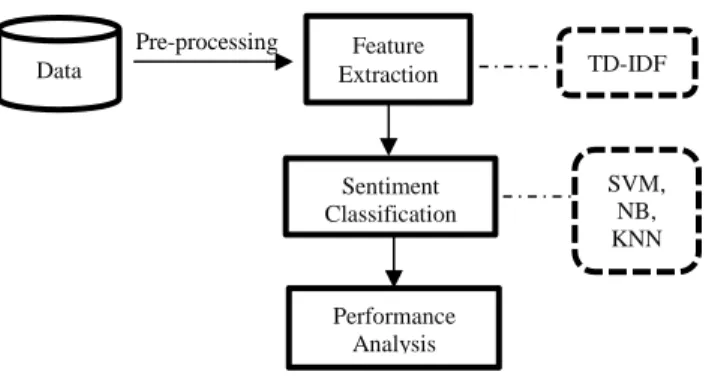
CorpusA closed group was set up on Facebook (MEC551 Thermal Engineering FKM UiTM) with 49 undergraduate students who were taking Thermal Engineering (MEC551) in their second semester. The purpose of the group was to create a platform for students to interact with their lecturer as well as other fellow students in order to discuss, pose questions or clear doubts that was otherwise not addressed in class. This also included passing information on assignments, quizzes as well as mid-terms and finals. The lecturer occasionally posed additional questions for students to answer which served as a mechanism to measure their understanding on the sub topic discussed. The data for this study was collected between October 2016 and January 2017 with the help of Facebook Graph API. A total of 980 posts written in both English and Malay were extracted. Figure 2 shows the methodology adopted for this study.
Figure 2: Methodology Pre-processing
The next step in any sentiment analysis would require data to be cleaned and pre-processed. This is to ensure the data is prepped in a form that would help train a classifier. For this study, all emoticons were removed. Misspelled and typo words were corrected with reference to the English and Malay dictionaries. Malay words were then translated using the dictionary and the translation was then cross-checked by a linguistic expert for verification. Posts that were less than three words long as well as contained more than five misspelled words were discarded. At the end of the cleaning process, a total of 870 posts were acquired. The selected data was then taken through pre-processing steps such as tokenization, changing all words to lower case, stop word removal and stemming using the appropriate operators in Rapid Miner. Word vector representation using term frequency-inverse document frequency (TF-IDF) was also generated at this point as a feature extraction method. The data collected was classified into different groups which identify them according to features. The groups were Modules, Exams, Assignments and Others. Each feature is explained in brief below:
a) Modules – chapters of MEC 551 (e.g. Conduction, Convection, Heat Exchanger, Refrigeration, Air conditioning, Combustion)
b) Exams – including quizzes, mid-terms and final examination c) Assignments – class assignments, group work, lab assignments etc. d) Others – online discussions, other information related to faculty or
on-going competitions etc. Sentiment Classification Algorithm
The classification algorithms used in this study were three of the most commonly adopted supervised machine learning algorithms especially when it comes to text classification [12,13]; namely, Support Vector Machine (SVM), Naïve Bayes (NB) and K-Nearest Neighbour (KNN). The cross-validation
Pre-processing Data Feature Extraction TD-IDF Sentiment Classification SVM, NB, KNN Performance Analysis
268
operator in Rapid Miner was set at 10-fold and it comes with two sub-processes namely training and testing which is conducted concurrently. Data was manually divided according to the mentioned groups (modules, exams, assignment, others) with the help of an expert. The divided data was then run individually for each algorithm, 10% of the divided data was individually used for training the algorithm leaving the rest for testing.
Evaluation Metrics
The evaluation metrics used in this study are prebuilt within Rapid Miner and are compared in terms of accuracy, precision and recall. Precision arbitrates the overall performance by defining the accuracy of the classification while accuracy refers to the proximity of measured results to the true value. Equation 1 and 2 [14] show the formula for calculation
𝐴𝑐𝑐𝑢𝑟𝑎𝑐𝑦 =∑ 𝑐𝑜𝑟𝑟𝑒𝑐𝑡𝑙𝑦 𝑝𝑟𝑒𝑑𝑖𝑐𝑡𝑒𝑑 𝑐𝑙𝑎𝑠𝑠
𝑡𝑜𝑡𝑎𝑙 𝑑𝑎𝑡𝑎 𝑥 100% (1)
𝑃𝑟𝑒𝑐𝑖𝑠𝑖𝑜𝑛 =∑ 𝑤𝑒𝑙𝑙 𝑐𝑙𝑎𝑠𝑠𝑖𝑓𝑖𝑒𝑑
𝑡𝑜𝑡𝑎𝑙 𝑑𝑎𝑡𝑎 (2)
Recall is defined by the number of true positive out of the actual positive documents. Equation 3 [14] shows the formula used.
𝑅𝑒𝑐𝑎𝑙𝑙 = 𝑤𝑒𝑙𝑙 𝑐𝑙𝑎𝑠𝑠𝑖𝑓𝑖𝑒𝑑 𝑐𝑜𝑢𝑛𝑡
ℎ𝑢𝑚𝑎𝑛 𝑐𝑙𝑎𝑠𝑠𝑖𝑓𝑖𝑒𝑑 𝑐𝑜𝑢𝑛𝑡 (3)
Results and Findings
Sentiment Classification Based on Evaluation Metrics
The results were compared in terms of accuracy, precision and recall. All results displayed are in the form of percentage unless otherwise stated. Table 1 shows the results comparison for accuracy, precision and recall. From the table, it can be noted that SVM produced the best accuracy for all four features with the highest accuracy score obtained for classifying modules (96.5%) while NB achieved the best results for precision and recall with the highest of 98.4% and 99.8% respectively for assignments feature.
Table 1: Results comparison of NB, SVM and KNN
Accuracy Precision Recall
Classification NB SVM KNN NB SVM KNN NB SVM KNN
Modules 92.3 96.5 90.1 90.7 90.1 89.7 95.2 92.7 93.1
Exams 87.4 92.5 89.7 97.2 95.4 96.1 94.3 90.9 92.8
Assignments 90.2 90.4 90.1 98.4 96.4 97.6 99.8 97.2 96.5
Sentiment Classification Based on Features
Figure 3 shows the sentiment of students’ feedback with respect to each feature (module, assignments, exams and others). From the data below, it is evident that students’ sentiments are rather negative towards exams but are rather receptive towards the modules, assignments and others.
Figure 3: Sentiment classification of student feedback Accuracy Based on Chapters
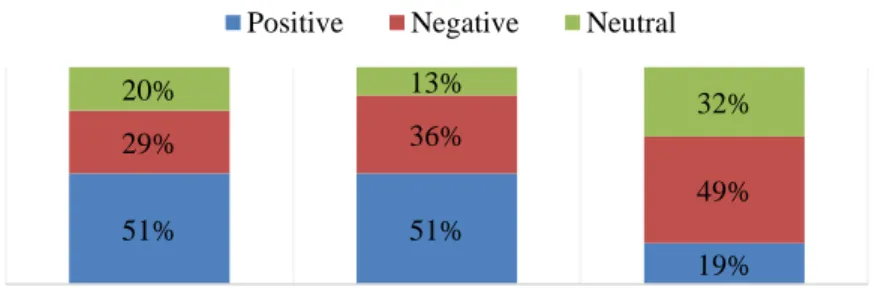
The students’ posts were analysed for each chapter taught in class. Since this preliminary study was only carried out between October 2016 and January 2017, the earlier chapters such as conduction, convection, and heat exchange were not included for this preliminary study. Figure 4 depicts the receptiveness of each student towards chapters shown.
Figure 4: Accuracy percentage of student’s feedback for 3 chapters Frequently Used Words
Figure 5 is a representation of the most frequently used words within the Facebook group of MEC 551. It can be noted that the two words that stands out most are “exam” and “test”. Students were relating each discussion in the
470 420 210 680 525 365 628 262 0 200 400 600 800 Positive Negative
Modules Examination Assignments Others
51% 51%
19%
29% 36%
49%
20% 13% 32%
Refrigeration Air conditioning Combustion
270
group with respect to its possibility of appearing in the exam. Words like “need time” and “revision” also shows students were interested in scoring during assessments thus using Facebook platform to interact with their lecturer in clearing any doubts before sitting for an examination.
Figure 5: Most frequently used words
Conclusion
This preliminary was conducted to analyse the student feedback extracted from Facebook using machine learning algorithms such as Naïve Bayes, Support Vector Machine and K-Nearest Neighbour implemented through Rapid Miner. The results indicate SVM is the best algorithm in terms of accuracy while NB proved to be better at precision and recall. In analysing the student data, it is evident the students do not have a positive sentiment towards exams. This could be due to the pressure faced during this period that further snowballs the sentiment towards negative. In a nutshell, the results indicate that students were able to express themselves more freely via Facebook which allowed for better classification results on how the students perceived the modules related to this subject. Students were highly receptive when it comes to online discussions as indicated by the higher percentage of positive comments but the fear and anxiety of performing in exams were always of a concern. Taking the results of this study, the faculty would be able to tweak the structure of the coming semester by allocating more time for tutorial and group assignments. Perhaps even reducing the percentage contribution of final examination towards the overall grade or even opting for open book based examination questions.
For future research, this study will be extended to a wider scale of extending the time frame for a whole semester and perhaps even including other subjects which are offered within the semester. An in-depth analysis on which chapter of the modules the students are more prone to answer during an
examination can also be studied using the sentiment analysis approach. Furthermore, the connection between the receptiveness of students towards a chapter and the probability of the students answering a question in the examination for that particular chapter can also be investigated.
Reference
[1] M. Adedoyin-Olowe, M.M. Gaber, C.M. Dancausa, F. Stahl and J.B. Gomes,“A rule dynamics approach to event detection in Twitter with its application to sports and politics”, Expert Systems with Applications, 55, 351-360, (2016)
[2] H. Wang, D. Can, A. Kazemzadeh, F. Bar and S. Narayanan, “A system for real-time twitter sentiment analysis of 2012 US presidential election cycle”, Proceedings of the ACL 2012 System Demonstrations, (2012) [3] R. Divya, S. Sandhya and V.S. Sai, “Sentiment Analysis and Effective
Visualization of Faculty and Course Feedback”, The International Journal of Science and Technoledge, 3(5), 125, (2015)
[4] K. Thomas, M. Fernandez, S. Brown and H. Alani, “OUSocial2: a platform for gathering students' feedback from social media”, Proceedings of the 2014 International Conference on Posters & Demonstrations Track-Volume 1272, (2014)
[5] A. Kumar and R. Jain, “Sentiment analysis and Feedback Evaluation”, Proceedings of the 2015 IEEE 3rd International Conference on MOOCs, Innovation and Technology in Education (MITE), (2015) [6] M. Liu, S. Yang, and Q. Chen, “Sentiment classification on Chinese
reviews based on ambiguous sentiment confined library”, Proceedings - 2nd International Conference on Cloud Computing and Intelligence Systems, IEEE CCIS 2012. (2012)
[7] B. Liu, “Sentiment analysis and opinion mining”, Synthesis lectures on human language technologies, 5(1), 1-167. (2012)
[8] N. Altrabsheh, M. Cocea, and S. Fallahkhair, “Learning sentiment from students’ feedback for real-time interventions in classrooms”, Adaptive and Intelligent Systems, (Springer), 40-49, (2014)
[9] M.A. Ullah, “Sentiment analysis of students feedback: A study towards optimal tools”, Proceedings of the International Workshop on Computational Intelligence (IWCI), (2016)
[10] F.F. Balahadia, M.C.G. Fernando and I.C. Juanatas, “Teacher's performance evaluation tool using opinion mining with sentiment analysis”, Proceedings of the Region 10 Symposium (TENSYMP), IEEE, (2016)
[11] K.K. Harris, “An examination of the relationship of course evaluations to student retention and student success in the community college online classroom”, PhD Dissertation, Mississippi State University (2015)
272
[12] C. Catal and M. Nangir, “A sentiment classification model based on multiple classifiers”, Applied Soft Computing, 50, 135-141. (2017) [13] G. Paltoglou and M. Thelwall, “Sensing Social Media: A Range of
Approaches for Sentiment Analysis. In Cyberemotions”, Springer International Publishing, 97-117, (2017)
[14] G. Song, Y. Ye, X. Du, X. Huang, and S. Bie, “Short Text Classification: A Survey”, Journal of Multimedia, 9(5), 635-643, (2014)