Unsupervised and Semi-supervised Multi-class Support Vector Machines
Linli Xu
∗ School of Computer ScienceUniversity of Waterloo
Dale Schuurmans
Department of Computing ScienceUniversity of Alberta
Abstract
We present new unsupervised and semi-supervised training algorithms for multi-class support vector machines based on
semidefinite programming. Although support vector
ma-chines (SVMs) have been a dominant machine learning tech-nique for the past decade, they have generally been applied to supervised learning problems. Developing unsupervised extensions to SVMs has in fact proved to be difficult. In this paper, we present a principled approach to unsupervised SVM training by formulating convex relaxations of the natu-ral training criterion: find a labeling that would yield an opti-mal SVM classifier on the resulting training data. The prob-lem is hard, but semidefinite relaxations can approximate this objective surprisingly well. While previous work has concen-trated on the two-class case, we present a general, multi-class formulation that can be applied to a wider range of natural data sets. The resulting training procedures are computation-ally intensive, but produce high quality generalization results.
Introduction
Efficient convex optimization techniques have had a pro-found impact on the field of machine learning. Most of their use to date, however, has been in applying quadratic pro-gramming techniques to support vector machine (SVM) and kernel machine training (Schoelkopf & Smola 2002). Nev-ertheless, one lesson from the success of SVMs is that ef-fective algorithmic approaches can lead to new progress in generalization, estimation and modeling issues, even when these are not directly algorithmic questions. The conve-nience of effective algorithms allows researchers to freely explore generalization ideas in the context of complex mod-els and large data collections.
Currently, new opportunities for developing novel ma-chine learning techniques are offered by the field of semidef-inite programming (SDP). Semidefsemidef-inite programming, and convex programming more generally, significantly extend the toolbox of optimization methods used in machine learn-ing, beyond the current unconstrained, linear and quadratic programming techniques. Recent progress in semidefinite
∗
Work performed at the Alberta Ingenuity Centre for Machine
Learning, University of Alberta.{linli,dale}@cs.ualberta.ca
Copyright c° 2005, American Association for Artificial
Intelli-gence (www.aaai.org). All rights reserved.
programming has yielded a viable technology that has ef-ficiency characteristics similar to quadratic programming (Boyd & Vandenberghe 2004), including polynomial run-time guarantees (Nesterov & Nimirovskii 1994). These techniques offer a new avenue for solving problems of rele-vance to machine learning.
In fact, semidefinite programming has already started to prove its utility in machine learning research. Lanckreit et
al. (2004) show how semidefinite programming can be used
to optimize the kernel matrix for a supervised SVM. Xu et
al. (2004) and De Bie & Cristanini (2003) develop new
unsupervised and semi-supervised training techniques for SVMs based on semidefinite programming. Similar tech-niques are used in the correlation clustering approach of (Bansal, Blum, & Chawla 2002). Graepel and Herbrich (2003) have shown how transformational invariants can be encoded in SVMs. Even though the number of such results remains modest, the initial achievements are impressive.
In this paper we provide a brief introduction to the appli-cation of semidefinite programming in machine learning and contribute further progress by extending the work of (Xu et
al. 2004; De Bie & Cristianini 2003) to multi-class SVMs.
Multi-class SVMs are similar to their two-class predecessors in that they can be trained by quadratic programming in the
supervised case (Crammer & Singer 2001). However,
devel-oping unsupervised and semi-supervised multi-class SVMs requires a semidefinite programming formulation that sig-nificantly extends the earlier two-class approaches.
After reviewing some of the relevant background, we present new semidefinite programming algorithms for un-supervised training and semi-un-supervised training of SVMs in the multi-class case. We then present experiments that show semidefinite training can obtain state of the art gener-alization performance, albeit at a greater computational cost than previous techniques. Further algorithmic developments in convex programming methods will hopefully continue to alleviate some of these costs in the future.
Semidefinite programming
Semidefinite programming is a recent extension of linear and quadratic programming which was significantly ad-vanced by (Nesterov & Nimirovskii 1994), who provided effective algorithmic foundations as well as polynomial run-time guarantees for solution techniques based on interior
point methods. Semidefinite programming has since had a profound impact on the field of combinatorial optimiza-tion (Goemans & Williamson 1995), and, as menoptimiza-tioned, has opened up exciting new avenues of research in machine learning (Lanckriet et al. 2004). Before explaining the direct relevance of these formulations to generalized SVM train-ing, we first briefly review the basic concepts.
The statement of a semidefinite programming problem, as well as the description of the interior point solution ap-proach, are both very simple. A semidefinite programming problem is a convex constrained optimization problem where one optimizes a symmetricn×nmatrix of variablesX
min
X hC, Xi subject to hAi, Xi=bi, i= 1...m
X º0 (1)
where h·,·i denotes the simple matrix inner product, hC, Xi = Pijcijxij, and X º 0 denotes the constraint
thatX must remain positive semidefinite (Helmberg 2000; Boyd & Vandenberghe 2004). Here, the objective is linear inX, and the semidefinite constraint simply means thatX must satisfyz>Xz≥0for any vectorz 6=0. For a sym-metricX, this is true if and only ifX has only nonnegative eigenvalues (Strang 1998). Sincez>Xz = hX,zz>i, one can see that a semidefinite program is a generalized form of
linear program onXwith infinitely many linear constraints
min
X hC, Xi subject to hAi, Xi=bi, i= 1...m
hX,zz>i ≥0, ∀z6=0 Of course the infinitely many linear constraints in fact define a non-linear constraint onX(a semi-infinite program). Nev-ertheless, the semidefinite constraint is still a convex con-straint onX. That is, for any two positive semidefinite ma-trices X and Y, any convex combination will be positive semidefinite, sincez>(ρX+ (1−ρ)Y)z=ρz>Xz+ (1− ρ)z>Yz≥0for0≤ρ≤1. The dual form of (1) is
max
y,Z b
>y subject to Z+P
iyiAi=C, Z º0
(Helmberg 2000; Boyd & Vandenberghe 2004). Below we will see how this type of problem can naturally arise when one attempts to generalize SVM training.
Convex optimization problems generally admit effective algorithmic approaches (Nesterov & Nimirovskii 1994). It has become apparent that interior point (or “barrier”) meth-ods are one of the most effective approaches for solving these problems (Boyd & Vandenberghe 2004; Helmberg 2000; Vanderbei 1996). An appealing aspect of popular bar-rier methods, beyond their effectiveness, is that they are also very intuitive: To handle inequality constraints, one simply replaces them with a convex barrier function that ensures the constraint is satisfied. Doing so removes the inequality constraints from the problem and replaces them with con-vex terms in the optimization objective, yielding a problem that can be easily solved—for example by using Newton’s method. In the case of a semidefinite constraintXº0there is a particularly elegant barrier function: −log(det(X)). To see how this works, note that for a symmetric matrix
X,det(X) = Qni=1λi, the product of eigenvalues (Strang
1998). Thus,−log(det(X)) =Pni=1log(1/λi). So as any
eigenvalue approaches 0 the barrier function goes to infin-ity and prevents the constraintX º0from being violated. Crucially, the barrier function−log(det(X))is also a con-vex function ofX.
Therefore, an overall interior point (path following) method for solving semidefinite programs is constructed roughly as follows. First, a tightness parameterµis set to ensure numerical stability. One then solves the barrier for-mulation of (1), which is a fully convex optimization prob-lem
min
X hC, Xi −µlog(det(X)) subject to
hAi, Xi=bi, i= 1...m (2)
For a givenµ, this can be efficiently solved using Newton’s method, in space linear in the size of the original problem (Helmberg 2000). Thenµis reduced by a fixed multiplier, typicallyµ(k+1) =µ(k)/10, and the process is repeated. It can be shown that asµ→ 0the solution to (2) approaches (1) (Boyd & Vandenberghe 2004). In practice, the iteration is stopped at a small value ofµ.
In fact, there already exist many software packages on the Web for solving semidefinite programming problems using barrier methods, including SeDuMi, SDPT3 and CSDP (see www.optimization-online.org). Although these techniques are not as well developed as methods for solving quadratic programs, progress is continuing and the current tools are starting to become adequate for solving practical problems.
Two-class SVM training algorithms
We first briefly review the results that have been obtained for generalized two-class SVM training. First, to establish the background ideas from SVMs as well as establish the notation we will use, we consider the supervised case.Assume we are given labeled training examples
(x1, y1), ...,(xn, yn)where each example is assigned a
bi-nary labelyi∈ {−1,+1}. The goal of an SVM of course is
to find the linear discriminantfw,b(x) =w>φ(x) +bthat
maximizes the minimum misclassification margin
γ∗ = max
w,b,γ γ subject to y
i(w>φ(xi) +b)≥γ ∀i
kwk2= 1 (3)
Here the Euclidean normalization constraint onw ensures that the Euclidean distance between the data and the sepa-rating hyperplane (inφ(x)space) determined byw∗, b∗ is maximized. It is easy to show that this same w∗, b∗ is a solution to the quadratic program
γ∗−2= min
w,b
1 2kwk
2 subject to yi(w>φ(xi) +b)≥1∀i
Importantly, the minimum value of this quadratic program, γ∗−2, is just the inverse square of the optimal solution value γ∗to (3) (Lanckriet et al. 2004).
To cope with potentially inseparable data, one normally introduces slack variables to reduce the dependence on noisy
examples. This leads to the so called soft margin SVM (and its dual) which is controlled by a tradeoff parameterβ
γ∗−2 = min w,b,ξ β 2kwk2+ξ >e subject to ξ≥0, yi(w>φ(xi) +b)≥1−ξ i ∀i = max λ λ >e− 1 2βhK◦λλ >,yy>i subject to 0≤λ≤1, λ>y= 0 (4)
The notation we use in this second (dual) formulation re-quires some explanation, since we will use it below: Here K denotes then×nkernel matrix formed from the inner products of feature vectors Φ = [φ(x1), ...,φ(xn)] such
that K = Φ>Φ. Thus Kij = φ(xi)>φ(xj). The
vec-toredenotes the vector of all 1 entries. We letA◦B de-note componentwise matrix multiplication. Note that (4) is derived from the standard dual SVM by using the fact that
λ>(K◦yy>)λ=hK◦yy>,λλ>i=hK◦λλ>,yy>i. Thus for supervised SVM training, one takes a given set of labeled training data(x1, y1), ...,(xn, yn), forms the ker-nel matrixK on data inputs, forms the kernel matrixyy> on target outputs, sets the slack parameterβ, and solves the quadratic program (4) to obtain the dual solutionλ∗and the inverse square maximum margin valueγ∗−2. Once these are obtained, one can then recover a classifier directly fromλ∗ (Schoelkopf & Smola 2002).
Unsupervised two-class SVMs
Recently it has been observed that semidefinite program-ming can be used for unsupervised training of two-class SVMs (Xu et al. 2004; De Bie & Cristianini 2003). The goal in this case is not to find a large margin classifier given labels on the data, but instead to find a labeling that results in a large margin classifier. This amounts to an intuitive two-class clustering principle: find a labeling so that if one were to subsequently run an SVM, the margin obtained would be maximal over all possible labellings (Joachims 1999; Bennett & Demiriz 1998). Unsurprisingly, this is a hard computational problem. However, with some reformula-tion it can be approximated by a semidefinite program that can efficiently compute a good solution (Xu et al. 2004; De Bie & Cristianini 2003).
Suppose one was given unlabeled data x1, ..,xn, and
wished to solve for a labeling y ∈ {−1,+1}n that leads to a maximum (soft) margin. Straightforwardly, one could attempt to tackle this optimization problem directly
min y∈{−1,+1}n γ ∗−2(y) subject to −²≤e>y≤² (5) where γ∗−2(y) = max λ λ >e− 1 2βhK◦λλ >,yy>i subject to0≤λ≤1
Unfortunately,γ∗−2(y)is not a convex function ofy, and this formulation does not lead to an effective algorithmic approach. To obtain an efficient technique for solving this problem one first re-expresses the optimization, not directly in terms of the cluster labelsy, but instead in terms of the
label kernel matrixM =yy>. The main advantage of do-ing so is that the inverse soft marginγ∗−2is in fact a convex function ofM (Lanckriet et al. 2004)
γ∗−2 (M) = max λ λ >e− 1 2βhK◦λλ >, Mi subject to 0≤λ≤1
The convexity ofγ∗−2with respect toM is easy to establish since this quantity is just a maximum over linear functions ofM (Boyd & Vandenberghe 2004).
Working with the matrixM turns out to be particularly convenient here because of the following useful fact: if Mij = yiyj, thenMij = 1 if and only if yi = yj, and
Mij = −1 otherwise. That is, forM ∈ {−1,+1}n×n,
M =yy> for someyif and only ifM is an equivalence
relation matrix. Therefore the optimization problem (5) can
be cast as working directly with equivalence relationsM in-stead of example labellingsy. (We will need to exploit this observation below for the multi-class case.)
Conveniently, the property of being an equivalence rela-tion matrix can be enforced with a simple semidefinite con-straint, sinceM ∈ {−1,+1}n×n encodes an equivalence
relation if and only if diag(M) = e andM º 0 (Helm-berg 2000; Laurent & Poljak 1995). However, in addition, one clearly needs to impose some sort of constraint on the class balance, since otherwise one could simply assign all the data points to the same class and obtain an unbounded margin. This can be enforced with an additional linear con-straint−²e≤Me≤²e.
Therefore, putting the pieces together, one is left with an optimization problem onM that has a convex objective and convex constraints, except for the integer constraintM ∈ {−1,+1}n×n. Dropping the integer constraint yields the
convex relaxation of the maximum margin labeling problem:
min M maxλ λ >e− 1 2βhK◦λλ >, Misubject to 0≤λ≤1, diag(M) =e, Mº0, −²e≤Me≤²e (6) This can be turned into an equivalent semidefinite program (Xu et al. 2004) min M,g,µ,ν g subject to · M ◦K e+µ−ν (e+µ−ν)> g− 2 βν>e ¸ º0 (7) diag(M) =e, Mº0, −²e≤Me≤²e
Given a solutionM∗to (7) one can recover a soft clustering
y by settingy = √λ1v1, whereλ1,v1 are the maximum eigenvalue and corresponding eigenvector ofM∗.
The results in (Xu et al. 2004) show that this method obtains clustering performance that often exceeds spectral clustering (Ng, Jordan, & Weiss 2001). However, a signifi-cant drawback of the method is the restriction to two-classes.
Semi-supervised two-class SVMs
Before considering multi-class extensions to this SVM train-ing technique, we first note that these clustertrain-ing algorithms can easily be extended to semi-supervised SVM training.
For semi-supervised training, one assumes that a small la-beled training set(x1, y1), ...,(xn, yn)given as well as an
unlabeled training setxn+1, ...,xN. The goal in this case is to combine the information in these two data sets to produce a more accurate classifier.
It turns out to be very straightforward to extend the pre-vious equivalence relation based clustering procedures to semi-supervised training. One simply adds constraints on the matrixM to force it to respect the observed equivalence relations among the labeled training data: Mij =yiyj for
labeled examplesi, j ∈ {1, ..., n}. Note that the observed training labelsyifori∈ {1, ..., n}are constants, and
there-fore the new constraints are still linear in the parameters of Mthat are being optimized. The resulting method, although a simple extension, appears to obtain superior performance to previous semi-supervised training procedures for SVMs (Joachims 1999; Bennett & Demiriz 1998).
Multi-class formulation
Our main technical contribution in this paper is to extend the previous two-class methods to general multi-class SVM training algorithms. Although our strategy is similar to that employed above, there are some significant complications to deriving an effective training procedure.
As before, we start with the supervised case. Assume we are given labeled training examples(x1, y1), ...,(xn, yn) where each example is assigned a label from a fixed fi-nite set yi ∈ {1, ..., `}. Here, we need to extend our
feature functionsφ(x, y)to include they-labels explicitly, which provides a separate weight vectorwk for each class
k. Once a complete weight vector has been learned, sub-sequent test examples x are classified according to y∗ =
arg maxyw>φ(x, y). The dominant multi-class training
procedure for SVMs is due to (Crammer & Singer 2001), which, including slack variables, is formulated as
ω = min w,ξ β 2kwk 2+ξ>e subject to w>(φ(xi, yi)−φ(xi, k))≥δ(yi, k)−ξ i ∀i,k(8) whereδ(yi, k) = 1
(yi6=k), andωis the multi-class analog of the inverse squared marginγ∗−2. Our main result depends crucially on being able to reformulate the quadratic program (8) so that it can be expressed entirely in terms of equiv-alence relation matrices instead of individualy-labels. To achieve this, we need to derive a different formulation of the dual from that given in (Crammer & Singer 2001).
Unsupervised multi-class SVMs
With some work, one can show that the following quadratic program is equivalent to the dual of (8).
Proposition 1 The dual quadratic program of (8) can be
re-formulated as ω(M, D) = max Λ Q(Λ, M, D)subject toΛ≥0, Λe=e where Q(Λ, M, D) = t− hD,Λi − 1 2βhK, Mi+ 1 βhKD,Λi −21βhΛΛ>, Ki (9)
HereDandΛaren×`matrices,MandKaren×n ces, and we define the equivalence relation indicator matri-cesM andDsuch thatMij = 1(yi=yj)andDik= 1(yi=k)
respectively. An important consequence of these definitions, which we exploit below, is thatM =DD>.
This is not the same formulation of the dual to (8) given in (Crammer & Singer 2001). Importantly, this reformula-tion of the dual expresses the problem explicitly in terms of the equivalence relationsM andD—which gives us a nec-essary advantage over the formulation of the dual given in (Crammer & Singer 2001).
We can now establish our main result. We would like to compute a solution to the problem
min
M,D ω(M, D) subject to M =DD
> M ∈ {0,1}n×n, D∈ {0,1}n×`
A solution to this problem will minimize the inverse square margin criterion ω and thus maximize the original margin criterion. However, just as in the two-class case, we need to worry about class balance, because a large margin value can always be achieved by eliminating classes. To impose class balance in the multi-class case we add the constraint
(1
` −²)ne≤Me≤(1`+²)nefor some².
The overall formulation, to this point, enjoys the advan-tage that the objectiveω(M, D)is jointly convex inM and D. Unfortunately, neither the integer constraints nor the nonlinear constraintM =DD>are convex. Therefore, as before, we need to derive a convex relaxation to this problem that preserves as much of the structure of the problem as pos-sible. To do so, we first relax the constraint thatMandDbe {0,1}-valued, and instead allow them to take values in[0,1]. However, we also have to cope with the nonlinear equality constraintM = DD>. To remove the non-convexity im-plicit in the nonlinear equality, we replace it with the convex inequalitiesM º DD>and diag(M) =e. The resulting problem is a convex optimization overM andD.
min M,D ω(M, D) subject to 0≤M ≤1, 0≤D≤1 diag(M) =e, M ºDD> (1 ` −²)ne≤Me≤( 1 ` +²)ne (10) This in fact yields the convex optimization problem we wish to solve.
To tackle this problem in practice, it is convenient to first reformulate it as a semidefinite program.
Proposition 2 The convex optimization problem (10) is
equivalent to min M,D,V,α,g g subject to · I⊗K c c> g+ 1 β2hK, Mi+β2α>e ¸ º0 · I D> D M ¸ º0 diag(M) =e, 0≤M ≤1, 0≤D≤1, V ≥0 (1 ` −²)ne≤Me≤(1` +²)ne (11)
wherec=vec(1βKD−D+V +αe>).1
This formulation re-expresses the problem in a form that can be solved by conventional semidefinite programming techniques (Helmberg 2000; Boyd & Vandenberghe 2004).
Semi-supervised multi-class SVMs
Again, before presenting experimental results, we briefly note that the above formulation of unsupervised multi-class SVM training can easily be extended to semi-supervised learning. The extension of the unsupervised training pro-cedure to the semi-supervised case proceeds similarly to the two-class case. Here we simply add the constraints in the ob-served labels to the semidefinite program: Mij = 1(yi=yj) for all labeled training pairsi, j, andDik= 1(yi=k)for each labeled training pair and class labeli, k. The remainder of the program is equivalent to (11), and thus still defines a semidefinite programming problem that can be solved by standard methods.
Experimental results
We implemented the generalized multi-class SVM train-ing procedures based on (11) ustrain-ing the semidefinite pro-gramming package SDPT3 available at www.optimization-online.org. Results for the unsupervised and semi-supervised formulations respectively are reported below.
Unsupervised results
First, for unsupervised training, we compared the perfor-mance of our semidefinite multi-class clustering technique to the spectral clustering method of (Ng, Jordan, & Weiss 2001) and also straightforward k-means clustering. Both semidefinite clustering and spectral clustering were run with the same radial basis function kernel and matching width parameters. In fact, in each case, we chose the best width parameter for spectral clustering by searching over a small set of five widths related to the scale of the problem. In addition, the slack parameter for maximum margin cluster-ing was simply set to an arbitrary value.2 To assess
cluster-ing performance we first took a set of labeled data, removed the labels, ran the clustering algorithms, labeled each of the resulting clusters with the majority class according to the original training labels, and finally measured the number of misclassifications made by each clustering.
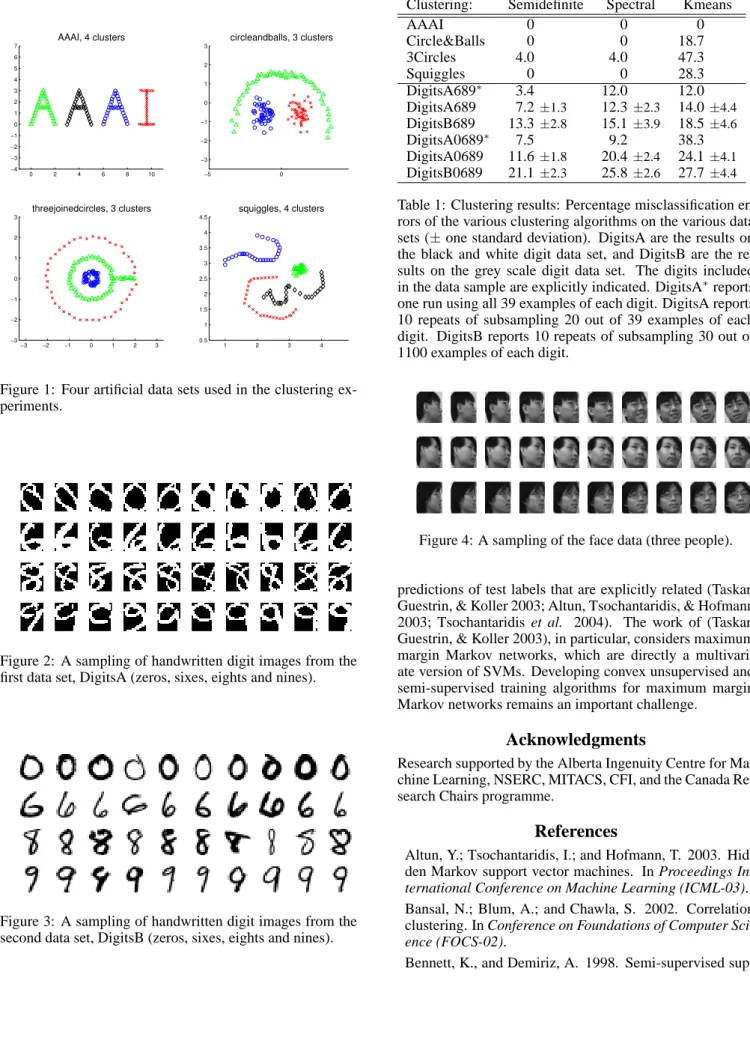
Our first experiments were conducted on the synthetic data sets depicted in Figure 1. Table 1 shows that for the first four sets of data (AAAI, Circle&Balls, 3Joined-Circles, Squiggles) semidefinite and spectral clustering ob-tained identical small error rates, which were in turn signif-icantly smaller than those obtained by k-means (except for the AAAI case).
We also conducted clustering experiments on two real data sets consisting of images of hand-written digits; see
1
The notation vec(X)means turningX into a vector by
con-catenating its columns.A⊗Bdenotes the Kronecker product.
2
It turns out that the slack parameterβdid not have a significant
effect on any of our preliminary investigations, so we just set it to
β= 0.01for all of the experiments reported here.
Figures 2 and 3. The first data set, DigitsA, consists of black and white images of20×16pixels, as shown in Figure 2. The second data set, DigitsB, consists of grey scale images of16×16pixels, as shown in Figure 3. Table 1 shows that semidefinite clustering demonstrates a significant advantage over k-means clustering on these data sets, but also a sys-tematic advantage over spectral clustering. (See the Table 1 caption for details of the experimental set up.)
Semi-supervised results
We tested our approach to semi-supervised learning on var-ious data sets from the UCI repository. To the best of our knowledge, there are no other semi-supervised train-ing procedures available for multi-class SVMs that apply the large margin approach of (Joachims 1999; Bennett & Dem-iriz 1998) or the semidefinite approach we develop above. Therefore, we compare to standard supervised multi-class SVMs (Crammer & Singer 2001) but also to a general semi-supervised approach based on clustering the data using spec-tral clustering, and then using the labeled data to assign min-imum error labels to the classes. In each case, we evaluated the techniques transductively. That is, we split the data into a labeled and unlabeled part, held out the labels of the un-labeled portion, trained the semi-supervised techniques, re-classified the unlabeled examples using the learned results, and measured the misclassification error on the held out la-bels.
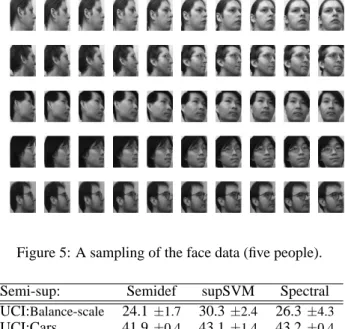
In these experiments, we used two UCI data sets (Balance-scale and Cars), one of the hand-written digits data sets (DigitsA), and a data set of face images. Here we see that the semi-supervised semidefinite approach tends to outperform the other methods, particularly on the dig-its data. Generally, semi-supervised training shows an ad-vantage over strictly supervised training which ignores the extra unlabeled data. Table 2 shows that the semidefinite SVM method is effective at exploiting unlabeled data to im-prove the prediction of held out labels. In every case (except 5faces), it significantly reduces the error of standard multi-class SVM, and obtains the best overall performance of the semi-supervised learning techniques we have investigated. (See the Table 2 caption for details of the experimental set up.)
Conclusion
We have proposed a general, unified principle for clustering and semi-supervised learning based on the maximum margin principle popularized by supervised SVMs. Our work gen-eralizes previous approaches to the multi-class case. Our results on both unsupervised and semi-supervised learning are competitive with, and sometimes exceed the state of the art. Overall, semidefinite programming appears to be an ef-fective approach for unifying and generalizing SVM training techniques, and applying SVMs to a wider range of circum-stances, like unsupervised and semi-supervised learning.
We plan to extend these results to the multivariate case where there are multiple, correlatedylabels associated with the input data observations. Recently, substantial progress has been made on learning classifiers that make dependent
0 2 4 6 8 10 −4 −3 −2 −1 0 1 2 3 4 5 6 7 AAAI, 4 clusters −5 0 5 −3 −2 −1 0 1 2 3 circleandballs, 3 clusters −3 −2 −1 0 1 2 3 −3 −2 −1 0 1 2 3 threejoinedcircles, 3 clusters 1 2 3 4 5 0.5 1 1.5 2 2.5 3 3.5 4 4.5 squiggles, 4 clusters
Figure 1: Four artificial data sets used in the clustering ex-periments.
Figure 2: A sampling of handwritten digit images from the first data set, DigitsA (zeros, sixes, eights and nines).
Figure 3: A sampling of handwritten digit images from the second data set, DigitsB (zeros, sixes, eights and nines).
Clustering: Semidefinite Spectral Kmeans
AAAI 0 0 0 Circle&Balls 0 0 18.7 3Circles 4.0 4.0 47.3 Squiggles 0 0 28.3 DigitsA689∗ 3.4 12.0 12.0 DigitsA689 7.2±1.3 12.3±2.3 14.0±4.4 DigitsB689 13.3 ±2.8 15.1±3.9 18.5±4.6 DigitsA0689∗ 7.5 9.2 38.3 DigitsA0689 11.6 ±1.8 20.4±2.4 24.1±4.1 DigitsB0689 21.1 ±2.3 25.8±2.6 27.7±4.4
Table 1: Clustering results: Percentage misclassification er-rors of the various clustering algorithms on the various data sets (±one standard deviation). DigitsA are the results on the black and white digit data set, and DigitsB are the re-sults on the grey scale digit data set. The digits included in the data sample are explicitly indicated. DigitsA∗reports one run using all 39 examples of each digit. DigitsA reports 10 repeats of subsampling 20 out of 39 examples of each digit. DigitsB reports 10 repeats of subsampling 30 out of 1100 examples of each digit.
Figure 4: A sampling of the face data (three people).
predictions of test labels that are explicitly related (Taskar, Guestrin, & Koller 2003; Altun, Tsochantaridis, & Hofmann 2003; Tsochantaridis et al. 2004). The work of (Taskar, Guestrin, & Koller 2003), in particular, considers maximum margin Markov networks, which are directly a multivari-ate version of SVMs. Developing convex unsupervised and semi-supervised training algorithms for maximum margin Markov networks remains an important challenge.
Acknowledgments
Research supported by the Alberta Ingenuity Centre for Ma-chine Learning, NSERC, MITACS, CFI, and the Canada Re-search Chairs programme.
References
Altun, Y.; Tsochantaridis, I.; and Hofmann, T. 2003. Hid-den Markov support vector machines. In Proceedings
In-ternational Conference on Machine Learning (ICML-03).
Bansal, N.; Blum, A.; and Chawla, S. 2002. Correlation clustering. In Conference on Foundations of Computer
Sci-ence (FOCS-02).
sup-Figure 5: A sampling of the face data (five people).
Semi-sup: Semidef supSVM Spectral
UCI:Balance-scale 24.1 ±1.7 30.3 ±2.4 26.3±4.3 UCI:Cars 41.9 ±0.4 43.1 ±1.4 43.2±0.4 DigitsA689 5.6±0.7 16.3 ±1.6 12.7±0.3 DigitsA0689 6.5±0.5 20.6 ±3.3 11.8±2.7 3faces 0 10.0 ±2.0 0 5faces 5.2±1.5 14.4 ±1.7 0 Table 2: Semi-supervised learning results: Percentage mis-classification errors of the various semi-supervised learning algorithms on the various data sets (±one standard devia-tion). 10 repeats, each randomly subsampling 1/10 of the data to be labeled. Data set sizes are: UCI:Balance-scale: 3 classes, 40 examples each. UCI:Cars: 3 classes, 40 exam-ples each. DigitsA689: 3 classes, 39 examexam-ples each. Dig-itsA0689: 4 classes, 39 examples each. 3faces: 3 classes, 32 examples each. 5faces: 5 classes, 30 examples each.
port vector machines. In Advances in Neural Information
Processing Systems 11 (NIPS-98).
Boyd, S., and Vandenberghe, L. 2004. Convex
Optimiza-tion. Cambridge U. Press.
Crammer, K., and Singer, Y. 2001. On the algorithmic interpretation of multiclass kernel-based vector machines.
Journal of Machine Learning Research 2.
De Bie, T., and Cristianini, N. 2003. Convex methods for transduction. In Advances in Neural Information
Process-ing Systems 16 (NIPS-03).
Goemans, M., and Williamson, D. 1995. Improved approximation algorithms for maximum cut and satisfia-bility problems using semidefinite programming. JACM 42:1115–1145.
Graepel, T., and Herbrich, R. 2003. Invariant pattern recognition by semidefinite programming machines. In
Advances in Neural Information Processing Systems 16 (NIPS-03).
Helmberg, C. 2000. Semidefinite programming for
com-binatorial optimization. Technical Report ZIB-Report ZR-00-34, Konrad-Zuse-Zentrum Berlin.
Joachims, T. 1999. Transductive inference for text clas-sification using support vector machines. In International
Conference on Machine Learning (ICML-99).
Lanckriet, G.; Cristianini, N.; Bartlett, P.; Ghaoui, L.; and Jordan, M. 2004. Learning the kernel matrix with semidef-inite programming. Journal of Machine Learning Research 5.
Laurent, M., and Poljak, S. 1995. On a positive semidefi-nite relaxation of the cut polytope. Linear Algebra and its
Applications 223/224.
Nesterov, Y., and Nimirovskii, A. 1994. Interior-Point
Polynomial Algorithms in Convex Programming. SIAM.
Ng, A.; Jordan, M.; and Weiss, Y. 2001. On spectral clus-tering: analysis and an algorithm. In Advances in Neural
Information Processing Systems 14 (NIPS-01).
Schoelkopf, B., and Smola, A. 2002. Learning with
Ker-nels: Support Vector Machines, Regularization, Optimiza-tion, and Beyond. MIT Press.
Strang, G. 1998. Introduction to Linear Algebra.
Wellesley-Cambridge Press.
Taskar, B.; Guestrin, C.; and Koller, D. 2003. Max-margin Markov networks. In Advances in Neural Information
Pro-cessing Systems 16 (NIPS-03).
Tsochantaridis, I.; Hofmann, T.; Joachims, T.; and Altun, Y. 2004. Support vector machine learning for interdepen-dent and structured output spaces. In Proceedings
Interna-tional Conference on Machine Learning (ICML-04).
Vanderbei, R. 1996. Linear Programming: Foundations
and Extensions. Kluwer.
Xu, L.; Neufeld, J.; Larson, B.; and Schuurmans, D. 2004. Maximum margin clustering. In Advances in Neural