CHAPTER 6: PERFORMANCE MANAGEMENT SYSTEM
6.1 INTRODUCTION
The purpose of this Chapter is to reflect the status quo of the City of Tshwane Metropolitan Municipality (CoT’s) Performance Management System.
6.2 BACKGROUND
Chapter 6 of the Local Government: Municipal Systems Act, 2000 (Act No. 32 of 2000), requires local government to:
• Develop a performance management system;
• Set targets, monitor and review performance based on indicators linked to the Integrated Development Plan (IDP);
• Publish an annual report on performance management for the councillors, staff, the public and other spheres of government;
• Incorporate and report on a set of general indicators prescribed nationally by the Minister responsible for local government;
• Conduct an internal audit on performance before tabling the report; • Have the annual performance report audited by the Auditor-General; and
• Involve the community in setting indicators and targets and reviewing municipal performance.
6.3 OVERVIEW OF POLICIES GUIDING PERFORMANCE MANAGEMENT IN THE CoT
6.3.1 POLICY FRAMEWORK
On 28 August 2003, the Council adopted a Performance Management Framework regulating the Performance management system in the municipality. The Framework provides guidelines on the development and implementation of the organizational and individual performance management system.
The approved framework provides the following guidelines on organizational performance management:
The IDP process and the performance management process are seamlessly integrated. The IDP fulfils the planning stage of Performance Management and Performance Management fulfils the implementation management, monitoring and evaluation of the IDP process.
6.3.3 PRIORITY SETTING
The IDP delivers products such as, amongst others a set of delivery priorities and objectives, a set of internal transformation strategies, priorities and objectives, identified projects that contribute to the achievement of the above objectives and a financial plan.
6.3.4 SETTING OBJECTIVES
All components of the IDP need to be translated into a set of clear and tangible objectives. The statement of objectives requires a tangible, measurable and unambiguous commitment to be made. In setting objectives, a municipality needs to:
• Carefully consider the results desired;
• Review the precise wording and intention of the objective; • Avoid overly broad results statements;
• Be clear about the scope and nature of change desired; and • Ensure that objectives are outcome and impact focused.
6.3.5 KEY PERFORMANCE INDICATORS
The priorities and objectives contained in the IDP will guide the identification of indicators. The development of objectives should be clustered into key performance areas such as service delivery development, institutional transformation, governance and financial issues among others. The activities and processes identified in the IDP for achieving the developmental objectives as well as the resources earmarked must also be taken into account.
The following general key performance indicators are prescribed in terms of section 43 of the Local Government: Municipal Systems Act, 2000 and must therefore be included:
• The percentage of households with access to basic level of water, sanitation, electricity and solid waste removal.
• The percentage of households earning less than R1100 per month with access to free basic services.
• The percentage of a municipality’s capital budget actually spent on capital projects identified for a particular financial year in terms of the municipality’s integrated development plan.
• The number of jobs created through municipality’s local economic development initiatives including capital projects.
• The number of people from employment equity target groups employed in the three highest levels of management in compliance with a municipality’s approved employment equity plan.
• The percentage of a municipality’s budget actually spent on implementing its workplace skills plan.
• Financial viability as expressed by the following ratios:
A = B – C D Where:
“A” represents debt coverage
“B” represents total operating revenue received “C” represents operating grants
“D” represents debt service payments (i.e. interest redemption) due within the financial year;
A = B C Where:
“A” represents outstanding services debtors to revenue “B” represents total outstanding service debtors
A= B + C D Where:
“A” represents cost coverage
“B” represents all available cash at a particular time “C” represents investments
“D” represents monthly fixed operating expenditure
6.3.6 SETTING TARGETS
A municipality must, for each financial year set performance targets for each of the key performance indicators set by it. A performance target set in terms of sub-regulation (1)1 must be:
• Practical and realistic;
• Measure the efficiency, effectiveness, quality and impact of the performance of the municipality;
• Identify administrative components, structures, bodies or persons for whom a target has been set;
• Commensurate with available resources and the municipality’s capacity; and
• Consistent with the municipality’s development priorities and objectives set out in its integrated development plan.
6.3.7 REVIEW OF KEY PERFORMANCE INDICATORS2
A municipality must review its key performance indicators annually as part of the performance review process referred to in regulation 13. Whenever a municipality amends its integrated development plan in terms of section 34 of the Act, the municipality must, as part of the process referred to in regulation 3, review those key performance indicators that will be affected by such an amendment.
6.3.8 DEVELOPING A MONITORING FRAMEWORK3
Performance monitoring is an ongoing process that runs parallel to the implementation of the agreed IDP. The monitoring framework must:
• Identify the roles of the different role players in monitoring and measuring the municipality’s performance;
• Allocate specific tasks to the gathering of data and submission of reports;
• Determine the data that must be collected in order to assess performance, how that data is to be collected, stored, verified and analyzed and how reports on that data are to be compiled;
• Provide for reporting to the municipal council at least twice a year;
• Be designed in a manner that enables the municipality to detect early indications of under-performance (organisational and employee [Human Resources] performance management);
• Provide for corrective measures where under-performance has been identified (organisational and employee [Human Resources] performance management); and • Compare current performance with performance during the previous financial year
and baseline indicators.
6.3.9 THE PERFORMANCE MEASUREMENT FRAMEWORK
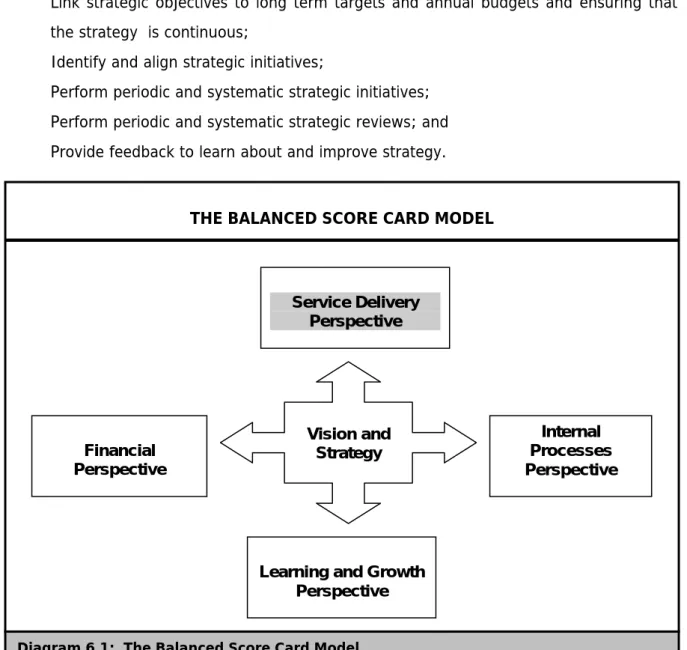
The Balanced Score Card Model was adopted as the model to be used in the City of Tshwane and is aimed to measure performance using four perspectives, i.e. customer, internal processes, financial and learning and growth. The Balanced scorecard, developed by Kaplan and Norton, is used to achieve the following:
• Clarify and translate vision and strategy; • Plan, set targets, and align strategic initiatives;
• Communicate and link strategic objectives and measures throughout the organisation; • Enhance strategic feedback and learning;
• Align Departmental and personal goals to the strategy;
3
the strategy is continuous;
• Identify and align strategic initiatives;
• Perform periodic and systematic strategic initiatives; • Perform periodic and systematic strategic reviews; and • Provide feedback to learn about and improve strategy.
Service Delivery Perspective
Learning and Growth Perspective Financial Perspective Internal Processes Perspective Vision and Strategy
THE BALANCED SCORE CARD MODEL
Diagram 6.1: The Balanced Score Card Model
6.3.10CONDUCTING PERFORMANCE REVIEWS
Performance review is a process where the organization, after measuring its own performance, assesses whether it is doing the right thing by using either of the following methods:
Analysis4
Analysis requires the interpretation of the measurements to determine whether targets have been met and exceeded and projections on whether future targets will be met. Where
targets are not being met, analysis requires that the reasons should be examined and corrective action recommended.
Benchmarking
Look at the municipality’s performance by comparing it with other similar ones, by way of a benchmarking exercise.
Surveys
Look at what the people think about the performance of the municipality across the range of services, by way of customer surveys or other community feedback mechanisms.
6.3.11REPORTING ON PERFORMANCE
Reporting requires that the municipality takes the priorities of the organization, its performance objectives, indicators, targets, measurements and analysis, and present this information in a simple and accessible format, relevant and useful to the specific target group, for review.
The City of Tshwane’s score card template that has been adopted for reporting is set out in section 4 of this chapter.
6.3.12INDIVIDUAL PERFORMANCE
In order to ensure that the City of Tshwane meets and deliver on its City Scorecards KPA’s and KPI’s at a high standard, it is appropriate to introduce a performance management system for the individual employees within the City. If each employee achieves his/her performance objectives, which are linked to the department’s objectives, which are in turn linked to the City Scorecard, then the COT will ultimately achieve its organizational performance indicators.
Performance measurement rests on the following two pillars:
• The identification of the selected few strategic objectives/1st level strategic objectives (inclusive of the 7NKPI’s) which summarises the performance of the whole organisation and which are the result of focussed strategic planning. These objectives are captured in the top down design of the city score card.
• Individual performance measurement which provides the bottom up measurement data for the measurement of performance of 1st level strategic objectives.
Key in rolling out effective individual performance measurement is an understanding of assumptions and allocation (delegation) of responsibility and accountability within the performance management system. An example is given:
The city wants to accelerate higher and shared economic growth and development (Strategic objective). The successful achievement of this will be measured by the growth in the city’s economy as measured by the Gross Value Added (GVA) measure. This measure takes into account the total money value of all products produced in the city less the taxes plus subsidies on products.
Currently this figure stands at between 5% and 6% for Tshwane.
It is assumed that if the city management creates the right economic environment, the city’s economy will grow, i.e. more products will be produced and that will in turn increase the number of jobs in the economy.
There are however a number of factors outside the city management’s control that also influences this figure – e.g. if the rand’s value decreases and more goods are exported, the products that are produced might increase and therefore the GVA might increase – regardless of whether the city created a favourable environment or not.
This level of indicator can therefore not be directly devolved to an individual’s scorecard – not even the municipal manager, since he is not responsible for adopting policy – only for implementing it. This level of indicator therefore needs to be “unpacked” into an individual level indicator, e.g.:
It is assumed that the city’s economy will grow if there are more products or services produced; therefore, attracting companies to do their business in the city becomes a key performance area: Such a key performance area could read: “Leverage growing and strategic sectors in the city in a way that optimize investment opportunities…” A suitable measure for this could be:
The number of enterprises locating in the COT in relation to the baseline (i.e. the current number of enterprises). – this is a suitable measure for the Municipal Manager’s scorecard. The decision of an enterprise as to where it locates is dependent on a number of favourable factors, e.g. the availability of raw materials for production, the availability of suitable land, the access to value adding products and services, e.g. transport facilities to airports or ports.
The Municipal Manager must now decide which departments could contribute towards ensuring favourable circumstances for businesses and allocate specific responsibilities to them. This means he will assume that some activities will contribute more towards attracting business investment than others. The following activities may be identified: • Availability of suitable commercial/business property and easy processes and
procedures through the City Planning Department for changing land use rights, etc; • Easy access to commercial connections for water and electricity;
• Reasonable / Competitive rates for businesses; and • Well maintained access routes (Roads).
For each of the above different indicators will be developed and included in the relevant departmental head’s scorecard.
Two broad approaches are used within COT to manage the performance of employees: Approach 1: Performance contracts and performance agreements
Approach 1 applies to the Municipal Manager, COO, SEO’s and GM’s. These will be signed on annual basis in compliance legislative requirements and best practices. The agreements for fixed term contract employees are linked directly to reward as per the Remuneration Policy of the Municipality.
Approach 2: Personal Score Cards Approach
Approach 2 applies to all permanent employees to manage their performance. The link to reward will initially be non-financial. Financial rewards will ultimately be determined through the Collective Bargaining process at South African Local Government Bargaining Council (SALGBC).
To ensure the above the following policies were adopted: • Performance management policy and procedure; • Policy for the management of poor work performance; • Performance reward scheme;
• Non-financial rewards for permanent employees; and • Remuneration policy.
Currently the use of scorecards is rolled out to the levels of managers and deputy managers in the CoT.
6.4 THE COT 5-YEAR STRATEGIC OBJECTIVES (2006/07 – 2010/2011), KEY
PERFORMANCE AREAS, KEY PERFORMANCE INDICATORS AND TARGETS – PROGRESS WITH IMPLEMENTATION UP TO THE SECOND QUARTER OF 2007
6.4.1 APPROVED CITY STRATEGIC OBJECTIVES
The approved five (5) City Strategic Objectives are as follows: • To provide quality basic services and infrastructure;
• To accelerate higher and shared economic growth and development; • To fight poverty, build clean, healthy, safe and sustainable communities;
• To foster participatory democracy and Batho Pele principles through a caring, accessible and accountable service; and
• To ensure good governance, financial viability and optimal institutional transformation with capacity to execute its mandate.
6.4.2 CITY OF TSHWANE SCORECARD WITH PERFORMANCE PROGRESS UP TO THE SECOND QUARTER OF 2006/07
We report on the third quarter against a backdrop of some important events that took place in our city during the intervening period. These events include the State of the City Address which will be debated today in Council, the launch of the Progressive Women Movement in the Gauteng Province and the handover of the remains of the Mamelodi four to the Freedom Park last week.
The aforementioned events took place as the country was celebrating human rights month. We had to assess our own contribution and progress we have made as a city to the struggle of deepening and consolidating this human rights culture in Tshwane. The Bill of rights as enshrined in our Constitution enjoins us as local government to deliver basic services to our people including access to clean and portable water, basic shelter, safety and security.
Therefore in reporting progress we have made during the period under review we will attempt to cover these issues. Accordingly, as a city we don’t want to create a perception that the work we do is of cosmetic or academic nature but it is meant to change the lives of our people for the better. Maybe I should hasten to condemn the vandalism of water reservoirs in Mamelodi last week by those in our society who seek to reverse the gains we have made in providing basic services to our communities. This led to the interruption to water supply in various areas of Mamelodi. Our law enforcement agencies are working around the clock to ensure that this does not happen again in future and that culprits are brought to book.
The performance report is evaluated against the five city strategic objectives, key performance areas (KPAs), Key performance indicators and targets as contained in the approved Five Year City Scorecard. And these include the following:
• To provide quality basic services and develop infrastructure;
• To accelerate higher and shared economic growth and development; • To fight poverty, building clean, healthy, safe and sustainable communities
• To foster participatory democracy and Batho Pele principles through caring, accessible and accountable service; and
Planned target 3rd Quarter Actual performance 3rd
quarter
Number of top structures provided
(4500) 5812 (exceeded our target)
Formalise 13 settlements by June
2007 12 already formalised and 6 in process. Exceeded our
target
Housing
Complete 190 family units at hostels. 98 completed. Expected shortfall of 70 by end of financial year due to delays in approval of plans.
Nr. of completed and houses
electrified (4285 ) 4180 electrified. Construction has houses were to be completed in other houses before electrification
Electricity
Nr. of completed and occupied households in Winterveldt electrified (4338 2606)
6579 connected
Target exceeded during the 3rd quarter.
Construction of water reservoir to be
completed in Hammanskraal west Construction was completed according to plan. Target achieved
Nr of residential stands provided with water connections planned at 7500
14683 have been connected. Annual target of 10 000 exceeded
Water, Sanitation
100% of informal settlements to
receive water 100% supplied with water. Target reached
26.73km of roads to reduce backlogs 24, 5 km achieved. Target
can still be reached before the end of 3rd quarter.
2.5km of new roads for growth and
224.8km maintained 28.4 km constructed and 420.8km maintained
Target exceeded
Roads & Storm water
15.1km of storm water drainage to
be constructed to reduce backlogs 23.1 km constructed. Target exceeded
Solid Waste removal 7500 access to solid waste removal Tenders pending approval of
type of containers. Target not met
Appointment of SMME
contractors 38 were to be appointed 52 have been appointed in parks and waste
management
Use of local labour 20% increase in the use of local
labour The service departments use local labour in all their
projects. Target exceeded.
2. To accelerate higher and shared economic growth and development • 1022 SMME’s received assistance from the municipality;
• 2659 short term jobs were created.
• All designs for public transport facilities completed
• 9 bad buildings are being renovated and 12 have been completed
3. To fight poverty, building clean, healthy, safe and sustainable communities • 46 800 indigents registered by city and receive free basic services;
• 7 applications for housing developments close to economic opportunities were approved.
• Two events were held to promote a culture of competitive sports activities which include City to City Marathon and Mayoral Golf Day
• 98% of households now have access to primary health care within a radius of 5km. • 8 programmes were implemented for the youth to alleviate poverty.
• 10 initiatives were implemented to benefit vulnerable groups, like the Boikanyo project for people living with disabilities.
4. To foster participatory democracy and Batho Pele principles through caring, accessible and accountable service
• 2 multipurpose centres have been completed to assist in the provision of one stop services. One in Winterveldt and another in Nellmapius
• Ward committees have been capacitated and are 100% functional in all areas.
5. To ensure good governance, financial viability and optimal institutional transformation.
• Tshwane development Agency establishment proceeding as planned
• The completed Business case gap analysis will ensure efficiencies in fleet management which will lead to a saving.
• The match between billing and property valuation has been completed
• There is a reduction in the % of municipal debt over 90 days the planned reduction was 77% (annual target) but 66% was achieved for the quarter.
• The response rate to customer enquiries has been reduced from 42 days to 34 days. • The call centre received 82 441 calls in this quarter and 69 310 were handled
billed on actual consumption.
• The micro structure to up to level 5 has been approved, this will aid in service delivery to be moved closer to the people.
• 50 unemployed learners were accepted into our learnership programme.
The City of Tshwane continues to make strides as can be seen but it still has challenges as well. We have issued over 1500 title deeds to residents in Garankuwa Extension 23. This area enjoys full services such as tarred roads, street trees, parks, public lighting and quality storm water drainage. The project was funded by both the Northwest province and City of Tshwane to the tune of R120 million. On 31 March we will be completing the electrification project in Winterveldt. The municipality will also be handing over housing to residents of Olievenhoutbosch. The mix settlement housing project is a joint initiative of the City of Tshwane, National Housing Department and ABSA Bank. This is a further testimony that it is possible deliver quality houses for various income groups without affecting value of the properties concerned.
On matter of the 2010 World Cup, the City of Tshwane as one of the ten host cities in South Africa, has started work in earnest in this regard. All mechanisms that are needed to ensure successful hosting of the Cup have been established. We will be appointing engineers next month to start with upgrading of Loftus Versveld Stadium. Furthermore, the 2010 project office will be capacitated within the next two months.
As a City we are concerned about the spending patterns especially with regard to our capital programme and we would want to assure you that this will be improved later in the financial year. Today in Council we will be tabling a report on our supply chain management which aims to refine our policies in this regard so as to improve the turn around time in service delivery.
The implementation of the Alternative Service Delivery Mechanisms means the municipality is committed to serving people in caring manner. Very soon five regions will become operational and the officials will become accessible to all our areas in the Tshwane.
The aim of this model is to achieve organisational efficiencies and ensure that we bring services closer to our people. The macro structure has been finalised up level 5 and we plan
to finalise the entire organisational by the end of April 2007. As indicated earlier in the year we will be finalising appointments of senior staff by April this year.
6.4.3 FINANCIAL PROGRESS
This section covers the actual financial progress made with the implementation of the operating budget and capital budget in the second quarter of 2006/07 financial year.
6.4.4 OPERATING BUDGET
The report on the operating budget is attached as Annexure A. For the period July – Marchof 2006/07 financial year, 71.2% (R5,824,345,000 of R8,176,969,000) of operating budget was spent.
6.4.5 CAPITAL BUDGET
The report on the capital budget is attached as Annexure C.
Summary of Spending of Capital Expenditure and Progress on Implementation of Capital Projects
The budget for capital projects in 2006/07 is R1, 586,651,000. A total of ± 339 capital projects were planned for implementation in the 2006/07 financial year.
For the period July-March of the 2006/2007 financial year, 34% (R539, 215,000 of R1, 586,651,000) of capital budget was spent.
The report below summarises progress on implementation of capital projects by end March 2007:
Energy and electricity
• 29 of 30 projects have commenced.
• R188 641 859 of R318 548 000 (59%) was spent by end March.
• R234 264 135 of R318 548 000 was assigned (including R57 497 926 commitments) by end March.
houses. Materials have been purchased and targets for electrification will be met, including the capital expenditure.
Housing, City Planning and Environmental Management
• 80 of 82 projects have commenced.
• 2 large projects (Olievenhout and Thorntree view) to a value of approximately R50M have been completed by developers. Payment claims have been submitted to Province for approval, and once these are approved the funds will be paid out to the developers.
DIVISION BUDGET ACTUAL COMMITMENT ASSIGNED AVAILABLE %
(ASSIGNED) City Planning R 6 554 264 R 1 095 397 R 2 013 086 R 3 108 482 R 3 445 782 47 Housing R250 504 879 R150 980 086 R 795 342 R 151 775 428 R 98 729 451 61 Environmental Management R 38 334 600 R 19 492 717 R 6 139 254 R 25 631 972 R 12 702 628 67 TOTALS R295 393 743 R171 568 200 R 8 947 682 R 180 515 882 R 114 877 861 61
Roads and Stormwater
• 56 of 87 projects have commenced, and 7 have been completed.
• 42.5% ( R124 564 394) of R293 345 000 (as per the adjustments budget) has been spent, with R148 190 235 committed.
• Specific community level projects have experienced delays, for example due to community engagements and the presence of graves in the road side. These particular issues will have to be resolved for certain projects to continue. The details can be found in annexure A (target 1.1.6)
Water and sanitation
• All 60 projects have commenced.
• 45.66%( R119 833 987) of R314 144 000 has been spent and a further R11 085 710 has been committed.
• The delivery of certain projects was delayed due to late approvals and availability of materials in the engineering sector. The projects are however on track, and there department has monitoring systems in place to ensure that targets are met.
Health and Social Development
• All 16 projects have commenced.
• 42% (R45 096 278) of the total budget (R107 629 285) as allocated during the adjustments budget has been spent, and R25 981 866 has been committed. The original budget allocated to the department was R62 422 400.
• The department is on track to spend the budget allocated and to achieve the targets, as the additional funding was applied to projects already in implementation.
Economic Development
• 35 of 39 projects have commenced and R 21.5% (R16 431 087) of the adjusted budget has been spent.
• An additional R3 740 096 is committed.
• A number of projects have been taken over from the COO office since October 2006 and are in various stages of implementation.
• The department projects an 80% expenditure of the capital budget by end June 2007 due to a number of factors, including delays in the process of appointing contractors.
Corporate services
• 9.6% (R 6 407 667) of the adjusted budget of R67 000 000 has been spent and R12 818 948 has been committed.
Metro Police
• R2972610 ( 10.5%) of the adjusted budget of R28 320 000 has been spent, with and additional R4 226 226 committed.
• Three projects of the metro police have been delayed for various reasons: the fibre cables project tender has been driven by IMD, and the head of Corporate services has provided assurances that this project will be realised. The Control room project was halted due to lack of funding for year 2 of a multi year project. The weighbridges project might have to go out on tender again, as only one company tendered, which did not meet all the specifications.
Legal and secretarial services
• 9% (R454 770) of R5000 000 has been spent.
• These funds are used for the purchase of land which cannot be linked to specific projects (general servitudes). Departments budget for land purchases for specific projects.
Emergency management services
• R364 007 (2.7%) of R13 700 000 has been spent.
• R11 992 453 has been committed for the purchase of vehicles which the
department is awaiting arrival of.
6.4.6 REVENUE GENERATION
The revenue realized up to the end of March 2007 is, 74.6 % (R6,403,502,000 of R8,587,559,000).
Original Budget 2006/07 Adjustments Budget 2006/07 Adjusted Budget 2006/07 Projections 2006/07 (YTD) Actuals 2006/07 (YTD) Variance (Actual vs Projection) Actuals vs Projections Actuals vs Adjusted Budget Actuals vs Original Budget Full Year Forecast 2006/07
Reasons for Variances >10% (YTD) Corrective Measures / Actions Taken (YTD)
Operating Revenue by Source
R'000 R'000 R'000 R'000 R'000 R'000 % % % R'000
Property rates ( 1 670 113) ( 1 735 113) ( 1 735 113) ( 1 190 442) ( 1 329 663) ( 139 221) 111.69% 76.63% 79.62% ( 1 735 113) Realised 11.69% more than originally projected for the 3rd quarter.
If revenue in this group exceeds the budget projection, the additional revenue will be declared at year-end with the Corporate Deviations Report.
Service charges - electricity revenue ( 2 663 845) ( 2 693 845) ( 2 693 845) (1 960 348) (1 842 132) 118 216 93.97% 68.38% 69.15% ( 2 693 845) Realised 6.03% less than originally projected for the 3rd quarter.
If revenue target in this group is not realised, the variance will be declared at year-end with the Corporate Devaitions Report.
Service charges - water revenue ( 1 048 864) ( 1 048 864) ( 1 048 866) ( 815 722) ( 749 080) 66 642 91.83% 71.42% 71.42% ( 1 048 866) Realised 8.17% less than originally projected for the 3rd quarter.
If revenue target in this group is not realised, the variance will be declared at year-end with the Corporate Devaitions Report.
Service charges - sanitation revenue ( 233 289) ( 233 289) ( 233 288) ( 181 432) ( 183 674) ( 2 242) 101.24% 78.73% 78.73% ( 233 288) Realised 1.24% more than originally projected for the 3rd quarter.
If revenue in this group exceeds the budget projection, the additional revenue will be declared at year-end with the Corporate Deviations Report.
Service charges - refuse removal ( 271 141) ( 271 141) ( 271 141) ( 201 848) ( 180 092) 21 756 89.22% 66.42% 66.42% ( 271 141) Realised 10.78% less than originally projected for the 3rd quarter.
If revenue target in this group is not realised, the variance will be declared at year-end with the Corporate Devaitions Report.
Regional Services Levies - turnover 0 ( 16 000) ( 16 000) ( 14 500) ( 4 504) 9 996 31.07% 28.15% ( 16 000) Recovery of arrear levies over 2 year grace period. Provided R16 m during the Adjustments budget.
This revenue has been discontinued since 1 July 2006 in compliance with National Government directive. All amounts collected reflect the receipt of levies relating to the period prior to the 2006/07 financial year. Required adjustments will be made at year-end.
Regional Services Levies - remuneration
0 0 0 0 ( 2 331) ( 2 331) 0 Recovery of arrear levies over 2 year grace period. Included R4 m in RSC Levies Turnover during the Adjustments budget.
Similar to the Regional Services Levies above, required adjustments will be made at year-end.
Rental of facilities and equipment ( 51 934) ( 56 194) ( 56 194) ( 37 013) ( 42 939) ( 5 926) 116.01% 76.41% 82.68% ( 56 194) Realised 16.01% more than originally projected for the 3rd quarter.
If revenue in this group exceeds the budget projection, the additional revenue will be declared at year-end with the Corporate Deviations Report.
Interest earned - external investments
( 42 442) ( 42 442) ( 42 442) ( 30 847) ( 66 534) ( 35 688) 215.69% 156.77% 156.77% ( 42 442) Realised 115.69% more than originally projected for the 3rd quarter.
Revenue in this group exceeds the budget projection. The additional revenue will be declared at year-end with the Corporate Deviations Report.
Interest earned - outstanding debtors
( 129 008) ( 137 008) ( 137 008) ( 99 950) ( 105 556) ( 5 606) 105.61% 77.04% 81.82% ( 137 008) Realised 5.61% more than originally projected for the 3rd quarter.
If revenue in this group exceeds the budget projection, the additional revenue will be declared at year-end with the Corporate Deviations Report.
Fines ( 52 743) ( 42 743) ( 42 743) ( 27 577) ( 29 895) ( 2 317) 108.40% 69.94% 56.68% ( 42 743) Realised 8.40% more than originally projected for the 3rd quarter.
If revenue in this group exceeds the budget projection, the additional revenue will be declared at year-end with the Corporate Deviations Report.
Licences and permits ( 34 298) ( 34 298) ( 34 298) ( 21 213) ( 14 296) 6 917 67.39% 41.68% 41.68% ( 34 298) Under collection of 32.61% against projections for 3rd quarter
If revenue target in this group is not realised, the variance will be declared at year-end with the Corporate Devaitions Report.
Government Grants and subsidies - Operating
( 1 319 280) ( 1 362 693) ( 1 362 693) ( 907 114) (1 163 508) ( 256 394) 128.26% 85.38% 88.19% ( 1 362 693) Realised more than originally estimated. Mainly due to Equitable Share transfer of R417,7m in 3rd quarter.
Departments are required to monitor all grants receivable for their respective departments and ensure collection thereof during next quarter.
Government Grants and subsidies - Capital
( 524 767) ( 386 651) ( 386 651) ( 321 263) ( 216 805) 104 459 67.48% 56.07% 41.31% ( 386 651) Actual recognition of revenue dependant on grants received and capital expenditure.
Departments are required to monitor all grants receivable for their respective departments, to ensure collection and appropriate expenditure thereof during next quarter.
Other income ( 392 459) ( 512 778) ( 512 778) ( 351 026) ( 365 741) ( 14 714) 104.19% 71.33% 93.19% ( 512 778) Realised 4.19% more than originally projected for the 3rd quarter.
If revenue in this group exceeds the budget projection, the additional revenue will be declared at year-end with the Corporate Deviations Report.
Public contributions, donated & contributed PPE
0 0 0 0 ( 89 980) ( 89 980) 100.00% 100.00% 100.00% 0 Contributions for township establishmment, etc not budgeted - to be corrected with year-end report
Revenue in this group exceeds the budget projection. The additional revenue will be declared at year-end with the Corporate Deviations Report.
Gains on disposal of PPE ( 14 500) ( 14 500) ( 14 500) ( 10 875) ( 16 773) ( 5 898) 154.24% 115.68% 115.68% ( 14 500) Sale of obsolete assests realised more gains on disposal
Revenue in this group exceeds the budget projection. The additional revenue will be declared at year-end with the Corporate Deviations Report.
CITY OF TSHWANE - BUDGETED PARENT ENTITY STATEMENT OF FINANCIAL PERFORMANCE Financial Year 2006/07 Year to Date Performance of Revenue and Expenditure
Schedule 1
ANNEXURE A: OPERATING REVENUE AND EXPENDITURE PROGRESS FOR THE 1ST THREE QUARTERS ENDED 31 MARCH 2007
Original Budget 2006/07 Adjustments Budget 2006/07 Projections 2006/07 (YTD) Actuals 2006/07 (YTD) Variance (Actual vs Projection) Actuals vs Projections Actuals vs Adjusted Budget Actuals vs Original Budget Full Year Forecast 2006/07
Operating Revenue By Department R'000 R'000 R'000 R'000 R'000 % % % R'000
General assessment (2 918 771) (3 067 139) (2 200 501) (2 867 373) ( 666 871) 130.31% 93.49% 98.24% (3 067 139) Governance ( 189) ( 189) ( 139) ( 339) ( 201) 244.45% 179.86% 179.55% ( 189) Municipal Manager 0 ( 4 733) ( 2 366) ( 735) 1 631 0.00% 0.00% 0.00% ( 4 733) Finance ( 20 307) ( 45 805) ( 26 950) ( 38 766) ( 11 816) 143.85% 84.63% 190.90% ( 45 805) Corporate Services ( 48 237) ( 52 423) ( 35 649) ( 30 982) 4 667 86.91% 59.10% 64.23% ( 52 423) Legal ( 352) ( 352) ( 264) 97 361 -36.54% -27.40% -27.43% ( 352) Economic Development ( 152 113) ( 175 374) ( 111 633) ( 104 908) 6 725 93.98% 59.82% 68.97% ( 175 374)
Health and Social Development ( 58 898) ( 64 897) ( 46 180) ( 22 445) 23 735 48.60% 34.59% 38.11% ( 64 897)
Emergency Management ( 33 628) ( 33 759) ( 25 377) ( 28 123) ( 2 746) 110.82% 83.31% 83.63% ( 33 759)
Metro Police ( 137 472) ( 127 472) ( 84 809) ( 86 199) ( 1 391) 101.64% 67.62% 62.70% ( 127 472)
Housing ( 782 232) ( 666 837) ( 424 798) ( 277 325) 147 474 65.28% 41.59% 35.45% ( 666 837)
Roads and Stormwater ( 73 417) ( 72 217) ( 54 317) ( 9 276) 45 040 17.08% 12.85% 12.64% ( 72 217)
Water & Sanitation (1 440 025) (1 463 319) (1 122 390) (1 026 584) 95 807 91.46% 70.15% 71.29% (1 463 319)
Electricity (2 783 044) (2 813 044) (2 035 799) (1 910 544) 125 255 93.85% 67.92% 68.65% (2 813 044)
Total Operating Revenue (8 448 683) (8 587 559) ( 6 171 170) (6 403 502) ( 232 332) 103.76% 74.57% 75.79% (8 587 559)
0
Financial Year 2006/07 Year to Date Performance of Revenue and Expenditure
CITY OF TSHWANE - BUDGETED PARENT ENTITY STATEMENT OF FINANCIAL PERFORMANCE (BY DEPARTMENT/STRATEGIC UNIT)
A3: OPERATING EXPENDITURE BY GROUP Original Budget 2006/07 Adjustments Budget 2006/07 Adjusted Budget 2006/07 Projections 2006/07 (YTD) Actuals 2006/07 (YTD) Variance (Actual vs Projection) Actuals vs Projections Actuals vs Adjusted Budget Actuals vs Original Budget Full Year Forecast 2006/07
Reasons for Variances >10% (YTD) Corrective Measures / Actions Taken (YTD)
Schedule 2
Operating Expenditure by Vote
Employee related costs 2 515 501 2 551 422 2 551 422 1 850 523 1 807 485 ( 43 038) 97.67% 70.84% 71.85% 2 551 422 Under expended by 2.33% against projections for 3rd quarter, mainly due to delay in filling of vacancies owing to ASD implications.
If expenditure target in this group is not realised, the variance will be declared at year-end with the Corporate Devaitions Report.
Remuneration of Councillors 40 752 40 752 40 752 30 534 31 960 1 426 104.67% 78.43% 78.43% 40 752 Over expended by 4.67% against projections for 3rd quarter, mainly due to incorrect implementation of National directives.
In terms of resolution to be corrected before year-end.
Bad debts 106 649 106 649 106 649 79 987 99 280 19 294 124.12% 93.09% 93.09% 106 649 Realised 24.12% higher than originally projected for the 3rd quarter.
Bad debts written-off approved by council resolution to be declared at year-end with the Corporate Deviations Report.
Coll tion costs 42 669 42 669 42 669 31 467 34 311 2 844 109.04% 80.41% 80.41% 42 669 Realised19.04% higher than originally projected for the 3rd quarter.
If expenditure target in this group is exceeded, the variance will be declared at year-end with the Corporate Devaitions Report.
Depreciation 592 729 592 729 592 729 432 989 416 136 ( 16 853) 96.11% 70.21% 70.21% 592 729 Realised 3.89% lower than originally projected for the 3rd quarter.
As the Asset Register is finalized the Depreciation will be corrected systematically.
Repa rs and maintenance 959 173 1 083 492 1 083 492 527 597 700 352 172 755 132.74% 64.64% 73.02% 1 083 492 Realised 32.74% higher than originally projected for the 3rd quarter.
Departments should ensure that budgeted repairs and maintenance is effected. Changes to the VAT Act will effect the expenditure in this group at year-end.
Inte st paid 345 900 345 900 345 900 259 425 142 144 ( 117 281) 54.79% 41.09% 41.09% 345 900 Realised 45.21% lower than originally projected for the 3rd quarter. Rebates have been received.
Interest payments for loans are payable quarterly (Sept, Dec, Mar & June). Rebates have also been received from banks on certain structure loans.
Bulk purchases 1 990 742 2 007 742 2 007 742 1 533 618 1 558 152 24 534 101.60% 77.61% 78.27% 2 007 742 Realised 1.6% higher than originally projected for the 3rd quarter.
If expenditure target in this group is exceeded, the variance will be declared at year-end with the Corporate Devaitions Report.
Gra s and subsidies paid 11 550 11 550 11 550 8 663 4 988 ( 3 675) 57.58% 43.18% 43.18% 11 550 Mapping of costs incorrect. To be corrected during June. General expenses 1 995 654 2 095 405 2 095 405 1 022 524 1 338 622 316 098 130.91% 63.88% 67.08% 2 095 405 Realised 30.91% higher than originally
projected for the 3rd quarter.
To be monitored by all departments over next quarter. Changes to the VAT Act will effect the expenditure in this group at year-end. Loss on disposal of PPE 0 0 0 0 8 492 8 492 100.00% 100.00% 100.00% 0 Asset register clean-up and audit
corrections on scrapping of assets.
As the Asset Register is finalized the Loss on Disposal of Property, Plant & Equipment, will be corrected systematically.
Internal recoveries ( 701 342) ( 701 342) ( 701 342) ( 526 007) ( 317 578) 208 429 -60.38% -45.28% 45.28% ( 701 342) Adjusted budget in SAP excludes internal costs and recoveries - reporting on primary costs only
Internal recoveries will be corrected at year-end with finalisation of the statements.
Ope ating Expenditure by Vote 7 899 977 8 176 969 8 176 969 5 251 320 5 824 345 573 025 110.91% 71.23% 73.73% 8 176 969 (SURPLUS)/DEFICIT (1) ( 548 706) ( 410 590) ( 410 590) ( 919 850) ( 579 157) 340 693 62.96% 141.05% 105.55% ( 410 590)
CITY OF TSHWANE - BUDGETED PARENT ENTITY STATEMENT OF FINANCIAL PERFORMANCE
Financial Year 2006/07 Year to Date Performance of Revenue and Expenditure
Schedule 1 ec i re nt r Note:
1. The figures reflected under “Adjusted budget 2006/07” in column 3 refers to the Budget adjustments in terms of the Fund Transfer Policy.
Original Budget 2006/07 Adjustments Budget 2006/07 Projections 2006/07 (YTD) Actuals 2006/07 (YTD) Variance (Actual vs Projection) Actuals vs Projections Actuals vs Adjusted Budget Actuals vs Original Budget Full Year Forecast 2006/07
Operating Expenditure By Department 0
General assessment 341 728 280 628 144 316 268 115 123 799 185.78% 95.54% 78.46% 280 628 Governance 96 881 115 020 75 292 74 355 ( 937) 98.76% 64.65% 76.75% 115 020 Municipal Manager 119 052 136 634 72 872 59 954 ( 12 918) 82.27% 43.88% 50.36% 136 634 Finance 446 170 453 216 310 392 247 667 ( 62 724) 79.79% 54.65% 55.51% 453 216 Corporate Services 636 167 657 944 468 334 498 160 29 826 106.37% 75.71% 78.31% 657 944 Legal 73 228 73 977 52 240 50 943 ( 1 297) 97.52% 68.86% 69.57% 73 977 Economic Development 280 900 309 511 190 026 225 689 35 663 118.77% 72.92% 80.34% 309 511
Health and Social Development 289 755 326 247 204 346 202 953 ( 1 393) 99.32% 62.21% 70.04% 326 247
Emergency Management 228 731 229 172 175 458 157 428 ( 18 030) 89.72% 68.69% 68.83% 229 172
Metro Police 414 695 426 275 296 695 303 812 7 117 102.40% 71.27% 73.26% 426 275
Housing 977 633 1 012 459 529 052 764 086 235 034 144.43% 75.47% 78.16% 1 012 459
Roads and Stormwater 468 170 471 355 222 520 325 812 103 292 146.42% 69.12% 69.59% 471 355
Water & Sanitation 1 187 479 1 237 383 839 934 906 311 66 378 107.90% 73.24% 76.32% 1 237 383
Electricity 2 339 389 2 447 149 1 669 841 1 739 060 69 219 104.15% 71.06% 74.34% 2 447 149
Total Operating Expenditure 7 899 977 8 176 969 5 251 320 5 824 345 573 025 110.91% 71.23% 73.73% 8 176 969
(SURPLUS)/DEFICIT ( 548 706) ( 410 590) ( 919 850) ( 579 157) 340 693 62.96% 141.05% 105.55% ( 410 590)
Financial Year 2006/07 Year to Date Performance of Revenue and Expenditure
CITY OF TSHWANE - BUDGETED PARENT ENTITY STATEMENT OF FINANCIAL PERFORMANCE (BY DEPARTMENT/STRATEGIC UNIT)
Note: Adjusted budget in SAP excludes internal costs and recoveries – reporting on primary costs only. Budget for Interest Paid moved to General & Assessment Rates
ANNEXURE C: CAPITAL BUDGET PROGRESS FOR THE 1ST TWO QUARTERS ENDED 31 MARCH 2007 C1: CAPITAL EXPENDITURE PER STRATEGIC UNIT
Strategic Unit/Department Approved Original Budget Approved Adjusted Budget Expenditure Projections Jul '06 - Mar '07 Actual Expenditure Jul '06 - Mar '07 Variance (Actual vs Projection) Actual as % of Adj. Budget Actual as % of Exp. Projection Commitment (YTD) Assigned (YTD) Available Electricity 314 948 000 318 548 000 179 670 725 176 766 209 - 2 904 516 55.5% 98.4% 57 497 926 234 264 135 84 283 865 Service Delivery: 601 089 000 607 489 000 288 048 422 244 398 381 - 43 650 041 40.7% 84.8% 34 711 551 279 109 932 328 379 068
Roads & Stormwater 282 945 000 293 345 000 133 020 808 124 564 394 - 8 456 414 42.5% 93.6% 23 625 841 148 190 235 145 154 765
Water & Sanitation 318 144 000 314 144 000 155 027 614 119 833 987 - 35 193 627 38.1% 77.3% 11 085 710 130 919 697 183 224 303
Social Development 62 422 400 107 629 285 43 612 773 45 096 278 1 483 505 41.9% 103.4% 25 981 866 71 078 144 36 551 141
Metro Police 21 000 000 28 320 000 5 116 703 2 972 610 - 2 144 093 10.5% 58.1% 4 226 226 7 198 836 21 121 164
Legal & Secretarial 5 000 000 5 000 000 2 179 597 454 770 - 1 724 827 9.1% 20.9% 0 454 770 4 545 230
Housing 442 693 000 295 934 600 194 163 630 165 787 478 - 28 376 152 56.0% 85.4% 9 932 719 175 720 197 120 214 403
Finance 20 000 000 21 800 000 9 491 716 548 586 - 8 943 130 2.5% 5.8% 1 604 828 2 153 414 19 646 586
Economic Development 47 330 000 76 330 000 19 952 672 16 431 087 - 3 521 585 21.5% 82.4% 3 740 096 20 171 183 56 158 817
Corporate Services 67 800 000 67 000 000 14 307 459 6 407 667 - 7 899 792 9.6% 44.8% 12 818 948 19 226 615 47 773 385
Emergency Management Services 13 700 000 13 700 000 393 215 364 007 - 29 208 2.7% 92.6% 11 992 453 12 356 460 1 343 540
Municipal Manager 128 784 600 48 500 000 7 050 000 732 995 - 6 317 005 1.5% 0.0% 3 116 953 3 849 948 44 650 052
Total 1 724 767 000 1 590 250 885 763 986 912 659 960 068 - 104 026 844 41.5% 86.4% 165 623 566 825 583 634 764 667 251
Capital Expenditure for the CTMM per Strategic Unit to 31 March 2007
Funding Source Approved Original Budget Adjusted Budget Projections to 31 Mar 2007 (YTD) Actuals to 31 Mar 2007 (YTD) Variance (Actuals vs Projections) Actuals vs Projections Actual vs Adjusted Budget R'000 R'000 R'000 R'000 R'000 % % Council Funding 1 200 000 1 200 000 503 886 439 287 ( 64 599) 87.18% 36.61%
Provincial Grants & Subsidies 20 100 25 707 13 956 10 710 ( 3 246) 76.74% 41.66%
Government Housing Program 273 723 130 000 74 580 47 174 ( 27 406) 63.25% 36.29%
Municipal Infrastructure Grant (MIG) 205 944 205 944 141 860 137 200 ( 4 660) 96.72% 66.62%
National Electricity Regulator (NER) 25 000 28 600 25 000 20 765 ( 4 235) 83.06% 72.60%
Total 1 724 767 1 590 251 759 282 655 136 ( 104 146) 86.28% 41.20%
Capital Expenditure for the CTMM per Funding Source to 31 March 2007
6.5 CHALLENGES
6.5.1 POLICY FRAMEWORK
The City of Tshwane acknowledges5 that there is a link between organizational
performance management and individual performance management and illustrates it as per the diagram below:
When the policy framework is however further explained as per diagram below, the linkage to the organizational level of planning is lost and the focus become the last grey box of the previous diagram which refers to individual performance:
The Performance management policy and procedure needs to be updated furthermore, to allow for changes in the IDP as well as new individual performance management
regulations published in 2006 by the Department of Local Government in August 2006.
6.5.2 PLANNING FOR PERFORMANCE MANAGEMENT
According to the local government planning and performance management regulations of 2001:
7. (1) A municipality’s performance management system entails a framework that describes and represents how the municipality’s cycle and processes of performance planning,
monitoring, measurement, review, reporting and improvement will be conducted, organised and managed, including determining the roles of the different role-players.
(2) In developing its performance management system, a municipality must ensure that: (a) the system complies with all the requirements set out in the Act;
(b) demonstrates how it is to operate and be managed from the planning stage up to the
stages of performance review and reporting;
(c) clarifies the roles and responsibilities of each role-player, including the local community, in the functioning of the system;
(d) clarifies the processes of implementing the system within the framework of the integrated development planning process;
(e) determines the frequency of reporting and the lines of accountability for performance (f) relates to the municipality’s employee performance management processes; and (g) provides for the procedure by which the system is linked to the municipality’s
In the development of the Current city 5-year programme we did not use the balanced scorecard methodology (which was approved for the performance management process) as point of departure for our planning process. We therefore do not have KPA’s in the various perspectives of the balanced scorecard supporting the achievement of other strategic objectives, e.g. Good governance KPA’s invariably link to other strategic objectives. Furthermore, it has been difficult to determine key performance indicators for all our strategic objectives. Not all our indicators are measurable. This has created a challenge in aligning fully our performance management process with the IDP process. Monitoring and evaluation is therefore difficult. Examples of misalignment have been identified below and we aaim to address them further in the 08/09 IDP review.
6.5.3 SETTING OBJECTIVES AND KEY PERFORMANCE AREAS
The approved five (5) City Strategic Objectives are as follows: • To provide quality basic services and infrastructure;
• To accelerate higher and shared economic growth and development; • To fight poverty, build clean, healthy, safe and sustainable communities;
• To foster participatory democracy and Batho Pele principles through a caring, accessible and accountable service;
• To ensure good governance, financial viability and optimal institutional
transformation with capacity to execute its mandate.
For each of our strategic objectives a number of key performance areas (priorities) were set to achieve the objective, e.g.:
To provide quality basic services and infrastructure • Eradication/reduce of infrastructure backlogs • Provide quality infrastructure for growth • Ensure maintenance of existing infrastructure • Ensure optimal resource utilization
• Formalisation of informal settlements
The following will need to be improved in further planning processes:
• We need to make mention of continued provision of services – 1.1-1.3 is
infrastructure focused. Even though we currently provide a service when we construct infrastructure, we have not reflected this explicitly.
• Optimal resource utilization in general management terminology is one of those things that become a management input into especially efficiency management – i.e. doing more for less. We realize that:
o Unaccounted for water and electricity will not help us provide basic services and
infrastructure
o Unaccounted for water and electricity does not have anything to do with how
optimally managers utilize the resources available to them but rather with how much of the water and electricity the CoT currently buys, that gets stolen – i.e. what control measures should we put in place to protect our resources – in this sense it becomes part of risk management.
• Formalisation of informal settlements is an internal business process that needs to happen in order to provide formal residential services (houses; water, sanitation electricity etc.) – it should not be considered separately but in context
• The exploration of alternative sources of energy will not provide basic services but is rather a learning and growth KPA that should be linked to sustainable usage of resources
• Labour intensity and community involvement should be linked to the objective to accelerate higher and shared economic growth in our city.
o In terms of achieving our objective of providing quality basic services and
infrastructure we will investigate measures that help us report on the quality of the service we provide, the types of service levels we provide and our ability to sustain demand for services.
The same degree of scrutiny will be applied to improve reporting on all our objectives.
A m
unicipality must set key performance indicators, including input indicators, output indicators and outcome indicators, in respect of each of the development priorities and objectives referred to in section 26(c) of the Municipal Systems Act.(b) A key performance indicator must be measurable, relevant, objective and
precise.
(2) In setting key performance indicators, a municipality must ensure that- (a) communities are involved; and
(b) the key performance indicators inform the indicators set for- (i) all its administrative units and employees; and
(ii) every municipal entity and service provider with whom the municipality has entered into a service delivery agreement.
The following challenges are currently experienced: • Indicators are not always measurable, e.g.
o “Provision of infrastructure per type as a proportion to new demand/need
(growth)”
Firstly as the sentence is phrased it actually is an activity and not a measure.
Secondly, infrastructure was not clearly defined “per type” resulting in Electricity reporting that they will deliver 11,131 new electricity infrastructure developments – the electricity infrastructure however could include the following: high voltage inflow substations, low voltage substations, power lines, street lighting, prepaid meters or the prepaid meter payment stations, residential connections, etc.
Thirdly the KPA relating to the above measure states: “Provide quality infrastructure for growth”. The “quality” aspect is however nowhere addressed in the indicator that refers to types of infrastructure which means that we won’t know anything about achieving the delivery of “quality” infrastructure.
o No of new of waste removal service points is described as infrastructure – it is
actually meant that municipal waste bins are provided
o “Length of roads to reduce the backlogs (in km)” and “Nr of residential stands
provided with roads and stormwater drainage” are different indicators used by different departments to achieve the same KPA “To reduce the current backlogs
measuring a KPA, the problem is with the information from the second indicator, the length of roads provided will still not be known. If the planning is done transparently it will be possible for the Department to project that 6000 top structures will be provided, that 1 km of roads will be delivered for every 200 stands and that 30 km of roads will be constructed.
o % increase in nr of households using non-conventional energy per energy type
as a proportion of total households – there is no database with information on households in informal settlements or even on plots and farms, using alternative energy sources (let alone “non-conventional”) gas, primus stoves, solar heating etc. – how will we force these households to report on the non-conventional methods that they are using so that we could report on this? If we relate the KPI to the KPA “Explore alternative sources of energy (non-conventional)” – the matter is confused even further because who needs to “explore” – households or the CoT – if it is the CoT that needs to “explore” why do we want to report on what the households are doing? How does this exploration relate to the strategic objective to “provide basic services and infrastructure”?
The above was just some indicators taken from the city’s scorecard, strategic objective 1. The trends are repetitive for all the strategic objectives and KPA’s.
The municipality must furthermore in the setting of KPI’s ensure that communities are involved according to section (9)(2) of the performance management regulations 2001. Currently there is no formal process of involving the communities, unless the approval by Council of the city’s 5-year programme is regarded as the required “community
involvement”.
6.5.5 SETTING TARGETS
(1) A municipality must, for each financial year, set performance targets for each of the key performance indicators set by it.
(2)A performance target set in terms of sub regulation must - (a) be practical and realistic;
(b) measure the efficiency, effectiveness, quality and impact of the performance of the municipality, administrative component, structure, body or person for whom a target has been set;
(c) be commensurate with available resources;
(d) be commensurate with the municipality’s capacity; and
(e) be consistent with the municipality’s development priorities and objectives set out in its integrated development plan.
A number of performance targets are not practical and realistic, e.g.:
• Achieve 4,5% growth per annum in the tourism market of overnight visitors (The municipality does not have control over the tourism market for overnight visitors – e.g. whether there is sufficient accommodation to their taste and affordability) • 100% of stagnant nodes with potential revived by 2011 – we do not own the land on
which the stagnant economic node is situated; township development has not taken place etc.
• 80% of needs in terms of regeneration of the inner city achieved per category (housing, businesses, open space and social) infrastructure by 2011 - we do not know what the needs in terms of regeneration of the inner city is and therefore do not have a calculated total against which the target of 80% is measured – what would regeneration of businesses mean in terms of the municipality’s job?
• Alienate 60% of council’s immovable property to BEE for commercial purposes by 2011 – do we mean all immovable property in the councils’ ownership – regardless of the purpose for which the property was originally acquired – e.g. provision for way leaves. Is the property to be alienated suitable for commercial purposes?
• Alienate 45% of councils immovable property to BEE per annum – does this mean that after year 1 the municipality has alienated 105% of immovable property that it owns – 45% to BEE for general purposes and 60% to BEE for commercial purposes? • Achieve direct rand value investment from 90% of strategic partnerships – what is
direct investment – investment in the municipality or investment in the city – by what is investment in the city measured – by acquiring /leasing of properties – or do we measure it by something else – where do we get the information from – can we provide evidence of the investment – what is a strategic partnership as opposed to an ordinary partnership? Does it require a signed memorandum of understanding? The above examples and other targets will be addressed in the 08/09 planning cycle.
6.5.6 REVIEW OF KEY PERFORMANCE INDICATORS6
The municipal planning and performance regulations of 2001 stipulates that a municipality must, after consultation with the local community, develop and implement mechanisms, systems and processes for the monitoring, measurement and review of performance in respect of the key performance indicators and performance targets set by it.
The reviewing process as per the City of Tshwane performance management policy, however only makes provision for the review of individual performance and not for the review of organizational performance.
6.5.7 DEVELOPING A MONITORING FRAMEWORK7
The municipality has a number of challenges in developing a monitoring framework:
• The current systems does not allow for the non-financial planning of initiatives – i.e. for developmental initiatives e.g. improving community skills, or focusing on target groups such as the youth or women
o There are no city level databases of all women, or youth or disabled
• The monitoring has to include ability to report on not only the city’s priorities but also on National KPI’s or provincial indicators. This becomes challenging when the city has a priority to support people receiving an income of R1700 or less as indigents whereas the national regulations make provision for R1100 – and reporting on the people that the City is supporting is therefore narrower than required.
6.6 CONCLUSION
The City is making progress with performance management in general and strives to improve on its ability not only to comply with legislative requirements, but to make a developmental difference to our community despite a number of challenges and obstacles.
6