Snelle-simulatietechnieken voor de exploratie van
de microarchitecturale ontwerpruimte
Fast Simulation Techniques for
Microprocessor Design Space Exploration
Davy Genbrugge
Promotor: prof. dr. ir. L. Eeckhout
Proefschrift ingediend tot het behalen van de graad van
Doctor in de Ingenieurswetenschappen: Computerwetenschappen Vakgroep Elektronica en Informatiesystemen
Voorzitter: prof. dr. ir. J. Van Campenhout Faculteit Ingenieurswetenschappen Academiejaar 2009 - 2010
Dankwoord
Bij de aanvang van dit onderzoek had ik slechts een vaag idee over het pad dat ik zou bewandelen. Al snel had ik door dat onderzoek niet over een rechte geplaveide weg loopt, maar op een kronkelig pad vol obstakels. Meerdere malen ben ik mezelf tegengekomen. Gelukkig kon ik rekenen op de steun van een aantal mensen, die onmisbaar waren bij het tot stand komen van dit werk. Graag wil ik hen uitvoerig bedanken. In de eerste plaats wil ik mijn promotor prof. Lieven Eeckhout be-danken. Verscheidene malen heb ik me kunnen beroepen op de exper-tise van Lieven wanneer ik door de bomen het bos niet meer zag. Hij heeft me (met het nodige geduld) de knepen van het vak geleerd, en kon steeds weer begrip opbrengen wanneer ik in de fout ging. Ook op momenten dat de moed me in de schoenen zonk wist hij me te motive-ren om verder te gaan. Zonder zijn hulp had ik nooit de tal van mooie ervaringen kunnen opdoen en had ik niet gestaan waar ik nu sta.
In de tweede plaats wil ik prof. Koen De Bosschere bedanken. Reeds meer dan dertien jaar bouwt Koen een onderzoeksgroep uit die jon-ge mensen de kans jon-geeft zich te verdiepen in computerarchitectuur. Door zijn enthousiasme en gedrevenheid weet hij steeds opnieuw tal van mensen te overtuigen om een onderzoek aan te vatten. Jaren terug heb ik ervoor gekozen om me te vervoegen bij de groep van Koen; iets wat ik mij nog nooit heb beklaagd.
I also would like to thank all members of my PhD committee for their effort to evaluate this thesis. I would like to thank prof. Brad Calder from Microsoft and prof. Erik Hagersten from Acumem and Uppsala University in Sweden. I really appreciate it that you have found the time to read my thesis and to serve on my committee; I know that you have a tight schedule. Your comments were invaluable for improving my thesis. Verder wil ik ook de binnenlandse leden van mijn doctoraatscommissie bedanken voor hun inspanning om dit werk te beoordelen: prof. Diederik Verkest, prof.
Chris Develder, prof. Koen De Bosschere en prof. Jan Van Campenhout. Uw suggesties waren van onschatbare waarde om mijn thesis sterker te maken. Uiteraard wil ik ook prof. Rik Van de Walle bedanken om de taak van voorzitter op zich te nemen.
Jarenlang heb ik kunnen werken in een aangename collegiale werk-sfeer. In de eerste plaats bedank ik mijn bureaugenoten: Andy, Dries, Kris, Frederick, Stijn en Max. Het was/is een plezier om met jullie een bureau te delen. In de afgelopen jaren heb ik ontzettend veel bijgeleerd ondermeer van mijn collega’s: Michiel, Stijn, Andy, Jonas, enz. On-getwijfeld ben ik een aantal mensen vergeten, daarom wil ik iedereen
bedanken voor die mooie jaren. In het bijzonder wil ik Andy en Stijn nog eens bedanken om mijn thesis na te lezen.
Gedurende mijn onderzoeksactiviteiten was ik tewerkgesteld op een aantal projecten. Bij deze wens ik dan ook het Institiuut voor de aan-moediging van Innovatie door Wetenschap en Technologie in Vlaan-deren (IWT), het Fonds voor Wetenschappelijk Onderzoek VlaanVlaan-deren (FWO) en de Universiteit Gent bedanken voor de financiering van dit onderzoek.
Tot slot wens ik ook mijn familie en vrienden te bedanken om mij al die jaren te steunen. Ik was niet altijd het zonnetje in huis, zeker niet op moment dat er eendeadlinemoest gehaald worden. Vaak heb ik tegen mijn kameraden ‘nee’ moeten zeggen wegens ‘geen tijd’. Daarom bedankt voor al jullie begrip! In het bijzonder, mama, papa en zus (en Pieter), jullie zijn zoals altijd de beste! Genoeg reden voor mij om te blijven doorgaan, dank u.
Davy Genbrugge Gent, 22 januari 2010
Examencommissie
Prof. Rik Van de Walle, voorzitter
Vakgroep ELIS, Faculteit Ingenieurswetenschappen Universiteit Gent
Prof. Jan Van Campenhout, secretaris
Vakgroep ELIS, Faculteit Ingenieurswetenschappen Universiteit Gent
Prof. Lieven Eeckhout, promotor
Vakgroep ELIS, Faculteit Ingenieurswetenschappen Universiteit Gent
Prof. Brad Calder
Department of Computer Science and Engineering University of California in San Diego
Microsoft USA
Prof. Koen De Bosschere
Vakgroep ELIS, Faculteit Ingenieurswetenschappen Universiteit Gent
Prof. Chris Develder
Vakgroep INTEC, Faculteit Ingenieurswetenschappen Universiteit Gent
Prof. Erik Hagersten
Department of Information Technology Uppsala University
Acumem Sweden
Prof. Diederik Verkest
Vakgroep ETRO, Faculteit Ingenieurswetenschappen Vrije Universiteit Brussel
Leescommissie
Prof. Brad Calder
Department of Computer Science and Engineering University of California in San Diego
Microsoft USA
Prof. Chris Develder
Vakgroep INTEC, Faculteit Ingenieurswetenschappen Universiteit Gent
Prof. Lieven Eeckhout, promotor
Vakgroep ELIS, Faculteit Ingenieurswetenschappen Universiteit Gent
Prof. Erik Hagersten
Department of Information Technology Uppsala University
Acumem Sweden
Prof. Diederik Verkest
Vakgroep ETRO, Faculteit Ingenieurswetenschappen Vrije Universiteit Brussel
Samenvatting
Het ontwerpen van een nieuwe microprocessor is enorm tijdrovend: het kan tot zeven jaar duren alvorens een processor op de markt komt. Processorontwerpers maken gebruik van cyclusgetrouwe simulatoren tijdens de verschillende stadia van het ontwerpproces, bijvoorbeeld bij het nemen van hoog-niveaubeslissingen tijdens de initi¨ele verkenning van de ontwerpruimte. Architecturale simulatoren modelleren de mi-croarchitectuur in software. Deze simulatoren zijn zeer nauwkeurig en zeer flexibel in gebruik, maar hebben als nadeel dat ze drie tot vier grootteordes trager zijn dan de hardware die ze modelleren. Bovendien vraagt het veel tijd om ze te ontwikkelen.
De huidige trendverschuiving naar chip-multiprocessors maakt deze laatstgenoemde problemen erger. Chip-multiprocessors combi-neren meerdere kernen op ´e´en enkele chip, en delen een aantal sys-teemhulpbronnen zoals caches, geheugenbussen, hoofdgeheugen, enz. Draden die gelijktijdig worden uitgevoerd kunnen elkaars prestatie be¨ınvloeden via deze gedeelde componenten. Bijvoorbeeld, een draad kan trager vooruitgang boeken dan een andere draad ten gevolge van bijkomend conflictgedrag. Bovendien kan een verandering in de microarchitectuur ervoor zorgen dat andere delen van de draden op hetzelfde moment in uitvoering zijn, wat op zijn beurt leidt tot een ver-schillend conflictgedrag en dus een verver-schillende relatieve vooruitgang van de draden. Deze verstrengeling van prestatie tussen de draden in uitvoering maakt het moeilijk om de prestatie van chip-multiprocessors te modelleren. Naarmate het aantal kernen op een processor toeneemt, neemt de simulatiesnelheid aan belang toe.
Onderzoekers en computerarchitecten zijn zich bewust van het si-mulatieprobleem en hebben reeds tal van technieken voorgesteld om de simulatie te versnellen. In dit proefschrift stellen we twee technie-ken voor die de simulatiesnelheid aanzienlijk verbeteren, namelijk, sta-tistische simulatie en intervalsimulatie.
Statistische simulatie versnelt de simulatie door het aantal gesi-muleerde instructies te verminderen. Dit gebeurt in drie stappen. Eerst meten we een aantal programmakarakteristieken op in een zogenaamd statistisch profiel door middel van functionele simulatie of andere pro-fileringshulpmiddelen. Op basis van dit profiel wordt dan een synthe-tische trace gegenereerd met dezelfde eigenschappen, maar bestaande uit veel minder instructies – in de orde van enkele miljoenen instruc-ties. Door de synthetische trace te simuleren verkrijgen we snel een schatting van de prestatie.
We leveren twee belangrijke bijdragen aan het statistische simulatie-paradigma. Ten eerste verbeteren we de nauwkeurigheid door een be-tere modellering van de geheugendatastromen; dit houdt onder ande-re in dat we geheugenparallellisme, secundaiande-re cachemissers, en load-store data-afhankelijkheden modelleren. Ten tweede breiden we het statistische simulatieparadigma uit om het conflictgedrag in gedeelde systeemhulpbronnen van chip-multiprocessors die meerdere program-ma’s uitvoeren te kunnen vatten. Dit vereist dat we toegangen tot het geheugensubsysteem onafhankelijk van de microarchitectuur model-leren; hiervoor gebruiken we metrieken zoals hergebruiksafstand en stapeldiepte. Een bijkomend voordeel van een microarchitecturaalon-afhankelijke modellering is dat er meerdere ontwerppunten kunnen ge¨evalueerd worden met eenzelfde statistisch profiel, wat de bruik-baarheid van statistische simulatie ten goede komt. In het geval van chip-multiprocessorsimulatie is het belangrijk om het fasegedrag van programma’s nauwkeurig te vatten, aangezien dit een niet onbelang-rijke invloed op totale prestatie heeft.
Deze bijdragen maken van statistische simulatie een snelle en nauwkeurige oplossing voor het simulatieprobleem van chip-multi-processoren, en is in het bijzonder goed geschikt om de microarchitec-turale ontwerpruimte te verkennen.
De gemiddelde fout op de prestatieschatting voor een chip-multi-processor met ´e´en, twee, vier en acht kernen bedraagt respectievelijk 2.1%, 5.6% , 6.3% en 7.3%, terwijl de simulatie gemiddeld ´e´en tot vier grootteordes versneld wordt. Ondanks deze absolute fouten observe-ren we dezelfde prestatietobserve-rends met statistische simulatie als met cy-clusgetrouwe simulatie. Bijvoorbeeld, statistische simulatie leidt tot dezelfde conclusie wanneer we de afweging maken tussen het aantal kernen enerzijds en de grootte van de gedeelde cache anderzijds. Bo-vendien identificeert het duidelijk welke benchmarks onderhevig zijn aan het delen van de cache tussen de verschillende processorkernen.
ix Intervalsimulatie is een nieuw, snel, nauwkeurig en eenvoudig te implementeren simulatieparadigma dat het abstractieniveau in archi-tecturale simulatie verhoogt; het vervangt het cyclusgetrouwe model voor de processorkern door een mechanistisch analytisch model.
In het cyclusgetrouwe model worden de individuele instructies stap voor stap gevolgd doorheen de pijplijn van de superscalaire out-of-order processor, terwijl de intervalsimulator de eigenlijke stroom van instructies doorheen de pijplijn beschouwt. Intervalsimulatie pakt het simulatieprobleem op twee fronten aan: het doel is om de simula-tiesnelheid te verbeteren ´en het ontwerp van een simulator te vereen-voudigen, zonder al te veel aan nauwkeurigheid in te boeten.
De inzichten verkregen uit intervalanalyse laten ons toe om nauw-keurig de timing van instructies te modelleren. De basis voor dit me-chanistisch analytisch model is dat in een superscalaire out-of-order processor de instructies vlot doorheen de pijplijn stromen in afwezig-heid van missers. Missers (cachemisser, foutief voorspelde sprong, etc.) delen de instructiestroom op in ge¨ısoleerde intervallen; dit is het best waarneembaar in de dispatch-trap van de pijplijn. De analytische mo-dellen voor de individuele kernen raadplegen de sprongvoorspelling-en de geheugsprongvoorspelling-enhi¨erarchiesimulatorsprongvoorspelling-en om de missers sprongvoorspelling-en de bijhorsprongvoorspelling-ende latenties te bepalen – de lengte van een interval is afhankelijk van het type en de latentie van de misser. Zowel de prestatie op niveau van de processorkern als op niveau van het gehele systeem wordt bepaald door de lengte van deze intervallen, wat op zijn beurt de timing van toekomstige missers zal bepalen.
Onze experimentele resultaten tonen aan dat intervalsimulatie nauwkeurig is; we melden een gemiddelde schattingsfout van 4.6% voor de full-system simulatie van de meerdradige PARSEC bench-marks. Bovendien leidt intervalsimulatie tot correcte beslissingen in praktische studies, terwijl de simulatie een grootteorde sneller is dan de cyclusgetrouwe simulatie. Tevens is intervalsimulatie makkelijk te implementeren; ons model telt niet meer dan duizend regels code, in plaats van tienduizenden regels code in cyclusgetrouwe simulatoren. Aldus kunnen we besluiten dat intervalsimulatie een goede afweging maakt tussen ontwikkelingstijd, simulatietijd en nauwkeurigheid.
Summary
Designing a microprocessor is extremely time-consuming: it can take up to seven years before a next-generation processor hits the market. Computer architects heavily rely on cycle-level (and in many cases truly cycle-accurate) simulators in various stages of the design of a new processor, e.g., to drive high-level design decisions during early stage design space exploration. Architectural simulators model the microarchitecture in software, at some level of abstraction. The benefit of architectural simulators is that they yield relatively accurate perfor-mance results, are highly parameterizable and are very flexible to use. The downside, however, is that they are at least three or four orders of magnitude slower than real hardware execution.
While this is true for single-core superscalar out-of-order processor simulation, the current trend towards chip-multiprocessors or multi-core processors, only exacerbates the problem. A multimulti-core processor combines several cores on a single chip, sharing some resources such as last-level caches, off-chip bandwidth, main memory, etc. Co-executing threads affect each other’s performance through the shared resources, e.g., conflict misses due to cache sharing may cause some threads to make slower progress than others. Moreover, changes in the microar-chitecture may change which parts of the threads execute together, which in turn may lead to different conflict behavior and thus different relative progress rates for the co-executing threads. This tight perfor-mance entanglement between co-executing threads makes it hard to model performance of a multicore processor. As the number of cores on a multicore processor increases, simulation speed has become a major concern in computer architecture research and development.
Researchers and computer designers are well aware of the (multi-core) simulation problem and have been proposing various methods for coping with it. In this dissertation, we propose and evaluate two simulation techniques, namely statistical simulation and interval
simu-lation, which both reduce the simulation time significantly.
Statistical simulation. The basic idea behind statistical simulation is to speedup the simulation by reducing the dynamic instruction count. Essentially, statistical simulation is performed in three steps. First, we measure a statistical profile of a program execution through functional simulation or through profiling; a statistical profile collects a number of program execution characteristics, such as instruction mix, inter-instruction dependence distributions, branch behavior information and memory behavior information. These statistics are then used to build a synthetic trace; this synthetic trace exhibits the same execution char-acteristics as the original program trace by construction, but it is much smaller in terms of its dynamic instruction count. Simulating this syn-thetic trace then yields a performance estimate. Given its short length (on the order of a couple millions of instructions), simulating a syn-thetic trace is done very quickly.
We make two contributions to the statistical simulation paradigm. First, we improve statistical simulation for single-core processors by ac-curately modeling the memory data flow in order to capture memory-level parallelism, secondary miss events, and load/store aliasing and bypassing. Second, we extend the statistical simulation paradigm to chip-multiprocessors running multiprogram workloads in order to capture the conflict behavior in shared resources. This requires that we model accesses to the memory hierarchy in a microarchitecture-independent way, using metrics as memory location reuse distance and stack distance. Moreover, microarchitecture-independent memory data flow modeling allows to evaluate more microarchitectural design points based on a single statistical profile, and thus improves the appli-cability of statistical simulation. Furthermore, we show that in case of multicore simulation it is important to accurately model time-varying program execution behavior, i.e., overall performance is affected by the phase behavior of the co-executing programs.
Both contributions make statistical simulation a fast and accurate solution to the multicore simulation problem, and make it a viable sim-ulation approach to chip-multiprocessor design space exploration. For our baseline superscalar out-of-order architecture, we obtain an aver-age overall performance estimation error of 2.1% for a single-core, 5.6% for a two-core, 6.3% for a four-core, and 7.3% for an eight-core pro-cessor, while achieving a simulation speedup of one order of magni-tude. Despite these absolute errors, the same design space performance
xiii
trends are observed with statistical simulation as with cycle-accurate simulation. For example, statistical simulation leads to the same con-clusion when making a trade-off between the number of cores on a chip and the size of the shared last-level cache. In addition, it clearly identi-fies which benchmarks are susceptible to cache sharing.
Interval simulation. Interval simulation is a novel, fast, accurate and easy-to-implement multicore simulation paradigm that raises the level of abstraction in architectural multicore simulation, i.e., it replaces the core-level cycle-accurate simulation model by a mechanistic analytical model. The core-level model of a truly cycle-accurate simulator tracks the individual instructions as they propagate through the pipeline. On the other hand, an interval simulator considers the stream of instruc-tions through the dispatch stage of the pipeline. Interval simulation tackles the multicore simulation problem on two fronts: it reduces both the development and evaluation time, while not compromising accu-racy too much.
Insights from interval analysis enable us to accurately model the timing of the instructions. The basis for this mechanistic analytical model is that a superscalar out-of-order core can smoothly stream in-structions through its pipeline in the absence of miss events. Miss events however divide the smooth streaming of instructions into so called intervals; this is most clearly observed in the dispatch behav-ior of a program. The analytical timing models for the individual cores consult branch predictor, memory hierarchy and interconnection net-work simulators to derive miss events and their latencies. By analyz-ing the types of miss events and their latencies, we can derive the length of each interval, which determines core-level and system-level perfor-mance. The estimated core-level performance, in turn, drives the tim-ing of (future) miss events.
Our experimental results show that interval simulation is fairly ac-curate; we report an average error of 4.6% for the multithreaded PAR-SEC benchmarks running in full-system simulation mode. Moreover, interval simulation leads to correct design decisions in practical design studies, while being one order of magnitude faster compared to cycle-accurate simulation. In addition, interval simulation is easy to imple-ment; our model requires no more than one thousand lines of code, whereas a fully detailed simulator can easily consist of tens of thou-sand lines of code. Therefore, interval simulation makes a good balance between development time, simulation speed and accuracy.
Contents
Nederlandse samenvatting vii
English Summary xi
1 Introduction 1
1.1 Microprocessor design challenges . . . 1
1.1.1 Trends in single-core processor technology . . . . 2
1.1.2 The shift towards chip-multiprocessors . . . 4
1.1.3 Architectural simulation . . . 5
1.1.4 Workload composition . . . 6
1.2 Focus and contributions in this dissertation . . . 6
1.2.1 Statistical simulation . . . 6
1.2.2 Contribution #1: Accurate memory data flow modeling in statistical simulation . . . 7
1.2.3 Contribution #2: Multicore statistical simulation . 8 1.2.4 Contribution #3: Interval simulation . . . 9
1.3 Thesis outline . . . 10
2 Architectural Simulation 11 2.1 Functional simulation and full-system simulation . . . . 12
2.2 Specialized cache and branch predictor simulation . . . . 13
2.3 Trace-driven and execution-driven cycle-accurate simu-lation . . . 14
2.4 Accelerating simulation . . . 15
2.4.1 Sampled simulation . . . 15
2.4.2 Statistical simulation . . . 15
2.4.3 Analytical modeling . . . 16
2.4.4 Parallelized and/or hardware-accelerated simu-lation . . . 16
2.5 Overview and Discussion . . . 18
3 Statistical Simulation: State-of-the-Art 19 3.1 Single-core statistical simulation . . . 19
3.1.1 Statistical profiling . . . 20
3.1.2 Synthetic trace generation . . . 23
3.1.3 Synthetic trace simulation . . . 24
3.2 Discussion on applicability . . . 25
3.3 Other work in statistical modeling . . . 27
4 Accurate Memory Data Flow Modeling in Statistical Simula-tion 31 4.1 Three shortcomings . . . 31
4.2 Cache miss correlation modeling . . . 32
4.3 Read-after-write memory dependences . . . 35
4.4 Delayed hits . . . 36
4.5 Experimental setup . . . 38
4.6 Evaluation . . . 41
4.6.1 Simulation speed . . . 41
4.6.2 Performance prediction accuracy . . . 42
4.6.3 Sensitivity to cache hierarchy parameters . . . 52
4.6.4 Trend prediction . . . 55
4.6.5 Error distribution across the design space . . . 57
4.6.6 Design space exploration . . . 58
4.6.7 Storage requirements . . . 58
4.6.8 Memory usage . . . 59
4.7 Summary . . . 60
5 Chip-Multiprocessor Design Space Exploration through Sta-tistical Simulation 63 5.1 Shared resource modeling . . . 64
5.1.1 Profiling memory address stream characteristics . 65 5.1.2 Modeling time-varying execution behavior . . . . 67
5.1.3 Virtual address to physical address translation during synthetic trace simulation . . . 71
5.1.4 Multibank DRAM modeling . . . 72
5.1.5 Simulating load and store instructions . . . 74
5.1.6 Design space exploration using statistical simula-tion . . . 78
5.2 Experimental setup . . . 79
CONTENTS xvii 5.3.1 Accuracy . . . 82 5.3.2 Simulation speed . . . 94 5.3.3 Storage requirements . . . 95 5.4 Summary . . . 95 6 Interval Simulation 97 6.1 Interval analysis . . . 97
6.2 Multicore interval simulation . . . 100
6.2.1 Framework overview . . . 100
6.2.2 Interval simulation: detailed algorithm . . . 102
6.2.3 Limitations . . . 109
6.3 Experimental setup . . . 110
6.4 Evaluation . . . 112
6.4.1 Code size of core-level model . . . 112
6.4.2 Single-threaded . . . 112
6.4.3 Homogeneous workloads . . . 114
6.4.4 Heterogeneous workloads . . . 116
6.4.5 Multithreaded workloads . . . 118
6.4.6 Cache design space exploration . . . 119
6.4.7 Performance trend case study . . . 119
6.4.8 Simulation speed . . . 119 6.5 Related Work . . . 121 6.6 Summary . . . 123 7 Conclusion 125 7.1 Summary . . . 125 7.1.1 Statistical simulation . . . 126 7.1.2 Interval simulation . . . 126 7.2 Discussion . . . 127 7.2.1 Accuracy . . . 128 7.2.2 Simulation speed . . . 129 7.2.3 Development cost . . . 130
7.2.4 A note on the statistical profiles . . . 130
7.3 Future Work . . . 130
7.3.1 Statistical simulation . . . 131
List of Tables
2.1 Comparing simulation and modeling techniques in terms of development time, evaluation time, accuracy, and ability to model multicore processors. . . 18 3.1 Example microarchitectural parameters that do or do not
require that a new statistical profile is computed. . . 26 4.1 The SPEC CPU2000 benchmarks, their reference inputs
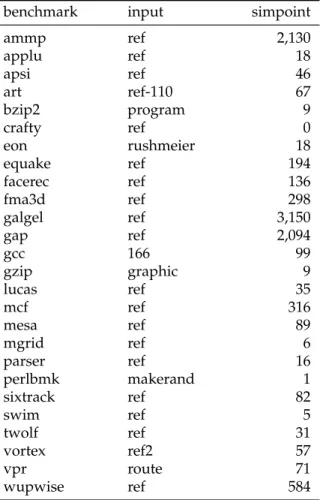
and the single 100 M-instruction simulation points being used. . . 39 4.2 Simulated processor models used for studying the
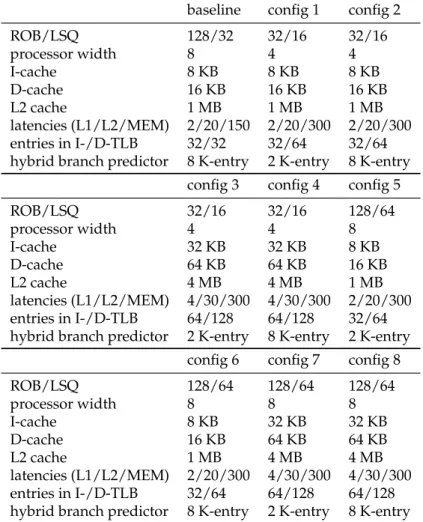
mem-ory data flow modeling. . . 40 5.1 Illustrating the reuse distance and the stack depth. . . 66 5.2 Comparing which memory hierarchy parameters that do
or do not require that a new statistical profile is com-puted for single-core statistical simulation versus mul-ticore statistical simulation. . . 78 5.3 The SPEC CPU2000 benchmarks and their global miss
rates for a 16 MB 16-way set-associative L2 cache. . . 80 5.4 Baseline processor core model with a shared L2 cache. . . 81 6.1 The multithreaded PARSEC benchmarks and their
refer-ence inputs. . . 110 6.2 Baseline processor core model with a shared L2 cache. . . 111
List of Figures
1.1 Diagram of a generic pipelined superscalar out-of-order processor. . . 3 1.2 Diagram of a generic chip-multiprocessor. . . 4 2.1 Trade-offs in architectural simulation and modeling. . . . 12 3.1 Statistical simulation: general framework. . . 20 3.2 Illustration of the statistical profile. . . 21 3.3 Illustrating synthetic trace generation. . . 24 4.1 Illustrating the importance of the accurate modeling of
overlapping long-latency loads. . . 33 4.2 Modeling delayed hits in the synthetic trace simulator. . 37 4.3 Minimum, maximum and average IPC estimates over
twenty different runs per SPEC CPU2000 benchmark. . . 41 4.4 Evaluating the accuracy of statistical simulation for the
baseline processor configuration. . . 43 4.5 Average IPC prediction errors for eight processor
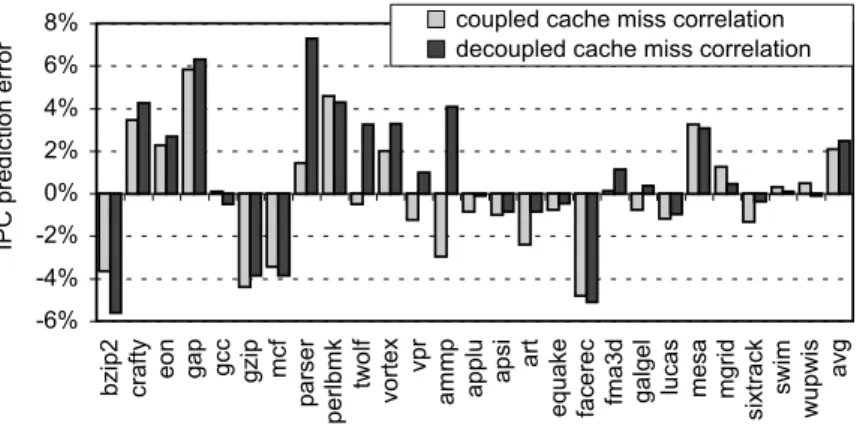
config-urations. . . 46 4.6 Comparing coupled versus decoupled cache miss
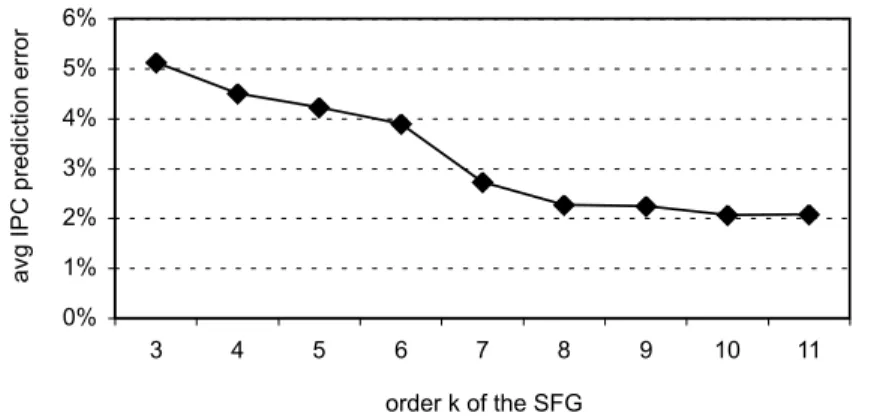
corre-lation modeling. . . 48 4.7 Average IPC prediction error as a function of the SFG’s
orderk. . . 49
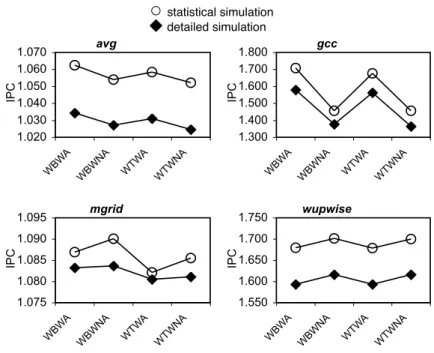
4.8 Average IPC prediction error as a function of the global cache hit/miss history length. . . 49 4.9 CPI breakdown for the SPEC CPU2000 benchmarks. . . . 51 4.10 IPC prediction errors for ten-billion-instruction sequences. 52 4.11 Estimating IPC as a function of cache line size. . . 53 4.12 Estimating IPC under four cache line updating policies. . 53 4.13 Varying the MSHR configuration. . . 54
4.14 Varying the number of store buffer entries. . . 54 4.15 Maximum relative IPC prediction error while varying
the D-cache latencies and the load/store queue size. . . . 56 4.16 Maximum variation in IPC prediction error observed
across eight processor configurations. . . 57 4.17 Average disk space requirements for storing the
statisti-cal profiles. . . 59 4.18 Average memory usage while computing the statistical
profiles. . . 60 5.1 Modeling time-varying behavior by dividing the
origi-nal program trace into intervals. . . 67 5.2 Dividing the original program trace into intervals
cap-tures the program phases. . . 69 5.3 Relative progress graphs illustrating the importance of
time-varying modeling. . . 70 5.4 Prediction error through statistical simulation with and
without modeling a program’s time-varying behavior. . . 71 5.5 Illustrating virtual to physical address translation during
statistical simulation. . . 72 5.6 High-level pseudocode for simulating caches with LRU
replacement policy during synthetic trace simulation. . . 76 5.7 High-level pseudocode for simulating DRAM during
synthetic trace simulation. . . 77 5.8 Evaluating the accuracy of statistical simulation for
ho-mogeneous multiprogram workloads. . . 83 5.9 Evaluating the per-core accuracy of statistical simulation
for heterogeneous workload mixes. . . 85 5.10 Evaluating the accuracy for heterogeneous workload
mixes in terms of STP and ANTT. . . 86 5.11 Evaluating the accuracy of statistical simulation for
ex-ploring CMP design spaces. . . 88 5.12 Evaluating the accuracy of statistical simulation for
ex-ploring CMP design spaces. . . 89 5.13 Evaluating the accuracy of multicore statistical
simula-tion as a funcsimula-tion of the cache configurasimula-tion. . . 91 5.14 Evaluating the accuracy of statistical simulation in terms
of system throughput for various DRAM configurations. 92 5.15 3D stacking case study. . . 93
LIST OF FIGURES xxiii
5.16 Average IPC prediction error as a function of synthetic trace length for homogeneous workloads. . . 94 6.1 Interval analysis analyzes performance on an interval
basis determined by disruptive miss events. . . 98 6.2 Schematic view of the interval simulation framework. . . 101 6.3 High-level pseudocode for multicore interval simulation. 103 6.4 Independent long-latency loads that will (not) overlap
with a blocking miss at the head of the ROB. . . 106 6.5 Illustrating critical path length computation during
in-terval simulation. . . 107 6.6 Evaluating interval simulation in a step-by-step manner. 113 6.7 Evaluating the accuracy of interval simulation for the
single-threaded SPEC CPU benchmarks. . . 115 6.8 Evaluating the accuracy for heterogeneous workload
mixes in terms of STP and ANTT. . . 117 6.9 Evaluating the accuracy of interval simulation for the
multithreaded full-system PARSEC workloads. . . 118 6.10 Evaluating the accuracy of multicore interval simulation
as a function of the cache configuration. . . 120 6.11 Evaluating interval simulation in a practical design
trade-off. . . 121 6.12 Simulation speedup compared to cycle-accurate
List of Abbreviations
ALU Arithmetic Logic Unit
ANTT Average Normalized Turnaround Time
BTB Branch Target Buffer
CMOS Complementary Metal Oxide Semiconductor
CMP Chip-Multiprocessor
CoV Coefficient of Variation CPI Cycles per Instruction CPU Central Processing Unit D-Cache Data Cache
D-TLB Data Translation Lookaside Buffer
DL1 Level-1 Data Cache
DL2 Level-2 Data Cache
DRAM Dynamic Random Access Memory
ED2P Energy-Delay-Square Product EPI Energy per Instruction
FPGA Field-Programmable Gate Array I-Cache Instruction Cache
I-TLB Instruction Translation Lookaside Buffer IL1 Level-1 Instruction Cache
IL2 Level-2 Instruction Cache ILP Instruction Level Parallelism IPC Instructions per Cycle ISA Instruction Set Architecture KIPS Kilo Instructions per Second
L1 Level-1 Cache
L2 Level-2 Cache
LSQ Load Store Queue
MIPS Million Instructions per Second
MLP Memory-Level Parallelism
OS Operating System
RAR Read after Read
RAW Read after Write
ROB Reorder Buffer
SFG Statistical Flow Graph
SMP Shared-memory Multiprocessor
SMT Simultaneous Multithreading
STP System Throughput
TLB Translation Lookaside Buffer
WAR Write after Read
Chapter 1
Introduction
Anyone who has never made a mistake has never tried anything new. Albert Einstein
Designing a microprocessor is extremely time-consuming: it can take up to seven years before a next-generation processor hits the mar-ket [56]. A long time-to-marmar-ket is undesirable, not only from an eco-nomical point of view, but also from a technical perspective. Processor architects make most of the high-level design decisions during the early stages of the design process, using benchmarks and compilers that are available at the time. If too much time elapses before the final processor becomes available then it could very well be that the processor deliv-ers suboptimal performance for emerging workloads that are different from the benchmarks that were used during the design process [80].
1.1 Microprocessor design challenges
In the following subsections, we will explain what causes this ex-tremely long development time, and we will discuss why future tech-nology trends worsen the problem. We will start with a brief overview of the history of a single-core processor, followed by a short intro-duction to chip-multiprocessors. We will then discuss the impact of processor technology and workload composition on architectural sim-ulation and how it impacts development time.
1.1.1 Trends in single-core processor technology
According to Moore’s law, transistor density on integrated CMOS cir-cuits doubles about every two years. This pace has kept up for over forty years. Throughout the years, computer architects have intro-duced several techniques to improve processor performance by putting more and more components on the chip.
In its simplest form, the CPU executes one instruction at a time in a sequential way. However, the execution of an instruction can be bro-ken into five more or less independent stages: (IF) fetch the instruction from memory, (ID) decode the instruction and generate the appropri-ate control signals, (EX) feed the control signals into the ALU and pro-duce a result, (MEM) read from memory, (WB) write the result back to the register file or to memory. The instruction throughput can be improved by overlapping the execution of multiple instructions each in a different stage of their execution, e.g., while one instruction is be-ing decoded, one can already fetch the next instruction from memory. This concept has led to pipelined architectures. The benefit is that the processor now consists of multiple stages with reduced complexity, al-lowing for higher clock rates. The classical pipeline has five stages, however, architectures with over ten pipeline stages are common for modern high-end processors.
The switch to pipelined architectures led to another concept, namely branch prediction and speculative execution. After a branch instruc-tion is fetched, the CPU does not yet know which instrucinstruc-tion address to fetch from in the next cycle, i.e., the direction and target of the branch are unknown before the branch gets to the writeback stage. However, we can try to predict what the next instruction address will be using a branch predictor. The CPU speculatively fetches instructions starting from the predicted address. If the target is predicted correctly then no time is wasted; if on the other hand, the target is mispredicted, the pipeline needs to be flushed and the execution restarts at the correct path.
In order to hide the access latency to main memory, processors now have a memory hierarchy. Multiple levels of on-chip and off-chip caches reside in between the execution core and main memory. Modern architectures typically have two or three levels of cache. The ones closer to the execution core tend to be smaller and thus faster than the ones further away. Caches are typically implemented as static RAM (or SRAM), which is much faster but more costly than the DRAM
1.1 Microprocessor design challenges 3
Figure 1.1:Diagram of a generic pipelined superscalar out-of-order processor.
technology used in main memory.
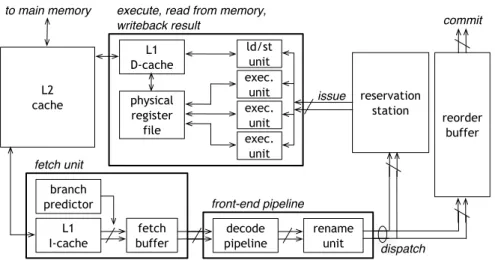
Superscalar out-of-order architectures boost performance by ex-ploiting instruction level-parallelism (ILP). The processor can execute multiple independent instructions simultaneously and out of the origi-nal program order. Figure 1.1 shows a diagram of a typical contempo-rary high-performance out-of-order processor; in the next paragraph, we will give a short overview of the most important features.
The fetch unit fetches the instructions from the level-one (L1) instruction-cache (I-cache), and in case of a branch, it accesses the branch predictor to determine the next instruction address to fetch from. Subsequently, the instructions move into the fetch buffer before being decoded. The register rename unit removes all write-after-write (WAW) and write-after-read (WAR) dependences by dynamically map-ping the instruction operands to real physical registers. Each stage can handle as many instructions per cycle as the bandwidth allows for, e.g., a fetch width of eight allows for eight instructions to be fetched per cycle. An instruction is dispatched into the reservation station (also called the issue queue) as long as the maximum dispatch width has not been exceeded, and provided that a reservation station entry is available. The reservation station entry keeps track of the read-after-write (RAW) dependences and issues the instruction to an available functional unit as soon as all input data dependences are resolved. It then becomes available for holding a newly dispatched instruction.
Figure 1.2: Diagram of a generic (two-core) chip-multiprocessor, sharing the
L2 cache, off-chip bus, etc. between all cores.
The functional unit executes the instruction and writes the result back to the physical register file, or in case of a load/store unit, it accesses the L1 data-cache (D-cache). The reorder buffer (ROB) keeps track of the status of all in-flight instructions, i.e., instructions in the back-end pipeline which have not yet completed. The reservation station and the ROB can be two separate structures or can be merged into one so called instruction window. Either way, they allow for ILP to be exploited. In addition, memory-level parallelism (MLP) is exploited, i.e., multiple reads and/or writes access the main memory simultaneously. Non-blocking caches allow for multiple outstanding misses, hereto miss status holding registers (MSHRs) are used to administer each miss and subsequent delayed hits to the same cache line.
Superscalar out-of-order processors are available on the high-performance processor market for over a decade. Some examples are: DEC Alpha 21264, MIPS R10000, Intel P6 family (Pentium Pro, Pentium III, Core, Core2, Core i7), Intel Pentium 4, AMD K5 through K8 and K10, IBM Power 1 through 5.
1.1.2 The shift towards chip-multiprocessors
Many of the enhancements mentioned in the previous subsection relate to instruction-level parallelism being exploited in order to increase per-formance. Thread-level parallelism is another type of parallelism that can be exploited by recently introduced chip-multiprocessors (CMP); also called multicore processors, see Figure 1.2 for a diagram of a typi-cal CMP with two cores. A multicore processor combines several cores
1.1 Microprocessor design challenges 5
on a single chip, sharing some resources such as last-level caches, on-chip interconnection network, off-on-chip bandwidth and main memory. Today’s microprocessors come with two to eight cores and it is to be expected that the number of cores will continue to increase. In fact, Intel has built a prototype with eighty cores during their (ongoing) ‘tera-scale’ computing research activities. Some examples of commer-cial CMPs are: Intel Core Duo, Core 2 Duo and Core i7, AMD K8 and K10, IBM Power 4 to 6 and Cell, Sun Niagara T1 and T2.
1.1.3 Architectural simulation
Computer architects use architectural simulation to drive design de-cisions early in the design cycle. At this stage it is infeasible and too costly to build hardware prototypes for performance evaluation stud-ies. Architectural simulators model the microarchitecture in software, at some level of abstraction. The benefit of architectural simulators is that they yield relatively accurate performance results, are highly pa-rameterizable and are very flexible to use.
The downside, however, is that they are at least three or four or-ders of magnitude slower than real hardware execution. Architectural simulators typically model the microprocessor in great detail, and very often, in a cycle-accurate manner. As more and more components of high complexity are modeled, more instructions need to be executed for each simulated instruction. As a result, culling a large design space through cycle-accurate simulation has become infeasible. While this is true for single-core processor simulation, the current trend towards chip-multiprocessors only exacerbates the problem. Several cores need to be simulated sequentially. In addition to single-core processor sim-ulation, the simulator must also model the conflict misses and the con-tention for shared resources. Hence, simulation speed has become a major concern in computer architecture research and development as the number of cores on a multicore processor increases.
In addition, developing an architectural simulator at a high level of detail is tedious, costly and very time-consuming. Thus, one could or even should pose the question whether this level of detail is needed or called for during every stage in the design cycle.
1.1.4 Workload composition
When designing a new processor, one starts with defining the target domain: what kind of applications will typically be run on the proces-sor? A representative workload, i.e., a set of benchmarks with their data input sets, is composed accordingly. The remainder of the de-sign process is based on this workload. Past and recent trends in the software world have led to long-running benchmarks combined with large input sets [1, 35]—today’s benchmarks execute several hundreds of billions or even trillions of instructions. This, in turn, has a nega-tive impact on simulation time, i.e., more instructions need to be sim-ulated, which prolongs the development time of new processors. Sim-ulating an industry-standard benchmark to completion for a single mi-croprocessor design point easily takes weeks to months, even on to-day’s fastest machines and simulators.
1.2 Focus and contributions in this dissertation
In this dissertation we focus on the early stage design space exploration of contemporary high-performance processors. In this context, we pro-pose and evaluate two simulation techniques, namely statistical simu-lation and interval simusimu-lation, which both reduce the simusimu-lation time significantly.Before doing so, we would like to state that we do not envision these techniques as a replacement for cycle-accurate architectural simulation. Instead, we view both simulation paradigms as useful complements to the other tools a computer designer has at his/her disposal when designing a microprocessor. Moreover, statistical simulation as well as interval simulation are orthogonal to and can be used in conjunction with other existing simulation speedup approaches such as sampled simulation and FPGA-accelerated simulation.
1.2.1 Statistical simulation
Statistical simulation is a recently introduced approach for efficiently culling the microprocessor design space [19, 20, 23, 58, 59, 61]. The ba-sic idea behind statistical simulation is to capture the essence of a real workload in a much shorter running synthetic trace. This is done in three steps. First, we measure a statistical profile of a program
execu-1.2 Focus and contributions in this dissertation 7
tion through (specialized) functional simulation or profiling; a statisti-cal profile collects a number of program execution characteristics, such as instruction mix, inter-instruction dependence distributions, branch behavior information and memory behavior information. These statis-tics are then used to build a synthetic trace; this synthetic trace ex-hibits the same execution characteristics as the original program trace by construction, but is much smaller in terms of its dynamic instruc-tion count. Simulating this synthetic trace then yields a performance estimate. Given its short length (on the order of a couple millions of instructions), simulating a synthetic trace is done very quickly.
1.2.2 Contribution #1: Accurate memory data flow modeling in statistical simulation
The memory subsystem has a significant impact on the overall perfor-mance of contemporary microprocessors. Poor modeling of the mem-ory data flow may yield large performance prediction errors. The state-of-the-art in statistical simulation prior to this dissertation considers simple memory data flow modeling, showing three major shortcom-ings.
First, none of the prior work accurately models cache miss patterns, or the number of instructions in the dynamic instruction stream be-tween misses. However, cache miss patterns have an important impact on the available memory-level parallelism. Independent long-latency misses that are close enough to each other in the dynamic instruction stream to make it into the reorder buffer together, (potentially) overlap their execution, thereby exposing memory-level parallelism. We accu-rately model cache miss patterns by collecting the cache characteristics dependent on a history of cache hit/miss outcomes.
Second, statistical simulation typically assigns hits and misses to loads and stores, and does not model delayed hits. A delayed hit, i.e., a hit to an outstanding cache line, is modeled as a cache hit although it should see the remaining latency of the outstanding cache line. We model delayed hits through cache line reuse distance distributions.
Third, none of the previously proposed statistical simulation ap-proaches adequately model load bypassing and load forwarding, i.e., it is assumed that loads never alias with preceding stores. We model aliasing through read-after-write memory dependence distributions.
prediction error in statistical simulation from 10.9% to 2.1%, while be-ing 2 to 4 orders of magnitude faster than detailed cycle-accurate simu-lation. A discussion on the improved memory data flow modeling has been published in:
Davy Genbrugge, Lieven Eeckhout and Koen De Bosschere, ”Ac-curate Memory Data Flow Modeling in Statistical Simulation”,
ICS ’06: Proceedings of the 20th Annual International Conference on Supercomputing, pp.87-96, Jun. 2006, [31].
Davy Genbrugge and Lieven Eeckhout, ”Memory Data Flow Modeling in Statistical Simulation for the Efficient Exploration of Microprocessor Design Spaces”,IEEE Transactions on Computers, Vol.57, No.1, pp.41-54, Jan. 2008, [29].
1.2.3 Contribution #2: Multicore statistical simulation
Previous work has explored the statistical simulation paradigm exten-sively for single-core out-of-order processor simulation; and one ear-lier study [60] and one more recent study [38] applied statistical simu-lation to multithreaded workloads running on shared-memory multi-processor systems. None of this prior work addresses the modeling of shared resources in chip-multiprocessors though. Co-executing threads affect each other’s performance through inter-thread synchronization and communication, as well as through the shared resources. Resource sharing may cause some threads to run slower than others. Changes in the microarchitecture may change which parts of the threads execute together. This change, in turn, may lead to different conflict behavior in the shared resources, which may lead to different relative progress rates for the co-executing threads.
We extend the statistical simulation technique to chip-multiproces-sors running multiprogram workloads. In order to capture the conflict behavior in shared resources, we model accesses to the memory hierar-chy in a microarchitecture-independent way. Hereto, we use the notion of stack depth inspired by the least-recently-used (LRU) cache replace-ment policy. In addition, we show that it is important to accurately model time-varying program execution behavior, in order to accurately capture conflict behavior in shared resources.
Our results show that statistical simulation with the aforemen-tioned enhancements is accurate and capable of tracking the trends in
1.2 Focus and contributions in this dissertation 9
a CMP design space. We report average performance prediction errors of less than 7.3%. A discussion on the modeling of conflict behavior in shared resources of a chip-multiprocessor has been published in:
Davy Genbrugge and Lieven Eeckhout, ”Statistical Simulation of Chip-Multiprocessors Running Multiprogram Workloads”,ICCD ’07: Proceedings of the 25th International Conference on Computer De-sign, pp.464-471, Oct. 2007, [28].
Davy Genbrugge and Lieven Eeckhout, ”Chip Multiprocessor Design Space Exploration through Statistical Simulation”, IEEE Transactions on Computers, Vol.58, No.12, pp.1668-1681, Dec. 2009, [30].
Lieven Eeckhout and Davy Genbrugge, Invited Chapter ”Statis-tical Simulation”, in ”Processor, Multicore and System-on-Chip Simulation”, Olivier Temam and Rainer Leupers (Eds.), Springer, 2010, [22].
1.2.4 Contribution #3: Interval simulation
Interval simulation is a novel, fast, accurate and easy-to-implement multicore simulation paradigm. Whereas other simulation techniques, including statistical simulation, increase simulation speed and have their place in the architect’s toolbox, they model a multicore processor at a high level of detail which impacts development time and which may not be needed for many practical research and development stud-ies. For example, when studying trade-offs in the memory hierarchy, cache coherence protocol or interconnection network of a multicore processor, cycle-accurate core-level simulation may not be needed. In-terval simulation raises the level of abstraction in architectural multi-core simulation to a level that makes multimulti-core simulator development tractable and speeds up multicore simulation substantially, while not compromising accuracy too much.
Interval simulation replaces the core-level cycle-accurate simulation model in a multicore simulator by a mechanistic analytical model. The mechanistic analytical model drives the timing simulation of the in-dividual cores without the detailed tracking of inin-dividual instructions through the cores’ pipeline stages. The basis for the mechanistic analyt-ical model is that a superscalar out-of-order core can smoothly stream instructions through its pipeline in the absence of miss events. Miss
events however divide the smooth streaming of instructions through the core’s pipeline into so called intervals. The analytical timing mod-els for the individual cores consult branch predictor, memory hierarchy and interconnection network simulators to derive miss events and their latencies. By analyzing the types of miss events and their latencies, we can derive the timing for each interval, which determines core-level and system-level performance.
The cooperation between the mechanistic analytical model and the miss event simulators enables the modeling of the tight performance entanglement between co-executing threads on multicore processors. We report average prediction errors below 6% while being one order of magnitude faster for multithreaded benchmarks running on a full-system simulator. Our core-level mechanistic analytical model is no more than one thousand lines of code versus twenty eight thousand lines for our detailed core-level model. An extensive discussion of this new simulation paradigm is presented in:
Davy Genbrugge, Stijn Eyerman and Lieven Eeckhout, ”Interval Simulation: Raising the Level of Abstraction in Architectural Sim-ulation”, Accepted for publication inHPCA ’10: Proceedings of the 16th International IEEE Symposium on High-Performance Computer Architecture, Jan. 2010, [32].
1.3 Thesis outline
This dissertation is organized as follows. In Chapter 2 we discuss ar-chitectural simulation and give an overview of other existing fast lation techniques. Chapter 3 describes the basics of the statistical simu-lation paradigm as we envision it, followed by a detailed discussion in Chapter 4 on how to accurately model memory data flow (Contribution #1). Chapter 5 discusses the enhancements to the statistical simulation paradigm for the purpose of CMP design space exploration running multiprogram workloads (Contribution #2). In Chapter 6 we discuss interval simulation and we show how raising the level of abstraction in architectural simulation addresses the two problems of simulator de-velopment time and simulation speed (Contribution #3). Finally, we conclude in Chapter 7 and we give some suggestions for future work.
Chapter 2
Architectural Simulation
A good simulation, be it a religious myth or scientific theory, gives us a sense of mastery over experience. To represent something symbolically, as we do when we speak or write, is somehow to capture it, thus making it one’s own. But with this appropriation comes the realization that we have denied the immediacy of reality and that in creating a substitute we have but spun another thread in the web of our grand illusion. Heinz Rudolf Pagels
Computer architects in industry and academia heavily rely on cycle-level (and in some cases truly cycle-accurate) simulators, i.e., architec-tural simulators are used at various stages during the design of a new processor. However, architectural cycle-level simulation is very costly in terms of simulation time as well as development time at the earliest stages of the design.
Architectural simulators model the microarchitecture at some level of abstraction, i.e., they provide detailed software models of proces-sor features such as caches, branch predictors, instruction windows, reorder buffers, load/store queues, etc. Typically, individual instruc-tions are tracked as they propagate through the processor’s pipeline. Industrial single-core simulators typically simulate one thousand to ten thousand (target) cycles per second (1 KHz to 10 KHz); academic sim-ulators typically run ten to a few hundred kilo instructions per second (KIPS) [14]. The input for these simulators are entire benchmarks, ex-ecuting hundreds of billions of instructions. Multicore processor sim-ulators exacerbate the problem because they have to simulate multi-ple cores, and have to model inter-core communication (e.g., coherence
Figure 2.1: Trade-offs in architectural simulation and modeling.
traffic) as well as resource contention in shared resources such as shared caches, interconnection network, chip I/O, etc.
Researchers and computer designers are well aware of the (multi-core) simulation problem and have proposed various methods for cop-ing with it. Figure 2.1 illustrates the trade-offs between accuracy, sim-ulation speed and simulator development time one has to make de-pending on the objective of a simulation technique. For example, when making system-level design decisions early in the design process, too much detail only gets in the way. One can then choose to trade accu-racy for simulation speed and development time, in order to define the high-level microarchitecture more quickly. On the other hand, when studying a particular low-level microarchitectural feature in detail, e.g., memory dependence prediction, one needs a more accurate but slower simulator, which is more costly to build.
Computer architects have a set of evaluation tools in their toolbox, often used in combination, i.e., many of the techniques are orthogonal. These tools include: functional simulation and full-system simulation, specialized cache and branch predictor simulation, trace-driven and execution-driven detailed cycle-accurate simulation, and many tech-niques to speedup the simulation such as sampling, parallelization, hardware acceleration, statistical and analytical modeling.
2.1 Functional simulation and full-system
simula-tion
Basically, a functional simulator implements an instruction set archi-tecture (ISA), i.e., it emulates how the output operand of an instruction is computed from its input operands. Functional simulation is most
2.2 Specialized cache and branch predictor simulation 13
useful for determining whether the design implements an instruction set correctly and whether a software program, including the operating system (OS), behaves as expected. It mimics the behavior of a micro-processor or the entire computer system. In other words, for a given program and its input, the emulator produces the same result as a real hardware execution. Functional simulation does not model any timing aspects, nor does it model the microarchitectural components. Conse-quently, functional simulation has poor accuracy with respect to perfor-mance evaluation, but on the other hand it is very fast. Moreover, the development cost is small because functional simulators have a long lifetime; a new implementation is needed only when the instruction set architecture changes.
For many programs, including the SPEC CPU benchmark suite, it is sufficient to emulate the system calls, without actually executing the kernel-space code. However, some applications such as webservers and databases require that the complete software stack from a real sys-tem runs on the simulator without modification. Moreover, the recent shift towards multicore processors running multithreaded applications drives the need for the simulation of the entire computer system, in-cluding the OS, device drivers, etc. (In particular, OS thread scheduling can affect program behavior.) Basically, a full-system simulator imple-ments an instruction set emulator and a virtual hardware layer capa-ble of booting an operating system. Examples of simulators with full-system support are SimOS [66], Simics [53], M5 [6] and PTLSim [81].
2.2 Specialized cache and branch predictor
simula-tion
When studying caches or branch predictors in isolation, one can use a specialized simulator. A functional simulator generates an instruction or address stream which is fed into the specialized simulator. The spe-cialized simulator models the cache hierarchy or the branch predictor in detail, but no other processor features are implemented.
Specialized simulation yields accurate cache miss rates or branch misprediction rates. However, overall performance accuracy is poor due to the lack of modeling other microarchitectural features which may have impact on the performance as well. The main benefit of these types of simulators lies in the low development cost and the high
sim-ulation speed. SimpleScalar [9] and M5 [6] are two example simsim-ulation tool sets which provide specialized simulation models. Sugumar and Abraham [70] show how multiple caches under optimal replacement can be simulated simultaneously. Other well-known cache simulators are DineroIV [18] and cachesim [10].
2.3 Trace-driven and execution-driven
cycle-accu-rate simulation
Highly accurate simulation models most of the microarchitectural fea-tures in a cycle-accurate manner. Cycle-accurate simulation comes in two variants: trace-driven simulation and execution-driven simulation. Trace-driven simulation separates the functional simulation from the timing simulation. A benchmark trace is generated with a func-tional simulator. This trace is fed into the detailed architectural timing simulator. The benefit of this approach is that a benchmark needs to be functionally simulated only once. A drawback is that these traces can be very large, requiring a lot of disk space. In addition, the traces do not incorporate instructions along mispredicted paths. Hence, it is impossible to model the effects these off-path instructions may have on performance.
Execution-driven simulation combines functional simulation and detailed architectural timing simulation, e.g., SimpleScalar [9], M5 [6], PTLSim [81], etc. The simulator takes the original binary program as input and executes it as it would be done on the real hardware. In such way, off-path instructions are simulated as well and the timing simula-tion captures the possible interference off-path instrucsimula-tions have on the overall performance.
Cycle-accurate simulation is very slow because it simulates all the processor features in detail. For the same reason it requires a long time to develop. Fortunately, the development time can be improved by providing a modular simulation infrastructure, such as Asim [24], Lib-erty [72] and Unisim [2].
2.4 Accelerating simulation 15
2.4 Accelerating simulation
As mentioned before, architectural simulation is very time-consuming. Throughout the years, researchers have proposed various techniques to speed up simulation. We will discuss some of these techniques in the following subsections.
2.4.1 Sampled simulation
The idea of sampled simulation is to simulate a limited number of pling units instead of the entire dynamic instruction stream. A sam-pling unit is a (small) fragment of consecutive instructions that is run on a detailed cycle-accurate simulator. One can use functional simula-tion in order to fast-forward between sampling units or use architec-tural checkpoints per sampling unit.
The major difficulty of sampled simulation is to select representa-tive sampling units, either one big sample or multiple small samples. A more general problem is that the execution of a program consists of sev-eral program phases. Therefore, sampling units must be chosen such that they represent each major program phase. The sampling units are selected either randomly (Conte et al. [17]), or periodically (SMARTS by Wunderlich et al. [79]), or based on phase analysis (SimPoint by Sher-wood et al. [67]).
Sampled simulation is fast and yields accurate performance esti-mates. Recent advances in architecture and microarchitecture state (re-)construction prior to each sampling unit enable the simulation of single-threaded benchmarks in the order of minutes with an error of around a few percent [73, 78].
2.4.2 Statistical simulation
The main objective of statistical simulation is similar to sampled simu-lation, i.e., the goal is to reduce the number of instructions that need to be simulated. Statistical simulation first records the distributions of im-portant program characteristics into a statistical profile. The statistical profile serves as input for a synthetic trace generator, which generates a much smaller trace compared to the original full program trace. This synthetic trace statistically resembles the original trace by construction. Simulating this synthetic trace on a cycle-accurate simulator yields
per-formance estimates.
Although statistical simulation is (slightly) less accurate compared to cycle-accurate simulation of the full program trace, it is still capable of accurately tracking performance trends throughout the design space. Moreover, simulating a synthetic trace is done very quickly because it is many orders of magnitude smaller than the full program trace.
Chapter 3 elaborates on the statistical simulation paradigm, which forms the basis for the work presented in Chapters 4 and 5.
2.4.3 Analytical modeling
There are basically three approaches to analytical performance mod-eling: empirical modeling, mechanistic modeling and hybrid empiri-cal/mechanistic modeling.
Empirical modeling, also called black-box modeling, learns a per-formance model through training and does not assume specific knowl-edge about the target processor. Ipek et al. [39] learn a model through neural networks, and Lee and Brooks [50] build a model through re-gression modeling. Lee et al. [51] leverage rere-gression modeling to pre-dict multiprocessor performance running multiprogram workloads.
Mechanistic modeling [26, 46, 47, 54, 69, 71] constructs a model by looking into the mechanisms in the target processor that affect the per-formance. Michaud et al. [54], Karkhanis and Smith [46], Taha and Wills [71] estimate performance through interval-based models which focus on the processor’s issue rate. By modeling the performance in terms of the processor’s dispatch behavior, Eyerman et al. [26] signifi-cantly simplify these interval models. These first-order core-level per-formance models serve as the basis for interval simulation which we describe in Chapter 6.
Hybrid mechanistic/empirical modeling proposes a mechanistic performance formula in which the parameters are derived through empirical modeling, see for example the pipeline model by Hartstein and Puzak [34].
2.4.4 Parallelized and/or hardware-accelerated simulation Architectural simulation is intrinsically highly parallelizable because it models hardware that has much inherent parallelism. By exploit-ing the coarse-grained parallelism in the simulator, one can
signifi-2.4 Accelerating simulation 17
cantly speedup the simulation. For example, the parallel Wisconsin Wind Tunnel II [57] achieves a speedup of factor five when simulating a thirty-two core target machine on an eight-core host processor ver-sus a single-core host processor. A disadvantage, is that a parallelized architectural simulator is tedious to develop. Penry et al. [63] build a structural model of a CMP that enables them to automatically paral-lelize the simulator. The individual components in the structural CMP model are designed to execute concurrently in hardware and are thus candidates to run in parallel in simulation.
In the recent years researchers have looked at field-programmable gate-arrays (FPGA) to speed up simulation, see for example RAMP by Wawrzynek et al. [77], FAST by Chiou et al. [15], Pellauer et al. [62] and Penry et al. [63]. FPGA-accelerated simulation speeds up simulation by mapping cycle-accurate timing models onto FPGAs. The simula-tion speedup comes from exploiting fine-grain parallelism in the FPGA. FPGA-integrated simulators typically run at a speed of a few million instructions per second (MIPS).
2.4.5 Interval simulation
As mentioned before, we propose a new simulation paradigm in this dissertation, namely, interval simulation. Interval simulation bridges the gap between detailed cycle-accurate simulation and mechanistic analytical performance modeling; it combines an interval-based core-level model [26] with specialized memory hierarchy, inter-connection network and branch predictor simulation. In other words, the analyt-ical core-level model replaces the detailed core-level model in a truly cycle-accurate simulator. In such way, it raises the level of abstraction.
Unlike all other techniques mentioned in this section, interval sim-ulation tackles the CMP simsim-ulation problem on two fronts, i.e., be-sides achieving a substantial simulation speedup, it significantly sim-plifies the simulator reducing development time and cost. In addi-tion, interval simulation does not compromise accuracy too much, i.e., it yields accurate performance estimates, and allows to make accurate high-level microarchitecture design decisions.
Technique Development Evaluation Accuracy Multicore
time time
Functional simulation excellent good poor yes
Specialized simulation
(cache & branch predictor) very good good poor yes Cycle-accurate simulation poor poor excellent yes
Sampled simulation poor good good yes
Analytical modeling excellent excellent good no Parallelized and
hardware-accelerated simulation very poor good excellent yes Statistical simulation poor to good very good good yes
Interval simulation very good good good yes
Table 2.1:Comparing simulation and modeling techniques in terms of
devel-opment time, evaluation time, accuracy, and ability to model multicore pro-cessors.
2.5 Overview and Discussion
Table 2.1 gives an overview of the simulation and modeling techniques in the toolbox of a computer architect. It summarizes the trade-offs of different techniques in terms of development time, evaluation time, and accuracy, and the ability to model multicore processors. It clearly illustrates the role of statistical simulation and interval simulation. Both techniques cope with the simulation speed problem, however, they tackle the problem on different sides: statistical simulation re-duces the number of instructions that need to be simulated, whereas interval simulation reduces the number of instructions that need to be executed on the host in order to simulate one instruction. In addition, interval simulation also tackles the development time problem.
Chapter 3
Statistical Simulation:
State-of-the-Art
Statistics are like bikinis. What they reveal is suggestive, but what they conceal is vital. Aaron Levenstein
Statistical performance modeling has gained a lot of interest over the past few years. This chapter describes the state-of-the-art in statistical simulation prior to this dissertation [19].
3.1 Single-core statistical simulation
Statistical simulation consists of three steps as shown in Figure 3.1. We first compute astatistical profile (i) through specialized functional sim-ulation and/or through profiling, using (dynamic) binary instrumen-tation. This profile contains a number of important program execu-tion characteristics such as control flow behavior, instrucexecu-tion mix, inter-instruction dependences, branch miss behavior, cache miss behavior, and TLB miss behavior. Subsequently, we use this statistical profile to generate asynthetic trace (ii) that is much smaller than the original program trace from which the profile was generated. In Chapter 4, we show that the synthetic trace can be up to 4 orders of magnitude smaller than the original program trace. The synthetic trace exhibits the same execution characteristics as the original program trace by construction. In the final step we simulate this synthetic trace (iii) on a statistical