Copyright by Yuhao Zhu
The Dissertation Committee for Yuhao Zhu
certifies that this is the approved version of the following dissertation:
Energy-Efficient Mobile Web Computing
Committee:
Vijay Janapa Reddi, Supervisor Lizy K. John
Derek Chiou Christine Julien Scott Mahlke
Energy-Efficient Mobile Web Computing
by
Yuhao Zhu, B.E.,; M.S.E.
DISSERTATION
Presented to the Faculty of the Graduate School of The University of Texas at Austin
in Partial Fulfillment of the Requirements
for the Degree of
DOCTOR OF PHILOSOPHY
THE UNIVERSITY OF TEXAS AT AUSTIN May 2017
Dedicated to my wife Yunjing Luo
Acknowledgments
I wish to thank the multitudes of people who helped me throughout this journey. First and foremost, I would like to thank The University of Texas at Austin, and the taxpayers of the great state of Texas, for supporting me to pursue a degree in a filed that I am truly passionate about. Among many things, UT Austin provides a stimulating, diverse, and welcoming environment for intellectual explorations that one could ever imagine having.
I would like to express my sincere gratitude to my advisor Vijay Janapa Reddi, who turned me from a student to a researcher. I came to UT as an avocational computer architecture enthusiast. Vijay patiently taught me how to turn half-baked ideas to high-quality research papers, and how to turn individual papers into a dissertation. I appreciate the many technical and visionary discussions that he had with me while walking on campus.
Vijay also trained me to be a long-term investor. In my first semester working with Vijay, he spent over a thousand dollars to send us to a half-day course on information visualization. He later sent us to other venues such as training mental agility. Although some of these investments might have not paid off immediately toward a paper—some never will—it gradually shaped my mindset beyond just becoming a better graduate student to becoming a better person, which I will forever benefit from.
I would also like to thank other members of my dissertation commit-tee: Lizy John, Derek Chiou, Christine Julien, and Scott Mahlke. Their keen insights and feedbacks are absolutely invaluable in developing and refining the concepts in my dissertation. In addition, Lizy taught me Computer Perfor-mance Evaluation and Benchmarking, and Derek taught me Parallel Archi-tecture; both helped me form the computer architecture foundations. Special thanks to Christine and Scott who gave me many pieces of advice and wrote me recommendation letters for my job search.
During my time at UT, I also had the privilege to interact and work with other faculty members, in particular Mattan Erez, Mohit Tiwari, and Yale Patt. Mattan is a calm, sharp, and encouraging human being who I look up to. He taught me Computer Architecture during my first semester in UT (and this country), which is the reason that I now can talk comfortably about computer architecture. Mohit is always there to provide me lots of advice in career development. I worked with Dr. Patt during my first year as a graduate researcher and as a teaching assistant for his Computer Architecture course in my second semester. The interactions with him provided me unique perspectives that I would have gotten from nowhere otherwise.
I had four summer internships during my graduate study, and I want to thank my mentors during each internship. Osvaldo Colavin was my mentor at STMicroelectronics in summer 2011. We first met at DAC that year at San Diego, and he later made me an internship offer. I thank Osvaldo for truly opening my eyes to the industry for the first time. Mauricio Breternitz was
my mentor during my two internships at AMD Research in summer 2012 and 2013. I admire his incredible experience in hardware and software industry. He gave me the opportunity to integrate several AMD specific hardware per-formance counters into thelibpfm in my first internship, and gave me lots of freedom to explore Web browser caching during my second internship. Nat Duca was my mentor during my internship at the Google Chrome team in summer 2015. Even to this day I couldn’t believe that I had worked with Nat. Nat is an incredible person and great friend who continues to help me after the internship. He also connected me with many other wonderful Chrome engineers—the reason that the Web is well alive and kicking!
My lab mates and friends at UT Austin not only help me academically, but also always encourage me to never back off from challenges, and I greatly thank them for that. Jingwen Leng and Aditya Srikanth helped me with my first project to get my research started. Jingwen and I had a lot of fun beyond research. Among many things, we often drove to Houston just to play snooker, and flew to UK to watch snooker games. Daniel Richins and Wenzhi Cui helped me with the Node.js project. Wenzhi would always listen to my nonsense ideas. Matthew Halpern helped me witheverything since he joined. He acts as a cheerleader when I am down and keeps me sane. I have also met many friends at UT and Austin who I want to thank: Song Zhang, Haishan Zhu, Tianhao Zheng, Yazhou Zu, Yong Li, Minsoo Rhu, Milad Hashemi, Faruk Guvenilir, and Khubaib. Special thanks to Khubaib who mentored me during my first year working with Dr. Patt and continued to support me after that.
I am grateful to the Google Ph.D. fellowship for supporting my Ph.D. research. Matt Welsh is my fellowship mentor, who is a true enemy of hog-wash. Matt has supported my research throughout my entire graduate study by being an advocator inside Google for our research. He also generously wrote a recommendation letter for my job search. I was also supported by the Mi-croelectronics and Computer Development Fellowship at the Cockrell School of Engineering in UT Austin during my second year.
I also want to thank my undergraduate advisor Yangdong (Steve) Deng at Tsinghua University. I was an undergrad at Beihang University, and Steve just came back from the United States to start his lab. I anxiously sent him a cold email expressing my interests, and (not) surprisingly he decided to bring me to the lab. We together worked on GPGPU programming and microarchitecture, which greatly raised my interests in system architectures. He encourages me to think big and makes me believe that I, too, could publish first-class research results. I would never get a Ph.D. if not for the one year working and interacting with Steve.
Most importantly, not a single word of this dissertation would happen without the support of my loving family. My parents, Qinxiong Zhu and Xiaojing Yu, care about me more than themselves and never hold me off in pursuing whatever I am passionate about, even if that means they only saw me four times in the past seven years. Finally, I thank my wife Yunjing Luo for always being there since we first met in 2012. Although she believes that I could have finished Ph.D. sooner without her, I believe otherwise.
Energy-Efficient Mobile Web Computing
Publication No.
Yuhao Zhu, Ph.D.
The University of Texas at Austin, 2017 Supervisor: Vijay Janapa Reddi
Next-generation Web services will be primarily accessed through mobile devices. However, mobile devices are low-performance and stringently energy-constrained. In my dissertation, I propose the design of a high-performance and energy-efficient mobile Web computing substrate. It is a hardware/software co-designed system that delivers satisfactory user quality-of-service (QoS) ex-perience on a mobile energy budget. The key insight is that the traditional interfaces between different Web stacks need to be enhanced with new abstrac-tions that express user QoS experience and that expose architectural-level complexities. On the basis of the enhanced interfaces, I propose synergis-tic cross-layer optimizations across the processor architecture, Web runtime, programming language, and application layers to maximize the whole system efficiency. The contributions made in this dissertation will likely have a long-term impact because the target application domain, the Web, is becoming a universal mobile development platform, and because our solutions target the fundamental computation layers of the Web domain.
Table of Contents
Acknowledgments v
Abstract ix
List of Tables xiv
List of Figures xv Chapter 1. Introduction 1 1.1 Research Contributions . . . 3 1.2 Long-term Impact . . . 6 1.3 Research Scope . . . 7 1.4 Dissertation Organization . . . 10
1.5 Previously Published Material . . . 10
Chapter 2. Web: A Universal Application Platform 13 2.1 The Scope of the Web . . . 13
2.2 Web Languages and The Web Browser Runtime . . . 14
Chapter 3. The Need for High-Performance and Energy-Efficient Computation in Mobile Web 17 3.1 The Need for Compute Performance in Mobile Web . . . 18
3.2 The Need for Energy-Efficient Computation . . . 22
Chapter 4. WebCore: A Mobile Processor Architecture for Web Computing 26 4.1 Experimental Setup . . . 29
4.2 Customizing General-Purpose Cores . . . 32
4.2.1 Design Space Exploration . . . 33
4.2.3 Sources of Inefficiency . . . 40
4.3 Style Resolution Unit . . . 43
4.3.1 Motivation . . . 44
4.3.2 Hardware Design . . . 46
4.3.3 Software Support and Programmability . . . 49
4.4 Browser Engine Cache . . . 50
4.4.1 Motivation . . . 51
4.4.2 Hardware Design . . . 53
4.4.3 Software Support and Programmability . . . 55
4.5 WebCore Evaluation . . . 57
4.5.1 Overhead Analysis . . . 58
4.5.2 Style Resolution Unit . . . 59
4.5.3 Browser Engine Cache . . . 61
4.5.4 Combined Evaluation . . . 64
4.6 Related Work . . . 67
4.6.1 Architecture Specializations for the Web . . . 68
4.6.2 Specialized Cache Design . . . 69
4.6.3 Web Applications Characterization . . . 70
Chapter 5. WebRT: Energy-Efficient Web Browser Runtime 71 5.1 Experimental Setup . . . 73
5.2 LTM Model of Mobile User Interaction . . . 74
5.3 Motivation: Energy-Delay Trade-off . . . 76
5.3.1 Representative Analysis . . . 77
5.3.2 Comprehensive Analysis . . . 79
5.4 Webpage-aware Scheduling . . . 81
5.4.1 Performance and Energy Modeling . . . 83
5.4.2 Model Evaluation . . . 86
5.4.3 Scheduler Implementation . . . 89
5.4.4 Evaluation . . . 90
5.5 Event-based Scheduling . . . 97
5.5.2 Scheduler Design Overview . . . 99
5.5.3 Scheduler Implementation Details . . . 101
5.5.4 Experimental Setup . . . 107
5.5.5 Evaluation . . . 109
5.6 Related Work . . . 119
5.6.1 Single ISA/DVFS Scheduling . . . 119
5.6.2 Web Performance Optimizations . . . 121
5.6.3 Web Energy Optimizations . . . 121
Chapter 6. GreenWeb: Web Language Extensions for Energy-Efficient Web Computing 123 6.1 Trade-off Between QoS, Performance, and Energy . . . 125
6.2 QoS Abstractions for Web Applications . . . 127
6.2.1 QoS Type . . . 128
6.2.2 QoS Target . . . 131
6.3 QoS-Aware Web API Design . . . 133
6.3.1 Design Principles . . . 133
6.3.2 QoS-Aware Web API Design . . . 134
6.3.3 Example Usage . . . 137
6.4 Automatic Annotation . . . 141
6.5 GreenWeb and WebRT Inteplay . . . 143
6.6 Evaluation . . . 144
6.6.1 Energy-Efficiency Improvement . . . 144
6.6.2 Annotation Effort . . . 149
6.7 Discussion . . . 151
6.8 Related Work . . . 153
6.8.1 Language Support for Web Performance . . . 154
6.8.2 Language Support for Energy Efficiency . . . 154
6.8.3 Mobile QoS Characterization . . . 156
Chapter 7. Retrospective and Prospective Remarks 157 7.1 Retrospective . . . 157
Bibliography 163
List of Tables
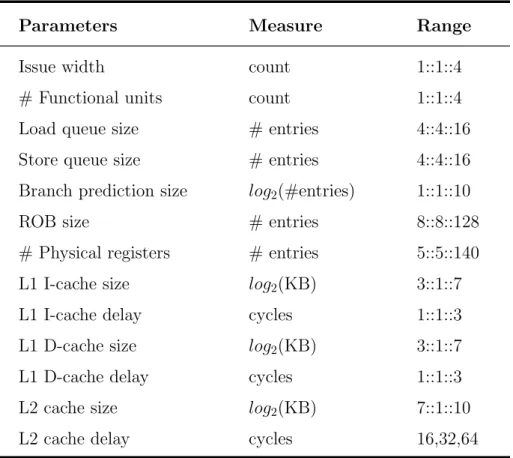
4.1 Microarchitecture design-space parameters. The first column shows the parameters that are considered in our DSE. The sec-ond column shows the metric that the value of each parameter is measured. The i::j::k in the third column denotes values ranging from i tok at steps of j . . . 34 4.2 Microarchitecture configurations for P1 and P2 in Figure 4.3.
They represent different energy-delay trade-offs. For compari-son purpose, we also show the parameters for ARM Cortex-A15, whose information is gather from measurements using the 7-Zip LZMA Benchmark [53] and ARM’s public presentation [56]. . 42 5.1 Model Predictors . . . 82 5.2 List of evaluated applications. “Interaction Description”
pro-vides a high-level description of the kind of interactions that are performed on each application. “Time” indicates the total interaction duration. “Events” indicates the amount of events triggered during an interaction. . . 110 6.1 Interactions in mobile Web applications fall into three categories
based on different QoS type and QoS target combinations. . . 129 6.2 Specifications of the GreenWeb APIs. Each API is a new CSS
rule specifying the QoS information when a particular event is triggered on certain Web application element. . . 135 6.3 Applications used for evaluating GreenWeb. They are the same
as the ones used for evaluating EBS in Chapter 5.5.5. “An-notation” indicates percentage of events that are annotated. “Events” indicates the amount of events triggered during full interaction. Note: we only annotate and count events that are directly triggered by mobile user interactions as discussed in Chapter 5.2. Applications marked with * are manually anno-tated because they are developed using libraries that Auto-Green does not currently support. Their annotation percent-age numbers are estimated. . . 145
List of Figures
1.1 Overview of my cross-layer research contributions. . . 5
1.2 The mobile Web computing scope. My research takes a compute-driven, client-centric approach. . . 8
2.1 A typical Web browser architecture. . . 15
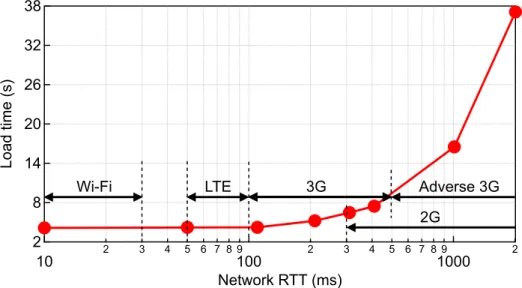
3.1 Webpage load time with respect to changing network latency. Each marker corresponds to an RTT value. We also super-impose the round-trip time (RTT) range for different cellular technologies derived from both technical specifications as well as real measurements in the field [1, 97]. . . 19
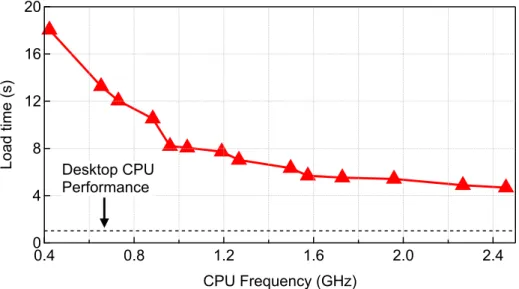
3.2 Webpage load time with respect to CPU frequency on a Galaxy S5 smartphone. The markers represent CPU frequencies, which range from 0.4 GHz (left) to 2.5 GHz (right). We also overlay the load time on a desktop CPU (the dotted line) for comparison purpose. . . 21
3.3 The correlation between smartphone battery capacities and their screen sizes. There is an almost linear relationship over the time. 23 3.4 CPU measured peak power consumption has increased signif-icantly compared to other key mobile device components over the years. In particular, the multicore CPU power alone can exceed SoC-level TDP. . . 24
4.1 We pick 24 representative webpages from 10,000 of the hottest webpages as per www.alexa.com . . . 30
4.2 www.cnn.com is a representative webpage from our benchmark suite because it is almost the centroid. . . 36
4.3 In-order versus out-of-order Pareto optimal frontiers. . . 37
4.4 In-order Pareto optimal frontier for each kernel. . . 39
4.5 Out-of-order Pareto optimal frontier for each kernel. . . 40 4.6 Pseudo-code of theStyle kernel. It consists of a matching phase
and an applying phase. SRU accelerates the applying phase, which takes about two-thirds of the Style kernel execution time. 45
4.7 SRU coupled with scratchpad memories. . . 46
4.8 Analysis of RLP and CSS properties across webpages. . . 48
4.9 Pseudo-code of the Style kernel with the new API. . . 49
4.10 DOM tree access behavior across webpages. . . 51
4.11 Representative DOM tree access patterns. . . 55
4.12 Using theDOMCache ST()API in the rendering engine. The new DOM attribute store API (line 4 in the new code) replaces the original attribute value assignment (line 4 in the original code), and performs cache management. . . 56
4.13 Performance and energy improvement of the SRU. . . 60
4.14 Energy savings with a browser engine cache. . . 62
4.15 DOM Cache and Render Cache hit rate for desktop webpages. 63 4.16 Execution time with the browser engine cache of the three de-signs. Values are normalized to each design’s baseline configu-ration without the browser engine cache. . . 64
4.17 Energy-efficiency improvement over three designs. . . 65
4.18 Allocating area for caches versus specializations. . . 67
5.1 The LTM (Loading-Tapping-Moving) user-application interac-tion model of mobile Web. LTM captures three primitive types of interaction: page loading, finger tapping, and finger moving. We use LTM as a framework to reason about user QoS experience. 74 5.2 Webpages have different ideal execution configurations to meet the cut-off latency while consuming the least energy. . . 78
5.3 The distribution of ideal core and frequency configurations un-der different cut-off latencies. . . 80
5.4 Predictor correlations. . . 85
5.5 CDF of prediction errors. . . 88
5.6 CDF of webpage load time under different configurations. . . . 91
5.7 Evaluation of different scheduling strategies. . . 92
5.8 Distribution of per-webpage energy comparisons. . . 96
5.9 Event handler variation in Ember.js todo list application. . . . 98
5.11 The simplified view of frame lifetime in modern multiprocess/thread browsers. A frame starts when the browser process receives an input event and ends when the frame is displayed and the browser process is signaled. In between, an input event is pro-cessed by different stages spread across multiple threads. Dif-ferent input events might interleave with each other. . . 103 5.12 Frame tracking algorithm. The key idea is to attach each input
event with a metadata (Msg in the code) that uniquely identi-fies an input event and is propagated with the event. We use two colors to represent metadata of two different events in this example. . . 105 5.13 The event execution trace of Paper.js under three different
run-time schemesr. . . 111 5.14 The latency and energy model accuracy forPaper.js, which has the
median accuracy of all the applications. . . 112 5.15 Energy consumption normalized to Perf. Lower is better. . . . 113 5.16 The architecture configuration distribution under the
“imper-ceptible” (EBS-I) and “usable” (EBS-U) usage scenario. . . 114 5.17 Execution configuration switching frequency under EBS-I and
EBS-U. Two configuration switching types exist: CPU fre-quency switch (solid) and core migrations (stripe). . . 116 5.18 QoS violations are presented as additional violations on top
of Perf. The y-axis of the two figures are kept the same for comparion purposes. . . 117 6.1 The interplay between QoS, performance, and energy. . . 126 6.2 The syntax of GreenWeblanguage extensions. . . 134 6.3 Express the QoS type of ontouchstart event as “continuous,”
and use the default PI and PU values. . . 138 6.4 Express the QoS type of ontouchmove event as “continuous,”
and use 20 ms and 100 ms as the new QoS targets. . . 139 6.5 AutoGreen’s workflow to automatically annotate mobile Web
applications with GreenWeb APIs. . . 142 6.6 Microbenchmarking results. Energy numbers are normalized
to Perf, which provides the best QoS and consumes the most energy. QoS violations are presented as additional violations on top ofPerf. GreenWeb-I andGreenWeb-U areGreenWebunder two usage scenarios. . . 146
Chapter 1
Introduction
Web technologies have shaped how we think, communicate, and inno-vate. Over the past decade, the Web’s role shifted from solely information retrieval (Web 1.0) to providing interactive user experiences (Web 2.0). Now the Web is once again on the cusp of a new evolution that features automatic recognition, mining, and synthesis of user-originated “big data.” The driv-ing force behind this evolution is today’s most pervasive personal computdriv-ing platform—mobile devices. It is estimated that 3 billion Web-connected mo-bile devices currently exist, and will reach nearly 50 billion by 2020 [91]. The trend is clear: next-generation Web services will be primarily accessed through mobile devices instead of desktops and laptops as in previous generations [121]. While there are significant growth opportunities for mobile Web com-puting, standing in the way are technology challenges. Specifically, there is a fundamental tension between the ever-increasing computation intensity of Web technologies and the performance and energy-constrained nature of mobile de-vices. Such a mismatch between computational “demand and supply” leads to poor quality-of-service (QoS) experience, resulting in severe consequences. For example, Google estimated that “a 400 ms delay leads to a 0.44% drop in
search volume.” [110] Similarly, Amazon concluded that a 1-second delay in webpage load time could translate to $1.6 billion lost in sales annually [87].
Conventional techniques to improve mobile compute capability have largely been focused on CPU design, largely by adopting desktop-oriented de-sign techniques, i.e., to apply aggressive (micro-)architecture mechanisms for both single-core and multi-core performance while relying the underlying cir-cuit techniques (i.e., Dennard Scaling [84]) for power and energy-efficiency [104]. However, as the demise of the graceful Dennard scaling becomes a reality [90], excessive power and energy consumption will eventually put the CPU-centric, desktop-like design strategy to its end.
Thesis Statement To sustain mobile performance improvement while being energy-efficient, we must deviate away from the traditional CPU-only mentality. Instead, we must expand the research scope to the entire Web computing stack spanning architecture, runtime, and programming language layers. Following this tenet, my dissertation proposes hardware accelerators, runtime scheduling mechanisms, and programmers-assisted language annota-tions, the combination of which forms a hardware/software co-designed com-puting substrate that improves mobile Web performance and energy-efficiency. The rest of this chapter is organized as follows. Chapter 1.1 provides an overview of my research contributions. Chapter 1.2 discusses the long-term impact of my work. Chapter 1.3 puts my work in the broad context of mobile computing. Chapter 1.4 outlines the rest of the dissertation and Chapter 1.5 lists previously published materials that this dissertation draws upon.
1.1
Research Contributions
The key theme of my work is to deviate away from the general-purpose CPU-centric mindset and to take a holistic view of the mobile Web compu-tation stack spanning application, Web browser runtime, and processor archi-tecture layers. I contend that improving energy-efficiency and performance of mobile Web computing requires us to enhance the traditional computing inter-faces withnew abstractions and to leverage the new interfaces for cross-layer optimizations. As such, the central challenge of my research is to carefully forge new abstractions that expose optimization opportunities while enabling effective and practical optimization mechanisms.
At the application/Web browser boundary, current Web applications merely specify visual appearance and functionalities to the browser through Web languages such as HTML, CSS, and JavaScript. User QoS requirements (e.g., latency tolerance) are unexpressed. However, different users QoS re-quirements lead to different optimal runtime decisions for trading off QoS with energy consumption. Exposing user QoS expectations at the application level would allow the Web runtime to budget wisely the energy usage while delivering satisfactory user QoS experience.
At the Web browser/architecture boundary, the traditional interface provides to the Web browser runtime a simplistic and monolithic execution model of the hardware. However, today’s mobile processors are becoming extremely complex, combining general-purpose cores that have different per-formance and energy characteristics [124] with special-purpose domain-specific
accelerators. While the hardware upheaval promises performance and energy improvements for the mobile Web, its practical impact depends on how effec-tive the Web browser can leverage it. I see both needs on specializing the pro-cessor architecture for the Web domain that enriches the runtime/architecture interface and on designing an intelligent Web browser runtime that can effec-tively manage the complex interface to optimize for energy-efficiency.
In the spirit of enhancing the traditional Web computing stack inter-faces and leveraging the new interinter-faces to optimize each layer, my dissertation makes the following three contributions. Figure 1.1 provides an overview of the contributions. Enhancements to the existing Web stack are shaded.
• Web Language Extensions: I propose GreenWeb, a set of program-ming language extensions that let Web developers express user QoS ex-pectations as program annotations. GreenWeb enhances the traditional application-runtime interface with two new programming abstractions, QoS type and QoS target, that capture two critical aspects of user QoS experience. Exposing QoS requirements in Web applications effectively guides the underlying Web runtime to determine how to deliver the tar-get QoS experience while minimizing the energy consumption. GreenWeb does not pose any constraints on specific runtime implementations but instead supports general energy optimization techniques.
• Smart Web Browser Runtime: I propose WebRT, a mobile Web browser runtime that optimizes for energy-efficiency while delivering the
W eb Languages W eb Br owser Runtime
Security Rendering Network Input
GreenWeb Extensions WebRT Feedback-Driven W eb Runtime Module
General- purpose Processor
WebCore Mobile Pr ocessor Ar chitectur e W eb Applications W eb-specific Processor Mo n o lit h ic Exe cu ti o n T ra d it io n a l In te rf a ce s En h a n ce d In te rf a ce s C o mp u ta ti o n T a sks <C o re , F re q > Ma p p in g Pe rf , En e rg y Resear ch Contributions Ener gy-A war e W eb Language Extensions ( § 6) ➣
eQoS: QoS, Perf. and Ener
gy T rade-o ff s ➣ QoS T
ype and QoS T
ar get Abstractions ➣ Gr eenW eb Language Design Ener gy-E ffi cient W eb Br owser Runtime ( § 5) ➣ L TM User
-Application Interaction Model
➣ W ebpage-awar e Scheduling ➣ Event-based Scheduling W eb-specific Mobile Pr ocessor Ar chitectur e ( § 4) ➣ General-purpose Cor e Customization ➣
Specialized Domain-specific Accelerator
Mobile W eb Computing Statck D isp la y Ba tt e ry N e tw o rk Device-level Characterizations ( § 3) ➣
Network vs. Compute Performance Analysis
➣
Display vs. Radio vs. Compute Power Analysis
St ru ct u re , St yl e , F u n ct io n a lit y Q o S typ e , Q o S ta rg e t Fig. 1.1: Ov erview of m y cross-la y er researc h con trib utions.
specified user QoS requirements. AlthoughWebRTis a generic runtime de-sign, I demonstrate a prototype implementation based on the asymmetric chip-multiprocessor (ACMP) hardware architecture. ACMP exposes two new architecture-level abstractions: core type and core frequency. WebRT leverages the new abstractions and dynamically provisions the hardware resources according to user QoS requirements for energy savings. In addi-tion, WebRT also continuously monitors the runtime execution behaviors to enable feedback-driven optimizations, which is critical considering the interactive nature of mobile applications.
• Web-Specific Processor Architecture: I proposeWebCore, a forward-looking mobile CPU architecture customized and specialized for the Web stack. The WebCore improves performance and energy-efficiency simul-taneously by integrating domain-specific hardware that exploits critical computation kernels and data communication patterns. A key design goal of WebCore is maintain general-purpose programmability, which is vital to ensure its applicability to the complex Web software stack. Over-all, WebCoredeepens the heterogeneity of the mobile processor architec-ture and enlarges the performance-energy trade-off space that the Web runtime can take advantage of.
1.2
Long-term Impact
Mobile hardware and Web software ecosystems undergo rapid design cycles to keep up with constant innovations. It is vital to ensure that any
research contributions to this domain have long-term impact, or they perish. The long-term impact of my work lies in two fundamental aspects. First, the problem that I study is a long-term research agenda. The key chal-lenge that my research focuses on, i.e., performance and energy-efficiency, will always be at the forefront of mobile computing research. As the battleground of mobile computing gradually shifts into even smaller form factors such as wearables and Internet-of-Things (IoT) devices, improving performance and energy-efficiency of mobile computing is ever important.
Second, my proposed techniques have long-term applicability because they focus on the fundamental computation layers of Web technologies rather than being tied to the specifics of today’s systems. For instance, WebCore proposes a hardware units that optimizes CSS processing, which is a corner-stone technology that remains largely unchanged as new Web standards and specifications come and go. Similarly, the designs ofWebRT and GreenWeb are also generally applicable because they are do not rely on a particular form of the underlying processor (micro-)architecture or application features.
1.3
Research Scope
The scope of mobile Web computing is broad and becoming increasingly rich. It involves two critical components: compute and network. The compute component can be further classified by approaches that are either client-centric or based on cloud-offloading. Figure 1.2 shows the hierarchy of the mobile Web scope. My research judiciously focuses on the client-side compute. In other
Client-Centric
Mobile Web
Compute Network Cloud-Offloading (Traditional Bottleneck) (Limited Applicability) My Research ScopeFig. 1.2: The mobile Web computing scope. My research takes a compute-driven, client-centric approach.
words, it takes a compute-driven and client-centric approach. This section discusses my rational. The goal here is not to dismiss research in network and cloud computing community, but to explain the trade-offs between different approaches and thereby set the context for my work.
Compute-versus-Network Traditionally when the scope of Web computing was merely about serving static webpages, Web performance was predominantly bottlenecked by network capability because very little process-ing was involved. However, this trend is changprocess-ing. Over the past decade cel-lular network technology has improved dramatically. For example, the round-trip time is improved by two orders of magnitude from 2G to LTE [111]. Meanwhile, the computational requirements posed by new Web technologies (e.g., CSS3, HTML5, WebGL) keep increasing. For instance, under the same network condition the processing time for loading the same website from dif-ferent years over the past decade has increased by as much as 10X [185]. The
combined effect of faster network performance and higher computation de-mand implies that future mobile Web performance will be unattainable with-out improving the compute capability. An in-depth computer-versus-network bottleneck analysis can be found in Chapter 3.1.
Client-versus-Cloud Compute in mobile Web has been primar-ily carried out by client-side devices only. Recently researcher have started investigating a new compute paradigm where part of the computation is of-floaded to cloud platforms through wireless connections—the so called mobile cloud computing (MCC). Although MCC is a promising approach that ex-tends the capability of mobile devices for computation-intensive applications, it has three major limitations. First, today’s Web applications are extremely dynamic where both data and code can be generated at runtime depending on user-specific information (e.g., via sensors). The dynamic nature of Web ap-plications leads to frequent synchronizations between client and cloud that po-tentially undermine the performance and energy-efficiency benefits that MCC brings. Second, MCC assumes the availability of wireless connections, which limits its usage scenario. Third, MCC raises security and privacy concerns as data and computation are transmitted over the network.
The limitations stated above indicate that a handful questions need to be addressed for MCC to succeed. That said, future mobile Web computing systems will most certainly incorporate certain aspects of cloud-offloading, a quantitative trade-off study of which is warranted but beyond my scope.
1.4
Dissertation Organization
The rest of my dissertation is organized as follows. Chapter 2 intro-duces the preliminary knowledge of Web computing. Chapter 3 quantitatively demonstrates the need for high-performance and energy-efficient computation in the mobile Web, which directly motivates the research theme of my work. Chapter 4, Chapter 5, and Chapter 6 describe the proposed WebCore,WebRT, and GreenWebat the architecture, runtime, and programming language layer, respectively. Chapter 7 provides a retrospective and prospective view of my dissertation work. The retrospective part summarizes the principles distilled from this work on building a high-performance while energy-efficient mobile Web computing system; the prospective part suggests next steps for general-izing the principles and outlines potential research items for future work.
1.5
Previously Published Material
This dissertation contains materials that are previously published in peer-reviewed conferences and journals:
Chapter 3. The network-versus-computer analysis in Chapter 3.1 contains results from the following paper: The Role of the CPU in Energy-Efficient Mobile Web Browsing. Yuhao Zhu, Matthew Halpern and Vijay Janapa Reddi. In IEEE Micro, Jan/Feb 2015, 35(1):26-33 [184]. The power and energy characterizations in Chapter 3.2 contains results from the following paper: Mobile CPU’s Rise to Power: Quantifying the Impact of Generational
Mobile CPU Design Trends on Performance, Energy, and User Satisfaction. Matthew Halpern, Yuhao Zhu and Vijay Janapa Reddi. In High Performance Computer Architecture (HPCA), 2016 [104].
Chapter 4. The design and implementation of WebCore are based on the following paper: WebCore: Architectural Support for Mobile Web Browsing. Yuhao Zhu and Vijay Janapa Reddi. In International Sympo-sium on Computer Architecture (ISCA), 2014 [186]. Chapter 4 also contains results from the following journal paper: Optimizing General-Purpose CPUs for Energy-Efficient Mobile Web Computing. Yuhao Zhu and Vijay Janapa Reddi. In ACM Transactions on Computer Systems (TOCS), March 2017, 35(1):1 [188].
Chapter 5. The fundamental idea of WebRT is based on the follow-ing position paper: Exploiting Webpage Characteristics for Energy-Efficient Mobile Web Browsing. Yuhao Zhu, Aditya Srikanth, Jingwen Leng and Vijay Janapa Reddi. In Computer Architecture Letters (CAL), Oct 2012, 13(1):33-36 [189]. The webpage-aware scheduler described in Chapter 5.4 draws upon
High-Performance and Energy-Efficient Mobile Web Browsing on Big/Little Systems. Yuhao Zhu and Vijay Janapa Reddi. In High Performance Computer Architecture (HPCA), 2013 [185]. The event-based scheduler in Chapter 5.5 draws uponEvent-based Scheduling for Energy-Efficient QoS (eQoS) in Mobile Web Applications. Yuhao Zhu, Matthew Halpern and Vijay Janapa Reddi. In High Performance Computer Architecture (HPCA), 2015 [183].
annotation framework are based on the following paper: GreenWeb: Language Extensions for QoS-aware Energy-Efficient Mobile Web Computing. Yuhao Zhu and Vijay Janapa Reddi. In Programming Language Design and Imple-mentation (PLDI), 2016 [187].
Chapter 2
Web: A Universal Application Platform
In this section, I first present the broad scope of the Web computing that this dissertation focuses on (Chapter 2.1). I then briefly introduce Web languages and the Web browser runtime (Chapter 2.2). Overall, I show that the Web has become a cornerstone technology in today’s mobile computing era. Its evolution is largely driven by innovations made in programming languages and system design. These observations motivate my effort on designing a holistic energy-efficient mobile Web computing substrate.
2.1
The Scope of the Web
Web applications are applications developed using Web languages, in-cluding HTML, CSS, and JavaScript. Originally, webpages running in a Web browser were the only form of Web application. The scope of the Web to-day has been greatly expanded beyond webpages to a universal application development platform. The driving force is Web’s “write-once, run-anywhere” feature that tackles the notorious device fragmentation issue [161]. Strategy Analytics reported that by the year 2015 63% of all business mobile applica-tions are based on Web technologies [162].
Mobile system vendors are actively embracing Web technologies. Both iOS and Android provide developers APIs that expose Web browser function-alities [4, 22]. This allows developing “hybrid” applications that are internally based on Web technologies, but are wrapped by a native shell. Such a de-velopment strategy has been widely adopted by popular mobile Apps such as Uber and Instagram [52]. In this dissertation, the scope of Web application extends beyond webpages to also include such hybrid applications.
2.2
Web Languages and The Web Browser Runtime
HyperText Markup Language (HTML), Cascading Style Sheets (CSS), and JavaScript are the three fundamental languages for Web development. In a nutshell, HTML describes the structural information of a Web application by building a Document Object Model (DOM) tree [17], in which each node represents a Web application element. CSS describes an application’s style information by declaring visual properties of each DOM tree node. JavaScript specifies an application’s dynamic behavior by defining callback functions to execute when certain user interactions are triggered on DOM nodes.
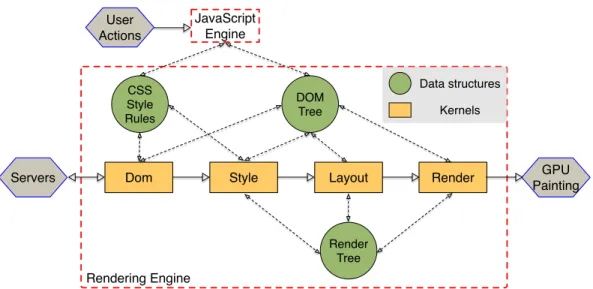
To enable portability of Web applications, the Web browser acts as a “virtual machine” or a runtime system layer that dynamically translates HTML, CSS, and JavaScript to different platforms. Figure 2.1 shows the overall flow of execution within any typical Web browser, which typically con-sists of two core modules: a rendering engine (e.g., WebKit for Chrome and Gecko for Firefox) that translates HTML and CSS, and a JavaScript engine
Dom Style Layout Render DOM Tree CSS Style Rules Render Tree
Servers PaintingGPU
User Actions JavaScript Engine Rendering Engine Data structures Kernels
Fig. 2.1: A typical Web browser architecture. that executes JavaScript code.
The rendering engine mainly consists of four kernels:Dom, Style, Lay-out, and Render. The kernels, shown in boxes, process the webpage and pre-pare pixels for a GPU to paint. The figure also shows the important data structures that the kernels consume. The DOM tree, CSS style rules, and Render tree are those important data structures, and they are heavily shared across the kernels. The data structures are shown in circles with arrows indi-cating information flow between the kernels.
The Dom kernel is in charge of parsing the webpage contents. Specif-ically, it constructs the DOM tree from the HTML files, and extracts the CSS style rules from the CSS files. Given the DOM tree and CSS style rules, the Style kernel computes the webpage’s style information and stores the re-sults in the render tree. Each render tree node corresponds to a visible element
in the webpage. Once the style information of each webpage element is cal-culated, theLayout kernel recursively traverses the render tree to decide each visible element’s position information based on each element’s size and relative positioning. The final < x, y > coordinates are stored back into the render tree. Eventually, the Render kernel examines the render tree to decide the
z-ordering of each visible element so that they can be displayed in the correct overlapping order.
Over the past two decades, language evolution and Web runtime design have been constantly driving Web innovations [36, 42]. As a result, current Web standards such as HTML5 and CSS3 enable ever-richer functionalities, such as offline storage, media playback, and geolocation, that are the core in today’s mobile applications. Web language and browser design innovations will continue to be the key enabler for next-generation Web computing.
Chapter 3
The Need for High-Performance and
Energy-Efficient Computation in Mobile Web
This section quantitatively demonstrates the importance of computa-tion, among other components such as network and display, to mobile Web’s performance and energy consumption. The observations discussed in this sec-tion directly motivate my research to focus on the computasec-tion layer of the mobile Web and to improve its performance and energy-efficiency.
The computation layer involves many mobile SoC components, such as CPU, GPU, and domain-specific accelerators. My work specifically focuses on the CPU for the following two reasons. First, CPU is the most heavily exer-cised computation component for Web applications because the Web runtime primarily targets CPUs. GPUs’ usage, although providing critical performance benefits, is still limited to specific tasks such as rasterization and composit-ing [49]. The key computations such as layout and JavaScript execution are still solely performed on general-purpose CPUs. Second, CPU serves as an incubator for future accelerators—we must first understand computation ker-nels’ characteristics on CPUs before they can be accelerated. In fact, one of my dissertation contributions is the accelerator design of a key Web computation
kernel based on its CPU execution behaviors.
In the rest of this chapter, I first show that the overall mobile Web performance depends increasingly on the computational capability of mobile CPUs, indicating the need for a high-performance computation (Chapter 3.1). I then show that mobile devices’ power consumption is increasingly dominated by CPUs, calling for an energy-efficient computation (Chapter 3.2).
3.1
The Need for Compute Performance in Mobile Web
Computation and network largely dictate the performance of mobile Web. Conventional wisdom suggests that mobile Web performance is primarily limited by the network latency. In this section, I quantify the impact of CPU and network performance by experimentally comparing how the webpage load time varies with different CPU and network performance on today’s high-end smartphone Galaxy S5. I show that as cellular network technologies evolve over generations, mobile Web performance becomes sensitive to CPU performance. Network Impact Network performance is typically evaluated in two metrics: latency and bandwidth. Prior work has shown that in the mobile context, network latency—typically evaluated by round-trip time (RTT)—has a much more significant impact than network bandwidth [97, 172]. Therefore, we focus only on the latency aspect of network performance.
To study the impact of network latency of various cellular network generations, we host all the webpages on a Web server, into which we manually
38 32 26 20 14 8 2 Lo ad ti me (s) 10 2 3 4 5 6 7 8 9100 2 3 4 5 6 7 8 91000 2 Network RTT (ms) LTE 3G Adverse 3G 2G Wi-Fi
Fig. 3.1: Webpage load time with respect to changing network latency. Each marker corresponds to an RTT value. We also superimpose the round-trip time (RTT) range for different cellular technologies derived from both technical specifications as well as real measurements in the field [1, 97].
inject delay. We then use Wi-Fi on the smartphone to access the webpages. The delay injection lets us mimic a wide range of network latencies because Wi-Fi has significantly lower latency than the current 4G/LTE network. This methodology is well-established to control cellular network latency [172].
Holding the CPU performance at its peak, Figure 3.1 shows the web-page load time with respect to different network latencies. We superimpose the figure with different mobile network technologies’ typical latencies derived from both technical specifications as well as real measurements in the field [1, 97]. We observe that reducing the network latency initially from an adverse 3G connection at 2,000 ms to an LTE connection at 100 ms results in a 9.5X speedup in webpage load time from 38 seconds to 4 seconds. However, as the
network latency further improves within the range of LTE network latency (50∼100 ms), the network latency has only a marginal impact on the overall webpage load time. This is because at this point the fast network accesses are hidden behind CPU computations in the asynchronous execution model; the application is largely CPU-bound. Further reducing the network latency from LTE to Wi-Fi has almost no effect.
Computation Impact As the network latency becomes low (e.g., under the LTE technology), the CPU performance starts playing a significant role in the mobile Web performance. To study how the CPU performance affects the webpage load time, we mimic a wide range of CPU performance capabilities by leveraging S5’s 14 frequency settings. Note that we use fre-quency only as aproxy for CPU performance, it isnot our intention to study the impact of a particular CPU’s frequency itself. Figure 3.2 shows how web-page load time changes with CPU performance under a 100 ms RTT (LTE-like cellular network connectivity). As the CPU frequency decreases from the high-est to the lowhigh-est by about 6X (2.5 GHz to 0.4 GHz), the webpage load time slows down by as much as 4.5X from 4 seconds to about 18 seconds, indicating strong sensitivity to CPU performance.
Note that increasing clock frequency between 1.6 GHz and 2.4 GHz yields small performance benefits. One may then naively conclude that mo-bile CPU performance improvements provide marginal improvements in Web performance. However, the “marginal improvement” is merely an artifact of using frequency as a performance proxy. At high frequencies, the processor’s
20 16 12 8 4 0 Lo ad ti me (s) 2.4 2.0 1.6 1.2 0.8 0.4 CPU Frequency (GHz) Desktop CPU Performance
Fig. 3.2: Webpage load time with respect to CPU frequency on a Galaxy S5 smartphone. The markers represent CPU frequencies, which range from 0.4 GHz (left) to 2.5 GHz (right). We also overlay the load time on a desktop CPU (the dotted line) for comparison purpose.
pipeline is already saturated, and the memory and interconnection become the microarchitecture-level bottlenecks [54]. To overcome this artificial constraint and assess the impact of future mobile CPU improvements, we perform the same experiment on a desktop CPU (Intel Core i5 at 1.2 GHz). The result is shown as the dotted line in Figure 3.2. The average webpage load time on the desktop CPU is about 1 second, effectively a 4X speedup over the peak performance of S5. This experiment shows that mobile CPU performance to-day is still far from reaching a diminishing return point, and it can continue to have a significant impact on mobile Web performance.
The takeaway from the results is that continuous improvement to net-work latency will eventually, if not already, take us to a point where further
Web performance improvement will be unattainable without improving CPU performance. This is a timely conclusion, especially when low latency cellular network, such as LTE, is already prevalent today. It is estimated that LTE’s subscription will reach 1.37 billion (one-fifth of the world population) by the end of 2015 [25]. Note, however, that we donot claim that network latency is irrelevant. When the network deviates from an ideal low-latency condition, or in emerging markets where high-latency network accesses are prevalent [123], mobile Web performance is indeed constrained by the network latency.
3.2
The Need for Energy-Efficient Computation
Despite the need for high-performance computation, mobile devices are severely limited by a battery-imposed energy budget, which in turn limits the achievable performance. In this section, I first use smartphones to quantita-tively demonstrate that the energy budget of mobile devices is likely to stay stringently constrained in the near future. I then show that the CPU is becom-ing the worst power and energy consumer of a mobile device as compared to other components such as display and radio. There is clearly a need for energy-efficient computation in the mobile Web. Data presented here is adapted from the results of a related project [104] that I collaborated on.
Energy Constraint Battery technology has not experienced Moore’s law-like improvements because of fundamental physics limitations [158]. As a result, the density of lithium-ion batteries has improved by only about 10% per year [62]. Thus, the battery capacity of today’s mobile devices is
deter-3.5x10³ 3.0 2.5 2.0 1.5 1.0 Ba tte ry C ap aci ty (mAh ) 6.5 6.0 5.5 5.0 4.5 4.0 3.5 3.0 2.5 2.0 1.5
Screen Size (inches) 2009 - Droid 2010 - S 2011 - Nexus 2012 - S3 2013 - S4 2014 - S5 2015 - S6
Fig. 3.3: The correlation between smartphone battery capacities and their screen sizes. There is an almost linear relationship over the time.
mined by the battery’s volume, which is largely dictated by the device’s screen size [6]. Using the smartphone as an example of a start-of-the-art mobile de-vice, Figure 3.3 compares the screen sizes and battery capacities of over 600 smartphones from 2006 to 2014. There is a near-linear correlation between the battery capacity and screen size. As smartphone form factors reach matu-rity [47], the total device energy budget will likely stay severely constrained.
Mobile CPU’s Rise to Power Different components contribute to the overall power consumption of a mobile device. Figure 3.4 compares the measured power consumption of three major mobile device components: CPU, display, and radio. We select seven top smartphones for each year from 2009 to 2015. They are Motorola’s Droid from 2009, and Samsung’s Galaxy S, Nexus, S3, S4, S5, and S6 from 2010 through 2015, respectively. Chronologically,
10 8 6 4 2 0 Me asu re d Po w er (W ) Droid S Nexus S3 S4 S5 S6
Smartphone Model (Year)
(2009) (2010) (2011) (2012) (2013) (2014) (2015) Display Radio CPU: Single-core CPU: Multicore SoC TDP (3.5 W)
Fig. 3.4: CPU measured peak power consumption has increased significantly compared to other key mobile device components over the years. In particular, the multicore CPU power alone can exceed SoC-level TDP.
the seven phones represent how cutting-edge smartphone technologies have progressed over time. The results are collected while running a standard Web benchmark, Sunspider [34], for the CPU(s), and dedicated benchmarks for the other components [28, 73]. We used the Monsoon power monitor to measure the seven smartphones’ power consumptions at the battery level.
We make two important observations from Figure 3.4. First of all, CPU has become a major power consumer in a mobile device. The year 2011 marks an inflection point where a single CPU core began overtaking the display as the most power consuming component. On any of the last three mobile CPU generations, the multicore CPU power consumption exceeds the entire mobile device’s thermal design power (TDP) even without considering
the power consumption of radio, display, and the rest of the SoC.
Second, while other mobile device components are becoming more power-efficient over time due to their respective technological advancements [78], the CPU’s power has risen excessively. The continuous mobile CPU power increase is a direct result of the mobile CPU design strategy, namely simply adopting desktop-like design techniques, such as aggressive single-core microarchitecture enhancement and multicore scaling, to improve performance at the expense of high power consumption. A recently study shows that mobile CPUs incor-porated over 20 years of desktop CPU design techniques in just about seven years [104]. The inevitable consequence of such a design methodology is that as the Dennard Scaling [84] comes to its end, the performance improvement can no longer make up for the additional power consumption [104], eventually making the mobile CPU extremely energy-inefficient.
Given that users expect each mobile device generation to incorporate new peripherals such as sensors that also require energy from the same budget, it is clear that the CPU, as a major energy consumer, needs to become more energy-efficient while sustaining performance improvement.
Chapter 4
WebCore: A Mobile Processor Architecture
for Web Computing
Domain-specific specialized architecture has long been deemed as ex-tremely high-performance and energy-efficient because it aggregates hundreds of operations in a few instructions and, therefore, reduces major sources of inefficiencies in general-purpose CPUs [105, 131, 176]. The key challenge of ap-plying architectural specialization to Web computing is how to retain general-purpose programmability. The general-purpose programmability is a particular necessity for Web technologies because they involve large pieces of software that are written in a combination of different general-purpose programming languages. For example, Google’s Chrome Web browser is developed in 29 lan-guages with over 17 million lines of code [145]. Recent work has demonstrated the importance and feasibility of balancing general-purpose programmability and specialization in various data computation domains (e.g., H.264 encod-ing [105], convolution [152]).
Following the architecture design philosophy of balancing general-purpose programmability and domain-specific specialization, we propose WebCore, a general-purpose core customized and specialized for mobile Web computing. In
comparison to prior work that either takes a fully software approach on general-purpose processors [75, 137] or a fully hardware specialization approach [63], our design strikes a balance between the two. On one hand, WebCore retains the flexibility and programmability of a general-purpose core. It naturally fits in the multicore SoC that is already common in today’s mainstream mo-bile devices. On the other hand, it achieves energy-efficiency improvement via modest hardware specializations that create closely coupled datapath and data storage.
We begin by examining existing general purpose designs for the mobile Web applications. Through exhaustive design space exploration, we find that existing general purpose designs bear inherent sources of energy-inefficiency. In particular, instruction delivery and data feeding are two major bottlenecks. We show that customizing current designs by properly sizing key design pa-rameters achieves better energy efficiency. The customization step ensures that further optimizations are performed upon an optimized general-purpose baseline.
Building on the customized general-purpose baseline, we develop spe-cialized hardware to further overcome the instruction delivery and data feeding bottlenecks. We propose two new optimizations: the “Style Resolution Unit”
(SRU) and a“Software-Managed Browser Engine Cache.” The SRU is a hard-ware accelerator for the critical style-resolution kernel within the Web browser engine. It is based on the observation that the style-resolution kernel has abun-dant fine-grained parallelism that is hidden in a software implementation but
can be captured by a dedicated hardware structure. SRU employs a GPU-like multi-lane architecture to exploit the inherent parallelism. Through exploiting the parallelism, the SRU aggregates enough computations in a few operations, which effectively increases the arithmetic intensity and offsets the instruction delivery and data feeding overhead.
The proposed browser engine cache structure improves data feeding ef-ficiency by exploiting the unique data access pattern of the browser engine’s principal data structures such as the DOM tree and the Render tree. Web applications typically operate on one DOM/Render tree node heavily and tra-verse to the next one, indicating both heavy data reuse and predictable access pattern. The browser engine cache uses a small and energy-conserving hard-ware memory to capture the heavy data reuse and uses softhard-ware to predict the access pattern and to manage the cache. Overall, the browser cache achieves a high hit rate for the important data structures but with extremely low ac-cessing energy.
Our results show that customizations alone on the existing general-purpose mobile processor design lead to 22.2% performance improvement and 18.6% energy saving. Our specialization techniques achieve an additional 9.2% performance improvement and 22.2% overall energy saving; the accelerated portion itself achieves up to 10X speedup. Finally, we also show that our spe-cialization incurs negligible area overhead. More importantly, such overhead, if dedicated to tuning already existing general-purpose architectural features (e.g., caches), lead to much lower energy-efficiency improvements.
The rest of this chapter is organized as follows. We first describe our ex-perimental setup including software/hardware infrastructure and application selection in Chapter 4.1. We then describe the design-space explorations that allow us to identify sources of inefficiency in existing general-purpose proces-sors and customize them for mobile Web applications in Chapter 4.2. Building on top of the customized general-purpose designs, we further propose the two new specialization techniques in Chapter 4.3 and Chapter 4.4. We show that our proposed WebCore achieves significant performance and energy-efficiency improvement over existing designs in Chapter 4.5. We review related work in Chapter 4.6.
4.1
Experimental Setup
Before we begin our investigation, we describe our software infrastruc-ture, specifically outlining our careful selection of representative webpages to study, and the processor simulator.
Web Browser We focus on the popular WebKit [173] rendering engine used in Google Chromium (Version 30.0) for our studies. WebKit is also widely used by other popular mobile browsers, such as Apple’s Safari and Opera.
Benchmarked Web Applications We pay close attention to the choice of webpages to ensure that the WebCore design is not misled. We mine through the top 10,000 websites as ranked by Alexa [55] and pick the 12 most representative websites. All except one happen to rank among Alexa’s
10-4 10-3 10-2 10-1 100 101 PC2 (log) -5 0 5 PC1
Fig. 4.1: We pick 24 representative webpages from 10,000 of the hottest web-pages as per www.alexa.com
top 25 websites. The 12 benchmarked websites also cover 10 of BBench’s 11 webpages [101]. Chapter 4.5 lists the website names. We refer interested readers to Chapter 4.6.3 for a discussion of BBench.
We consider not only the mobile version of the 12 websites, but also their desktop counterparts. Many mobile users still prefer desktop-version websites for their richer content and experience [65, 163]. Moreover, many mo-bile devices, especially tablets, typically load the desktop version of webpages by default. As webpage sizes exceed 1 MB [64], we must study mobile proces-sor architectures that can process more complex content and not just simple mobile webpages.
We study 24 distinct webpages in total. The 24 benchmarked web-pages are representative because they capture the webpage variations in both
webpage-inherent and microarchitecture-dependent features. To prove this, we performed principal component analysis (PCA), which is a statistical method that reduces the number of inputs without losing generality [86]. PCA trans-forms the original inputs into a set of principal components (PC) that are linear combinations of the inputs. In our study, PCA calculates four PCs from about 400 distinct features. These four PCs account for 70% of the vari-ance across all of the original 10,000 webpages. Figure 4.1 shows the results for two major components, PC1 and PC2. IPC (microarchitecture-dependent feature) is the single most significant metric in PC1, and the number of DOM tree nodes (webpage-inherent feature) is the most significant metric in PC2. The triangular dots represent our webpages. They cover a very large spread of the top 10,000 webpages in the Internet.
Performance Metric We focus on the initial loading of Web ap-plications. This is because user QoS experience is strongly tied to the initial load time in Web applications. For instance, it is estimated that 79% of online shoppers will not return to the website with slow load time [122].
Unless stated otherwise, we define Web application load time as the execution time that elapses until the onload event is triggered by the Web browser. It is worth noting that during the loading phase (i.e., before the onLoad event is triggered), many Web applications execute JavaScript code such as Ads and analytics. Therefore, our study not only takes into account the initial loading of the webpage, but also includes JavaScript activity that is triggered automatically by Web applications.
Simulators We assume the x86 instruction set architecture (ISA) for our study. Prior work shows that the ISA does not significantly impact energy efficiency for mobile workloads [66]. Therefore, we believe that our microar-chitecture explorations are generally valid across ISAs. We use Marss86 [149], a cycle-accurate simulator, in full-system mode to faithfully model all the network and OS activity. Performance counters from Marss86 are fed into McPAT [127] for power estimation.
4.2
Customizing General-Purpose Cores
WebCore design is based on general-purpose CPUs to best retain the general-purpose programmability. However, existing general-purpose proces-sors may not be an ideal baseline for WebCore, because they are not uniquely tuned for Web applications. WebCore customizes current designs by explor-ing a vast design space to properly size key microarchitecture parameters (Chapter 4.2.1). I derive two major conclusions through the customization process. First, out-of-order designs provide more flexibility for energy ver-sus performance trade-offs than in-order designs (Chapter 4.2.2). Second, a customized out-of-order design configuration still contains two sources of inefficiency–instruction delivery and data feeding–that need to be further mit-igated (Chapter 4.2.3).
4.2.1 Design Space Exploration
Design Space Specification We define the set of tunable microar-chitectural parameters in Table 4.1. We vary the values of functionally related parameters (e.g., issue width and the number of functional units) together to avoid reaching an entirely unbalanced design [70]. We also do not con-sider single-issue out-of-order processors, which are known to be energy inef-ficient [58]. In total, we consider over 3 billion design points.
We intentionally relax the design parameters beyond the current mobile systems in order to allow an exhaustive design space exploration. For example, we consider up to 128 KB L1 cache design whereas most L1 caches in existing mobile processors are 32 KB in size. Also, since thermal design power (TDP) is important for mobile SoCs, we eliminate overly aggressive designs with more than 2 W TDP.
We assume a fixed core frequency in our design-space exploration. We use 1.6 GHz, a common value in mobile processors, to further prune the ex-ploration space. However, because the latency of both the L1 and L2 caches can still vary, we include different cache designs in the exploration space.
We use a constant memory latency to model the memory subsystem be-cause we do not observe significant impact of the memory system on the mobile Web browsing workload. According to hardware measurements on the Cortex-A15 processor using ARM’s performance monitoring tool Streamline [57], the MPKI for the L2 cache across all the webpages is below 5. We observe similar
Table 4.1: Microarchitecture design-space parameters. The first col-umn shows the parameters that are considered in our DSE. The second column shows the metric that the value of each parameter is measured. The i::j::k in the third column denotes values ranging from i to k at steps of j
Parameters Measure Range
Issue width count 1::1::4
# Functional units count 1::1::4
Load queue size # entries 4::4::16
Store queue size # entries 4::4::16
Branch prediction size log2(#entries) 1::1::10
ROB size # entries 8::8::128
# Physical registers # entries 5::5::140
L1 I-cache size log2(KB) 3::1::7
L1 I-cache delay cycles 1::1::3
L1 D-cache size log2(KB) 3::1::7
L1 D-cache delay cycles 1::1::3
L2 cache size log2(KB) 7::1::10
low L2 MPKI, i.e. low main memory pressure, in our simulations. Therefore, we use a simpler memory system to further trim the search space.
Statistical Inference Method It is not feasible to simulate billions of the design points that we consider simply due to time constraints. Therefore, we leverage the statistical inference technique that trains predictive models us-ing a small number of samples. Such models reflect how different microarchi-tecture parameters, both individually and collectively, influence performance and power consumption. Statistical inference methods have been used suc-cessfully in the past for architecture design-space exploration [100, 125].
In particular, we use linear regression modeling [108] to construct our predictive models. A linear regression model can be formulated as in Equa-tion. 4.1, wherey denotes the response,x=x1, ..., xp denotep predictors, and β = β0, ..., βp denote corresponding coefficients of each predictor. The least
squares method is used to solve the regression model by identifying the best-fitting β that minimizes the residual sum of squares (RSS) [109]. In our case, the response y is either performance (measured in terms of instruction per cycle, IPC) or power, and the predictors xi are microarchitecture structures listed in Table 4.1. y=β0+ p X i=1 xiβi (4.1)
We find that 2,000 uniformly at random (UAR) samples of microar-chitecture configurations from the design space are sufficient in our case to
1.0x10⁴ 0.8 0.6 0.4 0.2 0.0
# DOM tree nodes
1200 800 400 0 # HTML class attributes
cnn
Fig. 4.2: www.cnn.com is a representative webpage from our benchmark suite because it is almost the centroid.
construct robust models. We also obtain 500 additional UAR samples from the cache design space (both L1 and L2) to reinforce the credibility of instruc-tion and data cache design predicinstruc-tions. We perform cross-validainstruc-tion of the model (i.e., we partition a sample dataset into complementary subsets, and perform analysis on one subset and validate the analysis on the other subset), and then obtain additional samples from the design space for full evaluation.
In order to derive general conclusions about the design space and opti-mize for the common case, in this section we present only our in-depth analysis for the representative websitewww.cnn.com. Figure 4.2 compareswww.cnn.com with other webpages to demonstrate that it is indeed representative of the other benchmarked webpages. The x-axis and y-axis represent the number of DOM tree nodes and the number of class attributes in HTML. These are
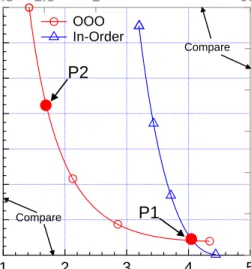
1.2 1.1 1.0 0.9 0.8 0.7 0.6 0.5 Energy (J) 5 4 3 2 1 Load Time (s) 500 450 400 350 300 250 200
EPI (pJ per instruction)
2.5 1.5 1 0.5 BIPS P2 P1 Compare Compare OOO In-Order
Fig. 4.3: In-order versus out-of-order Pareto optimal frontiers.
the two webpage characteristics that are most correlated with a webpage’s load time and energy consumption [185]. As the figure shows, www.cnn.comis roughly the centroid of the benchmarked webpages, and thus we use it as a representative webpage for the common case.
We construct predictive models for out-of-order and in-order design space separately because microarchitecture structures have different impact on performance and power in in-order and out-of-order pipelines. In general, the out-of-order models’ error rates are below 6.0%. The in-order models (not shown) are more accurate because of their simpler design. On average, the in-order performance and power models’ errors are within 5% and 2%, respectively.
4.2.2 In-order vs. Out-of-order Design Space Exploration
Design space exploration helps customization at the “macro-architecture” level, i.e., determining between in-order and out-of-order designs. We under-stand the difference between in-order and out-of-order design space by examin-ing their Pareto optimal frontiers. Design points on a Pareto optimal frontier reflect different optimal design decisions given specific performance/energy tar-gets. The Pareto-optimal is more general than the (sometimes overly specific)
EDP, ED2P metrics, etc. Design configurations optimized for such met-rics have been known to correspond to different points on the Pareto-optimal frontier [58]. Figure 4.3 shows the Pareto-optimal frontiers of both in-order and out-of-order designs between energy and performance. We use energy per instruction (EPI) for the energy metric, and million instructions per second (MIPS) as the performance metric.
We make two important observations from Figure 4.3. First, the out-of-order design space offers a much larger performance range (∼1 BIPS be-tween markers P1 and P2, see top x-axis) than the in-order design space (< 0.5 BIPS), which reflects the out-of-order’s flexibility in design decisions. Second, the out-of-order design frontier is flatter around the 4-second webpage load time range (see marker P1) than in the in-order design, which indicates that the out-of-order design has a much lower marginal energy cost. The ob-servation indicates that processor architects can make design decisions based on the different performance goals without too much concern about the en-ergy budget. In contrast, the in-order design space quickly enters the region
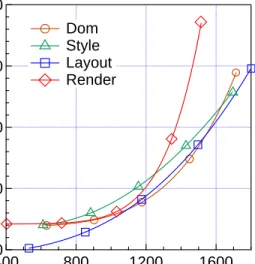
700 600 500 400 300 200
EPI (pJ per instruction)
1200 1000 800 600 400 MIPS 4-issue 1-issue Dom Style Layout Render
Fig. 4.4: In-order Pareto optimal frontier for each kernel.
of diminishing returns (i.e., sharp increase in energy consumption) as we push toward webpage load times that are less than 4 seconds. In other words, the in-order design has a low marginal performance value (or equivalently high marginal cost of energy).
To understand the difference behind the in-order versus out-of-order designs, we study the kernel behaviors in Web applications. There are four important computation kernels in executing a Web application: i.e., Dom,
Style, Layout, and Render. They contribute to about 75% of the webpage load time and energy consumption. Figure 4.4 and Figure 4.5 show the Pareto optimal frontiers of the in-order and out-of-order design space for each kernel. We find that the kernel variance in the in-order designs is more pronounced than in the out-of-order designs. As we push toward more performance in