BASED ON TRUST AND RISK
A Dissertation Submitted to the Faculty
of
Purdue University by
Lina Abdulaziz Alfantoukh
In Partial Fulfillment of the Requirements for the Degree
of
Doctor of Philosophy
May 2019 Purdue University Indianapolis, Indiana
THE PURDUE UNIVERSITY GRADUATE SCHOOL
STATEMENT OF COMMITTEE APPROVAL
Dr. Arjan Durresi, Chair
Department of Computer and Information Science Dr. Mohammad Al Hasan
Department of Computer and Information Science Dr. Snehasis Mukhopadhyay
Department of Computer and Information Science Dr. Mihran Tuceryan
Department of Computer and Information Science
Approved by:
Dr. Shiaofen Fang
To my father, Abdulaziz, who supported me To my mother, Munirah, who prayed for me
To my siblings: Layla, Omar, Mohammed, Ahmed, Nouf, Lubna and Fahad Thanks for always being there for me.
ACKNOWLEDGMENTS
I am grateful to all of those with whom I have had the pleasure to work during this journey. Each of the members of my Dissertation Committee has provided me professional guidance and taught me a great deal about scientific research.
I would especially like to thank my mentor and advisor, Dr. Arjan Durresi for his encouragement and guidance during my studies. He has shown me, by his example, what a good scientist should be. I want to acknowledge thesis committee members Dr. Mohammad Al Hasan, Dr. Snehasis Mukhopadhyay, and Dr. Mihran Tuceryan for reviewing and providing feedback on my thesis.
Nobody has been more important to me in the pursuit of this journey than the members of my family. I am grateful to my parent and siblings, who have provided me through moral and emotional support in my life. They are the ultimate role models. I am also grateful to friends who have supported me along the way and to my labmates, Yefeng Ruan and Murat Karakus for their kind supports and scientific advice.
Extraordinary gratitude goes out to my special friend, Dr. Abdullah Alzeer for his valuable guides, his moral support and his endless inspiration during my research work.
TABLE OF CONTENTS
Page
LIST OF TABLES . . . ix
LIST OF FIGURES . . . xii
SYMBOLS . . . xiv ABBREVIATIONS . . . xv ABSTRACT . . . xvi 1 INTRODUCTION . . . 1 1.1 Overview of Problem . . . 1 1.2 Motivation . . . 3 1.3 Proposed Solution. . . 5 1.4 Research Goals . . . 7
1.5 Assumptions and Limitations . . . 8
1.6 Expected Outcome . . . 8
1.7 Scope . . . 9
1.8 Contributions . . . 10
1.8.1 Trust-based decision-making . . . 10
1.8.2 The distribution of stakeholders’ preferences . . . 10
1.8.3 The aggregation operators selection . . . 10
1.9 Dissertation Structure . . . 12
2 SURVEY IN MULTI-STAKEHOLDER DECISION-MAKING BASED ON TRUST . . . 14
2.1 Abstract . . . 14
2.2 Introduction . . . 14
2.3 Trust and Risk . . . 17
Page
2.3.2 Risk . . . 19
2.3.3 Relationship Between Trust and Risk . . . 20
2.4 Using Trust and Risk in Multi-stakeholder Decision-Making . . . 22
2.4.1 Decision-Making Theory . . . 22
2.4.2 Changing preferences . . . 30
2.4.3 Trust in Multi-stakeholder Decision-Making . . . 34
2.4.4 Risk in Multi-stakeholder Decision Making . . . 43
2.5 Conclusion . . . 45
3 TRUST-BASED MULTI-STAKEHOLDER DECISION MAKING IN WA-TER ALLOCATION SYSTEM . . . 46
3.1 Abstract . . . 46
3.2 Introduction . . . 46
3.3 Related work . . . 48
3.4 Trust . . . 48
3.5 Possible cases of rating . . . 50
3.6 Multi-stakeholder Decision Making based on Trust. . . 51
3.7 Experiment and Result . . . 53
3.7.1 Round 1 . . . 53
3.7.2 Round 2 . . . 56
3.8 Conclusion . . . 58
4 MULTI-STAKEHOLDER CONSENSUS DECISION-MAKING BASED ON TRUST: A GENERIC FRAMEWORK . . . 60
4.1 Abstract . . . 60
4.2 Introduction . . . 60
4.3 Related Work . . . 62
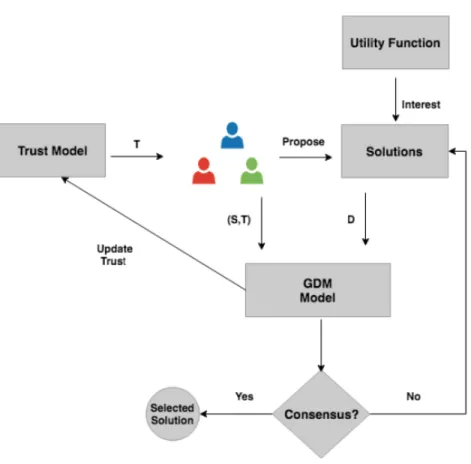
4.4 Multi-stakeholder Decision-Making Framework Based on Trust . . . 64
4.5 Trust . . . 67
4.6 Rating Convergence and Aggregation . . . 68
Page
4.8 Results . . . 73
4.9 Conclusion . . . 81
5 RATING MATRIX PERTURBATION . . . 83
5.1 Abstract . . . 83
5.2 Introduction . . . 83
5.3 Related Work . . . 85
5.4 Multi-stakeholder Decision-Making Model Based on Trust and Risk . . 86
5.4.1 Rating . . . 87
5.4.2 Aggregation . . . 88
5.5 Rating Convergence Measurement . . . 88
5.6 Experiment . . . 91 5.7 Results . . . 93 5.8 Conclusion . . . 98 6 RATING AGGREGATION . . . 100 6.1 Abstract . . . 100 6.2 Introduction . . . 100 6.3 Related Work . . . 102 6.4 Aggregation Operators . . . 103 6.4.1 Weighted Sum. . . 104 6.4.2 Weighted Product. . . 104 6.4.3 Similarity Measure . . . 104 6.5 Experiment . . . 106 6.6 Result . . . 107
6.6.1 Starting value of consensus degree . . . 108
6.6.2 Consensus Degree Convergence . . . 108
6.6.3 Consensus Degree per project . . . 108
6.6.4 Consensus Degree Threshold . . . 110
Page
6.7 Conclusion . . . 115
7 CONCLUSION . . . 116
7.1 Future Work . . . 119
REFERENCES . . . 120
A Mathematical Model for Rating . . . 137
A.1 Overview. . . 137
A.2 Generating the Mathematical Model . . . 138
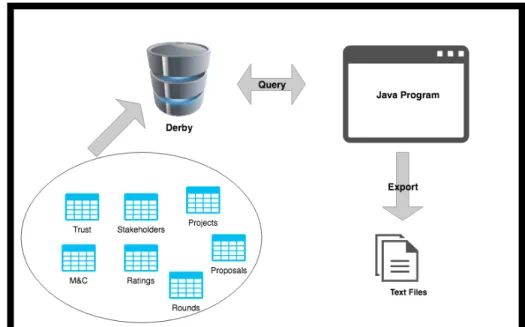
B Database Design . . . 139
LIST OF TABLES
Table Page
2.1 List of existing individual decision-making schemes with their trust, risk, and decision-making models . . . 26 2.2 List of common Multi-stakeholder decision-making process with the
asso-ciated challenges . . . 33 2.3 Multistakeholder decision-making schemes with the corresponding trust
model, group decision-making process, group decision-making model, the limitation and the application . . . 36 2.4 Multi-stakeholder decision-making scheme with the associated Risk Model
and the decision process . . . 44 3.1 Round 1, List of stakeholders and the corresponding trust values . . . 53 3.2 Round 1, The solution proposed by David showing the percentage of
wa-ter for each stakeholders and the corresponding benefit, damage and the calculated utility which is the damage subtracted from the benefit . . . 54 3.3 Round 1, The solution proposed by Steve showing the percentage of
wa-ter for each stakeholders and the corresponding benefit, damage and the calculated utility which is the damage subtracted from the benefit . . . 54 3.4 Round 1, The solution proposed by John showing the percentage of
wa-ter for each stakeholders and the corresponding benefit, damage and the calculated utility which is the damage subtracted from the benefit . . . 55 3.5 Round 1, Rating values from each stakeholders to others about the
so-lutions proposed. This value contributes to updating the trust value for each participant . . . 55 3.6 Round 1, the fairness index values and the weighted fairness index values
for all the solutions proposed by the stakeholders. . . 56 3.7 Round 2, List of stakeholders and the corresponding trust values . . . 56 3.8 Round 2, The solution proposed by David showing the percentage of
wa-ter for each stakeholders and the corresponding benefit, damage and the calculated utility which is the damage subtracted from the benefit . . . 57
Table Page 3.9 Round 2, The solution proposed by Steve showing the percentage of
wa-ter for each stakeholders and the corresponding benefit, damage and the calculated utility which is the damage subtracted from the benefit . . . 57 3.10 Round 2, The solution proposed by John showing the percentage of
wa-ter for each stakeholders and the corresponding benefit, damage and the calculated utility which is the damage subtracted from the benefit . . . 58 3.11 Round 2, Rating values from each stakeholders to others about the
so-lutions proposed. This value contributes to updating the trust value for each participant . . . 58 3.12 Round 2, the fairness index values and the weighted fairness index values
for all the solutions proposed by the stakeholders. . . 59 4.1 List of the parameters used in the simulation with their corresponding values73 4.2 Average Number of rounds for all three cases with and without trust for
Random and Normal Distribution . . . 79 4.3 Percentage of the projects that reached consensus for all three cases with
and without trust for Random and Normal Distribution . . . 80 4.4 Average number of rounds of the projects that reached consensus different
consensus thresholds for Random and Normal Distribution when applying trust . . . 81 4.5 Percentage of the projects that reached consensus with different consensus
thresholds for Random and Normal Distribution when applying trust . . . 81 5.1 List of the parameters used in the simulation with their corresponding values92 5.2 Rating matrix norm values and the consensus degree for one project. . . . 95 5.3 Percentage of the projects that reached consensus for all three cases with
and without trust for long term and short term preferences . . . 96 5.4 Average round of the projects that reached consensus for all three cases
with and without trust for long term and short term preferences . . . 97 6.1 Parameters of the simulation and their corresponding . . . 107 6.2 The number of rounds for each aggregation operator for different consensus
threshold . . . 112 6.3 The percentage of the projects that reached the consensus for each
aggre-gation operator for different consensus threshold . . . 113 6.4 Correlation between the rating matrix perturbation and the number of
B.1 List of the tables variables used in the simulation with their corresponding description. . . 140
LIST OF FIGURES
Figure Page
1.1 The phases required for the consensus decision-making process. The stake-holders start by proposing solutions based on the interests the solutions serve; then, they express their opinions to each other. After that, they check the group consensus. Finally, if none of the solutions has achieved consensus, the stakeholders start the process again. This process might
not end if the stakeholders have extremely conflicting interests. . . 3
1.2 The phases of the proposed multi-stakeholder consensus decision-making. It involves humans and a machine. The stakeholders start by proposing solutions, then express their opinions to each other. Next, the machine aggregates the opinions about each solution to compute the stakeholders consensus for each solution. After that, the machine updates the trust for each stakeholder. Finally, if none of the solutions have achieved consensus, the stakeholders start the process again. . . 5
2.1 Trust Framework which has three phases, each phase depends on the pre-vious one. . . 16
2.2 Limitations of Existing Multistakeholder Decision-making Schemes . . . . 35
3.1 Trust chain among entities in the Water Allocation system . . . 49
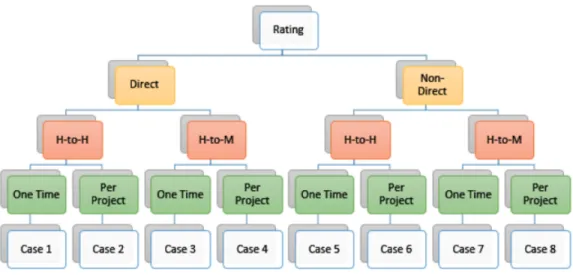
3.2 Rating hierarchy structure which involves Direct and non-direct rating as well as Human to human and Model to Model ratings (H-to-H, H-to-M). Some ratings are given during the project and some are not (Per Project, One Time). . . 50
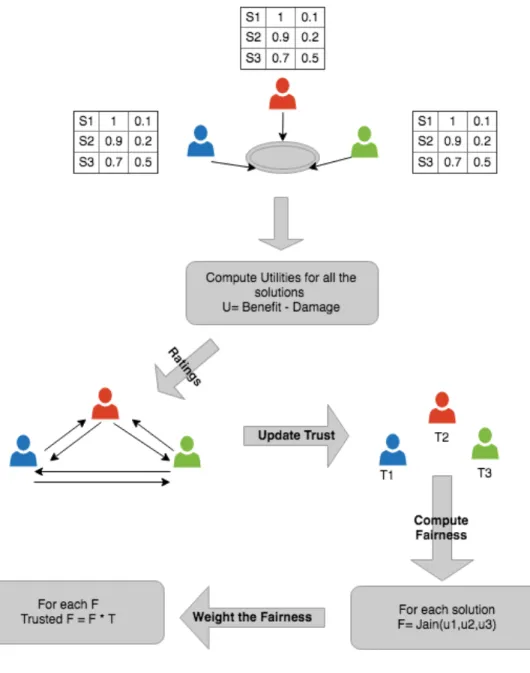
3.3 System workflow which has several steps. It starts with proposing solution and the associated benefits and damages. Then, computing utilities, rating solutions, updating trust network and computing fairness for each solution 52 4.1 Generic Framework of Multi-Stakeholder Decision Making. . . 65
4.2 The possible conflict of interest scenarios. . . 69
4.3 Simulation Design . . . 72
4.4 The tree structure of the cases considered in the simulation . . . 74 4.5 Average Consensus Degree in each round for projects for Random preferences75
Figure Page 4.6 Average Consensus Degree in each round for projects that reached the
consensus with Trust for Random Preferences. . . 76 4.7 Number of rounds with no overlap in interest with and without trust for
Random Preferences. . . 77 5.1 The scenarios to generate in the simulation. . . 92 5.2 Stakeholders movies selection movement during the negotiation for no
overlap case with trust . . . 94 5.3 Rating matrix norm changes for no overlap case with trust and without . . 95 5.4 Number of rounds in each project for all the three overlap cases . . . 99 6.1 Staring consensus degree for each aggregation operator. . . 109 6.2 Consensus degree convergence throughout the projects’ rounds for each
aggregation operator. . . 110 6.3 Consensus degree values for all of the projects and aggregation operators 111 B.1 The relational Database Design of the entities in the simulation . . . 139
SYMBOLS c Confidence m Impression R Rating S Stakeholder T Trust W Weight
ABBREVIATIONS MCDM Multi-Criteria Decision-Making
MSCDM Multi-Stakeholder Consensus Decision-Making RMS Root Mean Square
RWA Rating Weighted Average SM Similarity Measure
WESM Weighted Exponent Similarity Measure WP Weighted Product
WPSM Weighted Product Similarity Measure
ABSTRACT
Alfantoukh, Lina Abdulaziz Ph.D., Purdue University, May 2019. Multi-Stakeholder Consensus Decision-Making Framework Based on Trust and Risk. Major Professor: Arjan Durresi.
This thesis combines human and machine intelligence for consensus decision-making, and it contains four interrelated research areas. Before presenting the four research areas, this thesis presents a literature review on decision-making using two criteria: trust and risk. The analysis involves studying the individual and the multi-stakeholder decision-making. Also, it explores the relationship between trust and risk to provide insight on how to apply them when making any decision. This thesis presents a grouping procedure of the existing trust-based multi-stakeholder decision-making schemes by considering the group decision-decision-making process and models.
In the first research area, this thesis presents the foundation of building multi-stakeholder consensus decision-making (MSCDM). This thesis describes trust-based multi-stakeholder decision-making for water allocation to help the participants select a solution that comes from the best model. Several criteria are involved when deciding on a solution such as trust, damage, and benefit. This thesis considers Jain’s fairness index as an indicator of reaching balance or equality for the stakeholder’s needs. The preferred scenario is when having a high trust, low damages and high benefits. The worst scenario involves having low trust, high damage, and low benefit. The model is dynamic by adapting to the changes over time. The decision to select is the solution that is fair for almost everyone.
In the second research area, this thesis presents a MSCDM, which is a generic framework that coordinates the decision-making rounds among stakeholders based on their influence toward each other, as represented by the trust relationship among
them. This thesis describes the MSCDM framework that helps to find a decision the stakeholders can agree upon. Reaching a consensus decision might require sev-eral rounds where stakeholders negotiate by rating each other. This thesis presents the results of implementing MSCDM and evaluates the effect of trust on the con-sensus achievement and the reduction in the number of rounds needed to reach the final decision. This thesis presents Rating Convergence in the implemented MSCDM framework, and such convergence is a result of changes in the stakeholders’ rating behavior in each round. This thesis evaluates the effect of trust on the rating changes by measuring the distance of the choices made by the stakeholders. Trust is useful in decreasing the distances.
In the third research area, this thesis presents Rating Convergence in the imple-mented MSCDM framework, and such convergence is a result of changes in stake-holders’ rating behavior in each round. This thesis evaluates the effect of trust on the rating changes by measuring the perturbation in the rating matrix. Trust is useful in increasing the rating matrix perturbation. Such perturbation helps to decrease the number of rounds. Therefore, trust helps to increase the speed of agreeing upon the same decision through the influence.
In the fourth research area, this thesis presents Rating Aggregation operators in the implemented MSCDM framework. This thesis addresses the need for aggregating the stakeholders’ ratings while they negotiate on the round of decisions to compute the consensus achievement. This thesis presents four aggregation operators: weighted sum (WS), weighted product (WP), weighted product similarity measure (WPSM), and weighted exponent similarity measure (WESM). This thesis studies the perfor-mance of those aggregation operators in terms of consensus achievement and the number of rounds needed. The consensus threshold controls the performance of these operators.
The contribution of this thesis lays the foundation for developing a framework for MSCDM that facilitates reaching the consensus decision by accounting for the stakeholders’ influences toward one another. Trust represents the influence.
1. INTRODUCTION
”A consensus means that everyone agrees to say collectively what no one believes individually.” Abba Eban
1.1 Overview of Problem
In real-world problems where complexity exists, there is no single correct answer that solves a given one [1]. Multi-stakeholder decision-making is considered a complex problem because there could be various correct answers to select from. It requires the involvement of humans to discuss the possibility of forming a solution based on their discussions. The humans participating in the decision have a partial view of the problem domain because of the diversity of their mindsets, the experiences they have gained over the years, and their current experiences in various contexts. Therefore, combining those partial views in the decision-making produces a whole view of the problem. The challenge is to find a proper mechanism for combining those partial views during the negotiations about finding the solution or the answer to the problem. In situations where collective decisions have to be made by a group rather than an individual, it is essential to find a procedure that facilitates reaching a group agreement. Without reaching an agreement, then the problem will face a dead end. A real example is the Challenger explosion [2] when the spacecraft exploded in 1986, 73 seconds after takeoff. Various people participated in the decision to take off: NASA management, NASA executives, and engineers. The engineers warned against the launch due to the seal problems. The executives made the decision to take off instead of listening to the engineers. NASA management made a decision to silence the engineers warnings. As a result, there was no consensus, and the decision outcome caused a disaster.
In general, when considering the consensus process in decision-making, the partic-ipants gather to propose a solution and then negotiate accordingly. The process ends when they agree on a solution in consensus. Every solution has an associated interest for the stakeholders. The conflicting interests of the stakeholders lead to complicat-ing their negotiation process. The reason for such complications is that humans have a tendency to rationally propose solutions that serve their best interests under the assumption of rational choice theory [3].Therefore, it is challenging to adopt or design a mechanism that causes the stakeholders to be influenced by the others and at the same time maintains the expected interests.
Computers or machines are solutions to help stakeholders when seeking the best solution. However, relying on machines alone will lead to systematic decision-making that generates many solutions and using an algorithmic approach to compute the best one [4]. Although machines are useful, eliminating humans is not practical because humans add more information to the decision-making process based on their knowl-edge, experience, and historical data. In addition, an infinite number of solutions could be proposed by humans, but a machine would not be able to allocate them all because computers produce results based on what the humans feed them or based on what the computers learn from peoples behaviors in the past. Therefore, with computers, the solution selection algorithm works on a finite set of solutions. This is not practical in the consensus decision-making process because solution modification is important during the negotiations.
1.2 Motivation
”For good ideas and true innovation, you need human interaction, conflict, argument, debate”. Margaret Heffernan
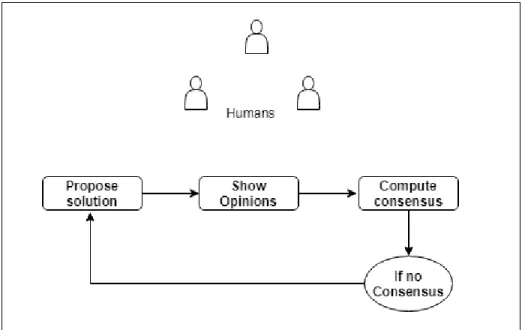
Fig. 1.1. The phases required for the consensus decision-making process. The stakeholders start by proposing solutions based on the interests the solutions serve; then, they express their opinions to each other. After that, they check the group consensus. Finally, if none of the solutions has achieved consensus, the stakeholders start the process again. This process might not end if the stakeholders have extremely conflicting interests.
Example: Groundwater allocation applications. There exist different stakehold-ers such as water supplistakehold-ers, water usstakehold-ers, and environmental policymakstakehold-ers.
The decision outcome is the amount of water to supply to the users under the en-vironmental policy. However, if each one of the stakeholders has an interest that is different from the others, then reaching an agreement will be difficult or impossible. Therefore, a proper procedure is to influence each other while bargaining about the best solution that benefits everyone.
There are several challenges when dealing with multi-stakeholder decision-making due to humans involvement:
• The stakeholders might come from different backgrounds, which leads to a vari-ety of expertise and, in turn, various proposals in the decision-making process.
• There might be extremely conflicting interests among the stakeholders, which leads to not agreeing on one decision.
• The stakeholders might have a partial view of the problem domain, which leads to not knowing the others decision preferences and expectations.
• The stakeholders might not be honest. There could be cases in which one or more stakeholders manipulate the decision-making process.
It is essential to add a new step or component to the consensus decision-making process illustrated in Fig.1.1 in order to solve the above challenges. This compo-nent should help in adding extra information, and, in turn, more knowledge of any stakeholder regarding the others. Also, this component contributes to combining the partial views of the decision problem domain corresponding to the stakeholders, which leads to obtaining a bigger picture of the decision problem. Moreover, this component can detect the honesty of the stakeholders. Finally, this component could work as an influential factor when making a decision, which leads to resolving the issue with the conflicting interests. Moreover, the advancement of technology and the existence of smart machines make it preferable to combine their capabilities with humans to achieve group decisions. Therefore, humans add extra information to the decision problem, and the machines moderate and facilitate the decision-making process to provide guides to the stakeholders while they negotiate about the correct solution to a given problem.
1.3 Proposed Solution
”Risk and trust are two facets of decision-making through which we view the world and choose to act.” Alcalde et al
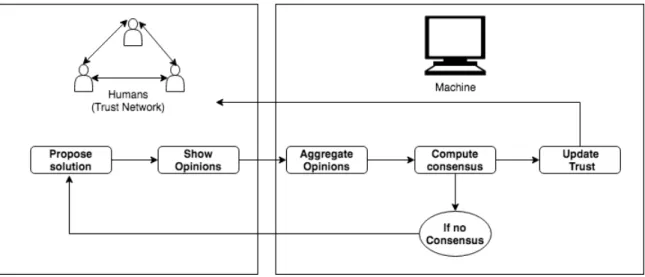
Fig. 1.2. The phases of the proposed multi-stakeholder consensus decision-making. It involves humans and a machine. The stakeholders start by proposing solutions, then express their opinions to each other. Next, the machine aggregates the opinions about each solution to compute the stake-holders consensus for each solution. After that, the machine updates the trust for each stakeholder. Finally, if none of the solutions have achieved consensus, the stakeholders start the process again.
Multi-stakeholder consensus decision-making involves participants who gather, propose solutions or decisions, and provide their opinions regarding the other so-lutions. Obtaining others views is used to gain some insight into the others needs and, in turn, modify the proposed solution accordingly. The opinions can result from the stakeholders perceived risk from each decision. Expressing an opinion is translated into trust.
In this thesis, trust is an essential part of developing a multi-stakeholder consen-sus decision-making framework to produce a decision outcome agreed on by all the stakeholders involved in the decision-making process.
The proposed decision-making framework (MSCDM) can be described as:
• Collaborative: The framework supports having several stakeholders who inter-act with each other during negotiation by proposing decisions and expressing opinions about the others decisions.
• Iterative: The framework supports several rounds of negotiation.
• Collective: The framework aggregates the stakeholders opinions to find a deci-sion agreed on by all of them.hers to find the decideci-sion agreed by all of them.
• Flexible: The framework allows the stakeholders to adjust their proposals. There is no fixed set of decision outcomes.
• Trust-based: The framework supports involving humans in the negotiation, who have different knowledge and expertise.
• Risk-based: The framework supports having the stakeholders perceived risk with each decision represented by interest.
• Dynamic: The framework supports updating the trust values after each round while negotiating.
• Consensus: The framework produces one decision outcome agreed on by all the participants.
• Computer-based: The framework uses machines to guide the decision-making process.
The use of trust among stakeholders adds extra information to help them to under-stand the preferences and expectations of the others. Trust helps to represent and maintain the stakeholders honesty. Therefore, the framework considers trust to have an influence on the others, which could lead to changing the proposed solution to one offered by a highly trusted stakeholder.
1.4 Research Goals
”Recent advances in computer science offer a better way to support multi-issue, multi-stakeholder negotiation processes, especially by significantly reducing the time required for negotiation”. Susetyo and et al
The research goal of this thesis is to develop a consensus decision-making frame-work for multiple stakeholders based on trust and perceived risk to facilitate finding a decision agreed on by all of them. This thesis proposes a framework for consensus decision-making that uses the influence of stakeholders toward each other as its core. Such influence is translated to trust. The proposed framework takes into account the interests associated with each decision, where the interests include the perceived risks by the stakeholders. The main research question of this thesis can be summarized as:
What is the trust-based consensus decision-making framework needed when the stakeholders have conflicting interests?
As this thesis explored the main research question, other fundamental questions associated with the research question arose.
• How should trust and perceived risk be applied in the decision-making frame-work being built?
– Does the perceived risk affect trust?
– Can the framework use the trust of the stakeholders to weigh their opin-ions?
• Does the interest corresponding to decisions for each stakeholder follow a specific distribution?
• What mathematical model and aggregation operators are required?
– What is the possible mathematical model for stakeholders interactions dur-ing the decision-makdur-ing process?
– What aggregation operators should be used when aggregating stakeholders interactions?
• Would the trusted stakeholder influence the others in changing their interests associated with the decisions?
• How does trust help in detecting malicious stakeholders in the proposed decision-making framework?
These fundamental questions help motivate the development of a consensus decision-making framework that produces the final decision agreed on by all the participants by considering the trust relationships among them.
1.5 Assumptions and Limitations
This experimental thesis research involves building a simulator for the proposed framework. The framework assumes that the stakeholders propose decisions and in-teract according to the assumptions of rational choice theory and social influence theory. This thesis work does not include building a mathematical model for risk computation, rather than assuming that the risk infers the interests of the stakehold-ers, and such calculations depend on the context.
1.6 Expected Outcome
This thesis involves developing a framework for multi-stakeholder consensus decision-making based on trust. This thesis expects to develop an algorithm of the proposed framework and then build a simulator. This simulator operates by being fed with the potential decision-making scenarios. This thesis intends to focus on capturing
the interactions among stakeholders during negotiations and translate those interac-tions into trust relainterac-tionships. This thesis research combines decision-making, trust, software engineering, and database design to develop a framework that produces con-sensus decisions.
1.7 Scope
This thesis focuses on developing a framework that supports selecting a consensus decision in a multi-stakeholder decision-making field using trust and risk as the main components. This thesis identifies the framework elements and presents a novel algo-rithm for integrating them to produce the preferred decision for all the stakeholders. This thesis shows human and machine involvement in the decision-making, where the machine coordinates the decision process, and the humans make the choices. The machine does not produce a feasible solution because there could be more than one feasible solution from which to select. Instead, it gives the humans guides dur-ing negotiations. The proposed framework involves expressdur-ing the trust relationship through stakeholders interactions while negotiating. Justifying why one stakeholder would trust another is outside the scope of this thesis because there could be countless reasons for trusting someone.
1.8 Contributions
This thesis adopts measurement theory-based trust regarding the consensus decision-making framework. In the following subsections, we present the principal contribu-tions of this thesis work.
1.8.1 Trust-based decision-making
Our first contribution in this thesis is to study the effect of trust on the con-sensus process in terms of the number of rounds, concon-sensus degree convergence and consensus achievement. Our result showed that trust was effective in decreasing the number of rounds by approximately 4 and increasing the consensus achievement by 77%. Moreover, trust affects the rating matrix perturbation by 82% increment, 2% no change and 16% decrements, whereas it is 100% no change if there is no trust taken into consideration. Moreover, there is a moderate negative correlation of -0.45 between perturbation and the number of rounds. Therefore, increasing the matrix perturbation can be useful in decreasing the number of rounds.
1.8.2 The distribution of stakeholders’ preferences
Our second contribution is to study the effect of the stakeholders preference dis-tribution on consensus achievement and the speed of the consensus process. Our result showed that the assumption of normal distribution performed better than the random distribution, as the number of projects that achieved the consensus increased by 1.3% with normal distribution, and the consensus speed decreased by 3 rounds with normal distribution.
1.8.3 The aggregation operators selection
Our third contribution is to study the performance of the aggregation operators on the proposed framework. The aggregation operators are the weighted sum (WS), the
weighted product (WP), the weighted product similarity measure (WPSM) and the weighted exponent similarity measure (WESM). Different performance measurements were considered such as degree of consensus, correlation between starting consensus and speed of convergence, correlation between ratings matrix perturbation and the number of rounds and changing the consensus threshold selection
Degree of consensus
Projects with WPSM and WPEM produce high consensus under the assumption of trust. The same was true with WA and WP but with lower performance.
Correlation between Starting consensus and speed of convergence
We studied the starting consensus degree of each operator to determine if it has an effect on the number of rounds. WS and WP had lower starting consensus compared with WPSM and WESM. WS and WP started with values between 0.4 and 0.8, whereas WPSM and WESM started with values between 0.8 and 0.95. However, our results showed that having a larger starting consensus degree did not necessarily decrease the number of rounds. For example, the average number of rounds for WS and WP was 6, which is faster than WPSM by 4 rounds, but at the same time, WESM had a larger starting consensus than them.
Correlation between Ratings matrix perturbation and number of rounds
We studies the rating matrix perturbation of each operator to determine if such perturbation would have an effect on the number of rounds. Our result showed that WS has a negative moderate correlation, 0.54 and WP has a negative moderate correlation, -0.6, while WPSM has no correlation, 0, and WPEM has a moderate positive correlation. This means the WS and WP operators were sensitive to the changes of the ratings more than the other operators.
Different consensus threshold selection
The selection of the consensus threshold has an effect on the number of rounds needed and the consensus achievement. In terms of the number of rounds, WPSM has the worst performance when the threshold is 1 and its number of rounds is larger by 4. However, when decreasing the consensus threshold to 0.90, WPSM became faster by reducing the number of rounds by 1, 2 and 3 compared to WESM, WS and WP, respectively. Similar to the consensus achievement, with WPSM, the achievement is lower by 78% and is higher than WESM, WS and WP by 1%, 4% and 6%, respectively.
1.9 Dissertation Structure
• Chapter 2 Survey of Multi-stakeholder Decision-Making based on Trust and Risk. Chapter 2 presents the existing schemes of using trust and risk in decision-making, whether it is individual or multi-stakeholder. It shows the group decision-making process, model, and application for each scheme and addresses the limitations that can be solved by the framework proposed in this thesis.
• Chapter 3 Trust-Based Multi-stakeholder Decision Making in Water Allocation System. Chapter 3 builds a multi-stakeholder Decision-Making Model having these characteristics: trust, damages, and benefits as criteria, trust is associated with the involvement of the human. The model is dynamic by adapting to the changes over time. The decision to select is the solution that is fair with almost everyone. This model is the basis for building the generic framework in chapter 4.
• Chapter 4 Multi-stakeholder Consensus Decision-Making based on Trust: A Generic Framework. Chapter 4 presents the design of the proposed framework by showing the components involved. It describes the simulator built for im-plementing the framework design and then evaluates the effect of trust on the
decision-making performance in terms of reaching an agreement and reducing the time required to achieve the agreement.
• Chapter 5 Rating Matrix Perturbation in the Multi-stakeholder Decision-Making Framework. Chapter 5 presents the changes in the rating matrix during stake-holders negotiations throughout the rounds being held. It measures the changes by considering the concept of matrix perturbation, where such a change can lead to the convergence of the consensus threshold.
• Chapter 6 Rating Aggregation in the Multi-stakeholder Decision-Making Frame-work. Chapter 6 studies the potential operators for rating aggregations and compares their performance using the simulator built for the framework.
• Chapter 7 Conclusions. Chapter 7 summarizes the thesis study, highlights thesis contributions, and uses the thesis results to recommend future research direc-tions.
2. SURVEY IN MULTI-STAKEHOLDER
DECISION-MAKING BASED ON TRUST
2.1 Abstract
Decision-making is expected to be encountered in many aspects of peoples lives and is involved in fields such as economy, business, health care, and education. There are also different methods of making a decision as well as various factors that affect making such decisions. Decision-making, therefore, depends on the context. It can be individual or group level. Group decisions are more challenging than individual decisions because of the existence of conflicting objectives among the participants or stakeholders. Group decisions may require negotiation, which involve the stakeholders influences on each other. Such influences could be acquired from the trust among them. Therefore, trust is used as a criterion for making group decisions. Usually, the decisions come with consequences even if it is short term or long term; therefore, it is important to put those consequences into consideration before making any selections. Such consequences can be addressed by perceived risk. The main contribution of this chapter is that it applies trust and risk in the study of multistakeholder decision-making by considering the use these factors as decision criteria. Additionally, we study multistakeholder decision-making processes and models based on our analysis of existing works.
2.2 Introduction
In real life, people encounter different situations, ranging from critical to noncriti-cal, that entail making a selection among several options. Therefore, there have to be some techniques or methods that help people with the selection process. Trust and
risk are criteria used for decision-making because of the uncertainty of consequences involved in these situations. One study [5] stated that ”Risk and trust are two tools for making decisions in an uncertain environment.”
In multistakeholder decision-making, a group of people proposes an action or so-lution. From a psychological perspective, each individual in the group builds an impression toward others based on his or her selection or experience. As a result, we can imagine a network of participants who represent nodes and the links between them are the feelings they build for each other. This impression can be translated to trust. In this situation, each person proposes a solution that is feasible to him-or herself regardless of the effect it may have on others. Therefhim-ore, the multistake-holder decision-making model should help reach a solution that benefits everyone and prevents damage to the network of participants.
Numerous works on decision-making use different factors depending on the field and even the applications within the fields. Those factors can be used to model trust. Several studies [5–12] showed that trust influences decision-making. Moreover, every decision comes with consequences and, as a result, makes risk another important criterion in decision-making. The use and application of trust and risk as the two criteria in decision-making are beneficial.
Trust can be a result of the decision makers expertise or experiences as well as the interaction between the decision maker and other entities (e.g., humans and ma-chines). Several studies [13–23] model these interactions and translate it to trust. Risk can be the result of estimating the potential damage or loss that may occur following the outcome of the decision [5,6,8–13,15,17–20].Furthermore, when two en-tities interact with each other, such interactions, which can influence decision-making, can be risky [14, 16, 21–23].
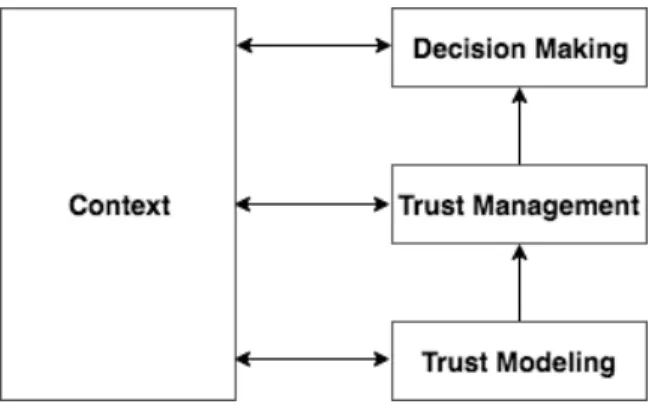
It is necessary to survey multistakeholder decision-making schemes to determine how to use trust value and risk value when making decisions. Various trust systems have been proposed, such as [24–34], including our framework [35–45]. This system has three phases, one of which is decision-making [35]. The outcome of the trust
management step is a trust value, which is then used in the decision-making phase subsequently. (Figure 2.1).
Fig. 2.1. Trust Framework which has three phases, each phase depends on the previous one.
This trust framework is based on measurement theory. To use the trust value for decision making, we need to acquire knowledge about what others have done regarding it. This trust management framework has been represented by [36], and it has been stated that trust modeling and decision making phases are dependent on context. The main contributions in this chapter are:
• Study the relationship between trust and risk.
• Study multistakeholder decision-making process and models.
• Survey individual decision-making schemes based on trust and risk.
• Survey multistakeholder decision-making schemes based on trust and risk.
• Analyze the challenges of existing multistakeholder decision-making schemes. There are several challenges associated with multistakeholder decision-making. For example, the participants may come from various backgrounds and have different expertise. Also, the participants may have partial views about the problem domain as well as have conflicting objectives. Regarding the use of trust and risk in a decision,
several challenges, such as risk quantification and, more specifically, rare events or those that have never occurred, arise as well. Another challenge can emerge from knowing how to apply trust and risk as decision criteria.
To the best of our knowledge, this is the first survey of multistakeholder decision-making using trust and risk. The outcomes of this survey include classifying the processes of multistakeholder decision-making and knowing the trust and risk models that were used for making decisions.
This chapter is organized as follows: In Section 2.3, we investigate different defi-nitions of trust and risk, then we introduce the possible relationships between them by analyzing existing related works. Next, in Section 2.4, we discuss trust and risk in multistakeholder decision-making by presenting decision-making theories and existing multistakeholder decision-making schemes. In Section 2.5, we conclude the chapter.
2.3 Trust and Risk
In this section, we discuss trust and risk concepts by listing some definitions and possible classifications.
2.3.1 Trust
The definition and evaluation of trust can be challenging because trust depends on the context. For each context, several factors model the trust. One study [46] pointed out, ”There is a consensus that trust depends on a variety of trust dimensions. However, there is no fixed set of such dimensions.” According to another study [47], ”Manifestations of trust are easy to recognize because we experience and rely on it every day, but at the same time trust is quite challenging to define because it manifests itself in many different forms.” When trust comes into the picture, uncertainty follows. A study [48] stated that ”trust relationships can be expressed as subjective opinions with degrees of uncertainty.”
There is no exact universal definition for it according to one study [49], Another [50] indicated that many researchers use the definition of trust in a very specific form relating to topics, such as authentication, or the ability to pay for purchases. Some authors defined trust with risk [51, 52] . One study [53] defined trust as the level of reliance placed on an entity based on experience of a particular context. One study [18] viewed the trust concept as the degree of confidence given to an entity. Another [54] considered trust as an assurance among participants while engaging in online auctions. Many researchers defined trust as a subjective probability that leads an individual to believe that another person will behave as expected [19] and as a particular level of subjective probability in which an agent assesses one or more agents to perform a specific action [47, 55–57].
Many researchers see trust as an expectation [15, 58, 59]. For instance, one study [58] stated that trust is ”psychological expectations or subjective belief that people think the trusted party will fulfill his obligations as their expectations.” Trust has also been defined as ”the extent to which one party is willing to depend on somebody, or something, in a given situation with a feeling of relative security, even though negative consequences are possible” [5, 47, 60]. Trust has been defined with vulnerability; one study [17] stated that ”trust definition is mainly based on the vulnerability that the trusting party is exposed to by this trust relation, and both positive and negative actions taken against this vulnerability by the trusted party.” Some authors view trust as ”users thoughts, feelings, emotions, or behaviors that occur when they feel that an agent can be relied upon to act in their best interest when they give up direct control” [22].
Trust can be classified into several types. For example, one study [51] classified trust as communication, information, social, and cognitive. Another study [61] classi-fied trust to be either generalized or specific. Yet another [62] classiclassi-fied it as relational or calculative. Relational depends on the relations between the parties while calcu-lative depends on past behavior. One study [47] divided trust into reliability trust (probability of transaction success) and decision trust (risk attitude defined by the
decision surface). It also sorted trust as being subjective (sources point of view) or objective (trustworthiness of the object).
2.3.2 Risk
Similar to trust, risk depends on the context as well. However, several works interpret risk as the probability of a negative event occurring. When taking risk into consideration, it is important to identify then evaluate it. The evaluation can be qualitative or quantitative. One study [60] defined risk as finding the balance between the likely cost and the possible reward. The cost is based on the likelihood of harm and its magnitude, which can be hard to asses. Another study [59] defined risk perception as the ”trustors belief about likelihoods of gains and losses.” Yet another study [63] defined risk as the probability of exploitation of vulnerabilities in terms of software. One study [64] mentioned the ISO/IEC TR 133351 definition of risk, which is related to the likelihood of exploiting vulnerabilities. Risk was also defined as the likelihood of an unwanted event and its consequence according to some studies [19, 53].
According to one study [54], perceived risk is defined as customers uncertainty of outcomes while performing an action. One study [65] stated that risk corresponds to uncertainty in outcome when making any decision. Another study [23] said that risk applies to situations when one is uncertain about the outcome. Another study [21] described risk as the consumers belief about potential adverse outcomes in uncertain situations. In one study [66], they described risk as the probability of making a loss. Another study [67] defined it as ”the likelihood of violation of a basic security property enforced by the system. Basic properties include confidentiality, integrity, authenticity and non-repudiation.”
From the above definitions, risk seems to depend on the possibility of a negative event occurring and the consequent amount of loss. Thus, risk evaluation is associated with probabilistic analysis. According to one study [68], risk is classified as subjective
and objective or systematic and nonsystematic. Risk can also be categorized in the way it is evaluated and analyzed, such as through quantitative analysis or qualitative analysis.
2.3.3 Relationship Between Trust and Risk
It is necessary to understand the relationship between trust and risk to know how to use them for decision-making. According to our analysis of previous works, there are many types of relationships. The following subsections show those types of relationships with the corresponding existing works.
Risk influences trust
In this relationship, risk may influence trust calculation, trust definition and trust relationships. Many works have shown how risk can influence trust. Some studies [51, 69] have shown that risk affects trust relationships. Other studies [70, 71] have shown that perceived risk has a positive influence on trusting human decisions and consumer trust. However, trust is associated with lower perceived risk [50, 59, 72]. When calculating trust, the risk variable can be used [13, 73, 74]. Risk can be used to derive a definition of trust called decision trust [5]. One study [75] used a risk management model to develop trust policies. Another [54] viewed risk as a precursor of trust.
Trust influences risk
In this relationship, trust may influence risk calculation, risk assessment, risk mitigation, risk relationship, and risk management. In terms of risk calculation, some studies [11, 14, 76] used trust values from direct interactions for risk computation. One study [77] incorporated trust in risk assessments, and another [78] investigated how trust and control may mitigate risk. In terms of risk relationship, one study [79]
illustrated that risk inversely depends on trust. If trust is high, then risk is small, and if trust is low, then risk is high. Another study [80] mentioned that parties who trust each other are more tolerant of risks. Another study [58] discussed the relationship between trust and perceived risk and mentioned that users trust in operators and application service providers would reduce the perceived risk of users. One study [81] showed that risk and trust are in an inverse relationship. For instance, riskier activities require a higher level of trust. Risk, in other words, is calculated based on trust. One study [21] stated that trust influences purchase intentions directly by influencing risk perceptions. Some studies [62, 82] showed the role of trust in risk management.
Complements to each other
Trust and risk can be viewed as complements to each other. One study [49] demonstrated that most systems consider trust and risk as complementary or ignore them. In our opinion, having such a relationship might lead to the use of one of them as a factor for decision-making because the other one is its complement. For example, if we say that one interaction has a trust value of 0.8, then the risk is 0.2. Therefore, we can use one of them to make the decision to proceed or not proceed.
No relationship
It is also possible that there is no connection between trust and risk. For example, trust can be considered as a property of principles but risk as a property of a process [49]. One study [21] showed that it is common to treat trust and risk as different concepts. In our opinion, this is practical if we deal with trust as a property of an entity that can make decisions and uses risk as a property of the decision itself. For example, someone is trying to decide whether to go on a picnic. He or she may ask two people whether it will rain. In this example, the individual needs to evaluate which of the two people is better at prediction; this can be translated into trust. He
or she must then evaluate the consequences of each decision; this is evaluating risk. At the end, the person will make the decision based on trust and risk.
Other relationships
There are other relationships between trust and risk than the ones mentioned ear-lier. For example, trust can be part of risk or vice versa. One study [83] stated that trust management could be characterized as a special case of risk management, focus-ing on authentication of and cooperation with actors whose identities and intentions may be uncertain. According to one study [55] , researchers agree that trustworthi-ness is a more general issue than risk. Other studies [84–86] discussed the following risk-taking behaviors. For example, the truster would have more risk-taking behavior when the level of trust is high. As another example, the truster would need to accept some residual risks using trust assumption. Trust and risk should work together to avoid ambiguity according to one study [13]. Similarly, another [68] stated that risk is always associated with trust. Another study [87] mentioned that that if there is no risk involved, then trust does not need to exist. The relationship between trust and risk may be unclear because it is difficult to tell which one influences the other as shown by one study [54] .
2.4 Using Trust and Risk in Multi-stakeholder Decision-Making
2.4.1 Decision-Making Theory
Theories and concepts
Decision theory can be divided into two branches, normative and descriptive. The descriptive model aims to predict behavior while the normative model seeks to observe how ideal people might behave. One study [88] stated that ”Emphasis has been placed on the normative aspects of human behavior, i.e., how a rational! A person or a group of rational persons ought to behave, as distinct from descriptive theories, which are
to explain and predict actual human behavior.” Therefore, decision-making models can relate to any of these branches. However, the central question is whether we can categorize each model to belong to a particular branch or not. According to one study [89], there is a little difficulty in categorizing some models as a clearly a descriptive or normative.
Expected utility theory is an important theory to address in terms of decision-making. Utility theory measures preferences related to decisions. One study [90] mentioned that economists and others have been developing mathematical theories regarding how people make choices among alternatives. ”These theories center on the notion of the subjective value, or utility, of the alternatives among which the decider must choose” . People behave rationally when they have transitive preferences and that they make a selection that maximizes the expected utility. The basis of expected utility theory is the vN-M (Von Neumann-Morgenstern) theory. The vN-M utility theory is useful because it can be used for modeling risk by including it in an axiomatic foundation [91].
Decision-making can be done based on the preferences of actions. Savage presented some axioms for restricting preferences over a set of actions. The purpose of Savages theory is to relate uncertainty or partial belief to rational preferences [92]. He proves that rational preference can be represented in term of subjective probability and utility measure. The primitive elements in Savages theory are the set of states, set of acts, and the preference relations. Expected utility can represent rational preferences. The set of outcomes is also considered and can be represented by the set of states because outcome is a new state.
Multiple Criteria Decision Making
Multiple Criteria Decision Making (MCDM) makes a decision based on more than one criteria. One study [93] stated that ”Multiple Criteria Decision Making is a discipline largely used to solve complex decision problems involving more than
one criterion.” Several challenges, such as the choice of criteria and the weight as-signment for each criterion, arise with MCDM. Some studies [94, 95] proposed works to address a situation in which the weight is entirely unknown. Many MCDM tech-niques aim to solve selection and ranking or sorting problems. One study [96] listed the following common MCDM methods: weighted sum method, weighted product method, ELECTRE (Elimination and Choice Translating Reality), AHP (Analytic Hierarchy Process), and TOPSIS (Technique for Order Preference by Similarity to Ideal Solution).
Another study [97] stated that the weighted sum method is the best known and simplest multicriteria decision-making method. If we assume that it is better to have a higher value of criteria, then the best alternative should have the maximum score among other alternatives. The score of each alternative can be calculated by multi-plying each of the alternatives criterion values by the associated weight, then sum the result. The weighted product method is similar to the weighted sum method but uses the product instead of the sum. The ELECTRE technique selects the best alternative from a set of alternatives. However, according to one study [98], ELECTRE is not the best decision aid. In AHP [99–101], one study [102] stated that this technique is effective in situations where judgments are made subjectively from different people. The TOPSIS technique [96, 103–105] selects the option that is the closest to the most ideal solution and the furthest one to the negative ideal solution.
Trust and risk in individual decision-making
Some multistakeholder decision-making models involve individual decision makers who prefer to make individual decisions before sharing it with others. Therefore, we study the existing individual decision-making schemes with corresponding models to analyze the way individual decisions are made. Several decision-making models exist regardless of the criteria used. For example, some researchers [6, 8, 24, 106, 107] proposed that their algorithms take predefined criteria as an input to produce the
result of decision-making as an output. Utility or expected utility is one of the other approaches. Expected utility takes into consideration peoples preferences about the available choices with uncertain outcomes. Some researchers [7, 23, 81, 108–113] used the expected utility value as a criterion for decision-making. In some cases, this utility value is related to risk. Some works [9,10,12–15,17–21,64,73,80,114–122] used predefined policies or rules to make decisions. For example, one can put a threshold value for trust and another for risk then compare the computed trust and risk values to these threshold values. If the values meet the policy condition or rule, the next step is to perform a particular action associated with the decision outcomes. Some researchers [123, 124] used MCDM for producing decision outcomes. Some works [5, 11,16,22,53,68,79,83,125–127] mentioned the criteria used in decision-making without specifying how to use them for producing decision outcomes or without mentioning the making approach. Table 2.1 shows a list of the existing individual decision-making schemes with the corresponding trust model, risk model, and decision-decision-making models.
T able 2.1.: List of ex isting individual decision-making sc hemes with their trust, risk, and decision-makin g mo dels Sc hemes T rust Risk DM Mo del Alcalde & et al [6] F unction o v er reputation, recommendation, comp etence, and con text Information System S ecurit y Risk Managemen t Algorithm Sen & et al [7] Higher utilit y outcomes Maxim um Exp ected U tilit y Exp ected Utilit y Jiang & et al [109] FluidT rust mo del Num b er of successful in teractions Exp ected Utilit y Ahmadi & et al [8] Recommendation-based trust Adaptiv e risk Algorithm Dimmo ck & et al [115] SECURE T rust Mo del Costs & lik eliho o ds of p ossible outcomes P olicy Dic kson & et al [73] Impression,reputation and risk attitude Risk attitude of the customer P olicy W ang & et al [79] T ransaction histo ry , other p eers’ ev al uation, old transaction amoun ts and the new transaction amoun t T ransaction trust v al ue N/A continue d on next p age
T able 2.1.: continue d Sc hemes T rust Risk DM Mo del Li & et al [13] Game v oting algorithm Utilit y function P olicy Li & et al [116] Mapping from spa ce (Sub ject, Op eration) Mapping from space (Op eration, ob ject) P olicy Y ao & et al [9] Cum ulativ e n um b er of resp onse correctly incorrectly Cost and resources consumed P olicy Hu & et al [10] Normal distribution Utilit y function P olicy Zuo & et al [14] p2p transaction Based on trust v alues from the dir ect in teractions P olicy Ruizhong & et al [15] P erceiv ed Risk Economic, time, fu nctional, service so cial and priv acy risk P olicy Y e [16] F eedbac k elemen ts of online comm unicatio n Priv acy , financial, functional, time , source, consignation, pa ying an d men tal riskS N/A Duan & et al [11] Latest observ ation and the history trust data units The cen tralit y degree and a v erage trust degree N/A continue d on next p age
T able 2.1.: continue d Sc hemes T rust Risk DM Mo del Ca yirci [17] P erio dical data w eigh ted using their freshness. Eliminate a securit y threat b y reco v ering from a serv ice outage P erio dical data w eigh ted using their freshness. Securit y and service outage. P olicy P ereira & et al [18] P ositiv e/negativ e feedbac k Distance from the p oin t of o ccurrence of pheromone dep osition and the similarit y of in terest of eac h agen t P olicy Burnett & et al [19] Sub jectiv e Logic mo del Risk-a w are authorization function P olicy Liu & et al [64] Three-Dimension F riendship Mo del Probabilit y of an ob ject b ein g illegally exp osed o r temp ered and subsequ en t loss P olicy Cho & et al [20] P ersonalit y chara cteristics P ersonalit y characte ristics P olicy Quercia & et al [81] Agen t co op eration Computation of lik eliho o ds Based on trust Exp ected Utilit y Sang & et al [5] Reliabilit y trust and decision trust The decision surface whic h defines an agen t’s risk attitude N/A continue d on next p age
T able 2.1.: continue d Sc hemes T rust Risk DM Mo del Grazioli & et al [12] Grazioli, Jarv enpaa and the theory of deception b y Johnson ab out trust w orth y of the store Grazioli, Jarv enpaa and the theory of deception b y Johnson ab out the riskiness of the site P olicy P atric k [22] Abilit y to trust, exp erience, predictable p erformance, comprehensiv e information,shared v alu es, comm un ication and in terface design Based on uncertain ty , p ersonal details, alternativ es and autonom y N/A Dimmo ck & et al [23] SECURE T rust Mo del SECURE risk mo del Exp ected Utilit y
2.4.2 Changing preferences
Interactions among stakeholders when they make a collective decision is important since they negotiate while they are seeking for a solution to choose. In decision-making framework that uses machines for moderate the stakeholder negotiations, the interac-tion could be rating or even written comment to express the others opinion regarding the individuals choices and preferences [128–136]. Such notion of preferences occurs in decision-making field [137]. The individuals’ preferences can be changed over the time due to the changes in the interests. Those interests change can be a result of the influence by the others [138], the choices made before or even other factors that are based on the individuals situation at the time of making selection. Several studies showed that the individual interest and preferences are changing [138–145] and these study are different in term of the causes that lead changing the prefer-ences. In [141], they predicted the changes in preferences based on the feedback of the negotiation process. [142] presented the dominant theories of belief change that may be called input-assimilating models. They expressed how the subject’s belief state is transformed upon assimilation of an input. In addition to the different fac-tors that change the individuals’ preferences, the choices proposed while making a decision may affect the preferences or in other word, it shapes them [145]. There is a study [138] explained the change the initial preference of an individual to match the others choices, either through coercion from others or selection by the individual team member. Preferences changes can be short term or long term [137,144,146,147]. Short term preferences affect the current choices while negotiating but the long term one affects the choices in the future. In social psychology field where they study the peoples’ behavior, there are different theories that predict the preferences changes. For example, dissonance theory [139, 148, 149] motivates individuals to change their preferences to match their prior decision that can be a result of a selection they made in the past based on influence.
Multi-stakeholder decision-making
Decision-making is not limited only to an individuals decision. Some scenarios involve more than one person to make a decision. In these cases, it is called multi-stakeholders or GDM (group decision-making) [150–168]. One member involved in a group no longer makes the final decision without the involvement of other mem-bers. For example, when recruiting a new person in a company, several employees from administration will be involved in the decision. Each person will give his or her decisions, and the final decision will depend on all individuals opinions. In so-cial settings, different approaches, such as taking the average of all the participant responses or taking the majority decision as final, have been proposed. For example, one study [24] proposed a GDM model that involves participants ranging from expert to novice. This approach employs the trust model to help in the decision process. If an individual cannot make his or her preference, then he or she seeks the advice of other member based on trust. Another study [111] used aggregated decision-making in urban planning. Each agent makes their evaluations of benefit, cost, and risk of the available alternatives. These assessments will then be aggregated to form a group decision. One study [169] combined the GDM method with AHP to evaluate the risk. Arrows impossibility theorem is used in the field of GDM. According to one study [170], ”When we consider the group decision-making problem (with more than two choices), it is clear that it would be nice to have a fair procedure that combined the individuals preferences about the alternatives (expressed as rankings) into a statement about the groups preferences about the alternatives while preserving the autonomy of each individual.”
Multi-stakeholder decision-making process
The involvement of multiple participants when making a decision makes it essen-tial to construct a process that takes each individual selection into consideration to reach a final decision. There are different types of multistakeholder decision-making
processes. However, based on our analysis of the existing works, we found that the three common processes are consensus, ranking, and voting. Table5.1 shows the de-scription of these methods and their corresponding challenges. An important point to mention is that there are some GDM scenarios that combine more than a GDM process.
Voting, for example, is considered a simple method because it involves making a decision based on the majority vote. However, its limitation comes from treating all participants equally even though they are different in terms of expertise. Also, the outcome of voting may be unsatisfactory for the members whose decisions received less votes [27]. Consensus, however, does have the advantage of reaching a solution that is agreed by everyone [26]. Thus, the decision makers need to negotiate several rounds, and in each round, they must modify their proposed solutions to be decided by other participants. However, this has its limitation as the participants cannot influence others, which could lead to an infinite number of rounds. The ranking process is used in several multistakeholder decision-making model by ranking the suggestions of each participant [28]. This has the advantage of knowing the degree of group convergence, which is useful in selecting the solution that receives the higher ranking. However, its limitation is the difficulty of ranking a large number of decisions. Also, it is possible that each participant will rank the solutions but will give his or her own the highest ranking.
In terms of using trust on those processes, it has been applied in a different way like obtaining the advices from the trusted individuals or weighting each alternative with the trust of the individual. One study [24] used trust for the consensus process and showed that the consensus decision is reached when decision makers adjust their preferences, such as the importance of the decision criteria, which can be obtained from the advice of other trusted participants. One study [25] selected the solution with the highest trust value to reach a consensus. This trust value is formulated using the decision-makers interactions when they propose suggestions. One study [26] proposed a GDM model that first creates a trust network that reflects the participants
opinions toward others based on the proposed solutions. In other words, this trust value considers the participants weights when aggregating proposed decisions. For the voting process, one study [27] aggregated single votes to a single collective decision and used trust to weight the influences of the decision makers in decision-making. Another study [29] also used trust in voting to show the tendency of making a decision in favor of another participant.
One study [28] proposed a multistakeholder decision-making model to rank the preferences. However, in some cases, the decision makers may not have enough in-formation about some alternatives to accurately rank them. Therefore, the decision makers opinion about such alternatives is influenced by other experts he or she trusts.
Table 2.2.
List of common Multi-stakeholder decision-making process with the asso-ciated challenges
Process Description Challenges
Voting Take the majoritys opinion The outcome is winning or not wining.Treat participants equally Consensus Consider the group decision
instead of selecting one
The outcome is hard to reach if there is conflict
Ranking Show the degree in which the group preferences converge
Difficulty to rank the large number of decisions
Multi-stakeholder Decision-Making Models
According to one study [171], there are five classes of GDM models. The first model, GDM1, assumes that the decision makers propose then aggregate their in-dividual solutions, rank them based on their utilities, and finally select the highest ranked solution. In the second model, GDM2, the decision makers propose their
indi-vidual solutions and use them as preferences when voting. In the third model, GDM3, there is a supra-decision maker that manages the decision-making process among the decision makers. The fourth model, GDM4, finds group utility to reach a consensus. In the fifth model, DGM5, the decision makers use the bargaining theory. There is no model better than the others because each model is useful in specific applications. For example, GDM1 is useful for applications that take individual preferences into account, GDM2 for applications that use voting as a decision-making process, GDM3 for applications where there is a hierarchy among participants, GDM4 for applica-tions that take group preferences for the consensus process into account, and GDM5 for applications that deal with resource allocations.
2.4.3 Trust in Multi-stakeholder Decision-Making
Trust in multistakeholder decision-making is crucial [25] because it is a valuable group component and is essential in the collaboration process. It becomes, however, a further complicated or more dependent parameter when an expert may be uncertain, have incomplete information, or cannot access information. Experts have to use their domain expertise to arrive at a decision. An expert may give his or her subjective preferences, but they may not be agreed to by other team members. In such situa-tions, experts have to collaborate, exchange information, and arrive at a consensus. One study [172] stated that ”Trust can reflect the actual reputation between experts because it uses the history of an experts actions or behavior. Therefore, it should be taken into account as a reliable source to be used in deriving aggregation weights for individual experts.” As a matter of a fact, trust can be used in the decision-making process to weight the influence of different decision makers [27].
Several schemes for multistakeholder decision-making vary in terms of the trust model as well as the GDM model and process. In addition, each of the schemes comes with limitations. For example, some schemes [24, 24, 25, 29, 31–33] do not allow the stakeholder to modify the decision outcome because there is a fixed set of