978-1-4799-8641-5/15/$31.00 ©2015 IEEE
Automatic Oil Tank Truck Alarm System from Illegal
Fuel Hoarding with Microcontroller and GSM
Module Based System
Muhammad Fikko Fadjrimiratno, Andrey Wicaksono, Rofiq Cahyo Prayogo, Hot Asi Yohannes Sidabutar, and
Sumardi
Department of Electrical Engineering Diponegoro University
Semarang, Indonesia
Abstract—Illegal fuel hoarding usually done by irresponsible drivers when they transport the oil from terminal to the gas stations. Many technologies already used by Pertamina (Indonesian National Oil Company) to prevent that case, but it has proved ineffectiveness until now. Therefore, the authors designed and created the automatic alarming system designed specially for oil tank truck. The system used microcontroller, GSM (Global System for Mobile communication) module, GPS (Global Positioning System), and ultrasonic sensors. Algorithm created based on survey done in the oil terminal and observation toward irresponsible driver habits when stealing the oil. Experiment results have proven that this system can do basic task to protect oil distribution from oil terminal to gas station, gas station to gas station, then returns to oil terminal. The application of this system is expected to be useful for reducing fuel scarcity due to illegal fuel hoarding and potentially help Pertamina and the gas station owners from financial losses with the much cheaper and effective system.
Keywords—illegal fuel hoarding; microcontroller; gsm; gps; ultrasonic sensor;
I. INTRODUCTION
Data from Directorate General of Oil and Gas [1] shows that Indonesia has oil reserves of 7.4 billions barrels in 2010. But, Indonesia is only able to produce 289.899 million barrels in 2011. This amount is clearly not capable for accommodating the yearly oil consumption in the country with almost 394.052 million barrels. The government estimates that the availability of oil in the country will only survive in the next 11 years. The oil reserves depletion will then causing fuel shortages in various regions in Indonesia. This condition then became worse by illegal fuel hoarding that are done by irresponsible oil tank truck drivers when the truck transports oil between oil terminal to the gas station and gas station to the gas station then returns to the oil terminal.
Illegal fuel hoarding are usually done by simply open the bottom loader trunk then with a little tricks, the valve can be opened without damaging the seal, note that since 2008 all of loading and unloading process in the Pertamina oil tank trucks
must done through bottom loader valve [2]. Pertamina has applied many technologies to prevent this case. The first one was a cheap solution, simply applied the GPS (Global Positioning System) tracker to the trucks. GPS tracker used to monitor on a real time basis the location, route taken, and speed of the truck [3]. From the recorded route, we can analize wether the driver was deviated from his route or not. If the route was deviated, we can imply that the driver did the illegal oil hoarding. But we can’t detect if such activity done in the correct route. Furthermore, the monitoring can’t be maximumly done if the amount of the trucks is too many, for example, one hundred trucks per oil terminal. The second method was a costly method but it can detect the change in oil level. The device generally use pressure sensors or float gauges to check the liquid level in the tank [4]. Still, the use of float gauges are not effective to be used on the moving liquid storage, especially when the route of the trucks are hilly, as the measurement of liquid level can change easily. This method requires the tanks to be modified and well maintained. Moreover, gasoline composed of different hydrocarbons with different boiling points in the range of 30ºC - 200ºC, and contains about 10% of light products that can evaporate at a temperature of about 5ºC [5]. So we can’t be sure wether the changes in oil level are caused by the illegal fuel hoarding, because the unstable terrains, or because of the massive evaporation.
Regarding to the above matters, the authors designed and created the automatic alarming system designed specially for Indonesian oil tank truck. This method expected to be a low cost, easy installation and easy maintenance system, but effective solution to prevent the illegal fuel hoarding and catch the oil theft on location.
II. WORKING METHODS AND APPLICATIONS A. Microcontroller as a Main Controller of the System
Microcontroller is a processor with a memory and a whole lot of other components integrated on one chip [6]. Both of microcontroller and microprocessor are commonly used as a controller part in automobile system. Selvamurugan research This research is sponsored by DIKTI and PERTAMINA applicable
[7] used ARM microprocessor based system in the design of vehicle tracking and monitoring system using GPS. Even though, we found that affordable chip like ATmega32 are good enough in terms of I/O ports (40 pins), and many features like Timer and USART (Universal Synchronous Asynchronous Receiver Transmitter) [8]. In this work, ATmega32 are used to be a main controller for GPS, GSM (Global System for Mobile communication) module, ultrasonic sensor, keypad, and alphanumeric LCD. ATmega32 communicates to GPS and GSM module with USART, processing some calculations to read ultrasonic sensors, generating random codes for the passwords, and generating watchdogs timer to automatically resetting microcontroller.
Fig. 1. Microcontroller ATmega32 B. GSM module
GSM module is a specialized type of modem which accepts a SIM card operates on sub scriber mobile number over a network, just like a cellular phone. It’s a cell phone without display [7]. GSM-module used is SIM900 series. SIM900 is a GSM module that can work at frequencies of 850/900/1800/1900 Mhz with a capabilities of GPRS mobile station class B. Class B means that it can connected to GSM services (phone call and SMS) or GPRS services alternately at the same time [9]. SIM900 using UART (Universal Asynchronous Reciver Transmitter) to communicate with controller and can be controlled using AT Command [10]. The algorithm of sending an SMS in this work can be seen as follow [11]:
1) Give high signal at least three seconds to pin “P” of the SIM900 to turn on SIM900 digitally.
2) Send serial data “AT+CMGF=1” to SIM900 to select SMS message format in text mode. Give one second delay afterward.
3) Send serial data “AT+CMGS=” to SIM900 to send SMS in text mode. Give one second delay afterward.
Fig. 2. GSM-Module SIM900
C. GPS
GPS with a complete name of NAVSTAR-GPS (Navigation System with Timing and Ranging Global Positioning System), were a formerly developed by Department of Defense of United States and used for civil and military purpose around the world for free [12]. To be able to use GPS, we need GPS receiver. GPS receiver must be locked on to the signal of at least three satelites for latitude and longitude of the vehicle. With four or more satellite in sight, the receiver can determine 3D position (latitude, longitude, and altitude) [7]. To get this information, controller must read the serial data that are sent by GPS receiver. There are some kind of standart protocol used by GPS receiver to send data readings position, here we use NMEA (National Marine Electronics Assosiation) 0813. This protocol always begins by ‘$’ character, then followed by address and then the data that are separated by commas and finished by checksum and CR/LF (Carriage Return or Line Feed) or ‘\r\n’ in C programming language [9].
The GPS receiver used is Ublox NEO-6M. This module communicates through UART with NMEA 0183 protocol with varieties of baudrate value of 4800, 9600, and 38400 through RMC (Recommended Minimum Data) structure as follow : $GPRMC,hhmmss,status,latitude,N,longitude,E,spd,cog,ddm,m yy,mv,mvE,mode*cs<CR><LF>
NEO-6M has the accuracy of around 2.5 meters [12]. In this works, we just need the latitude and longitude data to get the illegal fuel hoarding location. The algorithm of retrieving the latitude and longitude data can be seen as follow [11]:
1) Wait until GPS receiver send the ‘$’ character. If so, go to state 2.
2) Wait until GPS receiver send the ‘C’ character from ‘GPRMC address’ (Fig. 3). If so, go to state 3.
3) Wait until GPS receiver send the ‘,’ character. If so, go to state 4.
4) Wait until GPS receiver send the ‘,’ character. If so, go to state 5.
5) Wait until GPS receiver send the ‘,’ character. If so, the data retrieved is latitude.
6) Wait until GPS reciever send the ‘,’ character. If so, the data retrieved is N/S (hemisphere north or south) indicator. 7) Wait until GPS reciever send the ‘,’ character. If so, the data retrieved is longitude.
8) Wait until GPS reciever send the ‘,’ character. If so, the data retrieved is E/W (east or west) indicator.
Fig. 3. Serial Data from NEO-6M GPS Receiver Retrieved from CodeVisionAVR terminal. D. Ultrasonic Sensor to Detect Movements of the Bottom
Loader Trunk
Ultrasonic sensor can be used to measure distances in the range of a few centimeters to a few meters, based on the well known time of flight technique. Such sensors are reasonably cheap and work for ranges of up to a few meters, even though problems arise regarding both their accuracy and their behaviour in noisy open-air conditions [13]. To measure distances with the flight technique, the sensor detects echoes from objects and evaluate their propagation time and amplitude [14].
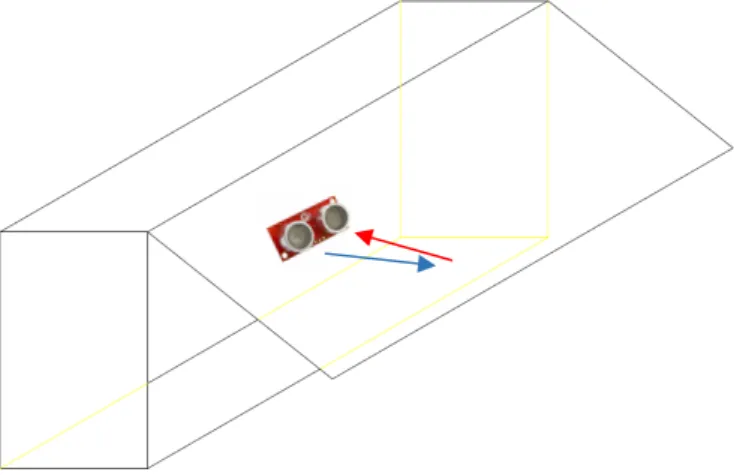
In this work, ultrasonic sensors used as range based indicator whether the bottom loader trunk is opened or not. This is works by placing the ultrasonic sensors in the bottom loader base so it can measure the range between the base and the trunk (Fig. 4). That range when the trunk is closed become the set point, that can be adjusted through the software. If the range detected is beyond the set point, then surely the trunk is opened. If the range detected is below the set point, then someone has covered the sensor with something and it is can be suspected as an attempt to do an illegal fuel hoarding. So, it is extremely difficult for irresponsible drivers to deceive the sensor for the first time since some trials and errors are needed to define exact measurement of the set point of range. Still, the use of ultrasonic sensor can be accompanied with some of mechanical switch like limit switch or reed switch for double protection.
Fig. 4. Placement of the Ultrasonic Sensor on Bottom Loader Trunk
III. SYSTEM DESIGN A. Testing Materials and Tools
The following are the materials and tools were used to make the testing device and prototype :
Materials :
a. 1 piece ATmega32 minimum system b. 1 piece 4x4 numeric keypad
c. 1 piece 20x4 alphanumeric LCD d. 2 pieces of HC-SR04 ultrasonic sensor e. 1 piece 5 volts buzzer
f. 1 piece SIM900 GSM module g. 1 piece Ublox NEO-6M GPS receiver
h. 1 piece 5 amperes Universal Battery Elimination Circuit (UBEC)
i. 1 piece 11.1 volts and 1.3 amperes power supply Tools :
a. 40 watts Solder b. Toolset
c. K125R USB downloader d. Mobile phone
e. Bottom loader trunk miniature
f. Computer with Windows 8 Professional 64 bit operating system
g. CodeVisionAVR C compiler B. Hardware Design
As shown in Fig. 5, the hardware of the prototype consists of input (keypad, ultrasonic sensor, GPS receiver), microcontroller (ATmega32), and output (GSM module, LCD, and buzzer). Keypad used is 4x4 numeric keypad for inputting some data to the system, such as the destination code of the gas station, password, etc. Ultrasonic sensors used are HC-SR04 series as a range based indicator whether the bottom loader trunk is opened or not. GPS receiver used is Ublox NEO-6M to retrieve the coordinates data of the illegal fuel hoarding location. GSM module used is SIM900 series to send notifications and coordinates retrieved by GPS receiver if illegal fuel hoarding occurs. Besides, GSM module used to send random numbers as a password to gas station owner. Then, LCD (20x4 alphanumeric type) and buzzer used to show the informations.
Fig. 5. Block Diagram of the System C. Software Design
The software is based on C programming language and created through CodeVisionAVR C compiler. Through in-depth surveying and observing on oil terminal of Boyolali City, we got various data of irresponsible driver habits when stealing oil and how it was occurred. We used that data as a basis to create the algorithm of the software, so that this software can estimate many possible tricks that will irresponsible drivers do when stealing oil.
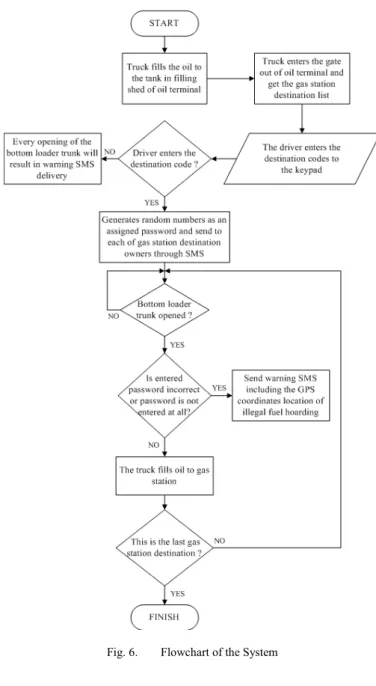
As shown in Fig. 6, the system works after the driver get the gas station destination list at gate out of oil terminal. Ordinarily, the truck services up to three gas stations for each delivery. Then, the driver must enter all of gas stations destination codes from the list to the keypad. If the codes is not entered, the warning SMS will be sent whenever and wherever the bottom loader trunk opened. After the codes entered, the system will generate random numbers as an assigned password for each of gas station destination. The generated password will be sent to each of gas station destination owners so that they can input the password when the truck arrives at their gas station. This way the password keeps changing for each delivery, so the accreditation is securely guaranteed and provides more secure and cost effective authentication than other methods, such as the use of RFID (Radio Frequency Identification) since the RFID needs high cost and easily leaks to a third party because the content travels through the air [15][16]. Afterwards, if password entered is incorrect for three times a row or password is not entered at all while the bottom loader trunk is opened, the system will send warning SMS including the GPS coordinates location of illegal fuel hoarding. The system will keep silent and work normally so that the executant will not feel suspected and police are able to catch the oil theft on location. Else, if the password entered is correct, we can be sure that the truck has arrived at gas station. Thereafter, the truck continue to distribute the oil to the next gas station. Buf if this gas station is the last destination, the system will reset itself through Watchdog Timer [17] and the truck returns to the oil terminal.
Fig. 6. Flowchart of the System IV. TESTING RESULTS
After the prototype created through in-depth designing and observing, the prototype will be tested with various basic tasks to protect oil distribution through the oil tank trucks, such as testing the ability to recognize more than one gas station destination, testing the detection of opened bottom loader trunk with ultrasonic sensor, testing the prototype response when the bottom loader trunk is opened with correct password, and testing the prototype response when the bottom loader trunk is opened with incorrect password or password is not entered at all.
A. Ability to Recognize more than One Gas Station Destination
The prototype can recognize more than one gas station destination per delivery. Once the driver enters the gas station destination code, a list of gas station destination will be shown
in alphanumeric LCD (Fig. 7), thus generates password for each of gas station destination.
Fig. 7. Testing the Ability to Recognize more than One Gas Station Destination.
B. Detect the Opened Bottom Loader Trunk with Ultrasonic Sensor
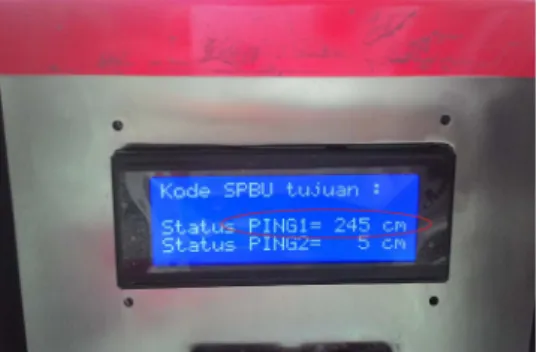
As shown in Fig. 8, the prototype has been able to detect the opened bottom loader trunk miniature with “PING1” status indicator listed on the LCD display. The range set point value is 5 cm, hence if the range detected is above 5 cm, then surely the bottom loader trunk is opened. In addition, the “PING2” status indicator is used to detect whether the prototype box is opened or not for extra protection.
Fig. 8. Testing the Detection of Opened Bottom Loader Trunk with Ultrasonic Sensor.
C. Prototype Response if Bottom Loader Trunk Opened with Correct Password
If bottom loader trunk is opened with correct password, the prototype will not send a warning SMS assumes that the oil tank truck has arrived safely at gas station. Gas station crews will be given 10 minutes (10 seconds for testing purpose as shown in Fig. 9) to unload the oil from the truck before the password is changed to a password generated for next gas station destination.
Fig. 9. Testing the Prototype Response if Bottom Loader Trunk is Opened with Correct Password and Shows the Countdown before Bottom Loader Trunk must be Closed Again.
D. Prototype Response if Bottom Loader Trunk Opened with Incorrect Password or Password is not Entered at All If the bottom loader trunk opened with incorrect password for three times a row or password is not entered at all, the prototype will send warning SMS that includes the coordinate of illegal fuel hoarding location (Fig. 10) that can be accessed instantly by Navitel Navigator GPS & Maps or simply input the coordinate to Google Maps (Fig. 11)
.
Fig. 10. The SMS Retrieved When Bottom Loader Trunk is Opened with Incorrect Password or Password is not Entered at All.
. Fig. 11. Determining the Illegal Fuel Hoarding Location with Entering the GPS Coordinate to Google Maps
V. CONCLUSION AND FUTURE WORK
In this paper, the automatic oil tank truck alarming system from illegal fuel hoarding is present. The system use GPS receiver to retrieve coordinate of illegal fuel hoarding while the GSM module send that coordinate through warning SMS. Ultrasonic sensor is used to detect the opened bottom loader trunk. Testing conducted on the prototype shows that the prototype can automatically do a basic task to protect oil distribution from oil terminal to gas station, gas station to gas station, then go back to oil terminal. The prototype is able to detect illegal fuel hoarding then send warning SMS that included the illegal fuel hoarding GPS coordinate. This system is expected to be much cheaper and effective than previous method, thus can prevent illegal fuel hoarding and potentially help Pertamina and gas station owner from financial losses.
The next work for the development of this system is the use of camera that can automatically trigger itself when the bottom loader trunk is opened. It is useful as an evidence if illegal fuel hoarding occurs. Then the microcontroller that has double serial communication pins will be used, so that the gas station owner can request real time location of oil tank truck through SMS. Then, we will test durability and handling of the prototype in the on-the-road testing with 32.000 litres modern oil tank truck.
ACKNOWLEDGMENT
First, we express our greatest gratitude towards God, to both of our parents, and our supervisor Mr. Sumardi, S.T, M.T. Biggest appreciation give to Mr. Arnold Pandaleki as S&D Manager of Pertamina MOR IV and Mr. Soeharto as HSE Supervisor of Boyolali Pertamina Oil Terminal for various of their suggestions to us. Also, authors thank all fellows of Electrical Engineering of the Diponegoro University and all those who support in the writing of this paper.
REFERENCES
[1] Kementerian Energi dan Sumber Daya Mineral, Statistika Minyak Bumi, Jakarta: Kementerian ESDM, 2012.
[2] Direktorat Pemasaran dan Niaga Pertamina, Buku Panduan K3LL, Jakarta: K3LL&MM, October 2008.
[3] Petron, Sustainability Report, Manila: Petron Supply & Operations, 2011.
[4] J. Feingold, “The science of fuel transportation,” J. PMAA, p. 24, 2014. [5] M.A. Abdelmajeed, M.H. Onsa, and A.A. Rabah, “Evaluation and
reduction of evaporation losses of gasoline storrage tanks,” Khartoum: Faculty of Engineering University of Khartoum, April 2009.
[6] G. Gridling and B. Weiss, Introduction to Microcontrollers, Vienna: Institute of Computer Engineering Vienna University of Technology, February 2007.
[7] T. Selvamurugan, “Design and implementation of vehicle tracking and monitoring system using GPS and ARM processor,” J. IJIRAE, vol. 1, pp. 217-220, November 2014.
[8] ATMEL, ATmega32 Datasheet, CA: Atmel Corporation, August 2007. [9] A. Pangestu, Sumardi, and Sudjadi, “Perancangan alat pengaman dan
tracking kendaraan sepeda motor dengan menggunakan mikrokontroler ATmega644PA," J. TRANSIENT, p. 433-441, 2014.
[10] SIMCom, SIM900 Hardware Design, Shanghai: SIMCom Wireless Solutions, January 2013.
[11] SIMCom, SIM900 AT Command Manual, Shanghai: SIMCom Wireless Solutions, December 2010.
[12] Jean and M. Zogg, GPS Essential of Satellite Navigation Compendium, Zurich: U-Blox AG, 2009.
[13] A. Carullo, M. Parvis, “An ultrasonic sensor for distance measurement in automotive applications,” J. IEEE Sensors, vol. 1, p. 143-147, August 2001.
[14] V. Magori, “Ultrasonic sensors in air,” Proc. IEEE ‘94 Ultrasonics Symp, pp. 471-481, 1994.
[15] A. Narayanan, S. Singh, and M. Somasekharan, “Implementing RFID in library: methodoligies, advantages and disadvantages,” J. Recent Advances in Information Technology, p. 271, 2005.
[16] S. Inoue, S. Konomi, H. Yasuura, “Privacy in the digitally named world with RFID tags,” Workshop on Socially Informed Design of Privacy-Enhancing Solutions in Ubiquitous Computing, 2002.
[17] R. Kamal, Devices and Communication Buses for Devices Network, vol. 3, New York: McGraw-Hill Education, 2008.