Robust Scene Estimation for Goal-directed Robotic
Manipulation in Unstructured Environments
by Zhiqang Sui
A dissertation submitted in partial fulfillment of the requirements for the degree of
Doctor of Philosophy
(Computer Science and Engineering) in the University of Michigan
2020
Doctoral Committee:
Professor Odest Chadwicke Jenkins, Chair Professor Ella Atkins
Professor Benjamin Kuipers Professor Edwin Olson
Zhiqiang Sui [email protected]
ORCID iD: 0000-0003-1286-9734
ACKNOWLEDGMENTS
First of all, I would like to give my deepest appreciation to my advisor, Professor Odest Chadwicke Jenkins, who has mentored and helped me along my Ph.D. journey. Chad’s immense enthusiasm and wisdom for robotics have shaped my perspectives on conducting independent research. His constant encouragement and support provided guidance not just in research, but also in my life. I would also like to thank my thesis committee members, Professor Edwin Olson, Professor Benjamin Kuipers, Professor Robert Platt, and Professor Ella Atkins, for their keen insights in shaping the documents and being supportive. I am also thankful to Professor Xiaoping Chen, who has led the way and provided lots of opportunities in my earlier research career. Thank you to all my labmates and collaborators for being supportive and provide immense contributions to this work. Thanks to the support and encouragement by Karthik Desingh for all the time from Brown to Michigan. Special thanks to great collaborations with my colleagues Zheming Zhou, Zhen Zeng, Lingzhu Xiang, Xiaotong Chen, Haonan Chang, and Ning Xu. The achievement would not be possible without their endeavors and contributions. Many thanks to Kevin French, Jana Pavlasek, Emily Sheetz, and Zhefan Ye for discussing and developing research projects.
Above all, my parents have supported me throughout my life. Without their support and sacrifice, none of these would be possible. Thanks for their endless love and support.
TABLE OF CONTENTS
Acknowledgments . . . ii
List of Figures . . . v
List of Tables . . . viii
Abstract. . . ix
Chapter 1 Introduction . . . 1
1.1 Aims and Motivation . . . 1
1.2 Challenges. . . 2
1.3 Thesis Contributions . . . 6
1.4 Dissertation Outlines . . . 8
2 Background . . . 9
2.1 Symbol Grounding for Robotics . . . 9
2.1.1 Shared Autonomy for Manipulation . . . 9
2.1.2 Goal-directed Manipulation . . . 10
2.2 Perception for Manipulation . . . 11
2.3 Scene Estimation . . . 12
2.4 Semantic Mapping . . . 14
2.5 Summary . . . 15
3 Axiomatic Scene Estimation . . . 16
3.1 Motivation for Generative Approach . . . 18
3.2 Problem Statement and Formulation . . . 20
3.2.1 Assumptions . . . 22
3.2.2 Scene Graph Enumeration . . . 22
3.2.3 Formulation. . . 24
3.3 Methods . . . 25
3.3.1 Axiomatic Particle Filter . . . 26
3.3.2 Axiomatic Monte Carlo Markov Chain . . . 27
3.4 System Architecture. . . 29
3.5 Parallelized likelihood evaluation . . . 31
3.6 Results. . . 34
3.6.2 Metrics for AxScEs. . . 38
3.6.3 Scene Graph Estimation . . . 38
3.6.4 Manipulation Results . . . 39
3.7 Summary . . . 42
4 Sequential Scene Understanding and Manipulation . . . 44
4.1 Motivation . . . 44
4.2 Formulation . . . 46
4.3 Methodology . . . 49
4.3.1 Object Detection Heuristics . . . 49
4.3.2 Particle Filtering for Pose Belief . . . 49
4.3.3 Greedy Data Association . . . 51
4.4 Results. . . 52
4.4.1 Single Scene Estimation . . . 54
4.4.2 Estimation and Manipulation on Sequential Scenes . . . 55
4.4.3 Robotic Manipulation Experiment in Adversarial Scenarios . . . 56
4.5 Summary . . . 57
5 Geometric Consistency informed Scene Estimation in Dense Clutter . . . 60 5.1 Motivation . . . 61 5.2 Formulation . . . 63 5.3 Data Association . . . 64 5.4 Graph Optimization . . . 68 5.4.1 Stage I Optimization . . . 69
5.4.2 Object Geometric Relationship Inference . . . 70
5.4.3 Stage II Optimization. . . 74
5.5 Experiments . . . 75
5.5.1 Implementation . . . 75
5.5.2 Dataset and Baseline . . . 75
5.5.3 Evaluation . . . 76
5.6 Summary . . . 79
6 Discussion and Conclusion . . . 81
6.1 Conclusion . . . 81
6.2 Future Directions . . . 82
6.2.1 Explore space and physics for real-time inference for AxScEs . . . 82
6.2.2 Maintain multi-modal distribution of object poses with multiple instances for SUM . . . 83
6.2.3 Explore point-wise error in optimization process . . . 83
LIST OF FIGURES
FIGURE
1.1 Common household manipulation tasks. (a) The robot from Technical University of Munich is preparing meals [8], (b) The robot from University of Tokyo is doing laundry, (c) The robot from Toyota Research Institute is making coffee [7]. . . 2
1.2 Examples of mobile manipulation robots. (a) Brown PR2 robot [103] (b) Michigan Progress Fetch Robot [104] (c) Kejia robot from University of Science and Technol-ogy of China [14]. They are equipped with low-cost cameras like Microsoft Kinect [121] or Asus Xtion, which have limited field-of-view and produce noisy RGB and depth data. Unlike the industrial arms, their manipulators also introduce imprecisions in actuator controls. . . 3
3.1 An example of AxScEs estimation and goal-directed manipulation of a (a) cluttered scene with (b) eight objects to a (c) goal state of putting small objects in a bin and boxes to the side. AxScEsestimation generatively infers from robot observations (d) the maximally likely scene configuration (e,f). The resultingAxScEsis used to plan and execute actions (g-l) to the user-specified goal state (c). . . 17
3.2 Example of a robot needing to grasp an object (the green block) in a simple stack scene. The robot needs to estimate the scene but faces ambiguity about whether there are two stacked objects or one larger object. Once estimated, the robot needs to per-form a sequence of actions to move the yellow block and then, once cleared, grasp the green block.. . . 20
3.3 Axiomatic scene estimation for an example four-object scene (top left), observed by the robot as a depth image (top right), will estimate the pose and spatial relations of objects as parameterized axiomatic assertions. . . 21
3.4 Architecture diagram for pose estimation within goal-directed manipulation with re-spect to the AxPF . Pose estimation and manipulation components are respectively highlighted in red and blue. . . 30
3.5 Pose estimation results for known axiom sets in scenes containing three to four ob-jects. Each subfigure, shows the RGB (left) and depth (middle) from an RGBD camera mounted on the head of the PR2 and estimated scene graph as a depth image (right), as well as the RMSE for translation and rotation error. . . 35
3.6 Pose estimation results for known axiom sets in scenes containing five to seven ob-jects. Each subfigure, shows the RGB (left) and depth (middle) from an RGBD camera mounted on the head of the PR2 and estimated scene graph as a depth image (right), as well as the RMSE for translation and rotation error. . . 36
3.7 Manipulation experiment of rearrangement of three rotated and stacked blocks. Ob-servation and estimated depth image along with reconstructed point cloud (top row). Frames of the robot performing stacking actions to rearrange toothpaste boxes into a straight stack (bottom rows). . . 42
3.8 Manipulation experiment of extraction of the middle block into the basket. Obser-vation and estimated depth image along with reconstructed point cloud (top row). Frames of the robot performing stacking actions to extract the middle block into the basket (bottom rows).. . . 43
4.1 (Left) Michigan Progress Fetch robot usingSUM for scene perception in the sorting of a cluttered set of objects on a table into cleaning (right bin) and non-cleaning cate-gories (left bin).SUMperforms perception by using (Middle) RGB object recognition to inform (Right) sequential pose estimation from 3D point cloud observations and the feasible grasp poses on the manipulated object. . . 45
4.2 An overview of ourSUMframework. Given an observation of the scene, pre-trained R-CNN object detector and recognizer output bounding boxes and object labels along with their confidence. Assuming that every object is independent with each other, we estimate the state of the scene by estimating the state of each object individually. The numbers in the figure denote the value of each term that composes to the posterior probability of a hypothesized object state. Multiple object pose estimator can originate from the same bounding box, for example, both the ”shampoo” and ”clorox” pose estimator originates from the same bounding box, and clorox is selected as the correct estimate since it has higherp(xi
t). . . 46
4.3 Graphical model for estimating pose of a particular objectoi given observations,
ac-tions. The bounding box and object label hypothesis at each frame is based on object detection, recognition, and data association as explained in Section 4.3. . . 48
4.4 TheSUMdataset objects (a). Eight of these objects in a cluttered scene (b) viewed as an observed depth image (c) and as ground truth (d). . . 52
4.5 The plots compare the performance between our methodSUMand FPFH with respect to the accuracy of correct poses. In each plot, there is a fixed translation error bound (1cm, 5cm, 10cm and 20cm), the x-axis is the changing rotation error bound and the y-axis is the percentage of the correct poses. Each point in the plot shows the accuracy of correctly localized objects with a fixed translation and rotation error bound. . . 53
4.6 (a)(d) The detection results from EgdeBox and R-CNN object detector . (b)(e) In-termediate results from SUM which contain false positive estimation (c) The scene estimate result of (a) after thresholding, correct the false positives: two ”spray bot-tle”, a ”shampoo” and a ”sugar”. (f) The scene estimate result of (d), correct the false positives: ”ranch”, ”waterpot”, ”spray bottle” and ”tide”. . . 54
4.7 Sequential manipulation by a robot to sort 5 objects on a cluttered tabletop into two bins: cleaning (right bin) and non-cleaning (left bin). From the left to right is the detection results from RCNN object detector, most likely object fromSUM, computed collision-free grasp poses and robot manipulating the object in action. Our system estimated and manipulated “tide”, “scotch brite”, “spray bottle”, “sugar” and “toy” sequentially. . . 58
4.8 The robot task is to pick the can of Coke and place it on the black tray under various adversarial scenes. One basic scene (a) and three adversarial scenes (b)(c)(d) are shown above. (b) is a dark scene, (c) is a cluttered scene in which the Coke is partially occluded, and (d) is a scene in which the Coke is wrapped with a brown cover. Figures (b)(f)(j)(n) show the detection results from the Faster-RCNN detector with a threshold of 0.5. The Faster-RCNN detector was not able to detect the Coke in those adversarial scenes. Figures (c)(g)(k)(o) show the detection results from our method. The detector missed the bottle of ranch in the dark scene, but successfully detected all the Coke cans and other objects in our dataset. Figure (d)(h)(i)(p) show the moment when the robot successfully picked up the Coke can, given the detection from our method. . . . 59
5.1 Given a robot moving around a table of cluttered objects (left), and noisy semantic measurements from state-of-the-art neural networks (middle), the robot builds an ac-curate and robust object-level semantic map (right). . . 61
5.2 Geometric consistency score between measurements and point cloud observation. The zoomed in picture shows the inlier, outlier and occlusion points of a mustard bottle. Point cloud observations are shown in blue. Inlier points are shown in green, outlier in red and occlusion in orange. . . 66
5.3 Factor graphs for our two stage optimization method. . . 68
5.4 Two types of the surface features: the left one is the plane surface feature, and the right one is the curved surface feature. . . 70
5.5 Illustrations for geometric relationships. Plane to plane (P2P) contact, plane to curved surface (P2C) contact, and curved to curved surface (C2C) contact are shown from the left to the right. . . 72
5.6 Pose accuracy comparison between different methods. . . 77
5.7 The comparison of the two-stage optimization of 230th keyframe of the scene in Fig. 5.1. . . 78
LIST OF TABLES
TABLE
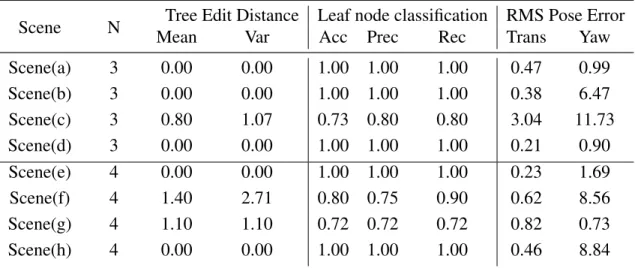
3.1 Metrics calculated forAxPFscene estimation. The first two columns are the mean and variance of the tree edit distance which is the minimum number of node operations to transform one tree to the other. From the 3rd column to the 5th column, the accuracy, precision and recall of the leaf node classification are reported. The last two columns are the pose error of translation(xandy) andyaw a correctly classified leaf node. N
is the number of objects in each scene. . . 37
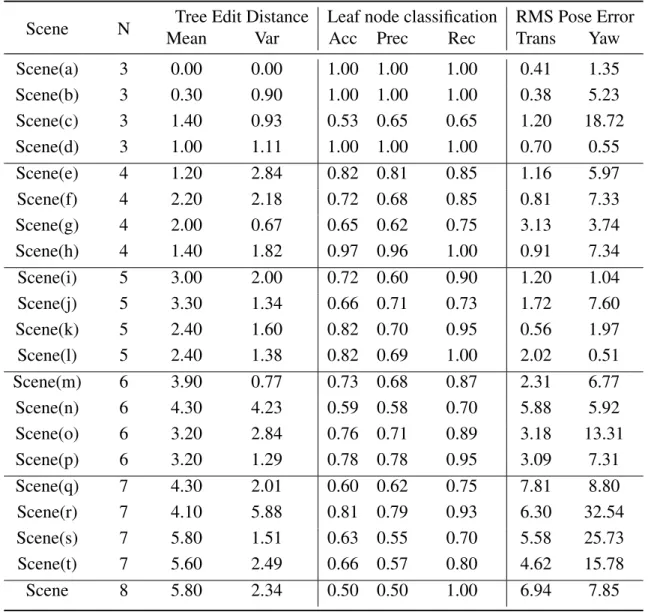
3.2 Metrics calculated forAxMCscene estimation. The first two columns are the mean and variance of the tree edit distance which is the minimum number of node operations to transform one tree to the other. From the 3rd column to the 5th column, the accuracy, precision and recall of the leaf node classification are reported. The last two columns are the pose error of translation(xandy) andyaw a correctly classified leaf node. N
is the number of objects in each scene. . . 40
4.1 The table shows results of manipulation experiments for 8 sequences. The first row shows the number of objects in each scene. The number of the manipulation errors and trials for the sequence are shown in row two and row three. The last row shows the ratio of how much the recognizable objects on the table are successfully sorted by the robot. . . 55
5.1 Object detection performance of different methods with mAP under different IoU. . . 75
5.2 Object detection performance on precision (Pr) and recall (Rec) for different methods under different mAP. The detection confidence threshold is set to 0.5. . . 76
ABSTRACT
To make autonomous robots “taskable” so that they function properly and interact fluently with human partners, they must be able to perceive and understand the semantic aspects of their environ-ments. More specifically, they must know what objects exist and where they are in the unstructured human world. Progresses in robot perception, especially in deep learning, have greatly improved for detecting and localizing objects. However, it still remains a challenge for robots to perform a highlyreliablescene estimation in unstructured environments that is determined byrobustness,
adaptabilityandscale. In this dissertation, we address the scene estimation problem under uncer-tainty, especially in unstructured environments. We enable robots to build areliableobject-oriented representation that describes objects present in the environment, as well as inter-object spatial re-lations. Specifically, we focus on addressing following challenges for reliable scene estimation: 1)robustperception under uncertainty results from noisy sensors, objects in clutter and perceptual aliasing, 2)adaptableperception in adverse conditions by combined deep learning and probabilis-tic generative methods, 3)scalableperception as the number of objects grows and the structure of objects becomes more complex (e.g. objects in dense clutter).
Towards realizing robustperception, our objective is to ground raw sensor observations into scene states while dealing with uncertainty from sensor measurements and actuator control . Scene states are represented as scene graphs, where scene graphs denote parameterized axiomatic state-ments that assert relationships between objects and their poses. To deal with the uncertainty, we present a pure generative approach, Axiomatic Scene Estimation (AxScEs). AxScEs estimates a probabilistic distribution across plausible scene graph hypotheses describing the configuration of objects. By maintaining a diverse set of possible states, the proposed approach demonstrates the
robustness to the local minimum in the scene graph state space and effectiveness for manipulation-quality perception based on edit distance on scene graphs.
To scale up to more unstructured scenarios and be adaptable to adversarial scenarios, we present Sequential Scene Understanding and Manipulation (SUM), which estimates the scene as a collection of objects in cluttered environments. SUM is a two-stage method that leverages the accuracy and efficiency from convolutional neural networks (CNNs) with probabilistic inference methods. Despite the strength from CNNs, they are opaque in understanding how the decisions are made and fragile for generalizing beyond overfit training samples in adverse conditions (e.g., changes in illumination). The probabilistic generative method complements these weaknesses and provides an avenue for adaptable perception.
To scaleup to densely cluttered environments where objects are physically touching with se-vere occlusions, we presentGeoFusion, which fuses noisy observations from multiple frames by exploring geometric consistency at the object level. Geometric consistency characterizes geomet-ric compatibility between objects and geometgeomet-ric similarity between observations and objects. It reasons about geometry at the object-level, offering a fast and reliable way to be robust to semantic perceptual aliasing. The proposed approach demonstrates greater robustness and accuracy than the state-of-the-art pose estimation approach.
CHAPTER 1
Introduction
1.1
Aims and Motivation
With the recent advances in AI and robotics research, the realization of general-purpose robots that can perform useful tasks in the human environment is within reach. Unlike traditional in-dustrial robots that perform pre-programmed actions in a confined workspace, general purpose robots are expected to autonomously and intelligently complete a variety of tasks that are helpful to humans across a diversity of user preferences and environments, including household chores, entertainment, medical domains, education, and emergency response. In these environments, they are expected to be “taskable” so that they function properly, meet human expectations, and interact fluently with human partners.
Ideally, human users can specify their intent as a goal state (i.e., the desired configuration of the world) without being required to specify how this goal should be achieved (either as motions and actions). Such human-expressed goals could then be translated into symbols that interpret as computationally assertable axioms. The symbolic description of the goal could be used by well-developed goal-directed symbolic planners [30, 55] in the planning stage of the well-known sense-plan-act cycle. Upon receiving the symbolic requests, robots should be able to perceive the world, reason over actions towards a satisfying goal, and carry out these actions in terms of physi-cal motion. More importantly, lots of tasks like preparing meals, doing laundry, or setting up tables require robots to physically interact with objects in the environments. Examples of common
ma-(a) (b) (c)
Figure 1.1: Common household manipulation tasks. (a) The robot from Technical University of Munich is preparing meals [8], (b) Therobotfrom University of Tokyo is doing laundry, (c) The robot from Toyota Research Institute is making coffee [7].
nipulation tasks are shown in Figure1.1Robots need to perform manipulation actions with objects to satisfy task requirements. This level of autonomy is defined asgoal-directed manipulation.
For extended goal-directed autonomy, we specifically face the problem of anchoring [20], a case of symbol grounding [37], to associate physical objects in the real world and relationships between these objects with computationally assertable axioms, from the robot’s perception of the world. Anchoring and symbol grounding are at the heart the emerging area of semantic mapping [52] and its accelerated growth due to advancements in 3D RGBD mapping [92, 41]. Given raw sensor observations, taskable robots must know what objects exist and where they are. They should be able to build an object-oriented symbolic representation that describes objects present in the environment, as well as inter-object spatial relations. This representation provides a natural and efficient way for robots to reason and plan at the task level and communicate with human users naturally. In this dissertation, our objective is to enable robots to perceive their surroundings and build an object-oriented representation, including object classes, poses, and spatial inter-object relations for goal-directed manipulation.
1.2
Challenges
Great progress has been made in the field of scene perception, especially in perception for robotic manipulation with the renaissance of deep learning. Convolutional Neural Networks (CNNs), a
(a) (b) (c)
Figure 1.2: Examples of mobile manipulation robots. (a) Brown PR2 robot [103] (b) Michigan Progress Fetch Robot [104] (c) Kejia robot from University of Science and Technology of China [14]. They are equipped with low-cost cameras like Microsoft Kinect [121] or Asus Xtion, which have limited field-of-view and produce noisy RGB and depth data. Unlike the industrial arms, their manipulators also introduce imprecisions in actuator controls.
prevalent class of neural networks for visual data, have achieved promising accuracy and real-time inference speed for object detection [86, 60, 40], 6D object pose estimation [116, 109,111], and spatial relations estimation in 2D images [57, 118, 122]. It is worth noting that these successes depend on well-designed models and adequate training resources. The robustness and general-ization ability of CNNs depends largely on the training data, which represents a certain range of conditions that the robot may face.
However, the real world that robots attempt to perceive is dominated by uncertainty. Uncer-tainty comes at three levels: 1) low-cost hardwares on robots, 2) noisy or erroneous measurements from imperfect algorithms, and 3) complex and dynamic nature of the real unstructured environ-ments. Uncertainty from low-cost hardwares arises as a result of both the observations from the noisy sensors and the performance of the motors that control the robot. Examples of mobile ma-nipulation robots are shown in Figure1.2. They are equipped with low-cost cameras like Microsoft Kinect [121] or Asus Xtion, which have limited field-of-view and produce partial and noisy RGB and depth observations. Unlike the industrial arms, their manipulators introduce imprecisions in actuator controls.
Uncertainty also comes from imperfect algorithms. CNN-based object detection and pose esti-mation methods often produce noisy or even false output due to the effects of overfitting during the training process and the biases and insufficient diversity in the training dataset. The performance of such discriminative systems deteriorates in unforeseen environmental conditions (which makes them especially vulnerable in adverse conditions). These errors (both benign and malicious) are another major source of uncertainty, semantic perceptual aliasing, as such CNNs serve as building blocks in scene perception for robotic manipulation.
Uncertainty from on-board sensors and algorithms increases in unstructured environments. The complex and dynamic nature of the environments (e.g., objects in clutter or varying illumination) limits the observability of the on-board sensors and adaptability of the CNNs recognition systems. Occlusions and physical contact between objects in clutter make Kinect produce data with greater depth discontinuities and straight edges appear as zig-zag lines. Distorted objects and/or objects captured under poor lighting conditions could be enough to defeat the recognition abilities of a CNN [27].
Under such perception uncertainty, our goal is to enable autonomous robots to perform robust goal-directed manipulation, which requires reliablescene perception. Specifically, robots should be able to build a reliable object-oriented representation that describes objects present in the envi-ronment, as well as inter-object spatial relations. Towards making a reliable scene perception, we must first answer: What are the key factors that restrict the reliability of scene perception methods for robotic goal-directed manipulation?
The first factor isrobustness. Scene perception methods should be able to provide robustness to uncertainty. However, a majority of the CNNs recognition systems [86,116,57] are discriminative methods, which perceive exact single estimates of scene state. The single estimate is fragile to uncertainty, especially in the manipulation tasks with a long horizon plan. Once the estimate is erroneous, it can lead to potentially disastrous outcomes, and the robot is difficult to recover from the failure as the single estimate does not preserve any other possibilities. Generative models provide a means to address uncertainty probabilistically. Possible world states can be hypothesized
to explain possibilities for the true world state that could have generated the robot?s observations. These generated hypotheses form an approximate probability distribution (or belief) over possible states of the world. The probabilistic generative approaches [23,31,107] have shown great success in the traditional robotics state estimation problem such as localization and mapping. The sample principle can be applied to perform reliable scene perception under uncertainty for goal-directed manipulation.
The second factor isadaptability. Due to the complex and dynamic nature of the unstructured environments, robots are subject to unforeseen conditions, which are not present in the training data. Discriminative CNNs recognition systems are not adaptable to such conditions, especially to adversarial scenarios due to the effects of overfitting to the training data. Generative approaches are inherently resilient to these conditions through the process of generating, evaluating, and main-taining a distribution of many hypotheses representing possible decisions. However, adaptability comes at the cost of computational efficiency. Discriminative-generative algorithms [97, 95, 72] offer a promising avenue for adaptable perception in unforeseen and adverse conditions. Such methods combine inference by deep learning (or other discriminative techniques) with sampling and probabilistic inference models. The weaknesses of one can be addressed by the strengths of the other.
The last factor is the scale. Lots of scene perception algorithms can work near perfectly in structured environments with objects separately placed on the table. But they don’t work well in scenarios where objects are in dense clutter as the problem becomes rapidly difficult when dealing with severe occlusions, physical contact, and semantic perceptual aliasing. One promising approach [94,65,119] for building object-level representation of objects in dense clutter is to fuse semantic measurements from different viewpoints. Robots can take advantage of their ability to move around the environment and provide continuous observations. This approach is particularly advantageous of objects in dense clutter as it performs inference directly on object instances instead of low-level primitives, which offers faster inference, more compact map representation, and the potential for dynamic object reasoning.
The major challenge of enabling autonomous robots perform reliable scene perception is to break the limitation that is determined by robustness, adaptabilityandscale. In this dissertation, we describe several methods that expand the reliability of scene perception for goal-directed ma-nipulation.
1.3
Thesis Contributions
In this dissertation, we address the scene estimation problem under uncertainty, especially in un-structured environments. We enable robots to build an object-oriented representation that describes objects present in the environment, as well as inter-object spatial relations. The object-oriented representation is expressed as scene graphs, where scene graphs denote parameterized axiomatic statements that assert relationships between objects and their poses and geometry. Given the arbi-trary initial scene, the robot is able to ground the raw sensor observations to scene graphs, generate a sequence of actions by symbolic planners and execute the motions to complete the task. We require the scene graph estimation to be reliable under uncertainty with respect to robustness,
adaptability, andscale.
In particular, this dissertation makes following contributions:
1. AxScEs: Axiomatic Scene Estimation for Goal-directed ManipulationWe propose pure generative approaches [102,103] to estimate the approximate distribution of the tree-structured scene graph describing the configuration of objects observed from robot sensing under sen-sor and actuation uncertainty. Our generative approaches iteratively hypothesizes possible scene configurations (as lists of axioms) and evaluates these hypotheses against the robot’s observations. The result of this inference is an approximate posterior probability distribution over possible scenes, where the scene with maximum likelihood is taken as the estimate of the scene configuration. Though probabilistic in nature, a principal motivation for provid-ing estimates represented in axiomatic form is the “closprovid-ing the loop” between goal-directed symbolic planners [30, 55] and modern robotics. Such planners reason over manipulation
actions for the robot to execute from the estimate towards realizing a given goal scene, also expressed axiomatically. Planned sequences of actions are then executed by motion con-trol/planning systems for pick-and-place manipulation [17] or general manipulation affor-dances [38]. By maintaining a diverse set of possible states, the proposed approach demon-strates the robustness to the local minimum in the axiomatic state space and effectiveness for manipulation-quality perception based on edit distance on scene graphs.
2. SUM: Sequential Scene Understanding and Manipulation However, AxScEs assumes known object identifications and works in moderately structured environments. To scale up to more unstructured scenarios and be adaptable to unforeseen and adverse conditions, we propose a combined discriminative-generative approach [104], which estimates the scene as a collection of objects in cluttered environments. SUMis a two-stage method that leverages the accuracy and efficiency from convolutional neural networks (CNNs) with generative probabilistic inference methods to deal with scene complexity and uncertainty. The approach utilizes candidates from the discriminative object detector to guide the generative process of sampling scene hypothesis, and each scene hypothesis is evaluated against observations. We demonstrate the effectiveness and robustness of SUM with respect to both perception and manipulation errors in a cluttered tabletop scenario for an object sorting task with a Fetch mobile manipulator. Moreover, we show that the proposed two-stage method is also adaptive to example adversarial scenarios.
3. GeoFusion: Geometric Consistency informed Scene Estimation in Dense ClutterSUM
ignores physical interactions between objects by assuming objects are independent with each other. To reason about physical interactions between objects, especially in densely cluttered environments, we explore geometric consistency, which characterizes geometric compatibil-ity between objects and geometric similarcompatibil-ity between observations and objects. We present a geometric consistency informed scene estimation method [101] by fusing observations from multiple frames in dense clutter (GeoFusion). The geometric consistency in GeoFusion
reasons about geometry at the object-level, offering a fast and reliable way to be robust to semantic perceptual aliasing. The proposed approach demonstrates greater robustness and accuracy than the state-of-the-art pose estimation approach.
1.4
Dissertation Outlines
The remainder of this dissertation is organized into five chapters as follows.
Chapter2(Background) will survey work related to symbol grounding for robotics, perception for manipulation, scene estimation, and semantic mapping.
Chapter 3 (Axiomatic Scene Estimation) presents our generative approaches for scene infer-ence and the evaluation of scene graphs and robot manipulation demonstrations.
Chapter4(Sequential Scene Understanding and Manipulation) describes the combined discriminative-generative approach for sequential scene estimation and manipulation and provides the scene esti-mation and sequential manipulation tasks evaluation.
Chapter5(Geometric Consistency informed Scene Estimation in Dense Clutter) describes the SLAM-based scene estimation method for building a semantic map at object-level from continuous noisy semantic measurements.
Chapter6(Conclusion) concludes the dissertation with a summary and talks about open prob-lems and future directions.
CHAPTER 2
Background
The aim of this dissertation is for robots to perform robust scene estimation in unstructured envi-ronments for goal-directed manipulation. This objective is related to and/or motivated by previous work in several areas, including symbol grounding, robotic perception for manipulation, scene estimation, and semantic mapping. By surveying the related work, it places our work within per-ception for manipulation and semantic mapping.
2.1
Symbol Grounding for Robotics
2.1.1
Shared Autonomy for Manipulation
In order for autonomous robots to interact fluidly with human partners, a robot must be able to interpret scenes in the context of a human user’s model of the world. The challenge is that many aspects of the human’s world model are difficult or impossible for the robot to sense directly. We posit the critical missing component is the grounding of symbols that conceptually tie together low-level perception and high-low-level reasoning for extended goal-directed autonomy. We specifically face the problem of anchoring [20], a case of symbol grounding [37], to associate physical objects in the real world and relationships between these objects with computationally assertable facts (or axioms), from the robot’s perception of the world. Anchoring and symbol grounding are at the heart the emerging area of semantic mapping [52] and its accelerated growth due to advancements
robot manipulators will be able to flexibly and autonomously perform goal-directed tasks that require reasoning over sequential actions. Just as important, human users will be able to more intuitively specify goals for robots, as desired states of the world, through spatial configurations.
In the greater context of shared autonomy, goal-directed manipulation offers the opportunity to extend the boundaries of the “neglect curve” [33]. The neglect curve is a conceptual expression of robot effectiveness with respect to delegation (or user neglect), codifying tradeoffs between the ex-tremes of full autonomy and manual teleoperation. While teleoperation can often yield high-levels of robot effectiveness, the performance of such systems relies heavily upon the training, apti-tude, and stamina of a human operator. Conversely, systems for autonomous robots place much less burden on a human operator but are often limited to generalized trajectories over controls [3, 11,84, 42], reactive policies [35,22, 15,78, 47,110], or goals as combinations of hardcoded features [77, 1, 6, 49, 98]. As evidenced during the recent DARPA Robotics Challenge [117], shared autonomy is especially onerous and error prone for control of humanoids and mobile ma-nipulators due to the complexity of goal-directed control. Similar to the pointing work by Kemp et al. [48], our long-term conjecture is that shared autonomy through the expression of goals will greatly reduce the complexity for human operation of robots, improving robot effectiveness during periods of delegation.
2.1.2
Goal-directed Manipulation
Our aim is to estimate axiomatic state representations that will allow robotics to build on the body of work in sequential planning algorithms, which have over a five-decade history. Described in early work, such as STRIPS [30] and SHRDLU [113], classical planning algorithms adapted theorem-provers to “prove” conclusions about goals based on symbolic axioms that describe the world through assertable logical statements. A classical planner can compute actions for a physical robot to perform arbitrary sequential tasks assuming full perception of the environment, which is often an untenable assumption in general.
demonstrated the ability to reliably perform goal-directed manipulation. Recent work by Mohan et al. [70] uses the Soar cognitive architecture for teaching a robot arm to play games such as tic-tac-toe, Connect-4, and Towers of Hanoi through language-based expressions. Similar in spirit to ourAxScEsestimators, Soar uses an axiomatic scene graph representation [114]. We positAxScEs
estimates could also be used within broader cognitive architectures, such as ACT-R/E [108], that are suited to axiomatic rather than strictly metric spatial representations. The approach proposed by Chao et al. [12] performs taskable symbolic goal-directed manipulation with a focus on associating observed robot percepts with knowledge categories. This method uses background subtraction to adaptively build appearance models of objects and obtain percepts but with sensitivity to lighting and object color. The work by Narayanaswamy et al. [74] performs scene estimation and goal-directed robot manipulation for cluttered scenes of toy parts for flexible assembly of structures.
The KnowRob system by Tenorth et al. [106] performs taskable goal-directed sequential ma-nipulation at the scale of entire buildings by automatically synthesizing sources from the semantic web and Internet. Leveraging the community of perception modules available in the Robot Operat-ing System (ROS) [85], KnowRob focuses uncertainty at the symbolic level and relies on hard and complete state estimates from hardcoded software components. Similarly, the work by Srivastava et al.[99] relies on hardcoded perception systems to perform the joint task and motion planning, taking advantage of modifications in controlled environments, which include green screens and augmented reality tags.
2.2
Perception for Manipulation
We summarize a relevant subset of existing work with respect to perception for manipulation. The PR2 interactive manipulation pipeline by Ciocarlie et al. [17] segments objects from a flat tabletop surface through the clustering of surface normals. This pipeline can perform relatively robust pick-and-place manipulation for isolated, non-occluded, and non-touching objects. For cluttered scenes, the work by Narayanaswamy et al. [74] performs pose and structure estimation of toy parts
for flexible assembly of structures. MOPED [19] is a framework for object detection and pose estimation using the clustering of features from multi-views. The method from Joho et al. [45] uses a probabilistic generative model to model the spatial arrangement of objects on a flat surface in the context of a table setting task.
In terms of sequential manipulation, the system by Tenorth et al. [106] performs task-directed manipulation at the scale of entire buildings by integrating different knowledge sources from a perception system, an internal knowledge base and Internet repositories.The approach proposed by Cosgun et al. [21] performs sequential manipulation for placing objects in a scene where the objects are separating on a clear table. The work from Papazov et al. [82] performs sequential scene estimation and manipulation through the matching of known 3D geometries with an observed point cloud. However, this method takes a bottom-up approach using a RANSAC algorithm with Iterative Closest Point registration that neither requires nor uses a model of uncertainty.
Rosman et al. [88] proposed approaches to address the same problem of estimating relational scene graphs for objects in contact as a collection of axioms. Their approach detects contact points between objects that can be directly observed from depth. Liu et al. [61] proposed KSMCMC, which uses MCMC to sample over scene graph structures represented axiomatically to estimate objects as oriented bounding boxes. Pose estimation is performed using image features for align-ment. Joho et al. [45] use a generative model to cluster objects on a flat surface into semantically meaningful categories.
2.3
Scene Estimation
We consider two categories of traditional methods for model-based object recognition and pose es-timation. First, feature-based methods, also known as descriptor-based methods, aim to match key features in the models to the scenes. Key features can be comprised of local or global descriptors [4]. Using local features [44,91, 89], the pose of the object is estimated by first matching a set of extracted features from the object model to the scene. Then, every matching pair will go through
the filtering process to generate the final transformation. In contrast, methods using global features [5, 64,90] attempt to match features with high resistance to the variance of the object pose. The object pose can be estimated by comparing those pose-preserving features from the training phase with the features computed from the test scene. A limitation of feature-based methods is that the estimation quality will degrade as the number of objects (and clutter) in the scene increases due to occlusion of key features.
Alternatively, generative methods (oranalysis by synthesis) attempt to find the state estimate that best describes the observed sensor input through iterating over comparisons with state hy-potheses rendered into sensor readings. TheRender-Match-Refineparadigm by Stevens et al. [100] applied iterative optimization method to find a rendering that best explains the input. Their early work demonstrated Render-Match-Refine for 2D images, relying upon low-level feature extrac-tion. Recent work uses convolutional neural networks (CNNs) to compare rendered and observed images. Among this work, the approach by Krull et al. [51] casts the CNN as a probabilistic model to output energy value, whereas work by Gupta et al. [36] directly outputs a coarse object pose and use ICP to refine it later.However, these methods do not address multi-object pose estimation such as in cluttered scenes. Narayanan et al. [72,73] proposed approaches to integrate exhaustive global reasoning with discriminatively-trained algorithm to perform scene estimation. However, their work assumes the identification of objects is given or provided by an idealized object detec-tion and recognidetec-tion system in order to perform A* search.
Great progress has been made by deep neural networks in object detection [86,40], 6D object pose estimation [116, 111] and semantic segmentation [62, 80]. To be robust to false detections due to the effects of overfitting, discriminative-generative algorithms [46,72] have been proposed for robust perception, especially in adversarial environments [13]. These efforts combine inference by deep neural networks with sampling and probabilistic inference models to achieve robust and adaptive perception. However, the robustness is at the cost of computation time and the assumption object independence.
poses based on compatibility score from physics simulation. The above-mentioned methods take either geometric and physical constraints into account for searching object poses, at the cost of computational efficiency.
2.4
Semantic Mapping
From the emerging of semantic mapping [52], lots of work have explored this field with various semantic representations [50]. With the focus on the object-level semantic map, one widely used approach is to reconstruct a 3D map from either sparse features [71] or dense point clouds [76,
112, 87] and then augments the map with the objects. Civera et al. [18] and Ekvall et al. [26] used SURF/SIFT descriptors to register objects to the map created in a parallel thread. However, their work can not deal with objects in clutter. To deal with clutter, Li et al. [56] proposed an incremental segmentation approach to fuse segmentation across different frames based on dense reconstruction 3D map and used ObjRecRANSAC [81] to register object poses. But their method does not scale well with substantial false detections.
Salas-Moreno et al. [94] proposed an object SLAM system that recognized objects using Point-Pair Features in each frame and directly performed graph optimization on object and camera 6D poses. Their work shows promising results in the direction of building maps with 6D object poses. Fusion++ [65] constructed an online object-level SLAM system with previously unknown shape and perform pose graph optimization at object level. Both of their work assume independence be-tween objects and hence difficult to work well in densely cluttered environments. Zeng et al. [119] proposed CT-MAP, which considers contextual relation between objects and temporal consistency of object poses in a conditional random field and maintain belief over object classes and poses. This approach is robust to false detections, however it does not scale well to the increasing number of objects due to the nature of pure generative inference.
2.5
Summary
In summary, we described previous work that is related for perception for manipulation and seman-tic mapping. We first elaborated on the related work of symbol grounding with shared autonomy and goal-directed manipulation. We then presented the related work of perception for manipulation and scene estimation. We also discussed related work on semantic mapping.
CHAPTER 3
Axiomatic Scene Estimation
In this chapter, we describe the problem of Axiomatic Scene Estimation (AxScEs), pronounced “access”, for robot manipulation in cluttered scenes given raw sensor observations. We propose generative approaches to scene inference (as the axiomatic particle filter, and the axiomatic scene estimation by Markov chain Monte Carlo based sampler) of the robot’s environment as a scene graph. The result from AxScEs estimation are axioms amenable to goal-directed manipulation through symbolic inference for task planning and collision-free motion planning and execution.
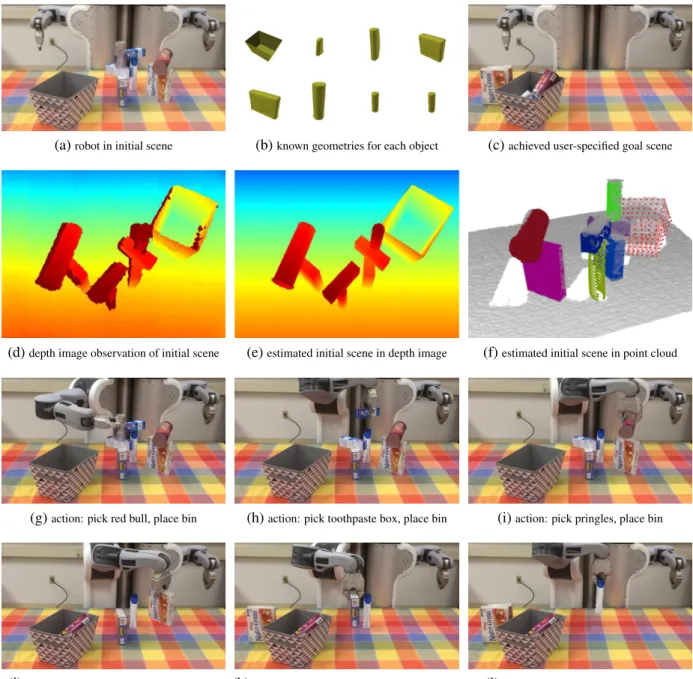
Figure3.1shows goal-directed manipulation in action from anAxScEsestimate of a cluttered scene of eight objects with a Willow Garage PR2 robot. We phrase the problem of AxScEs as the estimation of a tree-structured scene graph describing the configuration of objects observed from robot sensing. Similar to their use in computer graphics, scene graphs are represented as parameterized axiomatic statements that assert relationships between objects in the scene graph and the poses and geometry of each object. Our generative approach to inference for problems ofAxScEsiteratively hypothesizes possible scene configurations (as lists of axioms) and evaluates these hypotheses against the robot’s observations (currently as depth images). The result of this inference is an approximate posterior probability distribution over possible scenes, where the scene with maximum likelihood is taken as the estimate of the scene configuration. Though probabilistic in nature, a principal motivation for providing AxScEs estimates represented in axiomatic form is the “closing the loop” between goal-directed symbolic planners [30, 55] and modern robotics. Such planners reason over manipulation actions for the robot to execute from anAxScEsestimate
(a)robot in initial scene (b)known geometries for each object (c)achieved user-specified goal scene
(d)depth image observation of initial scene (e)estimated initial scene in depth image (f)estimated initial scene in point cloud
(g)action: pick red bull, place bin (h)action: pick toothpaste box, place bin (i)action: pick pringles, place bin
(j)action: pick nutrigrain, place side region (k)action: pick nature valley, place side region (l)reach goal: pick shampoo, place bin
Figure 3.1: An example of AxScEs estimation and goal-directed manipulation of a (a) cluttered scene with (b) eight objects to a (c) goal state of putting small objects in a bin and boxes to the side. AxScEsestimation generatively infers from robot observations (d) the maximally likely scene configuration (e,f). The resulting AxScEs is used to plan and execute actions (g-l) to the user-specified goal state (c).
towards realizing a given goal scene, also expressed axiomatically. Planned sequences of actions are then executed by motion control/planning systems for pick-and-place manipulation [17] or general manipulation affordances [38].
The remainder of this chapter describes the problem of axiomatic scene estimation, proposes instances of AxScEsestimators, and examines their use for goal-directed manipulation in scenes of increasing numbers of physically stacked objects. Section3.1 motivates the need for genera-tive approaches to problems ofAxScEsas a matter of inclusion towards bridging probabilistic and symbolic inference for goal-directed manipulation. We describe a formulation for the problem of axiomatic scene estimation in Section3.2. An analysis of the growth of possible tree-structured scene graphs is presented with respect to the number of stackable objects in a scene. In Section
3.2.3, we phrase the problem AxScEs as a probabilistic state estimation model that factors into the inference of scene tree relations and object pose. Within theAxScEs model, we propose the
Axiomatic Particle Filter (AxPF), as an exhaustive search over scene tree relations with particle filter inference of poses in Section3.3. We also introduceAxiomatic Scene Estimation by MCMC Sampling (AxMC)using the Metropolis-Hastings algorithm [39] to search the scene tree relations with pose estimation likelihoods. Our GPU-optimized parallel implementation ofAxScEs estima-tion for both the AxPF and AxMC are described in Section 3.5. This likelihood works directly with depth images from common ranging cameras without the need for computing discriminative features. Our experiments with this implementation are described in Section 3.6. These results indicate that AxScEs estimators are effective for manipulation-quality perception based on edit distance on scene graphs, estimation of currently manipulatable (clear) objects, and object pose estimation.
3.1
Motivation for Generative Approach
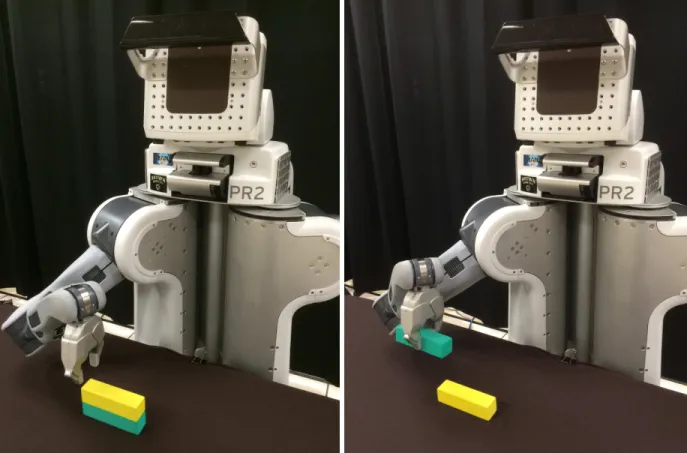
To motivate the problem of AxScEs , consider the scene in Figure 3.2 observed from 3D point clouds captured from the robot’s perspective. For this scene, assume the goal for the robot is to grab the bottom green block to give to a human user. It can be clearly observed thatblock1 (the top block) andblock2 (the bottom block) are two distinct objects from the perspective of human perception. A na¨ıve perception of this scene, common to most robots, would instead perceive
objects that are physically touching as a single object as shown in the right. From the perspective of common segmentation methods for 3D point clouds, estimates of the scene as two smaller objects or a single larger object are equally likely parsings of the robot’s observations.
To capture this uncertainty, our approach to problems of AxScEsis to maintain a distribution across plausible scene graph hypotheses supported by the robot’s point cloud observations. These generated hypotheses form an approximate probability distribution (or belief) over possible states of the scene. This ambiguity over possible scenes can be resolved at a later time with further in-formation, such as after a robot action to grasp one of the objects. In addition, by maintaining diverse perspectives, the robot can use either one of these hypotheses as an estimate of the scene state to plan and execute a current course of action. If the chosen state estimate was incorrect, the alternate hypothesis of the scene should still be represented in the diversity of the belief distribu-tion. Assuming the result of the action resolved the ambiguity, this alternate state hypothesis will now have a greater likelihood given the new point cloud observation. This distribution will now clearly distinguish the alternate as the true scene state estimate from which the robot’s plan can be recomputed. This approach to scene estimation is implemented by a system architecture, whose details are described in Section3.4.
Our approach toAxScEsaims to emulate and scale the highly effective and now ubiquitous pat-tern of decoupled decision making and probabilistic inference for autonomous navigation [23, 9] in the domain of robot manipulation. Specifically, probabilistic perception and symbolic planning are treated as independent processes, allow each to focus on what they do best. These processes interoperably interface through the communication of the maximally likely axiomatic state esti-mate and selected robot action (or operator). While avoiding the intractability of planning in the space of beliefs, this decoupling assumes state estimates are a plausibly accurate representation of the current state of the world.
Unlike autonomous navigation, AxScEsestimation faces a drastically large state space where generative inference must balance estimation accuracy and computational tractability. The scene dimensionality grows rapidly towards intractability as the number of objects in the scene increases,
Figure 3.2: Example of a robot needing to grasp an object (the green block) in a simple stack scene. The robot needs to estimate the scene but faces ambiguity about whether there are two stacked objects or one larger object. Once estimated, the robot needs to perform a sequence of actions to move the yellow block and then, once cleared, grasp the green block.
exceeding factorial growth. Such expansive state spaces prohibit exhaustive search over scenes, even with an optimized processing pipeline. Further, our search space consists of state variables with mixed types over both non-binary tree structures and real-valued object pose parameters.As described later, we explore sampling-based algorithms, including Markov Chain Monte Carlo (MCMC) and particle filtering, suited to the diverse types and high-dimensionality of axiomatic scenes.
3.2
Problem Statement and Formulation
The objective of axiomatic scene estimation is to infer a symbolic description of the sceneSˆfrom partial observationsztby a given robot at timet. This symbolic scene description can then be
read-(table object) (pose table pos1) (Nutrigrain object) (pose Nutrigrain pos4) (geom Nutrigrain geom nut) (on Nutrigrain table) (toothpaste object) (pose toothpaste pos5) (geom toothpaste geom tp) (on toothpaste Nutrigrain) (clear toothpaste)
(geom table geom table)
(nat val object) (pose nat val pos2) (geom nat val geom nv) (on nat val table) (shampoo object) (pose shampoo pos3) (geom shampoo geom sp) (on shampoo nat val) (clear shampoo) (free right hand robot) (free left hand robot)
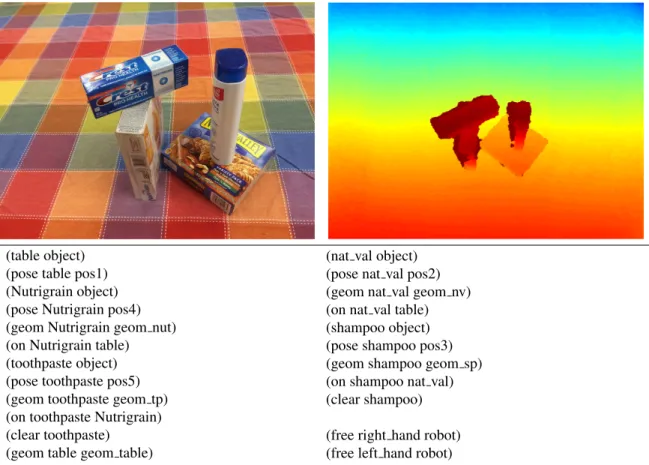
Figure 3.3: Axiomatic scene estimation for an example four-object scene (top left), observed by the robot as a depth image (top right), will estimate the pose and spatial relations of objects as parameterized axiomatic assertions.
ily used by modern task and motion planners to generate sequential actions that will autonomously control the robot to achieve a user-expressed desired goal stateSG.
Axiomatic state xtat timet is defined as a collection of axioms expressing possible scenesS.
A scene is expressed as a scene graphS(W(Q,V))as a set of axiomatic assertions describing the poseQi and geometryVi of each objectWi and relations for object interactions and affordances.
The Planning Domain Definition Language (PDDL) [66] is used to model axiomatic state as a formal language, which implicitly defines a tree-structured scene graph. Shown in Fig. 3.3, an example scene graph of a four object scene is represented in PDDL. To avoid ambiguity, we restrict the set of axioms to only spatial and physical expressions that can be tested geometrically or through physical simulation. These axioms assert the existence of an objectWi, as(Wi object),
also assert parent-child relationships between objects as whether an object Wi is inside another
object Wj, (inWi Wj), or resting on another object Wk, (on Wi Wk), as well as whether the
object is the possession of a robotR, (hasR Wi). Each of these inter-object relations induces a
spatial frame relation, where the frame of a child object is expressed in relation to its parent object. Given the AxScEs relations above, the relation (clear Wi) is asserted for each object Wi
that is not supporting another object. The objects asserting this relation can be picked by the robot or used as a support surface for placing other objects. For general manipulation affordances, additional axioms can be created that describe assertions for preconditions and postconditions for actions associated with objects. Precondition and postconditions axioms are envisioned to resemble collision-based “trigger” conditions, widely used to script interactive behaviors in video games through programming languages such as Lua [68].
3.2.1
Assumptions
For the methods presented in this article, we address the problem ofAxScEsfor inferring the ax-ioms in the scene S and the 3 DOF poses of each object Q. The n objects comprising W are assumed to have been uniquely identified with each having known spatial geometries contained in
V. This assumption is made based on using an ideal of common visual object recognition sys-tems [28,19] as a preprocessing step. Only the inter-object relation for stacking (on) is considered forAxScEsestimation, although the relations for enveloping (in) and grasping (has) are consid-ered for task planning. Objects are assumed to be an upright oriented and can take on any pose on the support surface provided by its parent object. As such, the object poses of Qconsist of a 2D position and yaw rotation (SE(2) group) in the coordinates provided by its parent object.
3.2.2
Scene Graph Enumeration
In the general case, scene estimation in this axiomatic form can lead to a very high dimensional belief space that would theoretically pose problems for probabilistic inference. For this work, we will assume scene graphs are tree-structured, have an implied base support plane, and consider only
the stacking case (asserted by the ”on” relation). Thus, a single object could physically support any number of other objects, but is itself physically supported by one other object. With these assumptions, letT(n)be the number of possible scene graphs, givenn objects in a scene. Then, the total number of scenes can be expressed recursively:
T(n) = n X k=1 n Ckg(n−k, k) (3.1)
wherenCk is the number of combinations for selecting a subset of k objects out of then objects
andg(s, k)is the number of scene graphs possible for stackingsobjects on top of a fixed scene on
kbase objects: g(s, k) = s X s1=0 s X s2=0 ... s X si=0 ... s X sk=0 s! s1!s2!...si!...sk! T(s1)T(s2)...T(si)...T(sk) (3.2) wheres =Pki=1si
Whenn = 0,T(0) = 1as the number of scenes with no objects as 1. Similarly whenn = 1,
T(1) = 1expresses the number of scenes with 1 object 1. Whenn = 2, T(2) = 3 breaks down into two terms2C1∗g(1,1)and2C2∗g(0,2)with respect to the recursion in Equation3.2. The first
term considers the number of ways1object can be placed on1supporting objectg(1,1) = 1times the number of ways each of the2objects to each of these stacking roles2C1 = 2. g(0,2) = 1 is
the number of ways2objects can be placed on the table, for which there is only one combination for stacking. Relationally,T(2) = 3expresses the 3 possible axiomatic scene graphs for 2 objects: objects A and B are not stacked, object A is stacked on object B, object B is stacked on object A.
Whenn = 3,T(3) = 16has three terms3C1∗g(2,1),3C2∗g(1,2)and3C3∗g(0,3). First term 3C
1∗g(2,1)denotes the number of ways of choosing 1 object out of 3 objects,g(2,1)denotes the
number of ways 1 object can be placed on two supporting objects. Computing each of the terms turns out to be 9, 6, and 1 respectively and henceT(3) = 16.
Following this recursive expression of Equation 3.2, T(3) = 16, T(4) = 125, T(5) = 1296,
an upper bound as it assumes each object is capable of providing a support surface for all other objects. However, we speculate that most of these scene possibilities are actually implausible phys-ically and statistphys-ically improbably to be encountered in common manipulation settings and human environments. That stated, na¨ıvely performing state estimation in such a huge state space becomes intractable quickly as the number of objects grows. Such inference can still be of considerable use for manipulation as tabletop environments can often consist of small stacks of objects. In such cases, a tabletop segmentation algorithm, such as for the PR2 Interactive Manipulation [17] can be used to identify clusters of stacked objects, each of which can be treated as their own scene.
3.2.3
Formulation
For axiomatic scene estimation, we represent the configuration of a scene at given time St as a
random state variablextto be inferred from a history of robot observations z1..t. This scene state
variable xt = [gt, qt]is comprised of both real-valued object poses, as random variable qt ∈ ℜ3,
and set-valued lists of axioms, as random variablegt. In our case, the axiomsgtdefine the topology
of objects in a scene as a tree.
We decompose theAxScEsproblem as an expression of the probability of a scene into poseqt
and scene tree structureg (assuming a static scene for clarity):
p(xt|z1:t) =p(g, qt|z1:t) (3.3) =p(g|z1:t)p(qt|g, z1:t) (3.4) ∝p(g|z1:t)p(g, zt|qt)p(g|z1:t) Z p(qt|qt−1, ut−1)p(qt−1|g, z1:t−1)dqt−1 (3.5) ≈p(g|z1:t)p(g, zt|qt) X j w(tj−)1p(qt|q( j) t−1, ut−1) (3.6)
The expressions decompose the problem of AxScEs into a scene tree factor p(g|z1:t) and an
object pose factor p(qt|g, z1:t). For inference, we assume the scene tree factor is unknown and
structure allows maintenance of the distribution over scenes in relation to object poses over time, approximated by particle filtering. For goal-directed planning, our primary concern is obtaining a scene estimateSˆfrom these distributions, which leads to our formulation ofAxScEs:
ˆ S= arg max xt p(xt|z1:t) (3.7) = arg max g,qt p(g|z1:t)p(qt|g, z1:t) (3.8) ≈arg max g,qt p(g|z1:t) h arg max qt p(g, zt|qt) X j wt(j−)1p(qt|qt(−j)1, ut−1) i (3.9)
3.3
Methods
We first propose a brute force method, the Axiomatic Particle Filter (AxPF). The AxPF exhaus-tively marginalizes over combinations of scene axiomsgtand performs inference over object poses
qtthrough particle filtering on robot observations zt. In the context of the AxPF, we additionally
explore object pose estimation using MCMC sampling.
Avoiding exploration over all possible scenes, another approach to AxScEs inference is to search over scenes with algorithms amenable to general data structures, such as a hill climbing optimization or MCMC algorithm. Similar to [61], such an inference procedure samples over pos-sible scenesgtwhere pose estimation onqton robot observationsztis performed for each sampled
scene. Our proposed Axiomatic Scene Estimation by MCMC sampling (AxScEs MCMCs) takes this form. AxMCperforms scene inference ofgtwith the MCMC-based Metropolis-Hastings
algo-rithm and pose inference ofqtwith a particle filter.AxMCworks directly on depth images without
the need for discriminative features, as used by [61] or [19]. Further,AxMCprovides distributions over both scene structure and object poses, which conceptually allows for updates over time as we consider for future work.
3.3.1
Axiomatic Particle Filter
For the Axiomatic Particle Filter (AxPF), we modeled the inference of axiomatic state xt from a
history of robot observationsz1:tas a sequential Bayesian filter. This model consists of updating
a prior belief from timet−1with a dynamic resampling and likelihood evaluation to form a new posterior belief at timet:
p(xt|z1:t)∝p(zt|xt)
Z
p(xt|xt−1, ut−1)p(xt−1|z1:t−1)dxt−1 (3.10) Although results presented are for observations of static scenes, the dynamics termp(xt|xt−1, ut−1) in this formulation is to retain generality for tracking the scene as the robot performs an actionut−1. As described by [23], the sequential Bayesian filter in Equation3.10is commonly approximated by a collection ofN weighted particles,{x(tj), w
(j) t }Nj=1, with weightw (j) t for particlex (j) t , expressed as: p(xt|z1:t)≈p(zt|xt) X j w(t−j)1p(xt|x (j) t−1, ut−1) (3.11)
Over successive iterations, inference in the particle filter is performed by drawing N scene hy-potheses by importance sampling, evaluating the likelihood of each hypothesis, and normalizing the weights to sum to one:
x(tj) ∼ X j wt(−i)1p(xt|x (i) t−1, ut−1) (3.12) wt∗(j)=p(zt|x (j) t ) (3.13) w(tj) = wt∗(j) P kw ∗(k) t (3.14)
Within the likelihood p(zt|xt(j)), the scene S(j) associated with each particle x
(j)
a depth imagezˆ(tj), through the z-buffer of a 3D graphics engine, for comparison with the robots current observationzt: p(zt|x( j) t ) =e −λr·SSD(z,zˆt(j)) (3.15)
whereλr is a constant scaling factor andSSD(I, I′)is the sum of squares distance function (SSD)
between depth imagesIandI′ :
SSD(I, I′) = X
(a,b)∈z
(I(a, b)−I′(a, b))2 (3.16) whereaandbare 2D image indices. Once the posterior distribution converges about a single scene hypothesis, the sceneSˆtfrom the most likely particlexˆtis taken as the scene estimate:
ˆ
St = arg max x(tj)
p(x(tj)|z1:t) (3.17)
This axiomatic scene estimateSˆtis used for planning robot actions and motion towards a given
goal stateSG, which is also expressed in axiomatic form.
3.3.2
Axiomatic Monte Carlo Markov Chain
We now describe AxMC as a method to perform axiomatic scene estimation using MCMC and particle filtering over, respectively, scene treesg and object posesqt. With respect to Equation3.4,
we cast inference of the unknown scene tree factorp(g|z1:t)as the target distribution for MCMC
sampling. Just as in theAxPF, particle filtering is performed on the pose factorp(qt|g, z1:t)and is
treated as a likelihood for a sampled scene tree. TheAxScEsestimateStis taken as the scene tree
and pose associated with the maximally likely sample from theAxMCprocess.
MCMC sampling uses the single-site Metropolis-Hastings algorithm to approximate the target distribution. In each iteration of Metropolis-Hastings, a proposal distribution p′
(g∗
|g(i)) is used
to generate a new sample g∗
a common instance of Metropolis-Hastings for a real-valued vector space has this local sampling using a normally distributed proposal.
For our tree-valued variable g, generation of a proposal sample g∗
∼ T(g(i)) occurs with
respect to a tree kernelT(g(i))that performs a single random edit to the treeg(i). The sampling of
T(g(i))randomly selects two different nodes,aandb, of g(i) to perform one of three permutation
operations, also selected at random: 1) swapaandb, 2) moveato be the child ofb, and 3) movebto the child ofa. These operations are carried out by changing theonrelations for objects associated with tree nodes foraandb.
The newly sampled scene treeg∗
is either accepted or rejected with probability:
A(g(i), g∗) = min ( 1, arg max qt p(qt|g∗, z1:t) arg max qt p(qt|g(i), z1:t)) ) (3.18)
based on the respective maximally likely pose estimates for each scene tree. In other words, the sampleg∗
is accepted ifA(g(i), g∗
)is greater than a uniformly generated random number between zero and one. After accepting a fixed number of N samplesG∗
= {g(i)}N
i=1, the scene tree
esti-mategˆis taken as the sample with the highest likelihood with respect to the likelihood over pose estimatesqi, as expressed in Equation3.9.
3.3.2.1 MCMC Pose
As an alternative to particle filtering, we additionally investigated an MCMC approach to pose estimation of qi as a likelihood for known scene graph g. This pose inference used a
single-site Metropolis-Hastings algorithm to approximate the target distribution p(q|z, g) as a sampled Markov chain, where g is a known set of scene graph axioms. In each iteration of Metropolis-Hastings, a proposal distributionp′
(q∗
|q(i))is used to generate a new sampleq∗
∼ N(q(i),Σ
q)from
a normal distribution centered on the previous sampleq(i)with covarianceΣ
qover the space of all
pose dimensions. Alternatively, this sampling can be done per object with normal distributions in the space of DOFs for each object. The newly sampled particleq∗
with acceptance probability: A(q(i), q∗ ) = minn1, w(q ∗ ) w(q(i)) o (3.19) wherew(q)is the likelihood of pose stateq, as specified in Equations3.13and3.15.
After accepting a fixed number of N samplesQ∗
= {q(i)}N
i=1, the pose estimateqˆis taken as
the sample with the highest likelihood with respect to the likelihoodw:
ˆ
q= arg max
Q∗(i)
w(Q∗(i)) (3.20)
After several rounds of informal testing, we chose to focus on pose inference by particle filter-ing due to significantly better estimation accuracy. We attribute this preference to the relative ease of tuning parameters of the particle filter predictive density in comparison to MCMC proposal co-varianceΣq. The remainder of the discussion in this article will assume pose estimation by particle
filtering, although MCMC pose estimation can be performed instead without loss of generality.
3.4
System Architecture
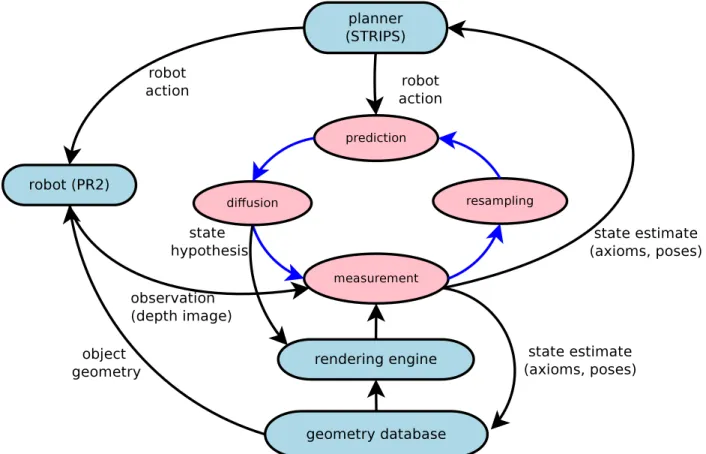
Our implementation forAxScEsperception of scenes and goal-directed manipulation is discussed in this section. This implementation follows the architecture outlined in Figure3.4. The core of this implementation is the particle filter object pose estimation that follow a module flow of pre-diction,diffusion,measurementandresampling. The distribution over object poses is represented as a mixture model of particles. Themeasurementmodule additionally performs comparisons of relative likelihood across estimations from other scenes. We store object geometries in a database, which are expressed with respect to the parent object frame once retrieved. We further assume that invalid samples, where the center of mass for a child object is outside the support surface of its parent, is disregarded.
![Figure 1.1: Common household manipulation tasks. (a) The robot from Technical University of Munich is preparing meals [8], (b) The robot from University of Tokyo is doing laundry, (c) The robot from Toyota Research Institute is making coffee [7].](https://thumb-us.123doks.com/thumbv2/123dok_us/10219823.2925842/13.918.130.788.125.290/household-manipulation-technical-university-preparing-university-research-institute.webp)
![Figure 1.2: Examples of mobile manipulation robots. (a) Brown PR2 robot [103] (b) Michigan Progress Fetch Robot [104] (c) Kejia robot from University of Science and Technology of China [14]](https://thumb-us.123doks.com/thumbv2/123dok_us/10219823.2925842/14.918.136.783.121.393/figure-examples-manipulation-michigan-progress-university-science-technology.webp)