ISSN 1330-3651(Print), ISSN 1848-6339 (Online) UDC/UDK 658.711.012.12:519.87
A NEW APPROACH TO GREEN SUPPLIER SELECTION BASED ON FUZZY
MULTI-CRITERIA DECISION MAKING METHOD AND LINEAR PHYSICAL PROGRAMMING
Mohsen Jafari Ashlaghi
Original scientific paper
During the last decades, supplier selection in a green supply chain has been addressed as a key issue around the world. Today, supplier selection is an essential part of competitive strategy to improve organizational profitability, productivity, and performance. The aim of this paper is to propose an integrated approach that is able to handle the interdependencies among various criteria and efficiently exploit the decision makers’ opinion in determining the weights of the criteria and dealing with the constraints. Thus, a novel hybrid approach to green supplier selection is proposed and then, its practical application is illustrated in a real case study. The proposed hybrid approach consists of three phases. First, the Fuzzy Decision Making Trial and Evaluation Laboratory (FDEMATEL) method is applied to construct interrelations among the criteria determined for evaluating green suppliers. Then, the criteria weights are determined through Fuzzy Analytical Network Process (FANP). Lastly, a linear physical programming model is applied in order to obtain the best suppliers. Finally, a real-world problem is considered to illustrate the applicability of the proposed model.
Keywords: fuzzy ANP, fuzzy DEMATEL, linear physical programming (LPP), supplier selection
Novi pristup izboru dobavljača eko proizvoda temeljen na metodi donošenja odluka na osnovu fuzzy mnogostrukih kriterija i linearnog fizičkog programiranja
Izvorni znanstveničlanka
Tijekom zadnjih desetljeća odabir dobavljača u lancu snabdijevanja ekološkim proizvodima postalo je ključnim pitanjem diljem svijeta. Danas je odabir dobavljača bitan dio strategije za poboljšanje organizacijske profitabilnosti, proizvodnosti i učinkovitosti. Cilj je ovoga rada predložiti integrirani pristup upravljanju uzajamnim ovisnostima među različitim kriterijima i učinkovito iskoristiti mišljenja onih koji odlučuju o određivanju težine kriterija i vrste ograničenja. Predlaže se novi hibridni pristup izbora dobavljača eko proizvoda te se njegova praktična primjena ilustrira analizom stvarnog slučaja. Predloženi se hibridni pristup sastoji od tri faze. Najprije se primjenjuje "Fuzzy Decision Making Trial" i "Evaluation Laboratory (FDEMATEL)" metoda kako bi se stvorili međuodnosi između kriterija određenih za vrednovanje eko dobavljača. Zatim se određuju težine kriterija kroz "Fuzzy Analytical Network Process (FANP)". Primjenjuje se model linearnog fizičkog programiranja za izbor najboljeg dobavljača. Konačno se analizira stvarni problem u svrhu ilustriranja primjenljivosti predloženog modela.
Ključne riječi: fuzzy ANP, fuzzy DEMATEL, izbor dobavljača,linearno fizičko programiranje (LPP) 1 Introduction
It is generally believed that supplier selection is one of the most significant activities in supply chain management for acquiring the required products due to the fact that applying a suitable supplier selection procedure has a great impact on reducing the total costs which leads to company competitiveness improvement. Different approaches have been applied to supplier selection problem. A comprehensive overview on the proposed methods to solve this problem is presented by De Boer et al. [1].
Supplier selection problem is a multi-objective problem in which different criteria should be taken into consideration. The criteria for selecting suitable suppliers are determined based on the type of product to be purchased or the service that needs to be outsourced. A great deal of attention has been paid to identifying supplier selection criteria [2, 3, 4]. Various mathematical techniques have been used by the researchers for assessment of suppliers, such as data envelopment analysis (DEA) [5], fuzzy AHP [6, 7, 8], fuzzy goal programming [9, 10, 11], fuzzy analytic network process (ANP) [12, 13], heuristics [14, 15], analytic hierarchy process (AHP) [16]. In evaluating and selecting suppliers, the decision maker needs to deal with both qualitative and quantitative factors. As mentioned before, the problem of selecting suppliers is a multiple criteria decision making (MCDM) problem and to solve this problem, MCDM approaches are required to be used. In this study, ANP
(Analytic network process) is employed to handle the relationships among factors. Proposed by Saaty [17], ANP is an efficient tool to prevail over the predicament of dependence among measures or options [18]. Moreover, the ANP approach is employed to enhance the comprehensibility of decision-making procedures and generate the priority-based order of the alternatives by determining the relative weights of the criteria.
DEMATEL is a prevalent tool for extracting a problem structure of a complex problematique [19, 20]. It is a suitable method to quantitatively determine the interrelationship among different factors in the problematique. DEMATEL is not only able to consider direct influences but also the indirect influences among various factors. In addition, by using DEMATEL dispatching factors that will rather affect the other factors, the receiving factors that will be rather affected by the other factors, and the central factors that the intensity of sum of dispatching and receiving influences is big can be found. Thus, DEMATEL is a well-known method that is suitable for building a structural model in order to analyse the inter-relation among complex criteria.
Linear Physical Programming (LPP), as a multi-objective optimization method, aggregates objective function of the criteria in a piece-wise Archimedean goal programming style. Developed by Messac et al. [21], LPP simplifies physical programming procedure by defining preference functions as piece-wise linear functions [22]. LPP has been successfully applied to different multi-objective problems [23].
ANP does not consider the treatments of inner dependences completely. DEMATEL method could be applied to handle the inner dependences among criteria. However, use of the integrated Fuzzy DEMATEL, Fuzzy ANP and Linear Physical Programming approaches has several advantages; this paper tries to apply these two approaches in green supplier selection.
This study aims to provide decision makers in green supply chain with an efficient and effective tool for evaluating and selecting the appropriate suppliers by introducing an integrated multi-criteria decision-making (MCDM) model. Thus, a novel integrated MCDM model hybridizing the decision-making trial and evaluation laboratory (DEMATEL) method, the analytic network process (ANP) method, and linear physical programming is developed to solve the green supplier selection problem.
The rest of this paper is organized as follows. The following section will review the supplier selection criteria. Then, an integrated model for selecting the suppliers is proposed in Section 3. An example for
application is illustrated in Section 4. Conclusions are presented in the final section.
2 Supplier Selection Criteria
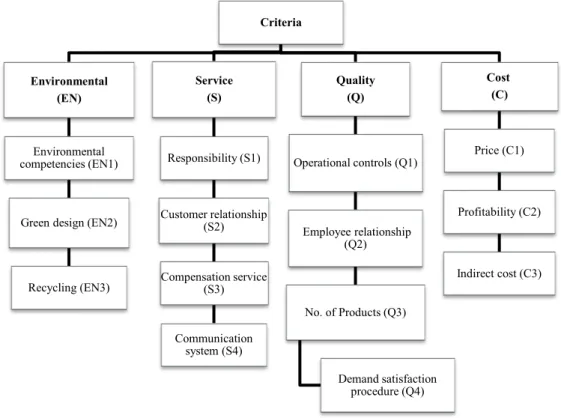
In traditional viewpoint of enterprise management, managers generally focus on internal operations to improve the performance and uphold profits. In order to satisfy customer requirements, supply chain management (SCM) uses a methodical model to organize material, service and information flow of firms. Selecting the proper supplier(s) is one the most important issues in SCM to enhance competitiveness of the enterprise and improve its performance. In order to determine the compatibility of the supplier to the technology and supply strategy of the enterprise, supplier criteria are used. These concerns are generally independent of the desired product or service. Based on a comprehensive investigation of the previous research available in the literatures, we focus on four criteria of supplier selection. Fig. 1 illustrates the criteria used in relevant literature.
Figure 1 Indicators in supplier selection 3 An Integrated Model for Supplier Selection
In this paper, a novel integrated MCDM model combining the approaches of DEMATEL, ANP and linear physical programming is proposed to solve the problem of selecting suppliers.
3.1 Fuzzy DEMATEL Method 3.1.1 DEMATEL Method
DEMATEL is an efficient approach for constructing and examining a structural model consisting of interrelations among complicated criteria. Introduced by
Institute [24], DEMATEL is a practical approach to describe the formation of complex causal relationships. Stepwise process of the DEMATEL method [25] is presented as follows:
Step 1. Generate the direct-relation matrix: First, the decision makers are asked to determine the effects and direction between criteria using sets of pair-wise comparisons. Comparisons are performed according to a five-scale approach in which no impact is shown by 0, very low impact by 1, low impact by 2, high impact by 3, and very high impact by 4. By using the data, the direct-relation matrix Z (an n × n matrix) can be determined. Each element of zij shows the level of importance of the Criteria
Environmental (EN)
Environmental competencies (EN1)
Green design (EN2)
Recycling (EN3) Service (S) Responsibility (S1) Customer relationship (S2) Compensation service (S3) Communication system (S4) Quality (Q) Operational controls (Q1) Employee relationship (Q2) No. of Products (Q3) Demand satisfaction procedure (Q4) Cost (C) Price (C1) Profitability (C2) Indirect cost (C3)
Step 2. Normalize the direct-relation matrix: This step is carried out based on Eqs. (1) and (2),
𝑋=𝑠·𝑍, (1)
𝑠=
min�1⁄𝑚𝑎𝑥1≤𝑖≤𝑛 ∑𝑛𝑗=1𝑧𝑖𝑗, 1⁄𝑚𝑎𝑥1≤𝑗≤𝑛 ∑𝑛𝑖=1𝑧𝑖𝑗�, 𝑖,𝑗= 1,2, … ,𝑛 (2)
Step 3. Obtain the total-relation matrix: Using the following equation, the total relation matrix T is obtained. In Eq. (3), I is the identity matrix
𝑻=𝑋(𝐼 − 𝑋)−1, (3) Step 4. Generate a casual diagram: The vectors D and R are the sum of rows and the sum of columns of the total relation matrix which are calculated using Eqs. (4 ÷ 6).
𝑇= [𝑡𝑖𝑗]𝑛×𝑛, 𝑖,𝑗= 1,2, … ,𝑛, (4)
𝐷= [∑𝑛𝑗=1𝑡𝑖𝑗]𝑛×1= [𝑡𝑖.]𝑛×1, (5) 𝑅= [∑𝑛𝑖=1𝑡𝑖𝑗]1×𝑛= [𝑡.𝑗]𝑛×1. (6)
Prominence, the horizontal axis vector (D + R), shows the relative importance of each criterion. Similarly, by subtracting R from D, the vertical axis (D − R) called Relation, is obtained which determines the type of criteria. Generally, when Relation is positive, the criterion is a member of the cause group and if it is negative, the criterion is of the effect group. Consequently, the causal diagram is obtained by plotting the dataset of the (D + R,
D − R), providing some insight for making decisions. 3.1.2 Triangular fuzzy numbers and defuzzification
A triangular fuzzy number à is shown as a triplet (l, m, r) and a membership function μà as Eq. (7).
The membership function is defined as follows.
. 0 ) ( ≤ ≤ − − ≤ ≤ − − = Otherwise , u x m , m u x u m x l , l m l x x A~ µ (7)
In this study, triangular fuzzy numbers are applied to find perfect solutions from group decision-making. In fuzzy aggregation, the Converting Fuzzy data into Crisp Scores (CFCS) is applied as a defuzzification approach. This approach has been shown to be more efficient than the other defuzzification methods for obtaining crisp values [5, 26].
In the CFCS procedure, the fuzzy maximum as well as minimum of the range of fuzzy number are determined. The total score is then obtained by calculating the weighted average [26]. Let 𝑧𝑖𝑗𝑘= (𝑙𝑖𝑗𝑘 ,𝑚𝑖𝑗𝑘 ,𝑟𝑖𝑗𝑘) be the
degree to which the criterion i affects the criterion j and fuzzy questionnaires k (k = 1, 2, 3 . . . b). First, the triangular fuzzy number is normalized as follows:
𝑥𝑙𝑖𝑗𝑘 = 𝑙𝑖𝑗𝑘−𝑚𝑖𝑛𝑙𝑖𝑗𝑘 ∆𝑚𝑖𝑛𝑚𝑎𝑥 , (8) 𝑥𝑚𝑖𝑗𝑘 =𝑚𝑖𝑗 𝑘−𝑚𝑖𝑛𝑙 𝑖𝑗 𝑘 ∆𝑚𝑖𝑛𝑚𝑎𝑥 , (9) 𝑥𝑟𝑖𝑗𝑘 =𝑟𝑖𝑗 𝑘−𝑚𝑖𝑛𝑙 𝑖𝑗𝑘 ∆𝑚𝑖𝑛𝑚𝑎𝑥 , (10)
where∆𝑚𝑖𝑛𝑚𝑎𝑥=𝑚𝑎𝑥𝑟𝑖𝑗𝑘− 𝑚𝑖𝑛𝑙𝑖𝑗𝑘. Then, the left (ls) and
right (rs) normalized values are computed using Eqs. (11) and (12). 𝑥𝑙𝑠𝑖𝑗𝑘 = 𝑥𝑚𝑖𝑗 𝑘 1+𝑥𝑚𝑖𝑗𝑘−𝑥𝑙 𝑖𝑗 𝑘, (11) 𝑥𝑟𝑠𝑖𝑗𝑘 = 𝑥𝑟𝑖𝑗 𝑘 1+𝑥𝑟𝑖𝑗𝑘−𝑥𝑚𝑖𝑗𝑘. (12)
Then, the total normalized crisp values and final crisp values are computed by using Eqs. (13) and (14) respectively.
𝑥𝑖𝑗𝑘 =
�𝑥𝑙𝑠𝑖𝑗𝑘�1−𝑥𝑙𝑠𝑖𝑗𝑘�+𝑥𝑟𝑠𝑖𝑗𝑘𝑥𝑟𝑠𝑖𝑗𝑘�
�1−𝑥𝑙𝑠𝑖𝑗𝑘+𝑥𝑟𝑠𝑖𝑗𝑘� , (13) 𝑧𝑖𝑗𝑘 = min𝑙𝑖𝑗𝑘 +𝑥𝑖𝑗𝑘∆minmax. (14)
Finally, crisp values are integrated as follow:
𝑧𝑖𝑗 =1𝑏�𝑧𝑖𝑗1+𝑧𝑖𝑗2+⋯+𝑧𝑖𝑗𝑏�. (15) 3.2 Fuzzy ANP
Introduced by Saaty (1996), ANP is a generic variation of the AHP. The ANP utilizes ratio scale measurements according to pairwise comparisons without imposing a strict hierarchical structure as in AHP. The ANP is a structured network which considers dependences and feedbacks among criteria instead of single direction relationships [17]. In the ANP, a decision problem is modelled through a systems-with-feedback procedure in which a decision attribute may be dominated or dominate other decision attributes. By determining the complex weights in developing a supermatrix, this approach is able to handle interdependence among the attributes. In the ANP network, a component with its elements is denoted by a node, the interactions between two components by an arc, inner dependence among elements within a component by a loop. The step-wise procedure of Fuzzy ANP (FANP) is as follows [17]:
Step 1: Remaining relations are established in this step. Pairwise comparisons of the components in different levels are done considering their relative significance to the control criterion. The relative strength of each pair of components and the preferences described by the decision maker are determined using triangular fuzzy numbers. The fuzzy judgment matrix X′ is then calculated as follows:
11 12 1 21 22 2 1 2 .... .... . . . .... n n n n nn x x x x x x X x x x ′ ′ ′ ′ ′ ′ ′ = ′ ′ ′ ,
wherexij′ =( ,l m uij′ ij′ ′, )ij is the importance of criterion i
over j (i and j = 1, 2,…, n).
1.1 The relative importance weights are then calculated. The priority vectors of the pair-wise comparison matrices are used to find supermatrix sub-matrices. The triangular fuzzy priorities
w
k(k = 1, 2. . . ,n) are then estimated from the judgment matrix. In order to calculate these weights the eigenvector method is applied:[
CFCS(X)−λmax]
⋅W =0,where W and λmax denote the eigenvector and maximum
eigenvalue ofCFCS X( ) respectively. To verify the results
of the approach, the consistency ratio is obtained for each matrix and the total consistency for the whole system. In order to estimate the consistency of the pairwise comparisons, the inconsistency ratios are calculated as follows: , RI CI CR= . 1 max − − = n n CI λ
Step 2: A supermatrix is formed to declare of the effects of the interdependence among the clusters in the network hierarchy. Each sub-matrix in the supermatrix contains a group of relationships between two clusters. The initial supermatrix is constructed by entering the priorities determined through using fuzzy ANP and fuzzy DEMATEL in the related columns.
2.1 The supermatrix is then solved. First, each of the columns is normalized and then, the priority ranking of the alternatives is attained. Thus, the overall priorities are calculated by raising the normalized supermatrix to limiting powers 2k+1. The cumulative effects of each component on other components are also obtained. Therefore, the overall priorities of components are derived.
3.3 Linear Physical Programming (LPP)
LPP, as a multi-objective optimization technique, is based on aggregating the objective function of the criteria in a piece-wise Archimedean goal programming manner. Physical programming (PP) has been successfully applied to solve a lot of multi-objective optimization problems [27]. In this approach, the preferences of the decision maker (DM) according to the criteria are expressed based on four classes. The decision vector is shown by x and
gp(x) is the pth linear objective function. Furthermore, let
the horizontal axis show the value of the criterion pth
objective function gp, and the vertical axis show the penalty function zp which is desired to be minimized. The preferred behaviour of the criterion is shown by one of the eight classes of penalty functions called class functions as follows:
Soft (S):
Class 1S (smaller-is-better, i.e., minimization) Class 2S (larger-is-better, i.e., maximization) Class 3S (value-is-better)
Class 4S (range-is-better) Hard (H):
Class-IH (Must be smaller) gi ≤ti,max Class-2H (Must be larger) gi ≥ti,min
Class-3H (Must be equal) gi =ti val,
Class-4H (Must be in range) ti,min ≤gi≤ti,max. The level of sharpness of the preference determined by the DM determines whether each criterion belongs to hard or soft classes [21]. For each criterion, the DM is able to define different ranges for determining the preferences. Six types of ranges, defined in the PP lexicon, determine the degrees of desirability of the criteria. The ranges for Class 1S are defined as follows:
Ideal range gp ≤tp+1
Desirable range tp+1≤gp ≤tp+2 Tolerable range tp+2 ≤gp ≤t+p3 Undesirable range tp+3≤gp≤tp+4 Highly Undesirable range tp+4≤gp ≤tp+5 Unacceptable range gp ≤tp+5.
The values tp+1 to tp+5 are target values which are determined by the decision maker to express the preference level of the pth criterion.
ps
w+
and w−ps are the
weights defined by PP to indicate the incremental slopes of the piecewise linear penalty functions of the criteria (zp). The objective is defined as to minimize the weighted sum of deviation from the target values. The linear physical programming model is as follows [21]:
), ( Min , , + + − − + − x=
∑∑
ps ps+ ps ps ps d ps d d w~ d w~ j (16) Subject to: , ) ( ; 0 ; ) ( − +ps ≤ +p,s−1 +ps ≥ p ≤ +ps p x d t d g x t g (17) (For classes 1S, 3S, 4S, P = 1…P, S = 2…5), (18) , ) ( ; 0 ; ) ( + −ps ≥ −p,s−1 −ps ≥ p ≥ −ps p x d t d g x t g (19) (For classes 2S, 3S, 4S, P = 1…P, S = 2…5), (20) . max min X X X ≤ ≤ − psd and d+ps are the negative and positive deviation
of the value associated with criterion p from the specified target levels
t
p s+, 1− andt
p s−, 1− respectively. Eq. (17) appliesto all class functions except class 2S and Eq. (18) applies to all classes but class 1S. Eq. (20) guaranties that decision variables x lie between lower and upper bounds.
further description of linear physical programming the reader is referred to Messaca et al. [21].
4 Computational Results
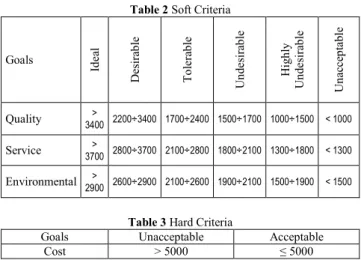
In order to show the applicability of the proposed integrated approach to the green supplier selection problem, it is applied to a real-world problem. In the proposed approach, fuzzy DEMATEL and fuzzy ANP are used to estimate the weights of the objectives. Then, the obtained weights are used in the linear physical programming to find the most appropriate suppliers considering the constraint of capacity of each supplier. Tabs. 1, 2, and 3 show the problem parameters. The demand is predicted to be 1100.
Table 1 The parameters of the problem
Cost Quality (%) Service (%) Environmental (%) Capacity Supplier 1 11 0,78 0,84 0,7 800 Supplier 2 15 0,81 0,82 0,7 500 Supplier 3 14,5 0,80 0,82 0,5 700 Supplier 4 12 0,81 0,85 0,6 600
The first questionnaire is designed for fuzzy DEMATEL. This questionnaire is used for conducting pairwise comparisons to assess the influence of each criterion. The scores of 0, 1, 2, 3 and 4 stand for no impact, very low impact, low impact, high impact, and very high impact by 4 respectively.
An expert interview method has been used in this study. The collected data from the experts has then been analysed using the fuzzy DEMATEL method. In this study linguistic variables as described by Li [28] have been used: no impact, very low impact, low impact, high impact and very high impact. In order to deal with the ambiguities inherent in the linguistic variables, positive triangular fuzzy numbers ( ,l m nijk ijk, ijk) as shown in Tab. 4 are also used.
Table 2 Soft Criteria Goals Ideal D es irab le To le ra ble U nd es ira bl e H ig hl y U nd es ira bl e U nac ce pt ab le Quality 3400 2200÷3400 1700÷2400 1500÷1700 1000÷1500 < 1000 > Service 3700 2800÷3700 2100÷2800 1800÷2100 1300÷1800 < 1300 > Environmental 2900 2600÷2900 2100÷2600 1900÷2100 1500÷1900 < 1500 >
Table 3 Hard Criteria
Goals Unacceptable Acceptable
Cost > 5000 ≤ 5000
A 5×15 linguistic/fuzzy scale direct-relation matrix T is allocated to each expert for comparison of supplier selection criteria. For example, Tab. 5 shows a
direct-relation matrix for expert 1 based on a linguistic scale evaluation among the criteria.
Table 4 The fuzzy linguistic variables
Linguistic Term Influence Score Triangular Fuzzy Numbers
No Influence (No) 0 (0; 0; 0,25)
Very Low Influence (VL) 1 (0; 0,25; 0,5)
Low Influence (L) 2 (0,25; 0,5; 0,75)
High Influence (H) 3 (0,5; 0,75; 1)
Very High Influence (VH) 4 (0,75; 1,1)
Table 5 The linguistic scale direct-relation matrix by expert 1
Cost Quality Service Environmental Cost (0;0;0,25) (0;0,25;0,5) (0;0;0,25) (0;0,25;0,5) Quality (0,75;1,0;1,0) (0;0;0,25) (0,5;0,75;1,0) (0,25;0,5;0,75) Service (0;0,25;0,5) (0,5;0,75;1) (0;0;0,25) (0;0,25;0,5) Environmental (0,25;0,5;0,75) (0,25;0,5;0,75) (0,5;0,75;1,0) (0;0;0,25)
Then, in order to obtain a crisp value direct-relation matrix for each expert, the CFCS method is utilized as described in Section 3. The crisp value direct-relation matrix for all experts is demonstrated in Tab. 6.
By using Eq (1), the direct-relation matrix is normalized. In this matrix, all diagonal elements are between 0 and 1. The total-relation matrix is then calculated by using Eq. (3) from the normalized direct
-relation matrix. The total-relation matrix, the sum of rows and the sum of columns are denoted as D and R, (D + R), and (D − R) respectively in Tab. 7. The relative weights between main criteria are depicted in Tab. 9.
Table 6 The initial direct-relation matrix
Cost Quality Service Environmental
Cost 0,0333 0,2667 0,0333 0,2667
Quality 0,9667 0,0333 0,7333 0,5000
Service 0,2667 0,7333 0,0333 0,2667
Environmental 0,2667 0,7333 0,0333 0,2667
The relative weights between other sub-criteria as well as eigenvectors are calculated and supermatrix is then formed according to the data obtained from the experts. The limited supermatrix is depicted in Table 9. The crisp formulation of the numerical example can now be presented as follows: , x x , x x g1=111+15 2+145 3+12 4 , x , x , x , x , g2=078 1+081 2+08 3+081 4 , x , x , x , x , g3=084 1+082 2+082 3+085 4 . x , x , x , x , g4=07 1+07 2+05 3+06 4 S.t: 1 2 3 4 1500 x x+ +x +x = 1 800, 2 500, 3 700, 4 600 x ≤ x ≤ x ≤ x ≤ 0, i x ≥ ∀i.
Based on the linear physical programming Eqs. (16) ÷ (20), the single objective formulation for this problem is as follows: Min 5 2 2 3 3 4 4 2 ( s s s) s j w d− − w d− − w d− − = =
∑
+ + Criteria:, x x , x x g1=111+15 2+145 3+12 4 , x , x , x , x , g2=078 1+081 2+08 3+081 4 , x , x , x , x , g3=084 1+082 2+082 3+085 4 . x , x , x , x , g4=07 1+07 2+05 3+06 4 Goal Constrainers: 5 4 3 2 ; 4 3 2 ; ) (x d t 1 p ,, s , , , gp + p−s, ≥ p−s,− = = 5 ( ) 2,3,4 p p g x ≥t− p= 1( ) 1,min g x ≤t System Constraints: 1 2 3 4 1500 x x+ +x +x = 1 800, 2 500, 3 700, 4 600 x ≤ x ≤ x ≤ x ≤ 0, i x ≥ ∀i.
The problem can now be easily solved using the linear programming software LINGO. The obtained optimal solution is as follows:
1 800 , 2 0 , 3 0, 4 300
x = x = x = x =
1 4960 , 2 3468 , 3 3708, 4 2960
g = g = g = g =
Goal 21,25= .
Based on the obtained results, Supplier 1 should supply 800 units; Supplier 4 should supply 300 units; Supplier 2 and 4 will be removed from firms’ strategy. Table 7 The total-relation matrix
Cost Quality Service Environmental D R D + R D − R
Cost 1,17 0,26 0,11 0,24 2,87 1,78 4,65 1,09
Quality 0,78 1,47 0,51 0,55 2,92 3,30 6,22 −0,38
Service 0,46 0,60 1,23 0,38 2,07 2,66 4,73 −0,59
Environmental 0,46 0,60 0,23 1,38 2,56 2,66 5,22 −0,10
Table 8 The relative weights between main criteria
Cost Quality Service Environmental
Cost 0,41 0,09 0,05 0,09
Quality 0,27 0,50 0,25 0,22
Service 0,16 0,20 0,59 0,15
Environmental 0,16 0,20 0,11 0,54
Table 9 The limited supermatrix
C Q S EN C1 C2 C3 Q1 Q2 Q3 Q4 S1 S2 S3 S4 EN1 EN2 EN3 Goal
C 0,03 0,03 0,03 0,03 0,00 0,00 0,00 0,00 0,00 0,00 0,00 0,00 0,00 0,00 0,00 0,00 0,00 0,00 0,03 Q 0,09 0,09 0,09 0,09 0,00 0,00 0,00 0,00 0,00 0,00 0,00 0,00 0,00 0,00 0,00 0,00 0,00 0,00 0,09 S 0,08 0,08 0,08 0,08 0,00 0,00 0,00 0,00 0,00 0,00 0,00 0,00 0,00 0,00 0,00 0,00 0,00 0,00 0,08 EN 0,07 0,07 0,07 0,07 0,00 0,00 0,00 0,00 0,00 0,00 0,00 0,00 0,00 0,00 0,00 0,00 0,00 0,00 0,07 C1 0,02 0,02 0,02 0,02 0,00 0,00 0,00 0,00 0,00 0,00 0,00 0,00 0,00 0,00 0,00 0,00 0,00 0,00 0,02 C2 0,09 0,09 0,09 0,09 0,00 0,00 0,00 0,00 0,00 0,00 0,00 0,00 0,00 0,00 0,00 0,00 0,00 0,00 0,09 C3 0,09 0,09 0,09 0,09 0,00 0,00 0,00 0,00 0,00 0,00 0,00 0,00 0,00 0,00 0,00 0,00 0,00 0,00 0,09 Q1 0,08 0,08 0,08 0,08 0,00 0,00 0,00 0,00 0,00 0,00 0,00 0,00 0,00 0,00 0,00 0,00 0,00 0,00 0,08 Q2 0,02 0,02 0,02 0,02 0,00 0,00 0,00 0,00 0,00 0,00 0,00 0,00 0,00 0,00 0,00 0,00 0,00 0,00 0,02 Q3 0,23 0,23 0,23 0,23 0,00 0,00 0,00 0,00 0,00 0,00 0,00 0,00 0,00 0,00 0,00 0,00 0,00 0,00 0,23 Q4 0,27 0,27 0,27 0,27 0,00 0,00 0,00 0,00 0,00 0,00 0,00 0,00 0,00 0,00 0,00 0,00 0,00 0,00 0,27 S1 0,22 0,22 0,22 0,22 0,00 0,00 0,00 0,00 0,00 0,00 0,00 0,00 0,00 0,00 0,00 0,00 0,00 0,00 0,22 S2 0,05 0,05 0,05 0,05 0,00 0,00 0,00 0,00 0,00 0,00 0,00 0,00 0,00 0,00 0,00 0,00 0,00 0,00 0,05 S3 0,24 0,24 0,24 0,24 0,00 0,00 0,00 0,00 0,00 0,00 0,00 0,00 0,00 0,00 0,00 0,00 0,00 0,00 0,24 S4 0,13 0,13 0,13 0,13 0,00 0,00 0,00 0,00 0,00 0,00 0,00 0,00 0,00 0,00 0,00 0,00 0,00 0,00 0,13 EN1 0,09 0,09 0,09 0,09 0,00 0,00 0,00 0,00 0,00 0,00 0,00 0,00 0,00 0,00 0,00 0,00 0,00 0,00 0,09 EN2 0,06 0,06 0,06 0,06 0,00 0,00 0,00 0,00 0,00 0,00 0,00 0,00 0,00 0,00 0,00 0,00 0,00 0,00 0,06 EN3 0,02 0,02 0,02 0,02 0,00 0,00 0,00 0,00 0,00 0,00 0,00 0,00 0,00 0,00 0,00 0,00 0,00 0,00 0,02 Goal 0,00 0,00 0,00 0,00 0,00 0,00 0,00 0,00 0,00 0,00 0,00 0,00 0,00 0,00 0,00 0,00 0,00 0,00 0,00 5 Conclusion
In this paper an integrated approach based on fuzzy DEMATEL-Fuzzy ANP that is able to handle the interdependencies among various criteria and efficiently exploit the decision makers’ opinion in obtaining the weights OF the criteria and dealing with the constraints is proposed. A novel hybrid approach to green supplier selection is proposed and its practical application is illustrated in a real case study. First, the Fuzzy Decision Making Trial and Evaluation Laboratory (FDEMATEL) method is used to construct interrelations among the criteria determined for evaluating green suppliers. Then,
Analytical Network Process (FANP). Lastly, a linear physical programming model is applied in order to select the perfect solution of this problem. The proposed approach can be easily modified to solve other multi-objective decision making problems. For future research, other fuzzy MCDM methods and optimization models to evaluate and select green suppliers can be applied. To provide as guidance for future research, other green criteria can be considered.
6 References
[1] De Boer, L.; Labro, E.; Morlacchi, P. A review of methods supporting supplier selection. // European Journal of Purchasing & Supply Management. 7, 2(2001), pp. 75-89. [2] Weber, C. A.; Current, J. R. A multi objective approach to
vendor selection. // European Journal of Operational Research. 68, 2(1993), pp. 173-184.
[3] Thaver, I.; Wilcock, A. Identification of overseas vendor selection criteria used by Canadian apparel buyers: Is ISO 9000 relevant? // Journal of Fashion Marketing and Management. 10, 1(2006), pp. 56-70.
[4] Dickson, G. W. An analysis of vendor selection systems and decisions. // Journal of Purchasing, 2, 1(1966), pp. 5-17.
[5] Wu, W. W.; Lee, Y. T. Developing global managers’ competencies using the fuzzy DEMATEL method. // Expert Systems with Applications, 32, 2(2007), pp. 499-507. [6] Chan, F. T.; Kumar, N. Global supplier development
considering risk factors using fuzzy extended AHP-based approach. Omega, 35, 4(2007), pp.417-431.
[7] Lee, A. H.; Kang, H. Y.; Hsu, C. F.; Hung, H. C. A green supplier selection model for high-tech industry. // Expert Systems with Applications, 36, 4(2009), pp. 7917-7927. [8] Rao, P.; Holt, D. Do green supply chains lead to
competitiveness and economic performance? // International Journal of Operations & Production Management. 25, 9(2005), pp. 898-916.
[9] Kumar, M.; Vrat, P.; Shankar, R. A fuzzy goal programming approach for vendor selection problem in a supply chain. // Computers & Industrial Engineering. 46, 1(2004), pp. 69-85.
[10]Tsai, W.-H.; Hung, S.-J. A fuzzy goal programming approach for green supply chain optimization under activity-based costing and performance evaluation with a value-chain structure. // International Journal of Production Research. 47, 18(2009), pp. 4991–5017.
[11]Nazari-Shirkouhi, S.; Shakouri, H.; Javadi, B.; Keramati, A. Supplier selection and order allocation problem using a two-phase fuzzy multi-objective linear programming. // Applied Mathematical Modelling, 2013. doi:10.1016/j.apm.2013.04.045
[12]Lin, R.-H. An integrated FANP–MOLP for supplier evaluation and order allocation. // Applied Mathematical Modelling. 33, (2009), pp. 2730-2736.
[13]Tuzkaya, U. R.; Önüt, S. A fuzzy analytic network process based approach to transportation-mode selection between Turkey and Germany: A case study. // Information Sciences. 178, (2008), pp. 3133-3146.
[14]He, S.; Chaudhry, S. S.; Lei, Z.; Baohua, W. Stochastic vendor selection problem: Chance-constrained model and genetic algorithms. // Annals of Operations Research. 168, (2009), pp. 169-179.
[15]Sen, S.; Basligil, H.; Sen, C. G.; Baraçli, H. A framework for defining both qualitative and quantitative supplier selection criteria considering the buyer supplier integration strategies. // International Journal of Production Research. 46, 7(2007), pp.1825-1845.
[16]Sevkli, M.; Koh, S. C. L.; Zaim, S.; Demirbag, M.; Tatoglu, E. An application of data envelopment analytic hierarchy process for supplier selection: A case study of BEKO in Turkey. // International Journal of Production Research. 45, (2007), pp. 1973-2003.
[17]Saaty, T. L. The analytic network process. Pittsburgh: RWS Publications, 1996.
[18]Liou, J. J. H.; Tzeng, G. H.; Chang, H. C. Airline safety measurement using a novel hybrid model. // Journal of Air Transport Management. 13, 4(2007), pp. 243-249.
[19]Fontela, E.; Gabus, A. DEMATEL, innovative methods. Rep. No. 2, Structural analysis of the world problematique (methods), Battelle Geneva Research Institute, 1974. [20]Tamura, H. Large Scale Systems – Modeling, Control and
Decision Making, Ed. Tokyo: Shokodo, (in Japanese). (1986).
[21]Messac, A.; Gupta, S.; Akbulut, B. Linear Physical Programming: A New Approach to Multiple Objective Optimization. // Transactions on Operational Research. 8, (1996), pp. 39-59.
[22]Ma, X.; Dong, B. Linear Physical Programming-Based Approach for Web Service Selection. // Proceedings of the International Conference on Information Management, Innovation Management and Industrial Engineering, Taipei, Taiwan, (2008), pp. 398-401.
[23]Hong-Zhong Huang; Zhi-Gang Tian; Ming J. Zuo. Multiobjective Optimization of Three-Stage Spur Gear Reduction Units using Interactive Physical Programming. // Journal of Mechanical Science and Technology, 19, 5(2005), pp.1080-1086.
[24]Gabus, A.; Fontela, E. Perceptions of the world problematique: Communication procedure, communicating with those bearing collective responsibility. Switzerland Geneva: Battelle Geneva Research Centre, 1973.
[25]Fontela, E.; Gabus, A. The DEMATEL observer. DEMATEL 1976, report. Geneva, Switzerland: Battelle Geneva Research Center, 1976.
[26]Opricovic, S.; Tzeng, G. H. Defuzzification within a multicriteria decision model. // International Journal of Uncertainty, Fuzziness and Knowledge-Based Systems. 11, 5(2003), pp. 635-652.
[27]Maria, A.; Mattson, C. A.; Ismail-Yahaya, A.; Messac, A. Linear Physical Programming for production planning optimization. // Engineering Optimization. 35, 1(2003), pp. 19-37.
[28]Li, R. J. Fuzzy method in group decision making. // Computers and Mathematics with Applications. 38, 1(1999), pp. 91-101.
Author’s addresses
Mohsen Jafari Ashlaghi
Department of Industrial Management, Faculty of Management, Central Tehran Branch, Islamic Azad University, Tehran, Iran E-mail: [email protected]