International Journal of COPD
Dove
press
O r I g I n a l r e s e a r C h
open access to scientific and medical research
Open access Full Text article
Effect of indacaterol on lung deflation improves
cardiac performance in hyperinflated COPD
patients: an interventional, randomized,
double-blind clinical trial
Pierachille santus1,2
Dejan radovanovic1,2
silvia Di Marco3
Vincenzo Valenti4,5
rita raccanelli1,2
Francesco Blasi6,7
stefano Centanni8,9
Maurizio Bussotti3
1Department of health sciences,
University of Milan, 2Pulmonary
rehabilitation Unit, Fondazione salvatore Maugeri scientific Institute of Milan-IrCCs, 3Cardiological
rehabilitation Unit, Fondazione salvatore Maugeri rehabilitation Institute of Milan-IrCCs,
4Department of Biomedical sciences
for health, University of Milan,
5respiratory Unit, Policlinico san
Donato-IrCCs, san Donato Milanese,
6Department of Pathophysiology
and Transplantation, University of Milan, 7IrCCs Fondazione Ospedale
Maggiore Policlinico Cà granda Milan,
8Department of health sciences,
University of Milan, 9respiratory Unit,
Ospedale san Paolo, Milan, Italy
Background: COPD is often associated with cardiovascular comorbidity. Treatment guidelines recommend therapy with bronchodilators as first choice. We investigated the acute effect of single-dose indacaterol on lung hyperinflation in COPD subjects, for the first time evaluating the potential effects on right heart performance.
Methods: In this Phase IV, randomized, interventional, double-blind, crossover clinical study, we recruited 40 patients (50–85 years of age) with stable COPD. Patients were treated with 150 μg indacaterol or placebo and after 60 minutes (T60) and 180 minutes (T180) the following tests were performed: trans-thoracic echocardiography (TTE), plethysmography, diffusing capacity of the lung for carbon monoxide, saturation of peripheral oxygen, and visual analog scale dyspnea score. Patients underwent a crossover re-challenge after a fur-ther 72 hours of pharmacological washout. All TTE measurements were conducted blindly by the same operator and further interpreted by two different blinded operators. Consensus decisions were taken on every value and parameter. The primary outcome was the effect of the reduction of residual volume and functional residual capacity on right heart systolic and diastolic function indexes evaluated by TTE in patients treated with indacaterol, as compared to placebo.
Results: Vital capacity, inspiratory capacity, and forced expiratory volume in 1 second were significantly increased by indacaterol, when compared with placebo, while residual volume, intrathoracic gas volume, and specific airway resistance were significantly reduced in patients treated with indacaterol. Tricuspid annular plane systolic excursion was significantly increased versus placebo, paralleled by an increase of tricuspid E-wave deceleration time. The cardiac frequency was also significantly reduced in indacaterol-treated patients.
Conclusion: Indacaterol significantly reduces lung hyperinflation in acute conditions, with a clinically relevant improvement of dyspnea. These modifications are associated with a signifi-cant increase of the right ventricular compliance indexes and may have a role in improving left ventricular preload leading to a reduction in cardiac frequency.
Keywords: lung deflation, bronchodilator, cardiac performance, right ventricular function, echocardiography
Introduction
COPD is characterized by persistent airflow limitation, pulmonary hyperinflation, and impaired ventilation homogeneity. COPD is often associated with various comorbidi-ties, mainly cardiovascular and metabolic in nature, and ranks third among the causes
of death worldwide.1
Correspondence: Pierachille santus Department of health sciences, University of Milan, Pulmonary
rehabilitation Unit, Fondazione salvatore Maugeri, Istituto Scientifico di Milano IrCCs, Via Camaldoli, 64 – 20138 Milan, Italy
Tel +39 02 5072 5122 Fax +39 02 5072 5240
email [email protected]
Journal name: International Journal of COPD Article Designation: Original Research Year: 2015
Volume: 10
Running head verso: Santus et al
Running head recto: COPD lung deflation and cardiac performance DOI: http://dx.doi.org/10.2147/COPD.S91684
International Journal of Chronic Obstructive Pulmonary Disease downloaded from https://www.dovepress.com/ by 118.70.13.36 on 22-Aug-2020
For personal use only.
Number of times this article has been viewed
This article was published in the following Dove Press journal: International Journal of COPD
Dovepress
santus et al
A form of COPD is chronic obstructive bronchitis, causing narrowed airways, persistent cough, and excess mucus production. Severe COPD partially overlaps with emphysema, accompanied by destruction of alveolar walls and permanent enlargement of lung regions. The loss of lung parenchyma and the supporting elastic structures leads to the loss of pulmonary elastic recoil. This causes increased resis-tance, airflow obstruction, air trapping, and lung hyperinfla-tion. This frequently results in dyspnea which is responsible
for the limitation of daily activities in COPD patients.2,3
The correlation between emphysema and altered left
ventricular (LV) end-diastolic volume is well established.4,5
Notwithstanding, little is known about the effects of these alterations on heart mechanical functions. The large Multi-Ethnic Study of Atherosclerosis (MESA) study, combining measurements of right ventricular (RV) structure and func-tion with assessment of emphysema, showed that percent emphysema was inversely correlated to RV end-diastolic volumes, stroke volume, and mass, likely associated with increased lung vascular resistance and pulmonary
hyperin-flation.6 A frequent complication of very severe COPD is
cor pulmonale, a structural alteration with function impair-ment of the right ventricle, leading to increased pulmonary vascular resistance and right heart failure. This condition is accompanied by the reductions in LV filling, LV stroke volume, and cardiac output, while left ventricular ejection
fraction (LVEF) is usually maintained.4 A study conducted
on a large cohort of patients with heart failure, either with preserved or with reduced LVEF, evaluated prevalence and prognostic impact of the noncardiac comorbidities in the two groups. The result of this survey revealed that COPD was the sole comorbidity significantly associated with an higher hazard for mortality in patients with preserved EF, although COPD was an independent predictor of mortality
in both the groups.7 These studies highlight the importance
of investigating the relationships between heart and lung structure and function.
COPD has been treated with bronchodilators and
corticos-teroids and for the last two decades long-acting β2-agonists
(LABAs) have been the mainstay of the management of COPD, according to the guidelines of the Global Initiative for Chronic
Obstructive Lung Disease (GOLD).3 These agents relax airway
smooth muscle and augment expiratory airflow, with reduced hyperinflation and improvement of dyspnea, functional capacity, and patient quality of life. More recently, ultra-
LABAs, like the novel once-daily LABA indacaterol,8 have
been also approved for COPD. They have an ultra-long dura-tion of acdura-tion (at least 24 hours) and rapid bronchodiladura-tion
activity (within 5 minutes).9 Several clinical studies revealed
that indacaterol has comparable or even superior clinical
efficacy than the previously available LABAs.10–17
Aim of the study reported here was to evaluate the acute
effect of a single-dose of the long-acting β2 agonist
inda-caterol 150 μg on lung hyperinflation in COPD subjects with
lung air trapping, and the consequent potential effects on right heart systolic and diastolic functional indexes.
Materials and methods
study design and patients
This was a Phase IV, monocentric, randomized, prospective, interventional, double-blind, placebo-controlled, crossover study. The protocol was approved by the Central Ethic Committee (CEC) of the Salvatore Maugeri Foundation. All patients provided their written informed consent.
The main inclusion criteria were patients aged 50–85 years, former or active smokers with a history of COPD of at least
1 year and defined according to GOLD 2013 criteria,3
clinically stable in the last 3 months, with forced respiratory
volume in 1 second (FEV1) pred #70% and a residual volume
(RVo) pred $135%, and absence of cardiac comorbidities.
Procedures
Between November 2013 and October 2014, we recruited and enrolled a total of 40 eligible patients with COPD. Patients
were randomly allocated in a 1:1 ratio to receive either 150 μg
indacaterol or placebo. Following the washout of the inhalation
therapy (T0), patients were treated with 150 μg indacaterol or
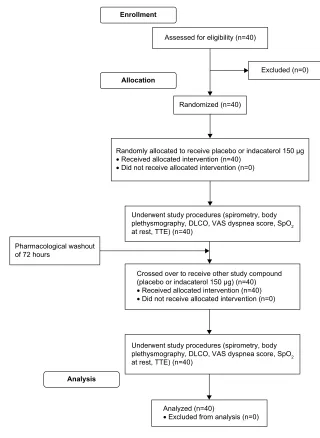
placebo. After 60 minutes (T60) and 180 minutes (T180) the following tests were performed: trans-thoracic echocardiog-raphy (TTE), plethysmogechocardiog-raphy, diffusing capacity of the lung for carbon monoxide, saturation of peripheral oxygen, and visual analog scale (VAS) dyspnea score. The VAS dyspnea score ranged from 0 (no dyspnea at rest) to 10 (unbearable dyspnea) and it was recorded by the same blinded operator. Patients underwent a crossover re-challenge after a further 72 hours of pharmacological washout (Figure 1).
All echocardiography examinations were performed with a GE Vivid 7 Dimension ultrasound system (GE HealthCare UK Ltd, Little Chalfont, UK). A complete standard M-mode and two-dimensional echocardiography examinations were performed according to our clinical laboratory practice using a S5-1 sector array probe. All measurements were made on three representative beats and the results were averaged. The following parameters were evaluated to study right heart size and systolic and diastolic function: RV size, right atrial size, RVEF, tricuspid annular plane systolic excursion (TAPSE),
International Journal of Chronic Obstructive Pulmonary Disease downloaded from https://www.dovepress.com/ by 118.70.13.36 on 22-Aug-2020
Dovepress COPD lung deflation and cardiac performance
systolic pulmonary artery pressure (sPAP) with an estimate of right atrial pressure on the basis of inferior vena cava size and collapse, tricuspid E/A ratio, tricuspid E/e’ ratio, and tricuspid E-wave deceleration time (DT-TR). Left heart size and systolic and diastolic function were evaluated as follows: LV size, left atrial (LA) size, LVEF, mitral valve peak E and peak A, E/A mitral ratio, E/e’ mitral ratio, mitral E-wave deceleration time (DT-MR).
TAPSE was expressed in millimeters (mm), while measurements of DT-TR and DT-MR were expressed in milliseconds (msec).
Heart rate (HR) was recorded during all echocardio-graphic maneuvers.
Outcomes
The primary outcome was to evaluate the reduction of RVo and functional residual capacity induced by indacaterol and its effect on the following right cardiac systolic and diastolic functional indexes: RVEF, TAPSE, sPAP, tricuspid E/e’ ratio, and DT-TR.
Additional outcomes after indacaterol treatment were the evaluation of: 1) interventricular septum motility modification; 2) modifications in cardiac LVEF, E/e’ mitral ratio, DT-MR; and 3) right cardiac chambers kinetics modifications by TTE. Inspiratory capacity modifications and specific airway resistance (sRAW) were assessed by body plethysmography and spirometry.
$QDO\]HGQ
•([FOXGHGIURPDQDO\VLVQ $VVHVVHGIRUHOLJLELOLW\Q
([FOXGHGQ
5DQGRPO\DOORFDWHGWRUHFHLYHSODFHERRULQGDFDWHUROJ
•5HFHLYHGDOORFDWHGLQWHUYHQWLRQQ
•'LGQRWUHFHLYHDOORFDWHGLQWHUYHQWLRQQ $OORFDWLRQ
5DQGRPL]HGQ
&URVVHGRYHUWRUHFHLYHRWKHUVWXG\FRPSRXQG SODFHERRULQGDFDWHUROJQ
•5HFHLYHGDOORFDWHGLQWHUYHQWLRQQ
•'LGQRWUHFHLYHDOORFDWHGLQWHUYHQWLRQQ (QUROOPHQW
$QDO\VLV
8QGHUZHQWVWXG\SURFHGXUHVVSLURPHWU\ERG\ SOHWK\VPRJUDSK\'/&29$6G\VSQHDVFRUH6S2 DWUHVW77(Q
8QGHUZHQWVWXG\SURFHGXUHVVSLURPHWU\ERG\ SOHWK\VPRJUDSK\'/&29$6G\VSQHDVFRUH6S2 DWUHVW77(Q
3KDUPDFRORJLFDOZDVKRXW RIKRXUV
Figure 1 Consolidated Standards of Reporting Trials (CONSORT) 2010 flow diagram.
Notes: The diagram graphically outlines the design and conduct of the clinical study.
Abbreviations: DlCO, diffusing lung capacity for carbon monoxide; spO2, peripheral oxygen saturation; TTe, trans-thoracic echocardiography; Vas, visual analog scale.
International Journal of Chronic Obstructive Pulmonary Disease downloaded from https://www.dovepress.com/ by 118.70.13.36 on 22-Aug-2020
Dovepress
santus et al
statistical analysis
Statistical analyses were performed using SSPS (v 20.0; IBM Corporation, Armonk, NY, USA). Results were analyzed using
the t-test for unpaired data with α=0.05. All results were also
compared using the t-test for paired data after analysis of
cova-riance and Bonferroni correction was applied. Any difference
with P#0.05 was considered significant. All values are
pre-sented as mean ± standard deviation, unless otherwise stated.
The reported work was a pilot study; therefore, sample size was not calculated by power analysis, because of the absence of any data in the literature that could be reviewed. The trial is
registered with ClinicalTrials.gov, number NCT01996124.
Results
This study has been conducted on a total of 40 COPD patients, from November 2013 to October 2014. Patients’
demographics and baseline variables of lung functionality are reported in Table 1.
The dynamic respiratory parameters, vital capacity
(VC), inspiratory capacity (IC), and FEV1 were recorded
in all subjects under study by spirometric measurements at baseline (T0) and after 60 minutes (T60) and 180 minutes
(T180) of indacaterol 150 μg inhalation. Values are expressed
as volumes (L) and as percent predicted (% pred) as well.
For all three parameters examined indacaterol 150 μg
treat-ment induced a significant increase, both at T60 and T180, as compared with T0. Particularly relevant increases of
volumes were observed at T180 for VC, IC, and FEV1. The
differences were statistically significant also when calculated versus the treatment with placebo (Table 2). No significant modifications were found in the diffusing capacity of the lung for carbon monoxide and its subcomponents (alveolar volume and transfer coefficient) both after indacaterol and placebo treatment (data not shown).
As regards the static respiratory parameters,total lung
capacity, RVo, intrathoracic gas volume (ITGV, a plethys-mographic equivalent to functional residual capacity), and sRAW were evaluated by plethysmography. As in the case
of dynamic volumes, the treatment with indacaterol 150 μg
provided the patients with a significant benefit, both at T60 and at T180. All parameters considered, total lung capacity, RVo, ITGV, and sRAW were significantly reduced, both when compared to T0 and placebo treatment (Table 3).
Following the evaluation of respiratory function param-eters, TTE was performed.
With regard to right cardiac chambers, no changes in RVEF, sPAP mitral valve peak E and peak A, E/A mitral ratio, and E/e’ mitral ratio were found.
After indacaterol, at T180 a significant increase of TAPSE was observed compared to T0, while at T60 the increase was significant when compared to the patients treated with placebo. In parallel, after indacaterol the DT-TR was significantly increased at T60 and T180 both
Table 1 Demographic, anthropometric, and baseline lung function variables
Variable Actual
value
Percent of predicted values
study participants, n 40
age, years 71.6±7.10
sex, M/F 27/13
height, m 1.64±0.10
Weight, kg 65.80±15.9
BMI 24.60±5.10
smoking history, pack-years 41.20±10.60
gOlD stage I–II, n 0–10
gOlD stage III–IV, n 13–17
FeV1, l 0.96±0.43 41.40±17.20
VC, l 2.71±0.85 86.70±15.70
rVo, l 4.70±1.34 201.40±59.20
room air spO2 92.60±2.30
hr, bpm 71.60±10.50
Vas dyspnea score 1.40±1.90
Note: Data are shown as mean ± standard deviation.
Abbreviations: BMI, body mass index; FeV1, forced expiratory volume in 1 second;
gOlD, global Initiative for Chronic Obstructive lung Disease; hr, heart rate; rVo, residual volume; spO2, peripheral capillary oxygen saturation; Vas, visual analog
scale; VC, vital capacity; bpm, beats per minute.
Table 2 Dynamic respiratory parameters after 60 and 180 minutes’ treatment with indacaterol or placebo
Parameter Indacaterol Placebo
T0 ΔT60 ΔT180 T0 ΔT60 ΔT180
IC, l 1.94±0.64 +0.14±0.35#,* +0.12±0.31#,* 1.91±0.63 +0.03±0.24 +0.02±0.22
IC, % pred 84.94±21.50 +9.51±22.91#,* +7.85±17.54#,* 83.7±21.70 +1.02±6.30 +0.90±5.90
VC, l 2.71±0.85 +0.16±0.25#,* +0.22±0.27#,* 2.70±0.87 +0.01±0.14 -0.04±0.21
VC, % pred 86.68±15.69 +6.85±9.75#,* +9.00±10.58#,* 87.05±15.23 +0.80±3.80 -0.50±4.20
FeV1, l 0.96±0.43 +0.07±0.12#,* +0.08±0.13#,* 0.94±0.46 -0.01±0.16 +0.01±0.15
FeV1, % pred 41.45±17.16 +7.75±10.9#,* +7.66±11.53#,* 40.65±17.16 +0.80±3.10 +0.20±4.50
Vas dyspnea 1.40±1.90 -0.48±1.01#,* -0.80±1.30#,* 1.30±1.92 -0.20±0.55 -0.25±1.15
Notes: Data are shown as mean ± standard deviation. #P#0.05 vs T0 (baseline); *P#0.05 vs placebo. Δ= post-(T60 and T180) (60 and 180 minutes) minus pretreatment (T0) values.
Abbreviations: FeV1, forced expiratory volume in 1 second; IC, inspiratory capacity; VC, vital capacity; Vas, visual analog scale; % pred, percent predicted.
International Journal of Chronic Obstructive Pulmonary Disease downloaded from https://www.dovepress.com/ by 118.70.13.36 on 22-Aug-2020
Dovepress COPD lung deflation and cardiac performance
Table 3 static respiratory parameters after 60 and 180 minutes’ treatment with indacaterol or placebo
Parameter Indacaterol Placebo
T0 ΔT60 ΔT180 T0 ΔT60 ΔT180
TlC, l 7.36±1.41 -0.32±0.75* -0.27±0.92* 7.33±1.39 -0.04±0.82 +0.03±0.85
TlC, % pred 130.61±22.65 -1.10±4.37* -2.58±11.52* 129.50±21.87 +0.20±5.20 +0.90±9.87
rVo, l 4.70±1.34 -0.48±0.85#,* -0.56±1.03#,* 4.74±1.31 -0.02±0.90 +0.04±0.98
rVo, % pred 201.42±59.25 -8.61±13.44#,* -9.14±16.62#,* 205.28±60.08 -1.20±14.52 +1.14±15.9
ITgV, l 5.50±1.42 -0.43±6.55#,* -0.54±0.91#,* 5.53±1.41 -0.06±7.82 +0.01±0.95
ITgV, % pred 174.92±45.01 -6.55±10.97#,* -7.81±12.36#,* 176.47±44.87 +1.2±11.12 -0.01±11.49
sraW, kPa/s 4.31±2.39 -0.75±0.87#,* -0.68±0.85#,* 4.26±2.28 -0.07±0.90 +0.02±0.80
sraW, % pred 393.22±219.26 -14.40±21.29#,* -13.11±18.02#,* 390.14±221.20 -0.80±16.42 +0.60±18.26
Notes: Data are shown as mean ± standard deviation. #P#0.05 vs T0 (baseline); *P#0.05 vs placebo. Δ= post-(T60 and T180) (60 and 180 minutes) minus pretreatment
(T0) values.
Abbreviations: ITGV, intrathoracic gas volume; kPa/s, kilopascal per second; RVo, residual volume; sRAW, specific airway resistance; TLC, total lung capacity; % pred, percent predicted.
Table 4 Cardiac performance after 60 and 180 minutes’ treatment with indacaterol or placebo
Parameter Indacaterol Placebo
T0 ΔT60 ΔT180 T0 ΔT60 ΔT180
TaPse, mm 22.30±3.52 +0.05±1.28* +0.41±1.07#,* 21.90±3.83 -0.03±1.26 +0.02±3.80
PaPs, mmhg 33.03±8.10 +0.71±5.50 -0.08±7.76 32.78±8.30 +0.77±4.46 +0.24±5.76
DT-Tr, msec 207.80±64.90 +9.93±36.31* +11.90±32.86#,* 206.70±65.84 +2.60±35.90 +3.80±38.90
lVeF, % 61.80±5.25 -0.03±1.90 -0.25±2.20 60.60±6.21 +0.09±2.12 -0.14±2.35
DT-Mr, msec 230.18±58.69 +3.98±38.24 +4.33±38.79 228.25±59.33 +1.12±37.52 +1.38±36.81 hr, bpm 71.54±10.60 -1.95±5.30#,* -2.00±6.10#,* 70.21±9.40 -0.80±1.20 +0.60±1.30
Notes: Data are shown as mean ± standard deviation. #P#0.05 vs T0 (baseline); *P#0.05 vs placebo. Δ= post-(T60 and T180) (60 and 180 minutes) minus pretreatment
(T0) values.
Abbreviations: bpm, beats per minute; DT-Tr, tricuspid e-wave deceleration time; hr, heart rate; lVeF, left ventricular ejection fraction; DT-Mr, mitral e-wave deceleration time; msec, milliseconds; PaPs, systolic pulmonary artery pressure; TaPse, tricuspid annular plane systolic excursion.
versus T0 and placebo. HR was significantly reduced after treatment with indacaterol at all time points, while no significant variations were observed after treatment with placebo (Table 4).
No changes in LV function parameters were detected. In particular, LVEF together with mitral valve function param-eters were not significantly modified both after indacaterol and placebo treatment.
Dyspnea evaluated with VAS score was significantly reduced after indacaterol at every time point as compared both to baseline and placebo (Table 2).
Discussion
This Phase IV, randomized, interventional study focused on the potential positive effect of indacaterol on the cardiac functions of COPD patients, based on two previous relevant advances in the field. On one hand, recent data reported the acute effects of indacaterol in reducing lung hyperinflation (inducing lung deflation) and alleviating dyspnea perception
at rest in COPD patients.19 On the other hand, it has been
shown that severe COPD with emphysema with the associ-ated hyperinflation plays a key role on heart size reduction
and cardiac dysfunction.4,5
Moreover, COPD was shown to be the sole comorbidity significantly associated with an increased risk of mortality in patients with heart failure, irrespective of the condition of
the EF.7 This evidence further underscores the importance
of preserving lung structure and function to improve heart conditions. Therefore, we hypothesized that the treatment of hyperinflated COPD patients with indacaterol, with its acute effect on lung deflation, may positively influence the cardiac parameters and the functionality of the right heart in particu-lar. Given that the main effect of lung deflation induced by indacaterol is a decrease of RVo with consequent increase
of IC, a RVo pred $135% was the most important criterion
among the inclusion criteria of this study.
The inter-operator variability of echocardiography evalu-ations was overruled by the fact that all echocardiography measurements were conducted blindly by the same opera-tor on all the patients under study and interpreted by two different blinded operators who discussed all the data and
consequently consensus decision was taken in account.18 This
procedure has been previously demonstrated to bring
inter-observer variability close to zero.19 The aim of the cardiac
performance study was mechanical, not electric, functionality (no electrocardiograms were performed).
International Journal of Chronic Obstructive Pulmonary Disease downloaded from https://www.dovepress.com/ by 118.70.13.36 on 22-Aug-2020
Dovepress
santus et al
In agreement with previously reported outcomes,20,21
the results of this study reveal that indacaterol significantly reduces lung hyperinflation versus placebo in acute condi-tions, and leads to a clinically relevant improvement in dyspnea perception at rest in COPD patients. These positive effects are accompanied by a significant increase in RV com-pliance. After 180 minutes following indacaterol inhalation, TAPSE and DT-TR show a significant improvement.
Moreover, a statistically significant reduction of cardiac frequency was observed. This is particularly relevant because it was accompanied by a concomitant reduction in dyspnea, which parallels lung deflation. The mechanical effort of accessory respiratory muscles during patient respiration was consequently reduced, as was the needed heart output. The reduction of transparietal pressure appears to play an
important role in improving diastolic right cardiac indexes22
and together with the reduced work of breathing may be responsible for the reduction in HR. In one of the first studies to make a complete echocardiographic assessment of COPD
patients, Boussuges et al23 described a reduced LV preload in
COPD patients that could be secondary to many factors, such as increased HR, increased positive end expiratory pressure
(PEEP), chronic hypoxia24 and relative hypovolemia. The
reduced right venous return secondary to PEEP increase can be therefore responsible for an impaired LV filling and increased cardiac frequency. All the patients in our study had chronic hypoxemia, that may be, per se, indirectly responsible for impaired LV preload (mean saturation of peripheral oxy-gen 92.6%, Table 1). In our study, by reducing hyperinflation, and therefore PEEP, we favor the right venous return, thus possibly influencing the diastolic filling pattern of the left ventricle and allowing a reduction in HR.
Unfortunately, we were not able to measure any changes in diastolic and systolic LV indexes. This might be due to two major issues: the first one may rely on the higher working pressures of the LV, therefore being affected to a lesser extent by the variations of intrathoracic pressure than the RV, thus leading to smaller measurable changes. Secondly, taking in to account the observation made earlier and the previous literature on the topic, echocardiography may not represent the most sensible tool in detecting the tiny changes that occur in the left heart chambers, especially in hyperinflated patients with air trapping. Indacaterol has a
well-known good safety profile,11 although potentially leads
to tachycardia25,26 that, however, was not recorded for any
patients of the present study.
Our study focused on acute effects only and this may be viewed as a limitation. However, as far as we are aware,
this is the first study on the effect of indacaterol on the heart function of COPD patients, and, given the positive acute effects observed, it can be the starting point for further long-term studies on the effect of pulmonary deflation on heart functionality.
Acknowledgments
The authors thank Dr Paola Corbo for her technical col-laboration in performing the echocardiographic evaluations. Editorial assistance was provided by Health Publishing and Services, Milan, Italy, and unconditionally supported by Novartis Farma, Italy.
Author contributions
All authors contributed toward data analysis, design, drafting and revising the paper and agree to be accountable for all aspects of the work. All authors had access to all the data and guarantee for the accuracy of the reported data.
Disclosure
PS has received financial support for research from Pfizer, Almirall, Chiesi Farmaceutici, and AirLiquide. He has received honoraria for lectures at national meetings from Chiesi Farmaceutici, Novartis, Zambon Italia, AstraZeneca, Almirall, GlaxoSmithKline, Boehringer Ingelheim, Menarini, and Malesci-Guidotti. He has served as consultant for Zambon Italia, AstraZeneca, Novartis, Chiesi Farmaceutici, and Boehringer Ingelheim. PS states that no funding sources influenced the preparation of the current manuscript or were involved in the collection, interpretation, and presentation of data.
FB has received financial support for research from Chiesi, Pfizer, and Zambon. He has received honoraria for lectures at international and national meetings from Almirall, AstraZeneca, Bayer, Chiesi, GSK, Guidotti, Menarini, Novartis, Pfizer, and Zambon. He has served as consultant for Chiesi, Mundipharma, Menarini, and Novartis.
SC has received financial support for research from Novartis and Pfizer. He has served as a consultant for AstraZeneca, Novartis, Chiesi Farmaceutici, Boehringer Ingelheim, GlaxoSmithKline, Mundipharma, and Almirall.
DR, SDM, RR, VV, and MB declare no conflicts of interest in this work.
References
1. Lozano R, Naghavi M, Foreman K, et al. Global and regional mortality from 235 causes of death for 20 age groups in 1990 and 2010: a sys-tematic analysis for the Global Burden of Disease Study 2010. Lancet. 2012;380(9859):2095–2128.
International Journal of Chronic Obstructive Pulmonary Disease downloaded from https://www.dovepress.com/ by 118.70.13.36 on 22-Aug-2020
International Journal of COPD
Publish your work in this journal
Submit your manuscript here: http://www.dovepress.com/international-journal-of-chronic-obstructive-pulmonary-disease-journal
The International Journal of COPD is an international, peer-reviewed journal of therapeutics and pharmacology focusing on concise rapid reporting of clinical studies and reviews in COPD. Special focus is given to the pathophysiological processes underlying the disease, intervention programs, patient focused education, and self management protocols.
This journal is indexed on PubMed Central, MedLine and CAS. The manuscript management system is completely online and includes a very quick and fair peer-review system, which is all easy to use. Visit http://www.dovepress.com/testimonials.php to read real quotes from published authors.
Dovepress
Dove
press
COPD lung deflation and cardiac performance
2. Celli BR, Cote CG, Marin JM, et al. The body-mass index, airflow obstruction, dyspnea, and exercise capacity index in chronic obstructive pulmonary disease. N Engl J Med. 2004;350(10):1005–1012. 3. Vestbo J, Hurd SS, Agustí AG, et al. Global strategy for the diagnosis,
management, and prevention of chronic obstructive pulmonary dis-ease: GOLD executive summary. Am J Respir Crit Care Med. 2013; 187(4):347–365.
4. Barr RG, Bluemke DA, Ahmed FS, et al. Percent emphysema, air-flow obstruction, and impaired left ventricular filling. N Engl J Med. 2010;362(3):217–227.
5. Watz H, Waschki B, Meyer T, et al. Decreasing cardiac chamber sizes and associated heart dysfunction in COPD: role of hyperinflation.
Chest. 2010;138(1):32–38.
6. Grau M, Barr RG, Lima JA, et al. Percent emphysema and right ventricu-lar structure and function: the Multi-Ethnic Study of Atherosclerosis-Lung and Multi-Ethnic Study of Atherosclerosis-Right Ventricle Studies. Chest. 2013;144(1):136–144.
7. Ather S, Chan W, Bozkurt B, et al. Impact of noncardiac comorbidities on morbidity and mortality in a predominantly male population with heart failure and preserved versus reduced ejection fraction. J Am Coll Cardiol. 2012;59(11):998–1005.
8. Seth HD, Sultan S, Gotfried MH. Role of indacaterol, a once-daily bronchodilator, in chronic obstructive pulmonary disease. J Thorac Dis. 2013;5(6):806–814.
9. Beeh KM, Beier J. Indacaterol, a novel inhaled, once-daily, long-acting beta2-agonist for the treatment of obstructive airways diseases.
Adv Ther. 2009;26(7):691–699.
10. Buhl R, Dunn LJ, Disdier C, et al; INTENSITY study investigators. Blinded 12-week comparison of once-daily indacaterol and tiotropium in COPD. Eur Respir J. 2011;38(4):797–803.
11. Chapman KR, Rennard SI, Dogra A, Owen R, Lassen C, Kramer B; INDORSE Study Investigators. Long-term safety and efficacy of inda-caterol, a long-acting β2-agonist, in subjects with COPD: a randomized,
placebo-controlled study. Chest. 2011;140(1):68–75.
12. Dahl R, Chung KF, Buhl R, et al; INVOLVE (INdacaterol: Value in COPD: Longer Term Validation of Efficacy and Safety) Study Investigators. Efficacy of a new once-daily long-acting inhaled beta2-agonist indacaterol versus twice-daily formoterol in COPD. Thorax. 2010;65(6):473–479.
13. Donohue JF, Fogarty C, Lötvall J, et al; INHANCE Study Investiga-tors. Once-daily bronchodilators for chronic obstructive pulmonary disease: indacaterol versus tiotropium. Am J Respir Crit Care Med. 2010;182(2):155–162.
14. Feldman G, Siler T, Prasad N, et al; INLIGHT 1 study group. Efficacy and safety of indacaterol 150 microg once-daily in COPD: a double-blind, randomised, 12-week study. BMC Pulm Med. 2010;10:11.
15. Korn S, Kerwin E, Atis S, Amos C, Owen R, Lassen C; INSIST study group. Indacaterol once-daily provides superior efficacy to salmeterol twice-daily in COPD: a 12-week study. Respir Med. 2011;105(5):719–726.
16. Kornmann O, Dahl R, Centanni S, et al; INLIGHT-2 (Indacaterol Efficacy Evaluation Using 150-μg Doses with COPD Patients) study investigators. Once-daily indacaterol versus twice-daily sal-meterol for COPD: a placebo-controlled comparison. Eur Respir J. 2011;37(2):273–279.
17. Laforce C, Aumann J, de Teresa Parreño L, et al; INTEGRAL Study Inves-tigators. Sustained 24-hour efficacy of once daily indacaterol (300 μg) in patients with chronic obstructive pulmonary disease: a randomized, crossover study. Pulm Pharmacol Ther. 2011;24(1):162–168. 18. Rudski LG, Lai WW, Afilalo J, et al. Guidelines for the
echocar-diographic assessment of the right heart in adults: a report from the American Society of Echocardiography endorsed by the European Association of Echocardiography, a registered branch of the European Society of Cardiology, and the Canadian Society of Echocardiography.
J Am Soc Echocardiogr. 2010;23(7):685–713; quiz 86–88.
19. Cazzola M, Mantero A, Santus P, et al. Doppler echocardiographic assessment of the effects of inhaled long-acting beta2-agonists on pulmonary artery pressure in COPD patients. Pulm Pharmacol Ther. 2007;20(3):258–264.
20. Santus P, Radovanovic D, Henchi S, et al. Assessment of acute bron-chodilator effects from specific airway resistance changes in stable COPD patients. Respir Physiol Neurobiol. 2014;197:36–45. 21. Rossi A, Centanni S, Cerveri I, et al. Acute effects of indacaterol on
lung hyperinflation in moderate COPD: a comparison with tiotropium.
Respir Med. 2012;106(1):84–90.
22. Boissiere J, Gautier M, Machet MC, Hanton G, Bonnet P, Eder V. Doppler tissue imaging in assessment of pulmonary hypertension-induced right ventricle dysfunction. Am J Physiol Heart Circ Physiol. 2005;289(6):H2450–H2455.
23. Boussuges A, Pinet C, Molenat F, et al. Left atrial and ventricular filling in chronic obstructive pulmonary disease. An echocardiographic and Doppler study. Am J Respir Crit Care Med. 2000;162(2 Pt 1):670–675. 24. Boussuges A, Molenat F, Burnet H, et al. Operation Everest III (Comex ‘97):
modifications of cardiac function secondary to altitude-induced hypoxia. An echocardiographic and Doppler study. Am J Resp Crit Care Med. 2000;161(1):264–270.
25. Cazzola M, Page CP, Rogliani P, Matera MG. β2-agonist therapy in lung disease. Am J Respir Crit Care Med. 2013;187(7):690–696. 26. Decramer ML, Hanania NA, Lotvall JO, Yawn BP. The safety of
long-acting β2-agonists in the treatment of stable chronic obstructive pulmonary disease. Int J Chron Obstruct Pulmon Dis. 2013;8:53–64.
International Journal of Chronic Obstructive Pulmonary Disease downloaded from https://www.dovepress.com/ by 118.70.13.36 on 22-Aug-2020