Journal of Learning Spaces
Volume 8, Number 2. 2019 ISSN 21586195
Evaluation
of
engagement
in
learning
within
active
learning
classrooms:
Does
novelty
make
a
difference?
May Lim Sok Mui
Singapore Institute of Technology
Guiller Augustin Cea Carpio
Singapore Institute of Technology
Chee Ming Ong
Singapore Institute of Technology
This cross‐sectional study examines students’ and faculty members’ perceptions on their use of active learning classrooms in a university in Singapore. The study targets students (398) and faculty (6) who use active learning classrooms ‐ Applied and Collaborative learning Environment (ACE) rooms. It investigated whether novelty to the learning environment plays a part in the perceptions and experiences of the rooms, through the Active Learning Classroom (ALC) Survey. Results reveal that effective utilisation, room/course fit, student‐ centred activities in the ACE room all play major roles in increasing student engagement and learning; yet no difference in the first‐time or repeated student‐users’ experience.
Introduction
A conducive active learning classroom (ALC) allows
students to enhance their learning capabilities to a higher
level. Physical or virtual spaces can bring a significant
impact to learning by bringing people together to encourage
exploration, collaboration, and discussion. In the same way
that it can also usher silence and disconnectedness among its
users (Oblinger, 2006). The emergence of ALCs in colleges
and universities has flipped the source of information from
the faculty to the student. Based on the constructivist theory,
active learning suggests that students must create their own
knowledge in order for learning to persist (Dori & Belcher,
2005). As students are focused on creating and discovering
their own knowledge, active learning classrooms create an
environment of interaction. In comparison to traditional
classrooms, active learning classrooms that facilitate social
interaction may affect student engagement and learning
outcomes (Walker & Baepler, 2017). In addition, engagement
is usually conceived as having a positive association with
academic achievement, including learning outcomes as well
as completion, persistence, time to degree, etc. (Appleton et
al., 2006; Christenson & Thurlow, 2004).
Parsons (2016) in her study involving round table
classroom design, explained that both students and
instructors expressed that physical, built learning spaces
positively influenced dialogue. Moreover, classrooms and
informal gathering areas were also effective for small group
discussions, debates, and dialouges. Yang et al. (2013) stated
that student perceptions of their learning environments
were highly reliant on spatial and ambient attributes. Spatial
attributes pertain to room layout and furniture while
ambient attributes pertain to temperature and quality.
Moreover, non‐classroom factors contributed important
contextual fingerprints for student perceptions of classroom
attributes, especially for visibility, acoustics and furniture.
In a study by Horne et al. (2012) about the use of
Transform, Interact, Learn, Engage (TILE) classrooms at the
University of Iowa, which also relates to rooms designed to
support active‐learning teaching strategies, students who
use TILE classrooms received, on average, higher grades
than those who previously took the same courses with the
same instructor in a traditional classroom.
Indeed, ALCs offer more conducive learning
environments not only to the students, but also to the
faculty. But its full capacity and technological edge over
traditional classrooms may not be fully tapped unless the
faculty has the usage knowledge. Bines and Jamieson (2013)
concluded that not all teachers would easily adapt to take
full advantage of the options offered by these spaces,
although these collaborative spaces provide new
opportunities for interactive learning. Therefore, it is
important to conduct workshops or other forms of training
activites targeted at assisting teachers explore the spaces and
consider how a collaborative approach may enhance their
learning objectives and their students’ learning experience. May Lim Sok Mui is Director of Centre for Learning Environment and Assessment Development, Singapore Institute of Technology. Guiller Augustin Cea Carpio is Research Officer of Centre for Learning Environment and Assessment Development, Singapore Institute of Technology. Chee Ming Ong is Learning Designer of Centre for Learning Environment and Assessment Development, Singapore Institute of Technology. 1
In the same manner, Horne et al. (2012) suggests that in
order to enhance students’ interests in TILE classrooms,
support in instructors’ process of designing learning
activities for TILE classrooms and collaborative learning
through adequate use of technology must be promoted. In
order for TILE classrooms to be fully maximised, a
successful support model must include a system for helping
instructors plan their learning activities, aside from
outlining methods to help them use technology. Likewise,
they found that faculty members must be engaged early on
in the process of instructional design through a model for
training, even before their first class. Beery et al. (2013) also
stressed the need for active learning strategies to be more
accessible to all teachers. Neill and Etheridge (2008) agreed
that to promote awareness of the room and its features, an
effective communication strategy is needed. This would in
turn further cultivate interest among faculty to use the room
and to make better use of its functionality and features.
These literature emphasizes the need to conduct teacher
training as an important element of active learning. On the
other hand, Freeman et al. (2014) concluded that future
research should focus on the relative efficacy of different
active‐learning approaches rather than comparing it with
lecture since the positive impacts of active learning versus
lecture are already well established.
There are three objectives in the study 1) to assess the
students and faculty’s perception on how the ACE rooms
supported various aspects of learning; 2) to examine the
difference between first time versus repeated users’ learning
experience; and 3) to collect feedback on the active learning
classroom. Koch et al. (2018) summarised that an increased
motivation to something, or an increased perceived usability
of something, on the account of its newness pertains to the
novelty effect. Furthermore, novelty effect was primarily
present in two scenarios: (1) initially, after a system’s
deployment, and (2) when changes are made to the system’s
state. Thus, it is hypothesised that due to the novelty effect,
first time users’ may engage more in the learning experience
and rate the learning space more positively in promoting
different aspects of learning.
This paper is significant as it contributes towards the
knowledge on the specific aspects of learning that an active
learning classroom helps promote. The study included
students and faculty from a wide variety of courses. It
examines whether novelty plays a part in shaping the
learning experience of learners. The paper will also provide
insights on aspects of learning experience that can be
enhanced when using active learning classroom.
Context
of
study
Applied
&
Collaborative
Learning
Environment
(ACE)
rooms
A total of four ACE rooms are included in this study.
Three are large rooms (SR1N, SR2N, SR3H) that can
accommodate 80 – 100 students each, whereas one is smaller
(SR1R) which can accommodate 50 students. The furniture
in each ACE room is grouped with each cluster having
access to a computer‐on‐wheel (COW) consisting of a mini
PC with a large touch‐screen monitor (43 or 48 inch)
mounted on a mobile cart with wireless accessories such as
keyboard, mouse and stylus. The classroom furniture
consists of individual 700mm x 500mm tables or 1800mm x
600mm long tables on wheels that can be arranged in clusters
ranging from 7 seats (in the smaller rooms) to 10 (in the
larger rooms) or rearranged to other configurations as
required (Figure 1). The general layout is illustrated in
Figure 2. The faculty’s console is able to broadcast to the
COWs as well as display student work to other COWs
wirelessly during classes using a software‐based solution,
Net Support School Version 12.
The Learning Space Rating System (LSRS), version 2
(Brown et al., 2017) is used to rate the room by a group of
staff (including University faculty, Estate and IT
professionals) and an external overseas consultant who is
part of the LSRS development team and an active
contributor to Educause. The ACE room received a score of
43.8, which is equivalent to 66% of the total credit for a best
practice design.
The Learning Space Rating System (LSRS) is meant to
provide a framework to measure the potential performance
of a learning space. It helps to assess what the space enables
learners and instructors to do in it and is designed to serve
as a way to measure progress toward designing learning
spaces that support active learning and engagement. Figure 1. ACE room furniture configuration
EVALUATION OF ENGAGEMENT IN LEARNING WITHIN ACTIVE LEARNING CLASSROOMS
Journal of Learning Spaces, 8(2), 2019.
Faculty
training
and
support
The preparation of faculty to teach and facilitate student
learning in an ACE room is deemed to be crucial for the
successful implementation of the facilities and classroom
technology. The initial launch of the ACE room focused on
staff and student awareness. A launch event showcasing the
“Applied & Collaborative Learning Environment” was used
to gain the interest of various stakeholders, including
faculty, students and university staff supporting teaching
and learning in the university. The launch was done in a
carnival style to allow stakeholders to immerse in the
classroom on the launch day, in order to learn about ACE
rooms in general and interact with the classroom
technology. Students were encouraged to use the ACE room
when a class is not in progress, and faculty interested to use
the room for their classes can arrange for scheduled classes
or ad‐hoc bookings. Subsequent awareness is promoted
through the faculty teaching induction programme where
the sessions are held in the ACE room, for new faculty to
experience how technology can be used in the class to
facilitate learners’ engagement.
Prior to the faculty members’ use of the ACE rooms for
their classes, hands‐on training was provided by the
learning designers from the teaching and learning unit on a
small group or one‐to‐one basis so they are familiarised with
the classroom technology. The learning designers would
make appointments with all faculty who are timetabled to
use the room. The learning designers were also on hand to
help faculty who would like to collaborate on the lesson
planning process to encourage learning that is active and
collaborative. Last but not least, the faculty received support
in terms of technical help from the IT Helpdesk as well as
learning designers providing learning support with the
classroom technology on their first few lessons in the ACE
rooms when necessary.
Figure 2. General layout of the ACE room (SR1N)
Methodology
Ethics
This study has been approved by Singapore Institute of
Technology’s Institutional Review Board and have complied
with Singapore’s Personal Data Protection Act of 2012. The
researchers ensured that no participant is identified in the
reporting of the results of this study.
Design,
Sample,
Setting
Using a descriptive, cross‐sectional design, data were
purposely collected within second trimester of academic
year 2017, among students enrolled at Singapore Institute of
Technology who were using the ACE rooms, across six
different courses, along with the faculty who facilitate each
class. The study took place in the later half of the trimester,
ensuring students had adequate experience in the learning
space before attempting the surveys. A total of 398 students
and six faculty members participated in the study. A total of
four rooms (SR1N, SR2M, SR3H, and SR1R) with an active
and collaborative learning design were included in this
study.
Instrument
A questionnaire adapted from STSS Research Project
Faculty Survey, Office of Information Technology,
University of Minnesota (2012) was used in this study. The
questionnaire was divided into two main parts. The first part
comprised of the participants’ demographics and items
pertaining to classroom utilisation, effective use and course
fit. The second part progresses further on their qualitative
feedback on situations that made the room work well, did
not work well, and their overall thoughts. Comprising of
Likert‐type items, statements pertaining to classroom
utilisation, and effective use and course fit were scored as
follows: Strongly agree = 4; Agree = 3; Disagree = 2; Strongly
disagree = 1. A Cronbach’s alpha of .95 was identified in this
study, indicating adequate reliability.
Data
collection
and
analysis
Faculty members who were timetabled to use the ACE
rooms were asked for voluntary participation in the study.
With informed consent, the research officer visited their
classes to conduct the survey among the students and the
faculty teaching in the class. The survey was collected online
via a platform called Qualtrics. Descriptive and inferential
statistics were used to analyse the quantitative data with the
aid of SPSS.
Results
Students
and
faculty
demographics
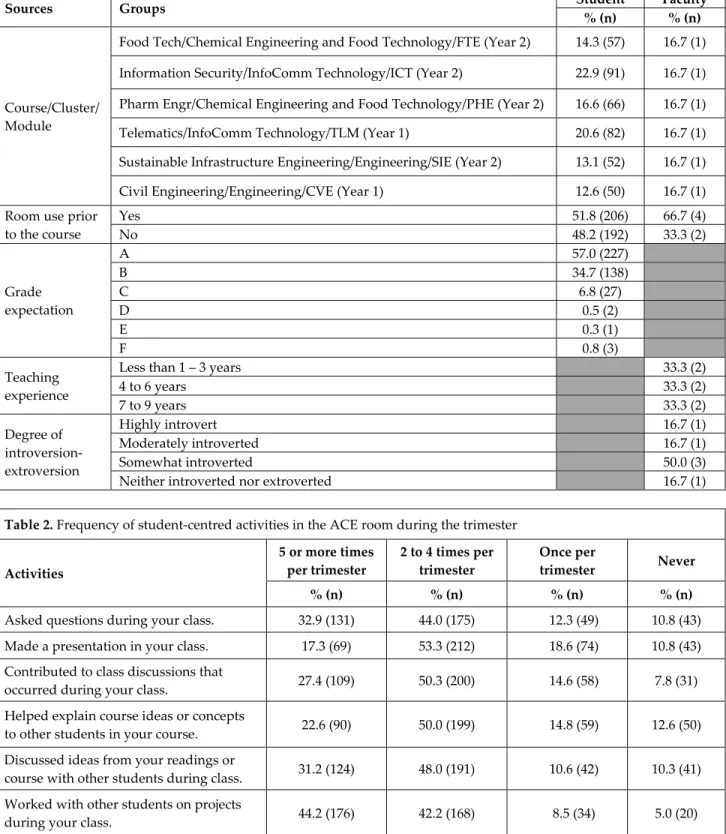
This section focuses on the basic information of our
participants. Table 1 summarises the demographics of the
participants. The students and faculty were from six
different courses, thus, representing the results of their
perceptions and feedback beyond a particular discipline.
Among the participants, 51.8% of the students had
experiences using the active learning classrooms prior to the
current course. The active learning classrooms were novel to
the rest of the students.
As shown in Table 1, the majority of the students (57.0%)
expected to have a grade of A in the courses they were
taking. For the faculty, the percentages of their years of
experience were across all ranges. Interestingly, the majority
of the faculty sees themselves on the introvert spectrum
(83.3%) while only one perceived him/herself to be
extroverted.
In
‐
class
active
learning
activities
that
occurred
during
the
trimester
To give an overview of the type of active learning activities
that occurred in the ACE rooms, the students were asked to
estimate the frequency they engaged in different types of
activity across the 12 weeks of teaching in a trimester. As
shown in Table 2, the majority of the students were engaged
in the in‐class active learning activities at least 2 or more
times in the trimester. An example of such learning activities
is “Discussed ideas from your readings or course with other
students during class.”
Perception
of
how
active
learning
classroom
support
learning
Table 3 shows the perceptions of students and faculty
members (italicised statements) on the extent to which the
ACE rooms supported various aspects of learning (e.g.,
engagement, confidence). For the students, the statements
which garnered the highest average ratings for the students
were: promotes discussion (3.28); helps me develop connections
with my classmates (3.17); and offers a physically comfortable
learning environment (3.13). On the other hand, the statements
which received the lowest average rating were: helps me
develop confidence in writing (2.84); helps me develop professional
skills that can be transferred to the real world (2.91); and makes
me want to attend class regularly (2.94).
Journal of Learning Spaces
Volume 8, Number 2. 2019 ISSN 21586195
Table 1. Participants’ demographics (N = 398, students; 6, faculty members)
Sources Groups Student Faculty
% (n) % (n)
Course/Cluster/
Module
Food Tech/Chemical Engineering and Food Technology/FTE (Year 2) 14.3 (57) 16.7 (1)
Information Security/InfoComm Technology/ICT (Year 2) 22.9 (91) 16.7 (1)
Pharm Engr/Chemical Engineering and Food Technology/PHE (Year 2) 16.6 (66) 16.7 (1)
Telematics/InfoComm Technology/TLM (Year 1) 20.6 (82) 16.7 (1)
Sustainable Infrastructure Engineering/Engineering/SIE (Year 2) 13.1 (52) 16.7 (1)
Civil Engineering/Engineering/CVE (Year 1) 12.6 (50) 16.7 (1)
Room use prior
to the course Yes 51.8 (206) 66.7 (4) No 48.2 (192) 33.3 (2) Grade expectation A 57.0 (227) B 34.7 (138) C 6.8 (27) D 0.5 (2) E 0.3 (1) F 0.8 (3) Teaching experience
Less than 1 – 3 years 33.3 (2)
4 to 6 years 33.3 (2) 7 to 9 years 33.3 (2) Degree of introversion‐ extroversion Highly introvert 16.7 (1) Moderately introverted 16.7 (1) Somewhat introverted 50.0 (3)
Neither introverted nor extroverted 16.7 (1)
Table 2. Frequency of student‐centred activities in the ACE room during the trimester
Activities 5 or more times per trimester 2 to 4 times per trimester Once per trimester Never % (n) % (n) % (n) % (n)
Asked questions during your class. 32.9 (131) 44.0 (175) 12.3 (49) 10.8 (43)
Made a presentation in your class. 17.3 (69) 53.3 (212) 18.6 (74) 10.8 (43)
Contributed to class discussions that
occurred during your class. 27.4 (109) 50.3 (200) 14.6 (58) 7.8 (31)
Helped explain course ideas or concepts
to other students in your course. 22.6 (90) 50.0 (199) 14.8 (59) 12.6 (50)
Discussed ideas from your readings or
course with other students during class. 31.2 (124) 48.0 (191) 10.6 (42) 10.3 (41)
Worked with other students on projects
during your class. 44.2 (176) 42.2 (168) 8.5 (34) 5.0 (20)
As for the faculty, the statements which received the
highest average ratings were: promotes discussion (3.67);
engages my students in the learning process; helps me develop
connections with my students; enriches my learning experience
(all at 3.50); and helps my students develop connections with their
classmates, offers a physically comfortable learning environment,
enables my students) to communicate effectively (all at 3.33).
Meanwhile, statements which received the lowest average
rating were: helps my students develop confidence in writing and
makes my students want to attend class regularly (both at 2.17);
and prepares my students to implement a solution to an issue or
challenge (2.50).
Interestingly, both groups of respondents perceived the
ACE rooms to promote discussion (engagement), offer
physical comfort (environment) while in the learning
environment, and help in the development of connections
(engagement), within their top three. On the other hand, the
development of confidence in writing (confidence) and Table 3. The extent to which the ACE rooms supported various aspects of learning
Factors Statements Student Faculty
M (SD) M (SD)
Confidence
Helps me (my students) develop confidence in working in small groups. 3.11 (.54) 3.33 (.51)
Helps me (my students) develop confidence in analysing. 2.97 (.56) 2.67 (.51)
Helps me (my students) develop confidence in presenting. 2.97 (.57) 3.00 (.00)
Helps me (my students) develop confidence in writing. 2.84 (.60) 2.17 (.41)
Improves my (my students’) confidence that (they) can speak clearly and
effectively.
2.95 (.61) 3.17 (.41)
Engagement
Promotes discussion (among students). 3.28 (.58) 3.67 (.52)
Encourages my (students’) active participation. 3.12 (.56) 3.00 (.63)
Helps me (my students) develop connections with my (their) classmates. 3.17 (.54) 3.33 (.52)
Engages me (my students) in the learning process. 3.08 (.51) 3.50 (.55)
Helps me develop connections with my instructor (student). 2.95 (.63) 3.50 (.55)
Enrichment
Increases my (students’) excitement to learn. 2.99 (.55) 2.83 (.41)
Helps me (my students) develop professional skills that can be transferred to the
real world.
2.91 (.59) 2.83 (.41)
Enriches my learning experience. 3.07 (.52) 3.50 (.55)
Makes me (my students) want to attend class regularly. 2.94 (.59) 2.17 (.41)
Environment Offers a physically comfortable learning environment. 3.13 (.56) 3.33 (.52)
Flexibility Facilitates multiple types of learning activities. 3.12 (.52) 3.17 (.41)
Nurtures a variety of learning styles. 2.97 (.56) 3.00 (.00)
Interaction Enables me (my students) to communicate effectively. 3.12 (.55) 3.33 (.51)
Learning
Enables me (my students) to locate and critically evaluate information. 3.00 (.56) 3.00 (.63)
Helps me (my students) to define issues or challenges and identify possible
solutions.
3.05 (.63) 3.00 (.63)
Prepares me (my students) to implement a solution to an issue or challenge. 2.95 (.55) 2.50 (.55)
Helps me (my students) to examine how others gather and interpret data and
assess the soundness of their conclusions.
3.03 (.59) 2.67 (.52)
Deepens my (my students’) understanding of a specific field of study. 2.97 (.56) 2.83 (.41)
Assists me (my students) in understanding someone elseʹs views by imagining
how an issue looks from his or her perspective.
3.00 (.56) 3.17 (.75)
Helps me (my students) to grow comfortable working with people from other
cultures.
3.03 (.56) 3.17 (.41)
Encourages me (my students) to create or generate new ideas, products, or ways of
understanding.
3.00 (.55) 3.00 (.63)
Prompts me (my students) to incorporate ideas or concepts from different courses
when completing assignments.
3.00 (.55) 2.67 (.82)
Enabled the instructor (me) to make intentional connections between theory and
practice in this course.
3.02 (.56) 3.13 (.66)
EVALUATION OF ENGAGEMENT IN LEARNING WITHIN ACTIVE LEARNING CLASSROOMS
Journal of Learning Spaces, 8(2), 2019.
making students attend class regularly (enrichment) both
fell within the bottom three statements. Noticeably, almost
all the statements under the factor ‘engagement’ received a
high average rating, suggesting that ACE rooms meet the
objective of promoting student engagement through active
learning.
Effective
use
and
room/course
fit
With the intention to collect feedback on the active
learning space, this section gives emphasis to the effective
use and room/course fit of the ACE room. Particularly, the
students and faculty were asked on their perceptions about
the effective use of technology and the appropriateness of
the room to their course. As shown in Table 4, both the
students and the faculty agreed that the ACE room was
appropriate to their particular courses (3.08 and 3.17,
respectively).
The results suggest that in one way or another, the faculty
had been quite effective in using the ACE room’s salient
features in delivering their lessons, although it can be noted
that the student’s average rating still sits relatively in the
middle of the ‘Agree’ range which leaves room for
improvement. Suggestions for improvement are provided in
qualitative feedback that are discussed later. As supported
by the qualitative results which will be discussed later, some
students perceived the ACE rooms to be effective for group
activities but not when they used mainly for didactic
teaching.
First
time
versus
repeated
users’
learning
experience
Lastly, this section examines the difference between first
time versus repeated users’ learning experience in the ACE
rooms. As shown in Table 5, there was no significant
difference (p = 0.74) between the two groups in the extent to
which they perceive the ACE rooms as supporting various
aspects of learning. This was contrary to the hypothesis and
suggested that the students were not rating the experience
positively due to the novelty effect.
Table 4. Student and faculty’s perceptions on the effective use and room/course fit in the ACE room
Factors Statements Student Faculty
M (SD) M (SD)
Effective use
The instructor is effective in using the technology available in the classroom
for instructional purposes.
I was able to effectively to use the technology available in the classroom for
instructional purposes.
3.03 (.63) 2.83 (.75)
Room/course fit This classroom is an appropriate space in which to hold this particular course. 3.08 (.61) 3.17 (.75)
Effective use The instructor is effective in using the classroom for instructional purposes.
I was able to effectively to use the classroom for instructional purposes.
3.07 (.59) 3.17 (.41)
Room/course fit The in‐class exercises for this course are enhanced by the features of this
classroom.
2.98 (.66) 3.17 (.75)
*italicised statements were items in the faculty’s survey
Discussion
Features
of
active
learning
classroom
that
promotes
engagement
within
students
When students and teachers work together for a variety of
educational approaches which uses their intellectual effort,
‘Collaborative learning’ usually comes into mind. Most of
the activities during this partnership focuses on searching
for solutions, meanings, or in creating a product (Smith &
MacGregor, 1992). From the study, both faculty and students
scored higher in items that were related to engagement with
classmates e.g. “promotes discussion”; “helps me develop
connections with my classmates”. This suggests that the ACE
room meets its purpose in encouraging collaborative
learning. The aligned top rated items suggest that students
experienced what the faculty aimed to achieve in the
collaborative learning experience. As Gokhale (1995)
mentioned, in collaborative learning, when a student is
responsible for his or her learning, and thinks of the learning
of others in the group, their learning becomes successful.
A few features of the classroom supported engagement in
collaborative learning. First, cluster seating helps in
promoting interaction among the students. One of the
students reported: “It aids in small group discussions because of
the way the tables are arranged (facing each other) and the
computer screen easy for all to access when we do PowerPoint
presentations together etc. Itʹs also helpful when another group is
presenting from where they are seated and it is easy for us to be
able to view their screen and presentation slides. Classroom is also
just the right size, allowing anybody who projects their voice to be
heard easily.” Second, technology such as a large screen that
enable the group to focus on the same screen, or screen
sharing among groups, enabled ease of communication and
hence enhance collaboration. A student reported: “There is
easy communication within the group during group discussion
where the screen can be shared and displayed within the group.” A
second student also commented “Very helpful for project
discussion where the COW was used to project the work onto the
screen where everyone can discuss on how to improve at the same
time.”
While cluster seating has its advantage in promoting
collaboration, it can worsen the learning experience if the
instructor choses to spend most time in didactic teaching.
When faculty spent a large amount of time lecturing in front,
instead of facilitating active learning activities, a common
weakness of the room was related to students back‐facing
the faculty. Sometimes, instructors are obligated to stay at
the podium area to gain an easy and quick access to class
materials or technologies connected to classroom projection
(Henshaw et al., 2011). Qualitative feedback are as follows:
When the lecturer is explaining things on the white board at the
front, the people back facing the white board have difficulties taking
down notes while looking at the white board. Another student
reported: “During lecture time, students who sit facing the
opposite won’t face the lecturer, thus is less engaged.”
The students also provided feedback that it was “Easy to
lose focus if the lecturer only stays at his table during class”. These
highlights that if faculty spend a large amount of time
remaining in front of the room and present information,
instead of moving around to engage and interact with
students, the cluster seating can serve to be a disadvantage.
These findings support Benoit and Collegeʹs (2017) study,
which states that since some instructors prefer to lecture
more than others, the students are bound to face forward in
order to engage themselves during the lecture.
For faculty who prefers to lecture, or classes that are better
delivered in the form of a lecture, perhaps it should be
highlighted that the ACE room is unconducive for this
purpose, and they are better off in a traditional lecture
theatre designed for students to face the podium.
Table 5. Comparison between first time and repeated users’ learning experience in the ACE room
Extent to wh ic h ACE rooms suppo rted various as p ec ts of learning
Factors Student users
First time (n=192); Repeated (n=206) M (SD) t‐value Sig.
Confidence First time users 2.95 (.45) .43 .51
Repeated users 2.99 (.46)
Engagement First time users 3.12 (.42) .12 .73
Repeated users 3.12 (.42)
Enrichment First time users 2.95 (.44) .31 .58
Repeated users 3.00 (.46)
Environment First time users 3.11 (.58) .06 .80
Repeated users 3.15 (.54)
Flexibility First time users 3.06 (.44) .08 .78
Repeated users 3.03 (.48)
Interaction First time users 3.13 (.57) 1.17 .28
Repeated users 3.12 (.53)
Learning First time users 2.97 (.41) .13 .72
Repeated users 3.04 (.44) Aspects of learning
Overall
First time users 3.01 (.38)
.13 .74
Repeated users 3.05 (.40)
Effective use First time users 3.00 (.55) 1.06 .30
Repeated users 3.10 (.57)
Room/course fit First time users 3.00 (.56) .34 .56
Repeated users 3.07 (.56)
Overall First time users 3.00 (.51) .45 .50
Repeated users 3.08 (.53) α= 0.05
EVALUATION OF ENGAGEMENT IN LEARNING WITHIN ACTIVE LEARNING CLASSROOMS
Journal of Learning Spaces, 8(2), 2019.
It’s
the
choice
of
learning
activities
rather
than
novelty
Contrary to the hypothesis, the student first time users
rated their learning experience very similar to those of
repeated users. In other words, the novelty effect of using
such a room for learning did not result in a difference in their
learning experience as we hypothesised. This emphasized
that it is the choice of learning activities within the space that
shaped their experience rather than the perceived newness
or novelty of the space.
In this study, students who used ACE rooms reported
experiencing collaborative learning activities regularly.
More than 70% of students reported that they explained
course ideas or concepts to other students in the course.
More than 75% of students reported that they contributed to
class discussions that occurred during class and more than
80% students reported working with other students on
projects during class. In addition, as faculty are regularly
engaging the students in collaborative learning activities, the
novelty effect was not a determining factor in their learning
experience and engagement. Umbach and Wawrzynski
(2005) discussed that when a faculty in an institution
engages students both in and out of the classroom, and
enriches their educational experiences, the students felt a
strong sense of support and tend to be active in their
learning. Indeed, faculty behaviours and attitudes play an
important role on student learning and engagement.
Importance
of
Technology
While there was only one item on the survey that
specifically asked about technology, “The instructor is effective
in using the technology available in the classroom for instructional
purposes”, and questions on technology were not specifically
solicited, the researchers were surprised to see that a high
percentage of qualitative feedback were about technology.
Students highlighted how the use of technology such as the
large computer of wheels supported them in their
collaborative experience:
It has the computer on wheels, which allows us to share
information with groupmates on a large screen instead of
crowding over a single computer. (Student’s comment)
When we need to discuss in group and use computer for
research. (Student’s comment)
It is a lot easier for me to share my laptop screen with my
classmates and teacher so everyone is able to participate actively
during the discussion. (Student’s comment)
At the same time, the students also reported struggles
frustration created by technology:
The screens cannot work due to some cable fault. (Student’s
comment)
The professor might be pointing to the screen at the front but it
does not reflect on our interactive screen. (Student’s comment)
This finding highlights that the choice of technology to
support the physical infrastructure is important. While
technology can support learning, when they fail, they can
frustrate both students and faculty, especially when the
learning activities are planned around using the technology.
It is important to maintain the technology regularly. In
addition, equipping the faculty with the skills to use the
technological tools is also instrumental. In order for faculty
to implement the technological tools, the end user needs to
know how the technology works and how it can be used— hence the importance for faculty training and development.
In a different study, it was also indicated that when given
enough guidance, examples, and remedial support, the
faculty would eventually adapt to the technological tools
(Keengwe, Kidd, & Kyei‐Blankson, 2009).
Recommendations
First, in encouraging a more common usage of active
learning classrooms, it is important to communicate the
study results to the wider community on what students
found useful to their learning and the challenges they faced
when the unsuitable teaching methods such as conducting
long lectures in such environments occur. It should be
underscored that it is not the novelty effect that results to a
positive experience, rather, it’s the importance of designing
active learning activities that can be optimized in such
learning environments. The use of change management
principles and ensuring regular communication is key to
transforming culture (Hayes, 2010) and this can apply to
changing traditional teaching practice too. Second, in terms
of technology, there is a need to closely monitor the users’
experience and maintain technology in these classrooms. For
example, while the individual table microphones were
available in some rooms, there were hardly any mention of
them used. Faculty may not be aware of them or the way to
encourage students to use them. A simple suggestion such
as the use of a digital pointer instead of the laser pointer on
the main screen can also improve students’ learning
experience especially those back‐facing faculty. Another
suggestion could be the use of visualizer (document camera)
instead of white board when writing and explaining the
material. Recommendations in the form of visual aids or user
guides of what students find helpful can be placed in the
room as a simple reminder. Third, while Asian students are
often perceived as reserved and less interactive in
classrooms (Biggs, 1991), the study suggests that students
also enjoyed active learning in the classroom, especially
interacting and learning from peers. Therefore, there should
be more promotion of such active learning space in Asia to
encourage discussions and debates among students.
Limitations
There are several limitations in the study. The sample size
of the faculty is small and therefore statistically, it is not
possible to understand whether faculty’s introversion affects
the extent they use active learning activities and interact
with students. The difference between the faculty first time
and repeated users was not determined due to the same
reason. Second, the sample of students who used the rooms
did not include Year 3 and 4 students. This may limit the
generalization of the findings to students in the senior years.
However, the use of large screens and seating
arrangements that promote interaction are common among
active learning classrooms in many higher institutions,
therefore, findings regarding first time versus repeated user
as well as feedback relating to common features of active
learning classrooms that promotes engagement can be
applied to other institutions.
Future
research
directions
While the study reported that most students have active
engagement in class, we have not examined the effect of this
to their learning outcomes. For future research directions, an
experimental design of comparing the learning outcomes of
students who were engaged in the ACE room versus a
traditional classroom can be helpful, particulary comparing
on outcomes such as critical thinking and communication
which are promoted through peer engagement. A focus
group or interview with faculty who used the room can also
provide more insights on the reasons why they practiced in
certain ways. This can help gather recommendation to train
other faculty or improve gaps in the room learning
environment.
Conclusion
One of the students’ comments nicely conclude the
reseachers’ perspective: “Good if class requires group work but
bad for lectures”. It is important for active learning classrooms
to be used for the purpose they were designed for. This
emphasizes the importance of faculty training and
development, both in the design of active, collaborative
learning activities as well as effective use of technology, and
faculty‐driven activities to enhance learning. Merely
creating space without supporting faculty to use them can
be problematic. It is also encouraging to know that it is not
the novelty effect that resulted in positive experiences,
highlighting that repeated users of such learning
environments can still experience positive learning
engagement in active learning classrooms. This evaluation
study helps identify strengths of the room that should be
communicated to other faculty to encourage the use of ALC
and gaps that can be addressed by the university to further
enhance students’ learning experience.
Acknowledgement
The researchers would like to thank the students and
faculty who took time to accomplish the questionnaires. We
would also like to thank Associate Prof. Foo Yong Lim for
his invaluable support to this study; Mr. Lim Li Siong, for
proofreading this article; and to the Estates and CIT
divisions for ensuring full functionality of the ACE rooms.
References
Appleton, J. J., Christenson, S. L., Kim, D., & Reschly, A. L.
(2006). Measuring cognitive and psychological
engagement: Validation of the student engagement
instrument. Journal of School Psychology, 44, 427 – 445.
https://doi.org/10.1016/j.jsp.2006.04.002
Beery, T. A., Shell, D., Gillespie, G., & Werdman, E. (2013).
The impact of learning space on teaching behaviors.
Nurse Education in Practice, 13(5), 382–387.
https://doi.org/10.1016/j.nepr.2012.11.001
Benoit, A., & College, L. (2017). Monitoring Implementation
of Active Learning Classrooms at Lethbridge. Journal of
Learning Spaces, 6(1), 2014–2015.
Biggs, J. B. (1991). Approaches to Learning in Secondary
and Tertiary Students in Hong Kong: Some Comparative
Studies. Educational Research Journal, 6, 27–39.
Bines, J. E., & Jamieson, P. (2013). Experiences from a
children’s hospital in Australia, 1820, 63–68.
https://doi.org/10.3109/13561820.2013.795933
Brown, M., Cevetello, J., Dugdale, S., Finkelstein, A.,
Holeton, R., Long, P., Meyers, C. (2017). Learning Space
Rating System, version 2. Retrieved from
https://www.educause.edu/~/media/files/educause/eli/ini
tiatives/lsrsv2.pdf?la=en
Christenson, S. L., & Thurlow, M. L. (2004). School
EVALUATION OF ENGAGEMENT IN LEARNING WITHIN ACTIVE LEARNING CLASSROOMS
Journal of Learning Spaces, 8(2), 2019.
Challenges. Current Directions in Psychological Science, 13(1), 36–39. https://doi.org/10.1111/j.0963‐
7214.2004.01301010.x
Dori, Y. J., & Belcher, J. (2005). How does technology‐
enabled active understanding of electromagnetism
concepts? Journal of Learning Science, 14(2), 243–279.
https://doi.org/10.1207/s15327809jls1402_3
Freeman, S., Eddy, S. L., McDonough, M., Smith, M. K.,
Okoroafor, N., Jordt, H., & Wenderoth, M. P. (2014).
Active learning increases student performance in science,
engineering, and mathematics. Proceedings of the National
Academy of Sciences, 111(23), 8410–8415.
https://doi.org/10.1073/pnas.1319030111
Gokhale, A.A., (1995). Collaborative Learning Enhances
Critical thinking. Journal of Technology Education, 7(1), 22–
30.https://doi.org/10.21061/jte.v7i1.a.2
Hayes, J. (2010). The Theory and Practice of Change
Management (3rd ed.), London: Macmillian.
Henshaw, R. G., Edwards, P. M., & Bagley, E. J. (2011). Use
of Swivel Desks and Aisle Space to Promote Interaction
in Mid‐sized College Classrooms. Journal of Learning
Spaces, 1(1). Retrieved from
http://libjournal.uncg.edu/ojs/index.php/jls/article/view/2
77/170
Horne, S. Van, Murniati, C., Gaffney, J. D. H., & Jesse, M.
(2012). Promoting Active Learning in Technology‐
Infused TILE Classrooms at the University of Iowa TILE
Classrooms at the University of Iowa, 1(2).
Keengwe, J., Kidd, T., & Kyei‐Blankson, L. (2009). Faculty
and technology: Implications for faculty training and
technology leadership. Journal of Science Education and
Technology, 18(1), 23–28. https://doi.org/10.1007/s10956‐
008‐9126‐2
Koch, M., Luck, K.V., Schwarzer, J., & Draheim, S. (2018).
The Novelty Effect in Large Display Deployments ‐
Experiences and Lessons‐Learned for Evaluating
Prototypes. ECSCW Exploratory Papers. https://doi:
10.18420/ecscw2018_3
Neill, S., & Etheridge, R. (2008). Flexible Learning Spaces:
The Integration of Pedagogy, Physical Design, and
Instructional Technology. Marketing Education Review, 18(1), 47–53.
https://doi.org/10.1080/10528008.2008.11489024
Oblinger, D., & Lippincott, J. K. (2006). Learning spaces.
Boulder, Colorado: EDUCAUSE.
Parsons, C. S. (2016). ʺ Space and Consequencesʺ: The
Influence of the Roundtable Classroom Design on
Student Dialogue. Journal of Learning Spaces, 5(2), 15‐25.
Smith, B.L., & MacGregor, J.T. (1992). What is Collaborative
Learning? In M. Maher A.M. Goodsell and V. Tinto,
editors, Collaborative Learning: A Sourcebook For
Higher Education, 10–30. National Center on
Postsecondary Teaching, Learning and Assessment.
STSS Research Project Faculty Survey, Office of Information
Technology, University of Minnesota (2012). Retrieved
from https://sites.google.com/a/umn.edu/learning‐
spaces‐research/home/instruments
Umbach, P. D., & Wawrzynski, M. R. (2005). Faculty do
matter: The role of college faculty in student learning and
engagement. Research in Higher Education, 46(2), 153‐184.
Walker, J. D., & Baepler, P. (2017). Measuring Social
Relations in New Classroom Spaces: Development and
Validation of the Social Context and Learning
Environments (SCALE) Survey. Journal of Learning Spaces, 6(3), 34–41.
Yang, Z., Becerik‐Gerber, B., & Mino, L. (2013). A study on
student perceptions of higher education classrooms:
Impact of classroom attributes on student satisfaction
and performance. Building and Environment, 70, 171–188.
https://doi.org/10.1016/j.buildenv.2013.08.030