Evaluation of Palm Kernel Shell Concrete Strength for Various
Mixes and Water/Cement Ratios using Non Destructive (UPV)
Method
I.T. Yusuf and Y.A. JimohDepartment of Civil Engineering, University of Ilorin, Ilorin, Nigeria
Abstract
Ultrasonic Pulse Velocity (UPV) measurement is one of the most popular non-destructive techniques used in the indirect assessment of mechanical properties of concrete. This paper investigates the compressive strength-UPV relationship of palm kernel shell concrete (PKSC) to develop strength based quality assurance model for construction of vegetative lightweight concrete pavement. A total of 420 cubes (150mm) and 28 PKSC slabs were casted for nominal mixes of 1:1:1, 1:1:2, 1:11/2:3 and 1:2:4 and varying water/cement (w/c) ratios of 0.3-0.7. The PKSC elements were cured in water at laboratory temperature for 3, 7, 14, 21, 28, 56 and 91 days, and then subjected to nondestructive testing using the Pundit apparatus for determination of the respective ultrasonic wave velocity and elastic modulus at the various ages. The unconfined compressive strength of the PKSC was determined after the pulse velocity to establish a velocity-strength data set, which was employed for the development of statistical model. Results show that the UPV and the compressive strength of PKSC increased with age but decreased with increase in w/c ratio and mixes. The strength-UPV models developed for all mixes were in the form of logarithm equation, at R2 values between 94.9 – 99.3 %. The application of the developed model as rigid pavement maintenance/deterioration planning and design was demonstrated in the paper.
Keywords: Compressive strength, Palm kernel shell concrete, Nondestructive technique, Rigid pavement maintenance, Ultrasonic pulse velocity.
1. Introduction
Traditionally, quality assurance of concrete construction and condition assessment for structural adequacy have been performed largely by visual inspection of the construction process and sampling by coring the concrete for performing standard tests on fresh and hardened specimens. This approach does not provide data on the in-place properties of concrete. NDT methods offer the advantage of providing information on the in-place properties of hardened concrete, such as the elastic constants, density, resistivity, moisture content, and hardness characteristics. Coring to examine internal concrete conditions and obtain specimens for testing is a sort of introduction of weak spots to the whole structure. This approach limits what can be detected, while the cores only provide information at the core location and coreholes needed to be repaired. The assessment of in situ compression strength of a rigid pavement structure plays a key role in the evaluation of its safety, feasibility in terms of strength at the time of production and the knowledge of the main physical properties of the concrete and its state. Maintenance of rigid pavements is more effective if the deterioration rate of the strength could be monitored as the pavement is being affected by traffic and weather conditions.
Nondestructive test (NDT) methods are used to determine the properties of hardened concrete as well as to indirectly evaluate the condition of concrete in deep foundations, bridges, buildings, pavements, dams and other concrete construction without direct loading, access or testing that causes no structurally significant damage to the concrete element. Nondestructive test methods are significant in concrete construction for mechanical (strength) and other attributes to address (i) quality control of new construction; (ii) troubleshooting of problems with new construction; (iii) condition evaluation of older concrete for rehabilitation purposes; (iv) quality assurance of concrete repairs and (v) detection of flaws or discontinuities [1]. Thus, the various NDT methods can be divided into two groups: (1) those whose main purpose is to estimate strength; and (2) those whose main purpose is to evaluate conditions other than strength, integrity evaluation. It is clear that the most reliable tests for strength are those that result in superficial local damage, and the term in-place testsare preferred for this group. The integrity tests, on the other hand, are nondestructive, which had been mostly based on visual inspections. However, modern day analysis and design of pavement desires that elastic properties of material be accurately determined (evaluated).
of crack depth, it is ineffective if the crack is water filled. The performance is also often poor in very rough surfaces. Sometimes good contact requires the use of a coupling gel between the transducers and the structure. This may be aesthetically unacceptable on some structures. The leading portable UPV test instrument is the Pundit Ultrasonic Testing Machine, which is used to transmit an irrational pulse to travel through a known distance in concrete. The generated ultrasonic pulse velocity (UPV) is correlated with prevailing compressive strength or other properties for in-situ and timely decision making in material quality/integrity evaluation. Pulse velocity is influenced by many variables such as mix proportions, aggregate type, age of concrete, moisture content, and other factors [2], which might make strength estimation with the pulse velocity suspect and inaccurate. Therefore, for the UPV-strength relations derived for structures to be reliable, at any time during its service period, the risk level involved must be defined quantitatively.
Some previous studies have concluded that, for concrete with a particular mix proportion, there is a good correlation between UPV and the compressive strength [3] and [4] but no clear rules or explicit quantification on the effect of mix proportions on lightweight concrete or rigid pavement in particular.
Palm kernel shell (PKS) concrete, is an emerging vegetative lightweight concrete derived from recycling the biomass waste for pavement. The palm kernel shells were used as substitutes for natural/traditional coarse aggregates in rigid pavement construction to provide protection for the environment by conserving natural resources and the lands for mining and for landfills, will provide a new source of aggregate, thus extending the life of sand and gravel mines, extending the life of the regional landfill, and eliminating costs for processing the road waste materials at the landfill. Benefits include economic development opportunities and reduced pollution hazards, thus protecting human health [5].
It has been established that adopting lightweight concrete is quite feasible at certain desirable nominal mixes and water/cement ratios. Thus, this paper tries to adopt different mix proportions and water/cement ratios of PKS concrete as a medium to investigate the relationship between UPV and the compressive strength of hardened PKS concrete, and for eventual adoption of the model for lightweight rigid pavement maintenance planning and design at service.
This paper is aimed at indirectly determining in-situ, the mechanical properties of a PKS concrete through the direct characterization of a physical property at various mixes and water/cement ratios of hardened palm kernel shell concrete elements as a rigid pavement. The specific objectives, therefore, are to:
(a) determine the Ultrasonic Pulse Velocity (UPV) of hardened PKS concrete cubes and slabs at varying nominal mixes and curing ages using the Pundit Apparatus,
(b) determine the compressive strengths of the same PKS concrete specimens as used in (a),
(c) develop the trend of the characteristic compressive strength with respect to the UPV of the PKS concrete at various ages and mixes,
(d) develop the statistical relationship between the Ultrasonic Pulse Velocity (UPV) and compressive strength of PKS concrete, and hence the strength deterioration model as rigid pavement maintenance parameter.
2. Materials and Methods
Palm kernel shells, acquired from wastes of small scale palm oil milling centres were washed, dried and evaluated for suitability as coarse aggregate for production of nominal concrete mixes of 1:1:1, 1: 1: 2, 1:1½:3 and 1: 2: 4 for water/cement ratios of 0.3, 0.4, 0.5, 0.6 and 0.7. A total number of 420 cubes were produced and batched, cured and tested for compressive strength at 3, 7, 14, 21, 28, 56 and 91 days. Prior to crushing, the PKS concrete cubes were subjected to NDT with the Pundit Apparatus (Model PC 1006) [6] to determine respective transit time, velocity of the pulse and elastic modulus in accordance with the specification of the British standard (BS EN 12504-4, 2004) [7].
Various forms of the UPV-compressive strength relationship of hardened PKS concrete were proposed for the concrete cubes, while the indirect derivation of the flexural strength of the slab was also accomplished using Microsoft Excel Software. The curve relationships between ultrasonic pulse velocity and compressive strength drawn for PKS concrete with the corresponding w/c ratios were plotted with linear, powe, logarithm and polynomial trend lines. The logarithm and polynomial trend lines show stronger correlations, but the later was too exaggerative. The logarithm trend line, with R2 in the range 0.949 – 0.993, was hence chosen for the relationships. The quality of PKS concrete in terms of uniformity and integrity was also assessed using the IS Code, BS, 1881, 1983 standard [8].
Table 1: Suggested Quality Criteria for Concrete
Pulse Velocity (km/sec) Concrete Quality (Grading)
Above 4.0 Very Good
3.5 to 4.0 Good
3.0 to 3.5 Medium
Below 3.0 Poor
Source: IS Code, BS, 1881, 1983
3. Results and Analysis
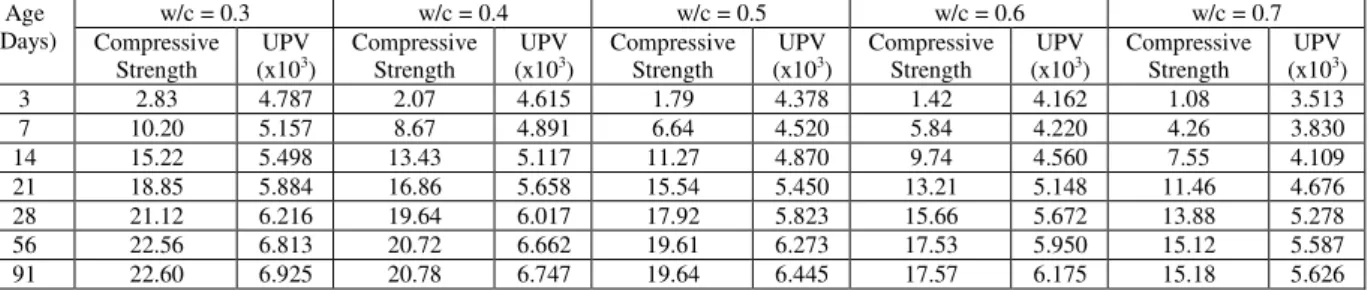
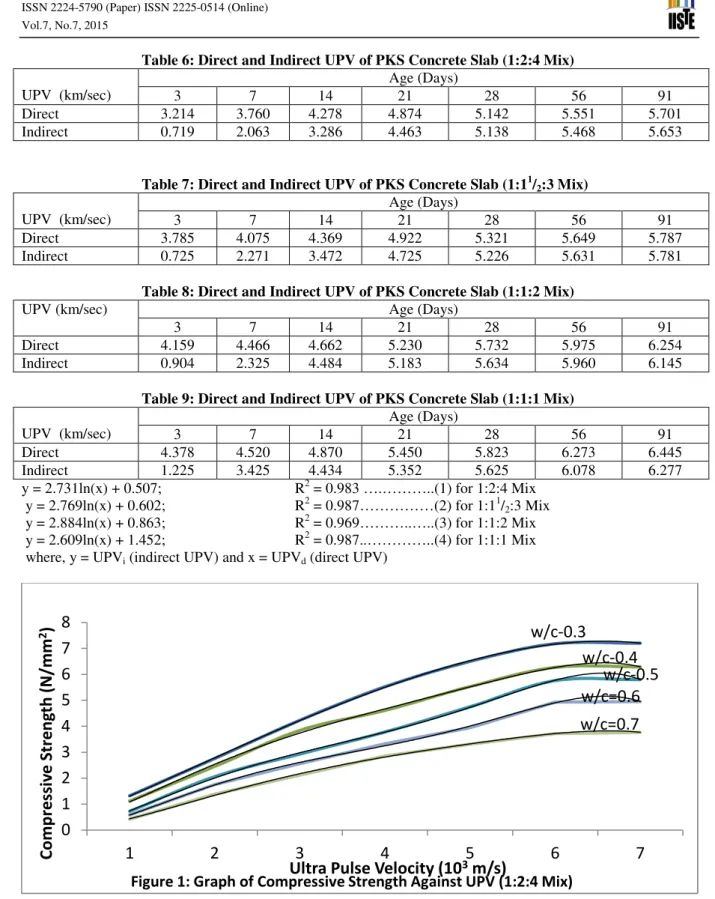
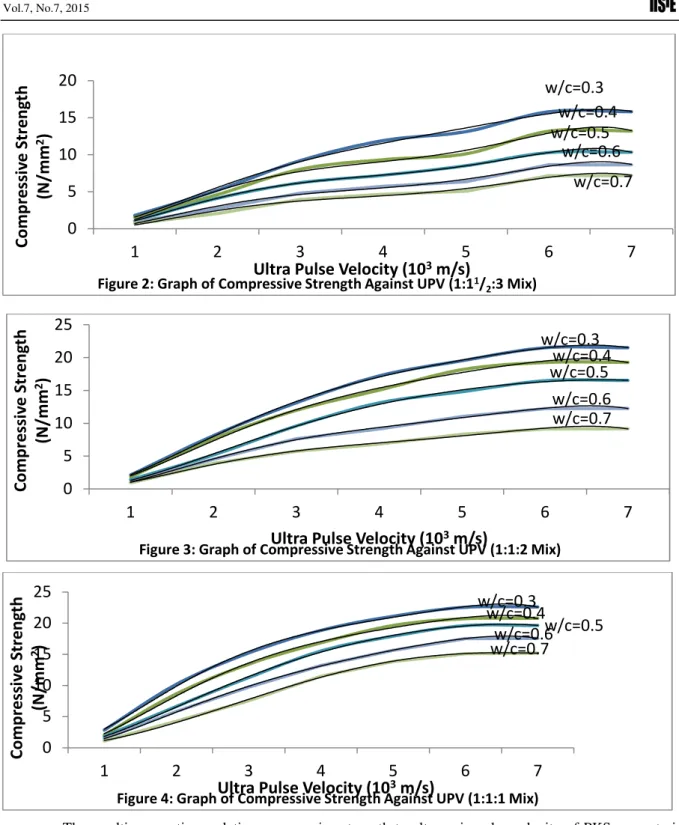
The statistical analysis results of the UPV and compressive strength tests are presented in Tables 2 – 5 and Figs. 1- 4. The results of the direct UPV (cube reading) and indirect UPV (slab reading) at w/c ratio of 0.5 for the considered nominal mixes are shown in Tables 6 – 9. (1) - (4) show the resulting equations relating direct UPV and indirect UPV of PKS concrete slab.
Table 2: Compressive Strength (N/mm2) versus Ultrasonic Pulse Velocity (m/s) of PKS Concrete (1:2:4 Mix Ratio) Age (Days) w/c = 0.3 w/c = 0.4 w/c = 0.5 w/c = 0.6 w/c = 0.7 Compressive Strength UPV
(x103) Compressive Strength (x10UPV 3) Compressive Strength (x10UPV 3) Compressive Strength (x10UPV 3) Compressive Strength (x10UPV 3)
3 1.32 4.211 1.12 3.723 0.72 3.214 0.58 2.986 0.42 2.157 7 2.76 4.630 2.45 4.386 2.06 3.760 1.75 3.233 1.38 2.464 14 4.23 5.036 3.84 4.700 2.93 4.278 2.56 3.852 2.12 3.085 21 5.52 5.542 4.61 5.286 3.78 4.874 3.32 4.292 2.85 3.612 28 6.50 5.731 5.53 5.498 4.75 5.142 3.95 4.639 3.31 3.936 56 7.18 6.268 6.27 5.889 5.76 5.551 4.93 4.962 3.72 4.395 91 7.20 6.324 6.29 6.008 5.80 5.701 4.95 5.089 3.77 4.412
Table 3: Compressive Strength (N/mm2) versus Ultrasonic Pulse Velocity (m/s) of PKS Concrete (1:11/2:3 Mix Ratio) Age (Days) w/c = 0.3 w/c = 0.4 w/c = 0.5 w/c = 0.6 w/c = 0.7 Compressive Strength UPV (x103) Compressive Strength UPV (x103) Compressive Strength UPV (x103) Compressive Strength UPV (x103) Compressive Strength UPV (x103) 3 1.80 4.407 1.52 4.054 1.08 3.785 0.89 3.314 0.71 2.657 7 5.20 4.761 4.61 4.451 4.12 4.075 2.75 3.890 2.07 3.270 14 9.21 4.978 8.04 4.777 6.21 4.369 4.81 4.139 3.96 3.642 21 11.91 5.638 9.33 5.392 7.23 4.922 5.72 4.411 4.66 4.147 28 13.12 5.828 10.12 5.686 8.52 5.321 6.37 5.046 5.06 4.302 56 15.80 6.560 13.18 6.163 10.29 5.649 8.63 5.383 7.15 4.838 91 15.81 6.465 13.20 6.275 10.33 5.787 8.65 5.492 7.18 5.056
Table 4: Compressive Strength (N/mm2) versus Ultrasonic Pulse Velocity (m/s) of PKS Concrete (1:1:2 Mix Ratio) Age (Days) w/c = 0.3 w/c = 0.4 w/c = 0.5 w/c = 0.6 w/c = 0.7 Compressive Strength UPV (x103) Compressive Strength UPV (x103) Compressive Strength UPV (x103) Compressive Strength UPV (x103) Compressive Strength UPV (x103) 3 2.13 4.516 1.82 4.328 1.41 4.159 1.06 3.675 0.93 3.247 7 8.12 5.059 7.63 4.658 5.18 4.466 4.53 4.042 3.89 3.551 14 13.13 5.333 11.98 4.986 9.58 4.662 7.64 4.322 5.75 3.974 21 17.21 5.744 15.05 5.502 13.10 5.230 9.15 4.722 6.83 4.347 28 19.52 6.045 18.16 5.886 14.80 5.732 11.02 5.441 8.32 4.902 56 21.49 6.685 19.25 6.450 16.47 5.975 12.22 5.699 9.13 5.288 91 21.50 6.793 19.27 6.584 16.51 6.254 12.25 5.806 9.16 5.435
Table 5: Compressive Strength (N/mm2) versus Ultrasonic Pulse Velocity (m/s) of PKS Concrete (1:1:1 Mix Ratio) Age (Days) w/c = 0.3 w/c = 0.4 w/c = 0.5 w/c = 0.6 w/c = 0.7 Compressive Strength UPV (x103) Compressive Strength UPV (x103) Compressive Strength UPV (x103) Compressive Strength UPV (x103) Compressive Strength UPV (x103) 3 2.83 4.787 2.07 4.615 1.79 4.378 1.42 4.162 1.08 3.513 7 10.20 5.157 8.67 4.891 6.64 4.520 5.84 4.220 4.26 3.830
Table 6: Direct and Indirect UPV of PKS Concrete Slab (1:2:4 Mix) UPV (km/sec) Age (Days) 3 7 14 21 28 56 91 Direct 3.214 3.760 4.278 4.874 5.142 5.551 5.701 Indirect 0.719 2.063 3.286 4.463 5.138 5.468 5.653
Table 7: Direct and Indirect UPV of PKS Concrete Slab (1:11/2:3 Mix)
UPV (km/sec)
Age (Days)
3 7 14 21 28 56 91
Direct 3.785 4.075 4.369 4.922 5.321 5.649 5.787
Indirect 0.725 2.271 3.472 4.725 5.226 5.631 5.781
Table 8: Direct and Indirect UPV of PKS Concrete Slab (1:1:2 Mix)
UPV (km/sec) Age (Days)
3 7 14 21 28 56 91
Direct 4.159 4.466 4.662 5.230 5.732 5.975 6.254
Indirect 0.904 2.325 4.484 5.183 5.634 5.960 6.145
Table 9: Direct and Indirect UPV of PKS Concrete Slab (1:1:1 Mix)
UPV (km/sec) Age (Days) 3 7 14 21 28 56 91 Direct 4.378 4.520 4.870 5.450 5.823 6.273 6.445 Indirect 1.225 3.425 4.434 5.352 5.625 6.078 6.277 y = 2.731ln(x) + 0.507; R2 = 0.983 ….………..(1) for 1:2:4 Mix y = 2.769ln(x) + 0.602; R2 = 0.987………(2) for 1:11/2:3 Mix y = 2.884ln(x) + 0.863; R2 = 0.969………..…..(3) for 1:1:2 Mix y = 2.609ln(x) + 1.452; R2 = 0.987..…………..(4) for 1:1:1 Mix where, y = UPVi (indirect UPV) and x = UPVd (direct UPV)
0
1
2
3
4
5
6
7
8
1
2
3
4
5
6
7
C
o
m
p
re
ss
iv
e
S
tr
e
n
g
th
(
N
/m
m
2)
Ultra Pulse Velocity (10
3m/s)
Figure 1: Graph of Compressive Strength Against UPV (1:2:4 Mix)
w/c-0.3
w/c-0.4
w/c-0.5
w/c=0.6
w/c=0.7
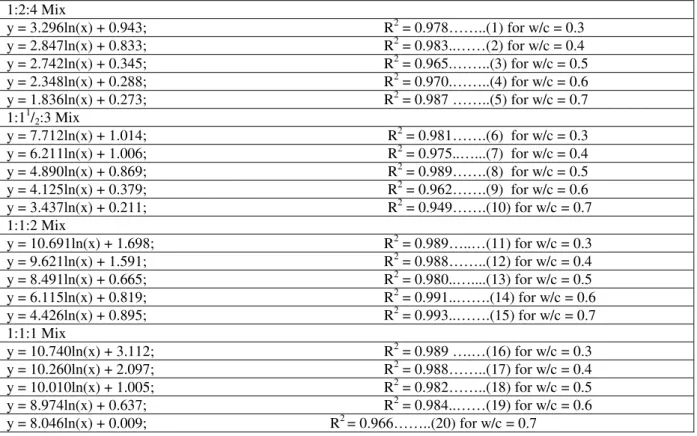
The resulting equations relating compressive strength to ultrasonic pulse velocity of PKS concrete is shown in Table 10.
0
5
10
15
20
1
2
3
4
5
6
7
C
o
m
p
re
ss
iv
e
S
tr
e
n
g
th
(N
/m
m
2)
Ultra Pulse Velocity (10
3m/s)
Figure 2: Graph of Compressive Strength Against UPV (1:11/
2:3 Mix)
w/c=0.3
w/c=0.4
w/c=0.5
w/c=0.6
w/c=0.7
0
5
10
15
20
25
1
2
3
4
5
6
7
C
o
m
p
re
ss
iv
e
S
tr
e
n
g
th
(N
/m
m
2)
Ultra Pulse Velocity (10
3m/s)
Figure 3: Graph of Compressive Strength Against UPV (1:1:2 Mix)
w/c=0.3
w/c=0.4
w/c=0.5
w/c=0.6
w/c=0.7
0
5
10
15
20
25
1
2
3
4
5
6
7
C
o
m
p
re
ss
iv
e
S
tr
e
n
g
th
(N
/m
m
2)
Ultra Pulse Velocity (10
3m/s)
Figure 4: Graph of Compressive Strength Against UPV (1:1:1 Mix)
w/c=0.3
w/c=0.4
w/c=0.5
w/c=0.6
Table 10: Equations Relating Compressive Strength, y (N/mm2) and UPV, x (km/s) of PKSC 1:2:4 Mix y = 3.296ln(x) + 0.943; R2 = 0.978……..(1) for w/c = 0.3 y = 2.847ln(x) + 0.833; R2 = 0.983..……(2) for w/c = 0.4 y = 2.742ln(x) + 0.345; R2 = 0.965.……..(3) for w/c = 0.5 y = 2.348ln(x) + 0.288; R2 = 0.970.……..(4) for w/c = 0.6 y = 1.836ln(x) + 0.273; R2 = 0.987 ……..(5) for w/c = 0.7 1:11/2:3 Mix y = 7.712ln(x) + 1.014; R2 = 0.981…….(6) for w/c = 0.3 y = 6.211ln(x) + 1.006; R2 = 0.975..…...(7) for w/c = 0.4 y = 4.890ln(x) + 0.869; R2 = 0.989…….(8) for w/c = 0.5 y = 4.125ln(x) + 0.379; R2 = 0.962…….(9) for w/c = 0.6 y = 3.437ln(x) + 0.211; R2 = 0.949…….(10) for w/c = 0.7 1:1:2 Mix y = 10.691ln(x) + 1.698; R2 = 0.989…..…(11) for w/c = 0.3 y = 9.621ln(x) + 1.591; R2 = 0.988……..(12) for w/c = 0.4 y = 8.491ln(x) + 0.665; R2 = 0.980..…....(13) for w/c = 0.5 y = 6.115ln(x) + 0.819; R2 = 0.991..…….(14) for w/c = 0.6 y = 4.426ln(x) + 0.895; R2 = 0.993..…….(15) for w/c = 0.7 1:1:1 Mix y = 10.740ln(x) + 3.112; R2 = 0.989 ….…(16) for w/c = 0.3 y = 10.260ln(x) + 2.097; R2 = 0.988……..(17) for w/c = 0.4 y = 10.010ln(x) + 1.005; R2 = 0.982……..(18) for w/c = 0.5 y = 8.974ln(x) + 0.637; R2 = 0.984..……(19) for w/c = 0.6 y = 8.046ln(x) + 0.009; R2 = 0.966……..(20) for w/c = 0.7 4. Discussion of Results
The Ultrasonic Pulse Velocity (UPV) is the measure of the quality of concrete. The UPV values of the PKS concrete for all w/c ratios, ages and mix proportions fall within 2.0 and 7.0 km/sec. Compared with UPV values in Table 1, PKS concrete produced for all the mix proportions and w/c ratios of 0.3, 0.4 and 0.5 are good while the ones for w/c ratio of 0.6 and 0.7 are fairly good only. This implies that PKSC at lower w/c ratios have high workability.
Tables 2 - 5 show the compressive strength versus ultrasonic pulse velocity of PKS concrete for the nominal mixes and water/cement ratios. Results show that compressive strength and UPV increase with advancement of age but decrease with increase in water/cement ratio. At the same age, both UPV and compressive strength of PKS concrete with low w/c ratio are higher than those with high w/c ratio mainly because of the denser structure of concrete with lower w/c ratio. Also, for all the nominal mixes, the PKS concrete with high w/c ratio (w/c = 0.7) at the age of 7 days have UPV values of between 70 and 75% of that of 28 days, but the corresponding compressive strengths are between 50 and 55%. Similarly, at the age of 7 days, PKS concrete with low w/c ratios (w/c = 0.3) have UPV values that fall in the range 80-85% of that at 28 days while the corresponding compressive strengths are in the range 55-60%. These imply that, the UPV and compressive strength growth rates of high and low w/c ratio concrete are significantly different at an early age. As a result, the relationship between UPV and compressive strength of PKS concrete becomes unclear when age and mix proportion are taken into consideration simultaneously. This observation suggests that it is better to separately consider the effect of age and mix proportion on UPV and compressive strength relationship.
The curves of the relationship between ultrasonic pulse velocity and compressive strength drawn for PKS concrete with the corresponding w/c ratios yielded the equations 1 – 20 presented in Table 6. For the five w/c ratios, the relationship between UPV and compressive strength of PKS concrete is good for the mix proportions with a very high coefficient of correlation, R2 in the range 0.949 – 0.993. This indicates relevance between data points and the regression curves.
5. Conclusions
This paper investigated the relationship between the Ultrasonic Pulse Velocity (UPV) and compressive strength of PKS concrete as well as the influence of the mix proportions, water/cement ratios and the age of concrete on the relationship between UPV and compressive strength. Based on the studies, the following conclusions are drawn:
(a) The PKS concrete produced are either good of fairly good.
(b) The compressive strength and UPV increase with advancement of age but decrease with increase in water/cement ratio.
(c) Both UPV and compressive strength of PKS concrete with low w/c ratio are higher than those with high w/c ratio at the same age mainly because of the denser structure of concrete with lower w/c ratio.
(d) The equations obtained from the simulation curves can be used to determine the compressive strengths of the concrete mix proportions.
(e) There is a unique relationship between compressive strength and UPV logarithm model of the form α1ln(x) + c, that can be used to describe the strength of PKSC at R2 values of 94.9 – 99.3 %, indicating relevance between data points and the regression curves.
(f) When the developed equations are used for concrete mixes with same concrete grades and w/c ratios but different materials from different projects, the predicted compressive strength of concrete will show more variation from the actual strength of the specimens.
6. Recommendations
(i) The recycle of PKS biomass waste material from palm oil farming helps preserve natural resources as a sustainable material and maintains ecological balances, and must be encouraged in order to effectively address the environmental pollution caused by indiscriminate dumping of PKS.
(ii) It is very difficult to monitor accurately using destructive approaches, especially when functionality is still desired. Thus, NDT characterization and effective pavement maintenance, which deserves the establishment of strength deterioration properties of the pavement layers as being transferred from repeated traffic loads.
(iii) The direct UPV-indirect UPV relationship determined can be used for rigid pavement assessment/ maintenance purpose.
(iv) The actual property of concrete being displayed is the flexural strength for bending influence from traffic which necessitates the development of the compressive strength – UPV model combined with the indirect UPV –direct UPV models to be used in obtaining the prevailing flexural strength of a rigid pavement slab.
(v) For further studies, the effect of changes in the volume fraction of cement paste, the source of PKS coarse aggregate (hinterland and coastal), the weather combined with traffic, the UPV-strength relationship should be examined for development of fatigue and other performance-based characteristics of PKS concrete pavement.
(vi) The cost effective analysis of recycling biomass for pavement rehabilitation should be further explored in order to demonstrate the economic viability, energy conservation, efficiency in transportation facility in poor soil conditions and protection of the environment from health hazard.
7. Acknowledgements
This paper cannot be put together without the tremendous background information made available by various research workers, authors of excellent books and articles which have been referred to and listed in my references. I thank them.
References
[1] H.N. Tomsett, The Practical Use of Ultrasonic Pulse Velocity Measurements in the Assessment of Concrete Quality, Magazine of Concrete Research, 32 (110), 1980, 7-16.
[2] Y. Lin, C.P. Lai and T. Yen, Prediction of Ultrasonic Pulse Velocity (UPV) in Concrete, ACI Materials Journal, 100 (1), 2003, 21-28.
[3] I. Lawson, K.A. Danso, H.C. Odoi, C.A. Adjei, F.K. Quashie, I.I. Mumuni and I.S. Ibrahim, “Non-Destructive Evaluation of Concrete using Ultrasonic Pulse Velocity, Research Journal of Applied Sciences, Engineering and Technology, 3(6), 2011, 499-504, ISSN: 2040-7467
[4] N.V. Mahure, G.K. Vijh, P. Sharma, N. Sivakumar and M. Ratnam, Correlation between Pulse Velocity and Compressive Strength of Concrete, International Journal of Earth Sciences and Engineering ISSN 0974-5904, 04 (06), 2011, 871-874
[5] I.T. Yusuf, and Y.A. Jimoh, The Transfer Models of Compressive to Tensile, Flexural and Elastic Properties of Palm Kernel Shell Concrete, International Journal of Engineering, IJE, 11(2), 2013, 195-200, http://annals.fih.upt.ro