Kozulin, A. (1990).Vygotsky’s psychology: A biography of ideas. Cambridge, MA: Harvard University Press.
Kozulin, A. (2005).The concept of activity in Soviet psychology: Vygotsky, his disciplines and critics. New York, NY: Routledge. Luria, A. R. (1978).The making of mind: A personal account of
Soviet psychology. Cambridge, MA: Harvard University Press. Maynard, A. E., & Martini, M. I. (2005).Learning in cultural
context: Family, peers, and school. New York, NY: Kluwer Academic/Plenum.
Moll, L. C. (1990).Vygotsky and education: Instructional implications and applications of sociohistorical psychology.New York: Cambridge University Press.
Palinscar, A. S. (2005).Social constructivist perspectives on teaching and learning. New York, NY: Routledge.
Rieber, R. W., Robinson, D. K., Bruner, J., Cole, M., Glick, J., Ratner, C., & Stetsenko, A. (2004).The essential Vygotsky. New York, NY: Kluwer Academic/Plenum.
Rogoff, B. (1990).Apprenticeship in thinking: Cognitive development in social context. New York: Oxford University Press.
Scribner, S. (1985). Vygotsky’s uses of history. In J. V. Wertsch (Ed.),Culture, communication, and cognition: Vygotskian perspectives. Cambridge, UK: Cambridge University Press. Tudge, J., & Scrimsher, S. (2003). Lev S. Vygotsky on education:
A cultural-historical, interpersonal, and individual approach to development. In B. J. Zimmerman & D. H. Schunk (Eds.),Educational psychology: A century of contributions (pp. 207–228). Mahwah, NJ: Erlbaum.
Van der Veer, R., & Valsiner, J. (1991).Understanding Vygotsky: A quest for synthesis. Oxford, UK: Basil Blackwell.
Vygotsky, L. S. (1978).Mind in society: The development of higher psychological processes.Cambridge, MA: Harvard University Press. Vygotsky, L. S. (1987).The collected works of L. S. Vygotsky,
Vol. 1: Problems of general psychology(R. W. Rieber & A. S. Carton, Eds.). New York: Plenum.
Wertsch, J. V. (1985).Vygotsky and the social formation of mind. Cambridge, MA: Harvard University Press.
Wertsch, J. V., & Tulviste, P. (2005).L. S. Vygotsky and contemporary developmental psychology. New York, NY: Routledge.
Mary Gauvain
COGNITIVE LOAD
THEORY
Cognitive load theory (CLT) can provide guidelines to assist in the presentation of information in a manner that encourages learner activities that optimize intellectual performance. Central to CLT is the notion that human cognitive architecture should be a major consideration when designing instruction. This cognitive architecture consists of a limited working memory (WM), which interacts with a comparatively unlimited long-term mem-ory (LTM). The limited WM carries the risk of learners being cognitively overloaded when performing a high-complexity task. According to the theory, the limitations of working memory can be circumvented by coding
multiple elements of information as one element in cog-nitive schemata, by automating rules, and by using more than one presentation modality.
COGNITIVE ARCHITECTURE: MEMORY AND SCHEMAS
WM is what people use when engage in activities such as reading. The text is a stimulus that enters the sensory register through attention and recognition. WM is used for all conscious activities and is the only memory that can be monitored. Everything else—content and function—is concealed until brought into working memory. A problem, especially for instructional designers, is that WM is limited to about seven new items or elements of information at any one time when the information merely has to be remem-bered (Miller, 1956; Baddeley, 1992). Furthermore, when this new information is also used to organize, contrast, compare or work on, only two or three items of informa-tion can be processed simultaneously (Cowan, 2000). Finally, WM is not one monolithic structure, but rather a system embodying at least two mode-specific components: a visuo-spatial sketchpad and a phonological loop coordi-nated by a central executive.
In contrast, LTM is what people use to make sense of and give meaning to activities such as reading. People are not directly conscious of LTM. It is the repository for more permanent knowledge and skills and includes all things in memory that are not currently being used but which are needed to understand (Bower, 1975). Most cognitive scientists believe that the storage capacity of LTM is unlimited and is a permanent record of every-thing that a person has learnt.
Human cognition thus places its primary emphasis on the ability to store seemingly unlimited amounts of infor-mation, including large, complex interactions and proce-dures, in LTM. Human intellect comes from this stored knowledge and not from long, complex chains of reasoning in working memory. Because of its capacity limitation, WM is incapable of such highly complex interactions using new information elements not previously stored in LTM. It follows, that instruction (and instructional design) that require learners to engage in complex reasoning processes involving combinations of unfamiliar information elements are likely to present problems and not work well. Instruc-tion, thus, must consider how this information is stored and organized in LTM so that it is accessible when and where it is needed.
According to schema theory, after being processed in WM, new knowledge is stored in LTM in schemas. A schema is essentially a mental framework for understanding and remembering information. For example, ‘‘the existence of a cognitive schema for the letteraallows us to treat each of the infinite number of printed and hand-written variants
of the letter in an identical fashion’’ (Sweller, 2002, p. 3). Schemas categorize information elements according to how they will be used (Chi, Glaser & Rees, 1982). When new schemas are formed or existing schemas altered, learning occurs. Schemata can integrate information elements and production rules and become automated, thus requiring less storage and controlled processing. Skilled performance and increasing expertise consists of building increasing numbers of increasingly complex schemas by combining elements consisting of lower level schemas into higher-level schemas. Although, WM can process only a limited num-ber of new elements at a time, the size, complexity, and sophistication of known elements—the schemata—is unimportant, because a schema can be treated as a single entity. In summary, schema construction aids the storage and organization of information in LTM and reduces the risk of a learner being overloaded by an instruction.
COGNITIVE LOAD
As a result of the WM limitation instruction should be designed so that WM is capable of processing the tion (i.e., the information that constitutes the instruc-tion). The instruction, because of its information elements that have to be processed, as well as the way it is designed, imposes a cognitive load (CL) on a learner. For understanding to commence, the load should not exceed the capacity of the limited WM. Thus CLT is concerned with measures that can be taken to control the cognitive load and the construction of schemata, that is, learning. The challenge for the instructional designer is to ensure that the limits of the learner’s WM load are not exceeded when he or she is processing instruction.
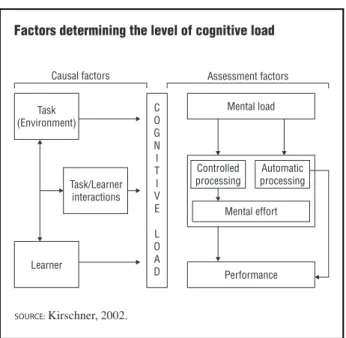
Both causal and assessment factors affect CL (Paas and Van Merrie¨nboer, 1994a; see figure 1). Causal fac-tors can be characteristics of the subject (e.g., cognitive abilities such as expertise), the task (e.g., task complex-ity), the environment (e.g., noise), and their mutual relations. Assessment factors include mental load, mental effort, and performance as the three measurable dimen-sions of CL. Mental load is the portion of CL that is imposed exclusively by the task and environmental demands. Mental effort refers to the cognitive capacity actually allocated to the task. The subject’s performance is a reflection of mental load, mental effort, and the aforementioned causal factors (Kirschner, 2002).
WM load is affected by the inherent nature of the instruction (intrinsic CL) and by the manner in which the instruction is presented (extraneous and germane CL). The following (Kirschner, 2002) is a short explica-tion of these three aspects of CL.
Intrinsic cognitive load is a direct function of perform-ing the task, in particular, of the number of elements that must be simultaneously processed in working memory
(element interactivity). A task with many constituent skills (a high-complexity task) that must be coordinated yields a higher intrinsic load than a task with less constituent skills (a low-complexity task) that need to be coordinated. Cerpa, Chandler, and Sweller (1995) give the following example. Learning basic operations on cells in a spreadsheet pro-gram, such as selecting a cell or group of cells, entering data into a cell or modifying data already in a cell are low-complexity tasks with low element interactivity. Each oper-ation can be learned independently with minimal reference to any other operations. By contrast, creating formulas requires learning that cells are intersections of rows and columns, identifying and manipulating them, learning that formulas consist of a number of cells and operations/oper-ators (i.e., equals/=, add/+, subtract/-), all of which must be learned and understood in conjunction with each other.
Extraneous cognitive load is the extra load beyond the intrinsic CL, mainly resulting from poorly designed instruction. For instance, if learners must search in their instructional materials for the information they need to perform a learning task (e.g., searching for data needed in a cell somewhere else in the spreadsheet or determining what the value of a variable in a cell might be while the task is to learn how to use a spreadsheet), this search process itself does not directly contribute to learning and thus causes extraneous CL.
Germane cognitive load is related to processes that directly contribute to learning, in particular to schema con-struction and rule automation. For instance, consciously
Task (Environment) Learner Task/Learner interactions C O G N I T I V E L O A D Mental load Controlled processing Automatic processing Mental effort Performance Causal factors Assessment factors
Factors determining the level of cognitive load
SOURCE: Kirschner, 2002.
Figure 1ILLUSTRATION BY GGS INFORMATION SERVICES. CENGAGE LEARNING, GALE.
connecting new information with what is already known, rather than focusing on task details (e.g., making explicit that the operator in a specific cell is very much like a different one already learned, but varies with respect to a specific characteristic), is a process that yields germane CL.
Intrinsic, extraneous, and germane CL are additive in that, if learning is to occur, the total load of the three together should not exceed the WM capacity. A basic assumption of CLT is that an instructional design that results in unused working memory capacity due to low extraneous CL because of appropriate instructional pro-cedures may be further improved by encouraging learners to engage in conscious cognitive processing directly rele-vant to learning, that is, germane CL (Paas & Van Merrie¨nboer, 1994b). Consequently, the greater the pro-portion of germane CL created by the instructional design, the greater the potential for learning.
According to CLT the limitations of working memory are rarely taken into account in conventional instruction. Conventional instructions tend to impose a high extrane-ous CL on WM, whereas learning something requires shifting from extraneous to germane CL.CLT states that the instructional interventions cannot change the intrinsic CL because this is ceteris paribusintrinsic to the material being dealt with. Extraneous and germane CL, however, are determined by the instructional design (Sweller, 1994). Appropriate instructional designs decrease extraneous CL but increase germane CL, provided that the total CL stays within the limits of WM capacity.
MEASURING COGNITIVE LOAD
Measuring CL can be done with several assessment techni-ques, subjective, physiological, and task- and performance-based (Paas, Tuovinen, Tabbers, & Van Gerven, 2003). Subjective techniques are based on the assumption that people are able to assess the amount of mental effort they expended. A frequently used measuring instrument in this category of techniques is the one-dimensional ninth-grade symmetrical category scale developed by Paas (1992), in which learners have to rate their perceived mental effort after completing a task on a 9-point rating scale ranging from ‘‘very, very low mental effort’’ to ‘‘very, very high mental effort.’’ Physiological techniques are based on changes in cognitive functioning that are reflected in phys-iological measurements like heart rate or eye activity. Task-and performance-based techniques consist of primary task measurements, which is the actual task performance, and of secondary task measurements, based on the performance of a second task, which is performed concurrently with the primary task. Some of these techniques have been com-bined to give a relative indication of the acceptable level of cognitive load. A good example of such a combination is
the instructional efficiency measurement developed by Paas and van Merrienboer (1993), which combines primary performance with the subjective mental effort rating scale developed by Paas to obtain information on the relative mental efficiency of instructional conditions.
EFFECTS GENERATED BY CLT
CLT research has led to the development of a number of instructional formats primarily meant to decrease extra-neous CL. These have enabled freed up WM capacity to be used for effective learning, and therefore studies have been conducted in which germane CL was increased when it was considered directly relevant to schema con-struction (Sweller, 1999). The basic assumption in these studies is that an instructional design that results in unused WM capacity because of a low intrinsic CL imposed by the instructional materials, and/or low extra-neous CL due to appropriate instructional procedures, may be further improved by encouraging learners to engage in conscious cognitive processing that is directly relevant to schema construction. Clearly, this approach can only work if the total CL of the instructional design (the combination of intrinsic CL, extraneous CL, and germane CL) is within working memory limits. This is the new frontier of instructional design.
An exhaustive overview of CLT-based instructional formats and their empirical base is given by Sweller, van Merrie¨nboer, and Paas (1998); Paas, Renkl, and Sweller (2003); and Van Merrie¨nboer and Sweller (2005). Six of the most researched instructional techniques are (a) the goal-free effect, (b) the worked examples effect, (c) the completion effect, (d) the split-attention effect, (e) the modality effect, and (f) the redundancy effect.
The goal-free effect occurs when a learner receiving a conventional, goal-specific problem learns less than when he or she receives a non-specific or goal-free problem to solve. Novice learners with a specific learning goal focus primarily on the goal and therefore pay no attention to other information. They compare the current state of a problem (i.e., where they are) to the goal state (i.e., where they want to get to, the solution), and the difference between them is divided up into a series of sub-goals that will have to be achieved to reach the goal, using their own limited repertoire of operators. This so called means-ends analysis approach (Newell & Simon, 1972) operates on the principle of trying to reduce differences between the goal state and problem givens, but it is a weak approach to problem solving, because it is an approach or strategy independent of a particular problem and causes a high extraneous CL. Consequently, it is detrimental to learn-ing. In goal-free problems, a problem solver has no other option than to focus on the information provided (the given data) and to use it where possible, automatically
inducing a forward-working solution path similar to that generated by expert problem solvers. Such forward-work-ing solutions impose very low levels of extraneous CL and facilitate learning.
The worked examples effect involves using known and resolved examples, which diminish extraneous CL and improve comprehension. A worked example consists of a problem and the steps to its solution. Reviewing worked examples eliminates the need to use means-end analysis because, since the solution is provided, it is no longer necessary to search for an operator to reduce the difference between the current state and the goal state. Presenting the problem solution allows the learner to focus on individual problem states, the problem solving moves associated with them, and the problem states resulting from these moves. Because this is the type of information contained in a problem-solving schema it was hypothesized that worked examples would help in schema acquisition and automa-tion as well as in reducing working memory load since they deconstruct a problem solution into its parts.
The completion effect has a similar rationale and effect as that of the worked examples. Instead of provid-ing a completely worked out example followed by a problem, the learner is provided with partially completed worked examples. Such examples provide enough guid-ance to reduce problem solving search and extraneous CL while problem completion ensures that learners are moti-vated to continue working.
The split-attention effect occurs when learners are forced to process and integrate multiple and separated sources of information. Many instructional materials make use of both a pictorial component and a textual component of information. Often, the pictorial component (i.e., a graphic) is presented with the associated text above, below, or at the side of it. This manner of presentation introduces a split-attention effect in which the learner must attend to both the graphic and the text, because neither alone pro-vides sufficient information for solving the problem. Learn-ing and understandLearn-ing can only occur after mental integration of the different sources of information. WM capacity needed for integrating the graphic information and the textual information is subsequently unavailable for processes that foster learning. Good instructional design incorporates (i.e., physically integrates) the graphical and textual information, thus reducing the need for the learner to do this and thus freeing up WM for learning. This is the traditional spatial split-attention effect. In addition, there is also a temporal split-attention effect that holds that learning from mutually referring information sources is facilitated if these sources are not separated from each other in time but, rather, are presented simultaneously.
The modality effect occurs when information is pre-sented in two different sensory modalities, for example
when textual information is presented in auditory form and diagrammatic information is presently visually. By making use of both auditory and visual channels, effec-tive WM capacity is increased. This expanded WM can be used to reduce mental workload and results in better learning than equivalent, single-mode presentations that only use visual information (Tabbers, Martens, & van Merrie¨nboer, 2004).
The redundancy effect holds that the multiple proc-essing of the same information that is presented more than once—such as when a presenter projects a slide and then reads it aloud to the audience—has a negative effect on comprehension since it increases extraneous CL. This effect sounds counter-intuitive because most people think that the presentation of the same information will have a neutral or even positive effect on learning. However, the presentation of redundant information causes learners to unnecessarily attend to individual bits of repeated infor-mation that can be understood in isolation. Also, learners must first process the information to determine whether the information from the different sources is actually redundant. These cognitively demanding processes do not contribute to meaningful learning.
EFFECTS OF CLT RESEARCH ON INSTRUCTIONAL DESIGN
In their book Van Merrie¨nboer and Kirschner (2007) dis-cuss how good instructional design can control CL and by doing so increase and/or facilitate learning. The CL asso-ciated with performing learning tasks is controlled in two ways. First, intrinsic CL is managed by organizing the learning tasks in easy-to-difficult task classes. For learning tasks within an easier task class, less elements and interac-tions between elements need to be processed simultane-ously in WM. As the task classes become more complex, the number of elements and interactions between the ele-ments increases. Second, extraneous CL is managed by providing a large amount of support and guidance for the first learning task(s) in a task class, thus preventing weak-method problem solving and its associated high extraneous CL. This support and guidance decreases as learners gain more expertise (‘‘scaffolding’’).
Because supportive information typically has high element interactivity, it is preferable not to present it to learners while they are working on the learning tasks. Simultaneously performing a task and studying the infor-mation would almost certainly cause cognitive overload. Instead, supportive information is best presented before learners start working on a learning task. In this way, a cognitive schema can be constructed in LTM that can subsequently be activated in WM during task perform-ance. Retrieving the already constructed cognitive schema is expected to be less cognitively demanding than Cognitive Load Theory
activating the externally presented complex information in working memory during task performance.
Procedural information consists of cognitive rules and typically has much lower element interactivity than supportive information. An example of procedural infor-mation is knowing that a voltmeter needs to be attached to a circuit in parallel while an ammeter must be attached in series. Furthermore, the development of cognitive rules requires that relevant information is active in WM during task performance so that it can be embedded in those rules. Studying this information beforehand has no added value; therefore, procedural information should be presented precisely when learners need it. This is, for example, the case when teachers give step-by-step instruc-tions to learners during practice, becoming in effect like an assistant looking over the learners’ shoulders.
Finally, part-task practice automates particular recur-rent aspects of a complex skill. In general, an over-reliance on part-task practice is not helpful for complex learning. But the automated recurrent constituent skills may decrease the CL associated with performing the whole learning tasks, making performance of the whole skill more fluid and decreasing the chance of making errors due to cognitive overload.
S E E A L S OConstructivism; Information Processing Theory.
B I B L I O G R A P H Y
Baddeley, A. D. (1992). Working memory.Science, 255,556–559. Bower, G. H. (1975). Cognitive psychology: an introduction. In
W. K. Estes (Ed.),Handbook of learning and cognitive processes: Vol. 1, Introduction to concepts and issues.Hillsdale, NJ: Erlbaum.
Cerpa, N., Chandler, P., & Sweller, J. (1995).Some consequences of training strategies when learning a computer application. Paper presented at the 1995 Australian Association for Research in Education conference, Hobart, Australia. Retrieved April 15, 2008, from http://www.aare.edu.au/ 95pap/cerpn95385.txt.
Cowan, N. (2000). The magical number 4 in short-term memory: A reconsideration of mental storage capacity. Behavioral and Brain Sciences, 24,87–114.
Fletcher, S. (1997a).Designing competence-based training(2nd ed.). London: Kogan Page.
Fletcher S. (1997b).Analysing competence: Tools and techniques for analysing jobs, roles and functions.London: Kogan Page. Kirschner, P. A. (2002). Cognitive load theory: Implications of
cognitive load theory on the design of learning.Learning and Instruction, 12(1), 1–10.
Kirschner, P. A., van Vilsteren, P., Hummel, H., & Wigman, M. (1997). A study environment for acquiring academic and professional competence.Studies of Higher Education, 2(22), 151–171.
Miller, G. A. (1956). The magical number seven,two: Some limits on our capacity for processing information.
Psychological Review, 63,81–97.
Newell, A., & Simon, H. (1972).Human problem solving. Englewood Cliffs, NJ: Prentice-Hall.
Paas, F. (1992). Training strategies for attaining transfer of problem-solving skill in statistics: A Cognitive-load approach. Journal of Educational Psychology, 84,429–434.
Paas, F., & van Merrie¨nboer, J. (1993). The efficiency of instructional conditions: An approach to combine mental-effort and performance measures.Human Factors, 35,737–743. Paas, F., & van Merrie¨nboer, J. (1994a). Instructional control of
cognitive load in the training of complex cognitive tasks. Educational Psychology Review, 6,51–71.
Paas, F., & van Merrie¨nboer, J. (1994b). Variability of worked examples and transfer of geometrical problem-solving skills: A cognitive-load approach.Journal of Educational Psychology 86, 122–133.
Paas, F., Renkl, A., & Sweller, J. (2003). Cognitive load theory and instructional design: Recent developments.Educational Psychologist, 38,1–4.
Paas, F., Tuovinen, J., Tabbers, H., & van Gerven, P. (2003). Cognitive load measurement as a means to advance cognitive load theory.Educational Psychologist, 38,63–71.
Sweller, J. (1994). Cognitive load theory, learning difficulty and instructional design.Learning and Instruction, 4,295–312. Sweller, J. (1999).From cognitive architecture to instructional
design.Paper presented at the inaugural seminar of Professor J. G. van Merrie¨nboer, Heerlen, The Netherlands.
Sweller, J. (2002). Visualisation and instructional design. Paper presented at the International Workshop on Dynamic Visualisations and Learning. Knowledge Media Research Center, Tu¨bingen, Germany. Retrieved April 15, 2008, from http://www.iwm-kmrc.de/workshops/visualization/
sweller.pdf.
Sweller, J., van Merrie¨nboer, J., & Paas, F. (1998). Cognitive architecture and instructional design.Educational Psychology Review, 10(3), 251–296.
Van Merrie¨nboer, J., & Kirschner, P. A. (2007).Ten steps to complex learning.New York: Taylor and Francis.
Van Merrie¨nboer, J., & Sweller, J. (2005). Cognitive load theory and complex learning: recent developments and future directions.Educational Psychology Review, 17,147–177.
Paul A. Kirschner Femke Kirschner Fred Paas
COGNITIVE STRATEGIES
A cognitive strategy is a mental process or procedure for accomplishing a particular cognitive goal. For example, if students’ goals are to write good essays, their cognitive strategies might include brainstorming and completing an outline. The cognitive strategies that students use influence how they will perform in school, as well as what they will accomplish outside of school. Researchers have found that effective learners and thinkers use more effective strategies for reading, writing, problem solving, and reasoning than ineffective learners and thinkers.